The new application of the firm’s security tools includes data analysis of generative AI inputs and such real-time user engagement elements as policy and risk coaching on the use of ChatGPT. It not only keeps an eye on the data that users feed to generative AI models or to other large language models such as Google Bard and Jasper, it can also block those inputs if they include sensitive data or code.
The new suite of capabilities is aimed at making sure employees at organizations, whether on premise or remote, are using ChatGPT and other generative AI applications in a way that doesn’t compromise enterprise data, according to the firm.
Netskope said its data showed that:
Roughly 10% of enterprise organizations are actively blocking ChatGPT use by teams.
One percent of enterprise employees actively use ChatGPT daily.
Each user submits, on average, eight ChatGPT prompts per day.
ChatGPT usage is growing 25% monthly in enterprises.
Based on research by data security firm Cyberhaven, at least 10.8% of company employees have tried using ChatGPT in the workplace, and 11% of data that employees upload to ChatGPT is confidential.
Jump to:
Zero-trust approach to protecting data fed to AI
Managing access to LLMs isn’t a binary problem
Real-time user engagement: popup coaching, warnings and alerts
Zero-trust approach to protecting data fed to AI
Robinson said Netskope’s solution applied to generative AI includes its Security Service Edge with Cloud XD, the company’s zero-trust engine for data and threat protection around apps, cloud services and web traffic, which also enables adaptive policy controls.
“With deep analysis of traffic, not just at the domain level, we can see when the user is requesting a login, or uploading and downloading data. Because of that, you get deep visibility; you can set up actions and safely enable services for users,” he said.
According to Netskope, its generative AI access control and visibility features include:
IT access to specific ChatGPT usage and trends within the organization via the industry’s broadest discovery of software as a service (using a dynamic database of 60,000+ applications) and advanced analytics dashboards.
The company’s Cloud Confidence Index, which classifies new generative AI applications and evaluates their risks.
Granular context and instance awareness via the company’s Cloud XDTM analytics, which discerns access levels and data flows through application accounts.
Visibility through a web category for generative AI domains, by which IT teams can configure access control and real-time protection policies and manage traffic.
Managing access to LLMs isn’t a binary problem
As part of its Intelligent Security Service Edge platform, Netskope capabilities reflect a growing awareness in the cybersecurity community that access to these new AI tools is not a “use” or “don’t use” gateway.
“The main players, including our competitors, will all gravitate toward this,” said James Robinson, deputy chief information security officer at Netskope. “But it’s a granular problem because it’s not a binary world anymore: whether members of your staff, or other tech or business teams, people will use ChatGPT or other tools, so they need access, or they will find ways, for good or bad,” he said.
“But I think most people are still in the binary mode of thinking,” he added, noting that there is a tendency to reach for firewalls as the tool of choice to manage osmosis of data into and out of an organization. “As security leaders, we should not just say ‘yes’ or ‘no.’ Rather, we should focus more on ‘know’ because this is a granular problem. To do that, you need a comprehensive program.”
SEE:Companies are spending more on AI, cybersecurity (TechRepublic)
Real-time user engagement: popup coaching, warnings and alerts
Robinson said the user experience includes a real-time “visual coaching” message popup to warn users about data security policies and the potential exposure of sensitive data.
“In this case, you will see a popup window if you are beginning to log in to a generative AI model that might, for example, remind you of policies around use of these tools, just when you are going onto the website,” said Robinson. He said the Netskope platform would also use a DLP engine to block uploads to the LLM of sensitive information, such as personally identifiable information, credentials, financials or other information based on data policy (Figure A).
Figure A
Netskope popup window warns user of LLM that the data they will not be allowed to upload sensitive data. Image: Netskope
“This could include code, if they are trying to use AI to do a code review,” added Robinson who explained that Cloud XD is applied here as well.
SEE:Salesforce puts generative AI into Tableau (TechRepublic)
The platform’s interactive feature includes queries that ask users to clarify their use of AI if they take an action that is against policy or is contrary to the system’s recommendations. Robinson said this helps security teams evolve their data policies around the use of chatbots.
“As a security team I’m not able to go to every business user and ask why they are uploading certain data, but if I can bring this intelligence back, I might discern that we need to change or alter our policy engine,” he said.
Subscribe to the Innovation Insider Newsletter
Catch up on the latest tech innovations that are changing the world, including IoT, 5G, the latest about phones, security, smart cities, AI, robotics, and more.
In the past, artists embedded QR codes within paintings, today we’re embedding images within QR codes! Users are linking their social media accounts, or their work not with boring scanners that work just fine, but beautiful images that also serve as a teaser of their work.
These beautiful QR codes are just the beginning of a bigger trend because it is not limited to the few who know how to use the software. It isn’t new information that we can embed images into QR codes and make beautiful artwork out of them, but AI just made it ridiculously easy to do so. With a functional QR code and a link, just go on to Hugging Face that released the first open source free QR code AI art generator.
How the trend began and how it works
Earlier this month, a Reddit user posted the first images of the AI generated QR art prompting others to respond with the resounding “How?” in the comments. Later, this was made available to everyone when Radamés Ajna, an engineer working with Hugging Face, announced that this process is available for all to experiment with.
The Reddit user had employed ControlNet, an additional extension to an already amazing Stable Diffusion. ControlNet gives the user the liberty to tailor their creations to imitate a chosen reference photo or even random objects from it. This works well for txt2img and img2img of Stable Diffusion, and has a range of models working in different ways. For example, one model on ControlNet draws a sketch of a reference picture to match the depth of another reference picture, while another model tries to recreate the colour, facial features from a different image and put them all together in the final image.
This complex layer over the text-to-image model of Stable diffusion can be accessed by downloading an extension. The internet is flooded with elaborate artwork done on mundane QR codes – all completely functional.
Though all of this is very impressive, it’s the efficient error correction rate of QR code which makes all of this possible. Even with a 30% distortion or damage, the code is still functional which makes it perfect to play around with.
Massive potential for creativity
QR codes, a sister of the bar codes, began gaining traction around 2011. Originally from Japan it was initially used to keep track of automobile parts in the assembly line. It worked its way into smartphones becoming indispensable in everyday use. Today, we use it to order food, to pay for it, to ensure the authenticity of vaccination certificates and, most strangely, even to pay respects to the dead.
The artwork isn’t ending with just images, users have found a way to make the experience 3D using the 8th Wall offering that doesn’t require a separate plugin or app. You already have multiple softwares that allow you to do the same thing like SparkAR and Unity3D. The democratisation of the technology is going to be evident in the coming months where people would do a double take at the QR code while scanning them.
We used a very specific prompt on Hugging Face (cumulus clouds on a sunny day over green pastures with cows) to link a previous article on QR codes.
The ubiquitous use of these QR codes can now be personalised and designed are brilliantly functional and beautiful pieces of art.
The post You’ll Never Have to See Another Boring QR Code Again! appeared first on Analytics India Magazine.
Microsoft is ready to build its quantum supercomputer. In the virtual event, Azure Quantum: Accelerating Scientific Discovery, Satya Nadella said the company’s goal is to make the discovery quicker. For this, the company has announced its roadmap for building one using the topological qubits, which the company has been working on for some years now.
Krysta Svore, Microsoft’s VP of advanced quantum development, told TechCrunch that even though there are a lot of milestones ahead, it will take less than a decade for the company to build its quantum supercomputer, which would be able to perform one million quantum operations per second.
Moreover, the company has also announced Azure Quantum Elements, for accelerating scientific discovery using AI and quantum on high-performance computing. This also includes a Copilot for Azure Quantum that will allow researchers to generate quantum simulations, calculations, querying and visualising data for better answers in natural language.
Last year, Microsoft made a major breakthrough in quantum computing. Researchers developed a new type of Majorana-based qubit, which is a fundamental component of quantum supercomputers. These qubits are more stable and easier to scale up resulting in the need for fewer of them.
Microsoft took an early initiative in this technology and has now published a new research paper, reviewed by peers in the American Physical Society’s Physical Review B. This paper confirms that Microsoft has successfully reached its initial goal on the path towards building a quantum supercomputer. However, the time it took for the company to reach just the first milestone presents questions on the 10-year roadmap with noise physical qubits.
The next step for the company is to build hardware-protected qubits to make it more resilient. These qubits are expected to be less than 10 microns on a side and able to perform one qubit operation in less than a microsecond. Then the next step for the company is to scale these smaller qubits into a supercomputer.
For ensuring a quantum-safe future, Microsoft is proactively speaking with customers and inviting participants to contribute to support the transition.
The post Microsoft Shares its Roadmap for Quantum, Releases Copilot for Azure Quantum appeared first on Analytics India Magazine.
Organizations can expect to spend almost $10,000 per employee on software as a service in 2023, according to a new study by SaaS management company Productiv. The year-over-year review from 2021 to 2023 surveyed 100 million SaaS licenses using Productiv’s own services, primarily within the United States.
Jump to:
Which SaaS apps do organizations use the most?
SaaS spending rises even as governance improves
Some SaaS hides in the shadows
Organizations slowly cut down on unused apps
ChatGPT makes waves among shadow SaaS
Changes in SaaS spending: Contract lengths shorten
Which SaaS apps do organizations use the most?
The average department now uses an average of 87 SaaS apps, a growth of 27% between 2022 and 2023. The five most popular SaaS apps overall are:
Lucidchart
LinkedIn
Salesforce
Atlassian Cloud
DocuSign
This list has remained mostly the same since 2021, with the five apps listed above swapping places but remaining in the top five. Zendesk is another popular app among customer success teams, while Figma appears in the top five for engineering teams.
Engineering teams tend to use the most SaaS apps, with an average of 108 apps. The IT and security teams saw the most growth in SaaS app usage between 2022 and 2023, with an increase of 33% mostly in point solution and ROI tools.
SEE: Discover how software as a service impacts your business.
SaaS spending rises even as governance improves
SaaS adoption continues to rise gradually. The average SaaS portfolio grew by 32% over the past two years.
When broken down by the size of the organization, the data shows that:
Small and medium-sized business SaaS portfolios grew by 5%.
Mid-market portfolios increased by 41%.
Enterprise portfolios increased by 49%.
“Our data demonstrate the path to immediate action for CFOs is to better identify and consolidate SaaS apps, given the cost reduction pressures currently facing every company,” said Jody Shapiro, chief executive officer and co-founder of Productiv, in a press release. “Buying and renewing software never stops, but the best procurement practices require collaborative decisions using data across IT, procurement, finance and functional leadership on what software to purchase, renew, downsize and consolidate.”
SEE: Download this customizable software procurement policy from TechRepublic Premium
Some SaaS hides in the shadows
Shadow SaaS are apps purchased and used by employees outside of the approval and knowledge of the IT team. IT may not know how much these apps cost, how they are used or to what extent they are used.
The most common shadow SaaS apps are Evernote, Coursera and Canva.
The amount of shadow SaaS in organizations decreased between 2022 and 2023, showing that organizations have become more aware of the bloat and more effectively took governance actions to reduce sprawl. However, shadow SaaS may still account for more than half (51%) of the applications in the average SaaS portfolio.
Productiv detected shadow SaaS apps using Google Social Login and employee expense reports.
Organizations slowly cut down on unused apps
Another area in which organizations can improve efficiency in terms of what SaaS they use is reducing unused apps. Of the surveyed organizations, 53% of SaaS licenses went unused. License usage increased slightly (2%) from 2022 to 2023. Companies using more apps per category and increasing license usage at the same time suggest organizations are improving their rationalization and consolidation efforts, Productiv said.
The apps with the lowest percentage of license usage are Greenhouse, Asana and Jira. Productiv noted that no one type of app dominated the list of unused licenses.
ChatGPT makes waves among shadow SaaS
The trendy AI app ChatGPT could count as shadow SaaS if employees use the free or subscriber tiers without IT being involved.
“Given our report reveals widespread shadow use of ChatGPT, it’s time for companies to figure out how to foster innovation using ChatGPT without security risks,” said Aashish Chandarana, chief information officer of Productiv, in a press release.
In the cases Productiv found, employees most often use ChatGPT for writing emails and marketing content, summarizing meeting notes, researching issues, writing code and finding coding bugs. The marketing, engineering and product departments use ChatGPT the most.
Changes in SaaS spending: Contract lengths shorten
As more companies move to remote work, many find that shorter (one-year) contracts are preferable because they allow for more flexibility. Reducing contract lifetime is also a way for organizations to reduce overhead costs.
One-year contracts accounted for 79% of all contracts in 2020 and 85% of all contracts in 2022. Three-year and longer contracts declined the most year-over-year.
In 2023, SaaS spend per employee averaged $9,643, a decrease from the previous year. Large businesses spent an average of $7,492 per employee in 2022, while medium-sized businesses spent $10,045 and small and medium-sized businesses spent $11,196. The large businesses spent less because they received volume discounts and enterprise-wide licensing agreements, as well as better efficiency of scale with consumption-based apps, Productiv said.
“To avoid shadow IT, organizations need to develop appropriate SaaS governance policies that help teams take their free and purchased apps out of the shadows and ensure the right level of corporate policies for procurement, security and compliance,” Chandarana said.
SEE: Download this customizable shadow IT policy from TechRepublic Premium
When it comes to consolidating SaaS, organizations should be sure that the IT, finance and procurement teams are working from the same data to prevent shadow SaaS from creeping in, Chandarana said.
“Having a granular understanding of what software you own, how it is being used down to the team and feature level will enable you to make smart decisions that drive value from your software stack and make a meaningful contribution to productivity, financial efficiency and business growth,” he said.
Subscribe to the Executive Briefing Newsletter
Discover the secrets to IT leadership success with these tips on project management, budgets, and dealing with day-to-day challenges.
According to the Information, Google has lodged a complaint against longtime rival Microsoft, accusing the tech giant of engaging in anti-competitive behaviour in the cloud-computing market. The complaint was conveyed through a letter addressed to the Federal Trade Commission (FTC), which had sought public input on potential anti-competitive acts within the cloud industry.
Google’s allegations centre around Microsoft’s utilisation of unfair licensing terms to effectively “lock in clients” and exert control over the market. This is after Europe’s antitrust authority probing Microsoft’s licence agreement for discouraging rival cloud usage.
According to Google, Microsoft’s dominant products, Windows Server and Microsoft Office, make it challenging for businesses to utilise anything other than Microsoft’s Azure cloud infrastructure offering. The search giant argues that Microsoft’s licensing restrictions create a complex web that hinders enterprises from diversifying their software vendors.
In its letter to the FTC, Google additionally raised concerns about Oracle’s practices, claiming that the company’s overly complex agreements aim to lock in clients and limit choice, thereby increasing costs and disrupting digital ecosystems.
Moreover, NetChoice made a public comment on aiming at Microsoft and Oracle. “Despite vibrant competition in the cloud industry, a few vendors use anticompetitive practices in order to entrench their position, most often by preventing customers from switching providers in search of lower costs, stronger service offerings, and more innovative solutions for their businesses,” said NetChoice.
Google contends that such control poses significant risks in terms of national security and cybersecurity, citing previous cyberattacks involving Microsoft products, including the SolarWinds breach. Both Google and Microsoft maintain active cybersecurity practices aimed at addressing and researching cyber threats.
This is not the first time Google has faced antitrust concerns. In January, the U.S. Department of Justice filed its second antitrust lawsuit against Google within a span of two years, focusing on its advertising business. A separate lawsuit initiated by multiple state attorneys general, led by Texas Attorney General Ken Paxton, also targets Google’s advertising practices.
This latest clash between Google and Microsoft brings to mind Microsoft’s involvement in a landmark antitrust case in the 1990s. The company was accused of exploiting its dominance in desktop software to favour its own internet browser, stifling competition from other players like Netscape. Ultimately, the government succeeded in the case, compelling Microsoft to allow PC manufacturers to install alternative browsers alongside its own.
The post Google Accuses Microsoft of Anti-Competitive Cloud Practices appeared first on Analytics India Magazine.
Lenovo unveiled on June 14, 2023, the next phase of its artificial intelligence strategy and new additions to its portfolio of products. The company also announced an annual record in AI infrastructure revenue of more than $2 billion. Moving forward, Lenovo will be investing an additional $1 billion in the next three years to accelerate AI deployment for businesses worldwide.
The new Lenovo AI portfolio includes AI-ready solutions, more than 70 AI-optimized upgraded edge-to-cloud server platforms, the new ThinkEdge SE360 V2 edge server, ThinkEdge SE350 V2 edge server, ThinkSystem SR675 V3 server for data centers and AI updates to the Lenovo ThinkPad commercial laptops.
TechRepublic spoke to Robert Daigle, senior manager of Lenovo ISG Global AI Business, about what the new Lenovo products are, how they can impact businesses and what decision-makers can expect from the brand.
“Lenovo is committed to being the most trusted partner and empowering our customers’ intelligent transformation by simplifying AI deployment through a one-stop shop that helps customers of all sizes and across all industries easily deploy AI with confidence,” Daigle said.
Jump to:
Lenovo’s new AI solutions, discover and infrastructure initiatives
New Lenovo edge and data servers and smart devices
Lenovo AI Discover Center of Excellence
What type of businesses should be looking into Lenovo’s AI technology?
Lenovo’s new AI solutions, discover and infrastructure initiatives
Despite companies investing in AI for the past decade or more, 2023 has been the year of artificial intelligence. Daigle explains that data proliferation grows exponentially, and AI drives new business opportunities everywhere. “However, deploying AI is still a complex journey for many business leaders, with significant challenges on the (areas of) solutions evaluation, architecture and scalability,” Daigle explained.
Lenovo’s new AI strategy, software, hardware and programs are designed to respond to business needs for artificial intelligence with a portfolio of smart devices and edge-to-cloud infrastructure.
“By providing more flexibility, reliability and efficiency, we are helping businesses worldwide implement generative AI, immersive metaverse simulations and cognitive decisions at scale,” Daigle said.
The company is investing in three fronts: AI Innovation Solutions, AI Infrastructure and the new Lenovo AI Discover Center of Excellence. This article primarily focuses on Lenovo’s AI Infrastructure strategy.
AI Infrastructure
Under AI Infrastructure, Lenovo detailed in a press release more than 70 AI-optimized upgraded solutions that range from smart devices to edge-to-cloud infrastructure platforms.
“New options for edge servers will allow more AI deployment and experimentations with distributed hybrid compute infrastructures; this, in turn, means better results and ROI for customers while also leveraging better reliability, security and manageability,” Daigle said.
The new AI-enhanced Lenovo portfolio is listed in the table below.
ThinkSystem Servers
Rack Server Inference
SR645, SR645 V3 AMD
SR630 V2, SR630 V3 Intel
SR650 V2, SR650 V3 Intel
SR655 V3 AMD
SR665 V3 AMD
Rack Server ML 4-socket
SR850 V2, SR850 V3 Intel
SR860 V2, SR860 V3 Intel
Rack Server 2-Socket
SR650 V2, SR650 V3 Intel
SR655, SR655 V3 AMD
SR665, SR665 V3 AMD
DL Training
SR670 V2 4x PCIe NVLink Bridge Intel
SR670 V2 8x PCIe NVLink Bridge Intel
SR670 V2 4-GPU HGX Intel
NEW SR675 V3 4x PCIe NVLink Bridge AMD
NEW SR675 V3 8x PCIe NVLink Bridge AMD
NEW SR675 V3 4-GPU HGX AMD
DL Liquid Cooled Training
SD650-N V2 Intel
SD650-I V3 Intel
SD665-N V3 AMDS
ThinkEdge, ThinkStation, ThinkAgile
ThinkEdge Clients
SE10, SE10-I
M90
SE30
SE50
ThinkEdge Edge Server
SE350
NEW SE350 V2
NEW SE360 V2
SE450
ThinkEdge AI
Appliance
SE70
SE70 AWS
Panorama
Data Science & Edge Workstations
ThinkStation Edge Workstations
P3 Ultra (RTX Ready)
P3 Tiny
ThinkStation Desktop Workstations
PX
P7
P620
P5
P3 Tower
ThinkPad Mobile Workstations
P16 Gen1 / Gen2
P16vi Gen1
P1 Gen5 / Gen6
ThinkAgile MX Systems (Microsoft)
MX3330-F, MX3330-H
MX3331-F, MX3331-H
MX3530-F, MX3530-H
MX3531-F, MX3531-H
ThinkAgile VX Systems (VMware)
VX3331
VX3530-G
VX7531
ThinkAgile HX Systems (Nutanix)
HX1330
HX1331
HX2330
HX2331
HX3330
HX3331
HX5530
HX5531
HX7530
HX7531
New Lenovo edge and data servers and smart devices
Lenovo ThinkEdge SE360 V2 Edge Server
The Lenovo ThinkEdge SE360 V2 is the latest purpose-built edge server that delivers more power to enable AI solutions ranging from computer vision, voice AI and generative AI (Figure A).
Figure A
Lenovo’s new ThinkEdge SE360 V2 Edge Server. Image: Lenovo
The new server provides extended accelerated computing that supports Intel Data Center GPU Flex Series, the NVIDIA AI platform, including NVIDIA L4 Tensor Core GPUs and NVIDIA AI Enterprise software and Qualcomm Cloud AI 100 platforms to enable intense workloads at the source of data creation.
The ThinkEdge SE360 V2 delivers the highest GPU density in the smallest form factor available. Lenovo assures it’s at least twice as quiet as the competition.
“We listened to customer feedback, and a few factors important to them when deploying AI at the edge, including cost, temperature range, environmental factors, noise level accelerator optionality and performance, and, of course, security and reliability,” Daigle explained.
Lenovo ThinkEdge SE350 V2 Edge Server
The ThinkEdge SE350 V2 Edge Server for hybrid cloud and modern HCI deployments doubles storage capacity and leverages Intel Xeon D processors. These processors are in place to enable customers to run AI while quickly consolidating workloads, data backing up data, collaborating and delivering content in the smallest form factor.
Daigle added that, when designing the SE350 V2, the company expanded more cost-optimized drive options, which is a significant cost factor for servers (Figure B).
“When designing the SE350 V2, we expanded more cost optimized drive options which is a significant cost factor for servers,” Daigle said.
Lenovo ThinkSystem SR675 V3
For the data center, Lenovo created the ThinkSystem SR675 V3. The company says it’s the most accelerated computing platform on the market.
The ThinkSystem SR675 V3 is purpose-built for AI with three server configurations in one. This includes supporting NVIDIA HGX 4-GPU systems, 4-DW PCle GPU, or 8-DW PCle GPU servers in a compact 3U footprint (Figure C).
Figure C
Lenovo ThinkSystem SR675 V3 front view. Image: Lenovo
“Some customers are deploying these systems near employees and customers in retail settings, making noise levels a concern,” Daigle said. “So, by going to larger fans and tuning the fan table, we can reduce the dB level and ensure the fans run at frequencies that are less noticeable.”
The modular design allows Lenovo to accommodate the highest power accelerators with the smallest footprint.
“We also fully support NVIDIA NVLink bridge in this platform to ‘bridge the gap’ between PCIe and HGX performance,” Daigle added.
Lenovo’s SR675 V3 for NVIDIA Omniverse Enterprise
Responding to the industrial metaverse and digital simulation trends, Lenovo announced it’s collaborating with NVIDIA on the latest NVIDIA OVX system. The system is designed for building and operating virtual worlds, delivering robust performance for NVIDIA Omniverse Enterprise workloads in the data center.
The ThinkSystem SR675 V3, based on the OVX architecture, features up to eight NVIDIA L40 GPUs to maximize performance and deliver advanced ray tracing with NVIDA RTX-accelerated graphics driven by AI. The tech will allow customers to unlock the potential of digital twins.
Additionally, the new Lenovo ThinkPad commercial laptops now include a new Lenovo View application. The app offers AI-enabled computer vision technology for enhanced video image quality and tools. To access immersive simulations, Lenovo offers augmented reality technology through its ThinkReality XR solutions. The new Lenovo ThinkPad laptop app and the ThinkReality XR solutions are technologies that companies can use with the industrial metaverse experiences of NVIDIA Omniverse.
Innovating AI solutions
Lenovo committed $100 million to its AI Innovators Program. The main goal of the program is for customers to be able to develop AI-ready solutions faster. The program added 15 new partners, totaling those participating to 45. Partners include Microsoft Azure, IBM, DeepBrain AI, VMware, alwaysAI, SAS, The Edge Company, V7 and StorMagic.
Lenovo and its partners under this program have developed more than 150 turnkey AI solutions that can be applied in finance, healthcare, manufacturing, retail and smart cities. Examples of AI ready-to-deploy solutions under the program include credit decision systems, fraud detection and threat intelligence, medical imaging and diagnosis, check-out automation, shopping recommendation, traffic control and smart policing.
“Through this program, we provide the expertise, evaluation, and guidance needed to take the guesswork out of AI implementation for each customer and environment,” Daigle said.
Lenovo AI Discover Center of Excellence
In addition, Lenovo announced its new AI Discover Center of Excellence, which will focus on accelerating AI adoption. The center will provide assessment workshops for generative AI, natural language processing and computer vision. It will also host the Responsible AI Committee, which is dedicated to establishing standards for responsible AI. Lenovo stressed the importance of responsible AI.
“We can assure our customers that the LLMs deployed by Lenovo meet privacy, security, ethical and legal concerns via approval of these models through the Lenovo Responsible AI Committee, which is one of the most forward-thinking approaches to guiding organizations when they develop and deploy AI technologies,” Daigle told TechRepublic.
The new Center of Excellence is made up of technical engineers, partners, data scientists and professional services consultants focused on helping Lenovo customers explore, deploy and scale AI applications.
Which businesses should be looking into Lenovo’s AI technology?
Lenovo wants to position itself as a leading partner that enables intelligent transformation by simplifying AI deployment. The company sees itself as a one-stop AI shop and believes its tech can be applied to businesses of all sizes and industries.
“Next-generation infrastructure technologies that deliver data center-like computing to the edge are critical to empowering AI for improved emergency response, public safety, accessibility, tourism and retail experiences,” Daigle explained.
Retail, food service and hospitality businesses are leveraging AI to reimagine front-end and back-end operations and enable improved customer service, mitigate waste and address shifts in the labor market.
“For example, Lenovo is partnering with DeepBrain AI to offer an end-to-end solution for generative AI virtual assistants that can be paired with powerful large language models to deliver 24/7 automated concierge service in hospitality and retail settings,” Daigle added.
Another example is Lenovo and Vistry.
“Quick service restaurants around the globe use computer vision to automate cook times and help predict supply quantities to prevent food waste, ensuring standards while helping improve customer retention and profitability,” Daigle said.
Daigle explained that innovative AI solutions from Lenovo and Guise AI help industrial customers reduce unplanned downtime with up to 14 days of advanced prediction. In manufacturing operations that seek digitalization to drive future growth and differentiation amidst economic disruptions, AI solutions are used to understand customer behavior and optimize processes with computer vision, predictive maintenance and anomaly detection on the production line.
As the world continues on an accelerated AI path, Lenovo doubles down on investments for the sector to help customers adopt and deploy disruptive technologies better and faster.
Subscribe to the Innovation Insider Newsletter
Catch up on the latest tech innovations that are changing the world, including IoT, 5G, the latest about phones, security, smart cities, AI, robotics, and more.
AI is an enabler and India wants to fully leverage the technology to tackle societal issues. Wadhwani AI, a non-profit AI lab set up by the Wadhwani brothers – Romesh and Sunil Wadhwani – is fully dedicated to tackling societal challenges in India with AI.
“We are probably the only non-profit in the world devoted exclusively to AI for social impact. We want to ride the digitisation and data creation wave to build robust AI solutions that will help people who typically don’t use technology; and that’s our mission,” Alpan Raval, chief scientist – AI/ML, Wadhwani AI, told AIM. “We work on developing AI solutions for underserved communities in the Global South. Our primary focus at the moment is underserved communities in India but our charter is broader than that.”
Established in 2018, and inaugurated by Prime Minister Narendra Modi, Wadhwani AI has developed a host of AI-powered solutions in multiple domains such as healthcare, agriculture, and education. Currently, we find ourselves at the cusp of generative AI and Wadhwani AI is also actively exploring the potential of this technology to drive social impact.
Generative AI for social impact
Raval reveals that since the launch of ChatGPT last year, they have seen a huge spike in interest from various government ministries and agencies for generative AI. “The health ministry and the agriculture ministry, they all want to know what this exciting new technology is and how we can leverage it for social impact.”
Wadhwani AI is continuously exploring the use of large language models (LLMs) or foundational models across the board. Even though GPT-4 is the most advanced LLM out there and is available through APIs, the institute isn’t using the models extensively. Instead, they are experimenting with Falcon, a fully open-source LLM developed by the Technology Innovation Institute (TII) in UAE. “There’s limitations to using GPT both from a cost perspective, as well as the data perspective. We have to be very careful about where the data goes. In most of our applications, we have to ensure that the data stays in India,” Raval said.
In most cases, Wadhwani AI is using its own language models and fine tuning them. Generative AI is part of its clinical decision support system. “We use large language models in order to extract knowledge from medical texts and use that to make decisions.”
The non-profit previously developed a disease surveillance system utilising language models. Now, a more advanced generative AI model has replaced it. This system scans local news sources, extracts relevant disease events, and reports them to a central cell in Delhi. Wadhwani AI is also exploring the use of generative AI to power Kisan Call Centres. “Our approach involves augmenting human expertise by utilising models that provide automated responses based on a knowledge base. We create these knowledge bases using current government reports and documents, and our speech interface enables a conversational AI system for seamless interactions,” he said.
Not only this, the institute is exploring the use of generative AI in many other areas. “We’re using generative AI to create eye images which the ophthalmologists cannot distinguish from real images. Generative AI is being used for projects like diabetic retinopathy detection to augment datasets and augment the best datasets for a pest management project. “We are also in talks with partners for developing financial inclusion tools that use language models, as well as automatic translation models,” Raval said.
Developing AI solutions for governments
The institute not only works closely with numerous governments, they also help establish AI centres of excellence within government organisations. “This has helped us tremendously in terms of getting access to datasets, getting the requisite permissions, and opening up deployment pathways because it builds trust. We have our own employees stationed within these government departments,” Raval explained.
The institute has developed an AI-powered tool for pest management for cotton farmers in India. Called CottonAce, and available through a mobile app, it helps farmers protect their crops by determining the right time to spray pesticides through immediate, localised advice. The app can work offline in remote areas as well and is available in nine languages — English, Hindi, Marathi, Gujarati, Telugu, Kannada, Tamil, Odia, and Punjabi, and is being used by more than 33,000 farmers across six states and over 140 talukas.
“We are in the process of generalising that to other pests and crops and so on. And we are also in a partnership with the Ministry of Agriculture & Farmers’ Welfare to be an integral part and develop solutions around agri stack.
Similarly, in healthcare, Wadhwani AI has been involved in multiple Ministry-led projects like maternal and child health, tuberculosis, and disease surveillance, among other things. For example, their AI-powered disease monitoring solution has already been deployed and is being used actively by the Government of India’s Media Scanning and Verification Cell. Since its launch in April 2022, it has evaluated 9 million health articles, 788 health events published and 115 outbreaks confirmed.
Furthermore, their Clinical Decision Support System has also been integrated with eSanjeevani 2.0. Since deployment from March 1 to April 15 2023, the AI generated smart differential diagnosis has enabled over 5 million Al-powered consultations. “Our ongoing anthropometry project involves developing an app that uses short videos of babies taken in rural home settings. The app accurately estimates the baby’s weight and other anthropometric metrics, achieving an impressive error margin of only 150 grams,” said Raval.
There were no pre-available datasets to build these tools. The institute collaborated with NGOs to collect ground-level data from hospitals and community settings. “Additionally, for certain projects like our TB solutions, we utilised government-collected longitudinal data on TB patients, tracking their journey from diagnosis to treatment completion. Given the number of TB patients in this country, the data set is huge and very informative.”
Recently, Wadhwani AI also ventured into education and is developing AI solutions in collaboration with UNICEF and the Gujarat government. “We are looking into AI for climate change. We are also interested in the use of AI in genomics and molecular biology, among other things,” Raval concluded.
The post This Indian AI Lab is Using Gen AI for Social Good appeared first on Analytics India Magazine.
Ever since ChatGPT surged in popularity in November, the AI chatbot space has become saturated with ChatGPT alternatives. These chatbots vary in LLMs, pricing, UIs, internet access, and more, making it difficult to decide which to use.
To make comparing them easier, the Large Model Systems Organization (LMYSY Org), an open research organization founded by students and faculty from the University of California, Berkeley, created the Chatbot Arena.
Also: Financial and legal professionals see the value in generative AI, according to a study
The Chatbot Arena is a benchmark platform for LLMs where users can put two randomized models to the test by inserting a prompt and selecting the best answer without knowing which LLM is behind either answer.
After users pick a chatbot, they get to see which LLMs were used to generate the output.
The results of the user ratings are used to rank the LLMs on a leaderboard based on an Elo rating system, a widely-used rating system in chess, according to LMSYS Org.
When trying the arena for myself, I used the prompt, "Can you write me an email telling my boss that I will be out because I am going on a vacation that was planned months ago."
The two responses were very different, with one providing much more context, length, and fill-in-the-blanks that would have been appropriate for the email.
After picking "Model B" as the winner, I found out it was the LLM created by LMSYS Org, based on Meta's LLaMA model, "vicuna-7b." The losing LLM was "gpt4all-13b-snoozy," an LLM developed by Nomic AI and finetuned from LLaMA 13B.
The leaderboards unsurprisingly currently place GPT-4, OpenAI's most advanced LLM, in first place with an Arena Elo rating of 1227. In second place with a rating of 1227 is Claude-v1, an LLM developed by Anthropic.
GPT-4 is found in both Bing Chat and ChatGPT Plus making both of those chatbots the best available right now, which aligns with ZDNET's own AI chatbot rankings.
Also: The AI voice-generating platform that shocked the world is getting an update to fight abuse
Anthropic's second-ranking Claude is not available to the public just yet, but it does have a waitlist available where users can sign up for early access.
Ranked number eight on the leaderboard is PaLM-Chat-Bison-001, a submodel of PaLM 2, the LLM behind Google Bard. This ranking parallels the general sentiment behind Bard, not the worst but not one of the best.
On the Chatbot Arena site, there is an option where you can select the two different models you want to compare. This feature could be helpful if you want to experiment with specific LLMs.
Tesla and its dream for autonomous robots is still in works. The company has announced that it is building a foundation model for autonomous agentic robots. The company already has multimodal neural networks in vehicles that take inputs from maps, cameras, and GPS.
And will be trained on enormous amounts of compute pic.twitter.com/BsmG9Vse6I
— Tesla AI (@Tesla_AI) June 21, 2023
Next month onwards, the company will start the production of Dojo supercomputer for training this foundation model in order to enable large amounts of computation. According to the graph shared by Tesla, the GPU clusters built by the company will be ten times bigger and the production rate will be close to, if not higher than NVIDIA. By October 2024, the company expected to produce 100 Exa-flops of compute.
Tesla is now able to reconstruct the entire scene with just multiple videos from the location shot during trips. This enables Tesla vehicles to take steps to avoid collisions by occupancy prediction. To combine this with auto-labelling capabilities of full-self drive of Tesla, the heavy compute capabilities is a necessity for the company.
Moreover, the company is also building generative modelling techniques for predicting possible future outcomes based on past observations. This is done by linking multiple cameras across the body of the car. Tesla says that these foundation models that are generating the world would be used for both its cars and Optimus robots.
Though there’s uncertainty over whether Tesla would sell its chips or keep them for itself, these could be one of the biggest revenue generators for the company, as we can clearly see how NVIDIA is rising in the AI world. And Tesla is clearly not a car company anymore.
The post Tesla to Contend NVIDIA with Dojo appeared first on Analytics India Magazine.
Kibsi raises $9.3M for its no-code computer vision platform Frederic Lardinois @fredericl / 11 hours
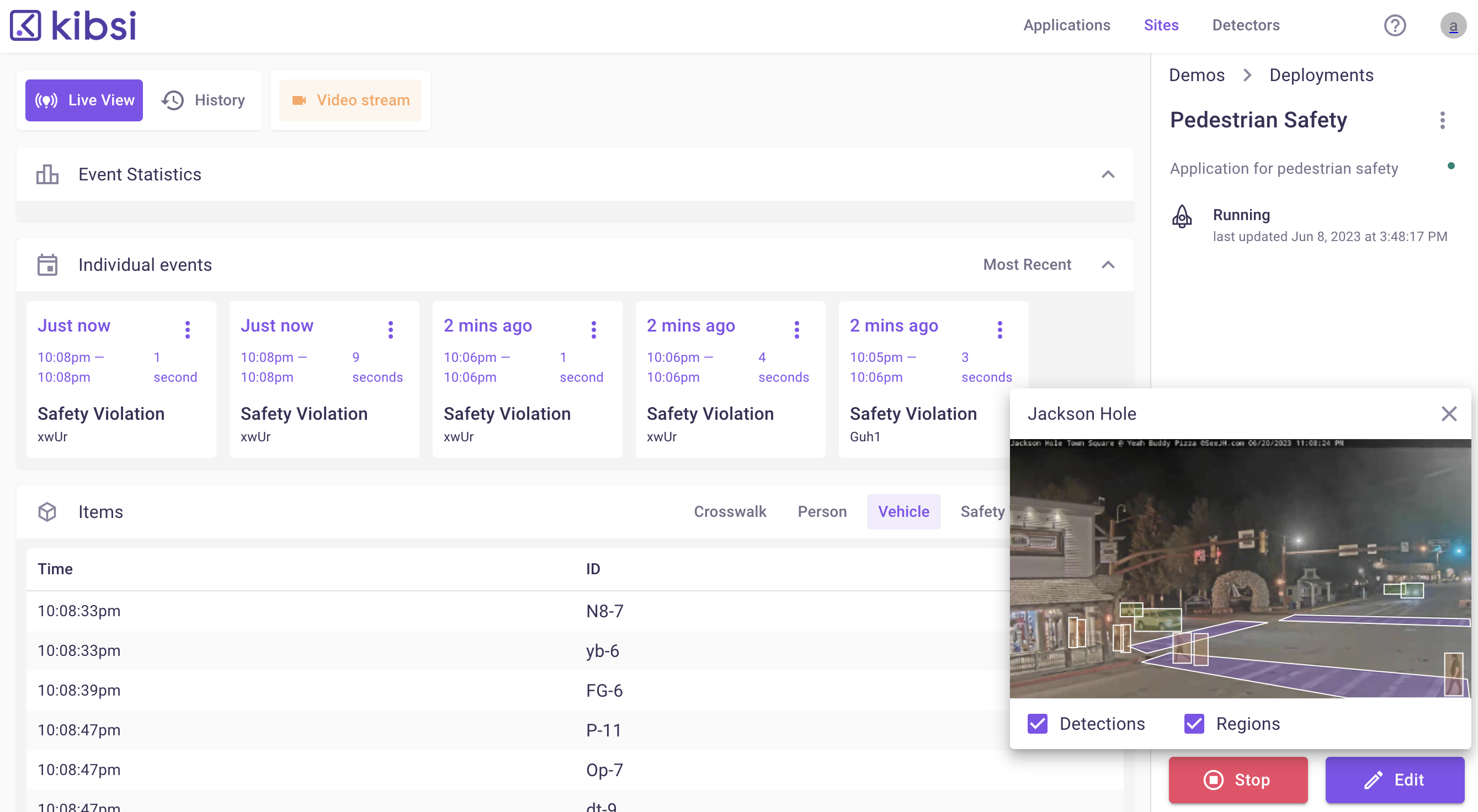
Kibsi is an Irvine, California-based startup that is building a no-code computer vision platform that allows businesses to build and deploy computer vision applications. Among the things that set Kibsi apart from many other players in this space is that it lets businesses reuse their existing cameras to create insights into virtually anything they want to track, be that in a warehouse, restaurant or on an airport ramp.
The company today announced that it has raised a total of $9.3 million in pre-seed and seed funding. The participants in these rounds were GTMfund, NTTVC (which led the $4 million pre-seed round), Preface Ventures, Ridge Ventures, Secure Octane, and Wipro Ventures.
Image Credits: Kibsi
Tolga Tarhan, who is now Kibsi’s CEO, joined Rackspace in 2019 after the founding team sold AWS-focused consulting business Onica to Rackspace. He later became the company’s CTO. After the Rackspace IPO, he decided that his journey in the company had come full circle. Together with co-founders and former Onica execs Amanda McQueen, Amir Kashani and Eric Miller, the team looked at what they could build next.
“I wanted to go get out and go create again,” Tarhan told me. “We wanted something that had an IoT orientation to it — because we’ve done a lot of IoT at Onica, was a big part of our business. We wanted it to be software — we had done enough consulting for multiple lifetimes. And we wanted it to be something involving AI, because we thought IoT by itself was almost old news. How do we combine these things? And as we thought about that space and our experience and where we got into roadblocks with customers, we realized that many customers are having trouble implementing computer vision.”
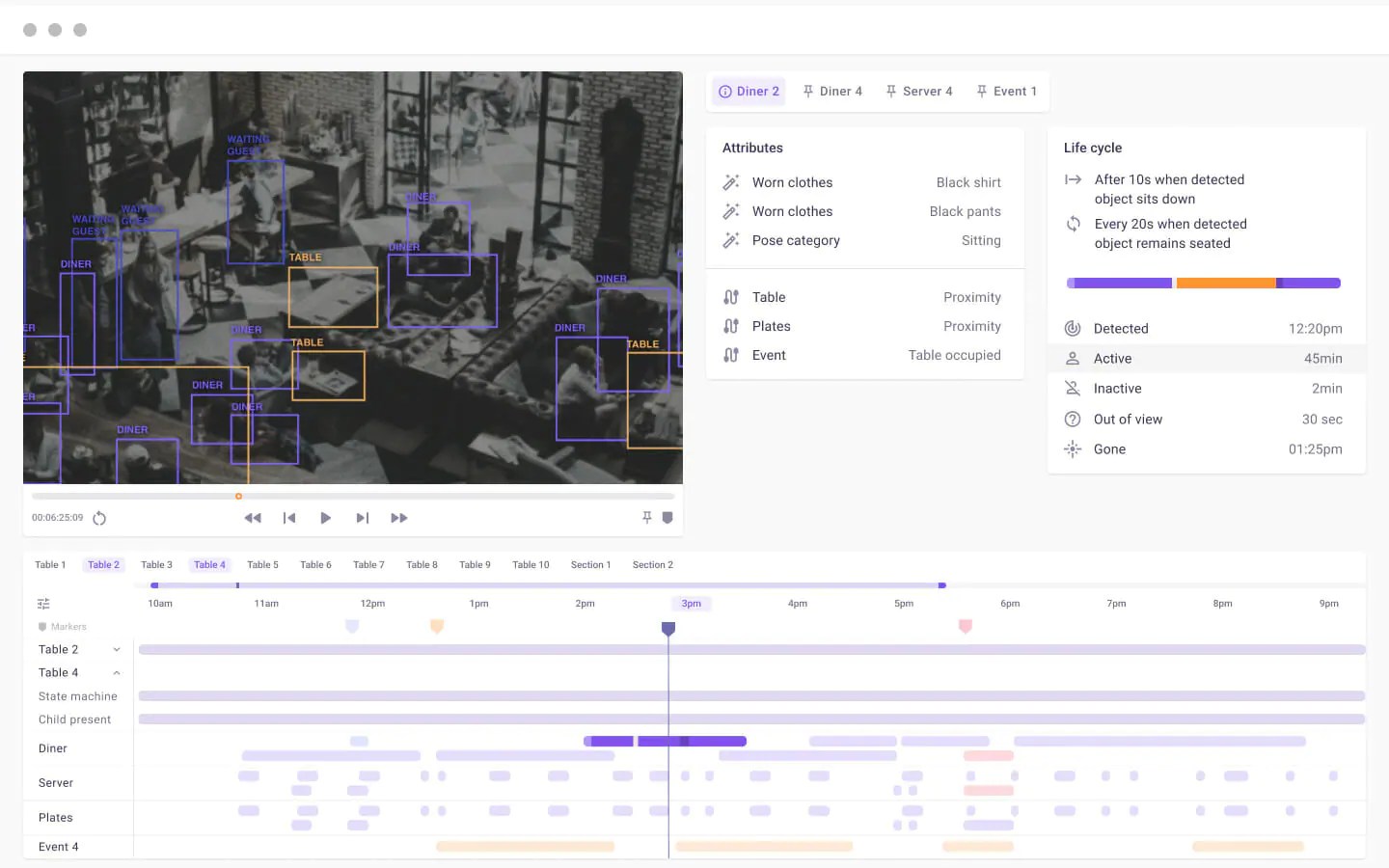
He noted that too often, computer vision projects in large enterprises fail even though they have the cameras and the talent to work on models. But to ingest stream from their cameras to then run the models takes a lot of undifferentiated work — and integrating all of this with downstream applications presents another set of integration challenges. So the team decided to build a computer vision platform that enables businesses to use their existing cameras and then combine that with a user experience that quickly enables users to gain real business value from this data. The platform lets users run their own computer vision models or Kibsi’s own and it then presents the results in a way that matches the business intent, both in Kibsi’s own user interface and through an API.
“We don’t return X and Y coordinates of people and objects,” said Tarhan. “If you’re thinking about a business analyst’s job, they don’t really care that a person is standing at this coordinate — what they want to know is: did that person interact with that merchandise?”
Image Credits: Kibsi
Kibsi has already attracted attention from customers like Owens Corning. Yet while manufacturing is a natural environment for computer vision, the Kibsi team also counts the likes of Whisker, which is embedding Kibsi’s tech into their litter robot, and the Woodland Park Zoo among its customers.
“Tracking animal behavior and interactions requires our professionals to sift through hours of camera footage,” said Bonnie Baird, Animal Welfare Scientist at Woodland Park Zoo. “We are excited to add Kibsi’s computer vision capabilities to our existing cameras to gain valuable insights about our animals and their well-being.”
While there are also obvious use cases for Kibsi in the smart city space (and its investor NTT is a major player there), Tarhan noted that the sales cycles there are quite slow. “As a startup, it’s not the best place to play day one,” he said.
Kibsi offers a free trial of their platform for developers, with a more comprehensive developer plan starting at $99/month. For premium and enterprise pricing plans, potential customers need to contact the company directly.