AI will change software development in massive ways, says MongoDB CTO

mongdodb-mark-porter

"There's this stereotype of how long it takes to write computer software and how long it takes to get it right," says MongoDB CTO Mark Porter. "I think generative AI is gonna change all that in massive ways."

Artificial intelligence, including the most popular form at the moment, generative AI such as OpenAI's ChatGPT, is going to provide tremendous leverage to software developers and make them vastly more productive, according to the chief technologist of MongoDB, the document database maker.

"One of the things that I strongly believe is that there's all this hype out there about how generative AI may put developers out of business, and I think that's wrong," said Mark Porter, MongoDB's CTO, in an interview with ZDNET.

Also: More developers are coding with AI than you think

"What generative AI is doing is helping us with code, helping us with test cases, helping us with finding bugs in our code, helping us with looking up documentation faster," said Porter.

"It's gonna let developers write code at the quality and the speed and the completeness that we've always wanted to."

Not just generative AI, said Porter, "but models and all the other stuff that's been around for 15 to 20 years that's now really solid" will mean that "we can do things which transform how developers write code."

Porter met with ZDNET last week during MongoDB.local, the company's developer conference in New York. The conference is one of 29 such developer events MongoDB is hosting this year in various cities in the US and abroad.

Prior to becoming CTO of MongoDB three and a half years ago, Porter held numerous key database roles, including running relational database operations for Amazon AWS RDS, running core technology development as CTO at Grab, the Southeast Asia ride-hailing service, and over a decade in numerous roles at Oracle, including a stint as one of the original database kernel developers.

AI is "an acceleration of the developer ecosystem," added Porter. "I think more apps are going to be written."

Also: Serving Generative AI just got a lot easier with OctoML's OctoAI

"There's this stereotype of how long it takes to write computer software and how long it takes to get it right," said Porter. "I think generative AI is going change all that in massive ways, where we're going to be able to write the apps we want to write at the speed we want to write them, at the quality we want to have them written."

A big element of MongoDB's one-day event was the company's discussion of new AI capabilities for the MongoDB database.

"MongoDB is actually the foundation of hundreds of companies building AI," said Porter. Indeed, the show floor, at Jacob Javits convention center in Manhattan, featured numerous booths from the likes of Confluent, Hashicorp, IBM, and Amazon AWS, where presenters explained the use of MongoDB with their respective software technologies.

Crowds at MongoDB's New York local conference for developers.

Porter emphasized new functionality in MongoDB that incorporates vector values as a native data type of the database. By supporting vectors, a developer can take the context vectors produced by the large language model, which represent an approximate answer to a query, store them in the database, and then retrieve them later using relevance searches that produce a precise answer with the necessary recall parameters.

Also: AMD unveils MI300x AI chip as 'generative AI accelerator'

When a user asks ChatGPT or another LLM a question, explained Porter, "I'm going to get a vector of that question, and then I'm going to put that vector into my database, and I'm then going to ask for vectors near it," which will produce a set of relevant articles, for example.

"Then I'm going to take those articles and prompt my LLM with all those articles, and I'm going to say, you may not say anything that is not in these articles, please answer this question with these articles."

The LLM can then perform functions such as summarizing a long article, offered Porter. "I love to use LLMs to take an article and make it shorter."

In that way, AI and the database have a division of labor.

Also: Microsoft unveils Fabric analytics program, OneLake data lake to span cloud providers

"You would never want to put an LLM in an online transaction processing system," said Porter. "I think you want to use the LLMs where they belong, and you want to use database technology and matrix technology where it belongs."

While there are standalone vector databases from other vendors, Porter told ZDNET that incorporating the functionality will reduce the burden for application developers. "It means that you don't have to have pipelines between the two [databases], copying data around," said Porter, "You don't have to manage two different systems, it's all in one system, your core data, your metadata, and your vectors all sit in one data store."

No matter what comes next with AI, said Porter, "It ain't going to put developers out of business.

"Developers are still going to be the ones who listen to their customers, listen to their leaders, and decide what to write."

Also: These are my 5 favorite AI tools for work

See also

IBM Acquires Software Firm Apptio for $4.6 Bn to Unleash Cloud Offerings

IBM has announced its acquisition of cloud software company Apptio for $4.6 billion. This move comes as organisations increasingly adopt hybrid cloud architectures, combining private and public clouds with on-premises solutions. Apptio has developed a platform that enables organisations to track data in hybrid environments, including its location and usage, as well as the associated financial and resource costs. IBM plans to integrate Apptio with its existing IT automation software and AI platform to offer businesses solutions for managing and optimising IT spend.

Apptio brings a substantial customer base of 1,500 enterprises, including over half of the Fortune 100 companies. It also has key integrations and partnerships with major cloud providers such as Amazon Web Services, Microsoft Azure, and Google Cloud Platform. This acquisition allows IBM to expand its services and upsell to existing clients.

“The acquisition is expected to close in the second half of 2023, pending regulatory approvals,” IBM stated. “Apptio’s offerings combined with IBM’s IT automation software and watsonx AI platform gives clients the most comprehensive approach to optimise and manage all of their technology investments,” said Arvind Krishna, CEO and chairman of IBM.

“This deal will follow IBM’s 2021 purchase of software provider Turbonomic for over $1.5 billion and its 2019 acquisition of software company Red Hat for $34 billion,” the company added.

The deal highlights the consolidation happening in the cloud management services space, as Apptio itself has made several acquisitions in recent years. Additionally, the acquisition gives private equity firm Vista a significant amount of funds for future acquisitions, as traditional funding avenues such as IPOs and venture capital have become more challenging.

“Our customers are evolving to a complex digital-first, hybrid world where technology investments are distributed and decentralised but all innovation must be aligned with clear business outcomes,” said Sunny Gupta, Apptio co-founder and CEO. “We are so excited to be joining IBM and combining our industry-leading offerings with IBM’s global presence and strong portfolio across AIOps, automation, and hybrid cloud offerings.”

Overall, the acquisition of Apptio enhances IBM’s IT automation capabilities, enabling businesses to optimise their IT spending and gain better insights into their technology investments.

The post IBM Acquires Software Firm Apptio for $4.6 Bn to Unleash Cloud Offerings appeared first on Analytics India Magazine.

Enter your data synthesis innovations to reform policing, win cash

Sponsored Post

Enter your data synthesis innovations to reform policing, win cash

Enter your data synthesis innovations to reform policing,
win cash

Harness the power of data technology to help police be accountable, effective, and inclusive of all communities. Enter the Innovations in Measuring Community Perceptions Challenge by July 31 and win prizes totaling $175,000.

More On This Topic

  • Six Ethical Quandaries of Predictive Policing
  • Innovations in Measuring Community Perceptions Challenge
  • High-Fidelity Synthetic Data for Data Engineers and Data Scientists Alike
  • AIRSIDE LIVE Is Where Big Data, Data Security and Data Governance Converge
  • Data Scientist, Data Engineer & Other Data Careers, Explained
  • Top November Stories: Top Python Libraries for Data Science, Data…

How (and why) to subscribe to ChatGPT Plus

ChatGPT Plus

When ChatGPT was unveiled in November, it was free for all to use. Its quick surge in popularity, however, sometimes caused extended wait times for users. As a result, OpenAI added a subscription plan that would help some users avoid the wait and provide access to other convenient perks.

Also: Bard vs. ChatGPT: Can Bard help you code?

ChatGPT's subscription plan is called ChatGPT Plus, and it costs $20/month. The paid subscription model guarantees users general access even during peak times when the free version is at capacity, and offers ffaster response times.

Plus plan subscribers also get priority access to new features and improvements, including OpenAI's latest and greatest updates, such as GPT-4, available to Plus subscribers now, and ChatGPT plugins, which will prioritize Plus users upon roll out.

We've tried Plus — and we believe if you're looking for accurate written answers to your questions, this paid-for service is much better than the first mass public previous version, GPT-3.5.

Also: GPT-3.5 vs GPT-4: Is ChatGPT Plus worth its subscription fee?

ChatGPT-4 can still make blunders, often referred to as "hallucinations". However, OpenAI describes GPT-4 as "10 times more advanced than its predecessor, GPT-3.5" — and ZDNET's Steven Vaughan-Nichols thinks these advances mean Plus is worth the subscription fee.

How to subscribe to ChatGPT Plus

If you are looking to expand your ChatGPT use and experience all the chatbot has to offer, here's how you can subscribe to ChatGPT Plus.

If you haven't created an account, click on Sign Up. Otherwise, log in with your OpenAI credentials.

FAQ

Can I still use ChatGPT for free?

Yes, the free version is still available for the public. With the free plan, you still get full access to the chatbot. The disadvantages of the free plan are that you won't be able to access the bot during periods of high demand and won't have access to the latest updates, such as GPT-4.

How much is ChatGPT Plus membership?

The ChatGPT Plus membership is currently priced at $20/month. Although this might seem steep, it is still half the cost that early access users paid at $42/month.

Also: How does ChatGPT work?

The original price was revealed when an early access user shared a video on Twitter, which showed the cost of the Plus subscription.

What are the advantages of a ChatGPT Plus membership?

The biggest perks of a ChatGPT Plus membership include priority access to the latest upgrades, such as GPT-4 and ChatGPT plugins, bypassing wait times, and quicker response rates.

See also

Databricks Announces Acquisition of Generative AI Platform MosaicML for $1.3 Bn

Databricks, has announced its definitive agreement to acquire MosaicML, a generative AI platform, in a transaction valued at approximately $1.3 billion. The acquisition aims to make generative AI accessible to organisations, allowing them to “build, own and secure generative AI models with their own data.” The CEO of Databricks, Ali Ghodsi, emphasised the goal of democratising AI and making the “Lakehouse the best place to build generative AI and LLMs.”

MosaicML was co founded by Naveen Rao and Hanlin Tang in San Franscico in 2021. Rao expressed enthusiasm about the acquisition, stating that joining forces with Databricks will help make their vision of empowering everyone to build and train their own AI models a reality. The proposed acquisition is subject to customary closing conditions, including regulatory clearances.

MosaicML is recognized for its state-of-the-art MPT large language models, which have been downloaded over 3.3 million times. It has demonstrated how organisations can quickly build and train their own models using their data in a cost-effective manner. Notable customers such as AI2, Generally Intelligent, Hippocratic AI, Replit, and Scatter Labs leverage MosaicML for various generative AI use cases.

The Databricks Lakehouse Platform, combined with MosaicML’s technology, will provide customers with a “simple, fast way to retain control, security, and ownership over their valuable data without high costs.” MosaicML claims that its automatic optimization of model training enables 2x-7x faster training compared to standard approaches. Furthermore, the scalability of resources allows for training multi-billion-parameter models in hours, rather than days. The collaboration between Databricks and MosaicML is expected to significantly reduce the cost of training and using LLMs, making it accessible to a wider range of organizations.

The entire MosaicML team, including its research team, is expected to join Databricks after the transaction closes. MosaicML’s platform will be integrated and scaled over time to provide a unified platform where customers can “build, own and secure their generative AI models.” This collaboration aims to offer organisations greater choice in building their own models, training them with their unique data, and creating intellectual property specific to their businesses. The acquisition aligns with the shared vision of Databricks and MosaicML to democratise AI and give organisations more control over their data.

MosaicML, had earlier, in the month of May launched a new service called MosaicML Inference to compete with OpenAI and other similar platforms on price. The offering aims to assist enterprise customers in training and deploying generative AI-powered solutions. As large models like ChatGPT and Stable Diffusion gain popularity, organisations are increasingly interested in leveraging these technologies.

MosaicML highlights that while existing solutions are suitable for those unconcerned with cost and willing to share data, building and hosting their own models can be a more cost-effective option for organizations with strict data privacy requirements. The company claims to make its technology accessible to all organizations at a significantly lower price, up to 15 times cheaper than its competitors.

CEO Naveen Rao mentioned that MosaicML has optimized its offerings to achieve cost savings. By offering the service at a much lower price, the company still maintains profitability. MosaicML has developed foundational models to support its new service, similar to the technology used in chatbot-enabled products by Microsoft and Google.

While MosaicML, like its competitors, provides its technology for rent, it differentiates itself by also offering its code to customers. This allows customers to run the code on their own hardware, ensuring the confidentiality of their data from MosaicML. This approach appeals to corporate customers who prioritize data privacy, as the value of an AI system is heavily dependent on the training data used.

The post Databricks Announces Acquisition of Generative AI Platform MosaicML for $1.3 Bn appeared first on Analytics India Magazine.

ChatGPT Plugins: Everything You Need To Know

ChatGPT Plugins: Everything You Need To Know
Image by Editor

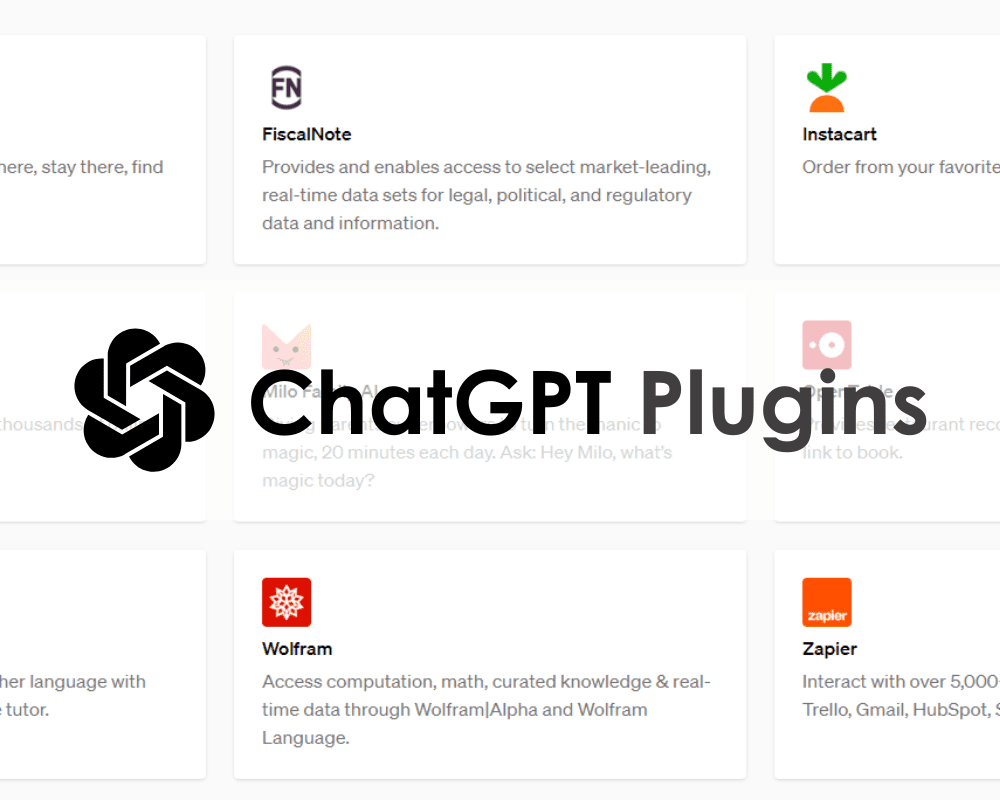
In March 2023, OpenAI announced the release of ChatGPT plugins to study real-world use and be able to improve the current safety and alignment challenges. Since the release of ChatGPT, users have been requesting plugins so developers can experiment with them for a variety of use cases.

To help ChatGPT users get the most out of the tool, OpenAI has started with a small set of users and is planning to roll out larger-scale access as they learn more on the way.

OpenAI has made it possible for plugin developers to build a plugin that allows ChatGPT to connect to the API. If you would like to know more about this, you can learn more by clicking on the documentation to build a plugin for ChatGPT.

But for now, the first plugins have already been created by:

  • Expedia
  • FiscalNote
  • Instacart
  • KAYAK
  • Klarna
  • Milo
  • OpenTable
  • Shopify
  • Speak
  • Wolfram,
  • and Zapier

Before we get into each of them a bit more, let’s learn about ChatGPT with browsing.

ChatGPT with Browsing

One of the challenges that ChatGPT was facing was that the data trained on ChatGPT is only current up to September 2021. However, by using ChatGPT with browsing, you can now research real-time information, beyond its training data.

ChatGPT with browsing uses the Bing API to search and a text-based web browser to select specific websites. Using the websites it locates and its own research, ChatGPT will provide you with an answer with citations. It will link the citations so that you can see the source, allowing you to verify ChatGPTs answer.

ChatGPT Plugins: Everything You Need To Know
Image by OpenAI Expedia ChatGPT Plugin

If you’re looking at holidays, if it’s for flights or hotels — Expedia is always a good start! Planning a holiday can always be a nuisance. It takes time, energy and money. With the Expedia ChatGPT Plugin, you can plan your vacation using follow-up queries. The ChatGPT plugin can help you plan your dream vacation, understand your expenses, provide a variety of resorts, and find local activities.

The chatbot uses up-to-date data, search criteria and algorithmic computations to provide recommendations that cater to the user.

FiscalNote ChatGPT Plugin

FiscalNote is a leading SaaS technology company which provides global policies and market intelligence. FiscalNote is known for aggregating and training models, specifically in the legal and political sectors.

FiscalNote’s ChatGPT Plugin will allow users and developers to turn their ideas into reality, by having access to the latest laws, policies, and regulations. The real-time communication provides tailored answers backed by artificial intelligence and machine learning, allowing users to keep up with the evolving regulatory environment.

Instacart ChatGPT Plugin

You can ask ChatGPT what ingredients are required for a traditional Bengali mutton biryani, however, it cannot go and buy those recipes for you. Wouldn’t it be great if you could have the ingredients to make your dinner? Instacart aims to make your life easier by connecting you to a personal shopper in your local area that can shop and deliver your order.

The Instacart plugin is an add-on to the ChatGPT, allowing users to shop for groceries that are linked to recipe-related conversations with ChatGPT, and get them delivered to your door so you can start cooking.

KAYAK ChatGPT Plugin

Another one for the jet setters! We don’t need to mention how vacation planning can be so stressful again. The KAYAK ChatGPT Plugin can help you book flights, find the best hotels and provide you with travel advice from start to finish. You can get your dream vacation, with all the recommendations of your preferences that are within your budget.

No need to flick through your emails to find your boarding pass, or your hotel reservation. KAYAK ChatGPT Plugin will provide you with a breakdown of your costs, departure times, layovers, reservations and more.

Klarna ChatGPT Plugin

Klarna has become very popular over the years, allowing people to shop a bit more freely. And it gets better with the Klarna ChatGPT Plugin where you can improve your shopping experience by having a customer shopping assistant tailoring your recommendations and the user's previous search history.

So for the shopaholics who are always looking for a bargain, Klarna is your best friend with the new ChatGPT plugin. You can search and compare prices from thousands of online shops, and be happy with your purchase.

Milo ChatGPT Plugin

If you’re a parent, and you’re struggling to keep up with the constant developments in artificial intelligence and you’re unsure how to keep up with it whilst having kids. Welcome, Milo ChatGPT plugin, where you can find calmness in the beautiful chaos — an AI co-pilot for parents.

Milo helps parents manage homelife, and be able to get things done more calmly. Parents can better organize themselves by asking Milo questions such as “What household chores are pending today?”.

It can be difficult to share valuable memories with your children if you’re working or always on the go. With Milo AI, it can provide suggestions to parents on how they can create special moments with their families, by just answering 'What's magic today?'.

OpenTable ChatGPT Plugin

This one is for the foodies! There have definitely been times when you’re on the go and you’re looking for somewhere to eat but are unsure where to go. And then you catch yourself calling different restaurants to see if they have any availability.

With the OpenTable ChatGPT Plugin, you can make reservations at a restaurant and then go. All you need to do is tell ChatGPT the date, time, location and party number and it will find you all the local restaurants available. A nice and simple way to have a good time with friends and family.

Shopify ChatGPT Plugin

Shopify is a global commerce platform that allows businesses to sell from anywhere around the world. Selling or buying something is so easy with Shopify and has just got better with the ChatGPT plugin.

Business owners can use the ChatGPT plugin to streamline their customer service processes, increase sales, or make their business more user-friendly. On the other hand, if you’re the buyer it can be time-consuming searching the web trying to find exactly what you want. With the Shopify ChatGPT plugin, you can search for millions of products from the world’s greatest brands, and the plugin will generate product recommendations on the go.

Speak ChatGPT Plugin

A lot of us have always wanted to take up learning a new language, but never have the time, resources or money to get a tutor. The Speak ChatGPT plugin has made it so much easier to learn a new language.

Speak is an advanced AI language tutor, which provides you with instant feedback in various languages. It doesn’t only just translate text, but it also helps with grammar correction, verb conjugations, and more. Start learning a new language today with the Speak ChatGPT plugin.

Wolfram ChatGPT Plugin

Wolfram was founded by Stephen Wolfram in 1987, and their research department is considered one of the world's most respected computer, web and cloud software companies. They have a long-term vision of developing science, technology and tools to make computation easier in the future.

The Wolfram ChatGPT plugin provides users with access to sophisticated computational, mathematical, and real-time data to help answer any question you may have. After hearing that you might be thinking “That’s just a lot of maths’. But it can be used for a variety of other tasks too, such as analyzing music, visualizing the human body, and much more.

Zapier ChatGPT Plugin

Zapier is an automation platform and is a very popular one as it allows businesses to transform their company with a no-code automation process. It has been a great help to a lot of organizations in streamlining repetitive tasks, marketing aspects, and more.

The Zapier ChatGPT plugin allows you to connect to over 5,000 apps and easily interact with them through ChatGPT. For example, these apps include Gmail, Google Sheets, Slack, and more. Not only will this save you time and confusion when switching between apps, you can now ask ChatGPT to perform the same task in another app without any hassle at all.

Wrapping it up

The above are the first plugins to be created, with more out there, and definitely more to come. Plugins are in beta and you will need to join the waitlist in order to get developer access. If you want to go through an example ChatGPT plugin setup, you can have a look at this: plugin quickstart repo.

It will be interesting to see what more plugins are yet to come, and if they will improve the quality of our lives. If you’re looking at creating a ChatGPT plugin, let us know in the comments below!
Nisha Arya is a Data Scientist, Freelance Technical Writer and Community Manager at KDnuggets. She is particularly interested in providing Data Science career advice or tutorials and theory based knowledge around Data Science. She also wishes to explore the different ways Artificial Intelligence is/can benefit the longevity of human life. A keen learner, seeking to broaden her tech knowledge and writing skills, whilst helping guide others.

More On This Topic

  • 10 ChatGPT Plugins for Data Science Cheat Sheet
  • Visual ChatGPT: Microsoft Combine ChatGPT and VFMs
  • ChatGPT: Everything You Need to Know
  • Using ChatGPT to Learn SQL
  • ChatGPT for Beginners
  • What Is ChatGPT Doing and Why Does It Work?

Will coding be a collaborative experience using GitHub copilot? – Part one

GitHub logo on the screen smartphone and notebook closeup. GitHu

Will coding be a collaborative experience using github copilot? – part one

Gitub recently released a survey about developer experience which claimed that “AI is here and it’s being used at scale. 92% of U.S.-based developers are already using AI coding tools both in and outside of work.”

This metric (92%) has garnered some attention – because of both the fear and the opportunity. The fear, because AI coding tools could potentially replace developer jobs – and the opportunity, because AI coding tools like Github co-pilot could make developers more productive.

A summary of the other findings include

  • Waiting on builds and tests is still a problem. Despite industry-wide investments in DevOps, developers still say the most time-consuming thing they’re doing at work besides writing code is waiting on builds and tests.
  • Developers want more collaboration. Developers in enterprise settings work with an average of 21 other engineers on projects—and want collaboration to be a top metric in performance reviews.
  • And they think AI will help. More than 4 out of 5 developers expect AI coding tools will make their team more collaborative.
  • Developers also see big benefits to AI. 70% say AI coding tools will offer them an advantage at work and cite better code quality, completion time, and resolving incidents as some of the top anticipated benefits.

The report also claims, that coding could become a collaborative experience. In this blog, I want to focus on the collaboration aspect.

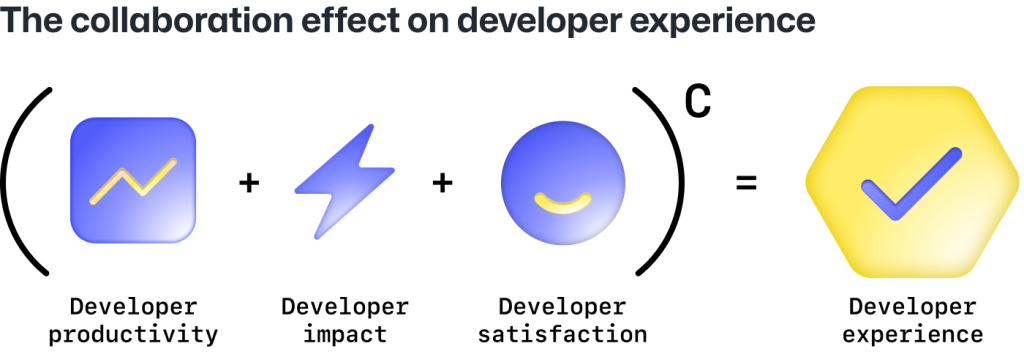
A formula called developer experience (DevEx) is proposed

DevEx is a formula that takes into account:

  • How simple and fast it is for a developer to implement a change on a codebase—or be productive.
  • How frictionless it is to move from idea through production to impact.
  • How positively or negatively the work environment, workflows, and tools affect developer satisfaction.

But crucially, collaboration ( C ) is seen as a multiplier across the whole developer experience.

The theme of collaboration flows through the report. For example, the report claims that one of the metrics developers should be evaluated upon is the quality of collaboration. Developers believe their ability to collaborate with others and the quality of their code–more than the quantity and efficiency of their output—should be the top performance metrics they’re measured by.

A diagram of a formula behind the developer experience that accounts for productivity, impact, satisfaction, and collaboration.

C = Collaboration, the multiplier across the entire developer experience.

The need for collaboration extends to feedback from end users. Product managers and marketing teams often act as intermediaries, making it difficult for developers to directly receive end-user feedback.

The report goes on to say:

  • Collaboration is the cornerstone of the developer experience
  • Developers thrive in collaborative environments
  • But developers also have a holistic view of collaboration—it’s defined not only by talking and meeting with others, but also by uninterrupted work time, access to fully configured developer environments, and formal mentor-mentee relationships.
  • Developers view regular touchpoints with colleagues across asynchronous channels, documentation, and well-run team meetings as critical to successful collaboration.

Recently, Github CEO Thomas Dohmke said that “Sooner than later, 80% of the code is going to be written by Copilot. And that doesn’t mean the developer is going to be replaced.”

So, the stakes are high and we will see more of these developments

In the second part of this blog, we will explore the impact and significance of collaboration due to Github co-pilot on the wider developer ecosystem.

Application analytics: How to leverage analytics during app creation

There probably isn’t a better time than now to develop an app for your business. By the end of 2023, mobile apps are expected to generate over $935 billion. Customers are hungry for apps that can provide instant access to services. Of course, simply having an app isn’t good enough.

Consumers will only use your product if it brings value to them. In other words, it meets their needs and provides the best user experience. How can you make sure you’re meeting these goals? Having the best hosting provider helps, as does a fantastic interface and design. But to achieve this, you need to look at data.

Of course, data is only as useful as the insights it provides. That’s why application analytics is so helpful. But what is application analytics, and how can it boost app development? We’ll discuss that, and more, below.

What is application analytics?

Application analytics: How to leverage analytics during app creation

Image sourced from financesonline.com

You don’t need to attend computer science events to know how important data is in the modern world. If you’re running a website, you’re probably sitting on a mountain of data.

Each time a user interacts with your application, they leave a digital footprint. How long did they linger on a certain page? Did they complete a certain conversion goal? Did they view a video for longer than 10 seconds? Application analytics is the process of turning all this data into actionable insights.

The right analytics programs present data in easy-to-understand and accessible ways. This might take the form of tables, graphs, or other forms of visualization.

Application analytics is often to improve apps. In this article, however, we’ll look at how data can help guide apps during development.

With the right data-driven insights, you can create apps with high levels of conversions, user retention levels, and engagement.

The two types of application analytics

If you’re building an application you’ll probably be interested in one of the two main types of analytics. These are performance analytics and usage analytics. Let’s look at both in more detail.

Performance analytics

One thing we can say for sure about users is that they don’t like to be kept waiting. That’s why it’s essential that as well as making an app that looks good, it performs well.

This is where performance analytics come in. As the name suggests, this tells us how well an app is performing.

Below is some of the information that performance analytics can tell us.

  • How often an app is crashing.
  • The responsiveness of an app.
  • Information relating to uptime.
  • Whether cached data is being sourced correctly.
  • Any glitches that might arise during usage.

To provide the best experiences, you’ll want to monitor performance analytics closely during development.

Usage analytics

The second kind of analytics relates to user behavior. What are people doing on your app? What aren’t people doing? This information is critical for building an app that optimizes conversions and engagement.

Below we’ve listed some key information that can be gained for usage analytics.

  • The number of conversions that occurred per session.
  • The speed at which users are adopting new features.
  • Whether users are returning to your app after using it.
  • The customer engagement score (CES).
  • The amount of time it takes a user to realize the value of your application.

Like performance analytics, usage analytics is essential during app development. Instead of guessing what your users want, you can find out directly.

How to use application analytics

There are a lot of reasons to be excited about application analytics. There are many ways it can help to build better mobile applications. Let’s look at some of the useful aspects of application analytics, and how they can support app development.

Embrace predictive analytics

There’s been a lot of talk about artificial intelligence in recent years. Thanks to science fiction, many people think of AI as a terrifying monster. But AI isn’t going to end the world (not yet anyway).

Instead, AI powers many of the application analytics programs that businesses use. Using a feature called predictive analytics, AI can provide predictions of future trends. This includes how users might behave in the future. By anticipating behaviors you can better meet the needs of users with your app.

So, when choosing your analytics software, make sure that predictive analytics is a feature.

Offer better personalization

Application analytics: How to leverage analytics during app creation

Image sourced from segment.com

Modern users love personalization. That isn’t an overstatement; over half (56%) of buyers say they will become repeat shoppers after a personalized experience. If you didn’t know, personalization is offering experiences that are tailored to individual customers. But knowing what users want isn’t easy.

That’s why application analytics is so useful. You can segment user data and identify the kind of content that users are likely to respond to. For instance, a user could log on to your app and see a list of offers that are relevant to them. You can boost sales and other important conversions.

Predictive testing

It’s fair to say that crashes and other issues can be very off-putting to users. If they run into too many problems, they’ll stop using your app. It’s much better to nip these problems in the bud as quickly as possible. That’s why testing mobile applications is essential.

Predictive testing is a form of application analytics that looks at user journeys. It can identify the actions that users are taking that result in crashes. You can then modify your app to prevent these problems from occurring.

Improve security

Application analytics: How to leverage analytics during app creation

Free to use image from Unsplash

Cybersecurity-related issues are constantly on the rise. Many businesses haven’t taken these issues seriously and learned the hard way. Customers have found their details compromised and their trust has been damaged.

Application analytics can help ensure that you’re always one step ahead of cybercriminals. By analyzing data, you can spot gaps in security and even predict future attacks. By doing so, you can ensure top levels of security for your app.

Better understand your audience

Application analytics: How to leverage analytics during app creation

Free to use image from Unsplash

The term ‘know your audience’ is commonplace in businesses. You might think you know your customers already, but think again. To build the best application in the modern world, you need to know your audience down to a T.

Thankfully, by leveraging application analytics, you can dig deep into your audience. Let’s look at some of the ways you can learn about your audience.

Build detailed customer reports

Before beginning any application you need to know exactly who you’re building for. As mentioned, this means knowing your audience on a more granular level. In the past, we had to rely on simple market research and a lot of guesswork. Today, that approach won’t cut it.

Not only should you know their demographic and buying patterns, but their interests, and their behavior online. What topics do they tend to search for, and what device do they use?

With the right analytics tool, you can learn all you need and more. Before you even start work on your app, you already have a very detailed picture of your audience. You can use this to guide your app creation. The end result should be an app that matches the wants and needs of your audience.

Analyze user behavior

The best way to understand your audience is to observe them. From the moment they log on to your app, what are they doing? Are there any tasks that they are struggling to complete? Thanks to an application analytics feature called real-time analytics, we don’t have to wait for this information.

Real-time analytics, as the name suggests, brings us data as soon as it comes in. You can literally watch users as they navigate your application. You can better track user journeys and spot pain points. You can use all this information to enhance in-app development.

Make the most of big data

Application analytics: How to leverage analytics during app creation

Free to use image from Unsplash

Does your business have access to large sets of data? If so, you can make use of big data. Big data can provide even more detailed information about application users. Big data modeling tools can help increase the accuracy and consistency of your data.

By analyzing big data you get information that helps with many aspects of application development. Thankfully, by leveraging application analytics and analyzing big data, you get information that helps with many aspects of application development. Additionally, utilizing tools such as an online form builder can further enhance your understanding of your audience and optimize your app accordingly.

For example, you can use big data analytics and recognition software to gain insights into user behavior patterns, preferences, and trends. This allows you to make data-driven decisions in designing and optimizing your app to meet the needs and expectations of your target audience.

This includes:

  • More in-depth customer information.
  • Access to user experience analysis and reports.
  • Access to real-time data reports.

Conclusion

Building an app without application analytics is the equivalent of driving to a new location without a map. You can create a fantastic UI, and choose the best web hosting (or even an alternative such as Pantheon web hosting). But ultimately, you’ll fall short of building the best app for your audience.

Application analytics gives you the insights to build an app that meets the needs of your audience. In this article, we looked at some of the best ways you can leverage the tool. Let’s recap some of the biggest advantages of application analytics. With the right analytics tool, you can

  • Leverage predictive analytics to spot trends in user behavior.
  • Offer more personalization to your users.
  • Bolster app security.
  • Build more complete user profiles.
  • Analyze user interactions to improve your app.
  • Unpack big data for even better insights.

So, before starting work on a new app ask yourself, “Am I making the most of data-driven insights?” If not, now’s the time to make a change.

Artificial Intelligence and localization: How AI is changing the landscape

man with laptop over words in foreign languages

Artificial Intelligence (AI) has emerged as a revolutionary technology that is transforming various industries, and one area where it is making a significant impact is localization. Localization refers to the process of adapting products, services, and content to meet the cultural, linguistic, and functional requirements of a specific target market. With the advent of AI, businesses are now able to leverage its capabilities to streamline and enhance localization efforts, resulting in improved user experiences and expanded global reach. In this article, we will explore the ways in which AI is changing the landscape of localization.

The Role of AI in Localization

In today’s interconnected world, businesses are expanding their global footprint and targeting diverse markets. Localization, facilitated by specialised localization company, plays a crucial role in ensuring that products and services resonate with local audiences. With AI, the localization process becomes more efficient and accurate, enabling companies to adapt and thrive in different regions. AI technology offers a range of capabilities that can automate and enhance various aspects of localization, from language translation to cultural adaptation.

Automated translation: breaking down language barriers

Language barriers pose a significant challenge in localization efforts. AI-powered automated translation systems leverage machine learning algorithms to process and translate text rapidly. These systems continuously improve their accuracy by analyzing vast amounts of data and learning from human feedback. With AI translation tools, businesses can save time and resources while delivering localized content in multiple languages.

Natural Language Processing: Enhancing context and meaning

Understanding the nuances of language is crucial for effective localization. Natural Language Processing (NLP) is an AI technique that enables computers to comprehend and interpret human language. By analyzing context, sentiment, and intent, NLP algorithms can accurately translate and adapt content, ensuring that the meaning is preserved in the target language. This technology helps overcome linguistic challenges and ensures a seamless user experience.

Content personalization: tailoring experiences to local audiences

Localization goes beyond language translation. It involves adapting content to resonate with the cultural preferences and expectations of target audiences. AI-powered content personalization algorithms analyze user data and behavior to deliver tailored experiences. By leveraging AI, businesses can create localized content that connects with users on a deeper level, fostering engagement and building brand loyalty.

Data-driven insights: making informed localization decisions

AI allows businesses to gather and analyze vast amounts of data to gain insights into local markets. By examining user behavior, preferences, and trends, AI algorithms help identify localization opportunities and refine strategies. This data-driven approach enables companies to make informed decisions, minimizing risks and maximizing the effectiveness of their localization efforts.

Multilingual SEO: Optimizing content for global visibility

Search Engine Optimization (SEO) is crucial for driving organic traffic to websites. AI-powered tools can assist in optimizing content for different languages and regions. By analyzing keywords, search patterns, and user intent, AI algorithms provide valuable insights to improve multilingual SEO strategies. This ensures that localized content is discoverable and ranks higher in search engine results, enhancing global visibility.

Speech recognition: Enabling voice-based localization

Voice-based interactions are becoming increasingly popular with the rise of virtual assistants and smart devices. AI-driven speech recognition technology plays a vital role in enabling voice-based localization. By accurately transcribing and interpreting spoken language, AI systems facilitate seamless communication and interaction with local users, further enhancing the localization experience.

Cultural sensitivity: Avoiding localization pitfalls

Localization requires careful consideration of cultural sensitivities and norms. AI-powered tools can help businesses navigate potential pitfalls by providing cultural insights and guidelines. These tools analyze cultural data and provide recommendations to ensure that localized content respects local customs, traditions, and sensitivities. This helps companies avoid cultural missteps and establish a positive brand image in different markets.

User feedback and iterative improvement

AI facilitates continuous improvement in localization efforts through user feedback loops. By analyzing user feedback, AI systems can identify areas for improvement and make iterative adjustments to localized content. This feedback-driven approach ensures that businesses stay attuned to the needs and preferences of their global audience, resulting in enhanced localization outcomes over time.

AI-powered tools and platforms: Empowering localization teams

AI has empowered localization teams with advanced tools and platforms that streamline their workflows. From translation management systems to content repositories, AI technology automates mundane tasks, allowing localization professionals to focus on higher-value activities. These AI-powered tools enhance collaboration, improve efficiency, and accelerate the localization process, enabling businesses to reach global markets faster.

Challenges and limitations of AI in localization

While AI offers immense potential for localization, it also presents challenges and limitations. Language nuances, regional dialects, and complex cultural contexts can still pose difficulties for AI algorithms. Ensuring accuracy, maintaining the integrity of the original content, and addressing ethical concerns related to AI are important considerations in the localization process. Human oversight and intervention are necessary to ensure quality and cultural appropriateness.

The future of AI-driven localization

The future of AI-driven services like Software Localization looks promising. As AI technology continues to evolve, we can expect even more sophisticated language translation, context analysis, and content adaptation capabilities. AI algorithms will become increasingly accurate, adaptive, and contextually aware, enabling businesses to deliver highly localized experiences that resonate with global audiences. However, human expertise and cultural understanding will remain crucial for ensuring seamless and culturally appropriate localization.

Conclusion

Artificial Intelligence is revolutionizing the localization landscape. Through automated translation, natural language processing, content personalization, data-driven insights, and more, AI is empowering businesses to connect with global audiences effectively. By leveraging AI-powered tools and platforms, localization teams can streamline their workflows and deliver high-quality localized content. While AI brings numerous benefits, it is essential to strike a balance between automation and human expertise to ensure accurate, culturally sensitive, and engaging localization.

BentoML scores $9M funding to expedite AI app development

BentoML scores $9M funding to expedite AI app development Rita Liao 8 hours

The success of large language models like GPT has sparked a frenzy of developers eager to make AI-powered applications. But building AI services can be tricky, especially due to the shortage of skilled developers to meet the rising demand these days.

That’s where Chaoyu Yang, an early software engineer at the data mega-unicorn Databricks, comes in. Along with his co-founders, he’s built the AI development framework BentoML, which just announced a seed financing round.

Yang, in an interview with TechCrunch, explained that today’s AI services are often built on multiple machine learning models, making their management and operation complicated. Many programmers entering the fray are coming from a full-stack or application development background, meaning they often lack the skills to build the required AI infrastructure, resulting in a prolonged development process.

A demo AI app like Microsoft’s Visual ChatGPT, an upgrade to the chatbot that allows it to produce responses from both text and image prompts, for example, can take at least three to six months to make it production-ready, Yang said.

While tech behemoths like Microsoft enjoy the financial prowess and human capital to train AI models and put them to use in the real world, smaller businesses, in Yang’s words, are collecting “valuable data that can benefit tremendously from AI” but “lack the resources to build the infrastructure for development.”

BentoML, which provides a high-level API that abstracts away the details of the infrastructure needed for running AI models on the cloud, belongs to a camp of tools like SageMaker that wants to smoothen the path for developing AI services. It’s a so-called AI application framework, a set of tools that make it easier to build, ship, and scale AI applications, like a construction tool kit one uses to build a house.

Specifically, BentoML is targeting data scientists who train AI models, DevOp engineers who manage their lifecycle and developers who actually build applications on top of the models.

With BentoML, developers can make Visual ChatGPT scalable and cost-efficient for production use in as short as two days, said Yang. Users have also used the framework to run the art generator Stable Diffusion and open-source LLMs on the cloud.

Yang compared his company to Vercel, which focuses on serving front-end developers and was last valued at over $1 billion. BentoML aims to be the Vercel for AI, he said.

While Yang predicted that AI would eventually become more production-ready, he admitted he didn’t think the AI application wave would arrive so soon. The founder expects AI app developers to account for over 90% of the platform’s users in the future.

“If you ask me a year ago, I’d say that probably 90% of the companies would be training their own models, but the foundation models that have recently emerged are so powerful that they can perform well even given a dataset it has never seen before,” he said.

“Rather than focusing on model training, developers now only need to work on finetuning and product engineering, which in themselves present a bottleneck because of the shortage of AI-focused developers.”

BentoML was open-sourced in 2019 and later introduced a self-hosted SaaS version to enterprise customers. It’s been acquiring users organically through its open-source community, which quadrupled its membership to over 3,000 over the past year, with South Korean social networking giants Line and Naver being among its early adopters.

Yang declined to disclose the company’s revenue size.

Investors are taking note of BentoML’s traction in the developer community. The startup recently raised $9 million from its seed financing round led by DCM Ventures with Bow Capital also participating. DCM’s general partner, Hurst Lin, has joined BentoML’s board following the round.

The exuberant AI market has been a boon to BentoML, but the rapidly changing industry also makes it tricky for the team to juggle short- and long-term goals, Yang admitted.

“You might have to build things that ride the current trend, but in the long term, we of course want to have our own moat. The question is how we balance our time and human resources between the two.”

Vercel raises $150M Series D as it looks to build an end-to-end front-end development platform