
Microsoft kills Cortana in Windows as it focuses on next-gen AI

Microsoft kills Cortana in Windows as it focuses on next-gen AI Sarah Perez @sarahintampa / 9 hours

Microsoft is shutting down its digital assistant app Cortana this month, having now put more of its focus on modern-day AI advances, like its ChatGPT-like Bing Chat and other AI-powered productivity features across Windows and its web browser Edge. A support page confirms the end of Cortana as a standalone app in Windows, starting in August 2023.

The company also confirmed to TechCrunch the page was first published earlier in June, but declined to share more of its thinking on the matter beyond what was referenced on the page itself.

However, reading between the lines from the explanation provided, it appears that Microsoft sees Cortana as something that was a stepping stone toward this new AI future, where users will instead rely on a smarter chatbot running GPT-4, powered thanks to Microsoft’s partnership with OpenAI. The company also announced in May that it would build this new ChatGPT-based Bing experience right into Windows 11.

In the meantime, Windows users will be in a transitional period where Cortana will still be around in some form, though the standalone Windows app will no longer be supported. For now, however, Cortana will continue to be available in Outlook mobile, Teams mobile, Microsoft Teams display, and Microsoft Teams rooms, the company notes.

Those Cortana-powered experiences may not be long for this world either, as Microsoft has already detailed its plans to bring Bing Chat to the enterprise, where Microsoft 365 Copilot will be integrated into its productivity software, plus Outlook, Teams, and more.

“We know that this change may affect some of the ways you work in Windows, so we want to help you transition smoothly to the new options,” Microsoft explains on the support page. “Instead of clicking the Cortana icon and launching the app to begin using voice, now you can use voice and satisfy your productivity needs through different tools.”

The company then points users to Cortana alternatives like Windows 11 voice access which lets users control their PC with voice commands, the new AI-powered Bing, Microsoft 365 Copilot, and Windows Copilot, which offers centralized AI assistance for Windows users.

The website Windows Latest (not affiliated with Microsoft) was the first to report on the Cortana app’s shutdown, having noticed that the latest update for the Cortana Windows app caused the app to stop working. Upon launching the app, a message informed users that “Cortana in Windows as a standalone app is deprecated” and pointed to the support page through a “Learn More” button.

Image Credits:

Microsoft’s shift to Bing Chat from its first-gen assistant Cortana may be later mirrored by other big tech companies.

This week, The Information reported, for example, that Amazon promoted its head scientist for Alexa, Rohit Prasad, to run a team developing artificial general intelligence. That signals that Amazon, too, may be thinking about how Alexa could evolve into something more capable than the digital assistant it is today. Apple has also been developing its own generative AI tools, Bloomberg reported, but hasn’t yet decided how they would be released to customers.

I Created An AI App In 3 Days

I started playing around with Chat GPT a few weeks ago. I was blown away. Immediately, I had to build something using this tool. I realized this was a once-in-a-lifetime golden opportunity to get into something at the exact right moment.

I toiled for a few weeks on what to create.

I wanted it to be something that everyone in the world could use. My past projects (not in AI) were niche use cases in small local areas, and I wanted to build something more significant than that. The biggest thing I learned from all my entrepreneur endeavors is to, going forward, build something with a massive potential market. Too often I built something cool that only relatively few people would ever need to use.

So I googled world trending topics on Google trends. Immediately, and quite luckily, I found the keyword “cover letter” to be extremely trendy at that moment. And it was an “aha” moment because I, too, had a pain point in cover letters.

Either I hated doing cover letters and labored through them for jobs I really wanted or simply skipped applying to the jobs that required cover letters that I wasn’t that interested in anyway.

And so, I decided to create an AI cover letter generator.

To make it different from any cover letter generator out there (which existed before AI), I realized I needed a key feature no one else had. And then it dawned it me that most cover letter generators simply ask for your skills. What if my cover letter generator asked for your skills and the skills required in the job description?

In the result, I set out to create a cover letter generator that asked you to paste your resume and job description into separate forms and mix them up into a cool cover letter. It would take the text of both your cover letter and the job description and write you a unique cover letter based on the skills and experience required in the job description relative to the skills and experience listed on your resume. Magic!

I’m a novice coder, but I was experienced (as much as possible at this point in time) at making neat prompts on ChatGPT so I knew I could do it.

So I fiddled with the Open AI playground, experimenting with my prompts over two days until I found what I thought was the best results for a cover letter made from my resume and a job description for a job I actually wanted that I found online. I would say I tried about 1000 different prompts, with many unique mixtures of max tokens, temperature and penalties.

Next, to create my application, I needed to learn how to code a website that did everything the Open AI playground did for me but in a much more user-friendly manner. Most importantly, I needed to have separate form boxes for the resume and job description, unlike the Open AI playground, which only has one form box.

And so, I watched a few YouTube videos on creating “ad copy” AI generators (which is analogous in a way to cover letter generators) and learned overnight to make my app on bubble.io. All I had to do as the final step was connect the Open AI API to my output form on my new website.

It took three days of work from start to finish to create my app. It is called Tally.Work (link). Check it out!

I Created An AI App In 3 Days

In the end, it turned out pretty well. Some people even seemed to think it was cool on HackerNews. Right now I am getting thousands of users on just the first day and I’ve actually spent about $100 on Open AI tokens (which is a problem for another day).

I realize that the cover letters generated on my app do look like an AI wrote them. But that’s ok. AI (at least my prompts) is not there yet. But one day, in the not too distant future it will be. Until then, my tool could be a place to start a first draft of a cover letter. Users could use my tool to get started and then edit and add to the cover letter to make it sound more human.

It also dawned on me that AI is going to all but remove from existence make-work and busybody tasks like this. That's good, right? Right?

I do hope that this project winds down because, as I mentioned, I’m not too fond of cover letters, and if this project (or others like it) succeeds, then employers will stop asking for cover letters, and the app will become useless. As I mentioned, I hate cover letters.

What I do hope happens from this project is that I learn a lot from this experience so I can build a more interesting AI app that I will hope does not fail.

My advice if you are looking to build your own AI app is to just get started. Use the Open AI playground where no code is required and then build your frontend either with code if you know how or with no code on a no code builder like bubble.io. There are tons of YouTube videos on all this, so why not start today?

Jeff Dutton is a employment lawyer for employees and employers in the Toronto area. Learn more about him by checking out the personal blog.

Original. Reposted with permission.

More On This Topic

  • DataLang: A New Programming Language for Data Scientists… Created by…
  • DeepMind’s MuZero is One of the Most Important Deep Learning Systems Ever…
  • Become an Analytics Engineer in 90 Days
  • How to break a model in 20 days — a tutorial on production model analytics

Open Source is the Base of Tech for Good 

The National Aeronautics and Space Administration (NASA) has estimated that in 2024 alone, the organisation’s Earth Science Missions will produce about a quarter million terabytes of data. It will be capturing data from all parts of the Earth such as atmospheric composition, water and energy cycle, climate variability and others.

Yesterday, an interesting partnership between NASA, Hugging Face, and IBM was announced for climate scientists and researchers to efficiently dig through a massive amount of collected data through Earth Science Missions to build AI models for the betterment of humanity. The trio have united to launch Earth’s largest open-source foundation model. Powered by NASA’s satellite data and IBM’s watsonx.ai, the model is now available on Hugging Face’s platform making geospatial data more accessible than ever before.

Furthermore, IBM and NASA have also collaborated with Clark University to adapt the model for a range of applications from time-series segmentation to similarity research. The collaborative plans to build an open-source geospatial foundation model as the basis for a new class of climate and Earth science — GPT-like models that can track deforestation, predict crop yield and rack greenhouse gas emissions.

Hugging Face, the prominent open-source software platform, will play an important role as the host for the model. As per IBM, the team achieved a 15% progress in the model’s performance compared to the current state-of-the-art. They did so by fine-tuning the model with ‘labelled data for flood and burn scar mapping’. The feat was achieved using only half the amount of data typically required for such improvements.

In a press release, Sriram Raghavan, VP of IBM Research AI, emphasised the role of open-source technologies in expediting advancements, particularly for climate change. He highlighted the significance of synergizing IBM’s endeavours in developing adaptable and reusable AI systems through their foundation model with NASA’s extensive repository of Earth-satellite data. “Making it available on the leading open-source AI platform, Hugging Face, we can leverage the power of collaboration to implement faster and more impactful solutions that will improve our planet,” he added.

Free and open-source software (FOSS) bedrocks nearly every piece of technology from our phones, cars, planes, to AI models such as the Linux kernelOS, the Apache and Nginx web servers, which run more than 60% of the world’s websites, and Kubernetes, the powerhouse of cloud computing.

Tech-ing it Personally

“By using open source, you are not limited by pre-written code,” stated Call For Code director Ruth Davis. “You get diverse perspectives from thousands of people around the globe. You’re essentially bringing more points of view, more wisdom into your project” she added. Call For Code is another IBM initiative to tackle sustainability issues.

In 2022, a team of students from Augustana University in South Dakota, US set out to find how gardeners can be a part of the solution for food insecurity across the globe. The team built GardenMate, a marketplace app that connects those with a surplus of fresh produce with local consumers.

The year prior in 2021, for the winning Indian team behind Saafwater, the inspiration to take on the issue of clean drinking water was personal. Despite having different native villages, the members of the team shared a common thread — their lives had been changed by contaminated water, either through personal experiences or witnessing its impact on their friends and family. This realisation led them to an understanding of the necessity for communities to access reliable data and information concerning their local drinking water. These communities can make informed decisions about the purification and consumption of water, ensuring safety and well-being.

A similar selection of open source social good projects can be found on GitHub’s Social Impact Showcase. In 2022, GitHub took an initiative to lend its support to the World Health Organization (WHO) in adopting open source technologies. The collaboration traces back to the early days of the pandemic in 2020 when GitHub joined forces with WHO to strengthen its internal source software development. Building on the partnership, the duo have established the first Open Source Program Office (OSPO) within the United Nations system. This OSPO will allow global WHO staff to use, create, and eventually release open source models.

In Terms of LLMs

While the big tech companies continue to build models like the latest GPT-4 behind closed doors, the ethical and social implications of these projects remain unknown to the public. These large language models are without a doubt an ethical nightmare. But as researchers continue to create and deploy models, the open-source community seems to have taken charge to use clean and consensual data to remain away from the ethical wrongdoings (to an extent).
A recent research paper, ‘Challenges and Applications of Large Language Models’ also states that the capability gap between fine tuned closed-source and open-source models pertains. With the Falcon models, Vicuna-13b, and Meta’s LLaMA, the gap is definitely narrowed but no model has proven to be an equal competitor of OpenAI’s GPT4.

The bottom line is while technological advancements continue to make it to the headlines for reasons right and wrong. Relying on open-source and contributing to the community looks like the right way forward.

The post Open Source is the Base of Tech for Good appeared first on Analytics India Magazine.

Multilabel Classification: An Introduction with Python’s Scikit-Learn

Multilabel Classification: An Introduction with Python's Scikit-Learn
Image by Freepik

In machine learning tasks, classification is a supervised learning method to predict the label given the input data. For example, we want to predict if someone is interested in the sales offering using their historical features. By training the machine learning model using available training data, we can perform the classification tasks to incoming data.

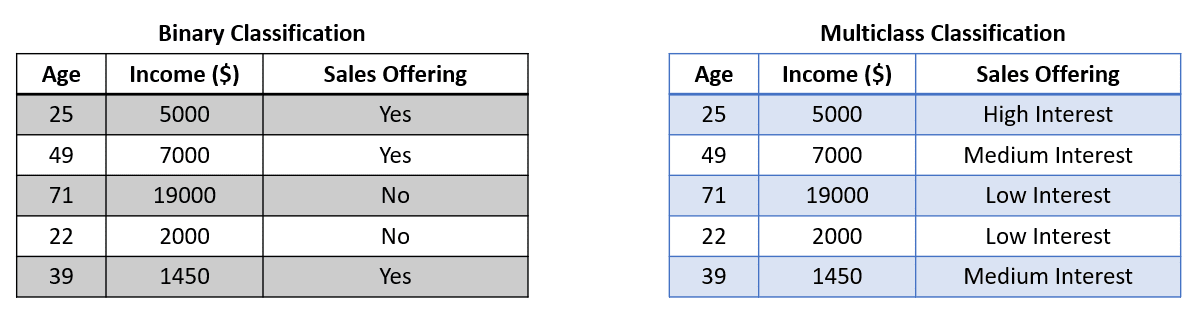
We often encounter classic classification tasks such as binary classification (two labels) and multiclass classification (more than two labels). In this case, we would train the classifier, and the model would try to predict one of the labels from all the available labels. The dataset used for the classification is similar to the image below.
Multilabel Classification: An Introduction with Python's Scikit-Learn

The image above shows that the target (Sales Offering) contains two labels in Binary Classification and three in the Multiclass Classification. The model would train from the available features and then output one label only.

Multilabel Classification is different from Binary or Multiclass Classification. In Multilabel Classification, we don’t try to predict only with one output label. Instead, Multilabel Classification would try to predict data with as many labels as possible that apply to the input data. The output could be from no label to the maximum number of available labels.

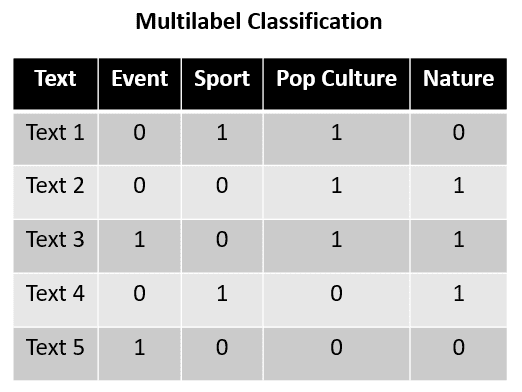
Multilabel Classification is often used in the text data classification task. For example, here is an example dataset for Multilabel Classification.
Multilabel Classification: An Introduction with Python's Scikit-Learn

In the example above, imagine Text 1 to Text 5 is a sentence that can be categorized into four categories: Event, Sport, Pop Culture, and Nature. With the training data above, the Multilabel Classification task predicts which label applies to the given sentence. Each category is not against the other as they are not mutually exclusive; each label can be considered independent.

For more detail, we can see that Text 1 labels Sport and Pop Culture, while Text 2 labels Pop Culture and Nature. This shows that each label was mutually exclusive, and Multilabel Classification can have prediction output as none of the labels or all the labels simultaneously.

With that introduction, let’s try to build Multiclass Classifier with Scikit-Learn.

Multilabel Classification with Scikit-Learn

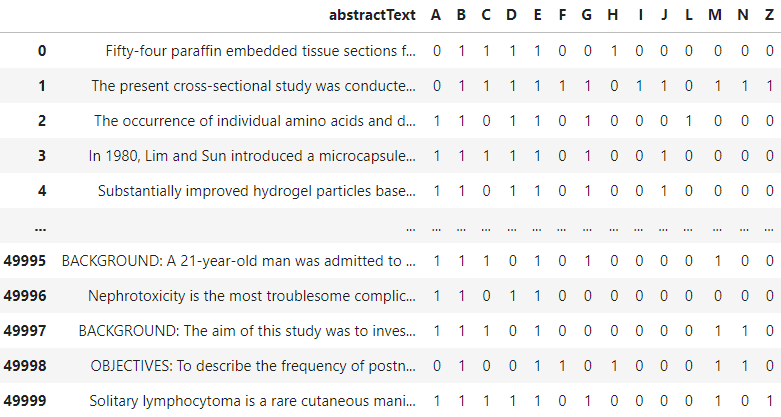
This tutorial will use the publicly available Biomedical PubMed Multilabel Classification dataset from Kaggle. The dataset would contain various features, but we would only use the abstractText feature with their MeSH classification (A: Anatomy, B: Organism, C: Diseases, etc.). The sample data is shown in the image below.
Multilabel Classification: An Introduction with Python's Scikit-Learn

The above dataset shows that each paper can be classified into more than one category, the cases for Multilabel Classification. With this dataset, we can build Multilabel Classifier with Scikit-Learn. Let’s prepare the dataset before we train the model.

import pandas as pd  from sklearn.feature_extraction.text import TfidfVectorizer    df = pd.read_csv('PubMed Multi Label Text Classification Dataset Processed.csv')  df = df.drop(['Title', 'meshMajor', 'pmid', 'meshid', 'meshroot'], axis =1)    X = df["abstractText"]  y = np.asarray(df[df.columns[1:]])    vectorizer = TfidfVectorizer(max_features=2500, max_df=0.9)  vectorizer.fit(X)

In the code above, we transform the text data into TF-IDF representation so our Scikit-Learn model can accept the training data. Also, I am skipping the preprocessing data steps, such as stopword removal, to simplify the tutorial.

After data transformation, we split the dataset into training and test datasets.

from sklearn.model_selection import train_test_split  X_train, X_test, y_train, y_test = train_test_split(X, y, test_size=0.2, random_state=101)      X_train_tfidf = vectorizer.transform(X_train)  X_test_tfidf = vectorizer.transform(X_test)

After all the preparation, we would start training our Multilabel Classifier. In Scikit-Learn, we would use the MultiOutputClassifier object to train the Multilabel Classifier model. The strategy behind this model is to train one classifier per label. Basically, each label has its own classifier.

We would use Logistic Regression in this sample, and MultiOutputClassifier would extend them into all labels.

from sklearn.multioutput import MultiOutputClassifier  from sklearn.linear_model import LogisticRegression    clf = MultiOutputClassifier(LogisticRegression()).fit(X_train_tfidf, y_train)

We can change the model and tweak the model parameter that passed into the MultiOutputClasiffier, so manage according to your requirements. After the training, let’s use the model to predict the test data.

prediction = clf.predict(X_test_tfidf)  prediction
Multilabel Classification: An Introduction with Python's Scikit-Learn

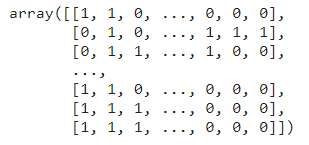
The prediction result is an array of labels for each MeSH category. Each row represents the sentence, and each column represents the label.

Lastly, we need to evaluate our Multilabel Classifier. We can use the accuracy metrics to evaluate the model.

from sklearn.metrics import accuracy_score  print('Accuracy Score: ', accuracy_score(y_test, prediction))

Accuracy Score: 0.145

The accuracy score result is 0.145, which shows that the model only could predict the exact label combination less than 14.5% of the time. However, the accuracy score contains weaknesses for a multilabel prediction evaluation. The accuracy score would need each sentence to have all the label presence in the exact position, or it would be considered wrong.

For example, the first-row prediction only differs by one label between the prediction and test data.
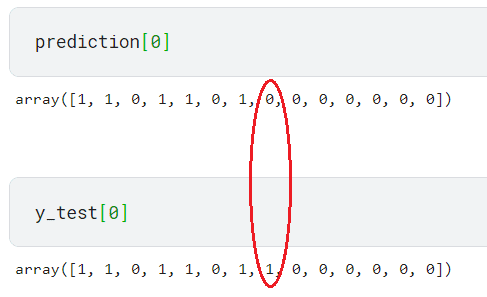
Multilabel Classification: An Introduction with Python's Scikit-Learn

It would be considered a wrong prediction for the accuracy score as the label combination differs. That is why our model has a low metric score.

To mitigate this problem, we must evaluate the label prediction rather than their label combination. In this case, we can rely on Hamming Loss evaluation metric. Hamming Loss is calculated by taking a fraction of the wrong prediction with the total number of labels. Because Hamming Loss is a loss function, the lower the score is, the better (0 indicates no wrong prediction and 1 indicates all the prediction is wrong).

from sklearn.metrics import hamming_loss  print('Hamming Loss: ', round(hamming_loss(y_test, prediction),2))

Hamming Loss: 0.13

Our Multilabel Classifier Hamming Loss model is 0.13, which means that our model would have a wrong prediction 13% of the time independently. This means each label prediction might be wrong 13% of the time.

Conclusion

Multilabel Classification is a machine-learning task where the output could be no label or all the possible labels given the input data. It’s different from binary or multiclass classification, where the label output is mutually exclusive.

Using Scikit-Learn MultiOutputClassifier, we could develop Multilabel Classifier where we train a classifier to each label. For the model evaluation, it’s better to use Hamming Loss metric as the Accuracy score might not give the whole picture correctly.
Cornellius Yudha Wijaya is a data science assistant manager and data writer. While working full-time at Allianz Indonesia, he loves to share Python and Data tips via social media and writing media.

More On This Topic

  • Getting Started with Scikit-learn for Classification in Machine Learning
  • Simplifying Decision Tree Interpretability with Python & Scikit-learn
  • Introduction to Binary Classification with PyCaret
  • Using Scikit-learn's Imputer
  • K-nearest Neighbors in Scikit-learn
  • Implementing Adaboost in Scikit-learn

Many A Generative AI Tricks Up Amazon’s Sleeves

On Thursday’s Q2 2023 earnings call, Amazon CEO Andy Jassy revealed that “Every single one” of Amazon’s businesses has “multiple generative AI initiatives going right now”. Founded as a retail store company, Amazon has been more focused on developing other AI-based products than its flagship e-commerce search in the recent past.

Over the past few months, the company has made several announcements and investments to accelerate through generative AI. During the AWS Summit in New York last week, the company launched Agents for Bedrock, for companies to use their own data to build AI apps that can automatically do tasks on their own foundational models, like image-to-text models or large language models, instead of just telling them about it. AI agents are the assistants which can actually do the job instead of just giving suggestions. For instance, an agent will book a flight instead of just giving a list of the cheapest available options.

Other AWS announcements include bringing generative AI to healthcare through AWS HealthScribe and a partnership with Nvidia allowing AWS to handle larger amounts of memory and data by using Nvidia H100 Tensor Core GPUs.

Last month, the Bezos-owned company also made an announcement to invest $100 million in a AWS Generative AI Innovation Center, to help customers build and deploy generative AI solutions.

“Alexa, Reboot Yourself”

While the company has been internally transforming its AI force, they have also been hiring for Alexa AI from candidates with background in dialogue systems or information retrieval. Earlier this year in May, based on a leaked document titled “Alexa LLM Entertainment Use Cases,” the big tech plans to reboot Alexa the voice assistant with ChatGPT-like features. An internal memo described a goal of making the voice assistant smarter, stating users should feel “like Alexa is thinking vs. fetching from a database.”

These job posts clearly state that Amazon intends to overhaul its venerable voice assistant search feature. The current SVP of Amazon Devices & Services David Limp announced last month on LinkedIn that it will be hosting an event to presumably launch new devices on September 20th at the new HQ2 in Arlington, VA.

The partnership between HuggingFace and AWS gives further confidence that Amazon has something up its sleeve to boost users’ conversational experience with Alexa.

Looking out for Search

While the company’s voice assistant took Silicon Valley by a storm, the company’s bread and butter since day one has been e-commerce. Even though the retail giant’s search experience has been long criticised for ads bombarding the result page, the company is finally concerned about the feature.

Earlier this year, the company had also posted job listings for a machine learning-focused engineer describing how it is “reimagining Amazon Search” with a new “interactive conversational experience” to answer product questions, compare products, personalise suggestions, and more.

In June, the retail giant began testing a feature in its shopping app that uses AI to summarise reviews left by customers on some products. It provides a brief summary of what users liked and disliked about the product, along with a disclaimer that the overview is “AI-generated from the text of customer reviews.”

The recent frenzy around generative AI and chatbots like OpenAI’s ChatGPT, Google’s Bard and Microsoft’s Bing has pushed Amazon to sharpen its focus on the technology. The company which has been able to sell anything and everything since day one is now more involved in the AI field than ever. Across all verticals from Alexa to Code Whisperer, it is trying to step up its game. In the big picture, the IT giant is hustling with its generative AI agenda to keep up with its rivals’ efforts to hold the users’ attention.

The post Many A Generative AI Tricks Up Amazon’s Sleeves appeared first on Analytics India Magazine.

Microsoft’s Cybersecurity at Big Risk, Tenable CEO Raises Red Flag

In March 2023, an engineer at Tenable, a cybersecurity firm, discovered an issue with Microsoft Azure Platform which enabled an unauthenticated attacker to access cross-tenant applications and sensitive data, such as authentication secrets. “To give you an idea of how bad this is, our team very quickly discovered authentication secrets to a bank. They were so concerned about the seriousness and the ethics of the issue that we immediately notified Microsoft,” Amit Yoran, chairman and CEO, Tenable, said in a blog post.

The cyber security breach at the tech giant has raised a big concern even for the US government. Last week, US Senator Ron Wyden urged the Cybersecurity and Infrastructure Security Agency (CISA) and the Department of Justice and the Federal Trade Commission (FTC) to hold Microsoft accountable for negligent cybersecurity practices, facilitating Chinese espionage against the US government.

“Microsoft’s lack of transparency applies to breaches, irresponsible security practices and to vulnerabilities, all of which expose their customers to risks they are deliberately kept in the dark about,” Yoran, who previously served as the national cyber security director to the George W Bush administration, said.

Did Microsoft rectify it?

Even though Microsoft quickly acknowledged and confirmed the issue in a few days time, it took them around three months to acknowledge again that the issue is fixed. Tenable reported the issue to Microsoft on March 30th 2023 and Microsoft confirmed that the issue was resolved on July 6th 2023. But soon, Tenable found out that the fix is incomplete.

“They took more than 90 days to implement a partial fix – and only for new applications loaded in the service. That means that as of today, the bank I referenced is still vulnerable, more than 120 days since we reported the issue, as are all of the other organisations that had launched the service prior to the fix,” Yoran said.

He further goes on to say that, to the best of his knowledge, most of these Microsoft Azure users have no clue about the vulnerability, and hence, can’t make any informed decision about compensating controls and other risk mitigating actions. “Cloud providers have long espoused the shared responsibility model. That model is irretrievably broken if your cloud vendor doesn’t notify you of issues as they arise and apply fixes openly.”

Interestingly this is not the first time Yoran criticised Microsoft’s cybersecurity practices. In 2022, he wrote another different blog post highlighting other vulnerabilities in Microsoft’s Azure platform. “This is a repeated pattern of behaviour. Several security companies have written about their vulnerability notification interactions with Microsoft, and Microsoft’s dismissive attitude about the risk that vulnerabilities present to their customers,” he said, back then.

Cybersecurity in the age of generative AI

Since the launch of ChatGPT by OpenAI late last year, Microsoft has almost toppled Google to emerge as the leader in AI. Microsoft is bringing generative AI capabilities not only through Azure, but also through its products such as Windows, Dynamics 365. However, generative AI is also bringing in new cybersecurity challenges. Recently, Indian IT giant Wipro, through a report titled State of Cybersecurity Report 2023’, revealed that the rise of sophisticated new technologies like generative AI is creating a widening cyber resiliency gap within many enterprises.

Today, many enterprises across the globe are leveraging OpenAI’s GPT models through Microsoft Azure’s OpenAI services, because it allows enterprises to run these models in a more confined manner. However, generative AI is also creating newer cybersecurity risks.“While there’s so much attention being placed on the use and availability of generative AI, ransomware groups continue to wreak havoc and find success at breaching organisations around the world,” Satnam Narang, senior staff research engineer at Tenable, previously told AIM.

Moreover, earlier this year, researchers from Saarland University presented a paper on prompt engineering attacks in chatbots. They discovered a method to inject prompts indirectly, using ‘application-integrated LLMs’ like Bing Chat and GitHub Copilot, expanding the attack surface for hackers. Injected prompts can collect user information and enable social engineering attacks.

Amidst heavy investment in cybersecurity by Microsoft, concerns arise about their effectiveness in protecting customers from generative AI-related threats.

The post Microsoft’s Cybersecurity at Big Risk, Tenable CEO Raises Red Flag appeared first on Analytics India Magazine.

Now You Can Run Stable Diffusion on Apple Silicon

Now You Can Run Stable Diffusion on Apple Silicon

In a significant move to advance the capabilities of their machine learning framework, Apple has announced the open-sourcing of Core ML Stable Diffusion XL (SDXL) for its cutting-edge Apple Silicon architecture. The new model, which has grown threefold in size, boasting around 2.6 billion parameters, brings a host of powerful features that enhance performance while maintaining efficiency.

Click here to check out the GitHub repository.

SDXL has been a topic of much anticipation and speculation among developers and machine learning enthusiasts, and with its open-sourcing today, the excitement is reaching new heights.

Stable Diffusion XL with Core ML on Apple Silicon! #SDXL The model grew 3x in size to ~2.6 billion parameters so we are releasing a new model compression technique that yields variants quantized to as little as 3 bits with minimal output difference 🧵 pic.twitter.com/f4RxdidfdN

— Atila (@atiorh) July 27, 2023

One of the highlights of this release is the new model compression technique, which enables variants of SDXL to be quantised to as little as 3 bits with minimal output difference. This breakthrough paves the way for faster and more efficient inference on Apple Silicon devices.

Since the announcement, the GitHub repository for Core ML Stable Diffusion has garnered an astounding 15,000 stars, indicating the keen interest and support from the developer community.

To ensure a seamless user experience, Apple has gone the extra mile to include SDXL support in both the conversion and inference package, allowing developers to easily integrate it into their workflows. The company has also provided SDXL support in a new demo app, showcasing the capabilities of the model and the power of Core ML on Mac.

Stable Diffusion XL running on Mac using Core ML and advanced quantization techniques!
Open-sourced today:
– SDXL support in Apple's conversion & inference package.
– SDXL support in our demo app.
– New mixed-bit quantization for Core ML.
– Core ML models ready for use.
Phew 😅 pic.twitter.com/rm0NoY6Ddg

— Pedro Cuenca (@pcuenq) July 28, 2023

Apple’s commitment to providing top-of-the-line machine learning tools is further evident with the introduction of mixed-bit quantisation for Core ML. Earlier this year, Apple also had an open source Transformer model for Apple Silicon to further innovation in large language models. Now with Stable Diffusion, Apple is garnering all the love from its developer ecosystem.

The post Now You Can Run Stable Diffusion on Apple Silicon appeared first on Analytics India Magazine.

The Threat Of Climate Misinformation Propagated by Generative AI Technology

The Threat Of Climate Misinformation Propagated by Generative AI Technology

Artificial intelligence (AI) has transformed how we access and distribute information. In particular, Generative AI (GAI) offers unprecedented opportunities for growth. But, it also poses significant challenges, notably in climate change discourse, especially climate misinformation.

In 2022, research showed that around 60 Twitter accounts were used to make 22,000 tweets and spread false or misleading information about climate change.

Climate misinformation means inaccurate or deceptive content related to climate science and environmental issues. Propagated through various channels, it distorts climate change discourse and impedes evidence-based decision-making.

As the urgency to address climate change intensifies, misinformation propagated by AI presents a formidable obstacle to achieving collective climate action.

What is Climate Misinformation?

False or misleading information about climate change and its impacts is often disseminated to sow doubt and confusion. This propagation of inaccurate content hinders effective climate action and public understanding.

In an era where information travels instantaneously through digital platforms, climate misinformation has found fertile ground to propagate and create confusion among the general public.

Mainly there are three types of climate misinformation:

  • Trend: Spreading false information about the long-term patterns and changes in global climate, often to downplay the seriousness of climate change.
  • Attribution: Misleadingly assigning climate events or phenomena to unrelated factors, obscuring the actual influence of human activities on climate change.
  • Impact: Exaggerating or understating the real-world consequences of climate change, either to incite fear or promote complacency regarding the need for climate action.

In 2022, several disturbing attempts to spread climate misinformation came to light, demonstrating the extent of the challenge. These efforts included lobbying campaigns by fossil fuel companies to influence policymakers and deceive the public.

Additionally, petrochemical magnates funded climate change denialist think tanks to disseminate false information. Also, corporate climate “skeptic” campaigns thrived on social media platforms, exploiting Twitter ad campaigns to spread misinformation rapidly.

These manipulative campaigns seek to undermine public trust in climate science, discourage action, and hinder meaningful progress in tackling climate change.

How is Climate Misinformation Spreading with Generative AI?

How is Climate Misinformation Spreading with Generative AI?

Image Source

Generative AI technology, particularly deep learning models like Generative Adversarial Networks (GANs) and transformers, can produce highly realistic and plausible content, including text, images, audio, and videos. This advancement in AI technology has opened the door for the rapid dissemination of climate misinformation in various ways.

Generative AI can make up stories that aren't true about climate change. Although 5.18 billion people use social media today, they are more aware of current world issues. But, they are 3% less likely to spot false tweets generated by AI than those written by humans.

Some of the ways generative AI can promote climate misinformation:

1. Accessibility

Generative AI tools that produce realistic synthetic content are becoming increasingly accessible through public APIs and open-source communities. This ease of access allows for the deliberate generation of false information, including text and photo-realistic fake images, contributing to the spread of climate misinformation.

2. Sophistication

Generative AI enables the creation of longer, authoritative-sounding articles, blog posts, and news stories, often replicating the style of reputable sources. This sophistication can deceive and mislead the audience, making it difficult to distinguish AI-generated misinformation from genuine content.

3. Persuasion

Large language models (LLMs) integrated into AI agents can engage in elaborate conversations with humans, employing persuasive arguments to influence public opinion. Generative AI's ability to generate personalized content is undetectable by current bot detection tools. Moreover, GAI bots can amplify disinformation efforts and enable small groups to appear larger online.

Hence, it is crucial to implement robust fact-checking mechanisms, media literacy programs, and close monitoring of digital platforms to combat the dissemination of AI-propagated climate misinformation effectively. Strengthening information integrity and critical thinking skills empowers individuals to navigate the digital landscape and make informed decisions amidst the rising tide of climate misinformation.

Detecting & Combating AI-Propagated Climate Misinformation

Though AI technology has facilitated the rapid spread of climate misinformation, it can also be part of the solution. AI-driven algorithms can identify patterns unique to AI-generated content, enabling early detection and intervention.

However, we are still in the early stages of building robust AI detection systems. Hence, humans can take the following steps to minimize the risk of climate misinformation:

  • Increase Vigilance: As AI fact-checking apps are still evolving, users must be vigilant in verifying the information they encounter. Instead of automatically publishing results from AI searches on social media, identify and evaluate reliable sources. Checking the sources is essential when dealing with important subjects like combating climate change.
  • Evaluate Fact-Checking Methods: Accept lateral reading, a technique expert fact-checkers use. Search for information on the sources cited in AI-generated content in a new window. Analyze the reliability of the sources and the authors' experience. Use conventional search engines to locate and assess the consensus among experts on the subject.
  • Evaluate the Evidence: Dig deeper into the evidence presented in AI-generated claims. Examine whether reliable scientific consensus and study support or disprove the statements. Quick inquiries to AI platforms might yield some preliminary data, but in-depth investigation is required to reach reliable results.
  • Don't Rely Solely on AI: Given AI systems' tendency to occasionally produce hallucinated or inaccurate information, it becomes imperative not to rely solely on AI. To ensure precision and accuracy in your knowledge, complement AI-generated material with diligent cross-verification using traditional search engines.
  • Promoting Digital Literacy: Media literacy is also pivotal in empowering individuals to navigate the complex climate discourse. Empowering the public with critical thinking skills enables them to discern misinformation, fostering a more informed and responsible society.

Ethical Dilemmas: Balancing Free Speech & Misinformation Control

In the battle against AI-propagated climate misinformation, upholding ethical principles in AI development and responsible usage is paramount. By prioritizing transparency, fairness, and accountability, we can ensure that AI technologies serve the public good and contribute positively to our understanding of climate change.

To learn more about generative AI or AI-related content, visit unite.ai.

Gorilla Out Performs GPT-4 in Making API Calls

The AI community is abuzz with the launch of Gorilla, a revolutionary language model that brings an unprecedented level of accuracy and functionality to invoking APIs using natural language queries.

Gorilla is an open-source project, licensed under Apache 2.0, and is the result of extensive fine-tuning on Falcon and MPT created by Shishir Patil who is currently a Phd Student in ML systems at UC Berkeley.

📢 Excited to release Gorilla🦍 Gorilla picks from 1000s of APIs to complete user tasks, surpassing even GPT-4! LLMs need to interact with the world through APIs, and Gorilla teaches LLMs APIs. Presenting Gorilla-Spotlight demo🤩
Webpage: https://t.co/QZrtMaYKfa pic.twitter.com/h6aSeofcXu

— Shishir Patil (@shishirpatil_) May 25, 2023

Unlike its predecessors, including the highly acclaimed GPT-4, Gorilla truly stands out by significantly reducing hallucinations and incorrect syntax when interacting with over 1,600 APIs and counting. This achievement is made possible by Gorilla’s capability to parse the Abstract Syntax Tree (AST) when writing code, resulting in semantically and syntactically correct API invocations.

One of the key features that make Gorilla exceptional is its compatibility with commercial use, allowing developers to incorporate it into their projects without any obligations. It’s available for use in various environments, including Google Colab and Command Line Interface (CLI) through pip installation of “gorilla-cli.”

APIBench, a meticulously curated collection of APIs, accompanies Gorilla. This extensive library facilitates easy training and expands the available resources for Gorilla to call upon. Furthermore, the project actively encourages API developers to join the cause and contribute their APIs for inclusion in the ever-growing API store.

For developers and language model enthusiasts, Gorilla represents a remarkable advancement in leveraging large language models for practical purposes. With its capabilities surpassing even the highly-touted GPT-4, Gorilla has emerged as a game-changer in the domain of API integration and usage.

GitHub Repository: https://github.com/ShishirPatil/gorilla

Read the Paper: arXiv

The post Gorilla Out Performs GPT-4 in Making API Calls appeared first on Analytics India Magazine.

Bias-Variance Tradeoff is Killing Your AI Models

Bias-Variance Tradeoff is Killing Your AI Models

Machine learning models have transformed various industries and applications, most importantly their biggest product, large language models (LLMs). But one of the key challenges in building these models is striking the right balance between bias and variance, known as the bias-variance tradeoff. This tradeoff plays a crucial role in the performance of LLMs and aligning them with human values.

Bias and variance are two fundamental sources of error in AI models. They represent the model’s ability to capture the true underlying patterns in the data and generalise well to unseen examples.

Bias refers to the error introduced when a model oversimplifies the underlying patterns in the data. This occurs when the model is underfit. A high bias model is often too simplistic, leading to underfitting. In this case, the model fails to capture important relationships and complexities in the data, resulting in poor performance. Mathematically, bias is the difference between the expected value of the model’s predictions and the true value.

Bias(ŷ) = E(ŷ) – y

where E(ŷ) is the expected value (or average) of all predictions made by the model, and y is the true value.

In the context of LLMs, a high bias would mean that the model struggles to understand the complexities and nuances of natural language because it has not been fed with enough examples to make sense of context. Consequently, it may produce generic and imprecise outputs, limiting its practical applications.

Variance, on the other hand, measures the sensitivity of a model’s predictions to changes in the training data. A high variance model tends to overfit the training data, capturing noise and idiosyncrasies specific to that dataset. Consequently, it fails to generalise well to new, unseen data. Mathematically, variance is the spread between individual predictions and the average prediction.

Var(Y_pred) = Σ [(Y_pred[i] – Y_mean)²] / n

where Y_pred represents the model’s predicted values, Y_mean is the mean of these predictions, and n is the number of data points.

In the context of LLMs, high variance can lead to overconfidence in generating responses that might seem plausible but lack factual accuracy or coherence, thus hallucinating. This happens because the model is fed with so much data that it forcefully tries to align its responses to the desired outcome of the user. This can be particularly problematic when these models are used for critical applications, such as generating medical advice or legal documents.

Finding the balance is the tradeoff

The bias-variance tradeoff is not a straightforward choice between minimising bias or variance; rather, it involves finding the right balance between the two to optimise the model’s performance. Achieving this balance is critical in building high-performing LLMs.

Bias and variance are inversely connected and it is nearly impossible practically to have an ML model with a low bias and a low variance. When we modify the ML algorithm to better fit a given data set, it will in turn lead to low bias but will increase the variance. This way, the model will fit with the data set while increasing the chances of inaccurate predictions. The same applies while creating a low variance model with a higher bias. Although it will reduce the risk of inaccurate predictions, the model will not properly match the data set. Hence it is a delicate balance between both biases and variance.

Models like GPT have billions of parameters, enabling them to process vast amounts of data and learn intricate patterns in language. However, these models are not immune to the bias-variance tradeoff. Moreover, it is possible that the larger the model, the chances of showing bias and variance is higher.

To tackle underfitting, especially when the training data contains biases or inaccuracies it is important to include as many examples as possible. Since these models have enormous capacity, they can memorise and regurgitate specific phrases or biases present in the training data. Consequently, they may generate content that aligns with the training data but lacks diversity or robustness in handling new inputs.

For example, if a model is trained on a biassed dataset that includes stereotypical gender roles, it may generate biassed responses when prompted with gender-specific queries. This can have harmful implications when the model is deployed in real-world applications, perpetuating harmful stereotypes.

On the other hand, over-explanation to models to perfectly align with human values can lead to an overfit model that shows mundane and results that represent only one point of view. This often happens because of RLHF, the key ingredient for LLMs like OpenAI’s GPT, which has often been criticised to be too politically correct when it shouldn’t be.

To mitigate overfitting, various techniques are employed, such as regularisation, early stopping, and data augmentation. LLMs with high bias may struggle to comprehend the complexities and subtleties of human language. They may produce generic and contextually incorrect responses that do not align with human expectations.

For example, an AI model with high bias might fail to understand sarcasm or humour, leading to inappropriate or nonsensical responses in certain situations. Similarly, it may struggle with understanding context and producing relevant responses in conversational settings.

To address both these issues, researchers or developers have to make a tradeoff between bias and variance and decide when to stop fine-tuning and when to increase fine-tuning of a model. Model architectures are continuously refined and fine-tuned using diverse datasets, covering a wide range of linguistic patterns and contexts. Additionally, advancements in pre-training techniques, such as transfer learning and self-supervised learning, help to alleviate bias by exposing the model to a diverse set of linguistic patterns during the pre-training phase.

The post Bias-Variance Tradeoff is Killing Your AI Models appeared first on Analytics India Magazine.