KDnuggets News, August 9: Forget ChatGPT, This New AI Assistant Is Leagues Ahead • 7 Steps to Mastering Data Cleaning and Preprocessing Techniques

Features

  • Forget ChatGPT, This New AI Assistant Is Leagues Ahead and Will Change the Way You Work Forever by Abid Ali Awan
  • 7 Steps to Mastering Data Cleaning and Preprocessing Techniques by Eugenia Anello
  • Fundamentals Of Statistics For Data Scientists and Analysts by Tatev Karen Aslanyan

This Week's Posts

  • I Created An AI App In 3 Days by Jeff Dutton
  • Using SHAP Values for Model Interpretability in Machine Learning by Abid Ali Awan
  • SQL For Data Science: Understanding and Leveraging Joins by Nate Rosidi
  • Multilabel Classification: An Introduction with Python's Scikit-Learn by Cornellius Yudha Wijaya
  • 5 Python Packages For Geospatial Data Analysis by Devashree Madhugiri
  • Inflection-1: The Next Frontier of Personal AI by Nisha Arya
  • The Importance of Data Cleaning in Data Science by Nahla Davies
  • Breaking the Data Barrier: How Zero-Shot, One-Shot, and Few-Shot Learning are Transforming Machine Learning by Christophe Atten
  • CDC Data Replication: Techniques, Tradeoffs, Insights by Petr Nemeth
  • This Week in AI, August 7: Generative AI Comes to Jupyter & Stack Overflow • ChatGPT Updates by KDnuggets

From Around The Web

  • Docker Crash Course for Data Scientists by Data Science Horizons
  • Pioneering Data Observability: Data, Code, Infrastructure, & AI by Toward Data Science
  • 7 AI Projects for All Levels by DataCamp

KDnuggets News

  • Top Posts July 31 – August 6: Forget ChatGPT, This New AI Assistant Is Leagues Ahead

More On This Topic

  • Forget ChatGPT, This New AI Assistant Is Leagues Ahead and Will Change the…
  • 7 Steps to Mastering Data Cleaning and Preprocessing Techniques
  • KDnuggets News, August 31: The Complete Data Science Study Roadmap • 7…
  • KDnuggets™ News 22:n05, Feb 2: 7 Steps to Mastering Machine Learning…
  • Exploring Data Cleaning Techniques With Python
  • KDnuggets News, August 17: How to Perform Motion Detection Using Python •…

India’s Only Fab at Mohali Awaits Transformation

As India continues its efforts to attract foreign chipmaking companies for establishing foundries within the country, the lack of attention towards India’s sole semiconductor fab situated in Mohali, Punjab, over the years is indeed concerning. Established in 1983, the Semi-Conductor Laboratory (SCL) was set up with the primary objective of promoting the indigenous manufacturing of semiconductor devices, integrated circuits, and other electronics components, which are crucial for the electronics industry.

Credited with making chips that have been used for Mangalyaan, India’s Mars Orbiter Mission, SCL is already equipped with industry-grade machinery and production lines. “SCL in India stands as one of the rare semiconductor manufacturers that can proudly claim their chips have journeyed to the moon and Mars,” Anshuman Tripathi, Member of the National Security Advisory Board (NSAB), told AIM.

It possesses the capacity to fabricate 200 millimetres (mm) of silicon wafers using the 180 nanometres (nm) process node at a rate of several thousand units per month. Identifying the need to benefit from the already existing fab, in May 2023, the union government announced a USD 2 billion investment in SCL for commercialisation and modernisation of SCL.

This is a welcoming announcement because India’s semiconductor initiative necessitates the transformation of SCL into a commercial entity. Arun Mampazhy, a semiconductor analyst, emphasises that India’s journey towards semiconductor self-reliance hinges on the revitalisation of SCL, marking it as the starting point for achieving ‘atma nirbhar’ status in this field.

Modernisation without commercialisation is a likely disaster

For quite some time, the government has emphasised the commercialisation and modernisation of SCL. Last year, MeitY initiated a ‘request for proposal’ (RFP) to identify an agency that would serve as a ‘Transaction Cum Legal Adviser’ for the modernisation or commercialisation of SCL. According to Mampazhy, both commercialisation and modernisation, are equally critical, and modernisation without commercialisation will most likely be a disaster.

Nonetheless, the current plan, as reports suggest, is to transform SCL into an entity with volume production and profitable assets. The objective is to expand SCL’s capabilities across semiconductor design, fabrication, testing, and packaging, aiming to enhance competitiveness, quality, and cost-effectiveness across a broader range of products.

“When opting for modernisation, it must be intricately tied to successful commercialisation, a process that should inherently involve various industry stakeholders, including customers, financial institutions, as well as research institutions and universities. Without the involvement of these key stakeholders, genuine commercialisation cannot be effectively achieved.” Ravindra Prakash Dubey, founder and president, IITians4Nation, said.

Mampazhy even emphasises that commercialisation of SCL is, in fact, the most critical part. So far, despite government initiatives and aid, there are no concrete plans for a fab in India as of yet. Initially, the Vendetta-Foxconn joint venture appeared promising; however, the partnership eventually dissolved, leading to indications that both entities are now independently exploring the construction of fabs.

Even though Union Minister Rajeev Chandrasekhar did suggest that an announcement for a fab is imminent, however, for someone to come in and set up a fab, and to ensure it runs at full capacity, it will take many years. Hence, India should look inward and build on its existing capacity. According to Mampazhy, that is a more viable and logical option for India. Previously, according to an Economic Times report from 2020, the Indian Space Research Organisation (ISRO), which managed SCL at that time, planned to build chips with 65-nanometre nodes.

Even though 180 nm chips are used in microprocessors, network equipment, and memory chips, the use of 180 nm chips has decreased over time as more advanced process technologies have been developed. Hence, if SCL can start producing 65 nm chips, as earlier reported, it could be a significant boost to India’s semiconductor ecosystem.

Research: Applied vs Academic

Chandrasekhar also announced an India Semiconductor Research Centre (ISRC) will be set up which will work in collaboration with top institutions like the IITs on cutting-edge semiconductor research. Dubey, who also mentors multiple startup incubations at different IITs, said that linking SCL with the different R&D labs in the country could be the right step in terms of the proposed commercialisation plans. But it is also critical to ensure that the research done should not just languish in books and research papers. Nonetheless, he does add that the research should not languish in books and research papers.

“We should begin by assessing the effectiveness of the Indian research ecosystem in transforming research into practical business ventures or viable solutions,” Tripathi said. Today, one drawback of the research ecosystem in India is that it often does not lead to practical solutions. This is not just limited to semiconductor research, the same can be said in the case of other fields such as AI.

“Moreover, when we talk about research, we must differentiate between applied research and research done by academicians. It’s crucial to distinguish between these two aspects,” Tripathi said. If the aim of ISRC is applied research, then the responsibility shouldn’t lie with academics. “For example, I began my career at STMicroelectronics, where I focused on practical and applied research rather than publishing papers,” Tripathi added.

Mampazhy, on the other hand, raises a further greater concern. He is fearful that the SCL could turn into a research tool at the hands of academics. This could have dire consequences, for example, in a commercial fab, the machines operate continuously around the clock to avoid frequent recalibrations. “Each time these machines are powered on and off, they require recalibration, consuming time and resources, including dummy wafers. The rapid depreciation of machine value also adds to the challenge. In essence, this approach could become a continual financial burden for the government with limited tangible outcomes,” Mampazhy told AIM.

Despite limited orders, SCL possibly maintains a similar operational model with employees working in three shifts(not confirmed). “If ISRC takes charge of SCL and follows the same practice, it might result in inefficient use of energy. However, if it opts to run operations only during the daytime, it raises concerns about potential layoffs affecting a significant portion of the workforce,” he added.

Leadership is key

Moreover, effective leadership is crucial for SCL’s optimal growth. While currently led by a Director, appointing a CEO and possibly a CTO is vital for successful commercialisation. Similarly, the leadership of ISRC and the nature of research are also significant considerations. Given SCL is currently under MeitY, it should not have similar faith as the Indian Semiconductor Mission (ISL), which still hasn’t managed to find a suitable CEO, despite reports in 2022 suggesting that government will hire someone with over 25 years of experience in the semiconductor industry and more than 10 years of experience at a global level.

In a previous interaction with AIM, Mampazhy said, “The CEO is a joint secretary of the Ministry of Electronics and IT (MeitY) and has absolutely no semiconductor background. The CTO is a scientist at MeitY and he too had no real exposure to the semiconductor industry throughout his career.” Hence, it becomes critical that SCL or even ISRC does not go down the same line, and is run by someone with an entrepreneurial mindset. Dubey also concurs, he further adds that an entrepreneur mindset is very important in transforming research into practical business ventures or viable solutions.

The post India’s Only Fab at Mohali Awaits Transformation appeared first on Analytics India Magazine.

Tailor ChatGPT to Fit Your Needs with Custom Instructions

Tailor ChatGPT to Fit Your Needs with Custom Instructions
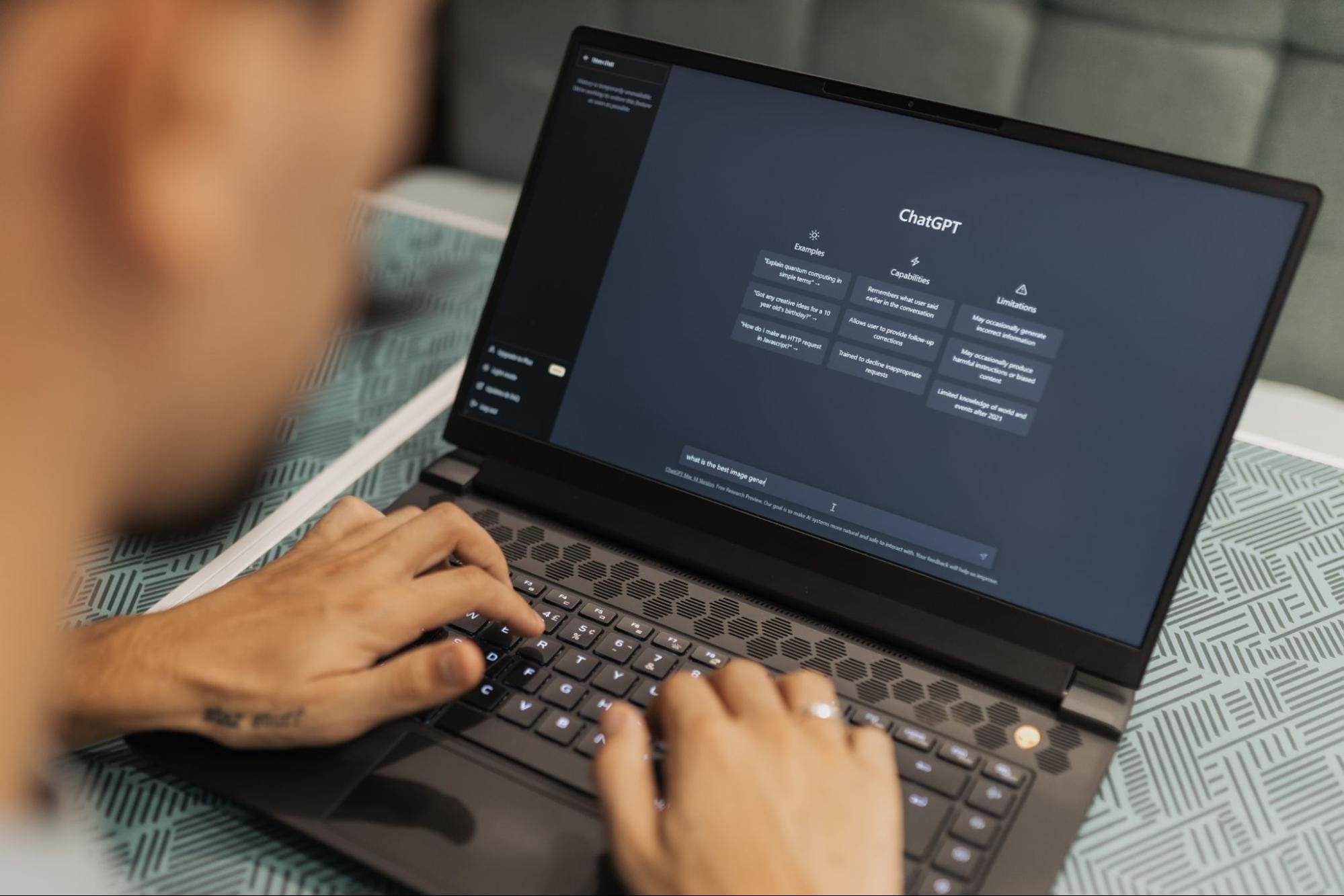
Photo by Matheus Bertelli

Many people have been using ChatGPT for several months now, with many success stories. With many users across 22 countries, OpenAI has been working on fine-tuning its models to understand diverse contexts and provide responses unique to the user. They have been taking into consideration user feedback, for example, the ability to start a ChatGPT conversation afresh and have been looking into solutions.

On the 20th of July, OpenAI announced that they are introducing new processes with custom instructions to tailor ChatGPT to your specific needs.

What are Custom Instructions?

The new beta Custom Instructions feature has been developed to help users get the most out of ChatGPT by preventing them from repeating common instructions between chat sessions. Moving forward, ChatGPT will take into consideration users' custom instructions every time it produces a response. Users will not have to repeat themselves, and continuously tailor their preferences during the conversation.

ChatGPT will remember specific user preferences based on past multiple interactions, as well as allow users to set their individual preferences. Setting preferences will provide specific unique responses, without having to start a new conversation each time.

Let’s look at an example that was provided by OpenAI.

Let’s say you’re a teacher and you are trying to put together a lesson plan. You want to create a lesson plan based on the following question: “What would be three important things to teach about the moon?”.

Without using Custom Instructions, ChatGPT will respond with:

Tailor ChatGPT to Fit Your Needs with Custom Instructions
Screenshot from OpenAI

The above response is very generic, and may not tailor to your specific needs. Now let’s look at how Custom Instructions can improve this.

ChatGPT will ask you the following questions in the Custom Instruction section:

  1. What would you like ChatGPT to know about you to provide better responses?
  2. How would you like ChatGPT to respond?

These questions will allow you to specify your preferences, allowing ChatGPT to use them when making a response.

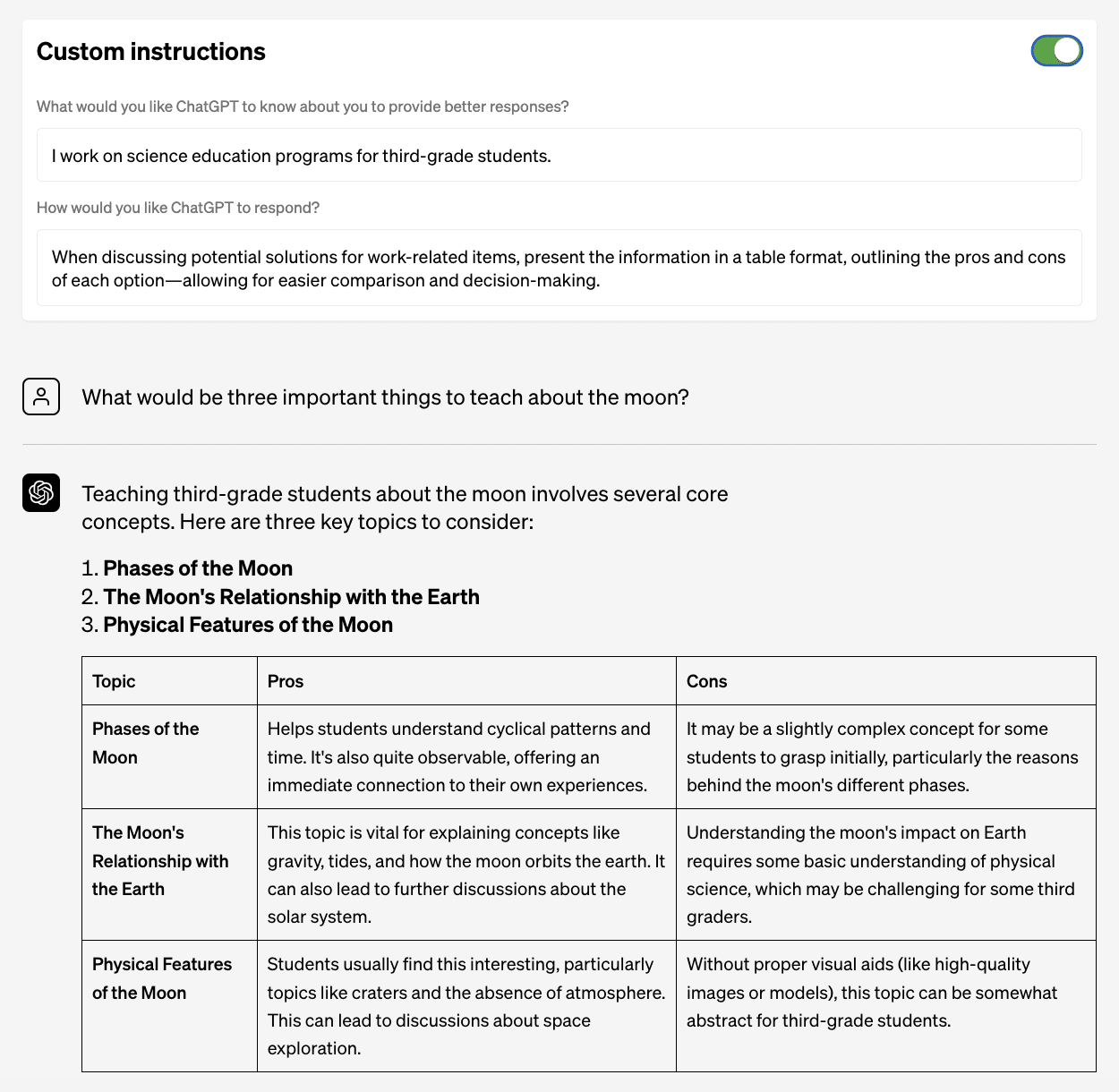
As you can see in the image below, ChatGPT has taken into consideration the user's preferences and tailored its response based on it.

Tailor ChatGPT to Fit Your Needs with Custom Instructions
Screenshot from OpenAI

So much better right? So what are the availability and access steps for this new feature?

Custom Instruction Availability

The Custom Instruction is currently available in beta for ChatGPT Plus members, with OpenAI extending its availability over the next few weeks to all users. As of this writing, the Custom Instruction feature is not yet available in the UK and EU.

During its beta phase, OpenAI stated that ChatGPT will not always be able to interpret custom instructions perfectly.

Custom Instruction Access

If you have ChatGPT Plus, you can access Custom Instructions via the web and iOS.

  1. Web

Click on your name, and go to ‘Settings’. You will then see ‘Beta Features’ and you will need to choose to opt into ‘Custom Instructions’. Once this is done, Custom Instructions will appear in the menu moving forward.

  1. iOS

On the ChatGPT app, go to ‘Settings’. You will then need to click on ‘New Features’ and turn on ‘Custom Instructions’. Once this is done, Custom Instruction will appear in settings.

Wrapping it up

OpenAI is continuously looking at new ways to improve ChatGPT by listening to users' feedback. Users’ custom instructions may be used to help OpenAI improve model performance, however, this can be disabled via data controls.

ChatGPT seems to be improving by the day. What else would you like to see happen with ChatGPT, let us know in the comments below!
Nisha Arya is a Data Scientist, Freelance Technical Writer and Community Manager at KDnuggets. She is particularly interested in providing Data Science career advice or tutorials and theory based knowledge around Data Science. She also wishes to explore the different ways Artificial Intelligence is/can benefit the longevity of human life. A keen learner, seeking to broaden her tech knowledge and writing skills, whilst helping guide others.

More On This Topic

  • Sentiment Analysis API vs Custom Text Classification: Which one to choose?
  • How to Create Custom Real-time Plots in Deep Learning
  • Write and train your own custom machine learning models using PyCaret
  • Introducing OpenChat: The Free & Simple Platform for Building Custom…
  • Visual ChatGPT: Microsoft Combine ChatGPT and VFMs
  • ChatGPT CLI: Transform Your Command-Line Interface Into ChatGPT

Deepset secures $30M to expand its LLM-focused MLOps offerings

Deepset secures $30M to expand its LLM-focused MLOps offerings Kyle Wiggers 7 hours

Deepset, a platform for building enterprise apps powered by large language models akin to ChatGPT, today announced that it raised $30 million in a funding round led by Balderton Capital with participation from GV and Harpoon Ventures.

The proceeds will be put toward expanding Deepset’s products and services and growing its team from around 50 people to 70 to 75 by the end of the year, co-founder and CEO Milos Rusic says.

“In many organizations, data science teams are still the default option for ‘all things AI.’ In reality, a lot of data science teams are restructuring, relearning and reshaping their habits to match the growing demands of the product teams and the end-users in the enterprise,” Rusic told TechCrunch in an email interview. “The industry is shifting from AI labs to AI factories — it’s not anymore about tinkering around, it’s about shipping successful products and value.”

Rusic’s not wrong in implying that data science teams are overworked and overburdened. According to one recent poll, the vast majority of data engineers — the data scientists who prep data for analytics tools — are experiencing burnout, likely to leave their current company for another within 12 months and considering quitting the industry altogether.

The unfortunate state of affairs is likely contributing to challenges around AI development within the enterprise. A 2022 Gartner poll found that only around half of AI projects make the leap from pilot to production and that 53% of machine learning models are never deployed.

Rusic co-launched Deepset with Malte Pietsch and Timo Möller in 2018, bootstrapping the business by training custom natural language processing models for enterprises. The three co-founders closely followed the Transformer AI model architecture developed by Google in 2017, which would go on to form the basis of sophisticated LLMs like ChatGPT and GPT-4.

In 2019, Rusic, Pietsch and Möller released Haystack, an open source framework to build NLP back-end services with Transformers and other LLM architectures. The goal was to provide a collection of tools for software engineers to quickly create LLM-driven applications, Rusic says — particularly applications covering a specific use case, like helping legal teams search across case files.

But Deepset’s ambitions eventually outgrew Haystack.

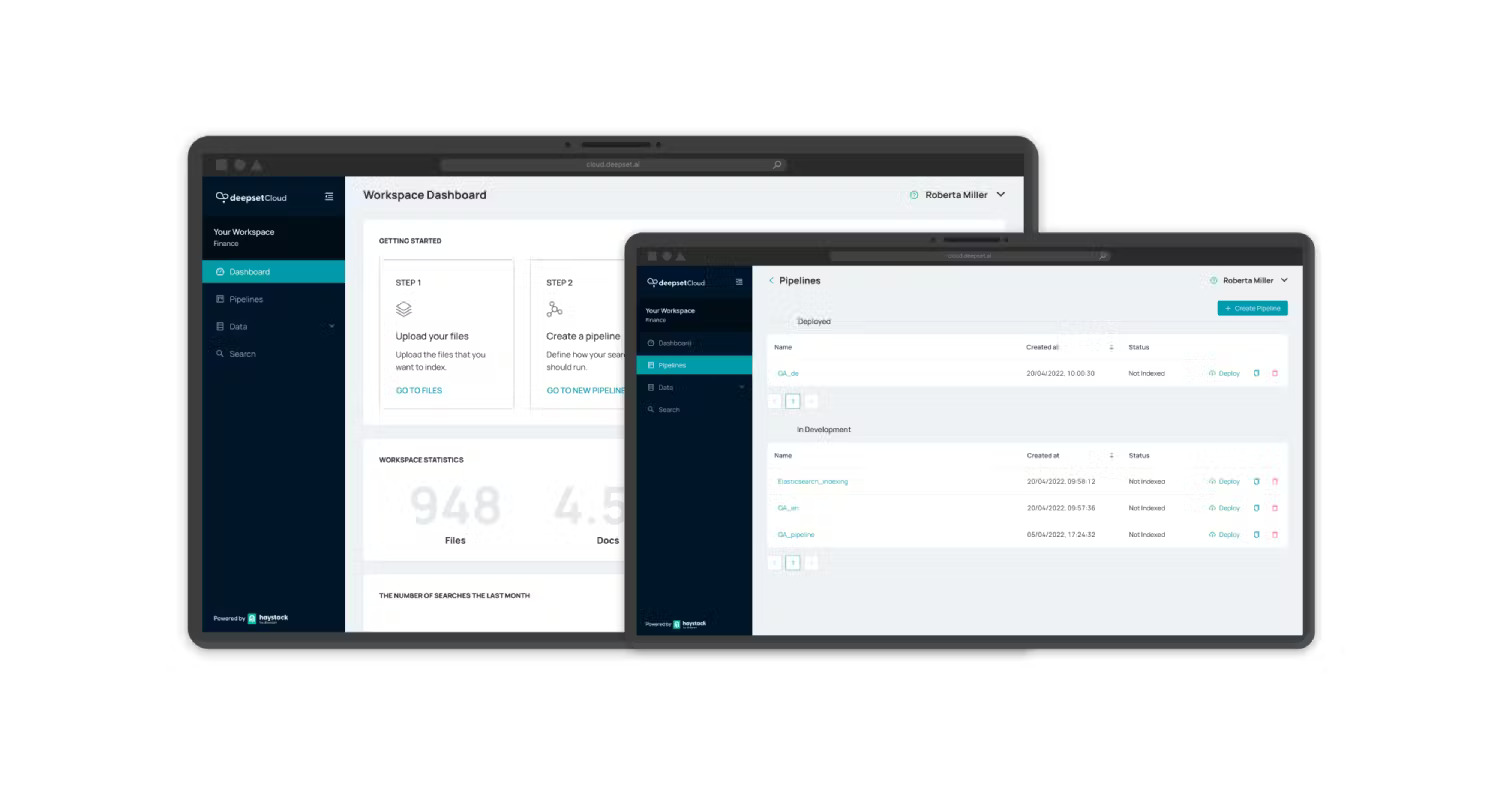
Last year, the startup debuted Deepset Cloud, which Rusic describes as an “enterprise LLM platform for AI teams.” Deepset Cloud extends Haystack by providing a platform where customers can try out different LLMs, embed those LLMs into applications, deploy the applications and LLMs to end users, and perform analyses of the LLMs’ accuracy while continuously monitoring their performance.

Deepset Cloud also includes components for measuring and mitigating common issues with LLMs, like hallucination. Hallucination, which plagues even the best LLMs today, causes models to make up false information or facts that aren’t based on real events or data.

Deepset

A screenshot of Deepset Cloud, Deepset’s new MLOps platform. Image Credits: Deepset Cloud

“Deepset Cloud leverages the open source Haystack technology very heavily — the pipeline architecture, the core components, datastores, integrations and so on,” Rusic explained. “Our platform delivers all the building blocks to avoid doing any ‘undifferentiated heavy-lifting’ and enables developers to focus on shipping NLP back-end services — API-driven, easily composable, easily embeddable and easily monitored.”

Deepset, which has raised a total of $46 million in funding to date, sees vendors competing in the MLOps space as its main rivals. MLOps attempts to streamline the process of building and managing machine learning models by providing tools to address each individual stage of a model’s life cycle.

Besides incumbents such as AWS, Azure and Google Cloud, a growing raft of startups provide MLOps products, platforms and services to enterprise clients. There’s Seldon, which recently raised $20 million; Galileo; McKinsey-owned Iguazio; Diveplane; Arize; and Tecton, to name a few.

Allied Market Research predicts that the sector for MLOps will reach $23.1 billion by 2031, up from around $1 billion in 2021. No doubt, the addressable market’s sheer size will continue to attract new entrants.

But Rusic points to Deepset’s expansion as evidence that it’s standing out from the crowd. The startup has “hundreds” of customer pipelines running on its platform, including workloads for Siemens and Airbus. Legal publishing house Manz tapped Deepset to launch an internal AI-powered tool that helps to surface court documents, related precedents and more. Airbus, meanwhile, is using Haystack to build apps that recommend aircraft operations guidelines to pilots in the cockpit.

“It’s often 10x faster to repeatedly build production-ready NLP and LLM services with Deepset Cloud as opposed to hiring, training and managing a dedicated team for robust back-end application development,” Rusic said. “Deepset Cloud allows customers to use various LLMs simultaneously, combining them in the application architecture to avoid vendor lock-in and mitigating data privacy and model sovereignty issues.”

After HCLTech, Infosys Adds Sonic Identity to Its Brand 

Indian IT giant Infosys today unveiled its sonic brand identity, the auditory equivalent of its blue visual identity and logo.The unique melody, the sonic landscape will be integrated across Infosys’ many platforms used by employees, and across brand assets, ranging from videos to signature events that the company’s clients and the broader community engage with.

Sumit Virmani, EVP and Global Chief Marketing Officer at Infosys, highlighted, “In a digital era where brand interactions largely unfold across virtual spaces, our sonic brand identity becomes an integral reinforcement of our distinct brand character. Beyond this, it’s a conduit for nurturing a profound emotional connection with Infosys, kindling the promise of opportunity creation that underpins our brand’s essence. We envision the sound of Infosys becoming synonymous with the sound of opportunity across diverse markets.”

The company said it cordially invites all stakeholders to embark on a journey to unlock opportunities by engaging with their sonic brand on the dedicated platform. “The resonant response from the audience will be the catalyst for catalyzing transformative digital learning experiences for underprivileged students and aspiring job seekers across India”, the company added.

You can listen to the sonic signature here.

Interestingly, Infosys is not the first Indian company to use sonic identity. Last year HCLTech partnered with Plimsoll to create their unique Sonic Branding. Plimsoll crafted a Sonic Signature, complete with Beam Behavior Effects and a captivating Hero Theme. The distinct sonic identity resonates across HCLTech’s prominent marketing campaigns.

The post After HCLTech, Infosys Adds Sonic Identity to Its Brand appeared first on Analytics India Magazine.
GPU is the New $$$$

GPU is the New $$$$

Remember those early Infosys days when Narayan Murthy and Co. struggled to import computers? The same is happening all over again in the generative AI space, but with GPUs.

Ask the folks in the AI space and they will tell you how much they love their GPUs. Earlier, if someone gave a 10 times bigger computer to a company, it wouldn’t know what to do with it. But now, each company just wants to have the biggest cluster possible and maybe later figure out what to do with it. Well, they would even begin to get more money based on the number of computers they have.

Now instead of just building AI, companies have been using the “hoarded” H100 as currency, to get… guess what? More GPUs! CoreWeave, a cloud computing upstart supported by both NVIDIA and Magnetar Capital, has successfully obtained a substantial $2.3 billion debt arrangement by leveraging the value of NVIDIA’s coveted H100 GPUs. The primary objective behind this financial manoeuvre is to acquire additional premium chips and fund other strategic initiatives.

In simpler terms, NVIDIA’s investment in CoreWeave, a company heavily reliant on NVIDIA’s offerings, has led to the situation where the very NVIDIA products are being utilised as security to facilitate the purchase of more products that are likely to be from NVIDIA’s inventory. Quite remarkable, isn’t it?

CoreWeave was founded to mine Ethereum with the help of NVIDIA GPUs. Now, those same GPUs are being pivoted to work as the base for cloud infrastructure running AI.

Same is the case with AWS Lambda. CEO Stephen Balaban stated, “Lambda has a few thousand more H100s coming online before the end of this year — if you need 64 H100s or more, DM me.” Moreover, Elon Musk also has been hoarding 10,000 GPUs for a long time to build his AI company.

The high-order bit that changed in AI:
"I'll give you 10X bigger computer"
– 10 years ago: I'm not immediately sure what to do with it
– Now: Not only do I know exactly what to do with it but I can predict the metrics I will achieve
Algorithmic progress was necessity, now bonus.

— Andrej Karpathy (@karpathy) August 3, 2023

NVIDIA has been funding almost every AI company in the world. Arguably, apart from gaining profit from the AI of the company, it was so that the companies can buy the H100 GPUs from them. On the other side, the companies were happy with the amount of money they got so that they would be able to build massive AI products. Most of the companies wouldn’t put a hard stop on the amount of compute they needed — the more the merrier.

What has your GPU done for you today?

GPU shortage is no joke. According to Andrej Karpathy, “who gets how many GPUs” is the top gossip of the Silicon Valley right now. At the end, it is up to NVIDIA to decide how they would come up with a plan to address this shortage.

Karpathy had earlier said the same thing, “Today FLOPS is one of the things you can spend $ on. Tomorrow $ is one of the things you can spend FLOPS on.” It is increasingly becoming true. Even Sam Altman posted a few hours later that all he thinks about all day is FLOPs.

Today FLOPS is one of the things you can spend $ on.
Tomorrow $ is one of the things you can spend FLOPS on.
A reading from the church of FLOPS.

— Andrej Karpathy (@karpathy) August 6, 2023

But on the other hand, this bid for debt with GPUs being a collateral is an interesting one. And it gets even more interesting when we think that this shortage is going to be just temporary. NVIDIA has already announced that it is going to release the GH200 GPU that would be almost thrice as powerful as the current H100s. The GH200s will be released to the market in the second quarter of 2024.

Till then, hoarding of H100s becomes the moat for AI companies.

But just how beneficial that would be, is still a question. Eventually, the companies would want the newer GH200 GPUs and not the H100s. So the companies that have huge amounts of H100s would end up selling them to other companies. This would even mean that bigger companies like OpenAI and Google would be able to establish a monopoly in the market by owning the better GPUs by next year, and moving away from H100s.

But this won’t happen until next year. Even then, people would still be using H100s for building AI models, just like developers are using consumer grade GPUs to make AI models.

So, it seems like GPUs are like the new dollar bills in the market right now. Since no one can buy GPUs anymore, tech companies are exchanging GPUs amongst each other to build AI products. This is what the GPUs are doing for the tech world — getting money even without using them.

The post GPU is the New $$$$ appeared first on Analytics India Magazine.

GPU is the New $$$$

GPU is the New $$$$

Remember the early Infosys days, when Narayan Murthy and co. struggled to import computers. The same thing is happening all over again with generative AI, but with GPUs.

Ask any folks in the AI space and they will tell you how much they love their GPUs. Earlier, if someone gave a 10 times bigger computer to a company, it wouldn’t know what to do with it. But now, each company just wants to have the biggest cluster possible and will later figure out what to do with it. Well, they would even begin to get more money based on the amount of computers they have.

Now instead of just building AI, companies have been using the “hoarded” H100 as currency, to get, guess what? More GPUs. CoreWeave, a cloud computing upstart supported by both NVIDIA and Magnetar Capital, has successfully obtained a substantial $2.3 billion debt arrangement by leveraging the value of NVIDIA’s coveted H100 GPUs. The primary objective behind this financial manoeuvre is to acquire additional premium chips and fund other strategic initiatives.

In simpler terms, Nvidia’s investment in CoreWeave, a company heavily reliant on NVIDIA’s offerings, has led to the situation where the very NVIDIA products are being utilised as security to facilitate the purchase of more products that are likely to be from NVIDIA’s inventory. Quite remarkable, isn’t it?

CoreWeave was founded to mine Ethereum with the help of NVIDIA GPUs. Now, those same GPUs are being pivoted to work as the base for cloud infrastructure running AI.

Same is the case with AWS Lambda. CEO Stephen Balaban stated, “Lambda has a few thousand more H100s coming online before the end of this year — if you need 64 H100s or more, DM me.” Moreover, Elon Musk also has been hoarding 10,000 GPUs for a long time to build his AI company.

The high-order bit that changed in AI:
"I'll give you 10X bigger computer"
– 10 years ago: I'm not immediately sure what to do with it
– Now: Not only do I know exactly what to do with it but I can predict the metrics I will achieve
Algorithmic progress was necessity, now bonus.

— Andrej Karpathy (@karpathy) August 3, 2023

NVIDIA has been funding almost every AI company in the world. Arguably, apart from gaining profit from the AI of the company, it was so that the companies can buy the H100 GPUs from them. On the other side, the company’s were happy with the amount of money they got so that they would be able to build massive AI products. Most of the companies wouldn’t put a hard stop on the amount of compute they need – the more the better.

What has your GPU done for you today?

GPU shortage is no joke. According to Andrej Karpathy, “who gets how many GPUs” is the top gossip of the Silicon Valley right now. It is in the end up to NVIDIA to decide how they come up with a plan to address this shortage.

Karpathy had earlier said the same thing, “Today FLOPS is one of the things you can spend $ on. Tomorrow $ is one of the things you can spend FLOPS on.” It is increasingly becoming true. Even Sam Altman posted a few hours later that all he thinks about all day is FLOPs.

Today FLOPS is one of the things you can spend $ on.
Tomorrow $ is one of the things you can spend FLOPS on.
A reading from the church of FLOPS.

— Andrej Karpathy (@karpathy) August 6, 2023

But on the other hand, this bid for debt with GPUs being a collateral is an interesting one. And it gets even more interesting when we think that this shortage is going to be just temporary. NVIDIA has already announced that it is going to release the GH200 GPU that would be almost thrice as powerful as the current H100s. These GH200s will be released to the market in the second quarter of 2024.

Till then, hoarding of H100s becomes the moat for AI companies.

The question of how beneficial that would be is still a question. Eventually, the companies would want the newer GH200 GPUs and not the H100s. So the companies that have huge amounts of H100s would end up selling them to other companies. This would even mean that the bigger companies like OpenAI and Google would be able to establish a further monopoly in the market by owning the better GPUs by next year, and moving away from H100s.

But this won’t happen till next year. Even then, people would still be using H100s for building AI models, just like developers are using consumer grade GPUs to make AI models.

So it seems like GPUs are like the dollar bills in the market right now. Since no one can buy GPUs anymore, tech companies are exchanging GPUs amongst each other to build AI products. This is what the GPUs are doing for the tech world – getting money even without using them.

The post GPU is the New $$$$ appeared first on Analytics India Magazine.
Fixit 2 vs Ruff

“Fixit is dead! Long live Fixit 2,” said Meta, releasing its latest version of our open-source auto-fixing linter. This all new auto-fixing linter was launched with the intention of enhancing developers’ efficiency and competence, encompassing both open-source projects and an extensive array of projects within the internal monorepo. All of this is fine, but how does it fare against Rust-based Ruff, which was released earlier this year?

Amethyst Reese, the project lead and primary engineer for Fixit 2, said on HN, that they are two different linters with very different goals. “Where Ruff prioritises speed over all other concerns, and chooses Rust as the method of achieving that goal with a set of generic lint rules, Fixit is focused on making it easy for Python developers to write custom lint rules,” she added.

Further, she said that use of LibCST (which has a parser written in Rust) makes it easy to build lint rules in Python. She said that Fixit permits engineers to craft specific linting rules within their project repository with minimal content, enabling prompt activation without the need of creating personalised plugins or packages, and without the requirement for rebuilding or deploying a fresh iteration of Fixit. “This lowers the barriers to writing rules, and provides a quick development and feedback cycle when testing them,” she added.

Moreover, she also said that hierarchical configuration allows Fixit to fit well into larger monorepos, with each team able to easily control what lint rules run on their code base. “Open source projects homed in those monorepos also have tools to ensure that results are the same when running on internal vs external CI systems,” she added.

Limitations of Fixit

The auto-fixing linter Fixit, was originally developed for Instagram and later released as an open-source tool, faced limitations. It lacked the capability to accommodate local lint rules or hierarchical configuration, features that were crucial for the monorepo structure hosting a multitude of projects. Requests from developers to incorporate Fixit into the monorepo were numerous; however, various challenges emerged, resulting in only partial support for a limited set of security lint rules. This diminished the direct benefits that could have been derived for the Python codebase.

Considering the AI/ML shift, Meta embarked on a partial rewrite of Fixit where the crucial emphasis was on embracing an open-source-first approach. The new version Fixit 2 meets the requirement of both internal monorepos and open-source projects. This version also introduced support for local, in-repository lint rules similar to those in Flake8, a more refined command-line interface (CLI), and an improved application programming interface (API) to enable seamless integration with other tools and automation. The risk of generating incorrect syntax is eliminated in Fixit 2 and it suggests and provides automated fixes based on the lint rules themselves, enhancing its utility and accuracy in code improvement.

Creating a fresh lint rule requires just a few lines of code, often fewer than twelve, along with inline definition of test cases. Additionally, you have the flexibility to position the rule adjacent to the code it intends to lint, streamlining the process.

Source: engineering.fb

Moving Away from Flake8

At Meta, Python holds a prominent position as one of the most extensively employed programming languages. The company believes that Python’s attributes of having a user-friendly syntax that is easy to understand, and its extensive collection of open-source libraries that provide pre-built functionality, serves as a pivotal tool.

There are a number of effective linters available in a Python ecosystem. At Meta, Flake 8 has been used since 2016 and has proven highly successful in aiding developers to minimise bugs and maintain a well-structured codebase. Flake8 is a widely used Python tool that combines several static analysis tools to check Python code for adherence to coding style and potential errors. As a linter it scans your Python code without actually executing it, helping you catch potential issues and maintain a consistent code style.

The flake8-bugbear plugin, an extension for the Flake8 Python tool that provides additional linting rules to catch potential issues and improvements in Python code, was created by Łukasz Langa, while working at Meta. A prominent figure in the Python community, and a developer who has made significant contributions to various Python projects such as Black and worked as Python Software Foundation developer-in-residence and release manager for Python versions 3.8 and 3.9.

Flake8 has been a cornerstone of our code linting approach, but it has limitations. Creating new linting rules requires complete plugins, leading to complex plugins addressing multiple errors. When linting issues arise, Flake8 only provides location details, lacking suggestions for improvements. Consequently, developers experience trial and error to meet linting standards. Furthermore, Flake8 relies on stdlib ast module, hindering the parsing of new syntax features. Thus, adopting new language features hinges on tool updates, potentially slowing down development.

While Meta has explained about Fixit 2, they did not mention anything about where it stands in terms of speed when compared to other linters. Ruff, which is written in Rust, as opposed to others which are Python-based, is the quickest. Ruff outpaces Flake8 by about 150 times in speed on macOS and surpasses pycodestyle by 75 times, along with outstripping pyflakes and pylint by 50 times, among others. Ruff achieves a swift total processing time of around 60 milliseconds for a single file in CPython, making it notably faster.

Source: GitHub

The post Fixit 2 vs Ruff appeared first on Analytics India Magazine.

Apple Banks on TSMC for iPhone 15 Pro

In the recent earnings report, Apple saw a decline in sales of its three major products— iPhones, iMac and iPads. iPhone sales revenue went down by 2.4% to $39.7 billion in this quarter as compared to the corresponding quarter last year. While Mac Book sales fell by 7.3% to $6.8 billion.

One of the expected reasons for the same can be attributed to the absence of a new processor in them. The iPhone 14 and 14 Plus were powered by Apple’s A15 Bionic chip, the same chip that’s in the iPhone 13 Pro. It seems like Apple is not going to repeat the same mistake this time and is planning to pack a punch in the new Macbook and iPhone 15 Pro.

TSMC’s Generous Deal

When the iPhone 15 Pro launches in September, this year, it is rumored to come up with the A17 chip, Apple’s first ‌ 3nm developed by TSMC.

The ‌3nm‌ node allows transistors to be even more densely packed, resulting in better performance and efficiency. Recently, The Information came out with an interesting revelation which says that TSMC has come up with a sweet deal for Apple through which it would be able to save billions of dollars on iPhone, iPad and Mac chips.

When new and better chip technology like the ‌3nm‌ is introduced, there are often some chips that don’t work perfectly at first. TSMC, the company making these chips for Apple, usually charges for all the chips on a wafer, even the ones that don’t work. But in this new deal, TSMC is only charging Apple for the good chips, and Apple’s big orders help cover the costs of the chips that don’t work, which is unusual.

Apple covers about 25% of TSMC’s revenue, which helps TSMC develop new technology and build the facilities needed to make these chips while testing them on Apple products.The orders from Apple are so big that it makes sense to spend a bit more money to help Apple out.

The strong bond between Apple and TSMC is no shocker, given their nearly decade-long partnership. The journey kicked off around ten years ago when Apple shifted its iPhone’s processor chip production to TSMC. The first Apple designed mobile application processor chip for the iPhone to be manufactured at TSMC was the A8 which began shipping in the Fall of 2014 after Apple broke up with Samsung.

The same thing happened with the Mac when Apple broke up with Intel. The year was 2020 when Apple announced that in the next two years, the company would transition all of its Mac lineup to its own M-series chips, made by TSMC rather than depending on Intel. It’s unlikely that Apple will reignite its relationship with Intel.

Not only this , Apple has recently started trying out its advanced laptop processor called M3 Max. This will lead to the launch of the most powerful MacBook Pro ever in the coming year. The M3 Max chip comes with 16 main processing cores and 40 graphics cores, as reported by Bloomberg, citing a developer of a Mac app who saw the test logs.

This chip will be used in a high-end MacBook Pro laptop, which is expected to be released next year and is known by the codename J514. The M3 chip will be a notable move for Apple, as it’s their first time using a 3-nanometer production process for Mac chips. This change is expected to bring improvements in battery life and better performance. According to Bloomberg, the transition to M3 chips is likely to begin from October.

Will Apple diversify?

Although industry experts think Apple should diversify its chip suppliers beyond TSMC, the reality is that Apple has consistently relied on TSMC for the past ten years. This relationship is symbiotic, where Apple receives top-notch chips and TSMC gains its biggest customer. Apple’s influence is significant, to the extent that TSMC is even considering building a production facility in Arizona, USA. Apple has stated its plan to eventually get chips for iPhones and MacBooks from TSMC’s US plant. It won’t be wrong to say that behind every successful Apple product there is TSMC which is working silently behind the scenes without grabbing any limelight.

The post Apple Banks on TSMC for iPhone 15 Pro appeared first on Analytics India Magazine.

Apple Music finally adds personalized recommendations, while Spotify expands AI DJ

Spotify and Apple Music apps on a phone

The Apple Music and Spotify rivalry is a tale as old as time. Both music streaming services continuously add new features to optimize users' listening experiences and hopefully get some people to convert from one platform to the other. Recently, both platforms did it again.

Apple just added its first personalized new music discovery playlist for users. Although this is a feature that Spotify users have been able to take advantage of for years, Apple Music users, like myself, have been eagerly anticipating this feature, and it's finally here.

Also: The best noise-canceling earbuds for deep work

As first spotted by Apple Insider, the Discovery station will live next to the "(Your name) Station" in the "Listen Now" tab of the app.

The difference between this station and the "(Your name) Station" is that it will use your listening patterns to algorithmically compile new music on a playlist that aligns with your music taste instead of creating a playlist with just music in your library.

The station is available only to select users, and Apple has yet to announce the feature or share details. However, MacRumors found a direct link that you can click on to access the feature and your Discovery Station.

While Apple plays catch-up, Spotify expands access to its AI-powered DJ custom music feature. Spotify's AI DJ creates custom music selections accompanied by the commentary of a realistic voice that provides insightful facts about what you are listening to.

Also: The best headphones for music

The feature was initially available in beta just in North America. However, Spotify is now expanding the feature to over 50 markets around the world, including select markets in Europe, Asia, Africa, Australia, and New Zealand.

Since the feature is still in beta, only Spotify Premium users can access it in their Spotify mobile app on iOS and Android. The feature lives in the "Music feed" tab on Spotify's home, where users can click "DJ" to access the feature.

Artificial Intelligence