Merkle Introduces Generative AI Powered GenCX to Revamp Customer Experiences

Dentsu’s prominent customer experience management (CXM) company Merkle has introduced Merkle GenCX, a new service that employs generative AI to enhance customer experiences significantly. Developed within dentsu’s robust Azure OpenAI framework and a secure private environment, this solution utilises AI to analyse substantial amounts of brands’ internal data. This enables the creation of connected customer experiences by gaining deeper insights into customer interactions, behaviors, sentiments, and engagements.

As data continues to expand exponentially and the demand for personalised experiences rises, brands are confronted with the task of effectively utilising their own data. Merkle’s GenCX solution addresses this challenge by constructing extensive knowledge models and harnessing the capabilities of LLMs using their clients’ exclusive data resources. These insights drive improvements in targeting, audience segmentation, creative development, and campaign recommendations through an intuitive chat-based interface. This not only enhances the speed and accuracy of results but also empowers marketers to make more efficient decisions.

Under the Hood

Generative AI models, like those used by Merkle GenCX, are capable of being trained on extensive sets of performance data. They can effectively analyse the complex relationships among various factors, allowing marketers to extract valuable insights from the data. Through the integration of AI-driven insights and decision-making into every customer interaction, brands can enhance the quality of customer experiences. Merkle GenCX harnesses this potential to swiftly create data-driven target audiences and segments, and it can extract valuable business insights from natural language in real time.

As the influence of AI continues to expand, brands have a significant opportunity to utilize this technology for crafting personaliSed and relevant experiences on a large scale. By leveraging their own firsthand data, Merkle GenCX empowers clients to engage with their customers on a more human level, granting them a distinctive competitive edge. Shirli Zelcer, the global head of analytics and data platforms at Merkle, highlights how GenCX enables brands to capitalize on AI, ultimately fostering meaningful connections and gaining a prominent market advantage.

Merkle’s AI & Analytics Play

“Back in the day, we used machine learning methodologies mostly in the predictive modelling space. And now, we use it for natural language processing, image recognition, next-best actions and decisions, and personalised customer experiences. AI has a role in all those different things. It’s not just about modelling anymore, it’s really about taking all of the data from every touch point and being able to process and analyse it and use it in different ways,” said Shirli Zelcer, global head of analytics, Merkle.

According to Shirli, there is a lack of sufficient discussions concerning the ethical aspects of AI. In the past, before the prevalence of machine learning and AI, transparency was higher in model-building processes. As per her, one could easily comprehend the data used, attributes within the model, their relationships, interactions, and their impact on the final algorithm. However, the introduction of new methodologies like machine learning led to a neglect of these considerations.

She added that in the present cultural context, ensuring the absence of underlying bias has gained significant importance. However, in machine learning and AI, attributes incorporated into models can inadvertently represent biases or variables might combine unexpectedly, resulting in unintended bias.

Trusted by Fortune 1000 corporations and global non-profits, Merkle is headquartered in Columbia, Maryland, and operates in more than 50 offices spanning the America, EMEA, and APAC regions. With a workforce exceeding 14,000 individuals, Merkle synergises data, technology, and analytics alongside consumer insights to craft exceptionally personalised marketing approaches. Moreover, the company harnesses the expertise of specialized marketing professionals spanning consulting, creativity, media, analytics, data, identity, CX/commerce, technology, as well as loyalty and promotions to fine-tune its solutions for optimal results.

Read more: How Merkle Implements Ethical AI

The post Merkle Introduces Generative AI Powered GenCX to Revamp Customer Experiences appeared first on Analytics India Magazine.


Microsoft Azure AI Adds GPT-4 and New Virtual Machines

A brain on circuitry representing AI.
Image: putilov_denis/Adobe Stock

Microsoft and OpenAI have gone hand-in-hand for a long time, from Microsoft’s initial funding of the company behind ChatGPT to embedding GPT services inside the Azure AI platform. Azure OpenAI Service is at the “forefront” of a generative AI transformation that includes GPT-4, while the Azure AI infrastructure is the “backbone,” the Redmond tech giant wrote in a blog post detailing updates to the Azure AI platform on Monday.

Two big changes — new offerings from OpenAI and upgraded virtual machine hardware — show Microsoft’s ongoing commitment to putting generative AI in play in more ways.

Jump to:

  • New models, including GPT-4, come to Azure OpenAI
  • What new NVIDIA-powered VMs mean for Azure customers
  • Red teaming needs to adapt to the behaviors of generative AI
  • Competitors to Azure AI

New models, including GPT-4, come to Azure OpenAI

OpenAI’s GPT-4 and GPT-35-Turbo will now be available through Azure OpenAI Service in four new regions: eastern Canada, eastern Japan, southern U.K. and an additional swath of the eastern U.S. (East US 2 on the availability map). GPT-4 is the most advanced generative AI model available from OpenAI today.

Azure OpenAI Service has about 11,000 customers who use it for tasks such as customer service, writing content and analyzing documents.

“What we’re seeing is that the ChatGPT editor [from Azure OpenAI] is helping users create content that is more relevant, personalized, even more creative,” Aprimo chief product officer Kevin Souers said.

Existing Azure OpenAI customers can now join a waitlist for access to GPT-4.

SEE: Threat actors spun ChatGPT out into the malicious WormGPT. Learn about this and other possible ChatGPT-related security risks. (TechRepublic)

What new NVIDIA-powered VMs mean for Azure customers

A new virtual machine series, the Azure ND H100 v5, are now generally available in the East U.S. and South Central U.S. Azure regions for existing enterprise customers. These VMs are designed to help organizations design and run generative AI applications.

The new hardware, NVIDIA H100 Tensor Core GPUs and NVIDIA Quantum-2 InfiniBand networking, is tuned for AI performance. The low-latency networking includes NVIDIA Quantum-2 ConnectX-7 InfiniBand with 400Gb/s per GPU with 3.2Tb/s per VM of cross-node bandwidth for supercomputer-level performance.

The PCIe Gen5 data transfer standard in the ND H100 v5 VMs, guided GPU performance to 64GB/s bandwidth per GPU for improved performance between the CPU and GPU, Nidhi Chappell, general manager of Azure AI infrastructure, and Eric Boyd, corporate vice president for AI platforms at Microsoft, detailed in a blog post.

Operations on the ND H100 v5 VMs will be able to be performed faster, and some large language models will see two times faster speeds when run on them, Microsoft said.

Red teaming needs to adapt to the behaviors of generative AI

Safety and security remain concerns when it comes to AI. Microsoft assures customers that it ” … incorporates robust safety systems and leverages human feedback mechanisms to handle harmful inputs responsibly.” Microsoft also encourages red teaming AI applications or inviting ethical hackers to play the role of threat actors to see how AI applications might be vulnerable to attack.

Microsoft’s guidelines for red teams gearing up to work with AI include:

  • Focusing on security and responsible AI outcomes, meaning making sure the output isn’t offensive or dangerous.
  • Working within the idea that not only malicious interactions but also benign ones could result in unwanted outputs.
  • Making sure both defensive and offensive techniques are very thorough.

Competitors to Azure AI

Competitors to Microsoft’s Azure AI include Amazon Web Services, IBM Watson, Google AI, DataRobot’s custom AI model service, Salesforce Einstein AI for marketing, ServiceNow AIOps for IT operations management, Oracle Cloud Infrastructure and H2O.ai.

Subscribe to the Innovation Insider Newsletter

Catch up on the latest tech innovations that are changing the world, including IoT, 5G, the latest about phones, security, smart cities, AI, robotics, and more.

Delivered Tuesdays and Fridays Sign up today

Microsoft’s red team has monitored AI since 2018. Here are five big insights

red-gettyimages-1175547284

In the last six months, the positive impacts of artificial intelligence have been highlighted more than ever, but so have the risks.

At its best, AI has made it possible for people to complete everyday tasks with more ease and even create breakthroughs in different industries that can revolutionize how work gets done.

At its worst, however, AI can produce misinformation, generate harmful or discriminatory content, and present security and privacy risks. For that reason, it's critically important to perform accurate testing before the models are released to the public, and Microsoft has been doing just that for five years now.

Also: Microsoft is expanding Bing AI to more browsers — but there's a catch

Before the ChatGPT boom began, AI was already an impactful, emerging technology, and as a result, Microsoft assembled an AI red team in 2018.

The AI red team is composed of interdisciplinary experts dedicated to investigating the risks of AI models by "thinking like attackers" and "probing AI systems for failure," according to Microsoft.

Nearly five years after its launch, Microsoft is sharing its red teaming practices and learnings to set an example for the implementation of responsible AI. According to the company, it is essential to test AI models both at the base model level and the application level. For example, for Bing Chat, Microsoft monitored AI both on the GPT-4 level and the actual search experience powered by GPT-4.

"Both levels bring their own advantages: for instance, red teaming the model helps to identify early in the process how models can be misused, to scope capabilities of the model, and to understand the model's limitations," says Microsoft.

The company shares five key insights about AI red teaming that the company has garnered from its five years of experience.

The first is the expansiveness of AI red teaming. Instead of simply testing for security, AI red teaming is an umbrella of techniques that tests for factors like fairness and the generation of harmful content.

The second is the need to focus on failures from both malicious and benign personas. Although red teaming typically focuses on how a malignant actor would use the technology, it is also essential to test how it could generate harmful content for the average user.

"In the new Bing, AI red teaming not only focused on how a malicious adversary can subvert the AI system via security-focused techniques and exploits but also on how the system can generate problematic and harmful content when regular users interact with the system," says Microsoft.

The third insight is that AI systems are constantly evolving and, as a result, red teaming these AI systems at multiple different levels is necessary, which leads to the fourth insight: red-teaming generative AI systems requires multiple attempts.

Also: ChatGPT is getting a slew of updates this week. Here's what you need to know

Every time you interact with a generative AI system, you are likely to get a different output; therefore, Microsoft finds, multiple attempts at red teaming have to be made to ensure that system failure isn't overlooked.

Lastly, Microsoft says that mitigating AI failures requires defense in depth, which means that once a red team identifies a problem, it will take a variety of technical mitigations to address the issue.

Measures like the ones Microsoft has set in place should help ease concerns about emerging AI systems while also helping mitigate the risks involved with those systems.

Artificial Intelligence

How to block OpenAI’s new AI-training web crawler from ingesting your data

A man is seen using the OpenAI ChatGPT artificial intelligence chat website in this illustration photo on 18 July, 2023. (Photo by Jaap Arriens/NurPhoto via Getty Images)

ChatGPT creator OpenAI has released a new web crawler — called GPTBot — along with directions on how to block it.

ChatGPT is one of the most capable AI systems ever built, despite recent reports of its wavering intelligence. OpenAI, the company behind the AI chatbot, continues to train its large language models (LLMs), like GPT-3.5 and GPT-4.

Also: ChatGPT is getting a slew of updates this week. Here's what you need to know

Web crawlers, used by search engines like Google and Bing to scan websites and index content, are also used by AI companies to train LLMs. These models learn from the content of websites and any other data its developers choose to train them on. Using a web crawler expedites this process by enabling the LLMs to train on massive amounts of data.

"Allowing GPTBot to access your site can help AI models become more accurate and improve their general capabilities and safety," OpenAI notes in its GPTBot documentation. The company claims it is filtering out web pages that require paywall access, gather personally-identifying information, and have text violating OpenAI's policies

Developers have the option of blocking the GPTBot from accessing their sites and using their information to train AI systems.

OpenAI explains how to disallow or customize GPTBot access to your site.

To block GPTBot from accessing a site altogether, the site owner can add the GPTBot token to the site's robots.txt and "Disallow: /".

OpenAI also lets users customize GPTBot's access by only letting it crawl certain parts of their site. To block GPTBot from accessing parts of a website, add GPTBot to the site's robots.txt and "Allow: /directory-1/" and "Disallow: /directory-2/" and customize as needed.

Also: Nvidia boosts its 'superchip' Grace-Hopper with faster memory for AI

OpenAI had not previously announced the use of web crawlers to train GPT-3.5, the LLM behind the free version of ChatGPT, or GPT-4, its newest LLM available to ChatGPT Plus subscribers and that powers Bing AI.

Though it's unclear if GPTBot was used to train OpenAI's currently available LLMs, it could be the web crawler training GPT-5, especially as the company filed to trademark the name in July. While OpenAI has not announced a release date for GPT-5, the new LLM is expected to be more powerful and larger than GPT-4, which is currently the largest LLM available.

Also: AI bots could soon become your new customer service agent

Since the launch of ChatGPT, OpenAI has been hit with several lawsuits alleging that the AI tool is stealing data from users, including a copyright infringement case that made the company the target of an FTC investigation. Websites like Stack Overflow, Reddit, and Twitter have said they plan to begin charging AI companies to access their data.

Artificial Intelligence

Quizlet launches four generative AI-powered tools to simplify studying

The summer came and went, and it is officially back-to-school season. Thanks to ChatGPT's bombshell debut last fall, this back-to-school season is coming with the launch of plenty of new AI tools for students, and now Quizlet joins the list.

On Tuesday, Quizlet announced four new AI features that will help with student learning and managing their classwork, including Magic Notes, Memory Score, Quick Summary, and AI-Enhanced Expert Solutions.

Also: Chegg is getting a generative AI makeover just in time for back-to-school season

With Magic Notes, students can upload their classroom notes and automatically transform them into study tools, including outlines, flashcards, practice tests, and more, according to Quizlet.

The feature is available today and can also create additional course materials such as sample essay topics and simplified summaries.

The Memory Score feature allows students to measure their familiarity with the material and schedule reviews to ensure material retention.

Like the Memory Score feature, the Quick Summary feature will help students retain material by pulling key concepts out of dense readings, creating more digestible summaries for students.

Also: The best back-to-school deals: Tablets, printers, and more

Lastly, the new AI-enhanced Expert Solutions feature will give students step-by-step guidance on how to solve homework problems of all complexities leveraging AI and millions of expert-written explanations.

Quizlet shares that these new features will be available to students 16 and above in the US, UK, and CA for the back-to-school season. Free users will have limited access to the features, while Quizlet Plus users can gain unlimited access.

Quizlet also teased the launch of other AI-powered learning tools such as Essay Starter, which, as the name suggests, will help students get essays started, and Brain Beats, which will turn study material into catchy songs to help users memorize it.

Also: Microsoft is expanding Bing AI to more browsers — but there's a catch

The company is familiar with AI, having used AI to power its platform way before the AI boom began. Quizlet also leveraged AI in February to launch Q-Chat, an AI tutor that uses ChatGPT.

Artificial Intelligence

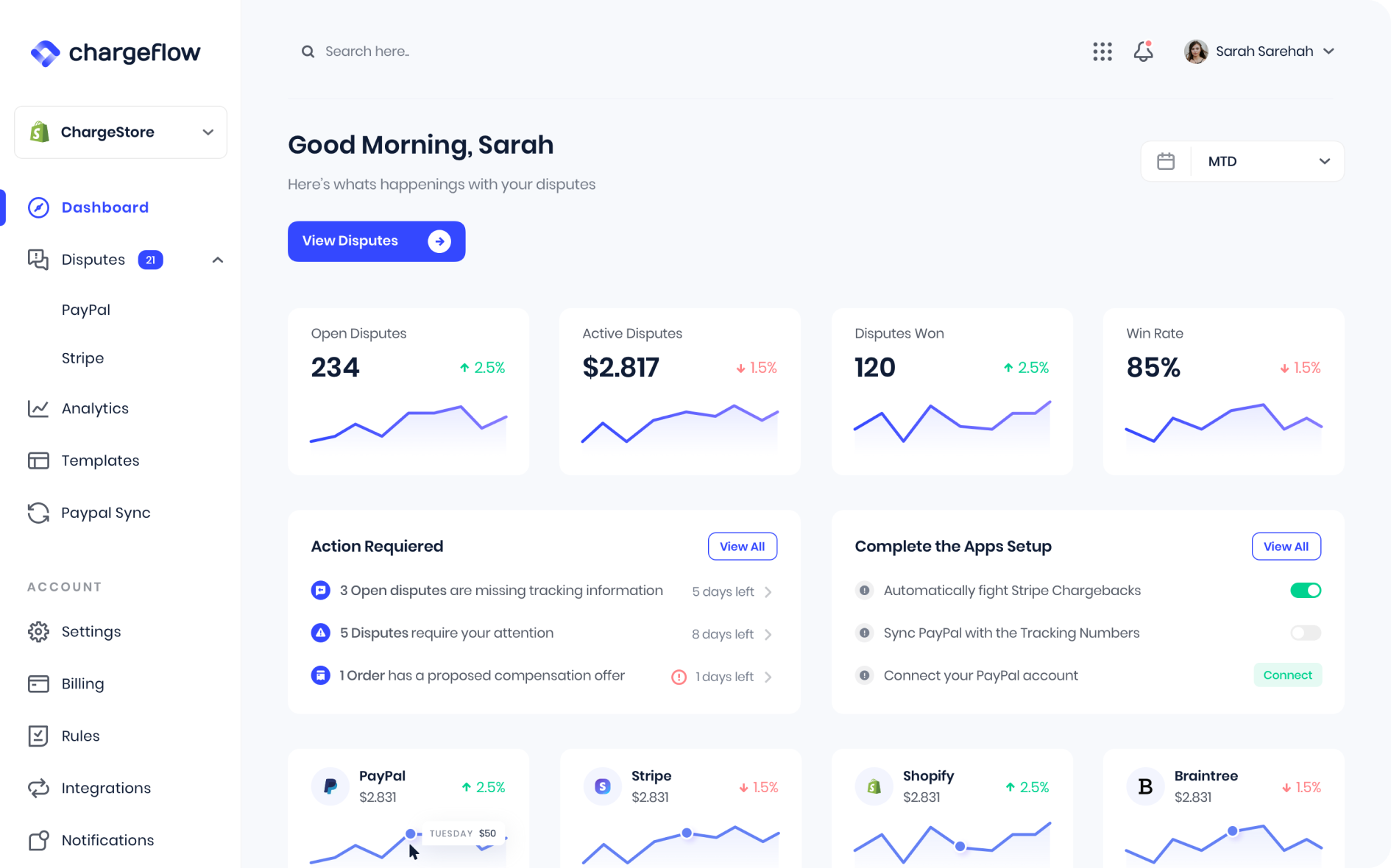
Chargeflow, which taps AI to fight chargebacks, raises $14M

Chargeflow, which taps AI to fight chargebacks, raises $14M Kyle Wiggers 17 hours

Chargeflow, a startup using AI to fight chargeback fraud, today announced that it raised $11 million in a seed round led by the VC firm OpenView Venture Partners. The tranche builds on Chargeflow’s previously undisclosed $3 million seed round closed several months ago, bringing the startup’s total raised to $14 million.

Chargeflow was launched in 2021 by Ariel Chen and his brother Avia Chen, both Israeli-American entrepreneurs. They previously co-founded Babe Cosmetics, a beauty brand developing a line of skincare products, which they sold to focus on Chargeflow.

“Although Babe Cosmetics was thriving, it encountered a significant problem with chargebacks,” Ariel and Avia told TechCrunch via email. “This glaring issue, coupled with our expertise in ecommerce, tech and fintech, ignited our determination to find a solution — but we couldn’t find an existing one.”

So Ariel and Avia started Chargeflow, which taps machine learning to generate custom “dispute evidence” — e.g. delivery confirmation receipts, signed orders and so on — for each chargeback and automatically submit it to the corresponding bank or credit card company.

Chargebacks are more complex than you might think. Credit card networks use different chargeback codes, and each code requires different evidence to overturn a chargeback.

Chargeflow

A view of the Chargeflow backend. Image Credits: Chargeflow

Any barrier to overturning fraudulent chargebacks costs businesses time — and money. According to a 2022 survey, 65% of merchants reported an increase in chargeback fraud from the year prior. Merchants lose an estimated $34 for every $1 in chargebacks, and this figure is expected to increase to $193 in 2023.

To maximize the chances of a merchant win, Chargeflow matches incoming disputes to a business’ order data, checks the code and its associated requirements and generates a dispute response using custom-made templates. Human experts review the AI-generated responses before they’re submitted.

“On average, it takes about one to two man hours of labor to fight a single chargeback,” Ariel and Avia said. “Chargeflow automates and eliminates the need for manual chargeback dispute and reduces that labor cost to zero.”

Integrating with existing e-commerce platforms, payment service providers and other, related tools, Chargeflow calculates the projected success of chargeback disputes by comparing transaction data, only billing merchants based on successful recovery of disputes in their favor.

Chargeflow claims to have thousands of customers. But there’s an abundance of vendors in the chargeback-fighting space — see Chargehound (which PayPal acquired in 2021), Justt, Midigator and Equifax-owned Kount, to name a few.

But Ariel and Avia didn’t express much concern about Chargeflow’s growth prospects.

“Chargeflow is well positioned to help merchants and business mitigate the problem and ensure higher business margins while reducing overhead expenses,” they said. “Despite the economic slowdown in other tech sectors, Chargeflow is growing rapidly.”

The proceeds from Chargeflow’s latest raise will be put toward enhancing its tech development efforts and strengthening its growth trajectory in the U.S., Ariel and Avia said. They’ll also support Chargeflow’s hiring efforts; the company’s looking to double its roughly 40-person headcount to 80 by the end of the year.

Nvidia boosts its ‘superchip’ Grace-Hopper with faster memory for AI

nvidia-jensen-2023-grace-hopper-gh200-unveil.png

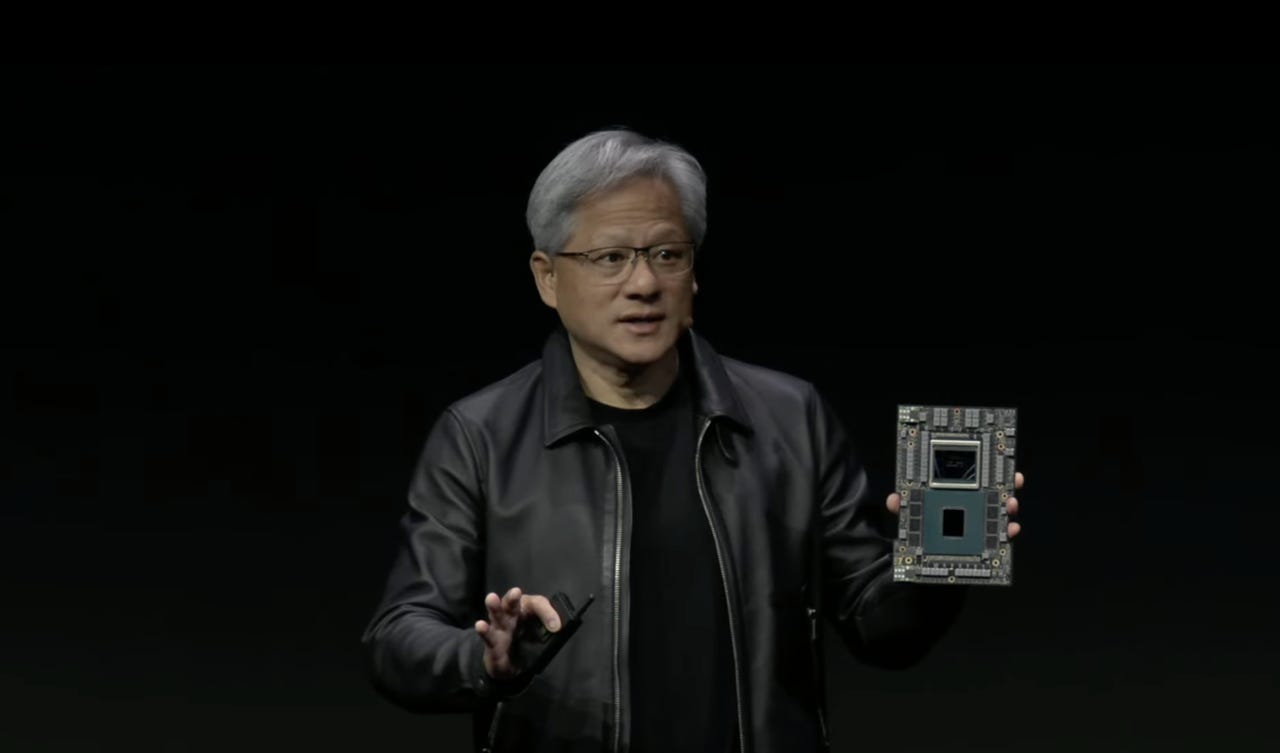
Nvidia CEO Jensen Huang on Tuesday showed off his company's next iteration of the combination CPU and GPU, the "GH200" Grace Hopper "superchip." The part boosts the memory capacity to 5 terabytes per second to handle increasing size of AI models.

Nvidia plans to ship next year an enhanced version of what it calls a "superchip" that combines CPU and GPU, with faster memory, to move more data into and out of the chip's circuitry. Nvidia CEO Jensen Huang made the announcement Tuesday during his keynote address at the SIGGRAPH computer graphics show in Los Angeles.

The GH200 chip is the next version of the Grace Hopper combo chip, announced earlier this year, which is already shipping in its initial version in computers from Dell and others.

Also: Nvidia unveils new kind of Ethernet for AI, Grace Hopper 'Superchip' in full production

Whereas the initial Grace Hopper contains 96 gigabytes of HBM memory to feed the Hopper GPU, the new version contains 140 gigabytes of HBM3e, the next version of the high-bandwidth-memory standard. HBM3e boosts the data rate feeding the GPU to 5 terabytes (trillion bytes) per second from 4 terabytes in the original Grace Hopper.

The GH200 will follow by one year the original Grace Hopper, which Huang said in May was in full production.

"The chips are in production, we'll sample it at the end of the year, or so, and be in production by the end of second-quarter [2024]," he said Tuesday..

The GH200, like the original, features 72 ARM-based CPU cores in the Grace chip, and 144 GPU cores in the Hopper GPU. The two chips are connected across the circuit board by a high-speed, cache-coherent memory interface, NVLink, which allows the Hopper GPU to access the CPU's DRAM memory

Huang described how the GH200 can be connected to a second GH200 in a dual-configuration server, for a total of 10 terabytes of HBM3e memory bandwidth.

GH200 is the next version of the Grace Hopper superchip, which is designed to share the work of AI programs via a tight coupling of CPU and GPU.

Upgrading the memory speed of GPU parts is fairly standard for Nvidia. For example, the prior generation of GPU — A100 "Ampere" — moved from HBM2 to HBM2e.

HBM began to replace the prior GPU memory standard, GDDR, in 2015, driven by the increased memory demands of 4K displays for video game graphics. HBM is a "stacked" memory configuration, with the individual memory die stacked vertically on top of one another, and connected to each other by way of a "through-silicon via" that runs through each chip to a "micro-bump" soldered onto the surface between each chip.

AI programs, especially the generative AI type such as ChatGPT, are very memory-intensive. They must store an enormous number of neural weights, or parameters, the matrices that are the main functional units of a neural network. Those weights increase with each new version of a generative AI program such as a large language model, and they are trending toward a trillion parameters.

Also: Nvidia sweeps AI benchmarks, but Intel brings meaningful competition

Also during the show, Nvidia announced several other products and partnerships.

AI Workbench is a program running on a local workstation that makes it easy to upload neural net models for the cloud in containerized fashion. AI Workbench is currently signing up users for early access.

New workstation configurations for generative AI, from Dell, HP, Lenovo, and others, under the "RTX' brand, will combine as many as four of the company's "RTX 6000 Ada GPUs," each of which has 48 gigabytes of memory. Each desktop workstation can provide up to 5,828 trillion floating point operations per second (TFLOPs) of AI performance and 192 gigabytes of GPU memory, said Nvidia.

You can watch the replay of Huang's full keynote on the Nvidia Web site.

Artificial Intelligence

Nvidia’s AI Workbench brings model fine-tuning to workstations

Nvidia’s AI Workbench brings model fine-tuning to workstations Kyle Wiggers 12 hours

Timed to coincide with SIGGRAPH, the annual AI academic conference, Nvidia this morning announced a new platform designed to let users create, test and customize generative AI models on a PC or workstation before scaling them to a data center and public cloud.

“In order to democratize this ability we have to make it possible to run pretty much everywhere,” said Nvidia founder and CEO Jensen Huang during a keynote at the event.

Dubbed AI Workbench, the service can be accessed through a basic interface running on a local workstation. Using it, developers can fine-tune and test models from popular repositories like Hugging Face and GitHub using proprietary data, and they can access cloud computing resources when the need to scale arises.

Manuvir Das, VP of enterprise computing at Nvidia, says that the impetus for AI Workbench was the challenge — and time-consuming nature — of customizing large AI models. Enterprise-scale AI projects can require hunting through multiple repositories for the right framework and tools, a process further complicated when projects have to be moved from one infrastructure to another.

Certainly, the success rate for launching enterprise models into production is low. According to a poll from KDnuggets, the data science and business analytics platform, the majority of data scientists responding say that 80% or more of their projects stall before deploying a machine learning model. A separate estimate from Gartner suggests that close to 85% of big data projects fail, due in part to infrastructural roadblocks.

“Enterprises around the world are racing to find the right infrastructure and build generative AI models and applications,” Das said in a canned statement. “Nvidia AI Workbench provides a simplified path for cross-organizational teams to create the AI-based applications that are increasingly becoming essential in modern business.”

The jury’s out on just how “simplified” the path is. But to Das’ point, AI Workbench allows developers to pull together models, frameworks, SDKs and libraries, including libraries for data prep and data visualization, from open source resources into a unified workspace.

As the demand for AI — particularly generative AI — grows, there’s been an influx of tools focused on fine-tuning large, general models to specific use cases. Startups like Fixie, Reka and Together aim to make it easier for companies and individual developers to customize models to their needs without having to shell out for costly cloud compute.

With AI workbench, Nvidia’s pitching a more decentralized approach to fine-tuning — one that happens on a local machine as opposed to a cloud service. That makes sense, given Nvidia and its product portfolio of AI-accelerating GPUs stand to benefit; Nvidia makes not-so-subtle mentions of its RTX lineup in the press release announcing the news. But Nvidia’s commercial motivations aside, the pitch might appeal to developers who don’t wish to be beholden to a single cloud or service for AI model experimentation.

AI-driven demand for GPUs has propelled Nvidia’s earnings to new heights. In May, the company’s market cap briefly reached $1 trillion after Nvidia reported $7.19 billion in revenue, up 19% from the previous fiscal quarter.

SIGGRAPH 2023: NVIDIA Keynote Highlights

The NVIDIA logo and symbol displayed on the facade of one of their office buildings located in the Company's campus in Silicon Valley.
Image: Sundry Photography/Adobe Stock

Generative AI was top-of-mind for NVIDIA at the computer graphics conference SIGGRAPH on Tuesday, Aug. 8. A Hugging Face Training Service powered by NVIDIA DGX Cloud, the latest version of NVIDIA AI Enterprise (4.0), and the AI Workbench toolkit headlined the announcements about enterprise and industrial generative AI deployments.

Jump to:

  • ‘Superchip’ with HBM3e processor supports AI development
  • NVIDIA DGX Cloud AI supercomputing comes to Hugging Face
  • AI Enterprise 4.0 revealed
  • NVIDIA brings the entire gen AI pipeline in-house with AI Workbench
  • New RTX workstations and GPUs support generative AI for enterprise
  • Omniverse embraces OpenUSD for digital twinning

‘Superchip’ with HBM3e processor supports AI development

The next installment in the Grace Hopper platform line will be the GH200 built on a Grace Hopper ‘superchip,’ NVIDIA announced on Tuesday. It consists of a a single server with 144 Arm Neoverse cores, eight petaflops, and 282GB of memory running on the HBM3e standard. HBM3e delivers 10TB/sec bandwidth, NVIDIA said, an improvement of three times the memory bandwidth as the previous version, HBM3.

“To meet surging demand for generative AI, data centers require accelerated computing platforms with specialized needs,” said Jensen Huang, founder and CEO of NVIDIA, in a press release. “The new GH200 Grace Hopper Superchip platform delivers this with exceptional memory technology and bandwidth to improve throughput, the ability to connect GPUs to aggregate performance without compromise, and a server design that can be easily deployed across the entire data center.”

NVIDIA DGX Cloud AI supercomputing comes to Hugging Face

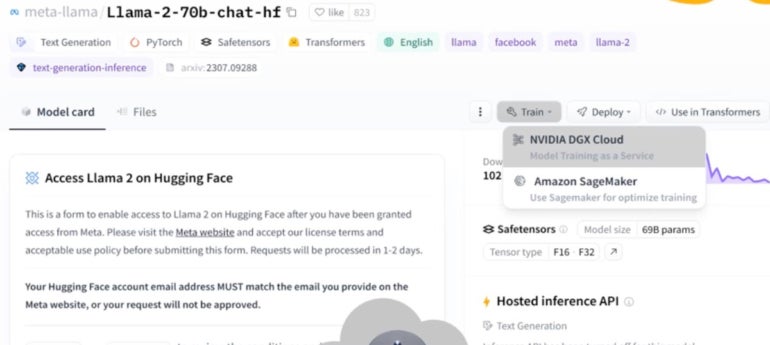
NVIDIA’s DGX Cloud AI supercomputing will now be available through Hugging Face (Figure A) for people who want to train and fine-tune the generative AI models they find on the Hugging Face marketplace. Organizations wishing to use generative AI for highly specific work often need to train it on their own data, which is a process that can require a lot of bandwidth.

Figure A

NVIDIA + Hugging Face AI menu screenshot.
An example of what DGX Cloud will look like on a Hugging Face page. Image: NVIDIA

“It’s a very natural relationship between Hugging Face and NVIDIA, where Hugging Face is the best place to find all the starting points, and then NVIDIA DGX Cloud is the best place to do your generative AI work with those models,” said Manuvir Das, NVIDIA vice president of enterprise computing, during a pre-briefing for the conference.

DGX Cloud includes NVIDIA Networking (a high-performance, low-latency fabric) and eight NVIDIA H100 or A100 80GB Tensor Core GPUs with a total of 640GB of GPU memory per node.

DGX Cloud AI training will incur an additional fee within Hugging Face, though NVIDIA did not detail what it will cost. The joint effort will be available starting in the next few months.

“People around the world are making new connections and discoveries with generative AI tools, and we’re still only in the early days of this technology shift,” said Clément Delangue, co-founder and CEO of Hugging Face in a NVIDIA press release. “Our collaboration will bring NVIDIA’s most advanced AI supercomputing to Hugging Face to enable companies to take their AI destiny into their own hands with open source.”

SEE: We dug deep into generative AI – both the good and the bad. (TechRepublic)

AI Enterprise 4.0 revealed

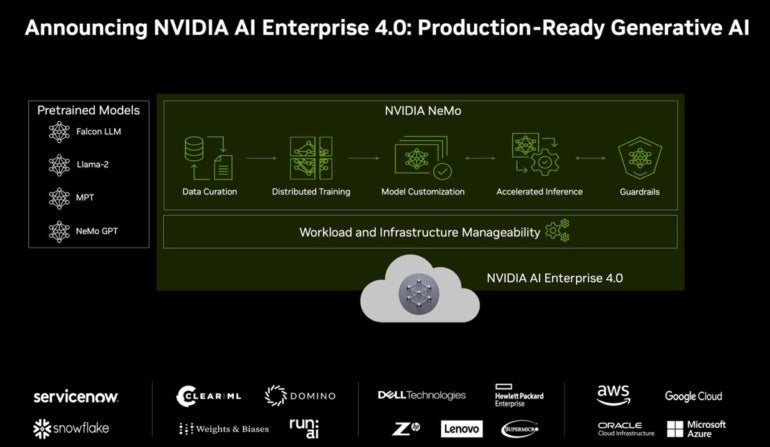
NVIDIA’s AI Enterprise, a suite of AI and data analytics software for building generative AI solutions (Figure B), will soon shift to version 4.0. The major change in this version is the addition of NeMo, a platform for custom tooling for generative AI curation, training customization, inference, guardrails and more. NeMo brings a cloud-native framework for building and deploying enterprise applications that use large language models.

Machine learning providers ClearML, Domino Data Lab, Run:AI and Weights & Biases have partnered with NVIDIA to integrate their services with AI Enterprise 4.0.

Figure B

NVIDIA AI Enterprise 4.0 showcase diagram.
This diagram shows AI Enterprise 4.0 offerings and the generative AI models it supports. Image: NVIDIA

NVIDIA brings the entire gen AI pipeline in-house with AI Workbench

AI Enterprise 4.0 pairs with NVIDIA AI Workbench, a workspace designed to make it easier and simpler for organizations to spin up AI applications on a PC or home workstation. With AI Workbench, projects can be easily moved between PCs, data centers, public clouds and NVIDIA’s DGX Cloud.

AI Workbench is “a way for you to uniformly and consistently package up your AI work and move it from one place to another,” said Das.

First, developers can bring all of their models, frameworks, SDKs and libraries from open-source repositories and the NVIDIA AI platform into one space. Then, they can initiate, test and fine-tune the generative AI products they make on a RTX PC or workstation. They can also scale up to data center and cloud computing hosting if needed.

“Most enterprises are building the expertise, budget or data center resources to manage the high complexity of AI software and systems,” said Joey Zwicker, vice president of AI strategy at HPE, in a press release from NVIDIA. “We’re excited about NVIDIA AI Workbench’s potential to simplify generative AI project creation and one-click training and deployment.”

AI Workbench will be available Fall 2023. It will be free as part of other product subscriptions, including AI Enterprise.

New RTX workstations and GPUs support generative AI for enterprise

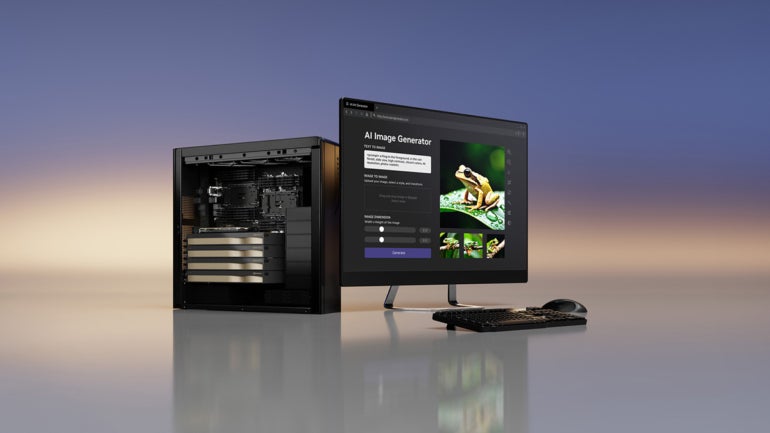
On the hardware systems side, new RTX workstations (Figure C) with RTX 6000 GPUs and AI-supporting enterprise software built in were announced. These are designed for the large GPU power requirements needed for industrial digitalization or enterprise 3D visualization.

The newest members of the Ada workstation GPU family will be the RTX 5000, RTX 4500 and RTX 4000. The RTX 5000 is available now, with the RTX 4500 and RTX 4000 available in October and September 2023 respectively.

In a similar vein, new architecture for OVX servers was announced. These servers will run up to eight L40S Ada GPUs each, and are also compatible with AI Enterprise software. All of these workstations are appropriate for content creation such as AI-generated images for graphic design, animation or architecture.

Figure C

Screenshot of a new RTX workstation from NVIDIA.
A RTX workstation. Image: NVIDIA

“With the performance boost and large frame buffer of RTX 5000 GPUs, our large, complex models look great in virtual reality, which gives our clients a more comfortable and contextual experience,” said Dan Stine, director of design technology at architectural firm Lake|Flato, in a NVIDIA press release.

Omniverse embraces OpenUSD for digital twinning

Lastly, NVIDIA detailed updates to Omniverse, a development platform for connecting, building and operating industrial digitalization applications with the 3D visualization standard OpenUSD. Omniverse has applications in 3D animation and game development as well as in automotive manufacturing. Many of the updates were connected to NVIDIA’s new partnership with Universal Scene Description, an open source format for the creation of objects and other elements in 3D graphics.

“Industrial enterprises are racing to digitalize their workflows, increasing the demand for connected, interoperable, 3D software ecosystems,” said Rev Lebaredian, vice president of Omniverse and simulation technology at NVIDIA, in a press release.

Several new integrations for Omniverse enabled by USD will be available including one with Adobe’s AI image generation application, Firefly.

Companies using Omniverse for industrial design include Boston Dynamics, which uses it to simulate robotics and control systems, NVIDIA said.

The newest version of Omniverse is now in beta and will be available to Omniverse Enterprise customers soon.

Person using a laptop computer.

Subscribe to the Daily Tech Insider Newsletter

Stay up to date on the latest in technology with Daily Tech Insider. We bring you news on industry-leading companies, products, and people, as well as highlighted articles, downloads, and top resources. You’ll receive primers on hot tech topics that will help you stay ahead of the game.

Delivered Weekdays Sign up today

After Joining Hands With Media Firms, OpenAI Funds NYU Ethical Journalism Project with $395,000 Grant

The Sam Altman-run OpenAI, has decided to fund a new journalism ethics initiative at New York University ‘s Arthur L. Carter Journalism Institute with a $395,000 grant. The announcements is a part of a broader effort by OpenAI to be associated with journalism on which the company replies on to train its infamous GPT-like AI models.

The initiative will be led by Stephen Adler, former EIC of Reuters who stated, “The initiative will provide workshops and discussions on existing and emerging journalism ethics issues.”

In terms of collecting clean data OpenAI seems to be a step ahead of its competitors like Google, one can decipher from its recent partnerships with organisations like Associated Press (AP), one of the biggest US news agencies, and the $5 million deal with American Journalism Project.

The partnership with AP is said to explore ways to develop AI to support local news and in the process OpenAI will indirectly tie up with 41 news agencies that AJP supports. The funding will also support the creation of a new product studio within AJP that will support local news outlets as they experiment with OpenAI’s technology, stated Sarabeth Berman, CEO of AJP.

Even though the company has been ‘trying’ to tackle the complexity of ethical journalism amid the generative AI revolution, OpenAI has been extremely cagey about where the company got the data it used to train its latest GPT model. While the big tech companies have almost never taken data privacy of the users seriously, initiative supporting ethical journalism by one of the technology leaders is rare.

Interestingly, the New York Times has recently reported about Google’s presentation of Genesis, a project aiming to responsibly generate news copy from factual information. Executives from media outlets like The Times, The Washington Post, and News Corp were a part of this demonstration. Impressions varied, as some “said it seemed to take for granted the effort that went into producing accurate and artful news stories,” while others likened the technology to a personal assistant.

Interestingly, Google discreetly updated its privacy policy, revealing its practice of mining public web data to enhance AI services like Bard and Cloud. With OpenAI’s recent contributions and advancements, the landscape appears promising. However, saying “Don’t believe everything you read on the internet” holds more weight due to the duality of these tech developments.

Read more: Why Google Is Killing Itself

The post After Joining Hands With Media Firms, OpenAI Funds NYU Ethical Journalism Project with $395,000 Grant appeared first on Analytics India Magazine.