A new era of carrier connectivity: How technology is bridging the gap

AdobeStock_382940021.62b9ce4762e71

In the logistics and transportation industry, carrier connectivity has long been challenging, often riddled with inefficiencies and communication barriers. Innovative tools and platforms are revolutionizing how carriers connect with shippers and other stakeholders, fostering real-time collaboration and transparency.

This new era of carrier connectivity enhances the flow of information and redefines how the industry operates. The emergence of solutions like Electronic Data Interchange (EDI), including protocols like EDI 214, offers a glimpse into the future where connectivity is seamless, efficient, and resilient. This article will explore how technology is ushering in a new age of connectivity and what it means for the future of logistics.

The evolution of carrier connectivity

Carrier connectivity, or the ability to communicate and exchange information between carriers and stakeholders, has significantly transformed over the decades. In the early days, manual processes and paper-based systems dominated, leading to slow communication, increased errors, and inefficiencies. The technological advancements of the 20th century introduced telecommunication and fax, speeding up the process but still lacking integration and real-time interaction.

The dawn of the internet age marked a turning point. Digital tools, email communication, and web-based platforms began to reshape how carriers connected. Interoperable systems allowed quicker exchanges, reduced paperwork, and a more streamlined workflow. However, fragmentation in technology adoption and a lack of standardized processes still pose challenges.

The introduction of Electronic Data Interchange (EDI) represented a quantum leap in the evolution of carrier connectivity. Protocols, such as EDI 214, have enabled the seamless exchange of essential shipment information, thereby promoting accuracy and providing real-time updates. This standardization facilitated more effortless collaboration and allowed carriers, shippers, and other stakeholders to operate on a shared platform.

Today, the industry is on the cusp of another transformation. Emerging technologies like cloud computing, the Internet of Things (IoT), and artificial intelligence are further enhancing connectivity, providing data-driven insights and enabling more intelligent decision-making.

Modern technologies transforming carrier connectivity

The transportation and logistics industry are experiencing a revolution driven by modern technologies transforming carrier connectivity. This transformation is multi-faceted and impacts various aspects of the industry:

Electronic Data Interchange (EDI): The integration of EDI, including using specific protocols like EDI 214, has been instrumental in standardizing the exchange of information. EDI reduces errors and streamlines processes by automating communication, fostering efficiency and collaboration.

Cloud Computing: Cloud-based platforms enable real-time data access and collaboration across geographically dispersed locations. Consequently, this aids in the seamless management of logistics operations, including tracking, inventory management, and route optimization.

Internet of Things (IoT): IoT devices offer unprecedented shipment visibility. Sensors can monitor everything from location to temperature, providing valuable insights and immediate alerts for better decision-making.

Blockchain Technology: With its immutable and transparent nature, blockchain technology ensures trust and security in transactions. It eliminates the need for third-party validations and streamlines payment processing, significantly enhancing carrier connectivity.

Machine Learning and Artificial Intelligence: ML algorithms and AI are driving predictive analytics, allowing carriers to anticipate potential issues and optimize routes. This predictive capability adds a new dimension to connectivity, with systems learning from data patterns and making decisions autonomously.

Mobile Applications: User-friendly mobile apps are placing the power of connectivity in the hands of drivers and other stakeholders. This enhances communication and enables real-time updates, tracking, and reporting.

Virtual and Augmented Reality (VR/AR): Emerging technologies like VR and AR provide unique solutions for training, maintenance, and even virtual collaboration, further strengthening connectivity within the industry.

Cybersecurity Measures: With increased connectivity comes the need for robust security. Modern cybersecurity solutions ensure that connections are secure and data integrity is maintained.

Sustainability Technologies: Sustainability-driven technologies are aligning carrier connectivity with eco-friendly practices. Solutions like electric vehicles and green routing algorithms are shaping the future of an environmentally responsible supply chain.

The impact of connectivity on logistics and supply chain

The modernization of carrier connectivity is making waves across the logistics and supply chain, resulting in profound impacts that redefine the way business is conducted:

Real-Time Visibility and Control: Connectivity tools, including GPS, RFID, and IoT devices, provide real-time visibility into the location, status, and condition of shipments. This level of insight enables immediate decision-making, enhancing control over the entire supply chain.

Collaboration and Coordination: The seamless flow of information among stakeholders creates an environment where collaboration and coordination thrive. This synergy ensures smoother operations, whether it is planning, executing, or monitoring various logistics activities.

Reduced Costs: Automation and intelligent analytics enabled by connectivity minimize manual processes, reducing errors, delays, and associated costs. Efficiency gains and optimized routing and resource utilization contribute to significant cost savings.

Enhanced Customer Experience: Real-time tracking and transparent communication build trust with customers, as they can access information regarding their shipments at any time. Personalized services and timely updates further enhance customer satisfaction.

Sustainability and Environmental Compliance: Connectivity facilitates the integration of sustainable practices such as green routing and energy-efficient transportation. Real-time data aids in adherence to regulatory requirements and alignment with environmental goals.

Risk Management: Enhanced visibility, analytics, and predictive algorithms empower businesses to foresee potential risks and take preventive measures. This proactive approach minimizes disruptions and ensures the resilience of the supply chain.

Scalability and Flexibility: Modern connectivity tools can dynamically scale operations according to demand. This adaptability is crucial in responding to market changes and seasonal fluctuations.

Innovation and Continuous Improvement: The data-driven insights derived from connectivity enable continuous improvement. Through monitoring and analyzing performance, businesses can identify opportunities for innovation and beat their competition.

Compliance and Regulation Adherence: Connectivity ensures that all data exchanges and transactions align with legal and industry standards, facilitating compliance with various regulations.

Empowering Small and Medium Enterprises (SMEs): By leveling the playing field, technology and connectivity allow smaller players to compete with larger entities. Cloud-based solutions and affordable connectivity options enable SMEs to access advanced tools that were previously beyond their reach.

Challenges and solutions in implementing technology

Integration Complexity: Implementing modern connectivity technology can be complex, especially when integrating with existing systems. The diverse array of systems and platforms can lead to compatibility issues.

Security Concerns: The interconnected nature of the technology leaves the network vulnerable to cyber-attacks. Protecting data and maintaining the integrity of information becomes a major concern.

Cost of Implementation: The expenses related to technology adoption, such as hardware, software, and training, may be prohibitive for some organizations, particularly smaller ones.

Skills Gap: A shortage of skilled professionals with expertise in emerging technologies may hamper implementation, creating bottlenecks and inefficiencies.

Regulatory Compliance: Adhering to industry standards and regulations, such as data protection laws, requires careful consideration and planning.

Solutions to overcome the challenges

Tailored Integration Strategy: Creating a phased and tailored integration plan helps align the technology with organizational goals. Employing interoperable systems ensures seamless connectivity.

Robust Security Measures: Implementing robust security protocols like encryption, firewalls, and regular monitoring can safeguard against potential threats.

Cost-effective Solutions: Leveraging cloud-based solutions or opting for scalable, modular technologies can make implementation more affordable.

Training and Skill Development: Investing in continuous training and development ensures that the workforce is equipped to manage and utilize the new technology efficiently.

Consulting Regulatory Experts: Collaborating with experts who specialize in industry compliance can help navigate complex regulatory landscapes.

Monitoring and Continuous Improvement: Regular monitoring, analytics, and feedback loops enable ongoing improvement, adaptation, and optimization of technology implementation.

Conclusion

As the global logistics and supply chain landscape continues to evolve, integrating modern technologies is paramount in bridging the connectivity gap between carriers. From enhancing efficiency and transparency to mitigating costs and security risks, technological innovation is redefining the very fabric of carrier connectivity.

However, success in this new era requires careful planning, strategic implementation, and ongoing adaptation. By understanding and overcoming the associated challenges, businesses can leverage technology to create a more connected, responsive, and resilient carrier network. Utilizing EDI documents represents a vital step toward this interconnected future.

You can build your own customer service AI chatbot with this drag-and-drop tool

chatbot-gettyimages-1413855189

Botpress seems to offer a lot of power once you move past the somewhat mediocre wizard interface and dig into the system's true potential.

Botpress is a tool for building interactive chatbots. While it supports building chatbots for a wide range of applications, the killer app is using it to build a customer support chatbot and backing it up with AI smarts.

Also: These are my 5 favorite AI tools for work

At its core, Botpress is a drag-and-drop interaction builder. You bring cards out onto the workspace, assign inputs, outputs, and calculations to the cards, and then connect one card to the next until a complete interaction has been mapped out.

On the surface, bot building is fairly straightforward. You can build question cards and, based on the answers provided by users, transfer the interaction to another card which will either ask more questions or provide answers. Rinse. Wash. Repeat.

Where this product stands out in the AI arena is that you can feed it knowledge sources ranging from a set of documents to a specific webpage, to searching on a specific website, to searching for answers across the web. AI analysis is powered by the ChatGPT API.

Botpress also enables you to use some natural language queries to set up expressions that are later used in the management of the user path. Unfortunately, Botpress also requires you to use some arcane expressions you either have to memorize or look up on Pastebin to build fully functional chatbots.

That said, I built a super-simple chatbot that queries ZDNET for an answer.

I'm sorry, Dave. I'm afraid I can't do that.

You can use Botpress for free, but if you exceed 1,000 interactions, you'll be required to pay. An interaction is any question, query, or unit of work. For testing, the free plan is fine. But once you let the chatbot loose on the world, you're paying for it.

Once you create an account, you are given the option to create a chatbot.

I decided to use the wizard and have my chatbot answer questions from a website.

I told it I wanted it to search ZDNET for answers.

Also: How does ChatGPT actually work?

After a while, Botpress generated this simple map, which allows for a question to be answered and a fallback. Fallback is an interesting feature. You can configure Botpress to use a knowledgebase, but if that knowledgebase doesn't have an answer, the flow can fall back to another knowledgebase. You can even set it to fall back to a ChatGPT prompt accessing the entire ChatGPT knowledgebase.

Here's what I got back:

I asked ZDNET's Ed Bott to check on the bot. (I know, the Bott/bot thing probably amuses me and you a lot more than it does Ed.) In any case, here's Ed's answer in terms of bot response quality:

Netplwiz has been a part of Windows since forever. As far as I know this does not work with Windows 11 anymore.

I asked ChatGPT the same question and restricted it from using the web for input. It gave me the same answer as supposedly came from ZDNET:

I then asked the wizard-generated ZDNET bot a few more questions that can definitely be answered from articles I've written, but are most likely not in the ChatGPT knowledgebase. They failed, too:

So the wizard was bust. Either it just didn't work or I did something wrong.

Also: How to use ChatGPT to write code

Fortunately, doing it the harder way and typing in various little blocks of pre-canned code did work. While I didn't have the time to try to build a full ZDNET chatbot (and wouldn't want to, because I'd prefer you read the articles we write for you), I was able to prove that Botpress can get domain-specific knowledge from a specific site:

Lots of applications

While there wasn't time on this project for me to learn the entire Botpress development environment and process, it's very intriguing. Just within the customer support realm, there are tons of applications. Botpress interconnects with Zapier, and through Zapier to hundreds of web services. That means you could build customer support flows that actually look up order information and can provide real, targeted help to individual users.

Also: How AI helped get my music on all the major streaming services

With the addition of ChatGPT's API processing localized web searches, the opportunity to build helper chatbots that scan your existing site and existing knowledge (including manuals, for example) shows the potential for customer service and tech support bots that can actually provide real customer service and tech support, 24/7/365.

That's not to say I advocate dumping your human workforce in favor of an AI bot license. (I don't!) But I think you might be able to use Botpress to augment your customer service, perhaps provide a level 1 tier for incoming requests, and even provide support for your less experienced agents, where they might query the bot to provide answers back to users.

The company also has a Github archive where they share client integrations, so you don't need to start from scratch. You can host Botpress in the cloud, or on-premises.

Also: We're not ready for the impact of generative AI on elections

What do you think? Will you build a Botpress customer service bot? Personally, from the time I've had with it, I think it would be a lot of fun. It seems to offer a lot of power once you move past the somewhat mediocre wizard interface and dig into the true potential of the overall system.

You can follow my day-to-day project updates on social media. Be sure to subscribe to my weekly update newsletter on Substack, and follow me on Twitter at @DavidGewirtz, on Facebook at Facebook.com/DavidGewirtz, on Instagram at Instagram.com/DavidGewirtz, and on YouTube at YouTube.com/DavidGewirtzTV.

Artificial Intelligence

Amazon taps generative AI to enhance product reviews

Amazon taps generative AI to enhance product reviews Sarah Perez @sarahintampa / 9 hours

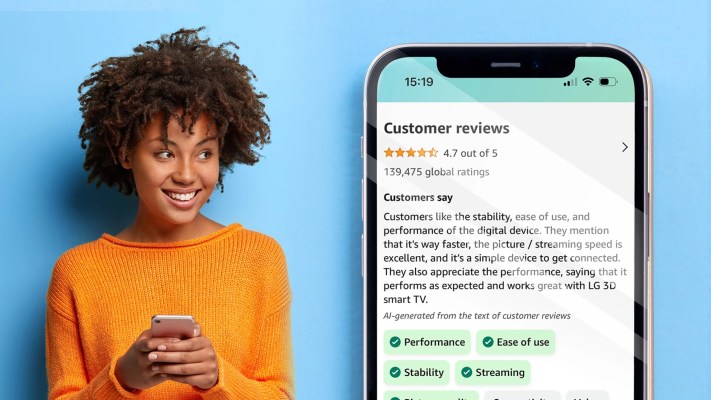
Amazon announced this morning it will begin to leverage generative AI to help customers better understand what customers are saying about a product, without necessarily having to read through dozens of individual reviews. The retailer says it will use the new technology to provide a short paragraph of text right on the product detail page that will highlight the product features and customer sentiment mentioned across the customer reviews.

This blub of text could be used to get an overall sense of the common themes across the reviews more easily, Amazon noted.

In addition to the summary text, Amazon will also highlight key product attributes as clickable buttons. For example, if a customer wanted to know about the product’s “ease of use” or “performance,” they could tap a button to see just those reviews that mention those terms.

Amazon had already offered a similar feature by surfacing frequently-used words found in the reviews, which were also available as clickable buttons.

Image Credits: Amazon

The new AI-powered features will initially be rolled out to a subset of U.S. shoppers on mobile devices across a “broad selection” of products, Amazon said. During these tests, the company will work to learn and fine-tune its AI models to improve their effectiveness. It’s also working to expand the highlights feature over time to include additional categories, as the feature becomes more broadly available to customers.

Of course, the AI summaries will only be as good as the data they ingest. And Amazon has struggled for years with fake and misleading product reviews, including paid reviews.

In 2021, the company admitted it had blocked 200 million fake reviews the year prior, for example. It has also tried to crack down on the sources of fake reviews for years via lawsuits and other actions, including suing sellers who bought fake reviews. Last year, it also sued the admins from 10,000 Facebook groups who were engaged in fake review brokering.

More recently, the FTC got involved, forcing a supplement maker to pay $600K in a case involving hijacked Amazon reviews — a situation where products are combined into a single listing to boost the reviews of one product with the good reviews of another.

With the growing capabilities of AI, fake reviews may now be even tougher to spot as the technology advances to sound more human, which could lead to another explosion of fake reviews. That would make Amazon’s AI-powered summaries of reviews less helpful, if the company doesn’t have other means of keeping AI-written reviews off its site.

Amazon addresses the concern around fake reviews today, saying it will only summarize those reviews from verified purchases. Plus, it continues to invest “significant resources” to proactively stop fake reviews.

“This includes machine learning models that analyze thousands of data points to detect risk, including relations to other accounts, sign-in activity, review history, and other indications of unusual behavior, as well as expert investigators that use sophisticated fraud-detection tools to analyze and prevent fake reviews from ever appearing in our store,” notes the retailer.

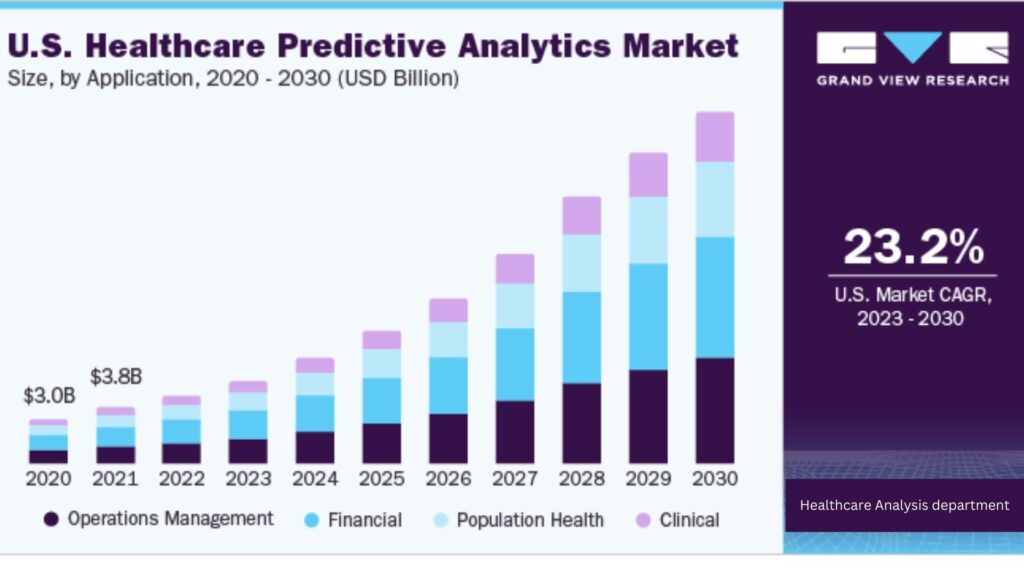
AI-driven predictive analytics for revenue forecasting in healthcare

healthcare AI

Innovation is increasingly driven by data. As technology advances and alters human behavior, industries collect a growing quantity of information. This data is valuable once we are able to extract actionable, meaningful insights from it – insights that can accelerate better outcomes while remaining equitable and inclusive of the populations we serve, allowing us to work more efficiently.

There is significant interest in predictive analytics, which employs a variety of statistical techniques, including predictive and data modeling, artificial intelligence (AI), machine learning, and deep learning, to analyze data and predict future, unknowable outcomes. It is prevalent in numerous industries, including business management, retail, travel, and sports, as well as science, healthcare, and pharma.

Predictive analytics can help clinicians predict and prevent events, improving patient outcomes. Targeted therapies like precision cancer treatment and cost waste identification improve systems. This blog will examine how predictive analytics and AI affect healthcare.

Predictive analytics uses current and historical data to predict outcomes. Data analysis can identify behavior associations. From these associations, many models can be created. Businesses can improve decision-making by applying model-specific conditions.

How can predictive analytics be leveraged in healthcare?

Healthcare has always looked ahead. Many have wondered how predictive analysis can benefit medicine given recent advances in AI. Big-data analytics, AI, and machine-learning models can improve healthcare in high-risk areas. AI and predictive analytics can help data scientists understand various health factors.

AI-driven predictive analytics for revenue forecasting in healthcare

The Role of AI in Enhancing Predictive Analytics:

Predictive analytics in healthcare revenue forecasting are enhanced by AI. EHRs, billing systems, patient demographics, and payer data can be analyzed by AI algorithms. AI-driven predictive models improve with new data.

Consider some ways AI can improve population healthcare management:

Predicting chronic and infectious diseases

Due to data points like the patient’s birth location, work location, lifestyle habits, and local environmental conditions, predictive analytics can help doctors predict illness with high probability. With this information, providers can assess chronic disease risk and prevent it. Diabetes, congestive heart failure, and COPD rates are declining in the sector.

Streamlining patient throughput and workflows

Predicting patient flow with AI-powered predictive analytics rationalizes resource allocation. By extrapolating patient needs, these forecasts can optimize bed allocations, staff reorganization, and healthcare facility employment rates.

Predicting hospital readmissions

Big data analytics can predict extreme epidemics using machine learning and high computational power. Weather-reported cases, population density, economic profile, etc. can predict contagious diseases.

Analyzing patient deterioration

Data scientists use predictive factor analysis to track disease progression and predict medication side effects to give patients the right treatment at the right time.

Tackling Real-World Data Challenges

One needs large amounts of historical data, “real-time” data from a similar distribution (from which historical data was sampled), and infrastructure to process, analyze, and generate predictive cloud models. Since many groups have siloed their data in private clouds, access is limited to themselves and select partners. Healthcare privacy, PHI, and HIPAA regulations also block data access. Patient’s willingness to share data digitally in patient-centric situations where trust is hard to earn. To build inclusive algorithms, we need full population representation and data sets. Healthcare leaders must explain the benefits of data sharing.

4 strategies for an AI-driven Approach to improve Revenue cycle Performance

Healthcare organizations should consider the following four revenue cycle management AI and automation strategies as use cases for healthcare AI development.

1. Automate manual tasks and focus staff on high-value tasks. 92% of hospitals plan to automate claims management and payment reconciliation. However, much can be improved: Automating revenue cycle functions could save providers $9.8 billion. Automating claims status inquiries alone could save $9.22 per transaction, or over $2.6 billion.

Automate the front-end revenue cycle. Real-time patient eligibility checks keep providers informed of patient coverage and deductible progress. Benefit information automatically pulled from the system to create patient charts reduces manual data entry and error risk. Registration and eligibility errors cause 23.9% of denials.

Automating these tasks speeds up patient check-in and lets staff focus on value-added activities like financial counseling.

2. Prevent denials with machine learning.Payers deny 9% of claims annually. This statistic means the average hospital risks losing nearly $5 million in payments each year. Administrative costs average $118 per claim to recover 63% of denials.

Machine learning lets providers anticipate denied claims. That’s how:

  • Payer and CPT code denial causes
  • Automated claim reviews using this intelligence
  • Flagging missing or incorrect information like charges or patient identifiers
  • triggering staff follow-up

Staff can correct claims before submission, increasing clean claim rates. It also helps revenue cycle teams manage denials by focusing on high-value denials and those likely to be overturned.

3. Use demographic data to predict patient billing methods. AI can help revenue cycle teams create highly targeted collection strategies based on a patient’s demographics, payment history, communication preferences, and payment methods. It can also suggest the best time and message to send to individual patients. AI can alert patient financial services to early signs of a patient defaulting on a hospital payment plan. AI-enabled patient financial communications and collections may be crucial in the future since half of patients lack confidence in their ability to pay medical bills.

Propensity-to-pay scoring predicts whether patients will pay their out-of-pocket healthcare costs. Despite the availability of propensity-to-pay solutions, one survey found that only 14% of healthcare organizations use advanced modeling tools to segment accounts and predict propensity-to-pay. Only 25% of providers use data or partners. Data-driven intelligence and processes are needed to boost collection rates.

4. Anticipate payer payments. Predictive analytics lets providers examine payer-specific payment behavior by CPT code to estimate how long a claim will take to be paid and when it will arrive. It accurately predicts claim remittance dates. Coding compliance is critical in healthcare in general but especially in long-term care to ensure accurate reimbursement and avoid penalties for fraudulent or erroneous billing.

Integrating Predictive Analytics into Revenue Management:

Healthcare organizations must prioritize these to maximize AI-driven predictive analytics:

  • Data Integration: Integrate data from multiple sources to create a complete and accurate dataset for analysis.
  • Technology Infrastructure: Buy powerful AI and data analytics platforms for large datasets and complex algorithms.
  • Expertise and Training: Help data scientists and analysts use and interpret AI-driven predictive models.
  • Data Privacy and Security: Protect patient data while using AI.

AI in healthcare is expected to grow 50.2% from 2018 to 2023, with hospitals and health systems being the biggest adopters. Leaders should carefully evaluate the business case for AI-driven revenue cycle management and explore small-scale innovations with high returns as the healthcare cost curve bends. Starting now will help healthcare organizations keep up with AI advances and improve financial performance.

Python Vector Databases and Vector Indexes: Architecting LLM Apps

Python Vector Databases and Vector Indexes: Architecting LLM Apps
Photo by Christina Morillo

Because of Generative AI applications created using their hardware, Nvidia has experienced significant growth. Another software innovation, the vector database, is also riding the Generative AI wave.

Developers are building AI-powered applications in Python on Vector Databases. By encoding data as vectors, they can leverage the mathematical properties of vector spaces to achieve fast similarity search across very large datasets.

Let's start with the basics!

Vector Database Basics

A vector database stores data as numeric vectors in a coordinate space. This allows similarities between vectors to be calculated via operations like cosine similarity.

The closest vectors represent the most similar data points. Unlike scalar databases, vector databases are optimized for similarity searches rather than complex queries or transactions.

Retrieving similar vectors takes milliseconds versus minutes, even across billions of data points.

Vector databases build indexes to efficiently query vectors by proximity. This is somewhat analogous to how text search engines index documents for fast full-text search.

Benefits of Vector Search Over Traditional Databases for Developers

For developers, vector databases provide:

  • Fast similarity search — Find similar vectors in milliseconds
  • Support for dynamic data — Continuously update vectors with new data
  • Scalability — Scale vector search across multiple machines
  • Flexible architectures — Vectors can be stored locally, in cloud object stores, or managed databases
  • High dimensionality — Index thousands of dimensions per vector
  • APIs — If you go for a managed vector database, it usually comes with clean query APIs and integrations with some existing data science toolkits or platforms.

The example of popular use cases supported by the vector searches (the key feature offering of a vector database) are:

  • Visual search — Find similar product images
  • Recommendations — Suggest content
  • Chatbots — Match queries to intent
  • Search — Surface relevant documents from text vectors

Use cases where vector searches are starting to gain traction are :

  • Anomaly detection — Identify outlier vectors
  • Drug discovery — Relate molecules by property vectors

What is a Python Vector Database?

A Vector database which includes Python libraries that supports a full lifecycle of a vector database is a Python vector database. The database itself does not need to be built in Python.

What Should be Supported by these Python Vector Database Libraries?

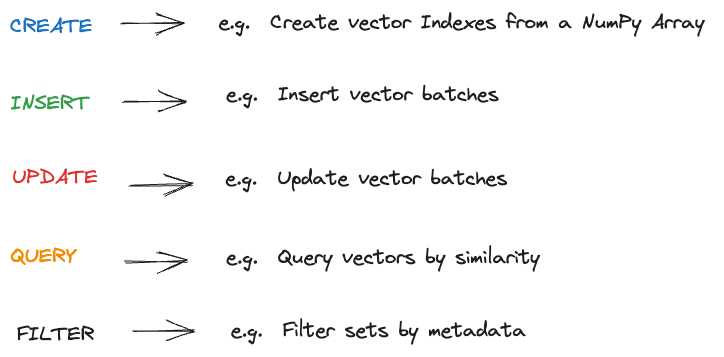
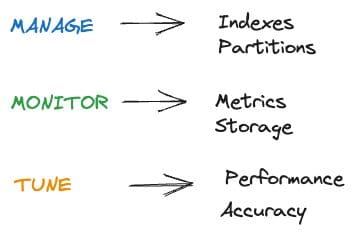
The calls to a vector database can be separated into two categories — Data related and Management related. The good news here is that they follow similar patterns as a traditional database.

Data related functions which libraries should support

Python Vector Databases and Vector Indexes: Architecting LLM Apps

Standard management related functions which libraries should support

Python Vector Databases and Vector Indexes: Architecting LLM Apps

Let’s now move on to a little more advanced concept where we talk about building LLM Apps on top of these databases

Architecting LLM Apps

Let’s understand what is involved from a workflow perspective before we go deeper into the architecture of vector search powered LLM Apps.

A typical workflow involves:

  1. Enriching or cleaning the data. This is a lightweight data transformation step to help with data quality and consistent content formatting. It is also where data may need to be enriched.
  2. Encoding data as vectors via models. The models have some transformers included (e.g. sentence transformers)
  3. Inserting vectors into a vector database or vector index (something which we will explain shortly)
  4. Exposing search via a Python API
  5. Document orchestrating workflow
  6. Testing and visualizing results in apps and UIs (e.g. Chat UI)

Now let’s see how we enable different parts of this workflow using different architecture components.

For 1) you might need to start getting metadata from other source systems (including relational databases or content management systems.

Pretrained models are almost always preferred for step 2) above. OpenAI models are the most well-liked models offered through hosted offerings. You might host local models for privacy and security reasons.

For 3), you need a vector database or vector index if you need to perform large similarity searches, such as in datasets with more than one billion records. From an enterprise standpoint, you typically have a little more context before you conduct the "search".

For 4) above, the good news is that the exposed search typically follows a similar pattern. Something along the lines of the following code:

From Pinecone

index = pinecone.Index("example-index")    index.upsert([      ("A", [0.1, 0.1, 0.1, 0.1], {"genre": "comedy", "year": 2020}),  )      index.query(   vector=[0.1, 0.1, 0.1, 0.1],   filter={   "genre": {"$eq": "documentary"},   "year": 2019   },   top_k=1,  )  

An interesting line here is this:

filter={   "genre": {"$eq": "documentary"},   "year": 2019   },

It really filters the results to vectors near the ‘genre’ and ‘year’. You can also filter vectors by concepts or themes.

The challenge now, in an enterprise setting, is that it includes other business filters. It is important to address the lack of modeling for data coming from data sources (think table structure and metadata). It would be important to improve text fidelity with fewer incorrect expressions that contradict the structured data. . A "data pipelining" strategy is required in this situation, and enterprise "content matching" starts to matter.

For 5) Other than the usual challenges of scaling ingest, a changing corpus has its own challenges. New documents may require re-encoding and re-indexing of the entire corpus to keep vectors relevant.

For 6) This is a completely new area and a human in the loop approach is required on top of testing similarity levels to ensure there is quality across the spectrum of search.

Automated search scoring along with different types of context scoring is not an easily accomplished task.

Python Vector Index: a simpler vector search alternative for your existing database.

A vector database is a complex system that enables contextual search as in the above examples plus all the additional database functionalities (create, insert, update, delete, manage, …).

Examples of vector databases include Weaviate and Pinecone. Both of these expose Python API’s.

Sometimes, a simpler setup is enough. As a lighter alternative, you can use whatever storage you were already using, and add a vector index based on it. This vector index is used for retrieving only your search queries with context, for example, for your generative AI use.

In a vector index setup, you have:

  • Your usual data storage (e.g. PostgreSQL or disk directory with files) provides the basic operations you need: create, insert, update, delete.
  • Your vector index which enables fast context-based search on your data.

Standalone Python libraries which implement vector indices for you include FAISS, Pathway LLM, Annoy.

The good news is that the LLM application workflow for vector databases and Vector indexes is the same. The main difference is that in addition to the Python Vector Index library, you continue to also use your existing data library for “normal” data operations and for data management. For example, this could be Psycopg if you are using PostgreSQL, or the standard Python “fs” module if you are storing data in files.

Proponents of vector indexes focus on the following advantages:

  • Data Privacy: Keeps original data secure and undisturbed, minimizing data exposure risk.
  • Cost-Efficiency: Lessens costs associated with extra storage, compute power, and licensing.
  • Scalability: Simplifies scaling by decreasing the number of components to manage.

When to use Vector Databases vs Vector Indexes?

Vector Databases are useful when one or more of the following is true

  • You have a specialized need for working with vector data at scale
  • You are creating a standalone purpose-built application for vectors
  • You do not expect other types of use for your stored data in other types of applications.

Vector Indexes are useful when one or more of the following is true

  • You do not want to trust new technology for your data storage
  • Your existing storage is easy to access from Python.
  • Your similarity search is just one capability among other larger enterprise BI and database needs
  • You need the ability to attach vectors to existing scalar records
  • You need one unified way of dealing with pipelines for your data engineering team
  • You need index and graph structures on the data to help with your LLM apps or tasks
  • You need augmented output or augmented context coming from other sources
  • You want to create rules from your corpus which can apply to your transactional data

The Future of Enterprise Vector Search

Vector search unlocks game-changing capabilities for developers. As models and techniques improve, expect vector databases or vector indexes to become an integral part of the application stack.

I hope this overview provides a solid starting point for exploring vector databases and vector indexes in Python. If you are curious about a recently developed vector index please check this open source project.
Anup Surendran is a VP of Product and Product Marketing who specializes in bringing AI products to market. He has worked with startups that have had two successful exits (to SAP and Kroll) and enjoys teaching others about how AI products can improve productivity within an organization.

More On This Topic

  • What are Vector Databases and Why Are They Important for LLMs?
  • The Rise of Vector Data
  • Support Vector Machines: An Intuitive Approach
  • A Gentle Introduction to Support Vector Machines
  • Vector and Matrix Norms with NumPy Linalg Norm
  • Support Vector Machine for Hand Written Alphabet Recognition in R

Maximizing GPU Performance Amidst Today’s Increasing Shortages

Maximizing GPU Performance Amidst Today’s Increasing Shortages August 14, 2023 by Stevie Lanigan

The default method for accelerating Deep Learning projects is increasing the size of a GPU cluster. However, the cost is increasingly prohibitive. According to Andreessen Horowitz, many companies investing in AI ‘spend more than 80% of their total capital raised on compute resources,’ and rightly so. GPUs are the cornerstone of AI infrastructure and as much budget as possible should be allocated to them. However, there are other ways to raise performance that should be considered and are becoming increasingly necessary amid these high costs.

Expanding a GPU cluster is far from straightforward, especially as generative AI has accelerated shortages. NVIDIA A100 GPUs were some of the first to be impacted (reported increases by up to 40% above MSRP according to WCCFtech) and they are now so scarce that the lead time for some versions is up to a year. These supply chain challenges have forced many to consider the even higher end H100s as an alternative, but a server full will be accompanied by a markedly higher price tag.

The hyperscalers are understandably picking up every piece of silicon they can get as they have the price point is less of a concern for them. But for those investing in their own infrastructure to create the next great generative AI solution for their industry, this development shines a light on the importance of squeezing every drop of efficiency from existing GPUs.

Let’s take a look at how a business can extract more out of its compute investment by proposing modifications on the design of AI infrastructure with networking and storage.

The Data Problem

If a project can’t wait until the shortage cools down, or its budget doesn’t provide carte blanche, a helpful approach is to consider the inefficiencies in existing compute infrastructure and how to mitigate for the best possible utilization from those resources. Maximizing GPU utilization is a challenge simply because the data is often delivered too slowly to keep GPUs busy. Some users have GPU utilization ratios as low as 20%, which is clearly not acceptable. This is a good place for AI teams to start to look for ways to maximize their AI investments.

GPUs are the engine of an AI environment. Just as a car engine requires gasoline to run, GPUs run on data. Restricting the flow of data limits GPU performance. If the GPUs are only working at even 50% efficiency, the AI team is less productive, a project will take twice as long to complete, and ROI is halved. It is imperative that infrastructure design ensures that the GPUs will run at full efficiency and deliver the compute performance expected.

How are You Delivering Data to Your GPUs?

It’s worth noting that both DGX A100 & H100 servers come with internal storage capacity of up to 30 terabytes. However, this capacity is not feasible for the vast majority of Deep Learning models considering that the average model size is roughly 150 terabytes. Hence the need for additional external data storage to keep GPUs fed with data.

While additional storage can sometimes simply mean attaching a ‘JBOD’ (just a bunch of drives) in certain environments, this is not the case in AI. So, what kind of storage is needed?

Storage Performance

AI Storage is made up of a server, NVMe SSDs and storage software, usually packaged up in a simple appliance. Just as GPUs are optimized for processing massive amounts of data in parallel with hundreds of thousands of cores, the storage that feeds the network also needs to be high performance. The fundamental requirement of storage in AI is — as well as storing the whole dataset — to have the capability to deliver the data to the GPUs at wire speed (as fast as the network will allow) in order to saturate GPUs and keep them running efficiently. Anything less is underutilizing this very costly and valuable GPU resource.

Delivering the data at speeds capable of keeping up with a cluster of 10 or 15 GPU servers operating at full speed will help to optimize GPU resources and create a gain in performance across the entire environment, making the best possible use of the budget to get the most from the infrastructure as a whole.

The challenge in fact is that storage vendors who are not optimized for AI require many client compute nodes to extract the full performance from the storage. If starting with one GPU server, it will conversely require many storage nodes to hit that performance to power a single GPU server.

Do not believe all benchmark results; it is easy to gain large bandwidth figures when using several GPU servers at the same time, but AI benefits from storage that will deliver all of its performance to a single GPU node whenever needed. Stick to storage that delivers the ultra-high performance that is required, but that does this in a single storage node and is capable of delivering this performance to a single GPU node. This may narrow the market down, but it is high on the list of priorities when starting out on an AI project journey.

Network Bandwidth

Ever more powerful compute capabilities drive constantly increasing demands on the rest of the AI infrastructure. Bandwidth requirements have reached new heights to be able to manage the massive amounts of data being sent across the network from storage every second to be processed by GPUs. The network adapters (NICs) in a storage device connect to the switches in a network which connect to the adapters inside the GPU server. NICs can connect storage directly to the NICs in 1 or 2 GPU servers with no bottlenecks when configured correctly, but always consult a solution provider for advice on networking.

Ensuring the bandwidth is high enough to pass the maximum data load from storage through to the GPUs to keep them saturated over sustained periods is the key and failure to do this is in many cases the reason why we see lower GPU utilization.

GPU Orchestration

Once the infrastructure is in place, GPU orchestration and allocation tools greatly help teams to pool and allocate resources more efficiently, get visibility into GPU usage, provide a higher level of control of resources, reduce bottlenecks and increase utilization. These tools can only do all of this as intended if the underlying infrastructure allows the data to flow correctly in the first place.

The Role of Data in AI

In AI, the data is the input, so lots of the great features of traditional enterprise flash storage for a business' mission critical applications such as stock control database servers, email servers, backup servers are simply not relevant for AI. These solutions were built using legacy protocols and while they have been re-purposed for AI, these legacy foundations demonstrably limit their performance for GPU and AI workloads, drive prices up and waste funds on overly expensive and unnecessary features.

With the current worldwide GPU shortage, combined with a burgeoning AI sector, it’s never been more important to find ways to maximize GPU performance – especially for the short term. These are a few of the key ways to keep costs down and output high as the Deep Learning projects continue to flourish.

About the Author

Stevie Lanigan is Partnerships Director at PEAK:AIO. Stevie is a highly skilled sales and business development leader with a wealth of experience in the global OEM & AI startup worlds. With a proven track record of success and a passion for delivering innovative solutions to customers, Stevie has built and managed several multi-million dollar partnerships, providing cutting-edge products and services. Through a deep understanding of customer needs and a keen eye for market trends, Stevie has helped drive growth for businesses across a range of industries.

Stevie's success is built on a foundation of strong leadership skills, strategic thinking, and a collaborative approach to problem-solving. With a focus on building high-performing teams and empowering individuals to achieve their full potential, Stevie has created a culture of innovation and excellence that has propelled businesses to new heights.

Whether working with established global OEMs or fast-paced AI startups, Stevie brings a unique perspective and a deep knowledge of the industry to every project.

Related

Can GPT-4 be a Saviour in the Medical Field ?

While OpenAI capabilities have made its way into every domain possible, there’s one field where LLMs, if utilised correctly, can have the highest impact by directly affecting lives — the medical field. Earlier this year, ChatGPT had even cleared all three parts of the United States Medical Licensing Examination (USMLE) and we even saw how ChatGPT helped save a dog’s life through accurate medical diagnosis. However, we have not seen much practical applications in the medical field. Does GPT-4 capabilities make it a suitable player in the medical field?

Massive Potential

A paper released by OpenAI and Microsoft on the Capabilities of GPT-4 on Medical Challenge Problems was released in March, this year. In this research, GPT-4 have shown impressive language understanding and generation abilities in medicine. The study evaluates GPT-4’s performance on medical competency exams and benchmark datasets, even though the model wasn’t specialised for medicine.

The researchers assess GPT-4’s performance on official USMLE practice materials and MultiMedQA datasets. GPT-4 surpasses the USMLE passing score by over 20 points, outperforming previous models (including GPT-3.5) and even models fine-tuned for medical knowledge. Additionally, GPT-4 demonstrates improved probability calibration, implying that it’s better at predicting correct answers. The study also explores how GPT-4 can explain medical reasoning, customise explanations, and create hypothetical scenarios, showcasing its potential for medical education and practice. The findings highlight GPT-4’s capabilities while acknowledging challenges related to accuracy and safety in real-world applications.

In comparison to its older models, GPT-4 has gotten much better when tested on official medical exams such as USMLE. GPT-4 improved by more than 30 percentage points when compared to GPT-3.5. While GPT-3.5 was getting close to this passing score (60% of multiple-choice questions to be correct), GPT-4 passed the score by a huge number.

Alignment and Safety In Place

When an earlier version of GPT-4, referred to as the base model, was compared with GPT-4, the former had slightly better performance by about 3-5% on some of the tests. This suggests that when the model was made safer and better at following instructions, it might have lost a bit of its raw performance. The researchers suggested that future work could focus on finding ways to balance accuracy and safety more effectively by refining the training process or by using specialised medical data.

Where does Med-PaLM fit in?

The above research did not compare GPT-4 with models such as Med-PaLM and Flan-PaLM 540B, as the models were not available for everyone to try at the time of study.

Google recently launched their multimodal healthcare LLM with Med-PaLMM – a large multimodal generative model that encodes and interprets biomedical data. Its capabilities are far more advanced than GPT-4 considering how it can handle various types of medical data such as clinical language, medical images, genomics and even performs a wide range of tasks. The model can generalise to new medical tasks and perform multimodal reasoning without specific training. It is able to precisely recognize and explain medical conditions in images using just instructions and prompts given in language.

Never Fool-Proof

However, GPT-4 applications are not as diverse as the ones Med-PaLM offers. Though GPT-4 was announced with multimodal features, it is not yet available for users. Furthermore, there have been negative observations on GPT-4’s capabilities in medical diagnosis. Problematic and biased results were part of the outcome, and concerns on how GPT-4’s inclination to embed societal biases may hamper its suitability for aiding clinical decisions.

The prevalent problem of hallucinations still persists with GPT-4 spewing incorrect information. The model has been generating incorrect answers for medical citations. GPT-4 produced over 20% errors for medical citations.

21% of medical journal articles cited by GPT-4 were found to be fake; GPT-3.5 cited an estimated 98% fake articles. Narrower topics had more fake articles than broader topics. Despite its promise, ChatGPT is currently not a reliable source of medical data. https://t.co/DCTIkT1OkZ

— JAMA Network Open (@JAMANetworkOpen) August 9, 2023

While GPT-4 might not be completely reliable as a medical assist for diagnosis with the current performance , there are other functions that the model can assist in. Hospitals are looking at AI to help relieve doctor burnout. With applications that can write notes for electronic health records and drafting empathetic notes to patients, AI can help smoothen the process. Transcribing doctor and patient comments, then creating physician’s summary format for electronic health records is one of the best use cases in the medical field. With the current limitations, GPT-4 still has a long way to go before it can be entirely adopted in the medical field.

The post Can GPT-4 be a Saviour in the Medical Field ? appeared first on Analytics India Magazine.

Google-Backed Anthropic Raises $100M from SKT to Fuel AI Innovation in Telecom

Artificial intelligence startup Anthropic has secured $100 million in funding from SK Telecom (SKT), a major player in the South Korean telecommunications sector. This strategic investment marks a significant move in the rapidly evolving landscape of generative AI and has the potential to reshape the telecommunications industry. The partnership between Anthropic and SKT will revolve around the development of a multilingual large language model tailored for global telco firms, ushering in a new era of AI-powered innovation in the telecommunications domain.

This funding comes on the heels of Anthropic’s Series C funding round in which it raised an impressive $450 million, led by Spark Capital. Notably, SKT was already involved in the Series C funding through its venture capital arm, SK Telecom Venture Capital (SKTVC). This strategic investment underscores SKT’s commitment to being at the forefront of AI advancements and leveraging Anthropic’s expertise to fuel transformative changes within the telecommunications sector.

Anthropic’s co-founder and chief science officer, Jared Kaplan, will steer the customisation of the multilingual LLM and the subsequent product roadmap, solidifying Anthropic’s pivotal role in this partnership. Dario Amodei, co-founder and CEO of Anthropic, expressed enthusiasm for the collaboration, stating, “SKT has incredible ambitions to use AI to transform the telco industry. We’re excited to combine our AI expertise with SKT’s industry knowledge to build an LLM that is customized for telcos.”

The resultant LLM, co-developed by SKT and Anthropic, is set to empower four members of the Global Telco AI Alliance—Deutsche Telekom, e&, Singtel, and SKT itself—to deliver AI-driven solutions tailored to their respective markets and users. This multilingual LLM is slated to support an array of languages, including English, Korean, German, Japanese, Arabic, and Spanish, effectively bridging language barriers and enabling more efficient and personalized AI-driven services.

Steering Changes in Telecom

SKT’s involvement in the Global Telco AI Alliance further solidifies its position as a key player in shaping the AI landscape within the telecommunications sector. By collaborating with Anthropic and harnessing its AI prowess, SKT aims to position itself at the forefront of AI-driven transformations in the industry. Ryu Young-sang, CEO of SKT, remarked, “By combining our Korean language-based LLM with Anthropic’s strong AI capabilities, we expect to create synergy and gain leadership in the AI ecosystem with our global telco partners.”

Conclusively, SKT’s substantial investment in Anthropic exemplifies its dedication to staying ahead in the dynamic field of AI. This partnership is set to redefine the telecommunications industry’s trajectory by fostering AI-driven innovations tailored to diverse linguistic and market needs. The collaboration between Anthropic and SKT stands as a testament to the potential of AI to reshape industries and underscores the growing significance of tailored AI solutions in today’s technological landscape.

Anthropic, founded in 2021, is the driving force behind Claude, an AI system designed to streamline various tasks within corporations, ranging from generating answers and automating workflows to coding and processing natural language. This innovation mirrors OpenAI’s ChatGPT, enhancing corporate efficiency through the seamless integration of AI technologies. Claude’s application in the telco industry will encompass specific areas such as customer service, marketing, sales, and interactive consumer applications, amplifying its utility and relevance.

Anthropic also launched Claude 2 in July. Its predecessor was confined to enterprise usage, however, Claude 2 marks a transition to greater accessibility by extending its services to the general public in the United States and the United Kingdom. Unlike its forerunner, Claude 2 stands apart by adopting a dual approach for accessibility—through a beta website and an API. This strategic move not only broadens Anthropic’s user base but also establishes a clear distinction between the two iterations of Claude, further underlining Anthropic’s commitment to democratising AI.

The post Google-Backed Anthropic Raises $100M from SKT to Fuel AI Innovation in Telecom appeared first on Analytics India Magazine.

5 Things You Need to Know When Building LLM Applications

Building LLM-based applications can undoubtedly provide valuable solutions for several problems. However, understanding and proactively addressing challenges such as hallucinations, prompt context, reliability, prompt engineering, and security will be instrumental in harnessing the true potential of LLMs while ensuring optimal performance and user satisfaction. In this article, we will explore these five crucial considerations that developers and practitioners should know when building LLM applications.

5 Things You Need to Know When Building LLM Applications
Photo by Nadine Shaabana on Unsplash 1. Hallucinations 5 Things You Need to Know When Building LLM Applications
Photo by Ehimetalor Akhere Unuabona on Unsplash

One of the main aspects that you should take care of when using LLMs is hallucinations. In the context of LLMs, hallucinations refer to generating unreal, incorrect, nonsensical information. LLMs are very creative and they can be used and tuned for different domains but a very critical unsolved problem that still exists is their hallucinations. Since the LLMs are not search engines or databases, therefore these mistakes are unavoidable.

To overcome this problem you can use controlled generation by providing enough details and constraints for the input prompt to limit the model's freedom to hallucinate.

2. Choosing The Proper Context

As mentioned one of the solutions to the hallucinations problem is providing the proper context to the input prompt to limit the LLM's freedom to hallucinate. However, on the other hand, LLMs have a limit on the number of words that can be used. One possible solution for this problem is using indexing in which the data is turned into vectors and stored in a database and the appropriate content is searched during runtime. Indexing usually works however it is complex to implement.

3. Reliability And Consistency

One of the problems you will face if you build an application based on LLM is reliability and consistency. LLMs are not reliable and consistent to make sure that the model output will be right or as expected every time. You can build a demo of an application and run it multiple times and when you lunch your application you will find that the output might not be consistent which will cause a lot of problems for your users and customers.

4. Prompt Engineering Is Not the Future

The best way to communicate with a computer is through a programming or machine language, not a natural language. We need an unambiguous so that the computer will understand our requirements. The problem with LLMs is that if you asked LLM to do a specific thing with the same prompt ten times you might get ten different outputs.

5. Prompt Injection Security ProblemA

Another problem you will face when building an application based on LLMs is prompt injection. In this case, users will enforce the LLMs to give a certain output that isn’t expected. For example, if you created an application to generate a youtube script video if you provide a title. A user can instruct to forget everything and write a story.

Wrap UP

Building an LLMs application is a lot of fun and can solve several problems and automate a lot of tasks. However, it comes with some issues that you take care of when building LLMs-based applications. Beginning from hallucinations, choosing the right prompt context to overcome the hallucinations and output reliability and consistency and the security concerns with prompt injection.

References

  • A Gentle Introduction to Hallucinations in Large Language Models
  • 5 problems when using a Large Language Model

Youssef Rafaat is a computer vision researcher & data scientist. His research focuses on developing real-time computer vision algorithms for healthcare applications. He also worked as a data scientist for more than 3 years in the marketing, finance, and healthcare domain.

More On This Topic

  • Best Python Tools for Building Generative AI Applications Cheat Sheet
  • 5 Applications of Computer Vision
  • Accelerating Distributed AI Applications
  • LangChain 101: Build Your Own GPT-Powered Applications
  • Clustering in Crowdsourcing: Methodology and Applications
  • Top 7 Diffusion-Based Applications with Demos

IBM Watson: A Cheat Sheet

IBM Watson is designed to make businesses more intelligent, so every member can perform at their best. It first garnered worldwide attention in 2011 as the computerized “brain” that won one million dollars on the TV game show Jeopardy! by beating human contestants. Since then, IBM has widely deployed Watson in many industry verticals and areas of application, and it has become the gold standard for purposeful analytics processing.

IBM Watson is an excellent data analysis platform integrated with advanced application programming interfaces, software-as-a-service application and specialized tooling. It leverages these tools for complex data analysis use cases and can be integrated with different platforms for optimizing daily tasks and enabling businesses to make the right decisions.

Jump to:

  • What is IBM Watson?
  • Key features of IBM Watson
  • How does IBM Watson work?
  • Use cases of IBM Watson
  • Who should use IBM Watson?
  • IBM Watson vs. other analytics applications
  • How can I get IBM Watson?

What is IBM Watson?

IBM Watson is a data analytics processor, named after IBM CEO Thomas J. Watson, that leverages natural language processing. This technology offers speech analysis to understand the syntax, context and meaning while translating it into actionable and practical answers.

SEE: Explore all of TechRepublic’s cheat sheets and smart person’s guides.

Watson was originally developed in IBM’s DeepQA research project. The primary goal was to develop a natural language-responsive system that could interpret questions asked in a human language, analyze vast amounts of data and return answers that it would take human researchers days, weeks or even months to derive.

Key features of IBM Watson

Cloud environment

IBM Watson’s cloud availability means companies can start small and pay for what they use. In addition, this means businesses won’t have to invest in in-house computing devices or hardware, which can be expensive.

API integration

IBM Watson is integrated with various APIs, allowing developers to combine different features of Watson into the business apps.

In addition, Watson APIs make incorporating conversation, language and advanced text analytics into applications easy. For example, Watson’s Natural Language Understanding can analyze text and return a five-level taxonomy of the content, concepts, emotion, sentiment, entities and relations.

Watson Orchestrate

Orchestrate provides automation for employees by streamlining processes and repetitive tasks accessed through open APIs and robotics process automation integrations. With Orchestrate, employees free up time to pursue more things on their “want-to-do” list, making them more effective.

Watson Assistant

Assistant builds better virtual agents to quickly get accurate answers across applications and devices from customer service to internal IT help desk and human resources teams. It delivers consistent and intelligent customer care across all channels and touchpoints with conversational AI.

Watson Code Assistant

Code Assistant enables developers with various levels of expertise to write code with AI-generated recommendations, making it easier for anyone to write code. Code Assistant brings the power of IT automation to the entire organization as a strategic, accessible asset for more users — not just the subject-matter experts.

How does IBM Watson work?

IBM Watson is deployed across a cluster of IBM Power servers, each running an instance of the software, and these servers communicate and work together to process large amounts of data and carry out complex tasks.

As a result, Watson can leverage parallel processing, meaning it can perform many tasks simultaneously by distributing them across multiple servers. Its parallel processing capability makes Watson extremely scalable, as additional servers can be added to the cluster to increase its processing power.

Use cases of IBM Watson

IBM Watson was initially developed to take months of research and provide answers within a few seconds or minutes. As a showcase of its processing power, in 2011, Watson won against human contestants on the game show Jeopardy!

Two years later, IBM announced the first commercial application of Watson with cancer research. Since then, IBM Watson has since become a common choice for various industries, including healthcare, engineering, education and entertainment.

Healthcare

Watson’s ability to process and understand large amounts of complex data makes it extremely valuable in healthcare. Watson can analyze medical literature, clinical guidelines and patient records to assist doctors in diagnosing diseases and suggesting treatments.

For example, the Watson for Oncology application can analyze a patient’s medical information and provide a list of potential treatment options based on current medical guidelines and data from similar patients.

Finance

Watson has been used in the financial industry to enhance customer service, risk management and financial forecasting. Watson’s natural language processing capabilities in customer service can build sophisticated chatbots that handle customer inquiries.

In addition, Watson can analyze various data sources for risk management to detect potential signs of fraud or other financial risks. Watson’s machine learning algorithms can also create more accurate financial forecasts by analyzing market trends and other relevant data.

Retail

Watson’s machine learning and natural language processing abilities create personalized shopping experiences in retail. For instance, Watson can analyze a customer’s shopping history and preferences to recommend products they might be interested in. Watson can also optimize inventory management by analyzing sales data and predicting future demand trends.

Who should use IBM Watson?

IBM Watson is one of the best choices for data scientists who want to develop unique algorithms and queries, as it can derive answers based on a variety of industry knowledge bases. As such, IBM Watson can be applied to different public sector organizations, companies and institutes.

IBM Watson APIs allows developers to incorporate advanced AI functionalities into their applications without developing and maintaining complex AI models. This can significantly accelerate development timelines and empower developers to build more intelligent and innovative solutions.

IBM Watson vs. other analytics applications

IBM Watson stands out from other analytics applications because it focuses on artificial intelligence and cognitive computing capabilities. While traditional analytics applications provide valuable insights based on historical data and statistical methods, Watson goes beyond that by incorporating AI, machine learning, natural language processing and other advanced technologies:

  • AI-powered insights: IBM Watson’s AI offers the ability to analyze unstructured data like text, images and audio to provide deeper insights from diverse data sources, unlocking valuable information that would otherwise remain untapped.
  • Natural language understanding: NLU capabilities enable users to interact with systems using natural language queries, making IBM Watson more user-friendly and accessible to a broader range of users and allowing nontechnical stakeholders to gain insights and make data-driven decisions easily.
  • Machine learning integration: IBM Watson seamlessly integrates with ML algorithms, allowing users to build predictive models and perform advanced analytics tasks as well as streamlining the process of developing and deploying AI-driven solutions.
  • Domain-specific solutions: IBM Watson’s domain-specific applications come with pretrained models, making it quicker for businesses to adopt AI in their specific fields.
  • Natural language generation: IBM Watson’s NLG capabilities enable it to generate human-like written responses or summaries, which can be beneficial for creating reports, communicating insights and automating content generation.

Other analytics applications may excel in providing traditional business intelligence and data analysis capabilities, but IBM Watson’s AI and cognitive computing capabilities set it apart. All in all, IBM Watson allows organizations to derive deeper insights, automate processes and drive innovation in various industries and use cases.

IBM Watson’s competitors

MATLAB

MATLAB is a high-level programming language and interactive environment primarily used for numerical computing, data analysis, visualization and algorithm development. It allows users to perform complex mathematical operations and create applications for various scientific and engineering applications.

RapidMiner

RapidMiner is a powerful and user-friendly data science platform that enables organizations to efficiently build, deploy and operationalize predictive models and advanced analytics. It offers a visual workflow interface that simplifies the entire data mining and machine learning process, making it accessible to data scientists and business users.

Vertex AI

Vertex AI is a machine learning platform offered by Google Cloud that simplifies and accelerates the development and deployment of AI models. It provides a unified interface for data preparation, training, evaluation and deployment. This makes it easier for developers and data scientists to build scalable and production-ready machine-learning solutions.

Alteryx

Alteryx is a self-service data analytics platform that empowers users to prepare, blend and analyze data from various sources without the need for complex coding. Alteryx also offers a visual workflow interface that enables data blending, advanced analytics and data science tasks. This makes it accessible to both data analysts and business users for faster and more insightful decision-making.

SEE: Explore how IBM Watson compares to other competitors like Microsoft Azure and AWS IIoT Core.

How can I get IBM Watson?

Companies that can afford an investment into multiple millions of dollars can purchase an in-house IBM Watson system, which consists of futile servers tethered together into a processing cluster. For companies without these resources, Watson can be accessed for free through the IBM cloud. For example, IBM offers a software developer’s cloud powered by Watson. It also provides a cloud-based global healthcare analytics cloud.

Try IBM Watson

Person using a laptop computer.

Subscribe to the Cloud Insider Newsletter

This is your go-to resource for the latest news and tips on the following topics and more, XaaS, AWS, Microsoft Azure, DevOps, virtualization, the hybrid cloud, and cloud security.

Delivered Mondays and Wednesdays Sign up today