Google updates Vector AI to let enterprises train GenAI on their own data

Google Cloud logo

At its annual customer and partner conference, Google Cloud Next '23, Google's Google Cloud unit on Tuesday morning unveiled updates to its suite of tools for deploying machine learning models, Vertex AI, including updates to its "foundation model," PaLM2, new models from third parties, such as Meta's Llama 2, and extensions to provide access to enterprise data.

The Vertex AI announcements accompany several other announcements at this year's show, including a collaboration program called Duet AI for Workspace; new developer capabilities, including Duet AI for Developers; and new security features, including Duet AI: Mandiant Threat Intelligence.

Also: Google Workspace's AI facelift is finally here. Meet Duet AI for Workspace

The highlight of the updates for enterprises will be the extensions to Vertex AI that let companies integrate their own data. Among other things, the extensions can integrate the Google-hosted models into enterprise apps such as CRM or email.

As Google stated in prepared remarks, "Developers can access, build, and manage extensions that deliver real-time information, incorporate company data, and take action on the user's behalf; this opens up endless new possibilities for genAl applications that can operate as an extension of your enterprise."

The announcement comes as competitor OpenAI on Monday unveiled the enterprise version of its ChatGPT program.

Also: Google Cloud expands developer tools and data analytics capabilities with generative AI

Google also announced an Enterprise version of its Colab notebooks system for writing Python in a browser. The new version lets data scientists develop the workflows of serving machine learning models with enhanced security and compliance features.

On the model-serving side, Google said it expanded PaLM 2, the second version of its Pathways Language Model, released in May, by increasing what's called the "context window," the amount of user input processed at each pass by the model when it is calculating an output.

Also: Train AI models with your own data to mitigate risks

That increase, it said, means that "enterprises can easily process longer form documents like research papers and books." Google did not disclose the context window length when it released its technical report in May.

The company also announced new "tuning" options for its image generation model, Imagen. Imagen can now be tuned using what's called Style Tuning, which lets a company create images "aligned to their specific brand guidelines or other creative needs" with a small number of reference images.

Featured

Google’s AlloyDB AI transforms databases to power generative AI apps

Google’s AlloyDB AI transforms databases to power generative AI apps Kyle Wiggers 22 hours

AlloyDB, Google’s fully managed PostgresSQL-compatible database service, is gaining a few AI smarts.

Google today announced the launch of AlloyDB AI, an integrated set of capabilities built into AlloyDB for PostgreSQL to support developers in building generative AI apps using their own data. AlloyDB AI, available in preview via AlloyDB Omni (which is moving from a technical preview to public preview), provides built-in support for vector embeddings — delivering the foundation for AI search apps and more.

“AlloyDB AI was built with portability and flexibility in mind … Developers [can] incorporate their real-time data into generative AI applications,” Andi Gutmans, GM and VP of database engineering at Google, wrote in a blog post shared with TechCrunch. “Not only is it PostgreSQL-compatible, but with AlloyDB Omni, customers can take advantage of [AlloyDB AI] to build enterprise-grade, AI-enabled applications everywhere: on premises, at the edge, across clouds or even on developer laptops.”

Vector embeddings — numerical representations of data, including but not limited to text, audio and image data — allow AI algorithms to better understand the relationships between different types of data and their semantic relevance to each other. That’s useful for, say, recommendation engines, which can tap embeddings to find data similar to other data (e.g. similar movies and TV shows). But the use cases extend beyond that — think things like fraud detection and typo correction.

AlloyDB AI, then, aims to help users transform data within databases — the databases that serve information to generative AI models — into vector embeddings with a single line of code and without a specialized data stack.

PostgreSQL already supports vectors. But AlloyDB AI takes this support a step further, providing access to Google’s on-premises embeddings models for in-database embeddings generation and cloud embeddings models served via Vertex AI, Google’s platform for building and deploying AI apps.

Both the on-premises and Vertex AI models can be used to generate embeddings on the fly in response to user inputs, Google says. Or they can be used to automatically create embeddings via inferencing in any generated database columns.

Beyond the models, AlloyDB AI delivers up to 10x faster vector query performance than standard PostgreSQL thanks to what Google describes as “tight integrations” with the AlloyDB query processing engine. AlloyDB AI, in addition, is integrated with Vertex AI Extensions, a set of fully managed tools that help developers connect models to proprietary data or third parties, and LangChain, an open framework designed to simplify the creation of apps that leverage generative AI text models.

In addition to AlloyDB Omni, AlloyDB AI will launch later this year on the AlloyDB managed service. The capabilities in AlloyDB can be added to any AlloyDB deployment by installing the relevant extensions at no additional charge, Google says.

Read more about Google Cloud Next 2023 on TechCrunch

Google Extends Vertex with More GenAI Features

Google Extends Vertex with More GenAI Features August 29, 2023 by Alex Woodie

Generative AI is taking the world by storm, as organizations discover the myriad ways it can be used to serve and entice customers. With today’s enhancements to Vertex AI, Google Cloud is giving its customers more GenAI capabilities to choose from.

The pace of adoption of GenAI and large language models (LLMs) has been nothing but astonishing since OpenAI rocked the world with the launch of ChatGPT nine months ago. It also put Google in the unconventional position of playing catchup with OpenAI and its partner Microsoft–which is ironic since Google developed the core transformer model technology underpinning LLMs.

Google Cloud has narrowed the gap considerably since it started adding GenAI and LLM capabilities to Vertex AI, its flagship product for enterprise AI. According to June Yang, Google Cloud’s vice president of Cloud AI and industry solutions, the number of GenAI customer accounts in Vertex AI has grown by more than 15x in just the past quarter.

“And the GenAI products we’re seeing on Google Cloud Platform has grown by over 150 times,” Yang added during a press conference last week. “Really, just a staggering amount of growth. We’re very happy to see this type of demand.”

Newcomers to Vertex AI will have a veritable smorgasbord of LLMs and image-generating models to choose from, as the company now boasts more than 100 large foundational models in its Model Garden. PaLM is the hometown favorite, as a Google product, but you can also find Llama2, made by crosstown rival Meta, wandering the Garden. Claude 2, a foundation model developed Anthropic, is another third-party model now available to Vertex users.

(sdecoret/Shutterstock)

An upgrade to PaLM will expand the input length by more than 4x, to 32,000 tokens. That will make it easier for customers to input longer documents and pieces of conversation into Google’s biggest foundational model, Yang says. “One of the key requests we’ve heard from customers is they want a bigger context lens windows so they can input more data,” Yang said.

PaLM also boasts full compatibility with 38 languages, including Arabic, Chinese, Japanese, German, and Spanish, among others. There are more than 100 more languages in private preview for PaLM, Yang added. Codey, a text-to-code model developed by Google, can boast up to 25% better code generation, Yang said. And Imagen, Google’s model for image generation, also boasts better quality output.

In addition to increasing the breadth and quality of foundation models, Google Cloud also announced that Vertex AI Search and Conversation is now generally available.

Vertex AI Search and Conversation utilizes vector search capabilities under the covers to provide a better search experience than keyword-search alone can provide, but without requiring advanced AI skills to integrate the search engine into customer environments. It also brings features like multi-turn search, which provides a more streamlined conversation, and conversation and search summarization.

“Think about this as Google Search for your business data,” Yang said. “You may have seen Google Search’s generative experiences from a consumer side. With Vertex AI Search, you can now offer the same generative AI experiences to your employes, partners, and customers, with built-in low code, multi-model and multi-language capabilities.”

Google Cloud also announced the general availability of Vertex AI extensions, which is set of developer tools within Vertex AI Search and Conversations that connect models to APIs to take action on real-time data.

“With extensions, a developer can now build their own extension or leverage an extension built either by Google or our partners,” Yang said. “And developers can use these extensions to build powerful GenAI application, like digital assistant, search engines, automated workflow, and more.”

The company said it’s developing pre-built extensions that connect Vertex AI to Google Cloud databases services like BigQuery and AlloyDB, the company said. It’s also committed to connecting to third-party NoSQL databases from MongoDB, Redis, and DataStax .

Google Cloud made the Vertex AI announcements at Google Cloud Next

Related

About the author: Alex Woodie

Alex Woodie has written about IT as a technology journalist for more than a decade. He brings extensive experience from the IBM midrange marketplace, including topics such as servers, ERP applications, programming, databases, security, high availability, storage, business intelligence, cloud, and mobile enablement. He resides in the San Diego area.

Yahoo Mail adds AI to help you write and search for emails

yahoo-gettyimages-1175965954

The AI boils down to four different features: Writing Assistant, Message Summary, Search, and Shopper Saver.

Move over Gmail. Yahoo Mail now has its own AI bot designed to help you write, respond to, and manage your emails. In a news release sent out Monday, Yahoo outlined the key areas in which the new AI aims to assist you if you're having trouble handling new or existing emails.

The new AI is currently in beta mode and only for Yahoo Mail iOS and desktop users in the US. To request access, browse to the Sign up page, enter your Yahoo username in the field for Request to join the beta, and click Next.

Also: Gmail will help you write your emails now: How to access Google's new AI tool

In my case, it took less than a day after submitting the request to gain access. Once you're on board, you can then try the AI, which boils down to four different features: Writing Assistant, Message Summary, Search, and Shopper Saver.

Writing Assistant

One new feature is a writing assistant that offers to compose new emails from your description or suggest replies based on your own writing tone and style.

To enlist the AI to create a new message, open the New Message window. For a reply to an incoming email, just open the message and click the Reply button. Click in the area below the notice that says: Write something below to create a draft.

Describe the purpose of the email and then click Create. For example, maybe you're looking for a bump in salary, so you describe the email by writing "I want to ask my manager for a raise based on all the projects I've completed ahead of schedule this past year."

In response, the AI displays a potential draft. If you like it, add any specific references necessary or make other tweaks and send it. If not, click one of the suggested options at the bottom to make it more polished, shorter, friendlier, or more formal. You can further revise the draft by selecting specific text, describing the changes you want, and clicking the Change button. When you're satisfied with the final version, send it.

Message Summary

Another new AI option is the message summary, which offers summaries of emails that include dates, times, action items, and other info. Depending on the message, this feature will then suggest follow-up items such as tasks and calendar events.

Search

Aided by AI, the search tool now accepts natural language queries. Rather than using abstract keywords and terms to find specific messages, you can simply ask a question or submit a request. Click in the Search field and type something like "Show me all messages from Lance Whitney," In response, it should display all the corresponding emails.

Also: Google is beefing up AI-powered search on Google Chrome for iOS and Android

To take it further, ask the search tool: "Where does Lance want to meet me on Sunday?" It will then retrieve the specific message with the right information. You can narrow the searches by selecting advanced factors such as sender, subject, date, and more.

Shopper Saver

Finally, Yahoo Mail has added an option called Shopper Saver. Here, the AI bot scans your email for unused gift cards, discount codes, store credits, and similar items. The idea is to find any savings bonuses that you've forgotten to use before they run out. Results of a recent survey published by Bankrate found that almost half of adults in the US had at least one gift card or store credit that remained unused.

Also: Is Temu legit? What to know about this shopping app before you place an order

The new AI push in Yahoo Mail is supported by Google Cloud's AI technology.

Artificial Intelligence

Google’s new A3 GPU supercomputer with Nvidia H100 GPUs will be generally available next month

Google’s new A3 GPU supercomputer with Nvidia H100 GPUs will be generally available next month Frederic Lardinois @fredericl / 19 hours

Despite their $30,000+ price, Nvidia’s H100 GPUs are a hot commodity — to the point where they are typically back-ordered. Earlier this year, Google Cloud announced the private preview launch of its H100-powered A3 GPU virtual machines, which combines Nvidia’s chips with Google’s custom-designed 200 Gpbs Infrastructure Processing Units (IPUs). Now, at its Cloud Next conference, Google announced that it will launch the A3 into general availability next month.

We’ll have to see if Google Cloud will be able to keep up with demand for these chips, given that their focus is on training and serving generative AI models and large language models.

When it announced the A3 last year, Google Cloud said that it would offer up to 26 exaflops of AI performance and, thanks in part to the custom IPUs, up to 10x more network bandwidth compared to the previous-generation A2 machines.

“A3 is really purpose-built to train, tune and serve incredibly demanding and scalable generative AI workloads and large language models,” Mark Lohmeyer, the VP and GM for computer and ML infrastructure at Google Cloud, said during a press conference ahead of today’s announcement. “It leverages a number of unique Google innovations including Google networking technologies such as their infrastructure processing and offloads, that help support the massive scale and performance that these workloads require.”

Read more about Google Cloud Next 2023 on TechCrunch

Empowering cyber guardians: How AI is changing the landscape of protection

ai cybersecurity

In the ever-evolving battle against the digital dark forces, the defenders of the virtual realm find themselves facing a barrage of ever-advancing threats. From the labyrinthine corridors of the Deep Web to the stealthy maneuvers of nation-state actors, the cyber landscape is as treacherous as it is vast.

As our dependency on digital infrastructure deepens, the guardians of the digital frontier are turning to a powerful ally: Artificial Intelligence (AI). In this journey through the realm of cybersecurity, we unveil the transformative role of AI in fortifying our defenses and revolutionizing the landscape of protection.

The unyielding tides of change

Gone are the days when script kiddies roamed the digital wilds, scribbling lines of code that disrupted the naive networks of the early internet. The modern cyber arena is populated by skilled adversaries wielding sophisticated tools that exploit vulnerabilities in ways we could scarcely imagine.

Traditional cybersecurity measures, like moats around medieval castles, are proving to be porous against the tide of these advanced threats.

As organizations struggle to keep up with the escalating arms race between cyber attackers and defenders, AI emerges as the great equalizer. Its ability to analyze vast datasets and detect patterns that evade traditional rule-based systems gives cybersecurity professionals a newfound advantage.

Things like penetration testing services allow businesses to proactively evaluate the robustness of their digital fortresses. Through simulated attacks orchestrated by skilled cybersecurity professionals, these businesses can uncover vulnerabilities before malicious actors exploit them.

What once seemed like science fiction – machines learning the nuances of attack vectors and evolving to counter them – is now the battleground reality. AI’s aptitude for processing and making sense of data at speeds beyond human capability has bestowed upon cyber guardians a potent weapon in this digital conflict.

The rise of the sentinel machines

Enter Artificial Intelligence – the sentinel machines of the digital age. AI, and its prodigious subset, machine learning, have emerged as the sword and shield of the digital realm. They don’t just stand guard; they predict, learn, and adapt.

Picture an autonomous sentinel patrolling the digital frontier, its vigilant gaze dissecting millions of lines of code, seeking the faintest traces of malicious intent. This is the essence of AI-powered threat detection.

Why human-centric cybersecurity won’t cut it

In a landscape where threats lurk in the shadows and attack vectors are as diverse as the digital terrain itself, the human-centric approach to cybersecurity falls short. Traditional rule-based systems, while effective to an extent, grapple with the rapid evolution of attacks. AI, on the other hand, thrives in this environment.

Through machine learning algorithms, it can discern even the subtlest deviations from the norm – the very anomalies that signal an impending breach.

Whether it’s detecting the minute variations in network traffic or identifying behavioral outliers, AI is our hyper-vigilant guardian against the intricate tapestry of cyber threats.

The dance of anomalies

Anomalies, those subtle deviations from the norm, often hold the key to unmasking a potential breach. With AI’s prowess, the guardians of our systems can now discern these dances amidst the noise. From the erratic pirouettes of data packets to the asymmetric waltz of access requests, AI is a virtuoso at detecting the telltale signs of intrusion.

In a world awash with data, identifying anomalies manually is akin to finding a needle in a haystack. But AI’s analytical capabilities extend far beyond human limits. By learning the rhythms of normalcy from massive datasets, AI algorithms can then spot deviations that might elude human analysts.

It’s akin to training a musician to recognize every note of a symphony and promptly detect when a single note is off-key. This ability to discern the faintest whispers of abnormal behavior within the cacophony of digital noise is what grants AI its remarkable anomaly detection prowess.

Furthermore, the dance of anomalies is not confined to isolated incidents. It’s a choreography that spans time, connecting seemingly unrelated actions into a coherent narrative of a potential threat. Imagine a conductor guiding an orchestra through a complex symphony; AI orchestrates the fragments of data into a cohesive storyline, revealing the malicious melodies hidden within. As cyber attackers adopt sophisticated techniques to blend in, AI’s ability to decipher these subtle deviations serves as a beacon of light in the ever-darkening landscape of cyber threats.

Predicting the unpredictable

As cyber threats mutate and adapt, cybersecurity strategies must evolve from reactive to proactive. This is where the crystal ball of predictive analytics, buoyed by AI’s computing might, comes into play.

By analyzing historical attack data and identifying patterns, AI foretells the future – highlighting the vulnerable points and potential attack vectors. This predictive prowess is nothing short of cyber clairvoyance.

In the realm of cybersecurity, staying one step ahead is a matter of survival. AI’s ability to process and contextualize vast amounts of historical and real-time data equips it with the capacity to anticipate threats before they manifest.

AI’s predictive superpowers

By identifying correlations, trends, and anomalies, AI models can paint a portrait of potential attack scenarios, enabling cyber guardians to shore up their defenses preemptively. This predictive capability, once a distant dream, now stands as a testament to AI’s transformative potential in safeguarding the digital realm.

Moreover, AI’s predictive capabilities don’t merely act as a fortune-telling device. They empower cyber defenders to take strategic initiatives, leveraging insights into future thre

ats to design countermeasures that undermine attackers’ plans.

The digital battleground is no longer characterized solely by reactionary moves; AI’s predictive edge introduces a proactive stance that shifts the balance of power. Just as a seasoned chess player anticipates the opponent’s moves, AI gazes into the intricate chessboard of cyber threats and plots its moves with calculated precision.

The adaptive guardians

The dynamics of cybersecurity have shifted from mere reaction to relentless adaptation. AI’s ability to learn from its experiences and adjust its defense strategies in real time is the epitome of this new paradigm. Picture an AI guardian reconfiguring its defenses on-the-fly, an impregnable fortress that morphs and evolves with every onslaught, learning from each encounter.

In the ever-shifting battlefield of cyberspace, staying static is synonymous with vulnerability. AI-driven cybersecurity solutions have shattered this rigidity, introducing an era of adaptability. These AI guardians are not merely programmed tools; they’re entities capable of autonomous learning.

Each engagement with an attacker, each instance of thwarting a breach, contributes to their knowledge base. Like battle-hardened warriors, they accumulate wisdom from every skirmish, enabling them to refine strategies, plug vulnerabilities, and transform into digital fortresses that grow stronger with each challenge they face.

Duet AI Goes Everywhere in Google’s Cloud

Duet AI Goes Everywhere in Google’s Cloud August 29, 2023 by Alex Woodie
Google Cloud Next in San Francisco in 2018 (behindlens/Shutterstock)

Google Cloud introduced several more uses for Duet AI, the AI interface unveiled earlier this year. Data engineers will be singing duets with integrations for BigQuery, AlloyDB, and Cloud Spanner, while data analysts will be in ML harmony with a new Looker integration. Duet AI is also being integrated across Google’s expansive Workspace properties, providing a productivity boost for millions of office workers.

Google Cloud officially unveiled Duet AI in May as a large langauge model (LLM)-based triple threat that can assist with development, assist with data anslysis, and assist with operations. The offering, which is still in beta, has been accessible to users via a pane found in the Google Cloud console and via IDEs. With today’s announcements, made on the first day of the Google Cloud Next conference that’s expected to attract 20,000 people to San Francisco, it’s now being expanded to work with a variety of other Google Cloud products, starting with Workspace.

Duet AI in Workspace

With 3 billion users, Google Workspace is one of the most popular products of all time. And now with Duet AI coming into the picture, the 10 million or so paying Workspace customers are getting access to some of the most advanced technology.

Google Cloud says Duet AI will act as your meeting assistant in Workspace, capturing notes and action items, and even taking video snippets in real time. Can’t make a meeting because you’re double booked? Don’t stress – just send your robot double, Duet AI, as your stand-in, where it will give you a summary of the meeting and even ask a question on your behalf.

“We’re fundamentally reshaping AI’s role as your collaborative partner across Workspace, putting Duet AI’s capabilities at the forefront of everything you do,” Kristina Behr, the vice president of products for Google Workspace, said in a press conference last week. “Our technology has always made it incredibly easy to collaborate in real time with other people. Now with Duet AI you can collaborate just as easily in real time with AI.”

Duet AI in GCP

There are two main roles for Duet AI in GCP, including helping developers with code completion and software development lifecycle tasks, and helping with administrative tasks on GCP infrastructure.

Duet AI for GCP is a specialized model that’s trained and tuned to the GCP context, Gerrit Kazmaier, Google Cloud’s vice president and general manager of databases, data analytics, and Looker, said in a press conference last week. “For instance, like generating and publishing an API or doing source citation,” he says. “It generates code for you, writing and providing test coverage.”
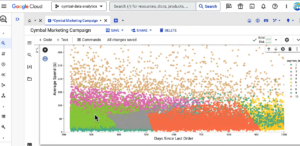
DuetAI can provide coding assistance in BigQuery

Duet AI for Looker allows users to “chat with their enterprise data,” Kazmaier said, including asking the AI to generate a report, dashboard, or text summaries for them. Duet AI for Looker also understands the customers’ data model, he said.

Duet AI for BigQuery functions as an AI assistant for data engineers. It can write code in Python, for example, enabling engineers to do more thinking about their data work and less actual coding. (For the record Duet AI speaks 22 languages, from Bash to YAML, according to this Google page.)

“Duet AI goes one step further than that,” Kazmaier said. “It can basically understand the data that you have access to, and it understands how the data is being used, so it can propose to you ways how you can analyze the data, which is very powerful because it can lead you to insights that you aren’t looking for in the first place.”

It’s important to understand the interaction between AI systems like Duet and data, Kazmaier said. “When you say ‘Bringing AI to data,’ you actually have to come up one big step,” he says. “It’s about understanding that every AI project is a data project in disguise, because you have to bring your enterprise data to the AI system.”

Google Cloud is also launching BigQuery Studio, which is a workbench that enables data and AI users to “collaboratively and collectively run the entire end-to-end chain, from data to AI activation,” he said.

Duet AI for Databases

Duet is also helping to move customer databases into the Google Cloud as part of the Database Migration Service (DMS). The AI operator will be called upon to write custom bits of SQL that can’t be automatically generated as customers move from the Oracle database to AlloyDB; support for Cloud SQL (Postgres) will be rolled out later this year.

“While we can do most of the code conversion completely automatically, there’s always going to be a few things we can’t do, so we’re using GenAI to help customer get over that last mile of code conversion,” Andi Gutmans, Google Cloud’s VP and GM of databases, said in a press conference last week.
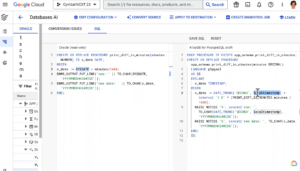
Duet AI can help with SQL generation in database migrations

A vector database is a key component of a GenAI application, and now you can get that capability in Alloy DB AI, which was also unveiled today. Gutmans described AlloyDB AI as “an integrated set of capabilities for easily building enterprise GenAI applications.”

In addition to delivering vector searches that are 10x faster than standard Postgres, AlloyDB AI will also “allow developers to easily generate vector embedding right from within the database, really making that developer experience simple and agile,” Gutmans said.

Duet AI is also being used with Cloud Spanner, the globally resilient SQL database service managed by Google Cloud. With Duet AI in Cloud Spanner, users can “generate code to structure, modify, or query your data using natural language,” the company said in a blog post today. “For instance, with a simple command such as ‘write a query to show all data in the messages table.’”

Duet AI for Security

Finally, Duet is also coming to Google Cloud’s security offerings, where it can function as a force multiplier for harried security teams.

“I’ve never met a CISOs who says they have enough talent and the people on their team,” Jeff Reed, Google Cloud vice president of products for security, said in a press conference last week. “GenAI offer a lot of opportunity to help scale talent. Level one operators can be as productive as level two and level three [operators].”

Specifically, Google Cloud is leveraging the Duet technology as well as Google’s PaLM large language model to bolster productivity to teams. The Google Cloud security team built their own custom model based on PaLM, called SecPaLM 2, and combined it with the interactive chat capabilites of Duet within Mandiant Threat Intelligence, the security research and services company it acquired a year ago for $5.4 billion.

“The beauty of Mandiant Threat Intelligence is you get some of the absolutely best threat intelligence in the world,” Reed said. “What we’ve done is we enable the Mandiant Threat Intelligence to be summarized using DuetAI so you can quickly use DuetAI to look at thousands of Mandiant finished intelligence report, summarize that for what’s most specific to you, and customize it to the type of audience.”

A Duet AI interface has also being created for Chronicle Security Operations, the company’s cloud-native security information and event management (SIEM) offering, which is designed to correlate petabytes of customer telemetry data with the latest security intelligence. Duet AI enables users to query Chronicle Security Operations using natural language, and also to provide summaries.

Duet AI remains in preview. You can sign up for it at cloud.google.com/duet-ai.

Related Items:

Google Cloud Levels Up Database Services with Cloud SQL Enterprise Plus

Google Cloud Bolsters Data, Analytics, and AI Offerings

Google Cloud’s 2023 Data and AI Trends Report Reveals a Changing Landscape

Related

About the author: Alex Woodie

Alex Woodie has written about IT as a technology journalist for more than a decade. He brings extensive experience from the IBM midrange marketplace, including topics such as servers, ERP applications, programming, databases, security, high availability, storage, business intelligence, cloud, and mobile enablement. He resides in the San Diego area.


Roadmap for building a data-driven, AI-powered supply-chain

Car Factory Engineer in Work Uniform Using Laptop Computer with
History & Evolution | The Concept of Supply-chain Network, The TOC & the Information Supply-chain | Imagining the future: Supply-chain 5.0 | Supply-chain Analytics Strategy | Roadmap for Building a Data-driven, AI-Powered Supply-chain

Despite the abundance of articles about how Big Data and AI are transforming enterprise supply chains, Gartner’s (consistent) surveys over the past decade have shown that less than half of CDAOs (Chief Data and Analytics Officers) believe their teams have been successful in delivering “some” value (latest Gartner, Mar 2023). In my experience, this is primarily due to organizations making blind investments in advanced analytics platforms and AI tools without first understanding the key principles involved in improving the throughput of the enterprise value chain.

More often than not, the failure lies in CDAO’s strategy, not in the choice of AI tools or technology. A 2020 Gartner survey identified three challenges to supply-chain analytics success:

  1. Lack of scalable data foundation needed (from the supply-chain)
  2. Lack of talent and skills relevant to supply-chain (Either you find people who have supply-chain domain experience, or experience in advanced analytics… rare to find people who understand both)
  3. Lack of clarity on building a supply-chain analytics business case…or, in other words, lack of a coherent supply-chain analytics strategy.

Given this article is rather long, it has been divided into three parts for your ease of reading.

Part-1 of this article examines how data-driven decision-making in supply-chain has evolved over the years, from the earliest rudimentary decision-support systems to the supply chains of the future, which will heavily rely on Bigdata, AI-ML and Generative AI.

Part-2 of this article explains how the enterprise value-chain is not one simple, unitary supply-chain, but rather a complex network, or an interlinked web of multiple interdependent supply-chains that need to work in tandem, and in perfect harmony to ensure the supply-chain performs at 100% & How resolving the bottlenecks in the information-supply-chain is the key to a successful TOC (theory of constraints) implementation for maximizing the enterprise throughput & how applying TOC to Information supply-chain provides a fail-safe methodology for building a data-driven supply-chain.

Part-3 of this article explains the immediate and pressing need for digitizing your supply chain; investing in supply-chain 5.0 is no longer an option, but has become a survival necessity for organizations seeking to remain relevant and competitive in the next decade. It goes on to describe the key features of the digital supply chain, and a broad roadmap for building a Data-driven, AI-powered supply-chain

Part 1: Data-driven supply chain – History & evolution

Is the concept of data driving decisions new?

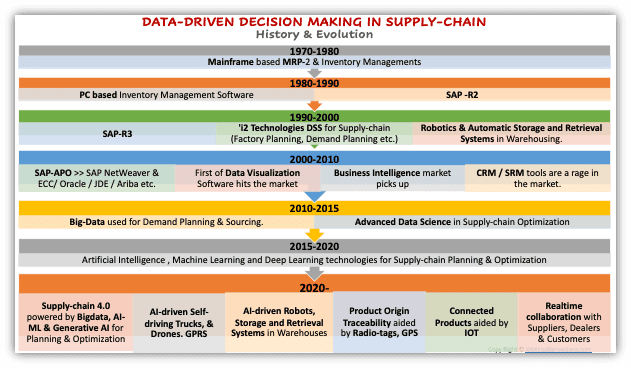
The concept of “data supporting decisions” is not new. Business intelligence (BI) has been around since the 1960s. However, the amount and availability of data is now far greater than ever, and businesses are relying on data-driven decision-making more heavily than ever before. For those in doubt, I recommend an excellent article from the Journal of Knowledge Economy that chronicles the evolution of the ‘Information-driven decision-making process’ through 1950–2020 (Parra. X & Ors, J Knowl Econ, 2022). Those of us who went to college in the 90s (when Peter Drucker was still alive) may recall being taught that “a manager’s job is to make rational decisions based on whatever data is available at one’s disposal”. Drucker was supposed to have pioneered the use of decision trees to depict the decision-making process (DMP) (Drucker, 1967). Some of the computational models now being extensively used in Artificial Intelligence, like Expert Systems, Neural Networks etc. were actually proposed in the ’70s, but real progress was made in the ’80s and 90’s as computers became more powerful and more affordable. As more and more data became available to support decision-making in the 1990s, decision-support systems were developed (DSS).

Among the most popular applications for DSS in the manufacturing industry were in logistics and supply-chain management.

Decision Support Systems (DSS) for supply-chain: A brief history

A quarter century ago, I used to be a fairly busy SAP consultant, and after several successful full-cycle implementations, I moved companies and switched over to supply-chain consulting…. mostly because I wanted to do something different. Besides, I was not exactly new to supply-chain management; as I had substantial domain experience in Logistics and Distribution-Packaging.

image-14
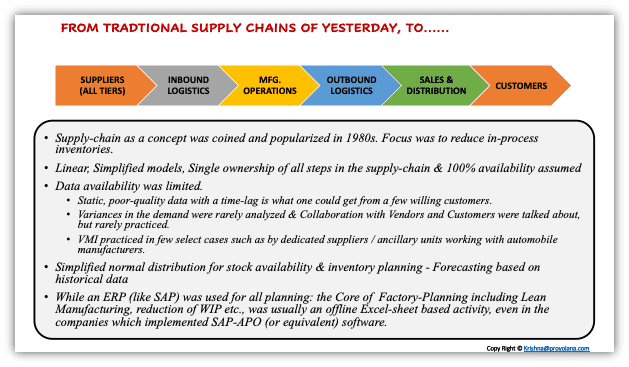
Figure 1: Traditional Concept of Supply-chain

Those days, i2 Technologies dominated the supply-chain and, more specifically, the decision support systems (DSS) space. However, I could notice something was odd about the whole i2 business, right from the day one… ‘i2’ struck me as a poorly thought-out, clumsily designed product; especially when compared to a wondrous and brilliantly designed product like SAP. Most of the i2 product implementations were done by i2 Technologies themselves, and occasionally an odd consultant was brought in from the newly inducted partners. I quickly learned that the i2 consultants charged exorbitant fees, flew only business-class+, …but whenever some customers tried asking pointed questions, they simply threw some jargon at them; while what they said sounded impressive and important, it rarely made sense. Within a few months, I knew enough to deduce there was no real value being delivered to the clients…ironically i2 used to claim they delivered over $ 75 Billion in ’audited savings’ to their customers. Whatever the authenticity of the number, it definitely helped them “sell” their products.

image-13
Figure 2: : Data-Driven Decision Making in Supply Chain – History & Evolution

SAP initially worked closely with i2. I remember some of their products were integrated into the SAP and could be configured within SAP. But they eventually fell out for reasons that were never made public, and SAP soon developed and launched APO — a far better-designed product that actually works and delivers value.

In 2002, i2 was fined over $ 1 billion by the SEC (Securities and Exchanges Commission, USA) for misrepresenting its revenues for over five years. Not sure who their external auditor was, and if they also ‘audited’ the savings of $ 75 Billion.

The first decade of the new millennium saw the introduction of a host of new tools and technologies for business intelligence, data warehousing, data visualization, etc., as well as CRM and SRM. Among the best-known are SAP BI-BO, Oracle, Siebel, Ariba, etc. Tableau made its debut in 2003 (it was called Polaris then).

The supply chain software market has seen significant innovation over the past decade with the advent of Bigdata — Advanced Analytics Platforms, AI-ML, IOT — Connected Products, Self-driving trucks, Drones for delivery, etc… Now Generative AI is expected to revolutionize it further.

Partner, helper, or boss? We asked ChatGPT to design a robot and this happened

Tomato-picking robot outside while person inside doing work.

European researchers working on the design of a tomato-picking robot.

With alarm bells ringing about artificial intelligence (AI) pushing us toward extinction, you might well imagine the process of an AI designing a robot as something akin to Frankenstein creating the Terminator — or even the other way around!

But what if, at some point in the future, dystopian or otherwise, we need to collaborate with machines on solving problems? How would that collaboration work? Who would be bossy and who would be submissive?

Also: How to write better ChatGPT prompts

Having ingested many episodes of the dystopian Netflix series Dark Mirror, along with a side order of Arthur C. Clarke's "2001: A Space Odyssey", I'd bet the farm on the machine being bossy.

However, an actual experiment of this sort conducted by European researchers turned up some distinctive results that could have a major impact on machine-human collaboration.

Assistant Professor Cosimo Della Santina and PhD student Francesco Stella, both from TU Delft, and Josie Hughes from Swiss technical university EPFL, conducted an experiment to design a robot in partnership with ChatGPT that solved a major societal problem.

"We wanted ChatGPT to design not just a robot, but one that is actually useful," said Della Santina in a paper published in Nature Machine Intelligence.

And so began a series of question-and-answer sessions between the researchers and the bot to try and figure out what the two groups could architect together.

Also: The best AI chatbots: ChatGPT and other noteworthy alternatives

Large language models (LLMs) like ChatGPT are absolute beasts when it comes to their ability to churn through and process huge amounts of text and data, and can spit out coherent answers at blazing speed.

The fact that ChatGPT can do this with technically complex information makes it even more impressive — and a veritable boon for anyone seeking a super-charged research assistant.

Working with machines

When ChatGPT was asked by the European researchers to identify some of the challenges confronting human society, the AI pointed to the issue of securing a stable food supply in the future.

A back-and-forth conversation between the researchers and the bot ensued, until ChatGPT picked tomatoes as a crop that robots could grow and harvest — and, in doing so, make a significant positive impact on society.

ChatGPT came up with useful suggestions on how to design the gripper, so it could handle delicate objects like tomatoes.

This is one area where the AI partner was able to add real value — by making suggestions in areas, such as agriculture, where its human counterparts did not have real experience. Picking a crop that would have the most economic value for automation would have otherwise necessitated time-consuming research by the scientists.

"Even though Chat-GPT is a language model and its code generation is text-based, it provided significant insights and intuition for physical design, and showed great potential as a sounding board to stimulate human creativity," said EPFL's Hughes.

Also: These are my 5 favorite AI tools for work

Humans were then responsible for selecting the most interesting and suitable directions to pursue their goals — based on options provided by ChatGPT.

Intelligent Design

Figuring out a way to harvest tomatoes is where ChatGPT truly shone. Tomatoes and similarly delicate fruits — yes, the tomato is a fruit, not a vegetable — pose the greatest challenge when it comes to harvesting.

The AI-designed gripper at work.

When asked about how humans could harvest tomatoes without damaging them, the bot did not disappoint, and generated some original and useful solutions.

Realizing that any parts coming into contact with the tomatoes would have to be soft and flexible, ChatGPT suggested silicone or rubber as material options. ChatGPT also pointed to CAD software, molds, and 3D printers as ways to construct these soft hands, and it suggested a claw or a scoop shape as design options.

Also: 7 ways you didn't know you can use Bing Chat and other AI chatbots

The result was impressive. This AI-human collaboration successfully architected and built a working robot that was able to dexterously pick tomatoes, which is no easy feat, considering how easily they are bruised.

The perils of partnership

This unique collaboration also introduced many complex issues that will become increasingly salient to a human-machine design partnership.

A partnership with ChatGPT offers a truly interdisciplinary approach to problem-solving. Yet, depending on how the partnership is structured, you could have differing outcomes, each with substantial implications.

For example, LLMs could furnish all the details needed for a particular robot design while the human simply acts as the implementer. In this approach, the AI becomes the inventor and allows the non-specialist layman to engage in robotic design.

Also: How to use ChatGPT

This relationship is similar to the experience the researchers had with the tomato-picking robot. While they were stunned by the success of the collaboration, they noticed that the machine was doing a lot of the creative work. "We did find that our role as engineers shifted towards performing more technical tasks," said Stella.

It's also worth considering that this lack of control by humans is where dangers lurk. "In our study, Chat-GPT identified tomatoes as the crop 'most worth' pursuing for a robotic harvester," said EPLF's Hughes.

"However, this may be biased towards crops that are more covered in literature, as opposed to those where there is truly a real need. When decisions are made outside the scope of knowledge of the engineer, this can lead to significant ethical, engineering, or factual errors."

Also: AI safety and bias: Untangling the complex chain of AI training

And this concern, in a nutshell, is one of the grave perils of using LLMs. Their seemingly miraculous answers to questions are only possible because they've been fed a certain type of content and then asked to regurgitate parts of it, much like a classical style of education that many societies still rely on today.

Answers will essentially reflect the bias — both good or bad — of the people who have designed the system and the data it has been fed. This bias means that the historical marginalization of segments of society, such as women and people of color, is often replicated in LLMs.

And then there's the pesky problem of hallucinations in LLMs such as ChatGPT, where the AI simply makes things up when confronted with questions to which it does not have easy answers.

There's also the increasingly thorny problem of proprietary information being used without permission, as several lawsuits filed against Open AI have begun to expose.

Also: ChatGPT vs. Bing Chat: Which AI chatbot should you use?

Nevertheless, an even-handed approach — where the LLMs play more of a supporting role — can be enriching and productive, allowing for vital interdisciplinary connections to be forged that could not have been fostered without the bot.

That said, you will have to engage with AIs in the same fashion you do with your children: assiduously double-check all information related to homework and screen time, and especially so when they sound glib.

Artificial Intelligence

DeepMind partners with Google Cloud to watermark AI-generated images

DeepMind partners with Google Cloud to watermark AI-generated images Kyle Wiggers 8 hours

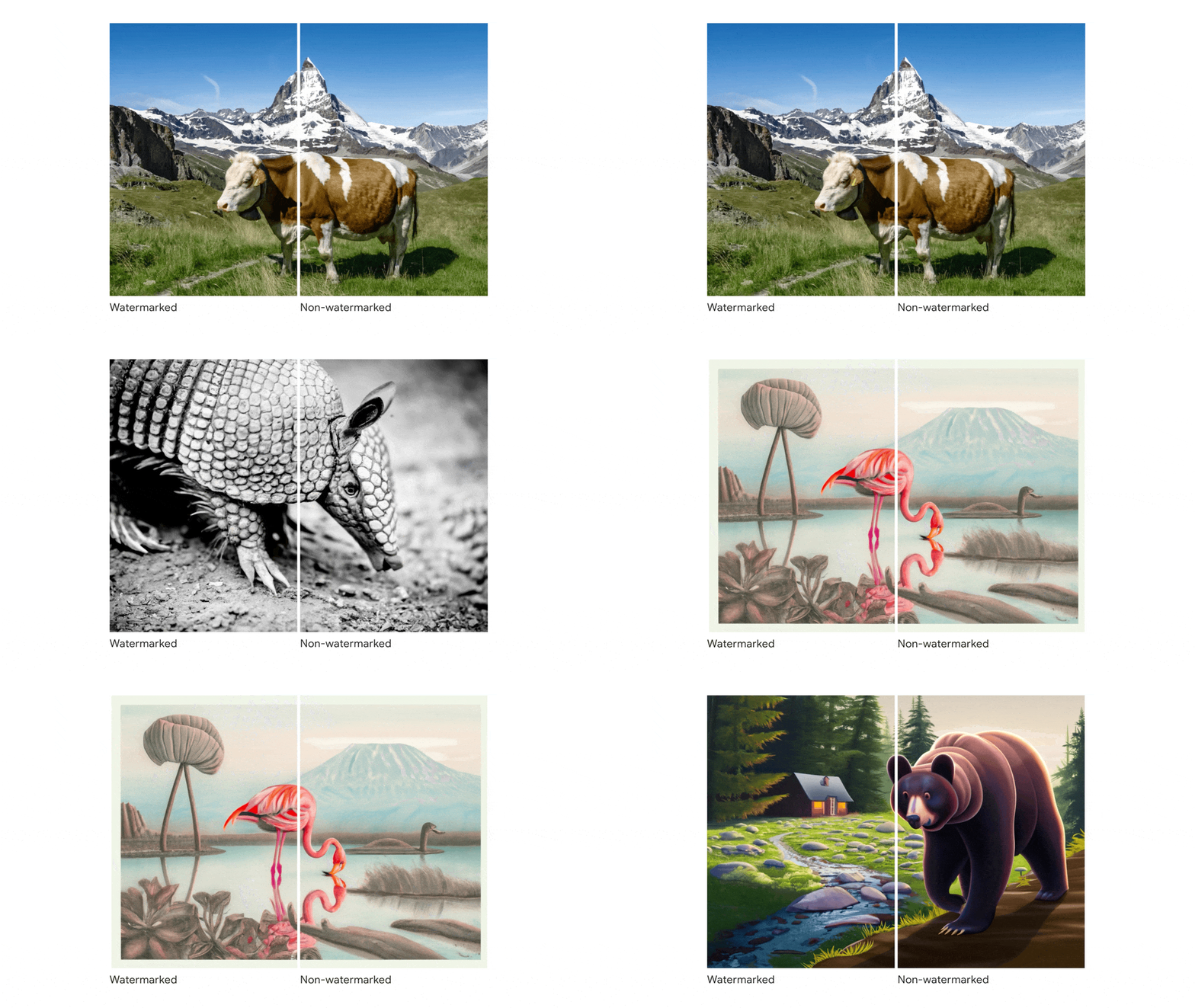
In partnership with Google Cloud, Google Deepmind, Google’s AI research division, is launching a tool for watermarking and identifying AI-generated images. But only images created by Google’s own image-generating model.

The tool, called SnythID and available in beta for select users of Vertex AI, Google’s platform for building AI apps and models, embeds a digital watermark directly into the pixels of an image — making it ostensibly imperceptible to the human eye but detectable by an algorithm. SynthID only supports Imagen, Google’s text-to-image model, which is exclusively available in Vertex AI.

Google previously said it would embed metadata to signal visual media created by generative AI models. SynthID, obviously, goes a step beyond this.

“While generative AI can unlock huge creative potential, it also presents new risks, like enabling creators to spread false information — both intentionally or unintentionally,” DeepMind writes in a blog post. “Being able to identify AI-generated content is critical to empowering people with knowledge of when they’re interacting with generated media, and for helping prevent the spread of misinformation.”

DeepMind claims that SynthID, which it developed and partnered with Google Research, Google’s R&D team, to refine, remains in place even after modifications like adding filters to, changing the colors of and highly compressing images. The tool leverages two AI models, one for watermarking and one for identifying, that were trained together on a “diverse” set of images, DeepMind says.

DeepMind SynthID

Image Credits: DeepMind

SynthID can’t identify watermarked images with 100% confidence. But the tool distinguishes between instances where an image might contain a watermark versus an image is highly likely to contain one.

“SynthID isn’t foolproof against extreme image manipulations, but it does provide a promising technical approach for empowering people and organisations to work with AI-generated content responsibly,” DeepMind writes in the blog post. “This tool could also evolve alongside other AI models and modalities beyond imagery such as audio, video and text.”

Watermarking techniques for generative art aren’t new. French startup Imatag, launched in 2020, offers a watermarking tool that it claims isn’t affected by resizing, cropping, editing or compressing images, similar to SynthID. Another firm, Steg.AI, employs an AI model to apply watermarks that survive resizing and other edits.

But the pressure is ramping up on tech firms to provide a way to make it clear that works were generated by AI.

Recently, China’s Cyberspace Administration issued regulations requiring that generative AI vendors mark generated content — including text and image generators — without affecting user usage. And in recent U.S. Senate committee hearings, Senator Kyrsten Sinema (I-AZ) emphasized the need for transparency in generative AI, including by using watermarks.

In May at its annual Build conference, Microsoft committed to watermarking AI-generated images and videos “using cryptographic methods.” Elsewhere, Shutterstock and generative AI startup Midjourney adopted guidelines to embed a marker that content was created by a generative AI tool. And OpenAI’s DALL-E 2, a text-to-image tool, inserts a small watermark on the bottom right-hand side of images that it generates.

But so far, a common watermarking standard — both for creating watermarks and detecting them — has proven to be elusive.

SynthID, like the other technologies that’ve been proposed, won’t be useful for any image generator that isn’t Imagen — at least not in its current form. DeepMind says that it’s considering making SynthID available to third parties in the near future. But whether third parties — especially third parties developing open source AI image generators, which lack many of the guardrails in generators gated behind an API — will adopt the tech is another matter altogether.