Modern data exchange methods: Exploring the strengths and limitations of leading protocols

78a9ffe1ada2c4e0291a2944803b95a9

Introduction

In our rapidly digitizing world, how businesses and systems communicate is paramount. The bedrock of this communication lies in data exchange methods, which allow seamless information flow, driving operational efficiencies and enabling innovation. Over the years, various data exchange protocols have emerged, each boasting unique strengths and presenting challenges. As enterprises strive to integrate disparate systems and streamline processes, understanding the intricacies of these protocols becomes imperative. From traditional methods like Electronic Data Interchange (EDI) to modern, flexible approaches using Application Programming Interfaces (API), the data exchange landscape is vast and evolving. This article delves into our time’s leading data exchange methods, explores their strengths and limitations, and fits the tapestry of modern business needs. The objective? To provide clarity and guidance for organizations navigating the complex terrain of data exchange in 2023.

Background of data exchange protocols

Data exchange protocols have been integral to business operations for decades, evolving with technological advancements and shifting organizational demands. Historically, businesses relied on manual, paper-based exchanges — a time-consuming and error-prone process. As global commerce expanded and the need for faster, more reliable communication became paramount, the first automated data exchange systems emerged.

Electronic Data Interchange (EDI), one of the earliest automated systems, revolutionized how businesses communicate. During the 1960s, a standardized format called EDI was created to enable the exchange of documents like invoices and purchase orders without human intervention. Its adoption paved the way for more efficient, error-free transactions, particularly in retail, logistics, and healthcare.

However, as the digital era progressed, the limitations of EDI became apparent. The emergence of the internet and cloud technologies catalyzed the development of newer protocols, emphasizing flexibility, real-time communication, and integration capabilities. APIs (Application Programming Interfaces), representing this new wave, enabled systems to ‘talk’ directly, fetching and updating data on the go.

While EDI laid the foundation for automated data exchange, the rise of APIs and other protocols signaled a shift towards more dynamic, interconnected, and responsive systems catering to the multifaceted demands of modern businesses.

Understanding Electronic Data Interchange (EDI)

Electronic Data Interchange (EDI) is a structured system that allows businesses to communicate electronically, converting human-readable documents into machine-readable formats. As a digital bridge, EDI has been instrumental in replacing manual processes with automated ones, reducing human errors, and speeding up business cycles.

At its essence, EDI refers to the exchange of various documents, including purchase orders, invoices, and shipping notices, between businesses. Companies can send these digitally instead of mailing a paper document, ensuring quicker transactions. This transition to electronic exchanges streamlined operations and brought about substantial cost savings.

The strength of EDI lies in its standardization. Several EDI standards exist globally, the most common being ANSI X12 (used in North America) and EDIFACT (widely adopted internationally). These standards ensure that every participating business speaks a common language, leading to seamless exchanges regardless of internal systems or structures.

However, while EDI’s rigid structure is beneficial for consistency, it can sometimes be limited. Integrating EDI requires specific software and can be time-consuming, especially when updating or transitioning between standards. Additionally, traditional EDI lacks real-time capabilities, which modern businesses often need.

Despite its challenges, EDI remains a trusted protocol in industries where standardized transactions are frequent, and consistency is paramount. Its legacy in the digital transformation of business communication is undeniable, laying the groundwork for developing more adaptable protocols, like APIs.

An insight into Application Programming Interface (API)

In the digital realm, Application Programming Interfaces, commonly known as APIs, have become the linchpin of connectivity. APIs serve as intermediaries, enabling distinct software applications to communicate, share data, and perform functions without revealing the intricate details of their underlying code.

The beauty of APIs lies in their flexibility and real-time capabilities. They can be likened to a restaurant menu: while you know what dishes are available and how to order them, the recipe and cooking techniques remain undisclosed. APIs offer a comprehensive catalog of general system operations, which external systems can utilize while keeping the internal mechanisms hidden.

This ‘black box’ approach offers businesses unparalleled adaptability, enabling them to integrate disparate systems, regardless of the languages or platforms they are built on. Moreover, unlike EDI, which is batch-oriented, APIs offer real-time data transmission, making them indispensable in scenarios demanding immediate responses, such as payment gateways or live tracking systems.

However, while APIs offer flexibility, they come with their own set of challenges. The decentralized nature of APIs means individual developers have a greater onus to ensure consistency and reliability. Also, with the rise of cyber threats, API security is paramount, necessitating robust protocols to prevent data breaches.

In conclusion, APIs have transformed how businesses and applications interact, offering a dynamic, flexible, and real-time solution. When juxtaposed against EDI, they represent the evolution of digital communication, catering to the ever-changing demands of modern enterprises.

Comparing EDI and API: A balanced view

In the ever-evolving digital communication landscape, the EDI vs. API debate comes to the forefront as industries grapple with finding the most efficient data exchange method. Both have their unique strengths and limitations.

EDI, having its roots in the early days of electronic communication, offers a standardized format. Its batch-processing nature is designed for scheduled, high-volume exchanges, making it ideal for retail or logistics industries where daily bulk transactions occur. Its robustness and longstanding history mean that it is trusted by many enterprises, especially when longstanding contracts and legacy systems are involved.

On the other hand, API shines in its agility and real-time capabilities. Suited for instantaneous data transfers, APIs facilitate interactions between disparate systems more dynamically. This is especially relevant in today’s cloud-driven environment, where integration between diverse platforms and instant feedback is crucial. Think of online payments, social media integrations, or real-time inventory checks.

However, while API offers flexibility, it might require more maintenance due to its decentralized nature. EDI, while sturdy, might need to be more agile in adapting to rapidly changing scenarios.

Neither method is categorically superior. The choice between them often boils down to an organization’s specific needs, existing infrastructure, and future goals.

The role of hybrid solutions: Best of both worlds?

In a digitally converging world, organizations often find themselves at crossroads, needing to choose between the reliability of EDI and the agility of API. Enter hybrid solutions: a fusion of EDI and API approaches, aiming to harness their combined strengths.

Hybrid solutions endeavor to offer businesses the structural robustness of EDI for scheduled, high-volume data transfers while capitalizing on APIs’ dynamic, real-time capabilities for immediate data needs. By seamlessly integrating these two protocols, organizations can achieve improved efficiency, reduced data silos, and more agile response mechanisms.

However, while this approach promises comprehensive benefits, its implementation demands a clear strategy. The challenge lies in ensuring seamless interplay between the two protocols without overcomplicating the system. If executed well, hybrid solutions can genuinely offer modern businesses the best of both the EDI and API worlds.

Considerations for businesses: Choosing a data exchange protocol

Selecting the proper data exchange protocol is paramount to ensuring smooth business operations. Before opting for either EDI, API, or a hybrid model, organizations should evaluate the following criteria:

  1. Volume & Frequency: Consider the amount and regularity of data transfers. High-volume, periodic transactions might lean towards EDI, while real-time, sporadic one’s favor APIs.
  1. Integration Complexity: Review existing systems and understand the intricacies of integrating a new protocol. Consider the potential need for middleware or specialized adapters.
  1. Data Format Flexibility: While EDI uses standardized formats, APIs can handle diverse data structures, which is beneficial for varied application interfaces.
  1. Cost Implications: Analyze the total cost of ownership, including setup, maintenance, and potential scalability expenses.
  1. Futureproofing: Gauge how adaptive the protocol is to emerging technologies and evolving business needs.

The chosen method should align with the company’s strategic goals, operational needs, and technological landscape.

Future trends in data exchange protocols

As digital landscapes evolve, modern data exchange methods are set to undergo significant shifts. Blockchain is emerging as a potential enhancer for secure, traceable data transfers, ensuring tamper-proof exchanges. With the evolution of Modern Data Exchange Methods, Quantum computing could revolutionize data transmission speeds and security. Meanwhile, the demand for real-time data access, spurred by IoT (Internet of Things) proliferation, may tilt the balance further in favor of APIs. Lastly, as businesses seek agility and interoperability, hybrid solutions that blend the stability of EDI with the flexibility of API, representing the zenith of modern data exchange, could become more prevalent.

Conclusion

The landscape of data exchange has never been more dynamic, with Electronic Data Interchange (EDI) and Application Programming Interface (API) standing as the titans of this realm. Both bring unique strengths, with EDI excelling in structured B2B communications, while APIs offer flexibility and real-time interactions. However, as we look forward to a rapidly changing digital era, it is evident that businesses cannot rely on just one method. Hybrid solutions that leverage the strengths of both protocols offer promising avenues for the future. As companies make pivotal decisions on data exchange methodologies, understanding the broader spectrum of these tools, their evolution, and the imminent future trends will be instrumental. It is not about EDI vs. API; it is about harnessing the best of both worlds for seamless, efficient, and future-proof data exchanges.

The future of shipping: How technology is shaping logistics and fulfillment

drone-and-earth-1-1

Currently, the use of technology in shipping and logistics is leading the industry through a transformative era, driven by rapid technological advancements, undoubtedly marking a pivotal moment in the digital shipping evolution. From automating routine processes to employing intelligent algorithms that predict and optimize routes, the technological revolution is redefining the way goods are transported and fulfilled. As global commerce is becoming more complex and interconnected, it’s evident that the role of tech in enhancing efficiency and customer satisfaction has never been more critical.

This article delves into the fascinating world of digital logistics, unraveling the innovations reshaping the industry. Whether it’s the application of artificial intelligence or Electronic Data Interchange (EDI) protocols like EDI 945 and EDI 210, the modern shipping landscape is being remolded to meet the demands of the 21st century.

In the following sections, we’ll explore the trends, tools, and techniques steering the shipping industry toward a new horizon of possibilities.

The transformation of logistics: A historical perspective

As an integral part of commerce, logistics has been evolving for centuries. From the ancient Silk Road to the modern global shipping networks influenced by technology in shipping and logistics, the history of logistics is rich with innovations and transformations The dawn of the industrial revolution in Britain marked a significant shift, introducing railways, steamships, and telecommunication. In the late 20th century, computerization brought about another profound change with real-time tracking, and optimization became possible.

In the past two decades, the digital shipping evolution has been further accelerated by the emergence of the internet and mobile technology. Digital platforms now enable unprecedented connectivity between carriers, shippers, and consumers. Integration of Electronic Data Interchange (EDI) tools like EDI 945 and EDI 210 allowed seamless communication and data exchange across the supply chain. In light of this, the digital evolution paved the way for predictive analytics, machine learning, and automation, subsequently enhancing the efficiency and transparency of logistics operations.

This progression clearly demonstrates how technology in shipping and logistics has catalyzed transformation, starting from physical labor and paper documents and then moving to a data-driven, automated landscape. Consequently, it has empowered businesses to adapt, innovate, and thrive in a globalized world, setting the stage for the future of shipping and logistics.

Emerging technologies in shipping

As we venture into a new era of shipping and logistics, the digital shipping evolution brings forward various emerging technologies spearheading the transformation, each with its unique impact and potential.

  • AI and ML: AI and ML algorithms drive intelligent decision-making. They analyze vast data sets, identify patterns, and make predictions to optimize routes, manage inventories, and reduce costs. Machine learning models can continually improve, adapting to changes and uncertainties in the global market.
  • Internet of Things (IoT): IoT devices provide real-time tracking and monitoring of shipments. From temperature control in refrigerated cargo to the location tracking of containers, IoT enhances transparency and ensures the integrity of the goods transported.
  • Blockchain Technology: Blockchain offers secure, transparent, and immutable records for transactions within the supply chain. It creates a single version of the truth that can be accessed by all parties, eliminating disputes and enhancing trust.
  • Automation and Robotics: Robotics in warehouses and automation in sorting and handling processes significantly improve efficiency and accuracy. Automated guided vehicles (AGVs) and drones are revolutionizing how goods are moved within and between facilities.
  • 3D Printing: 3D printing allows on-demand production of parts and products closer to consumption. This can shorten supply chains, reduce stockpiling, and allow more customized manufacturing.
  • Augmented and Virtual Reality (AR/VR): AR and VR technologies are being utilized for training, virtual tour of facilities, and even remote machinery maintenance.
  • Electronic Data Interchange (EDI) Tools: Although not new, using specific EDI protocols like EDI 945 and EDI 210 remains essential in standardizing communication between different players in the supply chain. It ensures smooth information flow, reducing manual errors, and speeding up transactions.
  • Sustainable Technologies: With increasing awareness of environmental issues, technologies that enable greener shipping methods like electric trucks, energy-efficient vessels, and sustainable packaging are gaining traction.

Digital innovations in freight billing and payment

Digital transformation is revolutionizing the complex freight billing and payment world, making it more efficient, transparent, and error-free. Here’s how:

  1. Automation: Automated invoicing and payment processing minimize manual handling and drastically reduce the potential for human error. Automated systems can cross-reference shipping details with contracts and tariffs, ensuring accurate billing.
  1. Blockchain: By utilizing blockchain technology, the industry ensures secure, immutable, and transparent transactions. Parties can track each payment stage, enhancing trust and reducing the risk of fraud.
  1. Electronic Data Interchange (EDI) Tools: Specific EDI protocols like EDI 210 enable seamless communication between shippers, carriers, and third-party logistics providers. It standardizes billing information and makes the entire process faster and more reliable.
  1. Mobile Payment Solutions: Mobile applications facilitate quick and hassle-free payments on the go. They offer convenience to shippers and carriers, allowing them to manage their finances from anywhere.
  1. Integration with Financial Software: Integration with accounting and financial management software ensures that billing and payment data flow directly into financial reports and compliance documents.
  1. Data Analytics: Advanced analytics provide insights into spending patterns, helping businesses identify opportunities for savings and make informed decisions.
  1. Sustainability: E-billing and digital payments reduce paper consumption, aligning with corporate sustainability goals.

Enhancing customer experience through technology

Digital shipping evolution plays a pivotal role in enhancing the customer experience in the dynamic shipping and logistics sector. Here’s how technology is shaping the customer experience:

  • Real-Time Tracking: Customers can now track shipments in real-time through GPS and IoT-enabled devices. This transparency fosters trust and allows for better planning and coordination.
  • Personalized Service: Advanced algorithms and AI empower businesses to offer personalized recommendations and services. Customers receive tailored shipping options based on their preferences, location, and history.
  • Automated Support Systems: Chatbots and automated support systems provide instant assistance, answering queries and solving issues at any hour. This 24/7 availability boosts customer satisfaction.
  • Mobile Apps: With user-friendly mobile applications, customers can manage shipments, receive notifications, and even make payments from their smartphones. This convenience enhances the overall experience.
  • Sustainable Shipping Options: Eco-conscious customers appreciate technology that helps them choose greener shipping options. Tools that calculate carbon footprint and offer sustainable alternatives align with the values of a growing segment of consumers.
  • Virtual Reality (VR) and Augmented Reality (AR): These technologies offer immersive experiences, such as virtual tours of warehouses or 3D views of products. They can enhance understanding and engagement with the services provided.
  • Secure Payment Gateways: Simplified and secure digital payment methods, including integrations like EDI 945 for warehouse shipping information, assure customers of safe transactions.

Sustainability and ethical considerations

The advent of technology in shipping is not only revolutionizing the speed and efficiency of logistics but is also paving the way for a more sustainable and ethical industry. In a world increasingly concerned with environmental stewardship and social responsibility, here’s how technology is contributing to sustainability in shipping:

  1. Energy-Efficient Technologies: Implementing smart sensors and automation allows for optimal utilization of resources, reducing energy consumption. Automated routing, for example, ensures the most efficient pathways, thereby saving fuel.
  1. Sustainable Packaging Solutions: Innovations in packaging technologies are leading to reduced waste and more eco-friendly materials. This includes reusable packaging and materials that are biodegradable.
  1. Waste Reduction through Analytics: Big data and analytics allow companies to accurately forecast demand and optimize inventory, leading to significant reductions in waste.
  1. Green Shipping Options: Technology enables customers to choose shipping methods that align with their sustainability goals, such as electric vehicle delivery or carbon offset programs.
  1. Ethical Supply Chain Management: Transparency and traceability, achieved through solutions like EDI 210 for freight payment and billing, ensure that ethical practices are maintained throughout the supply chain. Customers and businesses can verify the ethical sourcing of products and adherence to labor laws.
  1. Compliance and Reporting: Automated compliance tools make it easier for companies to adhere to environmental regulations and provide transparent reporting on sustainability efforts.

Challenges and obstacles in technological implementation

Embracing new technologies in the shipping industry offers incredible advantages but also presents some challenges and obstacles:

  • Integration Complexity: Incorporating modern technologies with existing systems can be complex and time-consuming, sometimes leading to compatibility issues.
  • Cost Consideration: Advanced technologies often require significant investments, which may be prohibitive for smaller firms.
  • Security Concerns: As digital solutions become integral, safeguarding sensitive information becomes paramount. Ensuring robust cybersecurity measures requires constant vigilance.
  • Regulatory Compliance: Navigating the legal and regulatory landscape is tricky, especially across international boundaries.
  • Skill Gap: The adoption of new technologies demands a skilled workforce. Training existing employees or hiring talent with the right expertise can be challenging.
  • Resistance to Change: Organizational culture and resistance to change can be barriers to successfully implementing new technologies, including systems like EDI 945 for warehouse shipping advice.

Overcoming these challenges requires strategic planning, stakeholder collaboration, and a commitment to continuous innovation and adaptation.

Conclusion

The future of shipping is undeniably intertwined with technological innovation, particularly the role of technology in shipping and logistics, signaling the ongoing digital evolution in the industry. The landscape is evolving rapidly from the transformation of logistics to the emergence of digital solutions in billing and customer experience.

The integration of tools like EDI 210 for freight invoice processing exemplifies how technology is reshaping the industry. While challenges exist, they are not insurmountable. By embracing change, prioritizing sustainability, and focusing on the customer’s needs, the shipping industry can navigate toward a more efficient, resilient, and customer-centric future. The journey ahead is filled with promise, and the possibilities are limitless.

How this simple ChatGPT prompt tweak can help refine your AI-generated content

different colored chat bubbles around laptop

It is no secret that ChatGPT can help you with everyday tasks at work and in your personal life. However, inputting the perfect prompt to get your desired answer can be tricky. This little "tone modifiers" trick can make a huge difference.

If you have ever heard the words "watch your tone" from a parent, you know that how you say something makes a world of difference in how your words are delivered.

Also: Google's Duet AI for Workspace can create presentations, write emails, and attend meetings for you

That concept may be the same reason that when ChatGPT writes an email, essay, presentation, or any written text, it doesn't sound just the way you want it to. To fix that issue, just tell ChatGPT what tone you'd like it to use.

For example, when I ask ChatGPT to write an email to my boss saying that I will be out for the rest of the day due to a stomach ache, it produces a very rigid, professional-sounding email that is quite unnatural and seems AI-generated.

It does this because when it sees the word "boss" in the prompt, it assumes that the tone it should take on is a super professional, serious tone. However, some workers have a more casual texting relationship with their bosses due to how closely and often they collaborate.

Also: You can build your own AI chatbot with this drag-and-drop tool

To remedy this issue, add some tone modifiers. Social Media Today put together an entire chart showcasing tone modifier combinations that can help generate the perfect output, such as "causal and conversational" or "humorous and informal."

For the use case of this email, I would use the tone combo of "casual and conversational" since I want the tone to be much more casual to reflect the mode we usually communicate in. All I did was add the tone modifier to the prompt and I got an entirely different result.

The results with the tweaks resembled an email or Slack message I would actually send to my manager. The initial email would have required a full, time-consuming rewrite, whereas this one just needs some quick revisions to be ready to go.

Tone modifiers can be leveraged to optimize the output for any kind of text prompt, and can go beyond the chart linked above.

Also: OpenAI finally introduces a business version of ChatGPT

For example, you can ask ChatGPT to output content in a way that a five-year-old would understand. Although that description isn't specifically a tone, it will simplify the response to align better with your needs if your needs include explaining something to a child.

You can also use the custom instructions feature on ChatGPT to input the tone you'd like the chatbot to use.

To do this, you would simply add the tone modifiers to the "What would you like ChatGPT to know about you to provide better responses?" and "How would you like ChatGPT to respond?" fields under custom instructions.

Also: 4 things Claude AI can do that ChatGPT can't

The biggest benefit of using this feature instead of simply tweaking your prompt is that it will apply these instructions to all of your outputs until you remove the tone from the constructions.

If you want to generate a series of output texts that all need to be in the same tone, custom instructions can save you a lot of time.

Artificial Intelligence

Google Colab gains an enterprise tier

Google Colab gains an enterprise tier Kyle Wiggers 15 hours

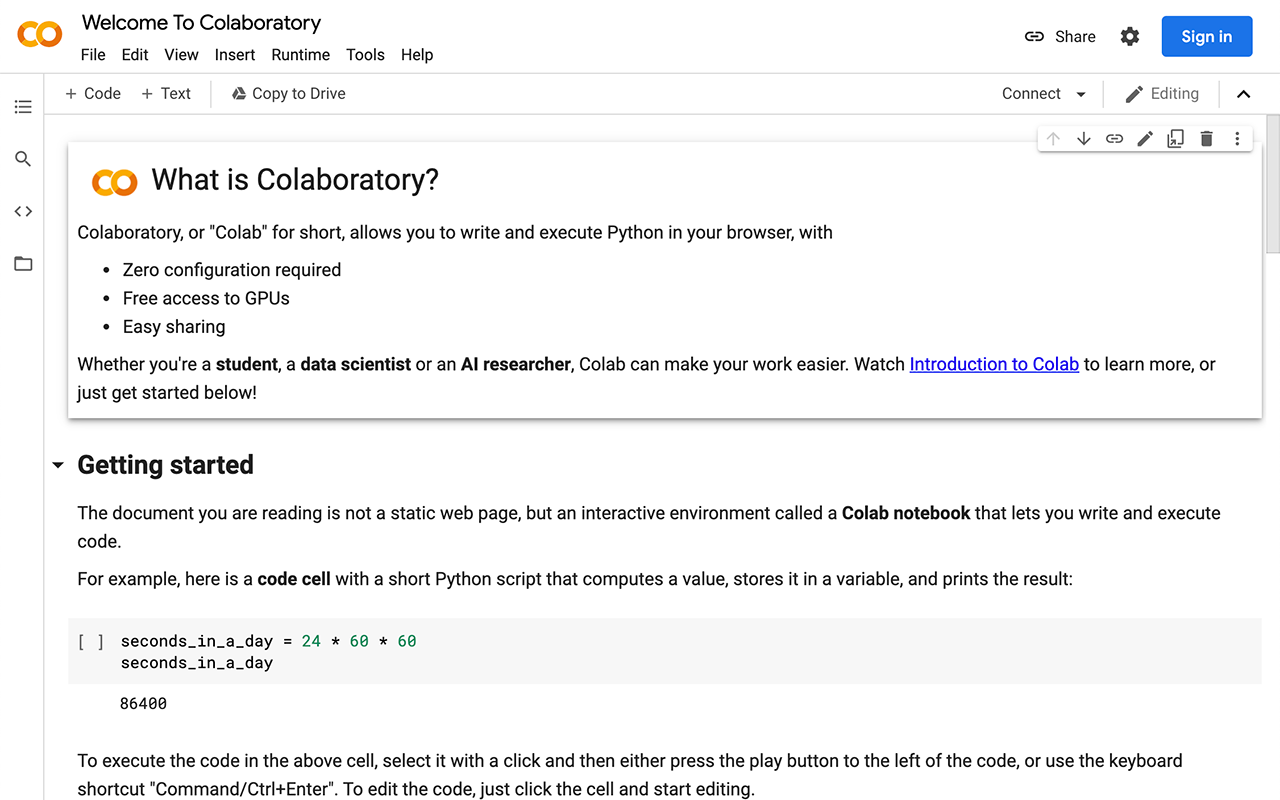
Google Colaboratory (Colab for short), Google’s service designed to allow anyone to write and execute arbitrary Python code through a browser, including code to run AI apps, is gaining an enterprise tier.

Called Colab Enterprise, the new offering combines Colab notebooks — the environment where developers write Python code — with what Google describes as “enterprise-level security” and “compliance support capabilities.”

While the free and individual paid Colab plans let users run Python code on a range of Google’s cloud-hosted hardware, including its TPU AI accelerator chips, Colab Enterprise provides access to the “full range” of capabilities in Vertex AI, Google’s managed AI service, in addition to integration with Google’s BigQuery platform for data extraction.

Colab Enterprise customers can tap prebuilt machine learning models in Vertex AI’s model library, Model Garden, plus a range of model fine-tuning tools, data science tooling and compute resources for training, testing and deploying models.

Via the BigQuery integration, Colab Enterprise users can start a notebook in BigQuery to explore and prep data, then open that same notebook in Vertex AI to continue their work with expanded infrastructure and tooling. Notebooks can be shared across team members and environments, a point Gerrit Kazmaier, the VP and GM of data and analytics at Google Cloud, emphasized to me in a phone interview.

Google Colab

Image Credits: Google

“No one works alone — there’s collaboration across data teams happening quite normally,” he said. “[Colab Enterprise] gives customers the ability to work together with co-workers on a shared notebook. That’s a big part of the experience.”

The rollout of Colab Enterprise comes as the corporate appetite for AI shows no signs of waning. In a recent Insight Enterprises survey, 72% of respondents said that they want AI incorporated into their business within the next three years. A separate poll from CNBC found that, for nearly half (47%) of companies, AI is their top priority of tech spending over the next year.

Google, keen to monetize the AI trend, has slowly transitioned Colab from an experiment to a fully featured paid product mainly aimed at individual developers and small data teams — until now. Spun out of an internal Google Research project in late 2017, Colab gained a premium option in 2020 and a pay-as-you-go plan last year. The free tier remains.

Colab has become the de facto digital breadboard for demos within the AI research community — it’s not uncommon for researchers who’ve written code to include links to Colab pages on or alongside the GitHub repositories hosting the code.

“In a nutshell, [Colab Enterprise delivers] on a lot of the enterprises’ expectations — all of the terms of service agreements to basically all the guarantees that an enterprise needs for governance [and] compliance” Kazmaier said. “Customers can buy, consume and use it as an enterprise product. The ‘Colab Enterprise’ name kind of gives it away — we’ve worked on basically adding in all of the abilities to be a Google Cloud enterprise product.”

Read more about Google Cloud Next 2023 on TechCrunch

DSC Weekly 29 August 2023

Announcements

  • Organizations have been ramping up their cloud adoption and expanding their digital infrastructures, but often without much concern for the environmental impact of these operations. Balancing the need for substantial data infrastructure with more eco-friendly policies should be top of all organizational to-do lists, and creating a specific data center decarbonization strategy will be key. This will range from improving the visibility and measurement of power usage, to actually reducing the carbon footprint of each operational layer. In the upcoming webinar Decarbonizing the Data Center: Making Data Modernization More Sustainable, panelists from Cisco and Hitachi Vantara will discuss the changing attitude to data center sustainability and cloud carbon emissions, the importance of understanding your energy consumption baseline, and much more.
  • Managing the supply chain is exceedingly difficult with global conflicts and market ups and downs interfering with companies’ ability to timely deliver and fulfil orders. Tune into the Overcoming Supply Chain Challenges summit to hear leading experts discuss emerging technologies to help protect and streamline supply chain management along with strategies and tools to secure the supply chain against the many cyber threats it faces. Register for free and gain access to live webinars, fireside chats and keynote presentations from the world’s leading supply chain innovators, vendors and evangelists.

Top Stories

  • Generative AI megatrends: The four horsemen of Generative AI
    August 29, 2023
    by ajitjaokar
    In the early days of the Internet, there were four ‘horsemen’ of the Internet With IBM’s 4.5 billion investment in Hugging face today, the generative AI landscape is becoming a bit clearer. There are four Generative AI leaders emerging – others lagging – and one unknown.
  • Using AI technologies for effective document processing
    August 25, 2023
    by Anastasia Molodoria
    Ever-growing volumes of unstructured data stored in countless document formats significantly complicate data processing and timely access to relevant information for organizations. Without proper optimization of data management workflows, it’s difficult to talk about business growth and scaling. That is why progressive companies opt for intelligent document processing powered by artificial intelligence.
  • Empowering cyber guardians: How AI is changing the landscape of protection
    August 28, 2023
    by Anas Baig
    In the ever-evolving battle against the digital dark forces, the defenders of the virtual realm find themselves facing a barrage of ever-advancing threats. From the labyrinthine corridors of the Deep Web to the stealthy maneuvers of nation-state actors, the cyber landscape is as treacherous as it is vast.
Education_DSC_160x600-2

In-Depth

  • Data migration redefined: Leveraging AI trends for smooth workspace transitions
    August 29, 2023
    by Anas Baig
    In the dynamic landscape of modern business, the art of seamless data migration has evolved into a strategic imperative. As you navigate the intricacies of workspace transformations, you’re met with a complex interplay of technological advancements and operational demands.
  • The future of shipping: How technology is shaping logistics and fulfillment
    August 29, 2023
    by Ovais Naseem
    Currently, the use of technology in shipping and logistics is leading the industry through a transformative era, driven by rapid technological advancements, undoubtedly marking a pivotal moment in the digital shipping evolution. From automating routine processes to employing intelligent algorithms that predict and optimize routes, the technological revolution is redefining the way goods are transported.
  • The power of digital solutions: How mental health apps are transforming patient care
    August 29, 2023
    by Ahana Pearl
    There seems to be an app for everything, and mental health is no exception. According to a report, the global mental health apps market size was valued at $5.2 billion in 2022 and is predicted to reach $26.36 billion by 2032, at a CAGR of 17.7% during the forecast period.
  • Modern data exchange methods: Exploring the strengths and limitations of leading protocols
    August 29, 2023
    by Ovais Naseem
    In our rapidly digitizing world, how businesses and systems communicate is paramount. The bedrock of this communication lies in data exchange methods, which allow seamless information flow, driving operational efficiencies and enabling innovation. Over the years, various data exchange protocols have emerged, each boasting unique strengths and presenting challenges.
  • Roadmap for building a data-driven, AI-powered supply-chain
    August 29, 2023
    by Krishna Pera
    History & Evolution | The Concept of Supply-chain Network, The TOC & the Information Supply-chain | Imagining the future: Supply-chain 5.0 | Supply-chain Analytics Strategy | Roadmap for Building a Data-driven, AI-Powered Supply-chain Part 1: Data-driven supply chain – History & evolution Is the concept of data driving decisions new?
  • Data visualization: The underrated skill in business analytics
    August 25, 2023
    by Erika Balla
    In an age where data has become the lifeblood of businesses, deciphering this raw data to yield actionable insights is critical. Here is where the role of business analytics comes into play.
  • DSC Weekly 22 August 2023
    August 22, 2023
    by Scott Thompson
    Read more of the top articles from the Data Science Central community.

Can China Address the Global GPU Shortage?

Many enterprises today want their own GPT models trained on their enterprise data. This has led to a shortage of GPUs in the market.

According to Liu Qingfeng, the founder of HKUST Xunfei, Huawei has developed an analog GPU that is comparable to the NVIDIA A100 GPU. NVIDIA, the company that dominates the Graphics Processing Units (GPU) space, only sells around 1.5-2 million GPUs a year, which it’s not enough to meet the demand. Reportedly, despite increasing production, NVIDIA’s GPUs are, in fact, sold out for 2024.

This is where Huawei, or other companies in the Chinese AI hardware ecosystem could step in. Although specific details about Huawei’s GPU are undisclosed, it exhibits prowess in running LLMs like GPT-4 effectively. Chinese media reports suggest that Huawei, which has introduced its LLM model named Pangu as a competitor to GPT models, aims to assist clients in constructing and training AI models using its proprietary Ascend AI processors and the MindSpore AI framework, which underpins the technology behind Pangu.

Chinese firms see an opportunity

Similar to Silicon Valley, China too, is facing a hardware crisis. The country is also wary that the hardware crisis could further be exacerbated by additional US sanctions. Reports suggest the Biden administration is contemplating fresh export controls which could prevent NVIDIA from selling its chips directly to China. Hence, in their quest to become self-reliant in semiconductors, China too is aiming to become independent in AI hardware.

While additional restrictions are likely to come further constraining China, domestic companies, however, see this as an opportunity. Since the start of the US-China trade war, numerous AI hardware startups have popped up in the country. A handful of them, notably, have been successful in building AI hardware. Last year, Shanghai-based Vastai Technologies launched its 7nm GPU for cloud AI applications claiming it offers industry-leading graphics rendering performance and world-leading encoding capabilities of ultra-high throughput, ultra-high quality and low latency.

Another Chinese startup named Moore Thread, established in 2020, initially created GPUs for gaming but is now redirecting its efforts towards crafting GPUs for data centres. Interestingly, the startup was founded by former global VP and China GM of NVIDIA, Zhang Jianzhong with fundings from Shenzhen Capital Group, Sequoia Capital China, ByteDance, and Tencent. Besides, companies like ILuvatar CoreX and Biren Tech are actively partnering with indigenous cloud computing providers, such as Baidu, to implement their LLM services.

A global opportunity

While a handful of companies across the globe are working towards breaking NVIDIA’s almost monopolistic hold in the GPU space, China could potentially emerge as a contender. China made its name by making cheaper ‘copycat’ alternatives to electronic gadgets in the last two decades. This culture became deeply ingrained, driven by factors such as a lack of intellectual property enforcement, a large pool of skilled labour, and a strong manufacturing base. This ‘copycat’ culture has been instrumental in China’s ability to produce cheap electronics and other goods.

By reverse-engineering established products, Chinese manufacturers can replicate them at lower costs, omitting the research and development phases. While making AI hardware is a different ball game altogether, China, nonetheless, already has the manufacturing base, and by tapping into the country’s ability to produce cheaper alternatives, it could emerge as a potential player to solve the GPU crisis.

While China’s primary goal is to address its domestic demand, it’s highly conceivable that the country will expand its AI products onto the international stage. Presently, China is engaged in a fierce competition with the US in its pursuit to lead the AI field. This rivalry extends beyond AI hardware; there are indications that Huawei is developing a LLM that might vie with GPT-4, the current pinnacle of LLM technology. Additionally, prominent Chinese companies like Baidu and Alibaba have already introduced their own LLMs, underlining China’s comprehensive efforts in the AI space.

China’s questionable reputation

Nevertheless, due to its autocratic governance, China often faces negative perceptions from other nations. Moreover, its economic strategies, including state subsidies, intellectual property infringement, and unjust trade practices, have triggered apprehensions among global counterparts. In a parallel context, India has taken measures to ban numerous Chinese mobile applications on the grounds of potential national security threats.

The US has banned Huawei, raising concerns that its telecommunications equipment could be used for espionage by the Chinese government. So far, the US government has implemented multiple measures to curtail Huawei’s operations within its borders. Consequently, for China’s AI offerings to gain acceptance on a global scale, the nation needs to address and rectify its questionable reputation.

The post Can China Address the Global GPU Shortage? appeared first on Analytics India Magazine.

DSC Webinar Series: How to Scale NiFi Deployments to Enable Universal Data Distribution

As businesses struggle with more data sources and destinations than ever, they strive to bring governance, security, and efficiency to their data ops. To address these concerns, many companies adopted open-source Apache NiFi as a versatile tool for their data distribution needs. While NiFi accelerates the speed at which developers can build new pipelines, managing open source software introduces operational and administrative complexities that make scaling these innovation projects difficult. That’s where Cloudera DataFlow comes in. DataFlow helps data ops teams focus on data, not software administration, so they can iterate quickly to achieve Universal Data Distribution scale.

Join us to learn:
● Why Cloudera DataFlow is the natural evolution of NiFi
● How a large health insurance provider made the switch from open source NiFi to Cloudera DataFlow in the cloud and experienced a 50% reduction in cloud utilization costs
● How a retail insights-as-a-service organization made the switch from NiFi to Cloudera on prem to more quickly deliver timely insights from disparate data sources
● The potential hidden costs and risks that come with a sub-optimal NiFi deployment configuration
● What administrative and operational complexities hinder Apache NiFi scaling efforts
● What universal data distribution (UDD) means and how to build and manage a UDD architecture that supports scalability, observability, and security

Microsoft officially adds Bing AI chatbot to Google Chrome

Bing AI accessible in Google Chrome

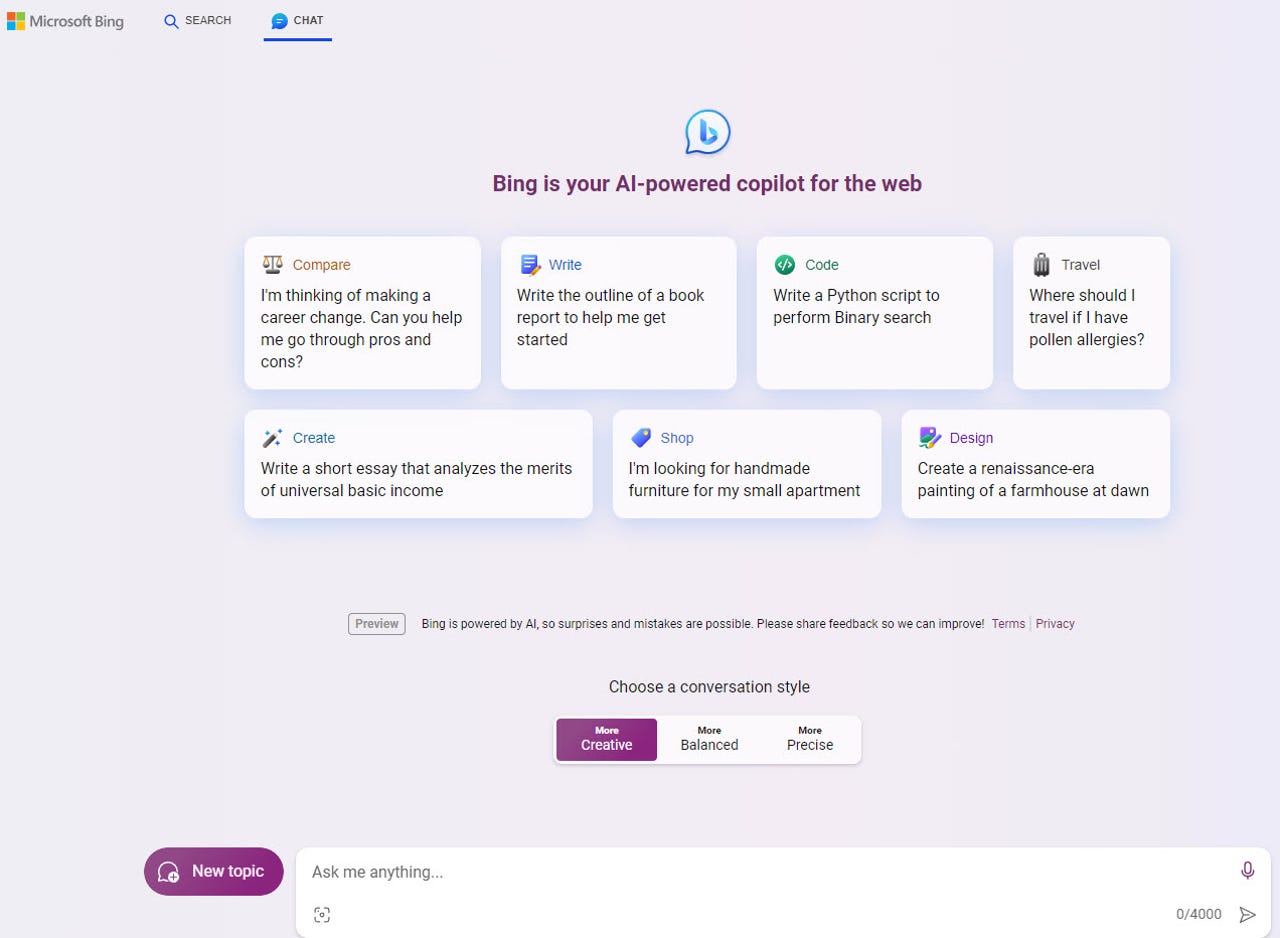
Those of you who want to take Microsoft's Bing AI for a spin are no longer restricted to trying it in the Edge browser or the Bing mobile app. On Friday, Microsoft announced that the Bing Chat tools for individuals and enterprises are now officially available in the Google Chrome browser. This means that Chrome users can browse to the Bing website, open a chat session, choose a conversation style, and seek out information or generate content.

In late July, Bing AI started its journey to non-Microsoft browsers, popping up in Chrome for Windows and Apple's Safari for MacOS, at least for select users. In early August, Microsoft revealed that its AI was heading toward more people and more third-party browsers, promising that Bing and Bing Chat would eventually be available on any modern browser via the website.

Also: Maybe Bing isn't trying to compete with Google after all

On my end, I was able to use Bing AI in Chrome in Windows 10, Windows 11, and MacOS. I also managed to access it in Firefox on one Windows computer but not on another, a sign that Firefox support is slowly rolling out.

Beyond touting Bing AI's support in Chrome, Microsoft announced other enhancements.

Organizations that have set up the new Bing Chat Enterprise can now access it in the Bing mobile app. Users are able to open and sign into the app with their work accounts and then click the Bing Chat button to access the enterprise version of the tool. Plus, people who use the Microsoft SwiftKey keyboard on their iPhones, iPads, or Android devices can now access Bing Chat 30 turns per day without having to sign in to their Microsoft account.

Despite the expansion of Bing AI into other browsers and apps, Microsoft is still trying to steer people to Edge by offering certain benefits, including longer conversations and a history of your chats. Using Bing AI in Chrome, you're also restricted to five messages per chat compared to 30 in Edge. Some browsers, such as Safari, limit you to 2,000 characters per request versus 4,000 in Edge. Plus, a popup window keeps appearing, prompting you to use Edge to chat with Bing.

Also: How to use Bing Chat (and how it's different from ChatGPT)

Otherwise, Bing AI works similarly in other browsers as it does in Edge and the Bing app. Select a conversation style — More Creative, More Balanced, or More Precise. Write and submit your question or request. In response, Bing answers your question or generates content for you. You can then submit further queries about the same topic or start a new subject. Beyond creating text, Bing can also cook up an image based on your description.

Artificial Intelligence

Duet AI, Google’s AI assistant suite, expands across Google Cloud

Duet AI, Google’s AI assistant suite, expands across Google Cloud Kyle Wiggers 13 hours

Duet AI, Google’s collection of generative AI features for text summarization, organizing data and more, is expanding to new products and services in Google Cloud.

At its annual Cloud Next conference, Google announced that Duet AI — still in preview with general availability set for sometime later this year — can now assist with code refactoring, or improving code by making small changes without altering the code’s overall external behavior.

In a developer’s preferred software development environment, they can open a Duet AI-powered chat window and write a natural language prompt (e.g. “Convert this function to Go and use Cloud SQL”) to have Duet AI execute on it (in this case, rewrite the function and convert the database connection to a managed relational database). And in the Google Cloud Console, Google Cloud’s dashboard for building and deploying web apps, websites and services, operators can chat with Duet AI to get “how to” information about infrastructure configuration and suggestions on deployment, cost and performance optimization.

Duet AI in Cloud Workstations, Google’s newly launched dev environment, can write code while highlighting best practices. Meanwhile, in Application Integration, the no-code tool to weave together software-as-a-service apps in Google Cloud, Duet can generate flows using existing APIs and assets, automatically creating documentation and test cases.

Select enterprises will be able to customize Duet AI with “organization-specific” knowledge from their libraries and codebases to generate context-aware code suggestions, Google says. That’ll let Duet AI, for example, generate code for a function that finds all products under $10 in a company’s product catalog.

Elsewhere, Duet AI can also now help design, create and publish APIs from natural language prompts via new connectors to Apigee, Google’s API management platform. And it’s more tightly integrated with BigQuery, Google’s fully managed serverless data warehouse, and Looker, the business intelligence tool for data exploration and discovery in Google Cloud.

Google describes Duet AI in BigQuery as a “collaborative” experience integrated into the BigQuery interface to provide “contextual assistance” for writing SQL queries and Python. Duet AI in BigQuery can auto-suggest code in real time based on existing metadata and schema, generating full functions and code blocks while recommending possible fixes and explaining the code. Beyond this, Duet AI can generate vector embeddings — mathematical representations of data — to power semantic searches and recommendation queries.

Using Vertex AI, Google’s platform for building, training and deploying machine learning models in the cloud, customers can customize the text-to-code model behind Duet AI to bring the model’s suggestions in line with their coding standards and practices.

In Looker, Duet AI powers new “context-rich insights” and report creation tools, plus a chat feature called Duet AI chat assistance. Similar to AI-powered chatbots such as OpenAI’s ChatGPT, chat assistance — which is also available in Cloud Workstations, Spanner and Apigee — allows users to ask questions about their business data and get answers back in natural language,

Via chat assistance and from other dashboards, Duet AI in Looker can automatically generate presentations; create summaries, calculations and visualizations based on saved reports; and start projects in LookML, Looker’s modeling language for describing data relationships. Later this year, Google says that it’ll add a Duet AI experience to analyze data in a collaborative notebook.

Duet AI is also coming to AlloyDB (Google’s fully managed database service), Cloud SQL and Cloud Spanner, the distributed database management and storage service in Google Cloud. From Cloud Spanner, Duet AI will help to generate code to structure, modify and query data using natural language. A command like “Write a query to show all data in the messages table” will prompt Duet AI to automatically generate the required code, for instance.

And Duet AI will soon arrive in Google’s Database Migration Service (DMS) to streamline the process of migrating data from a third party to Google Cloud. Later this year for Oracle customers, Duet AI in DMS will automate the conversion of certain database code, including stored procedures, functions, triggers, packages and custom query language code to AlloyDB and Cloud SQL.

Google promises a lot with Duet AI. But this reporter wonders about the underlying models’ tendencies to make mistakes, particularly in the coding arena.

Much has been written about the risks around generative AI coding tools, including their limitations when it comes to interpreting context. A recent Stanford study found that software engineers who use code-generating AI systems are more likely to cause security vulnerabilities in the apps that they develop. And, as one early user of GitHub’s generative AI, Copilot, pointed out, generative AI can be misled by ambiguous requirements, variable naming conflicts or even the misplacement of a single line of code.

Then, there’s the issue of copyright.

Code-generating systems like some of the features of Duet AI are trained on publicly available code, and some of this code, inevitably, is under a restrictive license. Several legal experts have argued that generative AI tools could put companies at risk if they were to unwittingly incorporate copyrighted suggestions from the tools into their production software.

Google’s mitigating step is having Duet AI cite the sources for its code suggestions. Attempting to allay enterprise customers’ privacy and security fears, Google says that the code and inputs to Duet AI, as well as recommendations generated by Duet AI, won’t be stored to train models powering Duet AI (like PaLM 2) or used to develop any products.

Read more about Google Cloud Next 2023 on TechCrunch

TinyML: Applications, Limitations, and It’s Use in IoT & Edge Devices

In the past few years, Artificial Intelligence (AI) and Machine Learning (ML) have witnessed a meteoric rise in popularity and applications, not only in the industry but also in academia. However, today's ML and AI models have one major limitation: they require an immense amount of computing and processing power to achieve the desired results and accuracy. This often confines their use to high-capability devices with substantial computing power.

But given the advancements made in embedded system technology, and substantial development in the Internet of Things industry, it is desirable to incorporate the use of ML techniques & concepts into a resource-constrained embedded system for ubiquitous intelligence. The desire to use ML concepts into embedded & IoT systems is the primary motivating factor behind the development of TinyML, an embedded ML technique that allows ML models & applications on multiple resource-constrained, power-constrained, and cheap devices.

However, the implementation of ML on resource-constrained devices has not been simple because implementing ML models on devices with low computing power presents its own challenges in terms of optimization, processing capacity, reliability, maintenance of models, and a lot more.

In this article, we will be taking a deeper dive into the TinyML model, and learn more about its background, the tools supporting TinyML, and the applications of TinyML using advanced technologies. So let’s start.

An Introduction to TinyML : Why the World Needs TinyML

Internet of Things or IoT devices aim to leverage edge computing, a computing paradigm that refers to a range of devices & networks near the user to enable seamless and real-time processing of data from millions of sensors & devices interconnected to one another. One of the major advantages of IoT devices is that they require low computing & processing power as they are deployable at the network edge, and hence they have a low memory footprint.

Furthermore, the IoT devices heavily rely on edge platforms to collect & then transmit the data as these edge devices gather sensory data, and then transmits them either to a nearby location, or cloud platforms for processing. The edge computing technology stores & performs computing on the data, and also provides the necessary infrastructure to support the distributed computing.

The implementation of edge computing in IoT devices provides

  1. Effective security, privacy, and reliability to the end-users.
  2. Lower delay.
  3. Higher availability, and throughput response to applications & services.

Furthermore, because edge devices can deploy a collaborative technique between the sensors, and the cloud, the data processing can be conducted at the network edge instead of being conducted at the cloud platform. This can result in effective data management, data persistence, effective delivery, and content caching. Additionally, to implement IoT in applications that deal with H2M or Human to Machine interaction and modern healthcare edge computing provides a way to improve the network services significantly.

Recent research in the field of IoT edge computing has demonstrated the potential to implement Machine Learning techniques in several IoT use cases. However, the major issue is that traditional machine learning models often require strong computing & processing power, and high memory capacity that limits the implementation of ML models in IoT devices & applications.

Furthermore, edge computing technology today lacks in high transmission capacity, and effective power savings that leads to heterogeneous systems which is the main reason behind the requirement for harmonious & holistic infrastructure mainly for updating, training, and deploying ML models. The architecture designed for embedded devices poses another challenge as these architectures depend on the hardware & software requirements that vary from device to device. It’s the major reason why its difficult to build a standard ML architecture for IoT networks.

Also, in the current scenario, the data generated by different devices is sent to cloud platforms for processing because of the computationally intensive nature of network implementations. Furthermore, ML models are often dependent on Deep Learning, Deep Neural Networks, Application Specific Integrated Circuits (ASICs) and Graphic Processing Units (GPUs) for processing the data, and they often have a higher power & memory requirement. Deploying full-fledged ML models on IoT devices is not a viable solution because of the evident lack of computing & processing powers, and limited storage solutions.

The demand to miniaturize low power embedded devices coupled with optimizing ML models to make them more power & memory efficient has paved the way for TinyML that aims to implement ML models & practices on edge IoT devices & framework. TinyML enables signal processing on IoT devices and provides embedded intelligence, thus eliminating the need to transfer data to cloud platforms for processing. Successful implementation of TinyML on IoT devices can ultimately result in increased privacy, and efficiency while reducing the operating costs. Additionally, what makes TinyML more appealing is that in case of inadequate connectivity, it can provide on-premise analytics.

TinyML : Introduction and Overview

TinyML is a machine learning tool that has the capability to perform on-device analytics for different sensing modalities like audio, vision, and speech. Ml models build on the TinyML tool have low power, memory, and computing requirements that makes them suitable for embedded networks, and devices that operate on battery power. Additionally, TinyML’s low requirements makes it an ideal fit to deploy ML models on the IoT framework.

In the current scenario, cloud-based ML systems face a few difficulties including security & privacy concerns, high power consumption, dependability, and latency problems which is why models on hardware-software platforms are pre-installed. Sensors gather the data that simulate the physical world, and are then processed using a CPU or MPU (Microprocessing unit). The MPU caters to the needs of ML analytic support enabled by edge aware ML networks and architecture. Edge ML architecture communicates with the ML cloud for transfer of data, and the implementation of TinyML can result in advancement of technology significantly.

It would be safe to say that TinyML is an amalgamation of software, hardware, and algorithms that work in sync with each other to deliver the desired performance. Analog or memory computing might be required to provide a better & effective learning experience for hardware & IoT devices that do not support hardware accelerators. As far as software is concerned, the applications built using TinyML can be deployed & implemented over platforms like Linux or embedded Linux, and over cloud-enabled software. Finally, applications & systems built on the TinyML algorithm must have the support of new algorithms that need low memory sized models to avoid high memory consumption.

To sum things up, applications built using the TinyML tool must optimize ML principles & methods along with designing the software compactly, in the presence of high-quality data. This data then must be flashed through binary files that are generated using models that are trained on machines with much larger capacity, and computing power.

Additionally, systems & applications running on the TinyML tool must provide high accuracy when performing under tighter constraints because compact software is needed for small power consumption that supports TinyML implications. Furthermore, the TinyML applications or modules may depend on battery power to support its operations on edge embedded systems.

With that being said, TinyML applications have two fundamental requirements

  1. Ability to scale billions of cheap embedded systems.
  2. Storing the code on the device RAM with capacity under a few KBs.

Applications of TinyML Using Advanced Technologies

One of the major reasons why TinyML is a hot topic in the AI & ML industry is because of its potential applications including vision & speech based applications, health diagnosis, data pattern compression & classification, brain-control interface, edge computing, phenomics, self-driving cars, and more.

Speech Based Applications

Speech Communications

Typically, speech based applications rely on conventional communication methods in which all the data is important, and it is transmitted. However, in recent years, semantic communication has emerged as an alternative to conventional communication as in semantic communication, only the meaning or context of the data is transmitted. Semantic communication can be implemented across speech based applications using TinyML methodologies.

Some of the most popular applications in the speech communications industry today are speech detection, speech recognition, online learning, online teaching, and goal-oriented communication. These applications typically have a higher power consumption, and they also have high data requirements on the host device. To overcome these requirements, a new TinySpeech library has been introduced that allows developers to build a low computational architecture that uses deep convolutional networks to build a low storage facility.

To use TinyML for speech enhancement, developers first addressed the sizing of the speech enhancement model because it was subject to hardware limitations & constraints. To tackle the issue, structured pruning and integer quantization for RNN or Recurrent Neural Networks speech enhancement model were deployed. The results suggested the size of the model to be reduced by almost 12x whereas the operations to be reduced by almost 3x. Additionally, it's vital that resources must be utilized effectively especially when deployed on resource constrained applications that execute voice-recognition applications.

As a result, to partition the process, a co-design method was proposed for TinyML based voice and speech recognition applications. The developers used windowing operation to partition software & hardware in a way to pre process the raw voice data. The method seemed to work as the results indicated a decrease in the energy consumption on the hardware. Finally, there’s also potential to implement optimized partitioning between software & hardware co-design for better performance in the near future.

Furthermore, recent research has proposed the use of a phone-based transducer for speech recognition systems, and the proposal aims to replace LSTM predictors with Conv1D layer to reduce the computation needs on edge devices. When implemented, the proposal returned positive results as the SVD or Singular Value Decomposition had compressed the model successfully whereas the use of WFST or Weighted Finite State Transducers based decoding resulted in more flexibility in model improvement bias.

A lot of prominent applications of speech recognition like virtual or voice assistants, live captioning, and voice commands use ML techniques to work. Popular voice assistants currently like Siri and the Google Assistant ping the cloud platform every time they receive some data, and it creates significant concerns related to privacy & data security. TinyML is a viable solution to the issue as it aims to perform speech recognition on devices, and eliminate the need to migrate data to cloud platforms. One of the ways to achieve on-device speech recognition is to use Tiny Transducer, a speech recognition model that uses a DFSMN or Deep Feed-Forward Sequential Memory Block layer coupled with one Conv1D layer instead of the LSTM layers to bring down the computation requirements, and network parameters.

Hearing Aids

Hearing loss is a major health concern across the globe, and humans ability to hear sounds generally weakens as they age, and its a major problems in countries dealing with aging population including China, Japan, and South Korea. Hearing aid devices right now work on the simple principle of amplifying all the input sounds from the surrounding that makes it difficult for the person to distinguish or differentiate between the desired sound especially in a noisy environment.

TinyML might be the viable solution for this issue as using a TinyLSTM model that uses speech recognition algorithm for hearing aid devices can help the users distinguish between different sounds.

Vision Based Applications

TinyML has the potential to play a crucial role in processing computer vision based datasets because for faster outputs, these data sets need to be processed on the edge platform itself. To achieve this, the TinyML model encounters the practical challenges faced while training the model using the OpenMV H7 microcontroller board. The developers also proposed an architecture to detect American Sign Language with the help of a ARM Cortex M7 microcontroller that works only with 496KB of frame-buffer RAM.

The implementation of TinyML for computer vision based application on edge platforms required developers to overcome the major challenge of CNN or Convolutional Neural Networks with a high generalization error, and high training & testing accuracy. However, the implementation did not generalize effectively to images within new use cases as well as backgrounds with noise. When the developers used the interpolation augmentation method, the model returned an accuracy score of over 98% on test data, and about 75% in generalization.

Furthermore, it was observed that when the developers used the interpolation augmentation method, there was a drop in model’s accuracy during quantization, but at the same time, there was also a boost in model’s inference speed, and classification generalization. The developers also proposed a method to further boost the accuracy of generalization model training on data obtained from a variety of different sources, and testing the performance to explore the possibility of deploying it on edge platforms like portable smart watches.

Furthermore, additional studies on CNN indicated that its possible to deploy & achieve desirable results with CNN architecture on devices with limited resources. Recently, developers were able to develop a framework for the detection of medical face masks on a ARM Cortex M7 microcontroller with limited resources using TensorFlow lite with minimal memory footprints. The model size post quantization was about 138 KB whereas the interference speed on the target board was about 30 FPS.

Another application of TinyML for computer vision based application is to implement a gesture recognition device that can be clamped to a cane for helping visually impaired people navigate through their daily lives easily. To design it, the developers used the gestures data set, and used the data set to train the ProtoNN model with a classification algorithm. The results obtained from the setup were accurate, the design was low-cost, and it delivered satisfactory results.

Another significant application of TinyML is in the self-driving, and autonomous vehicles industry because of the lack of resources, and on-board computation power. To tackle the issue, developers introduced a closed loop learning method built on the TinyCNN model that proposed an online predictor model that captures the image at the run-time. The major issue that developers faced when implementing TinyML for autonomous driving was that the decision model that was trained to work on offline data may not work equally well when dealing with online data. To fully maximize the applications of autonomous cars and self-driving cars, the model should ideally be able to adapt to the real-time data.

Data Pattern Classification and Compression

One of the biggest challenges of the current TinyML framework is to facilitate it to adapt to online training data. To tackle the issue, developers have proposed a method known as TinyOL or TinyML Online Learning to allow training with incremental online learning on microcontroller units thus allowing the model to update on IoT edge devices. The implementation was achieved using the C++ programming language, and an additional layer was added to the TinyOL architecture.

Furthermore, developers also performed the auto-encoding of the Arduino Nano 33 BLE sensor board, and the model trained was able to classify new data patterns. Furthermore, the development work included designing efficient & more optimized algorithms for the neural networks to support device training patterns online.

Research in TinyOL and TinyML have indicated that number of activation layers has been a major issue for IoT edge devices that have constrained resources. To tackle the issue, developers introduced the new TinyTL or Tiny Transfer Learning model to make the utilization of memory over IoT edge devices much more effective, and avoiding the use of intermediate layers for activation purposes. Additionally, developers also introduced an all new bias module known as “lite-residual module” to maximize the adaptation capabilities, and in course allowing feature extractors to discover residual feature maps.

When compared with full network fine-tuning, the results were in favor of the TinyTL architecture as the results showed the TinyTL to reduce the memory overhead about 6.5 times with moderate accuracy loss. When the last layer was fine tuned, TinyML had improved the accuracy by 34% with moderate accuracy loss.

Furthermore, research on data compression has indicated that data compression algorithms must manage the collected data on a portable device, and to achieve the same, the developers proposed TAC or Tiny Anomaly Compressor. The TAC was able to outperform SDT or Swing Door Trending, and DCT or Discrete Cosine Transform algorithms. Additionally, the TAC algorithm outperformed both the SDT and DCT algorithms by achieving a maximum compression rate of over 98%, and having the superior peak signal-to-noise ratio out of the three algorithms.

Health Diagnosis

The Covid-19 global pandemic opened new doors of opportunity for the implementation of TinyML as it’s now an essential practice to continuously detect respiratory symptoms related to cough, and cold. To ensure uninterrupted monitoring, developers have proposed a CNN model Tiny RespNet that operates on a multi-model setting, and the model is deployed over a Xilinx Artix-7 100t FPGA that allows the device to process the information parallelly, has a high efficiency, and low power consumption. Additionally, the TinyResp model also takes speech of patients, audio recordings, and information of demography as input to classify, and the cough-related symptoms of a patient are classified using three distinguished datasets.

Furthermore, developers have also proposed a model capable of running deep learning computations on edge devices, a TinyML model named TinyDL. The TinyDL model can be deployed on edge devices like smartwatches, and wearables for health diagnosis, and is also capable of carrying out performance analysis to reduce bandwidth, latency, and energy consumption. To achieve the deployment of TinyDL on handheld devices, a LSTM model was designed and trained specifically for a wearable device, and it was fed collected data as the input. The model has an accuracy score of about 75 to 80%, and it was able to work with off-device data as well. These models running on edge devices showed the potential to resolve the current challenges faced by the IoT devices.

Finally, developers have also proposed another application to monitor the health of elderly people by estimating & analyzing their body poses. The model uses the agnostic framework on the device that allows the model to enable validation, and rapid fostering to perform adaptations. The model implemented body pose detection algorithms coupled with facial landmarks to detect spatiotemporal body poses in real time.

Edge Computing

One of the major applications of TinyML is in the field of edge computing as with the increase in the use of IoT devices to connect devices across the world, its essential to set up edge devices as it will help in reducing the load over the cloud architectures. These edge devices will feature individual data centers that will allow them to carry out high-level computing on the device itself, rather than relying on the cloud architecture. As a result, it will help in reducing the dependency on the cloud, reduce latency, enhance user security & privacy, and also reduce bandwidth.

Edge devices using the TinyML algorithms will help in resolving the current constraints related with power, computing, and memory requirements, and it’s discussed in the image below.

Furthermore, TinyML can also enhance the use and application of Unmanned Aerial Vehicles or UAVs by addressing the current limitations faced by these machines. The use of TinyML can allow developers to implement an energy-efficient device with low latency, and high computing power that can act as a controller for these UAVs.

Brain-Computer Interface or BCI

TinyML has significant applications in the healthcare industry, and it can prove to be highly beneficial in different areas including cancer & tumor detection, health predictions using ECG & EEG signals, and emotional intelligence. The use of TinyML can allow the Adaptive Deep Brain Stimulation or aDBS to adapt successfully to clinical adaptations. The use of TinyMl can also allow aDBS to identify disease-related bio marks & their symptoms using invasive recordings of the brain signals.

Furthermore, the healthcare industry often includes the collection of a large amount of data of a patient, and this data then needs to be processed to reach specific solutions for the treatment of a patient in the early stages of a disease. As a result, it's vital to build a system that is not only highly effective, but also highly secure. When we combine IoT application with the TinyML model, a new field is born named as the H-IoT or Healthcare Internet of Things, and the major applications of the H-IoT are diagnosis, monitoring, logistics, spread control, and assistive systems. If we want to develop devices that are capable of detecting & analyzing a patient’s health remotely, it’s essential to develop a system that has a global accessibility, and a low latency.

Autonomous Vehicles

Finally, TinyML can have widespread applications in the autonomous vehicles industry as these vehicles can be utilized in different ways including human tracking, military purposes, and has industrial applications. These vehicles have a primary requirement of being able to identify objects efficiently when the object is being searched.

As of now, autonomous vehicles & autonomous driving is a fairly complex task especially when developing mini or small sized vehicles. Recent developments have shown potential to improve the application of autonomous driving for mini vehicles by using a CNN architecture, and deploying the model over the GAP8 MCI.

Challenges

TinyML is a relatively newer concept in the AI & ML industry, and despite the progress, it's still not as effective as we need it for mass deployment for edge & IoT devices.

The biggest challenge currently faced by TinyML devices is the power consumption of these devices. Ideally, embedded edge & IoT devices are expected to have a battery life that extends over 10 years. For example, in ideal condition, an IoT device running on a 2Ah battery is supposed to have a battery life of over 10 years given that the power consumption of the device is about 12 ua. However, in the given state, an IoT architecture with a temperature sensor, a MCU unit, and a WiFi module, the current consumption stands at about 176.4 mA, and with this power consumption, the battery will last for only about 11 hours, instead of the required 10 years of battery life.

Resource Constraints

To maintain an algorithm’s consistency, it's vital to maintain power availability, and given the current scenario, the limited power availability to TinyML devices is a critical challenge. Furthermore, memory limitations are also a significant challenge as deploying models often requires a high amount of memory to work effectively, and accurately.

Hardware Constraints

Hardware constraints make deploying TinyML algorithms on a wide scale difficult because of the heterogeneity of hardware devices. There are thousands of devices, each with their own hardware specifications & requirements, and resultantly, a TinyML algorithm currently needs to be tweaked for every individual device, that makes mass deployment a major issue.

Data Set Constraints

One of the major issues with TinyML models is that they do not support the existing data sets. It is a challenge for all edge devices as they collect data using external sensors, and these devices often have power & energy constraints. Therefore, the existing data sets cannot be used to train the TinyML models effectively.

Final Thoughts

The development of ML techniques have caused a revolution & a shift in perspective in the IoT ecosystem. The integration of ML models in IoT devices will allow these edge devices to make intelligent decisions on their own without any external human input. However, conventionally, ML models often have high power, memory, and computing requirements that makes them unify for being deployed on edge devices that are often resource constrained.

As a result, a new branch in AI was dedicated to the use of ML for IoT devices, and it was termed as TinyML. The TinyML is a ML framework that allows even the resource constrained devices to harness the power of AI & ML to ensure higher accuracy, intelligence, and efficiency.

In this article, we have talked about the implementation of TinyML models on resource-constrained IoT devices, and this implementation requires training the models, deploying the models on the hardware, and performing quantization techniques. However, given the current scope, the ML models ready to be deployed on IoT and edge devices have several complexities, and restraints including hardware, and framework compatibility issues.