5 Crucial Steps to Develop an Effective Coding Routine

5 Crucial Steps to Develop an Effective Coding Routine
Image by Author Introduction

I remember diving into the pages of “Atomic Habits” by James Clear. It got me thinking about how psychology influences our daily lives. As a coder, I started to think of ways to harness these insights to create a coding regime that actually works. Trust me, if we can somehow master the art of our minds and how our brain learns, it can be a game-changer. After careful research and observation, I devised these 5 steps to sculpt an effective coding routine. Let us go through them one by one and witness how psychology can transform your coding experience:

1. The Power of Tiny Gains: Start with the 1% Rule

This strategy is great for beginners and to prevent burnout. It focuses on the importance of incremental progress and developing consistency over time. Inspired by the idea, I dedicated a mere fraction of my time (15 minutes) to coding. Although it seems trivial, it can pave the way for consistency. Our brain considers it less daunting and over a while, we start to gain confidence. It's like planting the seeds of progress that grows over time. You are not chasing perfection — you are embracing progress. Let me explain this to you mathematically:

Day 1: 15 minutes

Day 2: 15 minutes + 1% = 15.15 minutes

Day 3: 15.15 minutes + 1% = 15.303 minutes

Day 4: 15.303 minutes + 1% = 15.45803 minutes

… and so on

Cumulative Effect Over 30 Days:

After 30 days, your daily coding time would be around 22.44 minutes

After 60 days, your daily coding time would be around 33.81 minutes

After 90 days, your daily coding time would be around 51.07 minutes

After 180 days, your daily coding time would be around 140.61 minutes

… and so on

Taking these baby steps will help you develop the coding regime over time.

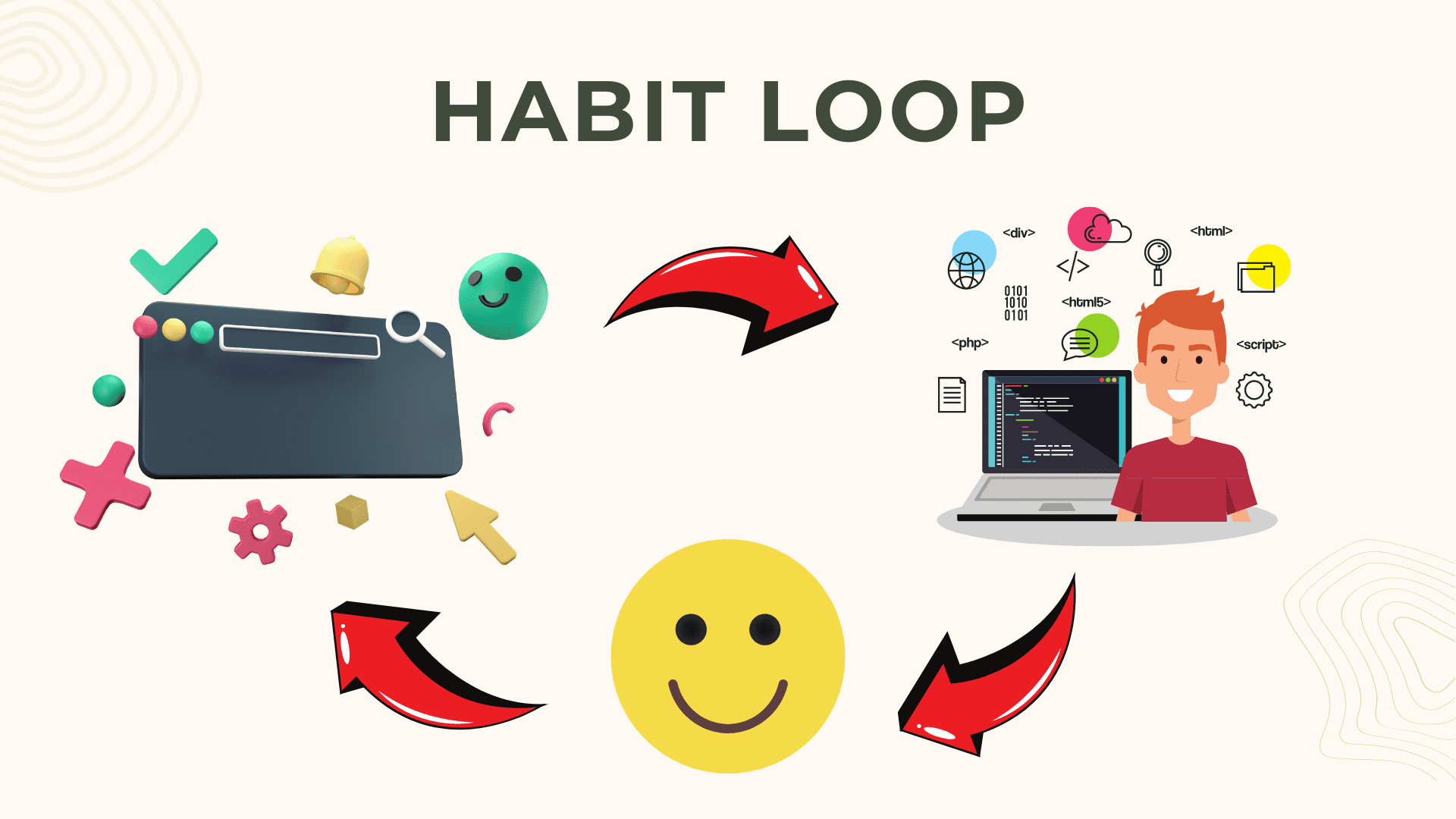
2. Cue, Routine, Reward: The Habit Loop

Let's talk about building habits. It's a loop where you start with a cue, do a routine, and then reap the reward. Here is how it works:

Cue: Something that reminds you it's time to work. It can be in the form of a particular environment, a specific time of day, or an emotional state. It triggers your brain and helps you get started.

Routine: This is your actual habit and is followed by a cue.

Reward: Finally, we have a reward in the form of a positive outcome or feeling that you get from completing the routine motivating you to repeat this behavior again in the future.

To make this work, I set up my dedicated coding space that acted as an initiator and my brain said "Hey, it's coding time!". I immersed myself in the coding followed by the sense of progress that I got from solving the coding challenge or decoding a problem. It was a mini victory that made it easier for me to re-enter this coding cycle.
5 Crucial Steps to Develop an Effective Coding Routine
Image by Author 3. Habit Stacking: Linking Coding with Existing Habits

You often experience the initial resistance while starting a new habit that can become remarkably smoother with Habit Stacking. It involves pairing up your old habit with the new one. It's easier because your brain likes patterns. There are 3 elements of habit stacking:

Anchor Habit (Existing Habit): It is something that you already do easily

New Habit (Desired Habit): Habit that you want to integrate.

Cue and Routine Fusion: Anchor habit acts as a cue for the new habit creating a seamless fusion

For me, I connected coding with my evening tea. As I sipped my tea, my brain reminded me it was time to code. So, while your water boils for tea, open your code editor – just like that, you're on your coding journey!

4. Environment Design: Shape Your Coding Environment

Guess what? Your environment has more impact on your mindset than you might think. They act as environmental cues subtly guiding our actions. Considering its importance, I dedicated a separate coding space for myself — a turning point in my journey. The absence of distractions and the intentional setup instantly put me in the coding mindset. Whenever my brain used to look at my workspace it knows that it's coding time now. This step heightened my concentration.

5 Crucial Steps to Develop an Effective Coding Routine
Image by storyset on Freepik 5. The Science of Rewards: Cultivate Intrinsic Motivation

Intrinsic motivation is closely tied to rewards. Rewards trigger the brain’s pleasure centers releasing dopamine, a chemical known for generating the feeling of pleasure. To reward myself, I set up some milestones and started celebrating each step of my progress by having a special meal. Pick projects that excite you. When you're curious, coding feels like an adventure, not a chore. Also, try to share your progress with others and surround yourself with positive people. Their feedback and words of encouragement can further strengthen your coding journey.

Conclusion

Congratulations! You've got the tools to build a good routine that rocks. As I conclude this article, I invite my readers to share their transformation journey. What coding habits have helped you out? Lastly, just remember that the effectiveness of the above-mentioned strategies may vary from person to person, so experiment and find what works best for you.
Kanwal Mehreen is an aspiring software developer with a keen interest in data science and applications of AI in medicine. Kanwal was selected as the Google Generation Scholar 2022 for the APAC region. Kanwal loves to share technical knowledge by writing articles on trending topics, and is passionate about improving the representation of women in tech industry.

More On This Topic

  • Big Data Analytics: Why Is It So Crucial For Business Intelligence?
  • How to Use MLOps for an Effective AI Strategy
  • How Reading Papers Helps You Be a More Effective Data Scientist
  • 15 Habits I Learned from Highly Effective Data Scientists
  • Build an Effective Data Analytics Team and Project Ecosystem for Success
  • This Data Visualization is the First Step for Effective Feature Selection

7 Best Cross-Platform App Development Frameworks

Cross-platform development is essential for deploying software across various platforms. It is nothing but the practice of creating mobile applications that can run seamlessly on multiple operating systems, such as iOS, and Android, and on the web. It enables developers to reach a wider audience with a single codebase, accelerates the development cycle, and facilitates consistent user experiences across different devices, leading to improved efficiency and cost-effectiveness in app development.

To get you started faster, we have curated some of the best cross-platform app development frameworks. Let’s take a look at them.

Flutter

Flutter, an open-source mobile app development framework by Google, is the most preferred framework by users as it enables the creation of high-performance, visually appealing apps for iOS, Android, and the web using Dart programming and Skia graphics. With rapid development, real-time code changes enhance efficiency. Its customizable widgets craft attractive interfaces, while performance focus ensures smooth animations even on older devices, broadening user reach. Offering cross-platform capabilities, it supports web and desktop apps. The framework’s openness fosters community collaboration. Though it boasts advantages like quick development, elegant UIs, high performance, and cross-platform adaptability, limited third-party libraries, a challenging learning curve due to Dart, and comparatively restricted corporate adoption pose challenges. Renowned applications like Alibaba, Google Ads, Tencent, and Reflectly showcase Flutter’s efficacy across diverse domains, solidifying its status as a robust framework for versatile, modern applications.

Tauri

Tauri is a modern framework that can be used to make cross-platform applications using familiar web technologies for the frontend, and leveraging the robust Rust programming language for the backend. It’s versatile, compatible with various frontend libraries like Vue, React, and Svelte. While Rust integration is optional, Tauri offers a JavaScript API that allows building the complete app, making it seamless to transform existing web app code into a native desktop app with minimal modifications.

NativeScript

NativeScript is popular for creating native apps using JavaScript. It offers direct access to native platform APIs through TypeScript, JavaScript, and Angular, enabling exceptional native-like experiences across web, iOS, and Android platforms. Introduced by Progress in 2014, it’s chosen for its flexibility and endorsed as visionary by Gartner’s Magic Quadrant. Beneficial for swift market entry, product testing, and gaining a competitive edge, NativeScript excels in developing custom mobile apps and Minimum Viable Products. Its strengths include strong support for Angular, Vue.js, and Svelte stacks, a dedicated marketplace, and seamless access to native APIs. However, challenges lie in UI diversity, limited verified plugins, and the need for developers well-versed in native functionalities. Noteworthy users span diverse industries and include Lorven Technologies, Netflix, and Blackfriars Group.

React Native

React Native, often abbreviated as RN, is a renowned JavaScript-based mobile development framework enabling the creation of native-style mobile applications for both Android and iOS platforms. It offers a unified codebase approach, aiding React Native development firms in constructing applications for various platforms with shared code. Introduced by Facebook as an open-source project in 2015, React Native swiftly emerged as a leading solution for mobile app development. Notable advantages of React Native encompass consistent app growth across platforms due to robust components adept at seamless presentation, efficient code reuse through pre-developed elements, and dynamic features like live and hot reloading. However, the framework presents challenges, including intricate debugging, difficulty in designing complex user interfaces and gestures, and the need to assemble cross-platform teams adept in both web and native technologies. React Native is embraced by prominent companies like Facebook, Instagram, Bloomberg, Skype, and Tesla for creating diverse applications that span from social media to remote car control.

Node.js

Node.js, built on Chrome’s JavaScript runtime, is pivotal in this realm. It ensures consistent app performance on diverse platforms. This platform’s technical prowess and strategic benefits are explored further, tackling challenges in multi-platform functionality. Node.js is an open-source runtime that enables JavaScript for both client and server-side scripting, aided by its event-driven, non-blocking I/O model. Its merits include using JavaScript universally, boosting code reusability, leveraging the V8 engine for efficient performance, and capitalizing on its rich ecosystem and package management. Node.js drives cross-platform triumphs like Netflix, LinkedIn, Walmart, Microsoft Office Online, and Trello, overcoming hurdles like CPU intensity and callback complexities. Best practices encompass code organization, asynchronous handling, library use, rigorous testing, performance optimization, security measures, code reviews, and CI/CD implementation. This makes Node.js a pivotal tool for cross-platform success.

Xamarin

Built by Microsoft, Xamarin allows you to create native apps using C# and .NET, leveraging platform features like notifications. It offers a unified development environment with core features like native integration and a shared C# codebase for all platforms, using .NET to encapsulate native libraries. It is advantageous lies in utilizing Forms Technology, enabling UI layout sharing through the .NET cross-platform UI toolkit, leading to easier maintenance and simultaneous updates for iOS and Android.

Companies like Alaska Airlines, World Bank, Storyo, and BBC Good Food employ Xamarin. However, debugging Xamarin apps can pose challenges, and performance may vary compared to native apps on certain devices.

Electron

Another fan favourite, Electron, is an open-source framework that facilitates cross-platform desktop app development using HTML, CSS, and JavaScript.Built by GitHub, it boasts adoption by major firms like Microsoft, Slack, and WhatsApp. Distinguishing itself from Node.js-based rivals, Electron merges Node.js’s benefits with the Chromium Engine, effectively uniting server and client-side JavaScript capabiliities. Notably, Electron apps are uncomplicated to construct and deploy, capitalizing on the host OS features, consisting of notifications and taskbar integration. Nevertheless, they can strain resources and underperform compared to native apps on certain devices, occasionally posing debugging challenges.

Read more: Top 5 LLM Benchmarks

The post 7 Best Cross-Platform App Development Frameworks appeared first on Analytics India Magazine.

AI is helping this crowdfunding site to raise more with less

Video screens of people

Give.Asia has developed its own artificial intelligence (AI) tool that is helping the crowdfunding platform generate content for fundraising campaigns.

Dubbed Sidekick, the AI application is used to create infographics, images, text, and short-form videos that are needed to run alongside fundraising campaigns. Tailored to portray personal stories of beneficiaries of these campaigns, the content is then shared across social media channels, such as Instagram and Facebook.

Also: How to use ChatGPT: Everything you need to know

Users only have to furnish the details needed to generate the infographics or provide the videos to be edited. The AI tool includes a text writer that can produce campaign stories that meet the chosen style of writing, including "journalistic or activistic".

Sidekick not only enables users without proficiency in the necessary skillsets to generate content, it has also significantly cut the amount of time and effort required to generate campaign stories, said Give.Asia CTO Gia Ngo in an interview with ZDNET.

Tasks that previously required days can now be completed in minutes. Instagram-styled videos, for example, can be generated in 15 minutes — it previously took three to five days to produce a single 30-second clip.

Also: 5 ways to use chatbots to make your life easier

Copies for a campaign also used to take two to three days to be completed, including graphics. This content-creation process now takes less than half a day using Sidekick, with multiple draft versions developed, from which the staff can choose one to use for the campaign.

Founded in 2009, Give.Asia is based in Singapore and raises funds primarily via online channels. To date, it has helped run more than 20,000 campaigns across six Asia-Pacific markets, including Hong Kong, Indonesia, and the Philippines, raising in excess of SG$100 million ($73.75 million).

Give.Asia is registered as a for-profit company, but does not collect a cut from the funds it helps raise. Instead, the platform sustains its operations mainly from "tips" that organizations give on top of their donations. It also supports charity organizations, from which it collects a nominal amount to cover transactional fees, such as credit card service charges.

It has worked with some 400 organizations, including hospitals and charities, and supported a few ad-hoc corporate social responsibility projects for private companies.

Also: Generative AI is changing your technology career path. What to know

Give.Asia has a headcount of 30 people, comprising full-time and part-time staff, as well as volunteers, who work in tech, marketing, partnership, and service support. The crowdfunding site helps both organizations and individuals, the latter of which mostly need funds for their medical bills.

It does not charge charities and non-profits for the use of Sidekick to create AI-generated materials for their fundraising campaigns.

Higher efficiency without the associated costs

Typically operating with minimum resources and in markets, such as Singapore and Hong Kong, where the cost of human talent can be high, charities often face difficulties finding the right skillsets, Ngo said. Doing more with the staff they have is essential — and AI enables them to achieve that, he said.

Ngo, who has a PhD in AI neuroscience and biomedical data analysis in healthcare, started as a volunteer with Give.Asia in 2014. He became a full-time employee in 2018 for two years, before heading off for his PhD studies, and returned again last year as its CTO to spearhead the company's AI initiatives.

It took his team six months to develop Sidekick, which is currently in closed beta and used by a small group of charities that gave explicit consent for the AI tool to be used for their campaigns.

Also: AI can write your emails, reports, and essays. But can it express your emotions?

The beta has been running for more than four months and feedback, so far, has been largely positive, according to Ngo.

"It helps drive the efficiency of the content writing team because they can now generate multiple jobs more quickly," he said.

"They can also do things they couldn't do before, where they would previously have to ask for help from the marketing team or designers to create graphics. Now, the content team can do these tasks by themselves."

The staff can also respond faster to what works better.

Now they're able to quickly generate multiple versions of content for a campaign. Charities can run an initial batch comprising different versions and then identify the one with the highest response, which can be pushed out on a larger scale.

Doing this work manually perviously required two or three days. Teams had to churn out different versions of content that was used to run a small scale campaign, Ngo said. With Sidekick, this task can now be done in one day.

He added that charities are keen to use AI because it is hard for them to compete against private companies for talent and, hence, they often lack the expertise.

"With AI, they can empower their staff to do more tasks, such as creative work, without having acquired the necessary talent," he said.

Also: Can AI detectors save us from ChatGPT? I tried 3 online tools to find out

Human oversight, though, is still important, Ngo noted, especially in human-centric industries, such as charity work, where trust is crucial and must be maintained.

Checks are carried out on the content generated by Sidekick. These checks ensure all AI-generated content, including text and video captions, are factually accurate and do not contain sensitive personal information.

AI, Ngo added, should be seen as a companion to a company's operations, assisting in tasks that are repetitive and manual-intensive.

With the beta run, his team is looking to improve the quality of campaigns generated by Sidekick, rather than increase the quantity of campaigns.

The AI application was developed in-house on top of open APIs, including OpenAI, which were used to build the base model and sources for content creation, such as graphics and logos.

Give.Asia's long-term goal is to make Sidekick open source and a self-service tool that can be accessed by any charity that wants to use it, Ngo said.

Also: 5 ways to use chatbots to make your life easier

Until then, the challenge is to adapt to changes in the evolving AI space, he said, noting that core models will continue to be developed and released by key market players, including OpenAI, Google, and Facebook. These emerging models then need to be assessed and applied in a way that is relevant for Give.Asia, he said.

"When we started implementing AI, we did so in an iterative process, running small experiments and MVPs with the various teams to see how the tool is adopted," he explained.

"We want to make sure we're not building something that isn't useful."

His team also provided guidelines, such as checking against hallucinations and data inaccuracies.

Also: This new technology could blow away GPT-4 and everything like it

"Everyone understands it's not a one-size-fits-all, and that human decisions and monitoring are still important," he said.

These checks and balances will remain important moving forward, as his team looks to apply AI more extensively. For example, they have begun evaluating the use of AI to transcribe interviews conducted with beneficiaries, the information from which is used to create content for fundraising campaigns.

These interviews often contain sensitive information, so the AI tool must be able to identify what should and should not be included in the campaign materials, Ngo explained. These perimeters need to be set as a criteria that the AI model can understand, he added.

With human oversight especially important, his team is still working to integrate both AI and human processes.

There are concerns about privacy, he added, noting that the AI model currently is missing out on some "red flags". For example, it was instructed to mask phone numbers and missed out on some instances.

Also: This new AI system can read minds accurately about half the time

His team is figuring out how to resolve such kinks, including the fine tuning of the prompt-engineering process.

There also are challenges that need to be addressed when the AI tool is used in different markets. Writing styles, for instance, that appeal to audiences in Singapore may not be as effective in Hong Kong. Infographics used in Hong Kong also require translation to Chinese.

Such issues underscore the need for continuous user feedback, monitoring, and improvement, Ngo said.

"AI is here to stay and, in future, will be embedded into our daily processes," he said. "The broader question then is how we evolve and live with AI, using it to empower ourselves."

Artificial Intelligence

Google Applies Generative AI Tools to Cloud Security

The Google log and a security symbol on a keyboard.
Image: Bilal Ulker

At its Google Next ’23 event this week, Google revealed how — with the use of its PaLM 2 foundational model — it is applying the generative AI Duet AI to security solutions in Google Cloud, including posture management, threat intelligence and detection and network and data security.

SEE: Google AI in Workspace: Zero-Trust and Digital Sovereignty (TechRepublic)

As Sunil Potti, vice president and general manager of security at Google Cloud, explained during a pre-event press briefing last week, the company is using the Duet AI model in three areas:

  • Analyzing and summarizing threat intelligence generated by Google’s Mandiant threat intelligence unit. The feature is in preview and will be generally available this year.
  • For Google’s Chronicle Security Operations platform, in order to reduce work and speed threat discovery and response. This is in preview and is expected to be generally available this year.
  • For another new feature for Chronicle that will involve Mandiant experts parsing an organization’s latest frontline intel proactively to look for undetected attacks.

“We have been working in (these) three areas where generative AI can bring real value to security,” said Potti at the press conference.

Jump to:

  • Duet AI in Mandiant threat intelligence
  • Duet AI for Chronicle Security Operations
  • Chronicle gets Mandiant Hunt feature
  • Supercharging Duet AI with PaLM 2
  • AI applied to security: fighting fire with fire

Duet AI in Mandiant threat intelligence

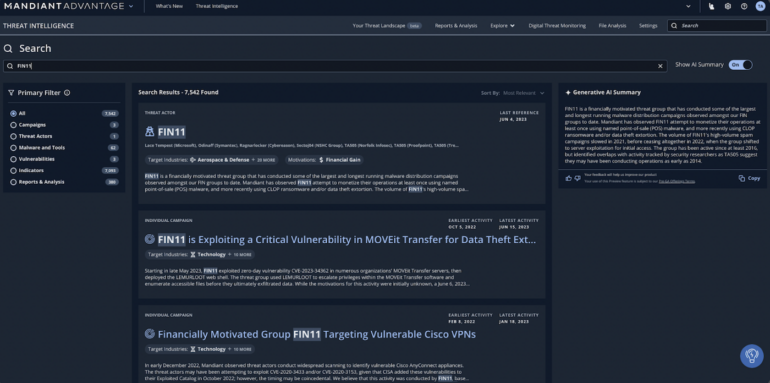
Potti explained that Google will augment its Mandiant threat intelligence unit, which it acquired in 2022, with Duet AI to accelerate detection of novel threats and improve visibility across a range of vulnerabilities, including in code. It will also translate Mandiant insights into tactics, techniques and procedures used by threat actors with summaries of threat intelligence in a natural language and easy to comprehend format (Figure A).

Figure A

Duet AI in Mandiant threat intelligence summarizes threat research.
Duet AI in Mandiant threat intelligence summarizes threat research. Image: Google

Duet AI for Chronicle Security Operations

Integrating Duet AI into Chronicle explicitly addresses security operations workload and tool proliferation, and implicitly the shortage of security operators in SOC teams, Potti explained.

“I’ve never met a CISO who said they have enough talent or people on their team. Generative AI presents a lot of opportunities to scale talent so level one operations can be as productive as level two,” he said.

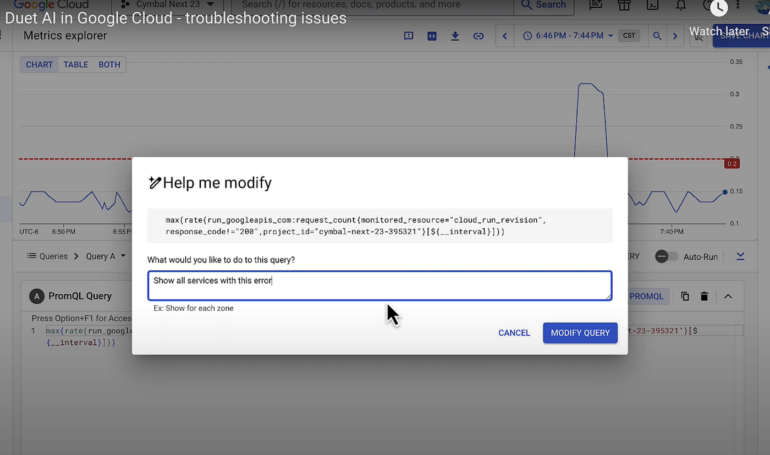
Google allows analysts to do things like make natural language queries. “When I spoke of upleveling talent in security, this is a great example. You don’t have to be conversant in our unified data model syntax; instead, you can ask questions in natural language,” Potti said (Figure B).

Figure B

Using a natural language query in Duet AI to troubleshoot a service issue and get recommendations.
Using a natural language query in Duet AI to troubleshoot a service issue and get recommendations. Image: Google

According to Potti, Mandiant generates vast amounts of data around indicators of compromise, which can be summarized using Duet AI. “This allows us to easily use Duet AI to look at thousands of intel reports, summarize that data for what is most specific to a user or circumstance and customize it to the type of audience receiving the report.”

The infusion of Duet AI into Chronicle will allow security administrators to generate summaries of all aspects of a security case, according to Potti, who said the AI-driven Chronicle platform will recommend next steps for defense.

SEE: Google Cloud Study: Big Risk in Proliferating Credentials (TechRepublic)

Potti said that as part of its SOC team services, Google is also integrating Duet AI into its Security Command Center in order to provide visibility into customer vulnerabilities in Google Cloud and perform automated tasks. For example, it can determine if assets are vulnerable to attack, generate a summary of what resources can be exploited and provide suggestions on how to remediate the vulnerabilities.

He said the innovations extend a new capability for Terminal Access Controller Access-Control System simulation, which can look across a user’s enterprise Google Cloud environment to identify which assets have vulnerabilities, threats, or were compromised. It also looks for the potential exposure of an organization’s privileged data, or a threat actor’s ability to escalate privileges.

“Through Duet AI and our Security Command Center, we are helping to summarize those attack paths so security teams can quickly understand what these paths are and recommended steps to remediate some of those issues. These are improvements that help reduce toil security teams face every day,” he said.

Chronicle gets Mandiant Hunt feature

Also at Google Next ’23, the company announced Mandiant Hunt for Chronicle. The new feature uses Mandiant personnel to do threat hunting on top of Chronicle environments in order to find threats that a security operations team may have missed.

According to Google, Mandiant experts build hypotheses using a robust and adaptable collection and analysis strategy alongside traditional automated hunting that searches for indicators of compromise.

SEE: Mandiant sees malware proliferating, but detection measures bear fruit (TechRepublic)

“Think of this as a way to augment the customer security team today with the best incident response investigators in the world,” said Potti. “Because Chronicle brings in data from so many sources, we are able to leverage not only endpoint data but network and identity data to run these queries.”

Supercharging Duet AI with PaLM 2

According to Potti, in order to tune Duet AI for security functions, Google used its Vertex AI PaLM 2. Google added that PaLM 2 vastly improves on the first generation PaLM’s advanced reasoning abilities, including code and math, classification and question answering, translation and multilingual proficiency, and natural language generation.

Potti said Google trained PaLM 2 on security data from its Mandiant threat intelligence unit to create a generative AI model it calls Sec-PaLM 2, which is designed to be optimized for supporting security work cases. He noted its plug-in architecture means Google Cloud customers can customize it easily. “It is powering innovations and enabling customers and partners to use it as a model within the Vertex AI garden,” he said.

AI applied to security: fighting fire with fire

Google’s move mirrors a rapidly escalating arms race between threat actors and defenders around the application of generative AI and other machine learning tools. Attackers are using these new technologies to write malware, impersonate brands and conduct an array of social engineering exploits.

Check Point Software has been leveraging AI for about a decade, and approximately 40 out of its 70 engines use AI and machine learning. Pete Nicoletti, global chief information security officer at Check Point Software, said AI is mandatory at this point.

“These days, if you don’t have AI to battle AI, you are going to be a statistic,” he said. “It’s lowering the bar for attackers.” He noted that hackers are using AI in two ways — the first being code generation. “They are beating the guardrails of ChatGPT systems and having them create snippets of code rather than full-blown zero day ransomware,” he said. The second is the automated creation of spam — that is, taking hacked content and creating new social engineering exploits. “Between the scripting capabilities of AI and content creation, you can do it in minutes and launch it in seconds.”

Subscribe to the Cybersecurity Insider Newsletter

Strengthen your organization's IT security defenses by keeping abreast of the latest cybersecurity news, solutions, and best practices.

Delivered Tuesdays and Thursdays Sign up today

OpenAI Finally Learns How to Do Business

OpenAI Finally Learns How to Do Business

OpenAI, the research company that turned into a business, is finally understanding how to make it work. After incurring surmounting losses of over $540 million for building ChatGPT, the company is now trying to make it work, and earn some revenue.

In the most recent report from the Information, OpenAI believes that it is now on pace to generate revenue of $1 billion over the next 12 months. All of it would be done by selling their ChatGPT to enterprises, an offering that was long being awaited by companies given all the concerns about data privacy. There seems to be no other way left for the company.

OpenAI has announced ChatGPT Enterprise, which will allow businesses to use the most famous chatbot, with enterprise level security and privacy, with unlimited high-speed access to GPT-4. ChatGPT Enterprise removed all usage caps, and performs up to two times faster. It includes 32k context in Enterprise, allowing users to process four times longer inputs or files, making it even better than ChatGPT Plus.

Do the numbers add up?

The billion dollar revenue that the company is projecting is a little off from what it had said before. OpenAI projected an annual revenue of $200 million in 2023, and was expected to reach $1 billion in 2024. Not too far off, but a person with direct knowledge of the situation said that the expectation is far ahead.

Microsoft is teaching OpenAI how to do business and earn some money. After all, the tech-giant has invested huge sums of money to turn the research organisation into a tech startup. If the predictions are right, then OpenAI must generate north of $80 million per month, which is too high when compared to just $28 million revenue it generated last year.

OpenAI was a research lab, but Sam Altman turned it into a tech startup.

— Pedro Domingos (@pmddomingos) August 28, 2023

Furthermore, though the revenue might flow, to turn into profitability, the company would have to account for the $700,000 it spends everyday to run ChatGPT. That is just for running inference, and does not include the company’s plan to make its models better and offer it for enterprise. There must be a lot of costs that OpenAI is possibly not taking into account.

On the other hand, Microsoft has stopped depending on OpenAI for its services. It possibly realised that the ChatGPT company is not providing it with smaller models and also jeopardising its image with so many people being concerned over data privacy. Thus, Microsoft partnered with Meta to release Llama 2 on its platform.

It silently also released Azure ChatGPT, something very similar to what OpenAI has released now. The GitHub repository also took a jab at OpenAI saying that people are scared of ChatGPT privacy issues. But just two days later, Microsoft took it down, hinting about some tussle between the two companies, since OpenAI was also planning to release exactly the same thing, and possibly raised the flag.

Is OpenAI now waking up to the Microsoft exploitation?

In May, OpenAI had announced that it would be launching ChatGPT Business in the coming months, promising enterprises more control over their data. It looked like Microsoft was just using OpenAI to do the dirty work to discover enterprise use cases, drive generative AI adoption, fix safety flaws, and replicate the process for customers.

But since then, Microsoft has been trying to push OpenAI’s APIs on its cloud for its services. Now, with ChatGPT Enterprise, OpenAI’s shift towards a profit-driven company is finally taking shape. OpenAI launching its own enterprise offerings while its biggest backer is doing so would simply not align well in the future.

Despite that, people were sceptical about using the platform within its organisation. Sam Altman recently posted on X to clear that OpenAI does not use a company’s data to train its model, unless the company opts-in.

seeing a lot of confusion about this, so for clarity:
openai never trains on anything ever submitted to the api or uses that data to improve our models in any way.

— Sam Altman (@sama) August 15, 2023

On the other hand, just like the GPT-4 multimodal announcement that never actually happened, OpenAI’s ChatGPT Enterprise announcement still is in its infancy. The company hasn’t revealed any pricing details and how it would finally be able to make money through the platform. Moreover, if companies are already able to leverage open source models with their data, would this new announcement actually bring them back to GPT?

Maybe, OpenAI should have thought about releasing this long back and been a little quicker. This release might kill a lot of other startups that are coming up as just wrappers around ChatGPT, but to make money for OpenAI again, it might take a lot more convincing soon to bring back the customers. But for sure, the company has learnt how to do business.

Would enterprises be willing to pay for the paid version of ChatGPT if there is already a free version available for everyone with data control features or will OpenAI pull the plug on ChatGPT entirely to make its ChatGPT Enterprise work? Probably also cut ties with Microsoft soon?

Either way, ChatGPT is not getting any smarter.

The post OpenAI Finally Learns How to Do Business appeared first on Analytics India Magazine.

Top 9 LangChain Alternatives for Building AI Agents

Top 9 LangChain Alternatives for Building AI Agents

There is no doubt that LangChain has emerged as one of the most discussed software in the modern times when it comes to deploying LLMs and building wrappers around it. It was expected to achieve a success similar to PyTorch. LangChain’s offering, though aiming for convenience, has ironically birthed a host of challenges. The intricate web it weaves has led to accusations of unnecessary complication, leaving developers questioning its true intentions.

Critics argue that rather than paving an accessible pathway to LLMs, LangChain exacerbates the complexities it aims to alleviate. Many notable observations highlight how LangChain’s convoluted approach sidetracks beginners from directly engaging with the heart of AI, instead acting as a puzzling intermediary.

Here are some of the alternatives that you can try instead of using LangChain for your next project:

Auto-GPT

Apart from the goal of deploying AI agents, Auto-GPT’s main goal centres around elevating GPT-4 into a fully self-reliant conversational AI. In contrast, LangChain stands as a toolkit that forges connections between various LLMs and utility packages, facilitating the creation of tailor-made applications.

Unlike LangChain, Auto-GPT’s focus is on executing codes and commands to furnish precise, goal-driven solutions that are presented in a comprehensible manner. Notwithstanding its impressive attributes, it’s worth noting that, in its current state, Auto-GPT exhibits a tendency to become entangled in continuous loops of logic and intricate scenarios.

LlamaIndex

LlamaIndex offers a versatile toolkit for streamlined data management and access. Through data connectors, it effortlessly extracts data from diverse sources like APIs, PDFs, and SQL databases. Data indexes then structure this information into formats optimised for LLMs. The platform facilitates natural language interactions through query engines for knowledge-augmented outputs, chat engines for interactive dialogues, and data agents that blend LLMs with tools.

LlamaIndex integrates smoothly with applications like LangChain, Flask, and Docker. It caters to users of all levels, providing a simple high-level API for beginners to ingest and query data, while advanced users can customise modules through lower-level APIs.

Simpleaichat (SimpleAIChat)

simpleaichat is a Python package designed to streamline interactions with chat applications like ChatGPT and GPT-4, featuring robust functionalities while maintaining code simplicity. This tool boasts a range of optimised features, geared towards achieving swift and cost-effective interactions with ChatGPT and other advanced AI models.

By employing just a few lines of code, users can effortlessly create and execute chat sessions. The package employs optimised workflows that curtail token consumption, effectively reducing costs and minimising latency. The ability to concurrently manage multiple independent chats further enhances its utility. SimpleAIChat’s streamlined codebase eliminates the need for delving into intricate technical details.

The package also supports asynchronous operations, including streaming responses and tool integration, and is also going to support PaLM and Claude-2 soon.

Outlines

At its core, Outlines empowers developers to steer text generation with precision, forging robust interfaces with external systems. This cutting-edge platform furnishes a spectrum of generation methods that provide airtight guarantees—outputs that adhere to regular expressions or adhere to JSON schemas. The library’s strength also lies in its impeccable prompting primitives, orchestrating a clear separation between prompting and execution logic.

This elegant division facilitates streamlined implementations of pivotal techniques such as few-shot generations, ReAct (Real-time Adaptive Concept-based Text generation), meta-prompting, and agent-based interactions. Notably, Outlines extends its compatibility umbrella to all models, establishing connections through next-token logits. This inclusivity encompasses API-based models, reaffirming its versatility.

Embracing a philosophy of compatibility, Outlines is meticulously designed to seamlessly integrate with the broader ecosystem, complementing rather than supplanting existing tools.

BabyAGI

BabyAGI presents itself as a Python script serving as an AI-driven task manager. It leverages OpenAI, LangChain, and vector databases including Chroma and Pinecone to establish, prioritise, and execute tasks. This involves selecting a task from a predefined list and relaying it to an agent, which, in turn, employs gpt-3.5-turbo as default and aims to accomplish the task based on contextual cues.

The vector database then enhances and archives the outcome. Subsequently, BabyAGI proceeds to generate fresh tasks and rearranges their priority based on the outcome and objective of the preceding task.

AgentGPT

Emerging as an ideal solution for enterprises, AgentGPT aspires to introduce self-sustaining AI agents through their web browsers. While Auto-GPT functions autonomously, generating its own prompts, AgentGPT takes a different approach by relying on user inputs and engaging in human interactions to fulfil tasks. Despite its ongoing beta phase, AgentGPT presently boasts capabilities like long-term memory retention and web exploration.

MetaGPT

MetaGPT, a Multi-Agent Framework on Github, approaching 10,000 stars, is looking to transform the landscape of software development. It is simply capable of running an entire software development company.

Until now, agents like Baby AGI and Agent GPT would spin up a bunch of agents to complete a task for ‘write me a code for this API’ but now, MetaGPT stepped up the game by taking in a one-line requirement as input and outputs user stories, competitive analysis, requirements, data structures, APIs, and documents. APIs, and documents.

AutoChain

AutoChain presents a groundbreaking fusion of the innovative approaches seen in LangChain and AutoGPT. Its overarching mission revolves around resolving two critical challenges in the domain: granting developers a nimble and adaptable framework to fabricate their agents using LLMs, alongside automated assessment of diverse user scenarios via simulated dialogues.

If you’re well-acquainted with LangChain, transitioning to AutoChain should be a breeze due to their shared yet streamlined concepts, facilitating seamless navigation within the new platform. By bestowing agents with the capability to harness a plethora of customised tools and incorporate OpenAI function calls, AutoChain establishes itself as a versatile and extensible generative agent pipeline.

PromptChainer

Similar to AutoChain, PromptChainer is useful for creating AI-driven flows with the help of traditional programming, prompts, and models, while also managing AI-generated insights.

Given the pre-built templates on the website, users can easily import their databases, which will then be powered by GPT-4, with a Visual Flow Builder. This agent supports multiple models available on Hugging Face and even Kaggle.

The post Top 9 LangChain Alternatives for Building AI Agents appeared first on Analytics India Magazine.

Top 5 LLM Benchmarks

The landscape of large language models (LLMs) evaluation is expanding, with various benchmarks emerging to gauge their capabilities across distinct domains. These benchmarks offer nuanced insights into LLMs’ performance on tasks that encompass coding proficiency, natural language understanding, multilingual comprehension, and more. Examining LLMs on these benchmarks provides a comprehensive picture of LLMs’ strengths and limitations.

Even though there is growing discussion about how reliable it is to trust the models based on the metrics, it is still essential to note the viability of the model and comprehend its capabilities, just like comparing your model against GPT.

While LLMs showcase promise, they continue to grapple with complexities inherent to language, coding, and context across these diverse evaluations. However, like the AI models, the benchmarks are constantly evolving, and will continue to do so.

Here are 5 benchmarks to evaluate the efficiency of language models-

HumanEval

The HumanEval benchmark is a set of 164 programming problems specifically created to evaluate the coding capabilities of large language models (LLMs). These problems cover a range of skills, including understanding language, working with algorithms, and basic mathematical operations.

Each problem within the HumanEval benchmark is presented in the form of a docstring, a concise piece of text that outlines the problem’s description and the expected outcome. The LLM’s task is to generate Python code that effectively solves the problem, based on the given docstring. This generated code is then evaluated by a human judge to determine its correctness and functionality.

Although the HumanEval benchmark is relatively new, it has already been employed to assess several LLMs, such as GPT-3, LLAMA, LLAMA 2 and PaLM. These evaluations have indicated that LLMs possess the ability to produce accurate and functional code. However, it’s worth noting that they still make errors, particularly on more complex challenges.

MBPP (Mostly Basic Python Programming)

The MBPP benchmark, stands for Mostly Basic Python Programming, is a collection of 1,000 Python programming problems sourced from the crowd. Its purpose is to assess the code generation capabilities of large language models (LLMs). The problems are intentionally designed to be solvable by individuals at an introductory programming level, using core programming concepts and standard library functionalities.

Each problem within the MBPP benchmark consists of three components: a concise task description, a Python code solution, and three automated test cases. The task description provides a brief explanation of the problem, while the code solution entails a Python function crafted to resolve the given problem. The automated test cases serve the purpose of confirming the accuracy of the provided code solution.

Although the MBPP benchmark is currently in its developmental phase, it has already been employed to evaluate several LLMs. Notable among these are LEVER + Codex, Reviewer + Codex002, MBR-Exec. The results of these evaluations demonstrate the capability of LLMs to generate functional and correct code for fundamental Python programming problems.

MMLU (5-shot)

MMLU, which stands for Multilingual Multitask Learning for Understanding, serves as an evaluation benchmark for large language models (LLMs) to execute diverse natural language understanding tasks in various languages. Covering question answering, summarization, translation, natural language inference, and dialogue tasks among the total 57 tasks, MMLU is crafted to be challenging, necessitating robust language comprehension by LLMs.

Evaluation considers accuracy and fluency, measuring correct responses and natural coherence. Utilized in assessing LLMs like Flan-PaLM 2, Codex + REPLUG LSR, Chinchilla, MMLU reveals LLMs’ capacity for multilingual understanding tasks, even though errors persist in intricate challenges.

TriviaQA (1-shot)

The TriviaQA (1-shot) benchmark assesses the capacity of large language models (LLMs) to respond to questions using just one training instance. This dataset comprises 100,000 questions and answers, categorized into 10,000 training, 10,000 validation, and 80,000 test examples. Questions span varying levels of difficulty, occasionally demanding real-world knowledge or common sense.

In the 1-shot framework, each question is assigned a sole training example for the LLM. This intensifies the challenge as the LLM must generalize from this single instance to address similar questions.

Various LLMs, such as PaLM 2-L, GLaM 62B/64E, FiE+PAQ have been evaluated using the 1-shot TriviaQA benchmark. While these evaluations indicate LLMs’ competence in answering questions with only one training example, errors persist, particularly with tougher questions.

BIG (Beyond the Imitation Game) -Bench Hard

The BIG Bench Hard serves as an extensive evaluation tool for large language models (LLMs), an initiative established by Clark et al. in 2021. Comprising over 200 tasks, the BIG-bench benchmark spans a diverse array of tasks categorized into 10 distinct categories.

These categories encompass a spectrum of language understanding tasks, including textual entailment, question answering, natural language inference, commonsense reasoning, code completion, translation, summarization, data analysis, creative writing, and miscellaneous tasks such as sentiment analysis and creative text generation. The benchmark is meticulously designed to challenge LLMs, requiring them to showcase various skills and abilities across an extensive range of tasks.

Designed with an extensible framework, the BIG-bench benchmark can accommodate the addition of new tasks as they are developed, enabling it to stay up-to-date with emerging language understanding challenges. This adaptability ensures that it remains a relevant and dynamic benchmark for assessing the evolving capabilities of LLMs.

The post Top 5 LLM Benchmarks appeared first on Analytics India Magazine.

Google Turns AI ‘Bold & Responsible’

Nearly half the planet uses Google and confides in the tech company to keep their data safe and secure. Apart from its popular search engine, Google provides other popular services and products which have long haunted the company on account of data breaches, leaks, and privacy scandals that have become commonplace since the infamous 2018 Google+ API breach.

For 2023, the company made sure its ‘bold and responsible’ approach remains at the centre stage during all its events. Within the first eight months, Google has already released 49 security blogs with the most (13) in the month of May. Each blog introduced a bunch of updates varying from AI-powered projects to its AndroidOS.

At the Google I/O alone, the company announced 11 new security updates majorly focused on AI and its large language models. The updates included a Safe Browsing API (which uses AI to identify and alert users about unsafe sites to avoid scams), and a similar tool for users to know if their data is being misused on the dark web.

The Next security overhaul

Yesterday, at Next ’23, Google Cloud’s conference Sunil Potti, General Manager and VP of Cloud security revealed GCP’s security strategy. The announcements build on Security AI Workbench (that leverages a security-specific large language model (LLM) from Google, Sec-PaLM) which the company released in April.

Potti said the new strategy is built on three pillars: Leveraging Mandiant expertise, infusing security into Google Cloud innovations and making expertise available for various environments.

He said, “The ongoing challenges in security include evolving threat landscapes, increasing number of security vendors and tools, and scarcity of security talent.” He further explained the potential generative AI holds to address those challenges. The announcement involves the technology’s applications in different security pillars: security workbench, Chronicle’s security operations, and Cloud Security Console.

Overall, Potti discussed the strategy of incorporating AI and expertise to enhance security across different aspects of Google Cloud. The presentation aimed to provide a structured approach for securing and leveraging AI in the security domain.

Bold & responsible – from Mountain View to Bangalore

Google has been carrying around the ‘Bold and Responsible’ label since its executives have not shut up about generative AI since 2023 began. The new mantra has been repeated over and over again in all the conferences held from Mountain View to Bangalore.

At the I/O, a drinking game emerged — take a sip every time the speakers utter the word “responsible AI”. And this did not stop at California, the first ever I/O Connect event at Bangalore was a carbon copy. As a responsible parent in the AI world, Google made sure every announcement was dashed with a hint of the responsible approach. Every speaker from the CTO of Google Cloud to the VPs of Google Pay and Android made sure to emphasise the ethical use of AI.

While the company has been portraying itself in a ‘don’t be evil’ light, its researchers have raised several flags over the recent past about the internal ongoing shenanigans at the search giant led by Pichai. James Manyika, the company’s head of ‘tech and society’ recently spoke to the Washington Post about the downsides of AI.

Before addressing a packed arena, he discussed the scourge of misinformation and how AI has become an echo chamber reflecting society’s misdemeanour. He warned about the emergence of new problems as the technology improves. As he stepped on stage, the words Bold and Responsible ironically flashed on the audience screen.

In an attempt to regain its pole position on the AI first podium, the Google Search creator has been trying to ship products without much oversight. Even though the company believes that ethics cannot be an afterthought, its actions have spoken differently for a while. As technology progresses so does the risk of misusing it. Looking at Google’s history of antitrust cases and data theft scandals, it looks happy carrying around the ‘Bold and Responsible’ placard for now.

The post Google Turns AI ‘Bold & Responsible’ appeared first on Analytics India Magazine.

Google’s Duet AI for Workspace can create presentations, write emails, and attend meetings for you

Duet AI for Workspace hero image

Back in March, Google announced that almost every application in its Workspace would get an AI revamp. At this year's Google Cloud Next event, the tech giant has made that announcement a reality with the unveiling of Duet AI for Google Workspace.

Duet AI is Google's real-time AI collaborator that works with users across Workspace applications, including Slides, Meet, Gmail, Chat, and more. It can facilitate everyday pesky tasks, such as reading hefty emails, creating slide decks, and even being in meetings.

Also: Google Labs rolls out its 'AI-first notebook'

For example, a financial analyst could use Duet AI to create a last-minute presentation by asking Duet AI to summarize the business's performance and produce a presentation by including text, charts, and images found in the analyst's Drive and Gmail accounts, according to Google.

Duet AI will also help facilitate workplace communications via special integrations in Google Meet and Google Chat.

Google Meet

Meetings provide a platform for collaboration, team-building activities, and workflow management. However, attending unnecessary meetings can waste time during the workday — and that's especially a problem when that time could be allocated to more productive tasks.

Duet AI is here to help by attending the meeting for you.

Also: Google debuts Duet AI to tackle new cybersecurity challenges in the cloud

With the "attend for me" feature, DuetAI can attend meetings on your behalf, deliver the message you would have liked to share, and then give you a recap of what you missed.

Duet AI can take notes, jot down action items, and even grab video snippets in real time using the 'take notes for me' feature. Then, after the meeting, it will send a summary to the attendees, and to those who couldn't attend, but who want to stay up to date.

If a user joins the meeting late, they can use the "summary so far" feature to catch up quickly with the rest of their colleagues.

Duet AI will also help to optimize the video experience for people on the call by providing a studio look, lighting, and sound, according to the release.

Also: Google Meet lets you add AI-generated background images to meetings

To make it easier to see and understand participants who are joining a call from a conference, Google is implementing dynamic tiles and face detections, which will give each participant a video tile with their meeting name.

Lastly, Google Meet will now have "automatic translated captions" for 18 languages, where it will automatically detect when another language is spoken and display a real-time translation.

Google Chat

To facilitate quick, on-the-go conversations, Google Chat now has a refreshed interface, new shortcuts, an enhanced search, and even a new huddle in Chat feature, allowing quick, impromptu voice chats.

Also: Nearly 40% of workers think generative AI can help with workplace communication

Users can also chat with Duet AI directly and "ask questions about your content, get a summary of documents shared in a space, and catch up on missed conversations", according to the release.

To save you time when composing messages, Google is enhancing its smart reply feature to support the generation of longer personalized replies in Gmail and Duet AI.

Privacy

A major concern when employees use generative AI in the enterprise is company privacy and security, especially since generative AI models often use input data to train and get smarter.

Also: Google Cloud expands developer tools and data analytics capabilities with generative AI

To ease those tensions, Google reassures professionals that interactions with Duet AI are private and will not be used to train any models without user authorization.

Availability

These DuetAI features are available with a no-cost trial, which users can access by completing this form. The form asks for the number of employees at the interested user's organization, whether you are a Google Workspace customer, and contact details.

Artificial Intelligence

GitLab’s Lemos: AI, Automation are Key to DevSecOps

Laptop computer displaying logo of GitLab.
Image: Monticellllo/Adobe Stock

GitLab, like its competitor GitHub, was born of the open source Git project and is still an open-core company (i.e., a company that commercializes open-source software that anyone can contribute to). It has, since its 2011 launch as an open-source code-sharing platform, seen its DevOps software package grow to over 30 million users. In May 2023, the company launched new AI capabilities in its DevSecOps platform with GitLab 16, including nearly 60 new features and enhancements, according to the company.

At the 2023 Black Hat conference this month, Josh Lemos, chief information security officer at GitLab, spoke with TechRepublic about DevSecOps and how the company infuses security features into its platform, and how AI is accelerating continuous integration and making it easier to shift security left. Lemos explains that GitLab has its roots in source code management and continuous integration and pipelines; a foundry, if you will, for building software.

Jump to:

  • Securing the build chain, at scale
  • Supply chain attacks: Less about ransom, more about persistence
  • GitLab’s AI toolkit, from code generation to natural language suggestions
  • Shift left: Just in time, actionable feedback to developers

Securing the build chain, at scale

Karl Greenberg: Can you talk about your role at GitLab?

Josh Lemos: First, when security was incorporated into DevOps and the entire lifecycle of code, it gave us an opportunity to insert security earlier in the build chain. As a CISO, I basically have a meta role in helping companies secure their build pipelines. So not only am I helping GitLab and doing what I would do for any company as CISO, in terms of securing our own product software, I am also doing that at scale for thousands of companies.

SEE: What are the implications of Generative AI for Cybersecurity? At Black Hat, Experts Discuss (TechRepublic)

Karl Greenberg: In this ecosystem of repositories, how does GitLab differentiate itself from, say, GitHub?

Josh Lemos: This ecosystem is basically a duopoly. GitHub is more toward source code management and the build phases; GitLab has focused on DevSecOps or the entire build chain, so infrastructure as code and continuous integration — the entire cycle all the way through to production.

Supply chain attacks: Less about ransom, more about persistence

Karl Greenberg: When you look at threat actors’ kill chains within that cycle, attacks that DevSecOps aims to thwart — supply chain attacks using Log4j, for example — this isn’t about some financially motivated actor seeking ransom, is it?

Josh Lemos: That would be one outcome, sure, but ransomware is a pretty finite end game. I think what’s more interesting from an attacker’s perspective is figuring out how to maintain silence, going undetected for a long period of time. Ultimately the goal [for attackers] is to either compromise data or get insights into a company, government or any organization for various reasons; it could be financially motivated, politically motivated or motivated by compromising intellectual property.

Karl Greenberg: Or, when I think of a threat actor’s persistent presence in a network, I suppose access brokers do this.

Josh Lemos: Generally, attackers don’t want to burn their access, so yeah they want to keep those persistence records as long as possible. So, going back to the first question, my goal in all of this is to create the environment in which companies can secure their build pipelines effectively, limit access to their secrets and utilize cloud security and CI/CD security controls at scale.

SEE: GitLab CI/CD Tool Review (TechRepublic)

GitLab’s AI toolkit, from code generation to natural language suggestions

Karl Greenberg: GitHub has been very successful with Copilot adoption. What are GitLab’s generative AI innovations?

Josh Lemos: We have over a dozen AI features, some designed to do things like code generation, an obvious use case; our version of Copilot, for example, is GitLab Duo. There are other AI features we have that are very useful in terms of making suggested changes and reviewers for projects: We can look at who has contributed to the project, who might want to review that change, then make those recommendations using AI. So all of these tools automate infusion of security into development without developers having to slow down and look for mistakes.

SEE: GitLab Report on DevSecOps: How AI is Reshaping Developer Roles (TechRepublic)

Karl Greenberg: But obviously, you want to do that early because, by the time it’s out in the wild, it’s expensive, and you are dealing with an exposure issue — a live vulnerability.

Josh Lemos: Yes, it’s shift left in terms of tightening the feedback loop early in the process, when the developer goes to commit the code, while they’re still thinking about that piece of code. And they will get feedback in terms of identifying an issue and fixing it within their process, and on our platform, so they don’t have to go to an external tool. Also, because of this tight feedback loop, they don’t have to wait for software to go into production and then get the problem identified when it’s happening at the time of build.

Shift left: Just in time, actionable feedback to developers

Karl Greenberg: What key security challenges in the software process need some sort of security solution beyond those tools you’ve talked about?

Josh Lemos: Generally, I think that a lot of shifting left terminology is really about making sure that we can secure the software pipeline regardless of the number of developers involved. We can do that by providing good, actionable and meaningful feedback to developers working in the build and development process. We want this part to be automated as much as possible so that we can start to use our security teams to do the more insightful work of design and architecture earlier in the process, before it even gets to the part where they’re building and committing code.

Karl Greenberg: Are we talking purely about ML- and AI-driven tools?

Josh Lemos: There’s a mix of tools and capabilities. Some of them are traditional static code analysis tools; some of them are container scanning that look for known CVEs (common vulnerabilities and exposures) and packages. So there’s a mix of AI and non-AI. But there’s a massive opportunity for automation. And whether that’s AI automation or traditional software, CI/CD security type automation, those can reduce the level of manual work and effort, which allows you to shift your team to focus on other problems that can’t be automated away yet. And I think that’s the big movement in security teams: How can we go automation first in order for us to scale and meet the velocity we are required to meet as a company, and the velocity we need to meet with our engineering teams?

Subscribe to the Cybersecurity Insider Newsletter

Strengthen your organization's IT security defenses by keeping abreast of the latest cybersecurity news, solutions, and best practices.

Delivered Tuesdays and Thursdays Sign up today