2024 Data Management Crystal Ball: Top 4 Emerging Trends

2024 Data Management Crystal Ball: Top 4 Emerging Trends
Image by kjpargeter on Freepik

Data dominance is rapidly increasing, signaling its influence in more industries and processes. Halfway into 2023, it is better to think about what the next 18 months would mean for data management platforms. I firmly believe that starting in 2024, enterprises stand at a critical juncture, realizing the indispensable need to harness data intelligently.

To thrive and flourish, organizations must embrace key data management trends that pave the path towards success. They have to rekindle their strategies and move on from traditional repositories. Traditional data management approaches can’t handle the uncertain volume of data in the era of IoT and AI. New technologies are on the shelf and it's time to include them in the strategy.

Among many interesting trends, I'm picking my hot favorites that will reincarnate the digital landscape. Tag along!

Trend 1: Focus on Data Democratization through Fabrics & Mesh

Data democratization is the practice of making data accessible and consumable for everyone in an enterprise, regardless of technical skills. Off-late, data fabrics and mesh have been hugely popular in embracing everyone in an organization, regardless of their technical expertise—for example, ThoughtSpot, Domino Data Lab, K2view and others.

As we know, a data fabric is a data management architecture that integrates data from multiple sources into a unified view. This makes it easier for users to find and access the necessary data. Likewise, a Mesh gives domain experts more control over their data and can also help improve data quality and governance.

Both architectures are equally instrumental in ensuring data democratization. Apart from improved data access, they make it easier for users to find and access the data as per their requirements. This leads to faster decision-making and insights. There’s also improved data quality by providing a single, unified view. Moreover, the centralized data access control and repository approach ensures improved governance and security.

Trend 2: Increased Adoption of Industry 4.0 Tech in Pulling Data Insights

Industry 4.0, as we know, is the fourth industrial revolution, which largely uses automation, data analytics, and artificial intelligence to create smart factories.

In Industry 4.0, data analytics can improve efficiency, productivity, and quality by identifying areas where processes can be optimized or defects can be prevented.

For example, data analytics track the performance of machines and identify patterns that indicate that a machine is about to fail. It further uses this information to schedule maintenance before the machine fails, which can prevent downtime and lost productivity. Why it matters is because the tech that is largely confined to manufacturing is actually growing at a CAGR of 16.3% from 2023-2030. This could value the industry to USD 377 billion.

Trend 3: Increased focus on GDPR Compliance through Masking

By masking sensitive data, enterprises can protect the privacy of their customers and employees, and they can also reduce their risk of data breaches. Masking redacts sensitive data from datasets that are used for analytics and machine learning. This ensures that sensitive data is not used in ways that could violate GDPR, such as profiling or targeting individuals.

Data masking can be used to create pseudonymized datasets. Pseudonymized datasets are those in which personal data has been replaced with artificial identifiers. This makes it more difficult to identify individuals in the datasets, and it can help to protect their privacy. Even though significant data management tools offer masking expertise to a certain extent, I’ll recommend K2View for compliance qualifications as It provides comprehensive features for masking sensitive data, including redaction, tokenization, de-identification, pseudonymization, and data obfuscation. Their data masking solution can help businesses comply with various data privacy regulations, including GDPR, CCPA, and HIPAA. The fabric solution is popular for its micro-database approach that contains a single entity's data, which has been masked according to the business's security and compliance requirements.

Trend 4: Increased Adoption of DataOps

DataOps streamlines the process of data collection, preparation, analysis, and delivery. This enables enterprises to extract actionable insights more efficiently. Since they deliver faster time to value, enterprises across sectors have begun including them in their data management stack.

DataOps emphasize cross-functional collaboration, automation, version control, and continuous integration and delivery in data operations. By applying these principles, DataOps aims to address common challenges faced by data teams, such as data silos, long development cycles, and lack of agility.

Organizations can ensure that data is consistently validated, cleaned, and transformed by implementing automated data pipelines and standardised processes. This leads to improved accuracy and reliability of insights derived from the data.

Traditional data management approaches often suffer from bottlenecks and data processing and analysis delays. DataOps, emphasizing automation and continuous integration, allows organizations to rapidly iterate and deliver insights to stakeholders, facilitating quicker decision-making and driving business outcomes.

Gazing at the Future

One thing is certain: organizations must prepare themselves for the future data revolution. With data's relentless growth and importance, businesses that proactively adapt and capitalize on emerging trends will gain a significant competitive advantage. The tech stack currently confined to selective enterprises will be easily accessible to SMEs. On top of it, AI makes it more imperative to act. What do you think?
Yash Mehta is an internationally recognized IoT, M2M and Big Data technology expert. He has written a number of widely acknowledged articles on Data Science, IoT, Business Innovation and Cognitive intelligence. He is the founder of a data insight platform called Expersight. His articles have been featured in the most authoritative publications and awarded as one of the most innovative and influential works in the connected technology industry by the IBM and Cisco IoT departments.

More On This Topic

  • 5 Key Data Science Trends & Analytics Trends
  • Data Management: How to Stay on Top of Your Customer's Mind?
  • Top 5 Data Management Platforms
  • Free Data Management with Data Science Learning with CS639
  • Data Mesh Architecture: Reimagining Data Management
  • KDnuggets News, May 18: 5 Free Hosting Platform For Machine Learning…

Everything we’re expecting at Amazon’s Devices and Services event

Amazon HQ2

A view of the Amazon HQ2 Campus in Arlington, VA, where the Amazon Devices and Services event will take place in 2023.

Amazon is constantly looking for new ways to innovate through hardware and software, from Echo devices to new Alexa capabilities. On September 20, the company will hold its annual Devices and Services event at its new headquarters in Arlington, VA. The event is an opportunity to unveil new products and improvements made to its platforms.

Also: Amazon's Echo Show 5 made me a smart display believer (and my daughter, too)

Last year, we saw the launch of the Kindle Scribe, a new generation of Echo Dot and Fire TV Cube, the addition of spatial audio to the Echo Studio, a Fire TV Pro Remote, and the eero built-in capability added to some Echo devices. Though we can't say for certain what is on the docket this year, we've got a pretty good idea of what could be.

Amazon

Google Search’s Generative AI Experience Now Available in India 

Google today announced that it is bringing its generative AI search experience for users in India and Japan that will show text or visual results to prompts, including summaries. The expansion follows successful experimentation and positive feedback garnered from the Search Labs in the United States.

The generative AI experience aims to empower users by offering them a broader understanding of various topics, assisting in discovering new perspectives, and facilitating smoother task completion. This innovation allows individuals to delve into complex queries and explore new types of questions, ultimately fostering a more conversational interaction with the search engine.

One of the notable aspects of this expansion is Google’s emphasis on supporting local languages. Users in both India and Japan can now access the generative AI capabilities in their native languages, either through text input or voice commands. In India, the feature offers a unique language toggle, enabling users to effortlessly switch between English and Hindi. Additionally, Indian users have the option to listen to responses, catering to diverse preferences.

Google said it has observed strong user engagement with the suggested follow-up questions, demonstrating the practicality of refining search queries effectively. The generative AI assists users in quickly locating desired information and encouraging them to explore inquiries they may not have considered previously.

As part of this ongoing enhancement process, the company is introducing a new way for users to discover relevant web pages associated with AI-powered overviews. A clickable arrow icon next to information in the overview allows users to seamlessly access corroborating web content, bridging the gap between AI-generated insights and real-world web sources.

However, the company said it’s essential to note that this generative AI experience remains an experiment. The tech giant said it continues to fine-tune its systems based on user feedback and preferences.
To utilize SGE, you can locate it within the Search Labs section of the Google app on both Android and iOS, as well as on Chrome when using the desktop version

The post Google Search’s Generative AI Experience Now Available in India appeared first on Analytics India Magazine.

IBM Should Help India in its AI Mission

IBM India AI

Lately, India has been stepping up in the technological landscape, the success of Chandrayaan-3 is just one of the feats. Top leaders from India have been getting into the AI field, such as Mukesh Ambani, Tech Mahindra, and now even IBM seeks to place its bet in India.

Recently, IBM CEO Arvind Krishna said that India should build sovereign capability in AI. He wants the government to push for more transparent and open AI policies when it comes to enabling companies to build and leverage AI within the country. With the policies and incentives, the private sector might be ready to take the risk to experiment with the expensive technology.

Citing the example of the success of Chandrayaan-3 and the rising AI capabilities of US, China, UAE, and many European countries, Krishna said at the B20 Summit in Delhi that the Indian government can help in speeding up the process by giving the private sector the confidence.

All of this definitely makes sense, but what is stopping IBM itself from stepping up its game in India and making an Indian AI hub?

Already deep in AI

IBM’s Deep Blue was the first machine to ever beat a human in a chess match. There is no doubt that the company can be considered one of the leaders in every realm of technology, even quantum computing, and now it is making even bigger strides in AI than before.

IBM was also one of the investors in the most recent $235 million series D funding round of AI startup Hugging Face. This was along with the leaders in the AI race such as Google, NVIDIA, AMD, Amazon, and others. IBM clearly knows where to put its money when it comes to developing AI such as the open source champion Hugging Face, and even partnering with Adobe for generative AI.

Most importantly, IBM joined the generative AI market with one of the most important aspects for enterprises—personalisation in generative AI. WatsonX is IBM’s very own foundational model platform which is being trained not just on language, but on various modalities including code and geospatial data, Geeta Gurnani told AIM.

To make the WatsonX.ai platform even better, the company collaborated with Meta to integrate Llama 2 for its clients. This also opens up a lot of opportunities for open source research through IBM’s platform.

Krishna believes that AI is here to stay and will be integrated within almost every company in the future. Though the CEO has previously said that AI could replace a lot of mundane and repetitive tasks, which might possibly replace a lot of jobs, it is clear that the tech leader wants to move into generative AI.

Others lay the groundwork for IBM

Apart from IBM, other companies are also stepping up to build AI, and specifically LLM focused projects within India. After Sam Altman’s remarks, during his visit to India about how hard it is to replicate what OpenAI has achieved with ChatGPT, TechMahindra accepted the challenge, and has now finally started working on Project Indus, an LLM based on Indic languages.

Most recently, Mukesh Ambani also said he wants Reliance to build an India-specific AI model. “India has scale. India has data. India has talent. But we also need AI-ready digital infrastructure that can handle AI’s immense computational demands,” said Ambani.

At the B20 Summit in August last week, Krishna said that he is excited about AI’s potential in driving the country’s economy as it can take over cognitive tasks and perform them efficiently. AI will help “generate more per capita GDP”, he also added. He further said that the goal IBM has is to make companies have a “secure and accountable AI.”

At the same summit, Nirmala Sitharaman, the finance minister of India, advised Krishna that IBM should have a little more presence in India if it needs to build and serve India. This advice came after Krishna sought words for multinational companies who wish to serve in, and for India.

This is where IBM can definitely contribute the most in this AI race. The company has more than 1 lakh employees in India, with many of them working in AI related areas. Krishna said that Indian IBM researchers are doing, “some of the deepest work we have going on in AI anywhere in the world.”

Given all of this, if IBM actually wants to get into India, tap on its talent pool, and build something within and from India, it might the perfect opportunity for the company to leverage its arsenal of tools, and actually be the first private company to make AI better in India, while not waiting on the government to better policies around incentivising AI.

The post IBM Should Help India in its AI Mission appeared first on Analytics India Magazine.

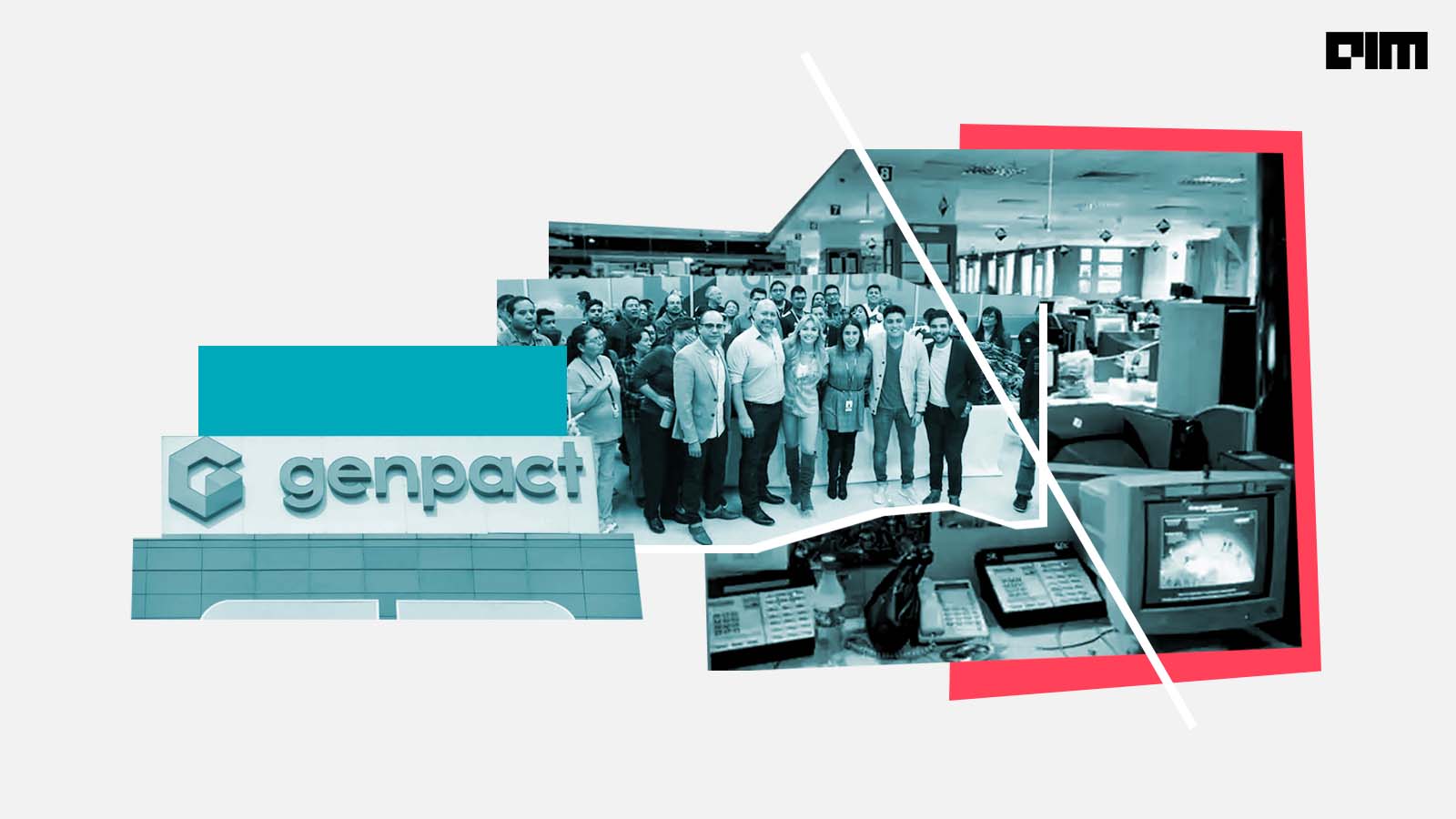
Genpact Unveils 12-Week Immersive Learning Program to Strengthen Gen AI Developer Community

Genpact AI

Genpact has launched an innovative 12-week immersive learning program aimed at fostering the growth of the Gen AI developer community. This strategic initiative seeks to bolster Genpact’s Gen AI delivery engine, enabling it to achieve unprecedented speed and scale in the rapidly evolving landscape of artificial intelligence.

The program, designed to elevate the capabilities of carefully selected Data-AI professionals spanning various experience bands, is poised to revolutionise the field. With prerequisites encompassing a solid understanding of machine learning concepts, neural networks, algorithm optimisation, and proficiency in Python programming, the program ensures a strong foundation for the journey ahead.

The very first batch comprising 300 professionals have embarked on their learning journey and many more to come!

Empowering through Expertise: A Unique Blend of Learning

Central to this immersive program is an innovative learning approach. The curriculum is powered by Udemy, a renowned platform for online education, offering a comprehensive and expert-curated syllabus coupled with hands-on labs. Over an 8-week period, participants will delve into topics essential for mastering Generative AI and Large Language Models (LLMs), starting from the fundamentals of deep learning and culminating in advanced topics and techniques that underpin these cutting-edge technologies.

The curriculum includes dedicated modules on Generative Adversarial Networks (GANs), Variational Autoencoders (VAEs), Sequence Models for Text Generation, Large Language Models and Finetuning, and the intricacies of structuring and deploying applications.

From Learning to Application: Bridging the Gap

The program goes beyond theoretical understanding, emphasising practical application. Following the 8-week Udemy learning path and weekly guru connects, participants will undergo rigorous knowledge and skill assessments to solidify their grasp of the material.

This will be followed by a pivotal 4-week capstone project phase, where participants will engage in real-world Gen AI Proof of Concepts (POCs). This hands-on experience will bridge the gap between theory and practice, enabling participants to apply their newfound knowledge to tangible, industry-relevant scenarios.

Culmination and Future Pathways

As participants complete the program, they will emerge as proficient developers, well-versed in harnessing Generative AI and Large Language Models to solve complex challenges. Graduates of the program will not only join the growing Gen AI developer community but also contribute to advancing Genpact’s AI-driven solutions at an accelerated pace.

With an ever-increasing demand for AI-driven innovations across industries, Genpact’s immersive learning program represents a significant leap forward. It equips participants with the tools, knowledge, and confidence to drive AI-powered transformation across various sectors, establishing themselves as trailblazers in the dynamic world of artificial intelligence.

The post Genpact Unveils 12-Week Immersive Learning Program to Strengthen Gen AI Developer Community appeared first on Analytics India Magazine.

Google Likely to Kill Gemini “Boldly & Responsibly”

Google Likely to Kill Gemini “Bold & Responsibly”

Google wanted to win in the generative AI race against OpenAI and Microsoft so badly, that it paused its grudges with DeepMind, and started working on their next-generation project called Gemini. The project is being led by Jeff Dean, the head of Google Brain, and Demis Hassabis, the founder of DeepMind. They are very confident that Gemini will eclipse OpenAI’s GPT-4. But is that really possible?

Firstly, the moment a company starts comparing its projects and its capabilities with GPT-3 or GPT-4, it is pretty clear who is the actual leader in the race. For example, even the recent rumour about Meta’s plan to release open source Llama 3 was also in the highlights because the person compared it with GPT-4, and was confidently against the alignment policy.

Speaking about alignment, Google has also been seriously concerned about making AI more “bold and responsible”. It made sure that its approach of building AI this way remains at the centre of every announcement it makes. This definitely comes with a lot of downs, and only a little ups, as we have seen how models start hallucinating the more we try to align them.

Too late to the grind

Apart from the claims that Gemini is going to be multimodal, there is very little information about how exactly Google plans to surpass GPT-4 in terms of capabilities. For the model to have different modalities, Google definitely has the golden data of YouTube, which OpenAI still does not have, but that is all.

Interestingly, DeepMind recently also published a paper about Reinforced Self-Training (ReST) for Language Modeling. This paper aims to remove humans from RLHF by letting LLMs build their own policy with just one initial command. If this is integrated in Gemini, it might possibly be able to improve the current capabilities of LLMs.

Another advantage DeepMind gives Google is the dedication to building AI agents based on reinforcement learning through game based models like AlphaGo, which might actually be a game changer here. On the other hand, possibly learning from Google DeepMind, OpenAI has also acquired Global Illumination, a company building creative simulations and training AI agents within it.

It is too hard to break OpenAI’s monopoly at the moment. Meta has been trying very hard to do it with Llama 2. But as soon as people start to move away from GPT-based models, OpenAI pulls another trick up its sleeve, like the most recent release of ChatGPT Enterprise. This time, OpenAI is ready to even take on Microsoft Azure OpenAI Service and Google VertexAI in the generative AI battle.

Amid all the GPU crunch, a recent trending blog by SemiAnalysis said that Google is the most compute rich firm in the world. It further adds that Gemini is already in training and given the massive infrastructure that Google has, it might actually be unbeatable. Interestingly, the GPU Rich vs GPU Poor conversation was not taken seriously by anyone.

incredible google got that semianalysis guy to publish their internal marketing/recruiting chart lol

— Sam Altman (@sama) August 29, 2023

Can’t take Google seriously enough

Given Google’s desperately failed attempts of the past with LaMDA, PaLM, and the chatbot Bard, it is not entirely clear why someone would expect the company to be able to actually take the lead with Gemini. Even though they have an arsenal of algorithms this time, and possibly a lot of computational power, it does not matter if they come up with something on par with GPT-4 by the end of the year, when OpenAI is already planning to build GPT-5.

In the meantime, Google has recently also integrated Meta’s Llama 2 in its cloud platform, Vertex AI. This is possibly after realising that Microsoft’s partnership with OpenAI hasn’t been working well, and even it is partnering with Meta for offering smaller and open models on Azure Cloud. This might be a good chance for Google DeepMind to decide to kill its project Gemini, boldly and responsibly.

Google is predominantly known for making tall claims but end up releasing experimental products, and services, and eventually taking them down.

Yeah if Gemini doesn't have an accessible API; I don't give a shit if it's 100 times better than GPT-4. I see a world where Google uses it to serve 1/10 of the toughest Bard questions and keeps it locked in DeepMind. That sounds like shit

— Aidan McLau (@aidan_mclau) August 28, 2023

At this point, no one really cares if Gemini is going to perform better than GPT-4 or not. All they want is an accessible API, instead of a locked out model like Bard or ChatGPT. For this, OpenAI is already on its move to make its models enterprise friendly by making it more secure and data secure. Seems like OpenAI is also becoming “bold and responsible”, and leaving Google behind.

The post Google Likely to Kill Gemini “Boldly & Responsibly” appeared first on Analytics India Magazine.

Google Cloud helps bring generative AI to the marketing sector, too

lightbulb in hand next to a laptop

A marketing professional's workflow includes producing text, images, designs, and ideas, which are all things generative artificial intelligence (AI) can assist with. Now, Typeface is partnering with Google Cloud and Growthloop to develop an all-encompassing marketing generative AI solution.

On Wednesday, at Google Cloud Next, Typeface unveiled its GenAI Marketing Solution, which does exactly what the title implies — it helps marketers use AI across the entire campaign-creation process.

Also: Google's Duet AI for Workspace can create presentations, write emails, and attend meetings for you

By using a combination of GrowthLoop's technology and Google Cloud's BigQuery and Generative AI foundation models, the solution can help marketers turn their audience customer data into targeted content.

"With generative AI, customers can create more impactful, tailored marketing campaigns, with tools that help improve efficiency throughout the campaign lifecycle," said Gerrit Kazmaier, VP & GM of data and analytics at Google Cloud.

Marketers can use BigQuery to build and access a Customer 360 view that brings together first-party data collected from ads, and sales, customers, and products information, according to the release.

They can then use the platform to create different types of content, including blog posts, landing pages, and even Google Workspace content, such as Google Docs and Slides.

Also: Google updates Vector AI to let enterprises train GenAI on their own data

Once the content is ready to be published, the GenAI Marketing Solution can help deploy it to target audiences with just a few clicks, boosting content-creation tenfold, according to the release. The platform can also be used to monitor the content's performance carefully.

"Collectively, we're addressing a fundamental challenge that enterprises have grappled with for years — the ability to consistently tell their stories and engage with customers with compelling content quickly," said Abhay Paransis, founder and CEO at Typeface.

To access the new GenAI Marketing Solution, users can request a demo by visiting this site. Current users, and those seeking to migrate to BigQuery, will have access to the solution in a private preview.

Artificial Intelligence

Google Search Generative Experience Now Available in India 

Google today announced that it is bringing its generative AI search experience for users in India and Japan that will show text or visual results to prompts, including summaries. The expansion follows successful experimentation and positive feedback garnered from the Search Labs in the United States.

The generative AI experience aims to empower users by offering them a broader understanding of various topics, assisting in discovering new perspectives, and facilitating smoother task completion. This innovation allows individuals to delve into complex queries and explore new types of questions, ultimately fostering a more conversational interaction with the search engine.

One of the notable aspects of this expansion is Google’s emphasis on supporting local languages. Users in both India and Japan can now access the generative AI capabilities in their native languages, either through text input or voice commands. In India, the feature offers a unique language toggle, enabling users to effortlessly switch between English and Hindi. Additionally, Indian users have the option to listen to responses, catering to diverse preferences.

Google said it has observed strong user engagement with the suggested follow-up questions, demonstrating the practicality of refining search queries effectively. The generative AI assists users in quickly locating desired information and encouraging them to explore inquiries they may not have considered previously.

As part of this ongoing enhancement process, the company is introducing a new way for users to discover relevant web pages associated with AI-powered overviews. A clickable arrow icon next to information in the overview allows users to seamlessly access corroborating web content, bridging the gap between AI-generated insights and real-world web sources.

However, the company said it’s essential to note that this generative AI experience remains an experiment. The tech giant said it continues to fine-tune its systems based on user feedback and preferences.
To utilize SGE, you can locate it within the Search Labs section of the Google app on both Android and iOS, as well as on Chrome when using the desktop version

The post Google Search Generative Experience Now Available in India appeared first on Analytics India Magazine.

Google Cloud Tames Llama 2 with RHFL

At the recent Google Cloud Next event in San Francisco, Google surprised everyone by announcing that they’re offering Llama 2 and Code Llama from Meta, as well as Falcon LLM on Google Cloud’s Vertex AI. This was unexpected because Google was the only cloud service provider that hadn’t partnered with rival institutions to host Llama 2 or any other open source LLM models before.

It appears this decision by Google has been taken keeping enterprises in mind who are staple customers of Vertex AI but are looking for more options. If we go by the trend, after GPT-4, Llama 2 is the most sought after large language model, considering it is open- sourced and commercially available. In the case of Llama 2, Google said that it is the only cloud provider offering both adapter tuning and RLHF.

Despite being ad rivals, Meta and Google have put aside their competition when it comes to large language models. Meta directly does not want to compete with anyone in the LLM business and is happy to provide Llama 2 to everyone. Now with Google Cloud having Llama 2, Meta has conquered every territory possible. Humorously we can say that Meta is doing the converse of “If you are good at something, never do it for free”.

However, Google accepting Llama 2 raises one question, is PaLM 2 not capable enough. Google Bard currently uses PaLM 2 and it seems like it isn’t a favorite among enterprises as they cannot customize it according to their requirements in addition to its poor responses as compared to ChatGPT.

The tech giant claims that its Model Garden has a collection of 100+ models including enterprise-ready foundation model APIs, open source models, and task-specific models from Google and 3rd parties. Google should understand that when it comes to LLMs, it’s not about the quantity but about the quality.

Recently OpenAI also took cues from Meta’s approach and is now working to provide customization options for GPT-4 and GPT-3.5 while avoiding open sourcing. To achieve this, the creator of ChatGPT recently introduced the GPT-3.5 Turbo API for fine-tuning. Additionally, it has partnered with Scale to fine-tune GPT-3.5, in order to woo enterprises.

LLM Cloud Battle Begins

Google might have been late to the game, but there is still hope, following the AWS route .

Google has understood the importance of hosting multiple LLMs, much like Amazon’s Bedrock platform. Currently, Bedrock hosts models from AI21, Cohere, Anthropic Claude 2, and Stability AI SDXL 1.0.

At present, Microsoft is actively exploring different LLMs. Microsoft Azure currently encompasses all OpenAI services via APIs, including the Azure OpenAI Service. This empowers enterprises and developers to create applications using GPT, DALL·E, and Codex.

When Llama 2 was launched by Meta, Azure was announced as the preferred partner for Llama 2. It seems like Microsoft is not going to stop here, as it further plans to sell a new version of Databricks’ software on Azure that will help customers make AI apps for their businesses. This new service will help companies make AI models from scratch or repurpose open-source models as an alternative to licensing OpenAI’s proprietary ones.

In the latest quarter Azure emerged as the winner with 26% revenue growth, thanks to Azure OpenAI services. However, now with Llama 2 being the common factor among all three clouds, it will be intriguing to witness who will lead the LLM cloud game in the upcoming quarter.

What about Gemini? As Vertex AI now hosts Llama 2 and has shifted its focus to smaller models, similar to the approaches of Microsoft and AWS, it raises the question of the feasibility of creating Gemini to take on GPT-5. This consideration is particularly relevant as OpenAI has also redirected its focus towards serving enterprises.

Not to forget, Google’s Codey has a new rival called Code Llama, only time will tell who codes better, alongside its adoption among the enterprise customers and developers.

The post Google Cloud Tames Llama 2 with RHFL appeared first on Analytics India Magazine.

Only 18% of Americans have ever used ChatGPT, according to Pew Research

Person using ChatGPT on a laptop

If you use ChatGPT, you are likely so impressed by its capabilities that you think most people use it, too. However, a new Pew Research Center study shows that most Americans have yet to try ChatGPT.

The Pew Research Center conducted a survey from July 17 to July 23 with 5,057 panelists to learn about ChatGPT use in the US. The study found that out of the respondents who had heard of ChatGPT, only 24% said they had ever used it, amounting to 18% of US adults overall.

Also: How to use ChatGPT

The age and education of the respondents had significant impacts on US adult ChatGPT use. Younger adults were more likely than older adults to have used the technology, with 41% of people ages 18-29 using it compared to 5% of those 65 and older.

Younger generations are typically more inclined to adopt new technology. They're more likely to still be in school, where they can benefit from using generative AI by leveraging it for research, essay writing, coding, math help, and more.

The amount of education an individual had also impacted their likeliness to use ChatGPT. Thirty-two percent of adults with a college degree or more have used ChatGPT, according to the study.

Also: I needed a mechanic. Here's how ChatGPT Plus helped me skip reading online reviews

In terms of how Americans are using ChatGPT, surprisingly the biggest use case is not to learn something or for tasks at work, but rather entertainment. One in five adults who have heard of ChatGPT reported to have used it for entertainment.

Using it to learn something trailed slightly behind at 19%, while only 16% of those respondents who were employed and had heard of ChatGPT reported using it for work.

Also: Partner, helper, or boss? We asked ChatGPT to design a robot and this happened

Because ChatGPT is prone to hallucinations and making mistakes, chatting with it can indeed be entertaining since it generates some outlandish answers at times. You can also use it to play basic games such as Tic-Tac-Toe or just to chat.

Only 19% of employed US adults working across all different industries who have heard of ChatGPT felt the technology would have a major impact on their jobs.

Artificial Intelligence