Why Cypher 2023 is a Must-attend Event for AI Enthusiasts & Business Leaders

“If you’re not in the AI game, you’re already lagging behind.

The message resonated deeply within the AI community and beyond when NVIDIA’s chief Huang Jensen said — “Those without AI expertise will be left behind…,” addressing the students at National Taiwan University, Taipei, urging them to create something new in the AI age fast, or risk getting left behind.

In a bid to bring industry leaders, AI experts and companies under one roof, AIM is organising the seventh edition of its flagship event – Cypher 2023 – India’s biggest AI conference. And for those looking to be a part of the AI revolution, there’s no better time than this. The event offers keynote, networking opportunities, insightful sessions, workshops and much more – and this time at a brand new location.

  • Where: Hilton Garden Inn, Bengaluru Embassy Manyata Business Park, Bengaluru, India
  • When: October 11-13, 2023 | Wednesday – Friday
    Register now

We are Here!

Organised by Analytics India Magazine, Cypher ‘23 guarantees a once-in-a-year experience like no other, bringing every nook and corner of AI and other advancements to the limelight. So, whether your interests lie in AI art, ethics, deployment strategies, or the technical aspects of AI, Cypher 2023 will leave no stone unturned to enthral and empower you.

The three-day event, being hosted at Hilton Garden Inn, Bangalore, will provide you the perfect platform to indulge in thought-provoking discussions, ask questions, and learn everything you need to know about the AI ecosystem. Moreover, the event will provide ample opportunities to connect with industry leaders and like-minded AI enthusiasts making strides in AI and machine learning.

What Sets Cypher ‘23 Apart

One of the distinguishing features of Cypher ’23 is the convergence of AI professionals from diverse backgrounds, creating a melting pot of ideas and perspectives. So whether you are a seasoned AI expert or just a beginner to the GenAI wave, Cypher ’23 is the perfect place to network and collaborate.

The meticulously curated content features a list of profound speakers and practitioners from around the globe. They will delve into every topic ranging from AI fundamentals to the latest developments in GenAI, covering every facet of this transformative technology.

Whom to look for at Cypher 23:

  • Kartik Ranganath, general manager – Business IT, SHELL R&D
  • Jacy Reese Anthis, co-founder, Sentience Institute
  • Raghu Krishnananda, chief product and technology officer, Myntra
  • Tapan Aslot, creative director and AI artist
  • Ashutosh Gavali, director (IT) – Engineering & Analytics, boAt

And the list goes on.

With over 1,500 attendees and 100+ speakers, Cypher ’23 boasts the largest representation from both the Indian and global AI communities. The conference will have three tracks — Thought leadership, Knowledge sessions, and Hands-on workshops. Attendees can choose from a variety of sessions based on their interests in AI.

The event will also feature several exhibitions spotlighting the latest AI art, solutions and technology. Attendees can interact with exhibitors and get a hands-on experience with the latest products and services.

A Legacy of Excellence

As the saying goes, “With age comes wisdom”. Cypher has a storied history, establishing itself as one of the oldest and most respected AI conferences on the Indian subcontinent. Since its launch in 2015, the conference has evolved and adapted to stay at the forefront of innovation. The rich history is a testament to its relevance and the ability to anticipate and showcase the latest technological trends focused on AI.

In its previous chapters, Cypher has attracted industry leaders and experts as speakers from renowned companies like Amazon, Oracle, Infosys, L&T, Wells Fargo, Hindustan Unilever, Swiggy, Dunzo, Viacom18, and many more.

Cypher ‘23 is not your run-of-the-mill AI conference; it’s the best edition yet. Going beyond the surface-level understanding of new-age tech in fields right from GANs to autoregressive models, Cypher brings to you an understanding of all the relevant AI/ML practices. Everything you’re looking for in an AI event depending on your profession and personal interests – Cypher 23 will have them all! So mark the dates to learn from AI practitioners and global leaders only during this annual get-together at India’s Silicon Valley.

What are you waiting for? Register now.

The post Why Cypher 2023 is a Must-attend Event for AI Enthusiasts & Business Leaders appeared first on Analytics India Magazine.

Slack Plans to Add a Generative AI Embed for Summaries and Search

Laptop computer displaying logo of Slack.
Image: monticellllo/Adobe Stock

Slack’s native generative AI tool will be introduced in a pilot program in winter 2023, the workplace collaboration software company announced on Wednesday. Slack revealed new task automation and collaboration tools at the same time.

Jump to:

  • New AI features will be put through their paces this winter
  • Workflow Builder automates tasks
  • Introducing Slack Lists in preview
  • Slack’s competitors

New AI features will be put through their paces this winter

Slack’s built-in generative AI, Slack AI, will be available across Slack’s coverage regions in a limited pilot project run in winter 2023. General availability has not yet been announced, but a waitlist has already opened for Slack AI on Sept. 6.

In May, Slack introduced Slack GPT inside Salesforce, an integration with ChatGPT. This may seem like it performs some of the same functions as Slack AI, such as summarization. However, Slack AI is built on a proprietary LLM and is a separate entity from Slack GPT.

The plan is for Slack AI to sit within Slack’s existing channel format. Slack AI can perform:

  • Channel recaps.
  • Thread summaries.
  • And search for answers within an organization’s Slack platform.

“Slack’s channel-based model is a powerful way of building a repository of knowledge across an organization — but we also know it can be tough to parse through it all quickly and find the info you actually need,” said Rukmini Reddy, Slack’s senior vice president of engineering for the platform, in an email to TechRepublic. “With that, we’re starting with a focus on functionality that powers search results and allows for quick and easy information summarization.”

The Slack AI search function and summarization mean an employee could look for answers across multiple threads and find an overview of what their colleagues discussed. This might be particularly useful when an employee wants to catch up on conversations after going on vacation, Reddy suggested.

“How we work is rapidly evolving and is highly reliant on our ability to effectively evolve and adopt new technologies,” said Wayne Kurtzman, vice president of social, communities and collaboration for IDC, in a press release from Slack. “Slack continues to evolve with new, more intelligent tools and ways of working that drive alignment, streamline efficiency and boost productivity for teams across the business.”

Slack made sure to state that information put into Slack AI won’t be used to train the AI model. The company has put guardrails in place to make sure information from the AI doesn’t appear in front of customers’ eyes or third parties, and the Slack AI is hosted in Slack’s own virtual private cloud.

“Slack AI is powered by an LLM that’s hosted within our infrastructure, so native AI capabilities are built on a very secure foundation by default,” said Reddy. “It’ll adhere to the same security, compliance and data controls that our customers have already come to know and rely on.”

Workflow Builder automates tasks

A new version of Slack’s Workflow Builder is generally available across Slack’s global regions, as of Sept. 6. It automates workflow galleries and provides templates, opening up automation to any user who wants to adjust their own workflows, regardless of whether they know how to code or not (Figure A). Integrations with Google, Atlassian and Asana are available for cases where tasks require a third-party application.

Figure A

A screenshot of Workflow Builder's options.
A demonstration of Workflow Builder’s options. Image: Slack

With Workflow Builder, application developers can build and deploy custom apps that require internal systems or advanced business logic, Slack said.

Introducing Slack Lists in preview

Slack introduced a new feature called Lists in preview. It allows workers to track work and share information with colleagues and across teams about the progress of requests, approvals and projects.

SEE: How to link Slack and Trello workspaces. (TechRepublic)

In addition, Slack Lists is formatted to make communication and project tracking between teams easier. Employees familiar with Slack’s messaging will see the same types of channels and notifications in Lists.

Slack Lists will be available in limited fashion as a pilot project in winter 2023, with general global availability following in 2024.

Slack’s attempt to even the playing field with its competitors

With Slack AI, Slack is trying to position itself as more flexible and useful for more types of work. Slack’s biggest competition comes from collaboration software built inside giant productivity suites like Microsoft’s Teams or Google’s Chat. While adding summarization or workflow building won’t compete directly with those on the same scale, it does give users more reasons to stay inside the Slack application when planning ahead, not just when conversing.

Other alternatives to Slack include Trello for kanban boards, Chanty for a text and video messenger, RingCentral for audio and video, Bitrix24 for sales and marketing, Rocket.Chat, Basecamp for project management and Troop Messenger for app developers.

Subscribe to the Innovation Insider Newsletter

Catch up on the latest tech innovations that are changing the world, including IoT, 5G, the latest about phones, security, smart cities, AI, robotics, and more.

Delivered Tuesdays and Fridays Sign up today

Why Cypher 2023 is a Must-attend Event for AI Enthusiasts & Business Leaders

“If you’re not in the AI game, you’re already lagging behind.

The message resonated deeply within the AI community and beyond when NVIDIA’s chief Huang Jensen said — “Those without AI expertise will be left behind…,” addressing the students at National Taiwan University, Taipei, urging them to create something new in the AI age fast, or risk getting left behind.

In a bid to bring industry leaders, AI experts and companies under one roof, AIM is organising the seventh edition of its flagship event – Cypher 2023 – India’s biggest AI conference. And for those looking to be a part of the AI revolution, there’s no better time than this. The event offers keynote, networking opportunities, insightful sessions, workshops and much more – and this time at a brand new location.

  • Where: Hilton Garden Inn, Bengaluru Embassy Manyata Business Park, Bengaluru, India
  • When: October 11-13, 2023 | Wednesday – Friday
    Register now

We are Here!

Organised by Analytics India Magazine, Cypher ‘23 guarantees a once-in-a-year experience like no other, bringing every nook and corner of AI and other advancements to the limelight. So, whether your interests lie in AI art, ethics, deployment strategies, or the technical aspects of AI, Cypher 2023 will leave no stone unturned to enthral and empower you.

The three-day event, being hosted at Hilton Garden Inn, Bangalore, will provide you the perfect platform to indulge in thought-provoking discussions, ask questions, and learn everything you need to know about the AI ecosystem. Moreover, the event will provide ample opportunities to connect with industry leaders and like-minded AI enthusiasts making strides in AI and machine learning.

What Sets Cypher ‘23 Apart

One of the distinguishing features of Cypher ’23 is the convergence of AI professionals from diverse backgrounds, creating a melting pot of ideas and perspectives. So whether you are a seasoned AI expert or just a beginner to the GenAI wave, Cypher ’23 is the perfect place to network and collaborate.

The meticulously curated content features a list of profound speakers and practitioners from around the globe. They will delve into every topic ranging from AI fundamentals to the latest developments in GenAI, covering every facet of this transformative technology.

Whom to look for at Cypher 23:

  • Kartik Ranganath, general manager – Business IT, SHELL R&D
  • Jacy Reese Anthis, co-founder, Sentience Institute
  • Raghu Krishnananda, chief product and technology officer, Myntra
  • Tapan Aslot, creative director and AI artist
  • Ashutosh Gavali, director (IT) – Engineering & Analytics, boAt

And the list goes on.

With over 1,500 attendees and 100+ speakers, Cypher ’23 boasts the largest representation from both the Indian and global AI communities. The conference will have three tracks — Thought leadership, Knowledge sessions, and Hands-on workshops. Attendees can choose from a variety of sessions based on their interests in AI.

The event will also feature several exhibitions spotlighting the latest AI art, solutions and technology. Attendees can interact with exhibitors and get a hands-on experience with the latest products and services.

A Legacy of Excellence

As the saying goes, “With age comes wisdom”. Cypher has a storied history, establishing itself as one of the oldest and most respected AI conferences on the Indian subcontinent. Since its launch in 2015, the conference has evolved and adapted to stay at the forefront of innovation. The rich history is a testament to its relevance and the ability to anticipate and showcase the latest technological trends focused on AI.

In its previous chapters, Cypher has attracted industry leaders and experts as speakers from renowned companies like Amazon, Oracle, Infosys, L&T, Wells Fargo, Hindustan Unilever, Swiggy, Dunzo, Viacom18, and many more.

Cypher ‘23 is not your run-of-the-mill AI conference; it’s the best edition yet. Going beyond the surface-level understanding of new-age tech in fields right from GANs to autoregressive models, Cypher brings to you an understanding of all the relevant AI/ML practices. Everything you’re looking for in an AI event depending on your profession and personal interests – Cypher 23 will have them all! So mark the dates to learn from AI practitioners and global leaders only during this annual get-together at India’s Silicon Valley.

What are you waiting for? Register now.

The post Why Cypher 2023 is a Must-attend Event for AI Enthusiasts & Business Leaders appeared first on Analytics India Magazine.

AI is great at coding, but there are some massive caveats

Red computerized brain

Creating and testing code at the touch of a button through generative artificial intelligence (AI) models, such as GitHub CoPilot or ChatGPT, almost seems too good to be true. So good, in fact, that there has to be a catch.

While software professionals are embracing AI as a power tool to build, launch, and update applications, there is also nervousness about its intellectual property and security implications. Is that AI-generated code scraped from someone else's intellectual property? Does the model draw on internal corporate data that should be kept secure?

Also: How to use ChatGPT to write code

Technologists recognize that AI adoption requires attention to rights, privacy, security, productivity, and training, according to a GitLab survey of 1,001 developers and executives, conducted in June.

The majority of respondents (79%) expressed concern about AI tools having access to private information or intellectual property. The main concern was that sensitive information, such as customer data, may be exposed.

Copyright concerns top the list of concerns about using AI-generated code. Close to half of respondents (48%) cited concern that code generated using AI might not be subject to the same copyright protection as human-generated code. Another 39% were worried about security vulnerabilities with such code.

Also: 6 skills you need to become an AI prompt engineer

Still, technologists are optimistic that these issues can be worked through and they continue to forge ahead. Among respondents whose organizations are using AI in software development today, as many as 90% felt confident using AI in their daily tasks at work. In addition, 60% said they use AI daily, and 22% said they use AI several times a week. More than half (51%) rated their organization's efforts in incorporating AI into the software development lifecycle as "very" or "extremely" successful.

AI is seen as an important investment from a software development perspective. Among respondents whose organizations are using AI or plan to in the future, 83% said they have or will have budget specifically allocated to AI for software development. Benefits cited included improved efficiency (55%), faster cycle times (44%), and increased innovation (41%).

Training and skills also emerged as a common theme in the obstacles and concerns identified by respondents. As much as 81% said they need more training to use AI at work, and 87% said organizations will need to re-skill employees to adapt to the changes AI will bring. A top area of concern was the potential to introduce a new set of skills to learn (42%), followed by a lack of the appropriate skill sets to use AI or interpret AI output (34%).

Also: 5 ways to explore the use of generative AI at work

The bottom line is that AI cannot replace human oversight and innovation. More experienced professionals "accept AI as a supportive tool for skill development, but don't think it can completely replace the expertise, knowledge, and problem-solving of seasoned professionals like themselves," the survey's authors assert.

"Ultimately, it comes down to more than simply human versus machine. Leveraging the experience of human team members alongside AI is the best — and perhaps only — way organizations can fully address the concerns around security and intellectual property."

AI might be able to generate code more quickly than a human developer, "but a human team member needs to verify that the AI-generated code is free of errors, security vulnerabilities, or copyright issues before it goes to production," they said.

Artificial Intelligence

Why Cypher 2023 is a Must-attend Event for AI Enthusiasts & Business Leaders

“If you’re not in the AI game, you’re already lagging behind.

The message resonated deeply within the AI community and beyond when NVIDIA’s chief Huang Jensen said — “Those without AI expertise will be left behind…,” addressing the students at National Taiwan University, Taipei, urging them to create something new in the AI age fast, or risk getting left behind.

In a bid to bring industry leaders, AI experts and companies under one roof, AIM is organising the seventh edition of its flagship event – Cypher 2023 – India’s biggest AI conference. And for those looking to be a part of the AI revolution, there’s no better time than this. The event offers keynote, networking opportunities, insightful sessions, workshops and much more – and this time at a brand new location.

  • Where: Hilton Garden Inn, Bengaluru Embassy Manyata Business Park, Bengaluru, India
  • When: October 11-13, 2023 | Wednesday – Friday
    Register now

We are Here!

Organised by Analytics India Magazine, Cypher ‘23 guarantees a once-in-a-year experience like no other, bringing every nook and corner of AI and other advancements to the limelight. So, whether your interests lie in AI art, ethics, deployment strategies, or the technical aspects of AI, Cypher 2023 will leave no stone unturned to enthral and empower you.

The three-day event, being hosted at Hilton Garden Inn, Bangalore, will provide you the perfect platform to indulge in thought-provoking discussions, ask questions, and learn everything you need to know about the AI ecosystem. Moreover, the event will provide ample opportunities to connect with industry leaders and like-minded AI enthusiasts making strides in AI and machine learning.

What Sets Cypher ‘23 Apart

One of the distinguishing features of Cypher ’23 is the convergence of AI professionals from diverse backgrounds, creating a melting pot of ideas and perspectives. So whether you are a seasoned AI expert or just a beginner to the GenAI wave, Cypher ’23 is the perfect place to network and collaborate.

The meticulously curated content features a list of profound speakers and practitioners from around the globe. They will delve into every topic ranging from AI fundamentals to the latest developments in GenAI, covering every facet of this transformative technology.

Whom to look for at Cypher 23:

  • Kartik Ranganath, general manager – Business IT, SHELL R&D
  • Jacy Reese Anthis, co-founder, Sentience Institute
  • Raghu Krishnananda, chief product and technology officer, Myntra
  • Tapan Aslot, creative director and AI artist
  • Ashutosh Gavali, director (IT) – Engineering & Analytics, boAt

And the list goes on.

With over 1,500 attendees and 100+ speakers, Cypher ’23 boasts the largest representation from both the Indian and global AI communities. The conference will have three tracks — Thought leadership, Knowledge sessions, and Hands-on workshops. Attendees can choose from a variety of sessions based on their interests in AI.

The event will also feature several exhibitions spotlighting the latest AI art, solutions and technology. Attendees can interact with exhibitors and get a hands-on experience with the latest products and services.

A Legacy of Excellence

As the saying goes, “With age comes wisdom”. Cypher has a storied history, establishing itself as one of the oldest and most respected AI conferences on the Indian subcontinent. Since its launch in 2015, the conference has evolved and adapted to stay at the forefront of innovation. The rich history is a testament to its relevance and the ability to anticipate and showcase the latest technological trends focused on AI.

In its previous chapters, Cypher has attracted industry leaders and experts as speakers from renowned companies like Amazon, Oracle, Infosys, L&T, Wells Fargo, Hindustan Unilever, Swiggy, Dunzo, Viacom18, and many more.

Cypher ‘23 is not your run-of-the-mill AI conference; it’s the best edition yet. Going beyond the surface-level understanding of new-age tech in fields right from GANs to autoregressive models, Cypher brings to you an understanding of all the relevant AI/ML practices. Everything you’re looking for in an AI event depending on your profession and personal interests – Cypher 23 will have them all! So mark the dates to learn from AI practitioners and global leaders only during this annual get-together at India’s Silicon Valley.

What are you waiting for? Register now.

The post Why Cypher 2023 is a Must-attend Event for AI Enthusiasts & Business Leaders appeared first on Analytics India Magazine.

Why Cypher 2023 is a Must-attend Event for AI Enthusiasts & Business Leaders

“If you’re not in the AI game, you’re already lagging behind.

The message resonated deeply within the AI community and beyond when NVIDIA’s chief Huang Jensen said — “Those without AI expertise will be left behind…,” addressing the students at National Taiwan University, Taipei, urging them to create something new in the AI age fast, or risk getting left behind.

In a bid to bring industry leaders, AI experts and companies under one roof, AIM is organising the seventh edition of its flagship event – Cypher 2023 – India’s biggest AI conference. And for those looking to be a part of the AI revolution, there’s no better time than this. The event offers keynote, networking opportunities, insightful sessions, workshops and much more – and this time at a brand new location.

  • Where: Hilton Garden Inn, Bengaluru Embassy Manyata Business Park, Bengaluru, India
  • When: October 11-13, 2023 | Wednesday – Friday
    Register now

We are Here!

Organised by Analytics India Magazine, Cypher ‘23 guarantees a once-in-a-year experience like no other, bringing every nook and corner of AI and other advancements to the limelight. So, whether your interests lie in AI art, ethics, deployment strategies, or the technical aspects of AI, Cypher 2023 will leave no stone unturned to enthral and empower you.

The three-day event, being hosted at Hilton Garden Inn, Bangalore, will provide you the perfect platform to indulge in thought-provoking discussions, ask questions, and learn everything you need to know about the AI ecosystem. Moreover, the event will provide ample opportunities to connect with industry leaders and like-minded AI enthusiasts making strides in AI and machine learning.

What Sets Cypher ‘23 Apart

One of the distinguishing features of Cypher ’23 is the convergence of AI professionals from diverse backgrounds, creating a melting pot of ideas and perspectives. So whether you are a seasoned AI expert or just a beginner to the GenAI wave, Cypher ’23 is the perfect place to network and collaborate.

The meticulously curated content features a list of profound speakers and practitioners from around the globe. They will delve into every topic ranging from AI fundamentals to the latest developments in GenAI, covering every facet of this transformative technology.

Whom to look for at Cypher 23:

  • Kartik Ranganath, general manager – Business IT, SHELL R&D
  • Jacy Reese Anthis, co-founder, Sentience Institute
  • Raghu Krishnananda, chief product and technology officer, Myntra
  • Tapan Aslot, creative director and AI artist
  • Ashutosh Gavali, director (IT) – Engineering & Analytics, boAt

And the list goes on.

With over 1,500 attendees and 100+ speakers, Cypher ’23 boasts the largest representation from both the Indian and global AI communities. The conference will have three tracks — Thought leadership, Knowledge sessions, and Hands-on workshops. Attendees can choose from a variety of sessions based on their interests in AI.

The event will also feature several exhibitions spotlighting the latest AI art, solutions and technology. Attendees can interact with exhibitors and get a hands-on experience with the latest products and services.

A Legacy of Excellence

As the saying goes, “With age comes wisdom”. Cypher has a storied history, establishing itself as one of the oldest and most respected AI conferences on the Indian subcontinent. Since its launch in 2015, the conference has evolved and adapted to stay at the forefront of innovation. The rich history is a testament to its relevance and the ability to anticipate and showcase the latest technological trends focused on AI.

In its previous chapters, Cypher has attracted industry leaders and experts as speakers from renowned companies like Amazon, Oracle, Infosys, L&T, Wells Fargo, Hindustan Unilever, Swiggy, Dunzo, Viacom18, and many more.

Cypher ‘23 is not your run-of-the-mill AI conference; it’s the best edition yet. Going beyond the surface-level understanding of new-age tech in fields right from GANs to autoregressive models, Cypher brings to you an understanding of all the relevant AI/ML practices. Everything you’re looking for in an AI event depending on your profession and personal interests – Cypher 23 will have them all! So mark the dates to learn from AI practitioners and global leaders only during this annual get-together at India’s Silicon Valley.

What are you waiting for? Register now.

The post Why Cypher 2023 is a Must-attend Event for AI Enthusiasts & Business Leaders appeared first on Analytics India Magazine.

Google to require political ads to reveal if they’re AI-generated

Google YouTube logos

Amid growing concerns about the harm AI can cause with fake ads and other misleading content, Google is taking one step toward damage control. In an update to its policy regarding political ads, the search giant will require that advertisers clearly divulge when their ads contain synthetic content created by AI. The policy specifically focuses on political ads that "inauthentically depict real or realistic-looking people or events."

Also: We're not ready for the impact of generative AI on elections

Due to go into effect mid-November, the policy states that the disclosure about the use of AI must be clear and conspicuous and be located in a spot likely to be noticed by users. The requirement applies to political ads with images, video, or audio served by Google on its own platforms (such as YouTube) and on third-party websites that are part of the company's display network.

But it excludes ads where the content is simply edited, meaning an image or video that's resized, cropped, color corrected, error corrected, or even had its background removed as long as the edits don't falsify realistic scenes of real people or events.

Also: TikTok quietly added a fast-forward option, and it's a game-changer

Google cited a couple of examples that would require disclosure. One would be a political ad with AI-generated content that makes it seem as if a person is saying or doing something they didn't say or do. Another would be an AI-generated ad that changes footage of an actual event or depicts scenes of a real event that didn't occur.

Political ads have a long history of bending or breaking the truth in order to make the other side look bad. But the technological age has exacerbated the problem through the influence of social media and AI.

Using artificial intelligence, a political campaign or other party can easily create a realistic but fake image, video, or audio clip depicting a candidate saying or doing something they didn't say or do. Voters who come to the table with clear biases may swallow the lie as truth without bothering to verify it.

Also: Google just gave Android's most frustrating widget an AI facelift, and it's such a relief

In response to concerns about political ads, Google has taken other steps in the past. In 2018, the company started requiring all advertisers of political ads to verify their identity with an in-ad disclosure that shows who paid for the ad.

Political ads in the US and other countries are included in Google transparency reports to help people learn who bought a specific ad, how much they spent, and how many times the ad was viewed. In 2019, the company expanded the transparency to include ads about state-level candidates, political parties, and ballot initiatives.

Google's policies have also prohibited the use of deep fakes and other phony content designed to deceive people on matters related to politics and social issues. The company uses both automated systems and human reviewers to find and remove ads that violate its policies. In 2022, Google removed 5.2 billion ads that ran afoul of the policies and blocked 2.6 million election ads that failed to complete the verification process.

Also: Google releases new apps and widgets to assist Android users

"For years we've provided additional levels of transparency for election ads, including 'paid for by' disclosures and a publicly available ads library that provides people with more information about the election ads they see on our platforms," a Google spokesperson said in a statement sent to ZDNET.

"Given the growing prevalence of tools that produce synthetic content, we're expanding our policies a step further to require advertisers to disclose when their election ads include material that's been digitally altered or generated," the spokesperson added. "It'll help further support responsible political advertising and provide voters with the information they need to make informed decisions."

Featured

Imbue raises $200M to build AI models that can ‘robustly reason’

Imbue raises $200M to build AI models that can ‘robustly reason’ Kyle Wiggers 10 hours

Imbue, the AI research lab formerly known as Generally Intelligent, has raised $200 million in a Series B funding round that values the company at over $1 billion. Among those participating are the Astera Institute, Nvidia, Cruise CEO Kyle Vogt and Notion co-founder Simon Last.

The new tranche takes Imbue’s total raised to $220 million, placing it among the better-funded AI startups in recent months. It’s only slightly behind AI21 Labs ($283 million), the Tel Aviv-based firm developing a range of text-generating AI tools, as well as generative AI vendors like Cohere ($435 million) and Adept ($415 million).

“This latest funding will accelerate our development of AI systems that can reason and code, so they can help us accomplish larger goals in the world,” Imbue wrote in a blog post published this morning. “Our goal remains the same: to build practical AI agents that can accomplish larger goals and safely work for us in the real world.”

Imbue launched out of stealth last October with an ambitious goal: to research the fundamentals of human intelligence that machines currently lack. Its plan, as presented to TechCrunch back then, was to turn “fundamentals” into an array of tasks to be solved, and to design different AI models and test their ability to learn to solve these tasks in complex 3D worlds built by the Imbue team.

The company’s approach seems to have shifted somewhat since then. Rather than unleash AI on 3D worlds, Imbue says that it’s developing models it finds “internally useful” to start, including models that can code (a la GitHub Copilot and Amazon CodeWhisperer).

Plenty of models can code. But what sets Imbue’s apart are their ability to “robustly reason,” the company claims.

“We believe reasoning is the primary blocker to effective AI agents,” Imbue wrote in the blog post. “Robust reasoning is necessary for effective action. It involves the ability to deal with uncertainty, to know when to change our approach, to ask questions and gather new information, to play out scenarios and make decisions, to make and discard hypotheses and generally to deal with the complicated, hard-to-predict nature of the real world.”

Imbue also believes that code is an important use case beyond enabling its team to build AI apps at scale. In the blog post, the company makes the case that code can improve reasoning and is one of the more effective ways for models to take actions on a machine.

“An agent that writes a SQL query to pull information out of a table is much more likely to satisfy a user request than an agent that tries to assemble that same information without using any code,” the company wrote. “Moreover, training on code helps models learn to reason better; training without code seems to result in models that reason poorly.”

It’s a philosophy that’s not dissimilar to Adept’s, which aims to build AI that can automate any software process. Google DeepMind has also explored approaches for teaching AI to control computers, like having an AI observe keyboard and mouse commands from people completing “instruction-following” computer tasks such as booking a flight.

Imbue says that its models are “tailor-made” for reasoning in the sense that they’re trained on data to “reinforce good reasoning patterns,” and using techniques that spend “far more compute during inference time” to arrive at “robust conclusions and actions.”

Specifically, Imbue’s training “very large” models — models with over 100 billion parameters — optimized to perform well on its internal benchmarks for reasoning. (“Parameters” are the parts of a model learned from training data and essentially define the skill of the model on a problem, like generating text or code.) This training is being conducted on a compute cluster co-designed by Nvidia, containing 10,000 GPUs from Nvidia’s H100 series.

Imbue is also investing in building its own AI and machine learning tooling, like AI prototypes for debugging and visual interfaces on top of AI models. And it’s conducting research into understanding the learning process in large language models.

Imbue doesn’t intend to productionize much of what it’s working on at the moment. Rather, it sees these tools and models as a way to improve future, more general-purpose AI, and to establish the groundwork for a platform that people will be able to use to create their own custom models.

“When we build AI agents, we’re actually building computers that can understand our goals, communicate proactively and work for us in the background,” Imbue continued in the blog post. “Ultimately, we hope to release systems that enable anyone to build robust, custom AI agents that put the productive power of AI at everyone’s fingertips … This latest funding will accelerate our development of AI systems that can reason and code, so they can help us accomplish larger goals in the world.”

Tailor Introduces ChatGPT Plugin Enabling Conversational Interface for ERP Operations

Tailor, a pioneer in headless ERP software, has announced the beta launch of their latest plugin, the Tailor ChatGPT Plugin. The plugin is built on OpenAI's ChatGPT and offers a conversational interface for reading and writing data within applications hosted on the Tailor Platform.

The plugin harnesses ChatGPT's capabilities and allows users to easily control various applications on the Tailor Platform in a conversational format. For example, users can issue instructions to Tailor's Order Management System (OMS) in natural language, such as “Output last week's order list in table format” or “Create an order for (product name).” This provides a user-friendly way to input and extract data from Tailor's OMS.

The plugin eliminates the need for users to master screen operations, reducing the learning curve for new users and those with infrequent system use. It also negates the need for a GUI in some use cases, resulting in significant cost savings in system design and development. The dialogue-based approach enables data output in any desired layout, further enhancing user convenience and system flexibility.

Tailor Technologies is committed to creating a user-friendly business system platform that leverages AI technology. They anticipate that AI will play a pivotal role in the human-system interface.

To learn more about the Tailor ChatGPT Plugin and other Tailor Technologies products, visit: https://www.tailor.tech/

New Language Mojo Seeks End to AI Framework Sprawl

New Language Mojo Seeks End to AI Framework Sprawl September 7, 2023 by Alex Woodie

A software development kit for Mojo, a new Python-based language for AI development created by former Google engineers, is now available for download on Linux systems, with support for Mac and Windows coming soon, the company behind Mojo announced today.

Mojo is Pythonic language designed to help AI developers get the most performance out of their diverse compute resources. The folks at Modular who developed Mojo, including CEO Chris Lattner and President Tim Davis, were tired of dealing with the technological sprawl of modern AI frameworks, and desired a single language that could handle a range of different processing tasks related to AI, as well as different hardware, thereby eliminating the need to hop around with different languages.

“Platforms like TensorFlow, PyTorch, and CUDA do not focus on modularity,” Lattner and Davis wrote in an introductory blog post in April 2022. “They are sprawling technologies with thousands of evolving interdependent pieces that have grown organically into complicated structures over time.”

Today, AI developers are forced to work with multiple toolchains to deal with different hardware. Nothing is interoperable, little is shared, and moving between them requires dependence on “flaky converters and translators,” the founders wrote.

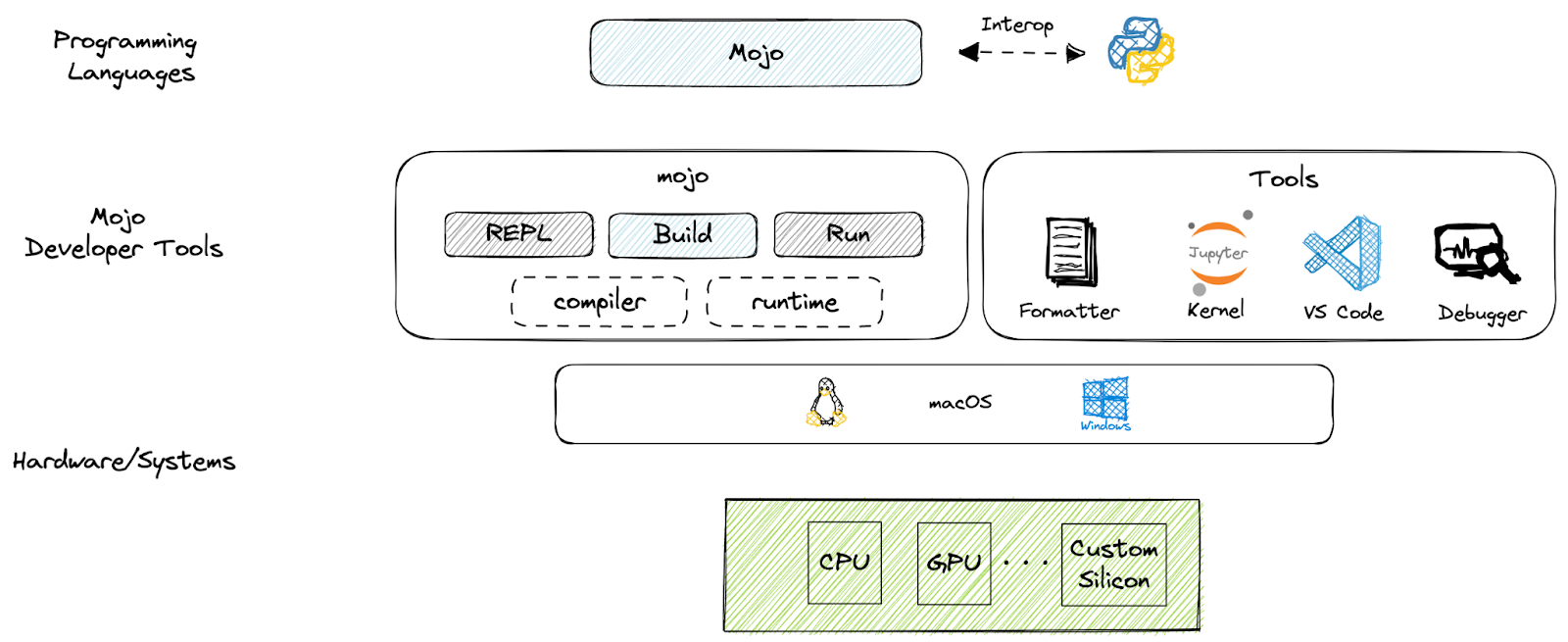
Mojo architecture (Image courtesy Modular)

“What we wanted was an innovative and scalable programming model that could target accelerators and other heterogeneous systems that are pervasive in the AI field,” Mojo’s creators wrote in a blog introduction to Mojo. “This meant a programming language with powerful compile-time metaprogramming, integration of adaptive compilation techniques, caching throughout the compilation flow, and other features that are not supported by existing languages.”

Mojo is based on Multi-Level Intermediate Representation, or MLIR, a project that Lattner spearheaded while at Google. MLIR is a successor to LLVM and GCC compilers, which is technology they were imminently familiar with, as Lattner co-developed LLVM, as well as the Clang compiler and the Swift programming language while at Google (Davis, meanwhile, helped create and scale systems at Google, including Tensorflow). While LLVM and GCC support a wide range of CPUs and GPUs, they were created decades ago and don’t support modern chip architectures.

“MLIR’s strength is its ability to build domain specific compilers, particularly for weird domains that aren’t traditional CPUs and GPUs, such as AI ASICS, quantum computing systems, FPGAs, and custom silicon,” Mojo’s creators wrote.

Modular intends for Mojo to become a superset of Python, or Python++, capable of supporting all the existing Python programs and libraries, but with superior performance for AI programs. The company claims Mojo apps can run up to 68,000 times faster than Python apps, and delivers performance on GPUs and ASICs that is similar to C++ or CUDA.

“We want predictable low-level performance and low-level control, and we need the ability to deploy subsets of code to accelerators,” they wrote. “Additionally, we don’t want to create a fragmented software ecosystem–we don’t want Python users who adopt Mojo to draw comparisons to the painful migration from Python 2 to 3. These are no small goals!”

Modular co-founders Chris Lattner (left) and Tim Davis previously worked at Google

Since Modular launched Mojo in May, it’s been downloaded by more than 12,000 developers, with more than 19,000 members in a Discord community and 9,000 stars on GitHub, the company says.

Today, the company announced that the Mojo SDK is now available for Linux. Developers can get a lot more done with the Mojo installed on their personal systems than what they could do in the cloud, the company says, thanks to features like the Mojo driver, which gives them the capability to program with REPL, and support for VS Code and Jupyter development environments. There’s no debugger yet, but that’s coming soon, the company says.

Meanwhile, Modular last month raised $100 million in a round led by General Catalyst that included GV (Google Ventures). That comes on top of an existing $30 million round in 2022. For more information and downloads, check out www.modular.com.

This article originally appeared on Datanami.

Related

About the author: Alex Woodie

Alex Woodie has written about IT as a technology journalist for more than a decade. He brings extensive experience from the IBM midrange marketplace, including topics such as servers, ERP applications, programming, databases, security, high availability, storage, business intelligence, cloud, and mobile enablement. He resides in the San Diego area.