Learn how to get the most out of ChatGPT with these courses.
Maybe you've played around with ChatGPT, to see what exactly the artificial intelligence chatbot is capable of doing. But if you're looking to get more out of the tool, you'll want to learn how to effectively structure your prompts — what you're actually asking it to do.
That's what the ultimate ChatGPT prompts guide is for. Not only will you get lifetime access to over 3,000 optimized inputs, but also a multi-chapter book on best practices. StackSocial currently has the best price found across the web for this deal at just $30 (reg. $119).
Get more out of the hottest open-source AI tool
First, you should understand what ChatGPT has to offer. If you're only using it to ask questions or tell jokes, you might be surprised to learn that it can be used for research, marketing, brainstorming ideas, business planning, SEO optimization, content creation, problem-solving, copywriting, and so much more. Students, business owners, working professionals, and creatives all have this free AI tool right at their fingertips.
The ultimate ChatGPT prompts guide could help you effectively structure inputs to generate better content. For example, you might just be writing prompts in the form of questions, but that may not be the best way to get your desired output.
On top of direct instruction, you also get access to over 3,000 ready-to-use prompts. These are highly optimized and proven to have great results, just input your own details and see what ChatGPT generates. These prompts are all in a user-friendly layout so you can quickly find what you're looking for and get back to streamlining your work.
Unlock ChatGPT's fullest potential with a lifetime subscription to the ultimate ChatGPT prompts guide, now available on StackSocial for just $30 (reg. $119).
Stability AI, gunning for a hit, launches an AI-powered music generator Kyle Wiggers 7 hours
A year ago, Stability AI, the London-based startup behind the open source image-generating AI model Stable Diffusion, quietly released Dance Diffusion, a model that can generate songs and sound effects given a text description of the songs and sound effects in question.
Dance Diffusion was Stability AI’s first foray into generative audio, and it signaled a meaningful investment — and acute interest, seemingly — from the company in the nascent field of AI music creation tools. But for nearly a year after Dance Diffusion was announced, all seemed quiet on the generative audio front — at least as far as it concerned Stability’s efforts.
The research organization Stability funded to create the model, Harmonai, stopped updating Dance Diffusion sometime last year. (Historically, Stability has provided resources and compute to outside groups rather than build models entirely in-house.) And Dance Diffusion never gained a more polished release; even today, installing it requires working directly with the source code, as there’s no user interface to speak of.
Now, under pressure from investors to translate over $100 million in capital into revenue-generated products, Stability is recommitting to audio in a big way.
Today marks the release of Stable Audio, a tool that Stability claims is the first capable of creating “high-quality,” 44.1 kHz music for commercial use via a technique called latent diffusion. Trained on audio metadata as well as audio files’ durations — and start times — Stability says that Audio Diffusion’s underlying, roughly-1.2-billion-parameter model affords greater control over the content and length of synthesized audio than the generative music tools released before it.
“Stability AI is on a mission to unlock humanity’s potential by building foundational AI models across a number of content types or ‘modalities,'” Ed Newton-Rex, VP of audio for Stability AI, told TechCrunch in an email interview. “We started with Stable Diffusion and have grown to include languages, code and now music. We believe the future of generative AI is multimodality.”
Stable Audio wasn’t developed by Harmonai — or, rather, it wasn’t developed by Harmonai alone. Stability’s audio team, formalized in April, created a new model inspired by Dance Diffusion to underpin Stable Audio, which Harmonai then trained.
Harmonai now serves as Stability’s AI music research arm, Newton-Rex, who joined Stability last year after tenures at TikTok and Snap, tells me.
“Dance Diffusion generated short, random audio clips from a limited sound palette, and the user had to fine-tune the model themselves if they wanted any control. Stable Audio can generate longer audio, and the user can guide generation using a text prompt and by setting the desired duration,” Newton-Rex said. “Some prompts work fantastically, like EDM and more beat-driven music, as well as ambient music, and some generate audio that’s a bit more ‘out there,’ like more melodic music, classical and jazz.”
Stability turned down our repeated requests to try Stable Audio ahead of its launch. For now, and perhaps in perpetuity, Stable Audio can only be used through a web app, which wasn’t live until this morning. In a move that’s sure to irk supporters of its open research mission, Stability hasn’t announced plans to release the model behind Stable Audio in open source.
But Stability was amenable to sending samples showcasing what the model can accomplish across a range of genres, mainly EDM, given brief prompts.
While they very well could’ve been cherry picked, the samples sound — at least to this reporter’s ears — more coherent, melodic and for lack of a better word musical than many of the “songs” from the audio generation models released so far. (See Meta’s AudioGen and MusicGen, Riffusion, OpenAI’s Jukebox, Google’s MusicLM and so on.) Are they perfect? Clearly not — they’re lacking in creativity, for one. But if I heard the ambient techno track below playing in a hotel lobby somewhere, I probably wouldn’t assume AI was the creator.
As with generative image, speech and video tools, yielding the best output from Stable Audio requires engineering a prompt that captures the nuances of the song you’re attempting to generate — including the genre and tempo, prominent instruments and even the feelings or emotions the song evokes.
For the techno track, Stability tells me they used the prompt “Ambient Techno, meditation, Scandinavian Forest, 808 drum machine, 808 kick, claps, shaker, synthesizer, synth bass, Synth Drones, beautiful, peaceful, Ethereal, Natural, 122 BPM, Instrumental”; for the track below, “Trance, Ibiza, Beach, Sun, 4 AM, Progressive, Synthesizer, 909, Dramatic Chords, Choir, Euphoric, Nostalgic, Dynamic, Flowing.”
And this sample was generated with “Disco, Driving, Drum, Machine, Synthesizer, Bass, Piano, Guitars, Instrumental, Clubby, Euphoric, Chicago, New York, 115 BPM”:
For comparison, I ran the prompt above through MusicLM via Google’s AI Test Kitchen app on the web. The result wasn’t bad necessarily. But MusicLM interpreted the prompt in a very obviously repetitive, reductive way:
One of the most striking things about the songs that Stable Audio produces is the length up to which they’re coherent — about 90 seconds. Other AI models generate long songs. But often, beyond a short duration — a few seconds at the most — they devolve into random, discordant noise.
The secret is the aforementioned latent diffusion, a technique similar to that used by Stable Diffusion to generate images. The model powering Stable Audio learns how to gradually subtract noise from a starting song made almost entirely of noise, moving it closer — slowly but surely, step by step — to the text description.
It’s not just songs that Stable Audio can generate. The tool can replicate the sound of a car passing by, or of a drum solo.
Stable Audio is far from the first model to leverage latent diffusion in music generation, it’s worth pointing out. But it’s one of the more polished in terms of musicality — and fidelity.
To train Stable Audio, Stability AI partnered with the commercial music library AudioSparx, which supplied a collection of songs — around 800,0000 in total — from its catalog of largely independent artists. Steps were taken to filter out vocal tracks, according to Newton-Rex — presumably over the potential ethical and copyright quandries around “deepfaked” vocals.
Somewhat surprisingly, Stability isn’t filtering out prompts that could land it in legal crosshairs. While tools like Google’s MusicLM throw an error message if you type something like “along the lines of Barry Manilow,” Stable Audio doesn’t — at least not now.
When asked point blank if someone could use Stable Audio to generate songs in the style of popular artists like Harry Styles or The Eagles, Newton-Rex said that the tool’s limited by the music in its training data, which doesn’t include music from major labels. That may be so. But a cursory search of AudioSparx’s library turns up thousands of songs that themselves are “in the style of” artists like The Beatles, AC/DC and so on, which seems like a loophole to me.
“Stable Audio is designed primarily to generate instrumental music, so misinformation and vocal deepfakes aren’t likely to be an issue,” Newton-Rex said. “In general, however, we’re actively working to combat emerging risks in AI by implementing content authenticity standards and watermarking in our imaging models so that users and platforms can identify AI-assisted content generated through our hosted services … We plan to implement labeling of this nature in our audio models too.”
Increasingly, homemade tracks that use generative AI to conjure familiar sounds that can be passed off as authentic, or at least close enough, have been going viral. Just last month, a Discord community dedicated to generative audio released an entire album using an AI-generated copy of Travis Scott’s voice — attracting the wrath of the label representing him.
Music labels have been quick to flag AI-generated tracks to streaming partners like Spotify and SoundCloud, citing intellectual property concerns — and they’ve generally been victorious. But there’s still a lack of clarity on whether “deepfake” music violates the copyright of artists, labels and other rights holders.
And unfortunately for artists, it’ll be a while before clarity arrives A federal judge ruled last month that AI-generated art can’t be copyrighted. But the U.S. Copyright Office hasn’t taken a firm stance yet, only recently beginning to seek public input on copyright issues as they relate to AI.
Stability takes the view that Stable Audio users can monetize — but not necessarily copyright — their works, which is a step short of what other generative AI vendors have proposed. Last week, Microsoft announced that it would extend indemnification to protect commercial customers of its AI tools when they’re sued for copyright infringement based on the tools’ outputs.
Stability AI customers who pay $11.99 per month for the Pro tier of Stable Audio can generate 500 commercializable tracks up to 90 seconds long monthly. Free tier users are limited to 20 non-commercializable tracks at 20 seconds long per month. And users who wish to use AI-generated music from Stable Audio in apps, software or websites with more than 100,000 monthly active users have to sign up for an enterprise plan.
In the Stable Audio terms of service agreement, Stability makes it clear that it reserves the right to use both customers’ prompts and songs, as well as data like their activity on the tool, for a range of purposes, including developing future models and services. Customers agree to indemnify Stability in the event intellectual property claims are made against songs created with Stable Audio.
But, you might be wondering, will the creators of the audio on which Stable Audio was trained see even a small portion of that monthly fee? After all, Stability, as have several of its generative AI rivals, has landed itself in hot water over training models on artists’ work without compensating or informing them.
As with Stability’s more recent image-generating models, Stable Audio does have an opt-out mechanism — although the onus for the most part lies on AudioSparx. Artists had the option to remove their work from the training data set for the initial release of Stable Audio, and about 10% chose to do so, according to AudioSparx EVP Lee Johnson.
“We support our artists’ decision to participate or not, and we’re happy to provide them with this flexibility,” Johnson said via email.
Stability’s deal with AudioSparx covers revenue sharing between the two companies, with AudioSparx letting musicians on the platform share in the profits generated by Stable Audio if they opted to participate in the initial training or decide to help train future versions of Stable Audio. It’s similar to the model being pursued by Adobe and Shutterstock with their generative AI tools, but Stability wasn’t forthcoming on the particulars of the deal, leaving unsaid how much artists can expect to be paid for their contributions.
Artists have reason to be wary, given Stability CEO Emad Mostaque’s propensity for exaggeration, dubious claims and outright mismanagement.
In April, Semafor reported that Stability AI was burning through cash, spurring an executive hunt to ramp up sales. According to Forbes, the company has repeatedly delayed or outright not paid wages and payroll taxes, leading AWS — which Stability uses for compute to train its models — to threaten to revoke Stability’s access to its GPU instances.
Stability AI recently raised $25 million through a convertible note (i.e. debt that converts to equity), bringing its total raised to over $125 million. But it hasn’t closed new funding at a higher valuation; the startup was last valued at $1 billion. Stability was said to be seeking quadruple that within the next few months, despite stubbornly low revenues and a high burn rate.
Will Stable Audio turn the company’s fortunes around? Maybe. But considering the hurdles Stability has to clear, it’s safe to say it’s a bit of a long shot.
Apple recently hosted its highly anticipated ‘Apple Event.’ But, guess what? It never uttered the term ‘AI’ even once. Without explicitly mentioning ‘artificial intelligence,’ Apple showcased a new line of products that included improved semiconductor designs powering the latest “machine learning and neural engines” capabilities.
“Apple is taking a product-first approach to AI instead of an AI-first approach to products,” said AI advisor Vin Vashistha. He said that the presenters talked about “machine learning” and immediately explained how this technology benefits customers by enhancing their experiences or achieving particular results.
“It kinda feels like Apple is asleep at the AI wheel and I think that could be the moment we look back on and think: why didn’t they invest way more?,” asked Suhail, the founder of Playground AI.
But, that’s not entirely true. Apple has spent nearly $22.6 billion on R&D, driven by investments in AI technologies, including generative AI, as reported by Reuters. Apple recently also said that it is expanding its budget for creating conversational AI to millions of dollars a day to develop new features for Siri where customers can use just voice commands to automate simple tasks.
The outcome of these efforts was actually felt in the recent Apple Event, even though it did not mention the word “AI” once – unlike Google and Microsoft – who by now might be tired, and their leaders just can’t stop talking about i, just to sell their products and services – “AI-powered that…” “Copilot that…” etc.
Be like Apple
This is not the first time Apple shied away from using the word “AI”. Five months back, at Apple earnings call, Cook said AI twice, and that was in response to a question, and that’s that.
In contrast, Google chief Sundar Pichai, earlier this year at the Google I/O event mentioned the word “AI” over 143 times during the two-hour presentation. Microsoft’s Satya Nadella used the word “AI” 47 times at its recent earnings call.
Be like Apple, instead. Even though AI is present in almost all of its offerings, it is all about getting down to specifics, mentioning things like transformer models, machine learning, and chips.
Marketing Genius
Apple is a marketing genius. Instead of selling its product, banking on AI, it very wisely spent all the time in the world to script a perfect script to save “Mother Nature” – played by Octavia Spencer, alongside its chief Tim Cook and team, who super tried to keep a straight face throughout.
Clearly, Apple knows its customers, and what matters to them. For instance, it built Series 9 Watch with a new chip that includes improved data crunching capabilities, notably adding a four-core “neural engine” that can process machine learning tasks up to twice as quickly. This is also the first product that is carbon neutral.
Also, thanks to the powerful new neural engine Siri requests are now processed on device making them faster and more secure – a more edge or federated learning use cases. Again, Apple is all about messaging, and it looks to provide a faster and more secure experience for its users.
Not just that, the machine learning chip components also enabled Apple to launch a new way to interact with the device: where people can now “double tap” their finger tips to answer or end phone calls, pause music, or launch other information like the weather. This uses advanced neural nets and machine learning algorithms that detect the unique signature of tiny wrist movements and changes in blood flow when the index finger and thumb perform a double tap, thereby providing hassle-free experience for users.
In Apple iPhone 15, Apple also introduced Next Gen Portraits which leverages machine learning to automate portrait mode in the camera so that users don’t have to remember to switch to portrait mode. Using machine learning it can automatically detect whether an object is in the frame, thereby improving the photo clicking experience.
Additionally, iPhone 15 has the power of computational photography to enhance picture quality. At the event it was demonstrated with various applications, ranging from enhancing light and detail balance to identifying and enabling portrait mode for both people and pets. “The 16-core Neural Engine handles everything from computational photography to live voicemail transcriptions on devices in order to protect your privacy” said Kaiann Drance, VP of iPhone Marketing at Apple.
All in all, Apple’s decision to refrain from explicitly mentioning “AI” serves to eliminate the distraction surrounding the technology, allowing them to concentrate on effectively conveying their message to customers and stakeholders. This approach is quite clever and differs significantly from anything we’ve previously witnessed.
The post Apple Hates AI So Much That It… appeared first on Analytics India Magazine.
SiMa.ai released Palette Edgematic to accelerate machine learning applications at the embedded edge. This debut delivers an on-ramp to AI and ML via its ‘no-code’ approach to create and fine-tune ML applications from anywhere via a web browser in no time.
Palette Edgematic enables a “drag and drop” feature – a code-free approach, where users can create and deploy their models and complete computer vision pipelines automatically within minutes. It provides a direct path to implementation at the edge, eliminating the need for an intermediate step in the cloud. Users can also evaluate the performance and power consumption needs of their edge ML application in real time.
The software is a free visual development environment designed for any organisation to get started and accelerate ML at the edge. It usually takes multiple weeks to evaluate and several months to deploy ML applications as customers have to hand optimise models and the entire end-to-end applications to get necessary performance and accuracy.
“ML adoption at the edge has been slow due to the lack of easy-to-use software tools. Our Palette Edgematic software provides a no code visual GUI platform that enables customers to evaluate our MLSoC platform in a few hours,” said Gopal Hegde, senior vice president of engineering and operations at SiMa.ai.
Using Palette Edgematic, developers can prototype and evaluate ML pipelines on edge devices within minutes and use real time data streams to measure KPIs. They can use the new visual canvas to iterate design and improve pipeline performance, eliminating tedious coding transitions for edge ML implementations.
The Palette Edgematic can convert visual representations of the pipeline to executable code with the push of a button.
SiMa.ai announced earlier this week a FPA/W excellence in the most recent ML Perf. 3.1 benchmark competition where it competed against NVIDIA’s newest Jetson NX. SiMa.ai was leading by a margin of 85%. This positions them as a dominant player in the competitive world of edge AI.
The post SiMa.ai Revolutionises Deployment of ML Applications, from Weeks to Hours appeared first on Analytics India Magazine.
The US is restricting NVIDIA from selling its advanced AI hardware to China and it will heavily impact the Santa Clara-headquartered company’s revenue since China is one of their most important markets.
China is a key market for Nvidia, so much so that the revenue from China and Hong Kong accounted for 22% of the company’s revenue in 2022, according to its financial statements.
“Over the long term, restrictions prohibiting the sale of our data centre GPUs to China, if implemented, would result in a permanent loss of opportunities for the US industry to compete and lead in one of the world’s largest markets and impact on our future business and financial results,” said Colette Kress, NVIDIA’s chief financial officer during an investment conference in June this year.
Furthermore, US officials plan to tighten these export curbs. The new move is aimed at Nvidia’s A800 chip, which it created to bypass the regulations and in order to continue to sell to China.
“We are aware of reports that the US Department of Commerce is considering further controls that may restrict exports of our A800 and H800 products to China,” Kress said recently at an investment conference.
Exploring New Frontiers
While the business with China has become tough because of geopolitical reasons, Jensen is searching for new markets to re-route the supply. And India is the next big market after China.
In 2020, India’s AI market was worth $3 billion, constituting about 1% of the global market, according to IDC. However, AI spending in India is projected to grow significantly, reaching $11.78 billion by 2025 and contributing $1 trillion to the country’s economy by 2035.
A joint study by Microsoft and IAMAI found that India’s AI market is set to grow by 20% in the next five years, second only to China globally.
Last week, NVIDIA CEO Jensen Huang visited India and made some big announcements. The company partnered with major Indian companies such as Tata, Reliance and Infosys. Under this partnership, NVIDIA will deliver AI computing infrastructure and platforms to these companies for developing AI solutions.
The partnerships also underlined the demand and the willingness on these companies’ part to integrate AI and expand on their ability to build and deploy AI models.
India, though a small AI market, contributes 16% of global AI talent, ranking among the top three talent producers worldwide, surpassing its own demand. With a legacy of exporting tech talent globally, India produces more talent than it consumes.
“I would like to accelerate the building of AI infrastructure here in India. You have your own data, lots and lots of data. You also have very diverse languages. You have the great talent of computer scientists,” said Huang during the press meet.
What the Partnerships Entail
The partnership ranges from creating LLMs in local Indian languages to building GPU cloud infrastructures and upskilling employees on a large scale for the AI revolution that’s on the horizon.
NVIDIA, in partnership with Reliance Industries, aims to develop India’s foundational LLM trained on the nation’s diverse languages, tailored for generative AI applications. The project will create AI infrastructure surpassing India’s fastest supercomputer, with access to NVIDIA’s GH200 Grace Hopper Superchip and DGX Cloud for high performance. This initiative will enable Reliance Jio Infocomm to develop AI applications for its 450 million customers and provide energy-efficient AI resources for Indian scientists and startups, expanding to 2,000 MW data centres.
“As India advances from a country of data proliferation to creating technology infrastructure for widespread and accelerated growth, computing and technology super centres like the one we envisage with NVIDIA will provide the catalytic growth just like Jio did to our nation’s digital march,” Reliance chairman, Mukesh Ambani said.
Meanwhile, Infosys is poised to collaborate with NVIDIA, leveraging its infrastructure and expertise to develop AI models and applications. NVIDIA’s CEO Jensen Huang discussed plans to reskill over 300,000 employees in AI, aligning with NVIDIA’s recent partnerships with Reliance and Tata to build significant AI infrastructure in India. These endeavours, utilising NVIDIA’s GH200 Grace Hopper Superchip and DGX Cloud, will empower TCS to innovate and enhance the skills of its extensive workforce of over 600,000 employees.
In the rapidly evolving global AI landscape, these partnerships signify India’s potential to become a major player.
OpenAI’s five-year journey is a testament to AI’s growth, and India, with plans to acquire tens of thousands of GPUs and achieve AI supercomputers 50 to 100 times faster by the next year, is poised to achieve similar success in a shorter timeframe.
“We are going to bring out the fastest computers in the world. These computers are not even in production [so far]. India will be one of the first countries in the world [to get them],” Jensen said. He added that by the end of 2024, India will have AI supercomputers that are an order of magnitude faster (i.e. 50 to 100 times faster), lowering the cost of foundational model training.
The post Why India is the Biggest Bet for NVIDIA appeared first on Analytics India Magazine.
If you thought AGI would be built with Python, you are almost halfway there. It would be built on top of the language that has the elegance of Python and the speed of C++, or even CUDA. And there is a language that has married both of these and has made it possible to achieve the dream of AGI – it is called Mojo.
Mojo is now finally here. After more than 120,000 developers signed up for Mojo Playground and heavy discussions about the capabilities of the language, Modular, the company that built Mojo, has made the language available for local download. It is now available only for Linux, with Microsoft and Mac support coming soon.
Mojo is now available for download locally to your machine! Beyond a compiler, the Mojo SDK includes a full set of developer and IDE tools that make it easy to build and iterate on Mojo applications. Let’s build the future together!https://t.co/KxmLvsxx5e
— Modular (@Modular_AI) September 7, 2023
Interestingly, developers have already started experimenting with Mojo. Aydyn Tairov, who goes by the name Mojician on the Mojo community, was able to implement llama2.py within Mojo, 20% faster than Andrej Karpathy’s llama2.c (Baby Llama), which was on C. This shows that Modular’s claims about Mojo being faster than Python are actually true.
llama2 inference in a pure Mojo https://t.co/4V3onMXmIF I found the SIMD Mojo primitives really interesting feature, since it helped to improve pretty awful performance of Python solution almost 250x times.
— Aydyn Tairov (@tairov) September 11, 2023
What is Mojo’s Mojo?
During the initial launch of Mojo in May, Modular claimed that it is 35,000X faster than Python. “Well it turns out we meant 68,000X faster,” Modular said in a recent post. How is that even possible?
One of the major motivations behind building the new programming language according to the developers was that most of the modern programming systems rely on accelerators like GPU for operations, and only “fall back” on main CPUs for supporting operations like data loading, pre and post processing, and integrations into foreign system written in other languages. The company wanted to support the full gamut of this into one language.
Now, with integrability with Python code and a scalable programming model for targeting GPUs, Mojo makes language transition seamless. “With simple code changes to existing Python code, developers can increase the speed of computation of models by more than 68,000X.
The initial release of the Mojo SDK includes a comprehensive set of tools for convenient Mojo program development. These tools encompass:
mojo driver: This tool offers a shell for executing read-eval-print-loop (REPL) commands and facilitates Mojo program compilation and execution. It also enables Mojo module packaging (including support for the Mojo extension!), document generation, and code formatting.
Visual Studio Code Extension (VS Code): This extension provides various productivity-enhancing features like syntax highlighting, code completion, and more.
Jupyter kernel: It supports the creation and execution of Mojo notebooks, enabling the inclusion of Python code within them.
Debugging support (upcoming feature): Soon, developers will be able to step into and inspect running Mojo programs, even mixing C++ and Mojo stack frames.
But even after all of this, Modular has decided to not open source Mojo yet.
No open source, no attention
Mojo is built with AI development in mind. It has the syntax of Python and the portability and speed of C. Interestingly, during the release of the language, the creators Tim Davis and Chris Lattner said that they had no intention of creating a new programming language, but as they were building their Modular Platform, a unified inference engine, they realised that programming across the entire stack was too complicated.
This meant building a programming language with powerful compile-time metaprogramming, integration of adaptive compilation techniques, caching throughout the compilation flow, and other things that are not supported by existing languages. That is the direction that Mojo was always heading towards, but they thought that can only be achieved on their platform.
All of this, combined with the fact that Modular is trying to compete directly with NVIDIA’s CUDA, for enabling faster inference across AMD, Intel, and other GPUs, the decision of not open sourcing still remains questionable, and it has already received criticism from the developer community. It seems like the company actually just released a closed-source Python, which is maddening.
In a HackerNews discussion, users discuss that Lattner might actually open source it soon, but until then they are not going to use it. Lattner has said that he might open source “parts of it”, and not the entire language. This is what happened with Swift programming language as well, keeping it closed source, which companies call an “incubation period”, to fix the small problems before open sourcing it. This might still be a reasonable approach, given it is a for-profit company indeed.
Nonetheless, developers say that marketing posts like “it is a billion times faster, oh no, it is actually a zillion times faster” actually doesn’t matter if the entire user base is waiting for licence issues to be clarified. There might be a transition from closed source to open source, but people are already put off with the fact that they still have to wait to use it commercially.
For AGI to be built on Mojo, Modular will have to be quick with open sourcing Mojo, because we all know, open source is the way forward.
The post Mojo🔥 is Fast But Not Furiously Open Source appeared first on Analytics India Magazine.
Generative AI has revamped our daily work routines. From drafting emails to crafting poetry, LLMs based chatbots like Bard and ChatGPT have improved the quality of our output. However, the efficacy of these generative AI models deoedns on their training, which is why tech companies are actively recruiting to fine tune existing models and develop new ones. Generative AI is more than just a technological marvel; it’s also a driver of job creation in various industries. Let’s explore some of the top career opportunities in this field.
Apple – ML Engineer (Generative AI)
Soon after the news of AppleGPT surfaced, the big tech started hiring for a passionate and dedicated ML engineer to join their Cloud Technologies App Platform team in Hyderabad. The role involves designing and implementing a machine learning strategy to enhance the developer experience platform and accelerate app development within Apple. The ideal candidate should have a strong grasp of advanced machine learning algorithms, deep learning, and statistics, along with expertise in transformer models like BERT, GPT, and RoBERTa. They will optimise and fine-tune large language models, possess proficient software development skills (Python, PyTorch, TensorFlow, JAX), and build MLOps infrastructure for experimentation, A/B testing, and production deployment.
Experience with MLOps technologies, LangChain pipelines, and presenting complex ML insights to non-technical audiences is valued. The role aims to contribute to Apple’s generative AI-based developer platform, collaborating with data scientists and software engineers to provide ML solutions for internal use, with a focus on improving the developer experience. The ideal candidate should have 5+ years of AI/ML-focused software industry experience, along with relevant educational qualifications (B.Tech/M.Tech/M.S. or Ph.D. in related fields).
Apply here.
Eli Lilly, Generative AI Senior Team Lead
American pharmaceutical company Eli Lilly is expanding their footprint in India.
They are looking to fill the role of a Generative AI – Machine Language Engineer requires an expert in machine learning to oversee the entire data lifecycle, including collection, cleaning, preprocessing, model training, and production deployment. The primary responsibilities involve configuring modern Natural Language Technology (NLT) platforms to extract insights from crucial business data. This entails designing, implementing, and managing data preparation and advanced analytics tools, showcasing insights from diverse data sources to business users, and developing language understanding/generation systems using text representation techniques.
Key responsibilities include collaborating with engineering partners to implement optimal cloud-based ML solutions, researching and adopting advanced NLG algorithms for tasks like summarization, and establishing best practices for deployment and infrastructure. Maintaining ML model performance, automating ML model processes, and fostering relationships with various stakeholders are also key aspects of the role. Required experience encompasses designing, developing, and researching ML systems, NLP/NLU/NLG expertise, AWS proficiency, coding skills in Python, Java, and R, MLOps knowledge, Docker/Kubernetes familiarity, and agile development experience.
Check out more about it here.
Siemens Healthineers, Generative AI Engineer
Siemens Healthineers is hiring an experienced Generative AI Engineer to join their Research & Development team. The role involves designing and implementing generative AI models like GANs, VAEs, and Transformers for various applications. Responsibilities include data preprocessing, model training, evaluation, deployment, optimization, and collaboration with cross-functional teams. Key skills required include machine learning fundamentals, proficiency in programming languages like Python, deep learning expertise, data preprocessing skills, software engineering proficiency, ethics awareness, and continuous learning. The role also entails security, documentation, problem-solving, and domain knowledge in healthcare, if applicable, and maintaining generative models in production environments.
If you think this role fits you, check out the full description.
PwC,Generative AI and Data Analytics Lead Manager
PwC is in search of an adept Generative AI and Data Analytics Lead Manager to join their Kolkata team, focusing on applying advanced analytics and AI methodologies to address intricate business challenges.
This position demands a blend of technical prowess, strategic thinking, and business insight to foster innovation and company growth. Responsibilities encompass independently engaging with global and domestic clients, employing deep mathematical expertise in statistics and probabilities, collaborating with diverse teams to pinpoint business priorities, crafting predictive and statistical models, utilizing generative AI for process enhancements, managing data pipelines, and communicating findings to various stakeholders. Qualifications include a bachelor’s degree in Computer Science, Statistics, Mathematics, or a related field, preferably a Master’s or Ph.D., along with 10-12 years of experience in analytics or AI. Proficiency in Python or R programming, deep learning frameworks like TensorFlow or PyTorch, statistical modeling, data visualization tools, and project management is expected. Key skills encompass AI, Generative AI, and Data Analytics, with a graduate degree preferred.
Here’s the link for you to apply.
Wipro, Generative AI Architect
Indian IT giant Wipro is hiring for the role of Generative AI Architect (C1). It requires a seasoned professional with over 10 years of experience. The role involves designing and implementing cutting-edge generative AI models and algorithms, including GPT, VAE, and GANs, and integrating cloud-based generative AII algorithms. Collaboration with cross-functional teams to align AI projects with business objectives is essential. Staying updated on the latest generative AI, machine learning, and deep learning advancements and optimizing existing models for enhanced performance is part of the job. Proficiency in Python, deep learning frameworks (TensorFlow, PyTorch, or Keras), cloud platforms (AWS, GCP, or Azure), and NLP tools (SpaCy, NLTK, Hugging Face) is required.
Find more about the job here
Ascendion,Generative AI Engineer
In this role with engineering firm Ascendion, you’ll be responsible for fine-tuning and optimising generative AI models to ensure they perform efficiently across various applications. Your tasks will also involve designing intelligent AI agents to enhance user interactions and experimenting with innovative techniques to improve recommender systems. You’ll be in charge of constructing and managing inference pipelines for seamless AI model deployment on different platforms, overseeing deployment and versioning for smooth updates and rollbacks. Additionally, you’ll develop tools to continuously assess model performance in production, with a strong focus on software engineering principles. Leveraging your expertise in transformer models and text embeddings, you’ll optimize and manage machine learning models in production settings. The job offers remote work flexibility, opportunities for skill growth, and various perks and rewards.
Follow this link to learn more.
Read more:
The post 6 Generative AI Jobs in India appeared first on Analytics India Magazine.
Salesforce announced a rebrand of its Einstein 1 Data Cloud and new capabilities for the Einstein generative AI assistant for CRM at the Dreamforce conference held in San Francisco on Tuesday, Sept. 12.
Salesforce’s Einstein 1 Data Cloud metadata framework will be integrated within the Einstein 1 Platform. The CRM giant also plans expanded capabilities for the generative AI assistant Einstein GPT, released in March, under the umbrella of the Einstein 1 Platform.
Jump to:
Data Cloud integrates into Einstein 1 Platform
Salesforce introduces the generative AI assistant Einstein Copilot
Einstein Trust Layer addresses security concerns
When will Einstein Copilot, Einstein Copilot Studio and Einstein Trust Layer be available?
Data Cloud integrates into Einstein 1 Platform
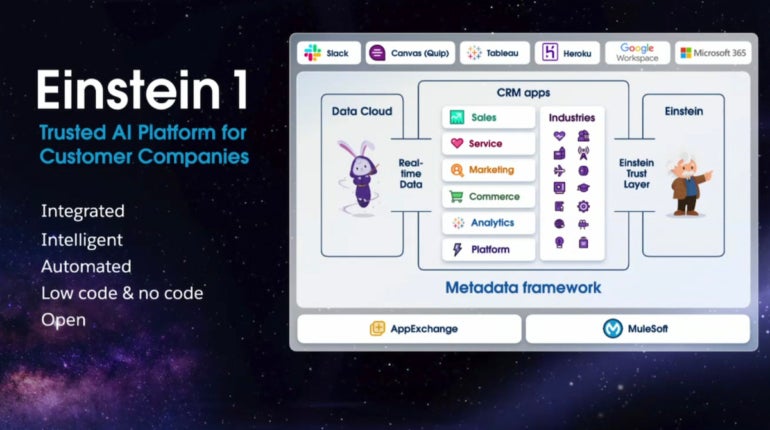
Einstein 1 is “a relaunch of our Salesforce platform to create a trusted AI platform for our customer companies,” said Patrick Stokes, executive vice president of product and industries marketing at Salesforce, in a press briefing in advance of Dreamforce (Figure A). The Einstein 1 Platform contains all of Salesforce’s customers’ own data, enabling the generative AI capabilities to learn from and generate new content from that data.
Figure A
Einstein 1 interoperability diagram. Image: Salesforce
Einstein 1 unifies data into one customer record usable across the entire Salesforce platform, including Sales Cloud, Service Cloud, Marketing Cloud and Commerce Cloud.
Helping companies use data they already have
Combining different Salesforce cloud products under the Einstein 1 name helps enable companies to find uses for the data they already collect, said Muralidhar Krishnaprasad, executive vice president of engineering, Salesforce Marketing Cloud, in an interview with TechRepublic.
“We look at CRM and AI data as being a loop,” said Krishnaprasad. “Your CRM (and) your engagement (with) your customers is going to be better if you use more AI, particularly generative AI. You can have personalized experiences, but that AI is only good if you have the right data.”
“We look at it as a cycle where CRM generates a lot of data, and you have other enterprise data. You mix it, you use AI to generate the right personalized things, (and) you feed that back in your engagement,” he said.
In a press release, Parker Harris, co-founder and chief technology officer at Salesforce, referred to the ways data and AI can work together.
“We pioneered the metadata framework nearly 25 years ago to seamlessly bridge data across applications. It’s the connective tissue that fuels innovation,” said Harris. “Now, with Data Cloud and Einstein AI native on the Einstein 1 Platform, companies can easily create AI-powered apps and workflows that supercharge productivity, reduce costs and deliver amazing customer experiences.”
Salesforce introduces the generative AI assistant Einstein Copilot
Salesforce is joining the AI assistant trend with Einstein Copilot, a natural-language chatbot that will sit inside every Salesforce application. Einstein Copilot can help sales, service or commerce workers write emails, prepare for meetings, handle customer calls or pull up the right Tableau dashboards; it does so by using an organization’s data on its customers stored in Salesforce Data Cloud.
“It’s really about going from clicking through navigation to get to the information you’re looking for … to simply being able to ask for it through natural language,” said Clara Shih, chief executive officer of Salesforce AI, during a press briefing.
The Einstein Platform already draws on 10 years of innovation based on predictive capabilities, said Stokes.
“We wanted to put our foot in the door there and see how well that would work and what kind of data we would need to connect into the prompt to provide a useful generation [generative content],” Stokes said.
Copilot was born out of that lineage, but it’s different because it can respond in natural language and conversational style and sits within the dashboards of Sales Cloud and Service Cloud. Einstein Copilot can interpret data from Tableau, assist sales personnel in making deals, summarize content, turn natural language instructions into code in the programming language Apex and write email.
Einstein Copilot will be available to every Salesforce user across every cloud, extending the capabilities of Einstein GPT.
Einstein Copilot Studio lets organizations customize generative AI content
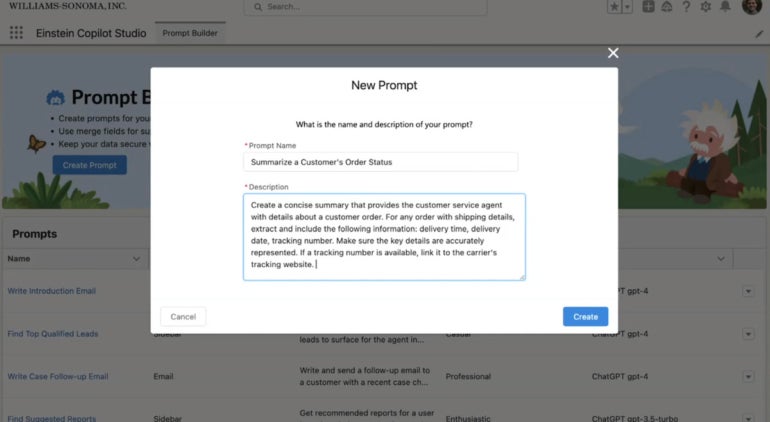
The admin portal for Einstein Copilot will be Einstein Copilot Studio, through which organizations can customize the chatbot for their specific prompts, skills and AI models (Figure B).
Figure B
Writing a prompt in Einstein Copilot Studio. Image: Salesforce
Einstein Copilot Studio is made up of three major sets of tools: Prompt Builder, Skills Builder and Model Builder. The tools will help Salesforce customers tailor their AI-assisted communications to their brand’s needs and voice.
Prompt Builder adds customizations and can A/B test versions before rolling them out to the service team.
In Skills Builder, company admins can control and designate which workflows they want the copilot to be able to access. Companies that already have customer workflows on Salesforce will be able to select them in Skills Builder.
Model Builder lets companies either bring their own AI model (from Anthropic, Cohere, Databricks, Google Cloud’s Vertex AI or OpenAI) or use one of Salesforce’s proprietary large language models. Either way, the selected models can be trained on Data Cloud.
Einstein Trust Layer addresses security concerns
Salesforce announced during the press briefing that Einstein Copilot and Copilot Studio will work in concert with the Einstein Trust Layer, a Salesforce-native AI architecture designed to keep proprietary information secure. The Einstein Trust Layer was first announced in June.
The Einstein Trust Layer ensures no customer data is used for large language model training. It prevents toxicity, masks personally identifiable information and creates an auditable trail of data about what Einstein Copilot does.
SEE: Salesforce’s guidelines for reducing AI bias (TechRepublic)
The Trust Layer includes feedback on whether AI-generated emails are actually helping businesses improve. For example, if sales or service workers tend to ask the AI to generate content but then heavily edit or do not use that content, the Trust Layer is where admins can access that information and fine-tune the AI based on how Einstein Copilot is being used in the real world.
“We are constantly experimenting in terms of the right models to use for the right job, what versions to use and also (how to) optimize on cost,” Krishnaprasad said. For example, it’s important to show admins when the AI is not being used so they can change the temperature settings or make other adjustments to make the output more appealing.
Krishnaprasad noted that companies wanting to get into generative AI should ask whether they have the right data in place already. Data is key because it lets a generative AI personalize responses.
Krishnaprasad said potential generative AI buyers should ask:
“Where should I be putting my generative AI?”
“How much of that data should I expose?”
“What brand voice do I want for it?”
Company leaders looking to use generative AI should experiment and optimize, which the Trust Layer allows them to do, Krishnaprasad added.
“Look at the feedback, because what you think is the right thing may not be what your consumers think is the right thing,” he said.
When will Einstein Copilot, Einstein Copilot Studio and Einstein Trust Layer be available?
Einstein Copilot, Copilot Studio and Trust Layer are coming out as pilot tests this fall, Salesforce said. A general availability date has yet to be announced.
Subscribe to the Innovation Insider Newsletter
Catch up on the latest tech innovations that are changing the world, including IoT, 5G, the latest about phones, security, smart cities, AI, robotics, and more.
Enterprises across Australia and New Zealand have been enthusiastic adopters of the cloud.
A 2023 IDC whitepaper sponsored by Microsoft said Australia and New Zealand are among the few countries in the Asia Pacific region where public cloud adoption has moved beyond discrete software-as-a-service-based solutions for the replacement of infrastructure, like disaster recovery, to advanced use cases driving digital transformation and innovation.
But this is not coming without strain. Forrester’s State of Cloud in Australia and New Zealand 2023 report found continued growth in cloud utilization across organizations is driving Australian and New Zealand IT leaders to focus on efficiency and cost. IT leaders should expect further challenges as demands grow for new use cases like artificial intelligence in the future.
Jump to:
Explosion in cloud demand putting pressure on cloud strategies
Australia and New Zealand proving they are cloud-forward
Data center expansions will support public cloud growth
Explosion in cloud demand putting pressure on cloud strategies
Senior Australian enterprise cloud decision-makers have reported their organizations spending an average of nearly US $14 million (AU $21.85 million) on public cloud in the past 12 months. Forrester said this scale, combined with the pressure of a technology sector and an economic slowdown, has revived interest in ballooning cloud waste and efficiency.
“As companies look to address economic uncertainty, optimization is top of mind,” the Forrester report said. “We’ve reached new levels of spend that have far surpassed expectations.”
Some IT leaders are renegotiating cloud contracts with higher amounts of committed spend or larger committed growth rates in exchange for discounts. Many are also using cloud cost management and optimization solutions to reduce waste, while work with database and network architects could further optimize performance, security and cost concerns, Forrester said.
Organizations are even expanding the adoption of financial operations practices. Rather than just using new tools, Forrester suggests that IT teams are making an effort to build in collaboration, hold users accountable for spending decisions and provide more transparency on spending initiatives.
“This initiative is gaining traction among tech executives, not just cloud leaders,” said Forrester. “While the tech downturn isn’t hitting local firms as much as onshore multinationals, Australian firms still want the most out of FinOps — even as layoffs by big tech firms cool the labor market.”
The strain on cloud strategies is expected to continue, Forrester said.
“In the coming years, many enterprises will start to explore new cloud use cases, whether that involves the edge or AI-enabled services,” said Forrester. “Each fresh opportunity will put a new strain on current strategies.”
Australia and New Zealand proving they are cloud-forward
IDC’s report predicted Australian spending on public cloud would increase by 83% between 2022 and 2026, from AU $12.2 billion (US $7.81 billion) in 2022 to AU $22.4 billion (US $14.34 billion). Gartner, meanwhile, predicted Australian organizations would shell out AU $19.9 billion (US $12.74 billion) on public cloud just this year and expected NZ $3 billion (US $1.77 billion) in spending from New Zealand organizations, up 22.9% year-on-year.
The spending predictions reflect the new scale of Australia and New Zealand’s cloud growth.
Ever since the arrival of the major public clouds, Forrester’s research shows local enterprises have been increasingly migrating their existing workloads rather than just using the cloud for new apps. On average, Australian enterprise cloud decision-makers in organizations migrating to a cloud computing infrastructure as part of public cloud adoption anticipate having migrated 46% of their workloads within two years, which would be an increase from 36% today.
Retailer Woolworths, for example, completed its migration of 20 SAP applications, 75 terabytes of data, 135 database servers and 435 application servers to Azure in 2022, which included one of the biggest SAP environments in the region. Meanwhile, ANZ Bank is in the midst of an enterprise-wide migration to AWS and Google Cloud Platform.
ANZ Bank is far from alone in its pursuit of a multi-cloud strategy. Forrester’s Infrastructure Cloud Survey, conducted in 2022, found a huge slice (95%) of Australian enterprise cloud decision-makers at organizations using the public cloud who say they use multiple public cloud vendors, demonstrating that multicloud is the predominant strategy for most organizations.
The shift is not limited to the private sector. Though slower to move, Australian public sector agencies have also been encouraged to embrace cloud-first or cloud inclusive approaches over a number of years, including in the Federal Government’s 2017 Secure Cloud Strategy, which was updated again in 2021. Reasons given include increasing speed, enabling continuous improvement, providing easier access to public services and reducing maintenance costs.
While Australia may not have become the second-largest cloud hub in the world as Forrester forecast in 2014, the future looks bright.
“The cultural and business factors that drove that prediction, including the country’s fast-follower mentality, a vibrant startup scene, tech-forward citizens and cultural ties to U.K. and U.S. business communities, continue to drive investment,” Forrester said.
Data center expansions will support public cloud growth
Australia and New Zealand’s cloud uptake will be accelerated by new hyperscaler data center investments across Australasia. AWS has committed a further AU $13.2 billion (US $8.44 billion) to Australia’s East Coast regions from 2023 to 2027, as well as NZ $7.5 billion (US $4.43 billion) to establish a data center in Auckland, consisting of three availability zones. Both Microsoft and Google have also announced plans for New Zealand regions.
The arrival of hyperscaler data centers in New Zealand, in addition to the existing presence of New Zealand’s Catalyst Cloud, is expected to propel strong growth in the market.
“Growth in cloud adoption continues globally, but it is in 2024 that we’ll see it explode in New Zealand,” said Gartner Research Vice President Michael Warrilow earlier this year. “The arrival of the hyperscale cloud vendors into the local market will drive this accelerated growth.”
For Forrester, changing data center footprints is only another reason organizations will be optimizing their strategies.
“ANZ firms need to strategically evolve their cloud strategies based on their own business context, including prior investments, new pressures and development skills and requirements, revisiting their existing plans to ensure optimization across cost, data, resilience and networking architectures,” the research firm said.
Subscribe to the Daily Tech Insider AU Newsletter
Stay up to date on the latest in technology with Daily Tech Insider Australian Edition. We bring you news on industry-leading companies, products, and people, as well as highlighted articles, downloads, and top resources. You’ll receive primers on hot tech topics that are most relevant to AU markets that will help you stay ahead of the game.
In recent years, the realm of artificial intelligence has witnessed an evolutionary leap with the advent of Generative AI. Characterized by its ability to produce novel outputs, be it text, images, or even code, Generative AI isn't just another tech trend – it's rapidly shaping the way businesses think, operate, and innovate. At the forefront of this transformative wave is Deloitte, with its freshly unveiled report, “The Generative AI Dossier.” A comprehensive exploration into the myriad use cases of Generative AI, this dossier isn't just a document; it's a testament to the transformative potential of this technology across multiple industry verticals.
Generative AI is more than just a tech jargon – it's a catalyst. A catalyst that is driving enterprise transformation at a pace and scale previously unimagined. Across industries, from finance to healthcare, businesses are discovering the profound impact of Generative AI applications, which are pushing the boundaries of innovation and creativity. Gone are the days when AI was a mere experimental investment. Today, as highlighted in Deloitte's report, Generative AI stands as an established value driver, charting the course for businesses to navigate the constantly evolving technological landscape.
Breakdown of Industry Verticals
As the influence of Generative AI permeates various sectors, its transformative potential becomes increasingly evident. The Deloitte report meticulously dissects its impact across several key industry verticals, illustrating the unique opportunities and benefits each industry can harness.
Financial Realm
In the financial realm, Generative AI emerges not just as a tool but as a genuine game-changer. It aids in deciphering customer behaviors, preferences, and lifestyles, paving the path for more personalized financial solutions. Beyond enhancing customer lifestyle management, it enables financial institutions to optimize model development. Such accelerations in processes, which previously demanded significant time and resources, are transformative. Furthermore, the integration of Generative AI into the broader technological landscape drives a holistic digital transformation, cutting down both costs and risks.
Technology, Media, and Telecommunications (TMT)
For the TMT sector, which is already data-rich, the potential advantages of integrating Generative AI are profound. This AI-driven approach can automate and optimize traditionally labor-intensive processes, enabling remarkable operational efficiencies. But more than just efficiencies, Generative AI introduces a paradigm shift. Instead of a product-centric approach, TMT businesses can now focus on a customer-centered orientation. By harnessing Generative AI tools, these businesses gain a deeper understanding of their customers' preferences, paving the way for more personalized service delivery.
Energy, Resources, and Industrial (ER&I)
The ER&I sector is poised for transformation, catalyzed by Generative AI. Amid pressing challenges such as energy security, affordability, and profitability, Generative AI furnishes companies with strategic insights. These insights enable firms to fortify their market positioning. As the global emphasis shifts towards sustainable practices, Generative AI plays a pivotal role. It aids in the creation of real-time training materials, allowing the workforce to smoothly transition to greener methodologies.
Consumer
Generative AI promises to revolutionize the consumer sector. Its deployment facilitates an intuitive grasp of consumer needs, fostering richer, more meaningful interactions. Beyond just enhancing these interactions, Generative AI's aptitude for content creation stands out. It can autonomously generate content, extending from marketing campaigns to product offerings. When combined with its rapid enterprise data analysis capabilities, companies can make informed decisions faster than ever. As this technology's potential unfolds, it's becoming clear that Generative AI, complemented by human oversight, is set to be the cornerstone of consumer businesses in the future.
Government and Public Services (GPS)
Government institutions stand at the threshold of a Generative AI-driven transformation. This technology offers an avenue for simplifying and expediting tasks ranging from basic administrative duties to intricate policy document analyses. By automating such tasks, valuable resources can be redirected to more consequential activities. However, its impact isn't limited to just internal operations. Generative AI, with its prowess in natural language processing, is redefining government-citizen engagement. This shift ensures more efficient, personalized services, enhancing public trust and contentment.
Life Sciences and Health Care (LSHC)
Generative AI is lighting the path of innovation in the complex domain of health and life sciences. Its capacity for process optimization guarantees enhanced operational efficiency. More than just operations, it provides a platform for hyper-personalization, ensuring that patients, consumers, and even employees receive custom-tailored experiences. This personal touch elevates satisfaction levels. However, its most profound impact lies in its potential to directly benefit patients. Through advanced analytics and personalized approaches, healthcare providers can offer superior quality care, leading to improved health outcomes.
Generative AI Modalities
As the Generative AI landscape expands, it encompasses diverse modalities that bring with them a plethora of applications across industries. Here's a succinct look into the six pivotal modalities and their implications:
1. Audio
At the crux of real-time communication, the audio modality can be a game-changer:
Call Centers: Generative AI can be used to synthesize realistic human-like voice responses for customer queries, reducing wait times and streamlining support.
Support for Field Technicians: Audio prompts or guides, generated in real-time, can assist technicians on field tasks, ensuring accuracy and efficiency.
2. Text
Textual data is ubiquitous, and its efficient management and generation can have transformative effects:
Summarizing Documents: Automating the task of condensing large texts, Generative AI can provide quick summaries without losing vital information.
Explaining Complex Topics: Converting intricate and complicated topics into easy-to-understand explanations becomes more feasible, making knowledge more accessible.
3. Code
Bridging the gap between human instruction and machine operation:
Generating Code from Natural Language Descriptions: Simplifying software development, Generative AI can transcribe human language instructions into functioning code, making the development process more intuitive and user-friendly.
4. Video
In the visual-driven world of today, the video modality of Generative AI has profound applications:
Autonomous Marketing Video Generation: Businesses can autonomously create marketing videos tailored to specific audiences, reducing production times and costs.
Safety Training Simulations: Using Generative AI, realistic safety training scenarios can be simulated, providing hands-on training without the associated risks.
5. Image
A picture is worth a thousand words, and with Generative AI, its potential is boundless:
Product Simulation in Customer Environments: Before making a purchase, customers can visualize how a product might look in their environment, enhancing the buying experience.
Accident Scene Reconstruction: In forensic investigations, Generative AI can recreate accident scenes based on available data, aiding in understanding the sequence of events.
6. 3D/Specialized
Merging the boundaries of the tangible and virtual:
Conversion of Text and 2D Images to 3D Outputs: Whether it's for entertainment, design, or educational purposes, transforming flat inputs into detailed 3D renders can revolutionize many industry verticals.
Public Perception and Engagement with Generative AI
In the contemporary era, public engagement with technology forms the backbone of its ultimate success or failure. Generative AI, in particular, has garnered attention from every corner, influencing industries and reshaping our interactions with technology.
The Fascination and Surprise of the Consumer Base: Generative AI, with its ability to create content that mimics human creativity, has evoked a mixture of wonder and astonishment. People have been both intrigued by its capabilities and occasionally wary of its implications. This dichotomy paints a picture of a technology that, while powerful, needs careful integration into society.
Generative AI’s Influence on Search, Educational Tools, and Services: The educational sector has experienced a renaissance, thanks to Generative AI. Students and educators alike leverage it for summarizing complex topics, creating visual aids, and generating study material tailored to individual needs. In the search domain, AI-driven suggestions and content enhancements are making information access more intuitive. Services, whether they are customer support or personal shopping assistants, have been elevated, offering more personalized and efficient interactions.
The Potential of Generative AI in the Consumer Industry for Enhanced Business Operations: As businesses constantly evolve to meet consumer demands, Generative AI stands as a beacon of transformation. From generating personalized marketing content to analyzing consumer preferences in real-time, the integration of Generative AI streamlines operations, making them more efficient and consumer-centric.
Generative AI, as illuminated in Deloitte's “The Generative AI Dossier” report, epitomizes the forthcoming phase of human-machine synergy. Across industries, modalities, and public perceptions, its transformative potential is profound. On the cusp of this technological watershed, it becomes imperative to engage with it judiciously. The report underscores the significance of harnessing its expansive capabilities while staying vigilant about ethical considerations and societal ramifications. The genuine merit of this tool lies not merely in its intrinsic abilities but in the discernment with which we employ it.







 Cloud, will empower TCS to innovate and enhance the skills of its extensive workforce of over 600,000 employees.

 is now available for download locally to your machine!

 that make it easy to build and iterate on Mojo applications. Let’s build the future together!