Unveiling Neural Magic: A Dive into Activation Functions

Unveiling Neural Magic: A Dive into Activation Functions
Image by Author Why Use Activation Functions

Deep Learning and Neural Networks consist of interconnected nodes, where data is passed sequentially through each hidden layer. However, the composition of linear functions is inevitably still a linear function. Activation functions become important when we need to learn complex and non-linear patterns within our data.

The two major benefits of using activation functions are:

Introduces Non-Linearity

Linear relationships are rare in real-world scenarios. Most real-world scenarios are complex and follow a variety of different trends. Learning such patterns is impossible with linear algorithms like Linear and Logistic Regression. Activation functions add non-linearity to the model, allowing it to learn complex patterns and variance in the data. This enables deep learning models to perform complicated tasks including the image and language domains.

Allow Deep Neural Layers

As mentioned above, when we sequentially apply multiple linear functions, the output is still a linear combination of the inputs. Introducing non-linear functions between each layer allows them to learn different features of the input data. Without activation functions, having a deeply connected neural network architecture will be the same as using basic Linear or Logistic Regression algorithms.

Activation functions allow deep learning architectures to learn complex patterns, making them more powerful than simple Machine Learning algorithms.

Let’s look at some of the most common activation functions used in deep learning.

Sigmoid

Commonly used in binary classification tasks, the Sigmoid function maps real-numbered values between 0 and 1.

Unveiling Neural Magic: A Dive into Activation Functions

The above equation looks as below:

Unveiling Neural Magic: A Dive into Activation Functions
Image by Hvidberrrg

The Sigmoid function is primarily used in the output layer for binary classification tasks where the target label is either 0 or 1. This naturally makes Sigmoid preferable for such tasks, as the output is restricted between this range. For highly positive values that approach infinity, the sigmoid function maps them close to 1. On the opposite end, it maps values approaching negative infinity to 0. All real-valued numbers between these are mapped in the range 0 to 1 in an S-shaped trend.

Shortcomings

Saturation Points

The sigmoid function poses problems for the gradient descent algorithm during backpropagation. Except for values close to the center of the S-shaped curve, the gradient is extremely close to zero causing problems for training. Close to the asymptotes, it can lead to vanishing gradient problems as small gradients can significantly slow down convergence.

Not Zero-Centered

It is empirically proven that having a zero-centered non-linear function ensures that the mean activation value is close to 0. Having such normalized values ensures faster convergence of gradient descent towards the minima. Although not necessary, having zero-centered activation allows faster training. The Sigmoid function is centered at 0.5 when the input is 0. This is one of the drawbacks of using Sigmoid in hidden layers.

Tanh

The hyperbolic tangent function is an improvement over the Sigmoid function. Instead of the [0,1] range, the TanH function maps real-valued numbers between -1 and 1.

Unveiling Neural Magic: A Dive into Activation Functions

The Tanh function looks as below:

Unveiling Neural Magic: A Dive into Activation Functions
Image by Wolfram

The TanH function follows the same S-shaped curve as the Sigmoid, but it is now zero-centered. This allows faster convergence during training as it improves on one of the shortcomings of the Sigmoid function. This makes it more suitable for use in hidden layers in a neural network architecture.

Shortcomings

Saturation Points

The TanH function follows the same S-shaped curve as the Sigmoid, but it is now zero-centered. This allows faster convergence during training improving upon the Sigmoid function. This makes it more suitable for use in hidden layers in a neural network architecture.

Computational Expense

Although not a major concern in the modern day, the exponential calculation is more expensive than other common alternatives available.

ReLU

The most commonly used activation function in practice, Rectified Linear Unit Activation (ReLU) is the most simple yet most effective possible non-linear function.

Unveiling Neural Magic: A Dive into Activation Functions

It conserves all non-negative values and clamps all negative values to 0. Visualized, the ReLU functions look as follows:

Unveiling Neural Magic: A Dive into Activation Functions
Image by Michiel Straat

Shortcomings

Dying ReLU

The gradient flattens at one end of the graph. All negative values have zero gradients, so half of the neurons may have minimal contribution to training.

Unbounded Activation

On the right-hand side of the graph, there is no limit on the possible gradient. This can lead to an exploding gradient problem if the gradient values are too high. This issue is normally corrected by Gradient Clipping and Weight Initialization techniques.

Not Zero-Centered

Similar to Sigmoid, the ReLU activation function is also not zero-centered. Likewise, this causes problems with convergence and can slow down training.

Despite all shortcomings, it is the default choice for all hidden layers in neural network architectures and is empirically proven to be highly efficient in practice.

Key Takeaways

Now that we know about the three most common activation functions, how do we know what is the best possible choice for our scenario?

Although it highly depends on the data distribution and specific problem statement, there are still some basic starting points that are widely used in practice.

  • Sigmoid is only suitable for output activations of binary problems when target labels are either 0 or 1.
  • Tanh is now majorly replaced by the ReLU and similar functions. However, it is still used in hidden layers for RNNs.
  • In all other scenarios, ReLU is the default choice for hidden layers in deep learning architectures.

Muhammad Arham is a Deep Learning Engineer working in Computer Vision and Natural Language Processing. He has worked on the deployment and optimizations of several generative AI applications that reached the global top charts at Vyro.AI. He is interested in building and optimizing machine learning models for intelligent systems and believes in continual improvement.

More On This Topic

  • How Activation Functions Work in Deep Learning
  • Optimizing Python Code Performance: A Deep Dive into Python Profilers
  • A Deep Dive into GPT Models: Evolution & Performance Comparison
  • KDnuggets™ News 22:n03, Jan 19: A Deep Look Into 13 Data Scientist…
  • Deep Learning Recommendation Models (DLRM): A Deep Dive
  • Unveiling Midjourney 5.2: A Leap Forward in AI Image Generation

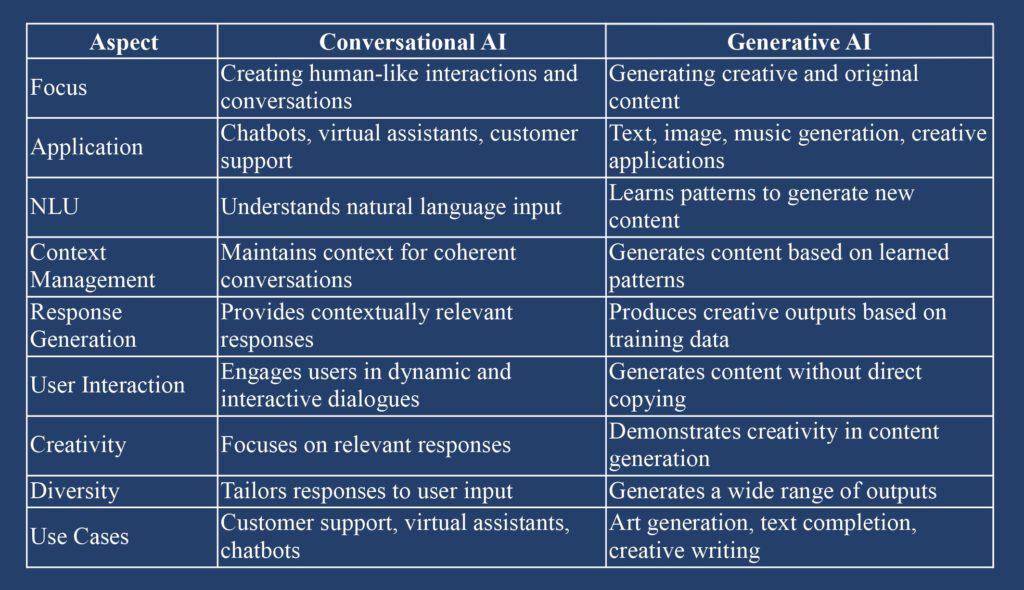
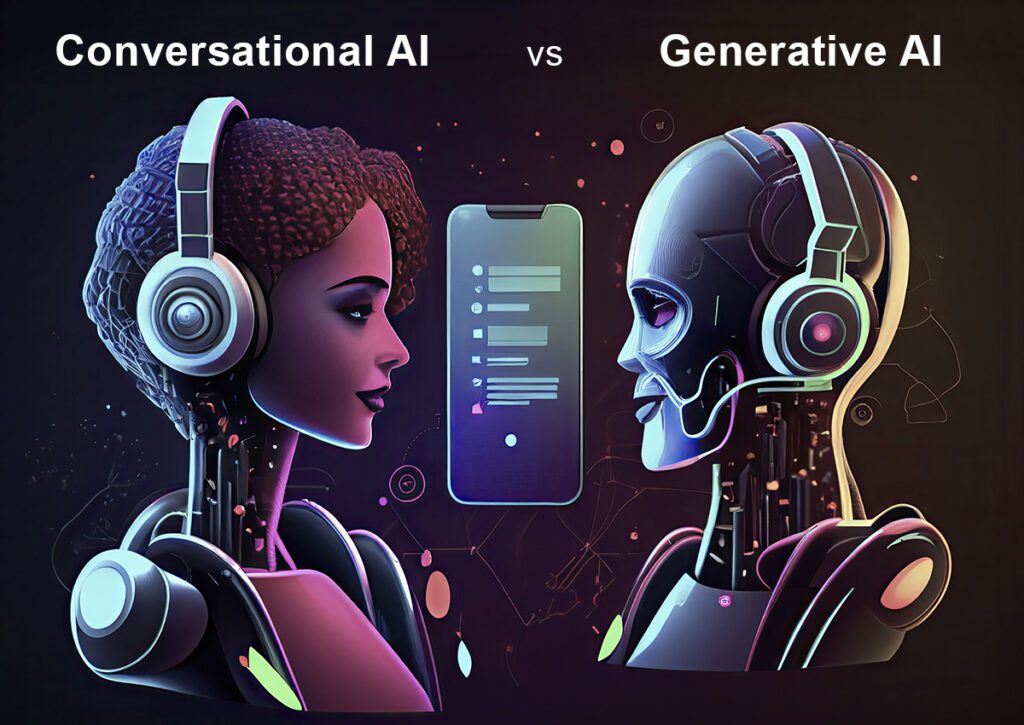
A complete guide: Conversational AI vs. generative AI

The two most prominent technologies that have been making waves in the AI industry are Conversational AI and Generative AI. They have revolutionized the manner in which humans interact and work with machines to generate content. Both these technologies have the power and capability to automate numerous tasks that humans would take hours, days, and months.

A complete guide: Conversational AI vs. generative AI

Conversational AI is characterized by its ability to think, comprehend, process, and answer human language in a natural manner like human conversation. At the other end, generative AI is defined as the ability to create content autonomously such as crafting original content for art, music, and texts.

A complete guide: Conversational AI vs. generative AI

The amalgamation of conversational AI and generative AI leads to:

• In-depth Conversations

• Human-like Experience

• Enterprise Support

• Decision Support

Exploring conversational AI

Conversational AI employs NLP and finds applications where a human touch is crucial. The best applications of conversational AI are chatbots and virtual assistants. The most popular example would be Amazon’s Alexa. They are efficient at collecting, comprehending, and sharing information just like human virtual assistants. Rule-based and ML-based approaches are majorly utilized to build conversational AI systems.

Understanding generative AI

Generative AI is creative and content-generating driven. This technique produces fresh content at record time, which may range from usual texts to intricate digital artworks. The development of GTP-3 and other pre-trained transformers (GTP) models has been a trendsetter in content creation.

Technologies involved

With the use of NLP, conversational AI takes on tasks like speech recognition and intent recognition enabling systems to understand content, tone, and intent, and conduct meaningful conversations. Generative AI relies on deep learning techniques such as GTP models and variational autoencoders to craft fresh human-like content.

Training data requirements

Huge volumes of datasets’ of human interactions are required to train conversational AI. It is through these training data, that AI learns to interpret and answer to a plethora of inputs. Generative AI models require datasets to understand styles, tones, patterns, and data types.

User experience & human interaction

Conversational AI believes in meaningful conversations. Thus, provides quick, direct, crisp, and relevant answers. Generative AI does not engage directly but contributes to user experience by coming up with useful content like blogs, music, and visual art.

Restrictions & ethical concerns

Conversational AI might face a slight struggle with context and nuanced interpretations that often lead to misunderstandings. Generative AI raises ethical concerns pertaining to widespread misinformation and biases due to incorrect training data. Therefore, it becomes imperative to strike a balance between autonomy and ethical responsibility. If the training data is accurate and error-free, the final AI model will be faultless.

What does the future hold?

The trend we observe for conversational AI is more natural and context-aware interactions with emotional connections. Generative AI’s future is dependent on generating various forms of content like scripts to digitally advance context.

Use cases:

• Conversational AI is used in industries like healthcare, finance, and e-commerce where personalized assistance is provided to customers.

• Generative AI is mostly applied to creative domains like content creation, entertainment, design, etc.

Wrapping it up

It would be right to claim conversational AI and Generative AI to be 2 sides of the same coin. Each has its own sets of positives and advantages to create content and data for varied usages. Depending on the final output required, AI model developers can choose and deploy them coherently.

Also Read: Limitless Possibilities through RLHF

OpenAI Releases GPT 3.5 Turbo Instruct 

OpenAI has silently unveiled “gpt-3.5-turbo-instruct,” a new instruction language model designed for giving specific instructions efficiently, similar to the chat-focused GPT-3.5 Turbo.

This new model will replace existing Instruct models and certain text-based models. It maintains the same cost and performance as other GPT-3.5 models within a 4K context window, using training data up to September 2021.

Compared to GPT-3.5, gpt-3.5-turbo-instruct is not a chat model. Instead, it excels in directly answering questions and completing text tasks swiftly, aligning with its purpose of following instructions effectively.

OpenAI emphasizes that GPT-4 surpasses GPT-3.5 in comprehending complex instructions, generating higher-quality output, and doing so at a faster pace and a lower cost.

Instruct models, including this new release, are a crucial foundation for the breakthroughs seen in ChatGPT, based on continual refinement through human feedback during and after pre-training. These models are known for better understanding and responding to human queries with fewer errors and less harmful content, making them preferred even when significantly smaller in parameters than regular GPT models.

In January, OpenAI had released the instruct GPT models which was intended to reduce hallucinations and coax the model to produce more ‘truthful’ and less toxic responses. GPT-3 already did this because they explained that “it is trained to predict the next word on a large dataset of Internet text, rather than to safely perform the language task that the user wants.” The model wasn’t aligned with the users and often made up facts which was combated by InstructGPT.

The main difference between the new update and the older version is that GPT 3.5 turbo instead of being conversational, will ‘instruct’ in a more task-oriented manner rather than a conversational one. The model will not be ‘chatty’ and it will follow instructions without requiring additional prompting techniques.

The post OpenAI Releases GPT 3.5 Turbo Instruct appeared first on Analytics India Magazine.

A guide to setting up analytics at a consumer tech startup

A guide to setting up analytics at a consumer tech startup

Where do you start if you want to build a data analytics function from the ground up? As an analytics leader at a startup, you will need to make several important decisions early on to build an effective team. This article dives into four decision areas and highlights ways in which to think about them:

  1. Team Structure & Skillset
  2. Foundational Processes
  3. Analytics Focus Areas
  4. Tools & Delivery

The important thing to remember at this early stage is that most, if not all, of your initial decisions will need to be revisited as the company grows and its analytics needs evolve. For the decision-making to be effective, it is important to be in lockstep with the company’s growth stage. For example, hiring a talented set of data scientists interested in deep learning before your company has aligned on its core metrics may not be the best use of resources early on (unless you are a deep learning startup, of course!).

Team structure & skillset

Centralized structure

This decision is relatively straightforward, especially if you are starting from zero and need to hire your first few data analysts. Your first few hires will need to wear several hats, support multiple teams, and set up foundational processes and reports for the entire company. Given these requirements and the broad nature of the analytics role at this stage, a centralized team structure tends to work well.

This structure allows you to ensure that the few resources available are being utilized completely and in the most impactful areas. A central structure also efficiently establishes best practices and defines core company metrics.

The appropriate team structure is definitely a decision that should be revisited over time and contextualized to the company size and stakeholder needs at different growth stages. Often, analytics teams will begin as a centralized unit and transition to a decentralized or hybrid model as additional specialization and dedicated support are required.

Broad analytics skillset

Your first few hires, as mentioned above, will be working on a wide variety of projects across domains. At this stage, you are not only interviewing for technical expertise but also for folks who are truly excited about building something from the ground up and passionate about the startup’s mission. As cliche as it might sound, they should be extremely comfortable dealing with ambiguity and adapting to changing requirements.

From a technical perspective, you will often look for candidates with a broad analytics skillset across tools and techniques versus specialists in any area. Assuming your startup already has a data engineering team that has set up the data infrastructure, you are looking for data analysts who can leverage the company’s data to generate insights and guide decision-making. You will need candidates with exceptional SQL skills and the ability to communicate and present data in a simple manner to your stakeholders. Experience with Python (or R) would be a bonus and help with automation.

A common trap when hiring early team members is overemphasizing candidates’ expertise in several technical areas while undervaluing their enthusiasm for the startup. Suppose the candidate is genuinely passionate about the company’s mission and excited about the prospect of building something new. In that case, it is worth giving them a shot, even if there is a certain technical area that they need to ramp up on.

Processes

Context is key

It is important to understand how evolved the data culture at your organization is. Are you truly data-driven, or is that just a buzzword in investor presentations? How data savvy are your stakeholders? How often are you or your team being asked to share data to assist with decision-making? The answers to these questions will help you decide what is and isn’t required from a process standpoint at any stage.

When setting up your analytics team, you can think of the processes you need to have in place from an external stakeholder perspective and an internal team standpoint. At this stage, balancing processes with the ability to move fast and iterate is crucial. Processes should only be added in places with a glaring need for them.

Don’t rush the intake process

If your stakeholders are not comfortable using data and metrics to guide their decisions, then your team goal should be to help them get there. Your choice of processes should reflect this goal. For example, instead of implementing a formal and rigid intake process where you ask all your stakeholders to fill out a detailed form to make a request, you should encourage them to reach out through whatever medium is easiest for them. It could be a simple Slack message, an email, or a casual in-person conversation.

At this stage, the role of you and your team should truly be of a coach and partner. Once you get a data request, work with your stakeholders to refine it and guide them on what data they should and shouldn’t be looking at to accomplish their end goal. Adding additional processes at the intake stage too early will only discourage outreach and be counterproductive in the long run.

Internally, however, the analytics team should maintain extensive documentation of each incoming ask. You should keep track of items such as the objective of each request, the requesting team, the SQL/Python code used to complete the request, and finally, a link to the deliverable shared. Access to this type of information can be a game-changer as the team and company grow. It will be useful to guide decisions across hiring and team structure, automation opportunities, and also for data analysts to share information and best practices quickly.

Serve before Self-Serve

An often overused phrase in the analytics community is “self-serve.” Self-serve refers to stakeholders accessing data and insights on their own through dashboards and tools, usually created by an analytics or BI team. Self-serve makes a lot of sense in organizations where teams are already data savvy and have developed sound intuition in interpreting and acting on data trends. A major advantage of self-serve is it frees up bandwidth for the analytics team to work on other important tasks. However, as with the intake process described above, how much to rely on self-serve will depend on your company’s context and its stakeholders. It is important to ensure that the analytics team is not using self-serve as a proxy for “I don’t have time for this; figure it out yourself.”

If you believe your stakeholders are not quite ready for self-serve, work your way up to it. Spend time educating them on interpreting the information you share and why it is important. Your first few reports may be automated emails pushed directly to their inboxes, removing all access barriers. The next set may be static reports available on Google Sheets. Once your stakeholders have built the habit of regularly accessing data for decision-making, you can finally begin implementing a more self-serve system with interactive dashboards using Tableau, Looker, or other similar tools.

Focus Areas

At most startups, you will be pulled in a hundred different directions, all seemingly important. While much of your time at this stage will be spent servicing the need of the hour, it will be equally important to carve out time to build foundational reports and establish baseline understanding across core business areas.

Key metrics

An important first step will be to ensure that your stakeholders are aligned on the definitions of key business metrics. Even if certain definitions seem obvious, it is worth discussing them as a group to avoid confusion later.

Once the definitions are established, you can develop one of your first few reports – a daily high-level view of key business metrics. This should not be a laundry list of every metric you are or will be tracking, but the handful that leadership and other stakeholders should have a pulse on constantly.

These metrics will vary based on company, business model, and industry, but here is an example of the metrics an audio streaming consumer app would track in such a report:

  1. Daily Active Users (New/Existing): the number of unique customers performing a certain action, such as visiting the app or playing a song, on a given day. The action(s) leading to a customer being counted as a DAU should be discussed in the definitions stage.
  1. Daily Streams: the number of song plays lasting over 30 seconds.
  1. Streams per DAU: the number of song plays per unique customer per day – this measures your daily customers’ engagement.
  1. Paid Subscribers (New/Existing) – the number of unique customers with an active paid subscription on a given day.

The first version of this foundational report may only contain information on the four key metrics above, shared in a daily email. With time, you can continue to iterate and get more granular, but having this single source of truth early will drive alignment and understanding of core metrics.

Understanding the customer journey

Almost all analytics tasks, directly or indirectly, tie back to a stage in the customer journey. For example, the asks from the marketing team are likely to be acquisition or reactivation-focused, while product may be looking for support across engagement or monetization initiatives.

The teams at a young startup may not be organized by these stages. However, it is still valuable for an analytics leader to begin developing insights for the company across this journey. Without a conscious effort to build this holistic understanding, you risk placing too much or too little emphasis on a specific focus area.

Continuing with our streaming app example, here are the types of questions you would begin to explore for each stage:

Acquisition

  • How many new customers use our app daily/weekly/monthly?
  • How are these customers finding our product? (Acquisition Source(s))
  • Are we paying to acquire new customers? If so, how much? (CAC)
  • How much monetary value do we generate from our customers (LTV), and how does this compare to our CAC?

Onboarding

  • How well are we able to onboard new customers?
  • What is the drop-off at each step of the onboarding funnel?

Activation

  • The first and more challenging step here is to come up with a definition for activation. Answering the following questions will help:
    • What actions do we want new customers to take on our product that will lead to a higher chance of them being retained?
    • When do we want them to take these actions?
    • Activation definition example: “Stream five songs within the first two sessions.”
  • What percentage of new customers are we able to activate?

Engagement & Retention

  • How much and how often are our users engaging with the product? (Streams per DAU, DAU/MAU, L7, L28)
  • How well do we retain our customers? (Retention curves by acquisition cohorts)
  • Which features are our customers engaging with and returning to most often?

Monetization

  • How many paid subscribers do we have?
  • How many free trial customers do we have?
  • What is the free to free trial and free trial to paid conversion rate?
  • What is our paid subscriber renewal rate?

Reactivation

  • How many dormant customers do we have, i.e., customers who have used our product at some point in the past but have not used it in the last 7/30/60 days?
  • How many customers do we reactivate in a given period? These customers were previously dormant but are now using the product again.

Customer Growth

  • This is not a specific stage but depends on performance across each stage described above.
  • You will want to build a detailed understanding of growth accounting, especially at a startup.
  • Levers that determine growth (or reduction) in monthly customers include:
    • New customers acquired this month (+)
    • Reactivated customers who were dormant last month but active this month (+)
    • Churned customers who were active last month but dormant this month (-)

Tools & delivery

Similar to processes, the decision around what tools to use can be broken out by tools that are internal to the analytics team, and tools that are used to share data and insight with external stakeholders. However, a guiding principle applicable across both categories is not to treat any tool as an end product or give it more importance than it deserves. Of course, you want to ensure that the tools you are using are appropriate and make your life easier, but it is important to remember that they are simply a means to an end.

The decision of what internal tools to use will be based on various factors such as team expertise, functionality provided, pricing, and budget. The tools you are using shouldn’t be set in stone and should be iterated on as needed.

For your external stakeholders, the tools used to communicate data and insights are less important than the format and delivery of that information. This applies not only to analytics teams at early-stage startups but also to more mature organizations. When sharing analyses and insights with your stakeholders, the emphasis should be on highlighting the most important takeaways in the most straightforward manner possible.

A few actionable data-driven bullets via a Slack message can have a much greater impact on your company than a hard-to-follow data dump in a CSV file. The data dump will be equally ineffective whether in a Google Sheet, Jupyter Notebook, or Tableau Workbook. Similarly, the simple and actionable bullets will be impactful regardless of whether they are read on Slack, in an email, or on a Google Doc.

Summary

In a fast-paced startup environment, building an analytics team from the ground up requires a thoughtful approach across four key areas:

Team Structure & Skillset: Start with a centralized team and hire adaptable data analysts passionate about your mission.

Processes: Context is critical when establishing processes. Align them with your organization’s data culture and encourage stakeholder interaction rather than rushing into formalities. Internally, maintain detailed documentation for future growth and efficiency.

Focus Areas: Prioritize key metrics and align on their definitions early. Follow a systematic approach to building knowledge across the customer journey, addressing acquisition, onboarding, activation, engagement, retention, monetization, and reactivation.

Tools & Delivery: Remember that tools are a means to an end. Focus on delivering insights to stakeholders in a format that resonates with them, regardless of the underlying platform.

Pryon raises $100M to index and analyze enterprise data

Pryon raises $100M to index and analyze enterprise data Kyle Wiggers 8 hours

Pryon, a startup developing an AI-powered platform to look for insights in — and surface answers from — enterprise knowledge bases, today announced that it raised $100 million in a funding round led by Thomas Tull’s U.S. Innovative Technology Fund.

Pryon’s founder, Igor Jablokov, said that the new cash will be put put toward supporting Pryon’s general growth, expanding its 100-person team, growing its presence in international markets and scaling its strategic partnerships. A source familiar with the matter tells TechCrunch that the funding, which brings Pryon’s total raised to $137 million, values the company at between $500 million and $750 million post-money.

Prior to launching Pryon, Jablokov led the multimodal AI research team at IBM. He left to create Yap, a Siri-like speech recognition startup that Amazon acquired in 2011 to jumpstart development of Alexa. (Fun fact: Pryon’s namesake was the code-name Amazon used for the speech engine underpinning Alexa.)

Pryon isn’t a voice assistant. But it is an assistant — of sorts.

Jablokov describes it as a “knowledge fabric” that can interface with a third-party chatbot or channel, ingesting data like audio, images, text and video and converting it into a format that’s searchable and usable by whatever frontend is connected to it.

An analog, Jablokov says, is Kendra, Amazon’s AI and machine learning-powered service for enterprise search. Similar to Kendra, Pryon leverages connectors to unify and index previously disparate sources of information from databases. But Jablokov claims that Pryon is up to 2x more accurate than Kendra, ingests data up to 10x faster and can index billions of documents versus Kendra’s 100,000-document limit.

“Organizations don’t need to migrate their content into the Pryon platform, as it layers over existing systems of record and doesn’t require end-user retraining to author content in a new way,” Jablokov said. “You simply point to a repository and it generates an AI model from the underlying content. If you have legacy content in there, that’s OK, since Pryon uses computer vision, optical character recognition and handwriting recognition to understand what’s in there.”

Jablokov claims that it takes less than a second for Pryon to create, update or delete content on the platform in a privacy-preserving way — and that the platform leaves no trace of its indexing work.

“Since the customer defines what goes into Pryon in terms of public, published, proprietary and personal data, there’s always attribution to authorship and ownership, so that only content they’re legally entitled to is what’s in there,” Jablokov claims.

Pryon has competition from the aforementioned Kendra as well as Microsoft SharePoint Syntex, which draws on knowledge bases to cobble together answers to company-specific questions. Startups like Hebbia, Kagi, Andi and Glean also tap machine learning models to return specific content in response to queries (as opposed to straightforward lists of results).

But Pryon appears to be doing quite well for itself, notching annual recurring revenue in the “seven figures” and securing “a dozen” large enterprise and public sector clients, including Dell, Nvidia and Westinghouse.

“Pryon is one of the few AI-native companies that was designed for enterprise use from its founding days,” Jablokov said. “It can meet the needs of the most regulated of environments, from energy to government, because of the unique way the platform safeguards content.”

Google Boosts Bard With YouTube, Maps and Other Extensions

Google has today announced a bunch of new features for Bard, the tech giant’s reply to OpenAI’s ChatGPT. While Google’s contender had a rough start, the latest update can help the company regain its podium position in the ongoing AI race.

The generative AI chatbot now has browser extensions for Google apps that pull data into user’s chat conversations. The extensions are for YouTube, Google Flights, Google Maps, and Google Drive, Google Docs, and Gmail, if you grant Bard permission to access your data.

The promising features are right there at the top right corner of the Bard screen, and you can also quickly select an extension by typing “@” followed by the extension’s name in the prompt.

Furthermore, users can now upload images with Google Lens, get Google Search images in responses, and modify Bard’s responses to be simpler, longer, shorter, more conversational or professional, and in all 40+ supported languages too.

AI chatbots are infamous for their nature of making up stuff but Google seems to have found a potential solution to the problem with Bard. The Google update notes that, ‘with the power of Google Search, the [G] button can help users double-check Bard’s responses. Moving on, Google says users can now ask Bard to find and bring together information from their Gmail inbox.

While these features sound enticing and a leap forward in human-machine communication, several red flags have been raised regarding the company’s intention. A recent exposé by Geoffrey A Fowler of The Washington Post poses a thought-provoking question: “Which data of ours is and isn’t off limits?” The investigative piece takes a deep dive into how the Valley companies including Google leech on user data and there’s not much you can do about it.

Read more: Why OpenAI Needs to be Singled Out in the Troubled Tech Valley

The post Google Boosts Bard With YouTube, Maps and Other Extensions appeared first on Analytics India Magazine.

Unveiling Unsupervised Learning

Unveiling Unsupervised Learning
Image by Author What Is Unsupervised Learning?

In machine learning, unsupervised learning is a paradigm that involves training an algorithm on an unlabeled dataset. So there’s no supervision or labeled outputs.

In unsupervised learning, the goal is to discover patterns, structures, or relationships within the data itself, rather than predicting or classifying based on labeled examples. It involves exploring the inherent structure of the data to gain insights and make sense of complex information.

This guide will introduce you to unsupervised learning. We’ll start by going over the differences between supervised and unsupervised learning—to lay the ground for the remainder of the discussion. We’ll then cover the key unsupervised learning techniques and the popular algorithms within them.

Supervised vs. Unsupervised Learning

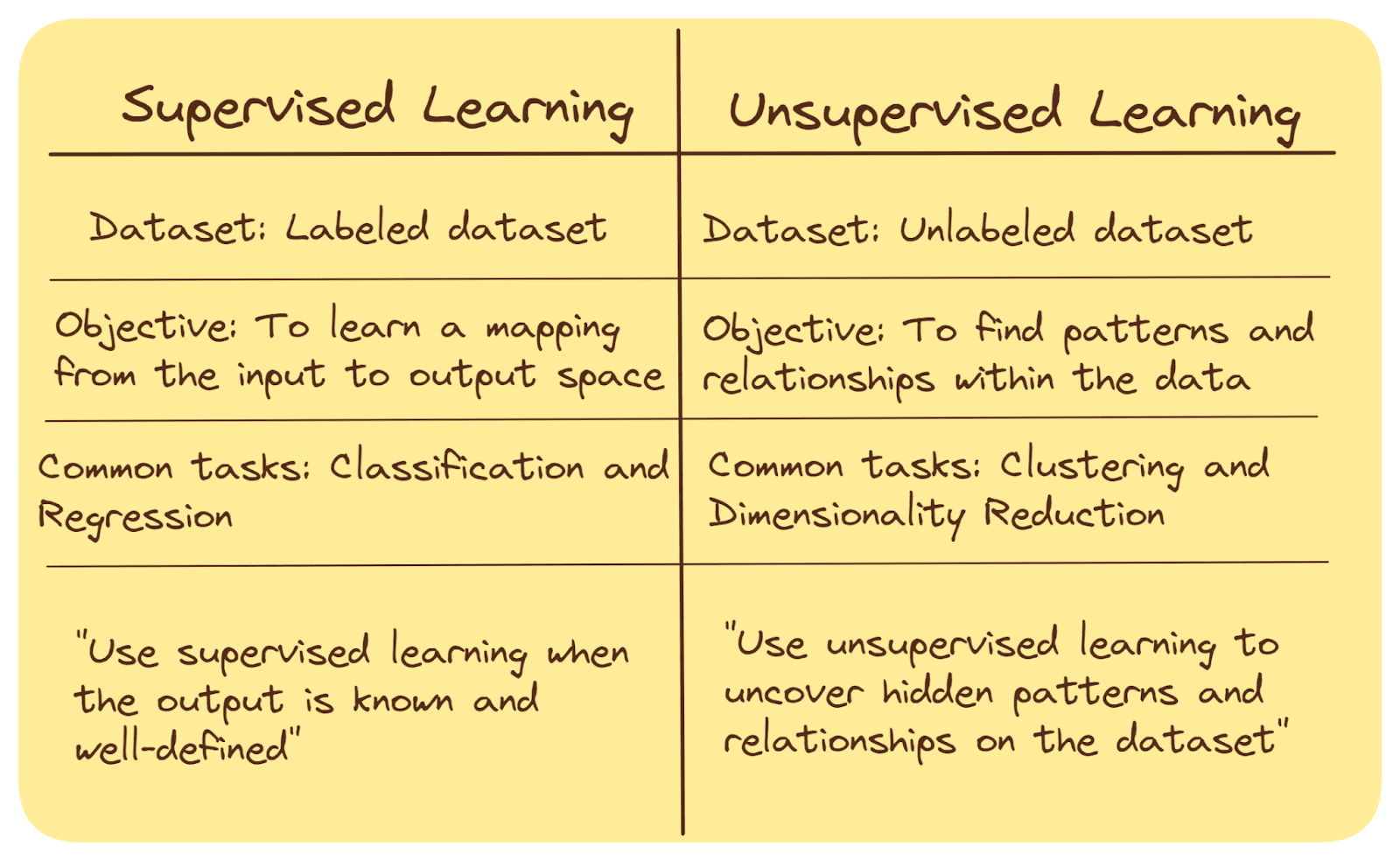
Supervised and unsupervised machine learning are two different approaches used in the field of artificial intelligence and data analysis. Here's a brief summary of their key differences:

Training Data

In supervised learning, the algorithm is trained on a labeled dataset, where input data is paired with corresponding desired output (labels or target values).

Unsupervised learning, on the other hand, involves working with an unlabeled dataset, where there are no predefined output labels.

Objective

The goal of supervised learning algorithms is to learn a relationshipa mapping—from the input to the output space. Once the mapping is learned, we can use the model to predict the output values or class label for unseen data points.

In unsupervised learning, the goal is to find patterns, structures, or relationships within the data, often for clustering data points into groups, exploratory analysis or feature extraction.

Common Tasks

Classification (assigning a class label—one of the many predefined categories—to a previously unseen data point) and regression (predicting continuous values) are common tasks in supervised learning.

Clustering (grouping similar data points) and dimensionality reduction (reducing the number of features while preserving important information) are common tasks in unsupervised learning. We’ll discuss these in greater detail shortly.

When To Use

Supervised learning is widely used when the desired output is known and well-defined, such as spam email detection, image classification, and medical diagnosis.

Unsupervised learning is used when there is limited or no prior knowledge about the data and the objective is to uncover hidden patterns or gain insights from the data itself.

Here’s a summary of the differences:

Unveiling Unsupervised Learning
Supervised vs. Unsupervised Learning | Image by Author

Summing up: Supervised learning focuses on learning from labeled data to make predictions or classifications, while unsupervised learning seeks to discover patterns and relationships within unlabeled data. Both approaches have their own applications—based on the nature of the data and the problem at hand.

Unsupervised Learning Techniques

As discussed, in unsupervised learning, we have the input data and are tasked with finding meaningful patterns or representations within that data. Unsupervised learning algorithms do so by identifying similarities, differences, and relationships among the data points without being provided with predefined categories or labels.

For this discussion, we’ll go over the two main unsupervised learning techniques:

  • Clustering
  • Dimensionality Reduction

What Is Clustering?

Clustering involves grouping similar data points together into clusters based on some similarity measure. The algorithm aims to find natural groups or categories within the data where data points in the same cluster are more similar to each other than to those in other clusters.

Once we have the dataset grouped into different clusters we can essentially label them. And if needed, we can perform supervised learning on the clustered dataset.

What Is Dimensionality Reduction?

Dimensionality reduction refers to techniques that reduce the number of features—dimensions—in the data while preserving important information. High-dimensional data can be complex and difficult to work with, so dimensionality reduction helps in simplifying the data for analysis.

Both clustering and dimensionality reduction are powerful techniques in unsupervised learning, providing valuable insights and simplifying complex data for further analysis or modeling.

In the remainder of the article, let's review important clustering and dimensionality reduction algorithms.

Clustering Algorithms: An Overview

As discussed, clustering is a fundamental technique in unsupervised learning that involves grouping similar data points together into clusters, where data points within the same cluster are more similar to each other than to those in other clusters. Clustering helps identify natural divisions within the data, which can provide insights into patterns and relationships.

There are various algorithms used for clustering, each with its own approach and characteristics:

K-Means Clustering

K-Means clustering is a simple, robust, and commonly used algorithm. It partitions the data into a predefined number of clusters (K) by iteratively updating cluster centroids based on the mean of data points within each cluster.

It iteratively refines cluster assignments until convergence.

Here’s how the K-Means clustering algorithm works:

  1. Initialize K cluster centroids.
  2. Assign each data point—based on the chosen distance metric—to the nearest cluster centroid.
  3. Update centroids by computing the mean of data points in each cluster.
  4. Repeat steps 2 and 3 until convergence or a defined number of iterations.

Hierarchical Clustering

Hierarchical clustering creates a tree-like structure—a dendrogram—of data points, capturing similarities at multiple levels of granularity. Agglomerative clustering is the most commonly used hierarchical clustering algorithm. It starts with individual data points as separate clusters and gradually merges them based on a linkage criterion, such as distance or similarity.

Here’s how the agglomerative clustering algorithm works:

  1. Start with `n` clusters: each data point as its own cluster.
  2. Merge closest data points/clusters into a larger cluster.
  3. Repeat 2. until a single cluster remains or a defined number of clusters is reached.
  4. The result can be interpreted with the help of a dendrogram.

Density-Based Spatial Clustering of Applications with Noise (DBSCAN)

DBSCAN identifies clusters based on the density of data points in a neighborhood. It can find arbitrarily shaped clusters and can also identify noise points and detect outliers.

The algorithm involves the following (simplified to include the key steps):

  1. Select a data point and find its neighbors within a specified radius.
  2. If the point has sufficient neighbors, expand the cluster by including the neighbors of its neighbors.
  3. Repeat for all points, forming clusters connected by density.

Dimensionality Reduction Algorithms: An Overview

Dimensionality reduction is the process of reducing the number of features (dimensions) in a dataset while retaining essential information. High-dimensional data can be complex, computationally expensive, and is prone to overfitting. Dimensionality reduction algorithms help simplify data representation and visualization.

Principal Component Analysis (PCA)

Principal Component Analysis—or PCA—transforms data into a new coordinate system to maximize variance along the principal components. It reduces data dimensions while preserving as much variance as possible.

Here’s how you can perform PCA for dimensionality reduction:

  1. Compute the covariance matrix of the input data.
  2. Perform eigenvalue decomposition on the covariance matrix. Compute the eigenvectors and eigenvalues of the covariance matrix.
  3. Sort eigenvectors by eigenvalues in descending order.
  4. Project data onto the eigenvectors to create a lower-dimensional representation.

t-Distributed Stochastic Neighbor Embedding (t-SNE)

The first time I used t-SNE was to visualize word embeddings. t-SNE is used for visualization by reducing high-dimensional data to a lower-dimensional representation while maintaining local pairwise similarities.

Here's how t-SNE works:

  1. Construct probability distributions to measure pairwise similarities between data points in high-dimensional and low-dimensional spaces.
  2. Minimize the divergence between these distributions using gradient descent. Iteratively move data points in the lower-dimensional space, adjusting their positions to minimize the cost function.

In addition, there are deep learning architectures such as autoencoders that can be used for dimensionality reduction. Autoencoders are neural networks designed to encode and then decode data, effectively learning a compressed representation of the input data.

Some Applications of Unsupervised Learning

Let’s explore some applications of unsupervised learning. Here are some examples:

Customer Segmentation

In marketing, businesses use unsupervised learning to segment their customer base into groups with similar behaviors and preferences. This helps tailor marketing strategies, campaigns, and product offerings. For example, retailers categorize customers into groups such as "budget shoppers," "luxury buyers," and "occasional purchasers."

Document Clustering

You can run a clustering algorithm on a corpus of documents. This helps group similar documents together, aiding in document organization, search, and retrieval.

Anomaly Detection

Unsupervised learning can be used to identify rare and unusual patterns—anomalies—in data. Anomaly detection has applications in fraud detection and network security to detect unusual—anomalous—behavior. Detecting fraudulent credit card transactions by identifying unusual spending patterns is a practical example.

Image Compression

Clustering can be used for image compression to transform images from high-dimensional color space to a much lower dimensional color space. This reduces image storage and transmission size by representing similar pixel regions with a single centroid.

Social Network Analysis

You can analyze social network data—based on user interactions—to uncover communities, influencers, and patterns of interaction.

Topic Modeling

In natural language processing, the task of topic modeling is used to extract topics from a collection of text documents. This helps categorize and understand the main themes—topics—within a large text corpus.

Say, we have a corpus of news articles and we don’t have the documents and their corresponding categories beforehand. So we can perform topic modeling on the collection of news articles to identify topics such as politics, technology, and entertainment.

Genomic Data Analysis

Unsupervised learning also has applications in biomedical and genomic data analysis. Examples include clustering genes based on their expression patterns to discover potential associations with specific diseases.

Conclusion

I hope this article helped you understand the basics of unsupervised learning. The next time you work with a real-world dataset, try to figure out the learning problem at hand. And try to assess if it can be modeled as a supervised or an unsupervised learning problem.

If you’re working with a dataset with high-dimensional features, try to apply dimensionality reduction before building the machine learning model. Keep learning!
Bala Priya C is a developer and technical writer from India. She likes working at the intersection of math, programming, data science, and content creation. Her areas of interest and expertise include DevOps, data science, and natural language processing. She enjoys reading, writing, coding, and coffee! Currently, she's working on learning and sharing her knowledge with the developer community by authoring tutorials, how-to guides, opinion pieces, and more.

More On This Topic

  • Unsupervised Learning for Predictive Maintenance using Auto-Encoders
  • Unsupervised Disentangled Representation Learning in Class Imbalanced…
  • Exploring Unsupervised Learning Metrics
  • Clustering with scikit-learn: A Tutorial on Unsupervised Learning
  • Unveiling the Potential of CTGAN: Harnessing Generative AI for Synthetic…
  • Unveiling Midjourney 5.2: A Leap Forward in AI Image Generation
Upskilling of Engineering Talent Key to Stay Relevant in Global Markets: L&T Technology CEO

Every time a new technology knocks on our doors, it always comes with force, and as always, the concerns are on whether this new technology will make humans redundant. In this era of generative AI, similar concerns have surfaced, capturing the attention of the general public. But automation has been a part of our evolution for years, according to Amit Chadha, chief executive and managing director at L&T Technologies Services (LTTS).

“I understand the concerns about AI and automation potentially replacing jobs, particularly in coding and other entry-level roles. However, it is important to note that automation has been a part of our evolution for years. We have seen transitions from fax machines to WhatsApp communications, the shift from manual to automated testing, and now the rise of AI-driven automation,” he told AIM.

In fact, the issue of machines replacing human labour has been discussed since at least Aristotle’s time. To be more specific, Chadha said that he doesn’t foresee automation completely eradicating entry-level coding positions. Instead, he believes it will reshape the nature of the work, and introduce new kinds of jobs. In this changing environment, coders proficient in generative AI will find themselves highly sought after.

Reskilling is key

As our economy becomes more digital, new roles will surface. While older roles may become redundant, they will be replaced by new ones with digital skill sets. The key lies in adaptability, upskilling and continuous learning. Currently, many organisations are splashing a good amount of money to upskill their workforce on generative AI, including the Indian IT giants like Wipro, TCS and Infosys.

Chadha says L&T Technology also remains dedicated to upskilling its employees to navigate new technologies and roles. Chadha believes upskilling of engineering talent will be a defining factor in remaining relevance in the global market. “L&T Technology has already taken a key step in this direction with its Global Engineering Academy (GEA).

“The academy is responsible for the onboarding training of all fresher hires across our locations and conducted over 450 sessions in the last fiscal. A first-of-its-kind initiative, the academy has helped retrain and enhance the skill sets of over 4,500 of our engineers to enhance our delivery capabilities across evolving global customer requirements, including at our Krakow, Poland centre.”

Leveraging generative AI

L&T Technology has recognised the transformative potential of Large Language Models (LLMs) in today’s technological arena. “In fact, we were among the early adopters of models like BERT, RoBERTa, and ALBERT, trained on 350 million parameters, setting the benchmark in 2021. These models form the basis of our foundational starting point,” Chadha said.

Besides the models mentioned above, the Vadodara-headquartered firm is also leveraging newer models like OpenAI’s GPT series as well as LLaMA from Meta. While they are not looking to build an LLM from scratch, they remain dedicated to enhancing existing models to craft solutions that resonate with their clients and the sectors they cater to. “We channel significant resources into refining them to meet the distinct needs of various sectors, from healthcare to SDV and industrial equipment. For example, we’ve employed specialised models like DenseNet for tasks involving X-ray analysis.”

“Moreover, our commitment isn’t limited to our clients – we also utilise AI internally to further our own digital transformation across teams as diverse as HR, finance and operations. The in-house application of AI not only deepens our understanding of the technology but also equips us to tackle the challenges of deploying AI solutions for our clients,” Chadha added.

Challenges in deploying generative AI

While organisations across multiple industries today are integrating generative AI to improve their offering, the technology also comes with its own set of challenges such as security risks and hallucinations. Chadha, while addressing these challenges, notes that one of the primary challenges L&T Technology has encountered while leveraging generative AI is data.

“Securing the right kind of data in the necessary volume often poses difficulties. In the absence of data from OEMs or clients, there’s a need to generate synthetic data, which might not always be production-ready. This remains an industry-wide challenge,” Chadha said. Moreover, the intricacy of the technology and its associated hardware is another concern for L&T Technology.

“Even though hardware costs have decreased, its complexity persists, demanding specialised expertise. We have grappled with issues related to model optimisation, especially crucial when handling expansive models. Additionally, generative AI is most effective for intricate use-cases, which can be elusive within certain sectors. Identifying the right business scenarios that could benefit from AI necessitated extensive research, involving close collaboration with clients and domain experts.”

L&T’s AI endeavour began six years ago

L&T Technology’s endeavour with AI began nearly six years ago. Over the years, the company has delved into various facets of AI, including Natural Language Processing (NLP), image processing, and ML. In the last few years, the company has crafted several AI-enabled platforms that are currently in active production. “We’ve crafted a number of AI-powered platforms, backed by close to 50 patents. These platforms cater to diverse departments and sectors, encompassing engineering, quality management, and regulatory assurance.”

One notable platform is AiKno, which centres on AI solutions for industrial applications, especially in the Oil & Gas sectors. “AiKno harnesses extensive models of NLP and has been effectively implemented over time, enhancing efficiencies, and addressing intricate challenges for our clients in these sectors.”

Another is an AI-driven quality assurance tool compliant with medical standards and an AI-facilitated annotation tool designed for Advanced Driver-Assistance Systems (ADAS). “These platforms have moved beyond the experimental phase, with tangible customer references and active implementations. Our internal adoption of AI has not only bolstered our R&D endeavours but has also been instrumental in addressing tangible business challenges,” he concluded.

The post Upskilling of Engineering Talent Key to Stay Relevant in Global Markets: L&T Technology CEO appeared first on Analytics India Magazine.

MigRun wants to simplify the process of immigrating to a new country

MigRun wants to simplify the process of immigrating to a new country Kyle Wiggers 8 hours

Two year ago, after Vlad Shipilov, a Russian immigrant, moved to Portugal, his business visa was denied because his lawyer wasn’t aware of certain requirements pertaining to visa applications originating from Russia. It ultimately took $16,000, joining immigration groups on Telegram and Facebook and the help of a Portugal-based friend to secure Shipilov his visa — and residency.

Shipilov quickly came to realize that his experience wasn’t unique.

“I found that there were many ‘handlers’ and scammers in this market,” Shipilov told TechCrunch in an email interview. “For instance, Portuguese passive-income visa consulting agencies can cost $3,000, $5,000 or even $8,000, while lawyers charge $800 to $1,000 — and none of them provide any guarantees. I believe that your immigration should inspire you, not cause stress and make you pay for nothing.”

So Shipilov, along with the friend he met in Portugal, Sergey Kotlov, started writing free guides, providing chat support and finding lawyers to deliver low-cost or free consultations for immigrants. The pair later decided to start a business — MigRun — to scale their support to new countries and immigrant cohorts.

MigRun, a participant in the Startup Battlefield 200 competition at TechCrunch Disrupt 2023, provides personalized assistance to people immigrating to another country based on similar experiences from other immigrants. MigRun collects immigration cases and layers tech and analysis on top, including free guides, instructions, deadline reminders and alerts.

“We help people feel the same level of predictability and security when moving from their country as with an expensive handler, but with a money-back guarantee, up to seven times cheaper and fully digital,” Shipilov said. “We aim to convince people from developing countries that they can handle immigration on their own, and don’t need to pay a lot of cash for basic advice based on one person’s experience just to feel safe.”

MigRun isn’t the only platform providing a way for immigrants to get in touch with experts and file applications for visas. Boundless, which recently acquired two other immigration-focused tech startups, Bridge and RapidVisa, comes to mind. So does Lawfully.

But what makes MigRun different is the breadth and depth of its platform, Shipilov asserts — and its investment in automation.

For one, MigRun provides resources targeted not only at immigrants in particular countries but at groups of people immigrating from one country to another — e.g. Morocco to Italy, Russia to Italy or Turkey to Italy. Users can chat with someone who’s gone through the same process from their home country or country of residence, or tap a conversational assistant trained on similar cases and publicly documented visa requirements.

“Our main goal is to create a network of immigration assistants who exclusively work through our platform,” Shipilov said. “We have detailed information for thousands of immigration cases, and we expect to handle tens of thousands more in the future. This data includes complete profiles of immigrants, all the documents used for visa and residence permit applications (including passports, birth certificates and bank records), chat logs of interactions between immigrants and our assistants and more. We keep this data up to date, so if consulate or immigration office requirements change, we know about it almost immediately. We also know whether an application was approved or denied and the reasons for any rejections.”

MigRun

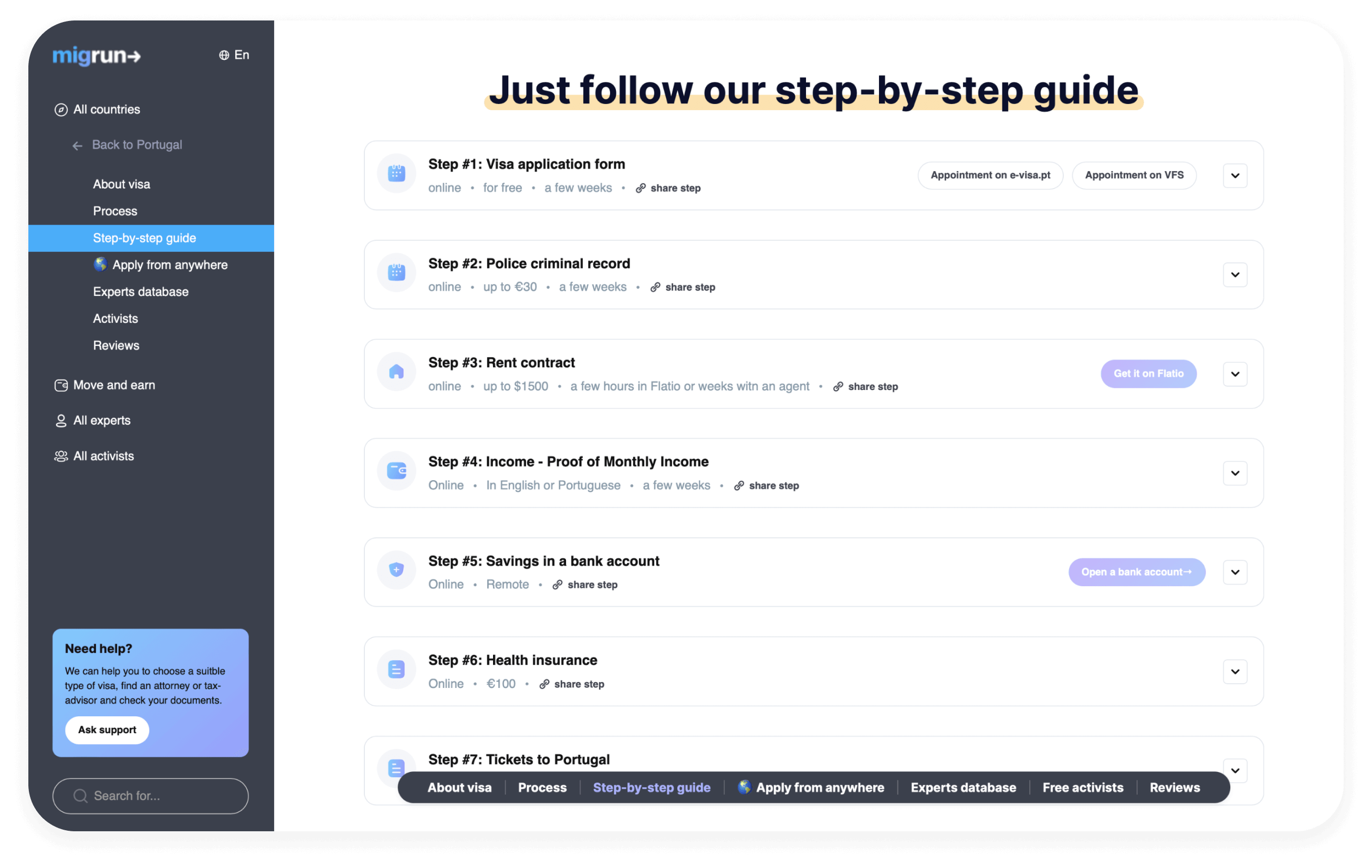
MigRun provides a range of both paid and free immigration resources.

MigRun uses this data to train its conversational assistant, aptly called Virtual Assistance. Shipilov claims it can even account for bias in immigration decisions, like when an immigration officer’s read of the law differs from the standard interpretation.

“Thanks to our extensive data set, our assistant can provide very specific advice, like how to apply for a Portuguese Digital Nomad visa in Istanbul, for example,” Shipilov said. “In most cases, it’s easier to adapt your application to match the preferences of the specific officer or immigration office you’re dealing with, rather than arguing with them to prove you’re right. This can save a lot of time and money.”

That’s a lot of sensitive data that MigRun’s storing — particularly for immigrants in countries with poor human rights records. Shipilov claims that the platform keeps immigrants’ identities anonymous and that it doesn’t pass personal data to third-party service providers without explicitly saying why it’s necessary. But he acknowledges that MigRun does retain this data for some time — at least 90 days and up to a year — unless a user requests their data be deleted sooner.

Asked to clarify MigRun’s retention policy, Shipilov said: “The rule is simple for us: we don’t sell personal data.”

MigRun — which also sees immigration agencies like VisaDB and Lawfully as its competitors — has been completely bootstrapped until now. Shipilov claims that the startup has over 3,900 customers and 16,000 monthly active users.

The plan for the near term is to focus on growth. In the next year, seven-employee MigRun aims to add support for more countries, fund product development on the AI assistant and paperwork automation side and increase revenue to $3 million per year. (MigRun claims to have made $800,000 in its first 12 months.)

“Currently, we have a 50% profit margin, but we seek to increase it to 70% by the end of 2024 and 90% in 2025 through the use of AI assistants, automation, and decreasing consultants roles,” Shipilov said. “More than 100 million people from developing countries immigrate annually. Therefore, even if we capture only 3% to 5% of the total market, which is worth $12 billion, it’d mean that we can assist millions of professionals, entrepreneurs, digital nomads, talented individuals, passive income holders and families to find better places, dramatically change their lives and save them billions of dollars.”

ChatGPT Cut-Off Date Now January 2022

ChatGPT Cut-off Date Now January 2022

While the world waits for ChatGPT to connect to the internet and GPT-4 multimodal, OpenAI has expanded its knowledge capabilities, but only a little bit. ChatGPT Plus, which is based on GPT-4 can now access information up to January 2022, while free users of ChatGPT based GPT-3.5 still have the knowledge cut-off of September 2021.

Apart from looking at it as a minor improvement, this definitely is a hint that OpenAI has added more capabilities, such as training its LLMs on more data. Though the company hasn’t made any announcement about the change, people on HackerNews and X are finding out and sharing the change.

I see no one reporting on the change in the cut-off date of ChatGPT, which is now January 2022. It was September 2021. This is huge… Why is no one reporting on it?! pic.twitter.com/5hgKJDD3Gc

— reinier van eijk (@reiniervaneijk) September 18, 2023

According to another user on HackerNews, if using the ChatGPT API, the chatbot mentions that the cut-off date is actually July 2023. To this, another user pointed out that asking ChatGPT itself about its knowledge cut-off is not a sure shot way of proving it.

Recently, OpenAI also announced ChatGPT Enterprise, catering for businesses. This expansion of the cut-off date might be a way of introducing more prices within the chatbot’s model. Even then, ChatGPT still hallucinates while giving information as mentioned by some users on X.

In another recent report, OpenAI has said that it is also planning to release GPTVision, which is going to be the multimodal version of GPT-4, in a bid to compete with Google DeepMind’s rush towards Gemini. The anonymous source also said that this might also be the first step towards GPT-5. OpenAI is yet to make a formal announcement about the same.

OpenAI has also announced its DevDay, a developer conference in San Francisco on November 6, 2023. There has been a lot of anticipation about what the company is going to announce, though Sam Altman has said that there is going to be no announcement about GPT-5.

Some predictions for OpenAI’s developer day on November 6th…
– Meaningful GPT-4 cost reduction
– Fine-tuning for GPT-4
– UI for fine-tuning
– Multimodal GPT-4 goes live
– DALL-E 3
– ChatGPT API (rethinking of plugins)
I bet I hit on at least 3.

— Mckay Wrigley (@mckaywrigley) September 15, 2023

The post ChatGPT Cut-Off Date Now January 2022 appeared first on Analytics India Magazine.