You can access Google’s latest AI experiments with Google Labs. Here’s how

Google Labs

Although Google Bard is the only one of Google's AI models that's generally available, the company has many different projects under wraps that have the capability of transforming your entire workflow, helping you generate music, and more. Although these projects haven't been released yet, the good news is you can try them out via Google Labs.

Google Labs is Google's platform where users can test out the company's early ideas for features and products, and provide feedback that affects whether the experiments are deployed and what changes are made before they are released.

Also: Back to school? How ChatGPT can help you with your essay writing

Currently available on Google Labs are some of the company's latest projects, including: Search Labs, Google's new Search with AI; Workspace Labs, the AI-infused Google Workspace; Notebook LM, Google's first AI notebook; and MusicLM, Google's first AI music generator.

Many of the experiments require you to enroll on a waitlist in Google Labs, and once you get off the list, you are able to start tinkering with Google's latest technology.

How to join Google Labs' waitlists

If you're interested, you can sign up for Google Labs' different waitlists today. Here's how.

Artificial Intelligence

IBM Unveils Ambitious Plan to Train 2 Million Individuals in AI by 2026, Prioritising Underrepresented Communities

Technology leader IBM has announced an initiative to train 2 million learners in artificial intelligence, by the end of 2026. The main objective of this step is to focus on underrepresented communities and help close the global AI skills gap.

The company also launched a new generative AI coursework through IBM skillsBuild. Through IBM SkillsBuild, learners across the world can benefit from AI education developed by IBM experts. SkillsBuild already offers free coursework in AI fundamentals, chatbots, and AI ethics. The new generative AI roadmap includes Prompt-Writing, Getting Started with Machine Learning, Improving Customer Service with AI, and Generative AI in Action.

AI-enhanced features within the IBM SkillsBuild learning experience will include chatbot improvements to help support learners throughout their journeys, and tailored learning paths based on each learner’s personal preferences and experiences. These courses are free. At course completion, participants will be able to earn IBM-branded digital credentials that are recognized by potential employers.

IBM Vice President & Chief Impact Officer, Justina Nixon-Saintil said that AI skills will be essential to tomorrow’s workforce, and that’s the reason why IBM is investing in AI training.

AI training for universities

According to a recent study conducted by IBM Institute of Business Value, implementing AI and automation will require 40% of its workforce to reskill over the next 3 years, mostly entry-level positions. This means that generative AI is creating a demand for new roles and skills.

IBM is collaborating with universities all over the world, to build capacity by leveraging IBM’S network of experts. University faculty will have access to IBM-led training such as lectures and immersive skill experiences, including certificates upon completion. IBM will provide courseware for faculty to use in the classroom, including self-directed AI learning paths. In addition to faculty training, IBM will also offer students flexible and adaptable resources, including free, online courses on generative AI and Red Hat open source technologies.

Worldwide, the skills gap presents a major obstacle to the successful application of AI and digitalization, across industries, and beyond technology experts. This new effort builds on IBM’s existing commitment to skill 30 million people by 2030, and is intended to address the urgent needs facing today’s workforce.

This development coincides with similar efforts by tech giants like MongoDB and Infosys, who are offering complimentary courses to empower individuals through self-learning. These companies recognize the potential for individuals not only to upskill but also to secure employment opportunities based on their performance in tasks and certifications.

The post IBM Unveils Ambitious Plan to Train 2 Million Individuals in AI by 2026, Prioritising Underrepresented Communities appeared first on Analytics India Magazine.

Why Atlassian Chose Not to Rush Through LLMs

Less than a year ago, when Microsoft-backed OpenAI introduced GPT technology through its AI chatbot, the majority of companies rushed to embrace this human-like technology. Despite the huge attention, not all of the tech firms jumped to embrace the tool; one of them being Atlassian.

Last week, the software company’s Chief Technology Officer Rajeev Rajan sat down with AIM to list down the company’s technological priorities and why Atlassian chose not to rush to large language models.

During the conversation at the Bengaluru office, he emphasised at certain instances that the cloud remains a top priority for Atlassian. He stated, “The value proposition of cloud is pretty clear both for customers as well as for providers like us. For the overall ecosystem we continue to invest a lot in the cloud as 99% of our customer base is on cloud.”

He added, “Our primary focus is to innovate and deliver features that enhance our customers’ experience. We want to harness the data already available to us to unlock value for our customers, leveraging existing developments. Building our own model is not our highest priority at this juncture.”

“We care about security and privacy first and foremost. Our chief trust officer [Adrian Ludwig] looks at these things holistically whether to go with any provider. We are still learning the game and will constantly evaluate different elements and providers to get the best of breed and then maybe end up in a combination,” elaborated Rajan on why the company chose OpenAI’s ChatGPT over other enterprise specific models provided by Cohere and others.

In April, Atlassian unveiled Atlassian Intelligence, an AI-driven “virtual teammate” that harnesses the company’s proprietary models in conjunction with OpenAI’s technology. This synergy enables the creation of customised teamwork graphs and facilitates features such as AI-generated summaries in Confluence and test plans in Jira Software, as well as rewriting customer responses in Jira Service Management.

A Year at Glance

Exactly one year ago, Rajan joined the Sydney-based software company as its CTO. Reflecting on his ongoing stint at the company he shared, “I was really attracted to Atlassian for the values of the company as well as the story of the founders and how the company started a really strong position with JIRA for engineers. I’m an engineer, I’ve always been one. To me, building software that is used by every inch of the world, to learn because some companies use our software in the cloud, is really empowering”.

He recounted his inaugural year, stating, “The first year has been about, ‘how do we take what we have to get to the next level of growth?’”

“We have a goal of getting to really being the best in class, world class engineering. What does it take to have what we call developer joy? We spend a lot of time with that programme, getting it up and running for the company and then building that into products so that we can influence every other tech company out there,” he continued.

Rajan who has also served as Meta’s engineering lead, delved further into the technical aspect of Atlassian, explaining, “When you write code to build software, you end up with legacy code also called monoliths. One of the things we have been doing last year is to decompose the monolithic software into micro services so that you have more scalar architecture, and it’s easier for engineers to go and make changes as opposed to legacy code. We have done a lot of reengineering of our code bases to commit engineers.”

Prior to joining Atlassian, Rajan had served as Vice President and Head of Engineering at Meta, with a distinguished career spanning over two decades at Microsoft, where he played pivotal roles, including leading the team responsible for Office 365’s Cloud Infrastructure.

Developing, Responsibly

Discussing the responsible adoption of AI, at several instances during the interview Rajan emphasised that Atlassian is crystal clear about its role in ensuring responsible technology practices, particularly in AI adoption.

He revealed, “We have established a working group that meets every month that looks at a bunch of questions around the responsibilities of AI. That’s one example of a responsible AI workstream. Secondly, when we have any new technology like AI, we have a whole set of objectives or questions that equals whenever we use any AI technology or develop something ourselves. We have a checklist to make sure it is adhering to these practices in terms of ethics.”

“This is really ingrained into our development process. We are totally aligned with those efforts as well to make sure that in the end, humanity gets the advances in technology without the ill effects that everyone’s worried about,” Rajan concluded.

The post Why Atlassian Chose Not to Rush Through LLMs appeared first on Analytics India Magazine.

Google Reveals Combined SIEM and SOAR Update for Chronicle Security Operations Platform

Google Cloud announced today that an updated version of its Chronicle Security Operations platform is available in preview. The update unifies security information and event management and security orchestration, automation and response, plus adds an Applied Threat Intelligence tool. The preview includes the chatbot Duet AI. At the same time, a new attack surface management service for Chronicle Security Operations from Mandiant was added.

Chronicle Security Operations is a subscription service, with pricing available on request.

Jump to:

  • What’s new in the Chronicle Security Operations update?
  • Duet AI chats with Chronicle Security Operations
  • Google’s Mandiant offerings expand with Attack Surface Management
  • Competitors to Google Chronicle Security Operations

What’s new in the Chronicle Security Operations update?

Google has combined SIEM and SOAR in Chronicle Security Operations to help security operations teams parse the massive amounts of data they receive. Software companies have been trying since the advent of modern big data collection to go beyond collection into effectively utilizing data. Security teams need to be able to see unified data connected in intuitive and practical ways and to know what data or alert to act on first.

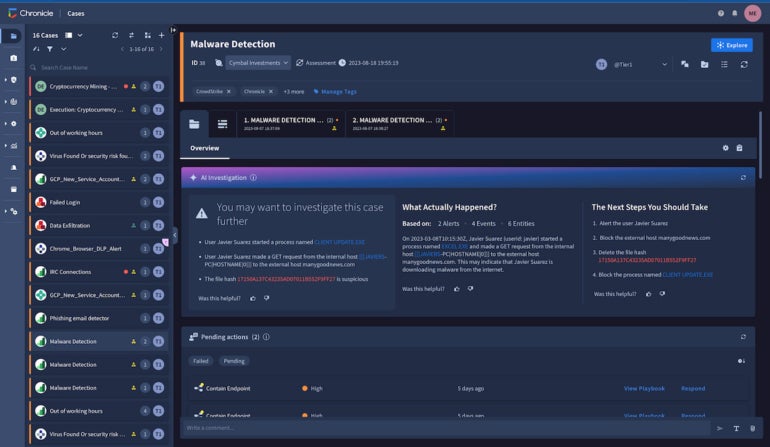
In the version of Chronicle now in preview, the application automatically groups alerts into cases; each case includes related alerts and enrichment. Ideally, this will help security teams make faster decisions, Google said.

SEE: What is DevSecOps? (TechRepublic)

“We have advanced capabilities around threat intelligence that are highly integrated into the Chronicle platform,” said Bashar Abouseido, chief information security officer at Charles Schwab, in the Google post about the news. “We like the orchestration capabilities that enable us to enrich the data and provide additional context to it, so our SOC and analysts are able to prioritize that work and respond with the attention that is needed.”

Applied Threat Intelligence tool collects information about threats

Applied Threat Intelligence is a new capability in Chronicle Security Operations, and it is now available in preview alongside the SIEM/SOAR unification update. It pulls threat intelligence from Google Cloud, Mandiant and VirusTotal, then applies that threat intelligence to the events listed in Chronicle Security Operations to enrich and contextualize each event. Artificial intelligence and machine learning decide how threats should be prioritized based on the specific needs of each security team.

If an event matches a known threat indicator, Applied Threat Intelligence will add the threat actor, threat campaign or malware family context. Then, security researchers can use custom searches or detections to find out more about the information Applied Threat Intelligence provides. Essentially, Google wants to use its search engine prowess to make active security events equally searchable.

Duet AI chats with Chronicle Security Operations

Built on the Vertex AI platform, the Duet AI chatbot assistant allows security researchers to ask questions in natural language and can summarize cases and guidance. (Figure A.) With Duet AI, SecOps workers will be able to search Chronicle Security Operations for threats, responses and the status of cases. The Duet AI integration is now in preview.

Figure A

The Google Chronicle Security Operations dashboard with natural language suggestions from Duet AI.
The Google Chronicle Security Operations dashboard with natural language suggestions from Duet AI. Image: Google

“Duet AI in Chronicle instantly turns natural language queries into complex searches, which helps people new to security ramp up faster and makes experts even more productive,” Eric Doerr, vice president of engineering, cloud security at Google Cloud, told TechRepublic in an email.

Google’s Mandiant offerings expand with Attack Surface Management

Starting now, Google has added Mandiant Attack Surface Management to Chronicle Security Operations. Mandiant Attack Surface Management identifies and validates exploitable entry points. Like the other Chronicle Security Operations updates, it is designed to help the SecOps team decide which risks are most impactful and therefore should be mitigated first. Google acquired Mandiant in September 2022.

Competitors to Google Cloud Chronicle Security Operations

Alternatives to Chronicle Security Operations include Microsoft Sentinel, Splunk Enterprise (for data analysis and searching), IBM Security QRadar, Datadog (for SIEM), Devo Technology and Oracle Security Monitoring and Analytics from Oracle Cloud.

Google Weekly

Subscribe to the Google Weekly Newsletter

Learn how to get the most out of Google Docs, Google Cloud Platform, Google Apps, Chrome OS, and all the other Google products used in business environments.

Delivered Fridays Sign up today

White Hat Hackers Discover Microsoft Leak of 38TB of Internal Data Via Azure Storage

Microsoft has patched a vulnerability that exposed 38TB of private data from its AI research division. White hat hackers from cloud security company Wiz discovered a shareable link based on Azure Statistical Analysis System tokens on June 22, 2023. The hackers reported it to the Microsoft Security Response Center, which invalidated the SAS token by June 24 and replaced the token on the GitHub page, where it was originally located, on July 7.

Jump to:

  • SAS tokens, an Azure file-sharing feature, enabled this vulnerability
  • What businesses can learn from the Microsoft data leak

SAS tokens, an Azure file-sharing feature, enabled this vulnerability

The hackers first discovered the vulnerability as they searched for misconfigured storage containers across the internet. Misconfigured storage containers are a known backdoor into cloud-hosted data. The hackers found robust-models-transfer, a repository of open-source code and AI models for image recognition used by Microsoft’s AI research division.

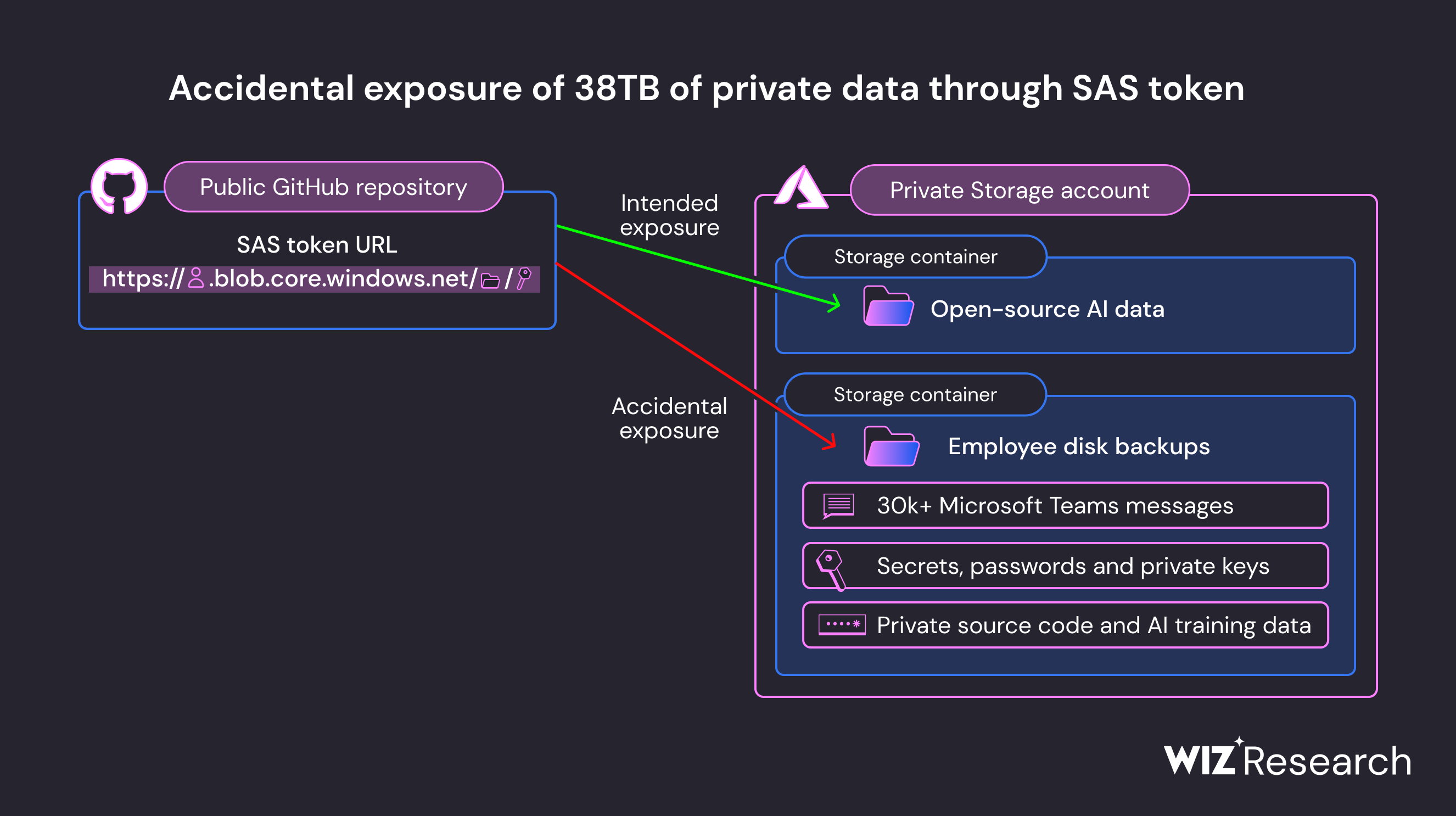
The vulnerability originated from a Shared Access Signature token for an internal storage account. A Microsoft employee shared a URL for a Blob store (a type of object storage in Azure) containing an AI dataset in a public GitHub repository while working on open-source AI learning models. From there, the Wiz team used the misconfigured URL to acquire permissions to access the entire storage account.

When the Wiz hackers followed the link, they were able to access a repository that contained disk backups of two former employees’ workstation profiles and internal Microsoft Teams messages. The repository held 38TB of private data, secrets, private keys, passwords and the open-source AI training data.

SAS tokens don’t expire, so they aren’t typically recommended for sharing important data externally. A September 7 Microsoft security blog pointed out that “Attackers may create a high-privileged SAS token with long expiry to preserve valid credentials for a long period.”

Microsoft noted that no customer data was ever included in the information that was exposed, and that there was no risk of other Microsoft services being breached because of the AI data set.

What businesses can learn from the Microsoft data leak

This case isn’t specific to the fact that Microsoft was working on AI training — any very large open-source data set might conceivably be shared in this way. However, Wiz pointed out in its blog post, “Researchers collect and share massive amounts of external and internal data to construct the required training information for their AI models. This poses inherent security risks tied to high-scale data sharing.”

Wiz suggested organizations looking to avoid similar incidents should caution employees against oversharing data. In this case, the Microsoft researchers could have moved the public AI data set to a dedicated storage account.

Organizations should be alert for supply chain attacks, which can occur if attackers inject malicious code into files that are open to public access through improper permissions.

SEE: Use this checklist to make sure you’re on top of network and systems security (TechRepublic Premium)

“As we see wider adoption of AI models within companies, it’s important to raise awareness of relevant security risks at every step of the AI development process, and make sure the security team works closely with the data science and research teams to ensure proper guardrails are defined,” the Wiz team wrote in their blog post.

TechRepublic has reached out to Microsoft and Wiz for comments.

Subscribe to the Cybersecurity Insider Newsletter

Strengthen your organization's IT security defenses by keeping abreast of the latest cybersecurity news, solutions, and best practices.

Delivered Tuesdays and Thursdays Sign up today

How to use ChatGPT to do research for papers, presentations, studies, and more

typing on a laptop

ChatGPT is often thought of as a tool that will replace human work on tasks such as writing papers for students or professionals. But ChatGPT can also be used to support human work, and research is an excellent example.

Whether you're working on a research paper for school or doing market research for your job, initiating the research process and finding the correct sources can be challenging and time-consuming.

Also: 5 handy AI tools for school that students, teachers, and parents can use, too

ChatGPT and other AI chatbots can help by curtailing the amount of time spent finding sources, allowing you to jump more quickly to the actual reading and research portion of your work.

Picking the right chatbot

Before we get started, it's important to understand the limitations of using ChatGPT. Because ChatGPT is not connected to the internet, it will not be able to give you access to information or resources after 2021, and it will also not be able to provide you with a direct link to the source of the information.

Also: The best AI chatbots: ChatGPT and other noteworthy alternatives

Being able to ask a chatbot to provide you with links for the topic you are interested in is very valuable. If you'd like to do that, I recommend using a chatbot connected to the internet, such as Bing Chat, Claude, ChatGPT Plus, or Perplexity.

This how-to guide will use ChatGPT as an example of how prompts can be used, but the principles are the same for whichever chatbot you choose.

ChatGPT generated:

Great, here's the MLA citation for the web link "How to Use ChatGPT to Write an Essay" from ZDNET, accessed on September 15:

"How to Use ChatGPT to Write an Essay." ZDNET, https://www.zdnet.com/article/how-to-use-chatgpt-to-write-an-essay/. Accessed 15 Sept. 2023.

If you used something other than a website as a source, such as a book or textbook, you can still ask ChatGPT to provide a citation. The only difference is that you might have to input some information manually.

Artificial Intelligence

BCG partners with Anthropic to launch yet another AI consulting initiative

BCG and Anthropic partnership

Businesses rely on consultants to get their expert advice in business operations. Now, along with the consultant service, many firms, including BCG, will provide generative AI assistance, too.

Last week, Anthropic announced its partnership with Boston Consulting Group (BCG) to bring its AI models, including its Claude 2 assistant, to BCG customers.

Also: 4 things Claude AI can do that ChatGPT can't

Through the partnership, BCG will help inform its customers about the best ways to strategically apply AI and also help them deploy the Anthropic models in a way that is conducive to delivering business results.

Some of the use cases for the businesses include "knowledge management, market research, fraud detection, demand forecasting, report generation, business analysis, and more," according to the release.

Throughout the release, there was a big emphasis on the ethical and responsible use of AI, likely in efforts to address concerns about AI replacing human work and also compromising the security of company data.

Also: 4 ways to increase the usability of AI, according to industry experts

"Our new collaboration with Anthropic will help deliver that alignment on ethics and effective GenAI," says Sylvain Duranton, global leader of BCG X. "Together, we aim to set a new standard for responsible enterprise AI and promote a safety race to the top for AI to be deployed ethically."

Last week, the consulting firm EY also announced a $1.4 billion investment into its own generative AI platform called EY.ai. This platform is also meant to help clients adopt AI to help them reach business goals.

BCG and EY join an already extensive list of consulting firms with AI projects underway, including KPMG, Accenture, and McKinsey.

Also: ChatGPT-supported Bing Chat is now available in Microsoft Launcher

The timing of these AI investments is interesting since the major consultant firms have all undergone either layoffs, hiring freezes, or start date delays within the last year.

According to The Wall Street Journal, after undergoing a big hiring spree to meet increased pandemic demands, some of the Big Four consulting firms, including KPMG, Deloitte, and EY had to cut their personnel.

Another WSJ report highlights how recently hired "rookie" consultants don't have enough work to do. As a result, they are being laid off, like in the case of KPMG and EY, or given delayed start dates, as seen by McKinsey and Bain, which have postponed start dates until 2024.

With the industry as a whole hurting post-pandemic, it is interesting to see that the companies are investing time and money into AI initiatives, and this can be seen as an attempt to leverage the popularity behind generative AI to attract and better help clients.

Artificial Intelligence

How AI is Transforming IT Service Management

IT Service Management (ITSM) is essentially the backstage hero of modern businesses. Think of it like a well-oiled machine that ensures all your IT services, from network management to software updates, run seamlessly. It aligns IT services with business goals, aiming to provide optimal service while balancing costs and resources.

Traditionally, this has involved human experts monitoring systems, diagnosing problems, and implementing solutions. However, the landscape is now evolving with Artificial Intelligence stepping onto the scene, adding a layer of sophistication and automation that promises to revolutionize the ITSM ecosystem.

The Evolution of AI in the Tech Industry

Remember when AI was just a concept we marveled at in sci-fi movies? Those days are long gone. Today, AI has transformed from a fantastical idea into a real-world solution. AI broke into sectors like healthcare, aiding in diagnostics and personalized medicine. It also ventured into finance, automating trades and risk analysis. Now, it is making waves in IT Service Management, revolutionizing how IT services are delivered and managed. From chatbots that handle customer requests around the clock to predictive algorithms that preempt system failures, AI is not just an add-on; it is becoming a necessity in tech.

And do not just take my word for it – there are real-world examples showcasing the benefits of AI in ITSM. Companies like IBM and Salesforce have incorporated AI to optimize ITSM operations. IBM's Watson helps in automated decision-making and incident management, while Salesforce's Einstein streamlines customer service and predictive maintenance. These are not isolated examples; they are part of a bigger trend that shows AI in ITSM is not just a fancy idea – it is a proven asset that is here to stay.

Importance of AI in IT Service Management

Why is the amalgamation of AI and ITSM akin to a match made in heaven? It is simple: efficiency and optimization. ITSM, though effective, has its limits, especially when handled by humans alone. Errors occur, systems fail, and customer complaints stack up.

With its data analytics, predictive capabilities, and automation, AI transforms ITSM into a more proactive, customer-centric, and efficient model. It takes ITSM from being reactive – “fixing things when they break” – to proactive and even predictive, flagging potential issues before they become full-blown crises. This fusion improves services and actually revolutionizes the whole customer experience.

Utilizing AI in the realm of IT Service Management addresses key pain points. For instance, let's talk about customer service. Traditional ITSM often involves long wait times and slower issue resolution. AI can automate these processes, slashing wait times and boosting customer satisfaction. Or consider system outages, the Achilles' heel for any IT-dependent business. AI's predictive analytics can foresee and prevent these outages, saving both time and money.

Types of AI in ITSM

AI in ITSM can be categorized into three types: automation, chatbots, and predictive analysis. Let's look into these more closely in the following sections.

  • Automation and Incident Management

When it comes to ITSM, automation is a game-changer, particularly in incident management. Think about routine tasks like password resets, access rights assignments, or ticket routing. Normally, these take up valuable time and manpower. However, with AI-based automation, such tasks become a breeze. Automated ticketing systems can classify and assign tasks to the right personnel, reducing resolution times. Some AI systems can even identify recurring issues and implement known solutions without human oversight. This means your IT staff can focus on more strategic, complex tasks, like system upgrades or cybersecurity measures, making the entire operation more efficient.

  • AI-driven Chatbots

Have you ever had to wait on hold forever – when minutes feel like hours? AI-driven chatbots are here to help. These are not your run-of-the-mill, script-following bots. Modern AI chatbots are equipped with Natural Language Processing (NLP) to understand and respond to user queries in a more human-like manner. For example, if a user asks, “Why is my Internet slow?” the chatbot system can run quick diagnostics on its own and offer solutions on the spot. This not only expedites problem-solving but also enhances the user experience by providing immediate, 24/7 support. Consequently, your human customer service agents can handle more complex issues that require a human touch.

  • Predictive Analysis

AI can predict system failures before they happen. Picture this: you are in a crucial business meeting, and suddenly, your system crashes. Nightmare, right? This is where AI's predictive analysis comes to the rescue. Through machine learning algorithms, it can analyze historical data and current system behavior to foresee potential issues. Imagine getting an alert saying, “Your server may crash in the next two hours.” That is really golden information. You can proactively address the issue, averting the catastrophe and the accompanying downtime. In the long run, this predictive capability can save companies huge amounts of time and money, not to mention saving your IT staff from stressful, last-minute scrambles.

Challenges and Considerations

It is always crucial to acknowledge and navigate the accompanying challenges that each technology possesses. In the case of AI, these challenges have to do with data security, cost, and ethical considerations.

  • Cybersecurity Concerns

As AI systems require access to vast amounts of data to function effectively, they become attractive targets for cybercriminals. Imagine the fallout if sensitive customer data or proprietary algorithms were to be hacked. Therefore, robust security protocols are essential when implementing AI in ITSM, making cybersecurity more critical than ever.

  • Cost of Implementation

The initial cost of implementing AI can be steep, encompassing not just the technology itself but also rebuilding the business structure and training employees to use it effectively. However, this should be viewed as a long-term investment. Over time, the efficiency gains and cost savings can provide a strong return on investment, justifying the initial expenditure.

  • Ethical Questions

The capabilities of AI raise important ethical considerations. For instance, if an AI system inadvertently discriminates in customer service based on data patterns, who is responsible? Or what about the inevitable job displacement as AI takes on roles traditionally performed by humans? These are questions still up for debate, and they demand thoughtful discussion and ethical guidelines as AI continues to intertwine with ITSM.

Future Prospects

Today, AI in ITSM, as well as in other areas, is much like a living organism – constantly growing and adapting. Researchers continuously explore new algorithms, machine learning models, and automation techniques. Today's advancements are merely the tip of the iceberg; an entire world of untapped potential is waiting to be discovered. AI in IT Service Management is a growing trend. From automation to data analytics, AI is making ITSM more efficient, reliable, and customer-friendly. If you are in the ITSM sector and have not yet embraced AI, it is high time you did.

Survey: Majority of US Workers Are Already Using Generative AI Tools, But Company Policies Trail Behind

Survey: Majority of US Workers Are Already Using Generative AI Tools, But Company Policies Trail Behind September 18, 2023 by Doug Eadline

A new survey from the Conference Board indicates that More than half of US employees are already using generative AI tools, at least occasionally, to accomplish work-related tasks. Yet some three-quarters of companies still lack an established, clearly communicated organizational AI policy.

The new survey finds that 56 percent of workers are using generative AI on the job, with nearly 1 in 10 employing the technology on a daily basis. Yet just 26 percent of respondents say their organization has a policy related to the use of generative AI, with another 23 percent reporting such a policy is under development.

The urgency for establishing clear AI usage guidelines will only rise as the technology continues to accelerate in capability and scope: Already, 55 percent of respondents say that the current output of generative AI tools they’re using matches the quality of an experienced or expert human worker.

The latest workforce survey from The Conference Board was fielded from July 26 to August 13 and polled nearly 1100 US employees—predominantly office workers. Respondents weighed in on how they’re using generative AI, the approach their managers and organizations are taking to the technology, the impact on productivity and job prospects, and more. Key findings include:

AI Adoption and Supervision

In all, 56% of respondents are using generative AI tools for work tasks.

  • 31% report using generative AI on a frequent, regular basis—including daily (9%), weekly (17%), or monthly (5%).
  • 25% say they are using generative AI occasionally.
  • 44% have ne­ver used generative AI.

Among workers who’ve adopted generative AI, a large majority—71%—say their managers or organizations are aware of their usage.

  • 46% say management is fully aware of their AI use.
  • 25% say management is partially aware.
  • Just 13% say their managers are not aware.

AI Use Cases and Work Quality

Workers are primarily using generative AI tools for basic, foundational tasks involving text.

  • Drafting written content (68%), brainstorming ideas (60%), and conducting background research (50%) are the most common use cases.
  • Far fewer respondents are using generative AI for quantitative and technical tasks—such as analyzing data and making forecasts (19%), generating/checking computer code (11%), or image recognition and generation (7%).

Most respondents believe the quality of AI output matches that of a seasoned human worker:

  • 45% say quality is equal to an experienced worker.
  • 31% say quality is equal to a novice worker.
  • 10% say quality is equal to an expert worker.

“Generative Al is already delivering work product that meets or exceeds the quality of employees with years of experience—at least on specific tasks,” said Diana Scott, Leader of The Conference Board Human Capital Center. “At the same time, few people we surveyed foresee AI technology as a threat to replace their jobs entirely. Rather, they appear to be embracing AI as a solution for repetitive or tedious parts of their work, freeing up bandwidth for more productive and valuable uses of their time.”

AI Productivity and Job Impact

Most respondents—63%—say generative AI tools have positively impacted their productivity.

  • 7% report a significant increase in productivity.
  • 56% report an increase.
  • 36% report no impact.

Many workers foresee generative AI replacing elements of their job functions—but overwhelmingly in a positive, rather than threatening, way.

  • 33% say AI will replace elements of their job in a positive way—e.g., by freeing up time for more valuable or creative tasks.
  • Just 4% foresee AI replacing parts of their work in a negative way—e.g., by threatening their job altogether.
  • 24% do not expect AI to replace any element of their job.

AI Organizational Policies

Most workers report that their organizations either don’t have a general policy related to the use of generative AI at work or are still developing one.

  • 34% say their organization does not have an AI policy.
  • 26% say their organization does have an AI policy.
  • 23% say a policy is under development.
  • 17% don’t know.

Adoption of AI is proceeding rapidly—and openly—even in the absence of final organization-wide policies.

  • Even among organizations that lack an AI policy, 40% of employees still report their managers are fully aware that they’re using AI tools at work.
  • In organizations with AI policies under development, 53% of workers say their managers are fully aware of their AI use—just a hair under the 56% in companies which have an established, finalized AI policy.

Media Contact

[email protected]


About The Conference Board

The Conference Board is the member-driven think tank that delivers Trusted Insights for What’s Ahead™. Founded in 1916, we are a non-partisan, not-for-profit entity holding 501 (c) (3) tax-exempt status in the United States. www.ConferenceBoard.org

Related

Microsoft Under Scrutiny After 38TB Data Leaked Via Azure Storage

Cloud security provider Wiz has discovered an incident that occurred in July 2020, where a misconfigured link inadvertently exposed approximately 38TB of sensitive Microsoft data. After nearly three years of this data being accessible, the security firm uncovered this issue while scanning the internet for exposed storage accounts.

The breach originated from a software repository hosted on Microsoft-owned GitHub, which provides open-source code and AI models. It was determined that a Microsoft employee had unintentionally shared the URL to a misconfigured Azure Blob storage bucket, which contained this vast amount of leaked information.

We found a public AI repo on GitHub, exposing over 38TB of private files – including personal computer backups of @Microsoft employees 👨‍💻
How did it happen? 👀
A single misconfigured token in @Azure Storage is all it takes 🧵⬇ pic.twitter.com/ZWMRk3XK6X

— Hillai Ben-Sasson (@hillai) September 18, 2023

Wiz’s report highlighted a concern related to the security of Shared Access Signature (SAS) tokens, emphasizing the need to limit their usage due to their inherent security risks. The report noted that these tokens are challenging to track, as Microsoft lacks a centralized method within the Azure portal for their management.

The exposed data included backups of personal information belonging to Microsoft employees, including passwords for various Microsoft services, secret keys, and an archive containing over 30,000 internal messages from 359 Microsoft employees, exchanged on the Microsoft Teams platform.

In response to the incident, the Microsoft Security Response Center (MSRC) issued an advisory on Monday, reassuring that no customer data had been exposed, and no other internal services were compromised as a result of this breach.

The exposure of this data was attributed to the use of an excessively permissive Shared Access Signature (SAS) token, which granted full control over the shared files. Wiz researchers described this Azure feature as posing challenges in terms of monitoring and revoking access, highlighting the need for enhanced security measures in this regard.

The post Microsoft Under Scrutiny After 38TB Data Leaked Via Azure Storage appeared first on Analytics India Magazine.