Oracle Introduces Integrated Vector Database for Generative AI

Oracle recently announced that it plans to add semantic search capabilities using AI vectors to Oracle Database 23c. The new collection comprises new vector data type, vector indexes, and vector search SQL operators, all of which will enable Oracle Database to store and retrieve the semantic content of a wide array of data types, encompassing documents, images, and more, using vectors. This advancement is expected to deliver lightning-fast similarity queries, significantly enhancing the efficiency of data retrieval processes.

Perhaps the most interesting aspect of AI Vector Search is its ability to support Retrieval Augmented Generation (RAG), a leading generative AI technique. RAG combines the power of large language models (LLMs) with sensitive business data to provide accurate responses to natural language queries. Notably, this is accomplished without exposing confidential or private data during the LLM training process, ensuring both data integrity and security.

“Searches on a combination of business and semantic data are easier, faster, and more precise if both types of data are managed by a single database. By adding AI Vector Search to Oracle Database, we enable customers to quickly and easily get the benefits of artificial intelligence without sacrificing security, data integrity, or performance.” said Juan Loaiza, executive vice president, Mission-Critical Database Technologies, Oracle

Applications built on Oracle Database and Autonomous Database are designed to feature LLM-based natural language interfaces, allowing end-users to query data using everyday language, making data access simple. The company intends to democratise access to natural language processing capabilities for users.

The announcement also encompassed updates to Oracle’s suite of products and services. Notably, Oracle Autonomous Database will feature a free container image, allowing developers to create cloud-native applications with the same capabilities as Oracle Cloud Infrastructure (OCI) Always Free Autonomous Database, all while working in an environment that suits their preferences. APEX, Oracle’s application development tool, will speed up the development process by converting natural language prompts into SQL queries and introducing integrated workflow and process automation.

Additionally, GoldenGate 23c Free, Oracle’s data integration and data mesh solution, will now be accessible for free. This version offers a simplified user experience, making it accessible even to individuals with limited experience.

Two months back in an exclusive interview with AIM, Oracle India’s technology head Saravanan P, had told about their plans to expand into vector databases.

The post Oracle Introduces Integrated Vector Database for Generative AI appeared first on Analytics India Magazine.

Will OpenAI Save SoftBank? 

Banking on AI and a possible favourable outcome of pulling itself out of mounting losses this year, Japanese investment holding company SoftBank recently announced its likely investment plans in OpenAI. Founder and CEO of SoftBank, Masayoshi Son said that he is looking to invest ‘tens of billions’ in AI, and OpenAI is a potential company.

Posting a staggering net loss of $3.3 billion, could OpenAI turn the tables for SoftBank?

Opportunity in the Making

Son categorises himself as a heavy user of ChatGPT. However, when it came to investing in AI companies, Son had been waiting on the sidelines to date. But not anymore. SoftBank, which was believed to rapidly invest in growing companies at one time, prioritising speed over anything else, is now changing its approach.

When OpenAI CEO Sam Altman visited Japan a few months ago, he spoke about expanding and opening an office in the country. Altman also spoke about how he wishes to build models that incorporate Japanese language and culture. As a prelude to what might materialise four months later, Altman’s vision and Son’s ambition to invest in OpenAI may not be too surprising. AIM had also predicted a possible future partnership between the two companies.

According to a report from The Information, OpenAI is poised to exceed $1 billion in revenue over the next 12 months. This significant revenue projection stands in contrast to OpenAI’s earlier estimate of $200 million for the current year. The company is said to be recording a monthly revenue of over $80 million, a substantial increase compared to the $28 million it earned in the entirety of the previous year.

With growth happening in leaps and bounds for the company, SoftBank’s willingness to invest in OpenAI might just be the right step towards guaranteeing positive returns. Given SoftBank’s recent streak of unfavourable luck in the last few quarters, investing in a substantial company like OpenAI could serve as a lifeboat for the company.”

AI: Here, There and Everywhere

SoftBank’s ambition to capitalise on the AI boom was apparent from June with Son explaining the company’s plan for shifting from a ‘defence mode’ to an ‘offence mode.’ Calling the past few year’s approach to be that of a defence owing to a shortage of ‘cash on hand’, the new approach would likely push the company to invest aggressively in a number of frontier tech companies.

SoftBank had acquired British chip designer company Arm in 2016 for $32 billion. Recently, Arm had a bumper IPO, raising $4.87 billion for SoftBank, making it the largest US listing in two years. The valuation of the company touched $65 billion. Arm designs chips for devices such as smartphones and game consoles, and the recent valuation will only boost SoftBank’s entry in the AI market. Interestingly, in 2022 NVIDIA wanted to purchase Arm from SoftBank for $40 billion but dropped the plan to do so.

Source: Bloomberg

The investment company is now focusing on ‘next-generation AI with high growth potential’, as means to achieve profitability. In August, SoftBank disclosed that as of June end, 343 of its portfolio companies had declined in value, while 112 companies witnessed a value gain. The company admitted to having unfavourable performance over the last few quarters, and is looking to turn it around. In the quarter, the company made $1.8 billion investments that surpasses its cumulative activity from preceding three quarters.

SoftBank’s foray into AI companies is going in full swing and in a latest development, the company is leading a $280 million funding round in Mapbox, a location-mapping company whose software is housed behind in-car navigation systems of Toyota, BMW, General Motors, and others. With vehicles shifting towards an autonomous space, the implementation of AI will be more than ever. SoftBank had previously invested in Mapbox in 2017 and achieved a $1.2 billion valuation in April 2020.

SoftBank has also invested in Agile Robots, Brain Corp, IonQ (quantum), and many others that are in the AI space.

An Expensive Blunder

One of the biggest miscalculations that SoftBank made was losing trust in NVIDIA. In January 2019, Softbank sold its entire portfolio of NVIDIA shares worth $3.63 billion. With a share price of $33 at the time of sale, NVIDIA has experienced explosive growth, with its share price reaching as high as $460, making SoftBank’s sold stake worth $45.91 billion today.

In April this year, Softbank sold shares of Chinese e-commerce giant Alibaba, worth $7.2 billion which has been facing a decline in market cap. This follows a $29 billion selldown from previous year – bringing down SoftBank’s stake in the company to 3.8% from 34% a few years ago.

Learning from past mistakes, and riding high on Arm IPO, it is clear that SoftBank is desperately trying to get back what it lost. If the OpenAI investment deal goes through, it would probably mark one of the best deals SoftBank could bank.

The post Will OpenAI Save SoftBank? appeared first on Analytics India Magazine.

Why Intel Closing the Gap With NVIDIA is Good News

NVIDIA’s AI hardware remains a highly coveted product within Silicon Valley. It’s not an exaggeration to suggest that NVIDIA currently enjoys a near-monopoly in the GPU market. Nevertheless, Intel, a company with a long-standing history of chip dominance, is progressively narrowing the gap with NVIDIA. This competition between the two giants could prove beneficial for the market as a whole.

In the recently released ML Perf benchmark test, NVIDIA dominated the charts and won every benchmark, however, surprisingly, Intel finished a close second. Intel provided performance results for the Habana Gaudi 2 accelerators, 4th Gen Intel Xeon Scalable processors, and Intel Xeon CPU Max Series.

Intel beats NVIDIA in Vision Models

Since its acquisition of AI chipmaker Habana Labs in 2019 for USD 2 billion, Intel has tried hard to break into the AI compute market and is making significant strides. Interestingly, Gaudi2’s performance surpassed that of NVIDIA’s H100 on a state-of-the-art vision language model on Hugging Face’s performance benchmarks. “Optimum Habana v1.7 on Habana Gaudi2 achieves 2.5x speedups compared to A100 and 1.4x compared to H100 when fine-tuning BridgeTower, a state-of-the-art vision-language model,” a Hugging Face blog post states.

This performance improvement, according to Intel, relies on hardware-accelerated data loading to make the most of your devices. Furthermore, Intel believes these recent results serve as a strong confirmation that, presently, Intel stands as the primary and most compelling alternative to NVIDIA’s H100 and A100 for AI computing requirements.

Intel’s claim is based on Gaudi2’s strong performance on the ML Perf benchmarks as well. When it comes to LLMs, Gaudi2 delivers compelling performance against NVIDIA’s H100, with H100 showing a slight advantage of 1.09x (server) and 1.28x (offline) performance relative to Gaudi2. Given, NVIDIA had the first-mover advantage, and Intel’s track record, it’s a significant development.

Why it matters

What Intel would bring with its Gaudi2 processors is competition to the market, besides catering to the GPU shortage. Today, enterprises want to get their hands on the NVIDIA H100 GPUs, because it is the fastest AI accelerator on the market. Moreover, NVIDIA has established its dominance in the market through forward-thinking strategies, a meticulously planned and well-documented software ecosystem, and sheer processing prowess. However, what Intel seeks to challenge is the prevailing industry narrative that implies generative AI and LLMs can solely operate on NVIDIA GPUs.

Currently, NVIDIA’s GPU comes with exorbitant costs. A single H100 could cost around USD 40,000. While Gaudi 2 is not only closing the gap with NVIDIA, Intel also claims Gaudi2 will be cheaper than NVIDIA’s processors. This is welcoming news from a market perspective even though Intel has not specifically revealed the price point. “Gaudi2 also provides substantially competitive cost advantages to customers, both in server and system costs,” Intel said in a blog post.

Gaudi 2 is powered by a 7 nm TSMC processor, compared to NVIDIA’s 5 nm Hopper GPU. However, the next generation of Gaudi could be powered by a 5 nm chip and could be released by year-end. Moreover, according to Intel, the integration with FP8 precision quantisation, would make Gaudi2 even faster for AI interference.

Tarun Dua, CEO at E2E Networks also told AIM that Intel’s entry into the GPU space is welcoming news because competition is always good for the market. With other players entering the market with relatively cheaper alternatives, GPUs could become more accessible. AMD and China-based Huawei are also working to introduce GPUs to the market to meet the growing demand. Moreover, constrained supply chains could hamper innovation.

“However, for Intel to truly compete with NVIDIA, it will need to build an entire plug-and-play ecosystem that NVIDIA has built over the years. It may take some time before we witness Intel operating at production scales comparable to NVIDIA, particularly in the training aspect. However, in terms of interference, we might observe their entry sooner,” Dua said.

Challenges remain

While Intel is closing the gap, NVIDIA, on the other hand, is making its own strides. The GPU maker has unveiled an updated TensorRT software designed specifically for LLMs. This software promises to deliver significant enhancements in both performance and efficiency during inference processing, applicable to all NVIDIA GPUs. The software upgrade could supercharge NVIDIA’s most advanced GPUs, which could further widen the gap between NVIDIA and Intel.

Besides the pure performance of its GPUs, NVIDIA moat is its software stack. NVIDIA released its first GPU in 1999 and in 2006 NVIDIA developed CUDA, touted as the world’s first solution for general computing on GPUs. Since then, the CUDA ecosystem has grown drastically.

“This dominance extends beyond just hardware, as it heavily influences the software, frameworks and ecosystem that surrounds it. The prevalence of NVIDIA GPUs in all the recent AI / ML advances, has led to the centralization of research, models, and software development around CUDA. Nearly every AI researcher currently chooses CUDA as a default due to this,” Mohammed Imran K R, CTO at E2E Networks, told AIM.

To compete with CUDA, Intel is in the process of shifting its developer tools to LLVM to support cross-architecture compatibility. Additionally, they are adopting a specification known as oneAPI for enhanced accelerated computing. This move aims to lessen NVIDIA’s control by reducing reliance on its proprietary CUDA language.

“Accelerated computing, for it to become pervasive, it needs to be standards-based, scaleable and multi-vendor and ideally multi-architecture. We set out four years ago to do that with oneAPI … and we’ve got to the point where we’re becoming productive for developers,” Joe Curley, VP and General Manager for software products at Intel told in an interview. Moreover, an open-source infrastructure that makes it easy to choose among GPU providers is also the need of the hour.

The post Why Intel Closing the Gap With NVIDIA is Good News appeared first on Analytics India Magazine.

Accenture Invests in Writer, Boosting Generative AI Capabilities for Enterprises

Accentureannounced to harness the power of generative AI with its investment in Writer, a platform that transforms how enterprises create and shape content.

Writer’s platform enables businesses to seamlessly integrate generative AI into their content creation and drive significant business impact across enterprise functions including support, operations, product, sales, HR, marketing, and more.

This strategic investment by Accenture Ventures further reinforces the firm’s position as a leader in the adoption of AI-powered solutions.

Baiju Shah, chief strategy officer of Accenture Song, emphasised the significance of this investment, stating, “Our continued investments in generative AI platforms will empower clients across all industries to transform how they create, personalise, and distribute content at pace, but also safely, securely, and with brand integrity.”

Accenture has already adapted Writer’s generative AI capabilities, with its marketing and communications professionals using the platform to enhance content creation, align with brand guidelines, and boost writing proficiency.

Accenture Research underscores the importance of AI in the coming years, with up to 40% of all working hours projected to be influenced by AI, and 98% of global executives acknowledging the pivotal role of AI foundation models in their organisations’ strategies.

Writer enables organisations to execute generative AI use cases designed to meet their specific workflow needs. These AI-driven applications sit securely on an organisation’s own on-premises, systems or private clouds, using their own proprietary data and conforming to their specific style and brand guidelines.

Accenture’s Big Bets on Gen AI

Terms of the investment remain undisclosed, but the collaboration between Accenture and Writer marks a significant milestone in the evolution of generative AI’s role in shaping the future of content creation and enterprise productivity.

The Writers Guild of America, which represents almost 12,000 writers, are protesting that their profession is at stake. The New York Times has filed a lawsuit on OpenAI, as the newspaper accused the firm of illegally using its articles to train ChatGPT. There have been forefront questions about how AI will replace humans or undermine their work in the media sector. With newer, bigger investments in generative AI, there are millions of jobs at stake. Although companies affirm that AI will be used to increase productivity in the workplace, there is a looming question at large, will they choose profits over workforce.

The post Accenture Invests in Writer, Boosting Generative AI Capabilities for Enterprises appeared first on Analytics India Magazine.

TikTok debuts new tools and technology to label AI content

TikTok debuts new tools and technology to label AI content Sarah Perez @sarahintampa / 1 day

As more creators turn to AI for their artistic expression, there’s also a broader push for transparency around when AI was involved in content creation. To address this concern, TikTok announced today it will launch a new tool that will allow creators to label their AI-generated content and will begin testing other ways to label AI-generated content automatically.

The company says it felt the need to introduce AI labeling because AI content can potentially confuse or mislead viewers. Of course, TikTok had already updated its policy to address synthetic media, which requires people to label AI content that contains realistic images, audio or video, like deepfakes, to help viewers contextualize the video and prevent the spread of misleading info. TikTok’s policy allows it to take down realistic AI images that aren’t disclosed.

However, outside of the extreme case of using AI to intentionally mislead users, some AI-generated content can toe the line between seeming real or fake. In this gray area, more transparency is generally appreciated by end users so they know whether or not the content they’re viewing has been heavily edited or created with AI.

Image Credits: TikTok

TikTok’s new tool being introduced now will not only make it easier for creators to comply with this existing policy around synthetic media, but also to label any other content that’s been completely generated using AI or significantly edited with AI. The tool will be available to creators upon uploading the video, and TikTok doesn’t expect creators to go back to re-label their past videos.

When the creator uses the new tool, TikTok will display a message below the username on the video that the creator has labeled the video as AI-generated.

However, TikTok won’t penalize creators for not labeling their AI content that doesn’t fall under the existing synthetic media policy.

Image Credits: TikTok

In addition, TikTok says it’s working to develop a way to automatically detect and label AI content. This week, it will begin testing an “AI-generated” label that will eventually apply to any content that it detects was edited or created with AI.

The company declined to share the specifics as to how its technology will look for possible AI content, noting that sharing those details could potentially allow bad actors to work around its detection capabilities. However, TikTok did say it will be testing different detection models for AI and it’s “assessing” provenance partnerships designed to help platforms detect AI better by embedding AI labels into the content itself.

Labeling AI is becoming a more common practice for large platforms with both OpenAI and Google announcing their own AI detection capabilities in recent months. Instagram also appears to be working on a feature that highlights when content has been created or edited with AI. And the EU is pushing for platforms to label AI content as a general rule in its fight against disinformation.

As a result of its new push for transparency, TikTok will also now rename all its effects that use AI by explicitly including “AI” in their names. That’s something it was previously refusing to disclose. In fact, when TikTok’s Bold Glamor filter went viral because of how much of a technical feat it was in terms of transforming users’ faces, some suspected the filter was not using AR (augmented reality), but AI. However, TikTok declined to respond to press inquiries asking if the product was AI at the time.

With the new labeling changes, users will now be able to determine which of TikTok’s filters are using AI at a glance. The company says its updated guidelines for Effect House creators will ask them to do the same.

TikTok notes it consulted with its Safety Advisory Councils when developing its new AI labels, as well as industry experts including MIT’s Dr. David G. Rand, whose research has examined how users respond to different types of AI labels. To that end, TikTok landed on the term “AI-generated” being widely understood across demographic groups.

It will also roll out educational videos and other media literacy resources over the coming weeks to help users better understand AI.

The updates follow other initiatives TikTok has taken around AI in media, including its February commitment to the Partnership on AI’s Responsible Practices for Synthetic Media, a code of industry best practices for AI transparency and responsible innovation, the company said. It also partnered with the nonprofit Digital Moment in August to host roundtables with young people to learn about their perspectives on AI advances online.

The AI labels will begin rolling out today but you may not immediately see them until the rollout is complete.

TikTok overhauls its community guidelines, adds new policies on AI and climate misinformation

Google’s Bard chatbot can now tap into your Google apps, double-check answers and more

Google’s Bard chatbot can now tap into your Google apps, double-check answers and more Sarah Perez @sarahintampa / 22 hours

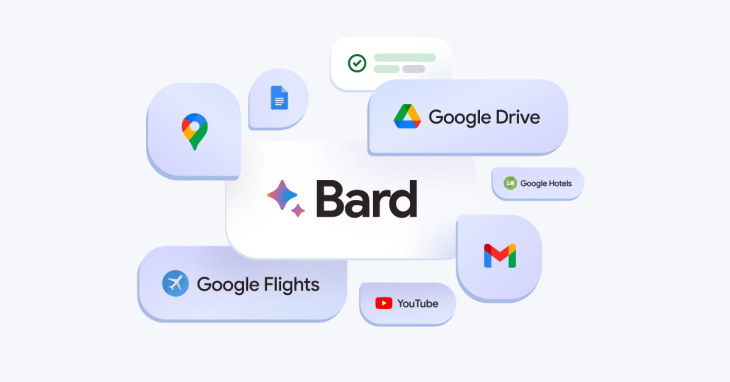
Google today is releasing a more capable version of Bard, its generative AI chatbot and ChatGPT rival, which now lets you double-check its answers, collaborate with others and, notably, integrate with Google’s own apps and services, including Gmail, Docs, Drive, Maps, YouTube and Google Flights and hotels.

The latter is available through new Bard Extensions and only in English for the time being. First announced at Google I/O, the company had not immediately rolled out extensions because it wanted to make sure it did so in a way that would offer a safe and trustworthy experience.

“We wanted to make sure that the way that we bring this to users is extremely rooted in the three principles that we have, as it relates to the trust that we build with our with people that use Bard, which is around transparency, choice and control,” explains Jack Krawczyk, product lead for Bard. “So we’re going to start off with saying when Bard interacts with Gmail, Drive and Docs, it’s only when a user has opted in to say it’s okay,” he says. And the user can revoke that permission at any time.

In addition, the company wants to ensure users understand how that data is and is not used. If you’re using personal data that’s been brought in from Gmail, Google Drive or Docs, that information is not used for reinforcement learning. Says Krawczyk, that’s a critical element in order to maintain user trust.

He notes that opting in to use Gmail with Bard isn’t providing Bard with the ability to store your entire Gmail inbox. Instead, on a per-prompt basis, it can be directed to find information in your inbox by using its ability to generate a call to Gmail to find something you’ve asked for. In addition to not being used for reinforcement learning, Google says no human reviewers will see the email Bard accesses either.

“It’s similar to how we’ve approached spam filtering in Google services in the past — your personal information isn’t read, because we believe that that trust is the most critical pillar upon which we build,” Krawczyk explains. “It’s early, and you lose some precision, some of the broader capabilities because you don’t have that. But we think it’s a long arc to make this technology helpful. And we would rather do it right. Do it from the position of building trust from the beginning.”

Once the extensions are connected, however, you could ask Bard to read your important emails and summarize what you missed. But there may be areas where it falls short, as the feature is further developed. For instance, it wouldn’t be capable of finding your wine club memberships and their next delivery dates if they don’t specifically say “wine club” in the email somewhere.

The new extensions can also work together. For instance, if you were planning a trip with friends, Bard could retrieve the dates from your Gmail thread that worked best for everyone and then look up real-time flight and hotel information, get Maps directions to the airport and even surface YouTube videos of things to do at the destination — all in the same conversation.

Image Credits: Google

For the extensions that don’t leverage personal data — YouTube, Flights, Hotels and Maps — you’re opted in automatically but you can choose to opt-out. The company says it eventually wants to support third-party services through this same Extensions model, but wants to first test and learn from the feature using its own first-party apps and services.

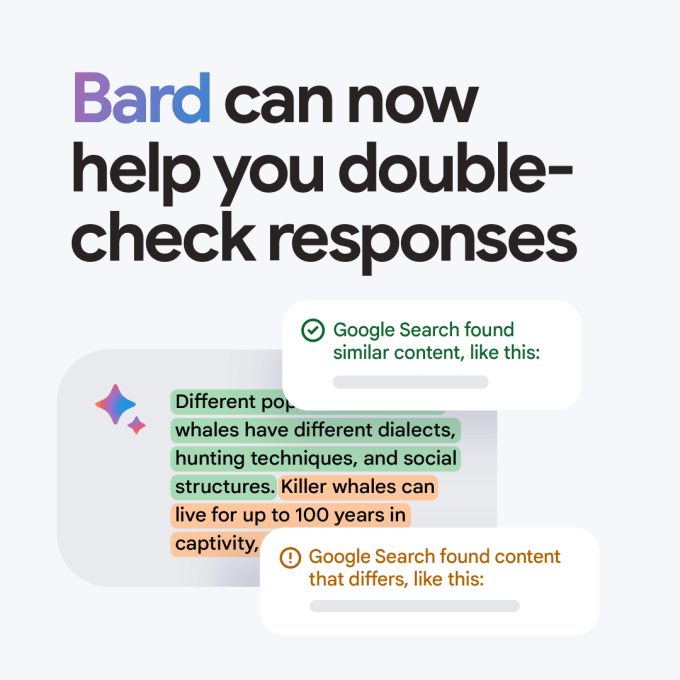
Another new feature updates the “Google it” button in Bard to double-check the chatbot’s response — an improvement that Google says taps into work from Google Research and DeepMind. When you tap the “G” icon, every sentence that Bard has written is validated against Google search to see if there’s content on the web to substantiate the answer. When the statement is evaluated, you can click on the highlighted phrases to learn more through Google Search.

Image Credits: Google

But if the AI is unsure, the sentence may be highlighted in orange to indicate that it knows this part of the answer might be wrong. This should help users better understand when the AI is “hallucinating” — that is, when it provides a response based on false information. This is a problem with modern AI that may confidently generate output even when it doesn’t have the supporting data.

“We are pretty excited about taking this step toward building trust with language models,” notes Krawczyk. “Of course, we certainly want to be transparent when we’re not confident or even when we make a mistake,” he says. The feature will also help the AI to improve as it learns what it gets wrong from user feedback and then uses that to create a better model.

A third update allows Bard users to collaborate with one another. Now, when someone else shares a Bard chat with you through a public link, you’ll be able to continue the conversation and ask Bard additional questions about that same topic. You can also use this as a starting point for your own ideas, says Google.

Image Credits: Google

Along with these new releases, Google is expanding access to Bard’s existing English language features, including the ability to upload images with Google Lens, get Search images in responses and modify Bard’s responses — to more than 40 new languages.

Google claims that Bard is improving at math and programming

Google ends Bard waitlist, making English version of chatbot widely available

Allie wants to layer intelligence on top of factory floors

Allie wants to layer intelligence on top of factory floors Kyle Wiggers 11 hours

Factory downtime is an expensive problem. According to one estimate, it costs enterprise companies 11% of their yearly turnover, amounting to almost $1.5 trillion each year. That works out to about $129 million per facility among Fortune 500 companies, over double what Fortune 500 companies reported paying in downtime in 2020.

Part of the reason downtime is occurring so frequently — and becoming more common — is because factories often lack a single source of truth, depriving them of the insights needed to make quick decisions about their operations.

To solve this problem, entrepreneurs Alex Sandoval and Nicolas DeGiorgis, who met a Rappi, the Latin America-based delivery app, founded Allie AI, which presented onstage during the TechCrunch Disrupt Battlefield competition today. Allie brings monitoring and analysis to factory data, delivering a level of visibility that’s usually absent in the industrial and manufacturing sector.

“It all started during the pandemic,” Sandoval told TechCrunch in an email interview. “One of our family friends asked me to serve as an advisor to support the family factory’s digitization initiatives, and I was surprised to see pen and paper being used for basic stats such as efficiency and machine monitoring. This was not an isolated case.”

Sandoval and DeGiorgis saw an opportunity to bring industrial data together, using modeling, and combine it with a streamlined dashboard experience for factory operators and managers to drive efficiency. They built a proof of concept, and this eventually morphed into Allie — which went on to raise $2.3 million in venture capital.

“Industrial operations typically have siloed and disconnected data sitting between an enterprise resource planning platform, a maintenance system and a factory floor monitor,” Sandoval said. “Factories need to centralize data sources to be able to identify patterns that lead to quality issues or downtime, so that technical departments can build intelligent layers for business and operations leaders to make smarter decisions to maximize productivity.”

To this end, Allie provides a configurable hub that connects to machines and sensors new and old within a factory. The gateway enables Allie to build a “digital layer” on top of the factory’s processes and hardware, Sandoval says, and identify factors tied to productivity, quality costs and machine health and store all this data in a secure cloud.

Allie allows factories to run root cause analyses that take into account metrics like operational efficiency, product wastage and costs across lines and production facilities. The platform also automates maintenance workflows, leveraging AI to attempt to predict when a machine might fail — and ways to prevent this.

A newer addition to the Allie platform is a chatbot-like assistant along the lines of ChatGPT. Trained on a factory’s productivity data, factory manuals and procedure documentation, the assistant can serve up information such as the most frequent component failures and instructions on how to perform specific preventative maintenance tasks.

“Allie gets smarter the more you use it,” Sandoval said. “Every single report and root cause is tagged into our model, enabling customers to make correlations between machine variables and failure types. Because every corrective action is traced on the platform, we’re able to give probable root causes and a recommended course of action. Years of factory know-how live on in the system — sharing the knowledge for all factory operators.”

Allie doesn’t stand alone in the market for digitizing and operationalizing factory data. See ControlRooms.ai, which recently raised $10 million for its AI-powered analytics platform designed to automate the industrial troubleshooting process. Elsewhere, there’s Augury, which is building hardware, AI and software to diagnose malfunctions in machinery; Traction offers a comparable tech solution.

Sandoval has confidence in Allie’s go-to-market approach, though, which will initially focus on manufacturing customers in the cement, steel, food and beverage, plastics and paper industries. With a team of 25 full-time employees and 50 contractors, Allie plans to invest in further developing its tech — specifically the recommendation engine that powers much of the Allie platform — and product.

“Allie is working with 30 of the largest industrial facilities in the Americas, which manufacture products worth $30 billion in annual production,” Sandoval said. “The pandemic has been positive in some ways for Allie. It helped catalyze the need to run cloud-based industrial operations when there was difficulty with physical mobility. This helped increase IT budgets for industrial players.”

Lucas Limas from Caravela Capital, an Allie investor, added via email: “We believe the time for Allie is now. There’s a strong migration of industrial operations from China to Mexico, one of Allie’s main markets, which is going to be transformational for the country’s GDP in the coming years. We’re excited about Allie’s traction, who in a short time, have been able to sell to the region’s leading manufacturers.”

AI startup speeds up the creation of climate-resilient crops

AI startup speeds up the creation of climate-resilient crops Harri Weber 8 hours

Creating crops that’ll endure climate change — think worse droughts, heat waves and pests — is a time-consuming and costly feat. Avalo is betting its machine learning models can speed that process up and make it a whole lot cheaper too.

The Durham, North Carolina–based startup, which pitched onstage at the TechCrunch Disrupt Startup Battlefield competition, doesn’t edit plant genes or breed crop varieties the traditional way. Instead, the AI company aims to supercharge crop breeding by quickly identifying the genetic basis of complex traits, such as heat tolerance.

In doing so, Avalo avoids much of the guesswork and waiting typically involved in crop breeding. CEO Brendan Collins explained in a call with TechCrunch, “We actually don’t care about the plant expressing the [desired] trait in the field, because we just genotype all the seedlings, and we know which ones are going to be the winners and which ones are going to be the losers already.”

Instead of testing crosses annually, Avalo “can bring seedlings into growth chambers and greenhouses and breed them under accelerated conditions,” said Collins. For most row crops, that translates to “four development cycles” in a single year versus just one, the CEO added.

The process is based on Avalo science chief Mariano Alvarez’s post-doctoral studies at Duke. TechCrunch did a deep dive into it two years ago, when Avalo had only secured a $3 million seed round. The startup has since raised another $3 million and today announced its intent to raise a $10 million Series A this fall.

According to Collins, Avalo proved its process recently when it created a fast-maturing broccoli variety for a vertical-farming startup called Iron Ox. Collins says Avalo succeeded, only you can’t try it yet, because the effort collapsed as the vertical-farming bubble popped earlier this year.

Avalo is still working with greenhouses to get the advanced broccoli on the market, but the CEO said he is now more focused on the startup’s other efforts. They include aiding in the cultivation of a latex-producing dandelion; finding and licensing valuable traits, such as pest-resistance, in soy and corn; and a just-launched effort to cultivate drought-tolerant cotton.

(Avalo’s co-founder and COO, Rebecca White, grew up on a cotton farm in Texas, Collins told TechCrunch. It happens that Collins and White were en route to the COO’s family farm when they pulled over to take my call.)

Ultimately, Collins sees Avalo as a company that will democratize access to world-class genomics.

“Since the 1950s, corn has had a 300% yield increase, and that’s because so much effort and money has been put into corn,” the CEO said before posing a question: “What could agriculture look like if we’re able to give that same level of resources for a fraction of the cost to all the other crops in the world?”

Evolving staples to withstand heat and drought isn’t agriculture’s (nor agtech’s) sole response to climate change.

Resilient crops overlooked or even previously outlawed by colonizers, such as amaranth, are getting renewed attention. Rising temps mean famers are also putting money toward crops that would not have previously thrived in their respective growing regions. That’s why you’ll see more mangos and avocados in Northern California and more grapevines in the U.K.

On the tech side, numerous companies are exploring ways to re-create beloved flavors with fewer resources. Berkeley Yeast modifies yeast to taste hoppy, giving brewers the option to ditch water- and energy-intensive hops altogether. Atomo, a “beanless coffee” startup, takes a less academic route; it combines roasted date seeds and chicory to make its oat lattes, and in doing so it avoids the cultivation of water-intensive coffee beans.

There are also plenty of tech firms exploring new ways to limit water and fertilizer waste, such as Verdi, SupPlant, Pivot Bio and Carbonwave. Avalo has some comparably more-direct competitors in crop discovery, too, including Keygene and Benson Hill.

DSC Weekly 19 September 2023

Announcements

  • End-user computing must now account for the millions of workforces that have transitioned to hybrid and remote models. Virtual workspace models such as DaaS and VDI allow users to access virtual desktops to help streamline their workflow and minimize the burden on IT staff. However, companies must consider cost, scalability and management when deploying a virtual workspace, as well as security strategies to ensure workers are protected and able to remain productive. Join the Next-Generation End User Computing summit to discover how to best implement and manage hosted and virtual workspaces including DaaS and VDI.
  • Managing the supply chain is exceedingly difficult with global conflicts and market ups and downs interfering with companies’ ability to timely deliver and fulfil orders. Tune into the Overcoming Supply Chain Challenges summit to hear leading experts discuss emerging technologies to help protect and streamline supply chain management along with strategies and tools to secure the supply chain against the many cyber threats it faces. Register for free and gain access to live webinars, fireside chats and keynote presentations from the world’s leading supply chain innovators, vendors and evangelists.

Top Stories

  • AI apps product development canvas – Part 2
    September 16, 2023
    by Bill Schmarzo
    In part 1 of this series on the updated “AI Apps Development Canvas,” I introduced the updated AI Apps Product Development Design Canvas. The AI Apps Product Development Canva is one of the capstone deliverables for my “Thinking Like a Data Scientist” methodology, so getting feedback is critical to ensure that the methodology is relevant.
  • A complete guide: Conversational AI vs. generative AI
    September 19, 2023
    by Roger Brown
    The two most prominent technologies that have been making waves in the AI industry are Conversational AI and Generative AI. They have revolutionized the manner in which humans interact and work with machines to generate content.
  • Are data science certifications the gateway to competitive pay?
    September 14, 2023
    by Aileen Scott
    Working as a data scientist is the dream of many IT professionals these days. It is no secret that data science is a skyrocketing field attracting young professionals and inspiring many to switch careers to data science.
Education_DSC_160x600-2

In-Depth

  • A guide to setting up analytics at a consumer tech startup
    September 19, 2023
    by Abhi Sawhney
    Where do you start if you want to build a data analytics function from the ground up? As an analytics leader at a startup, you will need to make several important decisions early on to build an effective team. This article dives into four decision areas and highlights ways in which to think about them.
  • CUPED for starters: Enhancing controlled experiments with pre-experiment data
    September 14, 2023
    by Igor Khomyanin
    In this article, I will briefly explain the randomized controlled experiments and why modern companies use them to make data-driven decisions. Then, I will introduce you to a CUPED procedure that improves the sensitivity of these experiments. After that, I will show you why it works in theory and practice. We will simulate an ordinary A/B test and compare results with the CUPED-adjusted procedure.
  • Searching for sustainability in data center cooling
    September 14, 2023
    by Jane Marsh
    Data centers are known for their impact on the environment. They run 24/7 and exude a lot of heat. Massive warehouses full of hot technology require advanced cooling systems or an HVAC system pushed to its limit. Data center managers and sustainability leaders no longer settle for antiquated techniques.
  • Collaborative visual knowledge graph modeling at the system level
    September 14, 2023
    by Alan Morrison
    The best way to model business and consumer dynamics is collaboratively, with stakeholders all in the same virtual room contributing. Of course, this has been happening asynchronously for some time now, but the potential exists for more real-time interaction. Modelers don’t work in a vacuum, of course.
  • DSC Weekly 12 September 2023
    September 12, 2023
    by Scott Thompson
    Read more of the top articles from the Data Science Central community.
  • Securing your AI data pipeline with MLOps
    September 12, 2023
    by Colin Priest
    Enterprises delving into AI data pipelines often find themselves wading through a mess of complex and convoluted code, commonly referred to as “spaghetti code.” This jumbled mass is not only challenging to understand but also hard to maintain while introducing a multitude of security risks.

OpenAI launches a red teaming network to make its models more robust

OpenAI launches a red teaming network to make its models more robust Kyle Wiggers 9 hours

In its ongoing effort to make its AI systems more robust, OpenAI today launched the OpenAI Red Teaming Network, a contracted group of experts to help inform the company’s AI model risk assessment and mitigation strategies.

Red teaming is becoming an increasingly key step in the AI model development process as AI technologies, particularly generative technologies, enter the mainstream. Red teaming can catch (albeit not fix, necessarily) biases in models like OpenAI’s DALL-E 2, which has been found to amplify stereotypes around race and sex, and prompts that can cause text-generating models, including models like ChatGPT and GPT-4, to ignore safety filters.

OpenAI notes that it’s worked with outside experts to benchmark and test its models before, including people participating in its bug bounty program and researcher access program. However, the Red Teaming Network formalizes those efforts, with the goal of “deepening” and “broadening” OpenAI’s work with scientists, research institutions and civil society organizations, says the company in a blog post.

“We see this work as a complement to externally-specified governance practices, such as third-party audits,” OpenAI writes. “Members of the network will be called upon based on their expertise to help red team at various stages of the model and product development lifecycle.”

Outside of red teaming campaigns commissioned by OpenAI, OpenAI says that Red Teaming Network members will have the opportunity to engage with each other on general red teaming practices and findings. Not every member will be involved with every new OpenAI model or product, and time contributions — which could be as few as 5 to 10 years a year — will be determined with members individually, OpenAI says.

OpenAI’s calling on a broad range of domain experts to participate, including those with backgrounds in linguistics, biometrics, finance and healthcare. It isn’t requiring prior experience with AI systems or language models for eligibility. But the company warns that Red Teaming Network opportunities might be subject to non-disclosure and confidentiality agreements that could impact other research.

“What we value most is your willingness to engage and bring your perspective to how we assess the impacts of AI systems,” OpenAI writes. “We invite applications from experts from around the world and are prioritizing geographic as well as domain diversity in our selection process.”

The question is, is red teaming enough? Some argue that it isn’t.

In a recent piece, Wired contributor Aviv Ovadya, an affiliate with Harvard’s Berkman Klein Center and the Centre for the Governance of AI, makes the case for “violet teaming”: identifying how a system (e.g. GPT-4) might harm an institution or public good and then supporting the development of tools using that same system to defend the institution and public good. I’m inclined to agree it’s a wise idea. But, as Ovadya points out his column, there’s few incentives to do violet teaming, let alone slow down AI releases enough to have sufficient time for it to work.

Red teaming networks like OpenAI’s seem to be the best we’ll get — at least for now.