Amazon brings generative AI to Alexa

Amazon brings generative AI to Alexa Kyle Wiggers 7 hours

During a press event this morning at its HQ2 headquarters in Arlington, Virginia, Amazon announced that it’ll soon use a new generative AI model to power improved experiences across its Echo family of devices.

“Our latest model has been specifically optimized for voice and the things we know our customers love — like having access to real-time information, efficiently controlling their smart home, and getting the most out of their home entertainment,” Dave Limp, the SVP of devices and services at Amazon, said onstage.

Amazon says that the new model will power more conversational experiences — experiences that take into account body language as well as a person’s eye contact and gestures. It’ll interact with APis to enable new smart home capabilities. And it’ll give Alexa a bigger — and more opinionated — personality.

“The capabilities … deliver unique experiences based on the preferences that you’ve shared, the services that you’ve interacted with and the information about the environment in and around your home,” Limp said. “This [new model] will allow you to surface personal reminders. For example, it can help you with recently-played music, or even come up with recipe recommendations based on your grocery purchases.”

During a demo, Limp asked an Alexa device connected to the new generative AI model “What’s your favorite sports team?” After a brief a hiccup with the event Wi-Fi, Alexa responded to that and follow-up questions about Seahawks stats and game times — even after Limp paused to address the audience and then returned to the conversation with Alexa.

Limp didn’t cover it during the demo. But the new generative AI model can also adjust its tone and response to express things like affirmation, excitement, laughter and surprise, Amazon says — adjusting to a person’s natural pauses and hesitation to deliver an ostensibly more free-flowing conversation.

It’s worth noting Alexa could do this before — at least to a degree. But there’s now more nuance to the assistant’s reactions… supposedly. We’ll have to put it to the test.

Soon, customers in the U.S. will get access to these new capabilities through a free preview on Echo devices they already own, Amazon says.

Read more about Amazon's Fall Event on TechCrunch

NVIDIA Catches Up to AMD, Intel with MCM Design 

NVIDIA Catches Up to AMD, Intel with MCM Design

There have been a lot of leaks and rumours about NVIDIA’s upcoming Blackwell architecture GPUs. According to leaks, the new architecture will have a Multi-Chip Module (MCM) design that will enhance the performance of the processor.

While the exact specifications and capabilities of Blackwell GPUs are still shrouded in mystery, a serial hardware leaker with username kopite7kimi on X has shed some light on what we can expect.

I think Nvidia has no other choice.

— High Yield (@highyieldYT) September 19, 2023

kopite7kimi suggests that the GB100 High-Performance Computing (HPC) chip within the Blackwell architecture will be based on an MCM design. This means that instead of relying on a single monolithic die, the GB100 will comprise multiple chiplets working in unison. While GB100 is for data centres, the same MCM design will also be implemented in GB200, which is a consumer-focused chip for gaming products, which would be used for NVIDIA’s next flagship RTX50 gaming GPU.

This is not the first time that NVIDIA is rumoured to be releasing a MCM design chip. The Grace Hopper 100 (GH100) was also expected to have an MCM design, but it came with a monolithic architecture again.

How is NVIDIA doing this?

The MCM approach involves integrating multiple chiplets into a single GPU package, allowing for enhanced performance and scalability. NVIDIA’s decision to explore this design is a significant departure from their traditional monolithic GPU approach. All of this is expected to start with the GB100 HPC chip, which was expected to launch in 2026, but is now anticipated even earlier, by the end of 2025.

The motivation behind this shift is clear: to unlock greater performance potential. Monolithic GPUs are limited by the physical constraints of fabrication processes, which dictate a maximum die size. With transistors becoming increasingly difficult to shrink further, the only option for boosting GPU performance is to create a larger chip.

This is where chiplets come into play. By dividing a GPU into smaller chiplets and connecting them via interconnects, a single GPU can effectively operate as a larger unit than the manufacturing process would traditionally allow. This approach offers the potential for significant performance gains, addressing the challenge posed by the end of Moore’s Law—the prediction that transistor density on a chip would double approximately every two years.

But here is another rumour that is going to make NVIDIA’s shift a little interesting.

Another X user named Revegnus shared a rumour that NVIDIA is also testing out Samsung’s 3nm chip. It suggests that NVIDIA might be using these for building the MCM design chips. These could also be in mass production in 2025. Though people argue that TSMC’s 5nm chip is better than Samsung’s 3nm, the MCM design is still going to benefit from the smaller size, and make a bigger overall architecture.

Blackwell on SS 3GAA then?

— Donald Kerner (@donaldave20051) September 18, 2023

Multi-chiplets for the future

It is important to note that NVIDIA is not the first player in the GPU industry to explore MCM designs. Both AMD and Intel have already made significant strides in this direction, reaping the benefits of increased performance and scalability. AMD, in particular, has seen remarkable success with its Ryzen processors and Radeon graphics cards, which employ chiplet architectures, and also with Instinct MI300.

If NVIDIA adopts the MCM design for its Blackwell architecture, it could signify a transformative moment for the GPU industry. Notably, this transition is not limited to the data centre market, as it may also extend to the consumer graphics cards, such as the RTX 50 series, expanding even further in the gaming market with increased performance within smaller form factors.

Although the number of units(like GPCs or TPCs) in Blackwell will not increase significantly, there are significant changes in its unit structure.

— kopite7kimi (@kopite7kimi) September 18, 2023

Though, the same hardware leaker said in another post that there is not going to be an increase in the core count, only structural improvements will make the difference.

While specific details about the Blackwell GPUs remain speculative, the potential for enhanced performance and scalability through MCM technology is undeniably exciting. NVIDIA’s competitors have already demonstrated the advantages of this approach, making it a logical step for the company to consider, and even a necessary one.

While these developments are still in the realm of rumours and speculation, the precedent set by industry leaders like AMD and Intel suggests that MCM technology holds the key to unlocking unparalleled GPU performance and scalability. For NVIDIA, making the transition to MCM could mark a transformative moment, ensuring that it remains at the forefront of the GPU industry for years to come.

The post NVIDIA Catches Up to AMD, Intel with MCM Design appeared first on Analytics India Magazine.

Fine Tuning LLAMAv2 with QLora on Google Colab for Free

Fine Tuning LLAMAv2 with QLora on Google Colab for Free
Generated using ideogram.ai with the prompt: “A photo of LLAMA with the banner written “QLora” on it., 3d render, wildlife photography”

It was a dream to fine-tune a 7B model on a single GPU for free on Google Colab until recently. On 23 May 2023, Tim Dettmers and his team submitted a revolutionary paper[1] on fine-tuning Quantized Large Language Models.

A Quantized model is a model that has its weights in a data type that is lower than the data type on which it was trained. For example, if you train a model in a 32-bit floating point, and then convert those weights to a lower data type such as 16/8/4 bit floating point such that there is minimal to no effect on the performance of the model.
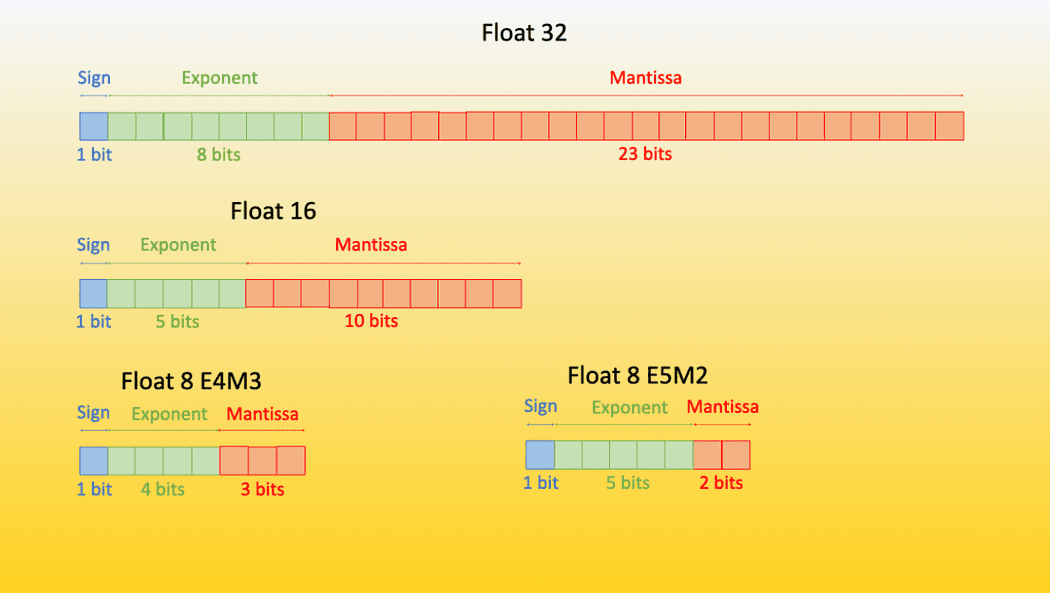
Fine Tuning LLAMAv2 with QLora on Google Colab for Free
Source [2]

We are not going to talk much about the theory of quantization here, You can refer to the excellent blog post by Hugging-Face[2][3] and an excellent YouTube video[4] by Tim Dettmers himself to understand the underlying theory.

In short, it can be said that QLora means:

Fine-Tuning a Quantized Large Language models using Low Rank Adaptation Matrices (LoRA)[5]

Let’s jump straight into the code:

Data Preparation

It is important to understand that the large language models are designed to take instructions, this was first introduced in the 2021 ACL paper[6]. The idea is simple, we give a language model an instruction, and it follows the instruction and performs that task. So the dataset that we want to fine-tune our model should be in the instruct format, if not we can convert it.

One of the common formats is the instruct format. We will be using the Alpaca Prompt Template[7] which is

Below is an instruction that describes a task, paired with an input that provides further context. Write a response that appropriately completes the request.    ### Instruction:  {instruction}    ### Input:  {input}    ### Response:  {response}

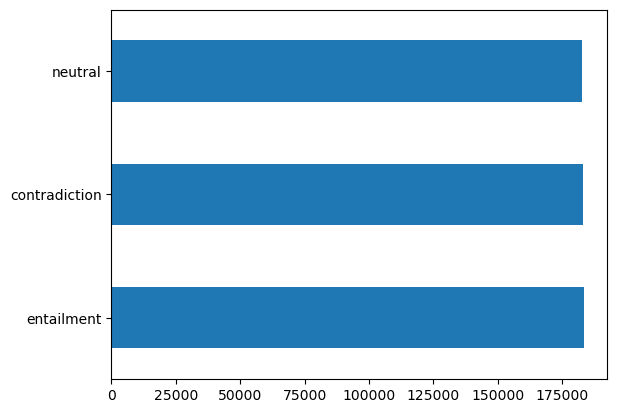
We will be using the SNLI dataset which is a dataset that has 2 sentences and the relationship between them whether they are contradiction, entailment of each other, or neutral. We will be using it to generate contradiction for a sentence using LLAMAv2. We can load this dataset simply using pandas.

import pandas as pd    df = pd.read_csv('snli_1.0_train_matched.csv')  df['gold_label'].value_counts().plot(kind='barh')
Fine Tuning LLAMAv2 with QLora on Google Colab for Free
Labels Distribution

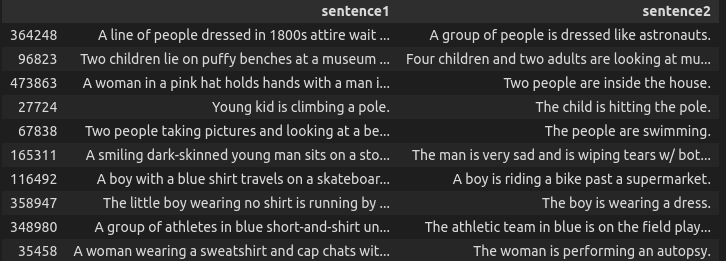
We can see a few random contradiction examples here.

df[df['gold_label'] == 'contradiction'].sample(10)[['sentence1', 'sentence2']]
Fine Tuning LLAMAv2 with QLora on Google Colab for Free
Contradiction Examples from SNLI

Now we can create a small function that takes only the contradictory sentences and converts the dataset instruct format.

def convert_to_format(row):      sentence1 = row['sentence1']      sentence2 = row['sentence2']ccccc      prompt = """Below is an instruction that describes a task paired with input that provides further context. Write a response that appropriately completes the request."""      instruction = """Given the following sentence, your job is to generate the negation for it in the json format"""      input = str(sentence1)      response = f"""```json  {{'orignal_sentence': '{sentence1}', 'generated_negation': '{sentence2}'}}  ```  """      if len(input.strip()) == 0:  #  prompt + 2 new lines + ###instruction + new line + input + new line + ###response          text = prompt + "nn### Instruction:n" + instruction + "n### Response:n" + response      else:          text = prompt + "nn### Instruction:n" + instruction + "n### Input:n" + input + "n" + "n### Response:n" + response            # we need 4 columns for auto train, instruction, input, output, text      return pd.Series([instruction, input, response, text])    new_df = df[df['gold_label'] == 'contradiction'][['sentence1', 'sentence2']].apply(convert_to_format, axis=1)  new_df.columns = ['instruction', 'input', 'output', 'text']    new_df.to_csv('snli_instruct.csv', index=False)

Here is an example of the sample data point:

"Below is an instruction that describes a task paired with input that provides further context. Write a response that appropriately completes the request.    ### Instruction:  Given the following sentence, your job is to generate the negation for it in the json format  ### Input:  A couple playing with a little boy on the beach.    ### Response:  ```json  {'orignal_sentence': 'A couple playing with a little boy on the beach.', 'generated_negation': 'A couple watch a little girl play by herself on the beach.'}  ```

Now we have our dataset in the correct format, let’s start with fine-tuning. Before starting it, let’s install the necessary packages. We will be using accelerate, peft (Parameter efficient Fine Tuning), combined with Hugging Face Bits and bytes and transformers.

!pip install -q accelerate==0.21.0 peft==0.4.0 bitsandbytes==0.40.2 transformers==4.31.0 trl==0.4.7
import os  import torch  from datasets import load_dataset  from transformers import (      AutoModelForCausalLM,      AutoTokenizer,      BitsAndBytesConfig,      HfArgumentParser,      TrainingArguments,      pipeline,      logging,  )  from peft import LoraConfig, PeftModel  from trl import SFTTrainer

You can upload the formatted dataset to the drive and load it in the Colab.

from google.colab import drive  import pandas as pd    drive.mount('/content/drive')    df = pd.read_csv('/content/drive/MyDrive/snli_instruct.csv')

You can convert it to the Hugging Face dataset format easily using from_pandas method, this will be helpful in training the model.

from datasets import Dataset    dataset = Dataset.from_pandas(df)

We will be using the already quantized LLamav2 model which is provided by abhishek/llama-2–7b-hf-small-shards. Let’s define some hyperparameters and variables here:

# The model that you want to train from the Hugging Face hub  model_name = "abhishek/llama-2-7b-hf-small-shards"    # Fine-tuned model name  new_model = "llama-2-contradictor"    ################################################################################  # QLoRA parameters  ################################################################################    # LoRA attention dimension  lora_r = 64    # Alpha parameter for LoRA scaling  lora_alpha = 16    # Dropout probability for LoRA layers  lora_dropout = 0.1    ################################################################################  # bitsandbytes parameters  ################################################################################    # Activate 4-bit precision base model loading  use_4bit = True    # Compute dtype for 4-bit base models  bnb_4bit_compute_dtype = "float16"    # Quantization type (fp4 or nf4)  bnb_4bit_quant_type = "nf4"    # Activate nested quantization for 4-bit base models (double quantization)  use_nested_quant = False    ################################################################################  # TrainingArguments parameters  ################################################################################    # Output directory where the model predictions and checkpoints will be stored  output_dir = "./results"    # Number of training epochs  num_train_epochs = 1    # Enable fp16/bf16 training (set bf16 to True with an A100)  fp16 = False  bf16 = False    # Batch size per GPU for training  per_device_train_batch_size = 4    # Batch size per GPU for evaluation  per_device_eval_batch_size = 4    # Number of update steps to accumulate the gradients for  gradient_accumulation_steps = 1    # Enable gradient checkpointing  gradient_checkpointing = True    # Maximum gradient normal (gradient clipping)  max_grad_norm = 0.3    # Initial learning rate (AdamW optimizer)  learning_rate = 1e-5    # Weight decay to apply to all layers except bias/LayerNorm weights  weight_decay = 0.001    # Optimizer to use  optim = "paged_adamw_32bit"    # Learning rate schedule  lr_scheduler_type = "cosine"    # Number of training steps (overrides num_train_epochs)  max_steps = -1    # Ratio of steps for a linear warmup (from 0 to learning rate)  warmup_ratio = 0.03    # Group sequences into batches with same length  # Saves memory and speeds up training considerably  group_by_length = True    # Save checkpoint every X updates steps  save_steps = 0    # Log every X updates steps  logging_steps = 100    ################################################################################  # SFT parameters  ################################################################################    # Maximum sequence length to use  max_seq_length = None    # Pack multiple short examples in the same input sequence to increase efficiency  packing = False    # Load the entire model on the GPU 0  device_map = {"": 0}

Most of these are pretty straightforward hyper-parameters having these default values. You can always refer to the documentation for more details.

We can now simply use BitsAndBytesConfig class to create the config for 4-bit fine-tuning.

compute_dtype = getattr(torch, bnb_4bit_compute_dtype)    bnb_config = BitsAndBytesConfig(      load_in_4bit=use_4bit,      bnb_4bit_quant_type=bnb_4bit_quant_type,      bnb_4bit_compute_dtype=compute_dtype,      bnb_4bit_use_double_quant=use_nested_quant,  )

Now we can load the base model with 4 bit BitsAndBytesConfig and tokenizer for Fine-Tuning.

tokenizer = AutoTokenizer.from_pretrained(model_name, trust_remote_code=True)  tokenizer.pad_token = tokenizer.eos_token  tokenizer.padding_side = "right"    model = AutoModelForCausalLM.from_pretrained(      model_name,      quantization_config=bnb_config,      device_map=device_map  )  model.config.use_cache = False  model.config.pretraining_tp = 1

We can now create the LoRA config and set the training parameters.

# Load LoRA configuration  peft_config = LoraConfig(      lora_alpha=lora_alpha,      lora_dropout=lora_dropout,      r=lora_r,      bias="none",      task_type="CAUSAL_LM",  )    # Set training parameters  training_arguments = TrainingArguments(      output_dir=output_dir,      num_train_epochs=num_train_epochs,      per_device_train_batch_size=per_device_train_batch_size,      gradient_accumulation_steps=gradient_accumulation_steps,      optim=optim,      save_steps=save_steps,      logging_steps=logging_steps,      learning_rate=learning_rate,      weight_decay=weight_decay,      fp16=fp16,      bf16=bf16,      max_grad_norm=max_grad_norm,      max_steps=max_steps,      warmup_ratio=warmup_ratio,      group_by_length=group_by_length,      lr_scheduler_type=lr_scheduler_type,      report_to="tensorboard"  )

Now we can simply use SFTTrainer which is provided by trl from HuggingFace to start the training.

# Set supervised fine-tuning parameters  trainer = SFTTrainer(      model=model,      train_dataset=dataset,      peft_config=peft_config,      dataset_text_field="text",  # this is the text column in dataset       max_seq_length=max_seq_length,      tokenizer=tokenizer,      args=training_arguments,      packing=packing,  )    # Train model  trainer.train()    # Save trained model  trainer.model.save_pretrained(new_model)

This will start the training for the number of epochs you have set above. Once the model is trained, make sure to save it in the drive so that you can load it again (as you have to restart the session in the colab). You can store the model in the drive via zip and mv command.

!zip -r llama-contradictor.zip results llama-contradictor  !mv llama-contradictor.zip /content/drive/MyDrive

Now when you restart the Colab session, you can move it back to your session again.

!unzip /content/drive/MyDrive/llama-contradictor.zip -d .

You need to load the base model again and merge it with the fine-tuned LoRA matrices. This can be done using merge_and_unload() function.

tokenizer = AutoTokenizer.from_pretrained(model_name, trust_remote_code=True)  tokenizer.pad_token = tokenizer.eos_token  tokenizer.padding_side = "right"    base_model = AutoModelForCausalLM.from_pretrained(      "abhishek/llama-2-7b-hf-small-shards",      low_cpu_mem_usage=True,      return_dict=True,      torch_dtype=torch.float16,      device_map={"": 0},  )    model = PeftModel.from_pretrained(base_model, '/content/llama-contradictor')  model = model.merge_and_unload()  pipe = pipeline(task="text-generation", model=model, tokenizer=tokenizer, max_length=200)

Inference

You can test your model by simply passing in the inputs in the same prompt template that we have defined above.

prompt_template = """### Instruction:  Given the following sentence, your job is to generate the negation for it in the json format  ### Input:  {}    ### Response:  """    sentence = "The weather forecast predicts a sunny day with a high temperature around 30 degrees Celsius, perfect for a day at the beach with friends and family."    input_sentence = prompt_template.format(sentence.strip())    result = pipe(input_sentence)  print(result)

Output

### Instruction:  Given the following sentence, your job is to generate the negation for it in the json format  ### Input:  The weather forecast predicts a sunny day with a high temperature around 30 degrees Celsius, perfect for a day at the beach with friends and family.    ### Response:  ```json  {    "sentence": "The weather forecast predicts a sunny day with a high temperature around 30 degrees Celsius, perfect for a day at the beach with friends and family.",    "negation": "The weather forecast predicts a rainy day with a low temperature around 10 degrees Celsius, not ideal for a day at the beach with friends and family."  }  ```

Filter Useful Output

There will be many times when the model will keep on predicting even after the response is generated due to the token limit. In this case, you need to add a post-processing function that filters the JSON part which is what we need. This can be done using a simple Regex.

import re  import json    def format_results(s):    pattern = r'```jsonn(.*?)n```'      # Find all occurrences of JSON objects in the string    json_matches = re.findall(pattern, s, re.DOTALL)    if not json_matches:      # try to find 2nd pattern      pattern = r'{.*?"sentence":.*?"negation":.*?}'      json_matches = re.findall(pattern, s)      # Return the first JSON object found, or None if no match is found    return json.loads(json_matches[0]) if json_matches else None

This will give you the required output instead of the model repeating random output tokens.

Summary

In this blog, you learned the basics of QLora, fine-tuning a LLama v2 model on Colab using QLora, Instruction Tuning, and a sample template from the Alpaca dataset that can be used to instruct tune a model further.

References

[1]: QLoRA: Efficient Finetuning of Quantized LLMs, 23 May 2023, Tim Dettmers et al.

[2]: https://huggingface.co/blog/hf-bitsandbytes-integration

[3]: https://huggingface.co/blog/4bit-transformers-bitsandbytes

[4]: https://www.youtube.com/watch?v=y9PHWGOa8HA

[5]: https://arxiv.org/abs/2106.09685

[6]: https://aclanthology.org/2022.acl-long.244/

[7]: https://crfm.stanford.edu/2023/03/13/alpaca.html

[8]: Colab Notebook by @maximelabonne https://colab.research.google.com/drive/1PEQyJO1-f6j0S_XJ8DV50NkpzasXkrzd?usp=sharing

Ahmad Anis is a passionate Machine Learning Engineer and Researcher currently working at redbuffer.ai. Beyond his day job, Ahmad actively engages with the Machine Learning community. He serves as a regional lead for Cohere for AI, a nonprofit dedicated to open science, and is an AWS Community Builder. Ahmad is an active contributor at Stackoverflow, where he has 2300+ points. He has contributed to many famous open-source projects, including Shap-E by OpenAI.

More On This Topic

  • Fine-Tuning Transformer Model for Invoice Recognition
  • Fine-Tuning BERT for Tweets Classification with HuggingFace
  • Fine-Tuning OpenAI Language Models with Noisily Labeled Data
  • ColabCode: Deploying Machine Learning Models From Google Colab
  • An Introduction to Reinforcement Learning with OpenAI Gym, RLlib, and…
  • From Google Colab to a Ploomber Pipeline: ML at Scale with GPUs

‘Haywire’ Australian IT Skills Market Prompts Logicalis to Add Talent as a Service

Happy businesswoman shaking hands with colleage after successful meeting.
Image: kerkezz/Adobe Stock

The IT skills shortage is no secret to Australia’s technology managers. Whether they’ve been hiring new talent into their teams or looking to keep their existing talent engaged and in place, the short supply of skills in recent years has made it quite a challenging time.

Scott Brown, who heads the new Talent Services offering at IT solutions and managed services provider Logicalis Australia, said it has been a unique period to be watching IT recruitment.

“I’ve never seen anything like the last two to three years. It’s been haywire,” Brown said.

The skills shortage is causing IT leaders to spend more on talent, with skill sets like cyber security and AI in demand in 2023. Logicalis has also launched a Talent Services business to help IT leaders meet skills needs and get projects done without hiring staff directly.

Jump to:

  • CIOs are spending more on IT talent attraction and retention
  • Cyber security, artificial intelligence leading IT skills demand
  • Logicalis meets market demand with Talent Services launch
  • IT leaders should expect skills shortages in the future

CIOs are spending more on IT talent attraction and retention

Australian organisations continue to face a hyper competitive market for local IT talent.

While tech sector employees did suffer through a round of layoffs in early 2023, led by U.S.-headquartered companies brutally shedding their local workforces, demand from local employers, the skills shortage and fast-paced change have seen these staff absorbed back into the workforce.

“We’ve run into a perfect storm of a low unemployment rate and immigration still recovering from pre-pandemic levels,” Brown said. “Many organisations are finding that getting their hands on the right employees and capabilities at the right time is a core challenge they are facing.”

Scott Brown, head of employee experience at Logicalis Australia.
IMAGE: Scott Brown, head of employee experience at Logicalis Australia

Logicalis’ Australia CIO Report 2023, for example, found that talent was one of the top three areas where CIOs were planning to increase spending this year. Just over three quarters (77%) of CIOs surveyed said they were planning to boost spending on hiring and retaining talent.

SEE: Many organisations are worried about employee retention.

“Organisations can either develop people and capabilities at the right speed, or if I can’t, they can go out and buy or borrow that talent for the right situation,” Brown said. “And if you look at the core technologies, the pace of change is about as fast as any other industry out there.

“CIOs are increasing spending to attract and retain talent and bridge the skills gap. At the same time, they are asking if they have the capacity to do what they want to do.”

Cyber security, artificial intelligence leading IT skills demand

Logicalis Australia sponsors Grad Girls, a career support program for female STEM students run by the Victorian Information Communication Technology for Women Network. At an event in 2023, it was clear where graduates saw the opportunities of the future.

“Ninety per cent of attendees were doing either AI, cyber security or data science,” Brown said. “That’s an indication for us of where the market is going. These are technologies where the market has not kept up with demand and is expected to grow exponentially.”

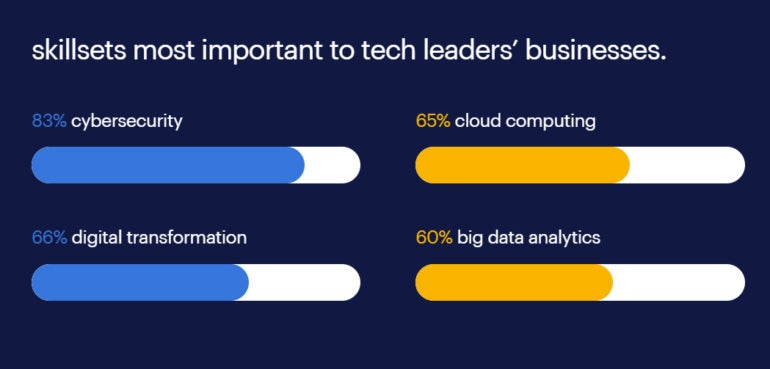
Cyber security and data science roles feature heavily on in-demand tech job lists for 2023. So do IT project managers, software developers, business analysts and network engineers. A Randstad Australia survey found cyber security roles were the most in-demand skill set and highest-growing job by headcount. The highest specific skills areas in demand were DevOps and continuous integration and deployment skills, cloud, development languages, cyber security skills and test automation.

Figure A

Infographic about Australia’s most in-demand IT skills according to Randstad.
Australia’s most in-demand IT skills according to Randstad. Image: TechRepublic

But the big growth area for this year is AI. A survey conducted by Robert Half found that generative AI was having a huge impact on hiring plans, with 30% of employers surveyed having shifted their focus to different IT skills that are more in demand due to AI advancements. The survey found 34% had hired contractors or consultants to bring in specialised skills, 33% had increased hiring to keep up with innovation and 23% had outsourced certain projects.

Randstad’s survey also found AI, automation and robotics skills were in the shortest supply in the market, while expecting the second largest growth in headcount (behind cyber security).

Robert Half’s senior managing director for APAC, David Jones, said generative AI may change how work is done, but that does not mean it will eliminate jobs in the process.

“It is in the environment of automation by and with AI that new job profiles are emerging that need people more than ever,” said Jones. “While there is a growing demand for workers who hold these skills, employers know it’s an emerging field and are willing to facilitate the upskilling of staff.”

Logicalis meets market demand with Talent Services launch

Logicalis Australia launched its Talent Services business to help customers get their hands on the IT skills and capabilities they need at the right time to be able to get IT projects done.

A fully managed solution, it offers remote, hybrid or on-site tech professionals while taking care of payroll, onboarding, performance management and renewal or disengagement.

Despite the market-wide talent shortage, Logicalis Australia says its access to a wide talent network means it can provide a shortlist of candidates within 48 hours of receiving a brief.

“Going out and hiring full-time is the traditional model, but that’s evolving,” said Brown. “We find there are core roles, and our service sits around that team, offering agility, capacity and capability.

“It reflects the needs in the market. They may not have the opex budget to hire five roles and deal with that commitment. This can be a low-risk option for organisations.”

The biggest change in the market now is the speed at which enterprise IT teams are moving.

“People are asking, ‘Can we do this now?’” Brown said. “They have projects banking up. As one thing rolls over, it banks up the next project. If they can bring someone in for three months, we find they are not having to delay those projects.”

Brown adds that because players in the tech sector are not sure what the future holds for the economy, augmenting teams in this way could increase flexibility during uncertainty.

Logicalis Australia is not expecting a significant shift in the skills available in the market over the next 24 months. Brown says there’s “not enough talent in those emerging tech areas.”

He says the skills gap is even driving different types of candidates to seize opportunities.

“People are seeing opportunities because of where things are going in the market, and it is clearly going to take a long time to catch up to the trend of supply and demand,” Brown said.

Brown adds that current economic pressures will push organisations to evolve faster and pursue further automation, driving even further demand for technology skills to support change.

Subscribe to the Daily Tech Insider AU Newsletter

Stay up to date on the latest in technology with Daily Tech Insider Australian Edition. We bring you news on industry-leading companies, products, and people, as well as highlighted articles, downloads, and top resources. You’ll receive primers on hot tech topics that are most relevant to AU markets that will help you stay ahead of the game.

Delivered Thursdays Sign up today

13 Startups that Google Funded Under its First AI Startup Cohort

The inaugural Google for Startups Accelerator: AI First cohort was announced yesterday. The tech-giant has shortlisted 13 startups from hundreds of applicants focusing on companies solving ‘pressing issues’ using AI. The chosen startups work on different domains in Europe, Israel and UK with a leaders hailing from diverse professional backgrounds.

In a 10-week, equity-free program supporting them from Seed to Series A stages, the cohort offers a blend of in-person and virtual activities, 1:1 mentoring, and group learning. The program also includes guidance on product design, business growth, and leadership development, providing dedicated Google AI technical expertise and credits through the Google for Startups Cloud Program.

Here are all the thirteen startups that are part of the Google cohort:

Annea.Ai

Annea Ai, a German company founded in 2019 by Maik Reder and Marcel Frenzel, provides predictive maintenance for renewable energy assets, such as wind turbines. They use AI and Digital Twin technology to forecast and prevent breakdowns in the renewable energy infrastructure. The company has raised $1 million in their seed round from Faber and Innoport.

They reduce the operational expenditure of renewable energy companies while increasing their production using advanced AI, models of how things should normally work, and physical models to figure out if something is wrong with the way a vehicle’s engine operates. They alert the operators incase of failures up to 365 days in advance with a detailed analysis on the problem and its cause.

Checktur.io

Checktur.io was founded by Agnieszka Michalik and Dr Lusia Müller-Wittmann in 2022. It is an artificial intelligence system designed to automate and manage transportation and logistics processes. Chektur enables businesses to manage their commercial vehicle fleets efficiently via an end-to-end fleet asset management ecosystem while using AI models and data-driven insights. They offer instant damage reports, digital documentation and damage allocation so companies can track their vehicles.

Exactly.ai

Exactly.ai was founded by Tonia Samsonova in 2022. The company is an AI tool for artists that allows them to create images in their own unique style with a simple written description. Unlike their competitors, Exactly.ai does not create the images but offers artists a service to make their own AI algorithms trained on their artwork to generate images in their style. This also tackles the issue of copyright as not only the artwork but also the algorithm belongs to the artist who preserves the ownership of their work.

Neurons

Neurons is a Danish company founded by Thomas Ramsoy in 2013. They’ve received 8.4 million in funding so far and has developed a precise AI model that can measure human subconscious signals to predict marketing responses. Neurons operates as a consumer neuroscience company, employing neuroscience tools to enhance consumer understanding and experiences. Their toolkit comprises a brain scanning device and eye-tracking goggles, utilising AI-driven software for interpreting consumer responses—both conscious and unconscious. Use cases encompass neuromarketing, UXD, in-store environments, and consumer journeys. Notable customers involve IKEA, Estée Lauder, Facebook, and Visa.

PACTA

PACTA, a German company, was founded by Dominik Müller, Fabian Pohl, Ludwig Wolter, Marcel Horndasch, and Tim Adrian in 2018. PACTA addresses the problem of legal digitisation by offering user-friendly disruptive technologies. It automates legal processes and facilitates intelligent legal communication. PACTA also unites various stakeholders on a central platform, streamlining legal workflows and document handling. Users can efficiently create, negotiate, digitally sign, and analyse legal documents, reducing costs and risks while boosting productivity. They raised €1,700,000 in the seed round in 2021.

Quantic Brains

Quantic Brains, headquartered in Spain, was founded by Julio Covacho López, Manuel Lucania Fesser, and Roy Conan Alonso Rising in 2021. Quantic Brains Technologies develops an AI-powered platform for audiovisual content creation. Users can automate game and film creation by utilising AI tools that automate character behaviours. The platform allows users to create and publish animations and video games, selecting characters (e.g., musicians, children, warriors) and objects (e.g., cars, phones, balls, swords), as well as scenes. They raised €300,000 in the pre-seed from Castiventures.

Sarus

Sarus is a French company founded in 2022 by Maxime Agostini, Nicolas Grislain, and Vincent Lepage. Sarus helps handle personal data for analysis or machine learning. It’s integrated into data systems and allows working on data while keeping it private using differential privacy. Sarus replaces the need for lengthy anonymization processes, saving time and preserving data value. Users can start projects faster and use the entire data securely. It minimises risks in collaboration projects across different areas.

Releva

Releva, founded by Georgi Georgiev and Yavor Stoychev, is a Bulgarian company founded in 2020. They provide an all-in-one AI automation solution for E-commerce marketing. Releva focuses on real-time revenue operations globally. It’s an AI-driven growth platform, enhancing customer experiences by understanding individual needs. It’s a comprehensive solution for e-commerce marketing as it integrates various tools on a single dashboard for measuring, attributing, experimenting, analysing, predicting, and automating growth in real-time. The company has raised $870K in their seed round in March 2022.

Semantic Hub

This is a Swiss company founded by Efimenko Irina, Khoroshevskiy Vladimir, and Vitaly Nedelskiy in 2015. They help partners navigate challenging patient segments, focusing on rare diseases and various minorities. They use AI and deep NLP technologies, along with Patient Voice – which is anonymous feedback from patients and caregivers on social networks and forums. Their platform can handle almost any language, and they have worked in 54 countries, dealing with 40+ languages and 80+ indications.

They transform patient language into a clinical format, offering valuable insights into their experience and journey, including unmet needs, barriers, treatment success factors, access issues, and more. They’ve raised $2.7 million in funding in 2021.

Vazy Data

Vazy Data is a French company founded by Lazare Masset, Sarah Kerriche and Jean Beuselinck in 2023. Vazy enables individuals without any technical expertise to analyse data. The platform integrates with various company databases and communication tools like Slack, Microsoft Teams, and Google Chat. Vazy allows users to ask questions like they would to a data analyst. The AI ensures clarity and removes ambiguity in inquiries to mitigate biases. The platform then autonomously manages data retrieval, aggregation, and processing and the results are presented visually with clear data origins and interpretations.

Visionary.AI

Visionary.ai is an Israeli company founded by Oren Debbi and Yoav Taieb in 2020. The company specialises in optics, computer vision engineering, and professional photography. Visionary AI enables cameras to reach the next level of image quality, utilising a software-based Image Signal Processor (ISP) infused with AI. Additional product features encompass gaze correction, bokeh, and generating depth maps on any sensor. Operating as a software-based ISP allows for real-time deployment of updates, ensuring that cameras can keep pace with the latest advancements in computer vision, maintaining the highest quality imaging capabilities available in the market.

Zenpulsar

Zenpulsar founded by Julien Artero and Pavel Dudko in 2021 is a UK-based company. The company provides financial fraud solutions that operate through Software-as-a-Service (SaaS). They help businesses figure out what’s true and not on social media. These tools provide clarity and trust in a chaotic world of social media. By using them, organisations can reduce the risk of misinformation. They can also respond quickly to any problems and protect their reputation, customers, investors, and business. The company has raised €1 million in their pre seed from 8X Ventures and Maydan Capital.

Zaya AI

Zaya AI is a Belgian company founded in 2022 by Christian Mogodici, Mihai Trascau and Sabina Zurac. They use machine learning to better understand and diagnose diseases, assisting healthcare professionals to make timely and informed medical decisions. They use scans of tissue and cell samples on their platform which provide the diagnoses after image analysis. Zaya provides powerful AI and cloud technology to help pathologists and scientists in labs analyse medical images faster and more accurately, improving consistency in their work. They haven’t been funded yet.

The post 13 Startups that Google Funded Under its First AI Startup Cohort appeared first on Analytics India Magazine.

KDnuggets News, September 20: Python in Excel: This Will Change Data Science Forever • New KDnuggets Survey!

Features

  • Python in Excel: This Will Change Data Science Forever
  • KDnuggets Survey: Benchmark With Your Peers On Data Science Spend & Trends 2023 H2
  • 5 Best AI Tools For Maximizing Productivity

From Our Partners

  • Pursue A Master’s In Data Science With The 3rd Best Online Program from Bay Path University

This Week's Posts

  • Applying Descriptive and Inferential Statistics in Python
  • Closed Source VS Open Source Image Annotation
  • Scikit-learn for Machine Learning Cheat Sheet
  • Hypothesis Testing and A/B Testing
  • Linear Regression from Scratch with NumPy
  • Demystifying Machine Learning
  • How to Get a Job in Data Science as a Student
  • 5 Amazing & Free LLMs Playgrounds You Need to Try in 2023
  • Getting Started with Scikit-learn in 5 Steps
  • Understanding Supervised Learning: Theory and Overview
  • Hands-On with Supervised Learning: Linear Regression
  • How to Identify Missing Data in Time-Series Datasets
  • Ensemble Learning Techniques: A Walkthrough with Random Forests in Python
  • Unveiling Unsupervised Learning
  • Unveiling Neural Magic: A Dive into Activation Functions
  • Don't Miss Out! Enroll in FREE Courses Before 2023 Ends

More On This Topic

  • Python in Excel: This Will Change Data Science Forever
  • Forget ChatGPT, This New AI Assistant Is Leagues Ahead and Will Change the…
  • KDnuggets News, September 14: Free Python for Data Science Course •…
  • KDnuggets News, September 28: Free Algorithms in Python Course • Lessons…
  • Automate Microsoft Excel and Word Using Python
  • Do You Read Excel Files with Python? There is a 1000x Faster Way

OpenAI To Make Fine-Tuning UI Available Soon

ChatGPT is Down, I Can’t Code Anymore

OpenAI is likely to make fine-tuning UI available in the coming months according to Logan Kilpatrick. Users will have a seamless experience through the UI, allowing them to easily view their fine-tunes and create them effortlessly using the same interface, according to Kilpatrick.

The @OpenAI fine-tuning UI is here! 🔥
You can now see your fine-tunes directly and will be able to create them though the UI in the months to come!
We also bumped the concurrent training limit from 1 to 3 so you can fine-tune more models! pic.twitter.com/qQcQSWZUt7

— Logan.GPT (@OfficialLoganK) September 19, 2023

Furthermore, OpenAI has increased the concurrent training limit from 1 to 3, enabling users to fine-tune multiple models simultaneously.

Currently, OpenAI permits developers to customize only a part of the model name using a suffix. However, in the coming future, developers might have the opportunity to fully customize the entire model name, as indicated by Kilpatrick.

Many developers around the world are hoping that OpenAI might make fine-tuning available at their inaugural developers’ conference ‘OpenAI DevDay’ which is taking place on November 6th, 2023 in San Francisco. There has been a lot of anticipation about what the company is going to announce, though Sam Altman has said that there is going to be no announcement about GPT-5.

Some predictions for OpenAI’s developer day on November 6th…
– Meaningful GPT-4 cost reduction
– Fine-tuning for GPT-4
– UI for fine-tuning
– Multimodal GPT-4 goes live
– DALL-E 3
– ChatGPT API (rethinking of plugins)
I bet I hit on at least 3.

— Mckay Wrigley (@mckaywrigley) September 15, 2023

Recently, OpenAI also silently unveiled “gpt-3.5-turbo-instruct,” a new instruction language model designed for giving specific instructions efficiently, similar to the chat-focused GPT-3.5 Turbo.

This new model will replace existing Instruct models and certain text-based models. It maintains the same cost and performance as other GPT-3.5 models within a 4K context window, using training data up to September 2021.

The post OpenAI To Make Fine-Tuning UI Available Soon appeared first on Analytics India Magazine.

Unity is Not as United as It Sounds

Unity, the game engine, apologised to its users, or it was something resembling an apology for their pricing change. It caused an uproar among the developers and 19 companies built out of Unity have pulled out with an open letter. New developers are now moving to Unreal and Godot as they claim they’ve ‘lost trust’ in Unity. Popular games like Cult of the Lamb have even threatened to delete their games from Unity amidst all this. In a cascading effect, the company’s stock fell after the announcement.

The new pricing model, announced last Tuesday that goes into effect on January 1, 2024, includes a pay-per-download fee for developers, who use the Unity Personal or Unity Pro plans.

The situation turned worse when the company silently removed the GitHub repository that tracks any terms of service (ToS) changes the company made. This has further infuriated the community and they’ve accused Unity of being anti-consumer and trying to hide the changes.

United we stand, divided we fall

The change in pricing affects developers who use the Unity Personal plan who will be charged $0.20 per install once their game surpasses 200,000 downloads. Developers who use the Unity Pro plan will be charged $0.10 per install once their game surpasses 1 million downloads.

The pricing plan gets more complex than the previous ones now that the plus is being removed, and the pro and enterprise levels all cost a subscription, in a tiered basis determined by the number of downloads. Handling subscription and per-install fees can be costly for developers, and this expense may be passed on to players

However, there is no cooldown period for the developers to adjust the new scheme to their current gaming prices. “Oh, and did I mention we’re automatically being switched to the more expensive Pro from Plus if we don’t cancel our subscription,” writes Brandon Sheffield, the Creative Director of Necrosoft Games. This gives no incentive for new developers who want to build games on Unity’s engine.

Given all this, Azur Games published a collective letter from the developers that read, “As a course of immediate action, our collective of game development companies is forced to turn off all IronSource and Unity Ads monetization across our projects until these changes are reconsidered.”

Unity responded that they require additional time to ascertain the precise nature of these modifications. It strongly implies that these alterations are unlikely to fully meet the demands for a complete reversal that developers have been advocating for.

The company said that the new pricing model is necessary to ensure that the company can continue to invest in its development and to provide support to its users. Since the company’s IPO in 2020, they’ve been looking for means to be profitable, but it just went south for Unity.

Decline of Unity, the rise of Unreal and Godot

Under the leadership of John Riccitiello, Unity has witnessed a consistent decline because of his unconventional business models, and a number of features being unattended and a notable lack of stability. His sale of stocks along with a few top executives before this announcement has not gone unnoticed.

For years, developers have been complaining about stability issues and unmanaged features with the engine. There are issues with security and privacy where Unity is no longer patching them. They stopped support for the web player in 2015 and now every particle system will also cost $0.20 per install is also unfeasible. Sheffield said, “Unity has internal champions for its features. Once those champions leave the company, that feature languishes and falls apart.”

The real winners in all of this are Unreal and Godot where thousands of developers opt to move away from Unity. This is more problematic for older games developed on Unity, Pokemon Go, Genshin Impact and Among Us who’ve established themselves on Unity won’t be able to shift so easily.

Nick Kaman, the studio head and art director at Aggro Crab Games said he’s worried that he’ll have to move to another engine for their new game after having spent 10 years in Unity. “A lot of us have kind of staked our lives on these platforms,” he told NPR.

Ismail, another developer, said on X, “This is a trust issue. Devs spent the weekend trying Godot & Unreal for the first time in their lives.” The desperation of the developers who want to move their game to another engine is high as one developer managed to port their (text-based) game core over to Godot in 14 hours of work. Studios prepared to apply for some porting grants to Unreal. Those steps are significant, Ismail explained.

People leaving Unity have two major options open to them, Godot and Unreal. While Godot is open-source and free, Unreal has a fair pricing plan for their customers. After the Unity fiasco it would be unwise for Unreal to do the same, though there is no guarantee of that. Meanwhile, we will wait till Unity actually apologises, and actually reverse the pricing plan.

The post Unity is Not as United as It Sounds appeared first on Analytics India Magazine.

Hands-On with Unsupervised Learning: K-Means Clustering

Hands-On with Unsupervised Learning: K-Means Clustering
Image by Author

K-Means clustering is one of the most commonly used unsupervised learning algorithms in data science. It is used to automatically segment datasets into clusters or groups based on similarities between data points.

In this short tutorial, we will learn how the K-Means clustering algorithm works and apply it to real data using scikit-learn. Additionally, we will visualize the results to understand the data distribution.

What is K-Means Clustering?

K-Means clustering is an unsupervised machine learning algorithm that is used to solve clustering problems. The goal of this algorithm is to find groups or clusters in the data, with the number of clusters represented by the variable K.

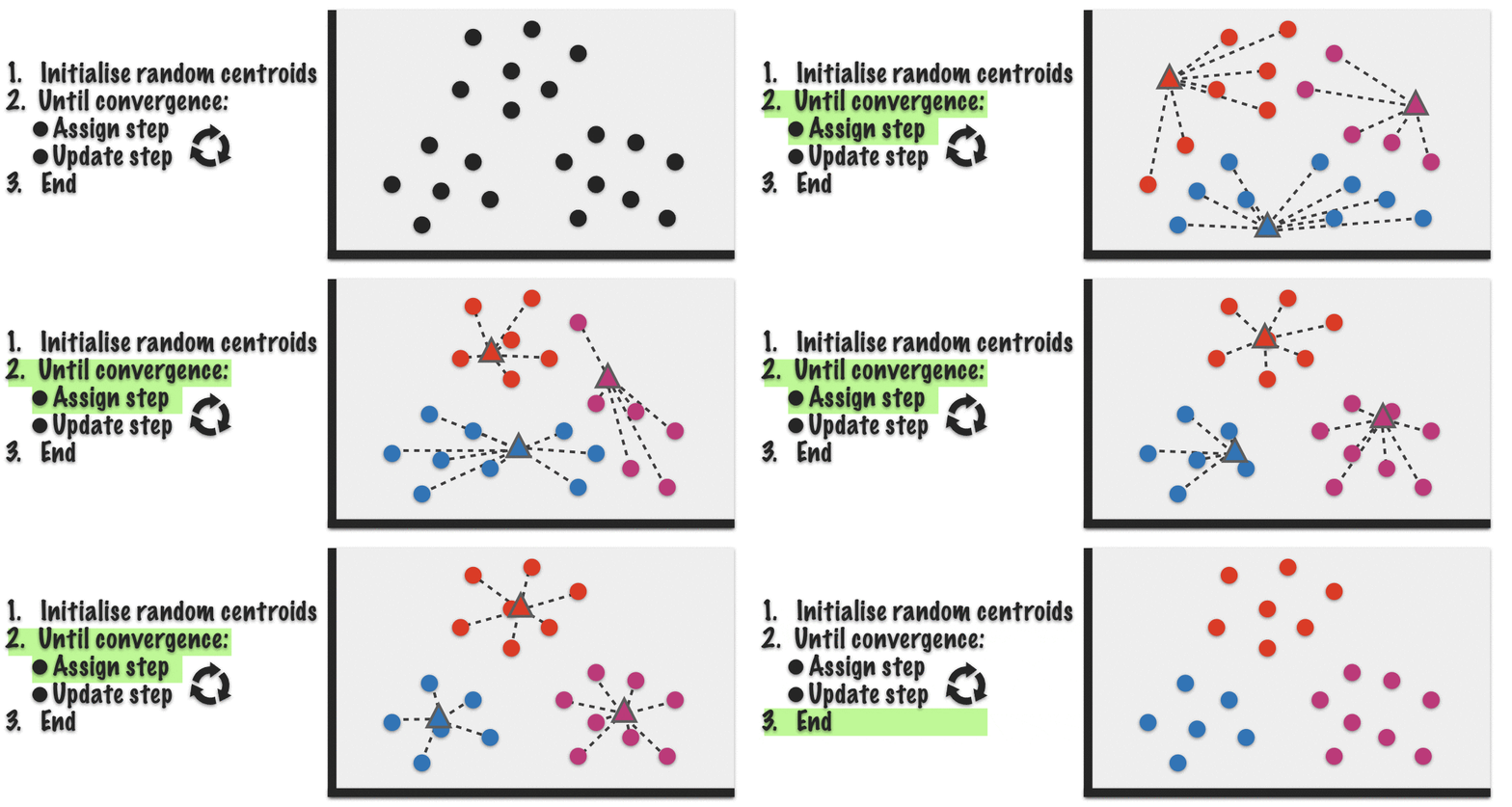
The K-Means algorithm works as follows:

  1. Specify the number of clusters K that you want the data to be grouped into.
  2. Randomly initialize K cluster centers or centroids. This can be done by randomly picking K data points to be the initial centroids.
  3. Assign each data point to the closest cluster centroid based on Euclidean distance. The data points closest to a given centroid are considered part of that cluster.
  4. Recompute the cluster centroids by taking the mean of all data points assigned to that cluster.
  5. Repeat steps 3 and 4 until the centroids stop moving or the iterations reach a specified limit. This is done when the algorithm has converged.

Hands-On with Unsupervised Learning: K-Means Clustering
Gif by Alan Jeffares

The objective of K-Means is to minimize the sum of squared distances between data points and their assigned cluster centroid. This is achieved by iteratively reassigning data points to the closest centroid and moving the centroids to the center of their assigned points, resulting in more compact and separated clusters.

K-Means Clustering Real-World Example

In these examples, we will use Mall Customer Segmentation data from Kaggle and apply the K-Means algorithm. We will also find the optimum number of K (clusters) using the Elbow method and visualize the clusters.

Data Loading

We will load a CSV file using pandas and make “CustomerID” as an index.

import pandas as pd    df_mall = pd.read_csv("Mall_Customers.csv",index_col="CustomerID")  df_mall.head(3)

The data set has 4 columns and we are interested in only three: Age, Annual Income, and Spending Score of the customers.

XXXXX

Visualization

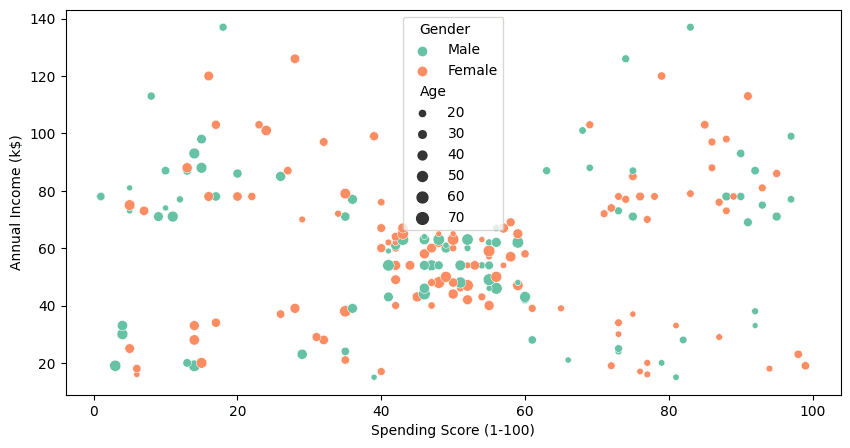
To visualize all four columns, we will use seaborn’s `scatterplot` .

import matplotlib.pyplot as plt  import seaborn as sns    plt.figure(1 , figsize = (10 , 5) )  sns.scatterplot(      data=df_mall,      x="Spending Score (1-100)",      y="Annual Income (k$)",      hue="Gender",      size="Age",      palette="Set2"  );

Even without K-Means clustering, we can clearly see the cluster in between 40-60 spending score and 40k to 70k annual income. To find more clusters, we will use the clustering algorithm in the next part.

Hands-On with Unsupervised Learning: K-Means Clustering

Normalizing

Before applying a clustering algorithm, it's crucial to normalize the data to eliminate any outliers or anomalies. We are dropping the “Gender” and “Age” columns and will be using the rest of them to find the clusters.

from sklearn import preprocessing    X = df_mall.drop(["Gender","Age"],axis=1)  X_norm = preprocessing.normalize(X)  

Elbow Method

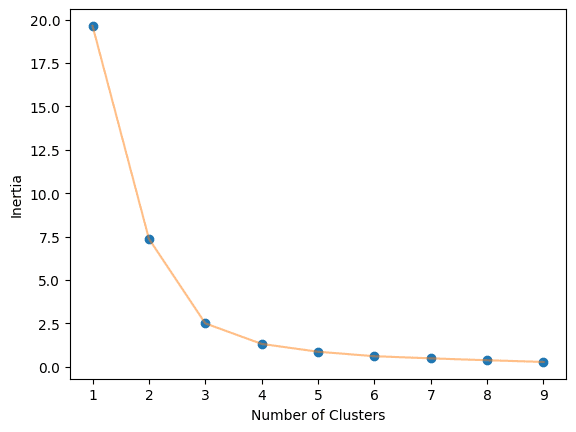
The optimal value of K in the K-Means algorithm can be found using the Elbow method. This involves finding the inertia value of every K number of clusters from 1-10 and visualizing it.

import numpy as np  from sklearn.cluster import KMeans      def elbow_plot(data,clusters):      inertia = []      for n in range(1, clusters):          algorithm = KMeans(              n_clusters=n,              init="k-means++",              random_state=125,          )          algorithm.fit(data)          inertia.append(algorithm.inertia_)      # Plot      plt.plot(np.arange(1 , clusters) , inertia , 'o')      plt.plot(np.arange(1 , clusters) , inertia , '-' , alpha = 0.5)      plt.xlabel('Number of Clusters') , plt.ylabel('Inertia')      plt.show();    elbow_plot(X_norm,10)

We obtained an optimal value of 3.

Hands-On with Unsupervised Learning: K-Means Clustering

KMeans Clustering

We will now use KMeans algorithm from scikit-learn and provide it the K value. After that we will fit it on our training dataset and get cluster labels.

algorithm = KMeans(n_clusters=3, init="k-means++", random_state=125)  algorithm.fit(X_norm)  labels = algorithm.labels_

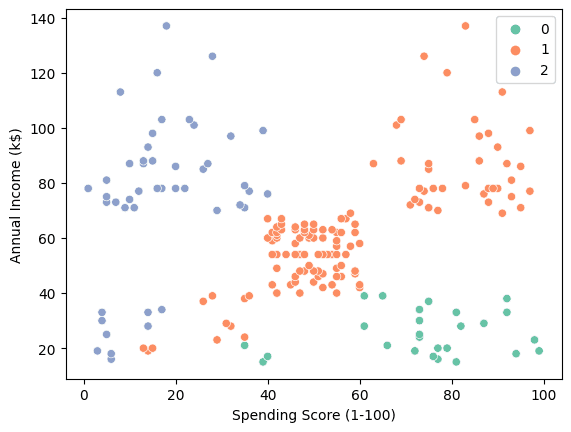
We can use scatterplot to visualize the three clusters.

sns.scatterplot(data = X, x = 'Spending Score (1-100)', y = 'Annual Income (k$)', hue = labels, palette="Set2");
  • “0”: From high spender with low annual income.
  • “1”: Average to high spender with medium to high annual income.
  • “2”: From Low spender with High annual income.

Hands-On with Unsupervised Learning: K-Means Clustering
This insight can be used to create personalized ads, increasing customer loyalty and boosting revenue.

Using different features

Now, we will use Age and Spending Score as the feature for the clustering algorithm. It will give us a complete picture of customer distribution. We will repeat the process of normalizing the data.

X = df_mall.drop(["Gender","Annual Income (k$)"],axis=1)    X_norm = preprocessing.normalize(X)  

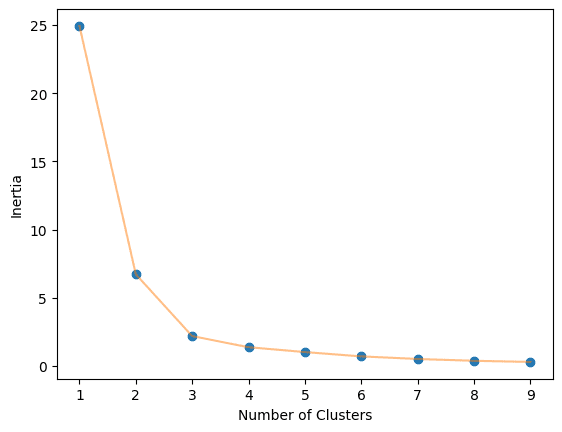
Calculate the optimal number of clusters.

elbow_plot(X_norm,10)

Train the K-Means algorithm on K=3 clusters.

Hands-On with Unsupervised Learning: K-Means Clustering

algorithm = KMeans(n_clusters=3, init="k-means++", random_state=125)  algorithm.fit(X_norm)  labels = algorithm.labels_

Use a scatter plot to visualize the three clusters.

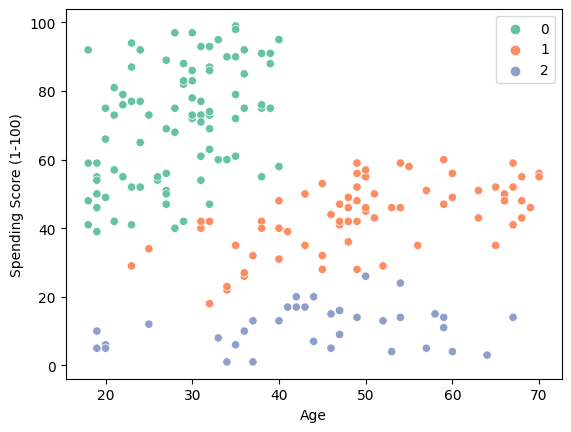
sns.scatterplot(data = X, x = 'Age', y = 'Spending Score (1-100)', hue = labels, palette="Set2");
  • “0”: Young High spender.
  • “1”: Medium spender from middle age to old ages.
  • “2”: Low spenders.

The result suggests that companies can increase profits by targeting individuals aged 20-40 with disposable income.

Hands-On with Unsupervised Learning: K-Means Clustering

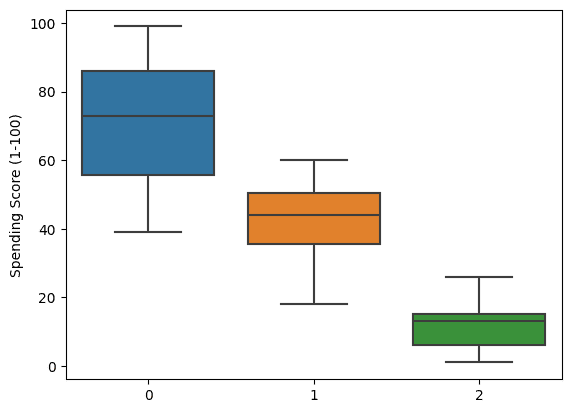
We can even go deep by visualizing the boxplot of spending scores. It clearly shows that the clusters are formed based on spending habits.

sns.boxplot(x = labels, y = X['Spending Score (1-100)']);

Hands-On with Unsupervised Learning: K-Means Clustering Conclusion

In this K-Means clustering tutorial, we explored how the K-Means algorithm can be applied for customer segmentation to enable targeted advertising. Though K-Means is not a perfect, catch-all clustering algorithm, it provides a simple and effective approach for many real-world use cases.

By walking through the K-Means workflow and implementing it in Python, we gained insight into how the algorithm functions to partition data into distinct clusters. We learned techniques like finding the optimal number of clusters with the elbow method and visualizing the clustered data.

While scikit-learn provides many other clustering algorithms, K-Means stands out for its speed, scalability, and ease of interpretation.
Abid Ali Awan (@1abidaliawan) is a certified data scientist professional who loves building machine learning models. Currently, he is focusing on content creation and writing technical blogs on machine learning and data science technologies. Abid holds a Master's degree in Technology Management and a bachelor's degree in Telecommunication Engineering. His vision is to build an AI product using a graph neural network for students struggling with mental illness.

More On This Topic

  • Clustering Unleashed: Understanding K-Means Clustering
  • Clustering with scikit-learn: A Tutorial on Unsupervised Learning
  • Centroid Initialization Methods for k-means Clustering
  • Key Data Science Algorithms Explained: From k-means to k-medoids clustering
  • What is K-Means Clustering and How Does its Algorithm Work?
  • Unsupervised Learning for Predictive Maintenance using Auto-Encoders

NVIDIA Now Partners with Infosys for Boosting Generative AI in Enterprise

NVIDIA Now Partners with Infosys to Boost Generative AI in Enterprise

In another groundbreaking development in the Indian tech industry, NVIDIA has announced its partnership with Infosys for revolutionising the world of enterprise AI. The collaboration will see the integration of the NVIDIA AI Enterprise ecosystem, encompassing models, tools, runtimes, and GPU systems, into Infosys Topaz, which is a trailblazing AI-centric suite of services, solutions, and platforms built on generative AI technologies.

This integration will empower Infosys to create offerings that enable businesses worldwide to seamlessly incorporate generative AI into their operations, fostering unprecedented innovation and productivity gains.

In a significant move, Infosys has also unveiled plans to establish the “NVIDIA Center of Excellence,” dedicated to training and certifying 50,000 of its employees in NVIDIA AI technology. This initiative will equip Infosys with a formidable workforce capable of providing expert generative AI solutions across diverse industries.

Infosys has fully embraced the NVIDIA generative AI platform, leveraging both hardware and enterprise-grade software to drive innovation across its operations and deliver generative AI applications that enhance business operations, sales, and marketing.

With access to NVIDIA AI Enterprise frameworks, pretrained models, and toolkits, Infosys has already rolled out multiple AI-first solutions across various industries:

Retail Transformation: By integrating the Infosys Video Analytics platform with NVIDIA Metropolis, Infosys is going to revolutionise the retail industry. This partnership enables frictionless shopping experiences, improved merchandising, enhanced planogram compliance, reduced shrinkage, real-time inventory monitoring, health and safety compliance checks, and more. It also has applications in logistics, manufacturing, and utilities.

Language Models for Enterprises: Through the pairing of Infosys Generative AI Labs with the NVIDIA NeMo framework, organisations can now fine-tune and expedite the deployment of large language models tailored to meet various enterprise needs. This collaboration also incorporates NVIDIA NeMo Guardrails to enhance the Responsible AI Toolkit, ensuring protection against potential risks associated with generative AI.

Next-Generation Contact Centers: Using Infosys Cortex with NVIDIA Riva speech and translation AI, is aiming to craft AI-driven contact centre solutions. These solutions offer language-neutral features for seamless multilingual support, real-time customer intent and sentiment analysis, ultimately boosting customer satisfaction and brand loyalty.

The partnership extends beyond these applications, encompassing digitalization solutions for 3D workflows, design collaboration, digital twins, world simulation, and other innovative use cases. Furthermore, Infosys and NVIDIA are collaborating on AI-powered solutions in emerging domains such as 5G, cybersecurity, and energy transition.

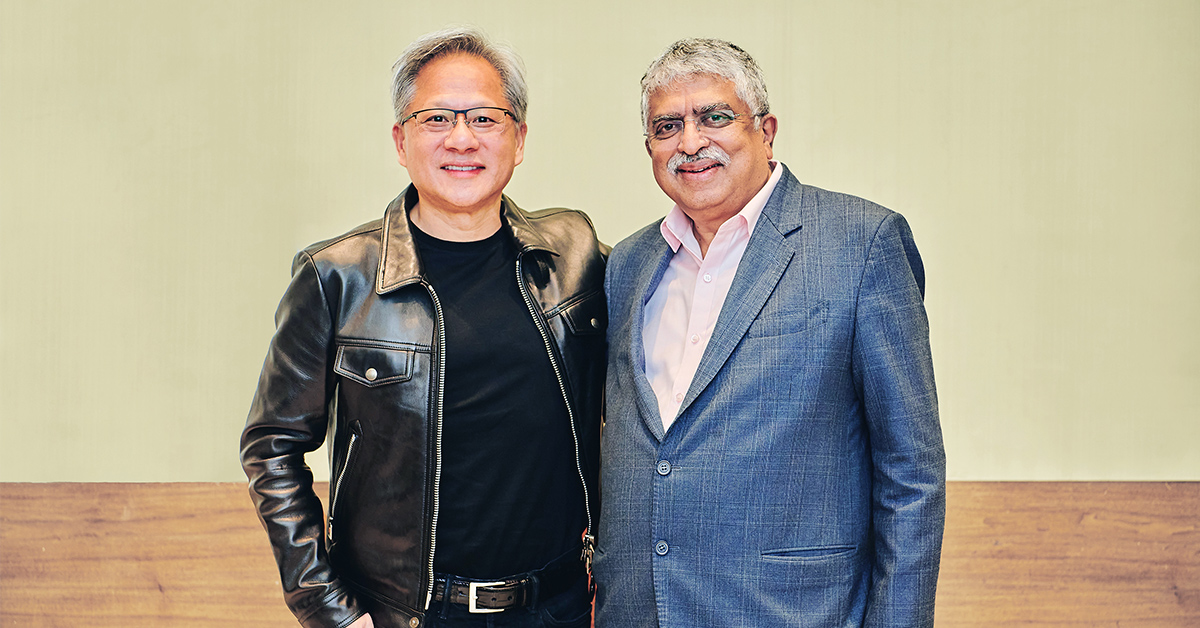
Speaking about the partnership, Nandan Nilekani, co-founder and chairman of Infosys, stated, “Infosys is transforming into an AI-first company to better provide AI-based services to our clients worldwide. Our clients are also looking at complex AI use cases that can drive significant business value across their entire value chain. Infosys Topaz offerings and solutions are complementary to NVIDIA’s core stack. By combining our strengths and training 50,000 of our workforce on NVIDIA AI technology, we are creating end-to-end industry-leading AI solutions that will help enterprises on their journey to become AI-first.”

Jensen Huang, founder and CEO of NVIDIA, emphasised the impact of generative AI on enterprise productivity, saying, “Generative AI will drive the next wave of enterprise productivity gains. The NVIDIA AI Enterprise ecosystem is ramping quickly to provide the platform for generative AI. Together, NVIDIA and Infosys will create an expert workforce to help businesses use this platform to build custom applications and solutions.”

Recently, during his visit to India, Huang also announced its partnership with Reliance and Tata for building generative AI infrastructure and capabilities within the country.

The post NVIDIA Now Partners with Infosys for Boosting Generative AI in Enterprise appeared first on Analytics India Magazine.