15 Best ChatGPT Prompts for Twitter (X)

In the rapidly evolving sphere of social media, Twitter (X) stands out as a platform where concise and impactful content reigns supreme. From brands to influencers, everyone is vying for engagement and visibility, necessitating a unique approach to content creation.

ChatGPT, with its versatile capabilities, can assist in crafting high-quality and engaging Twitter content. This article covers some of the best ChatGPT prompts for Twitter, each designed to optimize engagement, showcase value, and amplify presence on this bustling platform. Whether it’s designing a campaign or crafting an engaging Twitter thread, these prompts can be your guiding light.

1. Bio Creation

Crafting a bio that's both personalized and engaging is crucial as it acts as the initial point of interaction between you and your potential followers. The Bio Creation Prompt is designed to generate bios reflective of your content and your brand’s personality.

By inputting your content type and providing six bios that align with your brand's voice, ChatGPT will generate ten tailor-made bios, allowing you to select the one that best resonates with your brand identity. This helps enhance your profile's professional appeal and attract like-minded followers, thereby facilitating increased engagement and visibility.

  • Prompt: “Craft a personalized Twitter bio for me, based on the content I create, related to [INSERT YOUR INFO]. Refer to the following six bios: [COPY AND PASTE 6 EXAMPLES]. Produce 10 tailor-made Twitter bios for me, reflecting the style and ideas from the given examples.”

2. Retweet Commenting Prompt

Engaging with content through retweets with comments is a nuanced way to share perspectives with your followers. The Retweet Commenting Prompt assists in formulating varied comments that can be added to a retweet.

By feeding the tweet you intend to retweet, ChatGPT constructs comments that align with your viewpoint and accentuate the shared content’s value. This not only fosters richer interaction with the content but also encourages dialogue, enhancing community building and presence on Twitter.

  • Prompt: “I’m planning to retweet the following: “[COPY AND PASTE TWEET].” Construct 5 varied comments I could append to this retweet.”

3. Article Conversion to Twitter Thread Prompt

Conveying extensive information cohesively through Twitter threads maintains the platform's inherent brevity and is an effective method of communication. The Article Conversion to Twitter Thread Prompt allows the user to convert articles into coherent and engaging series of tweets by maintaining the core essence and information flow of the article. This makes your content more digestible and accessible, increasing engagement and expanding your content’s reach.

  • Prompt: “Transform the ensuing article into a sequence of Twitter posts, creating a coherent thread: “[COPY AND PASTE ENTIRE ARTICLE].””

4. Twitter Campaign Creation Prompt

Orchestrating a successful Twitter campaign is pivotal for enhancing brand visibility and engagement. This prompt serves as a guide through the intricate process of designing an impactful and goal-oriented Twitter campaign, emphasizing the integration of meticulous planning, best content creation practices, and distinct objectives to yield maximum impact.

he execution of such tailored campaigns can effectively drive traffic, escalate brand awareness, and procure leads, optimizing overall brand growth and presence on Twitter.

  • Prompt: “Design a potent Twitter campaign, aiming to accomplish [DESIRED GOALS] through the meticulous adoption of planning and content creation best practices.”

5. Twitter Content Calendar Development Prompt:

A consistent posting schedule, maintained by a well-organized content calendar, is indispensable for sustained engagement and growth on Twitter. Acting as a social media manager, this prompt aids in the generation of a week-long content calendar, emphasizing the crafting of diverse and engaging tweets that harmonize with the targeted customer persona, coupled with the strategic incorporation of relevant hashtags and emojis. Such meticulous content management is paramount in establishing a resonating and enduring brand presence on Twitter.

  • Prompt: “Serve as my social media manager, focusing on promoting [Describe your business or brand and its purpose]. Formulate a Twitter content calendar for the upcoming week, crafting at least three tweets per day that target the appropriate customer persona, incorporating relevant hashtags and emojis.”

6. Industry Evolution Threads:

Creating a detailed thread that encapsulates the evolution of a specific industry or brand can be both informative and engaging. This prompt enables you to portray the chronological progression of your chosen subject over a decade.

By conceptualizing a narrative that interweaves pivotal milestones, innovations, and transformations, ChatGPT can assist in illustrating a comprehensive overview of your industry or brand’s journey. Such threads not only serve as an educational tool but also enhance your credibility and authority in your domain, fostering deeper connections with your audience and eliciting increased engagement.

  • Prompt: “Conceive a thread illustrating the progression of [industry/brand] throughout the last ten years.”

7. Twitter Header Image Ideas:

Visual elements are integral in establishing an immediate connection with your audience. This prompt aids in conceptualizing at least five distinctive ideas for a Twitter header image suited to a specific profession or industry niche.

By garnering a spectrum of creative proposals, you can select or amalgamate elements that align with your brand’s essence and vision. A well-conceived header image augments your profile’s aesthetic appeal and coherence, thereby contributing to a stronger and more impactful brand presence on Twitter.

  • Prompt: “Propose a minimum of 5 conceptualizations for a Twitter header image tailored to a [Profession/Industry niche].”

8. Profession-Specific Tweet Generation:

Customization is key in resonating with your intended audience. Acting as a dedicated social media manager, this prompt facilitates the creation of a series of tweets explicitly crafted for a specific profession or business niche.

By incorporating relevant hashtags and designing content that aligns with the nuances of the selected niche, ChatGPT assists in optimizing engagement and reach. This level of tailored content accentuates your brand’s proficiency and relevance in your domain, fostering enhanced interaction and connection with your audience.

  • Prompt: “Assume the role of a social media manager and formulate at least 20 Tweets tailored for a [Profession/ Business niche or industry], integrating prevalent hashtags.”

9. Viral Twitter Thread Construction:

In a platform saturated with content, constructing a Twitter thread with the potential to go viral requires a blend of creativity, relevance, and engagement. This prompt aids in conceptualizing a thread that ingeniously highlights your service, product, or blog to the ideal customer persona.

By integrating pertinent hashtags and emojis and focusing on creative and engaging presentation, ChatGPT endeavors to optimize the thread's viral potential. This approach ensures wider visibility and amplifies the impact of your content, driving engagement, and conversions.

  • Prompt: “I desire a Twitter thread concept intended to gain viral traction and proficiently highlight [mention your service, product, or blog] to the optimal customer persona, embedding pertinent hashtags and emojis.”

10. Innovative Thread Ideas for Product/Service Display:

Showcasing the value and benefits of your product or service demands a strategic and creative approach. This prompt assists in formulating a Twitter thread idea aimed at presenting your offerings to your ideal customer persona in a manner that is bound to garner attention and engagement.

By employing innovative strategies and ensuring clear and compelling messaging, ChatGPT helps in creating threads that are not only visually appealing but also resonant with your audience’s needs and preferences. This enhances the perceived value of your offerings and encourages your audience to engage, relate, and ultimately, convert.

  • Prompt: “Conceive a Twitter thread concept designed to virally present my [product/service] to my [ideal customer persona], employing creative engagement strategies.”

11. Lead-Attracting Thread Ideas with Strong CTA:

Creating a Twitter thread with a powerful call-to-action (CTA) and captivating visuals is crucial in attracting high-quality leads. This prompt focuses on developing such a thread, ensuring that every aspect, from visuals to text, works in unison to grasp attention and incite action.

By leveraging ChatGPT, you can construct concise, compelling threads that concisely convey the unique selling propositions of your product or service, encouraging potential leads to explore further and engage, thereby fostering conversion opportunities.

  • Prompt: “Develop a Twitter thread concept poised to attract superior leads for my [product/service], emphasizing a robust call-to-action and enthralling visuals.”

12. Storytelling Thread Ideas for Products/Services:

The power of storytelling cannot be overstated when it comes to building a connection with your audience. This prompt is geared towards developing a Twitter thread that narrates a unique and relatable story about your product/service and its transformative impact on users.

By crafting an authentic and emotionally resonant narrative, ChatGPT aids in humanizing your brand and making it more accessible and appealing to your ideal customer persona, thereby elevating the overall engagement and interaction with your offerings.

  • Prompt: “Devise a Twitter thread concept that narrates a distinctive and relatable story regarding my [product/service] and its impact on [ideal customer persona] in achieving their [goal].”

13. Unique Feature Display Thread Ideas:

Showcasing the distinct features and benefits of your product/service in an entertaining and engaging way can significantly boost your brand’s appeal. This prompt assists in conceptualizing a thread that does exactly that—highlighting the uniqueness of your offerings in a fun and creative manner.

With ChatGPT’s assistance, you can emphasize the various aspects that set your product/service apart, ensuring a clearer understanding and appreciation from your audience, which can, in turn, lead to higher conversion rates.

  • Prompt: “Formulate a Twitter thread concept to uniquely delineate the features and benefits of my [product/service] in an entertaining manner, attracting quality leads.”

14. Value Showcasing Thread Ideas:

Emphasizing the value and benefits of your product/service is paramount in persuading your audience to take desired actions. This prompt aids in designing a thread that underlines the significant advantages and value propositions of your offerings.

By presenting clear, persuasive narratives with ChatGPT, you not only inform your audience about what you offer but also why it matters, thereby establishing a stronger perceived value and prompting more substantial engagement and action from your audience.

  • Prompt: “Conceptualize a Twitter thread idea intended to underline the value and advantages of my [product/service] to my [ideal customer persona], inducing them to execute [desired action] through a clear and persuasive narrative.”

15. Objection Handling Thread Ideas:

Addressing potential reservations and questions is an essential step in the customer’s journey. This prompt focuses on creating a Twitter thread designed to alleviate any concerns and clarify any doubts your potential customers might have regarding your product/service.

With ChatGPT, you can address these objections proactively, providing reassurances and presenting solutions, thereby instilling confidence in your audience and persuading them to take immediate action.

  • Prompt: “Create a Twitter thread concept aimed at addressing potential reservations and questions my [ideal customer persona] might harbor regarding my [product/service], persuading them to undertake [desired action] with immediacy.”

Unleashing the Power of ChatGPT for Twitter Engagement

In the dynamic and fast-paced realm of Twitter, having a structured approach to content creation can substantially elevate your brand presence. These meticulously designed prompts empower you to leverage ChatGPT’s capabilities in crafting content that is not only engaging and relevant but also finely tuned to your specific needs and objectives.

Whether it's crafting engaging bios, developing captivating threads, or showcasing the unique selling propositions of your products/services, each prompt serves as a potent tool in maximizing your Twitter engagement and impact.

These prompts act as a catalyst, enabling brands, individuals, and creators to navigate the Twitter landscape with precision and creativity. By integrating these prompts, you can seamlessly blend innovation with strategy, ensuring that your content resonates with your target audience and aligns with your brand ethos, thus fostering a more enriched and harmonious connection with your audience and paving the way for enhanced visibility and success on Twitter.

After Amazon and Microsoft, Oracle Introduces Generative AI Healthcare Solutions 

Oracle Corp. announced several enhancements to its healthcare solutions at its flagship event being held in Las Vegas. This includes new cloud-based electronic health record (EHR) capabilities, generative AI services, public Application Programming Interfaces (APIs), and back-office enhancements designed for the healthcare industry.

The new Oracle Health EHR platform will offer a modern interface and intuitive, guided processes that improve patient and provider experiences with easy-to-use, consumer-grade applications. The platform will also provide convenient self-service options that empower patients while reducing provider burden and administrative workloads.

For providers, taking advantage of a host of new features will not only save time, but also increase efficiency. For instance, using generative AI services, providers will be able to create personalised treatment plans based on the patient’s medical history, current condition, and preferences. The platform will also leverage natural language processing and machine learning to extract relevant information from clinical notes and generate accurate documentation and billing codes.

“Our goal is to deliver one of the industry’s best, most functionally rich EHR systems to reduce wasted time, eliminate redundant processes, and add value every step of the way for practitioners and the patients they serve,” said Travis Dalton, executive vice president and general manager of Oracle Health.

Oracle Health will be making its clinical and financial resources, such as vitals, appointments, and orders available via public Application Programming Interfaces (APIs). These new APIs will enable integration with Oracle’s clinical solutions and allow partners, customers, and third-party vendors to create more advanced customizations, as well as net new experiences and workflows :-

  • Generative AI capabilities: Clinical Digital Assistant enables providers to leverage generative AI together with voice commands to reduce manual work. For physicians, the multimodal voice and screen-based assistant participates in appointments using generative AI to automate note taking and to propose context-aware next actions, such as ordering medication or scheduling labs and follow-up appointments.
  • Human resources enhancements: To help healthcare organisations support their complex staffing needs, Oracle added new AI-powered workforce management within Oracle Fusion Cloud HCM. With AI-powered healthcare scheduling and EHR insights, managers can match the best suited workers to the appropriate assignment based on real-time patient and workforce data.
  • Finance and supply chain enhancements: Using Oracle’s existing applications, Oracle will enable healthcare organisations to consolidate disconnected systems and automate critical processes while providing the flexibility needed to support new delivery models ranging from tele-health to home- and community-based care.

Before Oracle, Amazon’s AWS launched HealthScribe and HealthImaging in July to improve the efficiency and accuracy of EHR using generative AI. In April, Microsoft partnered with Epic, America’s largest EHR to enhance medical records and improve patient-doctor interaction using ChatGPT-4.

The post After Amazon and Microsoft, Oracle Introduces Generative AI Healthcare Solutions appeared first on Analytics India Magazine.

Traditional AI vs Generative AI

Traditional AI vs Generative AI
Image by Author

‘Generative AI’ is the next buzzword that’s going around at the moment. Regardless of what sector you’re working in, you’ve definitely heard the word. It has shown us in the past 6 months alone the significant advancements in artificial intelligence (AI). It has reshaped various industries, and everybody wants to get their hands on it.

For some of you, you may not really know the difference between the subsets of AI, and this is the point of this article.

To clear things up for you.

What is Traditional AI?

Traditional AI — a part of AI in which the majority of non-technically inclined people know. Also known as Narrow or Weak AI, the traditional form of AI focuses on performing a specific task in an intelligent manner.

So what we know of traditional AI are voice assistants such as Siri and Alexa who are designed to respond to an input and produce an output. The way in which this is doable is by these AI systems learning from data, characteristics, and more to make decisions and predictions.

Think about when you’re playing computer chess. The computer is not just making up rules as it goes, it knows all the rules and uses this to make its next move. It’s a pre-defined strategy.

Strategy. That is what traditional AI is based on. It makes its decisions using a specific set of rules that it falls back on each time.

It receives an input and produces an output — based on rules, not by creating rules.

What is Generative AI?

Now, onto the buzzword ‘Generative AI’. As you can imagine, I have emphasised that Traditional AI is based on rules and cannot create something new. So, where does that leave Generative AI?

Yes, you’re right. Generative AI has the ability to create something new. Just like traditional AI, generative AI has learned a lot of data and is using this to make decisions and predictions. But rather than it being a simple input and output process.

Generative AI takes the input, understands it, and creates something new using the information from the input. It is trained on data and learns the underlying patterns to be able to generate new data based on the input information that is similar to the training data.

To date, you can use Generative AI to create outputs in different forms such as text, image, and music, as well as use it to help you with tasks such as code completion.

Examples of generative AI include GPT, Soundful, Synthesia, and DALL-E 2.

The Difference

So, what’s the difference between traditional AI and generative AI?

The capabilities and applications are the main difference.

As I mentioned prior, traditional AI is based on receiving an input and producing an output. Input data is analysed and used to make decisions and predictions. If you’re looking for pattern recognition, traditional AI is your go-to. Traditional AI is still very popular and is used to power a lot of current AI systems, such as chatbots and predictive analytics. It focuses on task-specific applications, which a lot of people use for their day-to-day tasks.

On the other hand, generative AI will go above and beyond and create new data, which is similar to training data. If you’re looking for pattern creation, generative AI is your go-to. Generative AI is opening new doors for companies to be more creative and innovative. It can drastically reduce the amount of time spent on tasks such as the ideation process. It can write song lyrics, write articles, and create deepfakes. Where creation and innovation are important, generative AI has a high potential of taking it to the next level.

Wrapping it up

To wrap up this general article about traditional AI and generative AI, you need to understand that their functions cannot be intertwined just yet. For example, generative AI can be used with traditional AI to provide more effective solutions. On the other hand, traditional AI can provide a specific output that could be further analysed to create personalised content using generative AI.

Understanding the difference between the two and their specific role in the world of AI is important. They are both shaping our future and are both highly embraced in today's society.

You know understand the unique capabilities of the two and will get to enjoy the ride as they continue to be innovative.
Nisha Arya is a Data Scientist, Freelance Technical Writer and Community Manager at KDnuggets. She is particularly interested in providing Data Science career advice or tutorials and theory based knowledge around Data Science. She also wishes to explore the different ways Artificial Intelligence is/can benefit the longevity of human life. A keen learner, seeking to broaden her tech knowledge and writing skills, whilst helping guide others.

More On This Topic

  • ChatGPT, GPT-4, and More Generative AI News
  • Are Data Scientists Still Needed in the Age of Generative AI?
  • Synthetic Data Platforms: Unlocking the Power of Generative AI for…
  • Free From Google: Generative AI Learning Path
  • Whose Responsibility Is It To Get Generative AI Right?
  • This Week in AI, August 7: Generative AI Comes to Jupyter & Stack Overflow…

The Proportional Rise of Inference and CPUs

A saying in the developer community goes, “Training costs scale with the number of researchers, inference costs scale with the number of users.” Imagine a few years into the future, when all the big techs have their own models and there are specialised LLMs and multimodal foundational models for specific use cases.

Now consider this scenario: While the cost of conducting a single training run for an AI model can be substantial, running inference, which involves applying the trained model to real-world data, is relatively inexpensive. However, the sheer scale of potential users and diverse applications means that the accumulated total of inference operations will eventually surpass the total cycles spent on training. The demand would move from hardware and software for training to that required for inference.

Many organisations today prefer not to fine-tune LLMs due to the availability of pre-trained models that can be adjusted with parameter tweaks, prompt banks, or sampled responses. If they do fine-tune, it’s typically on a limited number of tokens from a domain-specific corpus, incurring training costs only occasionally.

The major cost for organisations arises during inference, especially as user numbers and questions increase. To manage these expenses, organisations are adopting various optimisation strategies at the inference level. Even for relatively modest use cases, like a customer chatbot in the automotive sector, the monthly cost can range from $2000 to $2500 when using a proprietary LLM, assuming only a small percentage of users engage with it. As user usage grows, the cost can escalate significantly due to increased token generation.

AMD is strategically focusing on AI inference, diverging from the traditional GPU-centric path. The acquisition of Mipsology, an AI software company focused on inference, signifies AMD’s commitment to enhancing AI software capabilities and offering a comprehensive solution, including CPUs, streamlining AI model deployment through the AMD Unified AI Stack. This demonstrates AMD’s determination to establish itself as a major player in AI computing, emphasising CPU-based inference solutions.

Intel is also emphasising AI inference by leveraging its CPU capabilities. Its Xeon Scalable processors, complemented by hardware features like Intel DL Boost VNNI and Intel AMX, are central to its AI inference strategy. Intel’s participation in benchmark tests like MLPerf Inference v3.1 demonstrates competitive AI inference performance across various models.

The Habana Gaudi2 accelerators and 4th Gen Intel Xeon Scalable processors are powerful options for AI workloads. Moreover, Intel’s balanced platform for AI inference, featuring a larger cache, higher core frequency, and other advantages, positions Intel CPUs as strong contenders for diverse AI inference pipelines. Intel’s active contribution to the community through open sourcing-further challenges the GPU-centric perception in AI inference scenarios.

While it’s challenging to control user behaviour, organisations are seeking ways to reduce the cost per token at the hardware level, which could prove highly beneficial in managing overall expenses.

CPUs: The emerging tech in inference

CPUs are poised to become competitive players when it comes to inference, according to people in the ecosystem. While CPUs have long been considered slower than GPUs for training, they possess a set of advantages for inference. Furthermore, they can offer cost-effective performance per arithmetic operation compared to GPUs.

The distribution of training workloads remains challenging in AI, while inference can be efficiently distributed across numerous low-cost CPUs. This makes a swarm of commodity PCs an attractive option for applications reliant on ML inference.

Unlike training, inference often requires processing small or single-input batches, necessitating different optimisation approaches. Additionally, certain elements of the model, such as weights, remain constant during inference and can benefit from pre-processing techniques like weight compression or constant folding.

Inference presents unique challenges, particularly in terms of latency, which is critical for user-facing applications.

As inference costs continue to take centre stage, it will significantly impact the approach to developing AI applications. Researchers value the ability to experiment and iterate rapidly, requiring flexibility in their tools. Conversely, applications tend to maintain their models for extended periods, using the same fundamental architecture once it meets their needs. This juxtaposition may lead to a future where model authors use specialised tools, handing over the results to deployment engineers for optimisation.

In this evolving landscape, traditional CPU platforms such as x86 and Arm are poised to emerge as the winners. Inference will need to be seamlessly integrated into conventional business logic for end-user applications, making it challenging for specialised inference hardware to function effectively due to latency concerns. Consequently, CPUs are expected to incorporate increasingly integrated machine learning support, initially as co-processors and eventually as specialised instructions, mirroring the evolution of floating-point support in CPUs.

This impending shift in the AI landscape has significant implications for hardware development.

How NVIDIA Optimises GPUs for Inference

And NVIDIA has gotten wind of it. To enhance its H100 offering, NVIDIA through its new TensorRT-LLM—an open-source software—is offering double the performance of the H100 GPU when running inference on LLMs, greatly enhancing overall speed and efficiency.

TensorRT-LLM optimises LLM inference in multiple ways. It includes ready-to-run versions of the latest LLMs like Meta Llama 2, GPT-2, GPT-3, Falcon, Mosaic MPT, and BLOOM. It also integrates cutting-edge open-source AI kernels for efficient LLM execution. Additionally, TensorRT-LLM automates the simultaneous execution of LLMs on multiple GPUs and GPU servers through Nvidia’s NVLink and InfiniBand interconnects, eliminating manual management and introducing in-flight batching to improve GPU utilisation.

Furthermore, it’s optimised for the H100’s Transformer Engine, reducing GPU memory usage. These features enhance LLM inference performance, scalability, and power efficiency, supporting various Nvidia GPUs beyond the H100.

Traditionally, many ML researchers have regarded inference as a subset of training, but this perspective seems to be on the verge of change as inference takes centre stage.

The post The Proportional Rise of Inference and CPUs appeared first on Analytics India Magazine.

How Generative AI is disrupting data practices

Sponsored Content

By Bill Hammond, Event Director, Big Data London

Generative AI has created a shift in how we interact with and utilise data, with tools such as deep learning and natural language processing (NLP) enabling unprecedented levels of automation, and reshaping how we collect, process, and extract value from data. The release of Language Learning Model (LLM) ChatGPT by OpenAI in November of last year opened the floodgates leading to alternatives including Google Bard and Microsoft Bing and Gen AI has proved massively disruptive, with businesses seeking to explore how they can apply the technology.

AI is being used by companies of all sizes to optimise their business processes and enhance their products. Approximately 75% of the value Gen AI promises to deliver comes from its application in customer operations, marketing and sales, software engineering and R&D environments, according to 'The Economic Potential of Generative AI’ report by McKinsey.

Cereal Partners Worldwide (CPW), a joint venture between industry giants General Mills and Nestlé, is a case in point. They have turned to augmented analytics and generative AI to realise their vision for a data-driven culture, transforming decision making. An example of this is the AI assistant which employees can now use to interrogate company data using NLP, democratising access to data and effectively expanding the data insights offered by traditional business intelligence.

Enterprise-wide AI

What this use case demonstrates is that Gen AI has implications for data culture across the business. Gen AI is going to affect workforce dynamics, decision-making processes, and the role of human creativity. We can expect the technology to disrupt traditional organisational structures and challenge existing power hierarchies leading to much flatter organisational structures. Navigating this transformation will require organisations to foster a culture of innovation and put in place Gen AI policies.

In practical terms, AI will augment roles so the business will need to upskill employees to work alongside AI systems. In doing so, businesses can expect to free up between 60-70% of employee time, leading to productivity gains of up to 3.3% by 2040, states the same McKinsey report. This will bring previous predictions (with respect to when half of all work activities to be automated) forward by a full decade to 2045.

But they’ll also need to put safeguards in place, such as establishing ethical guidelines for AI usage. One of the chief concerns around Gen AI is its tendency to demonstrate bias or even ‘hallucinate’ (provide incorrect interpretations) which means the prompting of these early versions needs to be carefully controlled. There are also other risks associated with Gen AI, such as the current inability to track back to source material and restrict access to intellectual property (IP). Few businesses will want to open up their data to Gen AI without such measures in place.

Making the AI vision a reality

From a technical perspective, it's the Data Science teams who have dedicated years investing in Business Intelligence (BI) and machine learning (DS/ML) initiatives and operationalising their machine learning models (MLOps), that are now tasked with dovetailing Gen AI to the business.

Organisations have the option to either use SaaS LLM APIs to call a service like ChatGPT via OpenAI or they can choose to operate their own LLMs in-house. The benefit to the latter is that the LLM can be trained using content determined by the Data Science team, making it more focused, and LLM tools can be used to integrate with other company systems or develop prompt user interfaces, according to the Databricks 2023 State of Data report.

It's down to these data science teams to make Gen AI a reality but the wider business implications mean every facet of the organisation will be affected. How data is accessed, shared and communicated are now in the process of radical change, causing significant upheaval to how we work. Which means to realise the potential of the technology, we need to think strategically as well as technologically.

To find out more about businesses are using Gen AI to stay competitive and innovative, how data science is embracing the technology and its implications for the workplace, visit Big Data LDN (London) taking place on Wednesday 20th — Thursday 21st September 2023 at Olympia, London.

Highlights include a talk by Cereal Partners Worldwide (CPW) in the Gen AI and Data Science Theatre on its transformative journey from 16:40 — 17:10 on 20th September and the panel session ‘People, process and platform – is Gen AI creating a Game of Thrones and how can we lead our organisations on the AI revolution?’ in the Y-Axis Keynote Theatre at 09:15 — 10:00, on 21st September. Visitors can register to secure their free ticket now.

More On This Topic

  • Can Data Science Be Agile? Implementing Best Agile Practices to Your Data…
  • Software Engineering Best Practices for Data Scientists
  • Integrating ChatGPT Into Data Science Workflows: Tips and Best Practices
  • 7 Data Security Best Practices for 2021
  • Data Warehousing and ETL Best Practices
  • 11 Best Practices of Cloud and Data Migration to AWS Cloud

Ecovacs announced a new robot vacuum that squares up to the competition

Ecovacs Deebot X2 Omni

Ecovacs just announced the launch of the Deebot X2 Omni, a powerful all-in-one robot vacuum and mop that features a self-emptying dustbin, self-washing mops, AI-powered object avoidance, 8,000Pa of suction, and a compact design that enables it to fit in places no other vacuum's been before.

The new Deebot X2 is only 12.6 inches wide and 3.7 inches tall. Such a low profile gives the Deebot X2 the ability to easily navigate places that accumulate a lot of dust, like underneath couches, dressers, and beds. The narrow design lets it go in between furniture pieces and reach places that other robot vacuums can't access.

Also: The best robot vacuums

But don't let the narrow and low-profile design worry you about where your robot will end up; the Deebot X2 leverages expert AI-powered navigation to detect objects like cables, shoes, or toys to avoid them. The robot also uses visual recognition to identify different rooms and floor types. It then combines this data with historical cleaning information to recommend the best cleaning mode for each room.

According to Ecovacs, the Deebot X2 Omni also has the highest mop lift of robot mops on the market. With 15mm mop lifting, it can avoid getting rugs wet while simultaneously maximizing the suction power when the robot detects carpeted floors.

Have you ever wished you could talk to your robot vacuum? Ecovacs has YIKO, a virtual assistant built into the Deebot X2 that can follow instructions like "turn left, move forward one meter, and clean there," according to Ecovacs. YIKO can also handle multiple commands at once and can even handle cleaning commands without an internet connection.

Also: The best robot mops you can buy

All these features, however, are just part of the whole picture. The Omni station, true to its name, works as a charging dock for the Deebot X2, as well as a place for the robot to automatically empty its dustbin, wash its mop pads with hot water, and dry the mop with hot air.

Continuing the self-cleaning theme, the Omni station also washes itself to prevent dirt from accumulating at the bottom, where the mop pads are cleaned. This is something the consumer typically does with other models, so not having to clean the station is a certain advantage over competitors.

Also: The best iRobot vacuums

The Ecovacs Deebot X2 Omni retails for $1,499, but it's $300 off as part of a special launch offer when customers register ahead of the Oct. 3 launch.

If you live in New York City, Ecovacs is hosting a Bot Exchange on Sept. 23 and 24. During the event, customers can bring in their old robot vacuum to trade in for up to $500 in credit towards the purchase of the Deebot X2. Supplies are limited, so customers are encouraged to reserve a Deebot before coming.

YouTube to add AI creator tools to find music for videos, add dubs

YouTube to add AI creator tools to find music for videos, add dubs Sarah Perez @sarahintampa / 9 hours

YouTube is expanding its Creator Music feature, announced last year, with new AI features in addition to the launch of an AI-dubbing tool. Currently, creators can use Creator Music to search for songs, a specific artist or a music genre they want to use in a video. Now, they’ll be able to leverage AI tools to make finding music easier.

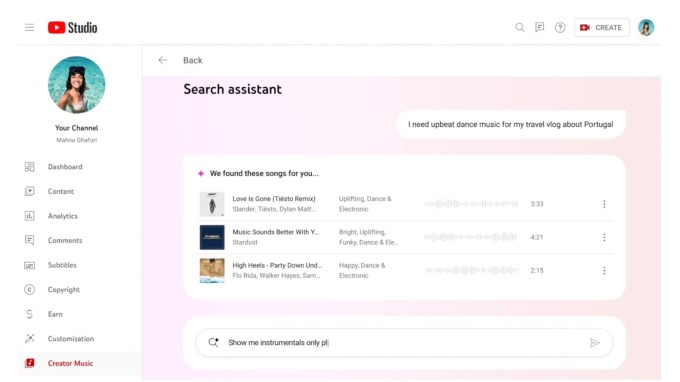
Starting early next year, YouTube will launch a new feature that will work like a music concierge by just typing in a description of the video.

Image Credits: YouTube

For example, the creator could type information about the length or type of the song they’re looking for and the Creator Music tool will suggest the right track at the right price.

The Creator Music dashboard was initially designed to allow creators to search for songs they have in mind or browse by collections, genres or moods, and then view the associated licensing costs. Creators can search for tracks based on a budget they have set for their project. They can choose to either buy a license after reviewing the terms or opt into a rev share agreement.

Image Credits: YouTube

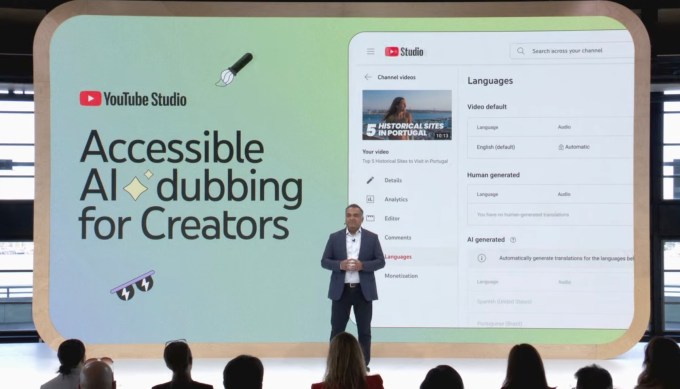
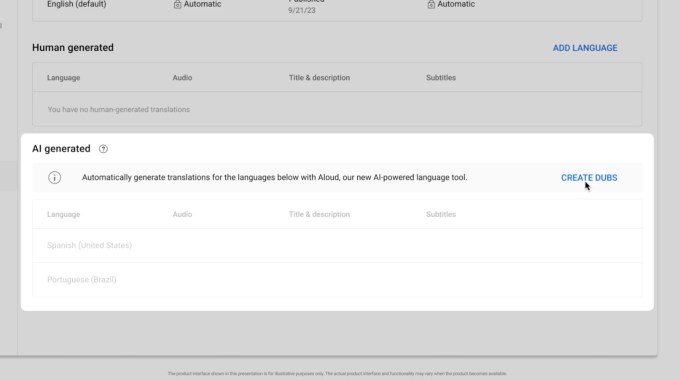
In addition, YouTube will introduce an AI-dubbing tool called Aloud, which will be integrated into YouTube Studio. The tool only takes one click to get an AI-generated dub in another language, which the creator can then review before adding it into their video. This tool is testing with select creators now and will open up more broadly next year.

YouTube had previously announced at VidCon its plans to integrate Aloud with YouTube.

Image Credits: YouTube

The feature was announced at YouTube’s live event “Made on YouTube” this morning, alongside other AI features, including a generative AI feature for Shorts and other tools, including a new creator app.

Exploring the Intersection of AI and Blockchain: Opportunities & Challenges

Exploring the Intersection of AI and Blockchain: Opportunities & Challenges

The crossover between artificial intelligence (AI) and blockchain is a growing trend across various industries, such as finance, healthcare, cybersecurity, and supply chain. According to Fortune Business Insights, the global AI and blockchain market value is projected to grow to $930 million by 2027, compared to $220.5 million in 2020. This union offers enhanced transparency, security, and decision-making, improving overall customer experience.

In this post, we’ll briefly cover the fundamentals of AI and blockchain and discuss the key opportunities and challenges related to the intersection of AI with blockchain.

Understanding AI and Blockchain

AI and blockchain have distinctive frameworks, features, and use cases. However, when combined, they are powerful catalysts for growth and innovation.

What is Artificial Intelligence (AI)?

Artificial intelligence enables computer programs to mimic human intelligence. AI systems can process large amounts of data to learn patterns and relationships and make accurate and realistic predictions that improve over time.

Organizations and practitioners build AI models that are specialized algorithms to perform real-world tasks such as image classification, object detection, and natural language processing. As a result, AI improves productivity, reduces human error, and facilitates data-driven decision-making for all stakeholders. Some prominent AI techniques include neural networks, convolutional neural networks, transformers, and diffusion models.

What is Blockchain?

Blockchain is a revolutionary framework offering a shared, decentralized – without a central authority, and immutable ledger for secure, transparent, and controlled exchange of data and resources among multiple entities.

The blockchain concept was first realized in 2008 by an anonymous entity known as Satoshi Nakamoto, who introduced Bitcoin cryptocurrency in a famous research paper titled Bitcoin: A Peer-to-Peer Electronic Cash System. Today, blockchain reportedly powers over 23,000 cryptocurrencies globally.

Blockchain is based on the principles of encryption, decentralized architecture, smart contracts – programs stored on blockchain that trigger based on predefined conditions – and digital signatures. This ensures that data cannot be tampered with and restricted to authorized users only. Blockchain framework has far-reaching applications, from handling financial transactions to cryptocurrency, supply-chain management, and digital electorates. Some prominent examples of blockchain frameworks include Ethereum, Tezos, Stellar, and EOSIO.

Properties of AI and blockchain

AI and Blockchain Comparison

The Synergy of AI and Blockchain

A merger between blockchain and AI frameworks can make more secure and transparent systems for enterprises. AI's real-time data analysis and decision-making capabilities expand blockchain’s authenticity, augmentation, and automation capabilities. Both technologies complement each other. For instance,

  • Optimizing automation of supply chain processes by embedding AI in smart contracts.
  • Addressing the challenges of AI ethics by ensuring the authenticity of data.
  • Fostering a transparent data economy by providing actionable insights.
  • Elevating the intelligence of blockchain networks by facilitating access to extensive data.
  • Boosting security with intelligent threat detection in financial services.

According to Moody’s Investor Service Report 2023, the interaction of AI and blockchain can potentially transform financial markets by automating manual tasks and reducing operating costs in the next five years.

Major Opportunities for AI in Blockchain

AI and blockchain will converge to impact critical areas of our society. Below are some promising opportunities and use cases of blockchain and AI.

Fraud Detection

Despite various security measures, blockchain security is still a significant concern. Cyberattacks can potentially disrupt blockchain networks completely. Hence, AI is instrumental in elevating the security of blockchain frameworks. AI-powered fraud detection mechanisms can proactively detect and safeguard sensitive blockchain transactions from cyber threats.

AI and machine learning (ML) algorithms are capable of the following:

  • Analyzing transaction patterns to detect fraudulent activities made by bots.
  • Trigger alerts and events in real-time to help prepare against attacks.
  • Enhance the security of smart contracts by blocking or minimizing smart contract-based cyberattacks, such as Reentrancy, overflow/underflow vulnerability, short address attack, and timestamp dependence.

AI-powered Smart Contracts

Smart contracts are self-fulfilling digital contracts with pre-established rules and governing principles, i.e., they automatically run actions or events when rules are met. AI can make these contracts more impactful by

  • Optimizing smart contract code for reducing the cost of operating blockchain, such as Ethereum Gas.
  • Improving the scalability of smart contracts using compression and parallelization.
  • Analyzing & auditing smart contracts using classification and pattern recognition techniques.
  • Integrating creative and cognitive capabilities in smart contracts.
  • Facilitating testing and verification for smart contracts.

Moreover, AI automation can help save time and effort in handling complex blockchain workflows by reducing the need for human supervision.

AI-powered Analytics & Insights

AI enhances the capabilities of blockchain systems using data-driven insights. For instance, implementing AI in a blockchain-based supply chain can improve inventory operations, transparency, sustainability, etc. ML models can run analytics on secure and trusted blockchain transaction data to:

  • Predict demand variations
  • Shorten supply routes
  • Improve order fulfillment
  • Monitor the quality of products

By maintaining snapshots of all supply-chain operations on a blockchain ledger, stakeholders can gain real-time insights and improve the traceability of their supply chains.

Decentralized Data Storage & Processing

The decentralized framework of blockchain synchronizes well with the data-handling capabilities of AI. Distributed ML models like federated learning can train on datasets stored across multiple sources. Blockchain offers a perfect framework for analyzing complex and disconnected datasets using these ML models. It maintains the privacy and security of sensitive blockchain transaction data.

Major Challenges for AI in Blockchain

If we address the following prevalent challenges, the intersection of blockchain and AI can be more seamless and quick.

Scalability Issues

Scalability is a critical technical roadblock when integrating AI and blockchain technologies due to varying requirements, parameters, and limitations, such as processing speed, data handling, and resource consumption.

AI and ML models often require high-speed processing and low latency. They favor smooth data pipelines to deliver real-time insights for timely decision-making. Conversely, the blockchain framework has slower consensus mechanisms that are decentralized and strictly isolated in nature.

The following solutions can help address these challenges:

  • Sharding – splitting the blockchain into smaller chunks for parallel processing and scalable usage beyond the restricted domain.
  • Layering – introducing dedicated layers for specific functionalities, such as consensus mechanisms, storage partitioning, and AI-powered smart contracts. It enhances parallel processing and optimizes resource allocation.
  • Sidechains – addressing the storage limitations of traditional blockchain networks by allowing smart device data to be securely stored in a separate database and mapping it to the sidechain transactions of the block.

Compatibility Issues

Making AI and blockchain work in synchronization requires ensuring compatibility factors. Addressing this issue demands highly optimized and effective data integration strategies and data-sharing models. Some of the vital approaches in this regard include:

  • Bridging the gap of data format in AI (large amount, centralized) and blockchain (small amount, decentralized) to effectively interpret blockchain data.
  • Using federated learning models with blockchain can help ensure trust and privacy while overseeing data and computation processes.

Legal & Regulatory Implications

Data privacy and protection are the primary concerns when exposing sensitive data regulated by a blockchain to AI and ML models. Regulation policies, such as GDPR, strictly force businesses to handle client data by ensuring:

  • Consensual usage of data and information
  • Data deletion, once processed
  • Anonymization of sensitive personal or business data

The legal issues related to smart contracts are challenging. Therefore, it is mandatory to create contractual terms and conditions carefully.

The future of blockchain and AI are intertwined, given the rapid digital transformation across industries. Soon, we will witness many more advancements and opportunities, facilitating various business operations.

For more information on AI advancements and trends, visit unite.ai.

How Oracle is using AI to enhance its cloud-based data visualisation and collaboration

Today, Oracle Corp announced new features for its cloud-based data analytics service to provide its 7000+ customers with more insights and collaboration tools. According to Gartner, the global cloud-based data and analytics services market is expected to grow 19.4% in 2021 to $77.6 billion. Oracle is playing a crucial role in the market with its latest advancements in the domain.

The company said its Oracle Analytics Cloud service now offers generative AI data interactions, which allow users to ask questions and get answers from data using natural language and AI-generated avatars. The avatars, powered by a partnership with Synthesia, can act as news readers and deliver data stories to business decision makers.

The software leader has also integrated its cloud service with OCI AI Services, which can read documents such as JPEG and PDF files and extract key values and their context. This can help users get information from documents and generate additional insights for their analytics.

Another new feature is contextual insights, which use machine learning to recommend insights based on the type and state of the data being viewed. These insights can help users understand the meaning of complex data without additional interpretation.

“Organisations across industries increasingly have all the data they need to enhance decision making, but the problem is that a lot of people still find the tools available to read and interpret that data intimidating because they don’t believe they have the skills to use them,” said T.K. Anand, executive vice president, Oracle Analytics.

Oracle said it has also added collaboration software integrations with Microsoft Teams and Slack, enabling users to post dashboards, visualisations, and insights into real-time discussions with their colleagues.

Oracle competes with other cloud providers such as Amazon Web Services, Microsoft Azure, and Google Cloud Platform in the data analytics market.

The post How Oracle is using AI to enhance its cloud-based data visualisation and collaboration appeared first on Analytics India Magazine.

Intel Goes All-In On AI

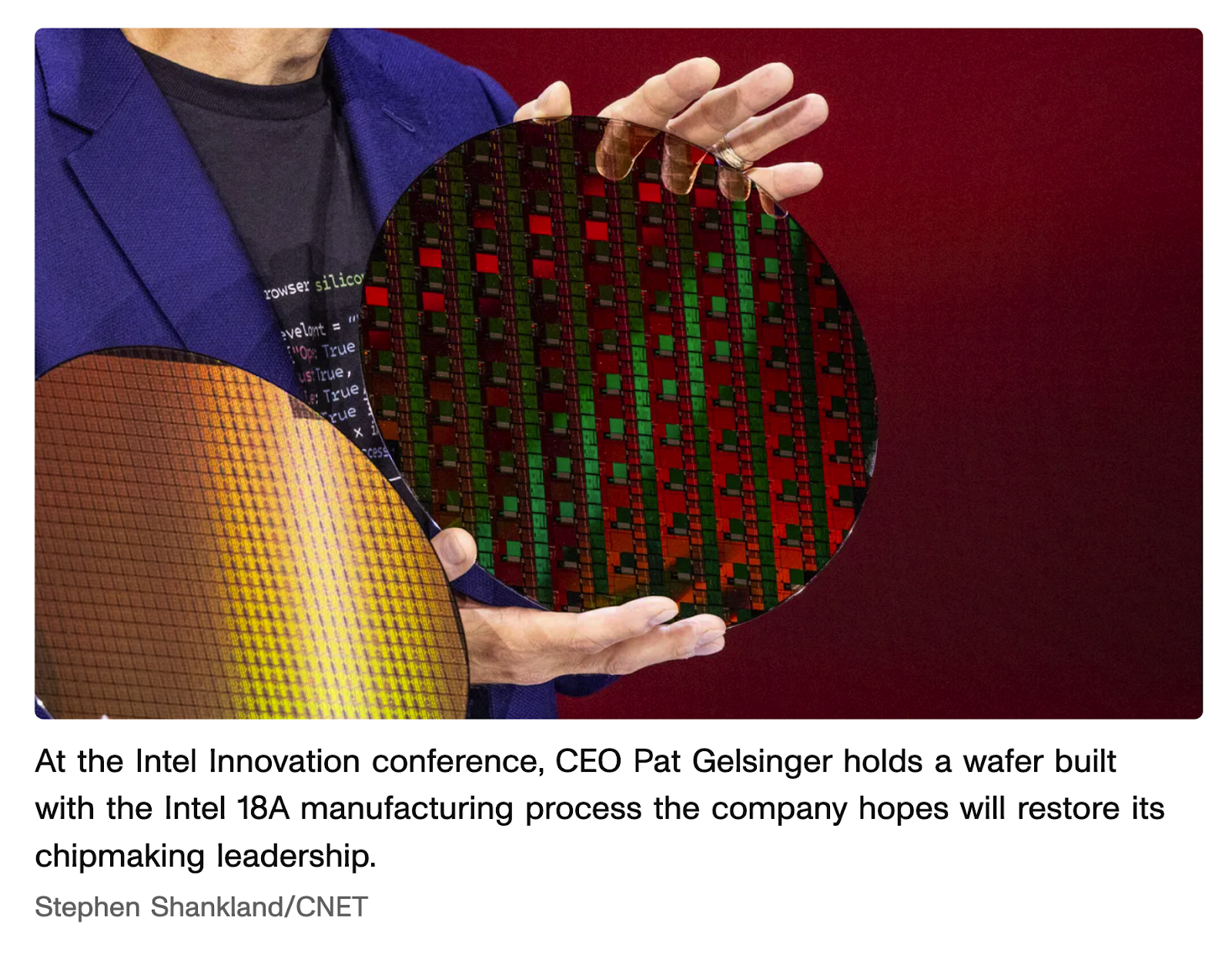
Intel, one of the giants in the world of technology, is embarking on a bold journey in AI to compete with NVIDIA, AMD, and Apple. At Intel Innovation 2023, the company revealed its ambitious roadmap for the next few years, making it clear that they are going all-in on AI, including a monster 288-core Xeon CPU, based on Emerald Rapids architecture, coming next year.

The announcement of Meteor Lake, set to launch on December 14, was undoubtedly a headline-grabber. Why? Because as CEO Pat Gelsinger said, the processor will power, “power-efficient AI acceleration and local inference on the PC.”

Gelsinger emphasised the company’s commitment to engineering excellence. The company showcased its efforts to democratise AI with its “AI PC” concept. This innovation is made possible by Intel’s forthcoming “Meteor Lake” laptop chip, which incorporates new AI data-crunching features. The AI PC concept aims to bring AI capabilities directly to personal computers, allowing users to run generative AI chatbots, like ChatGPT, locally without relying on cloud data centres.

To showcase the capabilities of the AI PC, Gelsinger along with Dan Siroker, CEO of RewindAI, demoed the capabilities of running Rewind on Windows, which was powered by Llama 2 and running entirely on the device. This will also be available on Intel-based Macbooks.

🥳Big news: @RewindAI is coming to Windows!
Today I shared the keynote stage with Intel CEO @PGelsinger to demo Rewind on Windows.
The demo includes Ask Rewind powered by Llama 2 running entirely locally!
Bonus: As of today, Rewind can also run on Intel-based Macs!
(1/4) pic.twitter.com/ziopSEpoWR

— Dan Siroker (@dsiroker) September 19, 2023

Focusing on developers, Intel has announced the general availability of its Intel Developer Cloud platform, offering developers the opportunity to test and deploy AI and high-performance computing applications with the latest CPUs, GPUs, and AI accelerators. The platform includes access to fifth-generation Xeon Scalable processors, Intel Data Center GPU Max Series, Intel Gaudi2 deep learning processors, and Intel software and tools.

Moreover, developers can utilise the oneAPI programming model to build and optimise AI and high-performance computing workloads. In addition, Intel has revealed Project Strata, a commercial software platform set to launch in 2024, aimed at supporting distributed edge infrastructure and applications with modular building blocks and premium services.

A Three-Pronged Performance Approach

What caught the industry’s attention were the processors in the pipeline such as Arrow Lake, Lunar Lake, and Panther Lake, scheduled for 2024 and 2025. These processors represent a significant leap forward in Intel’s pursuit of technological excellence.

Intel is employing a three-pronged approach to benchmark their processors against competitors, including Apple and even NVIDIA. This approach includes testing CPUs, GPUs, and NPUs within a fixed power budget.

One of Intel’s key strategies for regaining leadership is its focus on chip manufacturing. Gelsinger announced that Intel’s fabrication facilities would begin producing Panther Lake processors in early 2024. This move comes as part of Intel’s ambitious plan to accelerate its chipmaking progress. The company is investing heavily in advanced manufacturing processes, including extreme ultraviolet light (EUV), to etch finer features onto silicon wafers. This technology allows for the production of smaller, more efficient processors.

A large AI #supercomputer will be built with @StabilityAI on Intel Xeon processors and Intel Gaudi 2 AI hardware accelerators. #IntelInnovation https://t.co/8Hhh2oSDW1 pic.twitter.com/Qon8uua2ge

— Intel News (@intelnews) September 19, 2023

While it seems like NVIDIA has dominated this space, Intel is making significant strides. Intel has also announced that Stability.AI would purchase a Gaudi2-based AI supercomputer with Xeon processors overseeing 4,000 Gaudi2 accelerators.

To contextualise Intel’s focus on AI, we must first acknowledge its competition, particularly with Apple. For years, Intel supplied processors to Apple’s Mac lineup. However, with the introduction of Apple’s M1 and M2 chips, the tech giant decided to part ways with Intel. Apple’s in-house processors have received widespread acclaim for their performance and power efficiency.

Intel, not one to back down from a challenge, has made it clear that improving both performance and energy efficiency is a top priority. While specific details about Meteor Lake’s performance remain undisclosed, Intel promises significant advancements in processing, graphics, and AI capabilities. Gelsinger emphasised that these improvements would put Intel’s offerings on par with the best that Apple and other competitors have to offer.

Intel CEO @PGelsinger kicks off #IntelInnovation with a humorous video, knocking out a few push ups and setting the stage for “AI Everywhere”. @Intel tech covers client PC to datacenter, everything in-between, so this makes sense. $INTC pic.twitter.com/2WBGL0IE30

— Patrick Moorhead (@PatrickMoorhead) September 19, 2023

Making big bets

Gelsinger believes that the supercomputer that Intel is building will be the largest in Europe. He even hinted at Gaudi3, which according to him, would be two times faster than Gaudi2. It is expected to be released by the end of 2025. This comes after Intel has already been providing Gaudi2 AI chips for training models. Interestingly, Gaudi2 works 2.4 times faster than the NVIDIA A100, and is almost coming close to the H100 Hopper GPU.

Intel’s plan to converge its data centre GPU and Gaudi road maps with the Falcon Shores GPU, which is set to release by the same time looks like a robust plan. Falcon Shores chips were originally conceived as a fusion of CPU and GPU cores, representing the company’s inaugural venture into the ‘XPU’ architecture for high-performance computing.

“Simply put, our roadmap is extremely robust, and we are executing aggressively to bring this together,” Gelsinger said.

The post Intel Goes All-In On AI appeared first on Analytics India Magazine.