It’s High Time Apple Bought Stability AI

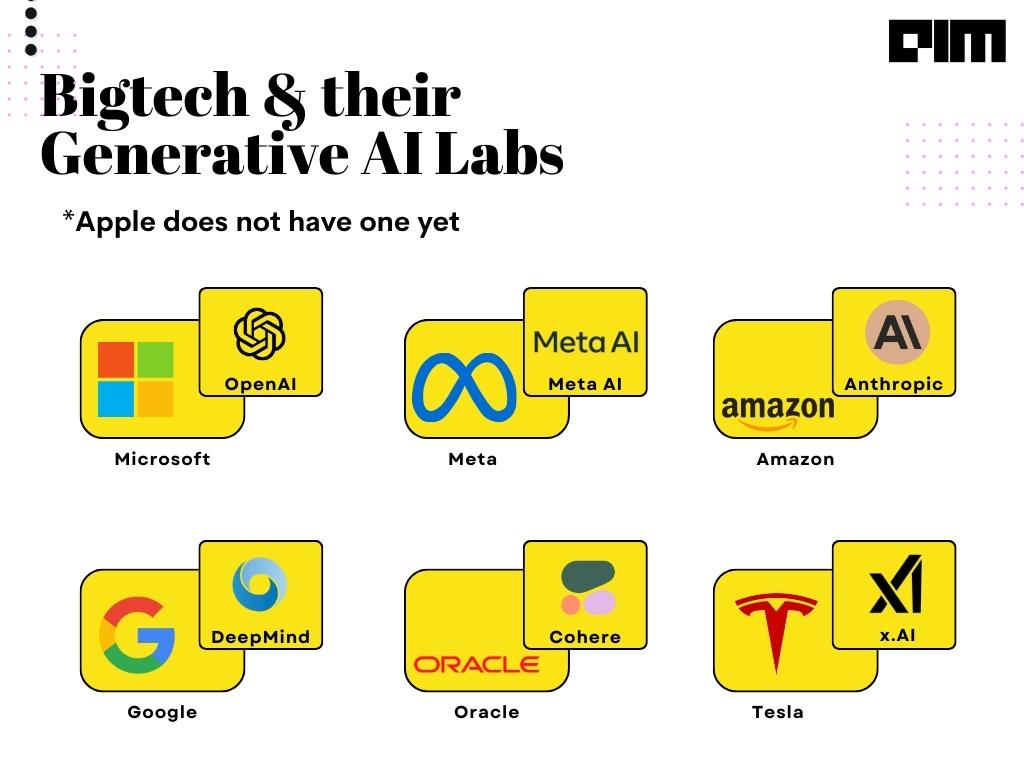
Big techs working on generative AI have their own research labs doing all the work for them. Most recently, Oracle revealed that it would be working on generative AI services based on Cohere’s technology. At the same time, Amazon has announced its partnership with Anthropic, and an investment of $4 billion for competing against Microsoft, Google, Meta, and NVIDIA.

But what about Apple?

Let’s not forget Apple’s affinity for Stability AI. Since December last year, Apple has been optimising its silicon chip to run Stable Diffusion and other Stability AI products. After releasing Transformer for Apple Silicon, the company also open sourced Stable Diffusion XL on Core ML.

The blog reads, “One of the key questions for Stable Diffusion in any app is where the model is running. There are a number of reasons why on-edge deployment of Stable Diffusion in an app is preferable to a server-based approach. First, the privacy of the end-user is protected because any data the user provided as input to the model stays on the user’s device. Second, after initial download, users don’t require an internet connection to use the model. Finally, locally deploying this model enables developers to reduce or eliminate their server-related costs.”

Since Apple has been all about privacy, and it bets on the fact that Stability AI’s offering are best for on-edge computing, it seems like Stability AI would be an ideal choice for Apple for building privacy-focused and on-device generative AI products. It seems like the partnership is already in the works in the backdrops.

Last year, Apple introduced OctaneX, a GPU rendering feature that can be found through the Mac Store, allowing rendering on Apple M1 and M2. Octane has reportedly used the Render (RNDR) token, which was built by OTOY, a company that provides decentralised GPU-based rendering solutions. There is a speculation that Apple might actually partner with OTOY.

$RNDR/USD
It is in partnership with OTOY Inc. and they are at favorable location to partner with APPLE Inc.
Octane X is available on apple appstore
As the name suggests, they render the metaverse and provide decentralized GPU-based rendering solutions. pic.twitter.com/8zJ44eAjW0

🌊Satoshi's Tears🌊 (@TearOfSatoshi) June 5, 2023

This matters because in April, Stability AI launched StableLM, which was touted as an open source rival to ChatGPT. Jules Urbach, the founder of OTOY, posted on X saying that RNDR has a large GPU for powering AI inference, which is going to be available on Apple Neural Engine Soon. To this Emad Mostaque, founder of Stability.AI, replied that they “should probably chat”.
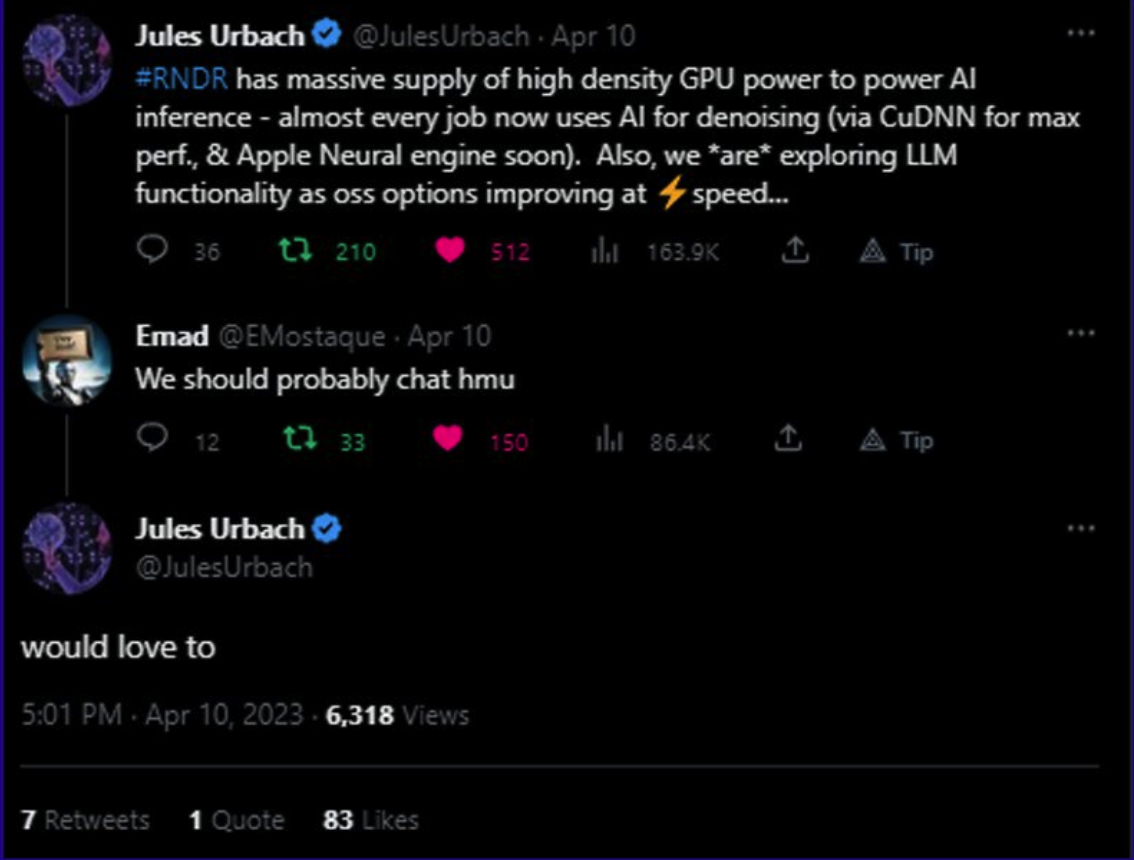
If Apple partners with OTOY, which seems to be in talks with Stability.AI, it is quite likely that Apple might be interested in talking to Emad Mostaque himself. In an interview, Mostaque said that he wants to run Stable Diffusion on mobile devices.

Why is it high time for Apple?

Apple seems to care less about building upon the generative AI miracle. The company built an “Apple GPT” for its employees on the Ajax foundation. But nothing happened after that. Even at the recent Apple Event, the company was not gung-ho about generative AI, and very subtly integrated them in its products.

It may seem like Apple is staying away from generative AI labs. But though it doesn’t like to say the word “AI”, it definitely is leveraging machine learning within its products. The company that was the leading buyer of AI companies a few years back, now seems to be staying away from investing in them.

Undoubtedly, Microsoft’s investment in OpenAI, though not a surprise, was definitely a strategic move that helped the big-tech leverage generative AI within its products. This led others in the field to adopt the same strategy. Google’s got DeepMind, Meta has Meta AI, now even Tesla has xAI. Now it is time for Apple to have its own AI research lab which would do all the work for it.
Steve Wozniak and Mostaque were one of the signatories of the pause giant AI experiments letter. But Apple’s approach towards its products of keeping it simple and user-centric might hinder its step towards partnering with the open source champ Stability.AI. Still, they both seem to be the best partners for each other.

Meanwhile, OpenAI is partnering WHOOP to compete with Apple hardware products by roping in Jony Ive, one of the main designers of Apple iPhone.

The post It’s High Time Apple Bought Stability AI appeared first on Analytics India Magazine.

Investing In AI? Here Is What To Consider

Return on Investment (ROI) assists businesses in determining which projects must be prioritized, or put simply – the initiatives that deserve the most resources and attention to achieve business goals.

Investing In AI? Here Is What To Consider
Image from Canva

Since we are talking about ROI, which involves numbers, so let’s start with some statistics:

  • As per Forbes, the global AI market is expected to grow at a CAGR of 38% and will reach a whopping ~$1812 billion by 2030.
  • AI is a top priority for 83% of the companies.
  • As per IBM, spending on AI systems will increase by 27% to USD 154 billion in 2023.
  • It further shares that the organizations, on average, can yield only 5.9% ROI on the invested cost of capital at 10%.
  • However, successful visionaries have generated 13% ROI by gauging the right opportunities at the right time.

Invest like a Pro.

Given the enormous spending, there is an inevitable tendency to talk about – what is there in return for such hefty investments. That's not it, PwC says that most companies are not even able to get any return at all.

AI investments soon become a point of concern for most executives. They need to make prudent AI investments that can garner high ROI, but how can they enable returns of the order of what leaders can generate? Note that the north star of the expected return is up to 30% in upcoming years.

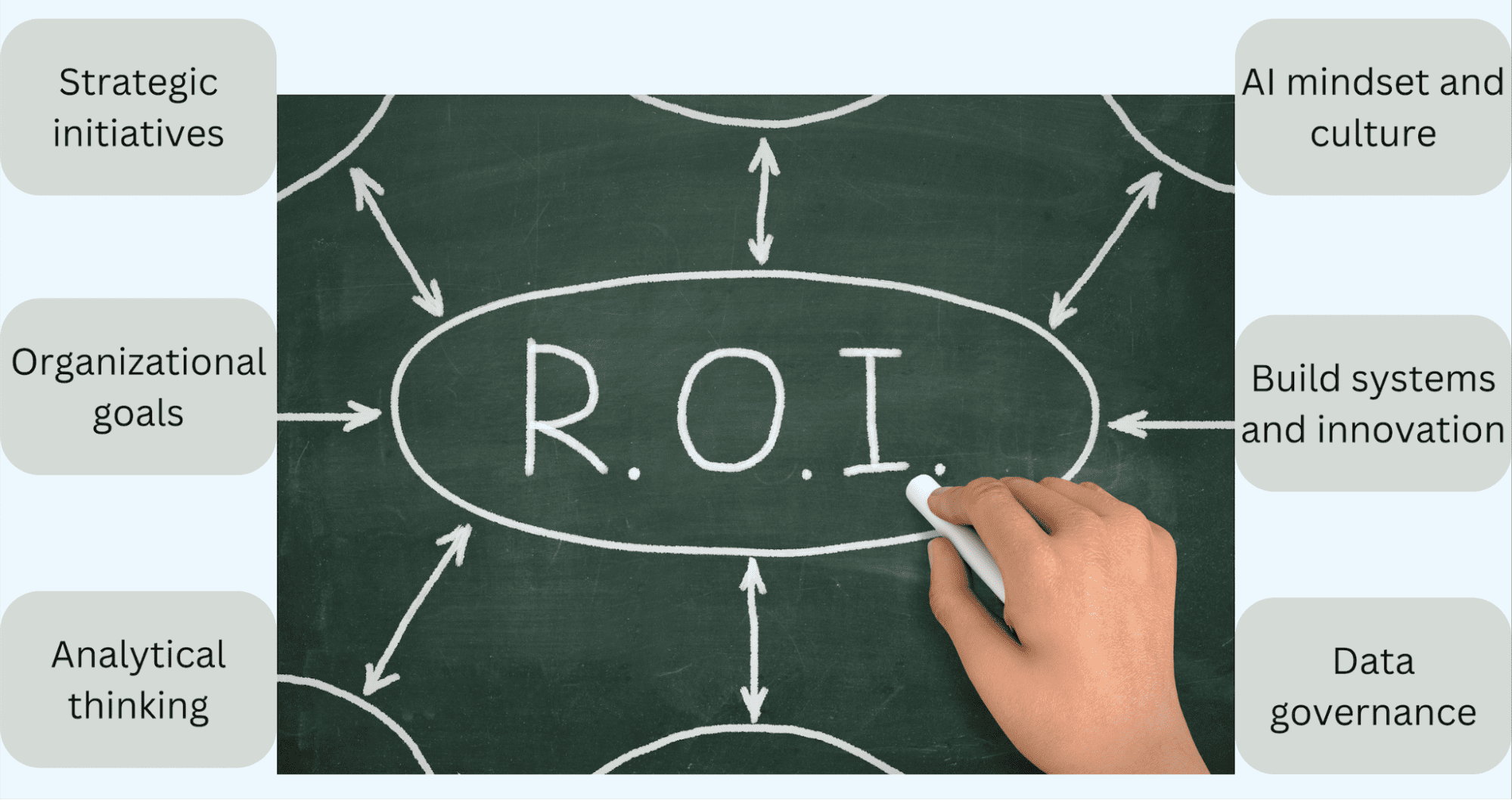
  • The first step is to think of AI as a strategic initiative. It must be derived from a specific organization’s goals, not that of a competitor’s goals. It is important to remember that each organization is uniquely positioned, given its niche, business model, and technical capabilities.
  • It requires identifying projects aligning with business strategy, i.e., the goal and vision of the organization for the next 3-5 years.
  • Even with a clear road ahead, realizing AI's potential isn't without its bumps. It mandates analytical thinking and inculcating AI culture throughout the organization.

Investing In AI? Here Is What To Consider
Image by Author

  • AI mindset helps the business discern which AI projects to kick-start while being frugal about non-AI-worthy projects. To put the cultural aspect into perspective, it is suggested to build a pool of opportunistic and innovative projects quickly and the ability to figure out the myriad variables on the go.
  • Next is data – it is the lynchpin of the entire AI transformation, and hence, the majority of the attention and efforts must go into building processes on data governance. SAP defines data governance as “the policies and procedures implemented to ensure an organization’s data is accurate to begin with – and then handled properly while being input, stored, manipulated, accessed, and deleted.”

Value Generation

To understand ROI contextualized for AI initiatives, ‘value’ becomes more important than pure-play profits.

Profits imply the actual cash that relates to calculating the returns conventionally. However, AI practitioners prioritize “value-generation” to signify the organization-wide benefits of AI implementation.

With this additional context, let us break down ROI into two components. Return is the value generated from the investment that involves the costs of developing such systems.

Revenue and returns

There are various ways to assess the revenue. Besides direct revenue streams from AI-powered products, some initiatives are not directly a source of revenue but can subtly enhance or complement an existing process.

Such initiatives may not yield immediate results but can lead to a significant uptick in revenue over time. Consider AI-driven recommendation engines at e-commerce platforms that suggest products based on users' browsing histories. These recommendations gently nudge the users towards additional purchases, leading to increased sales.

Investing In AI? Here Is What To Consider
Image from Canva

Another example is when platforms enhance search relevancy and improve customer experience by quickly providing their choices of interest, keeping them loyal to the platform, and retaining them.

Cost – as we all know it

Revenue is just one part of the ROI calculation; the other involves judicious cost management. The significant costs of AI projects are the infrastructure, building AI teams, and data management solutions.

Hiring for AI skills involves onboarding, upskilling, and compensation costs. Some organizations outsource either the complete project or a part of the project that requires a specific skill set, saving themselves from the upfront costs.

However, external hiring also comes at an indirect cost where the in-house is not well-equipped to continue supporting the project, thereby introducing a dependency on external contractors for project maintenance and additional costs.

AI can be deployed for cases as simple as automating some of the repeat tasks that go on to reduce human errors, saving operational overhead.

Cost of failure

Let us talk about the cost not often accounted for – the cost associated with perpetuating the wrong decisions.

The 1-10-100 rule explains “how failure to take notice of one cost escalates the loss in dollars. Prevention cost should probably take priority because it is much less costly to prevent a defect than to correct one”.

Investing In AI? Here Is What To Consider
Image from Total Quality Management

Like this rule, the cost of wrong decision choices is essential. It requires building a design thinking lens right from the beginning, including project scoping and identifying the right AI opportunities and associated risks.

Hence, building an organization-wide risk assessment framework is vital to address concerns such as bias, lack of oversight, transparency and accountability, data privacy, and more.

ROI estimation during PoC

An initial ROI estimate during the ideation phase helps prioritize projects.

Having built a deeper understanding of the business problems, it is time to discuss technology. It is advised to start building the PoC rather than waiting for an ideal environment – where all input components, such as the data, algorithms, infrastructure, etc., are sorted out.

Once you start developing the PoC, the reality of whether it is feasible to scale the project starts to sink in.

PoC helps you verify the idea within a limited budget and a shorter time span.

The testing ground or sandbox ensures the value proposition before investing in building systems at scale. But the aspect of scale must be forethought at the PoC stage itself, whether it is in terms of:

  • Building data pipelines to support data at scale,
  • Algorithms that require expensive computational resources or
  • The number of users the application will be serving.

An estimate of these dimensions shows how the AI solution will integrate into the organization’s technology stack.

If the PoC justifies the investment, the project moves to development.

It is worth noting that assessing revenue and cost factors is specific to the business model; hence, this post intends to help build a lens to gauge different factors and their impact on ROI.
Vidhi Chugh is an AI strategist and a digital transformation leader working at the intersection of product, sciences, and engineering to build scalable machine learning systems. She is an award-winning innovation leader, an author, and an international speaker. She is on a mission to democratize machine learning and break the jargon for everyone to be a part of this transformation.

More On This Topic

  • Why You Should Consider Being a Data Engineer Instead of a Data Scientist
  • Budgeting For Your AI Training Data: Consider These 3 Factors
  • 5 Data Science Open-source Projects You Should Consider Contributing to
  • Should You Consider a DataOps Career?
  • The Top AutoML Frameworks You Should Consider in 2023
  • Here’s Why You Need Python Skills as a Machine Learning Engineer

Why Microsoft is Using Nuclear to Fuel Its Data Centers? 

Microsoft is actively exploring the possibility of harnessing nuclear energy to fuel its data centres. The tech giant is currently in search of a program manager specialising in nuclear technology to spearhead the ‘development and implementation of a global strategy for small modular reactors (SMRs) and microreactor energy systems’.

This role will entail guiding the seamless integration of SMRs and microreactors into the infrastructure powering Microsoft’s data centres, where the Microsoft cloud and its suite of AI technologies are hosted.

Harnessing Nuclear Energy

Microsoft is not new to the field of nuclear energy. The IT giant has a goal of using 100% renewable energy by 2025.

Microsoft has already partnered with Helion, an energy start-up that is developing a nuclear fusion reactor. Microsoft has agreed to buy electricity from Helion when their reactor becomes operational in 2028. Helion is backed by OpenAI, which is majorly supported by Microsoft.

Data centres are one of the main consumers of electricity in the world. According to the International Energy Agency, data centres use 1-1.5% of the global electricity supply. A report by C&C estimates that an average data centre consumes 50-80 Megawatts of power per year, which is enough to power 80,000 households. Some larger data centres use more than 100 Megawatts.

Most of Microsoft’s data centres are located in the US, where fossil fuels still account for 60% of the electricity generation. By switching to nuclear power, Microsoft can reduce its carbon footprint and contribute to a cleaner and greener future.

Data Center Spends

Globally, there are an estimated 9,380 data centres in operation, with Microsoft taking charge of 200 of them. The collective expenditure on data centres for the year 2023 is projected to reach a staggering $217 billion.

Although Microsoft does not publicly divulge a detailed breakdown of their capital expenditures, their financial reports reveal a substantial capex figure for 2023, hovering at nearly $11 billion.

In line with industry averages, Microsoft is said to allocate an annual budget of approximately $24 million for the maintenance and operation of each of their data centres. This translates to an annual expenditure of nearly $5 billion on data centre-related costs, accounting for a significant 50% of their total capital expenditure.

How SMRs could Save Millions of $ and Energy

Small modular reactors (SMRs) are a type of nuclear reactor that can produce up to 300 MWs of electricity. They are smaller than conventional reactors and can be built in factories and transported to the site. They also have a subcategory called microreactors, which can produce up to 10 MWs of electricity. These reactors could be ideal for Microsoft, as their data centres have similar power requirements.

SMRs have several advantages over conventional reactors. They are modular, which means they can be assembled and installed quickly and easily. They are also cost-effective, as they require less capital investment and maintenance. A 300 MW SMR costs about $900 million to $1 billion to build, while Microsoft pays about $7-8 million in electricity bills for each data centre per year. By switching to nuclear power, Microsoft can save money and reduce its dependence on fossil fuels.

Microsoft’s Carbon Neutral goal

Back in 2020, the IT giant made a commitment to transform into a carbon-negative, water-positive, and zero-waste organisation. It appears that their strategy is yielding results. By 2022, they had already achieved a 23% reduction in emissions. Furthermore, their dedication to conserving water involves replenishing more water than they consume, with a recent pivot to nuclear power serving as a pivotal step in fulfilling this ambitious pledge.

In a statement, the company affirmed their unwavering commitment to these goals, emphasising their ongoing efforts to meticulously track emissions, accelerate progress, and bolster their reliance on clean energy to power their data centres. They also underscored their dedication to procuring renewable energy sources, all in pursuit of their sustainability objectives: to be carbon negative, water positive, and zero waste by 2030.

“We are committed to helping our customers use our platforms and tools to do more with less today and innovate for the future in the new era of AI” said Satya Nadella, CEO of Microsoft.

The post Why Microsoft is Using Nuclear to Fuel Its Data Centers? appeared first on Analytics India Magazine.

https://www.enterpriseai.news/2023/09/27/75816/

September 27, 2023 by Ali Azhar

As more companies experiment with Generative AI technology, a crucial question emerges: Can applications that use Generative AI be safe and scalable for an enterprise? With LLM Mesh, the answer is yes. Organizations can use LLM Mesh to effectively build enterprise-level applications mitigating concerns about cost management, technological dependencies, and compliance.

Dataiku, the artificial intelligence and machine learning company behind Everyday AI, unveiled LLM Mesh at its Everyday AI Conference in New York. There has been a critical need for a scalable, secure, and effective platform for the integration of Large Language Models (LLMs) in the enterprise. Dataiku also announced its LLM Mesh Launch Partners — Snowflake, Pinecone, and AI21 Labs.

Clément Stenac, Chief Technology Officer and co-founder at Dataiku said, “The LLM Mesh represents a pivotal step in AI. At Dataiku, we’re bridging the gap between the promise and reality of using Generative AI in the enterprise. We believe the LLM Mesh provides the structure and control many have sought, paving the way for safer, faster GenAI deployments that deliver real value.”

Everyday AI platform by Datiku is a daily livestream, newsletter and podcast on the latest AI trends and tips for everyday people. The Everyday AI conferences are conducted worldwide to help connect cutting-edge technology and enterprise applications.

While Generative AI offers several benefits and opportunities for enterprises, it also poses several challenges for organizations. One of the key challenges is the absence of a central administration. Most generative AI models operate without centralized oversight or governance. This can result in the spread of misinformation, regulation issues, and ethical concerns.

There is also a lack of cost-monitoring mechanism, minimal measures against toxic content, inadequate permission controls, and use of personally identifiable information. In addition, there is a need to establish best practices to fully realize and harness the potential of generative AI. With the launch of LLM Mesh, Dataiku plans on overcoming some of these key challenges.

The LLM Mesh is designed to provide components required to safely build and efficiently scale LLMs. The components of LLM Mesh include safety provisions for response moderation and private data screening, united AI service routing, and performance and cost tracking. Standard components for application development are also included to allow for quality and consistency in delivering control and performance.

With LLM Mesh sitting between end-user applications and LLM service providers, companies have the flexibility to choose cost-effective models for their needs and easily adapt to changes in the future. In addition, companies can reuse components for scalable application development.

With the announcement of its LLM Mesh Launch Partners, Dataiku has continued on its philosophy of enhancing, rather than duplicating existing capabilities. The partnership with Snowflake, Pinecone, and AI21 Labs represents several key components of LLM Mesh including vector databases, LLM builders, containerized data and compute capabilities.

In May 2023, Teradata, a multi-cloud data giant, announced its integration with Dataiku to enable users to import and operate their Dataiku-trend AI models on Terradata’s Vantage Platform. While Teradata provides comprehensive predictive and prescriptive analytics, Dataiku provides a central working environment for training, developing, and managing applications.

(everything possible/Shutterstock)

Torsten Grabs, Senior Director of Product Management at Snowflake, shared, “We are enthusiastic about the vision of the LLM Mesh because we understand that the real value lies not only in deploying LLM-powered applications but also in democratizing AI in a secure and reliable manner. With Dataiku, we empower our mutual customers to deploy LLMs on their Snowflake data using containerized compute from Snowpark Container Services within the security confines of their Snowflake accounts. Dataiku orchestrates this process to reduce friction and complexity, accelerating business value.”

Chuck Fontana, VP of Business Development at Pinecone, said “The LLM Mesh is not just an architectural concept; it represents a path forward. Vector databases set new standards, fueling AI applications through innovations like Retrieval Augmented Generation. Together, Dataiku and Pinecone are establishing a new benchmark, providing a framework for others in the industry to follow. This collaboration helps address the challenges faced in building enterprise-grade GenAI applications at scale, and Pinecone eagerly anticipates its role as an LLM Mesh Launch Partner.”

Pankaj Dugar, SVP and GM, North America at AI21 Labs, added “In today’s ever-evolving technological landscape, fostering a diverse and tightly integrated ecosystem within the Generative AI stack is of paramount importance for the benefit of our customers. Our collaboration with Dataiku and the LLM Mesh underscores our commitment to diversity, ensuring enterprises can access a wide array of top-tier, flexible, and dependable LLMs. We firmly believe that diversity fuels innovation, and with Dataiku’s LLM Mesh, we are stepping into a future filled with limitless AI possibilities.”

Related Items

Dataiku and Databricks Survey Highlights Booming ROI of AI and Future Challenges

Dataiku Captures $400 Million Series E Round Funding to Grow Its Data Science and ML Platform

Related

Gen Z isn’t threatened by generative AI at work but feels unprepared to adopt it

Double Exposure Silhouette a Bizarre Sensual Woman in Neon Light Mirror Maze - stock photo

Artificial intelligence (AI) has been part of the workplace for decades, from deep learning in voice assistants to new features in enterprise software. But generative AI is just being integrated into the workplace widely, stirring up fears of what it could mean for the job market. One group, however, isn't fazed.

Generation Z comprises the youngest professionals in the workforce and it is largely not threatened by generative AI. Most Gen Z (59%) say they're not concerned about generative AI replacing their jobs, but only 48% feel prepared for their employer to adopt generative AI into everyday work.

Also: Why IT growth is only leading to more burnout, and what should be done about it

Coinciding with the generative AI boom, we're also seeing a shift in the workforce. The post-pandemic job market has welcomed many young professionals from Generation Z to start their careers while Boomers retired.

Adobe just published its Future Workforce Study, which collected responses from 1,011 Gen Z in the US who worked for a medium to large company for up to three years. Gen Z includes those born between 1997- 2012.

The study explored Gen Z's thoughts on integrating generative AI at work and how Gen Z views the workplace — and it's not all optimistic. Gen Z understands the inevitable presence of generative AI in the workplace, but only 23% of those surveyed expressed excitement about its implementation at work.

Also: How to write better ChatGPT prompts for the best generative AI results

Half of the respondents have used generative AI to help with their work, and we know that 70% of Gen Z uses generative AI tools. Yet only 35% of the survey participants stated that their employers had established guidelines on using generative AI in the workplace.

Many large companies like Samsung and Google have implemented guidelines and restrictions on using popular AI chatbots, like ChatGPT, and other generative AI tools for fear of confidential data being leaked.

Also: Third-party AI tools are responsible for 55% of AI failures in business

However, implementing regulations for the responsible use of AI goes beyond restricting AI tools and moves into the realm of ethics and social responsibility. According to the study, Gen Z advocates for this in the workplace.

More guidelines are necessary to use AI responsibly from the companies that develop the technology but also those who adopt it. Beyond that, properly training employees to use available generative AI tools responsibly and successfully could be the answer to make the workforce feel more prepared to embrace them.

Artificial Intelligence

Cloudflare launches new AI tools to help customers deploy and run models

Cloudflare launches new AI tools to help customers deploy and run models Kyle Wiggers 9 hours

Looking to cash in on the AI craze, Cloudflare, the cloud services provider, is launching a new collection of products and apps aimed at helping customers build, deploy and run AI models at the network edge.

One of the new offerings, Workers AI, lets customers access physically nearby GPUs hosted by Cloudflare partners to run AI models on a pay-as-you-go basis. Another, Vectorize, provides a vector database to store vector embeddings — mathematical representations of data — generated by models from Workers AI. A third, AI Gateway, is designed to provide metrics to enable customers to better manage the costs of running AI apps.

According to Cloudflare CEO Matthew Prince, the launch of the new AI-focused product suite was motivated by a strong desire from Cloudflare customers for a simpler, easier-to-use AI management solution — one with a focus on cost savings.

“The offerings already on the market are still very complicated — they require stitching together lots of new vendors, and it gets expensive fast,” Prince told TechCrunch in an email interview. “There’s also very little insight currently available on how you’re spending money on AI; observability is a big challenge as AI spend skyrockets. We can help simplify all of these aspects for developers.”

To this end, Workers AI attempts to ensure AI inference always happens on GPUs close to users (from a geographic standpoint) to deliver a low-latency, AI-powered end-user experience. Leveraging ONNX, the Microsoft-backed intermediary machine learning toolkit used to convert between different AI frameworks, Workers AI allows AI models to run wherever processing makes the most sense in terms of bandwidth, latency, connectivity, processing and localization constraints.

Workers AI users can choose models from a catalog to get started, including large language models (LLMs) like Meta’s Llama 2, automatic speech recognition models, image classifiers and sentiment analysis models. With Workers AI, data stays in the server region where it originally resided. And any data used for inference — e.g. prompts fed to an LLM or image-generating model — aren’t used to train current or future AI models.

“Ideally, inference should happen near the user for a low-latency user experience. However, devices don’t always have the compute capacity or battery power required to execute large models such as LLMs,” Prince said. “Meanwhile, traditional centralized clouds are often geographically too far from the end user. These centralized clouds are also mostly based in the U.S., making it complicated for businesses around the world that prefer not to (or legally cannot) send data out of its home country. Cloudflare provides the best place to solve both these problems.”

Workers AI already has a major vendor partner: AI startup Hugging Face. Hugging Face will optimize generative AI models to run on Workers AI, Cloudflare says, while Cloudflare will become the first serverless GPU partner for deploying Hugging Face models.

Databricks is another. Databricks says that it’ll work to bring AI inference to Workers AI through MLflow, the open source platform for managing machine learning workflows, and Databricks’ marketplace for software. Cloudflare will join the MLflow project as an active contributor, and Databricks will roll out MLflow capabilities to developers actively building on the Workers AI platform.

Vectorize targets a different segment of customers: those needing to store vector embeddings for AI models in a database. Vector embeddings, the building blocks of machine learning algorithms used by applications ranging from search to AI assistants, are representations of training data that are more compact while preserving what’s meaningful about the data.

Models in Workers AI can be used to generate embeddings that can then be stored Vectorize. Or, customers can keep embeddings generated by third-party models from vendors such as OpenAI and Cohere.

Now, vector databases are hardly new. Startups like Pinecone host them, as do public cloud incumbents like AWS, Azure and Google Cloud. But Prince asserts that Vectorize benefits from Cloudflare’s global network, allowing queries of the database to happen closer to users — leading to reduced latency and inference time.

“As a developer, getting started with AI today requires access to — and management of — infrastructure that’s inaccessible to most,” Prince said. “We can help make it a simpler experience from the get-go … We’re able to add this technology to our existing network, allowing us to leverage our existing infrastructure and pass on better performance, as well as better cost.”

The last component of the AI suite, AI Gateway, provides observability features to assist with tracking AI traffic. For example, AI Gateway keeps tabs on the number of model inferencing requests as well as the duration of those requests, the number of users using a model and the overall cost of running an AI app.

In addition, AI Gateway offers capabilities to reduce costs, including caching and rate limiting. With caching, customers can cache responses from LLMs to common questions, minimizing (but presumably not entirely eliminating) the need for an LLM to generate a new response. Rate limiting confers more control over how apps scale by mitigating malicious actors and heavy traffic.

Prince makes the claim that, with AI Gateway, Cloudflare is one of the few providers of its size that lets developers and companies only pay for the compute they use. That’s not completely true — third-party tools like GPTCache can replicate AI Gateway’s caching functionality on other providers, and providers including Vercel deliver rate limiting as a service — but he also argues that Cloudflare’s approach is more streamlined than the competition’s.

We’ll have to see if that’s the case.

“Currently, customers are paying for a lot of idle compute in the form of virtual machines and GPUs that go unused,” Prince said. “We see an opportunity to abstract away a lot of the toil and complexity that’s associated with machine learning operations today, and service developers’ machine learning workflows through a holistic solution.”

Russian Tech Goliath Yandex Open Sources DataLens

Yandex Launches World’s First Online Data Labelling Course For Free

Yandex Cloud, the cloud platform of Russian internet giant Yandex, has published the source code of DataLens, a Business Intelligence (BI) system that serves as the backbone for numerous Yandex services and external companies on the cloud.

By going open source, DataLens aims to engage not only users and analysts, but also the developers in the BI community. With this move, the company aims to improve and expand the functionality of the product.

DataLens is a scalable BI system that can handle various data analysis and visualisation tasks, such as creating dashboards, monitoring key metrics, and sharing insights with others. DataLens is also compatible with other open source Yandex products, such as ClickHouse, a column-oriented database management system.

The BI system has been engineered as a query generator, offering connectivity to several data sources and delivering visualisations. What sets DataLens apart is data security; it never retains any information, opting to access databases directly. It integrates with external databases, whether they are hosted in alternative cloud environments or on-premises infrastructure.”

According to Yandex Cloud, the number of DataLens users on the cloud platform tripled in 2023, with tens of thousands of users relying on the tool for tasks spanning the retail, fintech, and IT sectors.

“Publishing source codes is an important step in the development of DataLens and represents another contribution to the world of open-source software from the Yandex Cloud team. We believe that openness will accelerate product development, expand application scenarios, and attract new contributors,” said Grigory Atrepiev, CPO of Yandex Cloud.

Yandex, combines the roles of a search engine, ride-hailing service, e-commerce platform, and AI innovator. Founded in 1997, it has grown to rival global tech firms with its blend of offerings, shaping the digital landscape in Russia and beyond. From delivering search results to powering autonomous vehicles, it integrated all around us.

The post Russian Tech Goliath Yandex Open Sources DataLens appeared first on Analytics India Magazine.
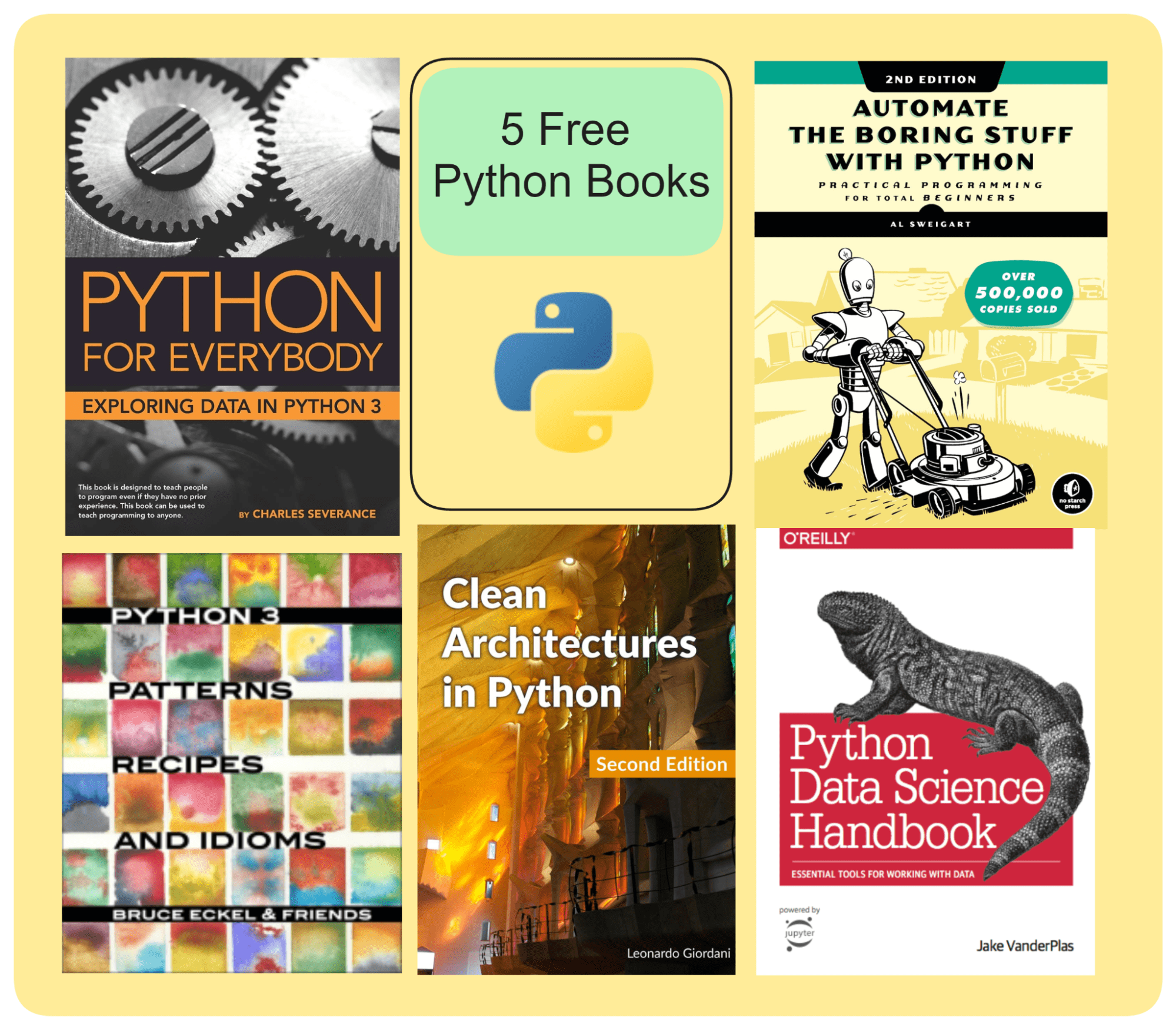
5 Free Books to Help You Master Python

5 Free Books to Help You Master Python
Image by Author

When you’re learning a new programming language or tech stack, you’ll often be overwhelmed with the bazillion resources—books, courses, tutorials and more—available to get started.

If you’re an experienced programmer learning Python, just-in-time learning to complete specific projects probably works better. But if you’re looking for a complete learning path, you may prefer a structured learning curriculum—coupled with projects—to become familiar with the language.

Here, we present five Python books to help you become proficient with the features of Python and build maintainable applications. Whether you are a beginner or an experienced Python programmer, these books will help you broaden your understanding of the language.

1. Python for Everybody: Exploring Data in Python 3

Python for Everybody by Dr. Charles Severance (Dr. Chuck) presents a code-first approach to learning the Python programming language. It's one of the best books to pick up if you are just getting started with Python.

From installing Python to web scraping and working with common data formats this book covers a good breadth of topics—along with practice exercises and solutions. You can also follow along with the Python for Everybody lecture—freely available—on the freeCodeCamp YouTube channel.

The topics covered in this book include:

  • Variables, expressions, and statements
  • Conditional execution
  • Functions
  • Loops and iteration
  • Working with strings and files
  • Lists, tuples, and dictionaries
  • Regular expressions
  • Network programming
  • Using web services
  • Object-Oriented Programming (OOP)
  • Databases
  • Data visualization

Start reading: Python for Everybody (PY4E)

2. Automate the Boring Stuff with Python

Automate the Boring Stuff with Python by Al Sweigart is another excellent beginner-friendly resource to learn basic to intermediate Python concepts.

You’ll learn the basics like built-in data structures, control flow, and exception handling. In addition, you’ll learn to write Python scripts to automate tasks like searching through files, downloading files from the web, processing PDFs and more.

Here's an overview of some of the topics covered in this book (in addition to the basics):

  • Pattern matching with regular expressions
  • Input validation
  • Reading from and writing to files
  • Debugging
  • Web scraping
  • Working with spreadsheets, PDF, CSV and JSON in Python
  • Scheduling tasks
  • Manipulating images
  • GUI automation

Start reading: Automate the Boring Stuff with Python

3. Python 3 Patterns, Recipes, and Idioms

Python 3 Patterns, Recipes and Idioms is a book for intermediate Python programmers who are already familiar with the features of the language and are looking to level up.

The book starts with the review of Python functions and classes and covers the following:

  • Initialization and clean up of instances
  • Unit testing and test-driven development in Python
  • Decorators
  • Meta programming
  • Generators, iterators, itertools
  • Design patterns and pattern refactoring in Python

Start reading: Python 3 Patterns, Recipes and Idioms

4. Clean Architectures in Python

When you go beyond simple python scripts and start building applications, you need to understand clean architecture and build production-ready apps.

Clean Architectures in Python by Leonardo Giordani is a free book that covers:

  • Clean architecture fundamentals
  • Components of clean architecture
  • integration with external systems (Postgres and MongoDB)
  • Running a production-ready system

Start Reading: Clean Architectures in Python

5. Python Data Science Handbook

You’ve gained familiarity with core Python and the functionalities of built-in modules. You’re also aware of the best practices to write clean Python code. So what's next?

If you’re looking to get started with data science, you also need to add a few Python data science libraries. The Python Data Science Handbook is a comprehensive resource to pick up the basics of cleaning, analyzing, and manipulating data.

The book covers python concepts like Python magic commands, debugging, and profiling code. If then covers enough ground to help you get started with Python data science libraries and build machine learning models. Here’s an overview:

  • NumPy
  • Pandas
  • Matplotlib
  • Machine learning

Start reading: Python Data Science Handbook

Wrap-Up and Next Steps

As mentioned, it is important to apply what you learn by building small projects that you're interested in! These books will serve as your companion in the process.

When you start building applications, it's possible that you may introduce subtle anti-patterns in your code. So regardless of the programming language that you are building with, be sure to read Clean Code and The Pragmatic Programmer to build better applications.

Bala Priya C is a developer and technical writer from India. She likes working at the intersection of math, programming, data science, and content creation. Her areas of interest and expertise include DevOps, data science, and natural language processing. She enjoys reading, writing, coding, and coffee! Currently, she's working on learning and sharing her knowledge with the developer community by authoring tutorials, how-to guides, opinion pieces, and more.

More On This Topic

  • Top 15 Books to Master Data Strategy
  • KDnuggets News, June 22: Primary Supervised Learning Algorithms Used in…
  • 9 Free Resources to Master Python
  • 5 Free Data Science Books You Must Read in 2023
  • AI in Dating: Can Algorithms Help You Find Love?
  • 5 Practical Data Science Projects That Will Help You Solve Real Business…

When Sam Met Ollie 

Silicon Valley is gushing with excitement as Sam Altman, currently the big cheese of the AI world, just introduced his beau, Oliver Mulherin. Alongside his remarkable professional accomplishments, Altman is looking forward to starting a new chapter in life by settling down and preparing for fatherhood with Oliver, affectionately known as Ollie, as reported by The New Yorker.

Since both Altman and Mulherin maintain an extremely private profile about their relationship, the couple was first spotted together when they attended a White House dinner in honour of Narendra Modi in June. The event saw powercouples from other big techs like Satya and Anu Nadella, Sundar and Anjali Pichai, and more.

Who is Oliver?

Although not much is known about Mulherin, he is of Australian origin and has graduated from the University of Melbourne in software engineering. His expertise lies in the space of Internet-of-Things (IoT) as confirmed by his joining of open-source coding organisation IOTA Foundation in 2018. During his university years, Oliver engaged in diverse AI projects, spanning from general game playing to language detection through LSTMs. His foray into the IoT realm commenced with victories in two hackathons, one sponsored by modular phone company Nexpaq and the other by General Electric. In the IoT domain, Oliver specialized in establishing mesh communication networks connecting cell phones and warehouse sensor networks.

Altman with his siblings (Source: New Yorker)

38 year old Altman has had a “middle-class Jewish upbringing” in Missouri with three younger siblings – Max, Jack, and Annie. As per a new report, The family adhered to unique traditions, such as having dinner together every night and fostering engagement through games and intellectual challenges. The family environment was notably supportive, with Altman’s parents consistently expressing love and belief in his abilities. This nurturing atmosphere played a crucial role in instilling a high level of self-confidence in Sam Altman throughout his formative years. In recognition of his efforts, GLAAD honoured Altman in 2017 with the Ric Weiland Award for promoting LGBTQ equality and acceptance within the tech sector.

Looking Back

Before Oliver, Altman had a nine-year-long relationship with Nick Sivo, who was also his Loopt co-founder and wanted to marry him. Unfortunately, the couple parted ways soon after Loopt was acquired by Green Dot Corporation for $43.4 million in 2012. Altman and Sivo had met at Stanford University and had been together since their sophomore year. There is absolutely no public information available about Sivo.

Sam & Nick (Source: Business Insider)

After acquiring Loopt and parting ways with his longtime partner Sivo, Altman took a year off. During his sabbatical, he read, played video games, and attended a spiritual retreat. In 2014, he wrote a blog post about ‘Founder’s Depression,’ sharing his own struggles and highlighting the commonality of depression among founders. He has always emphasised the need to openly address mental health challenges within the entrepreneurial community.

Why Sam’s Story Matters?

Recently recognised as one of the most influential people in AI by TIME magazine, blue backpack ambassador Altman came out during high school in an environment not particularly supportive of homosexuality. At the age of 17, Altman addressed his school community when objections were raised against a speaker for National Coming Out Day due to religious beliefs and negative attitudes. In his speech, Altman emphasised the importance of tolerance and acceptance, advocating for an open and inclusive community and challenging discriminatory views.

His openness holds significance given the stigma still attached to homosexuality in parts of the tech industry. Compounded by a lack of reliable LGBTQ+ data in Silicon Valley, it’s a challenge to address the community’s issues. Fear of prejudice or discrimination keeps many from disclosing their sexual orientation or gender identity at work, hindering accurate workforce diversity assessment.

Back in April, AIM got in touch with several queer employees in prominent Indian tech companies to understand their real experiences and gain firsthand insights. To ensure privacy, both corporate names and individual identities were kept confidential.

Despite facing initial resistance due to company policies, we found a common theme among respondents. Despite well-intentioned initiatives by management, a persistent issue of homophobic attitudes among coworkers was prevalent, with almost 60% of them being closeted in office space. The core problem appeared to be the prevalence of subtle homophobic jokes and microaggressions, seemingly innocuous but contributing to a broader culture of discrimination and intolerance within these tech giants.

Altman’s advocacy, by sharing his story, becomes pivotal in dismantling barriers and fostering inclusivity amid the prevalent culture of discrimination within these tech giants.

Read more: Behind Indian IT’s Mixed Emotions for LGBTQ+

The post When Sam Met Ollie appeared first on Analytics India Magazine.

Kickstart a New Well-Paid Tech Career With This $60 Training Bundle

A microchip that has the word AI written on it.
Image: StackCommerce

We are so fortunate to live in a time when it is no longer necessary to spend unnecessary time and funds on going back to school in order to make a major career change. If you want to train at your own pace for high-paying jobs, especially those that allow you to work from anywhere, start with The 2023 Ultimate Artificial Intelligence & Automation Developer Bundle.

You will have lifetime access to the latest courses taught by expert instructors Bryan Guerra (4.4/5 stars) and Chris Mall (4.3/5 stars) on the most in-demand skills, such as development, ChatGPT, AI in general and much more. Best of all, the modules were all designed specifically for beginners, and the bundle is on sale right now for just $59.99.

Want to kickstart a programming career? Try C++: Master C++ with Step-By-Step Examples for Beginners, Python MTA 98-381 Complete Preparation Course, Python Automation Scripting & Regular Expressions and Java: Master Java with Step-By-Step Examples for Beginners.

You may also find the SQL: Mastering MySQL & MariaDB with Step-by-Step Examples for Beginners and The Deep Learning Masterclass: Classify Images with Keras! Courses are helpful if your career goals lie in one of those directions. If you’re focused on more specific niches, check out the AI-900: Microsoft Azure AI Fundamentals Preparation Course, Google Assistant Automation IoT Development or Solidity Essentials: Web3 Development Blockchain Programming.

Of course, you know that AI is the future, so why not start training for it now? You could gain an edge for the best positions with courses like Introduction to the Latest Artificial Intelligence Tools, ChatGPT, Midjourney & DALL-E Essentials: 3 AI Courses in 1 and Robotics & Artificial Intelligence + Tools + Templates. If your job relies heavily on content creation, don’t miss the ChatGPT: Artificial Intelligence (AI) that Writes for You course.

It’s amazing how affordable technology has become. For well under $100, you can beef up your computer, change your life with self-paced courses and chart a new career path. Don’t pass up the chance to take advantage of that when you can.

Get The 2023 Ultimate Artificial Intelligence & Automation Developer Bundle now while it’s on sale for just $59.99, a discount of 74% off the regular $234 retail price.

Prices and availability are subject to change.

Person using a laptop computer.

Subscribe to the Daily Tech Insider Newsletter

Stay up to date on the latest in technology with Daily Tech Insider. We bring you news on industry-leading companies, products, and people, as well as highlighted articles, downloads, and top resources. You’ll receive primers on hot tech topics that will help you stay ahead of the game.

Delivered Weekdays Sign up today