Because ChatGPT can perform many technical tasks such as writing, coding, and researching, a lot of the hype surrounding the chatbot has been on its ability to revolutionize the workspace. However, ChatGPT's assistance can also be used for other, more exciting projects, such as vacation or trip planning.
If you have ever planned a vacation, you know how stressful the entire ordeal is. From finding the right destination to having everything booked to having an orderly itinerary, there are many things to consider to have a good vacation — that's where ChatGPT can help.
Over the summer, I took a trip to Europe and used a travel agent because I was so overwhelmed I didn't even know where to start. When I was sharing my plight with other tourists I met on the trip, multiple times I was met with, "Oh, we just used ChatGPT."
ChatGPT can help with every step of the way, answering all your questions the way a travel agent would by searching its robust database and outputting a conversational response.
If you're daydreaming about your next vacation or planning your next getaway, here's how you can use ChatGPT or other AI chatbots to do the heavy lifting.
Quick note: I am using ChatGPT for this article because of its popularity. However, the instructions work for any of the many AI chatbots on the market.
It's worth using a chatbot that has internet access, such as Bing Chat or Google Bard because you will not only get the latest prices, recommendations, and more, but you'll also get clickable links you can visit yourself.
Watsonx Brings AI Visibility to Banking Systems September 27, 2023 by Doug Eadline
A new set of AI-based code conversion tools is available with IBM watsonx. Before introducing the new "watsonx," let's talk about the previous generation Watson, perhaps better known as "Jeopardy!-Watson."
The original Watson system was initially developed as an experiment to answer questions on the quiz show Jeopardy! and in 2011, the Watson computer system competed against champions Brad Rutter and Ken Jennings, winning the first place prize of $1 million (IBM donated 100% of Watson's winnings to charity, with 50% of those winnings going to World Vision and 50% going to World Community Grid.) Except for one embarrassing blunder ("Its largest airport is named for a World War II hero; its second largest for a World War II battle," Watson "What is Toronto?"), Watson crushed the human competition.
In terms of hardware, Jeopardy!-Watson was no slouch. The Watson cluster was composed of ninety IBM Power 750 servers, each with a 3.5 GHz POWER7 server; the system provided 2,880 POWER7 processor threads and 16 TBytes of RAM.
Despite the Jeopardy! success and multi-billion dollar investment, Watson's further development and the creation of Watson Health never gained wide acceptance. In January 2022, IBM sold Watson Health for a reported $1 billion to private equity firm Francisco Partners.
Building on the Foundation
Building AI systems like ChatGPT, Bard, or Llama takes time and resources. Grown from information found across the internet, these massive large language modes (LLM) can answer complex questions on many different topics but lack specific knowledge. One way to envision these foundation LLMs is to consider them a well-built house. The basics include windows, walls, stairs, doors, rooms, closets, and pathways, but no furnishings exist. One might ask a house-foundation model, "How do I get from the living room to the upstairs bathroom?" to which the LLM will answer. It may provide different (answers) pathways through the house, but it will get you to your destination.
If one were to ask, "How big is the flat screen TV in the basement?" the house-foundational model would be a loss. This information is specific to a particular home and thus would require augmenting the foundational model with information about your home.
Providing foundational models with more domain-specific data is the gateway to widespread use. Of course, asking ChatGPT to write an essay on War and Peace or to provide Python code to multiply two matrices is impressive, but asking ChatGPT to write a 300-word report on last year's sales numbers won't work. You need to add furniture to the house.
Adding furniture means tuning the model specifically for your organization or business. This process introduces many "foundational questions" that may have a considerable importance in the success of your new model. For instance,
What Foundational model should I use?
What if the foundational provides biased answers?
What if my training data is biased?"
As suggested by these questions, putting AI to work with domain knowledge requires careful consideration of data providence and quality.
Meet watsonx
In May of 2023, IBM introduced watsonx. It might be convenient to describe watsonx as next-generation or evolutionary, but in reality, watsonx has little connection to Jeopardy!-Watson. watsonx is designed to assist with the GenAI technologies sweeping through virtually every market sector. That is, watsonx will help answer the types of questions mentioned above.
Watsonx has three main components listed below. These components offer advanced machine learning, data management, and generative AI capabilities to train, validate, tune, and deploy AI systems across the business with speed, trusted data, and governance. It helps facilitate the entire data and AI lifecycle, from data preparation to model development, deployment, and monitoring.
watsonx.ai allows users to train, validate, tune, and deploy generative AI, foundation models, and machine learning capabilities easily and build AI applications in a fraction of the time with a fraction of the data.
watsonx.data is an open lakehouse storage solution for AI projects, providing seamless data transfer and management. It provides a single entry point to data regardless of location and allows real-time or batch, all in the context of a robust governance framework.
watsonx.governance is an end-to-end governance solution. It covers the full AI lifecycle data provenance, ensuring traceability, transparency, explainability, and bias detection.
Getting Smart About The Future
Jen McComas, Executive Architect, Principal Global Industry Engineer for IBM Global Industries
In a recent interview with Jen McComas, Executive Architect and Principal Global Industry Engineer for IBM Global Industries, Financial Services, about watsonx in the banking industry, the topic of modernization was discussed. While most enterprises need to address modernization at some point, the Banking industry is under pressure to find increased revenue, reduce costs, and find growth opportunities.
One of the challenges facing the banking industry is the continued use of COBOL applications. COBOL is the second oldest high-level programming language and has been the mainstay of many banking and financial institutions. COBOL is still in use because it works, and the applications are trusted. There are issues, however. The first is the shortage of COBOL programmers. The second is the need for modern features and capabilities in a programming language to address the challenges mentioned above. New banking approaches that include hyper-personalized service need modern tools that support sophisticated analysis. Banks are pressured to modernize or build new systems to address their needs.
Generative AI provides a path forward for many of these challenges. Reports of using ChatGPT to translate code from one language to another are impressive. However, these success stories are usually based on small examples and may need further vetting to be trusted in production environments.
The challenges of code translation are where watsonx comes into play. Based on the watsonx.ai foundation models, IBM has developed the watsonx Code Assistant for Z that uses a fine-tuned coding model that can make it easier for developers to incrementally modernize COBOL business services and selectively convert to high-quality Java code. In addition, using watsonx, developers can gain insights and recommendations for existing COBOL code that may not have been possible without the original author's knowledge (the person who retired right after doing the Y2K fixes).
Code Assistant for Z allows users to tune and customize the underlying foundation model with their standards and best practices. At the same time, data-source attribution will provide transparency into the potential origins of the generated code.
When translating COBOL to Java, the resulting Java code is "human readable, " allowing the developer to modify or enhance the generated code. To provide confidence and verification for the new code, automatic generation of test cases for the existing COBOL and the new Java codes are produced.
While discussing these new tools with IBM's McComas, she mentioned attributes not generally associated with GenAI tools. Attributes such as traceability, transparency, explainability, and bias detection are part of watsonx.governance component that allows organizations to create open and observable conversion processes. With emerging AI (and existing) regulation, end-to-end data provenance will be essential for risk management and compliance in regulated industries.
Not Just for COBOL
Providing rigorous code conversion is not just limited to the banking industry. Almost every sector has code that needs trusted modernization or conversion.
Another application for IBM watsonx Code Assistant is a generative AI service that helps developers create Ansible content more efficiently. The Red Hat Ansible Lightspeed assistant reads plain English entered by a user and then interacts with IBM watsonx foundation models to generate code recommendations for automation tasks that are then used to create Ansible Playbooks. Results are written in YAML code and adhere to accepted best practices for Ansible experienced users. The Ansible Lightspeed assistant reduces the need for highly skilled Ansible developers.
It should be noted Watsonx Code Assistant for Z is a new addition to the watsonx Code Assistant product family, along with IBM watsonx Code Assistant for Red Hat Ansible Lightspeed. These solutions are powered by IBM's watsonx.ai code model, which is expected to have knowledge of 115 coding languages, having learned from 1.5 trillion tokens. At 20 billion parameters, it is on target to become one of the most significant generative AI foundation models for code automation. The watsonx Code Assistant product portfolio will extend over time to address other programming languages, improve time to value for modernization and address growing skills challenges for developers.
Converting that legacy Fortran application to Java, C, or even Python may be possible very soon because watsonx knows what you are talking about.
Meta's new Ray-Ban Smart Glasses will be the first hardware product to integrate the company's AI bot.
During Wednesday's Meta Connect event, the company announced several new AI services that will soon be available across its different platforms, including Instagram, WhatsApp, and Messenger.
Also: Meta Quest 3 hands-on: It's all about mixed reality with the new VR headset
On top of adding AI features to its existing platforms, Meta finally entered the AI chatbot race by unveiling one of its own — Meta AI.
If you missed the live stream, ZDNET's rounded up all the major AI announcements during the hour-long keynote, plus some fun bonuses, in the list below.
Mythos Ventures grabs $14M for inaugural fund to invest in AI Christine Hall 12 hours
Mythos Ventures, an early-stage venture capital firm started by Vishal Maini, closed $14 million in capital commitments for its first fund that will invest in transformative AI companies.
Metaplanet, Delphi Ventures and The Operating Group are backers alongside a group of individual investors, including Phil Black, co-founder of True Ventures; Walter Kortschak, managing director of Summit Partners; Tom Shaughnessy, co-founder of Delphi Digital; and Anna Counselman, co-founder of Upstart.
The solo general partner firm, based in San Francisco, joins the likes of Connect Ventures, Fuse and Unconventional Ventures in announcing a new fund this month.
Maini is joined by partners Jonathan Eng and Paul Gu, the latter he has known since young adolescence. They grew up together, even studying together at Yale. All three worked together at Gu’s startup Upstart, a fintech company focused on lending. Most recently, Maini was at DeepMind working on safety and artificial general intelligence deployment.
“It was pretty clear from being in the trenches that we were just about to cross the chasm from research to product ready,” Maini told TechCrunch. “We’re not even in the full swing of it yet. I started this now because I believe that in the next decade, a wave of companies will be built that will be genuinely history-defining in terms of the types of transformation that are achieved. It felt like the right time to bring a team together to focus on that.”
However, before you sigh about yet another VC firm targeting AI companies, Maini does understand. Not only did he say it was “a bad time to start a fund,” he doubled down and said it was “arguably an even worse time to start an AI fund.” Why? Because everyone is moving into the AI space, of course.
Ultimately, though, Maini was able to get the commitments in about six months and more than double his initial target of $6 million. Here’s how: leaning into its differentiation of “transformative AI.”
He explained that it’s a term used by Open Philanthropy, an early funder in OpenAI. The definition has two parts: One is impact-based in terms of reaching a certain level of advanced AI systems. The second is around the capability of frontier systems and having AI that is as good as a human at cognitive tasks. The term is still catching on, he added.
“That will change in the next few years because, in my view, it’s the correct term to be used to describe the space rather than generative AI,” Maini said.
Elicit is building a tool to automate scientific literature review
Maini intends to write check between $100,000 and $1 million for companies raising at the pre-seed and seed levels.
Mythos is going after startups in areas Maini considers underhyped. For example, companies that don’t heavily rely on generative AI, but instead use machine learning paradigms and artificial cognition to upend industries. Another is artificial general intelligence-proof companies that will be relevant five or 10 years from now when he said there won’t be a need to call a company an “AI company” anymore.
The firm has invested in four companies from the new fund, including Elicit, which is building an AI research assistant to automate scientific review, and which announced its first funding round this week. Others are Monumental, building AI-enabled robotic stone-carving factories, and ValueBase, which is automating real estate valuations.
“We want to be there from the idea stage, and we’re with the founders all the way through to the end,” Maini said. “I honestly don’t think that there will be many AI companies in 10 years. It’ll be a weird thing to say. Everyone’s going to use AI in 10 years. We will invest in the companies that will ride that tailwind as that transition plays out.”
Have a juicy tip or lead about happenings in the venture world? Send tips to Christine Hall at chall.techcrunch@gmail.com or Signal at 832-862-1051. Anonymity requests will be respected.
Questions every VC needs to ask about every AI startup’s tech stack
Since its release in November 2022, ChatGPT has been hailed as one of the most impressive and successful consumer software applications in history. Its release sparked a new leg of the AI arms race, inciting panic and hasty actions from Silicon Valley's heaviest hitters, Meta, Google, and Amazon.
But as the hype dies down for ChatGPT and other large language models, AI companies set their sights on achieving an intelligent agent that supersedes the wonders of today's AI models: artificial general intelligence (AGI).
What is artificial general intelligence?
AGI is a hypothetical intelligent agent that can accomplish the same intellectual achievements humans can. It could reason, strategize, plan, use judgment and common sense, and respond to and detect hazards or dangers.
This type of artificial intelligence is much more capable than the AI that powers the cameras in our smartphones, drives autonomous vehicles, or completes the complex tasks we see performed by ChatGPT.
What's the difference between AI and AGI?
Drew Sonden, product lead EMEA at SS&C Blue Prism, says AI chatbots like ChatGPT and Google Bard are considered narrow AI. Narrow AI is classified as an AI that uses algorithms to complete a task without learning anything from that task or applying knowledge to another task.
"A true AGI would be able to undertake conversational engagements, carry out detailed planning activities, deliver mathematical insights, create novel artworks — in theory, undertake any task," Sonden says.
AGI could change our world, advance our society, and solve many of the complex problems humanity faces, to which a solution is far beyond humans' reach. It could even identify problems humans don't even know exist.
"If implemented with a view to our greatest challenges, [AGI] can bring pivotal advances in healthcare, improvements to how we address climate change, and developments in education," says Chris Lloyd-Jones, head of open innovation at Avande.
To address a problem like climate change, AGI could access the internet and digest all the existing research about climate change. Then, it could create solutions while assessing every possible outcome. AGI could serve as a stream of consciousness more capable than humans, all while never needing a period to rest or learn more information.
However, the achievement of AGI is still far away — or at least not an achievement that can be reached soon. Expert opinions vary; some say it could take three years, while others say it could take decades before humans can achieve AGI.
AI is an exciting area of innovation, and where we are today once seemed like it was light years away to achieve. But the journey to AGI didn't start with ChatGPT. The race to AGI is an expansive, worldwide effort involving researchers, engineers, big-thinkers, and governments working together.
Is AGI a threat to humanity?
An intelligent being capable of intelligence comparable to or more advanced than humans could bring innovations to society only visualized in science fiction. But behind every transformative technology is the possible harm that comes with it.
AGI carries considerable risks, and experts have warned that advancements in AI could cause significant disruptions to humankind. But expert opinions vary on quantifying the risks AGI could pose to society.
The majority of experts would agree that AGI alone is not necessarily a risk to humanity, but the hands that puppeteer the intelligent being would dictate how helpful or harmful this technology could be.
Aaron McClendon, head of AI at Aimpoint Digital, stressed the importance of dispersing access to generally intelligent beings and ensuring that no one group of people or countries monopolize AGI.
"If AGI results in a significant increase in wealth and productivity, those benefits should be shared broadly rather than concentrated in the hands of a few," he says.
Nigel Cannings, CTO and founder of Intelligent Voice has a similar sentiment. A generally intelligent being would learn morals, reason, and judgment from the humans teaching it. The consequences could be grave if pointed in the wrong direction.
"…[I]t is the humans operating machines that have great power that is far more worrying. It is likely that any machine that achieves some level of sentience or intelligence will only become evil if pushed in that direction by its human masters," Cannings says. "Left to its own devices, it is probably more likely to be fair and impartial in its approach to humanity."
How close we are to achieving AGI
According to Wei Xu, an assistant professor at The Georgia Institute of Technology's College of Computing, we can trace the quest to achieve AGI back to the advent of computer systems in the 1950s.
Xu cites the Turing test, a test created by Alan Turing in 1950 where a human and a machine engage in a text-based conversation, and the conversation is evaluated by a judge. If the judge cannot distinguish which conversationalist is a human and which is a machine, then the machine passes the Turing test.
Xu also mentions the General Problem Solver, a computer program created by two computer scientists in 1956. The two believed that teaching a machine to use symbols to connect with the world around it would eventually lead to general intelligence.
Both the Turing test and the General Problem Solver were early attempts to create and test a machine's ability to act intelligently. And these tests lead us to today, where the success of language models like ChatGPT and GPT-4 is the culmination of research and a testament to the spirit of human innovation.
Xu refers to AGI as "the holy grail of computer science," as it consolidates many technologies to create a general, unified intelligent being that can complete tasks and solve problems. Applications like ChatGPT and DALL-E can produce text output and generate artwork independently, but AGI could do both — and much more.
"It is more efficient, more convenient, and more impressive to have one single product with one user interface that can do more things all at once," she says.
Experts are careful to say exactly how many years we could expect to see AGI, but Lloyd-Jones has an idea. He says although language models like ChatGPT are impressive and revolutionary, they cannot create new ideas, but technology that can is on the horizon.
"AI models are only as good as the data set used to train them, and they are unable to create new styles of art, or poetry, for example. We do not yet have a perfect data set for this purpose," he says. "Personally, with the pace of development, I think we'll be 80% there in five years."
But Cannings says we are still far from achieving AGI and can't know precisely when it might happen. He says that AI chatbots showcase the advancements in engineering but heavily lack the necessary characteristics of human intelligence.
Cannings emphasizes the difficulty of creating an intelligent being that can emote, empathize, and sense — cornerstones of the human experience. He believes that achieving AGI goes beyond engineering feats but will necessitate the involvement of the philosophical and psychological definitions of intelligence.
"While progress in AI is remarkable and continues to evolve, achieving AGI, encompassing the full range of human cognitive abilities, appears to be a challenge that will require significant advancements in both technical and philosophical domains," he says.
How AGI should be regulated
Many countries are investing in AI research in hopes of being the first country to report a breakthrough in achieving AGI. McClendon notes that although the US and China are at the forefront, Canada, the UK, France, and Germany are making strides in the race.
"It's important to note that achieving AGI will be a significant scientific and technological milestone, and its impact will be global, irrespective of where it's developed," he says.
What matters about the country in which AI is researched are the laws in that country and the geopolitical reasons for which a government could leverage the power of AGI. A country's philosophies about regulation and technological innovation are integral to how fast and widely adopted its technology could be.
Bryan Cole, director of customer engineering at Tricentis, says companies like OpenAI, Google, and Microsoft may disclose their progress to AGI, but governments and nation-states may be less open.
The secrecy around who could reach AGI first lies in global dominance and influence, and whoever achieves it first could become more powerful without letting adversaries know their next step.
"Major nation states like China and the US are pouring enormous resources into this because whoever gets an AGI system first will likely have the ability to prevent any other AGI system from coming into existence through technological dominion [or control]," he says.
But until countries reach AGI, AI companies, researchers, and lawmakers must collaborate to create legal safeguards for citizens.
Countries in the EU will soon have to adhere to the three risk categories outlined in the EU AI Act, which will ensure that AI is regulated by people — not by automated systems — to eliminate the possibility of harmful outcomes. China's regulations require AI systems to support and align with the country's political values, while the US has no legal framework at the federal level to regulate AI.
Michael Queenan, founder and CEO of Nephos Technologies, says Western governments should not willfully ignore the vital importance — and possible dangers — of AI, or they risk losing the race.
"AI technology is evolving at breakneck speed, far faster than regulators are, and we need to act fast," he says. "We are facing a tsunami of AI and have no plan for it. The West is at risk of being left behind; however, regulation is critical in deciding what and how we should be using it."
As AI becomes more advanced and its applications span different facets of life, it becomes increasingly difficult for lawmakers to create laws that clearly define the risks and how to address them.
Sarah Pearce, partner at the law firm Hunton Andrews Kurth, says lawmakers shouldn't spend too much time coming up with an exact definition of AI and should contain their efforts to regulate the technology's output.
"I think lawmakers would be better focusing on the outputs and uses of the technology when trying to legislate around it rather than trying to settle on an overly broad definition of what it is, as it is likely that any definition will be outdated by the time the legislation comes into force," she says.
For countries that don't have formal federal legislation surrounding AI, Pearce says governments and AI companies should focus on protecting user data. AI companies collect and use significant amounts of data to train AI models.
"Companies will inevitably be accused of taking their collection activities towards the excessive and may be asked to explain whether and why they are retaining the data for longer than may be perceived necessary," Pearce says. "Often, this is to help improve and further replicate algorithms — it is not necessarily being used for additional commercial gain."
AGI, a technology dreamed of since the dawn of computers, shown to us in movies like Spike Jonze's "Her," Jon Favreau's "Iron Man," and Stanley Kubrick's "2001: A Space Oddysey," is the lifeblood of AI research, and it's impossible to stop anyone from trying to achieve it.
In our favorite movies, AGI is a helpful sidekick, a loving companion, or a villain that recognizes humans as a threat to themselves and decides to exterminate humankind. Which version will we see? Experiencing a generally intelligent agent is no longer a matter of if — but when.
Workday unveils new HR-focused generative AI features Kyle Wiggers 9 hours
Just because generative AI is trendy right now, doesn’t mean it has to be applied to every application. But try telling that to Workday.
The enterprise management platform vendor today announced a suite of new generative AI features aimed at “increasing productivity” and “streamlining business processes.” Soon, Workday customers will be able to automatically compare signed contracts against contracts in Workday to surface discrepancies, create personalized knowledge management articles and generate statements of work for service procurement.
The announcements were made at Workday Rising, Workday’s annual customer conference, which is taking place in San Francisco this year.
Some of the additions seem genuinely useful — or harmless at the worst. But one is a bit concerning to this reporter: AI-generated employee work plans.
“Managers [will be able] to quickly create a summary of employees’ strengths and areas of growth, pulling from stored data including performance reviews, employee feedback, contribution goals, skills, employee sentiment and more,” Workday writes in a press release.
I see a few problems with this.
Studies have shown that text-analyzing AI can exhibit biases against people who use expressions and vernacular that fall outside the “norm” (i.e. the majority).
For example, some AI models trained to detect toxicity see phrases in African-American Vernacular English (AAVE), the informal grammar used by some Black Americans, as disproportionately “toxic.” And Black Americans aren’t the only minority group that suffers. In a recent study, a team at Penn State found that posts on social media about people with disabilities could be flagged as more negative or toxic by commonly used public sentiment and toxicity detection models.
So what if Workday’s models fail to understand the nuance of a performance review or employee feedback because of how it’s written, leading the models to draw the wrong conclusions about someone? Good question.
Then, there’s the “employee sentiment” piece.
Biases can once again rear their ugly head in AI models trained to detect sentiment from a sentence. Research has shown that, for instance, text-based sentiment analysis systems can exhibit prejudices along racial, ethnic and gender lines — e.g. associating Black people with more negative emotions like anger, fear and sadness.
In response to these concerns, Workday says that it’s “transparent about how its AI models are designed” (albeit unwilling to reveal the exact data used to train its models) and built the work plan feature to show managers “how the data inputs contribute to a strength or area of growth.”
“As with other Workday generative AI use cases and our human-in-the-loop approach, users are encouraged to review the results as a strong first draft that they should edit, iterate on and finalize,” Shane Luke, head of AI and machine learning at Workday, told TechCrunch via email. Let’s hope that managers using Workday heed that advice.
As for Workday’s other new generative AI features, they’re less problematic on their faces.
AI-generated job descriptions in Workday leverage information already stored in the platform, including the skills needed for a role and job location details, to simplify the process of writing job listings. This reporter was initially worried that Workday might be training its description-generating models on HR employees’ copy without their knowledge or permission, but Luke assures me that this isn’t the case.
“We don’t train on dedicated job description data,” he said. “Workday customers control and configure how their data is used for AI and machine learning purposes, including whether data is used for training purposes … We make it clear from the product fields what data is being used in generation, and users are encouraged to evaluate responses as first drafts and apply their own judgment.”
Elsewhere, Workday will soon be able to automatically craft “past due” notices with recommendations on the tone of the correspondence, driven by how late a customer is or how often they’re late. (Finance teams will be able to use the capability to automate letters in bulk, Luke says.) And procurement leaders will be able to get suggestions for relevant clauses to include in procurement contracts, depending on the type of project, project location and type of deliverables.
With the aforementioned contract analysis feature, powered by generative AI, Workday customers will be alerted to potential errors in contracts and receive proposed corrections. And with the knowledge article generation feature, users will be able to draft articles like talking points for managers and takeaways from company videos with suggestions on tone and length. (Workday stresses users are more than welcome to ignore those suggestions.)
Developer Copilot marks Workday’s first foray into the generative coding, introducing text-to-code capabilities to Workday Extent, its platform for creating custom apps that run on Workday. Developer Copilot — embedded in Workday’s app builder — delivers “contextually aware” code suggestions for Workday apps, complete with curated content and search results, similar to code-generating services like GitHub Copilot and Amazon CodeWhisperer.
And — piggybacking on the popularity of ChatGPT — Workday is piloting a number of conversational AI experiences. Luke says that they’ll “enhance users’ ability to interact with information and tasks” in a natural way, taking advantage of the generative AI capabilities such as summarization, search and maintaining context.
“We believe that when used responsibly, generative AI can drive impactful business outcomes,” Luke said. “Fundamentally, our AI approach is focused on human-machine teaming. The user is always the final decision maker and moderator.”
Workday expects the new generative AI features to launch within the next six to 12 months. Unfortunately, it didn’t provide a more specific timeline than that.
OpenAI is reportedly getting into the hardware business. WHOOP recently announced that it is partnering with OpenAI to launch WHOOP Coach today, the most advanced generative AI feature to ever be released by a wearable.
BREAKING: We have partnered with @OpenAI to launch WHOOP Coach today, the most advanced generative AI feature to ever be released by a wearable. Members can now ask @whoop anything about their data – and receive instant feedback.pic.twitter.com/wnzjzj2xX2
— Will Ahmed (@willahmed) September 26, 2023
WHOOP said that most guidance, from wearables or elsewhere, is based on information that might not apply to your body, and your goals. WHOOP Coach acts like a search engine for your body, using GPT-4, OpenAI’s most advanced generative AI system, to generate highly personalized, highly specific recommendations and guidance.
WHOOP Coach uses special WHOOP algorithms, a custom-made computer program that learns from data, the latest in sports science, and your own body information to find patterns and links in your WHOOP data. Leveraging OpenAI’s latest technology, WHOOP Coach instantly generates personalized, conversational answers to your inquiries about health, fitness, and well-being.
On the privacy aspect WHOOP said that it doesn’t share users data with other companies. When one uses WHOOP Coach, their information is made anonymous and analyzed by a third-party language learning model partner.
Also, renowned iPhone designer Jony Ive and OpenAI CEO Sam Altman have been in discussions regarding the development of a new AI hardware device, sources familiar with the matter told The Information.
Moreover, OpenAI recently announced that ChatGPT can now “see, hear and speak”. The company plans to introduce these updates to its paying users within the next two weeks. Voice functionality will be restricted to the iOS and Android apps, but image processing capabilities will be accessible across all platforms.
The post OpenAI to Challenge Apple Watch appeared first on Analytics India Magazine.
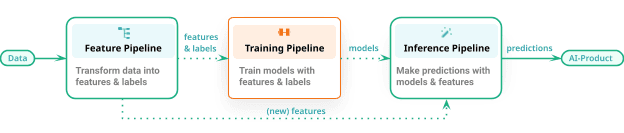
This article introduces a unified architectural pattern for building both Batch and Real-Time machine learning (ML) Systems. We call it the FTI (Feature, Training, Inference) pipeline architecture. FTI pipelines break up the monolithic ML pipeline into 3 independent pipelines, each with clearly defined inputs and outputs, where each pipeline can be developed, tested, and operated independently. For a historical perspective on the evolution of the FTI Pipeline architecture, you can read the full in-depth mental map for MLOps article.
In recent years, Machine Learning Operations (MLOps) has gained mindshare as a development process, inspired by DevOps principles, that introduces automated testing, versioning of ML assets, and operational monitoring to enable ML systems to be incrementally developed and deployed. However, existing MLOps approaches often present a complex and overwhelming landscape, leaving many teams struggling to navigate the path from model development to production. In this article, we introduce a fresh perspective on building ML systems through the concept of FTI pipelines. The FTI architecture has empowered countless developers to create robust ML systems with ease, reducing cognitive load, and fostering better collaboration across teams. We delve into the core principles of FTI pipelines and explore their applications in both batch and real-time ML systems.
Unified Architecture for ML Systems as Feature/Training/Inference Pipelines
The FTI approach for this architectural pattern has been used to build hundreds of ML systems. The pattern is as follows — a ML system consists of three independently developed and operated ML pipelines:
a feature pipeline that takes as input raw data that it transforms into features (and labels)
a training pipeline that takes as input features (and labels) and outputs a trained model, and
an inference pipeline that takes new feature data and a trained model and makes predictions.
In this FTI, there is no single ML pipeline. The confusion about what the ML pipeline does (does it feature engineer and train models or also do inference or just one of those?) disappears. The FTI architecture applies to both batch ML systems and real-time ML systems.
Figure 1: The Feature/Training/Inference (FTI) pipelines for building ML Systems
The feature pipeline can be a batch program or a streaming program. The training pipeline can output anything from a simple XGBoost model to a parameter-efficient fine-tuned (PEFT) large-language model (LLM), trained on many GPUs. Finally, the inference pipeline can be a batch program that produces a batch of predictions to an online service that takes requests from clients and returns predictions in real-time.
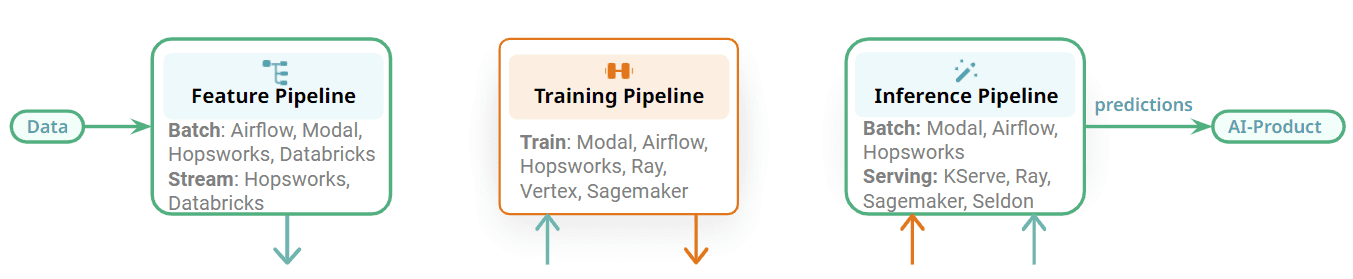
One major advantage of FTI pipelines is that it is an open architecture. You can use Python, Java or SQL. If you need to do feature engineering on large volumes of data, you can use Spark or DBT or Beam. Training will typically be in Python using some ML framework, and batch inference could be in Python or Spark, depending on your data volumes. Online inference pipelines are, however, nearly always in Python as models are typically training with Python.
Figure 2: Choose the best orchestrator for your ML pipeline/service.
The FTI pipelines are also modular and there is a clear interface between the different stages. Each FTI pipeline can be operated independently. Compared to the monolithic ML pipeline, different teams can now be responsible for developing and operating each pipeline. The impact of this is that for orchestration, for example, one team could use one orchestrator for a feature pipeline and a different team could use a different orchestrator for the batch inference pipeline. Alternatively, you could use the same orchestrator for the three different FTI pipelines for a batch ML system. Some examples of orchestrators that can be used in ML systems include general-purpose, feature-rich orchestrators, such as Airflow, or lightweight orchestrators, such as Modal, or managed orchestrators offered by feature platforms.
Some of the FTI pipelines, however, will not need orchestration. Training pipelines can be run on-demand, when a new model is needed. Streaming feature pipelines and online inference pipelines run continuously as services, and do not require orchestration. Flink, Spark Streaming, and Beam are run as services on platforms such as Kubernetes, Databricks, or Hopsworks. Online inference pipelines are deployed with their model on model serving platforms, such as KServe (Hopsworks), Seldon, Sagemaker, and Ray. The main takeaway here is that the ML pipelines are modular with clear interfaces, enabling you to choose the best technology for running your FTI pipelines.
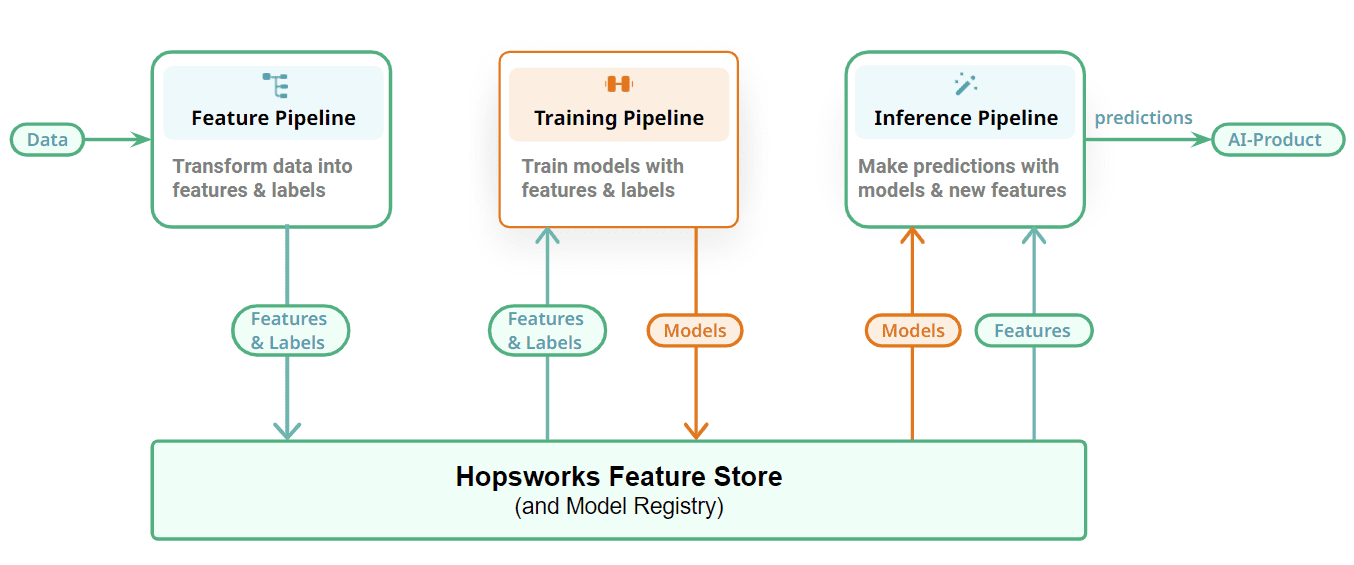
Figure 3: Connect your ML pipelines with a Feature Store and Model Registry
Finally, we show how we connect our FTI pipelines together with a stateful layer to store the ML artifacts — features, training/test data, and models. Feature pipelines store their output, features, as DataFrames in the feature store. Incremental tables store each new update/append/delete as separate commits using a table format (we use Apache Hudi in Hopsworks). Training pipelines read point-in-time consistent snapshots of training data from Hopsworks to train models with and output the trained model to a model registry. You can include your favorite model registry here, but we are biased towards Hopsworks’ model registry. Batch inference pipelines also read point-in-time consistent snapshots of inference data from the feature store, and produce predictions by applying the model to the inference data. Online inference pipelines compute on-demand features and read precomputed features from the feature store to build a feature vector that is used to make predictions in response to requests by online applications/services.
Feature Pipelines
Feature pipelines read data from data sources, compute features and ingest them to the feature store. Some of the questions that need to be answered for any given feature pipeline include:
Is the feature pipeline batch or streaming?
Are feature ingestions incremental or full-load operations?
What framework/language is used to implement the feature pipeline?
Is there data validation performed on the feature data before ingestion?
What orchestrator is used to schedule the feature pipeline?
If some features have already been computed by an upstream system (e.g., a data warehouse), how do you prevent duplicating that data, and only read those features when creating training or batch inference data?
Training Pipelines
In training pipelines some of the details that can be discovered on double-clicking are:
What framework/language is used to implement the training pipeline?
What experiment tracking platform is used?
Is the training pipeline run on a schedule (if so, what orchestrator is used), or is it run on-demand (e.g., in response to performance degradation of a model)?
Are GPUs needed for training? If yes, how are they allocated to training pipelines?
What feature encoding/scaling is done on which features? (We typically store feature data unencoded in the feature store, so that it can be used for EDA (exploratory data analysis). Encoding/scaling is performed in a consistent manner training and inference pipelines). Examples of feature encoding techniques include scikit-learn pipelines or declarative transformations in feature views (Hopsworks).
What model evaluation and validation process is used?
What model registry is used to store the trained models?
Inference Pipelines
Inference pipelines are as diverse as the applications they AI-enable. In inference pipelines, some of the details that can be discovered on double-clicking are:
What is the prediction consumer — is it a dashboard, online application — and how does it consume predictions?
Is it a batch or online inference pipeline?
What type of feature encoding/scaling is done on which features?
For a batch inference pipeline, what framework/language is used? What orchestrator is used to run it on a schedule? What sink is used to consume the predictions produced?
For an online inference pipeline, what model serving server is used to host the deployed model? How is the online inference pipeline implemented — as a predictor class or with a separate transformer step? Are GPUs needed for inference? Is there a SLA (service-level agreements) for how long it takes to respond to prediction requests?
MLOps Principles
The existing mantra is that MLOps is about automating continuous integration (CI), continuous delivery (CD), and continuous training (CT) for ML systems. But that is too abstract for many developers. MLOps is really about continual development of ML-enabled products that evolve over time. The available input data (features) changes over time, the target you are trying to predict changes over time. You need to make changes to the source code, and you want to ensure that any changes you make do not break your ML system or degrade its performance. And you want to accelerate the time required to make those changes and test before those changes are automatically deployed to production.
So, from our perspective, a more pithy definition of MLOps that enables ML Systems to be safely evolved over time is that it requires, at a minimum, automated testing, versioning, and monitoring of ML artifacts. MLOps is about automated testing, versioning, and monitoring of ML artifacts.
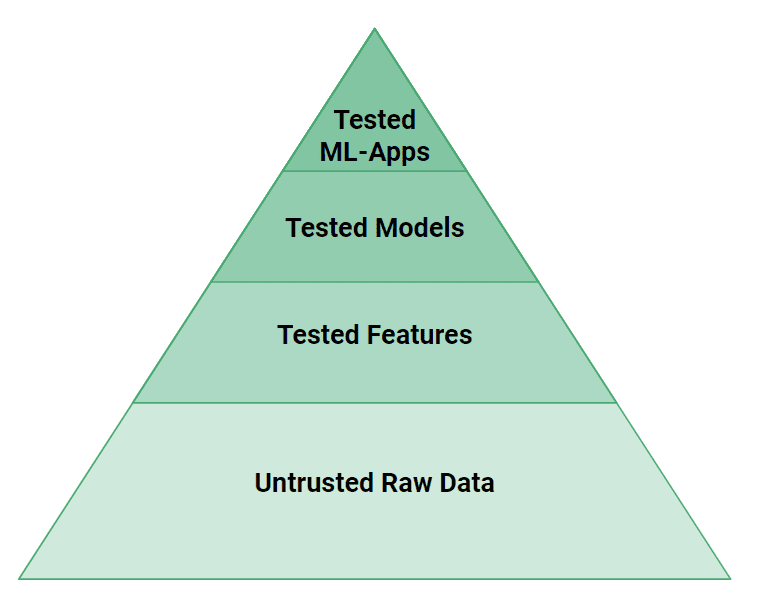
Figure 4: The testing pyramid for ML Artifacts
In figure 4, we can see that more levels of testing are needed in ML systems than in traditional software systems. Small bugs in data or code can easily cause a ML model to make incorrect predictions. From a testing perspective, if web applications are propeller-driven airplanes, ML systems are jet-engines. It takes significant engineering effort to test and validate ML Systems to make them safe! At a high level, we need to test both the source-code and data for ML Systems. The features created by feature pipelines can have their logic tested with unit tests and their input data checked with data validation tests (e.g., Great Expectations). The models need to be tested for performance, but also for a lack of bias against known groups of vulnerable users. Finally, at the top of the pyramid, ML-Systems need to test their performance with A/B tests before they can switch to use a new model.
Finally, we need to version ML artifacts so that the operators of ML systems can safely update and rollback versions of deployed models. System support for the push-button upgrade/downgrade of models is one of the holy grails of MLOps. But models need features to make predictions, so model versions are connected to feature versions and models and features need to be upgraded/downgraded synchronously. Luckily, you don’t need a year in rotation as a Google SRE to easily upgrade/downgrade models — platform support for versioned ML artifacts should make this a straightforward ML system maintenance operation.
Example ML Systems
Here is a sample of some of the open-source ML systems available built on the FTI architecture. They have been built mostly by practitioners and students.
Batch ML Systems
Electricity Demand Prediction (452 github stars)
NBA Game Prediction (152 github stars)
Premier league football score predictions (101 github stars)
Churn prediction (113 github stars)
Real-Time ML System
Online Credit Card Fraud (113 github stars)
Crypto Price Prediction (65 github stars)
Loan application approval (113 github stars)
Summary
This article introduces the FTI pipeline architecture for MLOps, which has empowered numerous developers to efficiently create and maintain ML systems. Based on our experience, this architecture significantly reduces the cognitive load associated with designing and explaining ML systems, especially when compared to traditional MLOps approaches. In corporate environments, it fosters enhanced inter-team communication by establishing clear interfaces, thereby promoting collaboration and expediting the development of high-quality ML systems. While it simplifies the overarching complexity, it also allows for in-depth exploration of the individual pipelines. Our goal for the FTI pipeline architecture is to facilitate improved teamwork and quicker model deployment, ultimately expediting the societal transformation driven by AI.
Read more about the fundamental principles and elements that constitute the FTI Pipelines architecture in our full in-depth mental map for MLOps.
More On This Topic
Feature Store Summit 2022: A free conference on Feature Engineering
How causal inference lifts augmented analytics beyond flatland
Building Machine Learning Pipelines using Snowflake and Dask
Answering Questions with HuggingFace Pipelines and Streamlit
Kedro-Airflow: Orchestrating Kedro Pipelines with Airflow
OpenAI is reportedly in talks with Jony Ive about a hardware project Kyle Wiggers 8 hours
OpenAI, not content with building large language models and art-generating AI, wants to get into hardware.
That’s according The Information, which reported this week that storied former Apple product designer Jony Ive is in talks with OpenAI CEO Sam Altman about an AI hardware project.
The details are wanting. But billionaire Masayoshi Son, the founder and CEO of investment holding company SoftBank, is involved with the initiative in some capacity, allegedly.
OpenAI’s hardware effort — whatever form it takes (or doesn’t) — is in the very earliest stages, as per The Information. Altman and Ive have only begun discussing what a piece of hardware could do or look like, not concrete features, capabilities or target market yet.
Ive’s reputation proceeds him, of course. The ex-Apple chief design officer has consulted on a number of products since leaving Apple in 2019, including a $60,000 turntable by audio equipment company Linn and a logo for King Charles III’s Astra Carta framework, a movement to emphasize sustainable space practices.
But hardware is a tricky business. OpenAI knows this well.
OpenAI once ran a robotics research division, which explored ways machines can learn to perform complex tasks like solving a Rubik’s Cube. But it disbanded the team in July 2021 after encountering major technical roadblocks — and presumably cost overruns.
OpenAI is in a position to burn some cash, however, having told investors that it expects to reach $1 billion in revenue this year. And the AI startup, best known for its viral AI-powered chatbot ChatGPT and text-generating system GPT-4, is sitting on a total of $11.3 billion in venture capital.
Just in April, OpenAI picked up another ~$300 million. And the company is said to be in discussions to possibly sell shares in a move that would boost the startup’s valuation from $29 billion to somewhere between $80 billion and $90 billion.
So, while hardware’s a risky venture, OpenAI’s likely to weather the storm better than most should its project fall well short of expectations.
On September 27, 2023, the technology realm experienced a momentous event with the emergence of Luda, a groundbreaking company striving to popularize Artificial Intelligence (AI). Luda empowers the general populace to construct, nurture, and deploy their unique AI entities, by integrating play into the learning process via an engaging sandbox experience.
Composed of seasoned experts from renowned organizations like Google Research, Disney, and Zynga, Luda has unveiled an unprecedented system for Real-Time Reinforcement Learning (RT-RL). This innovative system unlocks new realms of artistic expression and social interaction. Alongside this, the company has successfully secured $7 million in funding, orchestrated by BITKRAFT and Compound, and featuring notable contributors such as Jeff Dean and Illia Polosukhin, a co-author of the Transformers paper.
A New Creative Horizon: Mels
Luda has developed Mels, a pioneering browser-based simulator, providing a real-time platform for the generative AI to breathe life into abstract concepts. With this innovation, users can seamlessly construct AI entities, referred to as agents, using essential components within a virtual sandbox. These self-assembled characters are then invigorated by Luda’s RT-RL, following the laws of real-world physics, providing an array of interactive and unpredictable situations without the intricacies of coding or manual animation.
This avant-garde approach by Luda is reshaping the landscape of AI agent development through accelerated learning, significantly reducing the training duration from days to mere minutes. It also offers Low-Latency Inference, allowing these AI agents to operate on everyday consumer devices rather than being reliant on expensive server data centers, making interaction with agents instantaneous and user-friendly.
Empowering Human Creativity in AI
Vijay Sundaram, Luda’s Founder and CEO, emphasized, “At Luda, we believe people belong at the center of AI – not the other way around. That’s why we’re building UGC gameplay for the AI generation. The exciting thing about technology paradigm shifts is the chance to create fundamentally new experiences that weren’t possible before. We started researching and developing novel generative AI techniques like RT-RL five years ago in Google Research, to create a new consumer category: immersive, interactive AI agents anyone can create through an experience that’s as accessible and joyful as play – a new kind of playground bringing together human creativity, social connection, and user-generated agents.” He further shared the vision for Luda to be a convergence of human ingenuity, and user-generated agents, providing an experience that’s exhilarating and accessible.
Luda aims to provide a platform that goes beyond being just a game or intellectual property. It is shaping a new creative medium, allowing every user to construct their AI agents using Lego-like building blocks. This approach aligns with the revolutionary creativity and user-generated content witnessed in platforms like Minecraft and Roblox, positioning Luda as a harbinger of a new era of social and immersive experiences.
Changing the Consumer Interaction Landscape
Scott Rupp, a Partner at BITKRAFT Ventures, articulated his thoughts on Luda’s potential impact, “Luda’s generative AI breakthrough has the potential to transform how consumers interact with AI, and gameplay is the ideal use case. Luda isn’t just building an IP, game or platform, but developing an entirely new creative medium, one that empowers every user to truly craft AI agents through Lego-like building blocks. Just as Minecraft and Roblox ushered in a new era of active creativity and UGC, Luda is poised to introduce a fundamentally new category of social and immersive experiences, ”
Additionally, Michael Dempsey, Managing Partner at Compound, expressed his excitement about Luda's advancements in creating intelligent agents that are scalable and customizable with negligible inference cost, enabling the construction of a unique AI company. “Luda’s breakthroughs in crafting custom, scalable, and physically intelligent agents with almost zero inference cost have enabled them to build a full-stack AI company unlike any other. We've known the team since they started their R&D at Google Research five years ago and they've since assembled one of the few AI labs with world-class researchers and creatives working shoulder to shoulder. We couldn’t be more excited for category-defining experiences like Mels that were never before possible,” said Dempsey.
Conclusion
In summary, Luda's emergence marks the inception of an innovative approach to AI development, democratizing AI through playful learning and creative exploration. With its pioneering technologies, Luda is poised to redefine the realms of interactive and social experiences, opening doors to uncharted territories in AI and creative expression. The technological landscape keenly watches as Luda steps into a new epoch, merging human creativity with advanced AI, and crafting experiences that were previously deemed impossible.