IT giant Cloudflare has announced that developers can now build full-stack AI applications on Cloudflare’s network, Workers AI. The developer platform will provide affordable inference without the need to manage infrastructure. From startups to enterprises, businesses are looking to augment their services with AI. The platform is for developers to ship a production-ready application with use cases including LLM, speech-to-text, image classification, sentiment analysis and more.
Matthew Prince, CEO and co-founder of Cloudflare said, “Workers AI will empower developers to build production-ready AI experiences efficiently and affordably, in days, instead of what typically takes entire teams weeks or even months.”
The IT leader has also announced collaborations with Databricks, the data and AI company, Microsoft, Hugging Face, and Nvidia. Through these significant partnerships, Cloudflare will provide access to GPUs running on Cloudflare’s hyper-distributed edge network for a low-latency end-user experience. The company’s privacy-first approach will help users’ data used for training. Cloudflare currently supports a model catalogue to help developers get started quickly.
The company also introduced Vectorize, a vector database for developers to build full-stack AI applications entirely on Cloudflare. With Workers AI and Vectorize, developers no longer have to glue multiple pieces together to empower their apps with AI and machine learning – they can do it all on one platform.
Benefiting from Cloudflare’s global network the database allows vector queries to happen closer to users, reducing latency and overall inference time. It also integrates with the wider AI ecosystem, allowing developers to store embeddings generated with OpenAI and Cohere. .
Cloudflare is also introducing AI Gateway for developers, and c-suite leaders to understand how money is being spent across AI infrastructure, or how many and from where queries are happening. AI Gateway’s observability features will help them understand AI traffic like the number of requests, number of users, cost of running the app, and duration of requests. Additionally, developers can manage costs with caching and rate limiting, giving them more control over how they scale their applications.
The post Cloudflare Introduces AI-powered Suite To Fast Track App Development appeared first on Analytics India Magazine.
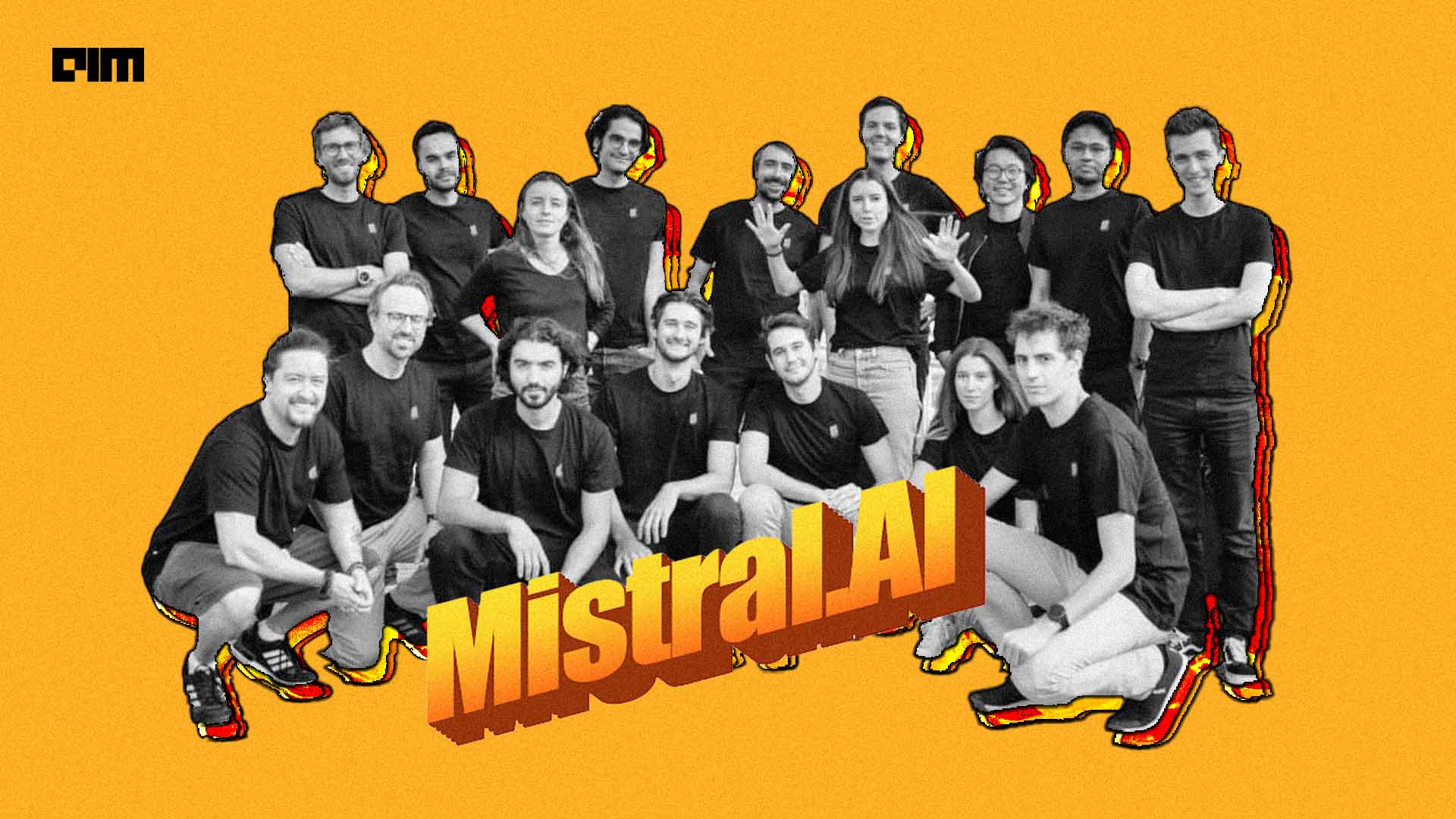
The Paris-based AI startup that believes in open source and raised the highest seed funding ever, that too without a product, has proved that it is here for making AI better, and fun at the same time. Mistral AI has released a 7 billion model that has outperformed Llama 2 13B on all benchmarks and Llama 1 34B on several benchmarks.
What’s interesting is that before releasing the open source model on GitHub, Mistral AI decided to post the torrent magnet link on X, promoting the true essence of open source and making it fun at the same time.
7B model coming up?
— Mohit Pandey (@MohitingAround) September 27, 2023
Mistral 7B is released with an Apache 2.0 licence, which means that it is actually open source, unlike Meta’s Llama 2, which has several restrictions on usage. This means that the model can be used for research and commercial uses without any restrictions. Mistral 7B proves that small models can actually perform a lot better than their larger counterparts, which is the whole point of open source.
The best open source model?
Mistral AI says that it is proud that Mistral 7B is the most powerful model of its size to date. The release also includes a model fine-tuned for chat, which also outperforms Llama 2 13B chat. If we compare the model with the benchmarks, it is actually quite a proud moment for the team – the model outperforms Llama 7B on all benchmarks.
The model is very close in performance to CodeLlama 7B on coding benchmarks. The model can be downloaded from GitHub or even torrent, and run locally with just a 13.4 GB size. It can also be deployed on AWS, Google Cloud, or Azure, using vLLM inference server and skypilot. Users on HackerNews say that they have already started deploying it on Macbook M1 Air and compare the performance with GPT-3.5.
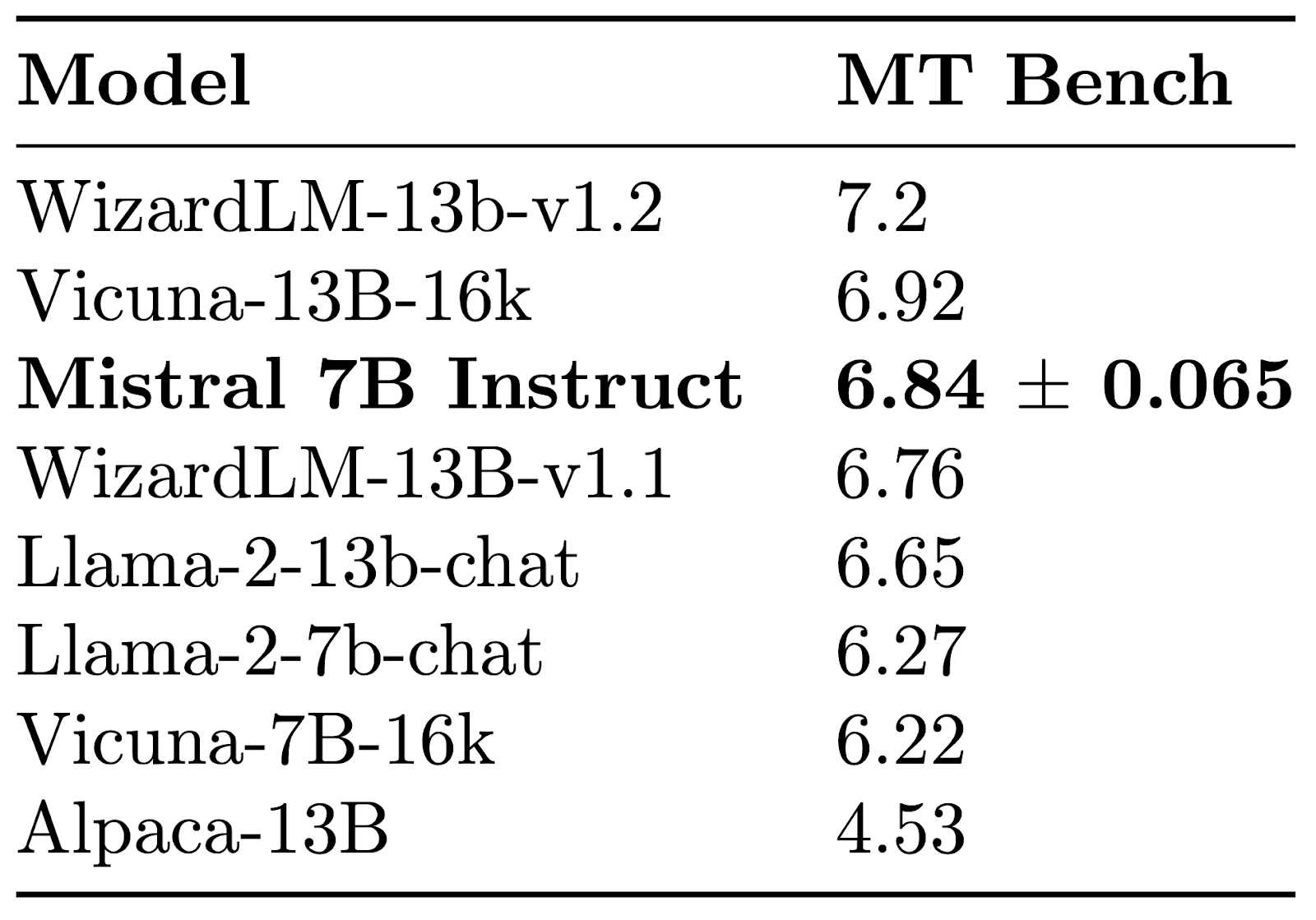
Furthermore, Mistral 7B Instruct, a model fine-tuned on instructions dataset on Hugging Face outperformed all 7B models on MT-Bench, and came close to 13B chat models. The blog reads, “No tricks, no proprietary data.”
The next Mistral step is not open source
It is not like Mistral AI does not understand the problems with open source. For this, the team has decided to open a GitHub repository and Discord channel for discussing the problems and fixing them with the community. They are also calling universities and researchers to figure out the flaws with the model and help in improving them.
“Our ambition is to become the leading supporter of the open generative AI community, and bring open models to state-of-the-art performance,” says the team.
Though, Mistral is not just going to go the open source way. The team has announced that it is parallelly developing a commercial product that will be optimised for proprietary data and private cloud deployment. “These models will be distributed as white-box solutions, making both weights and code sources available. We are actively working on hosted solutions and dedicated deployment for enterprises.”
Mistral AI was founded by Arthus Mensch from DeepMind, Guillaume Lample and Timothée Lacroix, from Meta AI. Lample was one of the core members of the team behind Meta AI’s LLaMa model, which has been leading the way in open-source. The company believes that open source is the way forward for AI.
Since the release of OpenAI models, the trio said that GPT felt like a shot in the arm for a lot of people in the AI world. “We could see the technology really start to accelerate last year,” said Mensch. But the trio has also decided to go the closed source way for the same reasons.
Arguably, this looks like a step away from the open source commitment that the company has made. But since the company has shown that its smaller model can outperform others, the larger models that the company strives to build would be the money minting solution for the company.
Hopefully the company sticks to its words. Initially, OpenAI also started out as an open source company and now we know where they are headed.
While OpenAI might have achieved AGI internally, “The year is 2028, MistralAI releases their 38th torrent link, with the text only “AGI achieved externally”, Apache 2.0”, said Nathan Lambert on X.
The post Mistral AI is Making Generative AI Fun appeared first on Analytics India Magazine.
With KaleidEO pioneering the demonstration of deep learning-based algorithms to analyse imagery in orbit—India is slated to be amongst the early adopters of edge computing in space.
KaleidEO partnered with Australia-based Spiral Blue for the hardware and implementation support to run deep learning-based algorithms which demonstrated in-orbit image analysis, on images captured by Satellogic – a satellite constellation and data provider company based out of Uruguay. ISRO is also working towards developing these capabilities but is delayed due to constraints in the availability of hardware solutions.
Today, data storage devices, even those suitable for space applications, have become quite affordable and it’s feasible to have terabytes of storage capacity in space without exorbitant costs. Data storage is no longer a significant bottleneck in space computing.
“The problem here is not about storage, it’s about having access to information and that’s what edge solves—knowing and having access to information instead of storing data and not knowing when to use it and taking hours or even days to downlink and process it,” KaleidEO COO Arpan Sahoo explained.
The goal is to provide near-real-time access to valuable information rather than just accumulating data. This shift in approach is aimed at making data more actionable and responsive in space applications. “We’re trying to remove a lot of that hereditary processes and change the way we do it,” he added.
For those unaware, traditionally, satellite data was downloaded in its raw form and processed on the ground due to the large data sizes generated. However, recent developments in hardware and software have allowed for the processing of heavy images in space with greater power efficiency.
Edge computing in space is relatively new—with the European Space Agency showcasing these with its PhiSat-1in 2019. Advancements in hardware miniaturisation and increased processing power have enabled edge computing in space.
What it Means for India
Having this capability holds significant importance for India, particularly in various sectors such as defence and agriculture. It enables timely decision-making processes that rely on data analysis and intervention. In the context of disaster management, edge computing can rapidly assess situations, such as assessing road conditions after a natural disaster, allowing for efficient deployment of disaster management teams.
In strategic applications, edge computing plays a crucial role in monitoring neighbouring assets and changes in real time. For example, it can continuously analyse data totrack objects or vehicles entering a specific territory.
“Every 15 minutes you keep on taking new photos and analysing it and understand how many new vehicles have entered the territory or not,”Sahoo said.
Overall, edge computing offers the potential for India to leverage data more effectively across various sectors, enabling quicker and more informed decisions that can have a substantial impact on disaster response, security, and other critical areas.
“I cannot dispose what conversations we are having with the strategic site, but I can say that this goes a long way in having Capability that our neighbors may or may not maybe having with third parties now,” Sahoo said hinting at defence collaborations in the coming months.
Data Complexity Galores
KaleidEO’s tech stack relies heavily on image processing enabled by edge computing in space, which comes with a huge set of data challenges. Explaining the process, Sahoo said that the data is preprocessed and standardised to make it readable, which includes handling environmental factors like lighting and image quality and the latitude and longitude coordinates are also added. For this, the company uses computer vision models that can adapt to different situations, which address image quality and variability challenges.
After preprocessing, the company uses neural network architectures to extract specific information from images, such as identifying roads, water bodies, or vehicles. However, data accuracy and space environment challenges are first addressed. This, without saying, also comes with hardware challenges and requires huge computing power.
NVIDIA to the Rescue
KaleidEO collaborated with hardware partners to modify and interface with off-the-shelf hardware, like Nvidia Jetson. Hardware like CPUs, GPUs and Vision Processing Units, provide distinct advantages. While CPUs excel at single-task processing with high clock frequencies, GPUs are capable of parallel processing, making them suitable for image processing and similar tasks.
“For something as simple as a lot of number crunching like metrics manipulation you would put it directly through a CPU,” said Sahoo. However, he said if you are building a very convoluted network which has a lot of abstractions, you’ll need GPUs.
Edge Computing in Space
In the past couple of years, hyper scalers like AWS and Microsoft and even companies like IBM amongst others have developed similar capabilities. Sahoo explained that in terms of capabilities, their solution is in the same ballpark as others because they work with similar hardware architectures, including Nvidia and AMD processors.
The real innovation in this field is centred around processing efficiency and speed. Faster data processing is critical because time is of the essence in space-related operations. They are all striving to be more efficient, which has far-reaching effects. “For instance, processing data more quickly can lead to cost savings,” explained Sahoo.
“Data saving in the commercial space means a lot because, suppose, if a data was 10 GB and you have reduced it to a few MB, now the 9.9 GB that you’ve saved for down-linking translates into operational cost being saved,” he added.
Reducing data sizes through edge computing can significantly benefit customers in terms of cost savings and accessibility, particularly when dealing with intermediaries in such markets. “The cost-benefit means your customers are getting that benefit of lower cost barrier to enter into the space domain. So we are able to service more customers in efficiently processing the data, for example, in agriculture, it’s a very price sensitive market,” said Sahoo, saying that the launch of SatSure’s (KaleidEO’s parent company) satellites will further bolster their capabilities, eliminating the need for partnerships for imagery or hardware.
Sahoo, like others, believes that recent advancements point to the emergence of a self-sustaining space ecosystem in India, distinct from its role solely as a support to ISRO.
The post Meet India’s First Space-tech Company to Bring Edge Computing to Space appeared first on Analytics India Magazine.
OpenAI is here to steal Apple’s mojo. Taking a leaf out of the tech giant’s book, OpenAI is all primed to challenge the company in its own territory by launching a series of wearable products. According to a recent report, Jony Ive, the renowned designer of the iPhone, and OpenAI CEO Sam Altman have been discussing a new AI hardware.
This development hints that Altman is looking at plunging into the hardware segment so his consumers can make the best use of OpenAI LLMs, including GPT-4. And it does make sense for OpenAI to venture into wearable products as the company has now created a ‘real multimodal’ model with GPT-4 which can now hear, see and speak. Currently, users can only access GPT-based models on the web and via smartphones.
Joining OpenAI right now is probably like joining Apple pre iPod and iPhone
— Ishan (@radshaan) September 27, 2023
OpenAI Saves SoftBank
Meanwhile, SoftBank CEO and investor Masayoshi Son is also involved in this new development and has held talks with both Altman and Ive about the idea, but it is unclear if he will remain involved in the longer run. SoftBank recently posted a staggering net loss of $3.3 billion and is looking for new investments in AI for a better ROI.
The fact that OpenAI recently partnered with WHOOP to introduce WHOOP Coach suggests that SoftBank might soon become part of OpenAI’s endeavours. Leveraging OpenAI’s latest technology, WHOOP Coach instantly generates personalised and conversational answers to your inquiries about health, fitness, and well-being.
WHOOP is an American wearable technology company headquartered in Boston, Massachusetts. Its primary product is a fitness tracker that monitors strain, recovery, and sleep. The device is widely recognised for its popularity among athletes. Notably, in 2021, WHOOP secured $200 million in a Series F funding round, valuing the company at $3.6 billion. This funding was led by SoftBank Vision Fund 2.
Moreover, recent reports indicate that SoftBank is looking for deals in AI, including a potential investment in OpenAI with SoftBank’s founder and chief executive, Masayoshi Son, looking to invest tens of billions of dollars in AI. Also currently, OpenAI is talking to investors about a potential share sale that would value the startup at $80 billion to $90 billion, according to The Wall Street Journal.
If we connect the dots, it is apparent that SoftBank might invest in OpenAI to introduce generative AI-based hardware products in the future. The step to partner with WHOOP appears to be a more of an experiment from OpenAI’s perspective where the company might try to gauge how the customers are reacting to generative AI capabilities in the hardware.
A true visionary with an investor mindset
This is not the first time Altman has shown interest in venturing into hardware. Earlier this year he invested in a startup called Humane Inc. which aims to create products in the era of generative AI. Humane recently raised $100 million in Series C round. In a statement, the company said that it is collaborating with OpenAI to integrate its technology into the Humane device and deliver OpenAI and Humane AI experiences at scale to consumers.
Interestingly, back in 2020, Altman invested $30 million in series A funding of Humane. One fascinating fact about Humane is that it was founded by former Apple employees Imran Chaudhari and Bethany Bongiorno. Imran spent over 20 years at Apple working on products like iPod, iPad and Apple Watch and iPhone. A partnership between Humane and Jony Ive could greatly benefit OpenAI.
Delighted to be on board–this is the first genuinely new computing platform I've seen since OpenAI! https://t.co/hlK0Wx17Vr
— Sam Altman (@sama) September 25, 2020
Humane recently introduced its new product called Humane AI Pin which is a cloth-based wearable technology with a software platform that leverages the power of AI to enable innovative personal computing experiences.
If OpenAI can develop new products for integrating LLMs, it could unlock a realm of fresh opportunities for the AI startup. The potential applications of multimodal GPT-4 are limitless, and it’s commendable that OpenAI is exploring a new interface, much like how Amazon’s Alexa revolutionised the way we use NLP.
Meanwhile, you can now access ChatGPT’s new voice assistant on iPhone 15 Pro using ‘Action Button’ and use it to replace Siri.
The post OpenAI is the New Apple appeared first on Analytics India Magazine.
Oracle, the hottest cloud provider, announced several of its AI strategies at Oracle CloudWorld 2023 held in Las Vegas. One of the key focuses was the multicloud bet, where the cloud provider is integrating its services within Microsoft. Apart from that, the company is gravely concerned about how companies’ want to use data for building AI products and analytics for decision making.
Oracle’s massive portfolio of business applications with horizontal applications like ERP, HCM, supply chain CX, as well as vertical applications like health, financial services, retail, and HR, give the company a tremendous trove of data.
“If you just leave the AI aside for a moment, our customers struggle with data. The hardest part about doing analytics, or even AI, is getting the right data in the right place in the right shape – it’s hard work.” said T.K. Anand, Executive Vice President of Product Development at Oracle, who now heads Oracle Cloud Infrastructure (OCI) data analytics platform, when speaking to AIM at OracleCloud World 2023, Las Vegas. Before Oracle, Anand was with Microsoft for more than two decades overseeing Power BI, SQL Server BI, and Azure Analysis Services.
Anand begins by emphasising what sets Oracle apart from other cloud providers. Oracle combines both cloud platform infrastructure and cloud business applications, which it calls Fusion Analytics, creating a unique advantage. He highlights the importance of this approach in shaping their analytics strategy, mirroring this duality.
Oracle has been doing this for the last four years. Within OCI, Anand oversees the analytics segment, which he highlights is data agnostic. This means that customers can harness the power of Oracle’s analytics tools for a wide range of data sources, whether it’s stored in Oracle databases or brought in from on-premises systems.
Fusion Analytics saves the day
Oracle’s treasure trove of data is not just raw data; it’s data with contextual meaning. They understand the intricacies of various business domains, enabling them to create tailored analytics and Software as a Service (SaaS) offerings. The focus is on infusing machine learning into these solutions to drive predictive analytics, not just descriptive analytics.
“Nobody comes into work in the morning and says, ‘today, I’m going to look at data’”, Anand said when speaking about how every average business user wants its daily activities to be powered by data, not just making sense of it manually. “Data has to just disappear behind the scenes and just influence what they are doing.”
For this, Fusion Intelligent Applications is the way to go for Oracle. The cloud provider has been doing that within the healthcare industry quite successfully for some time now after the acquisition of Cerner, the company that provides health related IT and hardware services. Just like any other business problems, healthcare is also one of them. “How can we reduce the occurrence of teenage diabetes? The solutions and how you manage the problem and how you help the provider to take care of it is all powered by data,” explained Anand.
Leveraging generative AI and natural language generation (NLG), instead of just converting line graphs and bar graphs into maps and charts, OCI lets you convert the data into narrative visualisations. “We are working with Cohere to make it even better,” said Anand. “Some people call it copilots, but essentially it is an experience right within this experience where you can interact and chat with the assistant, and it will give you insights and recommendations. You can choose to ignore it, you can choose to use it, ultimately, the user has to be in front of the analyst who’s in control.”
2024 is going to be huge for Oracle
Anand touches on Oracle’s pricing strategy, stating that Fusion Analytics and the upcoming Fusion Data Intelligence Platform will follow a model consistent with Oracle’s existing offerings. While existing pricing is user-based for applications, platform services like OCI follow consumption-based pricing. Future pricing for new functionalities will be revealed closer to their general availability.
“It’s already in the market. The core ML analytics will be there in the next seven months,” said Anand. For this Oracle has not only partnered with US companies like Deloitte or PwC, but also partnered with Infosys, Wipro, TCS, who are already leveraging it in various ways. “Even before the data analysis platform is readily available in its full capabilities, it is being received well by our customers, because we understand the fusion of data and analytics unlike any other cloud provider.”
When it comes to pricing, OCI’s pricing is similar to SAS models, making it easy for customers. They pay per user or employee, no matter how heavily they use it. “It doesn’t matter if you have 100 or 10 employees.” This simplicity eliminates complexity. Like Salesforce and other SAS providers, OCI’s pricing depends on user licences. This approach makes it easy for customers to understand.
Regarding scaling, OCI aims to cater to specialised tech needs and workforce skilling. They want to achieve a high attachment rate to Fusion customers, even if some have already made other investments. OCI offers free trials and an innovation sprint program for customers to try before buying, making it accessible to more users.
Anand underscores that Oracle’s approach is to simplify pricing for customers, providing a straightforward model that’s easy to understand. In contrast to complex pricing structures that vary based on usage intensity, Oracle’s approach aligns more with traditional SaaS providers ensuring transparency and predictability.
“AI is a cool new tool, among the 20 others at the home depot”
For Anand, generative AI is kind of like a buzzword and a cool new tool. “Businesses run towards adopting it for the hype without necessarily understanding if it is going to benefit them at all. I am excited about the customer’s business problem and to know their data, so we can apply AI to real world problems.”
“When you have to hire a partner, they have to tell you how to use the tool. But with Oracle, we know that customers do and want, that we can apply it to solve a real problem,” concluded Anand.
The post Oracle Doesn’t Want You to Care About Data Anymore appeared first on Analytics India Magazine.
Head of AI is a trendy new job title, but do businesses actually need someone in this role? What responsibilities does it entail? We asked Beena Ammanath, executive director of the Deloitte AI Institute, leader of Trustworthy Tech Ethics at Deloitte and author of the book “Trustworthy AI: A Business Guide for Navigating Trust and Ethics in AI.” A head of AI is an important role that requires a person with business and tech acumen, she said.
A chief executive officer, chief technology officer or chief information officer might hire for the role of head of AI, depending on the digital maturity and size of the organization. Ammanath pointed out that the role of head of AI covers a wide variety of technologies, including machine learning and data science, not just generative AI.
This interview was edited for length and clarity.
Jump to:
What does a head of AI do?
Head of AI is a trendy role, but the tech landscape means it’s here to stay
AI ethical considerations for business leaders
What does a head of AI do?
Megan Crouse: When someone is hiring an executive AI specialist, what should they be looking for? What is the job description, and how do people match it?
Beena Ammanath: Unlike the traditional roles of chief marketing officer or even chief technology officer and chief information officer, [the role of head of AI] depends on the maturity of the organization, of what they want to do with AI [and] where they are today.
Where do they see AI playing a role? I’ve seen two categories. One is the organization is so new to AI that they are trying to figure out how to bring AI into their business, into their core, whether it’s the core processes or new revenue opportunities [or] new product ideas. You would look for somebody who has depth of knowledge in AI but also has the business acumen.
Ideally, you would want somebody who has at least the domain expertise of the domain that your business is in. So if you are a healthcare company trying to look for a chief AI officer, it would be great to bring in somebody who knows AI but has some experience working with healthcare companies.
SEE: Budgets for data teams are tight, leading to under-equipped data leaders and teams and high turnover (TechRepublic)
You are looking for this person to truly understand your business and bring the most value from AI, whether it is for cost savings or new revenue opportunities, and you want somebody who also understands businesses. Someone who probably has a business degree, so that you can bring in that business acumen as well [so they can] say, “This is where AI would be most beneficial for this organization.”
If an organization is extremely mature in their AI journey or is an AI-native company, then you are also looking for somebody who has a deep understanding of the technology. Either this person has himself or herself done research with AI, is very much plugged into the open source community, or upcoming research papers or areas of AI research, or who has that deep technology knowledge.
So, if your company is very mature or an AI-native company, you probably would also be looking for a deep AI technologist.
Megan Crouse: How long have titles like head of AI been in conversation in the tech world?
Beena Ammanath: It’s an evolution like several other digital-native roles that have evolved. The first iteration of [head of AI] was probably chief data officers, when companies realized that there’s value in data. Then came data science. There are certainly chief data science, or chief data and analytics officers, or heads of data and analytics.
Over the last 10 years or so, that was the prominent title; now some of those same titles have morphed into AI. A lot of it has to do with the growth in AI as a technology itself beyond just big data and machine learning to other attributes of AI like large language models or text generation, image creation and so on.
I think the head of AI or chief AI officer has been in the vernacular for at least the past couple of years.
Megan Crouse: Should a head of AI role cover everything from engineering to user-focused decisions?
Beena Ammanath: Yes, or they should have a team structure set up. It’s a step towards failure if you’re trying to hire a unicorn who has deep tech knowledge and who also has deep business knowledge and who also has deep domain knowledge. It’s extremely unlikely to find that kind of a person who has that depth.
So [it is about] finding the person who [has] the basic tenets of leadership, who can collaborate, who can bring these different skill sets together [and] who understands the gaps in her own knowledge. And can augment with the right leadership role under her to make sure those gaps are filled.
You do not need to be an expert at all three to be the chief AI officer, but you should be cognizant of your gaps and surround yourself with an executive leadership team with the [right] skill sets.
Head of AI is a trendy role, but the tech landscape means it’s here to stay
Megan Crouse: Either at the enterprise size or at small and medium businesses, are more of these roles opening up? Do you think companies are going to be continuing to talk about the head of AI role in the next few years?
Beena Ammanath: Yes, absolutely. Over the next few years, for sure. No matter the size of your organization, I think there needs to be a focus on AI because there’s so much potential that this technology brings that it will help to have a head of AI, a senior leader looking at the powerful innovative ways this technology can come into your business and make an impact.
Over the next few years, AI is going to have a tremendous impact. Obviously, there is a positive impact — the business value creation — but it could also have negative impacts to your business.
Make sure that you are thinking about the value and the risk of the technology and have a senior leader who’s looking at both aspects and making those business decisions on when and where AI should be used, what kind of guardrails need to be put in place, [and] how do you leverage the best of the new technologies coming at us while also being aware of new AI regulations.
SEE: AI regulation in the US is an ongoing effort, including a September meeting between tech leaders and some members of the U.S. Senate. (TechRepublic)
Having a focused leader on AI is going to be crucial, whether you are a small company or a large company, because today every company is a tech-enabled company.
Megan Crouse: Can you talk a little bit more about the risks you mentioned, in terms of AI leaders needing to look out for those things?
Beena Ammanath: There are obviously the ones you hear a lot about: bias and fairness. So if you use human data in AI, then you should absolutely be checking for human fairness and bias in your algorithm and mitigating those, as well as the need for transparency, how the algorithm functions. It depends on when and where and how the AI is being used.
What’s the accepted level of fairness or transparency? Do you really want to know why a map is recommending you a certain path versus when AI is recommending a certain diagnosis for symptoms you might have? The level of priority will depend on the use case or the impact on data privacy. How do you make sure you have the right permissions to use [data] in the way you want to use it?
AI ethical considerations for business leaders
Megan Crouse: What other ethical considerations should be in place when making executive decisions about the use of generative AI? Which people from, which job titles and maybe from which interest groups should be involved in the decisions made by the head of AI or a similar title?
Beena Ammanath: You need a multi-stakeholder group, almost a committee, [which is] cross-business and cross-function. So if you have multiple product lines or business lines, the leader from each of those businesses should be present, but also from your various business functions [groups]. Because generative AI will have an impact not just on your businesses, but also in your finance team and your talent team, in your HR team, in your marketing team.
Having a cross-business and cross-functional stakeholder team who is evaluating and prioritizing the generative AI use cases that come in is going to be crucial to use generative AI most effectively in a responsible, compliant manner.
Subscribe to the Executive Briefing Newsletter
Discover the secrets to IT leadership success with these tips on project management, budgets, and dealing with day-to-day challenges.
If I told you that your seemingly private conversations with Bard are being indexed and appearing in Google search results, would you still use the AI chatbot? That's exactly what's happened, and Google is now scrambling to fix the issue.
Users on X, formerly Twitter, shared screenshots showing links to conversations with Bard that are showing up in Google Search results.
This appears to be unintentional, as Google only intends to allow users to create a public link to share conversations with others. Anyone with this link can see the conversation, but Google appears to be indexing them.
We replicated the issue by searching site:bard.google.com/share on Google.
"Bard allows people to share chats, if they choose. We also don't intend for these shared chats to be indexed by Google Search. We're working on blocking them from being indexed now," Google Search Liaison Danny Sullivan shared on X.
At press time, users could replicate the error by typing site:bard.google.com/share on the Google search bar and a list of chats with Bard would appear in the search results.
Also: How to write better ChatGPT prompts for the best generative AI results
Though not a lot of people would think to type that into the search bar, the possibility and the fact that these chats are appearing so publicly remain. Bard is certainly not as popular as ChatGPT, but consider how the over 100 million ChatGPT users would feel knowing that their conversations with the AI chatbot could appear in a Google search, just because they created a link of it to share with someone else.
This should work as a wake-up call for users to avoid sharing private information with Bard and any other AI chatbot and heed the warnings that developers behind these generative AI tools share.
Google Bard itself advises users not to share personally identifiable information with it if you ask whether your chats with it are private:
"Generally, your chats with me are not private. Google may collect and store your chats, and may use them to improve my performance or for other purposes. Google may also share your chats with third parties, such as researchers or partners."
Not everything should be shared on the internet, after all.
Also: Third-party AI tools are responsible for 55% of AI failures in business
There's no word on when this issue will be resolved, but if you've ever created links to Bard chats and are concerned that your chats may be indexed in search results, you can check in your Settings. Simply go to Bard's site and click on Settings, then select Your Public Links. This will show you and let you manage all the public links you've created.
On Wednesday, Mark Zuckerberg took the stage at Meta Connect to announce the company's latest hardware, including the much anticipated Meta Quest 3, and, of course, a slew of AI announcements.
Typically, tech giants make very similar announcements regarding generative AI, but surprisingly, Meta introduced something just as exciting and practical: AI chatbots with different personas.
Meta presented its concept of "Different AIs for different things" which will allow users to either access or build different AI chatbots to address different tasks they need help with.
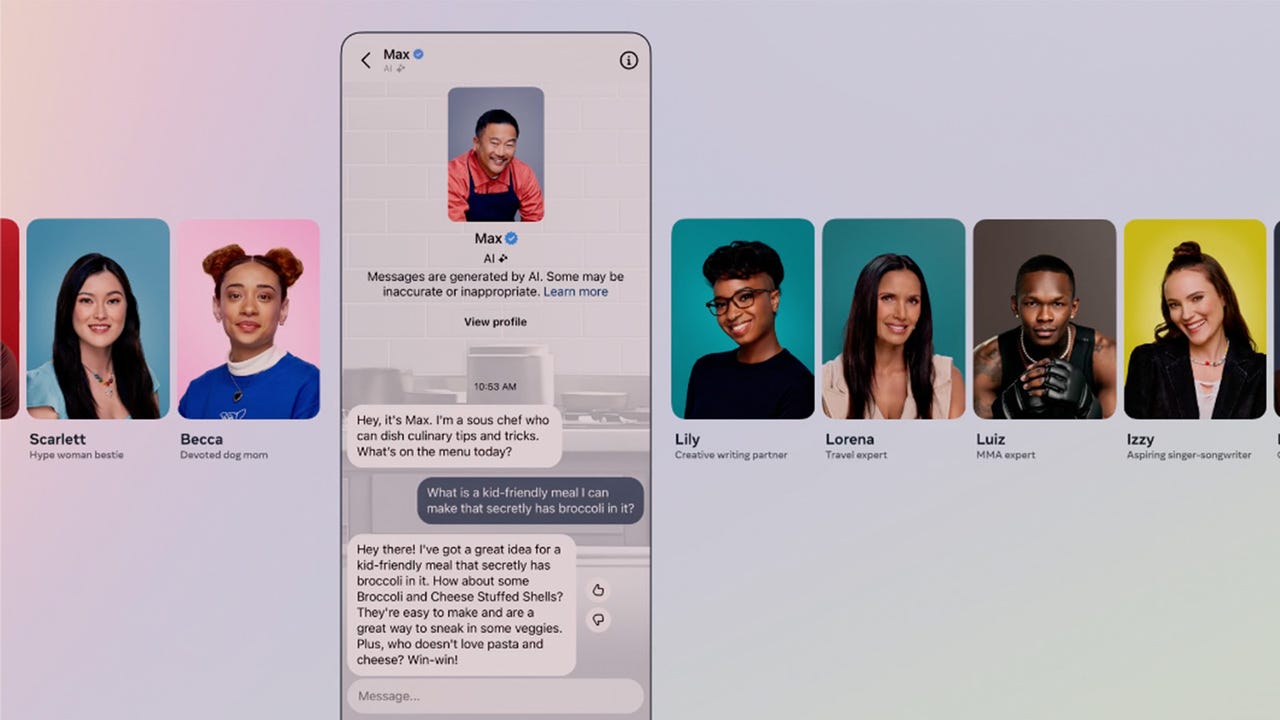
Although the build-your-own aspect is not yet available, Meta for now has created several fun chatbots that users can begin using today The AI chatbots represent different personas and personalities that can help with specific tasks. For example, a user can chat with a sous chef, an editor, or a physical trainer to seek cooking, writing, and fitness advice, respectively.
To make the AI chatbots more appealing, the company will allow users to chat with characters played by famous celebrities, too, starting with a beta release today.
For example, if a user wants to stay in shape, they can chat with Victor, played by former pro basketball player Dwyane Wade, who can create workout plans and encourage them to meet their fitness goals.
Other celebrities featured in these models include Snoop Dogg, Tom Brady, Naomi Osaka, LaurDIY, Chris Paul, Paris Hilton, Kendall Jenner, and MrBeast.
Although these interactive AIs don't have access to real-time information like the new Meta AI platform, they serve the purpose of making users actually want to use and interact with AIs through familiar and inviting personas and characters. Who wouldn't want to have an intimate conversation with Snoop Dogg?
Also: Meta uses your Facebook data to train its AI. Here's how to opt out (sort of)
These chatbots will be available across all of Meta's chat platforms, including Instagram, WhatsApp, and Messenger. Meta warns that these AIs will have limited databases for now, meaning some of the responses can be dated and, therefore, inaccurate.
The Meta Quest 3 mixed reality headset will be released on October 10, the company’s CEO Mark Zuckerberg announced during today’s Meta Connect presentation. In addition, Meta showed a group of AI chatbots, the work platform Meta Quest for Business, and the second generation of its Ray-Ban smartglasses.
Jump to:
Meta Quest 3 will start at $499
Meta Quest for Business interoperates with Microsoft 365
Meta rolls out chatbots and AI image generator
Second generation of Ray-Ban Meta smartglasses announced
Meta Quest 3 will start at $499
The Meta Quest 3 mixed reality headset (Figure A), first announced in June, will be released on October 10 in all countries in which the Meta Quest series is currently supported. Purchasers will be able to choose between two models: a previously announced $499 128 GB model and a 512 GB model for $649.
Figure A
The Meta Quest 3 headset. Image: Meta
The display has 2064×2208 resolution per eye, achieved with pancake lenses (so called because of their three polarization-film stacks) and high-fidelity color Passthrough, which enables users to see the real and virtual worlds at the same time. Meta said this resolution is a nearly 30% improvement over Meta Quest 2. Meta Quest 3 runs on a second generation Qualcomm Snapdragon XR2 (Figure B) and can be controlled using either hand gestures or the controllers.
Figure B
The Qualcomm Snapdragon XR2 placed within the Meta Quest 3. Image: Meta
Machine learning and what Meta calls “spatial understanding,” with two cameras and depth sensors, move Meta Quest 3 one step further in the company’s goal of blurring the physical and digital worlds, allowing users to interact with surfaces in the real world and see images overlaid on their physical surroundings.
Augments, digital objects that can be viewed through the headset and pinned in a physical location, will persist in place. For example, one could place a digital photograph on the wall of a room, walk out of that room and return to the room to view the photograph in the same place later.
Main competitors to Meta Quest and market analysis
Meta Quest, previously known as Oculus Quest, competes with Apple’s upcoming and much pricier Vision Pro AR headset, as well as HTC’s Vive headsets.
Meta’s Reality Labs unit, which handles virtual and mixed reality hardware and software, has lost $21 billion since the beginning of 2022, according to a 2023 earnings report cited by CNBC.
“The metaverse is a marathon, not a sprint. It’s too early to say which investments (and by whom) are paying off,” said Tuong H. Nguyen, director analyst at Gartner, in an email to TechRepublic. “One thing I can say with much more certainty is the trend of the metaverse will disrupt the industry; potentially displacing some of the tech giants of the current era while introducing new ones.”
Meta Quest for Business interoperates with Microsoft 365
Launching next month is the Meta Quest for Business platform, which aims to bring mixed reality to organizations at scale. It includes device management and admin controls for Meta Quest products. Meta expects Meta Quest for Business will be able to work with Microsoft 365 and other productivity apps by the end of the year.
Meta Quest for Business will be available in October in the U.S., Canada, the U.K. and Japan.
Meta rolls out AI chatbots and AI art generator
Zuckerberg said during the Meta Connect presentation, “We don’t think there’s going to be one singular superintelligence everyone interacts with. People are going to want to interact with a lot of different AIs for different things they want to do.”
SEE: Meta has an in-house large language model: Llama 2 (TechRepublic)
AI chatbots
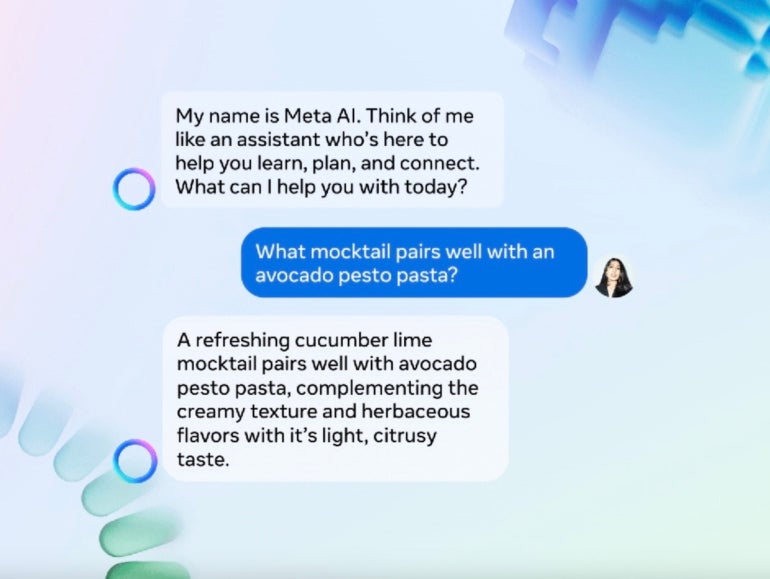
As such, Meta built several generative AI chatbots, creating “personalities” that can interact on Facebook, Instagram and in mixed reality. For example, the Meta AI chatbot (Figure C) is built on Llama 2 and enhanced by Microsoft’s Bing Search, so it can refer to current events that appear on the search engine. Other AI chatbot personas are customized to cooking, workouts, travel and other leisure activities.
Figure C
A demonstration of the Meta AI chatbot persona. Image: Meta
The personas are part of Meta’s effort to appeal to a younger audience, according to internal documents obtained by The Wall Street Journal.
This array of AI chatbots is rolling out in beta today and over the next few days.
AI Studio
People can build their own AI chatbot in AI Studio, which has been released to a small number of businesses in alpha today. It will be available for developers to explore using Meta’s APIs in the coming weeks, starting on Messenger and expanding to WhatsApp.
Emu art generator
An AI art generator called Emu for “expressive media universe” will be applied to stickers in WhatsApp, Messenger, Instagram, and Facebook Stories in order to create custom stickers within seconds.
Emu will roll out gradually over the next month. Plus, AI editing tools based on Emu will appear within Instagram in about a month, Zuckerberg said.
Second generation of Ray-Ban Meta smartglasses announced
The second generation of the Ray-Ban Meta partnership, which puts a camera and audio support into the smartglasses, will be on sale October 17 and start at $299. The Ray-Bans will include the Meta AI chatbot.
Starting next year, a software update will make the smartglasses multimodal, so the AI chatbot can interpret and react to images picked up by the camera. Live streaming to Facebook or Instagram will be available from the glasses at launch.
Subscribe to the Innovation Insider Newsletter
Catch up on the latest tech innovations that are changing the world, including IoT, 5G, the latest about phones, security, smart cities, AI, robotics, and more.
Meta's new Ray-Ban Smart Glasses will be the first hardware product to integrate the company's AI bot.
During Wednesday's Meta Connect event, the company announced several new AI services that will soon be available across its different platforms, including Instagram, WhatsApp, and Messenger.
Also: Meta Quest 3 hands-on: It's all about mixed reality with the new VR headset
On top of adding AI features to its existing platforms, Meta finally entered the AI chatbot race by unveiling one of its own — Meta AI.
If you missed the live stream, ZDNET's rounded up all the major AI announcements during the hour-long keynote, plus some fun bonuses, in the list below.