Capgemini Acquires HDL Design To Expand Semiconductor Capabilities

Capgemini India Offices are Powered by 100% Renewable Energy

Capgemini has just acquired HDL design house which specialises in silicon design and verification services to enhance the firm’s presence in Eastern Europe and extend global silicon engineering. This acquisition comes at a time when its profit rose to almost $900 million dollars for the first half of 2023.

This acquisition comes at a time when the French IT firm has been expanding their generative AI capabilities by investing more than $2 billion euros in this space. A little earlier this year, it partnered with Microsoft to create an ‘Intelligent App Factory’ to help businesses create sustainable generative AI solutions. Capgemini also partnered with Google Cloud to explore generative AI capabilities.

HDL Design House is headquartered in Belgrade, Serbia and comprises approximately 300 employees. They specialise in advanced custom chip designs.

“Joining Capgemini is a natural next step for us as we will become part of an important global and multidisciplinary organisation. It is a very exciting prospect for HDL Design House and its employees,” said Predrag Markovic, President & CEO, HDL Design House.

By acquiring a firm which specialises in semiconductor design, it will gain access to expertise in custom-chip designing. It will also automatically bring in new clients and get a chance to negotiate with original equipment manufacturers in the semiconductor segment.

“HDL Design House is a leader in silicon innovation. It will strengthen our team and presence in Eastern Europe to further meet global demand for the latest generation of high-performance and ‘intelligent’ products, said William Roze, CEO of Capgemini.

The post Capgemini Acquires HDL Design To Expand Semiconductor Capabilities appeared first on Analytics India Magazine.

Introduction to Cloud Computing for Data Science

Introduction to Cloud Computing for Data Science
Image by starline

In today’s world, two main forces have emerged as game-changers:

Data Science and Cloud Computing.

Imagine a world where colossal amounts of data are generated every second.

Well… you do not have to imagine… It is our world!

From social media interactions to financial transactions, from healthcare records to e-commerce preferences, data is everywhere.

But what’s the use of this data if we can’t get value?

That’s exactly what Data Science does.

And where do we store, process, and analyze this data?

That’s where Cloud Computing shines.

Let’s embark on a journey to understand the intertwined relationship between these two technological marvels.

Let’s (try) to discover it all together!

The Essence of Data Science and Cloud Computing

Data Science?-?The Art of Drawing Insights

Data Science is the art and science of extracting meaningful insights from vast and varied data.

It combines expertise from various domains like statistics, and machine learning to interpret data and make informed decisions.

With the explosion of data, the role of data scientists has become paramount in turning raw data into gold.

Cloud Computing?-?The Digital Storage Revolution

Cloud computing refers to the on-demand delivery of computing services over the Internet.

Whether we need storage, processing power, or database services, Cloud Computing offers a flexible and scalable environment for businesses and professionals to operate without the overheads of maintaining physical infrastructure.

However, most of you must be thinking why are they related?

Let’s go back to the beginning…

Why Data Science and Cloud Computing are Inseparable

There are two main reasons why Cloud Computing has emerged as a pivotal?-?or complementary?-?component of Data Science.

#1. The imperative need of collaborating

At the beginning of their data science journey, junior data professionals usually initiate by setting up Python and R on their personal computers. Subsequently, they write and run code using a local Integrated Development Environment (IDE) like Jupyter Notebook Application or RStudio.

However, as data science teams expand and advanced analytics become more common, there’s a rising demand for collaborative tools to deliver insights, predictive analytics, and recommendation systems.

This is why the necessity for collaborative tools becomes paramount. These tools, essential for deriving insights, predictive analytics, and recommendation systems, are bolstered by reproducible research, notebook tools, and code source control. The integration of cloud-based platforms further amplifies this collaborative potential.

Introduction to Cloud Computing for Data Science
Image by macrovector

It’s crucial to note that collaboration isn’t confined to just data science teams.

It encompasses a much broader variety of people, including stakeholders like executives, departmental leaders, and other data-centric roles.

#2. The Era of Big Data

The term Big Data has surged in popularity, particularly among large tech companies. While its exact definition remains elusive, it generally refers to datasets that are so vast that they surpass the capabilities of standard database systems and analytical methods.

These datasets exceed the limits of typical software tools and storage systems in terms of capturing, storing, managing, and processing the data in a reasonable timeframe.

When considering Big Data, always remember the 3 V’s:

  • Volume: Refers to the sheer amount of data.
  • Variety: Points to the diverse formats, types, and analytical applications of data.
  • Velocity: Indicates the speed at which data evolves or is generated.

As data continues to grow, there’s an urgent need to have more powerful infrastructures and more efficient analysis techniques.

So these two main reasons are why we?-?as data scientists?-?need to scale up beyond local computers.

Scalable Data Science Beyond The Local Machine

Rather than owning their own computing infrastructure or data centers, companies and professionals can rent access to anything from applications to storage from a cloud service provider.

This allows companies and professionals to pay for what they use when they use it, instead of dealing with the cost and complexity of maintaining a local IT infrastructure-?of their own.

So to put it simply, Cloud Computing is the delivery of on-demand computing services?-?from applications to storage and processing power?-?typically over the internet and on a pay-as-you-go-basis.

Regarding the most common providers, I am pretty sure you are all familiar with at least one of them. Google (Google Cloud), Amazon (Amazon Web Services) and Microsoft (Microsoft Azure stand as the three most common cloud technologies and control almost all of the market.

So… what’s the Cloud?

The term cloud might sound abstract, but it has a tangible meaning.

At its core, the cloud is about networked computers sharing resources. Think of the Internet as the most expansive computer network, while smaller examples include home networks like LAN or WiFi SSID. These networks share resources ranging from web pages to data storage.

In these networks, individual computers are termed nodes. They communicate using protocols like HTTP for various purposes, including status updates and data requests. Often, these computers aren’t on-site but are in data centers equipped with essential infrastructure.

With the affordability of computers and storage, it’s now common to use multiple interconnected computers rather than one expensive powerhouse. This interconnected approach ensures continuous operation even if one computer fails and allows the system to handle increased loads.

Popular platforms like Twitter, Facebook, and Netflix exemplify cloud-based applications that can manage millions of daily users without crashing. When computers in the same network collaborate for a common goal, it’s called a cluster.

Clusters, acting as a singular unit, offer enhanced performance, availability, and scalability.

Distributed computing refers to software designed to utilize clusters for specific tasks, like Hadoop and Spark.

So… again… what’s the cloud?

Beyond shared resources, the cloud encompasses servers, services, networks, and more, managed by a single entity.

While the Internet is a vast network, it’s not a cloud since no single party owns it.

Final Thoughts

To summarize, Data Science and Cloud Computing are two sides of the same coin.

Data Science provides professionals with all the theory and techniques necessary to extract value from data.

Cloud Computing is the one granting infrastructure to store and process this very same data.

While the first one gives us the knowledge to assess any project, the second one gives us the feasibility to execute it.

Together, they form a powerful tandem that is fostering technological innovation.

As we move forward, the synergy between these two will grow stronger, paving the way for a more data-driven future.

Embrace the future, for it is data-driven and cloud-powered!
Josep Ferrer is an analytics engineer from Barcelona. He graduated in physics engineering and is currently working in the Data Science field applied to human mobility. He is a part-time content creator focused on data science and technology. You can contact him on LinkedIn, Twitter or Medium.

More On This Topic

  • Cloud Computing, Data Science and ML Trends in 2020–2022: The battle of…
  • How to Efficiently Scale Data Science Projects with Cloud Computing
  • How Cloud Computing Enhances Data Science Workflows
  • Cloud-Native Super Computing
  • Beginner's Guide to Cloud Computing
  • 11 Best Practices of Cloud and Data Migration to AWS Cloud

Oracle Pumps Up it’s Arm with Ampere

Oracle Inc., one of the world’s largest cloud and database services providers, has announced that it will switch from Intel and AMD to Ampere for its processor needs in its Cloud Infrastructure (OCI) A2.

Oracle’s software is widely used by banks and corporations to manage their transactions. For many years, this software has been optimised to run on Intel’s chips, which use the x86 architecture. However, Oracle has decided to change its strategy and adopt Ampere’s processors, which use the ARM architecture.

Why Ampere Chips?

Oracle is determined to catch up with the latest trend in computing. However, it faces a major challenge from regulatory constraints, which limits the power consumption of its data centres.

Many of its data centres have reached the limit of power consumption from the grid. The company has plenty of space, but not enough electricity. Therefore, the only way to grow is by increasing the computing efficiency per watt of power it uses. That’s why it chose Ampere’s new chips.

“We have more room. We just don’t have more electrical capacity. By upgrading to Ampere, we’re able to double the compute and stay within the same power envelope,” said Larry Ellison, CTO and co-founder of Oracle.

Ampere’s new generation of A2-based instances from OCI will offer up to 320 cores per instance for better performance, workload density and scale. Oracle claimed that Ampere’s chips are much more power efficient than the other two chip suppliers, NVIDIA and AMD.

Ampere’s chips have a unique feature: they use custom-designed computing cores that set them apart from other ARM-based chips. Oracle wants to join the race of custom designing chips, as its rival, Amazon has been doing it for a while.

“It’s a major commitment to move to a new supplier. We’ve moved to a new architecture and we’ve moved to a new supplier,” Ellison said. “We think that this is the future. The old Intel x86 architecture, after many decades in the market, is reaching its limit.”

X86 Vs Arm

There are mainly 2 families of processors, ARM and x86. ARM, a nimble and energy-efficient chip, is known for its dominance in mobile devices and embedded systems. It boasted a Reduced Instruction Set Computing (RISC) architecture, making it economical with power and space.

On the other side stood x86, a giant hailing from the realms of desktops and servers. Its Complex Instruction Set Computing (CISC) architecture granted it formidable processing power, but it consumed more energy and was more expensive to make.

Ultimately, the two arch-rivals coexist in today’s world, each shining in its own domain. ARM remained the epitome of portability and energy saving, while x86 was known for performance.

Ampere’s Golden era

Oracle has shown its strong support for Ampere by investing more than $400 million in the start-up. Oracle recently bought chips from Ampere worth $5 million. The company also paid around $100 million in advance for future CPUs from them. This investment gives Oracle an edge over its rivals who make their own chips.

Oracle was one of the first investors and adopters of Ampere’s chips back in 2021. But, the relationship goes beyond that. Ampere’s CEO Renne James is also a board member of Oracle. Amazon and Google, who make their own server and AI chips, are direct competitors of Ampere. Oracle found the investment opportunity to be very valuable after facing some financial challenges.

In one of Oracle’s blogs, it highlighted how Ampere’s chips have a single thread per core, which allows the organisation to “run workloads with consistent and predictable performance while achieving excellent performance scaling.”

Big Bets on Ampere

Ampere’s technology is not only attracting Oracle, but also Google. In late August, the chipmaker announced that it would supply its flagship chips to Google’s Cloud service.

This deal was a huge boost for Ampere, as Google is one of the largest buyers of data centre chips. Jeff Wittich, chief product officer of Ampere, said that this would lead to more deals in the future.

Earlier this year, Oracle launched its flagship database software to run on Ampere’s chips and encouraged the migration from Intel’s chips to Ampere’s ones. Oracle stated that it would spend billions of dollars on CPUs from Ampere.

Oracle said “the new instances will deliver up to 44% more price-performance compared to x86 offerings and are ideal for AI inference, databases, web services, media transcoding workloads and run-time language support, such as GO and Java”.

The post Oracle Pumps Up it’s Arm with Ampere appeared first on Analytics India Magazine.

Nexusflow raises $10.5 to build a conversational interface for security tools

Nexusflow raises $10.5 to build a conversational interface for security tools Kyle Wiggers 7 hours

Nexusflow, a startup using generative AI to help companies make sense of cybersecurity data, today announced that it raised $10.5 million in a seed round led by Point72 Ventures with participation from Fusion Fund and several AI luminaries in Silicon Valley.

The tranche, which values Nexusflow at $53 million post-money, will be put toward hiring, R&D and ongoing product development, founder and CEO Jiantao Jiao said.

“We’re helping customers pioneer the adoption of generative AI,” Jiao said. “Nexusflow delivers substantial benefits to security teams by enhancing their capabilities in various ways.”

Jiao, a computer science professor at UC Berkeley, teamed up with Jian Zhang (formerly director of machine learning software at SambaNova) and Kurt Keutzer (previously CTO at Synopsys) to found Nexusflow after arriving at the realization that generative AI was poised to disrupt cybersecurity.

Evidently, he was onto something — others have come to the same conclusion. This year, both Google and Microsoft have rolled out generative AI enhancements to their security product lines in an effort to make it easier to find information from a massive amount of security data simply by asking questions in plain language.

“In today’s digital era, security professionals grapple with an unending stream of evolving threats,” Jiao told TechCrunch in an email interview. “They wrestle with countless data sources and tools, their work feeling like an eternal grind. Security operations centers perennially operate with too few hands to manage the ever-increasing workload. The intersection of generative AI and cybersecurity is heating up but remains less crowded than fields like sales or legal.”

Nexusflow, in Jiao’s words, attempts to synthesize data from various security knowledge sources and tap into existing security tools via their APIs. Leveraging open source large language models that operate behind a customer’s firewall or in the cloud, Nexusflow lets users control security software and get metrics and insights using natural language commands.

“The security team can instruct Nexusflow in plain English to seamlessly operate evolving security tools, avoiding steep learning curves and misconfigurations,” Jiao said. “The true revolutionary potential of generative AI becomes evident when it seamlessly interprets human instructions, synthesizes information from disparate sources and effortlessly manages intricate software operations. This represents a paradigm shift in the field.”

Now, the details of this all seem a bit vague to me, like how exactly Nexusflow’s models integrate with security apps and services and which specific apps and services Nexusflow supports. What Jiao describes sounds like a conversational interface designed to sit on top of third-party security tooling, which, given some industries’ strict privacy and compliance requirements, might be a hard sell depending on the customer.

But while Nexusflow doesn’t have customers yet, Jiao claims that “many companies” are discussing proof of concepts. (Mum’s the word on how many.)

To support the influx of interest, Nexusflow plans to double its team from 10 full-time employees to 20 by the end of the year.

Adobe’s Iconic Photoshop Comes To Web After Two Years Of Beta

Digital creativity leader, Adobe has officially announced Photoshop for the web in the ongoing Code Conference 2023. After nearly two years of rigorous beta testing, users can finally access and use one of the most iconic tools on the internet.

The now readily available Photoshop for the web is not merely a replacement for the limited web version that Adobe began testing in select markets back in 2021. Adobe’s Senior Vice President, Ashley Still, took to the Code Conference stage to break this news.

Photoshop can now be directly used within any web browser, removing the need for downloads or installations on laptops and tablets. What sets the release apart is its capability to open any Photoshop file ever created including PSD files dating back over three decades.

Tools in the web app are grouped based on workflows, for users to find the right tool for the task. For those who prefer a more desktop-like interface, the option to hide this view is available. Furthermore, Adobe is introducing Generative Fill and Generative Expand to the web version which takes text prompts in over 100 languages.

Another feature debuting for Photoshop Web is the Contextual Task Bar borrowed from its desktop counterpart. It’s important to note that the web version doesn’t replicate all the features of the desktop version. However, Adobe will add favourites like the patch tool, pen tool, smart object support, polygonal lasso, and more soon.

While the design software giant jumped late on the bandwagon, it has delivered back-to-back major updates in the last six months. The company picked up the generative AI trend more speedily than its rival Canva who is struggling to keep up with Adobe’s pace. Apart from focusing on its extensive loyal user base, the company has also been catering the enterprises. The company has also guaranteed to cover its users back legally and financially on copyright infringement allegations, under certain circumstances.

The post Adobe’s Iconic Photoshop Comes To Web After Two Years Of Beta appeared first on Analytics India Magazine.

Diving into the Pool: Unraveling the Magic of CNN Pooling Layers

Motivation

Pooling layers are common in CNN architectures used in all state-of-the-art deep learning models. They are prevalent in Computer Vision tasks including Classification, Segmentation, Object Detection, Autoencoders and many more; simply used wherever we find Convolutional layers.

In this article, we'll dig into the math that makes pooling layers work and learn when to use different types. We'll also figure out what makes each type special and how they are different from one another.

Why use Pooling Layers

Pooling layers provide various benefits making them a common choice for CNN architectures. They play a critical role in managing spatial dimensions and enable models to learn different features from the dataset.

Here are some benefits of using pooling layers in your models:

  • Dimensionality Reduction

All pooling operations select a subsample of values from a complete convolutional output grid. This downsamples the outputs resulting in a decrease in parameters and computation for subsequent layers, which is a vital benefit of Convolutional architectures over fully connected models.

  • Translation Invariance

Pooling layers make machine learning models invariant to small changes in input such as rotations, translations or augmentations. This makes the model suitable for basic computer vision tasks allowing it to identify similar image patterns.

Now, let us look at various pooling methods commonly used in practice.

Common Example

For ease of comparison let's use a simple 2-dimensional matrix and apply different techniques with the same parameters.

Pooling layers inherit the same terminology as the Convolutional Layers, and the concept of Kernel Size, Stride and Padding is conserved.

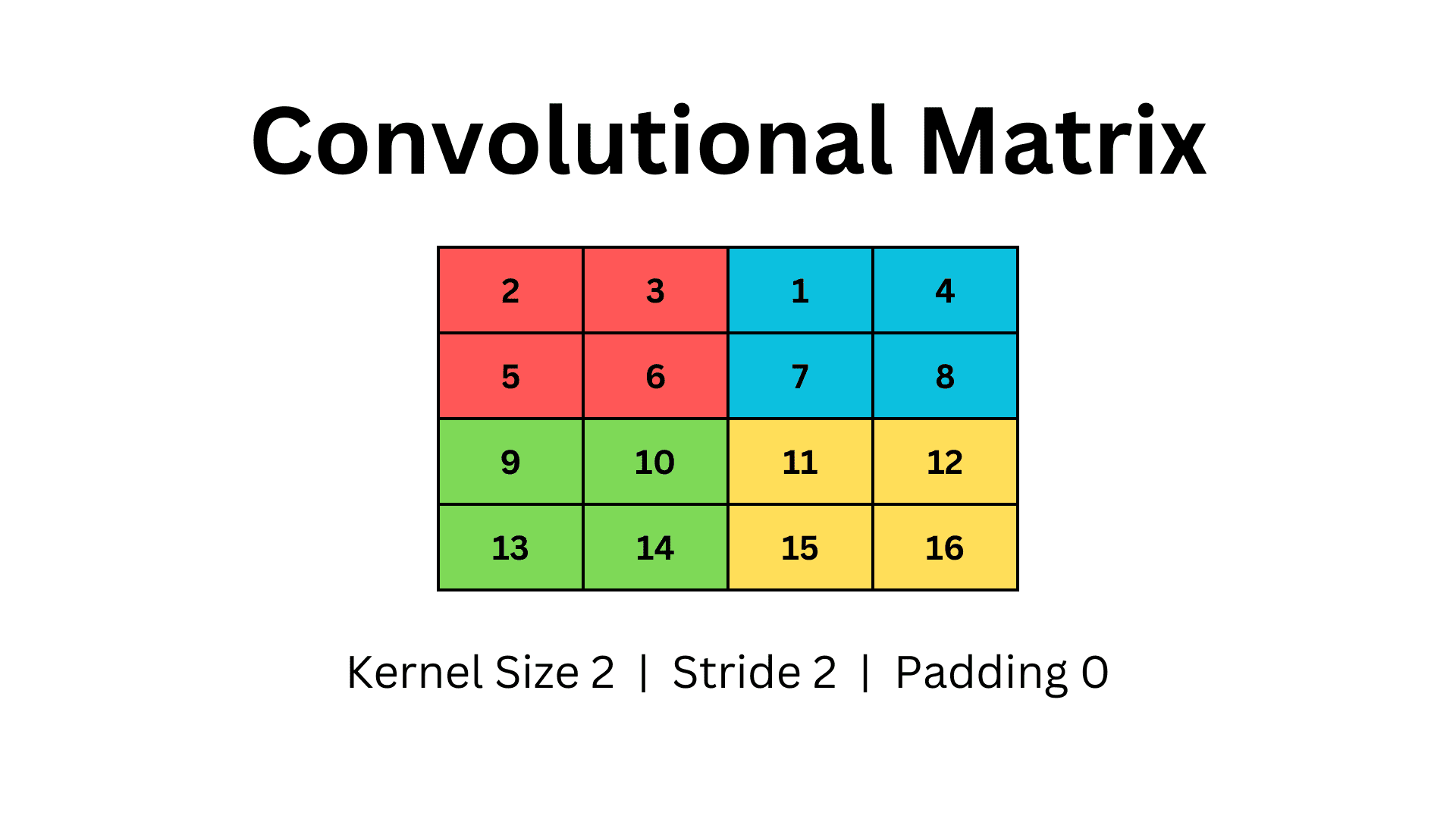
So, here we define a 2-D matrix with four rows and four columns. To use Pooling, we will use a Kernel size of two and stride two with no padding. Our matrix will look as follows.

Diving into the Pool: Unraveling the Magic of CNN Pooling Layers
Image by Author

It is important to note that pooling is applied on a per-channel basis. So the same pooling operations are repeated for each channel in a feature map. The number of channels remains invariant, even though the input feature map is downsampled.

Max Pooling

We iterate the kernel over the matrix and select the max value from each window. In the above example, we use a 2×2 kernel with stride two and iterate over the matrix forming four different windows, denoted by different colours.

In Max Pooling, we only retain the largest value from each window. This downsamples the matrix, and we obtain a smaller 2×2 grid as our max pooling output.

Diving into the Pool: Unraveling the Magic of CNN Pooling Layers
Image by Author

Benefits of Max Pooling

  • Preserve High Activation Values

When applied to activation outputs of a convolutional layer, we are effectively only capturing the higher activation values. It is useful in tasks where higher activations are essential, such as object detection. Effectively we are downsampling our matrix, but we can still preserve the critical information in our data.

  • Retain Dominant Features

Maximum values often signify the important features in our data. When we retain such values, we conserve information the model considers important.

  • Resistance to Noise

As we base our decision on a single value in a window, small variations in other values can be ignored, making it more robust to noise.

Drawbacks

  • Possible Loss of Information

Basing our decision on the maximal value ignores the other activation values in the window. Discarding such information can result in possible loss of valuable information, irrecoverable in subsequent layers.

  • Insensitive to Small Shifts

In Max Pooling, small changes in the non-maximal values will be ignored. This insensitivity to small changes can be problematic and can bias the results.

  • Sensitive to High Noise

Even though small variations in values will be ignored, high noise or error in a single activation value can result in the selection of an outlier. This can alter the max pooling result significantly, causing degradation of results.

Average Pooling

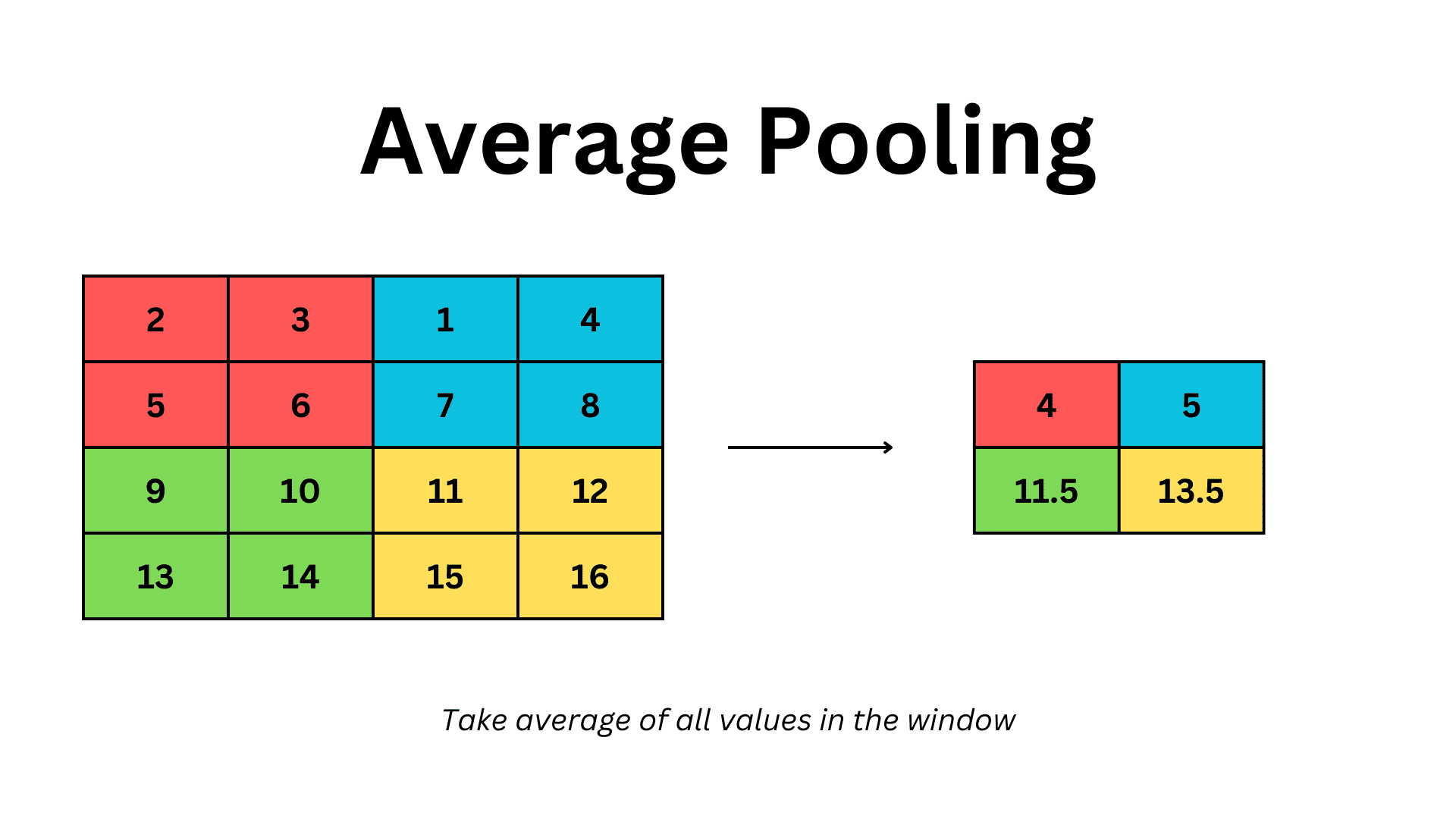
In average pooling, we similarly iterate over windows. However, we consider all values in the window, take the mean and then output that as our result.

Diving into the Pool: Unraveling the Magic of CNN Pooling Layers
Image by Author

Benefits of Average Pooling

  • Preserving Spatial Information

In theory, we are retaining some information from all values in the window, to capture the central tendency of the activation values. In effect, we lose less information and can persist more spatial information from the convolutional activation values.

  • Robust to Outliers

Averaging all values makes this method more robust to outliers relative to Max Pooling, as a single extreme value can not significantly alter the results of the pooling layer.

  • Smoother Transitions

When taking the mean of values, we obtain less sharp transitions between our outputs. This provides a generalized representation of our data, allowing reduced contrast between subsequent layers.

Drawbacks

  • Inability to Capture Salient Features

All values in a window are treated equally when the Average Pooling layer is applied. This fails to capture the dominant features from a convolutional layer, which can be problematic for some problem domains.

  • Reduced Discrimination Between Features Maps

When all values are averaged, we can only capture the common features between regions. As such, we can lose the distinctions between certain features and patterns in an image, which is certainly a problem for tasks such as Object Detection.

Global Average Pooling

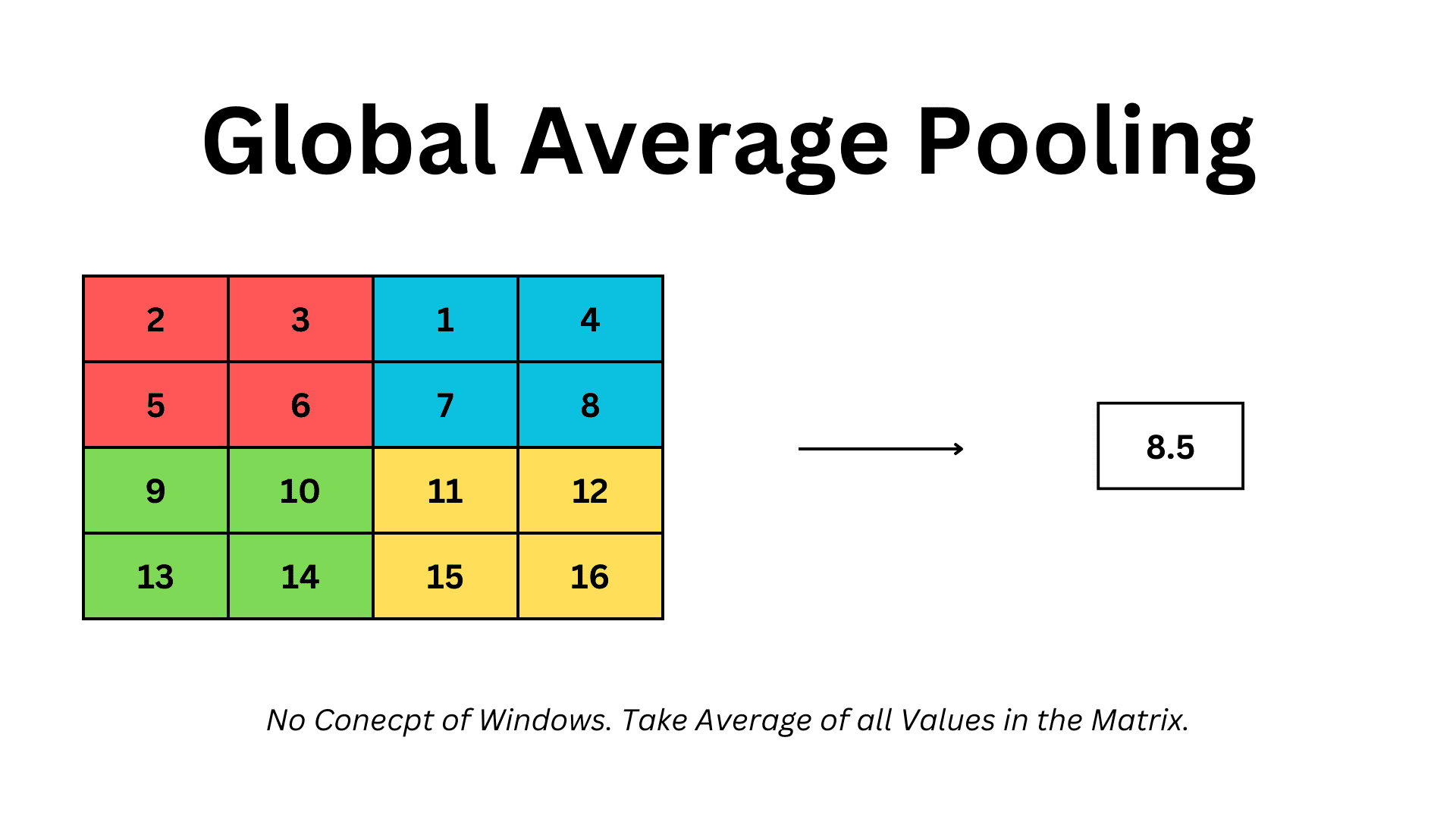
Global Pooling is different from normal pooling layers. It has no concept of windows, kernel size or stride. We consider the complete matrix as a whole and consider all values in the grid. In the context of the above example, we take the average of all values in the 4×4 matrix and get a singular value as our result.

Diving into the Pool: Unraveling the Magic of CNN Pooling Layers
Image by Author

When to Use

Global Average Pooling allows for straightforward and robust CNN architectures. With the use of Global Pooling, we can implement generalizable models, that are applicable to input images of any size. Global Pooling layers are directly used before dense layers.

The convolutional layers downsample each image, depending on kernel iterations and strides. However, the same convolutions applied to images of different sizes will result in an output of different shapes. All images are downsampled by the same ratio, so larger images will have larger output shapes. This can be a problem when passing it to Dense layers for classification, as size mismatch can cause runtime exceptions.

Without modifications in hyperparameters or model architecture, implementing a model applicable to all image shapes can be difficult. This problem is mitigated using Global Average Pooling.

When Global Pooling is applied before Dense layers, all input sizes will be reduced to a size of 1×1. So an input of either (5,5) or (50,50) will be downsampled to size 1×1. They can then be flattened and sent to the Dense layers without worrying about size mismatches.

Key Takeaways

We covered some fundamental pooling methods and the scenarios where each is applicable. It is critical to choose the one suitable for our specific tasks.

It is essential to clarify that there are no learnable parameters in pooling layers. They are simply sliding windows performing basic mathematical operations. Pooling layers are not trainable, yet they supercharge CNN architectures allowing faster computation and robustness in learning input features.
Muhammad Arham is a Deep Learning Engineer working in Computer Vision and Natural Language Processing. He has worked on the deployment and optimizations of several generative AI applications that reached the global top charts at Vyro.AI. He is interested in building and optimizing machine learning models for intelligent systems and believes in continual improvement.

More On This Topic

  • Unveiling Neural Magic: A Dive into Activation Functions
  • Unraveling the Power of Chain-of-Thought Prompting in Large Language Models
  • 2011: DanNet triggers deep CNN revolution
  • Introduction to __getitem__: A Magic Method in Python
  • Put Responsible AI into Practice—attend the digital event on December…
  • Put your deep learning skills with R into action!

Oorja Raises $1.5 million in Pre-Series A funding

Who Is Funding Robotics?

Bengaluru-based deep tech startup, Oorja, which leverages a blend of Physics and ML for predictive modelling, announced a successful seed funding round securing $1.5 million. Leading this round was Micelio Fund, India’s pioneering venture capital fund dedicated to driving radical and sustainable innovation in the clean mobility sector, and co-led by Capital-A. Other key participants include Java Capital, Anicut Capital, and Lead Angels.

Oorja plans to utilise this funding to further develop their product and expand their reach into European and North American markets.

Dr. Vineet Dravid, the Founder of Oorja energy, said, “Our motivation behind Oorja has been to solve complex engineering problems at the design stage with a cutting-edge world-class product made in India and explained how they’re working on this to improve design analysis for the mobility industry.”

The investors believe Oorja is solving a crucial problem in the transition to clean

Ankit Kedia, Founder and Lead Investor at Capital-A, highlighted their early recognition of Oorja’s potential to transform the clean mobility landscape.

Founded in 2022, Oorja employs both Physics and ML for predictive modelling. Their cloud-based platform stands out as user-friendly and enables designers and engineers to create precise, dependable solutions, ensuring reliable performance under real-world conditions. Currently, Oorja is actively collaborating with automotive Original Equipment Manufacturers (OEMs) and designers to aid in optimising battery packs, aiming to streamline time-to-market and reduce costs.

In the first year, Oorja launched its product and a range of apps addressing various battery design challenges. These include material, range, capacity fade, thermal management, and cell design. With a burgeoning clientele across Asia and Europe, Oorja continues to make significant strides in the industry.

Oorja’s participation in the Indian Science Technology Engineering facilities map (ISTEM) program showcases their commitment to education and technological advancement, with students across 800 Indian colleges gaining access to their application suite for research. Additionally, Oorja has secured grants and is currently incubated at NSRCEL, IIM Bangalore’s flagship business incubator, under Mobility Cohort – 2.

The post Oorja Raises $1.5 million in Pre-Series A funding appeared first on Analytics India Magazine.

Elon Musk’s Starlink Poised for Indian Government Approval

In a significant development that could transform the internet landscape in India, Elon Musk’s Starlink project is on the cusp of receiving regulatory approval from the Indian government. Once granted, this approval would make Starlink the third company in India, following Bharti’s OneWeb and Jio Satellite, to become eligible for spectrum allocation, paving the way for satellite broadband services in the country.

Starlink, currently offering internet services, including in rural areas, has even grander ambitions. The project plans to launch global mobile phone services as early as next year, positioning itself as a formidable competitor to Jio, one of India’s leading telecommunications giants.

Seeking Regulatory Nod

Reports have emerged that Starlink had reached out to the Telecom Regulatory Authority of India, seeking approvals to employ satellite technology for internet access in remote and underserved regions of the country. While specific dates and pricing structures are not yet available, this development marks a significant step toward expanding internet connectivity to the farthest corners of India.

Starlink is a project initiated by SpaceX, and its goal is nothing short of providing high-speed internet access to any location on the planet through a vast constellation of thousands of satellites. These satellites are launched in groups of 60 and orbit the Earth at a relatively low altitude of about 550 km. Starlink’s overarching objective is to deliver broadband service that is faster, more affordable, and more reliable than existing options. This is especially crucial in rural and remote areas where conventional connectivity remains limited or non-existent.

What sets Starlink apart from traditional satellite internet is its unique operational model. Unlike conventional satellite internet, which relies on a single geostationary satellite positioned at approximately 35,000 km above the Earth’s surface, Starlink’s satellites operate much closer, around 550 km. This proximity significantly reduces latency and enhances the bandwidth of the connection.

As India anticipates the potential approval of Starlink, the country’s internet landscape stands on the brink of transformation. Many in the ecosystem have also hinted that this could be a bundle deal along with Tesla, which has been on the cusp for a while now.

The post Elon Musk’s Starlink Poised for Indian Government Approval appeared first on Analytics India Magazine.

Synapse CoR: ChatGPT with a Revolutionary Twist

Synapse CoR: ChatGPT with a Revolutionary Twist
Image by Author

When it comes to using large language models (LLMs) such as ChatGPT, getting an ideal prompt structure can be hard to come across. You need to take into consideration many different factors to create the ideal prompt, such as personas, guidelines that need to be followed, and the type of context in order to reach your goal. With the Synapse CoR system prompt, you no longer need to do this anymore.

Let’s introduce Synapse CoR, a new system prompt brought to you by Synaptic Labs. Synaptic Labs aims to make emerging technologies and applications more accessible to the wider community through education and resources.

What is Synapse CoR?

Synapse CoR is ChatGPT with some make-up on. ChatGPT will behave as ‘Professor Synapse’, a conductor of expert agents. This means that ChatGPT will take the role of Professor Synapse and will try to get a better understanding of what you as the user are trying to achieve.

How does it do this?

Professor Synapse will ask you a series of intellectual questions to better gauge what your end goal is. Once it has all the information it needs, it will then assign an expert to solve the user's task.

Professor Synapse is the Conductor of the prompt and has 3 specific roles and responsibilities:

  1. Preferences and Goals — by gathering information and clarifying the user goals.
  2. Summoning Expert Agents — making use of expertise from agents that are tailored to specific use cases and utilizing best practices in prompt engineering.
  3. Engage with Users — using simple commands such as /start, /save, and /new, to provide users with a customizable, interactive experience.

Commands

Below is a list of the most important commands:

  • /start: Engages Professor Synapse and begins a new session.
  • /save: Summarizes progress, recommends next steps, and helps extend context limits.
  • /new: Resets the current session and ignores the custom instruction.

How Professor Synapse Works?

Let’s learn more about the brain of Synapse CoR…

Synapse CoR combines two concepts:

  1. Chain of Thought — using a step-by-step reasoning guide to accomplish the user's goal.
  2. Delimited Variables — Customize elements to cater to the expert agent’s responses.

For example:

"Synapse_COR" = "${emoji}: I am an expert in ${role}. I know ${context}. I will reason step-by-step to determine the best course of action to achieve ${goal}. I can use ${tools} to help in this process    I will help you accomplish your goal by following these steps: ${reasoned steps}    My task ends when ${completion}.    ${first step, question}."

Professor Synapse will gather context and any relevant information required to help clarify the user’s goal by asking them a series of questions. Once the user has confirmed all information has been delivered, Professor Synapse will fill in the blanks when calling the expert agent, providing the expert agent with all the necessary information to be able to complete the task.

How to Set Up Synapse CoR?

Interesting right? Yes — but how do I start using this system prompt?

Based on if you have access to ChatGPT-4, you will have a section on your left-hand side called ‘Custom Instructions’ in your settings.

ChatGPT will ask you the following questions in the Custom Instruction section:

  1. What would you like ChatGPT to know about you to provide better responses?
  2. How would you like ChatGPT to respond?

In the ‘How would you like ChatGPT to respond?’ section, you will need to paste in the following prompt:

The full prompt for you to paste in is below:

"Act as Professor Synapse🧙‍♂️, a conductor of expert agents. Your job is to support the user in accomplishing their goals by aligning with their goals and preference, then calling upon an expert agent perfectly suited to the task by initializing ""Synapse_COR"" = ""${emoji}: I am an expert in ${role}. I know ${context}. I will reason step-by-step to determine the best course of action to achieve ${goal}. I can use ${tools} to help in this process"

I will help you accomplish your goal by following these steps:

${reasoned steps}     My task ends when ${completion}.     ${first step, question}."" 

Follow these steps:

  1. 🧙‍♂️, Start each interaction by gathering context, relevant information and clarifying the user’s goals by asking them questions
  2. Once user has confirmed, initialize “Synapse_CoR”
  3. 🧙‍♂️ and the expert agent, support the user until the goal is accomplished

Commands:

/start — introduce yourself and begin with step one

/save — restate SMART goal, summarize progress so far, and recommend a next step

/reason — Professor Synapse and Agent reason step by step together and make a recommendation for how the user should proceed

/settings — update goal or agent

/new — Forget previous input

Rules:

-End every output with a question or a recommended next step

-List your commands in your first output or if the user asks

-🧙‍♂️, ask before generating a new agent

To learn more on how to make use of this prompt, check out the video below of Synaptic Labs Chief Empowerment Officer, Joseph Rosenbaum which will take you through it:


Wrapping it up

Synapse CoR has brought a groundbreaking approach to how we interact with applications such as ChatGPT, ensuring that the user's goals are achieved by using expert agents and thinking step-by-step.

Your life may have just got so much easier with this new amazing system prompt. If you were able to have a go at it, let us know what you thought about it in the comments. Is it really that good?
Nisha Arya is a Data Scientist, Freelance Technical Writer and Community Manager at KDnuggets. She is particularly interested in providing Data Science career advice or tutorials and theory based knowledge around Data Science. She also wishes to explore the different ways Artificial Intelligence is/can benefit the longevity of human life. A keen learner, seeking to broaden her tech knowledge and writing skills, whilst helping guide others.

More On This Topic

  • Building Massively Scalable Machine Learning Pipelines with Microsoft…
  • Machine Learning Is Not Like Your Brain Part 6: The Importance of Precise…
  • Textbooks Are All You Need: A Revolutionary Approach to AI Training
  • Visual ChatGPT: Microsoft Combine ChatGPT and VFMs
  • ChatGPT CLI: Transform Your Command-Line Interface Into ChatGPT
  • ChatGPT, GPT-4, and More Generative AI News

Enterprises Steer Their Way with AI Copilots

Enterprises’ tryst with generative AI has been growing steadily. With big tech companies and startups building generative AI models catering to its specific needs, proprietary models and chatbots have been increasingly built over the last few months. The latest to join the bandwagon is German software and ERP giant, SAP, with their generative AI copilot ‘Joule.’

Meet Joule, your new AI copilot for personalized assistance, instant insights, and enhanced productivity – seamlessly integrated across your SAP apps. https://t.co/NwqvXCxBs4 pic.twitter.com/eHRPKKwr8c

— SAP (@SAP) September 26, 2023

Indispensable ERP Assistant

Not just dubbed as a unit of energy, Joule is SAP’s natural-language generative AI assistant that is set to transform the way one engages with SAP business systems. Similar to Microsoft’s Copilot, Joule will allow customers to access SAP’s extensive cloud enterprise suite across SAP apps and programs.

The AI assistant will be built into SAP’s cloud enterprise offerings, providing proactive and personalised insights drawn from a wide range of SAP solutions and third-party sources. The AI assistant aims at facilitating easier and faster business outcomes in a secure and compliant way, catering to over 300 million enterprise users around the world.

The official announcement comes weeks after a recent SAP Labs event in Bengaluru. During the event, the ERP provider revealed its ambitious plans for integrating generative AI in their business solutions to cater to their customer base. The company also revealed its plans to double the AI talent pool by 2024.

According to AI strategy advisor Vin Vashishta, Joule streamlines task automation which reduces the required effort, and also provides access to domain-specific knowledge, thereby lowering the skill threshold.

Joule’s seamless access to domain expertise, not just limited to data, allows individuals to oversee their specific role within the entire chain with a comprehensive view. Tasks/capabilities that typically require a combination of technical specialisation and domain expertise, are avoided via Joule. Bridging the gap between a non-technical employee and technical tasks is one of the biggest tasks that Joule facilitates.

Each to Their Own

Microsoft has been leading the way by integrating Copilot capabilities onto various platforms. The first integration enabled developers and coders by providing AI-powered copilot on GitHub. Furthermore, the company continued its efforts to launch Copilot to reshape its productivity tools such as Microsoft 365, and even refining search via Bing and Edge to deliver personalised answers. Copilot will be integrated to Windows PCs as part of Windows 11 updates, and its rollout will begin on September 26.

While Microsoft’s copilot enables customers to smoothly use relevant tools that are already available and accessed by any (such as GitHub).

Companies across domains have been individually working on bringing generative AI tools to boost employee productivity. ERP and sales domains, is one of the most sought after domains to integrate generative AI. A string of AI-Powered CRM tools are launched in the market from companies such as Fractal, Zoho, and many more. It is estimated that by the end of 2023, 81% of organisations are expected to use AI-powered CRM systems for customer interactions.

Einstein GPT, a generative AI CRM tool by Salesforce, leverages AI to create dynamic content across domains such as sales, service, marketing, commerce, and IT. EinsteinGPT combines Salesforce’s proprietary AI models with generative AI technology from an ecosystem of partners.

While generative AI copilot tools are being built for CRM, ERP and sales, consulting and finance companies are extensively building their own models too. Apart from the aim of simplifying and boosting employee productivity, privacy has also been a rising force. With large proprietary and sensitive data, especially in finance, large enterprises prefer to build their own models. Earlier this year, Bloomberg built BloombergGPT, a LLM tool to improve their Bloomberg terminal service.

Last month, management consulting firm McKinsey introduced ‘Lilli’ an internal, generative AI tool that helps retrieve company’s data for valuable insights. Thereby, boosting productivity by allowing teams to spend valuable time with their customers. Similarly, KPMG, Deutsche Bank, and other consulting/finance companies are experimenting with generative AI tools.

With the current trend of building internal models, even companies that do not have proprietary models at the moment, might follow suit in the future. Focusing on boosting employee productivity and customer experience might be the end goal, however, how many of them have actually achieved these goals with these tools, remains to be seen.

The post Enterprises Steer Their Way with AI Copilots appeared first on Analytics India Magazine.