Canonical announces the general release of Charmed MLFlow

Hand touching abstract wall

Charmed MLFlow is part of Canonical's growing MLOps portfolio. This newly released platform is ideal for model registry and experiment tracking and can be integrated with other AI and big data tools, such as Apache Spark and Kubeflow.

Charmed MLFlow can be deployed within minutes (even on off-the-shelf hardware such as laptops and desktops) to help facilitate fast experimentation. Although Charmed MLFlow has been fully tested on Ubuntu, it can be used on other operating systems, via Canonical's Multipass or with Windows Subsystem for Linux (WSL).

Also: How to run Firefox in Ubuntu's Wayland mode (and why you should)

According to Cédric Gégout, VP of product management at Canonical, "MLFlow has become the leading AI framework for streamlining all ML stages. Its popularity arises from its flexibility in facilitating modest local desktop experimentation and extensive cloud deployment, catering to both individual and enterprise needs." Gégout added, "This made Charmed MLFlow a fitting addition to our Canonical MLOps suite, offering cost-effective solutions that enable developers to start small and scale up as their business grows, without the typical ML infrastructure hassle and with a simple Ubuntu Pro subscription."

Charmed MLFlow can also run on just about any environment, including public, private, and hybrid clouds and CNCF-conformant Kubernetes distributions, such as Microk8s. In addition, data scientists can migrate their models from laptops to whatever infrastructure they choose using the same tooling (which allows for seamless migration between clouds).

Also: Thinking about switching to Linux? 9 things you need to know

With Charmed MLFlow you can work with automated lifecycle management and integrations, generative AI, and much more. This new technology also benefits from security patching via Canonical's Ubuntu Pro subscription, which means it will receive timely patches for CVEs (Common Vulnerabilities and Exposures), as well as hardening and compliance with standards such as FedRAMP, HIPAA, and PCI-DSS.

You can read more about Canonical's Charmed MLFlow in the official announcement.

Artificial Intelligence

AI Trust Grows When Hidden

People May Be More Trusting of AI When They Can’t See How It Works,” read one of the articles in the latest edition of Harvard Business Review, which showed how not knowing the workings of a model, helped people trust the process more.

A similar pattern can be observed among the tech industry leaders. Apple, one of the image-conscious companies of the Silicon Valley lot has also made sure to keep a tight-lip about their AI/ML doings. The same goes for OpenAI, which is trying really hard to hide its technology, and yet struggling to woo enterprise customers.

During this year’s WWDC, CEO Tim Cook conspicuously refrained from using ‘AI,’ opting for the more subdued ‘machine learning.’ The iPhone maker’s aversion to using ‘AI’ as a label is far from new, as the company has long been cautious about its techno-magical capabilities. Instead, Apple focuses on the practical functionalities of machine learning, highlighting the tangible benefits of its user-centric audience.

The company’s chief put it in an interview with Good Morning America today, “We do integrate it into our products [but] people don’t necessarily think about it as AI.” This gives Apple an upper hand over its competitors like Microsoft and Google who are currently boasting their AI-powered products yet struggling to get adapted throughout companies.

OpenAI is abiding by the same playbook as Apple in terms of secrecy. The 98-page technical paper released by the company lacked even the basic details about the AI model’s data or architecture. While the paper was heavily criticised for being shallow, the secretive approach seems to be working in the company’s favour.

Trusting the Process

As per HBR, a group of researchers from Georgetown University, Harvard and MIT analysed the stocking decisions for 425 products of US luxury fashion retailers across 186 stores. Half the employees received recommendations from an easily understood algorithm and the other half of the recommendations from one that could not be deciphered.

A comparative analysis of the decisions made it evident that employees align with the recommendations provided by the opaque AI more frequently. The result concluded that individuals exhibit higher confidence in AI systems when they don’t thoroughly know how it works.

Professor Timothy DeStefabo highlighted a well-established phenomenon wherein decision-makers are often reluctant, whether consciously or unconsciously, to embrace AI-generated guidance, opting to override it. This is not the first time. Historically, new technologies receiving initial resistance has been a norm.

DeStefabo and his team partnered with Tapestry, a company boasting a worth of $6.7 billion and the parent entity of Coach, Kate Spade, and Stuart Weitzman. The collaborative effort began to examine the roots of this reluctance and find strategies to mitigate it.

The company had long used rule-based algorithms to help allocators estimate demand. The model was understood by the users from their daily experience and whose inputs they could see. The firm developed a more sophisticated forecasting model that was a black box to users, for better accuracy. Turns out, the shipments were up to 50% closer to the recommendations generated by the latter, suggesting the users trusted the black box model much more.

Prior to this initiative, the company had long relied on rule-based algorithms to help allocators estimate demand. These algorithms were comprehensible to users, based on their daily experiences and inputs. However, the firm developed a more intricate ‘black box’ forecasting model for better accuracy. Surprisingly, the shipments were up to 50% closer to the recommendations generated by the latter, suggesting the users trusted the black box model much more. This outcome suggested that users placed greater trust in the black box model.

One reason allocators overruled the less sophisticated system was due to ‘overconfident troubleshooting’ – users believe they understand models better than they actually do. Even though the employees could not tell how the model worked because it had been developed and tested with inputs from some of their colleagues it gave them confidence in the model, wrote DeStefabo.

In conclusion, tech companies need to focus on what customers need, and not sell the know-how of technology to their customers.

The post AI Trust Grows When Hidden appeared first on Analytics India Magazine.

Deploying Your First Machine Learning Model

Deploying Your First Machine Learning Model
Photo by Lucas Fonseca
Introduction

In this tutorial, we will learn how to build a simple multi-classification model using the Glass Classification dataset. Our goal is to develop and deploy a web application that can predict various types of glass, such as:

  1. Building Windows Float Processed
  2. Building Windows Non-Float Processed
  3. Vehicle Windows Float Processed
  4. Vehicle Windows Non Float Processed (missing in the dataset)
  5. Containers
  6. Tableware
  7. Headlamps

Moreover, we will learn about:

  • Skops: Share your scikit-learn based models and put them in production.
  • Gradio: ML web applications framework.
  • HuggingFace Spaces: free machine learning model and application hosting platform.

By the end of this tutorial, you will have hands-on experience building, training, and deploying a basic machine learning model as a web application.

Model Training and Saving

In this part, we will import the dataset, split it into training and testing subsets, build the machine learning pipeline, train the model, assess model performance, and save the model.

Dataset

We have loaded the dataset and then shuffled it for an equal distribution of the labels.

import pandas as pd  glass_df = pd.read_csv("glass.csv")  glass_df = glass_df.sample(frac = 1)  glass_df.head(3)

Our dataset

Deploying Your First Machine Learning Model
After that, we selected the model features and target variables using the dataset and split them into training and testing datasets.

from sklearn.model_selection import train_test_split    X = glass_df.drop("Type",axis=1)  y = glass_df.Type    X_train, X_test, y_train, y_test = train_test_split(X, y, test_size=0.3, random_state=125)

Machine Learning Pipeline

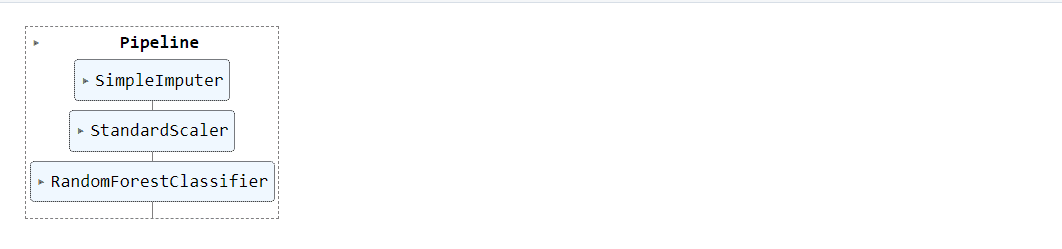
Our model pipeline is straightforward. First, we pass our feature through an imputer and then normalize it using Standard Scaler. Finally, we feed the processed data into a random forest classifier.

After fitting the pipeline on the training set, we use `.score()` to generate the accuracy score on the testing set.

The score is average, and I am satisfied with the performance. While we could improve the model by ensembling or using various optimization methods, our goal is different.

from sklearn.ensemble import RandomForestClassifier  from sklearn.preprocessing import StandardScaler  from sklearn.impute import SimpleImputer  from sklearn.pipeline import Pipeline      pipe = Pipeline(      steps=[          ("imputer", SimpleImputer()),          ("scaler", StandardScaler()),          ("model", RandomForestClassifier(n_estimators=100, random_state=125)),      ]  )  pipe.fit(X_train, y_train)    pipe.score(X_test, y_test)  >>> 0.7538461538461538

The classification report also looks good.

from sklearn.metrics import classification_report    y_pred = pipe.predict(X_test)  print(classification_report(y_test,y_pred))
precision    recall  f1-score   support               1       0.65      0.73      0.69        15             2       0.82      0.79      0.81        29             3       0.40      0.50      0.44         4             5       1.00      0.80      0.89         5             6       1.00      0.67      0.80         3             7       0.78      0.78      0.78         9        accuracy                           0.75        65     macro avg       0.77      0.71      0.73        65  weighted avg       0.77      0.75      0.76        65

Saving the Model

Skops is a great library to deploy scikit-learn models into products. We will use it to save the model and later load it into production.

import skops.io as sio  sio.dump(pipe, "glass_pipeline.skops")

As we can see, with a single line of code, we can load the entire pipeline.

sio.load("glass_pipeline.skops", trusted=True)
Deploying Your First Machine Learning Model
Building Web Application

In this part, we will learn how to use Gradio to build a simple classification user interface.

  • Load the model using the skops.
  • Create an array of class names and leave the first one empty or “None” as our numerical class starters from 1.
  • Write a classification Python function that takes inputs from the user and predicts the class using the pipeline.
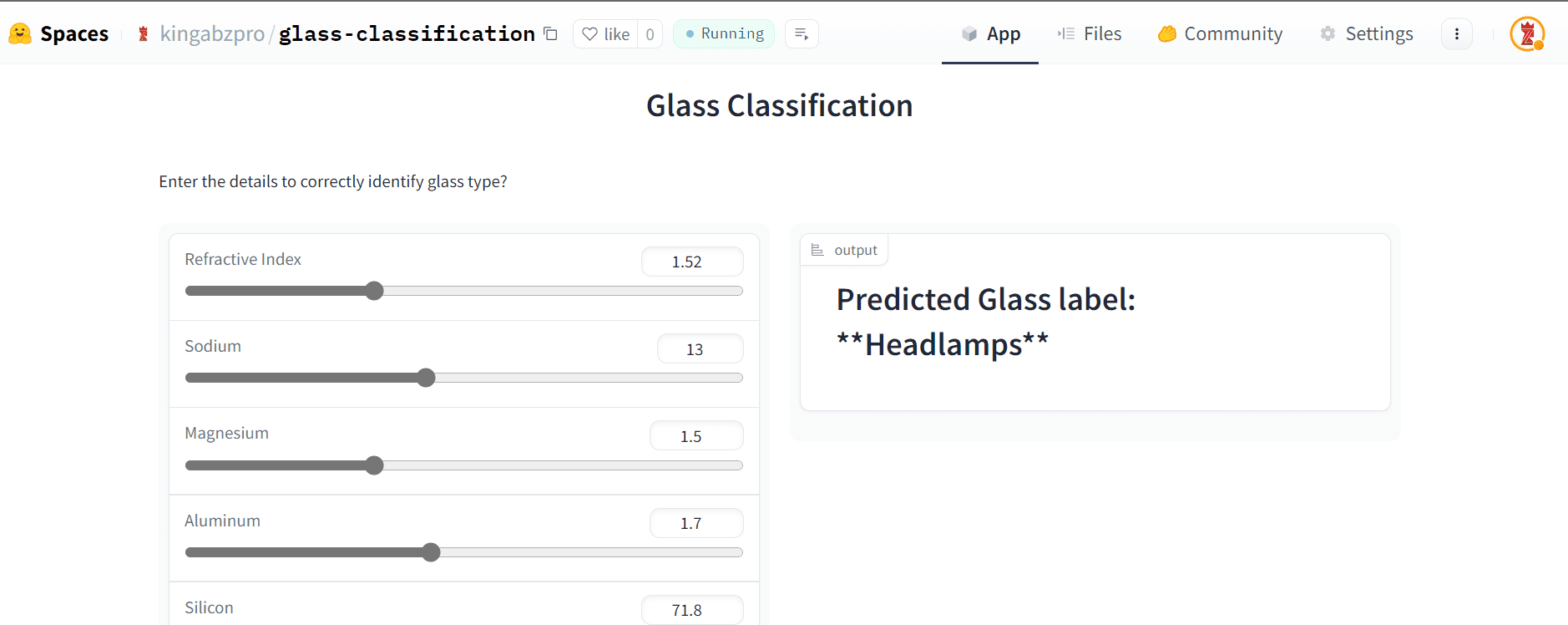
  • Create the inputs for each feature using the sliders. Users can use a mouse to select the numerical values.
  • Create the output using the Label. It will display the Label in bold text on the top.
  • Add the title and description of the app.
  • Finally, combine all of it using `gradio.Interface`
import gradio as gr  import skops.io as sio    pipe = sio.load("glass_pipeline.skops", trusted=True)    classes = [      "None",      "Building Windows Float Processed",      "Building Windows Non Float Processed",      "Vehicle Windows Float Processed",      "Vehicle Windows Non Float Processed",      "Containers",      "Tableware",      "Headlamps",  ]      def classifier(RI, Na, Mg, Al, Si, K, Ca, Ba, Fe):      pred_glass = pipe.predict([[RI, Na, Mg, Al, Si, K, Ca, Ba, Fe]])[0]      label = f"Predicted Glass label: **{classes[pred_glass]}**"      return label      inputs = [      gr.Slider(1.51, 1.54, step=0.01, label="Refractive Index"),      gr.Slider(10, 17, step=1, label="Sodium"),      gr.Slider(0, 4.5, step=0.5, label="Magnesium"),      gr.Slider(0.3, 3.5, step=0.1, label="Aluminum"),      gr.Slider(69.8, 75.4, step=0.1, label="Silicon"),      gr.Slider(0, 6.2, step=0.1, label="Potassium"),      gr.Slider(5.4, 16.19, step=0.1, label="Calcium"),      gr.Slider(0, 3, step=0.1, label="Barium"),      gr.Slider(0, 0.5, step=0.1, label="Iron"),  ]  outputs = [gr.Label(num_top_classes=7)]    title = "Glass Classification"  description = "Enter the details to correctly identify glass type?"    gr.Interface(      fn=classifier,      inputs=inputs,      outputs=outputs,      title=title,      description=description,  ).launch()

Deploying the Machine Learning Model

In the final part, we will create the spaces on the Hugging Face and add our model and the app file.

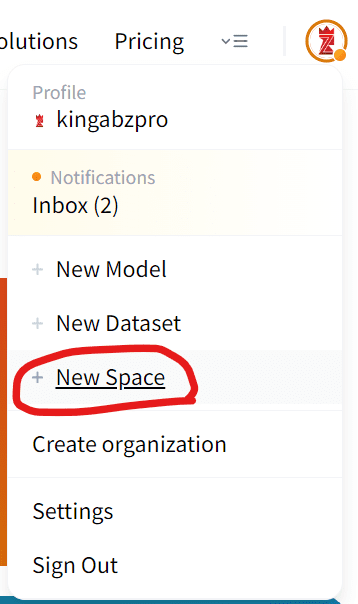
To create the spaces, you have to sign in to https://huggingface.co. Then, click on your profile image on the top right and select “+ New Space”.
Deploying Your First Machine Learning Model
Image from HuggingFace

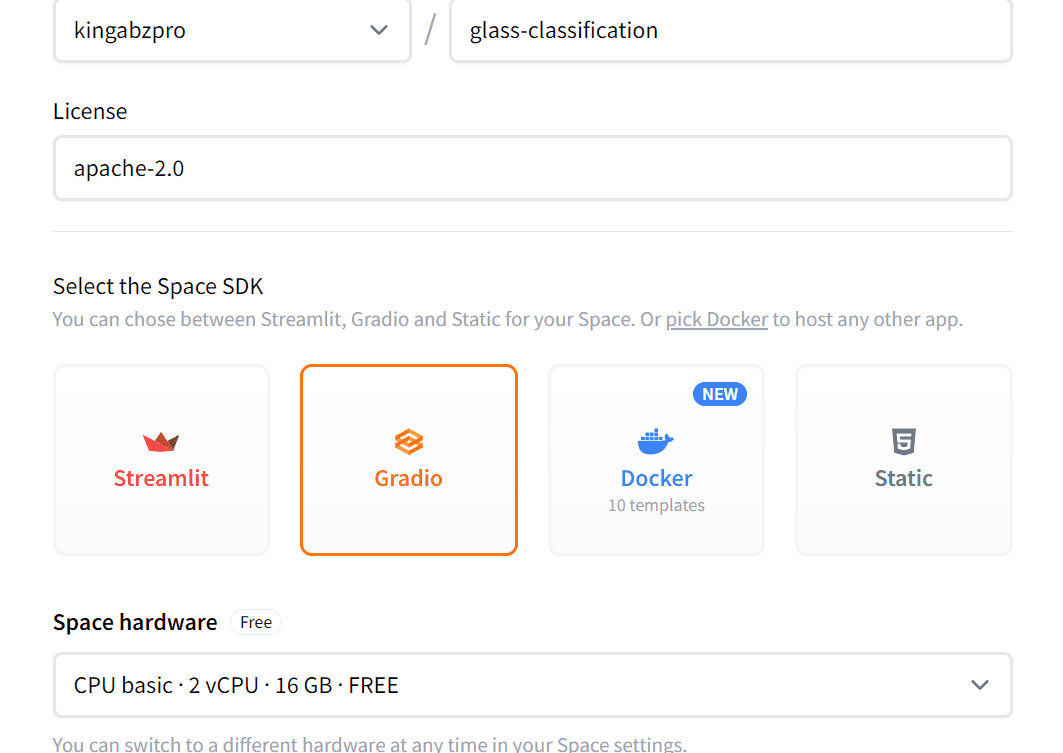
Write the name of your application, select SDK, and click on the Create Space button.
Deploying Your First Machine Learning Model
Image from Spaces

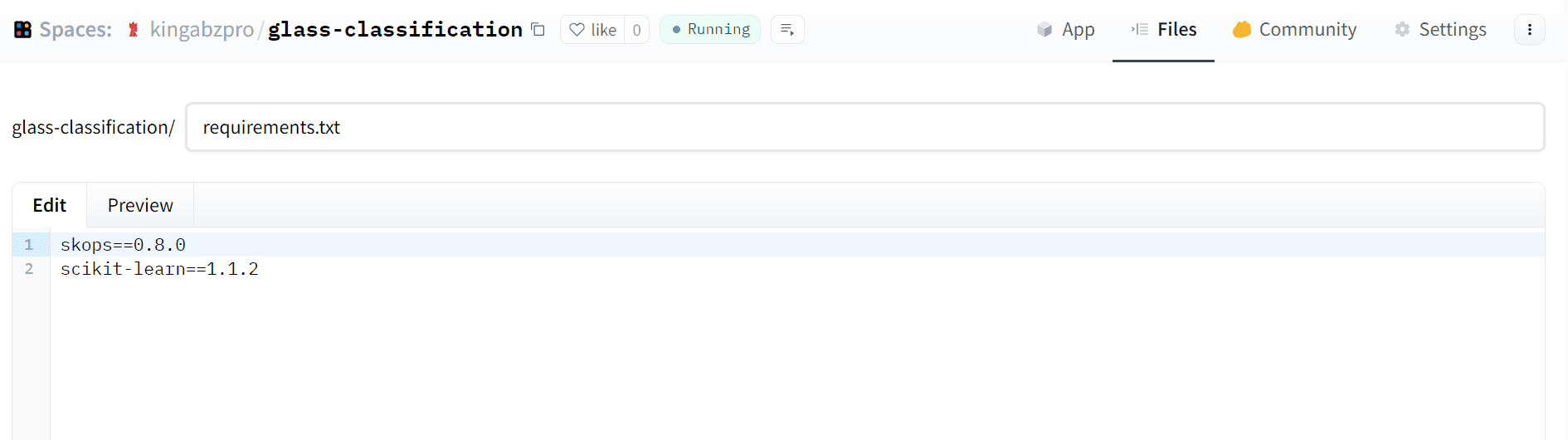
Then, create a `requirements.txt` file. You can add or create a file by going to the “Files” tab and selecting the “+Add file” button.

In the `requirements.txt` file, you have to add skops and scikit-learn.
Deploying Your First Machine Learning Model
Image from Spaces

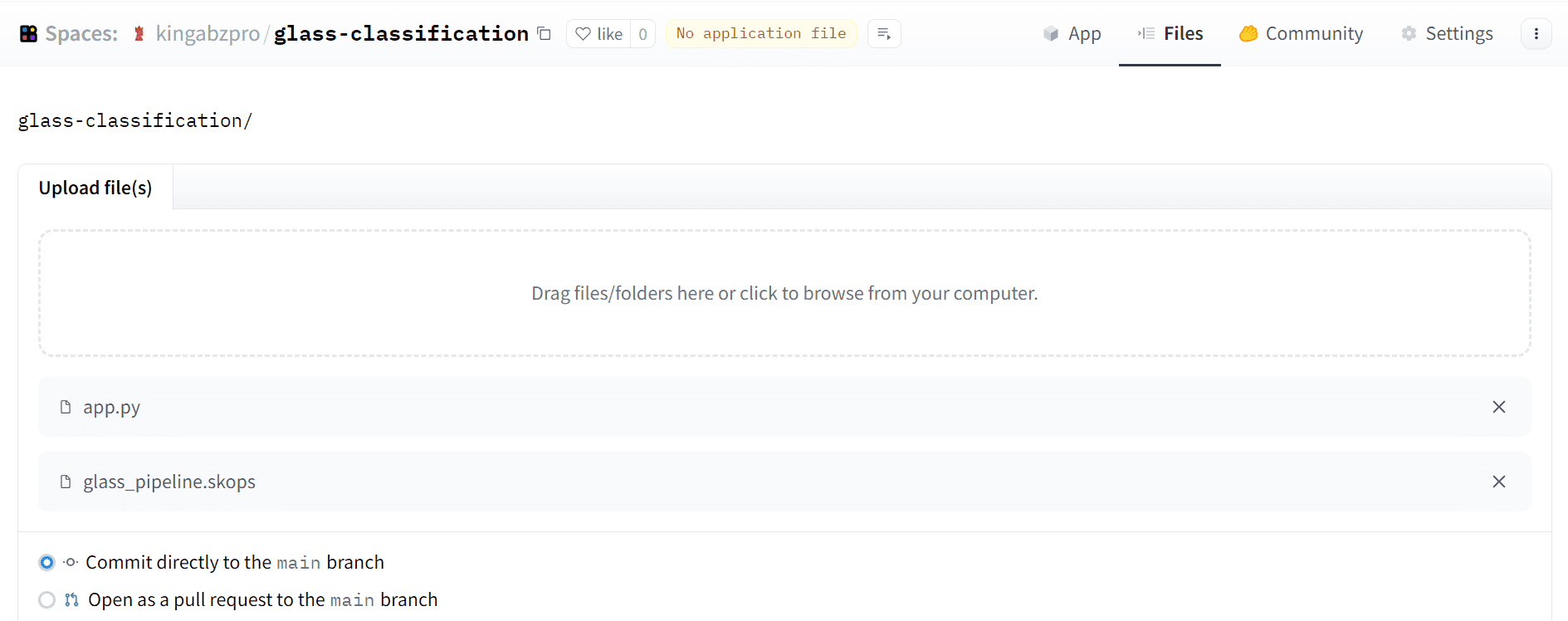
After that, add the model and file by dragging and dropping them from your local folder to the space. After that, commit.
Deploying Your First Machine Learning Model
Image from Spaces

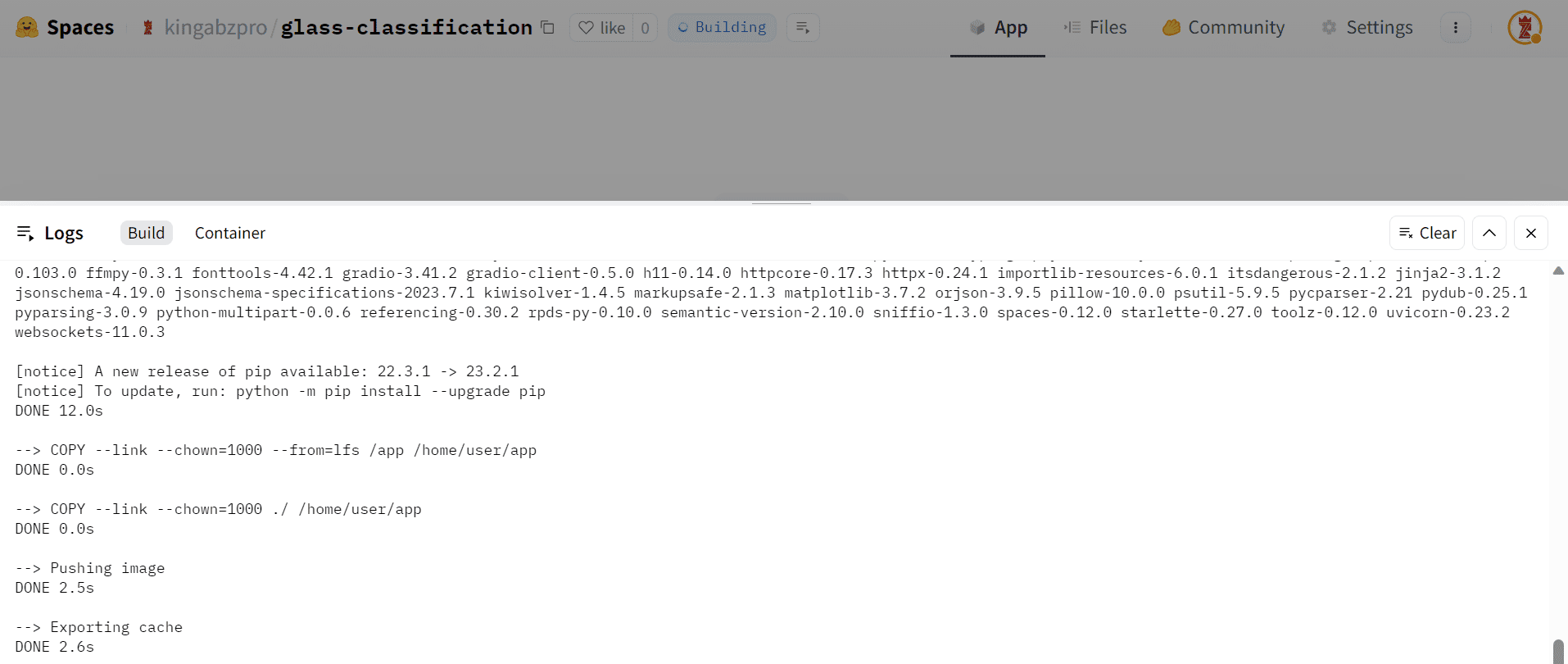
It will take a few minutes for the spaces to install the required packages and build the container.
Deploying Your First Machine Learning Model
Image from Spaces

In the end, you will be greeted with a bug-free application that you can share with your family and colleagues. You can even check out the live demo by clicking on the link: Glass Classification.
Deploying Your First Machine Learning Model
Image from Glass Classification Conclusion

In this tutorial, we walked through the end-to-end process of building, training, and deploying a machine learning model as a web application. We used the glass classification dataset to train a simple multi-class classification model. After training the model in scikit-learn, we leveraged skops and Gradio to package and deploy the model as a web app on HuggingFace Spaces.

There are many possibilities to build on this starter project. You could incorporate more features into the model, try different algorithms, or deploy the web app on other platforms. The important thing is that you now have hands-on experience with an end-to-end machine learning workflow. You've gotten exposure to training models, packaging them for production, and building web interfaces for interacting with model predictions.

Thanks for following along! Let me know if you have any other questions as you continue your machine learning journey.
Abid Ali Awan (@1abidaliawan) is a certified data scientist professional who loves building machine learning models. Currently, he is focusing on content creation and writing technical blogs on machine learning and data science technologies. Abid holds a Master's degree in Technology Management and a bachelor's degree in Telecommunication Engineering. His vision is to build an AI product using a graph neural network for students struggling with mental illness.

More On This Topic

  • Deploying Your First Machine Learning API
  • Deploying Serverless spaCy Transformer Model with AWS Lambda
  • From Zero to Hero: Create Your First ML Model with PyTorch
  • 4 Machine Learning Concepts I Wish I Knew When I Built My First Model
  • ColabCode: Deploying Machine Learning Models From Google Colab
  • Tips & Tricks of Deploying Deep Learning Webapp on Heroku Cloud

Why Google will Not Rank Websites Just Based on SEOs 

Recently, Google changed the policy in its latest update of search engine optimisation. They removed the part which mentioned content ‘created by humans’. Instead, the emphasis is on quality content. This means the SEO will now pick up content generated by AI. Most

It’s a complete shift from last year, when Google tried to stand against AI-generated content on its search results. The issue then and now is that Google has no way of verifying if the content is AI-generated or not.

Now, instead of policing AI content, the newer search updates are trying to assess the value and accuracy of the information provided by the search results.

How has this affected SEO?

Quite badly, to begin with, as fluctuations are common when Google pushes out new updates. This time however, content creators are annoyed at having to compete with the AI-generated content. According to a forum for content creators most of them were reporting a drop of engagement from 40 – 60% on their websites.

In the same forum, they are complaining how this biassed search results to AI-generated content is eating away at their cost. “This is a joke,” said a user of webmaster’s forum after the update. “I’ve got long-form content, well written, well researched, filled with original image content LOSING to 500 word AI-generated crap…Google is apparently forcing publishers to generate AI spam or die.”

Is AI-generated Content Winning?

Meanwhile, to address the debate between AI and human-generated content, Google published a blog that says the new policy is designed to reward websites with high-quality content that is helpful to users. According to their current guidelines, even sites with AI-generated content, which can also be helpful to users and are not created just to attract clicks, will rank high on the search engine. This should address the problem mentioned earlier about original content losing out to AI-generated spam.

After the new policy update, Google has been ranking down sites with SEO-friendly but spammy content, likely to be produced by generative AI, which further addresses the discussion around human and AI-generated content.

A spokesperson from the company said, “We are not targeting content produced by any particular method – AI or otherwise – we’re concerned with the quality of a given webpage and its helpfulness to readers.”

To make these changes, how is Google analysing what content is ‘helpful’ and of ‘high quality’? By EEAT score or Experience, Expertise, Authoritativeness and Trust. Google’s search quality raters, estimated to be about 16,000 contractors, score the sites based on the above parameters. These ratings are used by Google to refine machine learning algorithms designed to surface pages that users are likely to find helpful.

Further, Google is penalising AI-generated product reviews. The AI-generated reviews can be of high-quality but they can also be inaccurate. These reviews are taken down by Google by a combination of human experts and ML algorithms will enforce this update according to Google.

Google embraces AI, Humans Alike

The content on Google is going to be populated with AI. It is unlikely that this will displace all content creators and the search engine.

There is no proof that AI will take over as most of Google’s revenue depends on its search engine and Google is figuring out a way to reward content creators by constantly updating the SEO features. At the end of August Google announced the search generative AI experience, to integrate some of the traffic that has already moved to AI instead of using Google search.

Google has already integrated AI responses for simple questions from its Search Labs and the future of the search experience is likely to become even more personalised and relevant, as it learns more about each user’s individual needs and preferences.

To make sure that search results don’t get too personalised creating echo chambers, Google also announced the ‘hidden gems’ as part of the Helpful Content Update. This will ensure that results from smaller sites with different perspectives don’t get buried down but instead their ranking is improved with positive reinforcement of its content and SEO. This update hasn’t been rolled out yet but will solve a lot of the issues niche sites are currently facing.

The post Why Google will Not Rank Websites Just Based on SEOs appeared first on Analytics India Magazine.

MIT’s New AI-Powered Co-Pilot Will Redefine Aviation Safety

MIT’s New AI-Powered Co-Pilot Will Redefine Aviation Safety

MIT’s Computer Science and Artificial Intelligence Laboratory (CSAIL) has introduced Air-Guardian, an aviation safety system for a better collaboration between human pilots and AI, promising safer skies for all.

The technology will upgrade a cockpit to a place where both a human pilot and an AI co-pilot continuously monitor and assess the flight’s parameters, each focusing on different aspects but working together to ensure passenger safety.

Air-Guardian operates by proactively interpreting the pilot’s attention. It utilises eye-tracking technology for humans and “saliency maps” for AI, pinpointing the areas of focus within the cockpit’s visual field. These maps function as a virtual guide, aiding the AI in comprehending algorithms and identifying potential risks long before they escalate, setting it apart from traditional autopilot systems that react only after safety breaches have occurred.

Air-Guardian was put through field tests where both the pilot and the AI made decisions based on the same unprocessed visual data during navigation. The results: Air-Guardian not only reduced the risk level during flights but also improved the success rate of reaching predefined waypoints.

“This system doesn’t replace human judgement; instead, it complements it, leading to enhanced safety and collaboration in the skies, ” said Ramin Hasani, MIT CSAIL research affiliate and the mind behind liquid neural networks.

Air-Guardian’s core technology relies on an optimization-based cooperative layer and liquid Closed-form continuous-time neural networks, known for their ability to decipher cause-and-effect relationships. The inclusion of the VisualBackProp algorithm ensures a clear understanding of attention maps within the images.

The research for Air-Guardian was partially funded by organisations such as the United States Air Force Research Laboratory, the United States Air Force Artificial Intelligence Accelerator, The Boeing Company, and the Office of Naval Research. It represents a significant stride in aviation safety.

The post MIT’s New AI-Powered Co-Pilot Will Redefine Aviation Safety appeared first on Analytics India Magazine.

KDnuggets News, September 27: ChatGPT Projects Cheat Sheet • Introduction to PyTorch & Lightning AI

Featured Articles

  • 10 ChatGPT Projects Cheat Sheet
  • Introduction to Deep Learning Libraries: PyTorch and Lightning AI

From Our Partners

  • Feature Store Summit 2023: Practical Strategies for Deploying ML Models in Production Environments from Hopsworks
  • How Generative AI is disrupting data practices from Reed Exhibitions Ltd.

This Week's Posts

  • Hands-On with Unsupervised Learning: K-Means Clustering
  • Fine Tuning LLAMAv2 with QLora on Google Colab for Free
  • Kick Ass Midjourney Prompts with Poe
  • Machine Learning Evaluation Metrics: Theory and Overview
  • Your Features Are Important? It Doesn’t Mean They Are Good
  • Traditional AI vs Generative AI
  • Exploring Neural Networks
  • Optimizing Data Storage: Exploring Data Types and Normalization in SQL
  • Top 5 Free Alternatives to GPT-4
  • Effective Small Language Models: Microsoft’s 1.3 Billion Parameter phi-1.5
  • Introduction to Deep Learning Libraries: PyTorch and Lightning AI
  • 30 Years of Data Science: A review from a data science practitioner
  • Gartner Hype Cycle for AI in 2023
  • Building a Convolutional Neural Network with PyTorch
  • Using SQL to Understand Data Science Career Trends
  • The Data Maturity Pyramid: From Reporting to a Proactive Intelligent Data Platform
  • Introduction to Natural Language Processing
  • Generative Agent Research Papers You Should Read

From Around The Web

  • Exploring Data using dplyr in R via Machine Learning Mastery
  • NumPy Crash Course for Data Scientists via Data Science Horizons
  • Creating a LLaMa 2 Agent Empowered with Wikipedia Knowledge via Towards Data Science

More On This Topic

  • Advanced PyTorch Lightning with TorchMetrics and Lightning Flash
  • Introduction to PyTorch Lightning
  • Introduction to Deep Learning Libraries: PyTorch and Lightning AI
  • 10 ChatGPT Projects Cheat Sheet
  • KDnuggets News, September 21: 7 Machine Learning Portfolio Projects to…
  • Multilingual CLIP with Huggingface + PyTorch Lightning

Oracle’s Billion-Dollar Baby 

Oracle recently announced its ambitious goal of becoming a $65 billion company by 2026. To achieve this, it is betting big on Cohere, its billion dollar generative AI baby, alongside multi-cloud strategy and healthcare initiatives. It even raised $270 million at a valuation of $2.2 billion in a series C round from Oracle, NVIDIA and Salesforce.

Unlike OpenAI, Anthropic, Google DeepMind, and Meta AI, which are all around the place, Cohere seems to be focused on meeting the enterprise needs. “Cohere has been oriented toward solving business problems not toward the consumer space,” said Greg Palvik, senior vice president, OCI at the Oracle CloudWorld 2023 at Las Vegas.

Ironically, the marriage between cloud providers and generative AI startups seems to be the new norm nowadays. It all started with Microsoft partnering with OpenAI. Recently, AWS announced a $4 billion investment in Anthropic. The amount was substantial enough for everyone to take notice, and many saw this alliance in the same light as Microsoft’s partnership with Azure and OpenAI.

But, very little is known about Cohere and Oracle. Surprisingly, they are moving ahead swiftly and silently without making much noise and delighting enterprise customers, with generative updates across its products, solutions and services. This includes Oracle Fusion Cloud Applications Suite, Oracle NetSuite, and industry applications such as Oracle Cerner, alongside bringing Vector Store to MySQL HeatWave, which boasts generative AI capabilities.

Cohere is all about enterprise

Cohere is unlike any other generative AI startups out there. At CouldWorld 2023, Cohere co-founder Aidan Gomez spoke in great detail about how he sees Cohere as different from the rest of the competition. According to him, there are two types of models: generative models and embedding models.

Generative models are usually trained on publicly available data on the internet, whereas embedding models are typically trained on enterprise data where the model retrieves information from specific sources of data points.

Cohere is focussing on building both, but it places a stronger emphasis on ’embedding modes’. He added that the new embeddings models will perform twice as well, compared to the competition on datasets that are heterogeneous and noisy.

Gomez believes that embedding models combined with RAG (Retrieval, Augmented Generation) is going to solve most of the problems of enterprises. RAG is a relatively new AI technique that can improve the quality of generative AI by allowing LLMs to tap additional data resources without retraining.

Interestingly, Patrick Lewis, who coined the term RAG while working at Meta, now works at Cohere. “He’s now at Cohere leading our RAG efforts alongside Sebastian Hofstätter. We’re super fortunate to have him” said Gomez. Hofstätter has also worked on RAG during his PhD internship at Google Research.

Furthermore, he said that Cohere is going to come up with new embedding models. “I am really excited today to kind of pre-announce our new embedding models,” said Gomez, explaining how it is crucial for RAG – i.e. when the model makes that query to a database, the response is going to be of higher quality, and does not require training of a model as it updates the knowledge in real-time.

Oracle and Cohere Mean Business

In order to execute its plans, Cohere could not have found a better partner than Oracle. “We are cloud agnostic, but very closely partnered with Oracle,” said Martin Kon, COO Cohere, at Oracle CloudWorld 2023, Las Vegas.

Cohere service will form the basis for generative AI capabilities embedded across Oracle’s suite of SaaS applications, including Oracle Fusion Cloud Applications Suite, Oracle NetSuite, and industry applications such as Oracle Cerner.

Built on OCI in collaboration with Cohere, the OCI Generative AI service will enable users to integrate LLMs in their own applications through an available API. Once generally available, this service and Cohere models will work seamlessly with AI Vector Search, a feature of Oracle Database 23c that provides retrieval augmented generation (RAG).

Just like how Microsoft leveraged generative AI capabilities from OpenAI, Oracle is planning to do the same with Cohere, but with so much clarity and coherence. The key difference is that while OpenAI targets both consumers and enterprises, Oracle and Cohere are exclusively focused on serving enterprise customers.

The post Oracle’s Billion-Dollar Baby appeared first on Analytics India Magazine.

Whoop unveils a ChatGPT-powered AI coach. Here’s how you can access it

Whoop Coach

Whoop's screenless, simple band design makes it stand out from the crowd. Whoop has become a major competitor in the world of fitness wearables — and the company's new ChatGPT integration will only make it stand out further.

On Tuesday, Whoop introduced Whoop Coach, a new, GPT-4-supported, conversational chatbot that can deliver personalized recommendations and fitness coaching based on the user's data.

Also: The best blood pressure watches available

Whoop Coach leverages Whoop's proprietary algorithms, a custom-built machine-learning model, and the user's unique biometric data to identify patterns and make connections, which Whoop Coach can then use to produce responses to user questions by using GPT-4, according to the release.

Since Whoop Coach gives recommendations based on the user's data, the more data a user inputs, the more helpful Whoop Coach becomes.

Some tasks that Whoop Coach can assist with include training plans, such as a training program for running 5km, insight into the metrics that Whoop tracks, and answers to general questions about your wellbeing, such as why you are tired, and more.

Also: Buying an Apple Watch? How to pick the best one for you

The best part is that the AI-enabled feature is included in a Whoop membership at no additional cost. All users have to do is head over to their Whoop homescreen and ask a question.

To address privacy concerns, Whoop reassures users that their conversations will not be accessed without their consent and third parties will not store user data.

Also: How to get rid of My AI on Snapchat for good

When using Whoop Coach, the users' metrics are anonymized and put through the company's third-party large language learning model partner.

If you are still hesitant about AI, or don't want the new technology to connect to your data, there is an option to turn off Whoop Coach by going to the More tab > App Settings > WHOOP Coach. Users also have the option to delete their Whoop Coach chat data by contacting Whoop.

This isn't the first instance of a fitness wearable incorporating AI to help users develop fitness goals. Amazfit released its Cheetah smartwatch in June, which featured an AI coach within its app that could create training plans for users. As generative AI continues to grow in popularity, we will likely see it integrated into more hardware.

Artificial Intelligence

GPU has An Energy Problem

While the massive growth of NVIDIA, fueled by the burgeoning number of AI companies’ demand for GPUs occurs on one end, the costs incurred by the purchasing company doesn’t end with a mere GPU.

The amount of money spent on energy costs for running these GPUs in data centres are enormous. Recently, a study showed that data centres approximately consume about 1,000 kWh per square metre, which is about 10x the power consumption of a typical American home. BLOOM, an LLM, utilised 914kWh over an 18-day period while running on 16 NVIDIA A100 40GB GPUs, managing an average of 558 requests/hour.

Climbing Costs

As per an article by Sequoia, if $1 is spent on a GPU, approximately another dollar is spent on energy costs for running that GPU in a data centre, and taking into consideration how the companies buying them will need to make a margin, the costs incurred would almost be two-fold.

Training AI models within data centres can require up to three times the energy compared to typical cloud workloads, thereby straining the infrastructure needs. For instance, AI servers with GPUs may require up to 2 kW of power, whereas a standard cloud server will require only 300-500W.

Last year, in Northern Virginia’s Data Center Alley, there was almost a power outage owing to large consumption. It is also believed that the current generation of data centres are ill-equipped to handle surge demand owing to AI-related activities. Furthermore, power usage is expected to surpass 35GW per year by 2030.

Source: McKinsey

As per research, AI data centre server infrastructure along with operating costs is said to cross $76 billion by 2028. This exceeds twice the estimated annual operating cost of AWS which holds about one-third the cloud infrastructure services market.

Big tech companies are also shelling big on running it. Earlier this year, The Information had estimated that OpenAI spends close to $700,000 daily for running its models. Owing to massive amounts of computing power required, the infrastructural cost for running the AI model is not easy.

Considering the trend in which companies are speeding through the generative AI race, a Gartner study projects that in the next two years, the exorbitant costs will exceed the value generated, which would lead to about 50% of large enterprises pulling the plug on its large-scale AI model developments by 2028.

A user on X who reviews CPU coolers, spoke about how he would choose an energy efficient GPU not to avoid high electricity bills but because of its heat generation.

I'm probably going to end up getting the RTX 4070. I would consider a 6950XT or a used RTX 3090 but I really need an *energy efficient* GPU.
Not because I care about the electricity cost, it's cheap where I live, but because my AC is already struggling to keep it 23C inside. pic.twitter.com/ZTOeVOIFYV

— Albert Thomas – Cooling Reviewer (@ultrawide219) July 17, 2023

Workaround For Energy Efficiency

Specialised data centres that are aimed at running generative AI workloads are springing. Sprouting in suburban locations that are away from big markets and running on existing electrical networks without shorting them are options companies are looking at. With quicker connectivity and reduced expenses, these are emerging as viable alternatives.

Innovative technology to build cooler data centres are also pursued. As part of a government program COOLERCHIPS, the US Department of Energy, recently awarded $40 million to fund 15 projects. NVIDIA has been granted $5 million to build a data centre with revolutionary cooling systems to boost energy efficiency. The team is building an innovative liquid-cooling system that can efficiently cool a data centre in a mobile container, even when it operates at temperatures as high as 40 degree celsius drawing 200kW of power. The new system is said to run 20% more efficiently than current air-cooled approaches and will cost at least 5% less.

In the near-future, a probable possibility of renewable energy sources that can power data centres is also likely. Going by how big tech leaders are increasingly investing in nuclear energy companies, and with Microsoft posting a job opening for a ‘principal program manager for nuclear technology,’ nothing can be ruled out. It might pave the way for energy and cost-effective alternatives that might address the current problem.

With the current pattern of energy consumption slated to only go up, the rising demand of GPUs can also create another scenario. With increased adoption, the cost of GPUs can eventually come down. Thereby, a trade-off with energy consumption can be achieved.

The post GPU has An Energy Problem appeared first on Analytics India Magazine.

CIA Builds its Own AI Chatbot

The Central Intelligence Agency is on the road to release their own internal AI chatbot similar to OpenAI’s ChatGPT to help the agency’s data analysts find information based on their vast archive.

The U.S agency did not clarify on what type of model it will be using in its new tool. It also did not disclose how they plan to safeguard their information from leaks and prevent sensitive information seeping into the internet. It has most probably trained its bot with loads of data from its archive to make it understand what type of information analysts are dealing with.

The U.S department of Defense aims to take advantage of the power of AI as it struggles to process vast amounts of data fast, and wants to use AI to speed up the process.

“We’ve gone from newspapers and radio, to newspapers and television, to newspapers and cable television, to basic internet, to big data, and it just keeps going,” Randy Nixon, director of open-source division, CIA, told Bloombeg.

This tool allows agents to see the original source of information that they are viewing–to make sure that AI is not ‘hallucinating’ and the information is factually correct.

The feature will be available to 18 U.S. intelligence agencies, which includes National Security Agency, FBI, CIA and branches run by the military. However, in the interest of national security, it won’t be available to the public or government officials.

The U.S government has been exploring the potential uses of LLMs. They had set-up a task force earlier in May. “We need to find a way to take advantage of these large models without violating privacy,” Gilbert Herrera, director of research at NSA, told Bloomberg.

This announcement comes at a time when China has publicly stated that it is harnessing the power of AI and plans to dominate space by 2030.

The post CIA Builds its Own AI Chatbot appeared first on Analytics India Magazine.