Meta Supercharges its Ads Manager With a GenAI Trio

Today, Meta has started rolling out three new generative AI features for advertisers, allowing them to use AI to create backgrounds, expand images and generate multiple versions of ad text based on their original copy. This move shows Meta’s confidence in generative AI’s potential to assist brands and enterprises that constitute a major chunk of Meta’s revenue streams.

The first among the new features allows advertisers to customise their creative assets by generating multiple different backgrounds to change the look of their product images.

The technology is similar to that which Meta used to create Backdrop, which allows users to change image backgrounds using text prompts. However, in the toolkit, the backgrounds are generated for the advertiser based on their product images and will be “simple backgrounds with colours and patterns,” Meta explained. The feature is available to advertisers using the company’s Advantage+ catalogue for their sales ads.

The second feature is image expansion for advertisers to adjust their assets to fit different aspect ratios like Feed or Reels, for example. The feature would let advertisers spend less time repurposing images and video, for different surfaces, the company claimed.

Both of the above features are available to Advantage+ creative in Meta’s Ads Manager.

The third addition is the ‘text variations’ feature capable of generating up to six different text versions based on the original copy. These renditions can highlight particular keywords and phrases aligned with the advertiser’s requirements.

In the context of a particular campaign, Meta can present different text combinations to various audiences, to understand which versions yield better responses. However, the company won’t disclose detailed performance metrics for each variation, as conveyed by the technology behemoth.

Meta has already tested these features in its AI Sandbox with a diverse small set of advertisers and early results indicate that generative AI will save them over five hours on a weekly basis.

Nonetheless, the company admits that there remains a significant amount of work to be done to refine output aligning precisely with the advertisers’ styles. The company also revealed that there are more AI features to come.

The post Meta Supercharges its Ads Manager With a GenAI Trio appeared first on Analytics India Magazine.

Researchers Enable Control Over AI Model Behavior, Break Open The ‘Black Box’

Researchers have long tried to pierce the “black box” of deep learning. Even though neural networks have proven remarkably successful at text-to-everything tasks, they have largely remained shrouded in mystery. Buried in layers of complex computations, they defy easy understanding for researchers, making it hard to diagnose errors or biases.

In an effort to understand these ‘black boxes’ better, researchers from nine institutions including the Center for AI Safety (CAIS) in San Francisco have published a paper. The paper provides human overseers insight into the model decision-making processes and indicate when a model is misbehaving.

The research represents a step ahead in interpretability research which has been a pain for researchers universally. The subject has also taken a centre stage in political discussion since Senator Chuck Schumer has called explainability “one of the most important and most difficult technical issues in all of AI.”

The study not only lets humans-in-the-loop pinpoint failures but also enables them to make their respective AI models actively safer. Researchers can now wield control over whether these models adhere to truth or falsehood, morality or immorality, exhibit emotional responses, resist hacking attempts, mitigate biases, and more.

The researchers introduce a representation engineering (RepE) approach to increase transparency in AI systems that draws on insights from cognitive neuroscience. The RepE method places population-level representations, rather than neurons or circuits, at the centre of analysis, equipping the researchers with novel methods for monitoring and manipulating high-level cognitive phenomena in deep neural networks (DNNs).

Through the paper the team has provided baselines and an initial analysis of RepE techniques, showing that they offer simple yet effective solutions for improving the understanding and control of large language models (LLMs).

“Although we have traction on ‘outer’ and ‘inner’ alignment, we should continue working in these directions. At the same time, we should increase our attention for risks that we do not have as much traction on, such as risks from competitive pressures,” suggested Dan Hendrycks, one of the authors of the paper and the director of CAIS in his research released earlier this year. The paper titled — X-Risk Analysis for AI Research — which was also cited in the open letter calling for a 6-month pause on AI development bigger than OpenAI’s GPT4.

The post Researchers Enable Control Over AI Model Behavior, Break Open The ‘Black Box’ appeared first on Analytics India Magazine.

Hurtling toward generative AI adoption? Why skepticism is your best protection

AI concept

With some organizations moving ahead to adopt generative artificial intelligence (AI), it is critical they do so while mitigating potential risks and with some level of skepticism.

As it is, 45% of businesses are currently piloting generative AI, while 10% already have such tools in production, revealed a Gartner study released Tuesday. The survey polled 1,419 executives during a webinar last month to discuss business costs and risks of generative AI.

Also: AI safety and bias: Untangling the complex chain of AI training

These figures are significantly higher than a previous poll that Gartner ran in March and April this year, during which 15% reported piloting the technology and just 4% had these tools in production.

In the latest survey, some 78% said the benefits of generative AI outweighed its risks, higher than the 68% who thought likewise in the earlier poll.

Gartner noted that 45% of businesses were scaling up their generative AI investments across multiple functions, with 22% doing so across at least three different functions. Investment or adoption of generative AI in software development clocked the highest rate, at 21%, followed by marketing and customer service at 19% and 16%, respectively.

"Organizations are not just talking about generative AI — they're investing time, money, and resources to move it forward and drive business outcomes," said Frances Karamouzis, Gartner's group chief of research and distinguished analyst, noting that 55% of organizations had increased their investment in generative AI since its emergence in the public domain 10 months ago.

"Executives are taking a bolder stance on generative AI as they see the profound ways that it can drive innovation, optimization, and disruption," said Karamouzis. "Business and IT leaders understand that the 'wait and see' approach is riskier than investing."

When having doubt is necessary

Should businesses decide to move ahead, though, they should have the framework in place to ensure they are adopting generative AI responsibly and ethically.

Some level of skepticism also should apply, including toward tools used to detect when AI has been applied, said Kathy Baxter, Salesforce.com's principal architect of responsible AI.

Also: How AI can improve cybersecurity by harnessing diversity

Baxter noted that the technology has become democratized, enabling anyone to use generative AI without many handrails. But while many organizations are doing a decent job in trying to weed out toxic content and continuing to invest in such efforts, there still is not yet a lot of understanding on "how big a grain of salt" one should take with regard to AI-generated content.

Users regard all of such content as fact even if it is fabricated, Baxter said in an interview with ZDNET, noting that even AI detecting tools can be wrong in some instances, but may be deemed to be always accurate. Such perceptions may have an adverse impact when generative AI and its associated tools are used in some areas such as education, where students may be wrongly accused of using AI in their work.

Expressing her concerns over such risks, she urged any individual or organization using generative AI to do so with "enough skepticism".

Like others in the industry, she echoed the need for sufficient guardrails in place to ensure AI is accurate and safe. It would help, too, if deployments were rolled out alongside risk mitigation tools, she added. These can include fault detection and reporting features, and mechanisms to collect and provide human feedback.

Also: 5 handy AI tools for school that students, teachers, and parents can use, too

Grounding AI also is critical, she said, stressing the importance of data used to train AI models. Not many organizations, though, have good data hygiene, she noted.

In fact, just 4% of business and technology leaders described their data as fully accessible, according to the C-Suite Global AI Indicator Report released last month. Commissioned by Workday, the study polled 2,355 executives across Asia-Pacific, Japan, North America, and EMEA, who led various functions and included CEOs, CIOs, and CFOs.

More than half of respondents, at 59%, described their data as somewhat or completely siloed, the survey found.

While 98% believed there would be some immediate business benefit from deploying AI and machine learning, 49% said their organization was unprepared to do so due to a lack of tools, skills, and knowledge.

Some 43% expressed concern about the trustworthiness of AI and machine learning, with 67% of CEOs pointing to potential errors as a top risk of bringing on AI and machine learning.

Also: Is AI lying to us? These researchers built an LLM lie detector of sorts to find out

Increased transparency is needed to build trust, but siloed data is obscuring leaders' ability to lean in. Of organizations surveyed, 59% reported that their data is somewhat or completely siloed. Only 4% of all respondents said their data is fully accessible.

Workday CTO Jim Stratton said: "Despite some uncertainty, leaders are optimistic that AI and machine learning will augment their workforce and drive productivity. Trust is paramount to embracing these benefits, and building trust requires the right data foundation and commitment to governance."

Stratton urged organizations to prioritize data quality and transparency when implementing AI, in order to benefit from the technology.

Artificial Intelligence

Google Photos’ AI-powered Magic Editor feature to ship with Pixel 8 and 8 Pro

Google Photos’ AI-powered Magic Editor feature to ship with Pixel 8 and 8 Pro Sarah Perez @sarahintampa / 11 hours

Google is bringing generative AI to its popular Google Photos app with the arrival of the Pixel 8 and Pixel 8 Pro smartphones. The feature, first announced at the company’s I/O developer conference in May, allows for more complicated edits — like filling in gaps in a photo, repositioning the subject, and other edits to the foreground or background of a photo.

At I/O, Google demonstrated how Magic Editor could easily combine various editing tasks. For example, it took an image of someone standing in front of a waterfall, removed the additional people from the photo’s background, and then removed a bag strap from the subject’s shoulder for a cleaner shot. It then leveraged AI to “cut out” the photo’s subject and better reposition them in the resulting image.

Image Credits: Google

Previously, Google Photos users would have to use other tools, like Google’s Magic Eraser or professional tools like PhotoShop, to get the same effect. And the process would involve more manual edits.

In another demo, Google had shown off how you could reposition the photo’s subject and have AI “magically” fill in the rest of the photo as you shifted things that were more off-center in the original image. This time, Magic Eraser let you drag a boy sitting on a bench holding balloons closer to the photo’s center, and AI fills in the rest of the bench and the city scene behind him — even filling the sky with white fluffy clouds for a better photo.

Image Credits: Google

Under the hood, Google Photos is leveraging generative AI to make these more complex edits, like resizing or repositioning a subject. To work, users just tap the object to edit, then drag it to move it around or pinch to resize. Its contextual suggestions also let you change the photo’s lighting and background. Plus, Google says Magic Editor will offer multiple output options so you can choose the one you like best.

As demoed, the feature was fairly impressive, but it’s soon it going to be put into consumers’ hands for real-world tests. And it may or may not end up producing the natural-looking polished images we’ve seen so far. Google admits this to some extent, by noting today that Magic Editor is an experience from its Labs program that’s in “early stages” and it knows “there are going to be times when the result isn’t exactly what you imagined.” But it hopes that over time, with technology improvements and user feedback, users will get better results.

The scale of its test could be sizable, however, given that Google Photos users edit 1.7 billion photos every month. Even if only a subset of those are on the newer Pixel devices, there will likely be a lot of data and edits to learn from.

Magic Editor was one of several new AI-powered photo editing features for the Pixel 8 and 8 Pro. Others included Best Take, which takes a series of images and combines them into a blended image that produces the best shot; a generative AI feature Zoom Enhance feature that looked fairly sci-fi; and other improvements to its existing Magic Eraser feature that can now remove larger distractions from photos. Google said Best Take, Magic Editor and Audio Magic Eraser, which removes background noise, will be available on Pixel 8 devices starting October 12.

Google announces AI-powered photo editing features for new Pixel phones

Read more about Google's 2023 Pixel Event on TechCrunch

Learn How to Design & Deploy Responsible AI Systems

Sponsored Content

Learn How to Design & Deploy Responsible AI Systems

How do you build AI solutions that are trusted, responsible, and effective, too? Get the practical guidance you need in this white paper from Teradata. Download now.

DOWNLOAD WHITEPAPER NOW

More On This Topic

  • Coding Ethics for AI & AIOps: Designing Responsible AI Systems
  • Design effective & reliable machine learning systems!
  • Machine Learning Systems Design: A Free Stanford Course
  • Put Responsible AI into Practice—attend the digital event on December…
  • Towards a Responsible and Ethical AI
  • The Case for a Global Responsible AI Framework

EPAM Systems Becomes Microsoft’s Globally Managed Enterprise SI Partner, Driving Cloud Innovation Worldwide

EPAM Systems, a leading player in digital transformation services and product engineering has achieved the status of a Microsoft Globally Managed Enterprise Systems Integrator (SI) partner. This newly acquired designation equips EPAM with the capabilities to develop cloud-native intelligent applications using the Azure OpenAI Service.

Furthermore, the elevated Globally Managed Enterprise SI partner status will further empower EPAM to drive the growth of Microsoft certifications and specialisations, harness Microsoft’s partner investments, and expedite outcomes in cloud-native solutions, data management, and application modernization.

EPAM’s collaboration with Microsoft, dating back to 2004, has been instrumental in aiding global customers in their journey to Azure by developing strategies for executing Azure migrations at scale without compromising quality.

Elaina Shekhter, chief marketing and strategy officer at EPAM, said, “This enhanced status, combined with our accredited expertise in executing cloud implementations and leading the development of next-generation applications, empowers us to offer an even broader range of capabilities to our global customers, enabling them to unlock the advantages of Microsoft Azure.”

EPAM, a long-standing Microsoft partner, assists customers in shaping the future through Microsoft cloud solutions. With a workforce of over 55,000 professionals, including consultants, engineers, and architects operating in more than 50 countries, EPAM provides specialised Microsoft expertise to enterprise customers worldwide, optimising their Microsoft Azure cloud endeavours.

EPAM boasts five solution partner designations and 10 specialisations, enabling the company to deliver solutions that expedite business value and innovation for clients, solidifying EPAM’s status as a trusted Microsoft technology partner.

Kelly Rogan, CVP of Global Systems Integrator and Advisory Partners at Microsoft, expressed enthusiasm about EPAM’s new status, stating, “Through our expanded collaboration, EPAM will deliver innovative solutions and services on the Microsoft Cloud, which will help customers realise business transformation and growth.”

The post EPAM Systems Becomes Microsoft’s Globally Managed Enterprise SI Partner, Driving Cloud Innovation Worldwide appeared first on Analytics India Magazine.

DALL-E 3 is now available for free in Bing Chat

DALL-E 3 generated image of a Komodo dragon laying on a pillow

DALL-E 3 is now powering the Bing Image Creator and it's better than ever.

Check out that gorgeously detailed image above. It was created using DALL-E 3 through the Bing Image Creator with the prompt "a Komodo dragon laying on a plush deep green pillow on the floor of a mansion." Microsoft just announced that DALL-E 3 is generally available for free in Bing Chat or with the Bing Image Generator.

Created by OpenAI, DALL-E 3 is the company's latest version of a text-to-image model and promises to deliver improved detail in images and greater accuracy in faces, text, and even human hands.

Also: Google Assistant is finally getting the AI upgrades it deserves. Here's what's new

Microsoft has been using what it referred to as a more advanced version of DALL-E 2 in Bing Chat and the Bing Image Creator, but today's announcement appears to confirm that it was not using DALL-E 3 until now. Even though images created with Bing were superior to those created directly with DALL-E 2, today's upgrade is evident in the image output's improved quality, as shown below.

Before the DALL-E 3 upgrade (left) and after DALL-E 3 was made generally available (right).

The images on the left were created with the Bing Image Creator before integrating DALL-E 3, while the ones on the right were created with the same prompt after Microsoft made its announcement. Before the update, the creature looked like a stuffed animal on a scooter. With DALL-E 3, the images on the right show greater detail and are more photorealistic.

Also: Six skills you need to become an AI prompt engineer

OpenAI, also the creator of ChatGPT, improved the aesthetics of the images the model puts out, as well as the coherence and prompt following. These changes make the DALL-E 3-generated images more logically consistent with the prompts given, so users can provide more detail than before in their prompts without fear of confusing the model.

Aside from producing images that are more accurate to the prompts, Microsoft recently announced that images created with Bing Image Creator and Bing Chat will include an invisible digital watermark with the date and time it was created to confirm that the image was AI-generated.

More on AI tools

News app turned X competitor Artifact now lets users generate AI images for their posts

News app turned X competitor Artifact now lets users generate AI images for their posts Sarah Perez @sarahintampa / 8 hours

Artifact, the news aggregator recently turned X competitor, is adding a new generative AI feature. The app, built by Instagram’s co-founders, announced last week it would allow users to post their own updates, which didn’t have to include a link. Today, it’s expanding on that addition with the ability for users to create their own images to accompany their posts using generative AI.

The company believes the feature could help users make their posts more compelling as an eye-catching image can help tell their story. For example, it suggests users could create a landscape scene when posting about climate, or generate a concept car if talking about the future of EVs, among other things.

The feature, which has been in development over the past few months can be accessed by tapping on the plus “+” icon in the photo frame when creating a new w post on Artifact then choosing the option “create with AI.” Users can then enter in their prompt to see the generated image appear. The prompt can include a subject, a medium (like illustration or 3D image), and a style (like pop art or photo realistic, e.g.)

The company tells us it’s using a fine-tuned Stable Diffusion model for the image generation process.

Artifact says the whole process should take only a few seconds. However, if users aren’t satisfied with the results, they can re-use the same prompt to generate another image or revise the prompt to try again.

The addition is one of many AI technologies the app uses to help personalize its content to the end user. Originally, Artifact began as a newsreader of sorts, allowing AI to prioritize and surface the best content. The app also introduced AI technology to rewrite clickbait headlines and summarize stories so readers could get an overview of an article before diving in.

However, in more recent days, the app has been shifting away from being just a place to catch up on news to more of an X or Threads rival of sorts, as it added social features like commenting, user profiles, and the ability to post their own links and text-based posts. This broadens the content available through Artifact and makes the product more social, where curators of content can develop a following — not all that dissimilar from X (formerly Twitter).

With generative AI imagery, creators have another tool to attract users to their content and build their audience.

Artifact takes on X and Threads with new Posts feature

Reka AI Launches Yasa-1, Multimodal AI Assistant

Reka AI Launches Yasa-1, Multimodal AI Assistant

Reka AI, the company that came out of stealth just three months ago, has announced its first multimodal AI assistant called Yasa-1. The model boasts a fusion of language capabilities with visual and auditory sensors, and a unique code execution feature.

Reka developed Yasa-1 from the ground up, starting with the creation of base models and meticulously aligning them. The training and serving infrastructure were also heavily optimised to ensure top-notch performance. The best part is that it is also connected to the internet for live information.

Yasa-1’s impressive features include robust long-context document processing, lightning-fast natively-optimised retrieval augmented generation, multilingual support (available in 20 languages), a search engine interface, and a built-in code interpreter.

We are excited to announce the 1st version of our multimodal assistant, Yasa-1, a language assistant with visual and auditory sensors that can take actions via code execution 🪄.
Yasa-1 can understand text, images, videos, sounds & more! 🚀
Check out more details below👇 pic.twitter.com/XX6pRanDhx

— Reka (@RekaAILabs) October 3, 2023

Yasa-1 is currently available for private preview. Interested parties can access it through Reka’s APIs or as docker containers for on-premise or virtual private cloud deployment. Reka emphasises its commitment to deploying Yasa-1 responsibly and will soon expand access to more enterprise and organisational partners.

The multimodal capabilities of Reka’s model are outstanding. Yasa-1 seamlessly integrates images, audio, and short videos as inputs, extending its capabilities beyond traditional text-based AI assistants. Adding to that, a dynamic search engine feature, granting access to various commercial search engines for up-to-date information retrieval.

Additionally, it excels at understanding private datasets, with an API and deployment setup that facilitates integration.

Yasa-1’s long-context model supports up to 24,000 tokens by default, with potential for handling documents as long as 100,000 tokens. The model’s speed and accuracy were evaluated using a high-quality benchmark, demonstrating remarkable performance improvements. With a simple activation flag, Yasa-1 identifies and executes code blocks within its responses, appending the results accordingly.

Reka has developed a comprehensive evaluation framework to assess Yasa-1’s performance across various dimensions, including correctness, safety, and helpfulness. Human and automatic evaluations contribute to these assessments. While Yasa-1 offers remarkable capabilities, it may produce inaccurate outputs in certain scenarios.

Reka plans to enhance Yasa-1’s capabilities significantly in the coming months, promising continued innovation in the field of multimodal AI assistance.

Read: A New OpenAI Competitor Arrives

Reka AI is founded by former Google, DeepMind, Baidu, Meta, and Microsoft researchers, and it recently announced that it now wants to emerge out of the stealth mode and unveiled its series A funding of $58 million. The funding round was led by DST Global Partners and Radical Ventures, along with Snowflake Ventures.

The research focused founders are motivated to work on what they call ‘universal intelligence”, which means general-purpose multimodal and multilingual agents, which are also self-improving AI models, while designing them for specifically enterprise softwares. Reka is also hiring for both – technical and non-technical roles.

The post Reka AI Launches Yasa-1, Multimodal AI Assistant appeared first on Analytics India Magazine.

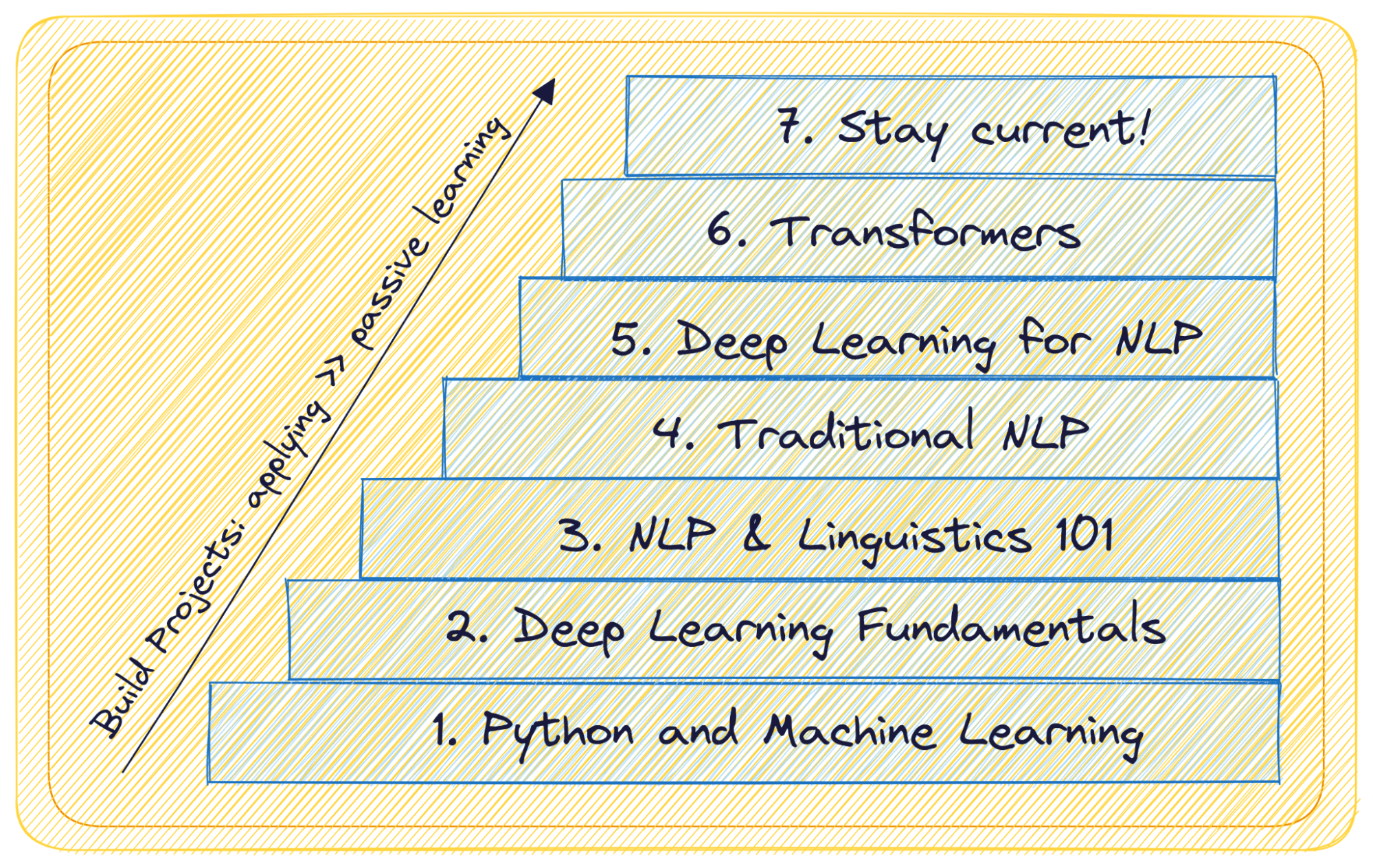
7 Steps to Mastering Natural Language Processing

7 Steps to Mastering Natural Language Processing
Image by Author

There has never been a more exciting time to get into natural language processing (NLP). Do you have some experience building machine learning models and are interested in exploring natural language processing? Perhaps you’ve used LLM-powered applications like ChaGPT—and realize their usefulness—and want to delve deep into natural language processing?

Well, you may have other reasons, too. But now that you’re here, here’s a 7-step guide to learning all about NLP. At each step, we provide:

  • An overview of the concepts you should learn and understand
  • Some learning resources
  • Projects you can build

Let’s get started.

Step 1: Python and Machine Learning

As a first step, you should build a strong foundation in Python programming. Additionally, proficiency in libraries like NumPy and Pandas for data manipulation is also essential. Before you dive into NLP, grasp the basics of machine learning models, including commonly used supervised and unsupervised learning algorithms.

Become familiar with libraries like scikit-learn, which make it easier to implement machine learning algorithms.

In summary, here’s what you should know:

  • Python programming
  • Proficiency with libraries like NumPy and Pandas
  • Machine Learning basics (from data preprocessing and exploration to evaluation and selection)
  • Familiarity with both supervised and unsupervised learning paradigms
  • Libraries like Scikit-Learn for ML in Python

Check out this Scikit-Learn crash course by freeCodeCamp.

Here are some projects you can work on:

  • House price prediction
  • Loan default prediction
  • Clustering for customer segmentation

Step 2: Deep Learning Fundamentals

After you’ve gained proficiency in machine learning and are comfortable with model building and evaluation, you can proceed to deep learning.

Start by understanding neural networks, their structure, and how they process data. Learn about activation functions, loss functions, and optimizers that are essential for training neural networks.

Understand the concept of backpropagation, which facilitates learning in neural networks, and the gradient descent as an optimization technique. Familiarize yourself with deep learning frameworks like TensorFlow and PyTorch for practical implementation.

In summary, here’s what you should know:

  • Neural networks and their architecture
  • Activation functions, loss functions, and optimizers
  • Backpropagation and gradient descent
  • Frameworks like TensorFlow and PyTorch

The following resources will be helpful in picking up the basics of PyTorch and TensorFlow:

  • PyTorch for Deep Learning
  • TensorFlow 2.0 Complete Course

You can apply what you’ve learned by working on the following projects:

  • Handwritten digit recognition
  • Image classification on CIFAR-10 or a similar dataset

Step 3: NLP 101 and Essential Linguistics Concepts

Begin by understanding what NLP is and its wide-ranging applications, from sentiment analysis to machine translation, question answering, and beyond.
Understand linguistic concepts like tokenization, which involves breaking text into smaller units (tokens). Learn about stemming and lemmatization, techniques that reduce words to their root forms.

Also explore tasks like part-of-speech tagging and named entity recognition.

To sum up, you should understand:

  • Introduction to NLP and its applications
  • Tokenization, stemming, and lemmatization
  • Part-of-speech tagging and named entity recognition
  • Basic linguistics concepts like syntax, semantics, and dependency parsing

The lectures on dependency parsing from CS 224n provide a good overview of the linguistics concepts you’d need. The free book Natural language Processing with Python (NLTK) is also a good reference resource.

Try building a Named Entity Recognition (NER) app for a use case of your choice (parsing resume and other documents).

Step 4: Traditional Natural Language Processing Techniques

Before deep learning revolutionized NLP, traditional techniques laid the groundwork. You should understand the Bag of Words (BoW) and TF-IDF representations, which convert text data into numerical form for machine learning models.

Learn about N-grams, which capture the context of words, and their applications in text classification. Then explore sentiment analysis and text summarization techniques. Additionally, understand Hidden Markov Models (HMMs) for tasks like part-of-speech tagging, matrix factorization and other algorithms like Latent Dirichlet Allocation (LDA) for topic modeling.

So you should familiarize yourself with:

  • Bag of Words (BoW) and TF-IDF representation
  • N-grams and text classification
  • Sentiment analysis, topic modeling, and text summarization
  • Hidden Markov Models (HMMs) for POS tagging

Here’s a learning resource: Complete Natural Language Processing Tutorial with Python.

And a couple of project ideas:

  • Spam classifier
  • Topic modeling on a news feed or similar dataset

Step 5: Deep Learning for Natural Language Processing

At this point, you’re familiar with the basics of NLP and deep learning. Now, apply your deep learning knowledge to NLP tasks. Start with word embeddings, such as Word2Vec and GloVe, which represent words as dense vectors and capture semantic relationships.

Then delve into sequence models such as Recurrent Neural Networks (RNNs) for handling sequential data. Understand Long Short-Term Memory (LSTM) and Gated Recurrent Units (GRU), known for their ability to capture long-term dependencies in text data. Explore sequence-to-sequence models for tasks such as machine translation.

Summing up:

    Word embeddings (Word2Vec, GloVe)

  • RNNs
  • LSTM and GRUs
  • Sequence-to-sequence models

CS 224n: Natural Language Processing with Deep Learning is an excellent resource.
A couple of project ideas:

  • Language translation app
  • Question answering on custom corpus

Step 6: Natural Language Processing with Transformers

The advent of Transformers has revolutionized NLP. Understand the attention mechanism, a key component of Transformers that enables models to focus on relevant parts of the input. Learn about the Transformer architecture and the various applications.

You should understand:

  • Attention mechanism and its significance
  • Introduction to Transformer architecture
  • Applications of Transformers
  • Leveraging pre-trained language models; fine-tuning pre-trained models for specific NLP tasks

The most comprehensive resource to learn NLP with Transformers is the Transformers course by HuggingFace team.

Interesting projects you can build include:

  • Customer chatbot/virtual assistant
  • Emotion detection in text

Step 7: Build Projects, Keep Learning, and Stay Current

In a rapidly advancing field like natural language processing (or any field in general), you can only keep learning and hack your way through more challenging projects.

It's essential to work on projects, as they provide practical experience and reinforce your understanding of the concepts. Additionally, staying engaged with the NLP research community through blogs, research papers, and online communities will help you keep up with the advances in NLP.

ChatGPT from OpenAI hit the market in late 2022 and GPT-4 released in early 2023. At the same time (we’ve seen and still are seeing) there are releases of scores of open-source large language models, LLM-powered coding assistants, novel and resource-efficient fine-tuning techniques, and much more.

If you’re looking to up your LLM game, here’s a two-part compilation two part compilation of helpful resources:

  • Top Free Courses on Large Language Models
  • More Free Courses on Large Language Models

You can also explore frameworks like Langchain and LlamaIndex to build useful and interesting LLM-powered applications.

Wrapping Up

I hope you found this guide to mastering NLP helpful. Here’s a review of the 7 steps:

  • Step 1: Python and ML fundamentals
  • Step 2: Deep learning fundamentals
  • Step 3: NLP 101 and essential linguistics concepts
  • Step 4: Traditional NLP techniques
  • Step 5: Deep learning for NLP
  • Step 6: NLP with transformers
  • Step 7: Build projects, keep learning, and stay current!

If you’re looking for tutorials, project walkthroughs, and more, check out the collection of NLP resources on KDnuggets.

Bala Priya C is a developer and technical writer from India. She likes working at the intersection of math, programming, data science, and content creation. Her areas of interest and expertise include DevOps, data science, and natural language processing. She enjoys reading, writing, coding, and coffee! Currently, she's working on learning and sharing her knowledge with the developer community by authoring tutorials, how-to guides, opinion pieces, and more.

More On This Topic

  • N-gram Language Modeling in Natural Language Processing
  • Getting Started with 5 Essential Natural Language Processing Libraries

  • Vision Transformers: Natural Language Processing (NLP) Increases Efficiency…

  • Natural Language Processing Pipelines, Explained
  • Applying Natural Language Processing in Healthcare
  • Linear Algebra for Natural Language Processing