Maximize Performance in Edge AI Applications

As AI migrates from the cloud to the Edge, we see the technology being used in an ever-expanding variety of use cases – ranging from anomaly detection to applications including smart shopping, surveillance, robotics, and factory automation. Hence, there is no one-size-fits-all solution. But with the rapid growth of camera-enabled devices, AI has been most widely adopted for analyzing real-time video data to automate video monitoring to enhance safety, improve operational efficiencies, and provide better customer experiences, ultimately gaining a competitive edge in their industries. To better support video analysis, you must understand the strategies for optimizing system performance in edge AI deployments.

Strategies for Optimizing AI System Performance Include

  • Selecting the right-sized compute engines to meet or exceed the required performance levels. For an AI application, these compute engines must perform the functions of the entire vision pipeline (i.e., video pre- and post-processing, neural network inferencing).

A dedicated AI accelerator, whether it be discrete or integrated into an SoC (as opposed to running the AI inferencing on a CPU or GPU) may be required.

  • Comprehending the difference between throughput and latency; whereby throughput is the rate that data can be processed in a system and latency measures the data processing delay through the system and is often associated with real-time responsiveness. For example, a system can generate image data at 100 frames per second (throughput) but it takes 100ms (latency) for an image to go through the system.
  • Considering the ability to easily scale AI performance in the future to accommodate growing needs, changing requirements, and evolving technologies (e.g., more advanced AI models for increased functionality and accuracy). You can accomplish performance scaling using AI accelerators in module format or with additional AI accelerator chips.

Understanding Variable AI Performance Requirements

The actual performance requirements are application dependent. Typically, one can expect that for video analytics, the system must process data streams coming in from cameras at 30-60 frames per second and with a resolution of 1080p or 4k. An AI-enabled camera would process a single stream; an edge appliance would process multiple streams in parallel. In either case, the edge AI system must support the pre-processing functions to transform the camera’s sensor data into a format that matches the input requirements of the AI inferencing section (Figure 1).

Pre-processing functions take in the raw data and perform tasks such as resize, normalization, and color space conversion, before feeding the input into the model running on the AI accelerator. Pre-processing can use efficient image processing libraries like OpenCV to reduce the preprocessing times. Postprocessing involves analyzing the output of the inference. It uses tasks such as non-maximum suppression (NMS interprets the output of most object detection models) and image display to generate actionable insights, such as bounding boxes, class labels, or confidence scores.

Maximize Performance in Edge AI Applications
Figure 1. For AI model inferencing, the pre- and post-processing functions are typically performed on an applications processor.

The AI model inferencing can have the additional challenge of processing multiple neural network models per frame, depending on the application’s capabilities. Computer vision applications usually involve multiple AI tasks requiring a pipeline of multiple models. Furthermore, one model’s output is often the next model’s input. In other words, models in an application often depend on each other and must be executed sequentially. The exact set of models to execute may not be static and could vary dynamically, even on a frame-by-frame basis.

The challenge of running multiple models dynamically requires an external AI accelerator with dedicated and sufficiently large memory to store the models. Often the integrated AI accelerator inside an SoC is unable to manage the multi-model workload due to constraints imposed by shared memory subsystem and other resources in the SoC.

For example, motion prediction-based object tracking relies on continuous detections to determine a vector which is used to identify the tracked object at a future position. The effectiveness of this approach is limited because it lacks true reidentification capability. With motion prediction, an object’s track can be lost due to missed detections, occlusions, or the object leaving the field of view, even momentarily. Once lost, there is no way to re-associate the object’s track. Adding reidentification solves this limitation but requires a visual appearance embedding (i.e., an image fingerprint). Appearance embeddings require a second network to generate a feature vector by processing the image contained inside the bounding box of the object detected by the first network. This embedding can be used to reidentify the object again, irrespective of time or space. Since embeddings must be generated for each object detected in the field of view, processing requirements increase as the scene becomes busier. Object tracking with reidentification requires careful consideration between performing high-accuracy / high resolution / high-frame rate detection and reserving sufficient overhead for embeddings scalability. One way to solve the processing requirement is to use a dedicated AI accelerator. As mentioned earlier, the SoC’s AI engine can suffer from the lack of shared memory resources. Model optimization can also be used to lower the processing requirement, but it could impact performance and/or accuracy.

Don’t limit AI Performance with System-level Overhead

In a smart camera or edge appliance, the integrated SoC (i.e., host processor) acquires the video frames and performs the pre-processing steps we described earlier. These functions can be performed with the SoC’s CPU cores or GPU (if one is available), but they can also be performed by dedicated hardware accelerators in the SoC (e.g., image signal processor). After these pre-processing steps are completed, the AI accelerator that is integrated into the SoC can then directly access this quantized input from system memory, or in the case of a discrete AI accelerator, the input is then delivered for inference, typically over the USB or PCIe interface.

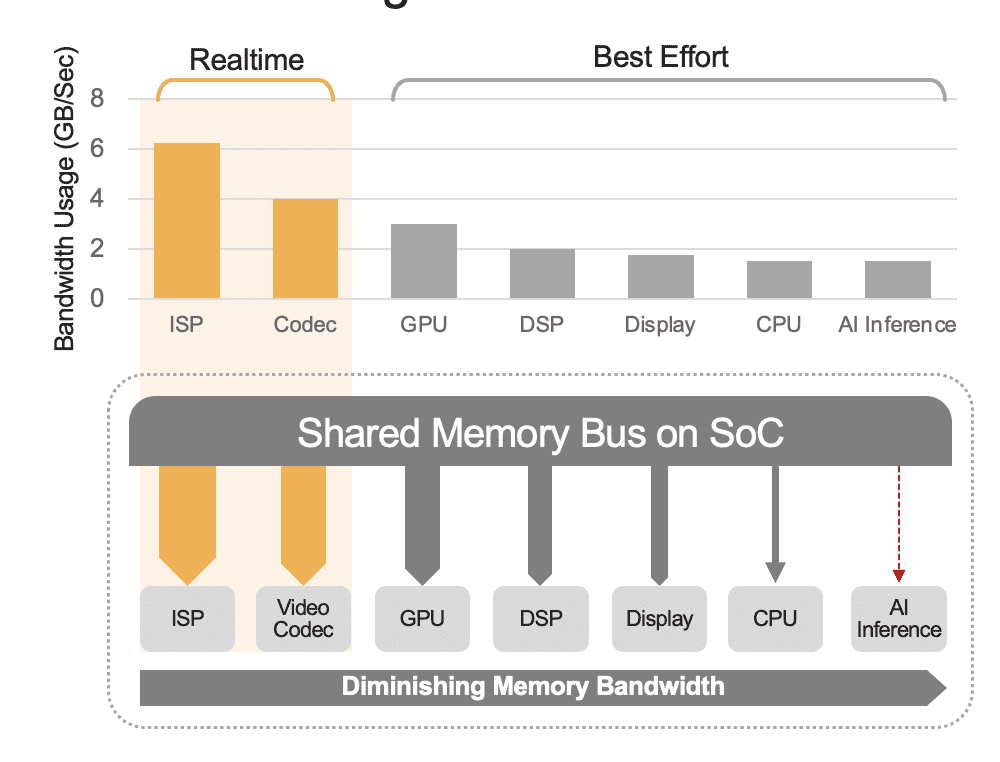
An integrated SoC can contain a range of computation units, including CPUs, GPUs, AI accelerator, vision processors, video encoders/decoders, image signal processor (ISP), and more. These computation units all share the same memory bus and consequently access to the same memory. Furthermore, the CPU and GPU might also have to play a role in the inference and these units will be busy running other tasks in a deployed system. This is what we mean by system-level overhead (Figure 2).

Many developers mistakenly evaluate the performance of the built-in AI accelerator in the SoC without considering the effect of system-level overhead on total performance. As an example, consider running a YOLO benchmark on a 50 TOPS AI accelerator integrated in an SoC, which mightobtain a benchmark result of 100 inferences/second (IPS). But in a deployed system with all its other computational units active, those 50 TOPS could reduce to something like 12 TOPS and the overall performance would only yield 25 IPS, assuming a generous 25% utilization factor. System overhead is always a factor if the platform is continuously processing video streams. Alternatively, with a discrete AI accelerator (e.g., Kinara Ara-1, Hailo-8, Intel Myriad X), the system-level utilization could be greater than 90% because once the host SoC initiates the inferencing function and transfers the AI model’s input data, the accelerator runs autonomously utilizing its dedicated memory for accessing model weights and parameters.
Maximize Performance in Edge AI Applications
Figure 2. The shared memory bus will govern the system-level performance, shown here with estimated values. Real values will vary based on your application usage model and the SoC’s compute unit configuration. Video Analytics at the Edge Require Low-latency

Until this point, we’ve discussed AI performance in terms of frames per second and TOPS. But low latency is another important requirement to deliver a system’s real-time responsiveness. For example, in gaming, low latency is critical for a seamless and responsive gaming experience, particularly in motion-controlled games and virtual reality (VR) systems. In autonomous driving systems, low latency is vital for real-time object detection, pedestrian recognition, lane detection, and traffic sign recognition to avoid compromising safety. Autonomous driving systems typically require end-to-end latency of less than 150ms from detection to the actual action. Similarly, in manufacturing, low latency is essential for real-time defect detection, anomaly recognition, and robotic guidance depend on low-latency video analytics to ensure efficient operation and minimize production downtime.

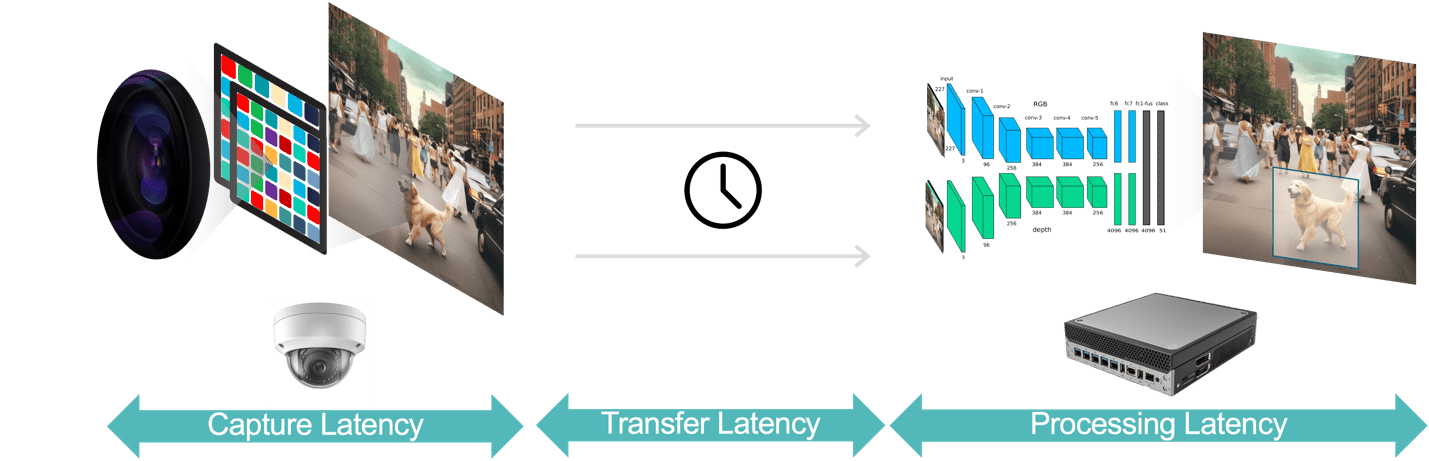
In general, there are three components of latency in a video analytics application (Figure 3):

  • Data capture latency is the time from the camera sensor capturing a video frame to the frame’s availability to the analytics system for processing. You can optimize this latency by choosing a camera with a fast sensor and low latency processor, selecting optimal frame rates, and using efficient video compression formats.
  • Data transfer latency is the time for captured and compressed video data to travel from the camera to the edge devices or local servers. This includes network processing delays that occur at each end point.
  • Data processing latency refers to the time for the edge devices to perform video processing tasks such as frame decompression and analytics algorithms (e.g., motion prediction-based object tracking, face recognition). As pointed out earlier, processing latency is even more important for applications that must run multiple AI models for each video frame.
Maximize Performance in Edge AI Applications
Figure 3. The video analytics pipeline consists of data capture, data transfer and data processing.

The data processing latency can be optimized using an AI accelerator with an architecture designed to minimize data movement across the chip and between compute and various levels of the memory hierarchy. Also, to improve the latency and system-level efficiency, the architecture must support zero (or near zero) switching time between models, to better support the multi-model applications we discussed earlier. Another factor for both improved performance and latency relates to algorithmic flexibility. In other words, some architectures are designed for optimal behavior only on specific AI models, but with the rapidly changing AI environment, new models for higher performance and better accuracy are appearing in what seems like every other day. Therefore, select an edge AI processor with no practical restrictions on model topology, operators, and size.

There are many factors to be considered in maximizing performance in an edge AI appliance including performance and latency requirements and system overhead. A successful strategy should consider an external AI accelerator to overcome the memory and performance limitations in the SoC’s AI engine.
C.H. Chee is an accomplished product marketing and management executive, Chee has extensive experience in promoting products and solutions in the semiconductor industry, focusing on vision-based AI, connectivity and video interfaces for multiple markets including enterprise and consumer. As an entrepreneur, Chee co-founded two video semiconductor start-ups that were acquired by a public semiconductor company. Chee led product marketing teams and enjoys working with a small team that focuses on achieving great results.

More On This Topic

  • Maximize Your Productivity as a Data Scientist by Organizing
  • Maximize Your Value With The 3rd Best Online Master’s In Data Science…
  • Pushing No-Code Machine Learning to the Edge
  • AWS Data Exchange Webinar: Maintain competitive edge with third-party…
  • The Three Edge Case Culprits: Bias, Variance, and Unpredictability
  • Machine Learning on the Edge
The Urgent Need for an Open GPU Infrastructure

Across the spectrum, from cloud service providers to AI labs and startups, there’s a fervent desire for access to the cutting-edge Graphics Processing Units (GPUs) available. However, the market is currently grappling with a scarcity of these high-end GPUs, which are primarily dominated by a single company, NVIDIA. This heightened demand from enterprises has led to a scarcity, resulting in soaring prices.

This is a challenge for the industry with many opining that the shortage could even stifle AI innovation. Hence, what the industry needs is competition. While NVIDIA, being a pioneer in this field, remains the leader, other GPU vendors such as Intel and AMD are making great strides and closing the gap between NVIDIA. However, choosing between multiple GPU vendors remains a complex task.

Need for an open software architecture

If your software or applications are optimised for one vendor’s GPUs, it may be challenging to transition to GPUs from one vendor to another without significant code modifications and testing. Additionally, GPU drivers and application programming interfaces (APIs) are vendor-specific. Applications that use these APIs, like CUDA or OpenCL, may not be compatible with GPUs from other vendors without significant modification. This can result in a lock-in period where switching GPUs becomes complex and costly.

Moreover, GPU vendors often provide software development kits (SDKs), libraries, and tools tailored to their GPUs. Developers may rely on these vendor-specific software components for tasks like GPU programming (e.g.CUDA for NVIDIA GPUs). Hence, switching to GPUs from a different vendor may require rewriting or adapting software to work with their software stack.

Hence, an open software infrastructure that facilitates the selection of GPU providers would undeniably be a significant boon to the AI community, Mohammed Imran K R, chief technology officer at E2E Networks, told AIM. Besides making it easier to choose between GPU vendors, an open software infrastructure would eliminate the constraints of long-term vendor lock-in, allowing AI researchers and developers to choose GPUs based on their specific requirements.

“It would also lead to a more competitive environment, pushing GPU manufacturers to innovate and offer better hardware options for AI workloads. It would also drive cost efficiency, as organisations could select GPUs based on both performance and cost, thus optimising their resources,” he said.

Furthermore, an open infrastructure would encourage collaboration within the AI community. Standardised tools and interfaces would make it easier for developers and researchers to work with different GPU platforms, potentially accelerating advancements in AI technology. “Additionally, this approach aligns with industry trends favouring open-source solutions and interoperability, empowering companies to construct adaptable technology stacks,” Shivam Arora, marketing manager at Compunnel told AIM.

Nonetheless, it is also essential to consider that developing and maintaining such an open infrastructure would require coordination from the GPU vendors, software developers and AI community. “While flexibility will be derived, performance optimisation could be an issue,” Sanjay Lodha, Chairman & Managing Director of Netweb Technologies told AIM.

OpenCL, ROCm and oneAPI

One could argue that OpenCL is one such open software architecture that already exists. Launched in 2009 by Apple and the Khronos Group to offer a standard for heterogeneous computing, OpenCL might be a viable option, but it does come with its own set of challenges. OpenCL allows you to write programs that can be executed on various GPU architectures from different vendors. “Even though OpenCL is gaining traction, it is still limited and may not provide the same level of optimisation as a vendor-specific tool like CUDA from NVIDIA,” Lodha said.

From an AI technology development standpoint, OpenCL currently has several drawbacks when compared to CUDA, with one critical aspect being that the majority of the latest research, models, and frameworks assume CUDA as the default GPU programming platform. “Additionally, achieving true cross-vendor portability can be challenging with OpenCL, as different GPU manufacturers implement it with varying degrees of compliance and performance,” Imran said.

In fact, a study comparing CUDA programs with OpenCL on NVIDIA GPUs showed that CUDA was 30% faster than OpenCL. Simultaneously, AMD’s ROCm, which is also an alternative to CUDA, is also making great strides. Interestingly, CUDA code can be converted to ROCm code using the HIP (Heterogeneous-Computing Interface for Portability) tools provided by AMD. Another interesting development in the last few years is oneAPI. While ROCm targets both AMD and NVIDIA GPUs, oneAPI applications can run on GPUs from Intel, NVIDIA and AMD, making both a viable option.

Moving away from CUDA

While enterprises might look into alternate vendors like Intel, AMD or even China-based Huawei, but for the industry to move away from CUDA could be challenging. “It involves rewriting or adapting existing code, potentially causing disruptions and requiring significant retraining of developers. However, the industry’s increasing interest in open-source alternatives indicates a growing willingness to embrace change. The difficulty of this transition ultimately depends on the specific needs and objectives of the company and its commitment to open-source principles,” Arora said.

Lodha on the other hand is a bit more sceptical. He believes it will be immensely difficult for the AI community to move away from CUDA towards a more open software architecture because many machine learning models have been trained using CUDA code. “This means that researchers and developers would need to rewrite their code in order to use a different GPU programming framework.”

Nonetheless, he believes that the benefits of moving to a more open-source GPU programming framework outweigh the costs. He further stated that an open-source framework would make it easier for researchers and developers to compare the performance of different GPUs and to choose the GPU that is best suited for their needs. It would also make it easier for vendors to compete with each other, which would lead to lower prices and better products.

“I think the best way to move from CUDA to a more open-source alternative is to transition gradually. Researchers and developers could start by writing new code in an open-source framework, such as OpenCL or RoCm. They could also start porting existing CUDA code to an open-source framework. There are already tools that are being used but still programming efforts are required.”

Imran also concurs. He thinks ensuring compatibility with other components of the software stack and achieving true cross-vendor portability is challenging at the moment. “However, in the long run, we believe that there will be alternatives and there are compelling reasons for it, including reducing vendor lock-in, promoting interoperability, and contributing to a more diverse GPU ecosystem.”

The post The Urgent Need for an Open GPU Infrastructure appeared first on Analytics India Magazine.

Gradient raises $10M to let companies deploy and fine-tune multiple LLMs

Gradient raises $10M to let companies deploy and fine-tune multiple LLMs Kyle Wiggers 7 hours

Gradient, a startup that allows developers to build and customize AI apps in the cloud using large language models (LLMs), today emerged from stealth with $10 million in funding led by Wing VC with participation from Mango Capital, Tokyo Black, The New Normal Fund, Secure Octane and Global Founders Capital.

Chris Change, Gradient’s CEO, co-founded the company alongside Mark Huang and Forrest Moret several months ago while working on AI products at Big Tech firms including Netflix, Splunk, and Google. The trio came to the realization that LLMs like OpenAI’s GPT-4 could be transformative for the enterprise, but believed that getting the most out of LLMs would require creating a reliable way to add private, proprietary data to them.

“Traditionally, teams have focused on improving a single, generalist model — and existing solutions support this model,” Chang told TechCrunch via email. “This is largely because it was too complex to manage multi-model systems. However, relying on a single model is suboptimal because there’s an inevitable tradeoff in task-specific performance.”

Chang, Huang and Moret designed Gradient, then, to make it easier for teams to deploy “specialized” and fine-tuned LLMs at scale. The platform runs in the cloud, allowing an organization to develop and integrate as many as “thousands” of LLMs into a single system, Chang says.

Gradient customers don’t have to train LLMs from scratch. The platform hosts a number of open source LLMs including Meta’s Llama 2, which users can fine-tune to their needs. Gradient also offers models aimed at particular use cases (like data reconciliation, context-gathering and paperwork processing) and industries (like finance and law).

Gradient can host and serve models through an API a la Hugging Face, CoreWeave and other AI infrastructure providers. Or it can deploy AI systems in an organization’s’ public cloud environment, whether Google Cloud Platform, Azure or AWS.

In either case, customers maintain “full ownership” and control over their data and trained models, Chang says.

“The barriers to development are far too high for AI today,” he added. “Building high-performance, custom AI is inaccessible due to the high complexity and cost of setting up the necessary infrastructure and developing new models. We’ve seen that the vast majority of businesses understand the value AI can bring to their business, but struggle to realize the value due to the complexity of adoption. Our platform radically simplifies harnessing AI for a business, which is a tremendous value-add.”

Now, you might ask — like this reporter did — what sets Gradient apart from the other startups engineering tools to pair LLMs with in-house data? And what about the many other companies already customizing LLMs for enterprise clients as a service? It’s a reasonable question.

Take a look at Reka, for example, which recently emerged from stealth to work with companies to build custom-tailored LLM-powered apps. Writer lets customers fine-tune LLMs on their own content and style guides. Contextual AI, Fixie and LlamaIndex, which recently emerged from stealth, are developing tools to allow companies to add their own data to existing LLMs. And Cohere trains LLMs to customers’ specifications.

They’re not the only ones. OpenAI offers a range of model fine-tuning tools, as do incumbents like Google (via Vertex AI), Amazon (via Bedrock) and Microsoft (via the Azure OpenAI Service).

Chang makes that case that Gradient is one of the few platforms that lets companies “productionize” multiple models at once. And, he asserts, it’s affordable — the platform is priced on-demand such that users only pay for the infrastructure they use. (Larger customers have the option of paying for dedicated capacity.)

But even if Gradient isn’t drastically different from its rivals in the LLM dev space, it stands to benefit — and is benefiting — from the massive influx in interest around generative AI, including LLMs. Nearly a fifth of total global VC funding this year has come from the AI sector alone, according to Crunchbase. And PitchBook expects the generative AI market to reach $42.6 billion in 2023.

“Gradient makes it much easier to develop complex AI systems that leverage many ‘expert LLMs,'” he said. “This approach ensures the AI system consistently achieves the highest performance for each task, all in a single platform … Our platform is designed to make it extremely easy for teams to deploy specialized LLMs, purpose-built for their specific problems, more effectively.”

Gradient claims to be working with around 20 enterprise customers at the moment with “thousands” of users combined. Its near-term goal is scaling the cloud backend and growing its team from 17 full-time employees to 25 by the end of the year.

Google Flexes Edge AI through Pixel 8

Google showed off their newest phone, the Pixel 8 and Pixel 8 Pro, at its Made by Google event. The new phone, which many tech enthusiasts say looks exactly the same as its predecessor, packs some impressive new features like a temperature sensor, an all new 48 MP camera and, the most innovative, the ‘On-device’ generative AI’.

The phone is powered by a Tensor G3 chip, which is a slightly modified version of Samsung’s Exynos 4 nm chipset.

The G3 will power the new ‘On-device’ generative AI–technology that is said to revolutionise the way we use our smartphones today.

On-device Gen AI will Change the Game

On-device generative AI, unlike conventional gen AI, generates context using the power and LLM already present in the device.

Gen AI on device will have access to user data which like photos, restaurant searches,, driving and texting patterns, and can generate solutions that are customised and helpful than generic responses from cloud-based gen AI like ChatGPT.

Another groundbreaking thing about this is that it can run completely without connecting to the internet. It has all the data it needs on the phone itself. This will also reduce latency issues as it doesn’t have to connect to a server.

Lot of companies use generative AI to help productivity, creativity and save time. Google has previously announced AI-enabled features for YouTube, and is constantly updating Bard to help it place itself in the ChatBot market. Now, its spotlight is on Pixel.

Google’s Paves the Way for On-device Gen AI

Google’s Pixel 8 will be the first phone to run on its generative AI models on-device. The G3 Tensor chip was built keeping in mind this feature. It is made to accelerate AI workloads. According to Rick Osterloh, SVP of devices and services at Google, it can run “distilled” generative AI versions of text and imaging.

“We’ve worked closely with our research teams across Google to take advantage of the most advanced foundation models and distil them into a version efficient enough to run on our flagship Pixel,” Osterloh said at the launch event.

The LLM running on Pixel 8 will power smart replies on Google’s keyboard. This will be done by using data already available on the device to analyse how the user usually replies to messages.

Using Gen AI,Google’s ‘Magic Eraser’ is enhanced and it can generate new pixels to fill in the spaces left on an image where anything was removed. It has also improved its Zoom where AI can intelligently better the details of the picture.

Now users can use the power of generative AI to summarise audio recordings and highlight important points.

The Tensor G3 chip allows the new phone to run twice as much machine learning on the device. The LLM on the Pixel 8 is 10 times more complex than the on the Pixel 6, Google said in a statement.

What has Apple been Doing?

The iPhone maker is rather silent when it comes to betting on generative AI. They have been known to keep quiet about their foray in this arena unlike Microsoft and Google which generally make a lot of noise when it comes to AI.

Apple has been integrating ‘Neural Engine’ in its new iPhones and watches, where the chip is twice as fast to process ML tasks. Neural Engine is what Apple calls the building blocks for its chips that accelerate AI functions, Reuters said.

Besides, Apple is silently working on “Ajax” an internal chatbox, to help employees in phone prototyping. They have also been working on Apple GPT, according to a report from Bloomberg. The company is known to integrate AI-powered technology on many applications like camera, iMessage and Siri.

Google, Microsoft, Apple among others are moving towards adopting generative AI to stay ahead, and capitalise on its salient features it offers. Because these IT giants know that, if they miss the bus on the AI-boom, it’s going to hurt them badly.

The post Google Flexes Edge AI through Pixel 8 appeared first on Analytics India Magazine.

5 Free Platforms for Building a Strong Data Science Portfolio

5 Free Platforms for Building a Strong Data Science Portfolio
Image by Author

In today's data-driven world, having a strong data science portfolio is crucial for landing your dream job or clients as a freelancer. Your portfolio allows you to showcase your skills, experience, and project work to potential employers or clients. While there are paid platforms out there for creating portfolios, you can build an impressive portfolio without spending a dime by leveraging free platforms.

As someone who is passionate about data science and helping others break into the field, I always encourage new data scientists to invest time in building a robust portfolio. A good portfolio typically includes links to data science projects you've worked on, a description of each project, details on your educational background, relevant work experience, and some basic info about yourself. This gives employers or clients a comprehensive view of your abilities.

The project descriptions in particular allow recruiters and clients to quickly assess your technical skills in data wrangling, analysis, modeling, etc. By providing this showcase of real-world experience, you can set yourself apart from other candidates. In this article, I will share the top 5 free platforms you can use to build and share your data science portfolio.

1. Kaggle

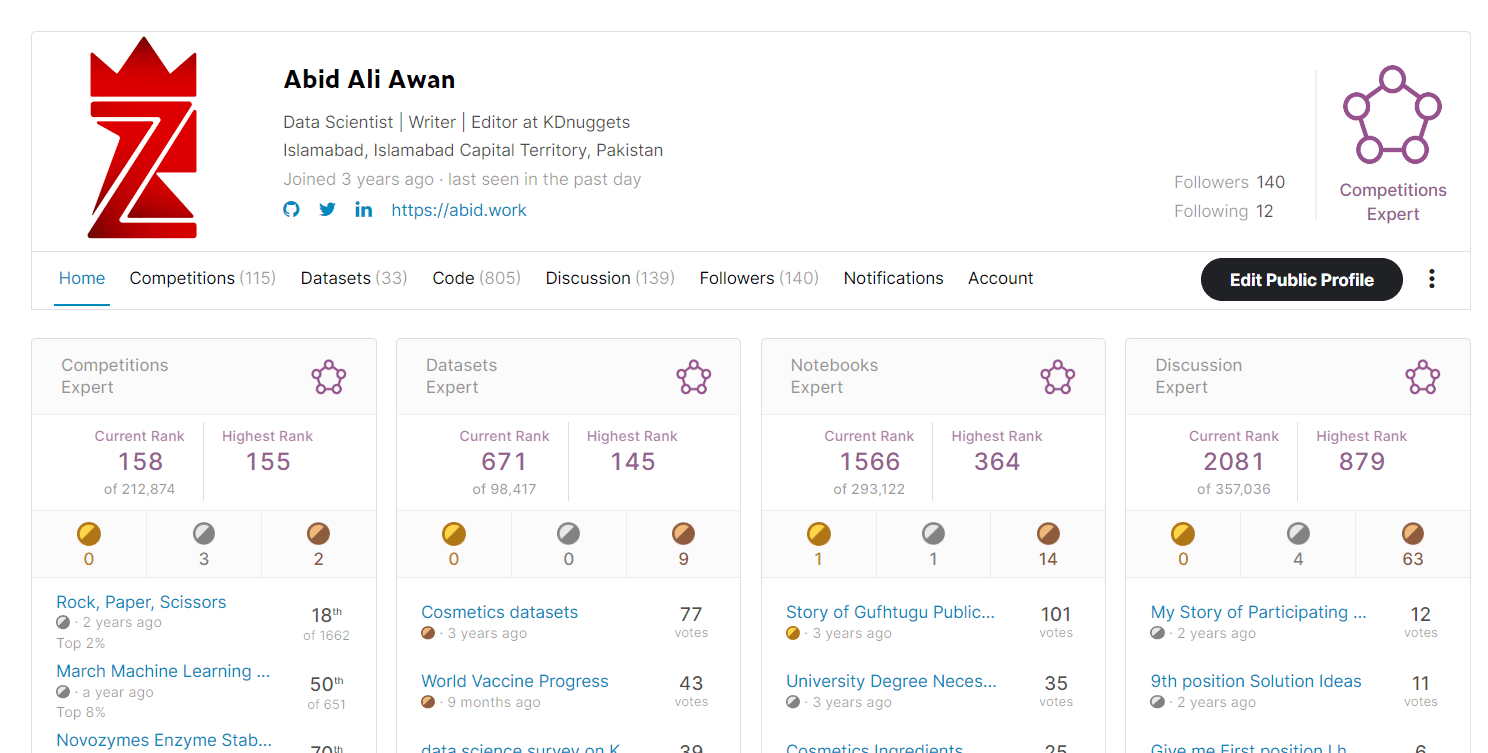
Kaggle is a top-notch platform for data science and machine learning. It is highly popular among students who are seeking to enhance their knowledge, discover datasets, and exchange ideas about specific problems. Additionally, it is an excellent platform to showcase your skills and grab the attention of hiring managers. To achieve this, all you have to do is participate in competitions, publish your notebooks/projects, and engage in community discussions.

The Kaggle progression system encourages data professionals to strive for excellence and improve their skills. By receiving upvotes, users can earn bronze, silver, and gold medals, which enable them to progress from Contributor to Grandmaster rank.

5 Free Platforms for Building a Strong Data Science Portfolio
Kaggle Portfolio 2. DagsHub

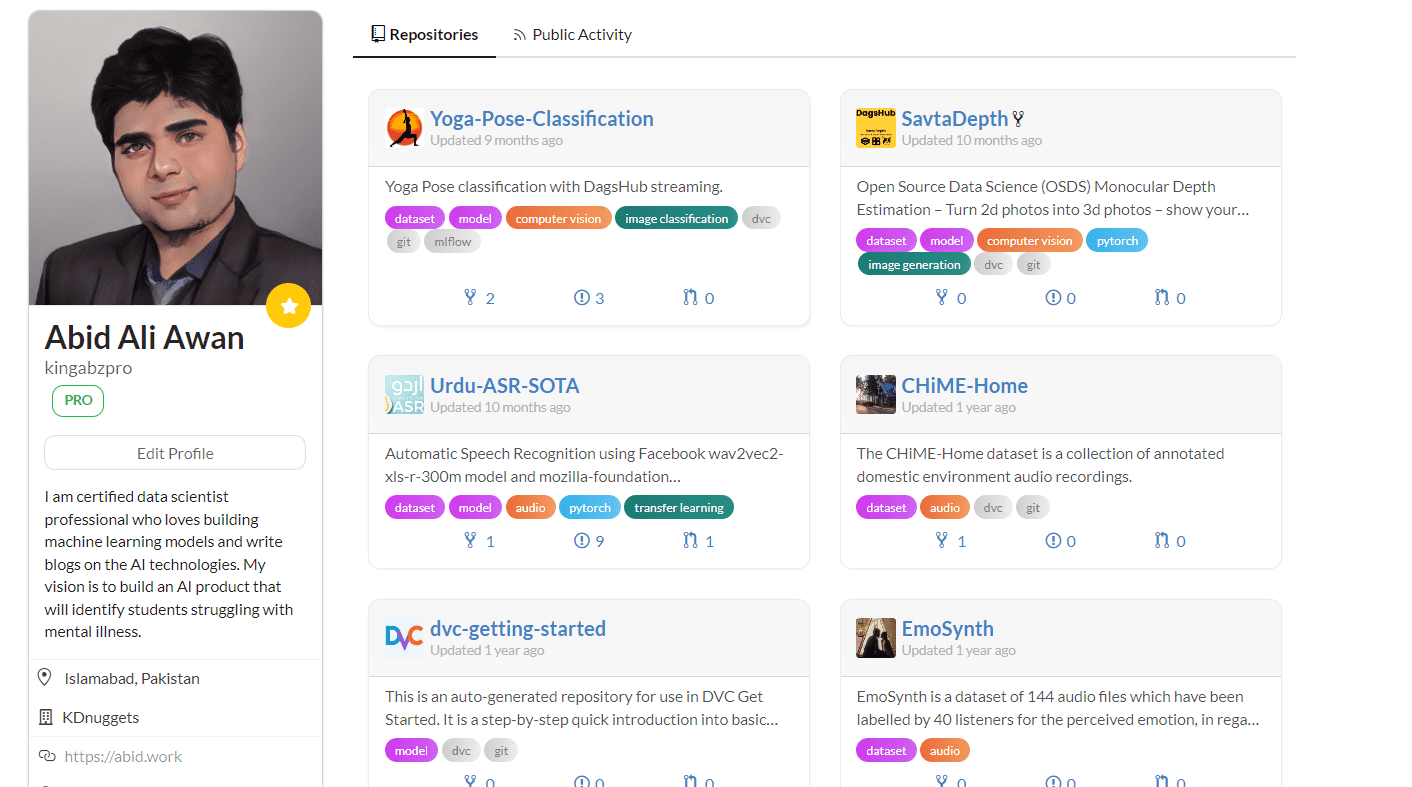
For data scientists looking to showcase their work in a sleek, user-friendly way, DagsHub is a must-try platform and a cooler sibling of GitHub. DagsHub allows you to do almost anything related to data science and machine learning model building, all in one centralized platform designed specifically for ML practitioners and students.

With DagsHub, you can easily host your data science projects complete with code, data ,models, visualizations, experiments, and documentation. It also makes deploying your machine learning models seamless.

5 Free Platforms for Building a Strong Data Science Portfolio
DagsHub Portfolio 3. LinkedIn

While LinkedIn may be thought of as a general professional networking platform, it can also serve as an excellent way for data scientists to showcase their projects, skills, and achievements. Given LinkedIn's huge user base and focus on careers, it provides a great opportunity to amplify your data science profile for connecting with potential employers or clients.

On LinkedIn, you can share links to your data science writing, such as technical blog posts that demonstrate your analytics chops. You can also post summaries of data science projects you've completed, whether academic, professional, or personal. Displaying certifications in data science or machine learning is another way to signal your technical capabilities.

The platform also allows you to connect with other data professionals, follow companies you're interested in, and join relevant groups. By actively engaging on LinkedIn, you increase your chances of being discovered for data roles or gigs. Essentially, it makes it easy for prospective connections and employers to find you based on your recent data science work and achievements.

5 Free Platforms for Building a Strong Data Science Portfolio
LinkedIn Portfolio 4. Medium

Medium provides an ideal blogging platform for data scientists to showcase their work and skills by writing about their projects and research. With its simple publishing format and vast readership, Medium is a great way to create a data science content portfolio that demonstrates your analytical abilities and communication skills.

On Medium, you can publish in-depth articles that walk through a data science project from start to finish. Explain how you approached the problem, processed and explored the data, developed and evaluated models, and interpreted the results. You can also write posts that detail your expertise in specific data science techniques and tools.

In addition, you can blog about recent data science research and news to exhibit your knowledge about the field. Writing about new algorithms, breakthrough models, ethical issues, and industry trends shows that you stay on top of advancements.

5 Free Platforms for Building a Strong Data Science Portfolio
Medium Portfolio 5. DataSciencePortfol.io

For data scientists seeking a straightforward way to assemble an online portfolio, datascienceportfol.io is a user-friendly, focused platform to showcase your work. Designed specifically for the data science community, datascienceportfol.io makes it simple to create a polished, professional data science portfolio in minutes.

With an intuitive interface, you can easily highlight your education, work experiences, skills, projects, and more on your datascienceportfol.io page. You can provide descriptions of your data science projects that explain the purpose, techniques used, and results. Links to GitHub repositories or live demos can also be included to provide evidence of your hands-on abilities.

5 Free Platforms for Building a Strong Data Science Portfolio
Datascienceportfol.io Portfolio Conclusion

Through my own experience as a data scientist, I've learned first-hand the importance of having a strong portfolio to demonstrate your skills and stand out from the crowd. A well-constructed data science portfolio allows you to put your best work on display for potential employers or clients.

I highly recommend taking the time to build up your portfolio leveraging the excellent free platforms now available. Curate your best projects, write compelling descriptions, and keep your portfolio updated as you take on new challenges. Treat your portfolio as an ever-evolving representation of your data science accomplishments.

Don’t wait until you desperately need a job to start thinking about your portfolio. Begin developing it early on and continue enhancing it throughout your career. Take advantage of platforms like Kaggle, DagsHub, LinkedIn, Medium, and DataSciencePortfol.io to create a robust, shareable portfolio.

A strong portfolio showcases your unique identity as a data scientist. It provides tangible evidence of the value you can bring to organizations seeking your analytics and machine learning skills. Invest in yourself by investing in your portfolio. You’ll be glad you did when exciting data science opportunities come knocking!
Abid Ali Awan (@1abidaliawan) is a certified data scientist professional who loves building machine learning models. Currently, he is focusing on content creation and writing technical blogs on machine learning and data science technologies. Abid holds a Master's degree in Technology Management and a bachelor's degree in Telecommunication Engineering. His vision is to build an AI product using a graph neural network for students struggling with mental illness.

More On This Topic

  • 7 Free Platforms for Building a Strong Data Science Portfolio
  • How to Build Strong Data Science Portfolio as a Beginner
  • Build a Data Science Portfolio that Stands Out Using These Platforms
  • 3 Free Platforms for Personalized ChatGPT Experience
  • KDnuggets News, September 21: 7 Machine Learning Portfolio Projects to…
  • 11 Best Data Science Education Platforms

Amazon’s Live Radio App Amp is Fading Out

Regrettably, Amp, Amazon’s bold entry into the live radio app arena, is about to shut down, according to a Bloomberg report. The announcement of this shutdown was made via an internal memo from Steve Boom, Amazon Music’s Vice President.

Initially positioned to rival the popular Clubhouse, Amp allowed users to take on the role of DJs, offering commentary alongside music tracks. However, the attempt fell short in attracting users to Amazon, as per documents obtained by Techcrunch in July revealing a meager user count in the single-digit thousands.

Despite the impending shutdown, the Amp app remains available for download and continues to host live radio broadcasts at the time of this report. The official expiration date of the service has not yet been determined.

Amp’s discontinuation follows a trend in the audio services sector, where platforms have had to pivot or shut down as user interest dwindled post-COVID. Clubhouse has plans to reinvent itself as a group messaging app, while Spotify previously closed its live audio feature, a fact highlighted by Boom in his memo to Bloomberg.

Amazon’s CEO, Andy Jassy, has been overseeing a review of the company’s expenses amid the challenging slow sales and an uncertain economy. The Amp division had experienced layoffs in 2022 and struggled to meet internal performance benchmarks, Insider reported.

Despite Amp’s closure, the room for live broadcasts within the music-streaming industry still holds potential. Amazon Music has introduced a range of shows and live-streamed performances on its sister platform, Twitch. Additionally, Apple Music maintains its official Radio network, while Stationhead, a startup credited with the idea that inspired Amazon Amp back in 2017 is still thriving.

The post Amazon’s Live Radio App Amp is Fading Out appeared first on Analytics India Magazine.

The Idea Was Never to Replace Humans

The Idea Was Never to Replace Humans

Elizabeth Weil from New York Magazine describes Sam Altman as ‘tone-deaf’ while profiling him as “Oppenheimer of Our Age” “For me, AGI is the equivalent of a median human that you could hire as a co-worker,” said Altman. He has said this on various occasions, but this time it is definitely put in the wrong light.

In a podcast with Lex Fridman, Altman said, “AI would be able to do anything that you’d be happy with a remote coworker doing just behind a computer, which includes learning how to be a doctor, learning how to be a very competent coder.” It seems Altman suggests that ‘median human’, that could be any of us for him, could be soon out of job. But at the same time, he has been promoting AI as a tool to augment human intelligence, not replace it.

Doing the work doesn’t mean replacing the worker

— Alan Cowen (@AlanCowen) October 1, 2023

Altman believes that it is the greatest technology ever created but, “we’ve got to be careful here. I think people should be happy that we are a little bit scared of this.” At the same time, during his trip to Europe, Altman said, “The discussion has been too focused on the negatives. It does seem the balance has gotten off given all the value that people are getting from these tools these days.”

Not too altruistic, but definitely careful

Even though it might seem like Altman’s sentences are blown out of proportion, recent developments narrate a very similar story. Suumit Shah, founder of Dukaan, who recently drew a lot of flak for firing 90% of his workers to replace them with an AI chatbot, is creating a lot of “fear mongering”. It seems like he is doing so to get some headlines the same as Emad Mostaque did by calling programming to be dead in five years.

But the 31-year old CEO of the e-commerce platform did not stop at just that.

In a recent interview with The Washington Post, Shah basically mocked the people that he has fired. “It was a no-brainer for me to replace the entire team with a bot,” Shah said about the customer service team that he fired because he thought a bot like ChatGPT would be able to do their job. Dukaan named its GPT-powered chatbot Lina.

Shah added that using these AI bots is like 100 times smarter, which is instant, and costs him like a 100th of what he used to pay to the support team. This is definitely similar to how people have been talking about replacing humans with AI bots.

Mark Cuban predicted six years back that a lot of jobs would become obsolete with AI and customer services are definitely taking a hit. On similar lines, Shah said that people who simply copy-paste responses are no longer safe. “That job is gone,” he said. “100 percent.”

When Altman talks about AI only augmenting human intelligence, he often overlooks that CEOs like Shah, who are just looking to cut costs might actually just cut-off jobs of people that can be replaced with simple AI chatbots. Altman has also testified in the U.S. Senate that he is scared of AI taking “some jobs”.

Love-hate relationship with AI

Though it is truly the time to boost up with AI, and not let it overwhelm us, Shah’s move is a clear example of what CEOs actually want, though it is not too altruistic.

While some CEOs are replacing their workers, other CEOs are scared of AI replacing them. According to a recent survey, 49% of the CEOs believe that AI models can replace their jobs almost entirely, and some say it would even be better than them.

In Altman’s own words from his blogs, he has “an absolutely delusional level of self-confidence.” This means that Altman can be a little too optimistic with what this technological revolution can do, but the brunt is being taken by the people being replaced by AI. How much of that can be attributed to him remains a question.

Does anyone fit his description of “normal” more than Sam Altman hisself?

— Per-Anders Edwards (@per_anders) October 2, 2023

Undoubtedly, Altman can be regarded as a person who cares about humanity. As the headline of the article goes, “Sam Altman Is the Oppenheimer of Our Age,” it shows that Altman’s views on what he is creating, and how it would be used in the future are not fully encompassing of the words he uses, and people merely call his vision “delusions of grandeur.”

On the other hand, CEOs like Shah, who are replacing people with AI, definitely have their heads in the cloud, while their feet are not so firm on the ground.

The post The Idea Was Never to Replace Humans appeared first on Analytics India Magazine.

How Oracle Plans to Kill Attrition in Indian IT

Oracle has cracked the code on how to get the best out of generative AI with its billion-dollar baby Cohere by its side. One of the key areas where Oracle is experimenting with generative AI is human resources. To streamline the HR department’s workflow, Oracle, earlier this year, introduced generative AI-powered features in Oracle Fusion Cloud Human Capital Management (HCM).

With HCM, HRs would be able to make decisions based on employee data. “Data in a system can now be utilised not only by managers and the organisation but also by the workers, making them feel valued,” said Chris Havrilla, vice president of product strategy Oracle, in an interaction with AIM at the Oracle CloudWorld 2023, Las Vegas.

With Oracle HCM, every employee will have access to upcoming opportunities within the company, leaving nothing hidden. For example, they will know which skills they must acquire to master any role. These recommendations will be based on employee data.

Havrilla believes that “democratising” data combined with capabilities of HCM would allow managers to uplift workers. Havrilla said that in any organisation, there are various types of personalities. Some individuals might be outspoken, while others may be quiet, but hardworking. Through the HCM tool, Oracle’s aim is to bring all employees on the same platform so that all of them feel valued within the company.

Furthermore, Havrilla shed light on the problem of talent retention within the company. She believes it is not often because of money that employees change their jobs frequently. “What we’re seeing from the data is that things that drive employees are feeling valued by their peers/organisation and the notion of belonging and growth,” she added.

Oracle to solve the attrition problem

In the recent past, Indian IT companies – the likes of Wipro, TCS, Infosys and Tech Mahindra – which also happen to be the customers of Oracle Fusion Cloud, have been dealing with high attrition rates, which now seems to be flattening to an extent.

Now, the average attrition rate for Indian IT companies stands at 20%. This means that one out of every five employees leaves their job every year. A factor that contributes to the high attrition rate in Indian IT companies is the lack of opportunities for growth and development, alongside stagnant work culture.

Havrilla pointed out that this happens because organisations struggle to understand their employees’ skills, predict future needs, and fill skill gaps. Similarly, employees find it hard to adapt to changing business needs because they often aren’t aware of growth opportunities due to lack of transparency.

“Everybody wants employees to be equipped with all the skills. We have to become more of a development marketplace,” she said, adding that (employers’) focus should be on bettering employees, rather than succumbing to hiring and layoffs.

To tackle this issue, Oracle earlier this year introduced ‘personalised coach’, Grow. It helps employees to identify and achieve their career goals, stay up-to-date on the latest skills and technologies, and network with other professionals in their field. In other words, increases retention for companies.

Citing Gen Z, who frequently switch jobs in search of better opportunities, Havrilla said that Oracle Grow will help enterprises retain Gen Z employees in the future as they will be able to figure out what suits them best.

“Grow is that personalised coach that is going through all the data, examining every single micro-action that happens in the organisation, updating in real-time, and understanding what impact that could have. It surfaces opportunities, connections, gigs, projects, learning, and all the different things,” explained Havrilla, pointing at Great Resignation.

Havrilla said that during the pandemic, individuals were figuring out what suited them best as organisations weren’t able to do it for them. She noted that even today, resignations continue to happen.

By providing employees with access to a wide range of learning resources and opportunities to connect with others, Oracle Grow can help employees to develop their skills and knowledge and advance their careers and can help organisations build a skilled and motivated workforce.

Towards Advisory Role

For quite some time now, HR’s role has been mostly around managing the human resource and running around for employees’ feedback, but now it’s transitioning towards mentorship and advisory roles, thanks to generative AI.

Havrilla believes that Oracle’s new offerings will enable HRs to become advisors who would further be able to assist the organisations in assessing the employee’s potential based on their performance data. “We really need HR to be the customer advocate for those employees, like red light, advocacy, advisory – all of these things,” said Havrilla

She further added that the process of performance and talent review would be automated with the help of HCM. “We can take off that burden of going out and collecting all this data for managers to create and do performance and talent reviews and let the system do that,” she added.

Their new role involves assisting employees in realising their full potential. With access to their data, HRs can now suggest specific growth opportunities for employees to pursue. “If you’re going to be an expert on anything. Be an expert on human behaviour. Be an expert on helping your leaders build great teams.” she concluded.

The post How Oracle Plans to Kill Attrition in Indian IT appeared first on Analytics India Magazine.

Google Assistant Gets a Generative AI Upgrade, Integrates Bard

After 7 years of launching Google Assistant, the company is giving the tool AI superpowers. Assistant for Bard debuted last evening during the Made for Google event to provide personalised assistance for users. Similar to its web counterpart, the chatbot will integrate the company’s existing apps like Docs and Gmail via the recently introduced extensions for Bard.

The Mountain-view based company states the latest Bard-powered tool is capable of helping users from planning a trip to picking out details from their inbox. For the content creators, the assistant can perform several tasks like generating relevant captions and trending hashtags to match the image.

Amid the ongoing dialogues about the company’s chameleon-like privacy policies, Google noted that the latest tool will let the users choose their individual privacy settings. Much like the rest of its AI-powered tools, Google has only let out a glimpse of Assistant for Bard without making it public. Google will make the tool available for early testers “soon” before it arrives on Android and iOS.

LLM integration is the magic ingredient missing in voice assistants that will take it from a somewhat helpful assistant to something that will more resemble the sci-fi concept familiar with.

By adding natural language understanding in these models asking complex, multi step queries, contextual conversations from previous discussions, even novel instructions it may not understand at first but can be explained and then remembered later can be done.

As per default the chatbot stores every interaction you have for 18 months. Apart from the prompts, Bard stores the users approximate location, IP address, and any physical addresses connected to the Google account for work or home. While these settings are activated, any conversation with Bard could be selected for human review.

While some Google fans are excited about the early “Jarvis”-style experiment, concerns have been raised as every conversation with Bard is tracked, logged and used to train the AI.

On a lighter note, some made fun of the branding saying ‘Assistant with Bard sounds like “Assistant to the Regional Manager” from Office.

The post Google Assistant Gets a Generative AI Upgrade, Integrates Bard appeared first on Analytics India Magazine.

What Can Java Do for Machine Learning?

Python and R are undoubtedly the most widely used languages for machine learning, and yet there is no dearth of developers who use Java for the same purpose. In fact, the language is slowly catching up with Python.

Meanwhile, LinkedIn and Oracle released Dagli and Tribuo frameworks, respectively, in 2020, which are also contributing to the Java Machine Learning Library (JavaML). The library gives users access to an extensive range of machine learning tools, apart from wrappers and APIs to integrate different frameworks to Java.

How Java is used in ML

Java is the go-to tool for many machine learning tasks. Users can create algorithms, build models, and easily launch applications with this language. The good thing about Java is its flexibility—it can handle everything from preparing data to making models.

Evelyn Miller, data Science lead at Magnimind Academy, said, “You should remember that Java gives support for development in any field you want, and data science is no different.”

Developers can use Java to make it easy for different parts of their app to talk to the ML features. Using third-party open source libraries and frameworks, users can leverage Java to implement what any other language does. For instance, the open source library TensorFlowJava can run on any JVM for building, training and deploying machine learning models.

Java also helps make the launch of machine learning applications smooth and offers libraries with specific tools for different tasks. A popular Java machine learning toolkit Weka provides a graphical interface for data preprocessing, modelling, and evaluation.

This library, developed by the University of Waikato, is as old as the language itself. However, it is still the most widely used library available and its popularity continues to rise because of its flexible data mining software.

Even big tech companies, including Google, Amazon, and Microsoft, are leveraging Java for machine learning. Google developers use Java for various applications, in fact, the entire Google Suite is built especially in Java code.

Apart from Weka, Apache Mahout is another framework widely used by enterprises like Facebook, LinkedIn, Twitter, and Yahoo. This is mostly because the framework is scalable. Complex data structures are manipulated in Java, which might not be possible in Python.

This can be done using different frameworks, for example, Mahout uses a distributed linear algebra while ADAMS (Advanced Data mining And Machine learning System) is a tree-like structure. This allows data manipulation in a variety of ways.

Adopting Java

There are 8-10 million Java developers in the world. Frank Greco, a senior consultant at Google, said at a talk, “All the big tech companies are interested to know more about using Java for ML.”

He, along with his peers, are working on promoting the language for ML. “Java’s role in ML will come as a revelation,” Greco said. His team engaged with major players, the likes of Twitter, Oracle, IBM, and Amazon.

The excitement for using Java in ML is unanimous across these industry giants — there is a genuine interest in exploring how Java could be harnessed for ML. “It isn’t a case of dismissing Java in favour of Python; instead, all are keen to understand Java’s potential in the ML realm,” he explained.

Greco built the JSR 381, a Java-friendly API for visual recognition and generic ML API which can be used for high-level abstractions. This API is not tied to any ML framework but developers can choose a framework that best suits their needs.

“The goal was to make visual recognition and ML easy to use by non-experts,” he said. Amazon implemented this API, and Greco says it is a good starting point for the language. He said, “I believe that with feedback from the community, we can move this forward.”

The post What Can Java Do for Machine Learning? appeared first on Analytics India Magazine.