AI is transforming organizations everywhere. How these 6 companies are leading the way

Abstract AI wave for different cases

2023 will be the Year of AI. Publications often mark a year with a name most closely associated with the biggest events of that year. Although AI has been with us for decades, generative AI has made AI into a productivity tool for everyday users.

Generative AI is changing everything: saving time, empowering people to produce work they otherwise don't have the skills for, opening new doors for opportunities, and more. But there's a dark side. Workers are worried employers might replace them with lower quality yet more inexpensive, AI-generated output.

There's also an accuracy problem. Generative AI systems are often wrong, and the more people rely on them, the less folks will double-check the results.

Also: We're not ready for the impact of generative AI on elections

Generative AI is just one aspect of AI currently being employed. We spoke via email to an army of executives and selected six stories that showcase a variety of AI applications and benefits already in play. These six spotlighted companies are leveraging AI to fundamentally transform traditional practices and norms in their respective industries. Their adoption of AI is leading to enhanced efficiencies, safety, customer experiences, and overall innovations.

The executives from these six companies told ZDNET how they were currently using AI, how AI has transformed their processes, and what benefits they were seeing. Special thanks to the executives for their time and in-depth answers.

Ericsson: AI in the telecommunications sector

  • Problem: Workplace injuries
  • AI technology: Computer vision
  • Benefit: Enhanced worker safety

Ericsson Safe Work is part of telecommunications giant Ericsson. Vivek Gnanavelu, founder and CEO of Ericsson Safe Work, tells us, "In telecommunications, where tower-related deaths outnumber those from general construction, Safe Work shields crews." He says this helps to eliminate workplace injuries and fatalities.

Despite safety protocols, many accidents occur when installing or maintaining cell towers, antennas, or radios. Since its inception, Gnanavelu reports, "We've seen remarkable AI-driven efficiencies with internal customers. Across key metrics, such as crew time saved, AI-detected non-compliances, and AI-assisted approval percentage for safety forms, significant efficiencies have emerged."

The company uses computer vision and AI models to validate worker compliance with Personal Protective Equipment (PPE) standards, such as helmets, gloves, vests, and work boots. It also provides live weather alerts and risk assessments. AI systems then provide continuous monitoring and live vital tracking, ensuring workers' readiness for tasks.

On a larger scale, the company's AI pattern recognition powers automated reporting and large-scale data analysis to learn and prevent future repeat incidents.

SoFi: AI in banking

  • Problem: Slow customer service
  • AI technology: Conversational AI
  • Benefit: Instant accurate, and empathetic responses

SoFi delivers member-centric digital financial services to help more than six million members "achieve financial independence."

We spoke to Aaron Webster, chief risk officer and global head of operations in Latin America, who tells ZDNET, "SoFi's AI solution is not a chatbot. It adopts an intelligent digital assistant model that comprehends customer emotions, enhancing experiences. Unlike basic chatbots, the assistant employs advanced natural language processing, providing a human-like interaction with real-time adaptation, seamless handoffs to agents when needed, and personalized responses."

SoFi integrated Cyberbank Konecta, a conversational AI engine offered by Galileo Financial Technologies affiliates, into their existing tech stack with the goal of enhancing their member experience with automated agents. SoFi is using this conversational AI engine to handle customer inquiries outside the hours their customer support team could offer alone.

Webster tells ZDNET, "We are leveraging conversational AI with empathy to tailor each member interaction in real time, infusing a human touch when needed, to enhance our member experience while reducing operational service costs by effortlessly managing common inquiries with AI."

He says that since deploying this solution, response time increased by more than 65%, and half as many customers dropped out from their chat interactions. He said that thousands of conversations are now resolved without the need for transfer to a human agent.

Hexagon: AI in the public safety sector

  • Problem: Vast public data
  • AI technology: Assistive AI
  • Benefit: Crime prevention and data analysis in real-time

Hexagon AB, headquartered in Stockholm, is a €5.2 billion multinational company that services municipalities. Kalyn Sims, chief technology officer for Hexagon's Safety, Infrastructure & Geospatial division tells ZDNET, "Data intelligence is valuable, but being able to share and act on that information in real-time is vital. Assistive AI is a key technology to help organizations manage the explosion of data we're facing today."

In this context, assistive AI helps human operators process vast amounts of data by sifting through it and identifying important patterns, correlations, or anomalies that might be missed or would take a long time for a person to identify.

Hexagon's Safety, Infrastructure & Geospatial division improves the resilience and sustainability of critical services and infrastructure. Their technologies transform complex data about people, places, and assets into meaningful information and capabilities for better, faster decision-making in public safety, utilities, defense, transportation, and government.

Hexagon uses assistive AI to help agencies fully realize real-time data, according to Sims, "Before the information becomes irrelevant." Assistive AI uses advanced statistics and machine learning to mine an organization's operational data to detect anomalies that require immediate action.

For example, assistive AI helps police, fire, and EMS to detect and respond to complex emergencies sooner. It works in the background and aids 911 dispatchers by seeing patterns and determining if public safety events are linked. Because it is assistive, it only alerts dispatchers of the anomalies, leaving the decision-making about resource deployment up to humans.

The public safety sector is a high-stress environment, and the industry is currently suffering from staffing challenges. With more calls for service from the public and more data coming in from surveillance cameras, traffic sensors, IoT devices, and more, users can become overwhelmed.

New collaborative AI capabilities, according to Sims, can solve that problem. By using smart technologies to update legacy systems, it takes the pressure off overworked crime analysts and dispatchers by sifting through incoming real-time data, looking for trends and anomalies, and providing users with alerts in the moment.

The net result, says Sims, is that "This autonomous initial assessment resulting from assistive AI technology is much more efficient, effective and scalable than the manual monitoring and analysis of information from multiple calls from the public, sensors, and alarms."

Revolear: AI in B2B sales

  • Problem: Complex B2B sales
  • AI technology: AI optimization
  • Benefit: Transformed sales process

Revolear provides tools for very complex B2B sales. Founder and CEO Raja Singh says, "Is a cutting-edge digital deal platform infused with AI that transforms the way companies structure, propose, negotiate, and approve complex business solutions."

Revolear uses AI in its product as well as in its development process.

The business-to-business selling process can often take months for complex deals, and involve many twists and turns. Not surprisingly, there are ample opportunities to apply AI in many of its forms. Revolear uses generative AI to distill customer requirements and generate tailored, role-specific sales proposal text. They use machine learning to predict optimal discount levels and other deal terms, and create weighted metrics around deal momentum and approval probabilities.

Revolear's development team uses the Copilot tools in GitHub to help with coding. Singh says it doesn't replace the engineer, but can complete a line or contribute a code snippet. He says, "we also use generative AI to refine our marketing copy. We don't use it to build the storyline, but it can proofread and improve sections. One really useful application is generating fictitious demo data. Our products look better with realistic data, and ChatGPT can produce it at high volumes."

Singh reports that AI has reduced the friction on one of the hardest parts of the sales process. "One of the most nerve-racking decisions a sales team has to make is setting their initial asking price. Historically, the sales team relies on their experience. Now, we've built machine learning models with as few as 50 rows of data to predict final prices."

Abpro: AI in biopharmaceuticals

  • Problem: COVID-19 treatment
  • AI technology: AI-driven discovery
  • Benefit: Speeds drug experimentation process

Abpro is a biotechnology firm developing monoclonal antibody therapies in the cancer, eye care, and infectious disease spaces. They have developed one of the key treatments for COVID-19.

Abpro CEO and co-founder Ian Chan explains that AI is helping in the fight against COVID. "A continuous challenge with COVID-19 is the inability of treatments to keep up with changing variants. Abpro is deploying AI to do just that."

With AI, he says, the company is able to predict the evolution of the spike protein, as well as other regions of the virus, making for a more future-proofed treatment. Abpro is able to develop monoclonal antibodies without solely relying on in vitro experiments by combining tested biochemical measurements and antibody generation from real experiments, then utilizing that data to train the antibody's predictive capabilities and enable it to keep up with evolving variants.

He tells ZDNET that AI can assist in the identification of new drug targets, designing new drugs, and accelerating the overall drug discovery process. AI is streamlining complex tasks such as expediting the design and optimization of antibodies.

Using machine learning models, companies can now enhance specific antibody properties including how an antibody binds to a target, as well as its solubility, immunogenicity, and yield. AI is also being used to predict pathways for producing theoretical drug compounds, with the ability to suggest modifications to those molecules, which would make them easier to manufacture.

The time savings using AI are considerable. Traditionally, monoclonal antibodies were discovered through experimental techniques, such as the hybridoma technique, or by using a phage display. According to Chan, "By harnessing the power of AI, biopharma companies, like Abpro, can cut an approximate eight-week experimental process into a single afternoon."

The Digital Panda: AI in a creative agency

  • Problem: Manual design mockups
  • AI technology: Midjourney and ChatGPT
  • Benefit: Rapid design mockups

The Digital Panda is a small creative agency developing branding, web, mobile, and motion design. The company uses off-the-shelf cloud AI tools like Midjourney and ChatGPT to help with their creative process. They use Midjourney to create rapid high-fidelity storyboards for motion. They also use ChatGPT on their development team to support coding and bug fixing.

Ilya Kroogman, The Digital Panda founder, tells ZDNET, "We utilize LLMs to improve our copywriting output and automate the way we post our own work on various social platforms."

Kroogman adds, "Using Midjourney has also allowed our creative team to rapidly streamline our ideation phase for mood board and storyboard development. Previously, we would need to spend hours on ideation, sketching, and conceptualization, where now we can simply tell the model our ideas, then iterate almost instantly."

Fundamentally, Kroogman credits generative AI with helping, "Make our organization feel and operate as a much larger one."

Organizational transformation through AI

Executives are also weighing in on the sudden adoption of generative AI among organizations. "Generative AI is a fascinating technology but still very new," says Jiani Zhang, executive vice president and chief software officer of Capgemini Engineering — its parent company Capgemini is a multinational IT services and consulting firm with offices in at least 50 countries.

"Many companies are experimenting with GenAI for its potential to accelerate the development of use cases across knowledge management, support, and even code generation," she tells ZDNET. "Despite the growing prominence of GenAI, degrees of adoption vary — primarily because of reservations trusting the integrity of the generated content."

Zhang provided three recommendations for adopting AI into organizations:

  1. New processes must be put into place to navigate the regulatory and ethical aspects of AI development with code generation.
  2. Organizations and users alike must be able to trust the generated content, and therefore experts must ensure the validity of the large language models (LLMs) being rolled out.
  3. This will require implementing new processes during the development lifecycle with methods for validation of the generated content.

Meanwhile, Slalom, a business and technology consulting company with offices on four continents surveyed two hundred C-suite executives from across the US on their 2023 AI investments and 2024 sentiments. The comprehensive survey of business adoption shows how organizations are using AI now and where they may go in the future. The results also showed two conflicting statistics.

First, the survey found 71% of executives don't fully comprehend the scope of tasks Al can effectively augment or automate in their organizations. Those tasks include work in the following sectors:

  • Organization and Workforce: Adapting workforce and culture for AI collaboration.
  • Technology and Data: Essential tools, platforms, and datasets for AI.
  • Business and Customer Value: Enhancing customer experience and market value with AI.
  • Strategy Alignment and Orchestration: Integrating AI into business strategy and operations.
  • Security, Ethics, and Governance: Ensuring ethical, secure, and governed AI practices.

Second, while executives don't fully understand where this AI thing is going, 87% have begun AI adoption or transformation initiatives.

"Most companies we talk to have already made AI investments such as AI chatbots for customers or internal training to improve how employees work, says Tony Ko, managing director of business development and advanced analytics at Slalom Consulting. "These investments are table stakes for them to remain competitive."

But Slalom's survey also shows that 61% of executives say their companies are struggling with the pace of AI advancement.

"The biggest challenge is knowing where to go next. Leaders are asking for help to build their longer-term visions and determine the investments they need to make to stand out from their competitors," Ko added.

Consequently, Slalom's survey revealed a full 70% of executives plan to increase resource and budget allocation toward AI in 2024.

This encapsulates how AI is not just an add-on but a pivotal force driving change, revolutionizing sectors, and redefining what's possible in both traditional and new-age industries.

What does it all mean?

If you think AI is big in 2023, it will be huge in 2024.

Ali Minnick, Slalom's General Manager of Global Business Advisory Services, tells ZDNET, "Many companies didn't budget for large-scale AI transformation efforts in 2023 given the concerns about the possible recession. Those concerns haven't changed, but many are preparing to spend more on AI in 2024. Their fear of falling behind outweighs the economic uncertainty."

That certainly holds true across the six companies we spotlighted. Across Ericsson, SoFi, Hexagon, Revolear, Abpro, and The Digital Panda, here are the common themes related to their AI use:

Enhanced efficiency: Both SoFi and Hexagon utilize AI to speed up traditionally manual processes. For SoFi, this means faster customer service, while for Hexagon, it translates to quicker data processing for public safety.

Improved decision-making: Hexagon's assistive AI provides insights for public safety agencies, aiding in making informed decisions that can prevent potential risks or threats.

Customer-centric solutions: SoFi's integration of a conversational AI platform to enhance customer service and Revolear's optimization of the B2B sales process both demonstrate a commitment to improving customer or client experiences.

Safety and compliance: Two companies, Ericsson and Hexagon, stand out for their commitment to leveraging AI for safety. Ericsson focuses on workplace safety while Hexagon emphasizes public safety and crime prevention.

Innovation in traditional sectors: Abpro's AI-driven approach to drug discovery in the biopharmaceutical industry and Ericsson's application of AI in telecommunications highlight the transformative potential of AI in long-established sectors.

Adaptive learning and evolution: The Digital Panda's use of AI for rapid design mockups exemplifies how AI-driven solutions can evolve and adapt to provide better results over time.

Challenging the status quo: Companies like Revolear and Abpro are using AI to redefine norms in their industries, from B2B sales to drug discovery.

Holistic solutions: Ericsson's comprehensive approach to ensuring worker safety, by integrating AI, computer vision, and IoT, demonstrates a holistic use of technology to address complex issues.

In essence, these themes emphasize the transformative potential of AI in diverse sectors, from banking to biopharmaceuticals, and its role in driving efficiency, safety, and innovation.

Kevin McClelland, general manager of Slalom Build sums up the situation perfectly, saying, "Many organizations find adopting generative AI to be like trying to jump on a moving train while blindfolded. They feel the urgency to move but it's hard to do, and they're not sure if it will even take them in the right direction."

It is clear that the moving train isn't going to stop. We've reached a massive tipping point in what AI can do for individuals and businesses. Keep reading ZDNET and Special Features articles like this one, so we can help you take off the blindfolds and see clearly where this technology is heading, focus on making the right decisions, and give you a clear heads up for pitfalls ahead.

What do you think? How has your business adopted AI? Let us know in the comments below. And be sure to read other articles in this Special Feature. Each one tackles the issue from a different perspective and has powerful insights you can integrate into your strategy right now.

You can follow my day-to-day project updates on social media. Be sure to subscribe to my weekly update newsletter on Substack, and follow me on Twitter at @DavidGewirtz, on Facebook at Facebook.com/DavidGewirtz, on Instagram at Instagram.com/DavidGewirtz, and on YouTube at YouTube.com/DavidGewirtzTV.


Generative AI in commerce: 5 ways industries are changing how they do business

Shopping carts in a trend line up

Generative artificial intelligence (AI) has the potential to transform how different industries operate. To emphasize the positive effects that AI could have on operations, Mastercard released its "Signals" report on the shape of commerce in the age of generative AI.

Generative technology, such as ChatGPT, can transform commerce in a range of ways, including knowledge distribution, HR and training, code writing, legal, cybersecurity, treasury, marketing, customer interfaces, and service delivery, according to the report.

This wide applicability means companies are starting to adopt AI at higher rates than they have in the past, with the report stating that 50% of companies used AI for at least one application in 2022 compared to just 20% in 2017.

"Over the next two to three years, generative AI will power hundreds of capabilities across business and consumer applications," said Mastercard.

Also: What is Amazon Bedrock? 4 ways it can help businesses use generative AI tools

The company identifies five areas of commerce that could benefit from the use of AI and presents possible use cases for AI in each industry. Here are the highlights of the report.

1. How AI is changing enterprise

AI can help enterprises by distributing company knowledge and insights across organizations in real time, regardless of size and scale.

Knowledge sharing is often a challenge for organizations, especially larger ones, because there is so much content and information that needs to be communicated across the lines of business, and finding an efficient way to do so is difficult.

Also: Can AI code? In baby steps only

The report suggests replacing traditional enterprise search engines, which can be overwhelming to use due to their vast resources, with a generative AI search engine. This engine would allow employees to find the exact answer with just one prompt.

Generative AI can be a medium that helps bring large quantities of content to employees in a digestible and fast way. Imagine a chatbot that could give you access to all of your company's resources, including training content, internal communications, reports, and more. Consulting firms such as BCG, EY, KPMG, Accenture, and McKinsey already have projects of that nature underway.

2. How AI is changing finance

Whether you work in finance or have interacted with finance operations, you know that the financial ecosystem includes many obstacles that can make the execution of tasks difficult to complete.

The finance industry could use generative AI's quantitative abilities to simplify complex tasks, such as wealth management.

The report outlines how generative AI can streamline and declutter key processes, including interacting with banks, insurance companies, and other institutions by acting as a personal wealth manager.

Another example of the potential impact of generative technology is an AI conversational engine that could help a user formulate a college savings plan, procure loans, and complete other financial tasks for users who may need assistance, according to the report.

These kinds of tools could help level the playing field for people who don't have access to financial services and could then benefit from AI's personalized recommendations.

Also: AI, trust, and data security are key issues for finance firms

With the proper data protections, generative AI can even be directly integrated into bank accounts, investment portfolios, and more, so the technology provides an all-encompassing view of an individual's financial life.

3. How AI is changing small businesses

A major challenge that small businesses face is a lack of resources. Nearly every step of a business's operation involves some cost, whether it's labor, time, or equipment. AI can double as an on-demand worker who is always prepared to assist and help with time-intensive tasks.

For example, AI can help a small business owner develop and deploy a social media strategy, a task that would have likely fallen down the priority list for an owner who lacks time and resources.

Also: Why companies must use AI to think differently, and not simply to cut costs

AI can also help small business owners perform tasks in areas they lack expertise or where they want to learn more. For example, someone who has never built an app or created a product could turn to AI for instructions on what to do. AI could even provide in assistance carrying out the task itself.

4. How AI is changing retail

Electronic commerce has come a long way since its birth in the 1990s. Today, you can find almost every product you can think of and many different variations of it online.

Yet there are so many online shopping options you can use that finding products can sometimes become an overwhelming process for users. Customers can struggle to find what they are looking for and businesses can lose out on potential transactions.

AI can help reduce this strain by acting as a personal shopper for users. An AI-powered, personal-shopping consultant can assist users and help them find precisely what they need, while connecting them to retail offers they might have otherwise missed.

Also: Machine learning helps this company deliver a better online shopping experience

Shopify, Google, Microsoft, and Amazon are examples of companies that have either deployed or are working on such integrations.

5. How AI is changing travel

Just as AI can boost retail processes, AI can connect prospective travelers with all the resources they need to book their getaway.

Also: How to use ChatGPT to plan a vacation

AI could double as a travel agent, helping travelers make educated trip-planning decisions. This tool would help users connect more easily to the resources they need. AI could also help travel companies, such as airlines and hotels, to make transactions. Travel platforms are already working on developing this type of AI-enabled experience for customers.

Bottom line: Get ready for more change

Generative AI will transform commerce. While we're only seeing the first impact of this AI-enabled revolution, it's already clear that the interaction between companies and their customers is set to change forever during this decade and beyond.

Every enterprise plans to increase AI spending next year

mit-tech-review-ai-survey-splash-image

A survey of 600 companies globally released Thursday, conducted by the MIT Technology Review's Insights group, found that all of the companies' executives plan to increase spending in the coming year "on modernizing data infrastructure and adopting AI."

The study, sponsored by data warehousing firm Databricks, was conducted from June through August of this year, and surveyed companies with half a billion or more in annual revenue, based in 12 countries in North America, Europe, Asia-Pacific, and the Middle East, said MIT Tech Review.

Also: Hurtling toward generative AI adoption? Why skepticism is your best protection

Executives surveyed were mostly C-level executives, in positions such as chief information officer, chief data/analytics officer, head of IT, AI, or data engineering, and similar roles.

The report's overall conclusions:

  • Enterprise adoption of AI is ready to shift into higher gear.
  • Technology executives are moving quickly to deploy or experiment with it.
  • Organizations are sharply focused on retooling for a data and AI-driven future.

The companies generally have very upbeat expectations, note the report's author, Denis McCauley, editor Teresa Elsey, and publisher Nicola Crepaldi. "Eighty-one percent of survey respondents expect AI to boost efficiency in their industry by at least 25% in the next two years; one-third say the gain will be at least 50%," writes McCauley.

The survey emphasizes that the firms also expect artificial intelligence programs to offer new routes to products and revenue. "While 70% of survey respondents say it's very important for AI projects to help reduce costs, the same percentage say it's very important that these projects enable new revenue generation (although there is variation across industries and geographies)," the report states. Executives clearly do not consider this a time to batten down the hatches."

Also: Why companies must use AI to think differently, and not simply to cut costs

Almost half of the firms surveyed said they will boost spending on data infrastructure and AI by more than 25%, the survey notes.

The survey includes some examples from executives who were willing to go on the record. For example, Jon Francis, the chief data and analytics officer at car maker General Motors, relates that:

"With advances in AI and machine learning and the investments we've made, we're better able now than a few years ago to create efficiencies […] "We'll do so in the back office with HR chatbots, on the factory floor with predictive maintenance, and in IT operations by scaling and productionizing software development."

At the US Transportation Security Administration, CIO Yemi Oshinnaiye told the author, "LLMs are definitely in our future. It's very important from a customer engagement perspective that we are able to leverage things that are going to become normal," referring to large language models, LLMs, a form of generative AI program.

Also: The best AI chatbots: ChatGPT and alternatives

The survey has a wealth of data points regarding companies' priorities. For example, among the top use cases for generative AI, in order of importance, respondents cited "Personalization and customer experience," "Supply chain optimization," and "Quality control."

The study also cites a number of differences globally. For example, in terms of readiness to deploy generative AI, Japan is well ahead of the US, with 35% of respondents saying their firm is "investing and adopting it" compared to just 26% of US respondents.

Regarding the increased spending, the majority of the respondents perceived that peers in their respective industries are moving ahead with spending at a fast pace, the survey notes.

Also: Businesses need a new operating model to compete in an AI-powered economy

"Most survey respondents perceive similar actions by their peer organizations — 60% of survey respondents say AI adoption in their industry is "fast" or "very fast," the survey notes.

"Though the dynamics vary somewhat by industry, the trend is that AI adoption in the enterprise is moving ahead at pace, and data modernization to support it remains a priority."

Artificial Intelligence

Hungryroot founder debuts Every, an AI-powered app for self-reflection and human connection

Hungryroot founder debuts Every, an AI-powered app for self-reflection and human connection Sarah Perez @sarahintampa / 7 hours

As founder and CEO of healthy grocery delivery service Hungryroot, Ben McKean has been investigating the power of AI technologies to improve his business. But with the launch of his new side project — an app called Every — McKean wants to explore the use of AI to help people establish deeper relationships with themselves and others and to find common ground.

Currently structured as a non-profit, Every’s iOS app leverages AI technologies to create “thought-provoking games” aimed at self-discovery.

For example, all users begin with a game called “Inner Odyssey” that challenges you to pick a photo that best represents the place you’d like to explore, from options like a cobblestoned city street, a natural landscape featuring a river and trees, a fantastical castle, or a remote island. You’re then asked follow-up questions like who would you travel with, what role would you play, what advice for your trip resonates with you best, and so on.

Image Credits: Every

As you play, the app shows you how others respond to the same question, and when you finish you’re prompted to see who among your connections — that is, your uploaded contact list — also answered similarly.

McKean says the idea to create an app focused on human connection was an idea that’s been brewing for some time — particularly after the Covid pandemic led to a world where everyone felt more disconnected than ever.

“There’s a very large number of people who feel disconnected from even people very close to them,” he explains. “58% of Americans report feeling like no one in their life knows them well, which was just a shocking stat. And 70% of Americans feel that distrust is hurting American society,” McKean notes, citing various stats on the loneliness epidemic and connection.

In addition, McKean says he also feels impacted by these issues through his own entrepreneurial experiences leading teams and finding how difficult it can be to form connections at work. In fact, McKean foresees the potential to tweak Every’s model for use in the workplace to help colleagues bond, but with fewer personal questions.

Despite the app’s focus on human connectivity, it may be a surprise, then, to learn that Every’s games were created using AI — specifically, by training large language models and leveraging technology from OpenAI and Midjourney. In addition to scratching his own itch, so to speak, McKean said this process helped him to develop his AI skills, which could impact his main business at Hungryroot, which is a heavily AI-driven company.

All the games in the app are inspired by a topic or a person, which is the initial input for the AI.

For the latter, the company is partnering with inspirational leaders for some of the topics, like Hector Guadalupe, founder of A Second U Foundation, which helps people develop skills to be successful in life after serving time in prison. The topic or the person is used to set the context for the generative AI. Then the team uses a structured format for the games they built into the prompts to create the questions. (Guadalupe’s AI-inspired game will release on Oct. 25th).

The AI’s output may still need some human intervention as the team has only been training their models for six months, McKean notes, but essentially, the AI creates the games in their entirety. The images that accompany the game’s questions are then created using Midjourney.

The plan is to release one new game every day — hence the app’s name — with each day of the week having a particular theme. For example, Monday’s games may be focused on careers, while Friday’s games may be about fun, Saturday’s games may be about family connections, and Sunday’s are about spirituality or philosophy. McKean says Every also intends the games to be tailored to timely events. So in the case of the upcoming presidential elections, you might see a game tied to politics, for example.

After playing the games, the app offers inspirational content to explore based on your responses, like videos that highlight particular topics — like pursuing your dreams or the importance of creativity.

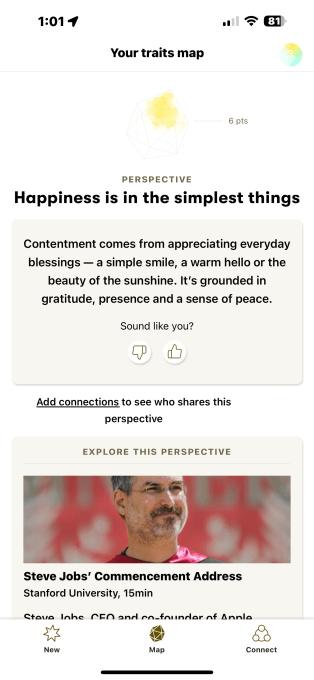
Another tab in the app, “Map,” uses AI to generate a map of your traits based on the points you earn while playing Every’s games. After trying out the first game, the map informed me my top traits included things like reason and happiness in the simplest things, which I don’t think I’d dispute. You can also thumbs up and thumbs down its findings if you agree or disagree to improve its analysis.

The idea is that, by playing these games, you aren’t only developing more self-awareness, you’re also learning how you share common ground with other people you know, which could lead you to deepen those relationships. For instance, you might find an old friend also enjoys international travel or your colleague prioritizes humility in the workplace. As you learn from the insights the app shares, you may be inspired to take further action, like engaging in conversations about your discoveries.

“A lot of the mission around this is about facilitating connection with people — one to one connection — but it’s also about helping to surface common ground a little more holistically,” McKean says. “And so part of the belief is that if you present the same game to every single person, you’re able to actually find common ground between two people who may be very different people.”

Image Credits: Every screenshot

Every was self-funded by McKean and is run by two women, Sarah McKean (Ben’s cousin) and Maya Valliath, while app development was handled through an outsourced firm. The plan for now is to run Every as a free app and side project. But if it takes off, McKean is leaving the door open to scale it as more of a business, potentially with investor backing.

The app has been running in beta since March, but today launched publicly on the App Store. It’s available as a free download with no in-app purchases.

Book Review: “How AI Works: From Sorcery to Science” by Ronald T. Kneusel

We recently reviewed the book “How AI Work: From Sorcery to Science” by Ronald T. Kneusel. I've so far read over 60 books on AI, and while some of them do get repetitive, this book managed to offer a fresh perspective, I enjoyed this book enough to add it to my personal list of the Best Machine Learning & AI Books of All Time.

“How AI Works: From Sorcery to Science” is a succinct and clear-cut book designed to delineate the core fundamentals of machine learning. This book facilitates learning about the rich history of machine learning, journeying from the inception of legacy AI systems to the advent of contemporary methodologies.

The history is layered, starting with the well-founded AI systems such as support vector machines, decision trees, and random forests. These earlier systems paved the way for groundbreaking advancements, leading to the development of more sophisticated approaches like neural networks and convolutional neural networks. The book doesn’t just stop here; it delves into the mesmerizing capabilities offered by Large Language Models (LLMs), which are the powerhouse behind today's state-of-the-art Generative AI.

Understanding the basics, such as how noise-to-image technology can replicate existing imagery and even create new, unprecedented images from seemingly random prompts, is critical in grasping the forces propelling today's image generators. This book beautifully explicates these fundamental aspects, allowing readers to comprehend the intricacies and underlying mechanics of image generation technologies.

Ron Kneusel, the author, demonstrates a commendable effort in elucidating his perspectives on why OpenAI’s ChatGPT and its LLM model signify the beginning of true AI. He meticulously presents how distinct LLMs exhibit emergent properties capable of intuitively understanding the theory of mind. These emergent properties appear to become more pronounced and influential based on the size of the training model. Kneusel discusses how a larger quantity of parameters typically results in the most proficient and successful LLM models, providing deeper insights into the scaling dynamics and efficacy of these models.

This book is a beacon for those wanting to delve into the mesmerizing world of AI, offering a detailed yet comprehensible overview of the evolutionary trajectory of machine learning technologies, from their rudimentary forms to the pioneering entities of today. Whether you are a novice or someone with a substantial grasp of the subject, “How AI Works: From Sorcery to Science” is designed to provide you with a refined understanding of the transformative technologies that continue to shape our world.

Readers may also want to take a look my interview with author Ronald T. Kneusel. This book is available at all major retailers including Amazon.

4 AI-powered photo and video features on Pixel 8 and Pixel 8 Pro giving us Google envy

Google Pixel 8 Pro Actua Display

On Wednesday, Google held its Made by Google event, where it unveiled the next generation of its Pixel smartphone, Pixel Watch, and Pixel Buds. One of the biggest highlights of the new Pixel 8 and Pixel 8 Pro is their ability to take amazing photos, which can be attributed to their advanced cameras and lots of AI.

With time, people have become increasingly dependent on their smartphones' cameras, and as a result, the cameras have gotten better and better over time. So even though the Pixel 8 and Pixel 8 Pro boast impressive camera systems, you'll find comparable cameras on nearly every flagship smartphone.

Also: Google Pixel 8 vs. Google Pixel 8 Pro: Which one is right for you?

What really makes the Pixel's photos stand out are all of the advanced features that users can take advantage of in post-production, such as Magic Eraser, which lets users remove unwanted objects from images with the tap of a button.

Now, Google is expanding what users can do to photos and video post-production with four photo and video editing features powered by AI and coming to the Pixel 8 and Pixel 8 Pro: Best Take, Magic Editor, Audio Magic Eraser, and Zoom Enhance.

If you have ever taken a picture with multiple other people, you know it takes several tries to get a photo in which every person looks their best. Google's new Best Take feature attempts to solve that problem by letting you choose the person's expression in a photo.

Also: Google Pixel 8 Pro hands-on: 5 features that have me excited

Best Take presents expressions taken from a series of similar photos to users where they can select their favorite expressions for each person. Once all the best expressions are selected, they are automatically blended into the image to create a new ideal photo.

Magic Editor was announced at Google I/O earlier this year and will allow users to make complex edits, such as selecting and dragging an item in a photo and entirely changing the background with some quick taps by using AI.

Google also unveiled Audio Magic Eraser, the equivalent of the much-loved Magic Eraser feature for audio. With this feature, users can remove distracting noises from photos by leveraging machine learning models.

For example, a feature demo shows a baby babbling with the noise of a dog barking in the background. Using Audio Magic Eraser, the user could filter out the barking so that all you could hear were the baby's babbles.

Also: The best Google Pixel phones

Lastly, Zoom Enhance will let users crop a photo after taking it and uses generative AI to restore the pixels and fine details that are often compromised when zooming into a picture after it is taken.

The first three features, Best Take, Magic Editor, and Audio Magic Eraser, will all be available on Pixel 8 and Pixel 8 Pro starting on Oct. 12, when the phones become available. Zoom Enhance will be coming to the Pixel 8 Pro "later," according to Google.

Google

Ronald T. Kneusel, Author of “How AI Work: From Sorcery to Science” – Interview Series

We recently received an advanced copy of the book “How AI Work: From Sorcery to Science” by Ronald T. Kneusel. I've so far read over 60 books on AI, and while some of them do get repetitive, this book managed to offer a fresh perspective, I enjoyed this book enough to add it to my personal list of the Best Machine Learning & AI Books of All Time.

“How AI Works: From Sorcery to Science” is a succinct and clear-cut book designed to delineate the core fundamentals of machine learning. Below are some questions that were asked to author Ronald T. Kneusel.

This is your third AI book, the first two being: “Practical Deep Learning: A Python-Base Introduction,” and “Math for Deep Learning: What You Need to Know to Understand Neural Networks”. What was your initial intention when you set out to write this book?

Different target audience. My previous books are meant as introductions for people interested in becoming AI practitioners. This book is for general readers, people who are hearing much about AI in the news but have no background in it. I want to show readers where AI came from, that it isn’t magic, and that anyone can understand what it is doing.

While many AI books tend to generalize, you’ve taken the opposite approach of being very specific in teaching the meaning of various terminology, and even explaining the relationship between AI, machine learning, and deep learning. Why do you believe that there is so much societal confusion between these terms?

To understand the history of AI and why it’s everywhere we look now, we need to understand the distinction between the terms, but in popular use, it’s fair to use “AI” knowing that it refers primarily to the AI systems that are transforming the world so very rapidly. Modern AI systems emerged from deep learning, which emerged from machine learning and the connectionist approach to AI.

The second chapter dives deep into the history of AI, from the myth of Talos, a giant robot meant to guard a Pheonecian princess, to Alan Turing 1950s paper, “Computing Machinery and Intelligence”, To the advent of the Deep Learning revolution in 2012. Why is a grasp of the history of AI and machine learning instrumental to fully understanding how far AI has evolved?

My intention to show that AI didn’t just fall from the sky. It has a history, an origin, and an evolution. While the emergent abilities of large language models are a surprise, the path leading to them isn’t. It’s one of decades of thought, research, and experimentation.

You’ve devoted an entire chapter to understanding legacy AI systems such as support vector machines, decision trees, and random forests. Why do you believe that fully understanding these classical AI models is so important?

AI as neural networks is merely (!) an alternate approach to the same kind of optimization-based modeling found in many earlier machine learning models. It’s a different take on what it means to develop a model of some process, some function that maps inputs to outputs. Knowing about earlier types of models helps frame where current models came from.

You state your belief that OpenAI’s ChatGPT’s LLM model is the dawn of true AI. What in your opinion was the biggest gamechanger between this and previous methods of tackling AI?

I recently viewed a video from the late 1980s of Richard Feynman attempting to answer a question about intelligent machines. He stated he didn’t know what sort of program could act intelligently. In a sense, he was talking about symbolic AI, where the mystery of intelligence is finding the magic sequence of logical operations, etc., that enable intelligent behavior. I used to wonder, like many, about the same thing – how do you program intelligence?

My belief is that you really can’t. Rather, intelligence emerges from sufficiently complex systems capable of implementing what we call intelligence (i.e., us). Our brains are vastly complex networks of basic units. That’s also what a neural network is. I think the transformer architecture, as implemented in LLMs, has somewhat accidentally stumbled across a similar arrangement of basic units that can work together to allow intelligent behavior to emerge.

On the one hand, it’s the ultimate Bob Ross “happy accident,” while on the other, it shouldn’t be too surprising once the arrangement and allowed interactions between basic units capable of enabling emergent intelligent behavior have happened. It seems clear now that transformer models are one such arrangement. Of course, this begs the question: what other such arrangements might there be?

Your take-home message is that modern AI (LLMS) are at the core, simply a neural network that is trained by backpropagation and gradient descent. Are you personally surprised at how effective LLMs are?

Yes and no. I am continually amazed by their responses and abilities as I use them, but referring back to the previous question, emergent intelligence is real, so why wouldn’t it emerge in a sufficiently large model with a suitable architecture? I think researchers as far back as Frank Rosenblatt, if not earlier, likely thought much the same.

OpenAI’s mission statement is “to ensure that artificial general intelligence—AI systems that are generally smarter than humans—benefits all of humanity.” Do you personally believe that AGI is achievable?

I don’t know what AGI means any more than I know what consciousness means, so it’s difficult to answer. As I state in the book, there may well come a point, very soon now, where it’s pointless to care about such distinctions – if it walks like a duck and quacks like a duck, just call it a duck and get on with it.

Cheeky answers aside, it is entirely within the realm of possibility that an AI system might, someday, satisfy many theories of consciousness. Do we want fully conscious (whatever that really means) AI systems? Perhaps not. If it’s conscious, then it is like us and, therefore, a person with rights – and I don’t think the world is ready for artificial persons. We have enough trouble respecting the rights of our fellow human beings, let alone those of any other kind of being.

Was there anything that you learned during the writing of this book that took you by surprise?

Beyond the same level of surprise everyone else feels at the emergent abilities of LLMs, not really. I learned about AI as a student in the 1980s. I started working with machine learning in the early 2000s and was involved with deep learning as it emerged in the early 2010s. I witnessed the developments of the last decade firsthand, along with thousands of others, as the field grew dramatically from conference to conference.

Thank you for the great interview, readers may also want to take a look my review of this book. The book is available at all major retailers including Amazon.

How Close Are We to AGI?

How Close Are We to AGI?
Image by Author

Is technology advancing at a faster rate than we humans can keep up with? Well yes. This year alone there were a lot of advancements, one after another and it was hard for us to keep up. It seemed like every day we were learning something new and were on our toes.

With these advancements, the conversation around Artificial General Intelligence (AGI) is becoming more and more frequent. It was once a conversation of science fiction, which we saw in movies and books, in which those storylines were a bit far-fetched and unrealistic.

But in the year 2023 in particular, that has changed drastically. The public has a big interest in AI and how it is going to shape the future. Generative AI systems such as ChatGPT have swept the world off their feet, with some loving it, and some concerned about job replacements.

This comes back to the topic of AGI. But what is AGI?

Artificial General Intelligence (AGI) is a machine that can perform any type of intellectual task, the same way a human can.

With that being said, the big question on a lot of people's minds is how close we are to actually achieving AGI and what will happen when we do.

This is what this blog will go through, so buckle up and enjoy learning about our potential future…

What We Know About AGI

So we know that AGI is an AI system that can perform any intellectual task that a human being can. This means that machines will have to possess human-level intelligence, without any help. The groundwork for AI began in the early 1900s, with many stating that achieving AGI would complete the ultimate goal of the AI legacy.

It’s not to say that AI systems currently don’t possess the ability to perform tasks at a highly accurate level, better than humans. However, there is something that is missing with AI systems, and that is their general-purpose ability. This means that they lack the ability to adapt to new situations in a quick manner, without the need for instructions.

We human beings have adapted over many years and survived through different situations. Our general-purpose ability links to survival, this is why we’re so good at it.

There have been a lot of recent developments that have shaped the technology world, one in particular is Generative AI systems such as ChatGPT. I’d like to state that Generative AI and Artificial General intelligence have their similarities, but they are different. Generative AI is a deep learning model that has the ability to generate content such as text and images, based on the data it was trained on.

To give you an example, an AI chess program will most likely finish you at a chess game, but the same AI system will not be able to tell you about what’s currently happening in world politics. This is because it is limited to a specific domain, and that’s all.

As we mentioned, AGI lacks general-purpose ability, which is also what Generative AI lacks — as that is not its purpose. Generative AI will aid AGI in its journey, but it is important to note that they are not the same.

Progression Towards AGI

So we understand that we haven’t exactly achieved AGI, but where are we currently and what’s in the works?

Research and Development

There have been years and years of research into deep learning, which is a subfield of machine learning. It is a machine learning method that teaches computers to do what comes naturally to humans. It trains an algorithm to predict outputs, given a set of inputs.

The use of large amounts of data on sophisticated neural networks has allowed AI systems to be able to tackle complex tasks such as natural language processing (NLP) and image recognition. There is a lot of learning and improvement happening in the deep learning industry to aid the birth of AGI.

Reinforcement Learning

Alongside this approach, there has also been an increase in reinforcement learning. The aim of reinforcement learning is to train a model to return an optimum solution by using a sequence of solutions and/or decisions that have been created for a specific problem. In order for the model to choose the right solution/decision, a reward signal is put in place.

If the model performs closer to the goal, a positive reward is given; however, if the model performs further away from the goal, a negative reward is given. Machine learning models learn by understanding their environment and receiving feedback based on their actions.

Challenges Towards AGI

Adaptable AI Systems

Naturally, during the progression of anything, you will come across challenges that you need to overcome. In the matter of research and development, the major challenge that AGI is facing is the ability to build a system that can understand the input context and adapt to it the same way humans do. Researchers are looking into new ways that an algorithm can think more in a creative manner to overcome this. For example, some researchers are looking at the possibility of intelligent AI systems that go through continual learning throughout their lifespan.

Based on this, are we even anywhere near AGI?

Hardware Limitations

As you can imagine, it is not simple to build these amazing AI systems. They require a lot of computing power, which has pushed the development of specialized hardware such as GPUs and TPUs. And these hardware are not cheap either. So you can imagine how many weeks and months it takes to build an accurate and robust AI system with the amount of time, data, and other resources that go into it.

So Where Are We With AGI?

It is difficult to say because the experts of AGI have mixed opinions. Some say that AGI could be achieved in the next few years, whilst others believe that we still have decades' worth of work left.

The only thing that can determine how close we are to AGI is the rate of technological advancements that come through. The more advanced current and new technological systems get, the closer experts are to finding the missing parts of the puzzle. The more breakthroughs we see in the tech world, the closer we are to AGI.

Another aspect that governments and organizations are taking into consideration now more than ever is the ethical implications of such AI systems to society. Pushing a narrative on AGI could lead to disastrous consequences of not being able to understand and control these AI systems.

Wrapping it up

With that all being said, we are seeing more and more organizations pumping more money into the tech industry. Many are jumping on the bandwagon to meet up with the competitive market, and others are trying to create a completely new market.

The answer to this blogs question is that we will have to wait and see what technological advancements will come out in the near future to have a better understanding of how close we really are to AGI.
Nisha Arya is a Data Scientist, Freelance Technical Writer and Community Manager at KDnuggets. She is particularly interested in providing Data Science career advice or tutorials and theory based knowledge around Data Science. She also wishes to explore the different ways Artificial Intelligence is/can benefit the longevity of human life. A keen learner, seeking to broaden her tech knowledge and writing skills, whilst helping guide others.

More On This Topic

  • Numerics V: Integrality – When Being Close Enough is not Always Good Enough
  • The AI Education Gap and How to Close It
  • AGI and the Future of Humanity
  • Surpassing Trillion Parameters and GPT-3 with Switch Transformers — a path…
  • Deep Neural Networks Don't Lead Us Towards AGI
  • Baby AGI: The Birth of a Fully Autonomous AI

Vera wants to use AI to cull generative models’ worst behaviors

Vera wants to use AI to cull generative models’ worst behaviors Kyle Wiggers 10 hours

Liz O’Sullivan is on a mission to make AI “a little bit safer,” in her own words.

A member of the National AI Advisory Committee, which drafts recommendations to the White House and Congress on how to foster AI adoption while regulating its risks, O’Sullivan spent 12 years on the business side of AI startups overseeing data labeling and operations and customer success. In 2019, she took a job at the Surveillance Technology Oversight Project, mounting campaigns to protect New Yorkers’ civil liberties, and co-founded Arthur AI, a startup that partners with civil society and academy to shine light into AI’s “black box.”

Now, O’Sullivan is gearing up for her next act with Vera, a startup building a toolkit that allows companies to establish “acceptable use policies” for generative AI — the type of AI models that generate text, images, music and more — and enforce these policies across open source and custom models.

Vera today closed a $2.7 million funding round led by Differential Venture Partners with participation from Essence VC, Everywhere VC, Betaworks, Greycroft and ATP Ventures. Bringing Vera’s total raised to $3.3 million, the new cash will be put toward growing Vera’s five-person team, R&D and scaling enterprise deployments, O’Sullivan says.

“Vera was founded because we’ve seen, firsthand, the power of AI to address real problems, just as we’ve seen the wild and wacky ways it can cause damage to companies, the public and the world,” O’Sullivan told TechCrunch in an email interview. “We need to responsibly shepherd this technology into the world, and as companies race to define their generative AI strategies, we’re entering an age where it’s critical that we move beyond AI principles and into practice. Vera is a team that can actually help.

O’Sullivan co-founded Vera in 2021 with Justin Norman, formerly a research scientist at Cisco, a lead data scientist in Cloudera’s AI research lab and the VP of data science at Yelp. In September, Norman was appointed a member of the Department of the Navy Science and Technology board, which provides advice and counsel to the U.S. Navy on matters and policies relating to scientific, technical and related functions,

Vera’s platform attempts to identify risks in model inputs — for example, a prompt like “write a cover letter for a software engineering role” to a text-generating model — and block, redact or otherwise transform requests that might contain things like personally identifiable information, security credentials, intellectual property and prompt injection attacks. (Prompt injection attacks, essentially carefully-worded malicious prompts, are often used to “trick” models into bypassing safety filters.)

Vera also places constraints on what models can “say” in response to prompts, according to O’Sullivan, giving companies greater control over the behavior of their models in production.

How does Vera achieve this? By using what O’Sullivan describes as “proprietary language and vision models” that sit between users and internal or third-party models (e.g. OpenAI’s GPT-4) and detect problematic content. Vera can block “inappropriate” prompts to — or answers from a model in any form, O’Sullivan claims, whether text, code, image or video.

“Our deep tech approach to enforcing policies goes beyond passive forms of documentation and checklists to address the direct points at which these risks occur,” O’Sullivan said. “Our solution … prevents riskier responses that may include criminal material or encourage users to self-harm.”

Companies are certainly encountering challenges — mainly compliance-related — in adopting generative AI models for their purposes. They’re worried about their confidential data ending up with developers who trained the models on user data, for instance; in recent months, major corporations including Apple, Walmart and Verizon have banned employees from using tools like OpenAI’s ChatGPT.

And offensive models are obviously bad for publicity. No brand wants the text-generating model powering their customer service chatbot, say, to spout racial epithets or give self-destructive advice.

But this reporter wonders if Vera’s approach is as reliable as O’Sullivan suggests.

No model is perfect — not even Vera’s — and it’s been demonstrated time and time again that content moderation models are prone to a whole host of biases. Some AI models trained to detect toxicity in text see phrases in African-American Vernacular English, the informal grammar used by some Black Americans, as disproportionately “toxic.” Meanwhile, certain computer vision algorithms have been found to label thermometers held by Black people as “guns” while labeling thermometers held by light-skinned subjects as “electronic devices.”

To be fair to O’Sullivan, she doesn’t claim Vera’s models are bulletproof — only that they can cull the worst of a generative AI models’ behaviors. There may be some truth to that (depending on the model, at least) — and the degree to which Vera has iterated and refined its own models.

“Today’s AI hype cycle obscures the very serious, very present risks that affect humans alive today,” O’Sullivan said. “Where AI overpromises, we see real people hurt by unpredictable, harmful, toxic and potentially criminal model behavior … AI is a powerful tool and like any powerful tool, should be actively controlled so that its benefits outweigh these risks, which is why Vera exists.”

Vera’s possible shortcomings aside, the company has competition in the nascent market for model-moderating tech.

Similar to Vera, Nvidia’s NeMo Guardrails and Salesforce’s Einstein Trust Layer attempt to prevent text-generating models from retaining or regurgitating sensitive data, such as customer purchase orders and phone numbers. Microsoft provides an AI service to moderate text and image content, including from models. Elsewhere, startups like HiddenLayer, DynamoFL and Protect AI are creating tooling to defend generative AI models against prompt engineering attacks.

So far as I can tell, Vera’s value proposition is that it tackles a whole range of generative AI threats at once — or promises to at the very least. Assuming that the tech works as advertised, that’s bound to be attractive for companies in search of a one-stop content moderation, AI-model-attack-fighting shop.

Indeed, O’Sullivan says that Vera already has a handful of customers. The waitlist for more opens today.

“CTOs, CISOs and CIOs all over the world are struggling to strike the ideal balance between AI-enhanced productivity and the risks these models present,” O’Sullivan said. “Vera unlocks generative AI capabilities with policy enforcement that can be transferred not just to today’s models, but to future models without the vendor lock-in that occurs when you choose a one-model or one-size-fits-all approach to generative AI.”

6 Most Exciting New Updates in PyTorch 2.1 

PyTorch recently released a new update, PyTorch 2.1. This new update offers automatic dynamic shape support in compiling and distributing checkpoints for parallelly saving and loading distributed training jobs on multiple ranks, alongside providing support for NumPy API.

In addition to this, it has released the beta version updates to PyTorch domain libraries for TorchAudio and TorchVision. Lastly, the community has added support training and inference of Llama 2 models powered by AWS Inferentia2.

This will make running Llama 2 models on PyTorch quicker, cheaper and more efficient. This release was the effort of 784 contributors with 6,682 commits.

New Features of PyTorch 2.1

  • The new feature updates include the addition of AArch64 wheel builds which would allow devices with 64-bit ARM architecture to use PyTorch.
  • They’ve added the latest CUDA 12.1 support for PyTorch binaries.
  • Compile PyTorch on M1 natively instead of cross compiling it from x86 which causes performance issues. Compiling PyTorch natively on M1 would improve performance and make it easier to use it directly on Apple M1 processors.
  • Enables UCC Distributed Communication Backend in CI where developers can efficiently test and debug their code with UCC support.

Improvements

  • Python Frontend: the PyTorch.device can now be used as a context manager to change the default device. This is a simple but powerful feature that can make your code more concise and readable.
  • Optimisation: NAdamW is a new optimiser that is more stable and efficient than the previous AdamW optimiser. NAdamW is an improved version of AdamW, stands out for its stability and efficiency, making it a superior choice for faster and more accurate model training.
  • Sparse Frontend: Semi-structured sparsity is a new type of sparsity that can be more efficient than traditional sparsity patterns on NVIDIA Ampere and newer architectures.

PyTorch’s TorchAudio v2.1 Library

The new update has introduced key features like the AudioEffector API for audio waveform enhancement and Forced Alignment for precise transcript-audio synchronisation. The addition of TorchAudio-Squim models allows estimation of speech quality metrics, while a CUDA-based CTC decoder improves automatic speech recognition efficiency.

In the realm of AI music, new utilities enable music generation using AI techniques, and updated training recipes enhance model training for specific tasks. However, users need to adapt to changes like updated FFmpeg support (versions 6, 5, 4.4) and libsox integration, impacting audio file handling.

These updates expand PyTorch’s capabilities, making audio processing and AI music generation more efficient and precise. With enhanced alignment, speech quality assessment, and faster speech recognition, TorchAudio v2.1 is a valuable upgrade.

TorchRL Library

PyTorch has enhanced the RLHF components making it easy for developers to build an RLHF training loop with limited RL knowledge. TensorDict enables an easy interaction between datasets (say, HF datasets), alongside RL models. It has added new algorithms, where it offers a wide range of solutions for offline RL training, making it more data efficient.

Plus, TorchRL can now work directly with hardware, like robots, for seamless training and deployment. It has added essential algorithms and expanded its supported environments, for faster data collection and value function execution.

TorchVision Library

This new library in PyTorch is now 10%-40% faster. PyTorch achieved this thanks to 2x-4x improvements made to the second version of Resize. “This is mostly achieved thanks to 2X-4X improvements made to v2.Resize(), which now supports native uint8 tensors for Bilinear and Bicubic mode. Output results are also now closer to PIL’s!,” reads the blog.

Additionally, TorchVision now supports CutMix and MixUp augmentations. The previous beta transforms are now stabilised, offering improved performance for tasks like segmentation and detection.

Llama 2 Deployment with AWS Inferentia2 using TorchServe

Pytorch for the first time has deployed the Llama 2 model using inference using Transformer Neuron using Torch Serve. This is done through Amazon SageMaker on EC2 Inferentia2 instances. This features 3x higher compute with 4x more accelerator memory resulting in up to 4x higher throughput, and up to 10x lower latency.

The optimization techniques from AWS Neuron SDK enhance performance while keeping costs low. The Llama deployment on PyTorch also shares the benchmarking results.

The framework is integrated with Llama 2 through AWS Transformers Neuron, enabling seamless usage of Llama-2 models for optimised inference on Inf2 instances.

The post 6 Most Exciting New Updates in PyTorch 2.1 appeared first on Analytics India Magazine.