Jacy Reese Anthis, co-founder of the Sentience Institute and known for his book ‘The End of Animal Farming’ believes AI is changing all domains of social life and may exceed human ability within our lifetimes. During the ongoing Cypher 2023, India’s biggest AI conference, Anthis delved into an interesting topic-The Rise of Digital Minds.
Given all the recent developments in generative AI, be it Google’s Lamda being sentient, to ChatGPT, to the Godfather of AI, Geoffrey Hinton leaving Google to warn others about the dangers of AI, a lot has happened. Nonetheless, “There is a feeling in the air that we are getting something radically new as a technology,” Anthis said.
“You have people like David Chalmers, one of the world’s most famous philosophers today, talking about the possibility of these systems being conscious. This was a presentation at Neurips, the top Machine Learning Conference, where he discussed this with computer scientists and gave a number of benchmarks as to how we think of a conscious or a sentient AI system,” he said.
Anthis’ talk delves into various facets of AI, from the perceived sentience of LLM-based chatbots to their implications, philosophical considerations, and user perceptions.
How does the public perceive AI?
Anthis started off with a project his team did in 2021 before much of the hype emerged around generative AI on what Americans actually think about the possibility of sentient AI. “When we asked people pretty straightforwardly, do you think it could ever be possible for robots/AI to be sentient? Around a third of the respondents said yes. But when we asked them whether any of the current AI systems are sentient, only 20% of them responded positively.”
Furthermore, a recent survey done by Anthis and his team found that around 10% of the respondents to the survey feel ChatGPT, the popular chatbot developed by OpenAI, is sentient. Anhthis, on the other hand, however, believes ChatGPT does not yet possess a high level of sentience.
Another important question, according to Anthis, is what people think about the future of AI systems. “We, in this room, often know that projects will be slow and haphazard, but the public expects progress very quickly.”
Interestingly, many people believe we already have Artificial General Intelligence. Whereas there is a section who thinks it will never happen, data shows that it could happen within the next two to five years.
Ethical and Social Considerations
Furthermore, Anthis also discusses the ethical considerations related to the rise of digital minds, including concerns about alignment issues and the safety of highly autonomous AI systems. Anthis hints at the need for guidelines and ethical frameworks.
Moreover, Anthis discusses the anticipation of the development of highly capable AI systems which could lead to a new class of entities in our society. This development raises unprecedented questions about the interaction between humans and AI.
Overall, the talk underscores the need to examine user perceptions, the philosophical implications of digital minds, and the ethical considerations arising from this transformation.
The post The Rise of Digital Minds appeared first on Analytics India Magazine.
For five decades, protein folding has been one of the toughest problems in life science. The breakthrough came in 2020 when Google DeepMind successfully tackled this long-standing challenge with AlphaFold. This achievement not only marked a turning point but also unlocked a multitude of possibilities for leveraging AI in drug development and broader healthcare applications.
Following AlphaFold’s success, other players entered the scene. Meta introduced ESMFold, while the Chinese biotech company Helixon pioneered OmegaFold. Generate Biomedicines contributed Chroma, and Baker Lab brought forth RoseTTAFold and RoseTTAFoldDiffusion, expanding the array of innovative solutions in this domain.
And one of the strongest players in this field of using AI in healthcare is Cambridge-based AstraZeneca. AIM got in touch with Siva Padmanabhan, Managing Director, AstraZeneca, India to understand how AI plays a crucial role in redefining medical science, providing a platform for the discovery, testing, and acceleration of potential medicines along with protein folding.
However, the incorporation of AI into drug development brings about advantages and challenges. Amid the vast amount of data accessible today, the key lies in effectively analysing, interpreting, and applying this information.
“In our research and development efforts, AI plays a vital role in decoding extensive datasets to enhance our understanding of specific diseases, identify new medicinal targets, guide molecule synthesis, and enhance predictions of clinical success,” Padmanabhan told AIM, stating that the application of AI goes beyond the laboratory and extends into various clinical approaches.
Consider the clinical trial process, for example, where AI and ML tools are employed to extract valuable insights from trial data. Proficiency in utilising trial data for safety and efficacy analysis has been demonstrated, and initiatives are in progress to maximise the potential of previously collected data. AI further contributes to event adjudication in clinical trials, streamlining processes across different stages with the overarching goal of reducing overall time investments.
AI in Protein Folding
The role of AI in protein folding research encompasses various aspects with potential benefits and limitations. Disease-causing proteins and antibodies’ atomic structures offer crucial insights into the functioning of therapeutics, aiding in the design of potent and safer drugs. Traditional methods such as X-ray crystallography, NMR, and cryo-EM play a pivotal role in structure determination for drug discovery. However, as per Padmanabhan, the emergence of powerful AI models has introduced an alternative approach by accurately predicting protein structures that are challenging, expensive, and time-consuming to determine experimentally.
In the space of predicting protein structures, optimising folding simulations, identifying novel proteins and their functions, and designing new protein structures, LLMs have shown promise. These models, trained on a vast repository of known protein structures, can propose protein sequences that enhance functionality and other desired properties. In the context of antibody drug discovery, these AI models can suggest sequences with tight binding to target proteins and improved developability properties. Leveraging publicly available antibody datasets, along with information about the proteins they bind to, serves as a valuable resource for building and fine-tuning models tailored to specific targets of interest.
AI-driven structure prediction facilitates the structure-guided discovery of small molecules, peptides, and antibody therapeutics. “Despite this advancement, existing AI models have limitations, primarily in predicting only the overall protein fold as their capability to predict changes caused by single amino acid mutations is restricted, and these tools provide a static snapshot of the protein while lacking insights into its dynamic nature,” added Padmanabhan.
However, according to Padmanabhan, interdisciplinary collaborations play a crucial role in advancing AI applications in protein folding research. To build effective protein folding models, a diverse team is needed, including data engineers, data scientists, structural biologists, and machine learning experts. Additionally, “the adoption of federated learning, where models are trained on data from various pharmaceutical companies and research centers without exposing the data to other entities, holds significant potential in transforming this field,” he commented.
What Next
AstraZeneca is actively engaged in exploring innovative approaches to leverage data and technology for optimising the efficiency of discovering and delivering potential new medicines.
“Throughout our R&D processes, AI is integrated to empower our scientists in pushing the boundaries of scientific exploration with the aim of delivering impactful and life-changing medicines,” concluded Padmanabhan.
Through the simulation of intricate molecular interactions, AI significantly contributes to the efficient discovery of novel drug candidates, potentially expediting the drug discovery process. This cutting-edge technology is revolutionising drug development, offering researchers the tools to combat diseases more effectively. Ultimately, this approach enhances the success rates of drug candidates, contributing to the overall improvement of patient outcomes on a global scale.
Step into the future of healthcare at Cypher 2023, where the fusion of AI and healthcare meets from October 11th to 13th at the Hilton Garden Inn Embassy, Bengaluru. In a space like healthcare where every breakthrough directly touches lives, join us to witness the metamorphosis of the healthcare industry through the lens of AI.
Read more: From Humble Beginnings to Scientific Stardom: Meet the Protein Prodigy from Bengal
The post How AstraZeneca is Using AI Models for Drug Development appeared first on Analytics India Magazine.
In an alternate history, if Leonardo Da Vinci had AI while painting Mona Lisa, would he have required the same 16 years to finish the magnum opus? He may have not.
AI art generators have given users the power to create fantastical images with just a few text prompts, sparking both excitement and concern among artists. While some see a problem, a number of artists are wholeheartedly embracing this transformative change.
In the recent months, we have seen text-to-image AI generators evolving from producing bizarre human fingers to hyper-realistic images indistinguishable from human-crafted. As the advancements continue, AI’s dominance is increasingly evident in the field of simulation and design as the biggest names in the industry including Adobe, Midjourney and Dall-E are actively collaborating with AI.
To delve deeper into these ongoing trends and how the landscape is developing, distinguished animation filmmaker Biren Ghose, will be taking the centre stage at India’s premier AI conference — Cypher 2023. His talk will be all about the intersection of AI, simulation and design.
Ghose, renowned for his extensive work as Country Head at animation leader Technicolor spanning nearly 15 years, will provide insights into a near-future where designers can swiftly transform their ideas into reality, reducing the time frame from days, months, or even years to mere minutes.
With the rise of AI tools, artists now possess the ability to convey their creative vision to computers, entrusting them with the intricate process of artistic creation and Ghose will be present at the AI event to talk about it all.
Pollock: A New Dialogue
Understanding the relationship between AI and art is the focal point of Cypher 2023. In its 7th edition, the conference not only welcomes industry leaders, technologists, and AI enthusiasts but also offers artists a dedicated platform, known as “Pollock,” to exhibit their work and share their perspectives on this technology poised at the crossroads of artistry.
An eye-opening report published earlier this year revealed a staggering statistic: over 15 billion images were generated using text-to-image algorithms in the previous year alone. To put this into perspective, traditional photographers took 150 years, from the introduction of photography in 1826 until 1975, to reach the same 15 billion milestone. The impact of technology is undeniable and cannot be left out of any conversation.
The momentous AI event in India’s very own Silicon Valley will host a panel discussion titled ‘The Fusion of Art and AI: Navigating the Impact of Artificial Intelligence in the Creative Industry.‘ Esteemed industry insiders like Tapan Aslot, a Creative Director and AI Artist, will talk at length about algorithm-driven creativity and the indispensable human touch.
The panel will further go down the rabbit hole to shed light upon different facets of the field including, but not limited to ethics of AI in art. With a particular emphasis on the ethical dimensions of AI in art, “Pollock” is set to mark a shift in the ongoing dialogue between art and technology.
Participate in the conversation in Bangalore from October 11th to the 13th, as experts search through the interplay between machine learning and artistic sensibility. The AI bonanza promises to break down conventional boundaries, bringing in fresh perspectives and pushing forth the frontiers of creative expression.
The post AI Meets Art At Cypher 2023 appeared first on Analytics India Magazine.
Australian and Aotearoa New Zealand organizations know they’re rapidly hurtling towards a security precipice and are willing to invest to try to save themselves from tipping over. New research from Gartner shows that security is becoming one of the most lucrative areas of IT in both countries.
There’s a lot to grapple with, from AI to rapid shifts in regulation, and Australian organizations need to do it while skills are in short supply. This “perfect storm” may well mean that despite the willingness to invest, Australian and New Zealand organizations might still struggle to cope with the evolving threat landscape.
Jump to:
IT security market in Australia and New Zealand
The four factors driving global security spending
But will the security spending be enough?
IT security market in Australia and New Zealand
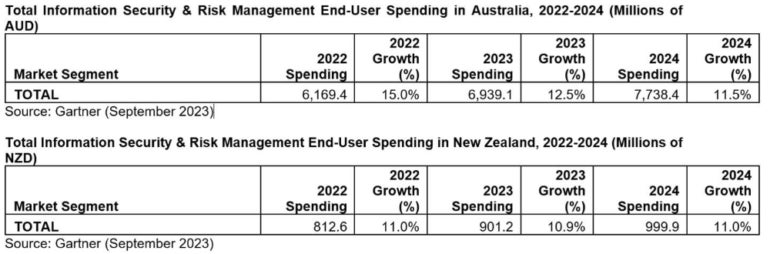
According to Gartner, security spending in Australia is projected to grow by 11.5% to a total of AU $7.74 billion (US $4.95 billion) in 2024 (Figure A). In New Zealand, the increase is slightly lower, at 11%, but that will bring New Zealand close to just shy of NZ $1 billion (US $600 million) for the first time.
Figure A
Forecasted spending on cybersecurity in Australia. Image: CRN
For both countries, this is slightly less than the growth in global spending, which is forecast to increase by 14.3%, but it’s also greater than the projected overall increase in spending within the country, with Garter forecasting growth of 7.8% in 2024.
The four factors driving global security spending
This commitment to security is coming at the expense of other business priorities, at a time where organizations are looking for ways to limit spending. A survey of CEOs found that recruitment and growth are slipping as business priorities, even while cybersecurity solidifies as a core objective. According to Gartner, cloud spending is being driven by four particular trends.
Ongoing move towards cloud services
More companies are moving their data and applications to the cloud, including more critical applications and datasets. This is leading to a new suite of security challenges that require additional resources to address.
At the least, organizations now need to invest in cloud-specific security solutions, such as cloud access security brokers software and cloud workload protection platforms and ensure they have the technical expertise to properly implement and manage policy.
Another factor that catches many out is the need for 24/7 security in the cloud. Many organizations look to the cloud for productivity benefits, but that also means they’ll need to enhance their security operations center team and ensure they’re able to respond to alerts and other flag triggers at all times of day.
Continuous hybrid workforce
While there is a push to get people back into an office together, remote work itself isn’t going away. Most expectations are now that people will have hybrid work experiences, where they’ll spend some time in an office and other times work remotely.
This means that the security risks decentralized IT environments face are now permanent. To address these challenges, businesses need to invest in improving solutions around endpoint detection and response and managed detection and response.
They also need to invest in zero-trust security solutions, as perimeter-based security will no longer be enough. The problem with zero trust is that, if it’s managed poorly, the user experience becomes so compromised it starts to impact everything from productivity to staff morale, so some level of investment needs to be put into getting zero trust right.
Rapid emergence and use of generative AI
While generative AI has many benefits, it also poses significant security risks, and as the newest of the trends, this one is going to cause organizations headaches they haven’t conceived yet in the years to come.
What we’ve already seen is that cyber criminals use generative AI to create fake images or videos for phishing attacks or other malicious purposes. Moreover, criminals are using AI to improve the quality of their code and work faster. With the support of AI, the flood of attacks that are coming in — one victim every 37 seconds — is going to escalate dramatically.
AI is also the solution to the problem, with algorithms able to detect and isolate suspicious activity in real time, but AI has a steep learning curve many organizations aren’t ready to embrace in full.
Evolving regulatory environment
There’s a rapidly shifting regulatory environment, particularly in Australia, that’s going to drive a lot of investment in security solutions. Australia’s newest announcement, a “six cyber shields” approach to cybersecurity, is going to require some substantial investment in the private sector to keep pace.
The six cyber shields approach is the latest step as the government continues to take strides across its broader three areas of action: setting clear cybersecurity expectations, increasing transparency and disclosure and protecting consumer rights. It’s also still considering greater use of cybersecurity standards for corporate governance, personal information and smart devices and actively seeking consultation from the private sector.
The sum of all of this is that Australian organizations need to prepare for what is likely to be many more far-reaching shifts in cyber regulation in the years ahead.
But will the security spending be enough?
If the investment that organizations are putting into cybersecurity is focused on developing and implementing innovative solutions to scaling problems, then it may well be enough. If, however, it’s an effort to play “catch up,” then organizations are likely to experience escalating pain, as the threat landscape rapidly moves beyond the current scope.
As associate professor in the School of Engineering at RMIT University, Mark Gregory noted in a column at InnovationAus, Australian businesses and industry continue to “lag international best practice.”
Australia also has a skills shortage that is reaching catastrophic levels, and so, as Gregory writes, the next wave of cyber crime is going to be “devastating.”
The reality is that, as a society, we’re just not ready for an era where AI can perfectly clone people’s voices, making it easy to scam businesses into thinking they’re talking to a victim, rather than the criminal. Organizations continue to assume that two-factor authentication, dates of birth and mother’s maiden names are enough to protect their customers.
And as we saw from the Optus, Medibank Private and Latitude data breaches, the Australian government is rapidly running out of patience for organizations that make it too easy for criminals to access customer data.
Australian organizations are taking this seriously, and the double-digit increase in spending on security demonstrates that. The fact that the bulk of the spending will go to “services” also shows that organizations realize they need expertise on this.
The missing piece is the innovation. As cyber criminals become more creative and dynamic in their approach, so too will the cybersecurity defences. Cybersecurity professionals are going to be challenged to think outside of the box in a way that they’ve never been challenged to in the past, in what has been traditionally seen as a rigid side of IT.
Subscribe to the Daily Tech Insider AU Newsletter
Stay up to date on the latest in technology with Daily Tech Insider Australian Edition. We bring you news on industry-leading companies, products, and people, as well as highlighted articles, downloads, and top resources. You’ll receive primers on hot tech topics that are most relevant to AU markets that will help you stay ahead of the game.
If you have ever watched a film or show that has been dubbed, you know how unnatural it feels. Oftentimes, the speaker's voice won't change amongst different characters, or the patterns and fluctuations are entirely off. ElevenLab's new AI feature is meant to remedy that problem.
On Tuesday, ElevenLabs unveiled AI Dubbing, a new feature that can convert spoken content to another language while keeping the voice, speech patterns, emotions, and intonations of the original speaker.
Also: Gen AI a job threat? On the contrary, human workers have much to gain
The AI Dubbing feature is meant to allow audiences globally to enjoy their favorite content in their native language by converting it in just minutes.
The AI Dubbing feature combines ElevenLab's multilingual speech synthesis, voice cloning, text, and audio processing to preserve the nature of the original content when creating a translation, according to the company.
In the release, the CEO and co-founder of ElevenLabs, Mati Staniszewski, shared his negative experience with dubbed content growing up and how the new technology could be a solution.
"Growing up in Poland, we watched English language movies that had been dubbed by a single narrator. It means every actor has the same voice. It takes so much magic out of the experience," said Staniszewski.
"The release of AI Dubbing is our biggest step yet towards eliminating these linguistic barriers of content. It will help audiences enjoy any content they want, regardless of the language they speak."
Also: AI and data: Honing hyper-personalization to build the bank of the future
The AI Dubbing feature will support over 20 languages currently supported by the Eleven Multilingual v2 model.
The full list includes English, Japanese, Chinese, German, Hindi, French, Korean, Portuguese, Italian, Spanish, Indonesian, Dutch, Turkish, Filipino, Polish, Swedish, Bulgarian, Romanian, Arabic, Czech, Greek, Finnish, Croatian, Malay, Slovak, Danish, Tamil, and Ukrainian.
AI Dubbing is available for all users starting today, and the pricing is dependent on how many characters you want to be dubbed.
In an era where data is often termed the ‘new oil,’ its security holds unparalleled importance for businesses across industries. With the proliferation of digital platforms, sharing business-critical information has become routine yet perilous. From financial records to customer data, organizations frequently exchange sensitive information that, if compromised, could have dire consequences. Given the staggering rise in cyberattacks and data breaches, ensuring data security is no longer optional—it’s imperative. This article aims to equip you with the knowledge and best practices to safeguard your business-critical information effectively, making data security not just a line item but a cornerstone of your business strategy.
Understanding the landscape of data security
Before diving into specific methods for ensuring data security, it’s crucial to understand the rapidly evolving landscape of data security itself. Although still relevant, traditional methods like firewalls and antivirus software are increasingly inadequate in the face of more sophisticated cyber threats. The attack surface has expanded exponentially, introducing new vulnerabilities, Internet of Things, mobile devices and Cloud computing, are now ubiquitous. Ignorance is no longer an excuse, as failure to secure data risks confidential information and incurs severe financial and reputational damage. Consequently, contemporary data security strategies must be multi-faceted, dynamic, and aligned with current technological trends and regulatory requirements.
The importance of a data security policy
A data security policy is the backbone of an organization’s efforts to protect confidential and sensitive information. This document outlines the protocols, rules, and practices that govern how data is accessed, shared, and stored within a company. A well-crafted policy is not just a set of guidelines; it’s a strategic roadmap that helps navigate the complexities of modern cybersecurity landscapes. It provides employees with a clear framework for what is permissible and not, reducing the risk of accidental data breaches. Moreover, having a robust data security policy is often a requirement for regulatory compliance, making it an indispensable element in any comprehensive data security strategy.
Best practices for data encryption
Data encryption is a cornerstone in the architecture of data security. It transforms plain text data into a complex, unreadable format, rendering it useless unless decrypted with the correct key. Here are some best practices for employing data encryption effectively:
Use Strong Algorithms: Opt for advanced encryption algorithms like AES-256, which are designed to provide higher levels of security.
Key Management: Keep encryption keys secure and separate from the data they unlock. Rotate keys periodically to enhance security.
End-to-end Encryption: Ensure data encryption at rest and in transit during transmission.
Multi-Layered Security: It is advisable to use encryption with other security measures like two-factor authentication and firewalls to create a more robust protection mechanism.
Regular Audits: Perform frequent audits to check the effectiveness of your encryption methods and update them as needed.
By diligently applying these best practices, you can significantly bolster the security of your business-critical information. This level of meticulous care is crucial in today’s digital landscape, where the potential risks associated with data breaches are ever-increasing.
Role of access control in data security
Access control is pivotal in safeguarding business-critical information by defining who can see or use what within a secured environment. It acts as the gatekeeper, allowing only authorized users to access specific data. A robust access control mechanism can prevent unauthorized intrusion, reducing the risk of data breaches or internal misuse. Organizations can fine-tune permission settings by employing role-based access control (RBAC) or multi-factor authentication (MFA), granting access only to users who require specific information to perform their job functions. In this way, access control complements encryption and other data security measures, working synergistically to create a more secure data environment.
Secure file sharing solutions
In the digital age, sharing business-critical information securely is a pressing concern. From confidential client data to financial reports, organizations require robust solutions that can safeguard the transmission of data. One common form of business data is the EDI file, used widely for electronic data interchange between systems. While these files facilitate seamless business transactions, their secure transfer is paramount. Utilizing encrypted channels, two-factor authentication, and secure sockets layer (SSL) are just a few ways to ensure that EDI files, along with other critical data, remain secure during transit. Software solutions that specialize in secure file sharing often include features tailored for EDI file security, making it easier for businesses to comply with industry standards and regulations. By selecting a file-sharing solution that prioritizes security features, companies can substantially mitigate the risk of data breaches.
Monitoring and auditing: Keeping an eye on your data
Adequate data security continues once your files are safely stored; continuous monitoring and auditing are crucial. Utilizing specialized software tools that track data access and alterations can provide real-time alerts for suspicious activity. Periodic audits also allow you to review who accessed what information and when which can be invaluable for regulatory compliance and internal investigations. By keeping a vigilant eye on your data, you enhance its security and gain valuable insights into how information flows within your organization, empowering you to tighten security measures further.
Legal compliance and regulations
Navigating the complex landscape of data security laws is critical. Different jurisdictions have stringent regulations like GDPR in Europe and CCPA in California, dictating how data should be handled, stored, and shared. Not adhering to rules may have harsh consequences and harm your company’s reputation. Therefore, understanding and adhering to these regulations is non-negotiable.
Conclusion
In an era where data breaches and cyberattacks are increasingly common, taking proactive steps to secure your business-critical information is not just advisable—it’s imperative. From crafting a comprehensive data security policy to implementing best practices in encryption and access control, the steps are numerous but necessary. Employing secure file-sharing solutions and maintaining compliance with legal regulations are crucial elements of a well-rounded data security strategy. By monitoring and auditing your data usage, you add a layer of accountability, ensuring the integrity and confidentiality of your valuable data. Make data security a priority today; the risks of neglect are too high.
AI is crucial for today’s businesses, providing analysis that empowers and facilitates better decision-making. It’s even been shown that organizations that leverage insights provided by AI experience higher ROI, sales growth, more efficient operations, faster time to market, and increased customer engagement and satisfaction. However, AI teams have a wide variety of enabling technologies and platforms to choose from, ranging from generative AI to machine learning and everything in between. Attend the Leveraging AI in the Enterprise summit for advice to help you make better buying decisions, get the most of your AI investments, and help AI teams increase their value.
To truly utilize the capabilities of the cloud, enterprises must implement a cloud-like experience for their on-premises data centers and improve their public cloud connections. This means that the future of the data center looks quite different from the present. Enterprises in the midst of modernizing their application infrastructure and migrating to the cloud are increasingly realizing they also need a cloud-like experience for on-premises data centers. To learn more about how to improve public cloud connectivity, attend the Updating the Enterprise Data Center online summit to gain access to live webinars and fireside chats from the world’s leading innovators, vendors and evangelists.
Top Stories
11 Questions Every CEO Should Ask about AI / Generative AI October 10, 2023 by Bill Schmarzo I’ve been in this industry for over 40 years (yes, I just started in the data and analytics industry when I was 11), and I have NEVER seen anything like Artificial Intelligence (AI) and Generative AI (GenAI) capture the attention of CEOs (and the dystopic fear of everyone else). Is AI a game-changer? Definitely!
Generative AI megatrends: Gen AI start-up ecosystem October 5, 2023 by Ajit Jaokar One of my students asked me: “Which is the best area/s for Gen AI start-ups?” This is not an easy question – mainly due to the dynamic nature of AI, but here are two reference points. The first is a Generative AI Tools Landscape from datacamp.
Understanding the difference: Data analyst, data scientist, and data engineer October 10, 2023 by Erika Balla In the contemporary digital landscape, data has emerged as a critical asset for organizations aiming to make informed decisions and foster innovation. Data analytics can unlock a treasure trove of insights, driving competitive advantage and operational excellence by leveraging the vast amounts of data generated every second.
In-Depth
How to ensure data security when sharing business-critical information October 10, 2023 by Ovais Naseem In an era where data is often termed the ‘new oil,’ its security holds unparalleled importance for businesses across industries. With the proliferation of digital platforms, sharing business-critical information has become routine yet perilous. From financial records to customer data, organizations frequently exchange sensitive information that, if compromised, could have dire consequences.
How does combining blockchain and AI create new business opportunities? October 10, 2023 by John Lee Gartner predicts blockchain’s economic impact to reach $176 billion by 2025 and $3.1 trillion by 2030. The AI software market is expected to reach $134.8 billion by 2025. Blockchain and AI benefit businesses. AI models process data, extract insights, and make decisions. Blockchain ensures data integrity and trust among participants.
Revolutionizing business: A look at generative AI’s real-world impact October 9, 2023 by Evan Rogen Businesses constantly seek for innovative ways to improve productivity, attract customers, and gain a competitive edge. Generative Artificial Intelligence (Generative AI), among the plethora of transformational technologies that have emerged recently, stands out. This cutting-edge area of AI focuses on building models that can create original material, including music, images, text, and even entire virtual worlds.
DSC Weekly 3 October 2023 October 3, 2023 by Scott Thompson Read more of the top articles from the Data Science Central community.
Generative AI Megatrends: ChatGPT can see, hear and speak – but what does it mean when ChatGPT can think? October 3, 202 by Ajit Jaokar One of the most impressive generative AI applications I have seen is viperGPT. The image / site explains it best. The steps are: This example, earlier this year, showed the potential of multimodal LLMs And as of last week, that future is upon us ChatGPT can now see, hear & speak.
Cracking the code: The rising demand for data scientists in various industries October 3, 2023 by Erika Balla In the ever-evolving landscape of the digital era, the relentless quest for deriving actionable insights from a sea of information has become the cornerstone of innovation and strategy. As businesses and organizations strive to navigate the complex corridors of big data, the spotlight invariably falls upon the expertise of data scientists, the modern-day architects of data comprehension and utilization.
Adobe has been quietly sneaking up on the frontrunners in the artifical intelligence (AI) marketplace by developing strong models that millions of creatives have already incorporated into their everyday workflows. Now, Adobe is releasing a slew of models and updates to expand its AI offerings even further.
On Tuesday, Adobe kicked off its annual Adobe MAX Creativity Conference by announcing its latest innovations, which included three new generative AI models: Firefly Image 2 Model, Firefly Vector Model, and Firefly Design Model.
Since Firefly was first released in March, users have generated over three billion images using the model. Now, Adobe is taking things up a notch by releasing its much more advanced successor, Firefly Image 2.
The major perk of the new model is the increased quality of renditions, which boast enhanced photographic quality for high-frequency details, higher resolutions, more vivid colors, and improved human renderings, according to Adobe.
Also: 5 ways to explore the use of generative AI at work
As seen by the comparison images of the first and second models (above), the improved quality of the renditions is noticeable.
The model will also feature new capabilities, including: Generative Match, which allows users to upload or select an image they'd like the new generation to resemble; Photo Settings, which allows a user to adjust and apply photo settings that resemble those of manual camera lens controls; and Prompt Guidance, which helps users get the results they desire while writing their prompts.
Firefly Image 2 has also been upgraded to better understand text prompts, ensuring that the image generations are better aligned with the user's vision.
Although there are many upgrades, the model will still have all the perks of the first model, including being safe for commercial use, and being trained on Adobe Stock assets and openly licensed, public domain content.
Firefly Image 2 is available starting today on Firefly.Adobe.com and supports 100-plus languages.
Firefly Vector Model
Firefly Vector is a brand-new addition to Adobe's generative AI models. It's also the world's first generative AI model for vector graphics, according to the company.
Vector graphics are often used for business marketing because of their crisp look that can be scaled without compromising the integrity of the image. With the Firefly Vector Model, users will be able to leverage generative AI and use a simple prompt to create "human quality" vectors and pattern outputs.
Like Firefly Image Model 2, this tool features Generative Match to ensure that the vector outputs match existing styles, such as a brand style kit. The technology is also trained on licensed content, such as Adobe Stock and public domain content where copyright expired.
Also: Most workers want to use generative AI to advance their careers but don't know how
Other features of the Firefly Vector Model include gradients, which are traditionally tough to complete successfully, organized and user-friendly output, seamless patterns, and precise geometry, according to Adobe.
The text-to-vector graphic tool is available now in Adobe Illustrator in beta.
New Firefly Design
The brand-new Firefly Design model powers a new text-to-template capability, which allows users to use text to generate fully editable templates that meet their exact design needs.
For example, as seen in the photo above, a user could input text saying they need a flyer for a real-estate open house. The model then generates different design template options that fit the theme.
The model can generate all kinds of outputs, including designs for print, social, and online advertising, such as social posts, posters, flyers, digital cards, and more.
Firefly Design was trained on hundreds of thousands of different Adobe Express templates and also leverages the Firefly Image Model, Adobe Stock, and Adobe Fonts to output the perfect design.
The text-to-template tool is available in beta in Adobe Express, where the templates are fully editable.
Adobe Express has also received a wave of new generative AI features, including: Generative Fill, which allows users to easily insert, remove, or replace objects using simple prompts; Translate, which allows users to auto translate into 45 languages; and Drawing and Paint, which adds over 50 multicolor paint and decorative brushes in Express for Education, according to the release.
TikTok now supports direct posting from AI-powered Adobe apps, CapCut, Twitch and more Sarah Perez @sarahintampa / 8 hours
TikTok today is introducing a new feature that will allow its users to post directly to the video platform from a range of popular editing apps, including Adobe’s AI-powered video editing software Premiere Pro, its AI creativity app Adobe Express, as well as others, including Twitch, SocialPilot, and ByteDance’s CapCut. The new offering, Direct Post, is actually aimed at the developers of third-party apps that want to integrate more closely with TikTok and builds on TikTok’s existing “Share to” integrations which allowed third-party apps to publish to TikTok along with their own hashtags.
With Direct Post, however, apps not only have the ability to post video content directly to TikTok’s platform, they can also take advantage of other options, like the ability to set captions, audience settings, and more within their own platform, then send information through to TikTok with a single click. In addition, the feature allows long-form video creators to schedule their content to publish to TikTok through social media management platforms.
The addition will make it possible for TikTok to benefit from the advances in the wider creativity app landscape, including those apps that are leveraging AI technology as part of the video editing process.
To use the feature, creators authenticate with their TikTok account within the third-party app. The apps that have partnered with TikTok are also vetted through an auditing process before being allowed to use Direct Post’s Content Posting API.
Adobe, which just today unveiled a host of new AI software and technology at its annual MAX conference, is a key partner for TikTok’s new feature. The company will now be offering Direct Post from Adobe Premiere Pro, which offers AI-powered video editing tools, and Adobe Express, a lightweight AI-powered creativity app.
“Now more than ever, publishing content in real-time has become a necessity, and creators of all skill levels need tools that can empower them with greater efficiency and without constraints,” said Deepa Subramaniam, Adobe VP of Creative Cloud product marketing, in a statement about the launch. “With the new Direct Post feature for TikTok available in Adobe Express and Premiere Pro, creators can continue to create standout content, but with increased speed and without any interruption to their creative workflows.”
Other partners include CapCut, a popular video editing tool from TikTok’s parent company ByteDance, which is also the second app from the company to hit the $100 million milestone, data.ai recently reported.
In addition, Twitch streamers will be able to use Twitch’s Clip Editor to covert their clips to portrait mode for direct sharing on TikTok and will also have the option to export their portrait clip to TikTok as a draft, so they can continue their edits.
The social media marketing tool SocialPilot is adopting Direct Post, as well, bringing the option to professionals, teams, agencies, and businesses that need to automate their social media posting.
Access to the API is open to developers of creative tools and video editing apps. The API will soon support photos, too, TikTok notes.
AI image-generation tools are improving rapidly. Every week, there is a new tool on the market. According to Global Market Insights, the AI image generator market will reach approximately $944 million by 2032, compared to $213.8 million in 2022, growing at a compound annual growth rate of 16.5%. These tools are capable of creating photo-realistic and creative images.
Two of the most popular and powerful AI image generation tools on the market today are Midjourney and Stable Diffusion. Both tools have unique strengths and weaknesses, making them suitable for different use cases.
In this article, we will look at Midjourney vs Stable Diffusion in detail, making it easier for AI artists and designers to choose the right tool.
Midjourney vs Stable Diffusion: What is Stable Diffusion?
Released by Stability AI, Stable Diffusion is one of the best AI image generators on the market. It can create photorealistic images with incredible precision and detail, outperforming previous GAN-based image generation models.
Image Generated using Stable Diffusion
Stable Diffusion is built on top of the latent diffusion model and U-Net architecture, as illustrated below. The diffusion model converts the training data image from high-dimensional pixel space to a latent space containing a low-dimensional representation of pixel space while keeping its characteristics intact.
During conversion, the diffusion model systematically introduces Gaussian noise into the training image. This is referred to as the diffusion process. As the original data becomes progressively noisier, the model undergoes a learning process to effectively reverse this noise using the U-Net architecture, referred to as denoising.
The denoising operation iteratively recreates the finer details of the original image. Following the completion of the training phase, the resulting diffusion model can be utilized to generate novel image data simply by guiding randomly sampled noise through the learned denoising mechanism.
An Overview of Stable Diffusion Architecture
Midjourney vs Stable Diffusion: What is Midjourney?
Midjourney is one of the best AI art generators on the market. It was created by David Holz and his team, who call it an “engine for the imagination.” It was first announced in 2021 and has since become one of the most sought-after AI image-generation tools on the market.
In 2023, Midjourney opened up its waitlist to the public. It is accessible via a discord server with over 15 million users as of today.
Midjourney is a closed-source model, so its internal architecture is publicly unavailable. However, online discussion forums suggest that it is a combination of diffusion models (mainly a variant of Stable Diffusion) and large language models (LLMs) to process text prompts and generate images. It is trained on a huge dataset of text and images. The model operates at different levels of detail, from coarse to fine, resulting in greater realism.
Midjourney vs Stable Diffusion: Strengths & Weaknesses of Stable Diffusion
Stable Diffusion Tool Screenshot
Strengths of Stable Diffusion
Photo Restoration: Effective at restoring and repairing damaged photos.
Image Editing: Offers various image editing features, like brightness, contrast, color saturation adjustments, and image enhancement.
Open Source: Accessible to researchers and developers as an open-source model.
Cost-effective: Free to use, with potential GPU or cloud computing deployment costs.
Accessibility: A deployed Stable Diffusion model is offered by Stability.ai as part of their Clipdrop tool kit, starting at $9 per month, with additional APIs in high-tier plans.
Limitations of Stable Diffusion
High Computational Demands: Requires powerful graphics cards like NVIDIA RTX 3080 for optimal results and high-resolution images.
Technical Complexity: More challenging to set up and operate compared to alternatives, demanding technical knowledge. Also, fine-tuning stable diffusion for domain-specific tasks requires expertise and time-intensive experimentation.
Speed: It is slightly slower than Midjourney, especially when using higher-quality settings.
Midjourney vs Stable Diffusion: Strengths & Weaknesses of Midjourney
Midjourney Platform Screenshot
Strengths of Midjourney
Generating Artistic Images: Midjourney is well-suited for generating creative and artistic images, such as concept art, digital painting, illustrations, and style transfer.
Flexibility: Midjourney offers a variety of filters that allow AI artists to customize their images. For example, users can try different variation modes to change the color, composition, and number of elements in an image.
Active Community: Midjourney has an active discord community where users share their work and tips to help each other.
Speed: Midjourney can generate images quicker than Stable Diffusion in “Fast” mode.
Limitations of Midjourney
Closed source: Midjourney is a closed-source model. This makes it difficult for researchers and developers to improve or customize the model for specific needs.
Accessibility: It is only available using the Discord server.
Costly: Midjourney is a paid service, starting at $10 per month and going up to $120 monthly for the Mega Plan.
Comparison of Stable Diffusion vs Midjourney
Model
Stable Diffusion
Midjourney
Availability
Open Source
Proprietary
Accessibility
Available directly via the web and Android and IOS apps.
Requires a Discord account.
Speed
Slightly slower
Offers a fast mode at a higher price.
Customization
Different style filters are available.
Variations for style, zoom, and orientation are available.
Ease of use
Depends on specific implementation and integration with AI frameworks or other tools like Photoshop and Figma. It may require coding or technical expertise.
Currently, it is only available via Discord.
Pricing
A free and open-source version is available. Stability.ai offers a paid deployed version as well.
A paid subscription starting at $10 per month.
AI Image Generators: Concluding Thoughts
Generative AI is growing rapidly, and new models are being released more frequently than before. AI-generated images are gaining traction among AI artists and designers. With so many AI art generators available, choosing the best one would depend on your specific needs and preferences. Moreover, tech companies are trying to make AI image generators mainstream with better protections against misuse.
If you want to learn more about AI image generation tools, we have curated a list of top AI image generators. Visit unite.ai for more AI-related content.