RAG vs Finetuning: Which Is the Best Tool to Boost Your LLM Application?

RAG vs Finetuning: Which Is the Best Tool to Boost Your LLM Application?
Image by Author
Prologue

As the wave of interest in Large Language Models (LLMs) surges, many developers and organisations are busy building applications harnessing their power. However, when the pre-trained LLMs out of the box don’t perform as expected or hoped, the question on how to improve the performance of the LLM application. And eventually we get to the point of where we ask ourselves: Should we use Retrieval-Augmented Generation (RAG) or model finetuning to improve the results?

Before diving deeper, let’s demystify these two methods:

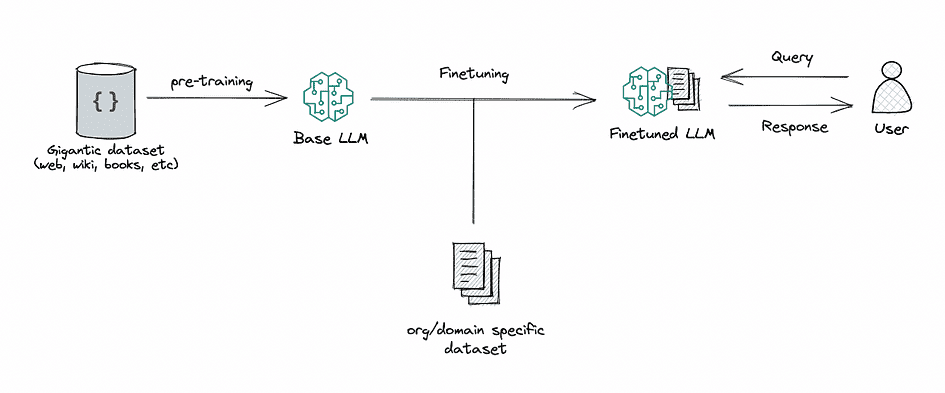
RAG: This approach integrates the power of retrieval (or searching) into LLM text generation. It combines a retriever system, which fetches relevant document snippets from a large corpus, and an LLM, which produces answers using the information from those snippets. In essence, RAG helps the model to “look up” external information to improve its responses.
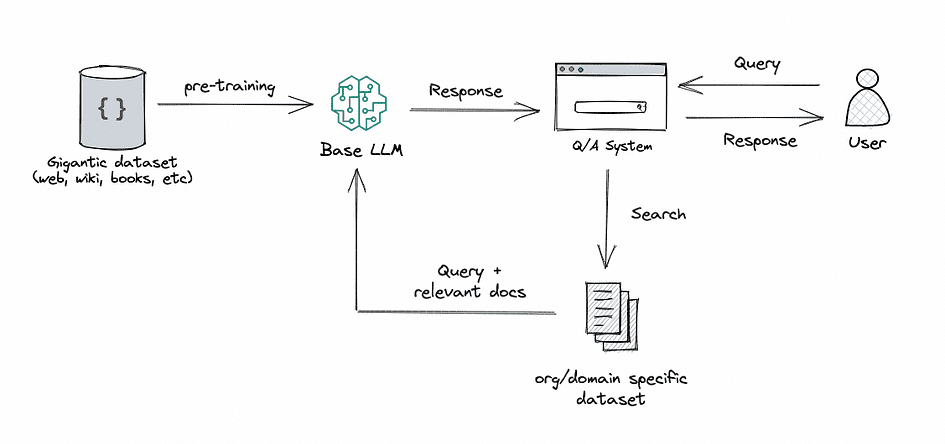
RAG vs Finetuning: Which Is the Best Tool to Boost Your LLM Application?
Image by Author

Finetuning: This is the process of taking a pre-trained LLM and further training it on a smaller, specific dataset to adapt it for a particular task or to improve its performance. By finetuning, we are adjusting the model’s weights based on our data, making it more tailored to our application’s unique needs.
RAG vs Finetuning: Which Is the Best Tool to Boost Your LLM Application?
Image by Author

Both RAG and finetuning serve as powerful tools in enhancing the performance of LLM-based applications, but they address different aspects of the optimisation process, and this is crucial when it comes to choosing one over the other.

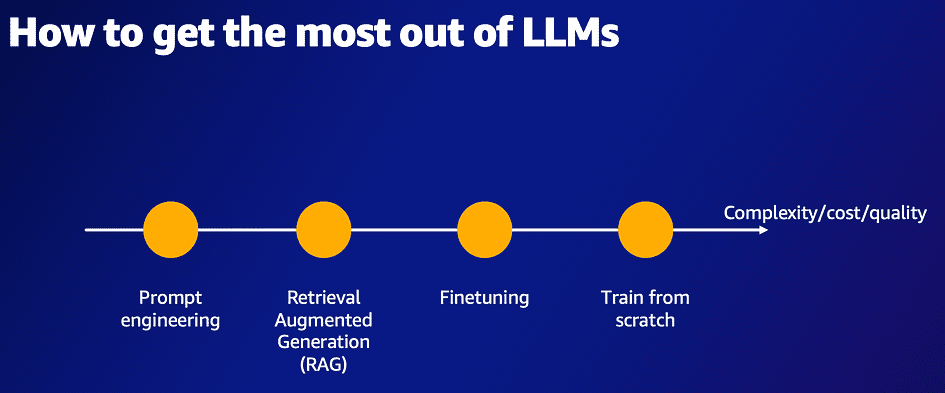
Previously, I would often suggest to organisations that they experiment with RAG before diving into finetuning. This was based on my perception that both approaches achieved similar results but varied in terms of complexity, cost, and quality. I even used to illustrate this point with diagrams such as this one:
RAG vs Finetuning: Which Is the Best Tool to Boost Your LLM Application?
Image by Author

In this diagram, various factors like complexity, cost, and quality are represented along a single dimension. The takeaway? RAG is simpler and less expensive, but its quality might not match up. My advice usually was: start with RAG, gauge its performance, and if found lacking, shift to finetuning.

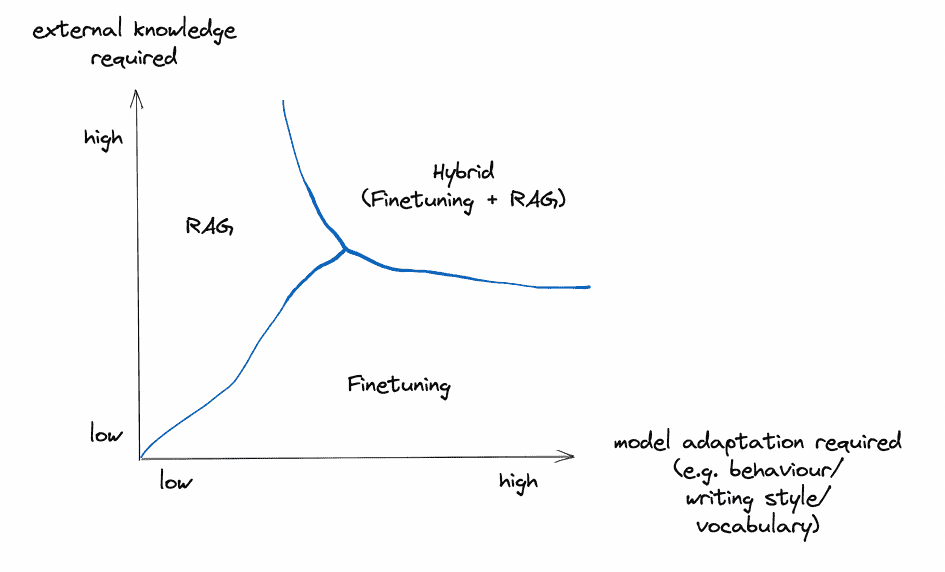
However, my perspective has since evolved. I believe it’s an oversimplification to view RAG and finetuning as two techniques that achieve the same result, just where one is just cheaper and less complex than the other. They are fundamentally distinct — instead of co-linear they are actually orthogonal — and serve different requirements of an LLM application.

To make this clearer, consider a simple real-world analogy: When posed with the question, “Should I use a knife or a spoon to eat my meal?”, the most logical counter-question is: “Well, what are you eating?” I asked friends and family this question and everyone instinctively replied with that counter-question, indicating that they don’t view the knife and spoon as interchangeable, or one as an inferior variant of the other.

What is this about?

In this blog post, we’ll dive deep into the nuances that differentiate RAG and finetuning across various dimensions that are, in my opinion, crucial in determining the optimal technique for a specific task. Moreover, we’ll be looking at some of the most popular use cases for LLM applications and use the dimensions established in the first part to identify which technique might be best suited for which use case. In the last part of this blog post we will identify additional aspects that should be considered when building LLM applications. Each one of those might warrant its own blog post and therefore we can only touch briefly on them in the scope of this post.

Why should you care?

Choosing the right technique for adapting large language models can have a major impact on the success of your NLP applications. Selecting the wrong approach can lead to:

  • Poor model performance on your specific task, resulting in inaccurate outputs.
  • Increased compute costs for model training and inference if the technique is not optimized for your use case.
  • Additional development and iteration time if you need to pivot to a different technique later on.
  • Delays in deploying your application and getting it in front of users.
  • A lack of model interpretability if you choose an overly complex adaptation approach.
  • Difficulty deploying the model to production due to size or computational constraints.

The nuances between RAG and finetuning span model architecture, data requirements, computational complexity, and more. Overlooking these details can derail your project timeline and budget.

This blog post aims to prevent wasted effort by clearly laying out when each technique is advantageous. With these insights, you can hit the ground running with the right adaptation approach from day one. The detailed comparison will equip you to make the optimal technology choice to achieve your business and AI goals. This guide to selecting the right tool for the job will set your project up for success.

So let’s dive in!

Key considerations for boosting performance

Before we choose RAG vs Fintuning, we should assess the requirements of our LLM project along some dimensions and ask ourselves a few questions.

Does our use case require access to external data sources?

When choosing between finetuning an LLM or using RAG, one key consideration is whether the application requires access to external data sources. If the answer is yes, RAG is likely the better option.

RAG systems are, by definition, designed to augment an LLM’s capabilities by retrieving relevant information from knowledge sources before generating a response. This makes this technique well-suited for applications that need to query databases, documents, or other structured/unstructured data repositories. The retriever and generator components can be optimised to leverage these external sources.

In contrast, while it is possible to finetune an LLM to learn some external knowledge, doing so requires a large labelled dataset of question-answer pairs from the target domain. This dataset must be updated as the underlying data changes, making it impractical for frequently changing data sources. The finetuning process also does not explicitly model the retrieval and reasoning steps involved in querying external knowledge.

So in summary, if our application needs to leverage external data sources, using a RAG system will likely be more effective and scalable than attempting to “bake in” the required knowledge through finetuning alone.

Do we need to modify the model’s behaviour, writing style, or domain-specific knowledge?

Another very important aspect to consider is how much we need the model to adjust its behaviour, its writing style, or tailor its responses for domain-specific applications.

Finetuning excels in its ability to adapt an LLM’s behaviour to specific nuances, tones, or terminologies. If we want the model to sound more like a medical professional, write in a poetic style, or use the jargon of a specific industry, finetuning on domain-specific data allows us to achieve these customisations. This ability to influence the model’s behaviour is essential for applications where alignment with a particular style or domain expertise is vital.

RAG, while powerful in incorporating external knowledge, primarily focuses on information retrieval and doesn’t inherently adapt its linguistic style or domain-specificity based on the retrieved information. It will pull relevant content from the external data sources but might not exhibit the tailored nuances or domain expertise that a finetuned model can offer.

So, if our application demands specialised writing styles or deep alignment with domain-specific vernacular and conventions, finetuning presents a more direct route to achieving that alignment. It offers the depth and customisation necessary to genuinely resonate with a specific audience or expertise area, ensuring the generated content feels authentic and well-informed.

Quick recap

These two aspects are by far the most important ones to consider when deciding which method to use to boost LLM application performance. Interestingly, they are, in my opinion, orthogonal and can be used independently (and also be combined).
RAG vs Finetuning: Which Is the Best Tool to Boost Your LLM Application?
Image by Author

However, before diving into the use cases, there are a few more key aspects we should consider before choosing a method:

How crucial is it to suppress hallucinations?

One downside of LLMs is their tendency to hallucinate — making up facts or details that have no basis in reality. This can be highly problematic in applications where accuracy and truthfulness are critical.

Finetuning can help reduce hallucinations to some extent by grounding the model in a specific domain’s training data. However, the model may still fabricate responses when faced with unfamiliar inputs. Retraining on new data is required to continuously minimise false fabrications.

In contrast, RAG systems are inherently less prone to hallucination because they ground each response in retrieved evidence. The retriever identifies relevant facts from the external knowledge source before the generator constructs the answer. This retrieval step acts as a fact-checking mechanism, reducing the model’s ability to confabulate. The generator is constrained to synthesise a response supported by the retrieved context.

So in applications where suppressing falsehoods and imaginative fabrications is vital, RAG systems provide in-built mechanisms to minimise hallucinations. The retrieval of supporting evidence prior to response generation gives RAG an advantage in ensuring factually accurate and truthful outputs.

How much labelled training data is available?

When deciding between RAG and finetuning, a crucial factor to consider is the volume of domain- or task-specific, labelled training data at our disposal.

Finetuning an LLM to adapt to specific tasks or domains is heavily dependent on the quality and quantity of the labelled data available. A rich dataset can help the model deeply understand the nuances, intricacies, and unique patterns of a particular domain, allowing it to generate more accurate and contextually relevant responses. However, if we’re working with a limited dataset, the improvements from finetuning might be marginal. In some cases, a scant dataset might even lead to overfitting, where the model performs well on the training data but struggles with unseen or real-world inputs.

On the contrary, RAG systems are independent from training data because they leverage external knowledge sources to retrieve relevant information. Even if we don’t have an extensive labelled dataset, a RAG system can still perform competently by accessing and incorporating insights from its external data sources. The combination of retrieval and generation ensures that the system remains informed, even when domain-specific training data is sparse.

In essence, if we have a wealth of labelled data that captures the domain’s intricacies, finetuning can offer a more tailored and refined model behaviour. But in scenarios where such data is limited, a RAG system provides a robust alternative, ensuring the application remains data-informed and contextually aware through its retrieval capabilities.

How static/dynamic is the data?

Another fundamental aspect to consider when choosing between RAG and finetuning is the dynamic nature of our data. How frequently is the data updated, and how imperative is it for the model to stay current?

Finetuning an LLM on a specific dataset means the model’s knowledge becomes a static snapshot of that data at the time of training. If the data undergoes frequent updates, changes, or expansions, this can quickly render the model outdated. To keep the LLM current in such dynamic environments, we’d have to retrain it frequently, a process that can be both time-consuming and resource-intensive. Additionally, each iteration requires careful monitoring to ensure that the updated model still performs well across different scenarios and hasn’t developed new biases or gaps in understanding.

In contrast, RAG systems inherently possess an advantage in environments with dynamic data. Their retrieval mechanism constantly queries external sources, ensuring that the information they pull in for generating responses is up-to-date. As the external knowledge bases or databases update, the RAG system seamlessly integrates these changes, maintaining its relevance without the need for frequent model retraining.

In summary, if we’re grappling with a rapidly evolving data landscape, RAG offers an agility that’s hard to match with traditional finetuning. By always staying connected to the most recent data, RAG ensures that the responses generated are in tune with the current state of information, making it an ideal choice for dynamic data scenarios.

How transparent/interpretable does our LLM app need to be?

The last aspect to consider is the degree to which we need insights into the model’s decision-making process.

Finetuning an LLM, while incredibly powerful, operates like a black box, making the reasoning behind its responses more opaque. As the model internalises the information from the dataset, it becomes challenging to discern the exact source or reasoning behind each response. This can make it difficult for developers or users to trust the model’s outputs, especially in critical applications where understanding the “why” behind an answer is vital.

RAG systems, on the other hand, offer a level of transparency that’s not typically found in solely finetuned models. Given the two-step nature of RAG — retrieval and then generation — users can peek into the process. The retrieval component allows for the inspection of which external documents or data points are selected as relevant. This provides a tangible trail of evidence or reference that can be evaluated to understand the foundation upon which a response is built. The ability to trace back a model’s answer to specific data sources can be invaluable in applications that demand a high degree of accountability or when there’s a need to validate the accuracy of the generated content.

In essence, if transparency and the ability to interpret the underpinnings of a model’s responses are priorities, RAG offers a clear advantage. By breaking down the response generation into distinct stages and allowing insight into its data retrieval, RAG fosters greater trust and understanding in its outputs.

Summary

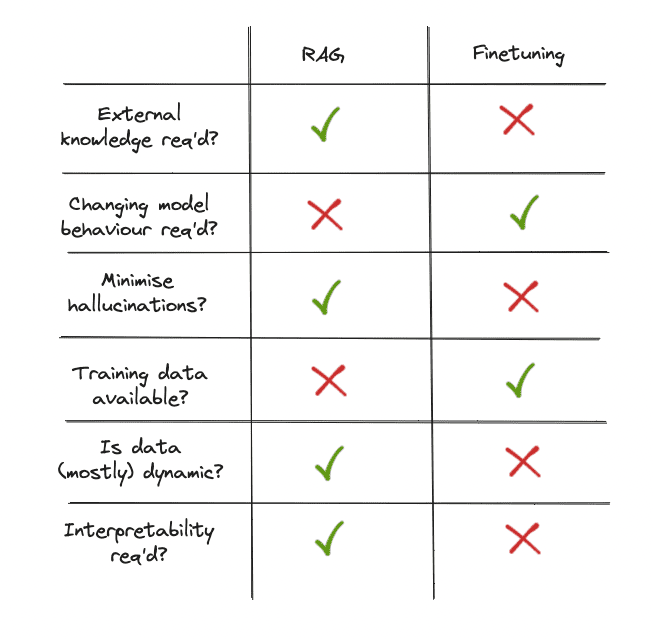
Choosing between RAG and finetuning becomes more intuitive when considering these dimensions. If we need lean towards accessing external knowledge and valuing transparency, RAG is our go-to. On the other hand, if we’re working with stable labelled data and aim to adapt the model more closely to specific needs, finetuning is the better choice.
RAG vs Finetuning: Which Is the Best Tool to Boost Your LLM Application?
Image by Author

In the following section, we’ll see how we can assess popular LLM use cases based on these criteria.

Use cases

Let’s look at some popular use cases and how the above framework can be used to choose the right method:

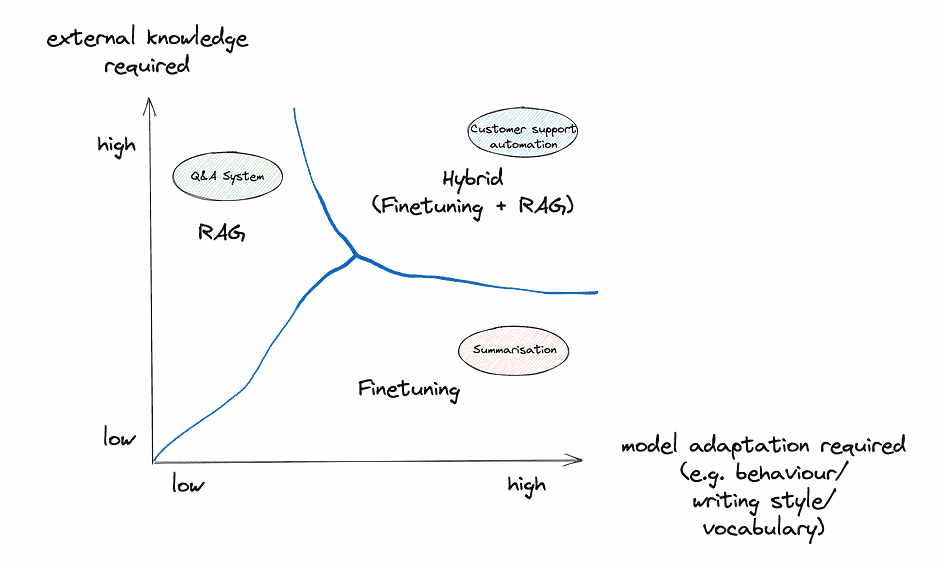
Summarisation (in a specialised domain and/or a specific style)

1. External knowledge required? For the task of summarizing in the style of previous summaries, the primary data source would be the previous summaries themselves. If these summaries are contained within a static dataset, there’s little need for continuous external data retrieval. However, if there’s a dynamic database of summaries that frequently updates and the goal is to continually align the style with the newest entries, RAG might be useful here.

2. Model adaptation required? The core of this use case revolves around adapting to a specialised domain or a and/or a specific writing style. Finetuning is particularly adept at capturing stylistic nuances, tonal variations, and specific domain vocabularies, making it an optimal choice for this dimension.

3. Crucial to minimise hallucinations? Hallucinations are problematic in most LLM applications, including summarisation. However, in this use case, the text to be summarised is typically provided as context. This makes hallucinations less of a concern compared to other use cases. The source text constrains the model, reducing imaginative fabrications. So while factual accuracy is always desirable, suppressing hallucinations is a lower priority for summarisation given the contextual grounding.

4. Training data available? If there’s a substantial collection of previous summaries that are labelled or structured in a way that the model can learn from them, finetuning becomes a very attractive option. On the other hand, if the dataset is limited, and we’re leaning on external databases for stylistic alignment, RAG could play a role, although its primary strength isn’t style adaptation.

5. How dynamic is the data? If the database of previous summaries is static or updates infrequently, the finetuned model’s knowledge will likely remain relevant for a longer time. However, if the summaries update frequently and there’s a need for the model to align with the newest stylistic changes continuously, RAG might have an edge due to its dynamic data retrieval capabilities.

6. Transparency/Interpretability required? The primary goal here is stylistic alignment, so the “why” behind a particular summarisation style might be less critical than in other use cases. That said, if there’s a need to trace back and understand which previous summaries influenced a particular output, RAG offers a bit more transparency. Still, this might be a secondary concern for this use case.

Recommendation: For this use case finetuning appears to be the more fitting choice. The primary objective is stylistic alignment, a dimension where finetuning shines. Assuming there’s a decent amount of previous summaries available for training, finetuning an LLM would allow for deep adaptation to the desired style, capturing the nuances and intricacies of the domain. However, if the summaries database is extremely dynamic and there’s value in tracing back influences, considering a hybrid approach or leaning towards RAG could be explored.

Question/answering system on organisational knowledge (i.e. external data)

1. External knowledge required? A question/answering system relying on organisational knowledge bases inherently requires access to external data, in this case, the org’s internal databases and document stores. The system’s effectiveness hinges on its ability to tap into and retrieve relevant information from these sources to answer queries. Given this, RAG stands out as the more suitable choice for this dimension, as it’s designed to augment LLM capabilities by retrieving pertinent data from knowledge sources.

2. Model adaptation required? Depending on the organization and its field, there might be a requirement for the model to align with specific terminologies, tones, or conventions. While RAG focuses primarily on information retrieval, finetuning can help the LLM adjust its responses to the company’s internal vernacular or the nuances of its domain. Thus, for this dimension, depending on the specific requirements finetuning might play a role.

3. Crucial to minimise hallucinations? Hallucinations are a major concern in this use case, due to the knowledge-cutoff of LLMs. If the model is unable to answer a question based on the data it has been trained on, it will almost certainly revert to (partially or entirely) making up a plausible but incorrect answer.

4. Training data available? If the organization has a structured and labeled dataset of previously answered questions, this can bolster the finetuning approach. However, not all internal databases are labeled or structured for training purposes. In scenarios where the data isn’t neatly labeled or where the primary focus is on retrieving accurate and relevant answers, RAG’s ability to tap into external data sources without needing a vast labeled dataset makes it a compelling option.

5. How dynamic is the data? Internal databases and document stores in organisations can be highly dynamic, with frequent updates, changes, or additions. If this dynamism is characteristic of the organisation’s knowledge base, RAG offers a distinct advantage. It continually queries the external sources, ensuring its answers are based on the latest available data. Finetuning would require regular retraining to keep up with such changes, which might be impractical.

6. Transparency/Interpretability required? For internal applications, especially in sectors like finance, healthcare, or legal, understanding the reasoning or source behind an answer can be paramount. Since RAG provides a two-step process of retrieval and then generation, it inherently offers a clearer insight into which documents or data points influenced a particular answer. This traceability can be invaluable for internal stakeholders who might need to validate or further investigate the sources of certain answers.

Recommendation: For this use case a RAG system seems to be the more fitting choice. Given the need for dynamic access to the organisation’s evolving internal databases and the potential requirement for transparency in the answering process, RAG offers capabilities that align well with these needs. However, if there’s a significant emphasis on tailoring the model’s linguistic style or adapting to domain-specific nuances, incorporating elements of finetuning could be considered.

Customer Support Automation (i.e. automated chatbots or help desk solutions providing instant responses to customer inquiries)

1. External knowledge required? Customer support often necessitates access to external data, especially when dealing with product details, account-specific information, or troubleshooting databases. While many queries can be addressed with general knowledge, some might require pulling data from company databases or product FAQs. Here, RAG’s capability to retrieve pertinent information from external sources would be beneficial. However, it’s worth noting that a lot of customer support interactions are also based on predefined scripts or knowledge, which can be effectively addressed with a finetuned model.

2. Model adaptation required? Customer interactions demand a certain tone, politeness, and clarity, and might also require company-specific terminologies. Finetuning is especially useful for ensuring the LLM adapts to the company’s voice, branding, and specific terminologies, ensuring a consistent and brand-aligned customer experience.

3. Crucial to minimise hallucinations? For customer support chatbots, avoiding false information is essential to maintain user trust. Finetuning alone leaves models prone to hallucinations when faced with unfamiliar queries. In contrast, RAG systems suppress fabrications by grounding responses in retrieved evidence. This reliance on sourced facts allows RAG chatbots to minimise harmful falsehoods and provide users with reliable information where accuracy is vital.

4. Training data available? If a company has a history of customer interactions, this data can be invaluable for finetuning. A rich dataset of previous customer queries and their resolutions can be used to train the model to handle similar interactions in the future. If such data is limited, RAG can provide a fallback by retrieving answers from external sources like product documentation.

5. How dynamic is the data? Customer support might need to address queries about new products, updated policies, or changing service terms. In scenarios where the product line up, software versions, or company policies are frequently updated, RAG’s ability to dynamically pull from the latest documents or databases is advantageous. On the other hand, for more static knowledge domains, finetuning can suffice.

6. Transparency/Interpretability required? While transparency is essential in some sectors, in customer support, the primary focus is on accurate, fast, and courteous responses. However, for internal monitoring, quality assurance, or addressing customer disputes, having traceability regarding the source of an answer could be beneficial. In such cases, RAG’s retrieval mechanism offers an added layer of transparency.

Recommendation: For customer support automation a hybrid approach might be optimal. Finetuning can ensure that the chatbot aligns with the company’s branding, tone, and general knowledge, handling the majority of typical customer queries. RAG can then serve as a complementary system, stepping in for more dynamic or specific inquiries, ensuring the chatbot can pull from the latest company documents or databases and thereby minimising hallucinations. By integrating both approaches, companies can provide a comprehensive, timely, and brand-consistent customer support experience.
RAG vs Finetuning: Which Is the Best Tool to Boost Your LLM Application?
Image by Author
Additional aspects to consider

As mentioned above, there are other factors that should be considered when deciding between RAG and finetuning (or both). We can’t possibly dive deep into them, as all of them are multi-faceted and don’t have clear answers like some of the aspects above (for example, if there is no training data the finetuning is just simply not possible). But that doesn’t mean we should disregard them:

Scalability

As an organisation grows and its needs evolve, how scalable are the methods in question? RAG systems, given their modular nature, might offer more straightforward scalability, especially if the knowledge base grows. On the other hand, frequently finetuning a model to cater to expanding datasets can be computationally demanding.

Latency and Real-time Requirements

If the application requires real-time or near-real-time responses, consider the latency introduced by each method. RAG systems, which involve retrieving data before generating a response, might introduce more latency compared to a finetuned LLM that generates responses based on internalised knowledge.

Maintenance and Support

Think about the long-term. Which system aligns better with the organisation's ability to provide consistent maintenance and support? RAG might require upkeep of the database and the retrieval mechanism, while finetuning would necessitate consistent retraining efforts, especially if the data or requirements change.

Robustness and Reliability

How robust is each method to different types of inputs? While RAG systems can pull from external knowledge sources and might handle a broad array of questions, a well finetuned model might offer more consistency in certain domains.

Ethical and Privacy Concerns

Storing and retrieving from external databases might raise privacy concerns, especially if the data is sensitive. On the other hand, a finetuned model, while not querying live databases, might still produce outputs based on its training data, which could have its own ethical implications.

Integration with Existing Systems

Organisations might already have certain infrastructure in place. The compatibility of RAG or finetuning with existing systems — be it databases, cloud infrastructures, or user interfaces — can influence the choice.

User Experience

Consider the end-users and their needs. If they require detailed, reference-backed answers, RAG could be preferable. If they value speed and domain-specific expertise, a finetuned model might be more suitable.

Cost

Finetuning can get expensive, especially for really large models. But in the past few months costs have gone down significantly thanks to parameter efficient techniques like QLoRA. Setting up RAG can be a large initial investment — covering the integration, database access, maybe even licensing fees — but then there’s also the regular maintenance of that external knowledge base to think about.

Complexity

Finetuning can get complex quickly. While many providers now offer one-click finetuning where we just need to provide the training data, keeping track of model versions and ensuring that the new models still perform well across the board is challenging. RAG, on the other hand, can also get complex quickly. There’s the setup of multiple components, making sure the database stays fresh, and ensuring the pieces — like retrieval and generation — fit together just right.

Conclusion

As we’ve explored, choosing between RAG and finetuning requires a nuanced evaluation of an LLM application’s unique needs and priorities. There is no one-size-fits-all solution; success lies in aligning the optimisation method with the specific requirements of the task. By assessing key criteria — the need for external data, adapting model behaviour, training data availability, data dynamics, result transparency, and more — organisations can make an informed decision on the best path forward. In certain cases, a hybrid approach leveraging both RAG and finetuning may be optimal.

The key is avoiding assumptions that one method is universally superior. Like any tool, their suitability depends on the job at hand. Misalignment of approach and objectives can hinder progress, while the right method accelerates it. As an organisation evaluates options for boosting LLM applications, it must resist oversimplification and not view RAG and finetuning as interchangeable and choose the tool that empowers the model to fulfil its capabilities aligned to the needs of the use case. The possibilities these methods unlock are astounding but possibility alone isn’t enough — execution is everything. The tools are here — now let’s put them to work.

Heiko Hotz is the Founder of NLP London, an AI consultancy helping organizations implement natural language processing and conversational AI. With over 15 years of experience in the tech industry, Heiko is an expert in leveraging AI and machine learning to solve complex business challenges.

Original. Reposted with permission.

Heiko Hotz is the Founder of NLP London, an AI consultancy helping organizations implement natural language processing and conversational AI. With over 15 years of experience in the tech industry, Heiko is an expert in leveraging AI and machine learning to solve complex business challenges.

More On This Topic

  • Web LLM: Bring LLM Chatbots to the Browser
  • 6 Best Free Online Courses to Learn Python and Boost Your Career
  • Build Your First Data Science Application
  • Writing Your First Distributed Python Application with Ray
  • 8 Ways to Improve Your Search Application this Week
  • Which is Best: Data Science Bootcamp vs Degree vs Online Course
AMD acquires Nod.ai to bolsters its AI software ecosystem

AMD acquires Nod.ai to bolsters its AI software ecosystem Kyle Wiggers 7 hours

AMD yesterday acquired Nod.ai, an open source AI software provider, as the chipmaker looks to bolster its efforts to build an ecosystem of AI development tools, libraries and models around its hardware.

The acquisition is expected to close this quarter, CNBC reports. AMD didn’t disclose the details of the transaction.

In a press release, AMD SVP Vamsi Boppana said that the Nod.ai acquisition will “significantly” enhance AMD’s ability to provide customers with “software that allows them to easily deploy highly performant AI models tuned for AMD hardware.”

“The addition of the talented Nod.ai team accelerates our ability to advance open-source compiler technology and enable portable, high-performance AI solutions across the AMD product portfolio,” Boppana said. “Nod.ai’s technologies are already widely deployed in the cloud, at the edge and across a broad range of end point devices today.”

Nod.ai, based in Santa Clara, was co-founded in 2013 by Anush Elangovan and Harsh Menon. Elangovan was part of the first Chromebooks team at Google and a lead engineer at Cisco. Menon previously worked at Kitty Hawk, the now-defunct electric aircraft company backed by Google co-founder Larry Page.

Nod.ai initially sought to build gaming-focused devices for gesture recognition and motion tracking. But it eventually pivoted to AI model tooling, building modules to reduce the need for AI developers to manually optimize and deploy AI models to run across data center and edge machines — including AMD-powered machines.

AMD rival Nvidia offers similar software-based solutions for accelerating AI models. But they’re largely closed-source, proprietary and designed to work with the company’s own GPUs.

Nod.ai had raised over $20 million in venture funding prior to the AMD acquisition, including from Atlantic Bridge, Square Capital, Pointguard Ventures, and Walden International. Alameda Research, the cryptocurrency firm co-led by disgraced entrepreneur and FTX co-founder Sam Bankman-Fried, reportedly participated in a Nod.ai funding round. But in December, Elangovan told the Financial Times that Nod.ai “[wasn’t] a recipient of FTX/Alameda funding.”

“At Nod.ai, we’re a team of engineers focused on problem solving — quickly — and moving at pace in an industry of constant change to develop solutions for the next set of problems,” Elangovan, who serves as Nod.ai’s CEO, said in a press release. “Our journey as a company has cemented our role as the primary maintainer and major contributor to some of the world’s most important AI repositories. By joining forces with AMD, we will bring this expertise to a broader range of customers on a global scale.”

Nod.ai will join the AI group that AMD created earlier this year, which employs about 1,500 engineers at present. The group’s expected to be expanded by around 300 employees by the end of the year as AMD races to catch up with Nvidia in the exploding market for AI chips.

Cypher 2023: The Future of Simulation and Design is AI

AI in art has made enormous progress in the past year. With brand new tools to improve the animation, VFX that uses AI. This has significantly changed the content created. Instead of using a body double, deepfakes are used to create the desired effect. There is incredible progress in AR/VR technologies that drives the concept of immersive experiences. “When we talk of design and media, more than what it looks like, it is about what the end result feels like. The images need to evoke a feeling in you.” begins Biren Ghose in his talk on the first day of Cypher.

Biren Ghose, the country head for Technicolor Studios spoke on the first day of Cypher. He began the session, “AI for Simulation and Design”, mentioning how far we’ve come in making movies. “When I was young we didn’t even have audio in our movies. And today many of the innovations that you see are dreams that were first portrayed to you in movies,” he said.

Instead of explaining further with a presentation, he played videos of the simulations created by Technicolor creative studios. He showed movies and advertisements created by the company. A unique project he shared was experimenting with a collaboration of beatboxing and AI. Using machine learning, a convolutional neural network interprets Reef’s voice, beats, and sounds, improvising on his contribution by adding on elements that complement his music.

Technicolor Studios which has now been rebranded to Vantiva last year, has four operating units creating VFX, animations, and visualisations for gaming, movies, shows and advertising. Biren mentioned that the studio has made “over 20 movies, 32+ large TV series, 3500 ad commercials so far”.

The future of animation with AI

“I’ve been with technicolor for 14 years and in this time we’ve seen at least four or five revolutions in terms of tech.” This is seen in the series of movies made by the studio. The first Kung Fu Panda or Madagascar movie was dramatically different from the last one. “Same character, similar stories but very different technologies.”

Ghose said this is to be expected in 2024 as well. The software next year will be clunky and won’t work without a massive latency in a machine more than two years old, he explained. To emphasise this point he played an advertisement created for MasterCard which involves a younger AI version of a football player.

The advertisement which didn’t involve any CGI was created using synthetic renders. Thousands of pictures were taken to generate the AI images of the footballer. “AI is an enabler and not necessarily a competitive tool for what we need to do in all of our industries,” he said.

Another startling example he explained was the comparison between how Jungle Book 2 which is in the works compared to the first one released seven years ago. While the first one was live-action and CGI, the second one is using AI to make the whole process easier and better.

Ghose said, “Our team and Disney travelled to the jungles, across three corners of India, across four seasons, and took hundreds and 1000s of photographs.” These photographs he said have been replicated as in ‘photogrammetry’ using various methods in order to actually create images of the real environments.

The Mill, one of the factions of Technicolor studios that creates advertisements, brought ‘DracARys’ home to all the House of the Dragon fans. The highly personalised dragon comes alive using augmented reality through an app. “We wanted to create a very personal, sophisticated, responsive virtual creature that fans could own and customise. Such immersive experiences will become more popular in the future,” he says.

AI and Art

“If AI is the Wild West, who is the sheriff around here?” he asked, referring to another advertisement created by Technicolor studio. But the question was not rhetorical, instead an important one to address. Ghose said, “We need more governance to come in. As in my role as the chairman of the CII’s National AVGC Committee, we are looking at what kind of regulation we can bring in.”

In the meanwhile the industry is self regulating. “So that we don’t really need a sheriff to tell us, ‘Hey, you should do this or that’, we can make that happen ourselves,” he explained.

This is possible with making contracts. The kind of contract the artist engages with determines how their ‘avatar’ or their digital persona is used. “The AI avatar will be licensed by the artist’s manager for a particular advertisement or movie. The other way is to write off your IP to a company so that everything they create is the IP of a particular company,” he explained.

There is also a huge opportunity to bring more women to the industry. In the production industry for visual effects, animation and games only 2% of the workforce are women in India. He said, “We were happy at our company to reach 11.5 Just before the pandemic and we have to make further efforts there. But there’s a whole opportunity now with new technology to bring more women into the game.” he concludes.

The post Cypher 2023: The Future of Simulation and Design is AI appeared first on Analytics India Magazine.

Comparing Natural Language Processing Techniques: RNNs, Transformers, BERT

Comparing Natural Language Processing Techniques: RNNs, Transformers, BERT
Image by Freepik

Natural Language Processing, or NLP, is a field within artificial intelligence for machines to have the ability to understand textual data. NLP research has existed for a long time, but only recently has it become more prominent with the introduction of big data and higher computational processing power.

With the NLP field becoming bigger, many researchers would try to improve the machine's capability to understand the textual data better. Through much progress, many techniques are proposed and applied in the NLP field.

This article will compare various techniques for processing text data in the NLP field. This article will focus on discussing RNN, Transformers, and BERT because it’s the one that is often used in research. Let’s get into it.

Recurrent Neural Network

Recurrent Neural Network or RNN was developed in 1980 but only recently gained attraction in the NLP field. RNN is a particular type within the neural network family used for sequential data or data that can’t be independent of each other. Sequential data examples are time series, audio, or text sentence data, basically any kind of data with meaningful order.

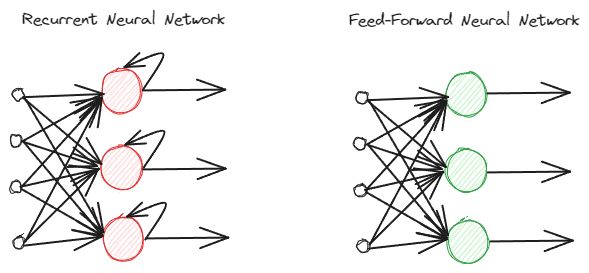
RNNs are different from regular feed-forward neural networks as they process information differently. In the normal feed-forward, the information is processed following the layers. However, RNN is using a loop cycle on the information input as consideration. To understand the differences, let’s see the image below.

Comparing Natural Language Processing Techniques: RNNs, Transformers, BERT
Image by Author

As you can see, the RNNs model implements a loop cycle during the information processing. RNNs would consider the current and previous data input when processing this information. That’s why the model is suitable for any type of sequential data.

If we take an example in the text data, imagine we have the sentence “I wake up at 7 AM”, and we have the word as input. In the feed-forward neural network, when we reach the word “up,” the model would already forget the words “I,” “wake,” and “up.” However, RNNs would use every output for each word and loop them back so the model would not forget.

In the NLP field, RNNs are often used in many textual applications, such as text classification and generation. It’s often used in word-level applications such as Part of Speech tagging, next-word generation, etc.

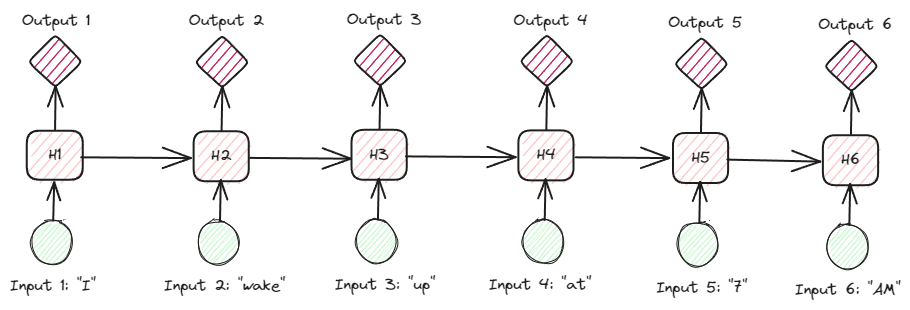
Looking at the RNNs more in-depth on the textual data, there are many types of RNNs. For example, the below image is the many-to-many types.

Comparing Natural Language Processing Techniques: RNNs, Transformers, BERT
Image by Author

Looking at the image above, we can see that the output for each step (time-step in RNN) is processed one step at a time, and every iteration always considers the previous information.

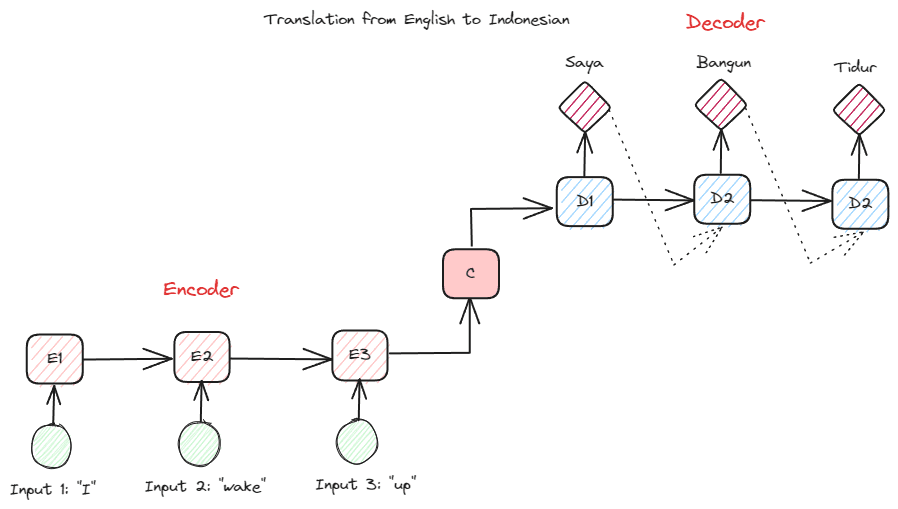
Another RNN type used in many NLP applications is the encoder-decoder type (Sequence-to-Sequence). The structure is shown in the image below.

Comparing Natural Language Processing Techniques: RNNs, Transformers, BERT
Image by Author

This structure introduces two parts that are used in the model. The first part is called Encoder, which is a part that receives data sequence and creates a new representation based on it. The representation would be used in the second part of the model, which is the decoder. With this structure, the input and output lengths don’t necessarily need to be equal. The example use case is a language translation, which often does not have the same length between the input and output.

There are various benefits of using RNNs to process natural language data, including:

  1. RNN can be used to process text input without length limitations.
  2. The model shares the same weights across all the time steps, which allows the neural network to use the same parameter in each step.
  3. Having the memory of past input makes RNN suitable for any sequential data.

But, there are several disadvantages as well:

  1. RNN is susceptible to both vanishing and exploding gradients. This is where the gradient result is the near-zero value (vanishing), causing network weight to only be updated for a tiny amount, or the gradient result is so significant (exploding) that it assigns an unrealistic enormous importance to the network.
  2. Long time of training because of the sequential nature of the model.
  3. Short-term memory means that the model starts to forget the longer the model is trained. There is an extension of RNN called LSTM to alleviate this problem.

Transformers

Transformers is an NLP model architecture that tries to solve the sequence-to-sequence tasks previously encountered in the RNNs. As mentioned above, RNNs have problems with short-term memory. The longer the input, the more prominent the model was in forgetting the information. This is where the attention mechanism could help solve the problem.

The attention mechanism is introduced in the paper by Bahdanau et al. (2014) to solve the long input problem, especially with encoder-decoder type of RNNs. I would not explain the attention mechanism in detail. Basically, it is a layer that allows the model to focus on the critical part of the model input while having the output prediction. For example, the word input “Clock” would correlate highly with “Jam” in Indonesian if the task is for translation.

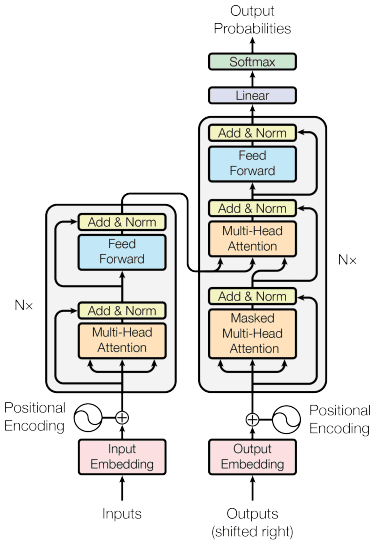
The transformers model is introduced by Vaswani et al. (2017). The architecture is inspired by the encoder-decoder RNN and built with the attention mechanism in mind and does not process data in sequential order. The overall transformers model is structured like the image below.

Comparing Natural Language Processing Techniques: RNNs, Transformers, BERT
Transformers Architecture (Vaswani et al. 2017)

In the structure above, the transformers encode the data vector sequence into the word embedding with positional encoding in place while using the decoding to transform data into the original form. With the attention mechanism in place, the encoding can given importance according to the input.

Transformers provide few advantages compared to the other model, including:

  1. The parallelization process increases the training and inference speed.
  2. Capable of processing longer input, which offers a better understanding of the context

There are still some disadvantages to the transformers model:

  1. High computational processing and demand.
  2. The attention mechanism might require the text to be split because of the length limit it can handle.
  3. Context might be lost if the split were done wrong.

BERT

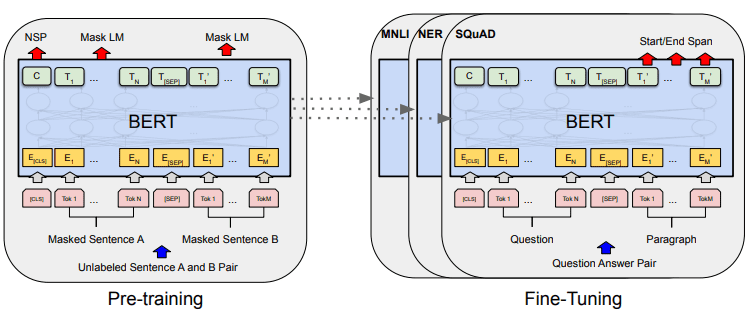
BERT, or Bidirectional Encoder Representations from Transformers, is a model developed by Devlin et al. (2019) that involves two steps (pre-training and fine-tuning) to create the model. If we compare, BERT is a stack of transformers encoder (BERT Base has 12 Layers while BERT Large has 24 layers).

BERT's overall model development can be shown in the image below.

Comparing Natural Language Processing Techniques: RNNs, Transformers, BERT
BERT overall procedures (Devlin et al. (2019)

Pre-training tasks initiate the model's training at the same time, and once it is done, the model can be fine-tuned for various downstream tasks (question-answering, classification, etc.).

What makes BERT special is that it is the first unsupervised bidirectional language model that is pre-trained on text data. BERT was previously pre-trained on the entire Wikipedia and book corpus, consisting of over 3000 million words.

BERT is considered bidirectional because it didn’t read data input sequentially (from left to right or vice versa), but the transformer encoder read the whole sequence simultaneously.

Unlike directional models, which read the text input sequentially (left-to-right or right-to-left), the Transformer encoder reads the entire sequence of words simultaneously. That’s why the model is considered bidirectional and allows the model to understand the whole context of the input data.

To achieve bidirectional, BERT uses two techniques:

  1. Mask Language Model (MLM) — Word masking technique. The technique would mask 15% of the input words and try to predict this masked word based on the non-masked word.
  2. Next Sentence Prediction (NSP) — BERT tries to learn the relationship between sentences. The model has pairs of sentences as the data input and tries to predict if the subsequent sentence exists in the original document.

There are a few advantages to using BERT in the NLP field, including:

  1. BERT is easy to use for pre-trained various NLP downstream tasks.
  2. Bidirectional makes BERT understand the text context better.
  3. It’s a popular model that has much support from the community

Although, there are still a few disadvantages, including:

  1. Requires high computational power and long training time for some downstream task fine-tuning.
  2. The BERT model might result in a big model requiring much bigger storage.
  3. It’s better to use for complex tasks as the performance for simple tasks is not much different than using simpler models.

Conclusion

NLP has become more prominent recently, and much research has focused on improving the applications. In this article, we discuss three NLP techniques that are often used:

  1. RNN
  2. Transformers
  3. BERT

Each of the techniques has its advantages and disadvantages, but overall, we can see the model evolving in a better way.
Cornellius Yudha Wijaya is a data science assistant manager and data writer. While working full-time at Allianz Indonesia, he loves to share Python and Data tips via social media and writing media.

Cornellius Yudha Wijaya is a data science assistant manager and data writer. While working full-time at Allianz Indonesia, he loves to share Python and Data tips via social media and writing media.

More On This Topic

  • Vision Transformers: Natural Language Processing (NLP) Increases Efficiency…
  • Introducing Packed BERT for 2x Training Speed-up in Natural Language…
  • N-gram Language Modeling in Natural Language Processing
  • Getting Started with 5 Essential Natural Language Processing Libraries
  • Natural Language Processing Pipelines, Explained
  • Applying Natural Language Processing in Healthcare

Duolingo opens waitlist for its new, free music course. Here’s how to sign up

Duolingo Music and Math

Duolingo is known for being a language-learning app that makes the process fun and intuitive through gamified, free, bite-sized lessons. In early September, Duolingo announced it was expanding its learning platform to music and math learning. The company just made a new announcement that will let you join in on the fun.

On Wednesday, at Duocon, Duolingo announced that users can now join an in-app waitlist if they are eager to try out the new music course before the broader rollout to all users in November.

Also: Adobe unveils three new generative AI models, including the next generation of Firefly

When selected for the update, users will be alerted through an in-app notification. Users will then be able to find the added courses in the top left where users typically toggle between languages. Like any other course on Duolingo, there is no additional cost for the new music and math courses.

The music course will allow users to learn to read and play music through its signature gamified learning experience.

Duolingo's new music course will include the same techniques it uses in its language-learning platform, with hundreds of bite-sized lessons, interactive exercises, and 200-plus "fun and familiar tunes," according to an announcement.

As seen by the images below, learning takes place through interactive exercises such as fill-in-blank and match the pairs, where users select the right note to match the sound.

Duolingo shares that more than 3.6 million students in the US don't have access to music education. Duolingo's free music course is meant to help make learning music more accessible, with professional lessons costing up to $400 per lesson.

I have had the opportunity to go hands-on with the music-learning experience and can say I am a fan. If you are used to the regular Duolingo teaching style, the music course is extremely similar.

The only major difference is that you have to turn your phone horizontally to complete the exercises and that your volume has to be on to listen to the tunes.

I can't speak to how effective the app is at teaching music since I am only a couple of exercises in, but I can vouch for how easy and fun the experience is.

Also: 56% of professionals are unsure if their companies have ethical guidelines for AI use

In addition to adding music, the application will also begin including math lessons as part of an attempt to make Duolingo more of a multi-subject learning platform.

The math lessons also align with Duolingo's current learning layout, gamifying the learning experience with fun little exercises, such as selecting the right angle and dragging tiles to make a basic math operation.

Innovation

Cypher2023: Humans + AI: The Perfect Mix to Remove Digital Friction

AI has the potential to truly revolutionise how we work, with many calling generative AI a true enabler, meaning it can give productivity a significant boost. Asana, which is based in San Francisco, helps teams organise, track, and manage their work. Now, the company wants to leverage the power of AI.

During the ongoing Cypher2023, India’s biggest AI conference, Vishnu Prasad, South Asia Lead at Asana, discusses the challenges faced in work management and how Asana aims to address them using AI. The focus is on enhancing productivity and collaboration by eliminating redundant tasks and streamlining workflows.

“We have a mission. We want to help the world’s teams work together effortlessly and Asana is the company that created this modern work management platform that actually came out of Facebook. Co-founder Dustin Moskovitz, who also co-founded Facebook, realised that, work, when you think about it intuitively, it’s all interconnected teams. It’s like a neural network of different connections. It’s like a social network. So the aim was what can be done to create a better work system.”

Digital Friction

Today, a lot of hurdles and inefficiencies arise in work processes and are often caused by redundant tasks, such as sending status updates and transferring information between different platforms. These seemingly small issues collectively result in a significant reduction in productivity and hinder progress.

A major problem with locomotive work is that it consumes a substantial amount of time and effort, offering minimal value in return. Employees find themselves swamped with tasks, yet the impact and outcomes of their work remain obscured.

“When you have different Excel sheets, different emails sitting in different systems, stuff does not happen very fast,” Prasad said.

The Asana Solution

To counter this, Asana proposes a solution to this pervasive issue. Prasad asserts that their innovative platform leverages AI to bridge the gap between humans and technology. Asana has created a unique work management system, which is founded on the concept of a “world graph.” It ensures that every unit of work within an organisation is interconnected, eliminating duplication and enhancing collaboration. It’s not just about automation; it’s about creating a comprehensive work ecosystem.

“What Asana has done is created a work management system where there is no duplication of work. The underlying data architecture is what is driving this. So what I mean is if you are an individual contributor, open Asana and you can actually see what the task that you need to attend to on the day. There is a clear dashboard which tells what you need to do and when.”

What sets Asana apart is its ability to implement AI effectively within its platform. AI-driven features enable users to generate automated status reports, streamline complex tasks and create sub-tasks. Asana’s neural network-type architecture facilitates the development of AI tools that can analyse data beyond specific projects.

These AI tools open up exciting possibilities for identifying problem areas and providing detailed feedback. The “future of work” that Prasad envisions involves pinpointing interdependencies within teams, fostering collaboration, and achieving organisational goals more efficiently.

Humans+AI

Prasad says we should be working collaboratively, making the best use of AI. For example, on Asana, if something is created by AI, users will see a small tab that says ‘generated by AI’ to help differentiate between AI-generated or human work.

He further states it’s important to make the distinction and this is our grounding principle. This alliance between humans and AI is not about replacing one with the other; it’s about harnessing the strengths of both to achieve unprecedented productivity and innovation.

In summary, Asana’s approach to removing digital friction is a testament to the power of combining human ingenuity with AI. By adopting their platform, Prasad says we can envision a future where work becomes more efficient, productive, and ultimately more meaningful. This union of humans and AI offers the perfect mix to propel us into an era of seamless, frictionless work experiences.

The post Cypher2023: Humans + AI: The Perfect Mix to Remove Digital Friction appeared first on Analytics India Magazine.

F5 Warns Australian IT of Social Engineering Risk Escalation Due to Generative AI

Experts from security firm F5 have argued that cyber criminals are unlikely to send new armies of generative AI-driven bots into battle with enterprise security defences in the near future because proven social engineering attack methods will be easier to mount using generative AI.

The release of generative AI tools, such as ChatGPT, have caused widespread fears that democratization of powerful large language models could help bad actors around the world supercharge their efforts to hack businesses and steal or hold sensitive data hostage.

F5, a multicloud security and application delivery provider, tells TechRepublic that generative AI will result in a growth in social engineering attack volumes and capacity in Australia, as threat actors deliver a higher volume of better quality attacks to trick IT gatekeepers.

Jump to:

  • Social engineering attacks will grow and become better
  • Bad actors will choose social engineering over bot attacks
  • Enterprises will improve cybersecurity defences with AI
  • Australia will continue to attract attention from threat actors

Dan Woods, global head of intelligence at F5

Dan Woods.
Dan Woods

Global head of intelligence at F5, Dan Woods said he is less worried about AI resulting in “killer robots” or a “nuclear holocaust” than some. But he is “very concerned about generative AI.” Woods says the biggest threat facing both enterprises and people is social engineering.

Australian IT leaders only need to interact with a tool such as ChatGPT, Woods said, to see how it can mount a persuasive argument on a topic as well as a persuasive counter argument — and do it all with impeccable writing skills. This was a boon for bad actors around the world.

“Today, one person can socially engineer somewhere between 40 and 50 people at a time,” Woods said. “With generative AI — and the ability to synthesize the human voice — one criminal could start to social engineer almost an unlimited number of people a day and do it more effectively.”

SEE: DEF CON’s generative AI hacking challenge explored the cutting edge of security vulnerabilities.

Things Australian IT leaders have been teaching employees to consider red flags in phishing or smishing attacks, such as problems with grammar, spelling and syntax, “will all go away.”

“We will see phishing and smishing attacks that will not have mistakes any more. Criminals will be able to write in perfect English,” Woods said. “These attacks could be well structured in any language — it is very impressive. So I worry about social engineering and phishing attacks.”

There were already a total of 76,000 cyber crime reports in Australia in the 2021–22 financial year, according to Australian Cyber Security Centre data — up 13% on the previous financial year (Figure A). Many of these attacks involved social engineering techniques.

Figure A

Reports of Australian cybercrime increased in the 2021–22 financial year.
Reports of Australian cybercrime increased in the 2021–22 financial year. Image: ACSC

Enterprises on the receiving end of attack growth

Australian IT teams can expect to be on the receiving end of social engineering attack growth. F5 said the main counter to changing bad actor techniques and capabilities will be education to ensure employees are made aware of increasing attack sophistication due to AI.

“Scams that trick employees into doing something — like downloading a new version of a corporate VPN client or tricking accounts payable to pay some nonexistent merchant — will continue to happen,” Woods said. “They will be more persuasive and increase in volume.”

Woods added that organizations will need to ensure protocols are put in place, similar to existing financial controls in an enterprise, to guard against criminals’ growing persuasive power. This could include measures such as payments over a certain amount requiring multiple people to approve.

Bad actors will choose social engineering over bot attacks

An AI-supported wave of bot attacks may not be as imminent as the social engineering threat.

There have been warnings that armies of bots, supercharged by new AI tools, could be utilized by criminal organizations to launch more sophisticated automated attacks against enterprise cybersecurity defences, expanding a new front in organisations’ war against cyber criminals.

Threat actors only rise to level of security defence sophistication

However, Woods said that, based on his experience, bad actors tend to use only the level of sophistication required to launch successful attacks.

“Why throw additional resources at an attack if an unsophisticated attack method is already being successful?” he asked.

Woods, who has held security roles with the CIA and FBI, likens this to the art of lock picking.

“A lock picking expert can be equipped with all of the specialized advanced tools required to pick locks, but if the door is unlocked they don’t need them — they will just open the door,” Woods said. “Attackers are very much the same way.

“We are not really seeing AI launching bot attacks — it’s easier to move on to a softer target than use AI against, for example, an F5-protected layer.”

Organizations can expect “a profound and alarming impact on criminal activity,” but not on all criminal activity simultaneously.

“It is not until enterprises are protected by sophisticated countermeasures that we will see a rise in more sophisticated AI attacks,” Woods said.

Criminals will gravitate to less cyber-aware Australian sectors

This lock picking principle applies to the distribution of attacks across Australian enterprises. Jason Baden, F5’s regional vice president for Australia and New Zealand, said Australia remained a lucrative target for bad actors, and attacks were shifting to less protected sectors.

Jason Baden, regional vice president for Australia and New Zealand at F5

Jason Baden.
Jason Baden

“F5’s customer base in sectors like banking and finance, government and telecommunications, who are the traditional large targets, have been spending a lot of money and a lot of time and effort for many years to secure networks,” Baden said. “Their understanding is very high.

“Where we have seen the biggest increase over the last 12 months is in sectors that weren’t previously targeted, including education, health and facilities management. They are actively being targeted because they haven’t spent as much money on their security networks.”

Enterprises will improve cybersecurity defences with AI

IT teams will be just as enthusiastic about using the growing power of artificial intelligence to outwit bad actors. For example, there are AI and machine learning tools that make human-like decisions based on models in areas such as fraud detection.

To deploy AI to detect fraud, a customer fraud file must be fed into a machine learning model. Because the fraud file contains transactions tied to a confirmed fraud, it teaches the model what fraud looks like, which it uses to identify future incidents of fraud in real time.

SEE: Explore our comprehensive artificial intelligence cheat sheet.

“The fraud would not need to look exactly like previous incidents, but just have enough attributes in common that it can identify future fraud,” Woods said. “We have been able to identify a lot of future fraud and prevent fraud, with some clients seeing return on investment in months.”

However, Australian enterprises looking at using AI to counter criminal activity need to be aware that the decision-making capabilities of AI models are only as good as the data being fed into them: Woods said organizations should really be aiming to train the models on “perfect data.”

“First of all, many enterprises will not have a fraud file. Or in some cases they might have a few hundred entries on it, 20% of which are false positives,” Woods said. “But if you go ahead and deploy that model, it will mean mitigating action will be taken on more of your good customers.”

Success will be as much about people as tools

IT leaders will need to ensure they don’t forget that people are another key ingredient in success with AI models, in addition to having copious amounts of clean data for labelling.

“You need humans. AI is not ready to be blindly trusted to make decisions on security,” Woods said. “You need people who are able to pour over the alerts, the decisions, to ensure AI is not making any false positives, which may have an impact on certain people.”

Australia will continue to attract attention from threat actors

IT professionals could be in the middle of a growing AI war between hackers and enterprises. F5’s Jason Baden said that, due to Australia’s relative wealth, it will remain a heavily targeted jurisdiction.

“We will often see threats come through first into Australia because of the economic benefits of that,” Baden said. “This conversation is not going away, it will be front of mind in Australia.”

Cybersecurity education will be required to combat threats

This will mean continued education on cybersecurity is needed. Baden said this is because “if it is not generative AI today, it could be something else tomorrow.” Business stakeholders, including boards, need to know that, despite money invested, they could never be 100% secure.

“It has to be education at all levels of an organization. We cannot assume customers are aware, but there are also experienced business people not exposed to cybersecurity,” Baden said. “They (boards) are investing the time to get to the bottom of it, and in some cases there’s a hope to fix it with money or buy a product and it will go away. But it is a long-term play.”

F5 supports the actions of the Federal Government to further build Australian cybersecurity resilience, including through six announced Cyber Shields.

“Anything that is continuing to increase awareness of what the threats are is always going to be of benefit,” Baden said.

Less complexity could help win the war against bad actors

While there is no way to be 100% secure, simplicity could help organizations minimize risks.

“Enterprises often have contracts with dozens of different vendors,” Woods said. “What enterprises should be doing is reducing that level of complexity, because it breeds vulnerability. That’s what bad actors exploit every day, is confusion due to complexity.”

In terms of the cloud, for example, Woods said organizations didn’t set out to be multicloud, but the reality of business and life caused them to be multicloud over time.

SEE: Australian and New Zealand enterprises are facing pressure to optimize cloud strategies.

“They need a layer of extraction over all these clouds, with one policy that applies to all clouds, private and public,” Woods said. “There is now a huge trend towards consolidation and simplification to enhance security.”

Subscribe to the Daily Tech Insider AU Newsletter

Stay up to date on the latest in technology with Daily Tech Insider Australian Edition. We bring you news on industry-leading companies, products, and people, as well as highlighted articles, downloads, and top resources. You’ll receive primers on hot tech topics that are most relevant to AU markets that will help you stay ahead of the game.

Delivered Thursdays Sign up today

Cypher2023: Driving Enterprise Value From Gen AI

Today, almost all enterprises in most domains want to leverage the power of generative AI. However, how do they leverage these Large Language Models (LLMs) remains a challenge. Vishesh Tewari. partner at Deloitte India, during the ongoing Cypher 2023, India’s biggest AI conference delved into how enterprises can find true value from generative AI.

He says enterprises are venturing into the realm of generative AI to unlock its potential, seeking opportunities for innovative services and business models. In his talk titled ‘ Driving enterprise value from generative AI, he delves into ways organisation’s can harness Generative AI to drive revenue, strategically select and prioritise use cases, and systematically explore its applications.

How can enterprises leverage generative AI?

Tewari says enterprises can leverage generative AI in multiple ways from back-office functions to front-office functions. Areas such as HR, finance, and tax, which are not customer-facing are ripe for experimentation with generative AI. It promises efficiency gains, reduced turnaround times, and cost reduction.

“That is the sweet spot for starting with generative AI for a lot of enterprises. The next bucket is your front office, which is customer-facing,” he said.

In fact, some organisations have already started experimenting with customer-facing functions like customer and sales teams. These are often early adopters, customising models to better serve their clientele. Moreover, generative AI is even influencing software engineering, with models capable of generating code. This helps improve the efficiency of software development.

A generative AI strategy

However, it’s important for enterprises to have a generative AI strategy which aligns closely with the overall enterprise strategy, ensuring that the technology supports broader organisational goals. He says Ensuring their generative AI strategy is aligned with enterprise strategy is critical.

“A lot of conflict in an organisation happens when it comes to trying new technologies due to a lack of this.” Also, it’s equally critical for enterprises to determine why they want to leverage generative AI. Is it for cost reduction or revenue growth, for example?

Tewari also notes that multidisciplinary teams are essential for a successful generative AI strategy. Representation from various departments, including legal and compliance, is crucial.

Ensure the collection and curation of proprietary data

Another important factor Tewari notes are that enterprises should focus on collecting, organising, and structuring their data to create customised Gen AI models. “Today, most of the models out there are trained on public data, but the real power of generative AI will come once enterprises start harnessing their own data. But that comes with a lot of challenges.”

Initially, it’s essential to pinpoint the location of your data. While many organisations have structured data stored in data warehouses, some are transitioning towards data lakes or data meshes. This shift might introduce unstructured data into the mix. However, a significant portion of data remains scattered throughout the organisation, lacking a centralised repository.

Assess against GenAI ethical principles

Tewari also states that it is important for enterprises to develop a robust framework for the ethical use of generative AI, emphasising privacy, fairness, and accountability. Compliance with emerging regulations is essential.

In conclusion, generative AI holds immense potential to reshape how enterprises function, streamline processes, and enhance customer experiences. As enterprises continue to explore its capabilities, the future of generative AI in the business world looks promising, according to Tewari, provided they align their strategies, address ethical concerns, and leverage the technology wisely.

The post Cypher2023: Driving Enterprise Value From Gen AI appeared first on Analytics India Magazine.

Most people the support need for trustworthy and regulated AI

Digital handshake

Most people support the need for trustworthy artificial intelligence (AI), which they expect to be regulated, with those in India, China, and Singapore leading the Asia-Pacific in the level of trust they have that current regulations are adequate in terms of keeping the use of AI safe.

Some 97% of respondents worldwide supported the principles for trustworthy AI, with three in four more willing to trust AI systems when assurance mechanisms were in place, according to a KPMG study released Tuesday. Another 71% expected AI to be regulated and 61% said they were wary about trusting AI systems, the study found.

Also: 5 ways to explore the use of generative AI at work

Produced in partnership with the University of Queensland, the report surveyed more than 17,000 individuals across 17 global markets, with a sample size of about 1,000 in each country. Data from the online survey was collected between September and October 2022.

And while 85% of people believed AI would provide a range of benefits, just half believed these outweighed the risks. Some 67% expressed low to moderate acceptance of AI.

In Singapore, though, eight in 10 were accepting of AI, above the global average of 71%. Another 72% in the Asian country expressed optimism about the technology, the study revealed.

Also: How does ChatGPT work?

About 90% of Singapore respondents believed AI offered a range of benefits, with 59% saying these outweighed the risks, the study found. Another 60% were willing to trust the use of AI at work, where 44% acknowledged AI would replace jobs in their work area. Just 27% disagreed AI would create more jobs than it would remove.

Some 53% of people in the country had trust that current regulations and safeguards were sufficient to make its use safe, placing Singapore third across the global study, behind India and China.

The KPMG report noted "significant differences" across nations with regard to public trust in their government involving the use and governance of AI, where half of respondents in the U.S., the U.K., and Japan expressed a lack of confidence.

Some 49% in the U.S. had no or low confidence in the government, while 39% had no or low confidence in commercial organizations to govern and develop AI. In the U.K., 45% and 31% had no or low confidence in the government and commercial organizations, respectively, to govern and develop AI.

In Japan, 47% and 43% respectively had no or low confidence in the government and commercial organizations to govern and develop AI.

Also: AI's true goal may no longer be intelligence

Respondents in China and India were most likely to believe appropriate safeguards were in place, at 74% and 80%, respectively, followed by about half in Brazil and Singapore. Their peers in Japan and South Korea were the least convinced, at 13% and 17%, respectively, reflecting similar views of the majority in western countries, the study noted.

Only 30% in the U.S. as well as the U.K. believed current regulations and safeguards were sufficient to ensure AI use was safe, as did 32% in the Netherlands and 39% in Germany.

Across the board, 61% of respondents believed the long-term impact of AI on society still was unclear. This result might help explain why 71% expected AI to be regulated and the majority, with the exception of India, viewed AI regulation as necessary.

However, just two in five respondents believed current regulations and safeguards facilitated the safe adoption of AI, indicating public dissatisfaction with AI regulation, the KPMG report noted.

However, three out of four people expressed more willingness to trust AI when mechanisms were in place to assure ethical and responsible use, such as monitoring systems for accuracy and reliability, independent AI ethics reviews, and codes of conduct.

Also: How can generative AI improve the customer experience?

Awareness of AI appeared high among Asian countries, with China, India, South Korea, and Singapore leading the global pack in terms of understanding of the technology.

China ranked highest in terms of understanding and interest in AI, with 82% saying they understood the technology, and 96% wanting to learn more about it. Some 75% of people in the country used common applications that contained AI and 58% knew when AI was used in such applications.

In the U.S., 55% said they had a low understanding of AI and when the technology was used, although 73% expressed interest in learning more about it. Some 63% used common applications containing AI, but 49% were unaware that AI was used in such applications.

Globally, 82% were aware of AI, but half acknowledged they did not understand the technology and how it was used. Two out of five people were unaware that AI powered common applications that they used.

"[The study findings] highlight the importance of developing adequate governance and regulatory mechanisms that safeguard people from the risks associated with AI use," the report noted. "The public also needs to be confident these safeguards are enacted and that AI is designed and used in a human-centric way to help people and support their understanding."

The report continued: "There's a range of resources to support organizations in embedding principles and practices of trustworthy AI into their operations and putting in place mechanisms that support stakeholder trust in the use of AI. While proactively investing in these trust foundations can be time and resource intensive, this research suggests it's critical for sustained acceptance and adoption of smart technologies over time and, hence, a returns on investment."

Singapore most AI-ready

A separate study released Tuesday also placed Singapore in the lead among its Asia-Pacific counterparts in overall AI readiness, scoring 70.1 on the index, which is ahead of 11 other regional economies. Japan and China placed second and third, with a score of 59.8 and 59.7, respectively, according to Salesforce.com's 2023 Asia-Pacific AI Readiness Index.

Singapore's latest score was higher than the 65.6 figure it got in the 2021 index, when it also placed first, Salesforce noted.

Currently in its third iteration, the bi-annual index was commissioned by the tech vendor and compiled by Access Partnership. It used a total of 15 indicators to measure AI readiness of both businesses and governments and its impact on socio-economic opportunities.

Seven indicators are used to assess business readiness — specifically, how the private sector is equipped to adopt AI — while eight indicators are used to evaluate government readiness, and how policymakers and regulators are enabling AI through funds and frameworks.

Also: 40% of workers will have to reskill in the next three years due to AI, says IBM study

Singapore led in both business and government AI readiness, with a score of 53.6 and 86.5, respectively. The study pointed to the country's "conducive policy and business environment" etched around its AI-related initiatives, including the Singapore government's national AI strategy, which outlines plans to develop and roll out AI applications across several key sectors. Its AI Verify Foundation also looks to drive the responsible use of AI via test frameworks and best practices.

China ranked second in business AI readiness with a score of 43.1, followed by South Korea at 42.6, while Australia placed second in government AI readiness at 77.7, followed by Japan at 77.5.

The index, though, revealed a "growing divide" between mature and emerging digital economies. With the exception of Singapore, other Southeast Asian countries — comprising Indonesia, Malaysia, Thailand, the Philippines, and Vietnam — all scored below the Asia-Pacific average of 51.15.

"However, these countries have all launched national AI policies between 2021 and 2022, suggesting it may be a matter of time before we see the impact of the policies on the ground," Salesforce noted.

Of the 12 Asia-Pacific economies surveyed, five — Australia, Indonesia, New Zealand, Singapore, and Thailand — saw improved overall AI readiness from their 2021 score, which the report attributed to the respective country's AI-related initiatives that were rolled out between 2021 and 2023.

Artificial Intelligence

Is the future General Purpose or Humanoid Robots?

Last week Google DeepMind released the RT-X model. This is a comprehensive robotics model with the primary objective of extending and applying its aptitude to diverse robots and tasks, including actions, vision, and language comprehension. This broadens its utility as a single tool for wide-ranging robotics research and application, in short a general purpose robot.

General purpose robots have a large number of use cases, yet suddenly we see extensive research done on humanoid robots. A combination of general purpose humanoid robots are on the rise like Unitree’s H1 robots designed to look like humans but also with a variety of use cases.

Another example is the Tesla Optimus, which recently went through a massive upgrade, is one of the many bipedal, humanoid robots that are being trained to perform tasks as the company puts it, “unsafe, repetitive or boring.”

Now on the other hand, specialised robots perform specific tasks. This can be hugely beneficial when tasks require precision but then it isn’t possible to reprogram them to work in a different environment. Most specialised robots are used for cleaning. Most specialised robots are used for cleaning in different environments. Most recently, Beta Tank Robotics Pvt. Ltd, a company in Bangalore built a robot to clean petrochemical tanks.

Generalised vs. Specialised Robots

“I think 2023 is finally the year for robotics to scale up.” said Jim Fan, comparing the paper to the ImageNet that kicked off the deep learning revolution for computer vision.

RT-X was trained on an extensive dataset known as the Open X-Embodiment dataset. This repository comprises data sourced from 22 distinct robot embodiments (or types of robots), covering an expansive spectrum of skills and tasks—totaling 150,000 tasks encapsulating over 500 discernible skills, as outlined in the paper.

General purpose robots are already in use extensively. The automotive industry which uses the largest number of robots, don’t require humanoid but general purpose robots. “Robots are moving beyond the “mainframe” era of big, fixed installations,” said Benjamin Gibbs, the CEO of Ready Robotics.

In contrast, specialised robots do only the task they’re designed to do. According to a recent research paper published a few years back, that compares if specialised robots are better than a generalist one. The results found that people trusted the former because of how the robot is trained for specific tasks which reduces the chances of errors.

The future of Humanoid Robots

For a long time now people have been working on building humanoid robots. Yet, there are no large-scale use cases for humanoid robots. The reasons are not hard to fathom as they are very expensive to build and maintain. Secondly, they are complex and difficult to control and finally, they are not very well-suited to performing many real-world tasks.

While there is a new wave of humanoid robots with quite a few of them like Unitree, SanctuaryAI, Fourier Intelligence, there is very little adoption of these robots. To improve this, Agility Robotics is building RoboFab, a factory that builds humanoid robots at scale. AI Robotics startup Figure unveiled early conceptual images of its humanoid robot, temporarily named Figure 01.

However, there is little adoption of humanoid robots compared to general purpose ones. There is also a distrust that the ‘anthropomorphism’ of machines could hurt the employment of real people. This debate over whether robots should resemble humans, considering lesser efficiency of the structure itself.

Some see potential in humanoid robots for medical and educational applications, enhancing our understanding of both robots and ourselves. Brett Adcock, the founder of Figure (AI Robotics) envisions humanoid robots serving various roles, from corporate labour to home assistance and space exploration. But there is no doubt that general purpose robots are ready for practical applications in comparison something Google DeepMind has thought of in their work with RT-X.

Last week Google DeepMind released the RT-X model. This is a comprehensive robotics model with the primary objective of extending and applying its aptitude to diverse robots and tasks, including actions, vision, and language comprehension. This broadens its utility as a single tool for wide-ranging robotics research and application, in short a general purpose robot.

General purpose robots have a large number of use cases, yet suddenly we see extensive research done on humanoid robots. A combination of general purpose humanoid robots are on the rise like Unitree’s H1 robots designed to look like humans but also with a variety of use cases.

Another example is the Tesla Optimus, which recently went through a massive upgrade, is one of the many bipedal, humanoid robots that are being trained to perform tasks as the company puts it, “unsafe, repetitive or boring.”

Now on the other hand, specialised robots perform specific tasks. This can be hugely beneficial when tasks require precision but then it isn’t possible to reprogram them to work in a different environment. Most specialised robots are used for cleaning. Most specialised robots are used for cleaning in different environments. Most recently, Beta Tank Robotics Pvt. Ltd, a company in Bangalore built a robot to clean petrochemical tanks.

The post Is the future General Purpose or Humanoid Robots? appeared first on Analytics India Magazine.