Dhruva’s Sprint to Space: How to Knock Triple Milestones in No Time

Mastering the space ecosystem is no small feat. From development to deployment, each mission demands years of intricate work. However, Hyderabad-based Dhruva Space has cracked the code. It has successfully completed three space missions in less than 12 months – a record for any private space company to date.

Alongside Bengaluru-based Digantara which works in situational awareness, Dhruva Space became one of the only two private organisations authorized by IN-SPACe to launch and carry out missions.

“This was a significant achievement for us as one of the first companies to receive authorisation and successfully launch two satellites,” said Abhay Egoor, co-founder and chief technology officer at Dhruva Space, in an exclusive interview with AIM.

Abhay Egoor

These three missions include DSOD-1U Space Qualification on June 30, 2022, where the Satellite Orbital Deployer obtained authorisation during ISRO’s PSLV C53 mission. This was followed by the Thybolt Mission, launched on November 26, 2022, involving two amateur radio communication nanosatellites, Thybolt-1 and Thybolt-2.

Thybolt Mission

The third mission in April featured successful experiments, including 3U and 6U Satellite Orbital Deployers and the Dhruva Space Orbital Link (DSOL). All experiments, including DSOL’s proven capability for satellite-based data relay applications, were declared successful on May 5, 2023, with the satellites completing about 5000 orbits to date.

Founded in 2012, Dhruva Space has 25 institutional investors including Indian Angel Network, Indian Angel Network Fund and Blue Ashva Capital. The founding team consists of Sanjay Nekkanti, chief executive officer, Krishna Teja Penamakuru, chief operating officer, Chaitanya Dora Surapureddy, chief financial officer and Egoor.

How Did They Make This Happen?

Egoor humbly attributes the success of this to strategic planning and the adept use of the local ecosystem.

Thybolt Mission

“Instead of managing everything internally, we’ve partnered with a network of over 430 registered vendors covering tasks like mechanical machining, coatings, and electronics,” he added. This approach, streamlining processes to operate concurrently with multiple vendors, expedites manufacturing.

However, in-house quality control, adhering to stringent space-grade standards, is rigorously maintained. Many of these vendors boast prior experience working with ISRO, demonstrating familiarity with and adherence to stringent standards. The company’s continuous optimisation for mass production addresses the escalating demand for larger-scale satellites, facilitating efficient service delivery. The success achieved is credited to the unwavering dedication of the team and their collaborative efforts with the local ecosystem.

Working with ISRO

In August this year, Dhruva Space received the transfer of satellite technology, including the IMS-1 Satellite Bus Technology from NewSpace (NSIL)/ISRO, and it encompasses detailed design files and documentation for all satellite subsystems. This includes information on solar panels, electrical connections, and structural elements, providing a comprehensive blueprint for the satellite’s construction.

IMS-1

“However, the transfer is not a mere replication of the design; rather, it involves fine-tuning for mass manufacturing, often in collaboration with design firms to make efficient modifications. This is important for meeting the demand for multiple satellites within a short timeframe,” added Egoor.

The support provided by ISRO as part of the tech transfer agreement further accelerates Dhruva’s credibility to offer services in this satellite class. “Overall, technology transfer accelerates our ability to offer services in this satellite class and reduces the time and effort required for research and development from scratch,” he added.

Tracking the Tech

Dhruva’s comprehensive tech stack spans three key segments: space, launch, and ground.

In the space segment, the company specializes in designing and manufacturing satellite platforms, encompassing crucial subsystems like solar panels, structures, electrical power systems, onboard controllers, RF systems, and attitude determination and control systems.

“While we don’t build propulsion systems or payloads, we manage most other subsystems internally,” said Egoor.

For the launch segment, the company doesn’t construct rockets but focuses on separation systems, particularly for CubeSats. In the ground segment, they offer complete ground stations, including antennas, control systems, radio stack, and software for data download, deploying these solutions as both software as a service and turnkey products across the country.

Throughout the whole process, AI and ML play a crucial role, particularly in the satellite segment, as Egoor said. In satellite operations, AI and ML are used for onboard processing to minimize the need for downlinking large datasets to the ground, improving operational efficiency by conducting initial analyses of extensive datasets in orbit, resulting in a more streamlined downlink of critical information.

Dhruva is also integrating edge computing with AI into its satellite platforms, expanding applications beyond imagery to include diverse payloads like communications or scientific instruments.

Additionally, the team has developed a comprehensive software suite for the ground segment, incorporating AI and ML elements to optimise data analysis and streamline ground station operations, ensuring reliable and efficient satellite downlinks for end customers.

Turning attention to generative AI, Egoor said that even though it is in an early stage of development for space, he sees potential applications for it in the space industry. “The evolving landscape of the space segment, coupled with advancements in processing power and emerging edge computing technologies, presents a promising opportunity for the integration of generative AI,” he added.

Unlike in the past, where extensive server farms were necessary for such operations, today’s technology allows us to deploy these models on processors as compact as a mobile phone. Moreover, real-time updates based on additional data enable us to manage modeling and data analysis without relying on large server farms.

Soaring into Space Success

Dhruva Space has a lot of interesting projects coming up. Just last week, Dhruva unveiled its ambitious plans for a 280,000-square-foot design, engineering, assembly, integration, and testing facility for large-scale spacecraft manufacturing, marking a significant stride in India’s space privatization efforts in Hyderabad.

Discussing the same, Egoor said, “This facility, set to start construction by year-end, will streamline the entire process from solar panel fabrication to satellite assembly and testing.”

The facility, strategically located in Shamshabad, will address the growing demand for satellite-based services on Earth. The project, set on a 6.5-acre plot allocated by the Telangana Government, will be completed in phases over five years, with the initial phase featuring a 150,000-square-foot space, including a Solar Array Assembly Line.

In their upcoming mission, scheduled for early next year, the space tech startup announced the introduction of hosted payload services through the Leap initiative. They plan to construct an entire satellite for an Australian company aiming to validate its imaging camera payload.

“Operating on our new flagship platform, the P30, a 30-kilogram satellite, we will design and integrate various subsystems, including solar panels, structure, power systems, onboard controllers, RF link, and attitude control systems,” Egoor told us.

Following the satellite’s launch, the company will manage all operations and data delivery for the customer. Moreover, beyond hosted payloads, the company intends to offer the P30 platform globally, allowing customers to purchase and launch complete satellites tailored to their specific needs.

Read more: This Indian Space Tech Startup is Building the World’s First Multisensor Satellite

The post Dhruva’s Sprint to Space: How to Knock Triple Milestones in No Time appeared first on Analytics India Magazine.

Generative AI in naval engineering: Small, proprietary data sets limit adoption

Shipbuilding Concept. Engineers Male Characters Welding and Painting Board Assembling Nautical Vessel on Scaffold in Dock. Ship Building and Manufacturing Industry. Cartoon People Vector Illustration

The discipline title of naval architecture and marine engineering (NAME) may only be a couple of hundred years old, but the origins date back thousands of years to ancient civilizations where humans were building boats to explore and carry out commerce. Various people, including Archimedes, Bouguer, and Chapman, have formalized the theories, science, and methods of the concepts of buoyancy, stability, and ship design.

NAME is a professional engineering discipline that covers the design, build, testing, surveying, maintenance, and operations of marine vessels and structures. I graduated from the US Coast Guard Academy with a bachelor's degree in naval architecture and marine engineering, as well as earning my master's at UC Berkeley. For the past 22 years, I have been working as a naval architect for a private marine consulting firm, working on the designs of passenger ferries, oceanographic research vessels, barges, and other vessels.

Matt Miller has been a naval architect for 22 years.

Designs include something as basic as a floating dock all of the way to complex 1,200-foot cruise ships and aircraft carriers serving as small towns on the open ocean. Professionals in this discipline also design offshore wind platforms, submarines, container ships, autonomous vessels, and just about any marine craft that operates on or under the water.

Also: How to use ChatGPT to write code

While the current generation of naval architects, including myself, may have drawn ship's lines by hand with pencils, splines, and ducks in their college courses, current design processes include advanced computer applications that incorporate machine learning.

The lines of a vessel provide the hull form that is used to evaluate the design and build of the vessel. At the time when pencils and splines were used, the lines were developed through trial and error as smoothness was evaluated visually and sheets of paper were strewn with eraser fragments. There is software today that aids in hull lines development instantly and builds on algorithms developed through historical data collection and validation.

Modern computing power provides engineers with the ability to test variables and evaluate their effectiveness in seconds where it consumed hours or days in the past. Much of this capability is built upon formulas and science that have existed for hundreds of years. Software also incorporates regulations that have minimum criteria that must be satisfied to meet safety standards.

It is often said that the marine industry is slow to adopt new technology, but if you enter a modern shipyard or engineering design firm you will see the regular use of 3D modeling, computational fluid dynamics, finite element analysis, and robotics manufacturing so that belief is no longer accurate. Now it is time to consider advanced tools that are available in the form of machine learning and AI.

Advanced software packages used by naval architects and marine engineers today have greatly increased the efficiency and accuracy of design development. Some of these tools are perfect for the incorporation of machine learning and AI. For example, computational fluid dynamics (CFD) is used to model the fluids the vessel travels in using primarily Navier-Stokes equations.

Thanks to modern computing power, these calculations can be performed to evaluate physical phenomena, but even with today's computers, these simulations require high-powered computers and lots of time running the simulations. Tow tanks are still used today to evaluate and measure hull form performance, but thanks to CFD we can perform "virtual" tow tank sessions and develop optimized hull forms. These can then be further tested in a tow tank for verification or even built without tow tank testing. Machine learning can reduce the time needed to run these simulations, saving money for the client while also reducing possible errors.

Also: How to use ChatGPT to create an app

One of the primary limitations on moving beyond basic machine learning algorithms to using artificial intelligence for marine vessel design is the limited, and proprietary, data sets available to the system. In order for AI to be successful, extensive amounts of data are needed for the AI system to pull from and build valid responses to queries. Without a robust data set, results from AI will not be useful for this engineering discipline. My company recognized that harvesting and using the data collected over many years is vital to reducing errors and improving designs so there are initiatives underway to collate and use the data in future designs.

As a naval architect, Matt Miller designs passenger ferries and a variety of other vessels.

There are indeed some areas of the naval architecture and marine engineering discipline with extensive data sets that can, and are, being used for improving designs. These include ocean wave and current measurements, ship maneuvering records, and marine equipment performance logs. Although there is a massive amount of data available for these types of activities they are often maintained by government agencies, operators, and equipment manufacturers. There are no global data sets readily available that could benefit all interested parties.

Vessel design data is particularly limited from being useful today for many reasons. These include private or government funding for designs where the data is restricted to the owner's use, specialized vessel designs where the number of vessels of a certain type is limited, and limited funding needed to collect, validate, and provide the available data for practical use.

Austal, an Australian-based vessel designer, revealed some details of its DeepMorpher tool that uses AI and machine learning to optimize ship hull forms. The Austal press release describes the use of high-performance computing for reducing the time to perform CFD, along with its data set of 3D ship hull designs. Austal has a large library of hull forms that were used to test and verify that DeepMorpher outperforms other current models by several orders of magnitude.

The limitations on proprietary data may be addressed in the future if the data can be certified as remaining anonymous and there are measurable benefits to the owner for providing access to their data. Some design decisions, such as the general arrangements that are designed for a particular use case or client need, can remain proprietary.

However, many other design decisions are made to satisfy mathematical certainty or regulatory requirements that are applicable across all designs. If an owner, including a government agency, will see improvements and efficiencies in the design through the use of the data and AI systems then they may be more amenable to providing the data set.

Also: I'm using ChatGPT to help me fix code faster, but at what cost?

There isn't much that can be done to design larger numbers of unique vessels, but there may be aspects of the data that are common to other vessel designs so that the data could be mined for use. It takes time and money to validate the data and check it for removing unique aspects so once again cost is a factor in making the data "clean" for more general use.

Naval architect Matt Miller works inside a vessel.

Naval architecture and marine engineering is an interesting field of engineering that requires the design of the hull form, internal structure, power generation, power distribution, interior design, living and working arrangements, ergonomics, and more that result in a floating platform that sustains life and aids the crew in carrying out the work of the platform.

Designs of all spaces and systems take considerable time and include addressing the needs of many parties so design errors can happen. One way that AI can be used to reduce errors, ensure regulatory compliance is achieved, address all ergonomic desires, and develop designs that "work" is in electrical system and equipment design and layouts.

An aerial view of a shipyard with a crane machine and container ship on the sea.

Today's modern ships have extensive electric and control systems with computers used throughout the ships and new all-electric and hybrid ferries requiring advanced control and monitoring systems. AI can help identify and resolve conflicts in these systems during the design phase at a faster rate than humans and potentially with fewer oversight errors.

Nearly 90% of traded goods are carried over the water and millions of people are moved around the world on ferries and other passenger vessels. People are in high demand in the marine industry with many scheduled vessel sailings being delayed or canceled due to limited qualified crew. There are only a few colleges in the US that offer degrees in naval architecture and marine engineering so finding available qualified individuals to help move the industry forward with machine learning and AI technologies is difficult.

The human staffing problem could be addressed with robust AI technology, but there is currently a chicken-and-egg situation. Given the multiple vessel contracts that are typically found with government projects, the more open nature of designs (as long as they do not have security limitations), and the funding available for research and development then it seems that pursuing AI technology is possible with entities like the US Coast Guard or US Navy.

A US Navy aircraft carrier in Norfolk, Virginia.

The US Navy is a large organization with fleets of similar vessels so this organization is a perfect fit for AI and machine learning. Task Force Hopper launched in 2021 to accelerate AI across the Navy surface fleet, primarily focused on operations. However, with the massive amount of data available and the series of vessel designs, AI is likely to be applied in the future to vessel design efforts.

Artificial Intelligence

Leading CISO Wants More Security Proactivity in Australian Businesses to Avoid Attack ‘Surprises’

The complexity and change experienced by organisations as they grow is one reason we are seeing similar cyber security risks to a decade ago, says Rapid7’s CISO Jaya Baloo. However, quantum computing is one emerging risk where we could stay ahead of the game.

Jaya Baloo, chief information security officer at Rapid7.
Jaya Baloo, chief information security officer at Rapid7

Speaking on ethics in information security at the 2023 Australian Cyber Conference, Baloo said the Australian market has truly woken up to cyber risks in the last year due to a number of high-profile data breaches that have affected millions of Australians.

Baloo told TechRepublic proactive mapping of assets and vulnerabilities, consistency through times of organisational growth and planning ahead for risks like quantum computing could help Australian security pros step off what can feel like a “hamster wheel.”

Jump to

  • Organisations lack understanding of assets and vulnerabilities
  • Multicloud expansion is exacerbating data security risks
  • The risks of quantum computing a test of industry proactivity

Organisations lack full understanding of assets and vulnerabilities

Despite talking to organisations about similar risks for a decade, Baloo said that many were “still surprised” when a lack of understanding of the assets they had and the vulnerabilities that were on those assets led to them being the victim of a cyber security incident.

“We still don’t have a full understanding of our footprint, a critical thing for an enterprise, and we wind up surprised if we have an exposed API, issues with credentials being made open or a dataset aggregated for an AI learning model that was open to everyone,” Baloo said. “It is not enough to have effective remediation.

“We should know ourselves, but we still don’t. For example we don’t understand our networks and systems, and we don’t deploy the same standards for internal products as we do to test environments — which we should, but we don’t.”

SEE: A definitive guide to evaluating cybersecurity solutions.

Old vulnerabilities were also creeping up into new products in new tech stacks, Baloo said, because, as an industry, “we haven’t done the security-by-design thing very well.”

Business growth making cyber risk control difficult

Part of the problem is a lack of discipline in the way companies have grown. Baloo said this leads to companies or departments adding new services, for example, or taking them away, without necessarily documenting these changes or following a thorough process.

This often happens when companies grow through acquisition or become a part of a bigger entity themselves, creating a lack of documentation on total external and internal assets.

“We don’t do that well, we don’t execute through these changes in a consistent fashion,” said Baloo.

SEE: Take advantage of TechRepublic Premium’s change control policy.

Baloo said attack surface management automations in the form of third-party risk scores were also not always correct in estimating what belonged to a company.

“We have an imperfect third-party external view and internal view, which is the most important stuff,” said Baloo.

Multicloud expansion is exacerbating data security risks

Cloud computing growth has exacerbated the risk of organisations losing track of their assets and vulnerabilities. Baloo said the ease of spinning up cloud assets, often not taken down, and slightly different services for logging, identity and monitoring added to overall complexity.

“Identity, for example, is set up differently (in different cloud environments), and that is the prerequisite for all the other stuff we do,” Baloo said. “If you are not doing that right from the get go and harmonising that across cloud stacks, it can be easy to screw everything up.”

Harmonise clouds to reduce complexity

Organisations should ask themselves what they are putting in the cloud and why, Baloo said. Pure “lift-and-shift” operations — which would see old applications just “flopped down somewhere else,” even when using some cloud native features — would be best avoided.

“In a multicloud environment, you need to ask how you harmonise the different cloud environments you are using,” Baloo said. “You should have a baseline for what you want on different platforms, how they are set up, then pull that back to centralised or native monitoring. We need to find a way to do this without it being incredibly complex.”

SEE: Here’s everything you need to know about multicloud.

If data is being shared cloud to cloud, Baloo said IT needed to know what that flow looks like.

“Even there can create points of failure,” said Baloo. “What are those from a topological point of view?”

The risks of quantum computing a test of industry proactivity

Quantum computing is one area where proactivity could put IT ahead of the game. With the first quantum computer potentially five to 10 years away, there is time to invest in replacing existing encryption algorithms before they are made redundant for defence by quantum computers.

SEE: Australia is looking at an “assume-breach” approach to combating cyber attacks.

Baloo said the question that should drive action is what data we want to protect and for how long. If Australian organisations want to be able to protect healthcare data for the lifetime of a patient, or even intergenerationally, Baloo said quantum computing now means “we don’t know how to do that.”

“Quantum computing is an area that I am worried will be just like AI,” said Baloo. “It won’t be prioritised as super important until it actually hits us. It is coming, so I would like to see us plan ahead. Let’s not be chickens with their heads cut off when it does hit us.”

Getting ahead of the quantum game

The solution will probably be a combination of both quantum communication networks, like those being developed in China, and post-quantum algorithms, Baloo suggested. However, the important thing is having enough time to undertake the transition before it is too late.

“We suck at change; we are terrible at it,” said Baloo. “Getting everyone in the same place and to the same level of understanding to invest in that transition is going to be a difficult thing to do. But if we wait until there is a quantum computer, then we are screwed.”

Subscribe to the Daily Tech Insider AU Newsletter

Stay up to date on the latest in technology with Daily Tech Insider Australian Edition. We bring you news on industry-leading companies, products, and people, as well as highlighted articles, downloads, and top resources. You’ll receive primers on hot tech topics that are most relevant to AU markets that will help you stay ahead of the game.

Delivered Thursdays Sign up today

Organizations are fighting for the ethical adoption of AI. Here’s how you can help

Two people looking at futuristic screen

As artificial intelligence becomes more intertwined in our daily lives, so are the ethical implications of this technology. As a result, organizations are advocating for workers and consumers whom AI could adversely impact — and there are ways you can join the fight for society's ethical adoption of AI.

Causing ethical concerns, AI has been known to exhibit gender and racial biases. It has also raised issues about privacy such as in the case of using AI for surveillance. What's more, the technology has been exploited to spread misinformation.

If used correctly — and ethically — AI could level up society as a whole and positively advance future technology. That's why these organizations are striving to even out the negative impacts and steer us in the right direction.

Also: The ethics of generative AI: How we can harness this powerful technology

One such nonprofit organization is ForHumanity, which works to examine and analyze the risks associated with AI and autonomous systems, as well as engage in the maximum amount of risk mitigation in those systems. Ryan Carrier, ForHumanity's executive director and founder, told ZDNET that the organization is made up of volunteers from around the world.

"ForHumanity is 1,600 plus people from 91 countries around the world, and we're growing 40 to 60 people per month," Carrier said. "Volunteers are a full spectrum of consumers, workers, academics, thought leaders, problem solvers, independent auditors, etc., helping us with our auditable rules and even some training to become certified auditors."

The ForHumanity community is 100% open, and there are no restrictions on who can join. You simply have to register on the website and agree to a code of conduct. Anyone who volunteers for the nonprofit can participate in the process as much or as little as they'd like.

One of the main things ForHumanity focuses on is creating auditable rules for AI auditors (people who evaluate AI systems to ensure they work as expected) based on the law, standards, and best practices through a crowd-sourced, iterated, and collaborative process with ForHumanity volunteers. The organization then submits these auditable rules to governments and regulators.

"We provide this level playing field, this ecosystem, where we encourage auditors, service providers, people in companies, etc., to use those rules to basically create compliance with the ever-changing landscape of laws, regulations, best practices, and so on," Carrier said.

So far, ForHumanity has submitted to both the UK and EU governments and is close to having an approved certification scheme (or, a sum of auditable rules), which Carrier said would be the world's first approved certification scheme for AI and algorithmic systems. This set of rules is the highest form of assured compliance, and there is currently nothing like it in AI today.

"The rules that have been crafted are designed to mitigate risks to humans and provide a binary interpretation of compliance with the law," Carrier said, adding that the impact of voluntary certification schemes is that companies that invest in them will have a higher certainty that they are not failing to be compliant with the law.

"ForHumanity's mission is exclusively focused on humans. So both consumers/users and employees will benefit from the implementation of these certification schemes," Carrier said.

Also: Five ways to use AI responsibly

Another organization working on AI research and policy is the Center for AI and Digital Policy (CAIDP), which focuses on building AI education that promotes fundamental rights, democratic values, and the rule of law.

CAIDP has AI policy clinics where those interested in learning more about AI can come together for free. So far 207 students have graduated from these learning sessions.

"Students [of the clinics] run the gamut of lawyers, practitioners, researchers, society advocates, etc., to learn how AI impacts rights and leave with skills and advocacy on how to keep governments accountable and how to affect change in the AI space," CAIDP president, Merve Hickok, told ZDNET.

Anyone can join these AI policy clinics to receive a CAIDP AI Policy Certification. Those interested in signing up can do so on CAIDP's website. The clinics last for a semester and require a time commitment of about six hours per week.

Hickok said aside from the education portion of CAIDP, the organization is also interested in the advisory side, especially in protecting consumer rights regarding AI.

Also: 6 AI tools to supercharge your work and everyday life

"We ask for safe guardrails for AI systems," Hickok added. "That AI systems should not be deployed without taking into account certain safety, security, and fairness measures. Consumers and society at large should not be testbeds — they shouldn't be experimented on."

In addition, the other part of CAIDP's concerns are workers' rights — especially in worker surveillance.

"We submitted recommendations to the White House, EEOC, and different agencies (about workers' AI rights)," Carrier said. "Because we want workers to have a say in how they get to use or engage in AI systems, and not just be subject to surveillance and performance monitoring, etc., and being exploited."

CAIDP's annual AI & Democratic Values Index is an important piece of its work, where it examines a worldwide assessment of AI policies and practices, broken down by 75 countries. In 2022, for example, countries like Canada, Japan, and Columbia ranked high in terms of AI policies in place, while countries like Iran, Vietnam, Venezuela, and more scored low.

"Governments around the world are moving rapidly to understand the implications of the deployment of AI as more systems are deployed," the report reads." We anticipate that the rate of AI policymaking will accelerate in the next few years."

CAIDP is already working with federal agencies and governments. In March, the organization submitted a comprehensive complaint about OpenAI to the Federal Trade Commission, asking to investigate and stop future models' deployments until guardrails are in place.

Also: Executives need better tech skills. Here are six ways to educate upward

And while both organizations are doing different things to keep AI accountable, both have the same concerns when it comes to the future of AI and its risks.

Carrier said it's essentially broken down into five areas of concern: Ethical risks, bias, privacy, trust, and cybersecurity.

"It really depends on the use case and the biggest risks within that, but there's usually always many," he said. "And that's why we do what we do."

As far as what the future looks like for AI, both organizations are relatively optimistic that regulations will be adopted and risks will be controlled.

"From our perceptive, we want to ensure that AI is adopted and that it is always done in a way that is beneficial to humans by maximizing the risk mitigation of each individual tool," Carrier said. "In a perfect future, it would be that independent audit AI systems are mandatory for all AI and that algorithmic and autonomous systems impact humans meaningfully."

Artificial Intelligence

Alluxio Claims 4X GPU Speed Boost for AI Training

Alluxio Claims 4X GPU Speed Boost for AI Training October 18, 2023 by Alex Woodie

(Aleksey Nikiforov/Shutterstock)

Customers that use the high-speed cache in the new Alluxio Enterprise AI platform can squeeze up to four times as much work out of their GPU setups than without it, Alluxio announced today. Alluxio also says the overall model training pipeline, meanwhile, can be sped up to 20x thanks to the data virtualization platform and its new DORA architecture.

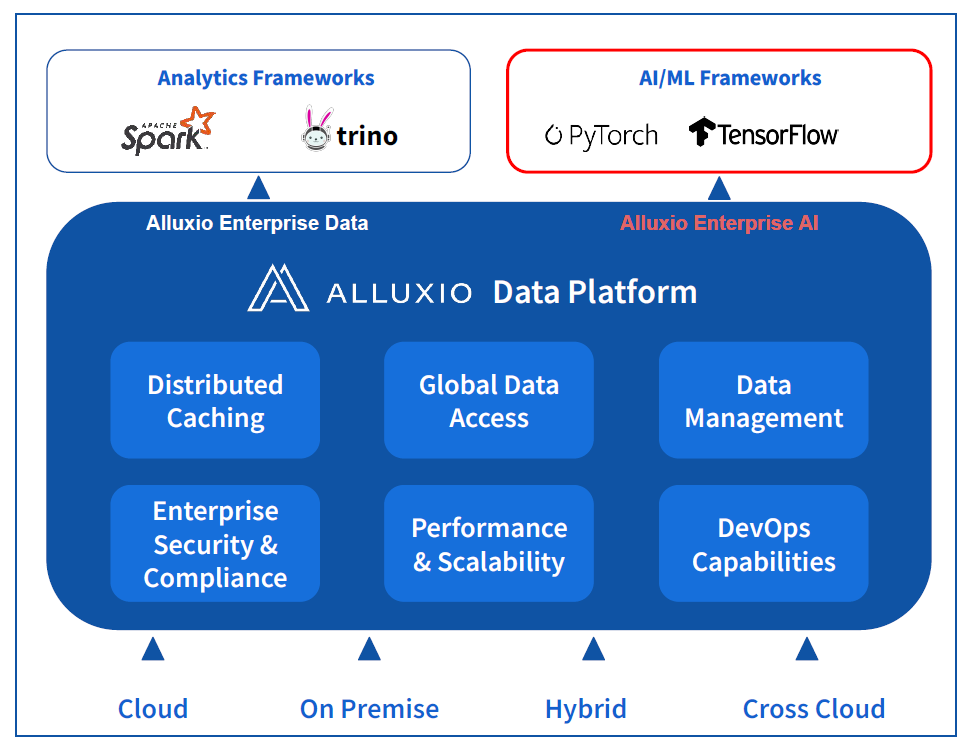
Alluxio is better known in the advanced analytics market than in the AI and machine learning (ML) market, which is a result of where it debuted in the data stack. Originally developed as a sister project to Apache Spark by Haoyuan “HY” Li—who was also a co-creator of Spark at UC Berkeley’s AMPlab—Alluxio gained traction by serving as a distrbuted file system in modern hybrid cloud environments. The product's real forte was providing an abstraction layer to accelerate I/O for data between storage repositories like HDFS, S3, MinIO, and ADLS and processing engines like Spark, Trino, Presto, and Hive.

By providing a single global namespace across hybrid cloud environments built around the precepts of separation of compute and storage, Alluxio reduces complexity, bolsters efficiency, and simplifies data management for enterprise clients with sprawling data estates measuring in the hundreds of petabytes.

Alluxio now works with analytics and AI workloads

As deep learning matured, the folks at Alluxio realized that an opportunity existed to apply its core IP to help optimize the flow of data and compute for AI workloads too—predominantly computer vision use cases but also some natural language processing (NLP) too.

The company saw that some of its existing analytic customers had adjacent AI teams that were struggling to expand their deep learning environments beyond a single GPU. To cope with the challenge of coordinating data in multi-GPU environments, customers either bought high performance storage appliances to accelerate the flow of data into GPUs from their primary data lakes, or paid data engineers to write scripts for moving data in a more low-level and manual fashion.

Alluxio saw an opportunity to use its technology to do essentially the same thing—accelerate the flow of training data into the GPU—but with more orhcestration and automaton around it. This gave rise to the creation of Alluxio Enterprise AI, which Alluxio unveiled today.

The new product shares some technology with its existing product, which previously was called Alluxio Enterprise and now has been rebranded as Alluxio Enterprise Data, but there are important differences too, says Adit Madan, the director of product management at Alluxio.

“With Alluxio Enterprise AI, even though some of the functionality sounds and is very familiar to what was there in the Alluxio, this is a brand new systems architecture,” Madan tells Datanami. “This is a completely decentralized architecture that we are naming DORA.”

With DORA, which is short for Decentralized Object Repository Architecture, Alluxio is, for the first time, tapping into the underlying hardware, including GPUs and NVMe drives, instead of living purely at the software level.

“We are saying use Alluxio on your accelerated compute itself,” i.e. the GPU nodes, Madan says. “We will make use of NVME, the pool of NvME that you have available, and provide you with the I/O demand by simply pointing to your data lake without the need for another high performance storage solution underneath.”

Source: Alluxio

Additionally, Alluxio Enterprise AI leverages techniques that Alluxio has used on the analytics side for some time to “make the I/O more intelligent,” the company says. That includes optimizing the cache for data access patterns commonly found in AI environments, which are characterized by large file sequential access, large file random access, and massive small file access. “Think of it like we are extracting all of the I/O capabilities on the GPU cluster itself, instead of you having to buy more hardware for I/O,” Madan says.

Conceptually, Alluxio Enterprise AI works similarly to the company’s existing data analytics product—it accelerates the I/O and allows users to get more work done without worrying so much about how the data gets from point A (the data lake) to point B (the compute cluster). But at a technology level, there was quite a bit of innovation required, Madan says.

“To co-locate on the GPUs, we had to optimize on how much resources that we use,” he says. “We have to be really resource efficient. Instead of let's say consuming 10 CPUs, we have to bring it down to only consuming two CPUs on the GPU node to serve the I/O. So from a technical standpoint, there is a very significant difference there.”

Alluxio Enterprise AI can scale to more than 10 billion objects, which will make it useful for the many small files used in computer vision use cases. It's designed to integrate with PyTorch and Tensorflow frameworks. It's primarily intended to be used for training AI models, but it can be used for model deployment too.

Source: Alluxio

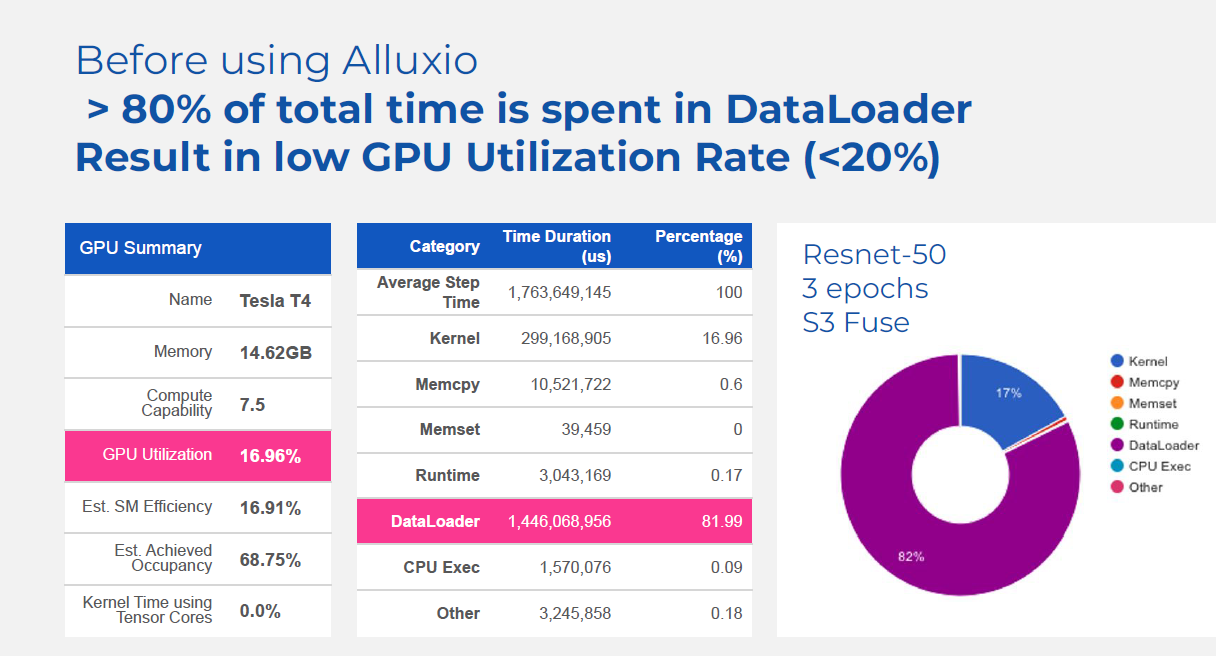
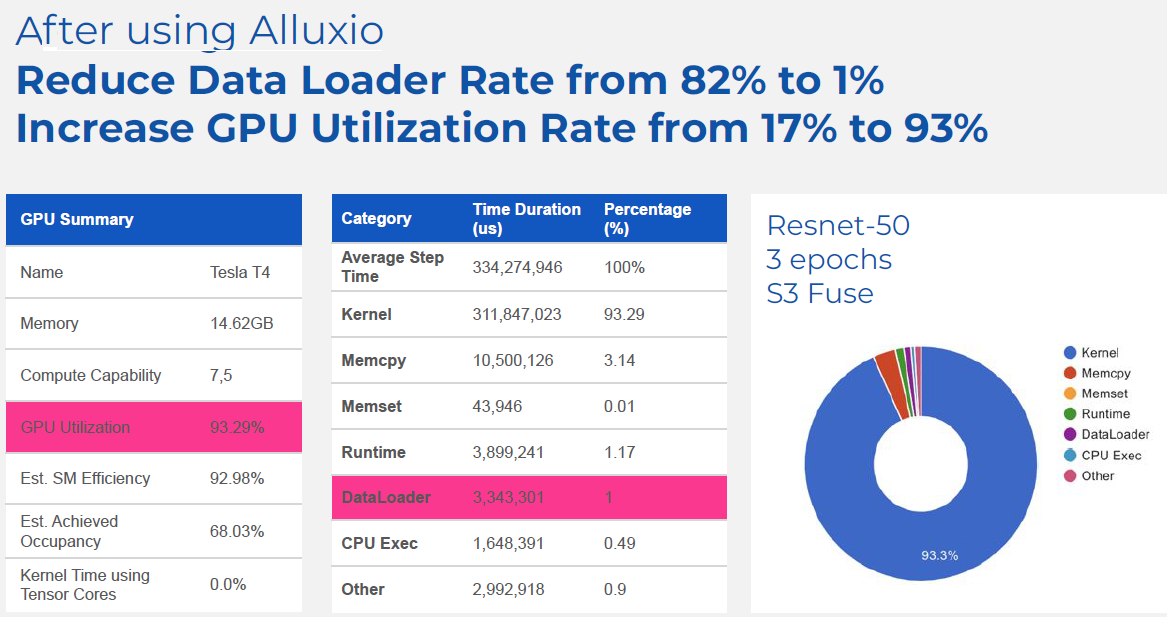
The results that Alluxio claims from the optimization are impressive. On the GPU side, Alluxio Enterprise AI delivers 2x to 4x more capacity, the company says. Customers can use that freed up capacity to either get more computer vision training work done or to cut their GPU costs, Madan says.

Some of Alluxio’s early testers used the new product in production settings that included 200 GPU servers. “It’s not a small investment,” Madan says. “We have some active engagement with smaller [customers running] a few dozen. And we have some engagements which are much larger with a few hundred servers, each of which cost a few hundred grand.”

One early tester is Zhihu, which runs a popular question and answer site from its headquarters in Beijing. "Using Alluxio as the data access layer, we’ve significantly enhanced model training performance by 3x and deployment by 10x with GPU utilization doubled," Mengyu Hu, a software engineer in Zhihu's data platform team, said in a press release. "We are excited about Alluxio’s Enterprise AI and its new DORA architecture supporting access to massive small files. This offering gives us confidence in supporting AI applications facing the upcoming artificial intelligence wave.”

This solution is not for everyone, Madam says. Customers that are using off-the-shelf AI models, perhaps with a vector database for LLM use cases, don’t need this. “If you're adapting your model [i.e. fine-tuning it] that's where the need is,” he says.

Related

About the author: Alex Woodie
Alex Woodie has written about IT as a technology journalist for more than a decade. He brings extensive experience from the IBM midrange marketplace, including topics such as servers, ERP applications, programming, databases, security, high availability, storage, business intelligence, cloud, and mobile enablement. He resides in the San Diego area.

7 Best Cloud Database Platforms

7 Best Cloud Database Platforms

Cloud computing has opened new doors for app development and hosting. Before cloud services became mainstream, developers had to maintain their own expensive servers. Now, cloud platforms like AWS and Azure provide easy database hosting without the high hardware costs. Cloud databases offer the flexibility and convenience of the cloud while providing standard database functionality. They can be relational, NoSQL, or any other database model, accessed via API or web interface.

In this review article, we will explore the top 7 cloud databases used by professionals to build robust applications. These leading cloud database platforms enable developers to efficiently store and manage data in the cloud. We will examine the key features, pros, and cons of each platform, so you can determine which one is the right fit for your app development needs.

Azure SQL Database

Azure SQL Database is a fully managed relational cloud database that is part of Microsoft's Azure SQL family. It provides a database-as-a-service solution built specifically for the cloud, combining the flexibility of a multi-model database with automated management, scaling, and security. Azure SQL database is always up-to-date, with Microsoft handling all updates, backups, and provisioning. This enables developers to focus on building their applications without database administration overhead.

🔑 Azure SQL Database Key Points

  • Serverless computing and hyperscale storage solutions are both flexible and responsive
  • A fully managed database engine that automates updates, provisioning, and backups
  • It has a built-in AI and high availability to ensure consistent peak performance and durability

✅ Pros

  • User-friendly interface for creating data models
  • Straightforward billing system
  • Fully managed and secure SQL database
  • Seamless migration from on-premise to cloud storage

❌ Cons

  • Job and task managers work in different ways
  • Limited database size
  • Need for more efficient notification and logging system for database errors
  • Costly scaling up and down without proper automation implementation

Amazon Redshift

Amazon Redshift is a fully-managed, petabyte-scale cloud-based data warehousing solution designed to help organizations store, manage, and analyze large amounts of data efficiently. Built on top of the PostgreSQL open-source database system, Redshift uses columnar storage technology and massively parallel processing to deliver fast query performance on high volumes of data. Its distributed architecture allows it to elastically scale storage and processing power to accommodate growing data volumes. Its tight integration with other AWS services also enables seamless data loading from S3, EMR, DynamoDB, etc. The end result is a performant, cost-effective, and flexible cloud data warehouse solution suitable for large-scale data analytics.

🔑 Amazon Redshift Key Points

  • It uses column-oriented databases
  • Its architecture is based on massively parallel processing
  • It includes machine learning to improve performance
  • It is fault tolerant

✅ Pros

  • Easy setup, deployment, and management
  • Detailed documentation that makes it easy to learn
  • Seamless integration with data stored in S3
  • Simplified ETL setup

❌ Cons

  • JSON support in SQL is limited
  • Array type columns are missing and are automatically converted to strings
  • The logging function is almost non-existent

Amazon DynamoDB

Amazon DynamoDB is a fast, flexible, and reliable NoSQL database service that helps developers build scalable, serverless applications. It supports key-value and document data models, and can handle massive amounts of requests daily. DynamoDB automatically scales horizontally, ensuring availability, durability, and fault tolerance without any extra effort from the user. Designed for internet-scale applications, DynamoDB offers limitless scalability and consistent performance with up to 99.999% availability.

🔑 Amazon DynamoDB Key Points

  • The ability to handle over 10 trillion requests per day
  • Support for ACID transactions
  • A multi-Region and multi-Master database
  • NoSQL database

✅ Pros

  • Fast and simple to operate
  • Handle data that is dynamic and constantly changing
  • Indexed data can be retrieved quickly
  • Performs exceptionally well even when working with large-scale applications

❌ Cons

  • If the resource is not monitored correctly, the expenses can be significant
  • Does not support backup in different regions
  • It can be expensive for projects that require multiple environments to be created

Google BigQuery

Google BigQuery is a powerful, fully-managed cloud-based data warehouse that helps businesses analyze and manage massive datasets. With its serverless architecture, BigQuery enables lightning-fast SQL queries and data analysis, processing millions of rows in seconds. You can store your data in Google Cloud Storage or in BigQuery's own storage, and it seamlessly integrates with other GCP products like Data Flow and Data Studio, making it a top choice for data analytics tasks.

🔑 Google BigQuery Key Points

  • It can scale up to a petabyte, making it highly scalable
  • It offers fast processing speeds, allowing you to analyze data in real-time
  • It is available in both on-demand and flat-rate subscription models

✅ Pros

  • Automatically optimizes queries to retrieve data quickly
  • Great customer support
  • Its data exploration and visualization capabilities are very useful
  • It has a large number of native integrations

❌ Cons

  • Uploading databases using Excel can be time-consuming and prone to errors
  • Connecting to other cloud infrastructures like AWS can be difficult
  • The interface can be difficult to use if you are not familiar with it

MongoDB Atlas

MongoDB Atlas is a cloud-based, fully managed MongoDB service that allows developers to quickly setup, operate, and scale MongoDB deployments in the cloud with just a few clicks. Developed by the same engineers that build the MongoDB database, Atlas provides all the features and capabilities of the popular document-based NoSQL database, without the operational heavy lifting required for on-premise deployments. Atlas simplifies MongoDB cloud operations by automating time-consuming administration tasks like infrastructure provisioning, database setup, security hardening, backups, and more.

🔑 MongoDB Atlas Key Points

  • It's a document-oriented database
  • Sharding feature allows for easy horizontal scalability
  • The database triggers in MongoDB Atlas are powerful and can execute code when certain events occur
  • Useful for time series data

✅ Pros

  • It is easy to adjust the scale of the service based on your needs
  • There are free and trial plans available for evaluation or testing purposes, which are quite generous
  • Any database information that is uploaded to MongoDB Atlas is backed up
  • JSON documents can be accessed from anywhere

❌ Cons

  • It is not possible to directly download all information stored in MongoDB Atlas clusters
  • Lacks more granular billing
  • No cross table joins

Snowflake

Snowflake is a powerful, self-managed data platform designed for the cloud. Unlike traditional offerings, Snowflake combines a new SQL query engine with an innovative cloud-native architecture, providing a faster, easier-to-use, and highly flexible solution for data storage, processing, and analytics. As a true self-managed service, Snowflake takes care of hardware and software management, upgrades, and maintenance, allowing users to focus on deriving insights from their data.

🔑 Snowflake Key Points

  • Provide query and table optimization
  • It offers secure data sharing and zero-copy cloning
  • Snowflake supports semi-structured data

✅ Pros

  • Snowflake can ingest data from various cloud platforms, such as AWS, Azure, and GCP
  • You can store data in multiple formats, including structured and unstructured
  • Computers are dynamic, meaning you can choose a computer based on cost and performance
  • It's great for managing different warehouses

❌ Cons

  • Data visualization could use some improvement
  • The documentation can be hard to understand
  • Snowflake lacks CI/CD integration capabilities

Databricks SQL

Databricks SQL (DB SQL) is a powerful, serverless data warehouse that allows you to run all your SQL and BI applications at a massive scale, with up to 12x better price/performance than traditional solutions. It offers a unified governance model, open formats and APIs, and supports the tools of your choice, ensuring no lock-in. The rich ecosystem of tools supported by DB SQL, such as Fivetran, dbt, Power BI, and Tableau, allows you to ingest, transform, and query all your data in-place. This empowers every analyst to access the latest data faster for real-time analytics, and enables seamless transitions from BI to ML, unleashing the full potential of your data.

🔑 Databricks SQL Key Points

  • Centralized governance
  • Open and reliable data lake as the foundation
  • Seamless integrations with the ecosystem
  • Modern analytics
  • Easily ingest, transform and orchestrate data

✅ Pros

  • Enhanced collaboration between Data Science & Data Engineering teams
  • Spark Jobs Execution Engine is highly optimized
  • Analytics feature recently added for building visualization dashboards
  • Native integration with managed MLflow service
  • Data Science code can be written in SQL, R, Python, Pyspark, or Scala

❌ Cons

  • Running MLflow jobs remotely is complicated and needs simplification
  • All runnable code must be kept in Notebooks, which are not ideal for production
  • Session resets automatically at times
  • Git connections can be unreliable

Cloud databases have revolutionized how businesses store, manage, and utilize their data. As we have explored, leading platforms like Azure SQL Database, Amazon Redshift, DynamoDB, Google BigQuery, MongoDB Atlas, Snowflake, and Databricks SQL each offer unique benefits for app development and data analytics.

When choosing the right cloud database, key factors to consider are scalability needs, ease of management, integrations, performance, security, and costs. The optimal platform will align with your infrastructure and workload requirements.

Abid Ali Awan (@1abidaliawan) is a certified data scientist professional who loves building machine learning models. Currently, he is focusing on content creation and writing technical blogs on machine learning and data science technologies. Abid holds a Master's degree in Technology Management and a bachelor's degree in Telecommunication Engineering. His vision is to build an AI product using a graph neural network for students struggling with mental illness.

More On This Topic

  • 11 Best Practices of Cloud and Data Migration to AWS Cloud
  • 11 Best Data Science Education Platforms
  • 7 Best Platforms to Practice SQL
  • Database Key Terms, Explained
  • How To Build A Database Using Python
  • Practising SQL without your own database

How to supercharge your Google searches with generative AI in Chrome

sge-google

Sometimes generative AI search results are far superior to what Google offers. Instead of having to wade through a lengthy list of sites that can get bogged down with ads or paywalls, you can more quickly get a question answered and learn about what you searched for.

Of course, generative AI tools aren't perfect. You have to contend with two simple realities: 1) the results will be incorrect sometimes and 2) the results could have been plagiarized (without proper citation).

Also: ChatGPT's web browsing feature just got a whole lot easier to use

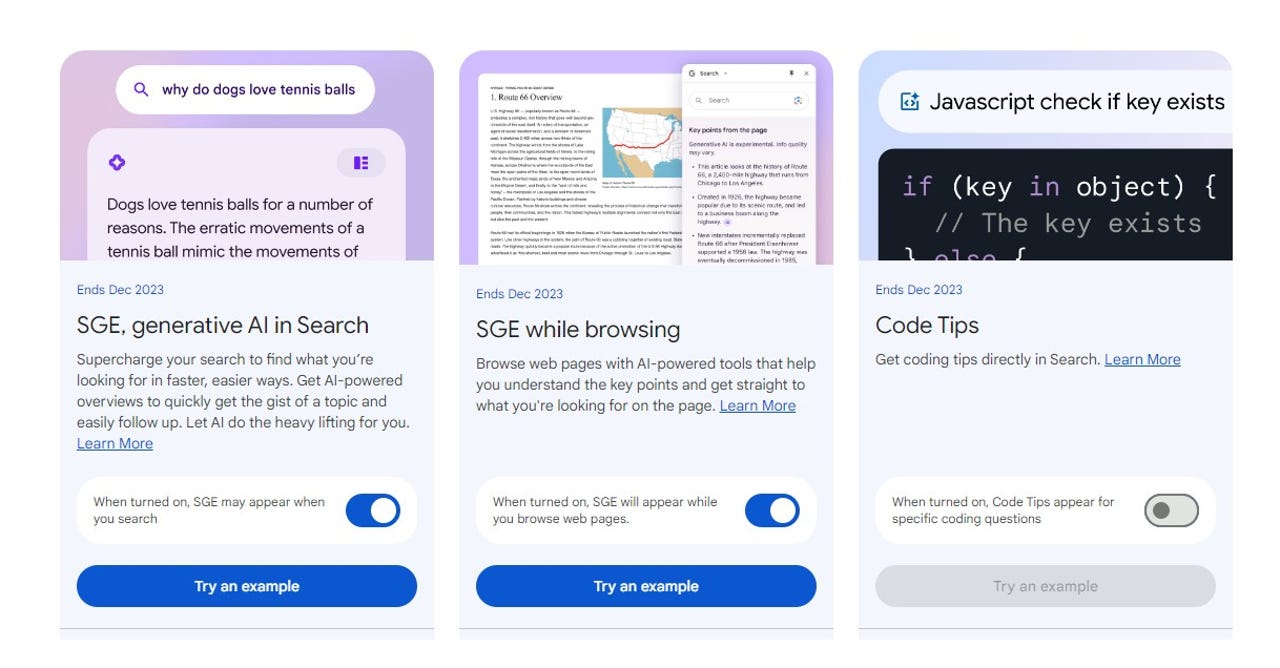
But for those who have grown to depend on AI, Google has simplified its use within the Chrome browser. All you have to do is enable SGE (Search Generative Experience) in Chrome and you can start (or continue) your AI journey with ease.

SGE is an experiment from Google Labs and recently Google applied very powerful Large Language Models (LLMs) to Search. One model, Multitask Unified Model (MUM) is 1,000 times more powerful than BERT (Bidirectional Encoder Representations from Transformers) and is trained across 75 different languages.

Also: 6 AI tools to supercharge your work and everyday life

With SGE, you can ask all types of complex and descriptive questions, get to the heart of a matter more quickly, get your work done faster, and ask conversational follow-ups.

Let me show you how it's done.

How to enable SGE in Chrome

What you'll need: To add SGE to Chrome, you'll need the Chrome desktop browser and a valid Chrome account that is not a work or school account (it's not yet available for those). That's it. Let's make it work.

Logging into your Google account to be used for Chrome Sync.

Accessing the Google Labs page is as simple as clicking the beaker.

You can also enable other Google Labs experiments here.

Once you've issued your search query, click Generate to add in AI results.

You can simply enjoy your results or expand on them with a follow-up question.

You've just empowered your Google searches with generative AI in Chrome. Hopefully, this tool will help you learn more, faster.

Biden further chokes off China’s AI chip supply with Nvidia bans

Biden further chokes off China’s AI chip supply with Nvidia bans Rita Liao 18 hours

In August last year, a ban on Nvidia’s chip export to China sent the country’s budding artificial intelligence startups scrambling for alternatives. A momentary sense of relief came when Nvidia unveiled chips with reduced performance to bypass export restrictions. But this respite was short-lived.

On Tuesday, the Biden administration announced a slew of measures to curb Beijing’s military ambitions, including a further restriction on Nvidia’s AI chip shipments to China. A800 and H800, the two AI chips Nvidia designed specifically to continue shipping to China, will be hit by the fresh round of new rules.

The chip bans are originally targeted at China’s military use, but the more visible victims are arguably the country’s raft of startups riding the rapid advancement of large language models. Many of them rushed to stockpile Nvidia’s A100 and H100 before the bans went into effect, shelling out millions of dollars for the inflated costs. Alibaba, Baidu, ByteDance and Tencent collectively ordered $5 billion of A800 chips this year and the next, according to a report from the Financial Times.

Nascent startups, meanwhile, are driven to raise venture capital hastily to support their costly AI dreams.

The U.S. chip bans have not stopped Chinese giants from pursuing their AI ambitions. On Tuesday, Baidu unveiled the latest version of its flagship foundation model, Ernie 4.0, and claimed that it now matches GPT4. To date, Ernie has amassed 45 million users, the company claimed.

The challenge of entering China’s AI fray goes beyond increasingly limited semiconductor access. The country’s regulations require that LLM-based services obtain a license before serving public users, a test of companies’ government relations and their ability to navigate the red tape.

Ultimately, a shortage of high-end chips and the intricate nature of Beijing’s censorship requirements created an environment for generative business intelligence services to flourish, as they require less computational power (data sources are internal rather than the entire internet) and are comparatively easier to control as prompts are more scenario-based. Qianfan, Baidu’s enterprise-facing AI platform built on Ernie, has amassed some 17,000 customers.

China’s AI firms might further lose chip access in new US ban

ChaosSearch Tackles Live Search, SQL, and Gen AI Analytics with LakeDB

ChaosSearch Tackles Live Search, SQL, and Gen AI Analytics with LakeDB October 18, 2023 by Ali Azhar

ChaosSearch, a leading log analytics platform, last week announced the release of Chaos LakeDB – the first data lake database designed to power generative artificial intelligence (AI), SQL, and Live Search. Chaos LakeDB is available as a SaaS data platform for enterprises and as an embedded database from cloud platform providers.

Earlier this year, ChaosSearch unveiled the Chaos AI Assistant – powered by open AI and integrated into the ChaosSearch platform. Industry leaders such as Cisco and Equifax are already using Chaos LakeDB.

The ChaosSearch technology allows organizations to stream data directly into cloud object storage such as Amazon S3, turning it into a searchable data lake with unlimited hot data retention. With the launch of Chaos LakeDB, any cloud provider or enterprise software company can embed the ChaosSearch database into its existing offering. Embedding ChaosSearch would allow organizations flexibility in how they search data.

Chaos LakeDB is designed for various applications including general system observability, understanding product usage trends to derive business insights, and search log data for troubleshooting. It helps simplify architecture by removing the need for complex data movement or data pipelines. In addition, it consolidates diverse data streams and formats into one cohesive data lake database. The database also has the capability to automate the data pipeline, orchestrate workload across the lake backbone, and schema management.

“Our vision with Chaos LakeDB was to tackle the challenges of live analytics at scale. We recognized the challenges businesses faced with legacy systems and aimed to provide a solution that was not only efficient but also future-proof. Chaos LakeDB is a testament to our commitment to innovation, offering a unified platform where data is not just stored but is also activated, analyzed, and leveraged for actionable insights. In this AI-driven era, we believe that data should be at the forefront of decision-making, and with Chaos LakeDB, we’re making that a reality for businesses worldwide,” said Thomas Hazel, Chief Technology Officer at ChaosSearch.

The integration with Amazon Simple Storage Service (S3), the leading object store for AWS customers, Chaos LakeDP allows users to merge vast storage capabilities with the accessibility of cloud databases and helps minimize the need for complex ETL and ELT processes. The integration also ensures enhanced cost efficiency and performance at scale – crucial requirements for today’s data-intensive analytics and AI applications.

“Every modern business today is a data business, and where you store your data and how quickly you’re able to leverage it for analytics is incredibly important,” said James Kirschner, general manager, Amazon S3 at AWS. “Solutions like ChaosSearch’s Chaos LakeDB help improve how customers interact with their data, making it easier to manage, faster to leverage, and more cost-effective, while retaining Amazon S3’s industry-leading durability, availability, security, and scalability.”

There has been a rising demand for observability technology and this is evident in the recent acquisition of Splunk by Cisco representing $28 billion in equity value, and the New Relix private equity takeover earlier this year. It is clear that this is a space to keep an eye on.

Related

About the author: Alex Woodie

Alex Woodie has written about IT as a technology journalist for more than a decade. He brings extensive experience from the IBM midrange marketplace, including topics such as servers, ERP applications, programming, databases, security, high availability, storage, business intelligence, cloud, and mobile enablement. He resides in the San Diego area.

Regulations are still necessary to compel adoption of cybersecurity measures

person using laptop

Regulations are still necessary to make sure organizations are compelled to adopt measures designed to strengthen their cybersecurity posture.

Singapore this week released guides it said will help organizations, including small- and mid-sized businesses (SMBs), better understand risks associated with using cloud services and what they, as well as their cloud providers, need to do to secure cloud environments.

Also: 6 simple cybersecurity rules you can apply now

The two cloud security "companion guides" serve to facilitate the adoption of national cybersecurity standards, Cyber Essentials and Cyber Trust, developed by Singapore's Cyber Security Agency (CSA), which announced the launch at its annual Singapore International Cyber Week conference.

Published alongside Cloud Security Alliance, the companion guides were developed closely with three cloud vendors — Amazon Web Services (AWS), Google Cloud, and Microsoft — which provided customer insights and relevant market statistics. The cloud players also "validated" the content provided in the companion guides, CSA said.

The guides outline organizations' cloud-specific risks and responsibilities, and the steps they should take to safeguard their environments, including staff training and mechanisms to track and monitor their cloud services inventory. The documents also include provider-specific guides for environments running on AWS, Microsoft, and Google platforms, which are organized based on measures for Cyber Essentials and Cyber Trust standards.

Also: The top 9 mobile security threats and how you can avoid them

"[A common] confusion when organizations use the cloud is the division of responsibility between themselves as cloud users, and that of their cloud providers," CSA said. "In a cloud deployment, there is shared responsibility, and organizations may not be fully aware of the areas they are responsible for. This may increase the likelihood of misconfigurations, malicious attacks, and/or data breaches."

Available for free, the guides are expected to help 27% of businesses in Singapore that use cloud computing services, the government agency said, citing a 2022 study from the Infocomm Media Development Authority (IMDA).

Singapore this week also took further steps toward expanding a national security labeling initiative to include medical devices, with the release of a sandbox with which manufacturers can test their products. Participants of the sandbox then will provide feedback on the requirements and application processes, against which devices will be assessed under the medical labeling scheme slated for launch at a later date.

Also: What is the dark web? Here's everything to know before you access it

The sandbox will run for nine months, with the feedback to be used to finetune the operational workflow and requirements in the scheme, where necessary, CSA said. The sandbox was launched in collaboration with the Ministry of Health, Health Sciences Authority, and Synapxe.

Noting that 15%, or more than 16,000, of medical devices in local public healthcare institutions have internet connectivity, CSA said medical devices are increasingly connected to hospitals and home networks. This can drive up cybersecurity risks, where security gaps in software used for clinical diagnostics, for instance, can be exploited to generate wrong diagnoses. Unsecured medical devices can also be targeted in denial-of-service attacks, thereby preventing patients from receiving treatment.

Such equipment also can be tapped by malicious hackers to breach a hospital's network, which can result in data leaks or network shutdown.

With the expansion of the security labeling scheme to include medical devices, manufacturers will be motivated to embed security into their product design, and healthcare operators can make more informed decisions on the use of such devices, according to CSA. The scheme encompasses four ratings, with each level reflecting additional tests on which the product was evaluated.

Also: Ransomware victims continue to pay up, while also bracing for AI-enhanced attacks

The sandbox will allow device manufacturers to test their products based on various assessments, including software binary analysis, penetration testing, and security evaluation.

However, such initiatives and other security best practices can only go so far if these are offered as guidelines and advisories, rather than mandates that businesses must adopt.

Many technology practitioners and CISOs will refer to guides and look at industry best practices, but doing so can only go so far if these are offered only as advisories, rather than as regulations, said Karan Sondhi, vice president and CTO of the public sector for security vendor, Trellix.

Initiatives such as the security labeling program, for instance, serve as an information tool, and not as enforcement, Sondhi said in an interview with ZDNET, on the sidelines of the conference.

Harold Rivas, who serves as Trellix's CISO, concurred, noting that the labeling scheme helps with purchasing decisions and creates awareness about potential risks. It provides decision-makers cause to consider alternatives and serves as a good reference point for best practices that are independently validated, Rivas said.

Also: Singapore and US pledge to combat online scams in cross-border cooperation

Ultimately, though, there should be clear mandates to push the industry toward clear outcomes, Rivas said.

Such requirements, for example, could include a proper patch management strategy and robust monitoring system, Sondhi said. These should be accompanied by roadmaps for rollout, so market players would be given the necessary timelines to ensure compliance, he added.

Acknowledging there will inevitably be pushback over concerns such mandates have on cost and time-to-market, he said regulations need not be overly complex. They also can point to accompanying standards bodies tasked to provide more details and update the adoption of best practices when necessary. This will free up governments from having to keep up with market changes and to instead focus on mandating high-level requirements, he noted.

Enforcement also is a good starting point when the road toward cyber resilience may be long and fraught with complexities.

Organizations in operational technology (OT) sectors, in particular, have ecosystems that have to be managed differently from IT infrastructures, Sondhi said. They will need to establish an inventory of all their OT systems and devices, and ensure third-party tools are secured as well as integrated so they have clear visibility across their entire supply chain.

Governments, including Singapore and the US, now are helping OT and CII (critical information infrastructure) sectors navigate these issues, Rivas said. The journey, however, is long and will take time, he said.

Also: Singapore and US sync up on AI governance and set up joint group

Governments can facilitate by enforcing certain industry requirements, enabling all industry players to gradually fall into place, Sondhi said. For instance, organizations that provide government-related services such as smart meters must demonstrate they have a clear inventory of their systems and patch management schedule. Vendors that breach requirements stipulated in these contractual agreements then should be penalized, he said.

Such overarching regulatory frameworks help drive actions forward and serve to safeguard both organizations and citizens, Rivas said.

Robust cyber resilience is essential, especially as some of these sectors face growing threats.

Public-sector organizations in Asia-Pacific, for one, had to fend off close to 3,000 attacks on average a week over the last six months, according to Vivek Gullapalli, Asia-Pacific CISO at Check Point Software Technologies.

The education and research sector experienced the highest number of weekly attacks, at 4,057 for each organization, over the last six months, followed by healthcare at 2,958 and the government and military sector, at 2,882 attacks.

Also: What is phishing? Everything you need to know to protect yourself from scammers

Going digital increases their attack surface and ransomware poses serious threats with its ability to shut down entire networks, Gullapalli said. These risks have pushed governments to protect their CII and OT industries.

He added that some of these sectors remain nascent, where smart nations are still being built out with emerging technologies such as driverless vehicles, smart cameras, and other Internet of Things (IoT) devices.

As the underlying OT infrastructure continues to evolve, the ability to manage the entire ecosystem will be complex. For instance, a different approach may be required to apply security patches for OT devices. And as demand for connectivity grows, organizations will need to figure out which devices are interconnected and, hence, require further security safeguards and embedded tools.

With the management of infrastructures sometimes overlapping between public and private sectors, a proper framework also will need to be established to protect the entire OT ecosystem, he said.

There still is a lot to be learned and different approaches will be needed, Gullapalli said. Amid this ongoing evolution, he urged the need for continued conversations and collaboration between governments, OT device manufacturers, and security players to plug the gaps.

Security