Genpact Embraces AI Guru for its Employees

Genpact Embraces AI Guru for its Employees

In a bid to boost employee learning and development, Genpact has adopted generative AI with AI Guru. The pivotal innovation in this endeavor is the introduction of a generative AI chatbot, which was launched in July as part of Genpact’s internal learning platform.

AI Guru assists employees in a variety of tasks, including managing IT projects, generating test cases, and offering valuable management advice. Genpact believes that generative AI represents a significant leap in technology, comparable to the advent of web browsers and smartphones, which is powered by OpenAI’s GPT-3.5.

Read: Genpact Sets the Stage on Fire with Long-term Vision for Generative AI

Genpact’s focus on employee learning is of paramount importance due to the nature of its business. The company currently employs over 115,000 individuals across more than 30 countries and hires 40,000 to 50,000 entry-level employees annually. Consequently, the need for training is substantial.

To address this need, Genpact transitioned most of its learning to an online platform called Genome. This platform features a curated selection of courses, with content largely sourced from internal experts, known as “master gurus.” These experts offer expertise in areas essential for growth, and their contributions are reviewed by peers.

“There is the whole concept of collective intelligence,” said Kunal Dureja, who leads Genpact’s learning technologies and is based in Gurugram. “People learn with each other. If you look at how we curate content, everywhere you see there is the element of the power of the team as opposed to having just one point of view.”

The platform boasts over 50,000 monthly learners, and courses cover a broad range of skills, including generative AI, storytelling, people management, and role-specific topics.

One noteworthy outcome of this shift to online learning is improved employee retention. Those who enroll in Genome training are twice as likely to stay with the company compared to those who do not participate.

However, Genpact encountered a bottleneck due to a shortage of master gurus, which necessitated the introduction of generative AI. In July, the Genome team introduced AI Guru, a chatbot powered by OpenAI’s GPT-3.5 via Azure OpenAI Service. This digital twin of the master gurus is available around the clock and offers assistance to thousands of senior learners globally.

AI Guru is currently employed as a learning companion, providing immediate answers to questions. The next phase includes guiding individuals in choosing skills to acquire and potentially acting as a coach for specific roles. As of mid-September, AI Guru had answered over 1,500 questions, significantly reducing response times compared to traditional forums.

The post Genpact Embraces AI Guru for its Employees appeared first on Analytics India Magazine.

Semantic Layer: The Backbone of AI-powered Data Experiences

Sponsored Content

This guide, "Five Essentials of Every Semantic Layer", can help you understand the breadth of the modern semantic layer.

The AI-powered data experience

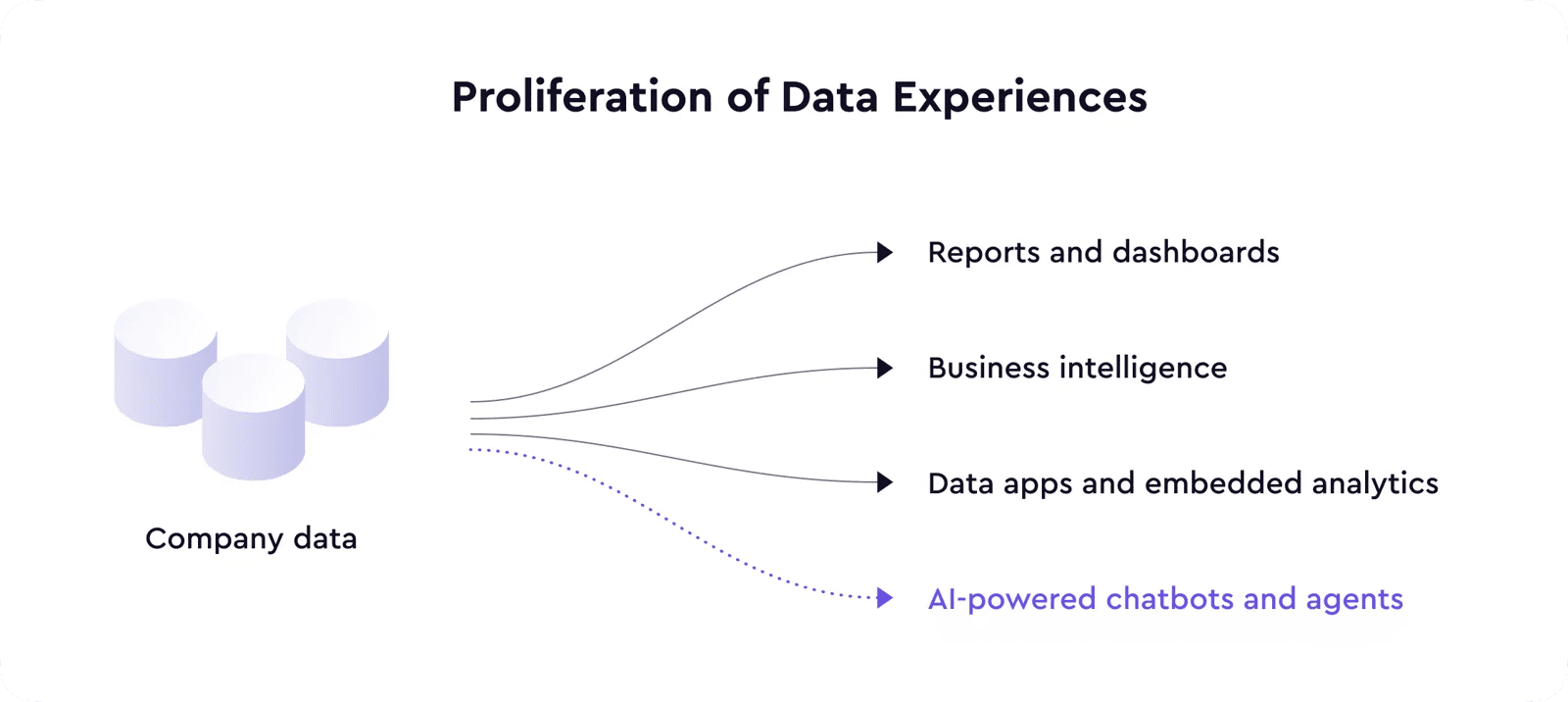
The evolution of front-end technologies made it possible to embed quality analytics experiences directly into many software products, further accelerating the proliferation of data products and experiences.

And now, with the arrival of large language models, we are living through another step change in technology that will enable many new features and even in the advent of an entirely new class of products across multiple use cases and domains—including data.

LLMs are taking the data consumption layer to the next level with AI-powered data experiences ranging from chatbots answering questions about your business data to AI agents making actions based on the signals and anomalies in data.

Semantic Layer: The Backbone of AI-powered Data Experiences

Semantic layer gives context to LLMs

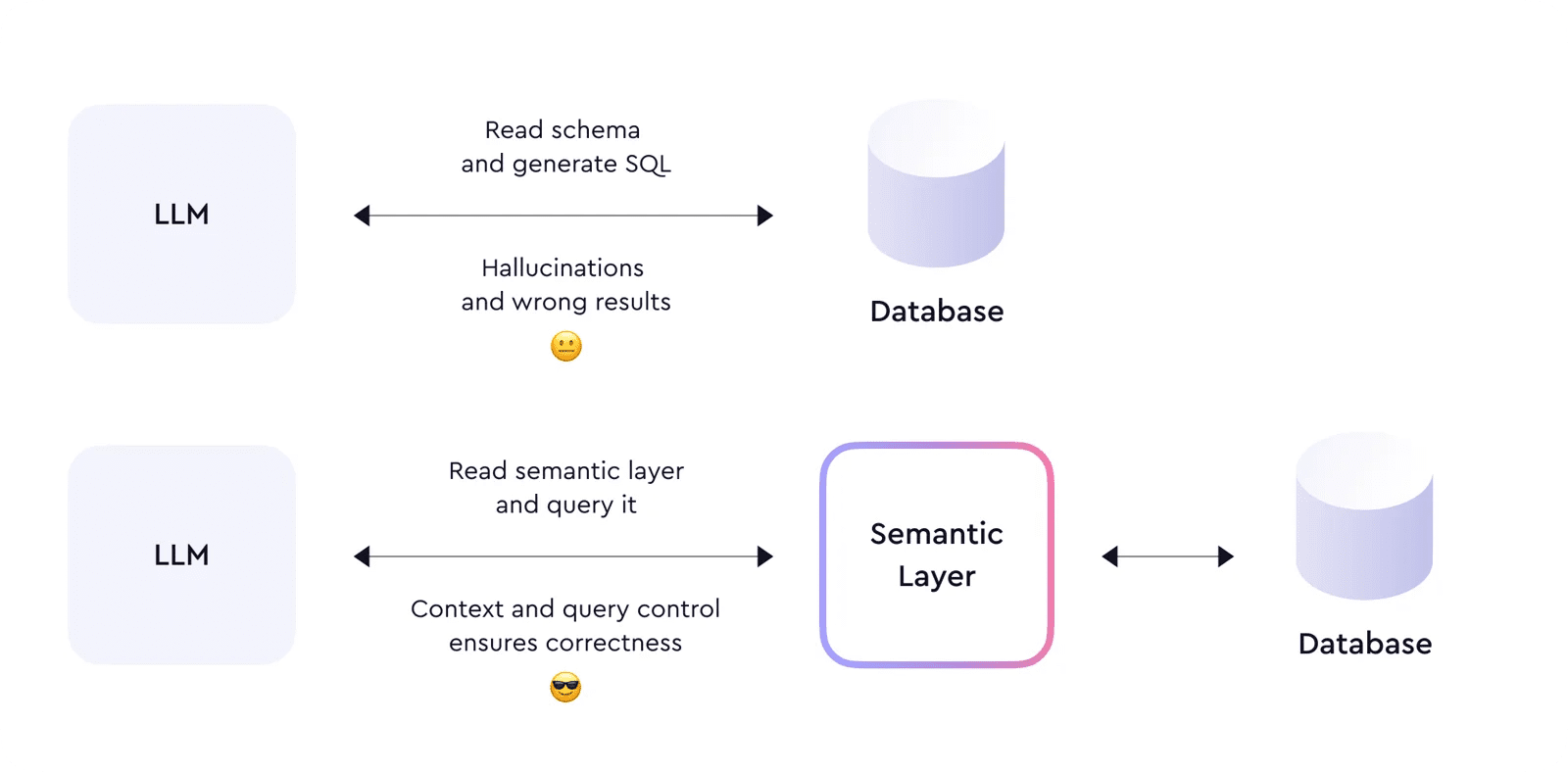
LLMs are indeed a step change, but inevitably, as with every technology, it comes with its limitations. LLMs hallucinate; the garbage in, garbage out problem has never been more of a problem. Let’s think about it like this: when it’s hard for humans to comprehend inconsistent and disorganized data, LLM will simply compound that confusion to produce wrong answers.

We can’t feed LLM with database schema and expect it to generate the correct SQL. To operate correctly and execute trustworthy actions, it needs to have enough context and semantics about the data it consumes; it must understand the metrics, dimensions, entities, and relational aspects of the data by which it's powered. Basically—LLM needs a semantic layer.

The semantic layer organizes data into meaningful business definitions and then allows for querying these definitions—rather than querying the database directly.

The ‘querying’ application is equally important as that of ‘definitions’ because it enforces LLM to query data through the semantic layer, ensuring the correctness of the queries and returned data. With that, the semantic layer solves the LLM hallucination problem.

Semantic Layer: The Backbone of AI-powered Data Experiences

Moreover, combining LLMs and semantic layers can enable a new generation of AI-powered data experiences. At Cube, we’ve already witnessed many organizations build custom in-house LLM-powered applications, and startups, like Delphi, build out-of-the-box solutions on top of Cube’s semantic layer (demo here).

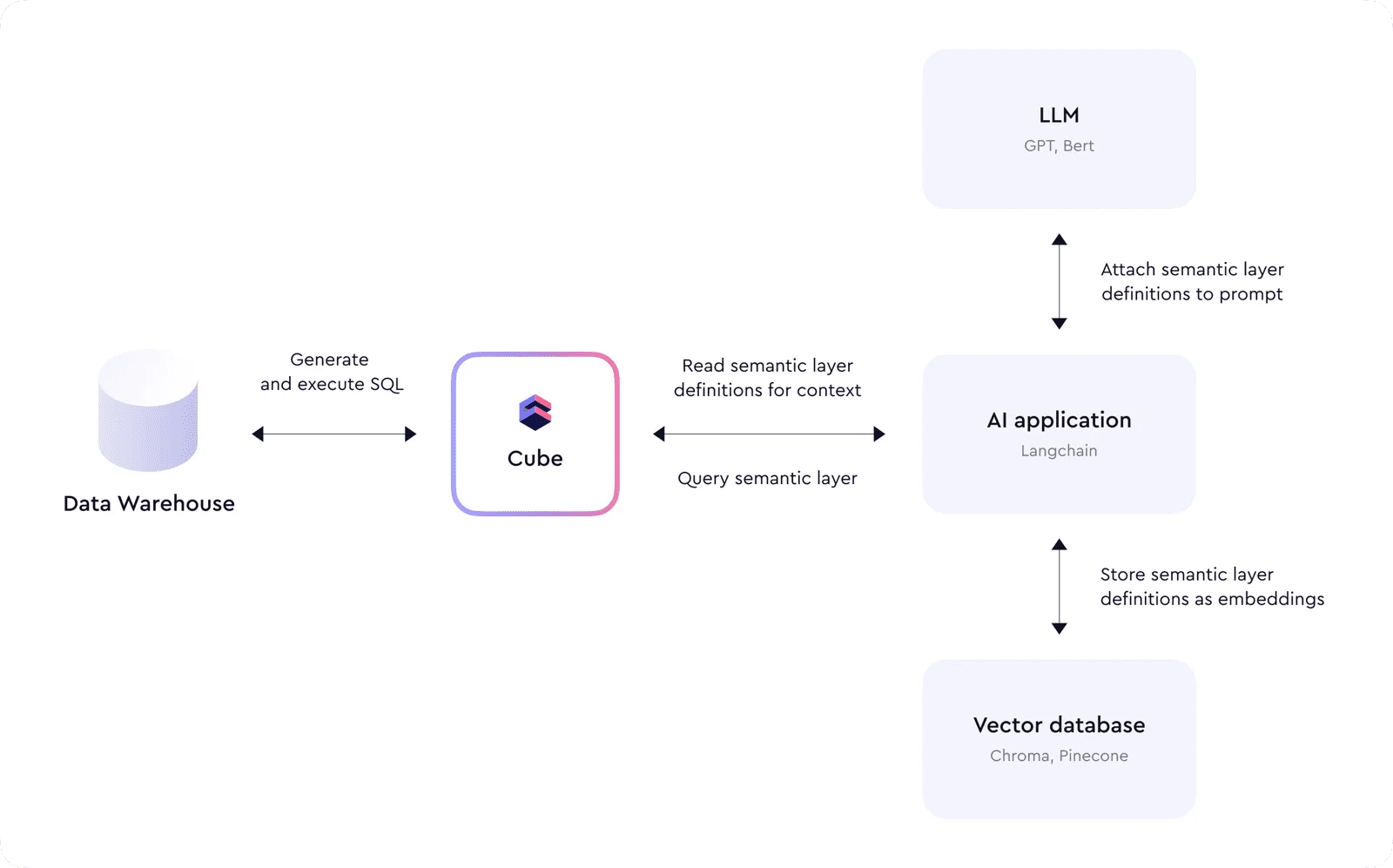
On the edge of this developmental forefront, we see Cube being an integral part of the modern AI tech stack as it sits on top of data warehouses, providing context to AI agents and acting as an interface to query data.

Semantic Layer: The Backbone of AI-powered Data Experiences

Cube’s data model provides structure and definitions used as a context for LLM to understand data and generate correct queries. LLM doesn’t need to navigate complex joins and metrics calculations because Cube abstracts those and provides a simple interface that operates on the business-level terminology instead of SQL table and column names. This simplification helps LLM to be less error-prone and avoid hallucinations.

For example, an AI-based application would first read Cube’s meta API endpoint, downloading all the definitions of the semantic layer and storing them as embeddings in a vector database. Later, when a user sends a query, these embeddings would be used in the prompt to LLM to provide additional context. LLM would then respond with a generated query to Cube, and the application would execute it. This process can be chained and repeated multiple times to answer complicated questions or create summary reports.

Performance

Regarding response times—when working on complicated queries and tasks, the AI system may need to query the semantic layer multiple times, applying different filters.

So, to ensure reasonable performance, these queries must be cached and not always pushed down to the underlying data warehouses. Cube provides a relational cache engine to build pre-aggregations on top of raw data and implements aggregate awareness to route queries to these aggregates when possible.

Security

And, finally, security and access control should never be an afterthought when building AI-based applications. As mentioned above, generating raw SQL and executing it in a data warehouse may lead to wrong results.

However, AI poses an additional risk: since it cannot be controlled and may generate arbitrary SQL, direct access between AI and raw data stores can also be a significant security vulnerability. Instead, generating SQL through the semantic layer can ensure granular access control policies are in place.

And more…

We have a lot of exciting integrations with the AI ecosystem in store and can’t wait to share them with you. Meanwhile, if you are working on an AI-powered application, consider testing Cube Cloud for free.

Download the guide "Five Essential Features of Every Semantic Layer" to learn more.

More On This Topic

  • The Power of a Semantic Layer: A Data Engineer's Guide
  • Working With The Lambda Layer in Keras
  • SAS® Visual Data Science Decisioning powered by SAS® Viya®:…
  • GPU-Powered Data Science (NOT Deep Learning) with RAPIDS
  • 7 AI-Powered Tools to Enhance Productivity for Data Scientists
  • ChatGPT-Powered Data Exploration: Unlock Hidden Insights in Your Dataset

Wadhwani AI secures $3.3M Google Grant for Crop Protection in India

Wadhwani AI has received a $3.3 million grant from Google–a part of Google’s AI for the Global Goals challenge, aiming to advance the United Nations Sustainable Development Global Goals. Wadhwani AI’s existing Cotton Ace app, which aids farmers in managing pests in cotton crops, will now be expanded to safeguard India’s staple food crops.

The Cotton Ace app currently allows farmers to upload pictures of pests, which are then analysed by AI to offer data-driven solutions for addressing crop damage. The app also provides real-time information on weather, farming techniques, and crop prices. This technology has already increased farmers’ profits by 20% and reduced pesticide expenses by 25%. With this new grant, Wadhwani AI intends to apply its AI-powered pest mitigation technology to staple crops like rice, wheat, and corn, aligning with the UN’s goal of zero hunger.

Wadhwani AI is among the 15 organisations globally chosen to receive support through Google.org’s $25 million philanthropy challenge. This challenge aims to facilitate projects that leverage AI to expedite progress toward the UN’s Sustainable Development Goals. The expansion of Wadhwani AI’s contributions to India’s agricultural knowledge systems is expected to bolster sustainable farming practices and improve farmers’ livelihoods.

Additionally, Wadhwani AI will develop two language model-based apps that incorporate verified sources, including agricultural research and government schemes. These apps will be integrated into PM Kisan chatbot and Kisan Call Centers, enhancing accessibility through features like text-to-speech, speech-to-text, and translation for Indian languages. This project ultimately aims to make valuable agricultural information accessible through voice commands in various Indian languages.

Annie Lewin, Senior Director of Global Advocacy and Head of Asia Pacific at Google, emphasised the importance of this grant, stating that it aligns with Google’s mission to support changemakers using technology to address significant global challenges.

The post Wadhwani AI secures $3.3M Google Grant for Crop Protection in India appeared first on Analytics India Magazine.

Top Companies in India to Consider for Employment

Top Companies in India to Consider for Employment
Image by Author

When we look at it from a global perspective, startups are having a tough time. Taking into consideration factors such as the post-pandemic effects, widespread layoffs, cautious investors and overall competitiveness.

All these factors have put employees in a challenging position when more and more become cautious if they will still have their jobs in the next few months. But times of uncertainty definitely make organizations push boundaries and innovate.

India has shown and proven exactly that. The Indian tech startup ecosystem has been growing and growing, with more organizations building AI systems, gaining a lot of investor attraction, and more and more edtech companies dropping out of thin air to meet the growing demand.

India has one of the largest populations of software engineers in the world, and the country has realized the talent it acquires and has decided to push its boundaries based on that.

So let’s get straight into it.

1. Fi

Fi is a company founded in 2019 that created a financial app with an in-built savings account using cutting-edge tech. They have raised $13.2 million in seed funds, led by Sequoia India & Ribbit Capital. If you’re looking to get into fintech, Fi is a good company to look into.

The company has and is continuously looking for candidates with skills such as data science and web development. They have had common job titles such as Product Manager, Risk Analyst, and Back End Developer.

2. Sprinto

Founded in 2019, Sprinto is a software development company that automates information security compliance & privacy laws for fast-growing SaaS companies. The platform works with any cloud setup and helps monitor entity-level risks and controls from a single dashboard.

The company has common job titles such as Full Stack Engineer, Customer Experience Manager, and Product Manager, and has a variety of vacancies online.

3. Jar

Okay another fintech company: Jar. A company founded in 2021, Jar was on a mission to reacquaint people with savings through the concept of a piggy bank — a concept we were familiar with when we were young. They have a revolutionary method of taking spare change from digital transactions and investing it in digital gold.

Their most upcoming job titles are software engineers, mobile application developers and others that have a data science background.

4. Zepto

Zepto is an e-grocery company that was founded in 2021 by two Stanford University dropouts, Aadit Palicha and Kaivalya Vohra. Not only is it India’s fastest-growing e-grocery company, but it has been valued at $1.4 Billion following its recent Series-E funding. Their headquarters is in Mumbai, however, the company is present across 10 major cities in the country with over 1000 employees.

Zepto's largest job functions are within the operations, engineering, and sales divisions. Have a look on LinkedIn or their careers section for a list of jobs available.

5. GoKwik

This ones for the data professionals who love nothing but data. GoKwik is a data & technology-led enabler that is on a mission to democratize the shopping experience. The company was founded in 2020, with roughly 250 employees.

If you’re looking for a 100% remote job, then GoKwik is exactly that. They are a 100% remote-first company and will continue to be 100% remote, with team members spread across 50+ cities and towns in India.

They have common job titles in Customer Experience Manager, Product Manager, and Sales Manager around different divisions such as Engineering, Customer Success, and Product Management.

6. BluSmart

The first to do it. BluSmart is India's first all-electric ride-hailing mobility service. Some of us are aware of urban India and its challenges with traffic. BluSmart has taken on this challenge by creating a sustainable means of transportation for India. But not at a cost, at an efficient, affordable, intelligent, safe and reliable mobility.

BluSmart’s largest job functions are within the engineering, operations, customer success and support division. The most common job titles are software engineer, product manager, and mobile application developer.

7. Skyroot Aerospace

Okay, this one may be a bit different to the tech world per se. But we have all been hearing about India and its recent work with space — it’s been incredible to hear, so it may be even better to get involved. Skyroot Aerospace was founded in 2018 with its headquarters in Hyderabad, India. The company specializes in futuristic space-launch vehicle design and building. India is becoming more and more competitive, and companies such as Skyroot Aerospace are innovations you want to be a part of.

They are not exactly part of the tech industry, however, as a tech professional, your skills are highly desirable and transferable. Skyroot Aerospace focuses on job roles such as engineering, operations, and quality assurance.

Conclusion

As more people get laid off, it can be difficult with the job search. Many are unsure of what companies to look into and which ones have areas of progression and continuous innovation. I hope this article has helped to steer your job search more effectively with start-ups that you can trust.

Nisha Arya is a Data Scientist and Freelance Technical Writer. She is particularly interested in providing Data Science career advice or tutorials and theory based knowledge around Data Science. She also wishes to explore the different ways Artificial Intelligence is/can benefit the longevity of human life. A keen learner, seeking to broaden her tech knowledge and writing skills, whilst helping guide others.

More On This Topic

  • The Top AutoML Frameworks You Should Consider in 2023
  • Why You Should Consider Being a Data Engineer Instead of a Data Scientist
  • Budgeting For Your AI Training Data: Consider These 3 Factors
  • 5 Data Science Open-source Projects You Should Consider Contributing to
  • Should You Consider a DataOps Career?
  • Investing In AI? Here Is What To Consider

Generative AI and machine learning are engineering the future in these 9 disciplines

Abstract engineering depicted by a circuit board

Generative artificial intelligence (AI) is proving to be a powerful tool for a broad range of engineering disciplines, offering highly streamlined processes and work products, and providing invaluable insights for industry leaders.

But while the term 'generative AI' is the tech industry's favorite buzzword, what exactly is it? At its core, generative AI is a subset of artificial intelligence that can generate new data, designs, or models based on existing data by using machine learning (ML) components and algorithms. Generative AI's power lies in its ability to optimize and accelerate processes, making it an ideal technology for engineering disciplines that require high precision, efficiency, and innovation.

Also: 4 ways generative AI can stimulate the creator economy

Each of the major engineering disciplines can apply generative AI toolsets in a similar manner, but also in their own unique ways — and each field also has unique commercial and open-source solutions they can use to leverage generative AI and ML to their best advantage.

Let's look at nine major engineering disciplines and think about how they might approach using generative AI, including examples of specific solutions, both commercial and open source. Many of these tools have been used for years, but are now incorporating generative AI features, or have capabilities that continue to be refined by improving their data models or codebases, which their developers train or optimize with commercial and open-source generative AI and ML toolsets and methodologies.

Conclusion

Generative AI and machine learning are more than just technological advancements — they are driving changes in tooling, processes, and methodologies that are revolutionizing the engineering landscape. The unique ability of these technologies to optimize and accelerate processes across various engineering disciplines makes them indispensable for modern engineering disciplines. As such, the message for businesses and engineering leaders is clear: embrace generative AI to stay competitive and future-ready.

Artificial Intelligence

Adobe Leading Future Design With New Generative AI Models

In a world where design and technology converge like never before, Adobe is leading the charge with its latest innovations. The tech giant recently announced the introduction of three new generative AI models, set to redefine the capabilities of Illustrator, Adobe Express, and Photoshop. These AI-driven enhancements promise to empower designers and creators to push the boundaries of their imagination.

The digital design realm is about to experience a seismic shift, thanks to Adobe's forward-thinking vision. At a recent company event, Adobe pulled the curtains back on its cutting-edge Firefly Image 2 model. This isn't just another iteration; it's a significant leap. But that's not all. Alongside this powerhouse, Adobe also presented two additional Firefly models specifically tailored for generating vector images and design templates, elevating the design process to new heights.

Elevating Imagery with Firefly Image 2

The Firefly Image 2 model is nothing short of a masterpiece. It's a testament to Adobe's commitment to enhancing image quality and providing tools that resonate with modern design needs. When pitted against its predecessor, the Firefly Image 2 model boasts of superior image generation. This is evident in the intricate details it captures, such as the intricate textures of human skin.

Moreover, the images rendered using this model are not just high-resolution but also radiate with vivid colors and striking color contrasts.

Beyond its image generation prowess, the model introduces groundbreaking AI-powered editing capabilities. Designers can now delve deep into their creative processes, manually or automatically adjusting parameters like depth of field, motion blur, and field of view — reminiscent of manual camera controls. To further assist users, Adobe has incorporated a “Prompt Guidance” feature. This intuitive addition aids in refining text descriptions and even offers auto-completion for prompts, streamlining the design workflow.

Embracing Brand Consistency with Generative Match

In today's dynamic digital landscape, brand consistency is paramount. Recognizing this, Adobe has introduced the “Generative Match” feature, a game-changer for brands looking to maintain a cohesive visual identity across various platforms. This innovative tool allows users to adjust the style of generated content to match specific images. Whether drawing from a preselected list or uploading their unique references, designers have unparalleled control over the final look of their creations.

The power of this feature doesn't stop there. Adobe has incorporated a slider that lets users determine the degree of resemblance between the reference and the generated image. This ensures that brands can strike the perfect balance between innovation and consistency.

Furthermore, in an age where transparency is valued, Adobe ensures that the origins of images aren't shrouded in mystery. Every piece of content generated using the Generative Match feature comes with “Content Credentials.” This not only builds trust but also ensures clarity in the ever-evolving realm of digital content.

Vector Design Reimagined: The Firefly Vector Model

Vector design, a cornerstone of digital art and graphic design, is poised for a revolutionary transformation. Enter the Firefly Vector model — Adobe's answer to the evolving needs of the design community. This state-of-the-art model doesn't just generate a singular image. Instead, it presents users with three distinct variations, empowering them to select the one that aligns best with their vision.

Safety and compliance are paramount in the commercial realm. Adobe addresses this head-on, ensuring that the Firefly Vector model is primed for commercial use. It is trained on licensed content, including offerings from Adobe Stock, as well as public domain content where copyrights have lapsed. This ensures that designers and brands can utilize the model with confidence.

For those eager to experience this innovation, Adobe has made the Firefly Vector model accessible via the Adobe Illustrator beta. Users can also explore other beta features, such as Mockup — a tool that realistically stages designs on 3D models — and Retype, which aids in identifying and editing vector fonts.

Revolutionizing Templates: The Firefly Design Model

In an era where efficiency and customization go hand in hand, Adobe's Firefly Design model emerges as a beacon of innovation. The Firefly Design model, with its astute AI capabilities, generates tailor-made templates for a myriad of applications — be it print, social media posts, online advertisements, videos, or more.

The genius of this model lies in its simplicity. Users need only provide text prompts, and the model gets to work, crafting fully editable templates that cater to popular aspect ratios. It's a paradigm shift from the traditional design process, where users had to piece together individual text and image assets on a blank canvas.

Furthermore, the AI-generated templates aren't just placeholders. They serve as personalized starting points, ensuring designers embark on their projects with a clear direction, rather than navigating the vast ocean of pre-existing designs.

Adobe's Bold Move in the AI Arena

As we reflect on Adobe's latest offerings, it's evident that the company is not just adapting to the AI era but pioneering it. The introduction of these generative models, though currently in beta, signals a bold step forward. Given the success of the original Firefly model, which has been instrumental in generating over 3 billion images, the potential of these new additions is boundless.

Yet, in the larger context, Adobe's move isn't just about staying ahead of the curve. It's a testament to their commitment to empowering designers, ensuring they have the tools and technologies to bring their visions to life in the most vivid and impactful ways.

In a landscape where numerous companies are venturing into AI-powered creative tools, Adobe's decision to unleash its AI innovations speaks volumes. It's not just about staying competitive; it's about redefining what's possible in the realm of digital design.

With these advancements, one thing is clear: The future of design is here, and Adobe is at the helm, guiding us toward uncharted territories of creativity and innovation.

Swarathma Becomes the First Indian Band to Use ChatGPT Live

Swarathma Cypher

Generative AI has been making its way into almost every industry, even music. The Bengaluru-based Indian-Folk Rock band, Swarathma, was live at Cypher 2023. At the biggest AI conference, the band decided to generate lyrics of a song on the spot with ChatGPT, and started singing it, enchanting the audience.

So we jammed with chatGPT live on stage for @Analyticsindiam #CYPHER2023!
The prompt was to write us an 8 line chorus about singing at an AI conference with a lady in red (who was grooving in the front row!)
What fun!@OpenAI https://t.co/7eJOw3SZfl

— swarathma (@swarathma) October 13, 2023

There have been mixed views about the use of AI in the music industry, where people have been concerned about the copyright issues, let alone how technology affects this field of art.

Generative AI can make a huge impact in the music industry and thus it needs to be balanced out. For this, a lot of companies have been partnering with music labels to ensure that there is no infringement of copyright, and apart from lyrics, the music generated by the AI models also finds its way into the industry.

Apart from generating original lyrics, people have also been leveraging ChatGPT to generate lyrics similar to other artists. For example, some people tried generating new song lyrics, similar to the style of Taylor Swift, and were able to pull it off well. Undoubtedly, just like any other field, generative AI has found its way into the music industry, and is here to stay.

The post Swarathma Becomes the First Indian Band to Use ChatGPT Live appeared first on Analytics India Magazine.

Google for India 2023 Key Highlights

Google’s annual flagship event, “Google For India,” which took place today in New Delhi’s Pragati Maidan announced new efforts aimed at enhancing core products for India and collaborating with leading Indian companies in areas such as banking, finance, and cyber safety.

The event was attended by Ashwini Vaishnaw said, “Just about 9 years back, mobile manufacturing was practically non-existent. Almost 98% of the mobile phones we used were imported. It is a significant achievement that Google has today announced the manufacturing of Pixel phones in India.”

Google revealed plans to improve access and bring in affordable data services throughout the country. Additionally, Google also plans to manufacture Pixel smartphones in India, highlighting the country’s importance as a priority market. The company aims to bring its top-tier hardware and software capabilities to a broader Indian audience.

Leveraging AI for Product Enhancement

Google said that it is improving user experiences through the application of AI. This includes reimagining the capabilities of search engines to better serve the information needs of users of the country.

The introduction of new visual and local features to its generative AI-powered search experience aims to enhance user interactions with search results. Google is working on incorporating images, videos, and user reviews, along with providing easy access to essential information about government schemes.

In addition, Google is facilitating small businesses’ online visibility and shoppers’ experiences through automatically generated high-quality catalogs using Generative AI.

Google Cloud and Axis My India have teamed up to make a new super-app called “a.” It aims to make government programs, daily services, jobs, and healthcare info more accessible. “a” uses Google Cloud’s Generative AI to provide personalised government info in real time for users in both rural and urban areas. Additionally, Google Cloud is working with ONDC to boost online sales for Farmer Producer Organisations (FPOs) and increase their revenue with Generative AI.

Google Offers Personal Loans

Google Pay is collaborating with financial institutions, including banks and NBFCs, to create financial products aimed at bridging the credit gap in India.

These products are underwritten by regulatory-approved financial institutions and are made accessible to users through the Google Pay platform. This initiative forms the basis of Google Pay’s Digital Pragati program, which seeks to provide formal credit access to millions of eligible but underserved Indians.

Strengthening Online Safety

Google’s “DigiKavach” program is designed to combat online financial fraud at scale. It involves studying fraudulent methods, developing countermeasures against emerging scams, and collaborating with experts and partners to create a secure online environment.

This includes support from The Fintech Association for Consumer Empowerment (FACE) to combat predatory digital lending apps on the Play Store in India. Google is working to protect users from scams, malware, and online fraud to build a trustworthy digital ecosystem.

Government and Local Business Partnership

The company is actively partnering with Indian government initiatives and local businesses to support India’s digital transformation. This includes collaborating with Bhashini to establish a Center of Excellence on Generative AI and Language Inclusivity, equipping professionals and students with generative AI knowledge and skills.

Moreover, Google Cloud and ONDC have joined forces to facilitate seamless onboarding of FPOs onto the ONDC Network, enabling them to sell produce online. Google.org, the philanthropic arm of Google, is providing grants to organizations that leverage AI and technology to enhance agricultural outcomes and combat misinformation.

The post Google for India 2023 Key Highlights appeared first on Analytics India Magazine.

Gradient Descent: The Mountain Trekker’s Guide to Optimization with Mathematics

The Mountain Trekker Analogy:

Imagine you're a mountain trekker, standing somewhere on the slopes of a vast mountain range. Your goal is to reach the lowest point in the valley, but there's a catch: you're blindfolded. Without the ability to see the entire landscape, how would you find your way to the bottom?

Instinctively, you might feel the ground around you with your feet, sensing which way is downhill. You'd then take a step in that direction, the steepest descent. Repeating this process, you'd gradually move closer to the valley's lowest point.

Translating the Analogy to Gradient Descent

In the realm of machine learning, this trekker's journey mirrors the gradient descent algorithm. Here's how:

1) The Landscape: The mountainous terrain represents our cost (or loss) function,

J(θ). This function measures the error or discrepancy between our model's predictions and the actual data. Mathematically, it could be represented as:

XXXXX
where

m is the number of data points,hθ(x) is our model's prediction, and

y is the actual value.

2) The Trekker's Position: Your current position on the mountain corresponds to the current values of the model's parameters,θ. As you move, these values change, altering the model's predictions.

3) Feeling the Ground: Just as you sense the steepest descent with your feet, in gradient descent, we compute the gradient,

∇J(θ). This gradient tells us the direction of the steepest increase in our cost function. To minimise the cost, we move in the opposite direction. The gradient is given by:

XXXXX
Where:

m is the number of training examples.

XXXXXis the prediction for the ith

training example.

XXXXXis the jth feature value for the ith training example.

XXXXXis the actual output for the ith

training example.

4) Steps: The size of the steps you take is analogous to the learning rate in gradient descent, denoted by ?. A large step might help you descend faster but risks overshooting the valley's bottom. A smaller step is more cautious but might take longer to reach the minimum. The update rule is:

XXXXX

5) Reaching the Bottom: The iterative process continues until you reach a point where you feel no significant descent in any direction. In gradient descent, this is when the change in the cost function becomes negligible, indicating that the algorithm has (hopefully) found the minimum.

In Conclusion

Gradient descent is a methodical and iterative process, much like our blindfolded trekker trying to find the valley's lowest point. By combining intuition with mathematical rigor, we can better understand how machine learning models learn, adjust their parameters, and improve their predictions.

Batch Gradient Descent

Batch Gradient Descent computes the gradient using the entire dataset. This method provides a stable convergence and consistent error gradient but can be computationally expensive and slow for large datasets.

Stochastic Gradient Descent (SGD)

SGD estimates the gradient using a single, randomly chosen data point. While it can be faster and is capable of escaping local minima, it has a more erratic convergence pattern due to its inherent randomness, potentially leading to oscillations in the cost function.

Mini-Batch Gradient Descent

Mini-Batch Gradient Descent strikes a balance between the two aforementioned methods. It computes the gradient using a subset (or "mini-batch") of the dataset. This method accelerates convergence by benefiting from the computational advantages of matrix operations and offers a compromise between the stability of Batch Gradient Descent and the speed of SGD.

Challenges and Solutions

Local Minima

Gradient descent can sometimes converge to a local minimum, which is not the optimal solution for the entire function. This is particularly problematic in complex landscapes with multiple valleys. To overcome this, incorporating momentum helps the algorithm navigate through valleys without getting stuck. Additionally, advanced optimization algorithms like Adam combine the benefits of momentum and adaptive learning rates to ensure more robust convergence to global minima.

Vanishing & Exploding Gradients

In deep neural networks, as gradients are back-propagated, they can diminish to near zero (vanish) or grow exponentially (explode). Vanishing gradients slow down training, making it hard for the network to learn, while exploding gradients can cause the model to diverge. To mitigate these issues, gradient clipping sets a threshold value to prevent gradients from becoming too large. On the other hand, normalized initialization techniques, like He or Xavier initialization, ensure that the weights are set to optimal values at the start, reducing the risk of these challenges.

Example Code for Gradient Descent Algorithm

import numpy as np    def gradient_descent(X, y, learning_rate=0.01, num_iterations=1000):      m, n = X.shape      theta = np.zeros(n)  # Initialize weights/parameters      cost_history = []  # To store values of the cost function over iterations        for _ in range(num_iterations):          predictions = X.dot(theta)          errors = predictions - y          gradient = (1/m) * X.T.dot(errors)          theta -= learning_rate * gradient            # Compute and store the cost for current iteration          cost = (1/(2*m)) * np.sum(errors**2)          cost_history.append(cost)        return theta, cost_history    # Example usage:  # Assuming X is your feature matrix with m samples and n features  # and y is your target vector with m samples.  # Note: You should add a bias term (column of ones) to X if you want a bias term in your model.    # Sample data  X = np.array([[1, 1], [1, 2], [1, 3], [1, 4], [1, 5]])  y = np.array([2, 4, 5, 4, 5])    theta, cost_history = gradient_descent(X, y)    print("Optimal parameters:", theta)  print("Cost history:", cost_history)

This code provides a basic gradient descent algorithm for linear regression. The function gradient_descent takes in the feature matrix X, target vector y, a learning rate, and the number of iterations. It returns the optimized parameters (theta) and the history of the cost function over the iterations.
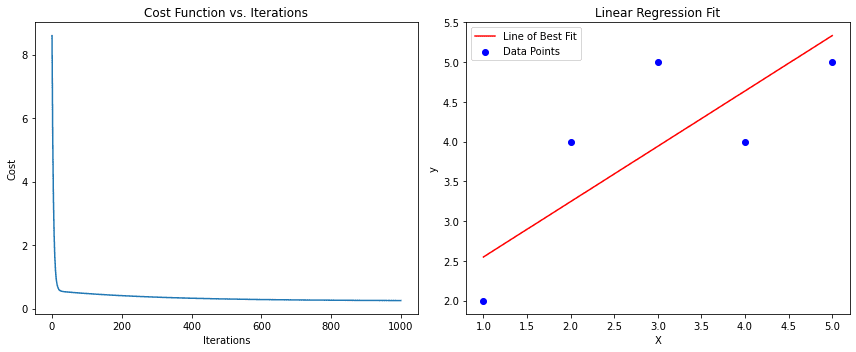
XXXXX

The left subplot shows the cost function decreasing over iterations.

The right subplot shows the data points and the line of best fit obtained from gradient descent.
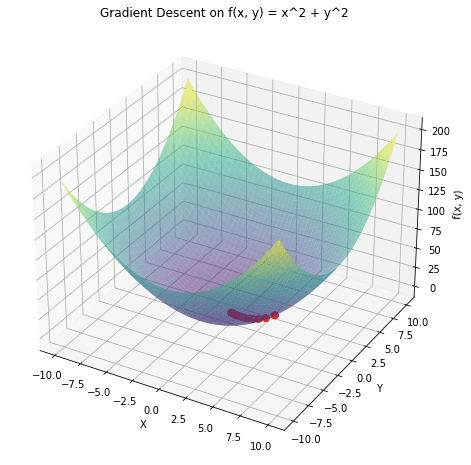
XXXXX

a 3D plot of the function XXXXX and overlay the path taken by gradient descent in red. The gradient descent starts from a random point and moves towards the minimum of the function.

Applications

Stock Price Prediction

Financial analysts use gradient descent in conjunction with algorithms like linear regression to predict future stock prices based on historical data. By minimising the error between the predicted and actual stock prices, they can refine their models to make more accurate predictions.

Image Recognition

Deep learning models, especially Convolutional Neural Networks (CNNs), employ gradient descent to optimise weights while training on vast datasets of images. For instance, platforms like Facebook use such models to automatically tag individuals in photos by recognizing facial features. The optimization of these models ensures accurate and efficient facial recognition.

Sentiment Analysis

Companies use gradient descent to train models that analyse customer feedback, reviews, or social media mentions to determine public sentiment about their products or services. By minimising the difference between predicted and actual sentiments, these models can accurately classify feedback as positive, negative, or neutral, helping businesses gauge customer satisfaction and tailor their strategies accordingly.

Arun is a seasoned Senior Data Scientist with over 8 years of experience in harnessing the power of data to drive impactful business solutions. He excels in leveraging advanced analytics, predictive modelling, and machine learning to transform complex data into actionable insights and strategic narratives. Holding a PGP in Machine Learning and Artificial Intelligence from a renowned institution, Arun's expertise spans a broad spectrum of technical and strategic domains, making him a valuable asset in any data-driven endeavour.

More On This Topic

  • 5 Concepts You Should Know About Gradient Descent and Cost Function
  • Back To Basics, Part Dos: Gradient Descent
  • September 26-30: SIAM Conference on Mathematics of Data Science (Hybrid)
  • Inside DeepMind’s New Efforts to Use Deep Learning to Advance Mathematics
  • Mathematics for Machine Learning: The Free eBook
  • Gradient Boosted Decision Trees – A Conceptual Explanation

Instagram co-founders’ app Artifact now let you discover recommended places, too

Instagram co-founders’ app Artifact now let you discover recommended places, too Sarah Perez @sarahintampa / 7 hours

Personalized news aggregation app Artifact is taking another step to become a place to discover interesting links of all sorts, not just the latest headlines. After last month adding a way to share organic posts as well as links of any sort through the service, the AI-powered app from Instagram’s co-founders is today adding a way to also share favorite places — like a restaurant, bar, shop, or another place you want to recommend to friends.

The addition again changes the nature of the news app, which is rapidly morphing itself into a discovery engine for the broader web, if not a full-on Twitter/X competitor. It also allows Artifact users to better establish themselves as curators who can build a following on the app by sharing their recommendations, thoughts, and now, hot spots, too.

The ability to share places is now a part of the posting experience on Artifact, which lets users press a plus “+” icon to post their own titles, text, and images. At the time of its launch, Artifact suggested posts could be used to share things like restaurant reviews, how-to guides, family recipes, app breakdowns, design inspo, and more. The addition inched the app closer to X’s territory as it now became a place for organic content, with or without links. But while X has focused heavily on text-based posts over the year, Artifact recently added generative AI tools to add images to their posts in order to grab other users’ attention.

AI plays a larger role within Artifact, powering its recommendation engine and being used to rewrite clickbait headlines and summarize news stories so readers can get an overview of a given article. Today, those AI summaries will also be available when you click through a headline to read the page in the in-app Safari web browser, too, along with Artifact’s other features that allow you to comment and save articles for later. These features work both in the native mobile app and from Safari’s share extension, notes Artifact co-founder Mike Krieger in a post on Instagram Threads, announcing the updates.

As of last month, Artifact had around 400,000 mobile app downloads, according to estimates from market intelligence provider data.ai.

In the months since its February 2023 public launch, the app has rapidly shipped new features, including user profiles, commenting, link sharing, posting, and more, raising the question as to whether or not the app aims to take on X head-on. Last month, Krieger said there’s “a flavor” of Twitter/X that he thought would be fun to have within Artifact, in the sense that he wants the app to help people discover if there’s a story that everyone is coalescing around that day. But he admitted the app hasn’t yet achieved that.

By chasing the long tail of news and discussions, the app is instead shaping up to be more like Flipboard, with its curated news magazines, or perhaps Pinterest, as a discovery engine for inspirational content from the web. However, without having a dedicated focus on just one area, people may end up confused as to what Artifact is for. Is it a news app? A discovery tool? A recommendations app? An X rival? And so on. Time will tell where Artifact ends up, in the meantime, it’s one of many places users can scroll for news, links, and content that interests them.

Artifact co-founder Kevin Systrom doesn’t believe in AI doomerism