Amidst rampant tech layoffs at top firms in the world, Indian IT majors are showing signs of disparity in hiring freshers as they are mostly focusing on training and upskilling their existing employees, alongside scaling work automation and digital initiatives.
However, there are exceptions. Tata Consultancy Services (TCS) recently announced that it is planning to hire around 35,000-40,000 freshers in FY24, just as it does every year.
TCS COO, NG Subramaniam said, “We usually hire between 35,000 to 40,000 people and those plans are intact.” Additionally, the COO also confirmed that the firm is not planning to conduct any large scale layoffs. In fact, the company wants to train the hires and reduce the bench size.
“The way we’ve calibrated this is we’re working towards improving our own utilisation because we have a decent bench,” he noted. TCS has around 10% of its employees on the bench.
Similarly, HCL Tech is also recalibrating its freshers target this year. The company wants to hire 10,000 freshers within the next half of this financial year, as per a statement from the CFO Prateek Aggarwal. Though Tech Mahindra hasn’t cleared its plans for the year, the company has been hiring around 15,000 freshers since last year.
Focus on training and automation
Most of the IT firms have been expanding their relationships with cloud providers such as Microsoft, Google, and NVIDIA to upskill their workforce. TCS and Infosys have partnered with NVIDIA to train their employees in generative AI. Tech Mahindra also partnered with Microsoft for modernising its business operations.
Apart from introducing a strict dress code for its employees while returning to office, TCS is focusing on improving the utilisation of its employees amid the slowdown in the sector. “All these people were going through training, induction, and upskilling in the last 12 months. They’re available as a productive pool to be deployed into various projects,” Subramaniam added.
He explained that when there is a contraction in discretionary spending, the company hires a lesser number of lateral. The Indian IT hired a huge number of employees after the pandemic in 2020, and then the company began cost cutting. On top of that, the attrition rate was huge, so the company decided to hire more employees to build a large bench. “Our utilisation is currently around 85 per cent. we used to operate at about 87-90 per cent,” said Subramaniam.
However, not all IT companies are following the same trend. Infosys has decided to not hire freshers from campuses this year. As mentioned by TCS, the biggest reason for this is a huge bench, and thus wants to reduce cost. In a press conference, CEO and MD of Infosys, Salil Parekh said that the company is carrying “inefficiencies in its employee pyramid and has enough room to tighten utilisation to 84-85 per cent.”
CFO Nilanjan Roy said in the second quarter briefing that the company is training its employees on generative AI, and wants to focus on that instead of hiring more freshers. The company hired 50,000 freshers last year, which is higher than TCS. Thus, the company wants to focus on utilisation of its bench.
Not all good news
Despite this, Infosys has also said that it will honour all past letters, contrary to the news last year that the companies have been rescinding the offer letters. The IT firm was also in the news for firing 600 freshers for failing an internal test and also slashed variable pay by 40 percent for employees in the quarter that ended in March 2023.
Wipro, on the other hand, has also decided to reduce hiring engineering students citing it as a response to reduced spending by cautious clients. Similar to Infosys, the company wants to onboard the employees who have already been offered jobs. Chief human resources officer, Saurabh Govil said that the company hired 22,000 freshers in March, and plans to hire lesser people this fiscal year.
Accenture is the most interesting of the bunch. After 19,000 layoffs this year, the company has also decided to not hike the salaries of its employees in India this year. The IT giant is also delaying hiring freshers to cut costs and “grapple with the present economic conditions.”
In April, LTIMindtree asked all its freshers who received offer letters in 2022, to attend Ignite, the company’s training program to check if they should be onboarded, which would be based on business demands. This has resulted in a delay in joining, leaving freshers crying foul.
It is important to note that despite hiring freshers, there has been a looming fear of economic recession, particularly in the U.S. and Europe. And both these regions contribute to approximately 86% of the revenue of the Indian IT firms. This has made the Indian giants a little cautious from expanding their workforce.
The post Why Indian IT is Not into Freshers appeared first on Analytics India Magazine.
Design software leader Adobe has announced Photoshop Elements and Premiere Elements 2024 with 20 AI-powered features and a fresh editing experience. This duo of software are now available for purchase on Adobe’s official website, Amazon, Best Buy, and various other retailers.
Adobe doesn’t stop at just desktop applications. The web and mobile companion apps are in on the action. The web app (currently available in English) lets users add creative overlays that frame their subject or create depth. The mobile app (also in English) is equipped with one-click Quick Actions to improve tone, remove backgrounds, and fix white balance.
Adding ‘Elements’ to Photo Editing
In Photoshop Elements one of the standout features being introduced is its AI-driven colour and tone matching capability. Users will be able choose from a range of built-in presets or upload their photos. For an ultra-modern editing experience, Elements has an aesthetic overhaul with new fonts, icons, buttons, and an option for light and dark mode.
Furthermore, the automatic photo selections powered by Adobe Sensei AI is a game-changer. In one click, users can select a specific element to enhance or replace it. Henceforth, Sensei AI will also deal with JPEG images.
Photoshop Elements introduces 62 step-by-step Guided Edits, for users at all skill levels. Among the additions are stylised photo text for shareable posts and the ability to make subjects stand out with new backgrounds in Guided Edits.
Users also have access to free Adobe Stock photos within the software to experiment with graphics.The Artistic Effect option (also) powered by Sensei AI will let users transform photos into works of art inspired by famous artistic styles.
Premiere Elements for Video Editing
Similar to Photoshop, Adobe’s Premiere Elements introduces AI-powered colour and tone matching for video projects. ‘Highlight Reels’ is another Sensei AI powered feature to turn raw video clips into content focused on motion, close-ups, and the highest-quality footage.
The software’s aesthetic overhaul extends to Premiere as well. Audio effects now also have Reverb, Vocal Enhancer, and DeHummer, for users to enhance the auditory experience for their videos.
Same as its photo-editing counterpart, Premiere offers an array of Guided Edits for video projects. With 26 Guided Edits to choose from, users can enhance their videos with creative effects, transitions, and eye-catching animations.
The post Adobe Announces 20 AI-Features Across Photoshop and Premiere Elements appeared first on Analytics India Magazine.
OpenAI recently announced its partnership with Abu Dhabi-based AI and cloud computing company G42. With this move, the possibility of UAE competing with OpenAI is subdued, and the strategic partnership may have a little something for both the parties.
OpenAI’s Demographic Push
In G42’s partnership announcement, the company spoke about leveraging OpenAI’s generative AI models for UAE’s financial services, energy, healthcare and many other sectors. OpenAI, on the other hand, will not only be able to expand in the Emirates market but also probably leverage G42’s Arabic language model.
G42 recently launched an Arabic language AI model Jais, which contains 13 billion parameters and combines Arabic and English data. The model was built in collaboration with academicians and engineers, partly from the scarcity of bilingual language models.
Jais was built on supercomputers produced by Cerebras Systems. The partnership with OpenAI will probably help the company achieve its multilingual model goals.
G42 Group CEO Peng Xiao and OpenAI CEO and co-founder Sam Altman. Source: G42
Altman has been keen on developing demographic specific models. In his visit to Japan in June, he spoke about wanting to build better models for Japanese language and culture. Furthermore, he even indicated his desire to start an office in Tokyo as SoftBank shows interest in investing in OpenAI.
Having established its presence in London and Dublin by opening new offices there, with another one coming up in Japan soon, it won’t be a surprise if UAE gets the next one.
Public-Private Collab
In June, Altman met Maktoum bin Mohammed Al Maktoum, deputy prime minister and minister of finance of the UAE, to explore AI development opportunities with the country. The ruler had even tweeted about how they explored ways to strengthen partnerships around AI solutions.
The UAE government takes active interest in the advancements of technological research and development, especially in AI. It either funds (partners) or advises companies working in the domain. Technology Innovation Institute (TII), the organisation behind open-source LLM Falcon, is a government-funded research institute. It has been on the forefront of releasing LLM models that surpassed even Meta’s LLaMA capabilities, a few months ago.
Close on the heels of TII, spearheading further AI advancements in the country is G42. Interestingly, UAE national security advisor Sheikh Tahnoon bin Zayed Al Nahyan, is also the chairman of G42 group. He also chairs sovereign wealth funds including government holding company ADQ worth $110 billion, that controls critical sectors of the economy.
Interestingly, UAE was the first country to appoint a minister of state for artificial intelligence, Omar Sultan Al Olama, in 2017. With funding and direction, the government has been spearheading AI progress in the country. And with G42’s latest partnership with OpenAI, the country now has the best of both worlds.
G42 and Big-Tech Companies
While OpenAI is the latest collaboration, G42 has also tied up with big-tech and emerging companies that will help accelerate the AI vision for UAE. G42 announced its partnership with Microsoft, in April, and last month announced their collaboration to boost cloud and technology infrastructure in the UAE. The companies will focus on AI solutions for health, energy and many other domains, similar to the OpenAI-G42 partnership plan.
The collaboration will see Microsoft expand its Azure cloud service within UAE by leveraging Khazna Data Centres, a joint venture between G42 and government telecom company Etisalat.
AI compute company Cerebras Technologies had signed a deal with G42 two years ago to bring high-performance AI compute to the Middle East. In July, both the companies unveiled Condor Galaxy, a network of nine interconnected supercomputers that significantly reduces the training time for AI models.
The OpenAI-G42 partnership emphasises the construction of AI systems through collaboration, rather than competition. As G42 CEO Peng Xiao stated, the partnership represents a “convergence of value and vision”, and Altman believes that this collaboration will help yield effective solutions that “resonate with the nuances of the region”. A win-win for all.
The post Why OpenAI Partnered with G42 appeared first on Analytics India Magazine.
In a significant industry development, AMD has introduced its Ryzen Threadripper 7000 Series processors and Ryzen Threadripper PRO 7000 WX-Series processors. These processors bring new standards of computing performance, targeting both high-end desktop users and professionals.
The Ryzen Threadripper PRO 7000 WX-Series processors are designed for professional use and are equipped with up to 96 cores and 192 threads. These processors excel in demanding professional applications and multitasking workloads, delivering a notable performance boost. They also offer up to 384MB of L3 cache and support eight channels for DDR5 memory.
In parallel, AMD has reintroduced the Ryzen Threadripper 7000 Series processors for high-end desktop users. These processors offer up to 64 cores and 128 threads, making them suitable for users who require excellent multi-threaded performance. Both the PRO and non-PRO processors are built on the “Zen 4” architecture and offer impressive PCIe 5.0 lane support.
AMD’s collaboration with Dell Technologies, HP, and Lenovo ensures the availability of workstations and high-end desktop platforms featuring these processors. These workstations are set to provide professionals and enthusiasts with powerful and reliable computing solutions, tailored to meet their specific needs.
The availability of these processors is expected by the end of 2023 through various channels, including system integrators and DIY retailers. AMD’s focus on delivering practical computing innovation underlines the importance of these new processor offerings.
The post AMD Introduces Ryzen Threadripper 7000 Series for High-Performance Workstations appeared first on Analytics India Magazine.
OpenAI debates when to release its AI-generated image detector Kyle Wiggers 10 hours
OpenAI has “discussed and debated quite extensively” when to release a tool that can determine whether an image was made with DALL-E 3, OpenAI’s generative AI art model, or not. But the startup isn’t close to making a decision anytime soon.
That’s according to Sandhini Agarwal, an OpenAI researcher who focuses on safety and policy, who spoke with TechCrunch in a phone interview this week. She said that, while the classifier tool’s accuracy is “really good” — at least by her estimation — it hasn’t met OpenAI’s threshold for quality.
“There’s this question of putting out a tool that’s somewhat unreliable, given that decisions it could make could significantly affect photos, like whether a work is viewed as painted by an artist or inauthentic and misleading,” Agarwal said.
OpenAI’s targeted accuracy for the tool appears to be extraordinarily high. Mira Murati, OpenAI’s chief technology officer, said this week at the Wall Street Journal’s Tech Live conference that the classifier is “99%” reliable at determining if an unmodified photo was generated using DALL-E 3. Perhaps the goal is 100%; Agarwal wouldn’t say.
A draft OpenAI blog post shared with TechCrunch revealed this interesting tidbit:
“[The classifier] remains over 95% accurate when [an] image has been subject to common types of modifications, such as cropping, resizing, JPEG compression, or when text or cutouts from real images are superimposed onto small portions of the generated image.”
OpenAI’s reluctance could be tied to the controversy surrounding its previous public classifier tool, which was designed to detect AI-generated text not only from OpenAI’s models, but from text-generating models released by third-party vendors. OpenAI pulled the AI-written text detector over its “low rate of accuracy,” which had been widely criticized.
Agarwal implies that OpenAI is also hung up on the philosophical question of what, exactly, constitutes an AI-generated image. Artwork generated from scratch by DALL-E 3 qualifies, obviously. But what about an image from DALL-E 3 that’s gone through several rounds of edits, has been combined with other images and then was run through a few post-processing filters? It’s less clear.
An image generated by DALL-E 3.
“At that point, should that image be considered something AI-generated or not?,” Agarwal said. “Right now, we’re trying to navigate this question, and we really want to hear from artists and people who’d be significantly impacted by such [classifier] tools.”
A number of organizations — not just OpenAI — are exploring watermarking and detection techniques for generative media as AI deepfakes proliferate.
DeepMind recently proposed a spec, SynthID, to mark AI-generated images in a way that’s imperceptible to the human eye but can be spotted by a specialized detector. French startup Imatag, launched in 2020, offers a watermarking tool that it claims isn’t affected by resizing, cropping, editing or compressing images, similar to SynthID. Yet another firm, Steg.AI, employs an AI model to apply watermarks that survive resizing and other edits.
The problems is, the industry has yet to coalesce around a single watermarking or detection standard. Even if it does, there’s no guarantee that the watermarks — and detectors for that matter — won’t be defeatable.
I asked Agarwal whether OpenAI’s image classifier would ever support detecting images created with other, non-OpenAI generative tools. She wouldn’t commit to that, but did say that — depending on the reception of the image classifier tool as it exists today — it’s an avenue OpenAI would consider exploring.
“One of the reasons why right now [the classifier is] DALL-E 3-specific is because that’s, technically, a much more tractable problem,” Agarwal said. “[A general detector] isn’t something we’re doing right now… But depending on where [the classifier tool] goes, I’m not saying we’ll never do it.”
Google is bringing generative artificial intelligence to its Search platform to offer users new ways of finding, visualizing and creating content.
The company began rolling out its generative AI-powered Search Generative Experience to select U.S. users on October 12, saying in a blog post that the update was the culmination of the work it has been doing over the years to make its search engine smarter and more intuitive.
Jump to:
What is Google SGE, and how does it work?
Google SGE can help users create written content
Building in safeguards
Future uses of SGE
What is Google SGE, and how does it work?
SGE allows Google users to generate AI images and text by typing a prompt into the Google Search bar, working much in the same way as AI-powered text-to-image generators like Midjourney and DALL-E 2 and acting as a rival to Microsoft’s GPT-4 powered Bing Chat.
Google said SGE could help in situations where users might be looking for a certain image they can’t find in traditional search results, or when they need help visualizing an idea.
Users who opt in to SGE will see an option to create AI-generated images directly in Google Images as part of the model’s testing period. This feature is designed to appear when users are searching for inspiration, said Google (e.g., “minimalist Halloween table settings” or “spooky dog house ideas.” Users can then fine-tune the results by modifying the description.
“Tap on any of those images and you’ll see how generative AI has expanded your initial query with descriptive details, like ‘a photorealistic image of a capybara wearing a chef’s hat and cooking breakfast in a forest, grilling bacon’,” explained Google.
“From there, you can edit the description further to add even more detail and bring your vision to life. Maybe you want to see the capybara chef making hash browns instead, or you want to add a light blue background with clouds.”
The image generation capability offered by SGE is only available in the U.S. to people who opted into the trial phase and are aged 18 or older.
SGE builds on a number of major AI advancements pioneered by Google in recent years, including its BERT natural language processing engine and even more powerful Multitask Unified Model — or MUM — a large language model reported to be 1,000 times more powerful than BERT.
According to Google, SGE is powered by a variety of LLMs, including an advanced version of MUM and PaLM2, which took center stage at Google I/O 2023.
Google has made a concerted effort to lean into growing consumer interest around AI, putting the technology at the center of the marketing around its flagship Google Pixel 8.
Google SGE can help users create written content
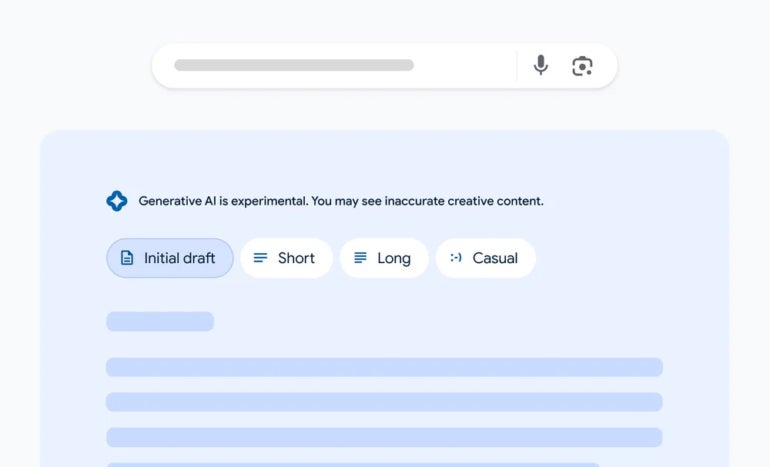
Similar to the capabilities offered by Google Bard and rival platform ChatGPT, SGE will also help users generate written content (Figure A).
Figure A
SGE can help users with written tasks, too. Image: Google
Google gave the example of someone looking for home improvement advice. “After finding helpful ideas across the web and contractors you’d like to get in touch with, you can ask SGE to ‘Write a note to a contractor asking for a quote to turn my garage into a home office’,” the company said.
SGE will draft a note based on the prompt, which users can revise for length, tone or language as needed. These can then be exported to Google Docs or Gmail.
Google said it was conscious of safety concerns around the use of generative AI and AI-generated content; and to that end, it was building in safeguards to block images that go against its prohibited use policy. This includes any content considered harmful or misleading.
Additionally, all images generated by SGE will be watermarked and contain metadata indicating that they have been AI-generated, while another upcoming Google tool called “About this image” will allow users to better ascertain the “context and credibility of images.”
Google explained: “For example, it might show you when a similar version of this image may have first been seen by Google; or show you other pages on the web that use a similar image, including news or fact checking sites.”
Further ahead, Google hopes SGE will help people in situations where various contextual or situational information is needed — for example, while shopping or searching local services. In these scenarios, SGE will pull from Google’s Shopping Graph to provide product information like reviews, prices and images or relevant information about local places to help consumers compare options.
SGE will also be used to serve ads in search results, as disclosed in Google’s documentation on SGE.
Exactly what role generative AI will play here isn’t clear, but it does suggest that any ads will be clearly labeled so they are distinguishable from organic results. “As Search applies the power of generative AI, Search ads will continue to play a critical role,” Google said.
The company continued: “In this new experience, advertisers will continue to have the opportunity to reach potential customers along their search journeys. We’ll continue to test and evolve the ads experience as we learn more. As always, we’re committed to transparency and making ads distinguishable from organic search results.”
Subscribe to the Innovation Insider Newsletter
Catch up on the latest tech innovations that are changing the world, including IoT, 5G, the latest about phones, security, smart cities, AI, robotics, and more.
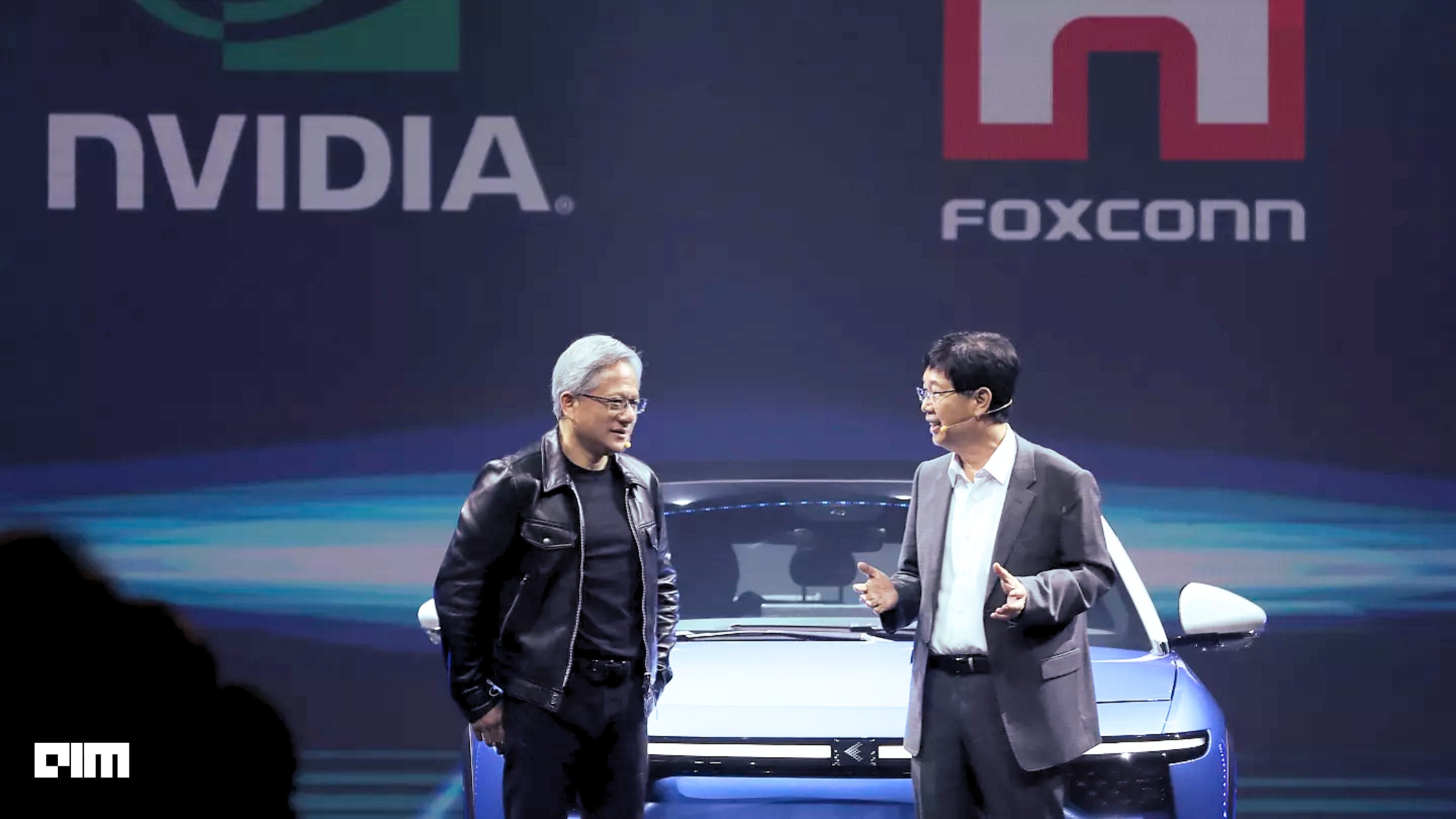
In a bid to boost EV and autonomous vehicles production, NVIDIA and Foxconn have joined forces to build ‘AI factories’. No, they won’t be churning out robots dressed in silicon suits, but they will be revolutionising the manufacturing landscape in a way that’s nothing short of extraordinary, bringing in electric cars, and training autonomous vehicles.
“A new type of manufacturing has emerged – the production of Intelligence. And the data centres that produce it are AI factories,” said Jensen Huang in a statement. He further adds that, “Foxconn, the world’s largest manufacturer, has the expertise and scale to build AI factories globally.”
This partnership was unveiled during Foxconn’s annual tech day in Taipei, where Huang made a surprise appearance. Foxconn’s CEO Young Liu drove to the stage in their new electric, and Huang said, “This car is an ideal vehicle for a young couple like Young and me.”
The term ‘AI factory‘ is a metaphorical expression of a new era of manufacturing, one that harnesses unstructured data from an array of sources, including automobiles, robots, and IoT sensors, and transforms it into valuable insights and products.
The presence of Huang on the stage highlights that NVIDIA, known for its prowess in GPUs and accelerated computing, is the wizard behind the curtain. These AI factories are essentially massive data centres equipped with high-performance GPUs, ready to turn raw data into actionable intelligence.
Foxconn, the Taiwanese electronics giant responsible for producing gadgets for tech giants like Apple, is the one building these AI factories.
New foray for both the partners
These AI factories will be powered by NVIDIA HGX, GH200 SuperChips, and OVX reference designs, along with Mellanox-derived networking equipment. Foxconn plans to employ these systems across a range of products and services built upon NVIDIA’s enterprise software platforms, such as DGX.
One such endeavour is the Smart EV platform, using NVIDIA’s Drive Thor autonomous driving computer system, set to hit the market in 2025. Foxconn has already been using the Drive Orin platform to create electronic control units for automobiles.
Interestingly, Foxconn does not want to produce its own EVs, but wants to partner with other car makers, and mass produce vehicles on their behalf. Looks like Foxconn is looking to find its Apple in the EV industry. But as Tu Le, analyst and managing director from Sino Auto Insights said, “Foxconn is trying to enter a market they have absolutely no experience in.” He calls it a very daunting task for them.
But Foxconn does not stop here. Beyond electric vehicles, Foxconn is also eyeing “smart manufacturing” applications that leverage NVIDIA’s Isaac autonomous robotics platform. Additionally, they have their sights set on creating a “smart city” platform, integrating NVIDIA’s Metropolis video analytics service. However, the realisation of “smart cities” has been somewhat elusive, with progress lagging behind the hype.
What’s in it for NVIDIA?
NVIDIA’s influence goes beyond providing hardware. They are making strides in the software domain as well. The OVX systems, designed to power the Omniverse platform, are key to visualising machine learning and sensor data. They allow for the creation of digital twins of actual factory floors, enabling simulations to test operational changes before implementing them in the real world.
It’s like a sophisticated game of SimCity but for industry.
The company has been working diligently to expand the horizons of accelerated computing beyond the conventional domains of hyperscale and cloud data centres. But the concept of AI factories for NVIDIA, is just another buzzword for building AI.
Last year, they were talking about the “industrial metaverse“, in collaboration with Siemens, to bring photorealistic digital twins to mainstream industry using their Omniverse platform. However, it seems the allure of the metaverse has dimmed, and they’ve pivoted toward AI factories.
As Huang said in a CNBC interview that the next big invention for NVIDIA would be to make “AI meet the physical world”, and it seems like with Foxconn, that dream is taking place sooner than expected. The company recently also expanded its Jetson platform for edge AI and robotics, bringing generative AI into the real world, and out of the omniverse.
It seems like this partnership between NVIDIA and Foxconn will not only process data but also help train autonomous machines, making production smarter and more efficient. Moreover, as Huang said, if successful, Foxconn would be able to make robots, and eventually foray into self-driving cars.
The post NVIDIA Surprises Everyone with AI Factories appeared first on Analytics India Magazine.
Amidst the hype around multimodal AI models and AI agents, Adept has unveiled the Fuyu-8B, a scaled-down version of their multimodal model now accessible through HuggingFace. The model can understand charts, documents, and diagrams, with its newly improved OCR capabilities.
This new model has garnered considerable attention for several key reasons that includes a simplified architecture. Fuyu-8B boasts a simple training process compared to other multimodal models, offering a more accessible, scalable, and deployable solution.
We’re open-sourcing a multimodal model: Fuyu-8B! Building useful AI agents requires fast foundation models that can see the visual world. Fuyu-8B performs well at standard image understanding benchmarks, but it also can do a bunch of new stuff (below)https://t.co/7bTh6mDNEY
— Adept (@AdeptAILabs) October 18, 2023
It is specifically tailored for digital AI agents by meticulously designing to cater to the specific needs of digital agents. It excels in handling arbitrary image resolutions, answering queries related to graphs, diagrams, UI-based questions, and precise localization on screen images. Perhaps most notably, Fuyu-8B exhibits remarkable speed, delivering responses for large images in under 100 milliseconds.
Despite being optimised for specific applications, Fuyu-8B performs admirably in standard image understanding benchmarks, such as visual question-answering and natural-image-captioning.
The Fuyu model eschews the complex and convoluted architecture of its counterparts. Instead, it employs a vanilla decoder-only transformer, omitting the need for a separate image encoder. Image patches are linearly projected into the first layer of the transformer, simplifying the model’s structure.
This architectural streamlining allows Fuyu to support image resolutions of any size, treating image tokens as it does text tokens. Special image-newline characters indicate line breaks, and the model utilises its existing position embeddings to adapt to different image sizes. This approach eliminates the need for separate high and low-resolution training stages, vastly simplifying the training and inference process.
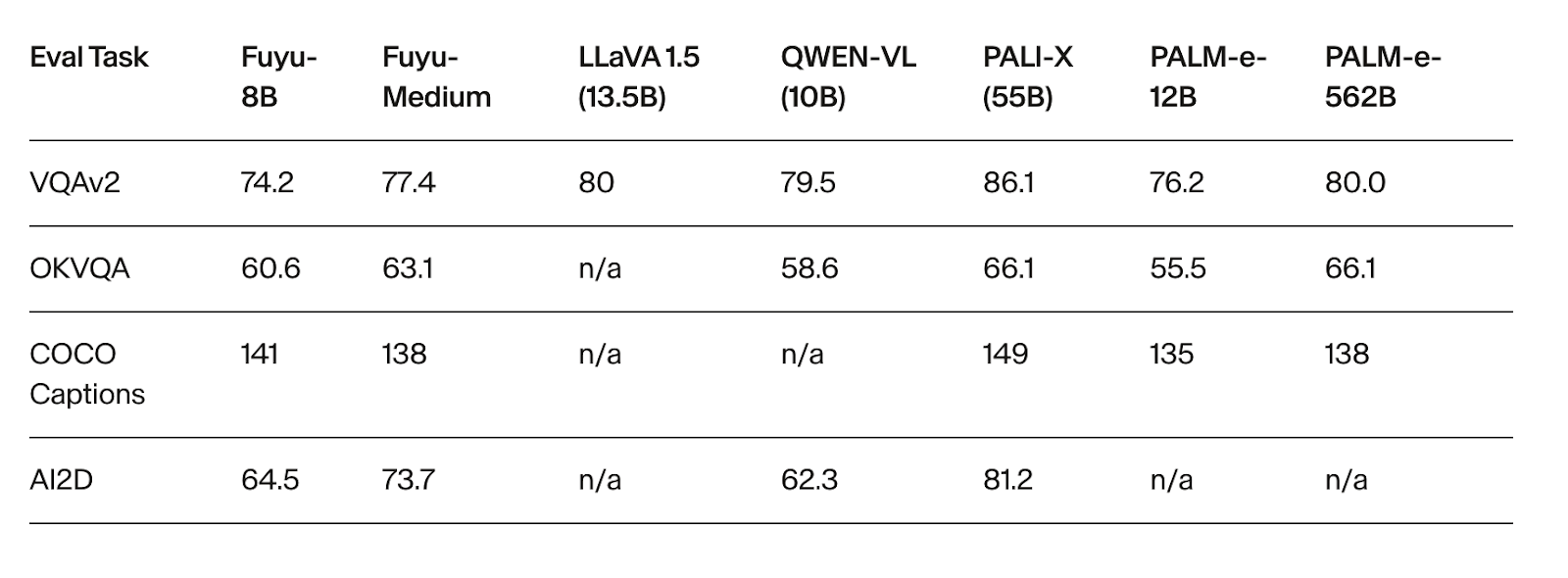
To assess the changes, Adept conducted evaluations on prominent image-understanding datasets, including VQAv2, OKVQA, COCO Captions, and AI2D. Fuyu-8B demonstrated robust performance, even in the realm of natural images. It notably outperformed models like QWEN-VL and PALM-e-12B on multiple metrics, despite having significantly fewer parameters. Even the Fuyu-Medium variant held its own against PALM-E-562B, boasting a fraction of the parameters.
Although PALI-X remains the leader on these benchmarks due to its fine-tuning for each specific task, it is essential to note that Adept’s primary focus does not revolve around optimising these benchmarks. Nevertheless, Fuyu-8B and its variations are promising additions to the field of multimodal models, offering a simpler yet highly effective alternative.
Gartner has identified the top 10 strategic technology trends for 2024 and generative and other types of AI solutions take center stage with widespread adoption and risks that are primary focus areas.
The top strategic technology trends for 2024 are:
1. Democratized Generative AI
Generative AI (aka, GenAI) is becoming democratized by the confluence of massively pre-trained models, cloud computing, and open source — making these models accessible to workers worldwide. By 2026, Gartner predicts, over 80% of enterprises will have used GenAI APIs and models and/or deployed GenAI-enabled applications in production environments, up from less than 5% in early 2023.
Also: Generative AI is everything, everywhere, all at once
2. AI Trust, Risk, and Security Management
The democratization of access to AI has made the need for AI Trust, Risk and Security Management (TRiSM) more clear and urgent. Without guardrails, AI models can rapidly generate compounding negative effects that spin out of control, overshadowing any positive performance and societal gains that AI enables. AI TRiSM provides tooling for ModelOps, proactive data protection, AI-specific security, model monitoring (including monitoring for data drift, model drift, and/or unintended outcomes), and risk controls for inputs and outputs to third-party models and applications. Gartner predicts that by 2026, enterprises that apply AI TRiSM controls will increase the accuracy of their decision-making by eliminating up to 80% of faulty and illegitimate information.
3. AI-Augmented Development
AI-augmented development is the use of AI technologies, such as GenAI and machine learning, to aid software engineers in designing, coding, and testing applications. AI-assisted software engineering improves developer productivity and enables development teams to address the increasing demand for software to run the business. These AI-infused development tools enable software engineers to spend less time writing code, so they can spend more time on strategic activities such as the design and composition of compelling business applications.
Also: The impact of artificial intelligence on software development? Still unclear
4. Intelligent Applications
Intelligent applications include intelligence — which Gartner defines as learned adaptation to respond appropriately and autonomously — as a capability. This intelligence can be utilized in many use cases to better augment or automate work. As a foundational capability, intelligence in applications comprises various AI-based services, such as machine learning, vector stores, and connected data. Consequently, intelligent applications deliver experiences that dynamically adapt to the user.
5. Augmented-Connected Workforce
The augmented-connected workforce (ACWF) is a strategy for optimizing the value derived from human workers. The need to accelerate and scale talent is driving the ACWF trend. The ACWF uses intelligent applications and workforce analytics to provide everyday context and guidance to support the workforce's experience, well-being, and ability to develop its own skills. At the same time, the ACWF drives business results and positive impact for key stakeholders. Through 2027, 25% of CIOs will use ACWF initiatives to reduce time to competency by 50% for key roles.
6. Continuous Threat Exposure Management
Continuous threat exposure management (CTEM) is a pragmatic and systemic approach that allows organizations to evaluate the accessibility, exposure, and exploitability of an enterprise's digital and physical assets continually and consistently. Aligning CTEM assessment and remediation scopes with threat vectors or business projects, rather than an infrastructure component, surfaces not only the vulnerabilities but also the unpatchable threats. By 2026, Gartner predicts that organizations prioritizing their security investments based on a CTEM program will realize a two-thirds reduction in breaches.
7. Machine Customers
Machine customers (also called 'custobots') are nonhuman economic actors that can autonomously negotiate and purchase goods and services in exchange for payment. By 2028, 15 billion connected products will exist with the potential to behave as customers, with billions more to follow in the coming years. This growth trend will be the source of trillions of dollars in revenues by 2030 and eventually become more significant than the arrival of digital commerce. Strategic considerations should include opportunities to either facilitate these algorithms and devices, or even create new custobots.
8. Sustainable Technology
Sustainable technology is a framework of digital solutions used to enable environmental, social, and governance (ESG) outcomes that support long-term ecological balance and human rights. The use of technologies such as AI, cryptocurrency, the Internet of Things and cloud computing is driving concern about the related energy consumption and environmental impacts. This makes it more critical to ensure that the use of IT becomes more efficient, circular, and sustainable. In fact, Gartner predicts that by 2027, 25% of CIOs will see their personal compensation linked to their sustainable technology impact.
Also: Tech for a sustainable future: The challenges and opportunities ahead
9. Platform Engineering
Platform engineering is the discipline of building and operating self-service internal development platforms. Each platform is a layer, created and maintained by a dedicated product team, designed to support the needs of its users by interfacing with tools and processes. The goal of platform engineering is to optimize productivity and the user experience, and to accelerate the delivery of business value.
10. Industry Cloud Platforms
By 2027, Gartner predicts, more than 70% of enterprises will use industry cloud platforms (ICPs) to accelerate their business initiatives, up from less than 15% in 2023. ICPs address industry-relevant business outcomes by combining underlying SaaS, PaaS, and IaaS services into a whole product offering with composable capabilities. These typically include an industry data fabric, a library of packaged business capabilities, composition tools, and other platform innovations. ICPs are tailored cloud proposals specific to an industry and can further be tailored to an organization's needs.
Also: If AI is the future of your business, should the CIO be the one in control?
In addition to the top technology strategic trends, Gartner also provided its top strategic IT predictions, exploring how GenAI has changed executive leaders' way of thinking on every subject and how to create a more flexible and adaptable organization that is better prepared for the future. Here are Gartner's top 10 strategic predictions:
By 2027, the productivity value of AI will be recognized as a primary economic indicator of national power.
By 2027, GenAI tools will be used to explain legacy business applications and create appropriate replacements, reducing modernization costs by 70%.
By 2028, enterprise spending on battling malinformation will surpass $30 billion, cannibalizing 10% of marketing and cybersecurity budgets to combat a multifront threat.
By 2027, 45% of chief information security officers (CISOs) will expand their remit beyond cybersecurity, due to increasing regulatory pressure and attack surface expansion.
By 2028, the rate of unionization among knowledge workers will increase by 1,000%, motivated by the adoption of GenAI.
In 2026, 30% of workers will leverage digital charisma filters to achieve previously unattainable advances in their careers.
By 2027, 25% of Fortune 500 companies will actively recruit neurodivergent talent across conditions like autism, ADHD, and dyslexia to improve business performance.
By 2028, there will be more smart robots than frontline workers in manufacturing, retail, and logistics due to labor shortages.
By 2026, 50% of G20 members will experience monthly electricity rationing, turning energy-aware operations into either a competitive advantage or a major failure risk.
By 2026, generative AI will significantly alter 70% of the design and development effort for new web applications and mobile apps.
Also: What technology analysts are saying about the future of generative AI
Research from Salesforce's annual State of IT report confirms many of the projections from Gartner. Many other independent research reports validate the accelerated adoption of AI, including generative AI. According to McKinsey, 50% of organizations used AI in 2022. IDC is forecasting global AI spending to increase by a staggering 26.9% in 2023 alone. A recent survey of customer service professionals found adoption of AI had risen by 88% between 2020 and 2022. Customer service leads AI use cases with organizations with AI using it in the following ways: service operations optimization (24%), new AI-based products (20%), customer service analytics (19%), customer segmentation (19%), AI-based product enhancements (19%), customer acquisition and lead generation (17%), contact center automation (16%), and product feature optimizations (16%).
The State of IT report found that generative AI has only recently become mainstream. The report shows 86% of IT leaders believe generative AI will have a prominent role in their organizations in the near future. Yet 64% of IT leaders are concerned about the ethics of generative AI, and 62% are concerned about its impacts on their careers. The report also notes that ethics and generative AI focus on accuracy, bias, toxicity, safety, and privacy.
Also: AI will change the role of developers forever, but leaders say that's good news
In a recent survey of IT leaders, concerns around generative AI included security risks (79%), bias (73%), and carbon footprint (71%). With nearly 9 out of 10 IT leaders believing generative AI will have a prominent role in their organizations in the near future, business leaders must understand the strategic technology trends highlighted by Gartner for 2024 and beyond. In order to do this, businesses must commit to education, stakeholder reskilling, and strategic partnerships in order to ready themselves for a future that is led by AI-powered products and services.
Google takes aim at Duolingo with new English tutoring tool Kyle Wiggers 7 hours
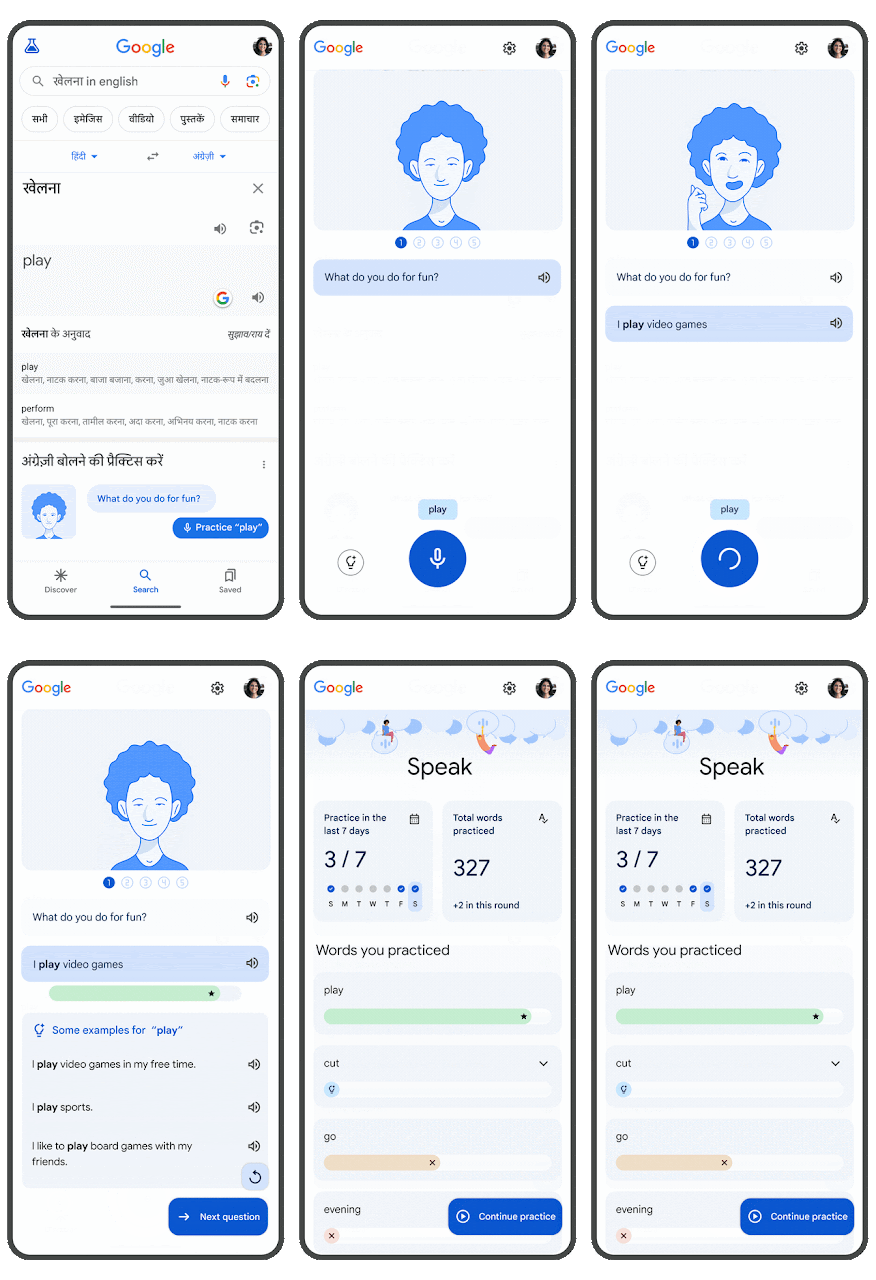
Google’s gunning for Duolingo with a new Google Search feature designed to help people practice — and improve — their English skills.
Rolling out over the next few days for Search on Android devices in Argentina, Colombia, India, Indonesia, Mexico and Venezuela, with more countries and languages to come in the future, the new feature will provide interactive speaking practice for language learners translating to or from English, Google said in a blog post.
“Google Search is already a valuable tool for language learners, providing translations, definitions, and other resources to improve vocabulary,” reads the the post, attributed to Google Research director Christian Plagemann and product manager Katya Cox. “Now, learners translating to or from English on their Android phones will find a new English speaking practice experience with personalized feedback.”
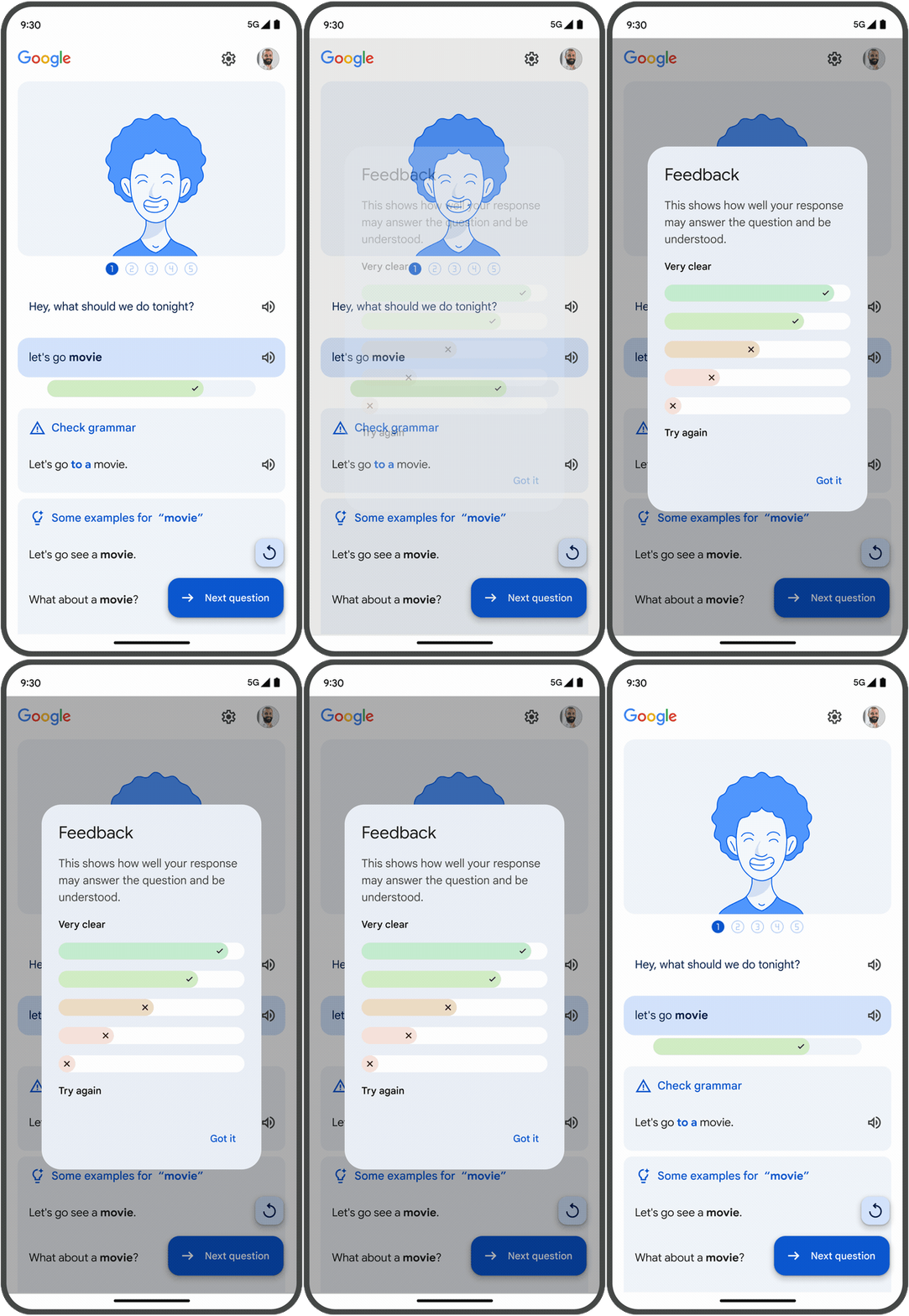
The new experience presents Search users with prompts and asks them to speak the answers using a provided vocabulary word. During each practice session, which last 3 to 5 minutes, Search gives personalized feedback — and the option to sign up for daily reminders to keep practicing and level up to the next difficulty level.
How personalized is it, exactly? Well, according to Google, the experience gives semantic feedback — indicating whether a response was relevant to a given question and comprehensible to a conversation partner. It also recommends areas where grammar could be improved, and, to give concrete suggestions for alternative ways to respond, provides a set of example answers at varying levels of language complexity.
During practice sessions, learners can tap on any word they don’t understand to see a translation of that word that considers its context.
“Designed to be used alongside other learning services and resources, like personal tutoring, mobile apps and classes, the new speaking practice feature on Google Search is another tool to assist learners on their journey,” Plagemann and Cox write.
These features required a fair bit of AI and machine learning engineering, Google says.
For example, the Google Translate team had to develop a model, Deep Aligner, to connect different words that create meaning to suggest translations. Other research groups at Google adapted grammar correction models for text to work on speech transcriptions, specifically for users with accented speech. Google Research teams created a separate model to power the semantic feedback component of the experience. And those same teams built another model to estimate the complexity of a sentence, phrase or individual words to “challenge learners appropriately for their ability levels.”
Google says that it recruited “linguists, teachers and ESL/EFL pedagogical experts” to craft the Search experience, yielding a mix of human-expert content — e.g. prompts, focus words and example answers — in addition to content created with AI assistance and in-house “human review.”
Other, unnamed language learning partners participated, as well, Google says — helping to surface content they’re creating with learners. And Google plans to broaden the program to additional partners in the future.
“We look forward to expanding to more countries and languages in the future, and to start offering partner practice content soon,” Plagemann and Cox continue. “With these latest updates, which will roll out over the next few days, Google Search has become even more helpful.”
One wonders what Google’s endgame might be with the rollout of the new AI-powered language learning experience for Search. Certainly, it’ll boost engagement — or could, in theory. But is it meant to lay the groundwork for a true challenger to language learning apps like Duolingo, Memrise and Babbel? The blog post’s language implies that it isn’t. Given the profits to be made in the massive field of language education, though, it’s tough to say for certain.