Google Play’s policy update cracks down on ‘offensive’ AI apps, disruptive notifications Sarah Perez @sarahintampa / 8 hours
Google is taking aim at potentially problematic generative AI apps with a new policy, to be enforced starting early next year, that will require developers of Android applications published on its Play Store to offer the ability to report or flag offensive AI-generated content. The new policy will insist that flagging and reporting can be done in-app and developers should use the report to inform their own approaches to filtering and moderation, the company says.
The change to the policy follows an explosion of AI-generated apps, some of which where users tricked the apps into creating NSFW imagery, as with Lensa last year. Others, meanwhile, have more subtle issues. For instance, an app that went viral this summer for AI headshots, Remini, was found to be greatly enhancing the size of some women’s breasts or cleavage, and thinning them. Then there were the more recent issues with Microsoft’s and Meta’s AI tools, where people found ways to bypass the guardrails to make images like Sonic the Hedgehog pregnant or fictional characters doing 9/11.
Of course, there are even more serious concerns around the use of AI image generators, as pedophiles were discovered using open source AI tools to create child sexual abuse material (CSAM) at scale. And with the coming elections, there are also concerns around using AI to create fake images, aka deepfakes, to mislead or misinform the voting public.
Image Credits: Google
The text of the new policy indicates that examples of AI-generated content includes “text–to-text conversational generative AI chatbots, in which interacting with the chatbot is a central feature of the app,” which encompass apps like ChatGPT, as well as apps where images are “generated by AI based on text, image, or voice prompts.”
Google, in its announcement, reminded developers that all apps, including AI content generators, must comply with its existing developer policies, which prohibit restricted content like CSAM and others that enable deceptive behavior.
Beyond changing its policy to crack down on AI content apps, Google says some app permissions will also receive an additional review by the Google Play team, including those apps that request broad photo and video permissions. Under its new policy, apps will only be able to access photos and videos if it’s directly related to their functionality. If they have a one-time or infrequent need — like AI apps that ask users to upload a set of selfies, perhaps — the apps need to use a system picker, like the new Android photo picker.
Image Credits: Google
The new policy will also limit disruptive, full-screen notifications to only those times when there’s a high-priority need. The ability to pop up full-screen notifications has been abused by many apps in an attempt to upsell users into paid subscriptions or other offers, when really the functionality should be limited to real-world priority use cases, like receiving a phone call or video call. Google says it will now change the limitations and requires a special app access permission. This “Full Screen Intent permission” will only be granted to apps targeting Android 14 and above that actually require the full screen functionality.
It’s surprising to see that Google is first out of the gate with an policy on AI apps and chatbots, as historically, it’s been Apple that issues new rules to crack down on unwanted behavior from apps, which Google then mimics. But Apple does not have a formal AI or chatbot policy in its App Store Guidelines as of yet, though it has tightened up in other areas, like apps’ requesting data for the purpose of identifying the user or device, a method known as “fingerprinting,” as well as on apps that attempt to copy others.
Google Play’s policy updates are being rolled out today though AI app developers have until early 2024 to implement the flagging and report changes to their apps.
Large language models (LLMs) like OpenAI's GPT series have been trained on a diverse range of publicly accessible data, demonstrating remarkable capabilities in text generation, summarization, question answering, and planning. Despite their versatility, a frequently posed question revolves around the seamless integration of these models with custom, private or proprietary data.
Businesses and individuals are flooded with unique and custom data, often housed in various applications such as Notion, Slack, and Salesforce, or stored in personal files. To leverage LLMs for this specific data, several methodologies have been proposed and experimented with.
Fine-tuning represents one such approach, it consist adjustment of the model's weights to incorporate knowledge from particular datasets. However, this process isn't without its challenges. It demands substantial effort in data preparation, coupled with a difficult optimization procedure, necessitating a certain level of machine learning expertise. Moreover, the financial implications can be significant, particularly when dealing with large datasets.
In-context learning has emerged as an alternative, prioritizing the crafting of inputs and prompts to provide the LLM with the necessary context for generating accurate outputs. This approach mitigates the need for extensive model retraining, offering a more efficient and accessible means of integrating private data.
But the drawback for this is its reliance on the skill and expertise of the user in prompt engineering. Additionally, in-context learning may not always be as precise or reliable as fine-tuning, especially when dealing with highly specialized or technical data. The model's pre-training on a broad range of internet text does not guarantee an understanding of specific jargon or context, which can lead to inaccurate or irrelevant outputs. This is particularly problematic when the private data is from a niche domain or industry.
Moreover, the amount of context that can be provided in a single prompt is limited, and the LLM’s performance may degrade as the complexity of the task increases. There is also the challenge of privacy and data security, as the information provided in the prompt could potentially be sensitive or confidential.
As the community explores these techniques, tools like LlamaIndex are now gaining attention.
Llama Index
It was started by Jerry Liu, a former Uber research scientist. While experimenting around with GPT-3 last fall, Liu noticed the model's limitations concerning handling private data, such as personal files. This observation led to the start of the open-source project LlamaIndex.
The initiative has attracted investors, securing $8.5 million in a recent seed funding round.
LlamaIndex facilitates the augmentation of LLMs with custom data, bridging the gap between pre-trained models and custom data use-cases. Through LlamaIndex, users can leverage their own data with LLMs, unlocking knowledge generation and reasoning with personalized insights.
Users can seamlessly provide LLMs with their own data, fostering an environment where knowledge generation and reasoning are deeply personalized and insightful. LlamaIndex addresses the limitations of in-context learning by providing a more user-friendly and secure platform for data interaction, ensuring that even those with limited machine learning expertise can leverage the full potential of LLMs with their private data.
High-Level Concepts & some Insights
1. Retrieval Augmented Generation (RAG):
LlamaIndex RAG
RAG is a two-fold process designed to couple LLMs with custom data, thereby enhancing the model's capacity to deliver more precise and informed responses. The process comprises:
Indexing Stage: This is the preparatory phase where the groundwork for knowledge base creation is laid.
LlamaIndex Indexing
Querying Stage: Here, the knowledge base is scoured for relevant context to assist LLMs in answering queries.
LlamaIndex Query Stage
Indexing Journey with LlamaIndex:
Data Connectors: Think of data connectors as your data’s passport to LlamaIndex. They help in importing data from varied sources and formats, encapsulating them into a simplistic ‘Document' representation. Data connectors can be found within LlamaHub, an open-source repository filled with data loaders. These loaders are crafted for easy integration, enabling a plug-and-play experience with any LlamaIndex application.
LlamaIndex hub (https://llamahub.ai/)
Documents / Nodes: A Document is like a generic suitcase that can hold diverse data types—be it a PDF, API output, or database entries. On the other hand, a Node is a snippet or “chunk” from a Document, enriched with metadata and relationships to other nodes, ensuring a robust foundation for precise data retrieval later on.
Data Indexes: Post data ingestion, LlamaIndex assists in indexing this data into a retrievable format. Behind the scenes, it dissects raw documents into intermediate representations, computes vector embeddings, and deduces metadata. Among the indexes, ‘VectorStoreIndex' is often the go-to choice.
Types of Indexes in LlamaIndex: Key to Organized Data
LlamaIndex offers different types of index, each for different needs and use cases. At the core of these indices lie “nodes” as discussed above. Let's try to understand LlamaIndex indices with their mechanics and applications.
1. List Index:
Mechanism: A List Index aligns nodes sequentially like a list. Post chunking the input data into nodes, they are arranged in a linear fashion, ready to be queried either sequentially or via keywords or embeddings.
Advantage: This index type shines when the need is for sequential querying. LlamaIndex ensures utilization of your entire input data, even if it surpasses the LLM’s token limit, by smartly querying text from each node and refining answers as it navigates down the list.
2. Vector Store Index:
Mechanism: Here, nodes transform into vector embeddings, stored either locally or in a specialized vector database like Milvus. When queried, it fetches the top_k most similar nodes, channeling them to the response synthesizer.
Advantage: If your workflow depends on text comparison for semantic similarity via vector search, this index can be used.
3. Tree Index:
Mechanism: In a Tree Index, the input data evolves into a tree structure, built bottom-up from leaf nodes (the original data chunks). Parent nodes emerge as summaries of leaf nodes, crafted using GPT. During a query, the tree index can traverse from the root node to leaf nodes or construct responses directly from selected leaf nodes.
Advantage: With a Tree Index, querying long text chunks becomes more efficient, and extracting information from various text segments is simplified.
4. Keyword Index:
Mechanism: A map of keywords to nodes forms the core of a Keyword Index.When queried, keywords are plucked from the query, and only the mapped nodes are brought into the spotlight.
Advantage: When you have a clear user queries, a Keyword Index can be used. For example, sifting through healthcare documents becomes more efficient when only zeroing in on documents pertinent to COVID-19.
Installing LlamaIndex
Installing LlamaIndex is a straightforward process. You can choose to install it either directly from Pip or from the source. ( Make sure to have python installed in your system or you can use Google Colab)
1. Installation from Pip:
Execute the following command:pip install llama-index
Note: During installation, LlamaIndex may download and store local files for certain packages like NLTK and HuggingFace. To specify a directory for these files, use the “LLAMA_INDEX_CACHE_DIR” environment variable.
2. Installation from Source:
First, clone the LlamaIndex repository from GitHub:git clone https://github.com/jerryjliu/llama_index.git
Once cloned, navigate to the project directory.
You will need Poetry for managing package dependencies.
Now, create a virtual environment using Poetry:poetry shell
Lastly, install the core package requirements with:poetry install
Setting Up Your Environment for LlamaIndex
1. OpenAI Setup:
By default, LlamaIndex utilizes OpenAI's gpt-3.5-turbo for text generation and text-embedding-ada-002 for retrieval and embeddings.
To use this setup, you'll need to have an OPENAI_API_KEY. Get one by registering at OpenAI's website and creating a new API token.
You have the flexibility to customize the underlying Large Language Model (LLM) as per your project needs. Depending on your LLM provider, you might need additional environment keys and tokens.
2. Local Environment Setup:
If you prefer not to use OpenAI, LlamaIndex automatically switches to local models – LlamaCPP and llama2-chat-13B for text generation, and BAAI/bge-small-en for retrieval and embeddings.
To use LlamaCPP, follow the provided installation guide. Ensure to install the llama-cpp-python package, ideally compiled to support your GPU. This setup will utilize around 11.5GB of memory across the CPU and GPU.
For local embeddings, execute pip install sentence-transformers. This local setup will use about 500MB of memory.
With these setups, you can tailor your environment to either leverage the power of OpenAI or run models locally, aligning with your project requirements and resources.
A simple Usecase: Querying Webpages with LlamaIndex and OpenAI
Here's a simple Python script to demonstrate how you can query a webpage for specific insights:
!pip install llama-index html2text
import os from llama_index import VectorStoreIndex, SimpleWebPageReader # Enter your OpenAI key below: os.environ["OPENAI_API_KEY"] = "" # URL you want to load into your vector store here: url = "http://www.paulgraham.com/fr.html" # Load the URL into documents (multiple documents possible) documents = SimpleWebPageReader(html_to_text=True).load_data([url]) # Create vector store from documents index = VectorStoreIndex.from_documents(documents) # Create query engine so we can ask it questions: query_engine = index.as_query_engine() # Ask as many questions as you want against the loaded data: response = query_engine.query("What are the 3 best advise by Paul to raise money?") print(response)
The three best pieces of advice by Paul to raise money are: 1. Start with a low number when initially raising money. This allows for flexibility and increases the chances of raising more funds in the long run. 2. Aim to be profitable if possible. Having a plan to reach profitability without relying on additional funding makes the startup more attractive to investors. 3. Don't optimize for valuation. While valuation is important, it is not the most crucial factor in fundraising. Focus on getting the necessary funds and finding good investors instead.
Google Colab Llama Index Notebook
With this script, you’ve created a powerful tool to extract specific information from a webpage by simply asking a question. This is just a glimpse of what can be achieved with LlamaIndex and OpenAI when querying web data.
LlamaIndex vs Langchain: Choosing Based on Your Goal
Your choice between LlamaIndex and Langchain will depend on your project's objective. If you want to develop an intelligent search tool, LlamaIndex is a solid pick, excelling as a smart storage mechanism for data retrieval. On the flip side, if you want to create a system like ChatGPT with plugin capabilities, Langchain is your go-to. It not only facilitates multiple instances of ChatGPT and LlamaIndex but also expands functionality by allowing the construction of multi-task agents. For instance, with Langchain, you can create agents capable of executing Python code while conducting a Google search simultaneously. In short, while LlamaIndex excels at data handling, Langchain orchestrates multiple tools to deliver a holistic solution.
Lenovo and NVIDIA have announced a major expansion of their collaboration, with a focus on pioneering generative AI solutions for enterprise. The two tech giants aim to make the power of generative AI accessible to enterprises everywhere. This announcement was made during the annual global Lenovo Tech World keynote event in Austin, Texas.
Under this collaboration, Lenovo will provide fully-integrated systems designed to bring AI-powered compute to all data creation points, from the edge to the cloud. The goal is to enable businesses to effortlessly deploy customised generative AI applications to drive innovation and transformation across various industries.
Lenovo chairman and CEO Yuanqing Yang and NVIDIA founder and CEO Jensen Huang described the new offerings during the event. They emphasised the need for end-to-end solutions that bring together accelerated systems, AI software, and expert services, enabling businesses to quickly develop and deploy custom AI models using their own data.
This partnership is supported by the newly introduced Lenovo AI Professional Services Practice, offering enterprises a hybrid cloud approach. Companies can build their custom AI models using NVIDIA AI Foundations cloud service and then run them on on-prem Lenovo systems, which are powered by NVIDIA’s latest hardware and software specifically designed for generative AI.
Kirk Skaugen, president of Lenovo Infrastructure Solutions Group, highlighted the significance of this partnership, stating, “Together, Lenovo and NVIDIA are driving a new era of Hybrid AI for businesses, designing the next generation of technology that delivers an AI-powered future now and unlocks the power of their data anywhere it is created.”
Bob Pette, vice president of Enterprise Platforms at NVIDIA, echoed similar sentiments, emphasising the need for flexible solutions that allow businesses to develop and deploy workloads across various environments, including workstations, data centres, and clouds.
Lenovo’s NVIDIA-powered systems are optimised to run NVIDIA AI Enterprise software, ensuring secure, supported, and stable production AI. These systems utilise the NVIDIA NeMo framework and retrieval-augmented generation (RAG) techniques to create generative AI applications customised for specific business data.
At the core of this partnership are the Lenovo ThinkSystem SR675 V3 server and ThinkStation PX workstation, both optimised for production AI using NVIDIA AI Enterprise. These systems incorporate advanced components, such as NVIDIA L40S GPUs, NVIDIA BlueField-3 DPUs, and NVIDIA Spectrum-X networking.
Additionally, the ThinkStation PX brings expanded AI capabilities to desktops, accommodating up to 4x NVIDIA RTX 6000 Ada GPUs.
Lenovo and NVIDIA are also working on next-generation systems based on the NVIDIA MGX modular reference design. These systems will provide secure solutions for demanding generative AI workloads, enabling businesses to implement immersive simulations and cognitive decisions at scale with NVIDIA Omniverse.
Furthermore, the Lenovo solutions will support the recently announced VMware Private AI Foundation with NVIDIA, streamlining the adoption of generative AI for VMware customers.
In their joint effort, Lenovo and NVIDIA are making it easier for businesses to deploy AI confidently and embark on AI-driven transformations. They are introducing the Lenovo AI Professional Services Practice and Lenovo’s TruScale aaS offering, both of which offer a wide range of services, solutions, and platforms to help businesses of all sizes leverage AI quickly, cost-effectively, and at scale.
This initiative is aimed at bringing AI from concept to reality, with services ranging from AI roadmap design to platform deployment and technology utilisation transparency through the Lenovo TruScale Hub.
The post Lenovo, NVIDIA Boost Partnership for Hybrid AI Solutions for Enterprise appeared first on Analytics India Magazine.
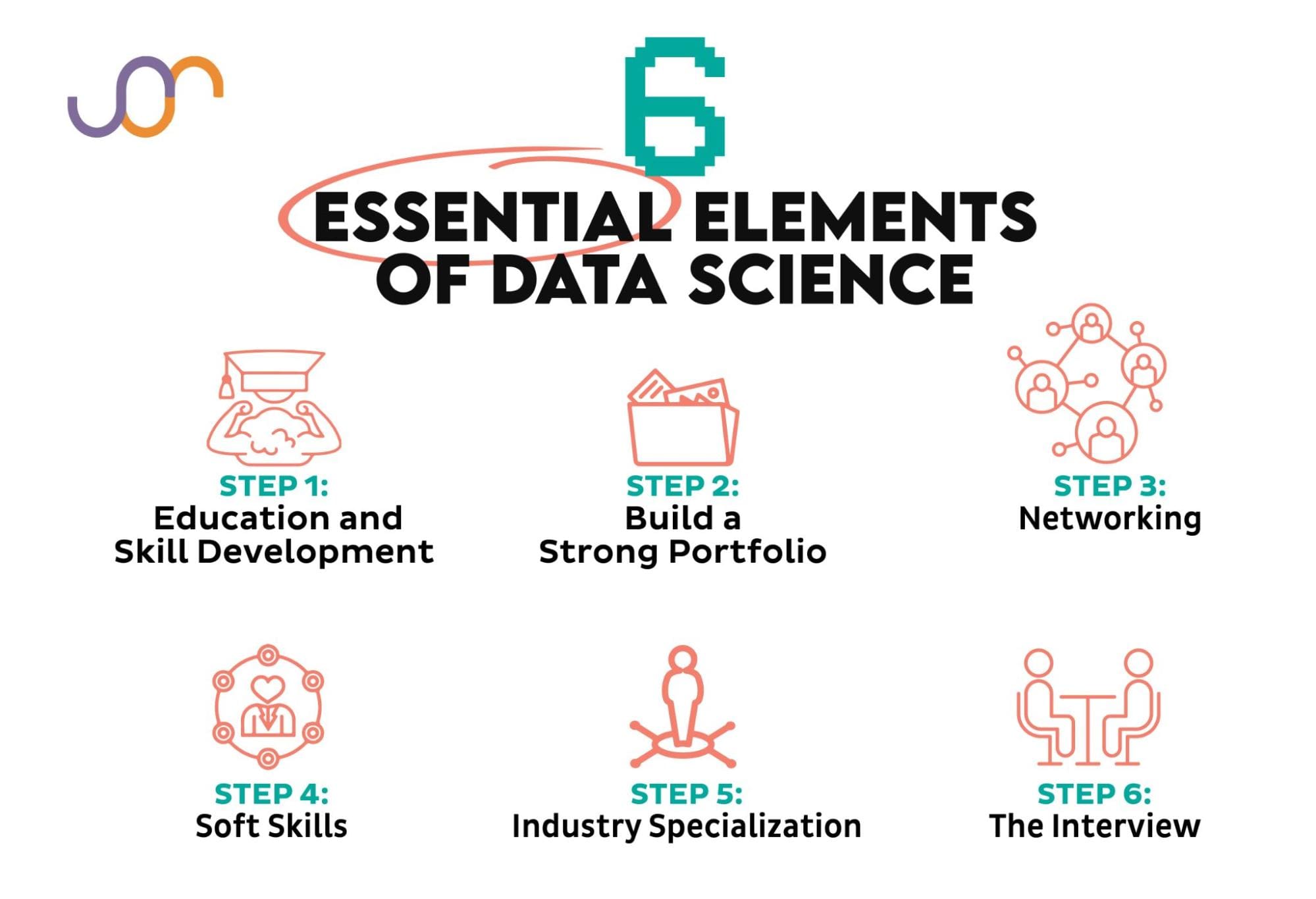
To develop a successful career in data science, you need to strengthen what I consider to be the six main pillars of the area: technical skills, building a portfolio, networking, soft skills, and finally developing a niche specialty. Once you have all that, you also need to perform well at the interview stage.
Too many would-be data scientists think it’s all about the skills, and neglect the network. Or you rely on a network contact to get you the job interview, but stumble under the pressure, and don’t do your skills justice.
1. Education and Skill Development
None of these sections are really optional, but this is probably the most important one of the six. You might stumble into a job if you don’t know the right people, or if your portfolio isn’t perfect, but if you don’t have the right skills, you won’t get the job. Or worse: you might get the job, but you’ll crash and burn. And get fired.
Here’s what you should focus on:
Learn the fundamentals
Every data science job requires a strong foundation in mathematics, statistics, and programming. Proficiency in languages like Python or R is essential. Almost every data science job description will mention one of those two languages.
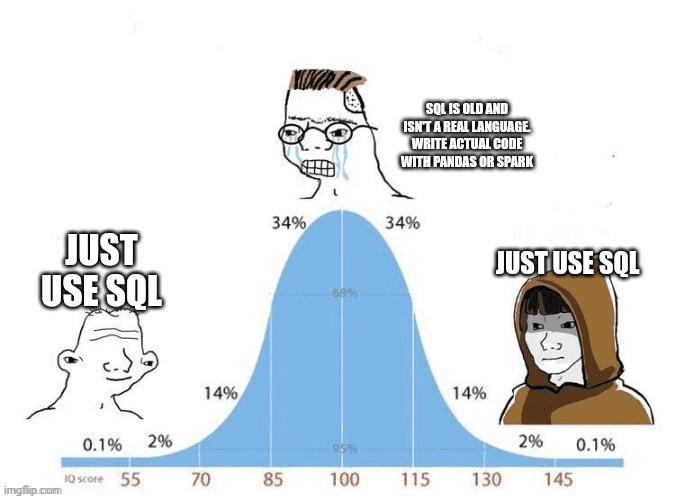
I also suggest you consider learning SQL as a fundamental requirement. SQL databases are a reality of life for data scientists. And it’s a comparatively simple language to learn.
Image from r/datascience
Machine learning and data manipulation
It’s not just the recent rise of AI; data scientists have always needed mastery of machine learning. You will need to gain expertise in machine learning algorithms, data preprocessing, feature engineering, and model evaluation.
Data visualization
A data scientist’s findings are worthless unless she can communicate them to another. This is done with graphs, charts, and other types of data viz. You’ll need to master data visualization tools and techniques to effectively communicate insights from data with key stakeholders at your company.
I’ll get into this a little more when I talk about the soft skills, too – communication is a vital skill.
Big Data technologies
Gone are the days when data scientists dealt with little data, if they ever existed. Today, you’ll need to be extremely familiar with big data and the requisite tools. Even if your company doesn’t handle truly “big” data, they’ll aspire to it.
Familiarize yourself with tools like Hadoop, Spark, and cloud platforms for handling large datasets.
2. Build a Strong Portfolio
Onto pillar two: your portfolio.
There’s a dearth of qualified data scientists, as you probably know. Bootcamp grads rose to fill the gap. That caused a new problem: lack of trust. See, companies know a degree isn’t necessarily a needed qualification to do a good job. However, bad bootcamps also gave aspiring data scientists a bad rap, because many boot camps churned out “graduates” that didn’t know a join from a subquery. Hence, your personal portfolio is a chance for you to prove you know your stuff. (It’s also worth noting that boot camps are very expensive, especially compared to the slightly less optimistic job outlook currently.)
Image from r/ProgrammerHumor
Here’s what you need:
Personal projects
Work on personal projects that showcase your skills. These could be Kaggle competitions, open-source contributions, or your own data analysis projects. You can maintain a well-organized GitHub repository to showcase your projects, code samples, and contributions.
Blog or website
Consider creating a blog or personal website where you can share insights, tutorials, and case studies related to data science. It’s possible to cheat this system and hire someone to do it for you, but it’s so expensive and time-consuming that few people try to falsify it. A blog serves as a great portfolio of your knowledge.
Be ready to explain your projects, methodologies, and problem-solving approaches. Brush up on common data science interview questions and coding challenges.
3. Networking
Remember the golden rule of jobs, no matter the field: potentially as many as 70% of job listings are never advertised. This is an old stat, but even if it’s 20 to 30 percent, it proves that who you know matters. That’s not even considering that as many as a third of job openings posted are actually fake, designed to make a company look more successful than it is. A personal network can help you avoid wasting your time.
Here’s what you should do:
Join professional networks
Join data science communities, and attend meetups, conferences, and webinars to connect with other professionals in the field. This more formal approach to a network can help you meet the right folks, make a splash in your industry, and stay up to date with current events.
Social media
More informally, you should also engage on platforms like LinkedIn, Twitter, and relevant forums to share your work, and insights, and learn from others.
4. Soft Skills
Remember, hard skills are only half the battle. That’s why you need to ensure that your soft skills aren’t neglected. I’m not saying soft skills are more important. Hard skills vs soft skills is a false dichotomy – they’re both important. But people don’t hire data science machines, they hire people. Here are the areas I recommend focusing on:
Communication
Remember that data viz skill? Data scientists need to effectively communicate complex technical findings to non-technical stakeholders. It’s amazing how much of a data scientist’s job comes down to explaining why someone in marketing should understand the pretty graph.
Problem-solving
It’s almost a meaningless buzzword at this point, so make sure you actually understand what “problem-solving” really means. In the context of data science, solving problems isn’t just debugging. It’s also knowing when it makes sense to collaborate with different departments, when to rejig a project’s tech stack to meet new specs, or going back over your model if it stumbles on the test dataset.
Image from r/DataScienceMemes
Critical thinking
Another almost-buzzword that merits deeper consideration. Critical thinking means the ability to analyze data from multiple angles, question assumptions, and think creatively to derive meaningful insights.
Teamwork
Data scientists don’t work in a vacuum. You’ll work with web developers, data analysts, business analysts, marketers, salespeople, and CXOs. Collaborate with cross-functional teams to understand business needs and align data-driven solutions.
5. Industry Specialization
Haven’t you heard? We’re in the middle of a tech winter for hiring. Venture capital money isn’t flowing like it used to, and companies are tightening their belts. It’s not a good time to be a generalist. You’ll need to specialize to survive.
Choose a niche
Data science spans various industries, such as healthcare, finance, e-commerce, and more. Specializing in a particular domain can make you more attractive to employers in that field. Look for what you’re naturally interested in, or where you might already have extra knowledge.
Domain knowledge
Acquire domain-specific knowledge relevant to the industry you want to work in. This helps you understand the nuances of the data and make more informed decisions. For example, if you want to work at Google, you’ll need to know the intricacies of search algorithms and user behavior.
6. The Interview
Last, but certainly not least: prepare for interviews. You can nail the first five pillars and still stumble at the finish line. Here’s how I recommend you prepare:
Explanations
You can know a concept without really being able to explain it to others. For the interviews, you will have to be ready to explain your projects, methodologies, and problem-solving approaches.
Take the time to ensure you not only have a complete understanding of what you did, why you did it, and why it works for all your projects but that you’re able to explain it well enough that a layperson could understand. (this is also a great way of practicing that “communication” soft skill.)
Coding prep
The whiteboard is a famous pillar of coding interviews, yet so many people panic when faced with that blank, white surface. The more you practice interview questions ahead of time, the better you’ll perform under pressure on the day.
How to develop a successful career in data science
It’s a little presumptuous to even pretend there’s a single right answer here, or that it could be explained in an article. Hopefully, this blog post acts more like a roadmap than a comprehensive solution. Practice these six pillars of data science jobs, and you’ll be well on your way to developing a career in data science to last as long as you want.
Nate Rosidi is a data scientist and in product strategy. He's also an adjunct professor teaching analytics, and is the founder of StrataScratch, a platform helping data scientists prepare for their interviews with real interview questions from top companies. Connect with him on Twitter: StrataScratch or LinkedIn.
More On This Topic
KDnuggets™ News 22:n05, Feb 2: 7 Steps to Mastering Machine Learning…
7 Steps to Mastering SQL for Data Science
7 Steps to Mastering Python for Data Science
7 Steps to Mastering Data Science Project Management with Agile
7 Steps to Mastering Data Cleaning and Preprocessing Techniques
7 Steps to Mastering Machine Learning with Python in 2022
Predibase Launches New Offering to Fine-tune and Serve 100x More LLMs at No Additional Cost October 25, 2023 by Ali Azhar
(Dilok Klaisataporn/Shuttesrtock)
Organizations across industries are under pressure to figure out how and where to use generative AI solutions. More specifically, they are concerned about how to implement Large Language Models (LLMs) in their workflows. On one hand, there is genuine excitement about the potential for LLMs, on the other there is a fear of falling behind the competition if the company is unable to leverage the power of AI.
To address some of the concerns about using LLMs, such as privacy and cost, Predibase, the developer platform for open-source AI, announced the launch of a software development kit (SDK) designed for efficient fine-during and serving of LLMs. The new kit is expected to reduce deployment costs and complexity and increase training speed.
Predibase recently conducted a study that highlighted the surprisingly low adoption rate for LLMs among businesses. While a high percentage of companies have started working with LLMs, most of the work is in the experimentation phase, and only 23 percent have already deployed or have plans to deploy commercial LLMs.
The new SDK kit will allow developers to train task-specific and smaller LLMs without needing expensive GPU hardware. The readily available GPUs on the cloud can be used to train models. The fine-tuned models can then be served with Predibase’s LLM architecture which is designed to be lightweight and has the ability to load and unload models on demand in seconds. This helps reduce the additional costs of serving multiple models.
via Shutterstock
“More than 75% of organizations won’t use commercial LLMs in production due to concerns over ownership, privacy, cost, and security, but productionizing open-source LLMs comes with its own set of infrastructure challenges,” said Dev Rishi, co-founder and CEO of Predibase. “Even with access to high-performance GPUs in the cloud, training costs can reach thousands of dollars per job due to a lack of automated, reliable, cost-effective fine-tuning infrastructure. Debugging and setting up environments require countless engineering hours. As a result, businesses can spend a fortune even before getting to the cost of serving in production.”
As the AI landscape is evolving rapidly, Predibase aims to level the playing field for startups and small companies who do not have the resources to compete with industry giants. Along with cost savings and reduced complexity, the new SDK kit by Predibase offers ease of use. The platform’s simplicity allows novice users to develop the model, and then more seasoned practitioners can fine-tune the model parameters. This can significantly reduce the deployment timeline.
Predibase claims that its platform offers an overall 15x reduction in deployment costs and a 50x improvement in training speed for task-specific models. This includes automatic memory-efficient fine–tuning that works on commodity GPUs, such as Nvidia T4. Predibase’s training system automatically applies optimizations to ensure training success on whatever type of hardware is available.
(Joe Techapanupreeda/Shutterstock)
The built-in orchestration logic is designed to use the most cost-effective hardware in your cloud to run each training job. In addition, businesses can fine-tune each LLM deployment according to their needs. They can scale up and down using dynamic or stand-alone hosting. Each fine-tuned model can be loaded and queried in seconds after fine-tuning, with no need for deployment of each model on a separate GPU.
Along with the announcement of the new SDK kit, Predibase also introduced the Predibase AI Cloud — a new service for supporting multiple cloud environments and regions. It optimizes a combination of training hardware based on performance criteria and cost.
The introduction of Predibase’s SDK is set to democratize access to advanced technology. This marks a significant shift in the AI landscape, as smaller businesses get a fair opportunity to compete against bigger players in the market. As a result, we can expect increased competitiveness and innovation across various industries.
Related Items
Predibase Launches AI Platform, Secures Additional $12.2M in Series A Funding Round
VMware Unveils New Generative AI Tools, Expands Nvidia Partnership
Breaking the Language Barrier: The Unprecedented Capabilities Large Language Models like ChatGPT Offer Businesses
There's a vigorous debate taking place currently about whether artificial intelligence (AI) has the potential power to wipe humanity off the face of the Earth.
This much, however, is already clear. Before possibly executing a whack job on us, AI will insinuate itself in almost every facet of human existence, especially work life.
And its first, most significant notice of arrival will be to replace a whole host of human jobs.
But not just anyone's job. In partnership with Bloomberg, workforce analytics firm Revelio decided to take a study conducted by the National Bureau of Economic Research, which had identified jobs imperiled by AI, and then put a gender filter on the results.
The result of the process was alarming. At least 10 million jobs, or 71% of the total number of jobs threatened by AI, belonged to women in what are called 'support' roles — bill and account collectors (82.9%), payroll and timekeeping clerks (79.7%), executive secretaries (74.3%), word processors and typists (65.4%), and bookkeeping, accounting, and auditing clerks (65%).
Gender Cad
The results read like a cruel joke. After being shut out of the workplace for centuries, given the right to vote shockingly late, and brought into the workforce to aid various war efforts during the last century, women have subsequently had to fight hard to eke out workplace gains.
Percentage of women in AI-exposed positions.
Just a third (34%) of working-age women (16 and older) participated in the labor market in 1950, but more than half (57%) of working-age women were able to claw themselves into the workforce by 2016.
Today, women are still under-represented in higher management positions. They held just 20.5% of C-suite positions in companies in the S&P Index in 2021, up from only 16% in 2015. And a scant 10.4% of Fortune 500 companies have women as CEOs.
Nevertheless, these rises are steady, much-needed gains for society, which is why any setback caused by generative AI could be catastrophic.
"The distribution of genders across occupations reflects the biases deeply rooted in our society, with women often being confined to roles such as administrative assistants and secretaries," says Hakki Ozdenoren, economist at Revelio Labs. "Consequently, the impact of AI becomes skewed along gender lines."
Other surveys, including one recently conducted by the Pew Research Center, have all come to the same conclusion.
For instance, Pew examined 41 essential work activities in 873 occupations from the U.S. Department of Labor's Occupational Information Network, and showed that a greater share of women (21%) than men (17%) are going to be at risk of losing their jobs due to AI.
Another study, from the University of North Carolina's Kenan-Flagler Business School, estimated that as many as 79% of all working women (nearly 59 million people) are in jobs threatened by AI. The proportion for men was 58%.
Women who work as budget analysts, data-entry keyers, tax preparers, technical writers, and web developers will all see AI encroaching onto their turf.
Once again, women will have to fight hard by taking proactive measures to upskill and find opportunities upstream in areas where machines don't tread.
In fact, any kind of job that involves organizing, planning, managing, or navigating a complex set of codes or rules (such as junior staff in accounting, finance or law, and tax experts), is going to be at risk of gradually being replaced, say experts.
And what's more, the potential impact of AI on jobs is proving to be even more considerable.
White-collar blues
It turns out that AI also has another seemingly unlikely cohort in its cross-hairs: highly-skilled, white-collar workers.
Apparently, AI will not — initially, at least — engage in the kind of class warfare that its predecessors, such as robots on automotive assembly lines, waged as they went about decimating the ranks of blue-collar workers.
Now, according to the same Pew report, AI is instead evening the playing field by gobbling up high-paying jobs — those roles that command college degrees and highly prized skills, including critical thinking, writing, science, and mathematics.
The most affected cohort is expected to be Asian workers and college graduates. Asian professionals are some of the most highly educated workers and occupy a host of high-paying jobs that require advanced analytical and critical-thinking skills — where AI also excels.
Professionals with a bachelor's degree or more (27%) are more than twice as likely as those who only have a high school diploma (12%) to see the most exposure from AI.
People who are less likely to be affected are those who perform uniquely human services — taking care of children and the elderly, or dealing with equipment maintenance.
The AI hit list.
Blue-collar workers might be heaving a sigh of relief at being spared the scythe, but the bad news is that this will merely be a temporary respite from AI for certain kinds of blue-collar jobs. As technology and advanced robots get further melded into manufacturing, some of these roles will also begin to fade away, say experts.
However, a plumber who often works on-location, interacting with clients while problem-solving and dealing with customers will not be replaceable anytime soon.
Also: 40% of workers will have to reskill in the next three years due to AI, says IBM study
But an entire home construction crew that frames houses over the course of a month or two may be replaced by an enormous 3d printer loaded with a CAD design that is able to pour out the foundations and walls of your house in just a few days — and with just two or three workers supervising the process.
It's a situation that leaves me feeling that the concept of Universal Basic Income has never seemed as attractive.
Surviving and evolving
Amidst this pall of gloom, it is important to note that technology has always resulted in some jobs being compromised while new ones are being created.
Also: Data poisoning tool lets artists fight back against AI scraping. Here's how
It is also certifiably true that machines cannot replicate the essence of what we humans are about — beings with unique qualities such as empathy, creativity, collaborativeness, flexibility, drive, and vision. It will be a long time before neural networks are able to have their artificial synapses fire in this way.
Nevertheless, it is crucial to re-skill ourselves for the future in ways that render AI an ancillary support system that can be harnessed for more efficiency or speed rather than being looked at as a job killer. After all, the calculator or the assembly line didn't eliminate accounting or manufacturing jobs. They just paved the way for higher-order ones.
Here are some tips and observations to act on to survive in the age of AI:
1. Use AI at any given opportunity
Those who learn how to use AI tools will have an edge over those who don't. What does this translate to? For starters, learn how to write ChatGPT prompts well, say industry experts, with enough context, detail, and good grammar.
Also: Six skills you need to become an AI prompt engineer
ChatGPT-style generative AI is essentially a Large Language Module (LLM) whose entire construction is predicated on how words and sentences are digested and linked to one another in a training process. It is, in other words, a giant predictive text machine, for now. So, better prompts that mine the ability to ask good questions framed in the right way will engender better responses. There's an entire mini-industry coalescing around this skill.
2. Stay up-to-date on AI trends and your community
We may be heading towards a future where we use AI in as matter-of-fact a manner for our daily work and play as we have been using the internet. Therefore, staying abreast of the latest trends and technologies and bolstering your knowledge of tools can help you stay relevant and sought after. Seek out re-skilling or up-skilling opportunities that add multiple dimensions to your existing portfolio of skills.
Equally important, as AI technologies proliferate, is the need to be part of a professional network that will help you to keep on top of things. Industry experts suggest joining in-person and virtual networking events, remaining active in online groups and making the effort to attend the occasional conference or industry gathering. There will be connections here that may prove to be important conduits for your next job or promotion.
3. Engage in rigorous career analysis
If you haven't given thought to what you want to do next in your career, consider undertaking regular investigative forays into which careers are quickly becoming AI-proof. These invariably include people professions where what will be on offer is something that machines will always struggle to match such as nurses and other healthcare workers, teachers, coaches and physical trainers.
But also on the list are blue-collar professions such as plumbers, electricians, and carpenters. They require on-site problem-solving, design and manual skills that no robot trundling in would be able to replicate with any degree of competence or speed.
Also: 7 advanced ChatGPT prompt-writing tips you need to know
"Plumbing is one of the types of jobs least likely to be replaced in any significant way by automation in the near future", says Future Institute CEO Amy Webb.
"We've got too many different types of toilets," she added. "So there's no finely tuned, finely articulated robot that's going to work on its own yet. It's the knowledge jobs that are going to find that they are either obviated or reduced to some capacity."
US security remains paramount in the continued rise of AI, according to Treasury Department secretary Jacquelyn Melinek 8 hours
In a post-COVID world, startup investing has grown beyond meeting in Silicon Valley coffee shops to talk business with new projects. This means investors are expanding their horizons to write checks across borders.
As investments grow globally, there’s still a concern stateside for security and making sure the U.S. protects its businesses, meaning it must monitor foreign inflows while still promoting innovation. “In our mandate, national security isn’t specifically defined because in many ways it’s an evolving concept,” Paul Rosen, assistant secretary of the treasury for investment security, said at TechCrunch Disrupt 2023.
As technological developments change, so does Rosen’s position.
For example, consider data and sensitive personal information, which are hot topics for both average Americans wanting to retain privacy and big corporations wanting to gain information on users.
Data is ubiquitous and whenever a company is developing new strategies, there’s a huge reliance on it, Rosen said. “One of the things that we think about is, well, what is the risk to national security if troves of data — whether it’s personal information [or] data around IP or others — get into the wrong hands?”
MiQ has once again been certified as the Best Firm for Data Scientists to work for by Analytics India Magazine (AIM) through its workplace recognition programme.
The Best Firm For Data Scientists certification surveys a company’s data scientists and analytics employees to identify and recognise organisations with great company cultures. AIM analyses the survey data to gauge the employees’ approval ratings and uncover actionable insights.
“We are delighted to be selected by AIM as Best Firm for Data Scientists to work for. Data and data science greatly influence everything we do. The impact that data has and will have continues to grow every day. Our focus has been on solving major business challenges that go beyond media campaigns. Thanks to our entire team for making our DS practice one of the best in the industry,” said Ramya Parashar, chief operating officer at MiQ.
The analytics industry currently faces a talent crunch, and attracting good employees is one of the most pressing challenges that enterprises are facing.
The certification by Analytics India Magazine is considered a gold standard in identifying the best data science workplaces and companies participate in the programme to increase brand awareness and attract talent.
Best Firms for Data Scientists is the biggest data science workplace recognition programme in India. To nominate your organisation for the certification, please fill out the form here.
The post MiQ Certified as Best Firm for Data Scientists for the 2nd Time appeared first on Analytics India Magazine.
In a world increasingly reliant on Earth observation data, ISRO’s Bhoonidhi Data Hub, which provides open access to Earth observation satellite data, serves as a comprehensive source of satellite images and essential geospatial data.
It even sets itself apart when measured against Earth observation datasets provided by NASA or ESA. “We are on par with NASA or any other international space agencies today,” said Radha Krishna Kavuluru, project manager at ISRO’s NISAR – proudly – at India’s biggest AI conference, Cypher 2023, held in Bengaluru.
Comparison with NASA and ESA Datasets
Currently, international agencies like ESA provide data with lower resolutions, such as 3.7 meters from PlanetScope, 0.65 meters from SkySat, and 6.5 meters from RapidEye, but these services are not free. NASA, on the other hand, offers astronaut photography with a single-pixel resolution of up to 3 meters, but its clarity may be limited, and it lacks a consistent revisit schedule.
In contrast, ISRO stands out by offering a diverse range of Earth observation satellites. RESOURCESAT-2 and RISAT-1 cater to land and water resource monitoring, while Cartosat-3 showcases India’s high-resolution imaging capabilities with a remarkable 0.3-meter spatial resolution.
ISRO’s satellites cover various applications, including environmental monitoring and disaster management, with imaging capabilities ranging from 1 km to 0.3 meters. This comprehensive approach positions ISRO as a significant player in the global Earth observation landscape.
Changes in the space policy indicate that the Bhoonidhi portal is moving towards providing free access to 5-meter data in the future, which is currently not available. However, some datasets like EOS-06, Landsat-8/9, and Sentinel -1/2 amongst others are available for free use.
Moreover, ISRO also offers 17KM X 17KM scene from Cartosat-3, with a resolution of 0.3 meters, which is priced at Rs 3,860. This pricing is significantly lower than commercial pricing for similar private satellites, as indicated by comparison to Geo-eye, which offers imagery at approximately the same resolution for $25 per square kilometre.
For the entire area covered by Geo-eye (289 sqkm), the cost is approximately Rs 5.78 lakh, whereas Cartosat-3 offers the same coverage for just Rs 3,800, making it a more cost-effective option.
A True Gamechanger
Bhoonidhi promises to revolutionise the accessibility of this invaluable resource by integrating the data hub with computational resources, allowing users to access data in real-time without the need for extensive downloads.
“What happens is the data that is collected by ISRO’s ground stations comes into this portal in near real-time. There is some analytics built into it,” explained Kavuluru.
Initially designed for disseminating free data, it received a significant upgrade in March 2021, allowing the distribution of commercial data as well. By unofficial estimates, about 2,000 public and private entities in India in the realm of geospatial data use this data.
Applications
Earth observation data have various applications, be it administrative or commercial.
It empowers critical sectors with tools to combat climate change, manage disasters, monitor agriculture, and strengthen defence. Additionally, it plays a pivotal role in tracking climate change, aiding carbon credit initiatives, and bolstering disaster management.
The commercial sphere is equally impacted, with applications spanning commodity dynamics, asset monitoring, insurance pricing, and consumer insights. Businesses leverage this data to estimate supply chain risks, predict retail customer footfall using car counts, oversee dispersed assets, calculate insurance premiums accurately, and profile consumers effectively.
For instance, the insurance industry amongst many has found immense value in Earth observation data for accurately calculating premiums. Indian companies like SatSure, which deal with geospatial data and have yet to launch their satellites, employ ISRO’s dataset. The company offers its services to banks to asses loans for agriculture, which helps them with risk and demography analysis.
In the context of Walmart and other such enterprises, Earth observation datasets have proven valuable for consumer insights. The ability to analyse satellite images for consumer behaviour aids in making data-driven decisions.
Asset monitoring, another standout application, offers an efficient means of overseeing geographically dispersed assets. This is particularly crucial in industries where infrastructure maintenance and reliability are paramount.
Impact
Not just that, interactions with major US banks about EO data and Bhoonidhi have resulted in innovative ideas enriching different areas of their business using data from ISRO, sources indicate.
This portal offers several features to users, including simplified target area identification, event-driven input specifications, natural language text-based search options, and a Vista comparison slider for comparing different satellite imagery, which aids in change detection. It also provides a real-time satellite tracker for Earth observation missions.
To meet the growing demands of the geospatial industry and startups, Bhoonidhi is planning to offer a cloud computing environment and API-based data access for machine-to-machine data retrieval. If you’re in need of Earth observation data, Bhoonidhi is the place to explore, offering a unique perspective on observing the Earth.
To address the challenges posed by the vast volume of data, ISRO is launching ‘Codelab’ early next year. “This is almost synonymous with Google Colab, but the additional benefit is the Bhoonidhi portal will be integrated into this, and you can leverage the infrastructure of ISRO directly on your browser,” he said, outlining the advantage of being able to scale computing and storage horizontally, eliminating the need to download extensive data.
The post ISRO’s ‘Bhoonidhi’ Matches NASA’s Space Standards appeared first on Analytics India Magazine.
Harnessing the vast power and untapped potential of machine learning, also known as ML, is no longer a luxury but a necessity for businesses, researchers, and developers.
As the market is expected to be worth $209 billion by 2029, the demand for ML solutions grows, and so does the search for the most effective and scalable platforms to build and deploy them. Enter cloud-based machine learning platforms—combining the flexibility of the cloud with the computational power of ML applications.
In this article, we'll review the top 5 cloud machine learning platforms that stand out in the market today. Whether you're new to the field, a seasoned data scientist, or even an experienced enterprise leader, our list, featuring Azure ML, Lambda Labs, Google Cloud, Neptune, and BigML, will help provide some vital insights into which platform might best cater to your specific machine learning needs.
Azure ML is Microsoft’s flagship product for cloud machine learning platforms, known for its integrated environment—the Azure Machine Learning Studio. This visual interface simplifies the process of building, training, and deploying ML models without requiring deep coding knowledge. Users can easily drag and drop datasets and modules onto an interactive canvas, making it accessible even for beginners. For professionals, Azure ML supports a wide array of algorithms and frameworks, like TensorFlow, PyTorch, and Scikit-learn. Its built-in model management and deployment capabilities make the transition from development to production seamless.
🔑 AzureML Key Points
Comprehensive ML Studio for development
Supports a wide array of algorithms and frameworks
Built-in capabilities for model management and deployment
✅ Pros
Intuitive visual interface
Vast framework support
Robust deployment options
❌ Cons
Learning curve for advanced functionalities
Cost can be a concern for smaller projects
Lambda Labs breaks the mold by directly targeting deep learning enthusiasts with its advanced GPU cloud. Recognizing the computational demands of various deep learning tasks, Lambda Labs provides infrastructure tailored for optimal performance. This translates to faster training times and real-time inferences, which are critical in modern AI tools. In addition to raw hardware power, Lambda Labs offers pre-configured software stacks, enabling developers to jump straight into training and deploying neural networks. Their high-performance workstations are an added advantage for developers needing top-tier local machines for ML workloads.
🔑 Lambda Labs Key Points
GPU cloud built for deep learning
Offers pre-configured software stacks
Known for high-performance workstations
✅ Pros
Deep learning-focused infrastructure
Offers pre-set software stacks
Powerful local machine options
❌ Cons
More tailored for deep learning operations than traditional ML
Not as versatile as other options for broader ML tasks
Google Cloud AI & ML is an all-encompassing platform designed to empower both budding and established data scientists. It offers a wide range of tools and services from robust data storage solutions like Google Cloud Storage to trailblazing machine learning libraries like TensorFlow. One distinct advantage is its seamless integration with cost-effective website solutions, making it particularly beneficial for startups and small businesses. Through real-time data analysis and model deployment directly from websites, Google Cloud AI simplifies the machine learning process and propels businesses toward data-driven decision-making.
🔑 Google Cloud AI & ML Key Points
Offers a suite of tools catering to various AI needs
AI Hub for collaboration and deployment
Integrated with other Google Cloud services
✅ Pros
Wide array of tools available
Collaborative AI Hub for devs
Tight integration with Google services
❌ Cons
Pricing can be complex
Some services have steeper learning curves
Neptune is unique in bringing advanced machine learning capabilities to graph databases. It enables a range of applications, from recommendation systems to fraud detection, by predicting relationships in graphs. The platform's strength lies in its ability to automatically recognize graph structures, optimize ML models, and enable predictions without manual feature engineering. Another plus is its seamless integration with Amazon SageMaker, allowing for a comprehensive workflow from model training to deployment. Neptune also allows for quick and efficient insights through SPARQL queries.
🔑 Neptune Key Points
ML on Graph databases
Seamlessly integrated with Amazon SageMaker
Predictions with SPARQL queries
✅ Pros
ML for graph databases
Easy integration with SageMaker
Intuitive predictions via SPARQL
❌ Cons
Niche focus on graph databases
Requires familiarity with the AWS ecosystem
BigML provides an accessible and user-friendly cloud-based machine-learning platform suitable for both beginners and experts. It features a visual interface that simplifies tasks like data import, transformation, and model creation. One standout feature is WhizzML, a domain-specific language that automates complex ML workflows. This automation is useful for optimizing repetitive tasks and ensuring reproducibility. The platform also offers a variety of algorithms and visualization tools, making it an attractive option for diverse data analytics needs.
🔑 BigML Key Points
User-friendly platform for ML tasks
Wide variety of algorithms and visualization tools
Leverages WhizzML for automation
✅ Pros
Intuitive and easy-to-use platform
Integrates with WhizzML for easy automation
Offers a wide array of algorithm support
❌ Cons
It can be limiting for very specialized tasks
Certain advanced features have a learning curve
The advent of cloud machine learning platforms has undoubtedly revolutionized how businesses, researchers, and developers approach artificial intelligence.
From the intuitive design of Azure ML and BigML to the deep learning specialization of Lambda Labs—each platform offers unique strengths to cater to varied needs that exist in the field.
Choosing the right one hinges on recognizing specific project requirements, budgetary constraints, and desired scalability. So, regardless of whether you're new to the field and seeking a straightforward platform or a seasoned AI researcher looking for more advanced and specialized capabilities, the landscape of currently available solutions is quite rich and varied for you to choose the best option.
Nahla Davies is a software developer and tech writer. Before devoting her work full time to technical writing, she managed—among other intriguing things—to serve as a lead programmer at an Inc. 5,000 experiential branding organization whose clients include Samsung, Time Warner, Netflix, and Sony.
More On This Topic
7 Best Cloud Database Platforms
11 Best Practices of Cloud and Data Migration to AWS Cloud
Top 18 Low-Code and No-Code Machine Learning Platforms
A Critical Comparison of Machine Learning Platforms in an Evolving Market
Tech visionaries to address accelerating machine learning, unifying AI…
9 Top Platforms to Practice Key Data Science Skills