As developers learn the ins and outs of generative AI, non-developers will follow

Abstract coding

Generative artificial intelligence (AI) and other AI-based programming tools are making their mark — does this mean they are the ultimate low-code and no-code tools? Yes, but it may be some time before we realize their full potential as productivity super-boosters for developers and eventually non-developers.

Developers are already deep into generative AI. One-third of respondents in a recent survey out of O'Reilly report using environments such as GitHub Copilot, and ChatGPT — with a caveat. "We suspect this estimate is lowballing Copilot's actual usage," the survey's author, Mike Loukides, suggests. "We're sure that even if they aren't using Copilot or ChatGPT on the job, many programmers are experimenting with these tools or using them on personal projects."

Also: Generative AI could help low code evolve into no code — but with a twist

Full, formal adoption may take time, however. The biggest struggle for developers working with new tools is training (34%), and another 12% said the biggest struggle is ease of use, the survey shows. "Together, that's almost half of all respondents (46%). That was a surprise, since many of these tools are supposed to be low- or no-code. There's a learning curve, and it appears to be steeper than we'd have guessed. It's also worth noting that 13% of the respondents said that the tools didn't effectively solve the problems that developers face."

Productivity tools — and specifically the successors to tools like Copilot — "are remaking software development in radical ways," the report states. "Software developers are getting value from these tools, but don't let the buzz fool you: That value doesn't come for free. Nobody's going to sit down with ChatGPT, type: 'Generate an enterprise application for selling shoes,' and come away with something worthwhile. Each has its own learning curve, and it's easy to underestimate how steep that curve can be."

Also: With AI, organizations are now seeing software developers as great collaborators

Once developers master generative AI-developed code, expect it to make its way to the citizen developer set. Generative AI has great potential to change the way software is built, tested, and deployed — and add a new dimension to the low and no-code movement. "We are excited about the potential of generative AI for no-code automation," says Katherine Kostereva, CEO of Creatio. "We expect to see a massive proliferation of use cases for generative and conversational AI in the upcoming years."

The convergence of no-code and generative AI opens up ways for developers and non-developers alike to employ visual drag-and-drop tools, Kostereva continues. "Generative AI complements and speeds up the no-code development process by automatically pre-generating templates, components, or even entire applications based on the text input from the user. In this way, it will spare the no-code app creator time and effort to convert basic requirements into the prototype."

Also: Can AI code? In baby steps only

Generative AI "offers a wide range of opportunities to enhance apps with new capabilities and use cases," she says. "For example, you can easily add a feature to automatically generate human-like text responses, analyze historical data in your app, or use AI's assistance to generate decision recommendations."

When it comes to changes driven by generative AI in the low-code and no-code space, we can expect accelerated development. "Tools that leverage generative AI will expedite the creation of applications using no-code methods," says Kostereva. Users will be spending more time describing the expected outcome rather than meticulously laying out each step to get there."

Artificial Intelligence

The House Fund aims to invest a fresh $115M in Berkeley-affiliated startups

The House Fund aims to invest a fresh $115M in Berkeley-affiliated startups Kyle Wiggers 15 hours

The House Fund, the pre-seed and early-stage venture capital fund focused on UC Berkeley startups, specifically AI startups, today announced that it has closed its third tranche — Fund III — at $115 million.

With the close of Fund III, Ken Goldberg, the UC Berkeley professor and prolific roboticist, will join The House Fund as a part-time partner, said Jeremy Fiance, the managing partner at The House Fund, in an email interview with TechCrunch.

“We’re called The House Fund because we’re the home for the Berkeley startup community,” Fiance said. “We support Berkeley people in their entrepreneurial journey, whether that’s joining startups, starting startups, advising them, providing feedback on their ideas well before any startup materializes and so much more.”

Fund III will invest in Berkeley-affiliated AI startups — whether founded by alumni, faculty, PhD candidates, postdoctoral and grad students, recent graduates, undergraduates or dropouts.

Roughly 70% of Fund III will go toward startups at the pre-seed stage, Fiance says. But The House Fund will also lead, co-lead and participate in seed rounds and “consider” a “small number” of first-round Series A rounds with founders who’ve had previous exits worth $500 million to over $1 billion.

“We write first checks up to $2 million and reserve for follow-ons,” Fiance added. “We can write a check as small as $100,000 in a recently graduated founder or dropout and are fine being the only investor, for example.”

The House Fund, launched in 2016, claims to be the “first-ever fund” focused on Berkeley startups and the only fund backed by both the University of California System Endowment and UC Berkeley’s campus endowment.

The House Fund currently has $330 million under management and more than 100 funds have follow-on invested in its startups, Fiance says. (The VC firm’s first fund was $6 million, and its second fund, closed in late 2019, was $44 million.) Notable investments from The House Fund’s previous funds include Anyscale, a company building a framework for distributed compute projects; software development platform Crowdbotics; and Goldberg’s Ambi Robotics.

“There’s roughly 600,000 Berkeley people — among the biggest alumni bases in the world,” Fiance said. “And there’s been a longstanding ask from most alumni for more accessible community engagement and frictionless ways to unlock from Berkeley as an alum. As a big public school, Berkeley historically hasn’t had the resources to meet this demand. So we took matters into our own hands in service to our community … We exist to meet the needs of entrepreneurs, curating comprehensive resources for Berkeley AI founders and creating the connected environment startups need to thrive.”

Startups that receive backing from The House Fund get access to tech from the VC firm’s partners, mentorship from The House Fund’s LPs and advisors, access to talent from the Berkeley campus and alumni base and introductions to potential customers with Berkeley relationships.

The House Fund also runs an accelerator, recently announced, that provides a handful of companies a $1 million investment each, a $10 million post-money SAFE note and “free and early access” to tech from tech company partners, including OpenAI, Microsoft and Databricks. (SAFE notes give investors the right to purchase equity in a company at some specified date in the future.) The House Fund accelerator participants also get mentorship from Gradient Ventures, Google’s AI-focused venture fund, as well as from The House Fund’s aforementioned tech partners.

Neural Networks Achieve Human-Like Language Generalization

In the ever-evolving world of artificial intelligence (AI), scientists have recently heralded a significant milestone. They've crafted a neural network that exhibits a human-like proficiency in language generalization. This groundbreaking development is not just a step, but a giant leap towards bridging the gap between human cognition and AI capabilities.

As we navigate further into the realm of AI, the ability for these systems to understand and apply language in varied contexts, much like humans, becomes paramount. This recent achievement offers a promising glimpse into a future where the interaction between man and machine feels more organic and intuitive than ever before.

Comparing with Existing Models

The world of AI is no stranger to models that can process and respond to language. However, the novelty of this recent development lies in its heightened capacity for language generalization. When pitted against established models, such as those underlying popular chatbots, this new neural network displayed a superior ability to fold newly learned words into its existing lexicon and use them in unfamiliar contexts.

While today's best AI models, like ChatGPT, can hold their own in many conversational scenarios, they still fall short when it comes to the seamless integration of new linguistic information. This new neural network, on the other hand, brings us closer to a reality where machines can comprehend and communicate with the nuance and adaptability of a human.

Understanding Systematic Generalization

At the heart of this achievement lies the concept of systematic generalization. It's what enables humans to effortlessly adapt and use newly acquired words in diverse settings. For instance, once we comprehend the term ‘photobomb,' we instinctively know how to use it in various situations, whether it's “photobombing twice” or “photobombing during a Zoom call.” Similarly, understanding a sentence structure like “the cat chases the dog” allows us to easily grasp its inverse: “the dog chases the cat.”

Yet, this intrinsic human ability has been a challenging frontier for AI. Traditional neural networks, which have been the backbone of artificial intelligence research, don't naturally possess this skill. They grapple with incorporating a new word unless they've been extensively trained with multiple samples of that word in context. This limitation has been a subject of debate among AI researchers for decades, sparking discussions about the viability of neural networks as a true reflection of human cognitive processes.

The Study in Detail

To delve deeper into the capabilities of neural networks and their potential for language generalization, a comprehensive study was conducted. The research was not limited to machines; 25 human participants were intricately involved, serving as a benchmark for the AI's performance.

The experiment utilized a pseudo-language, a constructed set of words that were unfamiliar to the participants. This ensured that the participants were truly learning these terms for the first time, providing a clean slate for testing generalization. This pseudo-language comprised two distinct categories of words. The ‘primitive' category featured words like ‘dax,' ‘wif,' and ‘lug,' which symbolized basic actions akin to ‘skip' or ‘jump'. On the other hand, the more abstract ‘function' words, such as ‘blicket', ‘kiki', and ‘fep', laid down rules for the application and combination of these primitive terms, leading to sequences like ‘jump three times' or ‘skip backwards'.

A visual element was also introduced into the training process. Each primitive word was associated with a circle of a specific color. For instance, a red circle might represent ‘dax', while a blue one signified ‘lug'. Participants were then shown combinations of primitive and function words, accompanied by patterns of colored circles that depicted the outcomes of applying the functions to the primitives. An example would be the pairing of the phrase ‘dax fep' with three red circles, illustrating that ‘fep' is an abstract rule to repeat an action thrice.

To gauge the understanding and systematic generalization abilities of the participants, they were presented with intricate combinations of the primitive and function words. They were then tasked with determining the correct color and number of circles, further arranging them in the appropriate sequence.

Implications and Expert Opinions

The results of this study are not just another increment in the annals of AI research; they represent a paradigm shift. The neural network's performance, which closely mirrored human-like systematic generalization, has stirred excitement and intrigue among scholars and industry experts.

Dr. Paul Smolensky, a renowned cognitive scientist with a specialization in language at Johns Hopkins University, hailed this as a “breakthrough in the ability to train networks to be systematic.” His statement underscores the magnitude of this achievement. If neural networks can be trained to generalize systematically, they can potentially revolutionize numerous applications, from chatbots to virtual assistants and beyond.

Yet, this development is more than just a technological advancement. It touches upon a longstanding debate in the AI community: Can neural networks truly serve as an accurate model of human cognition? For nearly four decades, this question has seen AI researchers at loggerheads. While some believed in the potential of neural networks to emulate human-like thought processes, others remained skeptical due to their inherent limitations, especially in the realm of language generalization.

This study, with its promising results, nudges the scales in favor of optimism. As Brenden Lake, a cognitive computational scientist at New York University and co-author of the study, pointed out, neural networks might have struggled in the past, but with the right approach, they can indeed be molded to reflect facets of human cognition.

Towards a Future of Seamless Human-Machine Synergy

The journey of AI, from its nascent stages to its current prowess, has been marked by continuous evolution and breakthroughs. This recent achievement in training neural networks to generalize language systematically is yet another testament to the limitless potential of AI. As we stand at this juncture, it's essential to recognize the broader implications of such advancements. We are inching closer to a future where machines not only understand our words but also grasp the nuances and contexts, fostering a more seamless and intuitive human-machine interaction.

AI pioneer Daphne Koller sees generative AI leading to cancer breakthroughs

Daphne Kollner

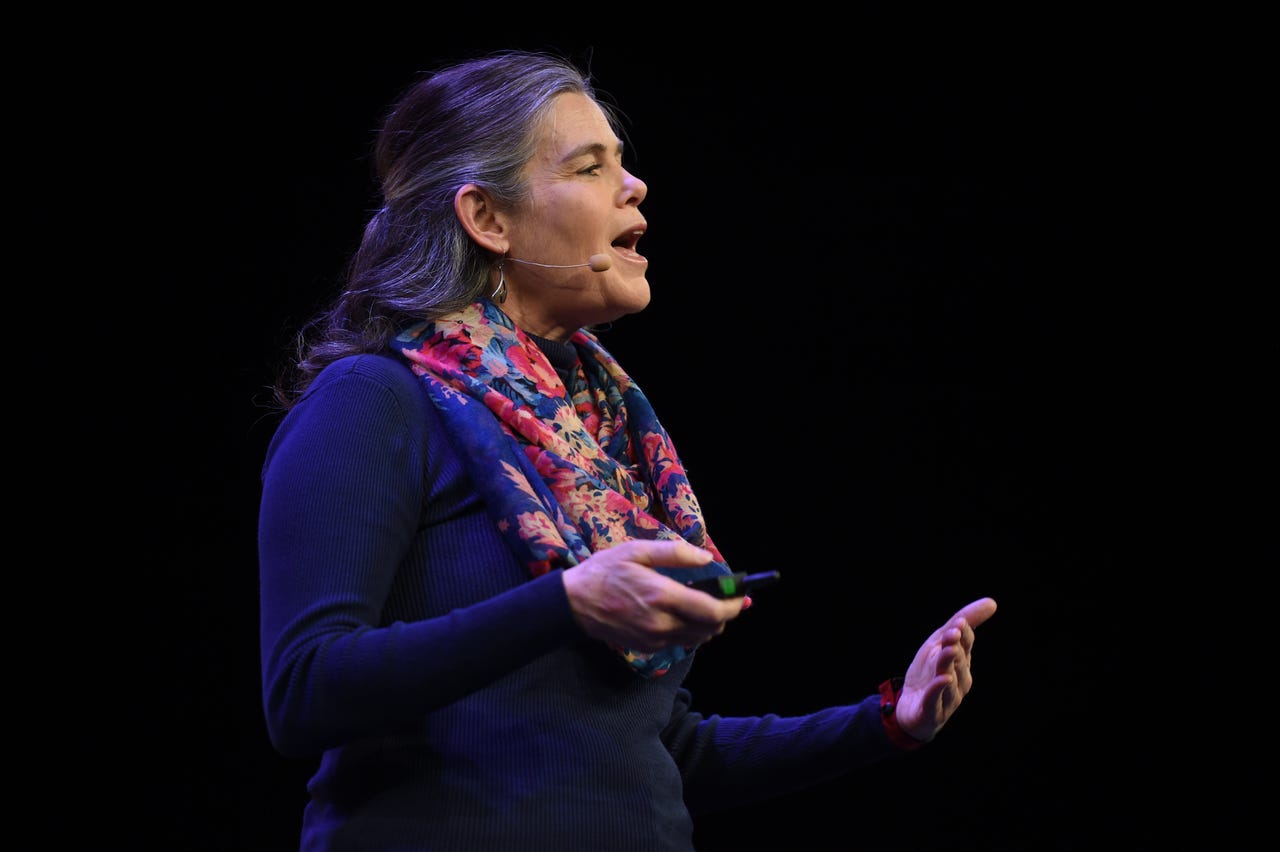
Generative artificial intelligence, like the kind that powers OpenAI's DALL-E, ChatGPT, and other popular programs, is going to be an important tool for breakthroughs in oncology, the study of cancer, according to Daphne Koller. Koller is an AI pioneer and co-founder and CEO of life sciences AI firm Insitro.

"What we've taken on as an effort is to really learn the language of histopathology [the study of tissues]… and then use that to […] give us potential [drug] targets," said Koller, speaking at a daylong workshop hosted by Stanford University's Human-Centered AI institute on Tuesday, titled, "New Horizons in Generative AI: Science, Creativity, and Society."

Also: Generative AI is everything, everywhere, all at once

Koller is an adjunct professor of computer science at Stanford. Koller explained a two-step process that can lead to novel drug targets for cancer.

In the first step, Insitro machine learning AI technology is able to analyze images of cancerous tissue, a histology image generated from a biopsy. A human pathologist will "typically boil down these images of billions of pixels into, like, three numbers," she explained, "And it's clear that there is a ton more information that is available within them" that is not being used.

Also: Cerebras and Abu Dhabi's M42 made an LLM dedicated to answering medical questions

By using machine learning, the computer will "really learn the language of histopathology," she said, which in turn lets the machine predict genetic changes in patients with cancer with 90% to 95% accuracy.

"So, basically, by looking at a slide, you can say this patient has this genetic mutation versus this other patient, something that no clinician can really do," she explained.

That's the first step. To find drug targets, you need a lot more samples of tissue than are actually collected — thousands versus dozens. To solve that supply of images, the Insitro team used generative AI to create "deep fakes" of tissue images, said Koller. "Rather than generating images of movie stars, we generate images of pathology slides."

Also: Microsoft unveils extensions to Fabric, Azure for healthcare AI

By multiplying tissue samples from hundreds to thousands, Koller explained, a much larger sample can be analyzed using a special tool developed at Stanford called an "ATAC-seq" assay. The team was able to go from 400 cancer tissue image samples to almost 100,000. That scale starts to make it possible to ask questions that would be impossible with fewer samples.

Generative AI is used to create "deep fakes" of tissue images, to vastly expand the sample size that can then be mined using a genetic assay.

"And now you can basically start to ask questions like the open-ness or closed-ness of which gene — that is, the activity of which gene — is most strongly associated with survival, something that would not be possible to do if you had 30 patients."

The thousands of fake samples tested with the assay can reveal novel candidate drug targets for cancer.

By analyzing thousands of deep fake images of triple-negative breast cancer, for example, with ATAC-seq, the technology reveals previously unknown genetic changes that can be drug target candidates. "Some of these targets are novel in triple-negative breast cancer [but] they've been implicated in other cancers," said Koller. "That gives you confidence around the causal role that they play, and [they] are potentially really interesting new drug targets."

Koller described the overall program of generative AI in biology as dealing with a level of complexity that is "not something that the human brain will really ever be able to understand."

"In order to tackle this domain, we really just need to first collect a very large amount of data, at unprecedented fidelity and scale, at different levels of biological granularity, and then let machines do what they now do much better than people, which is understand the subtle patterns in these data, help us redefine the heterogeneity and complexity of human disease, and identify intervention hubs that might give rise to therapeutics that work in the clinic."

Also: Generative AI will far surpass what ChatGPT can do. Here's everything on how the tech advances

The workshop's co-organizer, Percy Liang, an associate professor of computer science at Stanford, lauded Koller as a Stanford professor who "inspired a whole generation of researchers" in AI. Koller also co-founded the online learning company Coursera.

Liang noted that the workshop's various speakers, including Koller, offered lots of examples of "multi-modality," where the same kinds of generative AI programs operate on very different kinds of data, from biological data to sound data to even whale songs. As ZDNET has pointed out, multi-modality, which brings together different data types, is one of the most important future directions of the field.

In closing out her talk, Koller remarked how science goes through periods of tremendous progress. "Think about the late 1800s and chemistry, with the uncovering of the periodic table [of elements]," she offered, "Or the early 1900s, of course, physics, with the connection between energy and matter, space and time."

Also: 3 ways AI is revolutionizing how health organizations serve patients. Can LLMs like ChatGPT help?

The 1990s saw a similar explosion of discovery in two disciplines, said Koller, "Data/machine learning/AI, which is really something that began back then, and quantitative biology, which is the ability to measure biology at unprecedented fidelity."

Those two disciplines are now merging, she said, to create a new field called digital biology, which is "the ability to read the biology digitally at this incredible fidelity at an unprecedented scale, interpret what we see using tools such as machine learning and AI, and then write biology using techniques like CRISPR and combinatorial chemistry, and all sorts of other things to make biology do things that it wouldn't otherwise do."

Also: Generative AI and machine learning are engineering the future in these 9 disciplines

That new field, said Koller, will have "tremendous repercussions in human health, but also in the environment, in energy, in bio-materials, and sustainable agriculture, and many other disciplines that will help make our world a better place, which is why I think it's a really exciting place to be."

The full workshop agenda is posted online, and you can watch the replay of the entire event on YouTube.

Artificial Intelligence

As publishers block AI web crawlers, Direqt is building AI chatbots for the media industry

As publishers block AI web crawlers, Direqt is building AI chatbots for the media industry Sarah Perez @sarahintampa / 13 hours

A number of news and media publishers are already blocking AI web crawlers from accessing their sites, worried about the impact on traffic when all their work is swept up into AI chatbot experiences. However, a startup called Direqt believes publishers should embrace AI chatbots — just on their own terms. The company, which has now raised its first outside capital of $4.5 million, offers media companies like ESPN, GQ, Wired, Vogue, Cosmopolitan, and others, their own customizable chatbot solutions that provide a direct connection to their audience, increased engagement with their own published content, as well as monetization via ads.

The startup was originally founded in 2017 with a focus on chatbot monetization, before turning more recently to AI. In its earlier days, the company had built out the ability to serve promotions and ads inside a chatbot experience, which it licensed to a larger customer in the U.S. In 2021, the team pivoted to start building a chatbot platform for publishers, still slightly ahead of the GPT wave and the rise of ChatGPT.

“Part of that was, candidly, us being a little bit early to the market,” remarked Direqt co-founder and Chief Commercial Officer Nick Martin. “Fortunately, things over the last couple of months have really broken the direction we did anticipate all these years,” he said.

Image Credits: Direqt

The idea was that the existing chatbot platforms that had been built at the time were originally created for other purposes, like customer service, and didn’t really meet the needs of publishers. So the team decided they’d take on the challenge of building a platform that could work for publishers.

The team also realized that about 10% of consumers’ time on mobile was spent on messaging apps, like iMessage, WhatsApp, Telegram, Messenger, Viber, and others, and around 5.3 billion people around the world engage in messaging. Meanwhile, publishers were telling Direqt they wanted a direct relationship with readers, rather than having to rely on the ever-changing whims of Big Tech companies, like Meta and Google, which have been distancing themselves from the news business in recent years.

Meta, for instance, has been pulling news from its products after adjusting algorithms in ways that negatively impacted publishers, and Google recently laid off a portion of its news team.

While the earlier chatbot product for publishers leveraged tools like NLP and AI, over the last 18 months, Direqt has enhanced the platform to support more capabilities, including those that rely on generative AI.

Publishers can choose to implement their chatbot in ways that fit their own business’s AI policy and strategy, whether that means simpler, non-AI chatbots that let users ask about stories their team has written; those where editorial teams curate the AI-generated content before it goes live; or those where AI could generate a quiz or a set of questions about the story, and so on.
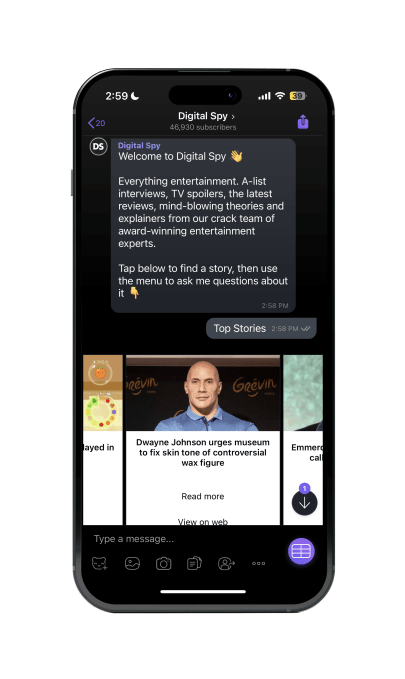
Image Credits: Direqt

Or, if the publisher simply wants their own version of ChatGPT, that’s also possible, as Direqt works with OpenAI and other AI vendors, including Google, to meet the publishers’ goals.

The generative AI experiences have the most draw at present, even though some publishers may not have yet finalized their AI strategy.

“Almost everyone that we work with is trying to figure out their generative AI strategy if they haven’t already started deploying things,” says Martin. “There’s been a really fast-paced development in the perspectives around it since November 30 of last year to about 12 months later…we haven’t met a publisher yet, who’s like ‘we don’t want to do this,'” he says.

In fact, publishers may even be fighting some AI battles — like suing AI companies for aggregating their content into their models without permission — even as they move forward with their own bots.

“There doesn’t seem to be much of a sense of like, we’re scared of this technology and we don’t want to use it,” Martin continues. “There’s certainly a fear and a concern around AI through a few lenses — what it’s going to do to traffic from search, what is the impact on the creative and writers and journalism — and those two things are pretty massive. But it does seem that in all of the private conversations, everybody has a very sober view on the technology — [as in] ‘it’s not going back in the box, we need to figure this out.'”

As publishers are beginning to gear up for their annual planning, quite a few have plans to implement generative AI experiences in 2024, he notes.

Image Credits: Direqt

To ingest publishers’ content, Direqt can leverage RSS feeds or, with permission, scrape the website.

The publishers’ chatbot experience itself can also be placed wherever the publisher wants, including directly on their website with a few lines of code, within partnered messaging apps that reach a collective 260+ million users. (Supported apps include Google Messages, SMS, and Viber, with Messenger and WhatsApp to soon come.) And, later this quarter, social media will also be supported. In the case of the latter, Direqt is launching an integration with Instagram where users can comment on the publisher’s post, which will trigger the chatbot to initiate a conversation in Instagram’s DMs.

Today, the company has 75 brands on its platform, including names like Good Housekeeping UK, Women’s Health UK, ClutchPoints, Bob Vila, Dance Magazine, Hollywood.com, Indy100, Popular Science, The Drive, Domino, Field & Stream, Outdoor Life, Task & Purpose, Car Bibles, Popular Photography, and others.

Within the chats, the bots serve links to publisher content, which see an average clickthrough rate (CTR) of 24.16%, compared with the average email CTR of 3.48% per active campaign. One customer, Mitch Rubenstein, founder of the Sci-Fi Channel and owner of Hollywood.com & Dance Magazine, said Direqt has boosted time-on-site by over 200%.

In addition to providing direct traffic, Direqt has a hybrid business model. Publishers can choose between a SaaS approach where it’s paid a platform licensing fee based on transaction volume, or a revenue-based model where Direqt takes a cut of the in-chat ad revenue that runs inside the platform. Those ads can be sold by the publishers or can include ads from Direqt’s 500 advertiser partners and other partners.

For publishers dependent on ad revenue, chat appears to be a good solution.

“There’s market data that suggests performance in chat is significantly higher to the order of 10% and 10x, depending on which source you’re looking at, that in-chat ads outperform traditional advertising,” Martin notes.

In addition to Martin, formerly the co-founder and COO of a sports equipment manufacturer, Direqt was co-founded by serial entrepreneur John Duffy, a co-founder of another chatbot company 3Cinteractive; Myk Willis, a former Citrix engineer, and co-founder and CEO of streaming radio company Myxer; and Bill Madden, a former IBM product engineer.

The team has now raised its first round of capital, a seed round of $4.5 million from investors including various entrepreneurs and executives, including Todd Parker, former Global Head of Business Development for Business Messaging at Google; NFL Hall of Famer Dan Marino; Peter Callahan, Former CEO of American Media; Ron Antevy, Founder & CEO e-Builder; and Dave Walsh, Partner at Kayne Anderson.

The funds will help Direqt accelerate product development, roadmap, and go-to-market, and allow it to double its headcount from 15 to about 30 people by the end of next year. The Seattle-headquartered company aims to improve the core conversational engine it offers, increasing its monetization capabilities and unlocking more distribution with the new funds, as well.


Google’s AI search won’t be ad-free much longer

Ads on a website illustration

Google is attempting to infuse its world-dominant search engine with AI through its Search Generative Experience (SGE), currently available for user testing. Even though SGE is still in its early stages, Google is planning on adding ads.

On Tuesday, Google released its third-quarter earnings, which revealed that despite steep investments into AI and growing competition with search engines like Bing on the rise, Google is still in a good spot with an 11% increase in revenue from last year.

Also: Microsoft has over a million paying Github Copilot users: CEO Nadella

During Google's earnings call, CEO Sundar Pichai also talked about the company's plan to introduce ads to the SGE, sharing that Google would be experimenting with new formats, according to a report.

The advertisements are supposed to open opportunities for more companies to get their products in front of the right audience. They are also meant to equally benefit the customers who will be able to find what they need sooner.

Also: Google's new AI-powered tool helps users learn English right in Search

Google's chief business officer, Philipp Schindler, added, "It's extremely important to us that in this new experience, advertisers still have the opportunity to reach potential customers along their search journeys," according to the report.

When Google first introduced the idea of SGE in May, the company showcased some demos of what ads on the platform would look like.

It seems like a user would search for something specific, such as "hiking backpacks for kids," as seen by the photo, and then Google would provide a conversational answer that would be followed by ads for the specific product.

Bing Chat made a similar move, implementing ads to its own platform only a month after it was released while it was still in preview, which surprised many.

Also: The best AI chatbots

Similar to Google's demo, Bing Chat's ads are displayed below the conversational text output that answers the user's query. The ads relate to the nature of the query and, at times, can help connect users to the ideal product.

Artificial Intelligence

AI titans throw a (tiny) bone to AI safety researchers

AI titans throw a (tiny) bone to AI safety researchers Kyle Wiggers 10 hours

The Frontier Model Forum, an industry body focused on studying “frontier” AI models along the lines of GPT-4 and ChatGPT, today announced that it’ll pledge $10 million toward a new fund to advance research on tools for “testing and evaluating the most capable AI models.”

The fund, says the Frontier Model Forum — whose members include Anthropic, Google, Microsoft and OpenAI — will support researchers affiliated with academic institutions, research institutions and startups, with initial funding to come from both the Frontier Model Forum and its philanthropic partners, the Patrick J. McGovern Foundation, the David and Lucile Packard Foundation, former Google CEO Eric Schmidt and Estonian billionaire Jaan Tallinn.

The fund will be administered by the Meridian Institute, a nonprofit based in Washington, D.C., which will put out a call for an unspecified number of proposals “within the next few months,” the Frontier Model Forum says. The Institute’s work will be supported by an advisory committee of external experts, experts from AI companies and “individuals with experience in grantmaking,” added the Frontier Model Forum — without specifying who exactly those experts and individuals are or the size of the advisory committee in question.

“We’re expecting additional contributions from other partners,” reads a press release put out by the Frontier Model Forum on a number of official blogs. “The primary focus of the fund will be supporting the development of new model evaluations and techniques …. to help develop and test evaluation techniques for potentially dangerous capabilities of frontier systems.”

$10 million isn’t chump change. (More accurately, it’s $10 million in pledges — The David and Lucile Packard Foundation hasn’t formally committed funding yet.) But in the context of AI safety research, it seems rather, well, conservative — at least compared to what members of The Frontier Model Forum have spent on their commercial endeavors.

This year alone, Anthropic raised billions of dollars from Amazon to develop a next-gen AI assistant, following a $300 investment from Google. Microsoft pledged $10 billion toward OpenAI, and OpenAI — whose annual revenue is well over $1 billion — is reportedly talks to sell shares in a move that would boost its valuation to as high as $90 billion

The fund’s also small in comparison to other AI safety grants.

Open Philanthropy, the grant-making and research foundation co-founded by Facebook founder Dustin Moskovitz, has donated about $307 million on AI safety, according to an analysis on the blog Less Wrong. The public benefit corporation The Survival and Flourishing Fund — furnished primarily by Tallinn — has given around $30 million to AI safety projects. And the U.S. National Science Foundation has said that it’ll spend $20 million on AI safety research over the next two years, supported in part by Open Philanthropy grants.

AI safety researchers won’t necessarily be training GPT-4-level models from scratch. But even smaller, less capable models that they might wish to test would be expensive to develop with today’s hardware, ranging in cost from hundreds of thousands of dollars to millions. That’s not factoring in other overhead, like the salaries to pay the researchers. (Data scientists don’t come cheap.)

The Frontier Model Forum alludes to a larger fund down the line. If that comes to fruition, it might just have a chance at moving the needle on AI safety research — if we’re to trust the fund’s decidedly for-profit backers to refrain from exercising undue influence over the research. But no matter how you slice it, the initial tranche seems far too limited to accomplish much.

Microsoft has over a million paying Github Copilot users: CEO Nadella

Satya Nadella

Microsoft is seeing big growth in the generative AI business, as the company's CEO, Satya Nadella, Tuesday evening told Wall Street that the company's paying customers for its GitHub Copilot software rose by 40% in the September quarter from the prior quarter.

"We have over 1 million paid copilot users in more than 37,000 organizations that subscribe to copilot for business," said Nadella, "with significant traction outside the United States."

Also: GitHub's AI-powered coding assistant moves to public beta. How to access it

A recent addition to Copilot, Copilot Chat, is "already being used by both digital natives like Shopify as well as leading enterprises like Maersk and PWC to supercharge the productivity of their software developers," said Nadella.

Copilot is one of the many ways Nadella is holding to his promise to spread artificial intelligence throughout the company's product line.The company's Bing search engine, which has been integrated with OpenAI's ChatGPT, has resulted in users engaging in "more than 1.9 billion chats" so far, said Nadella.

He noted that the Microsoft Edge browser has now gained share for 10 consecutive quarters. "This quarter, we introduced new personalized answers as well support for DALL-E 3 helping people get more relevant answers and to create incredibly realistic images. More than 1.8 billion images have been created to-date. And with our Copilot in shopping, people can find more tailored recommendations and better deals," said Nadella.

Also: AI aims to predict and fix developer coding errors before disaster strikes

Wall Street expects Microsoft to have a big financial payoff from Microsoft's partnership with startup OpenAI, in which it has invested over ten billion dollars. That partnership may someday be worth a hundred billion dollars to Microsoft, some Wall Street analysts have estimated.

Though Nadella did not quantify the revenue from GitHub Copilot, Microsoft CFO Amy Hood said that "higher-than-expected AI consumption contributed to revenue growth in Azure."

The company's total revenue for its Intelligent Cloud computing operations in the quarter topped analysts' estimates, rising 19%, year over year, to $24.3 billion, the company said, versus Wall Street's expectation for $23.4 billion. Within that total, the Azure business rose 29%, of which 3 percentage points was from "AI services," said Hood.

Also: Every enterprise plans to increase AI spending next year

Other uses of Copilot, and AI more generally, included expanded use of Copilot via Microsoft's developer tools, the Power Platform. "More than 126,000 organizations including 3M, Equinor, Lumen Technologies, Nationwide, PG&E and Toyota have all used Copilot and Power Platform," said Nadella.

Nadella noted that "more than 18,000 organizations now use Azure OpenAI service, including new-to-Azure customers, and we are expanding our reach with digital-first companies with OpenAI APIs as leading AI start-ups use OpenAI to power their AI solutions, therefore making them Azure customers as well."

The company is adding generative AI to its LinkedIn business, including a "learning coach that gives members personalized content guidelines and tool," rolled out last quarter. "We have seen a nearly 80% increase in members watching AI-related learning courses this quarter" on LinkedIn, said Nadella.

Also: LinkedIn just added AI-powered coaching and recruiting tools to make your job easier

Nadella also called attention to the company's spreading of Copilot to industries, in particular, health care, where the company is integrating clinical tools into its Fabric data service on Azure. Among those tools, the DAX Copilot, used to transcribe clinical notes, is "increasing physician productivity and reducing burnout," said Nadella.

It is still early in the roll-out of GitHub Copilot and the rest, said Nadella. "We are in the very, very early innings there, and so we look forward to seeing the traction for these products going forward," he said. The early use of Copilot, he said, is "giving us good confidence, and our customers, more importantly, good confidence around what these products represent in terms of value."

Featured

Andrew Ng Rolls Out New Generative AI Course on LangChain

Andrew Ng, announced a new generative AI course on LangChain in the series collaborating with Harrison Chase, founder of LangChain.

Titled ‘Functions, Tools, and Agents with LangChain,’ developers can update themselves on the fast paced world of LLM and how to use LangChain to work with their models.

In the earlier courses they explained how to use LangChain to chat and manipulate the data. “In the short time since we created those courses, there have been significant advancements in LLMs and the libraries to support the use as a developer tool,” Andrew Ng said.

This course was created to update developers on function calling such as OpenAI’s LLM’s calling of other functions, which turns out to be very useful for handling structured data.

While the majority of work is done using formatted data, with function calls or API’s that want specific data in specific formats. The recent updates to training algorithms can now understand and output data like JSON, and in this course, students will get a chance to work with this directly.

These updates make LLMs more predictable and reliable, as well as being better at understanding when to use tools. This makes it more feasible to build agents that can reason about how to use tools to solve multi step problems.

Harrison Chase who explained the format of the course said, “In this course, we’ll start by explaining the recent advancements in LLM APIs. Next we’ll go over a new syntax that we at LangChain have introduced called LangChain Expression Language (LCEL) which makes it much easier to compose and customise chains and agents.”

Students of the course will also explore the popular use cases, like structured data extraction, function calling and building up to a conversational agent. To register for the course you can follow this link.

Simultaneously, Andrew Ng also announced a course to build Computer Vision models which will be livestreamed on the 6th of November.

Read: Andrew Ng other courses

The post Andrew Ng Rolls Out New Generative AI Course on LangChain appeared first on Analytics India Magazine.