Mid-career professionals, watch out. You’re the most exposed to AI

Ai at workplace place graphic

The continued rise of generative AI has the potential to transform how operational activities in the workplace are completed. However, some sectors and careers are more susceptible than others, and a new report sheds light on the biggest targets.

Indeed Hiring Lab has published its AI at Work Report, which uses its prior report and Bureau of Labor Statistics data to highlight the groups and industries that are more susceptible to AI-led change than others.

Also: Worried about AI gobbling up your job? Start doing these 3 things now

The report labels exposure to generative AI as "high" if generative AI is "good" or "excellent" at performing 80% or more of skills in the field.

The exposure is "moderate" when generative AI is "good" or "excellent" at performing between 50% and 80% of skills, and "low" when generative AI can perform less than half of skills in a "good" or "excellent" manner.

The study suggests younger generations face the least amount of exposure. Only 5.6% of workers between the ages of 16 and 24 have the highest potential exposure to generative AI, while 38.4% of workers in that age group have the lowest potential exposure.

The report says these younger workers are susceptible to mostly low exposure because of the roles they fulfill. Many professionals in this age group work in roles that don't require advanced skills or rely on skills that can be learned quickly.

For example, the report points out that 16.3% of workers in this younger age group work in food preparation or service jobs, sectors where generative AI assistance would not be very beneficial or valuable.

Also: As developers learn the ins and outs of generative AI, non-developers will follow

However, as these professionals become older, they move into positions and acquire skills where generative AI can excel.

For example, management positions are generally offered after an individual has gained several years of experience in a field or role, with one in eight workers between the ages of 25 to 54 working in management.

The report says management iis one field where generative AI excels, with the technology able to perform 67.9% of the skills required in a "good" or "excellent" manner.

Older professionals often choose to further their education, making them eligible for roles that are highly exposed to AI, such as "Business & Finance" and "Mathematics & Computers".

As a result, mid-career professionals between the ages of 25 and 54 have the highest potential exposure to AI, with 13.4% of professionals in that age group prone to high AI exposure, 58.4% having moderate exposure, and 28.2% classified as low-exposure individuals.

Also: Google's AI search won't be ad-free much longer

The 55-plus age group boasts the same protection as the youngest age group of working professionals. Many of the roles that older workers fulfill, such as driving, cleaning, and sanitation, depend on hands-on or social interactions, which are tasks that generative AI can't perform well.

Only 11.5% of workers in this latter category are highly exposed to generative AI, with 59.4% having moderate exposure, and 29.1% having low exposure.

Artificial Intelligence

How AWS is Fueling India’s Space Tech Ambitions 

Recently, AWS partnered with ISRO and IN-SPACe to provide cloud capabilities with scaled computing due to the increasing application and demand in the Indian ecosystem, alongside boosting India’s space tech startups.

In an exclusive interaction with AIM, Clint Crosier, AWS’ Director of Aerospace and Satellite Solutions unveiled the ambitious growth trajectory of India’s space sector, AWS’ partnership with a host of Indian space tech companies, their multi-billion dollar bet, their vision and initiatives aimed at scaling the industry beyond borders.

Crosier, resonating with sincerity, painted a vivid picture of India’s thriving space ecosystem, with the triumphant Chandrayaan 3 mission, the ambitious Gaganyaan mission and ISRO’s growing role in the commercial space arena, amplified by new policies promoting startups.

“I really see significant growth here in India. And that’s why AWS is invested. We announced recently that we’re investing 12.7 billion US dollars in infrastructure here in India, cloud computing industry infrastructure until 2030 because we see such a growth track,” said the aerospace director.

ISRO, IN-SPACe, and AWS Partnership

Crosier shared insights into partnership with ISRO, IN-SPACe, which was formalised through an MoU—that aims to foster innovation and bolster the startup ecosystem in the space tech sector He reiterated by saying “ISRO was a very enthusiastic partner and they said we want to grow this industry in India and we said we want to help that too.”

AWS will provide essential cloud skills training to space tech startups through workshops and programs needed to harness cloud capabilities for their space missions. Furthermore, the partnership aims to introduce STEM (Science, Technology, Engineering, and Mathematics) education into the space industry.

“When you bring space experts together with cloud experts and let them do innovative activity today, it really unlocks some powerful innovation opportunities. And that’s what we’re doing with ISRO. We’re going to work together to grow the space geospatial ecosystem here in India,” said Crosier, emphasising the impact of the partnership.

Partnerships with Private

A resounding objective was laid out, in the new 10 year new space policy— to amplify its market share from 2% to 8% of the global space capability. This audacious goal, according to Crosier, is entirely attainable. “I believe it’s entirely achievable because India has developed such a strong technical base,” he added.

He also underlined various avenues such as launch capabilities, geospatial analysis, satellite manufacturing, and operations that could attract more attention, potentially propelling the entire country’s ecosystem to the next level.

He highlighted that AWS is shouldering the larger cause by collaborating with companies such as Pixxel, Digantara, Dhruva Space, and Skyroot. These companies are involved in various aspects of space tech, from hyperspectral satellite systems to space-based situational awareness and rocket design and launch.

Pixxel, in partnership with AWS, is creating a hyperspectral satellite system for continuous global monitoring. Meanwhile, Digantara is developing a space-based Space Situational Awareness (SSA) system, with Crosier noting the potential for improved SSA and space domain protection from space itself.

Additionally, Crosier revealed that the AWS team recently visited firms like Dhruva Space and Skyroot in Hyderabad, and were surprised by the cutting-edge endeavours taking place in the Indian space market.

As India’s space sector continues to evolve and garner global attention, AWS’s investments and collaborations promise a thriving ecosystem that will play a pivotal role in space technology and research for years to come.

“I see so many opportunities across the Indian space market. The convergence of space expertise and AWS’s cloud capabilities is a recipe for exciting developments,” according to Crosier.

AWS to the Rescue

Crosier emphasised that one of the fundamental challenges AWS cloud solutions can address is reducing the barriers to entry for businesses. By providing access to the world’s largest global infrastructure, AWS enables companies, both commercial and governmental, to conserve their limited resources and redirect them towards their core missions.

AWS helps space companies save significant amounts of money by avoiding the arduous task of building their own infrastructure and applying AI for advanced geospatial analysis.

AWS goes beyond infrastructure support. They empower space organizations with the tools and know-how to implement AI and ML at scale. This fosters efficiency and opens up new possibilities for space missions. Crosier pointed to real-world examples, such as collaborating with SatSure in India, where AI and ML are used to identify climate change patterns in geospatial data to support climate decision-making. The technology powerhouse also partners with companies like Kawa Space, a space startup focused on real-time signal detection from space to combat illegal shipping and illicit maritime threats.

Enters AWS Activate Program

AWS’ Activate Programplays a pivotal role in nurturing and supporting the growth of space startups in India and globally through its Activate Program. It provides credits and fosters a cloud-native mindset among emerging space tech ventures. Activate offers credits to help startups learn to operate in the cloud, removing financial barriers. This initiative empowers startups to leverage cloud technology without the initial financial burden.

Crosier explained, “Activate is a program… where we provide space startups credit so that they can get started… learn how to operate the cloud, train their people to become experts on the cloud and applications in the cloud.”

AWS’s broader goal with Activate is to nurture a cloud-savvy workforce, enabling startups to make significant contributions. For example, they can leverage geospatial data for India’s benefit.

Crosier offered an illustrative example, stating, “And so there’s activation credits make it possible for companies to say I don’t know where to start… It allows us to do good things across the community by leveraging, in this case, geospatial data for the good of the country of India.”

AWS also offers a Space Accelerator program, which runs for four weeks, helping startups effectively integrate cloud technology into their space systems. The program which has been going on for the past three years enables participants to work closely with AWS experts to build cloud platforms.
The programme’s 2023 14 startup roaster features India-based space startups like Kawa Space, Delta V Analytics and others.

The post How AWS is Fueling India’s Space Tech Ambitions appeared first on Analytics India Magazine.

Why Databricks Acquired Arcion

In a move aimed at transforming data replication technology, San Francisco-based Databricks announced the acquisition of Arcion, a leading real-time enterprise data replication solutions provider. This strategic acquisition, valued at over $100 million, will help Databricks streamline how enterprises ingest data from various sources into the Databricks Lakehouse Platform.

Data Lakehouse Platforms have become a cornerstone of enterprise data and AI solutions, but their value hinges on the quality and speed of data ingestion. Ingesting data from existing databases and applications has been a persistent challenge, characterised by complexity, fragility, and high costs. The acquisition of Arcion is a game-changer, as it equips Databricks to provide a seamless, scalable, and cost-effective data ingestion solution for a multitude of enterprise data sources.

Recent surveys have indicated that many businesses grapple with managing multiple, often siloed data systems. In fact, 34% of surveyed organisations reported dealing with ten or more systems, while over 80% of large companies juggled a similar data complexity.

Vital data resides not only in traditional transactional databases like Oracle, MySQL, and Postgres, but also in cloud-based SaaS applications such as Salesforce, SAP, and Workday. Leveraging Arcions’ change data capture (CDC) engine, which offers connectors for over 20 enterprise databases— such as Oracle, MySQL, and Postgres—and data warehouses from the likes of Salesforce, SAP, and Workday. This would streamline the process of continuous or on-demand data ingestion into the Databricks Lakehouse Platform. Crucially, this integration would also bolster enterprise security, governance, and compliance, thus limiting concerns about data integrity.

Ali Ghodsi, Co-Founder and CEO at Databricks, highlighted the significance of this acquisition, stating, “To build analytical dashboards, data applications, and AI models, data needs to be replicated from the systems of record like CRM, ERP, and enterprise apps to the Lakehouse. Arcion’s highly reliable and easy-to-use solution will enable our customers to make that data available almost instantly for faster and more informed decision-making,” he said.

He added that Arcion will be a great asset to Databricks, and he is excited to welcome the team and work with them to further develop solutions to help his customers accelerate their data and AI journeys.

Gary Hagmueller, CEO of Arcion, emphasised how Arcion’s real-time, large-scale CDC data pipeline technology complements Databricks’ existing ETL solutions. “Databricks has been a great partner and investor in Arcion, and we are very excited to join forces to help companies simplify and accelerate their data and AI business momentum.”

Mapping its Growth Strategy

Not long ago, Databricks had acquired MosaicML, a multi-cloud platform, in a deal worth a whopping $1.3 billion, with a vision to democratise AI by helping enterprises build, own and secure best-in-class AI models. MosaicML, known for its MPT large language models, also offers a cost-effective way for enterprises to build and train custom models using their data.

With a host of these acquisitions and technology bolstering, Databricks has positioned itself as a leading platform for enterprises to build and scale their very own generative AI models.

Databricks’ ability to maintain its share price and increase its valuation in the midst of market challenges is a testament to its strength in the data analytics and AI sectors, positioning it as a key player in these rapidly evolving industries. Its timely and well-thought-out acquisitions have helped it.

Unlike many enterprise software companies that are cutting back due to slowing growth and reduced consumer spending, Databricks has not announced any layoffs and is actively maintaining its growth trajectory.

Databricks’ CEO, Ali Ghodsi, has focused on cost-cutting measures in technology expenses, including software subscriptions.

“We spent $30 million on 300 pieces of SaaS software,” Ghodsi said, “I said, ‘Let’s halve that,’” he added.

In the quarter ending in July, Databricks reported an impressive $1.5 billion annual revenue run rate, with sales increasing by 50% year over year. This is in stark contrast to some of its competitors, like Snowflake, which, despite being a prominent player in the cloud software industry, reported 36% growth in the latest quarter, with revenue reaching $674 million.

Maintaining Resilience in Downturn

Moreover, the San Francisco-based data analytics software company had recently raised more than $500 million in fresh capital. This funding round pushed the company’s valuation to an impressive $43 billion, up from its previous valuation of $38 billion in 2021.

What’s remarkable about this valuation increase is that it comes at a time when the cloud software industry has faced significant challenges. Many tech startups have looked to the IPO market for funding, but Databricks has opted to stay private and has continued to attract investors.

In this latest funding round, Databricks issued shares at a price of $73.50 each, which is roughly the same price at which they were valued in 2021. The $5 billion increase in valuation is mainly attributed to the issuance of new shares. Databricks CEO Ali Ghodsi mentioned that a significant portion of these new shares went to the company’s rapidly growing workforce, which has expanded to approximately 6,000 employees, with around 3,500 hires in just the past two years.

Despite challenging market conditions with high interest rates and economic concerns affecting some tech companies, Databricks has capitalised on the growing momentum in the field of artificial intelligence. In July, the company made a notable acquisition by purchasing MosaicML, a startup specialising in software for efficiently running large language models that generate natural-sounding text. The acquisition was valued at $1.3 billion, indicating Databricks’ strong commitment to AI innovation.

Moreover, a significant development in this funding round is the participation of NVIDIA as a new investor in Databricks. Nvidia, known for its advanced graphics processing units (GPUs), has actively invested in various AI infrastructure startups. This investment in Databricks is consistent with Nvidia’s strategy of supporting companies involved in AI development, and it underscores the growing importance of AI in the tech industry.

With Microsoft being in a key position in the generative AI landscape, Databricks’ partnership to offer its services on Azure Databricks will also prove to be a key component in its growth.

The post Why Databricks Acquired Arcion appeared first on Analytics India Magazine.

Jina AI Launches Open Source 8K Text Embedding, Rivalling OpenAI

Jina AI Launches Open Source 8K Text Embedding, Rivalling OpenAI

Berlin-based Jina AI has unveiled its latest achievement, the second-generation text embedding model known as jina-embeddings-v2. This groundbreaking model boasts an impressive context length of 8,192 tokens, a milestone that places it in direct competition with OpenAI’s proprietary model, text-embedding-ada-002, on both the Massive Text Embedding Benchmark (MTEB) leaderboard and in terms of capabilities.

Check out the model on Hugging Face.

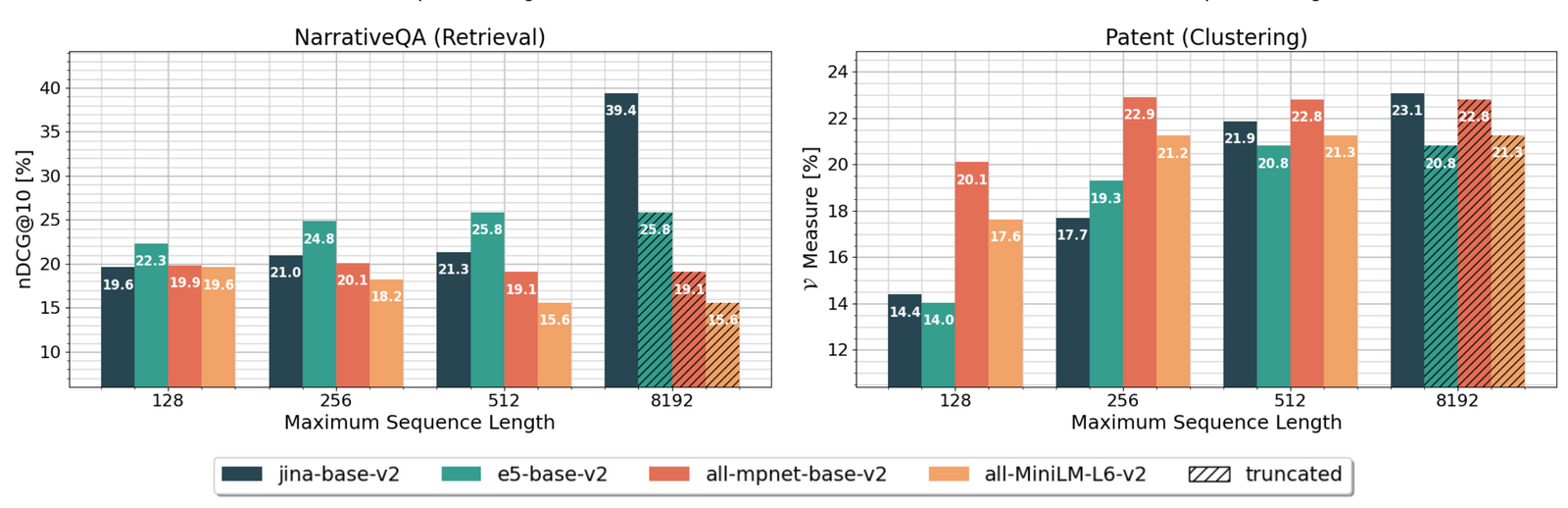
Jina AI’s jina-embeddings-v2, when directly compared to OpenAI’s 8K model text-embedding-ada-002, demonstrates its mettle. Notably, jina-embedding-v2 surpasses its OpenAI counterpart in terms of Classification Average, Reranking Average, Retrieval Average, and Summarization Average.

jina-embeddings-v2 was meticulously crafted from the ground up through intensive research and development, data collection, and fine-tuning. The result is a model that represents a significant leap from its predecessor.

Beyond its technical achievement, jina-embeddings-v2’s 8K context length opens new doors for various industry applications, including legal document analysis, medical research, literary analysis, financial forecasting, and conversational AI. Benchmarking shows that this extended context allows jina-embeddings-v2 to outperform other leading base embedding models in several datasets, highlighting the practical advantages of longer context capabilities.

Reflecting on this, Dr. Han Xiao, CEO of Jina AI, shared his thoughts: “in the ever-evolving world of AI, staying ahead and ensuring open access to breakthroughs is paramount. With jina-embeddings-v2, we’ve achieved a significant milestone. Not only have we developed the world’s first open-source 8K context length model, but we have also brought it to a performance level on par with industry giants like OpenAI. Our mission at Jina AI is clear: we aim to democratise AI and empower the community with tools that were once confined to proprietary ecosystems. Today, I am proud to say, we have taken a giant leap towards that vision.”

A forthcoming academic paper detailing the technical intricacies and benchmarks of jina-embeddings-v2 will provide the AI community with deeper insights.

Jina AI is setting its sights on launching German-English models, further expanding its repertoire as it continues to advance and democratise artificial intelligence through open source and open science.

The post Jina AI Launches Open Source 8K Text Embedding, Rivalling OpenAI appeared first on Analytics India Magazine.

AMD Focuses on Software Ahead of MI300X Release

AMD Focuses on Software Ahead of MI300X Release

Lisa Su announced in June that the company would be launching Instinct MI300X soon, which would be an alternative to NVIDIA’s H100, and the timing couldn’t be better given the GPU shortage talk in the world. Amidst the arms race between NVIDIA and Intel, AMD is working quietly and coming up ahead in the AI race. And currently, the focus is on software, as the plans for hardware are already on the right track.

Most recently, AMD along with Korean telecom KT, decided to back AI software developer Moreh. In a series-B fund, the Santa Clara based startup raised $22 million, bringing the total it raised to $30 million. The company is focused on developing software alternatives to CUDA, the NVIDIA’s moat in AI. Right now, that is ROCm.

Recently, Vamsi Boppana, senior VP of AI at AMD said that Radeon Open Compute platform (ROCm) is the company’s number 1 priority at the moment. “We have much larger resources actually working on software, and [AMD CEO Lisa Su] has been very clear that she wants to see significant and continued investments on the software side,” he said.

When it comes to Moreh, the company’s flagship product MoAI, is compatible with PyTorch, TensorFlow, and other applications that earlier were exclusively running on NVIDIA hardware. With AMD’s investment, the company will further enhance and accelerate AMD’s race in the software realm of AI.

KT has been working with Moreh since 2021 and powering its scalable AI infrastructure on AMD GPUs, coupled with MoAI software. Currently, the MoAI platform primarily supports AMD’s ROCm. KT uses AMD Instinct MI250 accelerator with MoAI, which it claims is 116% faster than NVIDIA’s A100.

Software is the king

Brad McCredie, corporate vice president of data center GPU and accelerated processing at AMD, said in a statement: “The AI software ecosystem supporting AMD AI hardware continues to grow, providing choice for data scientists and other users of AI as they build the AI models and solutions that will drive the continued growth of this industry.”

Companies such as Lamini, have been eagerly waiting for the launch of MI300X with 192GB of HBM, which will allow its models to run even better. Lamini says that AMD’s ROCm is production ready already and claims that it “has enormous potential to accelerate AI advancement to a similar or even greater degree than CUDA for LLM finetuning and beyond.”

Apart from Moreh, AMD has made a huge leap with its recent acquisition of Nod.ai, an open source AI software firm. “The acquisition of Nod.ai is expected to significantly enhance our ability to provide AI customers with open software that allows them to easily deploy highly performant AI models tuned for AMD hardware,” said Boppana.

The software bet has been going on at AMD for some time now. In August, the company also announced the acquisition of Mipsology, a French AI startup, which has also been a long-standing AMD partner and developing AI software for the chipmaker, similar to Nod.ai.

Boppana then wrote, “The team will help develop our full AI software stack, expanding our open ecosystem of software tools, libraries, and models to pave the way for streamlined deployment of AI models running on AMD hardware.” Clearly AMD has found the software route.

ROCm is bracing for MI300X

Boppana said in the AI Hardware Summit in September that AMD is getting an enormous customer pull at the moment and it is dictating a lot of the company’s tactics at the moment. “The plane is flying right now, so we cannot disassemble the engine. However, we are absolutely doing things at the foundational level to make more unification happen in our stack,” he said in an interview.

He also said that MI300 samples are already there with a lot of customers and they are testing its capabilities with ROCm. For example, MosaicML, the startup that was acquired by DataBricks has also been experimenting with AMD’s hardware since the beginning of this year, (but that is MI250, not MI300), sharing its systems with NVIDIA’s.

El Capitan, the upcoming exascale supercomputer in Lawrence Livermore National Laboratory is also hosting an unannounced number of MI300s already, building on the hype of the release.

Boppana further highlighted that the performance of ROCm is going to be crucial for the success of its upcoming hardware. Despite some companies and developers embracing it, ROCm is still in the early stages of development, and “being candid, we have a few places to grow.”

So while CUDA might be the king at the moment, AMD is definitely not sitting ducks anymore with ROCm, and is driven to take over NVIDIA in the race.

The post AMD Focuses on Software Ahead of MI300X Release appeared first on Analytics India Magazine.

Why is Everyone Making GenAI Laptops? 

Qualcomm recently announced that its redesigned Snapdragon Elite X chip, optimised for handling AI tasks such as summarising emails, text generation, and image creation, will be available in laptops from the next year.

NVIDIA, which has taken the world by storm with its GPUs, is now discreetly working on designing CPUs compatible with Microsoft’s Windows operating system, utilising technology from Arm Holdings. Similarly, AMD, in collaboration with Arm, plans to make AI chips for PCs.

Meanwhile, Intel has revealed plans to introduce artificial intelligence to contemporary PCs by incorporating a brand-new Neural Processing Unit (NPU) in their 14th-Gen Meteor Lake processors. Microsoft’s latest Surface Laptop Studio 2 is equipped with the latest 13th Gen Intel Core processors, which are part of the Intel Evo platform. Moreover, it comes with a variety of NVIDIA GPU options, including the RTX 4050, RTX 4060, and RTX 200, giving users a wide range of powerful graphics options to choose from.

Recently, Apple also announced that it’s holding a launch event ‘Scary Fast’ on October 30. It is expected that it will introduce a new Macbook with an M3 chip. The company is rumored to be working on its own generative AI models, which would be optimised to run on the M3 chip.

But, why though?

Looks like everybody is now into making generative AI laptops and better AI chips to support that. Microsoft chief during the recent Qualcomm Snapdragon Summit, Satya Nadella said, “This generation of generative AI has the potential to be, quite frankly, as significant as the mobile revolution or the cloud revolution.”

Nadella believes that Microsoft Copilot will change the way we interact with our PCs. LLMs will usher in a new era of user interface (UI) for PCs, making it easier for users to perform their daily tasks at work. Moreover, Microsoft is planning to bring on edge generative AI capabilities within Microsoft 365.

Running LLMs on local PCs offers various advantages. One significant benefit is the lower latency of responses. Moreover, when LLMs are operated on edge devices, the data doesn’t need to be transmitted to the cloud at all. This not only enhances privacy but also ensures that sensitive data remains stored locally, inaccessible to third parties.

All these developments are clearly indicating that the laptops or PCs are not going anywhere anytime soon. However, it can be speculated that AI capable laptops will act as a transition to spatial computing in the future. Now, Apple also joins the generative AI party, with the release of M3 chips in the coming days.

What about spatial computing?

While everyone is chasing laptops and busy integrating generative AI capabilities, Apple seems to be ahead of the curve. Its Vision Pro, combined with its next generation silicon capabilities that run Macbook, can be a watershed moment for spatial computing.

Just as the Mac introduced us to personal computing, and iPhone introduced us to mobile computing, Apple Vision Pro introduces us to spatial computing.

It uses a custom-designed chip called the R1 chip that is designed to handle the complex tasks involved in spatial computing. It is able to process input from 12 cameras, five sensors, and six microphones in real time, and it can stream images to the displays within 12 milliseconds.

With Vision Pro scheduled to ship early next year, equipped with visionOS, users would be able to effortlessly engage with digital content in their real surroundings using natural inputs like their eyes, hands, and voice. As of today, Apple’s worldwide developer community can even craft a fresh category of spatial computing applications.

Bring your personal office anywhere, no PC required! #Quest3 pic.twitter.com/e3xszHlSuv

— Fluid (@fluid_xr) October 20, 2023

The only competitor to Vision Pro is Meta’ Quest 3. Since its launch videos have been popping up over the internet showing its use cases. People are using it to play games, to learn music and what not. To put a strong case for Quest, Mark Zuckererg even appeared in an interview with Lex Fridman in Metaverse using Quest 2.

Meta’s Quest 3 and the latest Ray-Ban Meta Smart Glasses are both equipped with Qualcomm technology. The Quest 3 is powered by the new Snapdragon XR2 Gen 2, ensuring superior performance and enhanced capabilities. Meanwhile, the Ray-Bans utilise the new Snapdragon AR1 Gen 1, incorporating onboard AI features for advanced user experience.

The post Why is Everyone Making GenAI Laptops? appeared first on Analytics India Magazine.

India Inks Extensive Semiconductor MoC with Japan

The Union Cabinet, led by PM Modi, has approved a Memorandum of Cooperation (MoC) between India and Japan on the Japan-India Semiconductor Supply Chain Partnership. This landmark agreement, signed in July 2023, seeks to enhance the semiconductor supply chain, recognising its pivotal role in the advancement of industries and digital technologies.

The MoC is set to come into effect from the date of its signing and will remain in force for five years. It reflects a shared commitment by both governments to promote bilateral cooperation through Government-to-Government (G2G) and Business-to-Business (B2B) channels, aiming to bolster the resilience of the semiconductor supply chain while leveraging the strengths of both nations. It will also help create employment opportunities, particularly in the Information Technology sector.

This move is in line with India’s efforts to establish a conducive environment for electronics manufacturing and foster the development of a robust and sustainable semiconductor and display ecosystem.

Previously, the Ministry of Electronics and Information Technology (MeitY) had initiated the “Programme for Development of Semiconductor and Display Manufacturing Ecosystem in India” to provide fiscal support for the establishment of various semiconductor facilities. Furthermore, the “India Semiconductor Mission” was established under the Digital India Corporation to drive India’s strategies for semiconductor and display manufacturing.

India is experiencing a surge in semiconductor investments from major players. US-based Microchip has unveiled a $300 million investment plan, while Micron is constructing a $2.75 billion semiconductor factory in Gujarat. Additionally, Foxconn’s $8 billion investment in India is expected to increase fivefold in the coming three years. These investments signify the growing interest in India’s semiconductor industry and its potential for substantial growth.

Recognising the importance of international cooperation, MeitY has actively engaged with counterpart organizations and agencies in various countries to promote bilateral cooperation and exchange of information, as well as to ensure supply chain resilience.

The $75 billion “India-Japan Digital Partnership” (IJDP), launched during PM Modi’s visit to Japan in October 2018, aimed to broaden and deepen cooperation in the field of electronics. It is within this framework, along with the “India-Japan Industrial Competitiveness Partnership,” that the MoC on the Japan-India Semiconductor Supply Chain Partnership will further strengthen collaboration in the electronics ecosystem.

The post India Inks Extensive Semiconductor MoC with Japan appeared first on Analytics India Magazine.

Eve launches to bring LLMs to the legal profession

Eve launches to bring LLMs to the legal profession Kyle Wiggers 24 hours

In 2020, Jay Madheswaran, Matt Noe and David Zeng, all veterans of the tech industry, had a vision to harness the power of large language models (à la OpenAI’s ChatGPT) to shake up the legal profession. Their goal was to create a platform that’d enable lawyers to be more productive by abstracting away processes around legal discovery and research.

“Legal professionals dedicate hours of their day manually sifting through documents to extract relevant insights,” Madheswaran told TechCrunch in an email interview. “This work is not only becoming unmanageable; it’s costing law firms a significant amount of money.”

To Madheswaran’s point, one survey — albeit a quite dated one, from 2012 — found that “information workers” in the legal profession, including lawyers and paralegals, spend more than 11 hours a week dealing with challenges related to document creation and management, at least six hours of which is wasted time. All told, time wasted in document creation and management activities cost firms $9,071 per lawyer a year, amounting to nearly $1 million for a firm with 100 lawyers, the study found.

So Madheswaran — who previously was an early-stage investor in Lightspeed Venture Partners and, before that, the head of engineering at Rubrik, where het met Noe (then the lead for Rubrik’s machine learning products) and Zeng (a Rubrik engineer) — founded Eve, an AI-powered platform designed to handle legal tasks like document review, case analysis, client intake and research.

Eve today emerged from stealth with $14 million from Lightspeed Ventures — Madheswaran’s old firm — and Menlo Ventures.

“Eve can be fine-tuned to meet the evolving demands and variety of case work at any given firm,” Madheswaran said. “Our platform comes pre-trained with skills and knowledge specific to the legal profession, which means law professionals can derive value right out of the box — without any engineering work required.”

Eve comes with a set of apps aimed at automating what Madheswaran describes as “low-value” use cases for litigation, transactional law and specific practice areas. Customers can fine-tune and customize the apps for specific practice areas and applications, Madheswaran says, and embed Eve in their firm’s day-to-day tasks and workflows.

Lest a lawyer or paralegal be concerned that Eve starts to “hallucinate” — the tendency generative AI models have to make things up — Madheswaran emphasizes that the platform is “built to encourage full citations” and direct quotes, and always prompt users to validate the results of its work.

“Eve can scale and evolve alongside a law practice,” Madheswaran said. “There’s no configuration or extensive onboarding needed.”

Now, Eve is but one of many “AI assistant” products emerging in the legal market. To name a few of its rivals, there’s Harvey, which uses AI to answer legal questions; Zero Systems, with seeks to bring automation to professional services including law firms; and generative AI platform Casetex, which Thomson Reuters acquired in August for $650 million.

But Eve’s competitors face the same challenges: convincing firms to embrace the tech. According to a recent poll by the Association of Corporate Counsel and the Wisconsin-based law firm Lowenstein Sandler, only 64% of in-house counsel have used AI for legal tasks. Those who haven’t adopted it cited legal risks and ethical concerns as the top blockers.

Eve’s had some success so far, however, with a customer base that numbers “over a dozen” firms with “several hundred lawyers” under their employ. The 15-person startup plans to use the proceeds from its latest funding round to “double down” on product development and go-to-market functions, according to Madheswaran.

Grammarly’s new generative AI feature learns your style — and applies it to any text

Grammarly’s new generative AI feature learns your style — and applies it to any text Kyle Wiggers 22 hours

As generative AI becomes embedded in the platforms we use every day, debates are swirling around who should get credit — and compensation — for AI-generated works.

YouTube is in the process of hashing out licensing agreements with record labels to use musicians’ voices to create new music in their styles. Meanwhile, some art-generating AI platforms are figuring out ways to pay artists for their contributions to the data used to train the platforms’ AI models.

But what about text? Should — and if so, how should — writers be recognized and remunerated for AI-generated works that mimic their voices?

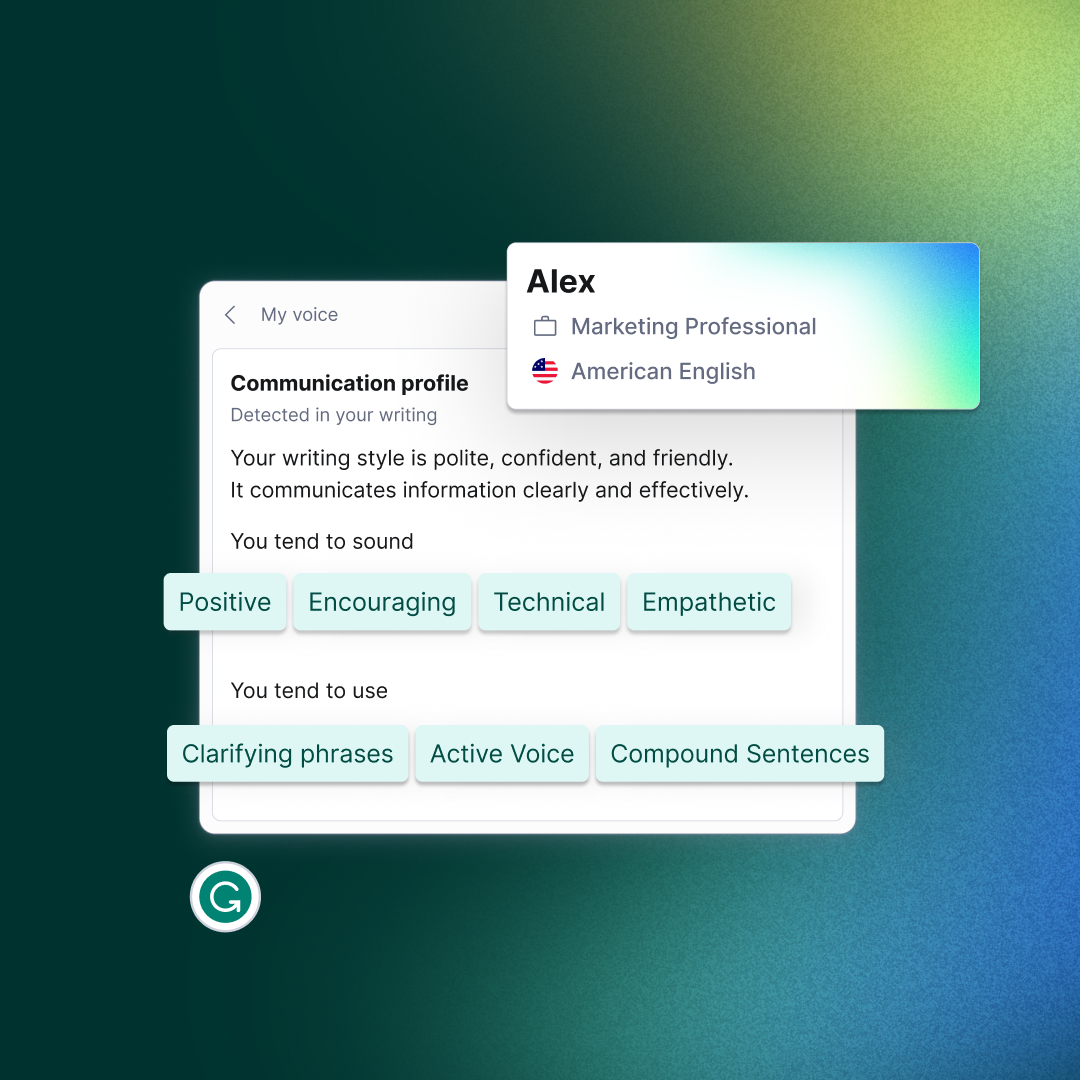
Those are questions that are likely to be raised by a feature in Grammarly, the cloud-based typing assistant, that’s scheduled to launch by the end of the year for subscribers to Grammarly’s business tier. Called “Personalized voice detection and application,” the feature automatically detects a person’s unique writing style and creates a “voice profile” that can rewrite any text in the person’s style.

“Because Grammarly works across apps and tools, we can understand a user’s unique style and preferences in the places they communicate to generate a personalized profile,” Tal Oppenheimer, head of product for Grammarly’s client apps, told TechCrunch in an email interview. “We generate a person’s profile as they passively use our product.”

Oppenheimer says that each profile, which comes with an AI-generated description that highlights what Grammarly sees as the defining characteristics of the person’s style (e.g. “positive,” “encouraging”), can be customized to a certain degree. Users can discard elements such as tone and style choices — say, a tendency to use active voice and compound sentences — that they believe don’t accurately reflect the way they write.

Grammarly

Grammarly’s new voice profile feature, which uses generative AI to match the style of a person’s writing. Image Credits: Grammarly

“As this is the first release of our personalized voice features, we’ll continue to refine them over time and consider ways to make them even more personalized to customers and their needs,” Oppenheimer said.

Grammarly pitches the tech as a way for writers to leverage context to “make [their] writing sound more personal.” But this writer worries about how it might be used in considerably less charitable ways.

Imagine a company tapping a Grammarly voice profile while a writer’s on leave — or after they’ve been let go — to publish blog posts under their byline without their approval and without compensating them. Or, picture a Grammarly voice profile being used to impersonate someone in a sophisticated phishing attempt.

It’s not as far-fetched as it sounds. Author Jane Friedman discovered in August that new books were being sold on Amazon under her name — new books that she didn’t write, and that appeared to have been generated by AI. (Amazon later removed the fake books and said that its policies prohibit such imitation.)

Grammarly isn’t the first to bring to the fore the issue of writer protections where they pertain to generative AI, of course. Thousands of authors recently signed an open letter decrying generative AI technologies that “mimic and regurgitate” their “language, stories, style and ideas.” Writers in California and New York, meanwhile, have gone a step further, suing AI startup OpenAI — which they say trained text-generating AI on their work without permission — over alleged IP theft.

Now, to be fair to Grammarly, not just anyone can access a Grammarly voice profile. At least at launch, individual users can only use their corresponding voice profile — not anyone else’s. And they can’t be exported.

I do worry, though, about how voice profiles might evolve down the line given Grammarly’s emphasis on cost savings in its marketing materials. Conceivably, in the pursuit of cost cutting, a Grammarly-subscribed business will eventually want access to all of its writers’ profiles. Will Grammarly deny them? Who’s to say?

For her part, Oppenheimer stressed that voice profiles “aren’t designed to replace anybody.”

“Rather than imitate them, [voice profiles] helps [writers] learn about how they sound, create more personalized output and write in a more authentic way.”

Call me skeptical, but I’m very wary.

Personalized voice detection and application joins Grammarly’s other generative AI features, many of which are entering general availability this week. The company, which has more than 30 million users and over 70,000 teams on its platforms, says that users are creating over 12 million pieces of content weekly with the features.

Amazon brings conversational AI to kids with launch of ‘Explore with Alexa’

Amazon brings conversational AI to kids with launch of ‘Explore with Alexa’ Sarah Perez @sarahintampa / 20 hours

Amazon’s Echo devices will now allow kids to have interactive conversations with an AI-powered Alexa via a new feature called “Explore with Alexa.” First announced in September, the addition to the Amazon Kids+ content subscription allows children to have kid-friendly conversations with Alexa, powered by generative AI, but in a protected fashion designed to ensure the experience remains safe and appropriate.

Though there are already some AI experiences that cater to younger users, like the AI chatbots from Character.ai and other companies, including Meta, Amazon is among the first to specifically look to generative AI to develop a conversational experience for kids under the age of 13.

That also comes with constraints, however, as generative AI can be led astray or “hallucinate” answers, while kids could ask inappropriate questions. To address these potential problems, Amazon has put guardrails into place around its use of gen AI for kids.

For starters, the Alexa Kids science team narrowed down the new experience, which leverages Alexa’s LLM (large language model) technology, to include only kid-friendly fun facts and trivia questions. Initially, the content will come from just two partners, the World Wildlife Fund and A-Z animals. In time, the team would like to expand the AI to include other areas of interest to kids, like space, music, video games and sports.

In addition, and perhaps most importantly, the generative AI experience is not happening in real time on the device.

“We want to go slow and be intentional and be measured with how we’re introducing this new tech, as well as any new tech for kids, which is why we’re not just hooking the experience up to an LLM at runtime and kind of letting kids go at it,” explains Arjun Venkataswamy, senior product manager for Alexa Kids, in an interview with TechCrunch. “The way that we’ve integrated an LLM here is we use it to generate content at scale offline, and then go through a review process that includes both humans, as well as AI, and then take that reviewed content and then put it into our experience,” he says.

In other words, kids aren’t using generative AI on the fly when conversing with Alexa, and the content is pre-reviewed and comes from a small dataset of just animal facts and sources.

However, because the AI can generate tens of thousands of potential responses, not every answer can be reviewed by a human before being added to the experience. To that end, Amazon is also using AI to help it review the materials it’s using for “Explore with Alexa.”

“What our AI is doing is taking trusted content and then figuring out what’s fun, looking at what’s fun, turning them into a trivia question — so it is doing useful things for us at scale that we wouldn’t have been able to do without this tooling…but we feel really good about the safety guardrails that are in place right now in terms of content,” says Venkataswamy.

To access the new experience, kids can trigger the AI-generated facts or trivia in one of two ways. They can either utter a particular phrase that kicks off “Explore with Alexa,” like “Alexa, let’s explore animals” or “Alexa, tell me an animal fact.” But the more interesting way to use this feature is to have kids engage in organic conversations with Alexa where this topic could come up. For instance, a kid might ask “What does a lion’s roar sound like?” or “How fast can a cheetah run?” This would also allow kids to enter the more conversational Q&A experience.

Plus, over the next few months, Alexa will also prompt kids on some occasions, asking if they want to hear something interesting about animals.

Unlike more traditional conversations with Alexa, the AI experience works two ways. That is, it’s not just kids asking Alexa a question and receiving a response.

“One of the things we think is really cool about this paradigm is kids aren’t just asking Alexa questions and getting the answers — Alexa is now asking kids questions,” says Venkataswamy. That is, Alexa could ask the kids a trivia question like “What’s the fastest animal on Earth?”

As any teacher will tell you, by having the kids try to think of the answer first, the answer will stick in their minds better when they hear the response.

“Right now it’s, it’s narrow. Alexa is asking kids trivia questions,” Venkataswamy continues. “But we want to continue expanding on that and making it more interactive.”

Eventually, Amazon wants to have this generative AI experience integrated at runtime for both kids and adults, but it knows it needs to proceed carefully, especially with the former.

“We do want to integrate an LLM in runtime in a more protected way than we would integrate it for adults…However, this approach lets us iterate and figure out the right ways to get both safe and delightful content outputted from the LLM for kids,” says Venkataswamy.

Amazon is also preparing to launch an AI-powered “Let’s Chat” Alexa experience for adults later this year, he says.

In terms of privacy, the company notes it’s not training its LLM on kids’ answers. In addition, the “Explore with Alexa” experience and any future LLM-backed features will continue to follow the same data handling policies of “classic Alexa” (non-AI Alexa). That means the Alexa app will include a list of the questions asked by kids in the household (those with a kids’ profile) and the response Alexa provided. That history can be stored or deleted either manually or automatically, depending on your settings.

amazon tablets kids

Image Credits: Amazon

Alongside the launch of “Explore with Alexa,” the new Echo Pop Kids speakers will also now be available for purchase, starting at $49.99 in the U.S.

The Echo Pop Kids will come in two new designs: Marvel’s Avengers and Disney Princess, which feature corresponding character themes. Kids can use the devices to hear a greeting, fun fact or joke about an Avenger or Disney Princess, in keeping with the theme. Both also include six months of access to the Amazon Kids+ subscription service, which, in addition to “Explore with Alexa,” also offers a range of kid-friendly games, apps, books, videos and more, including custom Alexa themes.

However, you don’t need a specific “Kids” device to use “Explore with Alexa.” The feature works on any device set to kids mode or any communal family device, if parents have set up their kids’ voice ID.

Initially, “Explore with Alexa” will be available in English only but internationalization is further down the road.

It’s harder for Amazon to estimate when such an AI feature will become available at runtime for kids, though.

“I can’t give you a timeline, because we don’t have a concrete answer for what exactly we’re going to be doing yet, although we do have plans and experiments we’re planning to look into,” Venkataswamy says. “I will say that in terms of our criteria for when we’re going to get there, we’re working closely with the Family Trust team at Amazon that’s connected to a variety of research institutions in the U.S…we want to be able to get some confidence from external partners that our approach is right,” he adds.