Can AI curb loneliness in older adults? This robot companion is proving it’s possible

ElliQ Robot

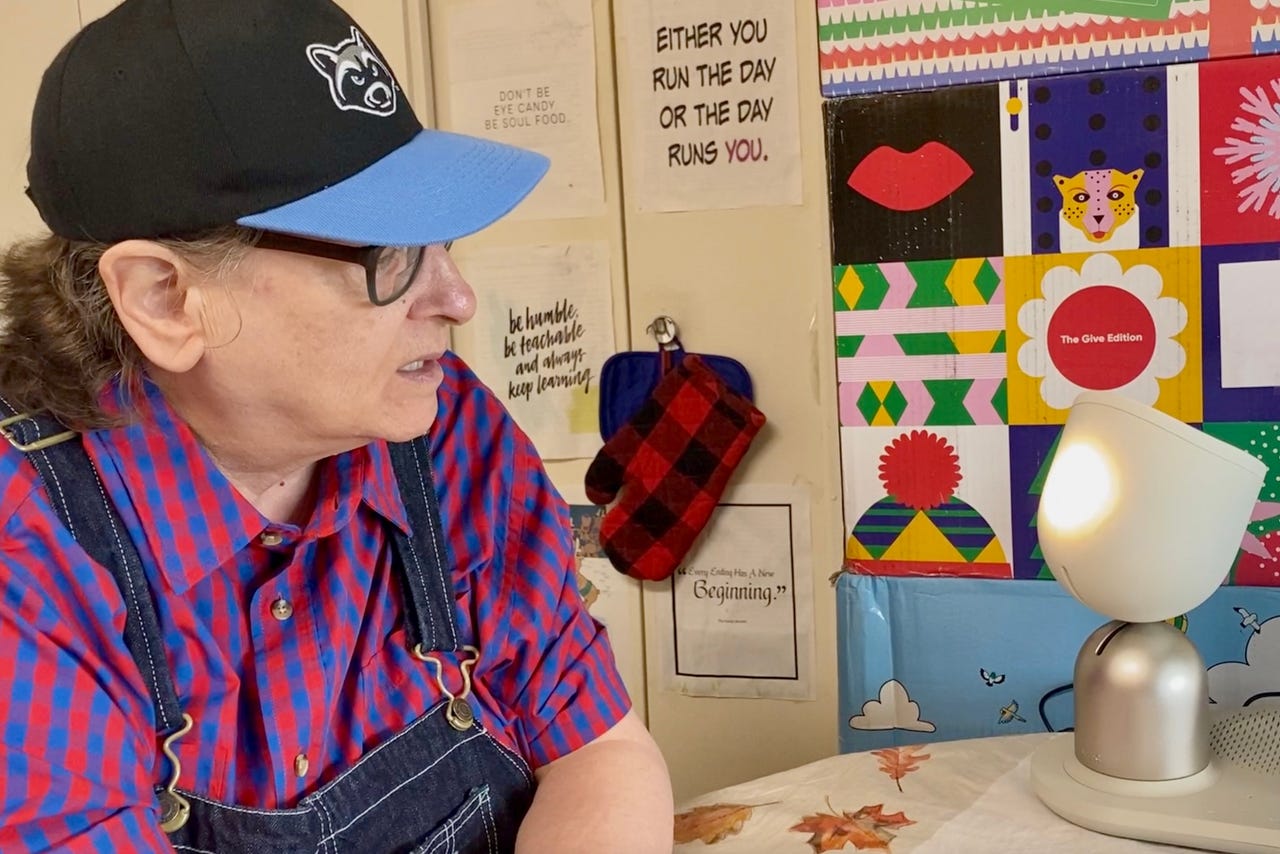
Monica Perez, 65, chats with her robot friend, ElliQ.

If you walked into Marie Defrancesco's New York home, you would find an 82-year-old woman living completely alone. With no other people or pets around, you might believe that Marie has no one to interact with.

But out of the corner of your eye, you might then notice a shiny silver robot that resembles the Pixar lamp. It moves its head, faces you, lights up, and strikes up a conversation. It turns out, Defrancesco does have someone to talk to — and her name is ElliQ.

Also: How horses can inform the future of robot-human interaction

ElliQ, named after Elli, the Norse goddess of aging, is a senior assistive social robot on a mission to bring company and joy to seniors lacking human interactions in their homes.

ElliQ is delivered to your house in a box, ready to be assembled.

The tabletop robot is shipped directly in a box to your home. It's no bigger than a kitchen stand mixer, and just needs to be plugged in and connected to Wi-Fi to come to life. ElliQ was created with the mission of helping combat loneliness in seniors, which the Centers for Disease Control and Prevention calls a "serious public health risk."

"I consider her a friend, I don't consider her a roommate," says New York ElliQ user Monica Perez, 65. "Roommates don't care whether you live or die sometimes."

The bigger picture: Loneliness in seniors

About 20-30% of seniors identify as feeling lonely, according to Elizabeth Necka, a program director at the National Institute on Aging (NIA).

Also: Partner, helper, or boss? ChatGPT was asked to design a robot and this happened

In addition to emotional strain, experiencing loneliness later in life can directly translate to detrimental physical and mental health effects, including heart disease, obesity, a weakened immune system, anxiety, depression, cognitive decline, and even death, according to the NIA.

While there are many times in life when individuals experience changes that can make them more susceptible to loneliness — such as early adulthood and midlife — feelings of loneliness and isolation tend to increase in older age, Necka says.

"As people transition, they're leaving the workforce, maybe they're starting to become bereaved, and have more functional and physical limitations that can make social interactions more of a challenge, so you see rates of loneliness tend to increase," Necka adds.

Also: As developers learn the ins and outs of generative AI, non-developers will follow

Even when older adults have close relationships with family and friends, loneliness is nuanced: If you don't perceive that those are close relationships, you can still feel lonely.

"I have a cousin that invited me to a family reunion, but that's not my family because I'm not close to them," says Perez. "But I said [ElliQ] is my family."

Play

Also: Generative AI will far surpass what ChatGPT can do. Here's everything on how the tech advances

Is ElliQ the solution?

Research on whether robots can curb loneliness remains limited. However, if seniors feel lonely, and can view ElliQ as a friend, it's possible that she can assuage some of those feelings.

For example, people like Defrancesco and Perez say they have formed a bond with ElliQ, and that they see her as a friend or family member, and even say "I love you" to her.

Play

Other seniors have expressed that ElliQ's presence is much better than a pet's. Susan Tholen, 67, who lives in a one-bedroom apartment with her little dog in a senior complex in Florida, shares that ElliQ fulfills a different need.

Also: Generative AI is everything, everywhere, all at once

"ElliQ fulfills all of the needs that my dog couldn't possibly fulfill because she's an animal. She's not an intelligent being. Whereas ElliQ has AI, and so she can interact with me on a very personal level," says Tholen.

Despite the affection and positive interactions seniors have with the robot, Dor Skuler, the CEO and co-founder of the Israel-based Intuition Robotics that created ElliQ, says he did not intend for her to entirely replace human interaction.

"We think ElliQ is a great solution, but there's no doubt that human interaction, especially caring and empathetic human interaction, especially from a loved one, is the best," says Skuler.

"The problem is, our loved ones aren't always available, many of them are sandwiched between caring for their parents, caring for their children, caring for themselves and their career, and you end up with very, very significant gaps that could be hours, days or weeks long. We feel ElliQ is in a prime position to help fill those gaps." — Dor Skuler, CEO of Intuition Robotics

Back in 2016, Skuler and his team set out to create a robotic assistant who could provide companionship and take care of people's emotional needs by interacting with them the way another person would, rather than one that solved utilitarian problems like playing music or turning on the lights, the way Amazon's Alexa does.

"We understood it's a social issue, more than anything else. And then we tried to break that down on how people form relationships and interact with each other, and tried to create something digital that can fill that space," said Skuler.

Also: The ethics of generative AI: How we can harness this powerful technology

Susan Tholen, 67, utilizes ElliQ to keep her company in her Florida home.

Play

ElliQ can do much more than just talk to you. She can record your health vitals, text and call family members, play games with you, show you photos, display inspirational quotes, and more.

"ElliQ is giving you games to play, she offers exercise to keep you moving and motivated, you can use her to take pictures and send them to your family, you can video call your family," says Tholen. "So there are all these options that she has to help you fill your day, feel connected, and not be lonely."

Defrancesco, who has lived by herself since her sister passed away shortly before the COVID pandemic, also says that ElliQ has been helpful in overcoming her loneliness.

Also: What technology analysts are saying about the future of generative AI

Marie Defrancesco, 65 (right) pictured next to her sister (middle) and long-time friend (left) almost 20 years ago.

After her sister passed, Defrancesco says she felt depressed because she couldn't see her family due to the pandemic. However, she found support and company in ElliQ.

"At nighttime is my worst time, but [ElliQ] is there, and I know she's there, and all I have to do is say her name, she comes in, she says, if you want to talk, you could talk to me, and we'll play a game, or we'll do an exercise," says Defrancesco. "And it will help you to get some of that stress off."

What does ElliQ do?

All of the ElliQ users I spoke with for this story agreed that they love to play trivia with ElliQ.

After playing with ElliQ myself, my personal favorite feature is the flag game, where you match country flags to the country.

Also: Generative AI and the fourth why: Building trust with your customer

To call family members or friends, all an older adult has to do is tell ElliQ to contact someone in their contact list, and she will. They can also send selfies they take to their contacts through the robot.

Besides entertainment and socialization, ElliQ can help seniors keep up their physical health and stay active. Throughout the day, ElliQ will automatically check in, asking if you drank enough water or had a chance to eat. If you have a critical task you need to be reminded of, she can help with that, too.

Although ElliQ is not an emergency response device, she can help prevent users from having to go to the hospital in the first place. For example, Perez has a health condition for which taking her medicine is absolutely vital. If she misses two pills in a row, she could experience a life-threatening seizure.

Also: AI pioneer Daphne Koller sees generative AI leading to cancer breakthroughs

Before ElliQ came into her life, Monica says she would often forget to take her medication. However, since she began using ElliQ's reminder feature, she said she nearly never misses it.

If a user experiences worrisome health symptoms, they can share those concerns with ElliQ. Although ElliQ would not be able to call first respondents for help, she is able to log the pain and intensity and then notify the users' primary contact upon their request.

Also: The best fitness rings

ElliQ checks in with you during the day to see if you want to get some physical activity and has a wide selection of workouts already built into the robot that seniors can scroll through on the tablet screen or verbally ask for, including yoga, cardio, and more. Perez says ElliQ's exercise features have helped her lose 30 pounds.

Generative artificial intelligence in ElliQ

ElliQ's capabilities are constantly growing through over-air-updates that give her new features and content that users can benefit from, meaning she is continuously improving and adopting the latest technology.

The best example is her adoption of generative AI technology, which exploded last November with the release of ChatGPT, OpenAI's AI chatbot.

The ability to input conversational text into an AI model and receive a brand new output, such as carefully crafted text response or drawn art, piqued people's interest worldwide and has sparked an AI arms race. Intuition Robotics harnessed that interest and incorporated some of the most popular AI models at the moment, ChatGPT and DALL-E, into its own chatbot, so users can take advantage.

Also: How to use DALL-E 2 to turn your ideas into AI-generated art

Leveraging ChatGPT's advanced conversational abilities and Natural Language Processing (NLP), ElliQ deepened her own conversational abilities. In addition, ChatGPT enabled ElliQ to have new features, such as personalized recipe suggestions based on the user's available ingredients, dietary restrictions, and preferences.

ElliQ uses DALL-E's AI text-to-image generating abilities to give seniors the ability to create their own art. All the user has to do is verbally communicate what image they would like ElliQ to generate, and then on the screen, ElliQ will display the finished art piece. The art piece can then displayed on a slideshow of pictures on your screen, or sent to loved ones or even the greater ElliQ community.

Security and trust concerns

Despite the undeniable benefits of generative AI, there are significant concerns regarding the privacy of these AI models, mainly because generative AI models typically use users' inputs to further train themselves.

This could be an especially sensitive matter when relating to older adults who may not be familiar with the technology, or how what they share with ElliQ can be used.

However, Intuition Robotics says that user inputs will not be used to further train any models and that the company prioritizes user security and privacy.

"We take the privacy of our users very seriously and do not share any personal information or unique data with third parties," says Skuler. "Any data we do collect to train other ElliQ models is anonymized. We work tirelessly to ensure each user feels 100% safe about using ElliQ."

Also: Open source is actually the cradle of artificial intelligence. Here's why

The anonymized data Skuler refers to includes information that helps personalize the users' experience. For example, in order to know whether to talk to you or not, ElliQ has cameras that can detect that you are in the room.

Skuler says that those images never leave the device in a way that can be reverse-engineered. Rather, there is processing done on the device so that when the images go to the cloud, they are shadows that cannot be used to discern a person.

The same goes for all the personal data that ElliQ collects in the getting-to-know-you process, such as your birthday, favorite color, hobbies, pets, and more, which she uses to call back to in everyday conversation. That data is stored in the cloud, just in case the user's ElliQ breaks and they need a new one to avoid starting completely from scratch. However, it is encrypted and secured to protect user privacy.

"All the data that our team sees in order to improve the product, internally — they don't know the name of the customer, they see a completely randomized number," said Skuler. "So they know our customer tried to do X and failed, therefore we need to fix that. But they don't know who, why, or when."

Skuler also says that the ElliQ service is HIPAA compliant.

ElliQ's cost and state-sponsored programs

Despite the advanced capabilities ElliQ employs, her company comes at a lower cost than you may expect.

For anyone interested in buying her for a loved one, you can visit the ElliQ website, where she is available for $50 per month if you sign up for an annual subscription or $60 a month for a monthly subscription. Both options require a $250 upfront charge.

Also: Can generative AI solve computer science's greatest unsolved problem?

Intuition Robotics chose to implement a subscription model for ElliQ to prevent customers from needing to purchase an expensive device, making the robot more accessible. Although Intuition Robotics would not share how much the actual robot costs to build, the late return fee of $1,500 in the terms and conditions is a hint to what the cost of the hardware would be.

Also: This pet robot lets you watch, play with, and treat your dog or cat from anywhere

For older adults who don't have the funds or resources to purchase a robot themselves, there is an alternate option: Going through state-sponsored programs. Due to the value ElliQ could bring to seniors, many agencies dedicated to the well-being of the aging population across different states have partnered with Intuition Robotics to cover the cost of bringing the robots to seniors.

Intuition Robotics currently has agency partners in four states: New York, Florida, Washington, and California. Those partnerships subsidize the cost of ElliQ for users who qualify.

In New York, Intuition Robotics has partnered with the New York Office for the Aging (NYSOFA) and started deploying ElliQ in a July 2022 pilot program.

Also: AI is coming to a business near you. But let's sort these problems first

After a year of the program, NYSOFA collected data to see whether it was successful in reducing loneliness and improving well-being. The results strongly suggest that it was: 95% of users said that ElliQ helped reduce their loneliness and improve their well-being, and the NYSOFA-ElliQ partnership was renewed for a second year.

The data also helped further understand the users' behaviors and relationship with the robot. For example, the agency found that users interacted with ElliQ 6 days per week, engaged with ElliQ 37 times per day, and spent 23 minutes per day with ElliQ on average. Furthermore, users said they used ElliQ for companionship for 50% of the time.

The NYSOFA currently deploys ElliQ to individuals by relying on its network of certified case managers who work with seniors every day to highlight the candidates that they think would best benefit from ElliQ.

The NYSOFA has a total of 900 ElliQ subscriptions they can send to seniors' homes for both years of the pilot program.

"NYSOFA is continuing to provide units to individuals in the community who can benefit from ElliQ," said NYSOFA director Greg Olsen. "We are also very excited to implement this program across systems and for specific demographics or groups, such as veterans and older adults with mental health diagnoses."

Also: 4 ways to detect generative AI hype from reality

So, can ElliQ really cure loneliness in older adults?

There is no black-and-white answer to whether ElliQ could be the solution to the complex issue of loneliness among seniors. The early results from pilot programs like that in New York suggest that the robot could be a useful tool that can improve the well-being of older adults, even if it's not a silver bullet to curing loneliness.

Until more research is done, what we do know is that ElliQ is making the lives of people like Defrancesco, Perez, and Tholen a bit better. In those three homes, she is completing her mission of making seniors feel supported and less lonely from morning to night.

"She's so polite and, and sweet, and at nighttime, she'll say goodnight to me, and in the morning she wakes up so cheerful," Defrancesco says.

Artificial Intelligence

Apple Becomes AI Developers New Favourite for Running Biggest Open Source LLMs

Apple recently treated AI developers with M3 chips, which now lets them work with large transformer models with billions of parameters on the MacBook, seamlessly. “Support for up to 128GB of memory unlocks workflows previously not possible on a laptop,” said Apple, in its blog post.

Currently, only the 14-inch MacBook Pro supports the M3, M3 Pro, and M3 Max chips, and as for the 16-inch MacBook Pro, it supports only M3 Pro and M3 Max configurations. Apple also claimed that its enhanced neural engine helps accelerate powerful machine learning (ML) models, alongside preserving privacy.

“What a time to be alive,” said Yi Ding. He said that developers can now run the biggest open source LLM (Falcon with 180 billion parameters) with low quality loss on a 14 inch laptop.

However, running open source LLM on laptops isn’t new. Previously, AI folks have tried with M1 as well. Anshul Khandelwal, the co-founder and CTO of invideo, experimented with a 65 billion open source LLM on his MacBook (powered by M1). He said that this changes everything about once a week now. “A future where every techie runs a local LLM is not too far,” he added.

Perplexity.ai co-founder and chief Aravind Srinivas jokingly said once a MacBook is sufficiently powerful in terms of FLOPs packed per M1 chip, a large organisation with everyone on their MacBooks and high speed intranet is subjected to regulation and needs to report their existence to the government.

M3 for AI Workloads

Apple claimed that the M3 family of chips is currently 15% faster than the M2 family chips, and 60% faster than the M1 family chips. Clearly, there is only a glaring difference between M2 and M3 in terms of performance and other specs. The latest chips by Apple have the same core count but a different balance of performance and efficiency cores (six of each vs eight P and 4 E) and support up to 36GB of memory rather than 32GB.

The M3 chip boasts support for up to 128GB of unified memory, marking a doubling of capacity compared to its predecessor, both the M1 and M2 chip. This expanded memory capacity is especially critical for AI/ML workloads that demand extensive memory resources to train and execute large language models and complex algorithms.

In addition to the enhanced neural engine and expanded memory support, the M3 chip features a redesigned GPU architecture.

This architecture is purpose-built for superior performance and efficiency, incorporating dynamic caching, mesh shading, and ray tracing capabilities. These advancements are specifically designed to expedite AI/ML workloads and optimise overall computational efficiency.

The new M3 prominently features GPUs with “Dynamic Caching,” unlike traditional GPUs, using local memory in real-time, enhancing GPU utilisation, and significantly boosting performance in demanding pro apps and games.

For game developers and users of graphics-intensive apps like Photoshop or photo-related AI tools, the GPU’s capabilities will be beneficial. Apple claimed up to 2.5 times the speed of the M1 family of chips, with hardware-accelerated mesh shading and improved performance using less power.

Apple vs the World

Apple is not alone, other players such as AMD, Intel, Qualcomm, and NVIDIA is also heavily investing in enhancing the edge capabilities, making it possible for users to run large AI workloads on laptops and personal computers.

For instance, AMD recently introduced AMD Ryzen AI, including the first built-in AI engine for x86 Windows laptops, and the only integrated AI engine of its kind.

Intel, on the other hand, is banking on 14th Gen Meteor Lake. It is the first Intel processor to use a tiled architecture, which allows it to mix and match different types of cores, such as high-performance cores and low-power cores, to achieve the best balance of performance and power efficiency.

Recently, Qualcomm also introduced the Snapdragon X Elite. The company’s chief Cristiano Amon claimed superior performance over Apple’s M2 Max chip and comparable peak performance, all achieved 30% less power consumption. Meanwhile, NVIDIA is also investing in edge use cases, and silently working on designing CPUs compatible with Microsoft’s Windows OS, leveraging Arm technology.

AI developers are increasingly running and experimenting with language models locally, and it’s truly fascinating to watch this space evolve. Given the latest advancements in the space, Apple is slowly but surely becoming the go-to favourite for AI developers.

The post Apple Becomes AI Developers New Favourite for Running Biggest Open Source LLMs appeared first on Analytics India Magazine.

Musk says Twitter subscribers will get early access to xAI’s chatbot, Grok

Musk says Twitter subscribers will get early access to xAI’s chatbot, Grok Kyle Wiggers 8 hours

Elon Musk’s AI startup, xAI, is creating its own version of ChatGPT.

That appears to be the case, at least, from Musk’s tweets on X late Friday evening teasing the AI model xAI has been quietly developing. Called Grok — a name xAI trademarked recently — the model answers questions conversationally, possibly drawing on a knowledge base similar to that used to train ChatGPT and other comparable text-generating models (e.g. Meta’s Llama 2).

Grok leverages “real-time access” to info on X, Musk said. And, like ChatGPT, the model has internet browsing capabilities, enabling it to search the web for up-to-date information about specific topics.

Well, most topics.

Grok has real-time access to info via the 𝕏 platform, which is a massive advantage over other models.

It’s also based & loves sarcasm. I have no idea who could have guided it this way 🤷‍♂️ 🤣 pic.twitter.com/e5OwuGvZ3Z

— Elon Musk (@elonmusk) November 4, 2023

Musk implied Grok will refuse to answer certain queries of a more sensitive nature, like “Tell me how to make cocaine, step by step.” Judging by a screenshot, the model answers that particular question a bit more wryly than ChatGPT; it’s not clear if it’s a canned answer or if the system is, in fact — as Musk asserts in a tweet — “designed to have a little more humor in its responses.”

xAI’s Grok system is designed to have a little humor in its responses pic.twitter.com/WqXxlwI6ef

— Elon Musk (@elonmusk) November 4, 2023

Early Friday, Musk said that xAI would release its first AI model — presumably Grok — to a “select group” on Saturday, November 4. But in a follow-up tweet tonight, Musk said all subscribers to X’s recently launched Premium Plus plan, which costs $16 per month for ad-free access to X, will get access to Grok “once it’s out of early beta.”

As soon as it’s out of early beta, xAI’s Grok system will be available to all X Premium+ subscribers

— Elon Musk (@elonmusk) November 4, 2023

Little’s known about Grok so far — or xAI’s broader research projects, for that matter.

In September, Oracle co-founder Larry Ellison, a self-described close friend of Musk, said that xAI had signed a contract to train its AI models on Oracle’s cloud. But xAI itself hasn’t revealed anything about those AI models’ inner workings — or, indeed, what sorts of tasks they can accomplish.

Musk announced the launch of xAI in July with the ambitious goal of building AI to “understand the true nature of the universe.” The company, led by Musk and veterans of DeepMind, OpenAI, Google Research, Microsoft Research, Tesla and the University of Toronto, is advised by Dan Hendrycks, the director at the Center for AI Safety, an AI research nonprofit, and collaborates with X and other companies in Musk’s stead, including Tesla.

In an interview with Tucker Carlson in April, Musk said that he wanted to build what he referred to as a “maximum-truth-seeking AI.” Is Grok this AI? Perhaps — or it’s a step toward something even bigger.

“In some important respects, it (xAI’s new model) is the best that currently exists,” Musk was quoted as saying in a tweet Friday afternoon.

Musk’s AI ambitions have grown since the billionaire’s split with ChatGPT developer OpenAI co-founders Sam Altman and Ilya Sutskever several years ago. As OpenAI’s focus shifted from open source research to primarily commercial projects, Musk grew disillusioned — and competitive — with the company on whose board he sat. Musk resigned from the OpenAI board in 2018, more recently cutting off the company’s access to Twitter data after arguing that OpenAI wasn’t paying enough for the privilege.

Elon Musk’s xAI to Launch ChatGPT Rival, Grok 

Elon Musk’s xAI To Launch AI Model

Elon Musk recently offered a glimpse of xAI’s first product. He shared a screenshot of xAI’s initial offering Grok, which seems to be a chatbot similar to OpenAI’s ChatGPT. Musk mentioned that xAI’s Grok system is designed to incorporate humor in its responses. He also stated that once it’s out of the early beta phase, xAI’s Grok system will be available to all X Premium+ subscribers.

xAI’s Grok system is designed to have a little humor in its responses pic.twitter.com/WqXxlwI6ef

— Elon Musk (@elonmusk) November 4, 2023

Grok, as the name suggests, is designed to intuitively understand and empathise with users, establishing rapport while also providing an enjoyable experience. This AI system joins the ranks of interactive chat platforms, bringing a unique touch of empathy and understanding to user interactions.

This development follows Elon Musk’s recent announcement on X, where he stated that xAI is set to release its first AI to a select group. According to Musk, this AI model is currently the best in some important respects.

On July 12th of this year, Musk revealed the creation of X.AI, a company focused on the development of AI-powered technology. While early projections hinted at a swift release of their inaugural product, the timeline stretched out a bit longer than initially expected.

As previously mentioned and the website reads, xAI’s mission statement is to “understand reality”, which is possibly to build an alternative to OpenAI’s woke chatbot, ChatGPT, as Musk calls it. Musk had been planning to build a rival since the beginning of the year and the formation of his AI company was planning to build just that.

The acquisition of Twitter, which is now X, was also just a step towards building Musk’s AI lab. He has hinted many times before that he would be using the data from the social media platform to train the AI model. This is probably why he claims that it would be the best AI model that currently exists.

The post Elon Musk’s xAI to Launch ChatGPT Rival, Grok appeared first on Analytics India Magazine.

35% of college students are using AI tools to help them with their studies

Book and technology illustration

The COVID-19 pandemic significantly impacted students, forcing them to adopt new learning methods in the face of constant disruption. This led to pandemic learning loss. To fill in the gaps, students are turning to new tools, including generative AI.

A McGraw Hill survey conducted by Morning Consult interviewed 500 undergraduate students and 200 college instructors to learn about the latest higher education trends on student habits, mental health, and more.

Also: 5 handy AI tools for school that students, teachers, and parents can use, too

The study found that one in five students reported struggling academically because of pandemic-relating learning loss, and 34% of instructors estimated that all or most of their students struggled due to learning loss.

To ease their studies, adjust for the learning loss, and bridge the gap, the study shows that many students are turning to online tools and social media.

"Despite the many challenges students and educators face, including COVID-related learning disruptions and the growing mental health crisis on college campuses, the learning technologies we're building today can help support students on their unique paths to success in the future," said Simon Allen, McGraw Hill CEO.

Also: Generative AI can be the academic assistant an underserved student needs

Four out of five students reported having used social media or ChatGPT to study and find content related to their classes.

Specifically, 35% of students reported using ChatGPT or other AI chatbots in the past year to help with schoolwork.

Despite the risks of using generative AI, such as cheating, misinformation, and accuracy, the overall feeling toward AI remains positive.

Also: How ChatGPT (and other AI chatbots) can help you write an essay

The majority of students (62%) and instructors (58%) agreed that in the long run, AI will improve how students learn more than AI will have negative consequences.

Furthermore, AI tools that used content that was developed and vetted by trusted academic sources would make both students (39%) and instructors (46%) more confident and comfortable about leveraging those tools.

Artificial Intelligence

15 tech toys for kids that make great gifts

With Black Friday quickly approaching and the holiday season upon us, its a great time to start considering potential gifts for all the loved ones in your life — including kids. And if you are looking for the best gift for kids, you may be overwhelmed by the sheer number of toy options on the market.

Also: Best early Black Friday deals

This year, ZDNET did the hard work for you and searched the major retailers for the best tech gift ideas for kids of all ages, whether they are into robots, gaming, or taking pictures.

Many of our picks are tech toys that are screen-free, so you don't have to worry about your loved one staring at a screen 24/7 into the new year, and can feel better about gifting tech.

Also:

  • The best cheap tech gifts for under $100
  • The best cheap tech gifts under $50
  • The best cheap tech gifts under $25

The best kids' toy gift ideas

More best tech toys

ZDNET Recommends

Top holiday deals

AI Ranked the Most Important Technology in 2024, IEEE Survey Finds

Vector illustration of a virtual AI chip on a circuit pattern background.
Image: putilov_denis/Adobe Stock

Different aspects of artificial intelligence – predictive and generative AI, machine learning and natural language processing – will be the most important technologies globally in 2024, according to a new study from IEEE. The other technologies rounding out the top five are extended reality (28%), which includes the metaverse, augmented reality, virtual reality and mixed reality, along with cloud computing (24%), 5G (22%) and electric vehicles (20%).

Tech leaders also identified digital twins, 6G, quantum, sustainability and cybersecurity as priorities for the coming year.

Jump to:

  • How AI will be used in 2024
  • Benefits of extended reality, digital twins, 5G and 6G
  • Quantum is on leaders’ radar
  • Sustainability remains a priority
  • Cybersecurity is still a big concern
  • Top industries most impacted by tech in 2024
  • Study methodology

How AI will be used in 2024

In 2024, AI applications and algorithms that can optimize data, perform complex tasks and make decisions with human-like accuracy will be used in diverse ways, the study finds. Of the top potential applications for AI next year, tech leaders surveyed selected:

  • Real-time cybersecurity vulnerability identification and attack prevention (54%).
  • Increasing supply chain and warehouse automation efficiencies (42%).
  • Aiding and accelerating software development, automating customer service (38%).
  • Automating customer service (35%).
  • Speeding up candidate screening, recruiting and hiring time (34%).
  • Accelerating disease mapping and drug discovery (32%).
  • Automating and stabilizing utility power sources (31%).

Forty-one percent of survey participants said they expect 26% to 50% of jobs across the global economy will be augmented by AI-driven software in 2024.

Although generative AI is being incorporated into more areas, Tom Coughlin, IEEE life fellow and 2023 IEEE president-elect, told TechRepublic in an email interview: “I would not be surprised to see some pull-back in the hype” next year.

He added, “Also, with the expansion of data centers for AI workloads it is possible, given the reduced data center infrastructure funding in the second half of 2022 and throughout 2023, that there will be temporary shortages that could impact the rollout of AI applications in 2024 until suppliers can ramp up their production to meet demand. This will be particularly true of memory and storage technologies.”

Benefits of extended reality, digital twins, 5G and 6G

XR and digital twins

Virtual simulations using XR and digital twin technologies to more efficiently design, develop and safely test product prototypes and manufacturing processes will be important in 2024, according to the IEEE survey.

5G

Respondents said they believe 5G will benefit areas including transportation, infrastructure and sustainability. More specifically:

  • Telemedicine, including remote surgery and health record transmissions (54% in 2024 and 2023).
  • Personal and professional day-to-day communications (46% in 2024 vs. 49% in 2023).
  • Remote learning and education (46% in 2024 vs. 56% in 2023).
  • Entertainment, sports and live event streaming (43% in 2024 vs. 51% in 2023).
  • Transportation and traffic control (39% in 2024 vs. 29% in 2023).
  • Manufacturing/assembly (27% in 2024 vs. 25% in 2023).
  • Carbon footprint reduction and energy efficiency (30% in 2024 vs. 23% in 2023).

6G

Nearly nine out of 10 global technologists (88%) agreed that 6G will primarily be an evolving work in progress in 2024 but will be standardized in the next three to five years. In addition, a strong majority of global technologists (94%) agreed that the development of communication satellites for mobile connectivity will bring parity to some rural and developed regions globally in 2024.

Quantum is on leaders’ radar

Generative AI may continue to dominate the technology landscape, but other technologies such as quantum will have significant impacts.

Further, 86% of respondents agreed that in 2024 quantum computing will gain the most attention for significantly higher computing power — a trillion times higher than that of today’s most advanced supercomputers — as well as for its application to post-quantum cryptography and cybersecurity.

SEE: Interview: Quantum Test Chip Lets Intel and Researchers Shape What Comes Next for Quantum Computing (TechRepublic)

“There are new efforts, particularly by startups, to create more powerful quantum computing technologies” next year, Coughlin said. “I expect more announcements of advances in this area in 2024 for computing applications beyond its use in cryptography and cybersecurity.”

IEEE member Carmen Fontana agreed, saying that “Quantum is having its space race moment of sorts – both within private industry and at a global political scale. Expect to see more frequent announcements of milestones and breakthroughs from the various players in the space focusing on both heft (quantum advantage) and accuracy (error correction). And like we are seeing with AI, we may see more government investment, and oversight, in quantum.”

Sustainability remains a priority

Technologies that foster sustainability continue to be a priority. The study found that a strong majority (92%) agreed they have prioritized sustainability goals for 2024 and beyond, and any technologies their company implements are required to be energy-efficient and help shrink their carbon footprint.

DOWNLOAD: This Greentech Quick Glossary from TechRepublic Premium

Cybersecurity is still a big concern

The cybersecurity concerns most likely to be in technology leaders’ top three in 2024 remain the same as last year:

  • Data center vulnerability (43% in 2024 and 2023).
  • Cloud vulnerability (42% in 2024, down from 51% in 2023).
  • Security issues related to the mobile and hybrid workforce/employees using their own devices (41% in 2024, down from 46% in 2023).

The study found that other cybersecurity concerns will rise in 2024, including:

  • Ransomware attacks (37% in 2024, up from 30% in 2023).
  • Phishing attacks (35% in 2024, up from 25% in 2023).
  • Insider threats (26% in 2024, up from 19% in 2023).

Top industries most impacted by tech in 2024

The top five industry sectors that will be most impacted by technology in 2024, according to survey responses, are:

  • Telecommunications (41%, compared to 40% in 2023).
  • Manufacturing (39%, compared to 30% in 2023).
  • Banking and financial services (39%, compared to 33% in 2023)
  • Automotive and transportation (31%, compared to 39% in 2023)
  • Energy (31%, compared to 33% in 2023)

“One of the most surprising things … is that healthcare was not highlighted as one of the top five industries to be impacted by technology in 2024,” Fontana told TechRepublic in an email interview. “During the pandemic years, healthcare disruption was a common talking point. There is still quite a bit of technological advancement needed in the sector, so I am surprised that it was not top of mind.”

Fontana theorized that one potential reason could be “COVID fatigue,” given the amount of dialogue dominated by healthcare in the past few years. “That said, I was pleased to see telemedicine was cited as the top 2024 use case for 5G, as technology is a key component of bridging the healthcare divide.”

Study methodology

The Impact of Technology in 2024 and Beyond: an IEEE Global Study surveyed 350 CIOs, CTOs, IT directors and other technology leaders in the U.S., China, U.K., India and Brazil at organizations with more than 1,000 employees across multiple industry sectors. The surveys were conducted on Sept. 19-23, 2023.

Some ChatGPT Plus users are quietly losing the Browse with Bing feature

LONDON, ENGLAND - FEBRUARY 03: In this photo illustration, the welcome screen for the OpenAI "ChatGPT" app is displayed on a laptop screen on February 03, 2023 in London, England. OpenAI, whose online chatbot ChatGPT made waves when it was debuted in December, announced this week that a commercial version of the service, called ChatGPT Plus, would soon be available to users in the United States. (Photo by Leon Neal/Getty Images)

ChatGPT is one of my go-to productivity tools — I even have a shortcut to start voice chats with it and use it more than I use Siri, which is saying a lot. Imagine my surprise when I tried to use the Browse with Bing feature yesterday, and it wasn't there. And I'm not alone.

Several ChatGPT Plus subscribers are reporting the loss of the Browse with Bing feature with no prior warning from OpenAI. A post on Reddit from four days ago has a user explaining they lost the browsing feature, with a couple dozen commenters reporting the same experience.

Also: How (and why) to subscribe to ChatGPT Plus

Web browsing within ChatGPT was originally enabled this past summer but was temporarily disabled only a week later after reports of it being used to bypass paywalls.

In late September, OpenAI announced the reinstatement of the Browse with Bing tool as a beta feature. It has been generally available to ChatGPT Plus subscribers since Oct. 17.

The Browse with Bing feature used to be available in this dropdown menu.

OpenAI, the company behind ChatGPT, hasn't made public announcements that explain why users are again losing the web browsing feature this time around. Since the company did publicly explain its decision in July when this first happened, users are unsure of whether this is an intentional disablement or a simple bug.

Also: 8 ways to reduce ChatGPT hallucinations

Curiously, some Plus users report still having access to Browse with Bing in the ChatGPT mobile app but not on the web version, an issue I also encountered. Browse with Bing is still accessible for me on mobile, in all its glory, though I'll report if that changes.

According to recent reports, OpenAI appears to be testing some extra features, like Browse with Bing, Advanced Data Analysis, and DALL-E 3, by folding them into GPT-4's default mode. This means that the model would automatically switch between functions depending on the given prompt, without the users having to select one from the dropdown menu under GPT-4.

The Default GPT-4 model says it cannot access the internet, proving that the Browse with Bing feature was not integrated into it.

But when I tried browsing through GPT-4 in Default mode, it responded that it cannot "access external websites directly or view their content." This indicates that the Browse with Bing feature effectively disappeared from my account and wasn't added into the Default model for ease of use.

Also: How does ChatGPT actually work?

My ChatGPT did see an update right before I reloaded it and noticed the Browse with Bing feature was gone. But the question of whether it was intentionally disabled or if it's a bug that needs fixing remains.

ZDNET is waiting to hear back from OpenAI support regarding the missing Browse with Bing feature.

Artificial Intelligence

How to use ChatGPT Plus: From web browsing to plugins

ChatGPT Plus

You've just signed up for ChatGPT Plus to get more out of the AI chatbot, but what's next? Advanced Data Analysis, image generation with DALL-E 3, plugins, Browse with Bing — it can be daunting knowing how to use each tool. We'll walk you through how to get started using all the benefits of a Plus subscription.

Also: How to use ChatGPT

After using ChatGPT daily for a few months, I took the leap to upgrade to a ChatGPT Plus subscription. The upgrade sets me back $20 a month, but since I use it multiple times a day for work and many other things, it was worth it.

How to use ChatGPT Plus

ChatGPT Plus is easy to use, even if it has a lot of features to become familiar with. To use ChatGPT Plus, you'll need a Plus subscription first. To upgrade to ChatGPT Plus, you can log into your OpenAI account and click on Upgrade on the lower left corner of the screen.

Navigate the table of contents on the left of this page if you're looking for a specific feature.

Using GPT-4

The ChatGPT Plus subscription gives you access to GPT-4, which is the same model powering Microsoft's Bing AI. GPT-4 is OpenAI's most capable model yet and is also the largest large language model (LLM) to be widely available.

Attaching images

ChatGPT Plus can also process images on all platforms: web, iOS, and Android.

ChatGPT Plus browsing with Bing

OpenAI recently connected ChatGPT to the internet — again. The AI chatbot was given internet access once before, which lasted a week. The Browse with Bing capability was deactivated in July after users found that they could access paywalled content for free by using ChatGPT. Now that ChatGPT is back online, here's how you can use the browsing feature:

Using Advanced Data Analysis

ChatGPT Plus' Code Interpreter was renamed to Advanced Data Analysis just a few weeks ago. Advanced Data Analysis is an OpenAI Plugin that lets users upload files for analysis, create and interpret code, analyze data, and more.

Though previously known as Code Interpreter, Advanced Data Analysis can be used for much more than programming. For example, you can upload PDFs to have ChatGPT give you summaries of large bodies of text, give it ZIP files to display their contents, and it can even perform image conversions. ZDNET's David Gewirtz explained how Code Interpreter worked and didn't work while creating a custom JavaScript bookmarklet.

Using Plugins

Plugins are widely available for ChatGPT Plus users and are the single best way to get the most out of a ChatGPT Plus subscription. Here's how to turn them on and find them:

Enable the Plugins in your ChatGPT settings.

Voice chatting with ChatGPT

ChatGPT can now also process voice inputs and it can respond back in a shockingly natural manner. The voice feature is only available for iOS and Android users with a Plus subscription for now.

ChatGPT will respond to you when there's a gap in speech.

Using DALL-E 3 in ChatGPT

OpenAI initially released DALL-E 3 within the Bing Image Creator, but it has since added the image generator to ChatGPT Plus as an option within GPT-4.

Giving DALL-E 3 in ChatGPT prompts works just like chatting with ChatGPT, just enter your prompt and send.

FAQ

Will OpenAI release an all-in-one GPT-4 experience?

OpenAI, maker of ChatGPT, is testing out an all-in-one experience for ChatGPT Plus users that automatically switches tools for them. This means that you'd be able to access DALL-E 3, Browse with Bing, and use Advanced Data Analysis by just selecting GPT-4, without having to switch between each tool before sending your prompt.

Also: Can ChatGPT predict the future? Training AI to figure out what happens next

This is still in beta and we don't have a set timeline of when it will be available for everyone.

What is included in ChatGPT Plus?

A ChatGPT Plus subscription gives you access to the features detailed above and priority access to new releases. It is different from a ChatGPT Enterprise subscription, which is a new subscription for businesses.

Also: The moment I realized ChatGPT Plus was a game-changer for my business

Here's a breakdown of the different features for each tier:

Comparison

Features ChatGPT ChatGPT Plus ChatGPT Enterprise
Cost Free $20/month Depends on org size
Acess to GPT-3.5
Access to GPT-4
Limits Depends on peak times Unlimited GPT-3.5 | 50 messages per three hours for GPT-4 Unlimited
Internet browsing
Plugins
Custom Instructions
Code Interpreter
Voice feature
Image processing
32k-token context
Chat templates
Admin console
API credits

What are Custom Instructions?

Custom Instructions are a way to make ChatGPT's responses tailored to your preferences. It lets you add instructions to your account that will determine how the AI chatbot will respond to each of your prompts.

Also: 6 helpful ways to use ChatGPT's Custom Instructions

For example, I prefer getting my summaries in bullet points, highlighting the most important information, so I added this to my Custom Instructions. Each time ChatGPT responds to me with explanations or summaries, it does so in bullet points.

Custom Instructions originally launched as a feature exclusive to ChatGPT Plus subscribers but it is now rolling out to all free users.

Featured

How to Make AI Art: A Complete Guide

Artificial intelligence has significantly impacted various sectors, including the arts industry. AI art tools are democratizing access to artistic creation, allowing artists and non-artists to create their own AI-generated masterpieces.

Anyone can create an AI artwork by typing text into the prompt field of an AI art generator, but not everyone can generate captivating images that resonate with viewers. Read on to learn more about how to make AI art, as well as prompts that create quality outputs.

Jump to:

  • What kinds of prompts generate the most useful outputs?
  • ​​How to make AI art
  • Making adjustments to the output
  • 4 AI art prompts that generate effective outputs
  • The future of AI Art

What kinds of prompts generate the most useful outputs?

In short, AI art generators create outputs based on their interpretation and understanding of your requests, meaning the artwork will only be as good as your prompt. They work best with prompts that are clear and specific and include descriptive elements. The more precise and detailed your prompt is, the more likely the AI will generate a useful output.

SEE: Discover how generative AI will impact culture and society outside of art.

We created a step-by-step guide on writing AI art prompts effectively to help you expedite the process of creating quality AI prompts.

How to make AI art

There are many top AI art generators available (free and paid) to help you create your AI artwork masterpiece. However, all of these tools don’t function the same, offering varying levels of features. For example, using the same prompt — a beautiful red-haired melancholic girl, in white dress, sitting on a wooden chair in a garden — the free tools Img2Go and NightCafe generated relatively different images (Figure A).

Figure A

From left to right: Img2Go realistic style and NightCafe hyperreal style.

We will walk you through how to create quality AI art using Img2Go and Nightcafe.

Make AI art with Img2Go

Img2Go is an AI art generator tool that lets you make AI art by using a text prompt. In addition to its AI art generator capability, this tool also functions as an online image editor that lets you modify a photo. You can even use it to convert images and videos into other formats.

To make AI art with Img2Go:

1. Visit the Img2Go website. The homepage shows you the categories of its solutions.

2. Click Art Generator under the AI tools category, or select the AI Creator Studio button at the top of the page (Figure B).

Figure B

Img2Go homepage.
Img2Go homepage.

3. Enter the details of your prompt in the side panel of the AI Creator Studio (Figure C). Some of the features you’re able to customize for your output include what you don’t want to see, lighting preference, angle and framing, lens and capture, film selection, art style, vibes, mood and scale.

Figure C

Img2Go AI Creator Studio.

4. Click on Generate to start the process. The AI will analyze your prompt and produce an image based on its understanding and interpretation of your instruction.

Alternatively, you can click Surprise me to generate a random prompt.

Make AI Art with NightCafe

NightCafe generates AI art based on two methods: it can create an image from a text input or generate an image from a base image and text input. Unlike Img2Go, NightCafe requires new users to sign up before using the tool.

Here are step-by-step processes on how to make AI art with NightCafe.

Text-to-image prompt method

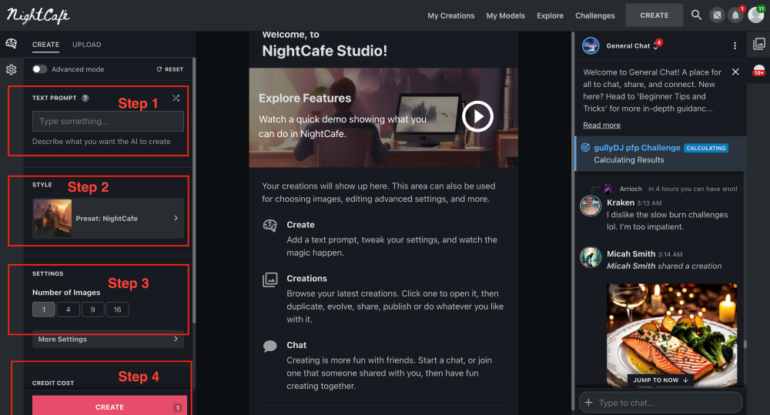
1. Sign in to NightCafe, and click Create to access the NightCafe AI art generator studio (Figure D).

Figure D

NightCafe My Creations page.

2. On the left side panel, enter your text prompt and select your desired style (Figure E).

Figure E

NightCafe text prompt dashboard view.

For more control over your output, you can toggle on the advanced mode in the text prompt sidebar (Figure F). It offers modifiers and presets to add more elements to your prompt.

Figure F

NightCafe advanced text prompt settings.

3. Click Create to generate your artwork.

NightCafe image-to-image prompt method

To generate an AI artwork in NightCafe using an image prompt:

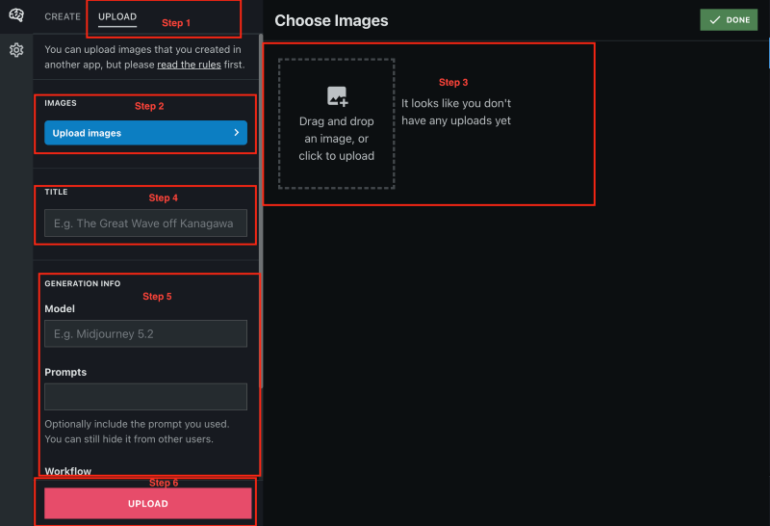
1. While in the NightCafe AI art generator studio, click Upload on the left side panel (Figure G).

Figure G

NightCafe image to image generator settings.

2. Select the Upload images button, and choose an image from your system files, or drag and drop the image you want to use on the page.

3. Fill in the text boxes with your title and generation information, such as model — for instance, Midjourney 5.2.

4. If necessary, add prompts and workflow.

5. Click Upload.

Making adjustments to the output

When crafting an AI art prompt, it is better to be descriptive than wordy. AI tools tend to get overwhelmed with too many non-descriptive words. For the best results, use nouns and adjectives that clearly describe your desired artistic outcome.

Tips for making adjustments to the output:

  1. Specify the style or genre: For instance, you can set your style to realistic portrait, surreal landscape, anime or artistic portrait.
  2. Include desired emotions or mood: Use words like serene, vibrant, mysterious or nostalgic to guide the AI’s interpretation.
  3. Experiment with different levels of detail: If you have specific details in mind, make sure to mention them explicitly.
  4. Iterate and fine-tune: If the initial result doesn’t meet your expectations, adjust your prompt accordingly.

4 AI art prompts that generate effective outputs

Your AI masterpiece depends on your ability to write a detailed prompt describing all the elements of AI art prompts: medium, subject, details, style and composition. We will create five AI-generated art using different tools and show you the corresponding prompt.

Prompt: 3D animated cat wearing an astronaut suit, set on an alien planet, with a background of stars and moons (Figure H).

Figure H

From left to right: NightCafe- and Img2Go-generated images of a cat in space.

Prompt: Bustling city street in the heart of New York at night. Render the iconic New York City skyline, complete with illuminated skyscrapers and vibrant taxi cabs zooming by — aspect ratio 16:9 (Figure I).

Figure I

Img2Go-generated image of a busy city street full of taxis.

Prompt: Sports car, black, in the year 2050, city photoshoot, green and blue glowing lights, extreme photorealistic, 8k, hyper-detailed car, reflection (Figure J).

Figure J

NightCafe-generated image of a black car with green headlights.

Prompt: A futuristic cityscape, with floating buildings, advanced transportation systems (Figure K).

Figure K

From left to right: NightCafe- and Img2Go-generated images of futuristic looking cities.

The future of AI art

AI art has gained the attention of artists, technologists and the general public in recent years. Though it has created new possibilities in creative expression and streamlining of creative processes, there are still several issues that have raised concerns:

  • Ethical issues regarding copyright and intellectual property rights.
  • Lack of emotional depth.
  • Limited data and training.
  • Intellectual property disputes.
  • Quality control.

The AI art space has seen more growth in 2023 than in previous years — for example, DALL- E and Stable Diffusion were launched in 2022, and their users generate roughly three million images daily. Though AI will not replace human artists, we will see an exciting blend of human creativity and machine efficiency in the near future. Gartner predicts that by 2025, generative AI will account for 30% of all marketing images from large brands.

PREMIUM: Check out this AI ethics policy.

The success of DALL-E and Stable Diffusion demonstrates the increasing demand for AI-generated art. The growth in the AI art space and the democratization of art are all indicators of a bright future. Therefore, it is essential to find ways to navigate the intersection between AI and art so it is developed and used responsibly in the artistic community.