Apple CEO Tim Cook says AI is a fundamental technology, confirms investments in generative AI

Apple CEO Tim Cook says AI is a fundamental technology, confirms investments in generative AI Sarah Perez @sarahintampa / 8 hours

Apple CEO Tim Cook pushed back a bit at the notion that the company was behind in AI on yesterday’s Q4 earnings call with investors, as he highlighted technology developments that Apple had made recently that “would not be possible without AI.” Specifically, the exec pointed to new iOS 17 features like Personal Voice and Live Voicemail as examples of its innovation with AI technologies. In addition, Cook confirmed Apple was working on generative AI technologies.

The features Cook called out aren’t necessarily thought of as AI by consumers, and that may be by design. Cook suggested that Apple doesn’t label the features as “AI” necessarily.

“We label them as to what their consumer benefit it,” Cook said. “But the fundamental technology behind it is AI and machine learning.”

Personal Voice, for example, is an accessibility feature designed to create an automated voice that sounds like you. It’s intended for people who are losing their speaking ability due to various health conditions, including ALS. To use the feature, people first spend 15 minutes reading text prompts into the device’s microphone. Then, using machine learning technologies, the audio is processed locally on their iPhone, iPad, or Mac to create their own Personal Voice that sounds like them.

Live Voicemail, meanwhile, is a new consumer-facing feature in iOS 17 that displays a live transcription of a voicemail as it’s being recorded in real time.

“AI is at the heart of these features,” Cook told investors. “And then, you can go all the way to the lifesaving features on the watch and the phone like fall detection, crash detection, ECG on the watch. These would not be possible without AI,” he noted.

The Apple exec also confirmed that the company was developing generative AI technologies, saying “obviously, we have work going on.” But he declined to share details, noting that Apple doesn’t really do that.

“But you can bet that we’re investing, we’re investing quite a bit, we’re going to do it responsibly and it will — you will see product advancements over time that where those technologies are at the heart of them,” Cook added.

Apple, however, seems to have some catching up to do in terms of consumer-facing AI technologies, which have gained attention in recent months thanks to launches of tools like OpenAI’s ChatGPT and others from companies like Anthropic and Google.

The company has been said to be expanding its budget for building AI to “millions of dollars a day,” according to The Information, and is employing multiple teams working on LLMs (large language models) as it attempts to put the tech to use. The hope is that one day users would be able to automate tasks via Siri, which today have to be manually programmed, for example via the Shortcuts app. In addition, Siri could gain new AI skills, like being told to turn the last few photos a user has taken on their iPhone and text it to a friend, the report said.

Bloomberg also noted the next version of iOS will include more AI capabilities, including changes to Siri and the Messages app, in terms of answering questions and completing sentences — similar to Google’s autocomplete for Gmail. The outlet also suggested generative AI would come to Apple development tools, like Xcode.

Apple is Still Cooking Generative AI

For the first time, Apple head Tim Cook has peppered his narrative with the term ‘generative AI,‘ stepping aside from the usual ‘machine learning‘ lingo that is pretty common in all Apple conferences.

Against the backdrop of this linguistic jump, Apple has reported a revenue of $89.5 billion for the September quarter, clinching all-time highs in India and setting records in an array of countries from Brazil to Vietnam. However, this quarter is not without its shadows as it marks the fourth consecutive period of a revenue drop, with a year-over-year decrease of 1%.

In the broader context of generative AI, Apple regarded these technologies as the bedrock for the vast majority of their products. “This was exemplified with the launch of iOS 17, which featured innovations such as Personal Voice and Live Voicemail, all underpinned by AI,” said Tim Cook, CEO, of Apple, during the Q3 earnings call.

“Regarding generative AI, we have ongoing projects. I won’t delve into specifics, as our policy is to keep development details confidential but rest assured we are heavily invested in this area. We are committed to responsible innovation, and you’ll see our products progressively integrate these technologies at their core,” Cook added.

Moreover, Apple’s foray into AI is not merely for consumer convenience but also extends to safety-critical applications. Features such as fall detection, crash detection, and the ECG functionality on the Apple Watch, while not overtly marketed as AI-powered, are indeed built upon a bedrock of AI and machine learning.

Parallel to AI ventures, the tech giant’s iPhone revenue surpassed expectations, marking a record for the September quarter and attaining quarterly records in several markets such as China Mainland, Latin America, the Middle East, South Asia, and an unprecedented all-time high in India.

“Despite facing a turbulent macroeconomic climate marked by significant foreign exchange challenges, we have maintained its course by investing in the future and adopting a long-term management perspective, staying true to the principles that have historically steered our success,” said Cook.

The company has recently broadened its retail footprint by inaugurating its first stores in India and opening additional outlets in Korea, China, and the UK. Apple also expanded its online store services to Vietnam and Chile and is on the verge of opening yet another store in China.

Apple is nearing $10 billion in revenue in India. “India represents a vibrant and rapidly expanding market where we have recorded strong double-digit growth and achieved an all-time revenue record,” Cook added.

With a relatively low market share in this large market, Apple sees significant headroom for growth. While the average selling price (ASP) in India may be lower compared to the global average, Apple does not view this as a deterrent. The company regards each market’s trajectory as unique and resists drawing direct comparisons to other markets, such as China’s growth patterns a decade earlier.

The expansion of the middle class and improvements in distribution channels are among the positive indicators Apple has identified in India. The company’s two new retail stores in India have performed better than anticipated, and although it is the beginning of their journey, they are off to a strong start, which aligns with Apple’s overall satisfaction with its current trajectory in the region.

In addressing queries about supply chain priorities, Apple acknowledges the importance of diversification in its supply chain strategies. By continually assessing and adjusting its supply chain, Apple aims to maintain efficiency and adaptability in its operations worldwide.

Read more: Apple Hates AI So Much That It…

The post Apple is Still Cooking Generative AI appeared first on Analytics India Magazine.

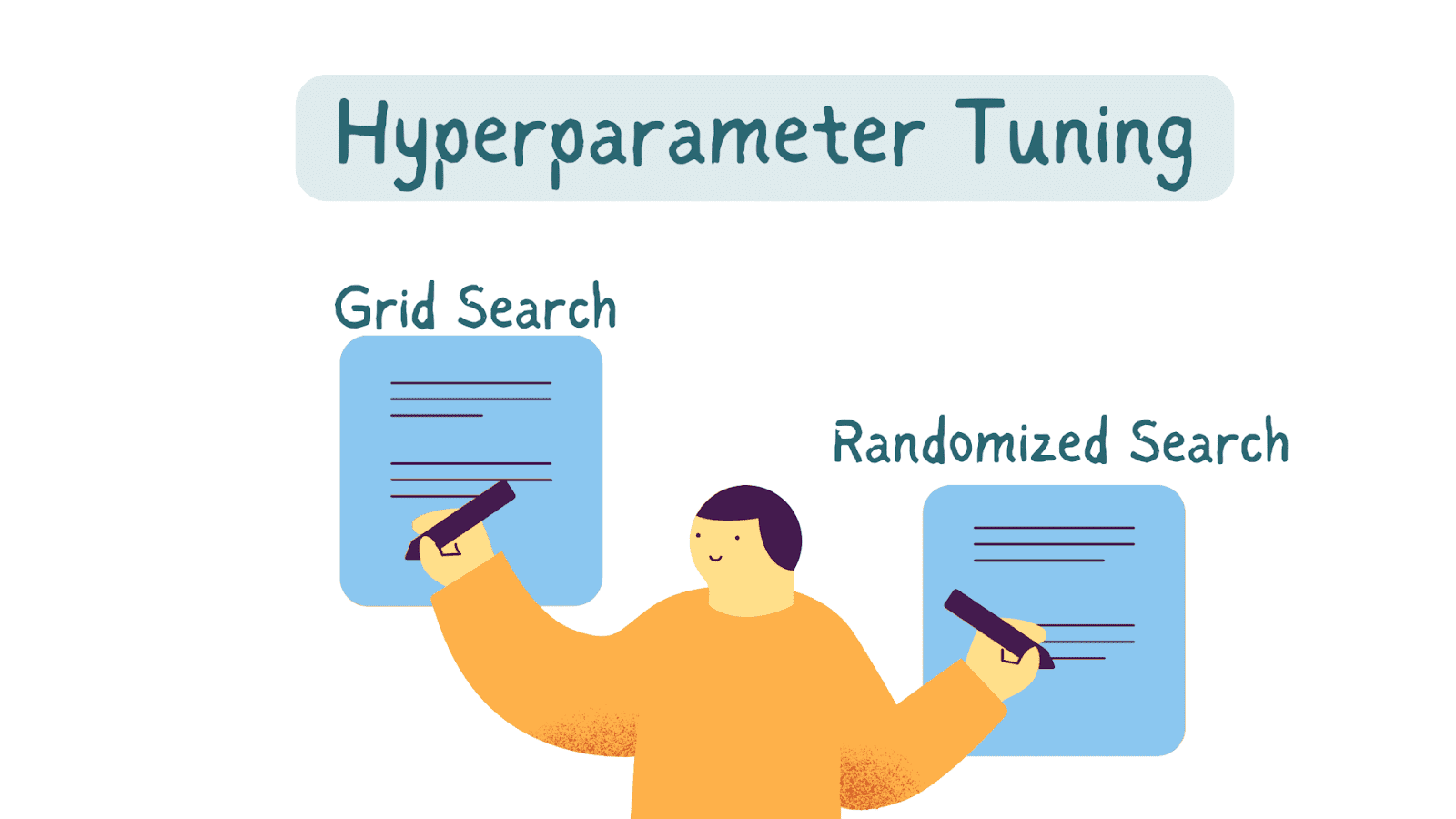
Hyperparameter Tuning: GridSearchCV and RandomizedSearchCV, Explained

Hyperparameter Tuning: GridSearchCV and RandomizedSearchCV, Explained
Image by Author

Every machine learning model that you train has a set of parameters or model coefficients. The goal of the machine learning algorithm—formulated as an optimization problem—is to learn the optimal values of these parameters.

In addition, machine learning models also have a set of hyperparameters. Such as the value of K, the number of neighbors, in the K-Nearest Neighbors algorithm. Or the batch size when training a deep neural network, and more.

These hyperparameters are not learned by the model. But rather specified by the developer. They influence model performance and are tunable. So how do you find the best values for these hyperparameters? This process is called hyperparameter optimization or hyperparameter tuning.

The two most common hyperparameter tuning techniques include:

  • Grid search
  • Randomized search

In this guide, we’ll learn how these techniques work and their scikit-learn implementation.

Training a Baseline SVM Classifier

Let's start by training a simple Support Vector Machine (SVM) classifier on the wine dataset.

First, import the required modules and classes:

from sklearn import datasets  from sklearn.model_selection import train_test_split  from sklearn.svm import SVC  from sklearn.metrics import accuracy_score

The wine dataset is part of the built-in datasets in scikit-learn. So let's read in the features and the target labels as shown:

# Load the Wine dataset  wine = datasets.load_wine()  X = wine.data  y = wine.target

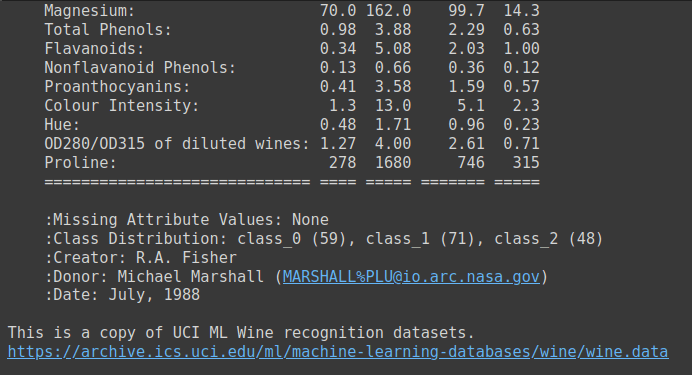
The wine dataset is a simple dataset with 13 numeric features and three output class labels. It’s a good candidate dataset to learn your way around multi-class classification problems. You can run wine.DESCR to get a description of the dataset.
Hyperparameter Tuning: GridSearchCV and RandomizedSearchCV, Explained
Output of wine.DESCR

Next, split the dataset into train and test sets. Here we’ve used a test_size of 0.2. So 80% of the data goes into the training dataset and 20% to the test dataset.

# Split the dataset into training and testing sets  X_train, X_test, y_train, y_test = train_test_split(X, y, test_size=0.2, random_state=24)

Now instantiate a support vector classifier and fit the model to the training dataset. Then evaluate its performance on the test set.

# Create a baseline SVM classifier  baseline_svm = SVC()  baseline_svm.fit(X_train, y_train)  y_pred = baseline_svm.predict(X_test)

Because it is a simple multi-classification problem, we can look at the model’s accuracy.

# Evaluate the baseline model  accuracy = accuracy_score(y_test, y_pred)  print(f"Baseline SVM Accuracy: {accuracy:.2f}")

We see that the accuracy score of this model with the default values for hyperparameters is about 0.78.

Output >>>  Baseline SVM Accuracy: 0.78

Here we used a random_state of 24. For a different random state you will get a different training test split, and subsequently different accuracy score.

So we need a better way than a single train-test split to evaluate the model’s performance. Perhaps, train the model on many such splits and consider the average accuracy. While also trying out different combinations of hyperparameters? Yes, that is why we use cross validation in model evaluation and hyperparameter search. We’ll learn more in the following sections.

Next let's identify the hyperparameters that we cantune for this support vector machine classifier.

SVM Hyperparameters to Tune

In hyperparameter tuning, we aim to find the best combination of hyperparameter values for our SVM classifier. The commonly tuned hyperparameters for the support vector classifier include:

  • C: Regularization parameter, controlling the trade-off between maximizing the margin and minimizing classification error.
  • kernel: Specifies the type of kernel function to use (e.g., 'linear,' 'rbf,' 'poly').
  • gamma: Kernel coefficient for 'rbf' and 'poly' kernels.

Understanding the Role of Cross-Validation

Cross-validation helps assess how well the model generalizes to unseen data and reduces the risk of overfitting to a single train-test split. The commonly used k-fold cross-validation involves splitting the dataset into k equally sized folds. The model is trained k times, with each fold serving as the validation set once and the remaining folds as the training set. So for each fold, we’ll get a cross-validation accuracy.

When we run the grid and randomized searches for finding the best hyperparameters, we’ll choose the hyperparameters based on the best average cross-validation score.

What Is Grid Search?

Grid search is a hyperparameter tuning technique that performs an exhaustive search over a specified hyperparameter space to find the combination of hyperparameters that yields the best model performance.

How Grid Search Works

We define the hyperparameter search space as a parameter grid. The parameter grid is a dictionary where you specify each hyperparameter you want to tune with a list of values to explore.

Grid search then systematically explores every possible combination of hyperparameters from the parameter grid. It fits and evaluates the model for each combination using cross-validation and selects the combination that yields the best performance.

Next, let’s implement grid search in scikit-learn.

GridSearchCV in Scikit-Learn

First, import the GridSearchCV class from scikit-learn’s model_selection module:

from sklearn.model_selection import GridSearchCV

Let’s define the parameter grid for the SVM classifier:

# Define the hyperparameter grid  param_grid = {      'C': [0.1, 1, 10],      'kernel': ['linear', 'rbf', 'poly'],      'gamma': [0.1, 1, 'scale', 'auto']  }

Grid search then systematically explores every possible combination of hyperparameters from the parameter grid. For this example, it evaluates the model's performance with:

  • C set to 0.1, 1, and 10,
  • kernel set to 'linear', 'rbf', and 'poly', and
  • gamma set to 0.1, 1, 'scale', and 'auto'.

This results in a total of 3 * 3 * 4 = 36 different combinations to evaluate. Grid search fits and evaluates the model for each combination using cross-validation and selects the combination that yields the best performance.

We then instantiate GridSearchCV to tune the hyperparameters of the baseline_svm:

# Create the GridSearchCV object  grid_search = GridSearchCV(estimator=baseline_svm, param_grid=param_grid, cv=5)      # Fit the model with the grid of hyperparameters  grid_search.fit(X_train, y_train)

Note that we've used 5-fold cross-validation.

Finally, we evaluate the performance of the best model—with the optimal hyperparameters found by grid search—on the test data:

# Get the best hyperparameters and model  best_params = grid_search.best_params_  best_model = grid_search.best_estimator_      # Evaluate the best model  y_pred_best = best_model.predict(X_test)  accuracy_best = accuracy_score(y_test, y_pred_best)  print(f"Best SVM Accuracy: {accuracy_best:.2f}")  print(f"Best Hyperparameters: {best_params}")

As seen, the model achieves an accuracy score of 0.94 for the following hyperparameters:

Output >>>  Best SVM Accuracy: 0.94  Best Hyperparameters: {'C': 0.1, 'gamma': 0.1, 'kernel': 'poly'}

Pros and Cons of Grid Search

Using grid search for hyperparameter tuning has the following advantages:

  • Grid search explores all specified combinations, ensuring you don't miss the best hyperparameters within the defined search space.
  • It is a good choice for exploring smaller hyperparameter spaces.

On the flip side, however:

  • Grid search can be computationally expensive, especially when dealing with a large number of hyperparameters and their values. It may not be feasible for very complex models or extensive hyperparameter searches.

Now let’s learn about randomized search.

What Is Randomized Search?

Randomized search is another hyperparameter tuning technique that explores random combinations of hyperparameters within specified distributions or ranges. It's particularly useful when dealing with a large hyperparameter search space.

How Randomized Search Works

In randomized search, instead of specifying a grid of values, you can define probability distributions or ranges for each hyperparameter. Which becomes a much larger hyperparameter search space.

Randomized search then randomly samples a fixed number of combinations of hyperparameters from these distributions. This allows randomized search to explore a diverse set of hyperparameter combinations efficiently.

RandomizedSearchCV in Scikit-Learn

Now let's tune the parameters of the baseline SVM classifier using randomized search.

We import the RandomizedSearchCV class and define param_dist, a much larger hyperparameter search space:

from sklearn.model_selection import RandomizedSearchCV  from scipy.stats import uniform    param_dist = {      'C': uniform(0.1, 10),  # Uniform distribution between 0.1 and 10      'kernel': ['linear', 'rbf', 'poly'],      'gamma': ['scale', 'auto'] + list(np.logspace(-3, 3, 50))  }

Similar to grid search, we instantiate the randomized search model to search for the best hyperparameters. Here, we set n_iter to 20; so 20 random hyperparameter combinations will be sampled.

# Create the RandomizedSearchCV object  randomized_search = RandomizedSearchCV(estimator=baseline_svm, param_distributions=param_dist, n_iter=20, cv=5)    randomized_search.fit(X_train, y_train)

We then evaluate model’s performance with the best hyper parameters found through randomized search:

# Get the best hyperparameters and model  best_params_rand = randomized_search.best_params_  best_model_rand = randomized_search.best_estimator_    # Evaluate the best model  y_pred_best_rand = best_model_rand.predict(X_test)  accuracy_best_rand = accuracy_score(y_test, y_pred_best_rand)  print(f"Best SVM Accuracy: {accuracy_best_rand:.2f}")  print(f"Best Hyperparameters: {best_params_rand}")

The best accuracy and optimal hyperparameters are:

Output >>>  Best SVM Accuracy: 0.94  Best Hyperparameters: {'C': 9.66495227534876, 'gamma': 6.25055192527397, 'kernel': 'poly'}  

The parameters found through randomized search are different from those found through grid search. The model with these hyperparameters also achieves an accuracy score of 0.94.

Pros and Cons of Randomized Search

Let’s sum up the advantages of randomized search:

  • Randomized search is efficient when dealing with a large number of hyperparameters or a wide range of values because it doesn't require an exhaustive search.
  • It can handle various parameter types, including continuous and discrete values.

Here are some limitations of randomized search:

  • Due to its random nature, it may not always find the best hyperparameters. But it often finds good ones quickly.
  • Unlike grid search, it doesn't guarantee that all possible combinations will be explored.

Conclusion

We learned how to perform hyperparameter tuning with RandomizedSearchCV and GridSearchCV in scikit-learn. We then evaluated our model’s performance with the best hyperparameters.

In summary, grid search exhaustively searches through all possible combinations in the parameter grid. While randomized search randomly samples hyperparameter combinations.

Both these techniques help you identify the optimal hyperparameters for your machine learning model while reducing the risk of overfitting to a specific train-test split.

Bala Priya C is a developer and technical writer from India. She likes working at the intersection of math, programming, data science, and content creation. Her areas of interest and expertise include DevOps, data science, and natural language processing. She enjoys reading, writing, coding, and coffee! Currently, she's working on learning and sharing her knowledge with the developer community by authoring tutorials, how-to guides, opinion pieces, and more.

More On This Topic

  • Hyperparameter Tuning Using Grid Search and Random Search in Python
  • Bayesian Hyperparameter Optimization with tune-sklearn in PyCaret
  • Hyperparameter Optimization: 10 Top Python Libraries
  • Fine-Tuning Transformer Model for Invoice Recognition
  • Fine-Tuning BERT for Tweets Classification with HuggingFace
  • Guide to Iteratively Tuning GNNs

GitHub Copilot is All Gain, No Pain for Microsoft

GitHub Copilot is All Gain, No Pain for Microsoft

Developers love GitHub Copilot. Probably, even more than ChatGPT. It has been gaining traction ever since its launch despite several copyright claims. Satya Nadella describes it as a tool that translates and writes code in a “fairly magical way“. Reports show that it boosts developers’ productivity by 55%.

Writing code without Copilot feels like writing code in Google Docs.

— Santiago (@svpino) November 1, 2023

Despite the love from developers, the AI code generation tool might not be as beneficial for Microsoft. Recent reports from The Wall Street Journal have raised concerns about GitHub Copilot’s financial performance.

It was revealed that, on an average, GitHub was losing more than $20 per user each month earlier in 2023. Some users were even costing GitHub as much as $80 a month. With approximately 1.5 million users, this translates to a substantial monthly loss for GitHub.

In response to these reports, Microsoft’s VP of product Mario Rodriguez challenged the claims of financial losses. He stated that GitHub Copilot is thriving and generating revenue at an annual rate of $100 million. Microsoft claims that GitHub Copilot’s financial performance is healthy and it is not running at a loss.

Despite the financial discussions, Microsoft has seen a significant increase in the number of paid users for GitHub Copilot. According to Nadella, the paying customer base for Copilot software grew by 40% in the September quarter. With over 1 million paid Copilot users in more than 37,000 organisations, the service has gained traction internationally.

Though he did not specify the revenue from GitHub Copilot, Microsoft CFO Amy Hood said that “higher-than-expected AI consumption contributed to revenue growth in Azure”.

Would the costs increase?

Currently, GitHub Copilot offers two subscription plans – the Individual Plan priced at $10 per month or $100 per year, and the Business Plan priced at $19 per user per month. These plans were designed to make GitHub Copilot accessible to both individual developers and businesses. However, the pricing strategy has come under scrutiny due to its impact on Microsoft’s financials.

The reason is that the code generation platform works on OpenAI’s Codex, which is built out of GPT-3.5, and the later version GPT-4. These models require a high amount of compute, and Microsoft is extensively looking to cut costs. For example, even if a person pays $10 per month, the amount of code they generate is still not counted, and could cost a lot more than that. Possibly, Microsoft actually burns a lot more compute than it gets paid for even now.

That is one of the reasons why the company has also been testing out smaller models like Meta’s Code Llama for code generation.

Nat Friedman, former CEO of GitHub, has also completely denied the claims that it was actually costing Microsoft money. He said, the actual cost was “less than the price”.

Less than the price!

— Nat Friedman (@natfriedman) October 11, 2023

It does not seem like the prices would increase anytime soon. Though, the GitHub Universe 2023 is just around the corner. There might be new updates to the software, or probably to the pricing as well (hopefully not).

But is there room for loss in the future?

In March, we reported that Indian IT prefers IBM’s CodeNet more than GitHub Copilot. The reason simply being that it is open source. IBM had also boasted the capabilities and user base of its Wisdom code generation platforms. Though it is miniscule compared to GitHub Copilot, Indian IT was adopting it rapidly.

Companies like Replit have been changing the scenario of code generation globally. “A lot of people in India code using their phones… In college classrooms under their tables, students are coding on their phones to practise what they’re learning in real time,” Anshul Bhide, BizOps, India head at Replit, told AIM.

Meanwhile in August, Replit announced changes to its pricing plans after upgrading its capabilities and easier deployment of code.

Google has also introduced its Codey, auto code generation model on Vertex AI, which it obviously claims is better than other models. The same is the case with Amazon’s CodeWhisperer. Though the pricing for all of these models comes around the same, individual developers, more than enterprise ones, still prefer GitHub Copilot for its accuracy, thanks to OpenAI’s Codex.

Also, Zoho is also planning to come up with a rival to GitHub Copilot.

Now, the only challenge that GitHub Copilot faces when it comes to the future is the rise of competitors. The question whether it is working for Microsoft or not is not up for debate at the moment, but alternatives are increasingly raising the bar.

The post GitHub Copilot is All Gain, No Pain for Microsoft appeared first on Analytics India Magazine.

Intel Collaborates with Indian Manufacturers to Make Laptops in India

Intel Collaborates with Indian Manufacturers to Boost 'Make in India' Laptop Production

Intel joins the Make in India brigade. The company has unveiled a strategic partnership with eight prominent Electronics Manufacturing Services (EMS) companies and Original Design Manufacturers (ODMs) to bolster laptop manufacturing in India.

The move aims to harness Intel’s extensive industry knowledge to lay the groundwork for a robust laptop manufacturing sector in the country, in alignment with the Make in India initiative.

The collaborative effort with Intel involves firms like Bhagwati Products Ltd, Dixon Technologies India Ltd, Kaynes Technology India Ltd, Optiemus Electronics Ltd, Panache Digilife Ltd, Smile Electronics Ltd, Syrma SGS Technology Ltd, and VVDN Technologies Private Ltd.

For some of these companies, this venture signifies their inaugural foray into laptop manufacturing, reflecting Intel’s commitment to empower the Indian manufacturing ecosystem to cater to both domestic and global demand.

As part of this collaboration, Intel will leverage its expertise to facilitate the production of complete entry-level laptops in India, employing state-of-the-art Surface Mount Technology (SMT) assembly lines, implementing quality control processes for components, and benchmarking finished products. Intel also offered support to ODMs across both Semi Knocked Down (SKD) and Completely Knocked Down (CKD) manufacturing processes.

“It is our Prime Minister’s goal that the Indian Electronics Ecosystem should have deep and broad capabilities, and that Indian Electronics Manufacturing Companies should grow, scale, and expand their footprint as trusted players in the Electronics Global Value Chains,” stated Rajeev Chandrasekhar, Minister of State for electronics and IT, skill development, and entrepreneurship.

“By enabling the laptop manufacturing process – from surface mount technology assembly to finished product – we are not only meeting the demands of the Make in India initiative but also contributing to the technological progress of the nation,” remarked Santhosh Viswanathan, VP & MD, India region, Intel.

Intel is set to host the India Tech Ecosystem Summit in November, which will bring together numerous local manufacturers to showcase a broader range of devices manufactured in India.

The post Intel Collaborates with Indian Manufacturers to Make Laptops in India appeared first on Analytics India Magazine.

6 Artificial Intelligence Myths Debunked: Separating Fact from Fiction

6 Artificial Intelligence Myths Debunked: Separating Fact from Fiction
Image by Editor

Artificial Intelligence is undoubtedly the buzzword of our time. Its popularity, particularly with the emergence of generative AI applications like ChatGPT, has brought it to the forefront of technological debates.

Everyone is talking about the impact of AI generative apps like ChatGPT and whether it is fair to take advantage of their capabilities.

However, amid all this perfect storm, there has been a sudden surge of numerous myths and misconceptions around the term Artificial Intelligence or AI.

I bet you might have heard many of these already!

Let's dive deep into these myths, shatter them, and understand the true nature of AI.

1. AI is Intelligent

Contrary to popular belief, AI isn't intelligent at all. Most people nowadays do think that AI-powered models are intelligent indeed. This might be led by the inclusion of the term “intelligence” within the name “artificial intelligence”

But what does intelligence mean?

Intelligence is a trait unique to living organisms defined as the ability to acquire and apply knowledge and skills. This means that intelligence allows living organisms to interact with their surroundings, and thus, learn how to survive.

AI, on the other hand, is a machine simulation designed to mimic certain aspects of this natural intelligence. Most AI applications we interact with, especially in business and online platforms, rely on machine learning.

6 Artificial Intelligence Myths Debunked: Separating Fact from Fiction
Image generated by Dall-E

These are specialized AI systems trained on specific tasks using vast amounts of data. They excel in their designated tasks, whether it's playing a game, translating languages, or recognizing images.

However, out of their scope, they are usually quite useless… The concept of an AI possessing human-like intelligence across a spectrum of tasks is termed general AI, and we are far from achieving this milestone.

2. Bigger is Always Better

The race among tech giants often revolves around boasting the sheer size of their AI models.

Llama’s 2 open-source LLM launch surprised us with a mighty 70 billion features version, while Google’s Palma stands at 540 billion features and OpenAI’s latest launch ChatGPT4 shines with 1.8 trillion features.

However, the LLM’s amount of billion features doesn't necessarily translate to better performance.

The quality of the data and the training methodology are often more critical determinants of a model's performance and accuracy. This has already been proved with the Alpaca experiment by Stanford where a simple 7 billion features powered Llama-based LLM could tie the astonishing 176 billion features powered ChatGPT 3.5.

So this is a clear NO!

Bigger is not always better. Optimizing both the size of LLMs and their corresponding performance will democratize the usage of these models locally and allow us to integrate them into our daily devices.

3. Transparency and Accountability in AI

A common misconception is that AI is a mysterious black box, devoid of any transparency. In reality, while AI systems can be complex and are still quite opaque, significant efforts are being made to enhance their transparency and accountability.

Regulatory bodies are pushing for ethical and responsible AI utilization. Important movements like the Stanford AI Transparency Report and the European AI Act are aimed to prompt companies to enhance their AI transparency and provide a basis for governments to formulate regulations in this emerging domain?.

Transparent AI has emerged as a focal discussion point in the AI community, encompassing a myriad of issues such as the processes allowing individuals to ascertain the thorough testing of AI models and understanding the rationale behind AI decisions.

This is why data professionals all over the world are already working on methods to make AI models more transparent.

So while this might be partially true, it is not as severe as common though!

4. Infallibility of AI

Many believe that AI systems are perfect and incapable of errors. This is far from the truth. Like any system, AI's performance is contingent on the quality of its training data. And this data is often, not to say always, created or curated by humans.

If this data contains biases, the AI system will inadvertently perpetuate them.

An MIT team's analysis of widely-used pretrained language models revealed pronounced biases in associating gender with certain professions and emotions. For example, roles such as flight attendant, or secretary were mainly tied to feminine qualities, while lawyer and judge were connected to masculine traits. The same behavior has been observed emotion-wise.

Other detected biases are regarding race. As LLMs find their way into healthcare systems, fears arise that they might perpetuate detrimental race-based medical practices, mirroring the biases inherent in the training data.

It's essential for human intervention to oversee and correct these shortcomings, ensuring AI's reliability. The key lies in using representative and unbiased data and conducting algorithmic audits to counteract these biases.

5. AI and the Job Market

One of the most widespread fears is that AI will lead to mass unemployment.

History, however, suggests that while technology might render certain jobs obsolete, it simultaneously births new industries and opportunities.

6 Artificial Intelligence Myths Debunked: Separating Fact from Fiction
Image from LinkedIn

For instance, the World Economic Forum projected that while AI might replace 85 million jobs by 2025, it will create 97 million new ones.

6. The AI Takeover

The final and most dystopian one. Popular culture, with movies like The Matrix and Terminator, paints a grim picture of AI's potential to enslave humanity.

While influential voices like Elon Musk and Stephen Hawking have expressed concerns, the current state of AI is far from this dystopian image.

Today's AI models, such as ChatGPT, are designed to assist with specific tasks and don't possess the capabilities or motivations depicted in sci-fi tales.

So for now… we are still safe!

Main Conclusions

In conclusion, as AI continues to evolve and integrate into our daily lives, it's crucial to separate fact from fiction.

Only with a clear understanding can we harness its full potential and address its challenges responsibly.

Myths can cloud judgment and impede progress.

Armed with knowledge and a clear understanding of AI's actual scope, we can move forward, ensuring that the technology serves humanity's best interests.

Josep Ferrer is an analytics engineer from Barcelona. He graduated in physics engineering and is currently working in the Data Science field applied to human mobility. He is a part-time content creator focused on data science and technology. You can contact him on LinkedIn, Twitter or Medium.

More On This Topic

  • ARTIFICIAL INTELLIGENCE (AI), A TEXTBOOK
  • Artificial Intelligence vs Machine Learning in Cybersecurity
  • Demystifying AI: The prejudices of Artificial Intelligence (and…
  • Should You Become a Freelance Artificial Intelligence Engineer?
  • Artificial Intelligence Project Ideas for 2022
  • Artificial Intelligence and the Metaverse

Elon Musk’s xAI To Launch its First AI Model

Elon Musk’s xAI To Launch AI Model

After announcing its existence in July, Elon Musk’s xAI is finally going to launch a product. He has posted on X that xAI is going to release its first AI to a select group. He says that it is the best AI model that currently exists, in some important respects.

Tomorrow, @xAI will release its first AI to a select group.
In some important respects, it is the best that currently exists.

— Elon Musk (@elonmusk) November 3, 2023

As previously mentioned and the website reads, xAI’s mission statement is to “understand reality”, which is possibly to build an alternative to OpenAI’s woke chatbot, ChatGPT, as Musk calls it. Musk had been planning to build a rival since the beginning of the year and the formation of his AI company was planning to build just that.

The acquisition of Twitter, which is now X, was also just a step towards building Musk’s AI lab. He has hinted many times before that he would be using the data from the social media platform to train the AI model. Which is probably why he claims that it would be the best AI model that currently exists.

The xAI website says, “We are a separate company from X Corp, but will work closely with X, Tesla, and other companies to make progress towards our mission.” The website highlights the suitability of Twitter’s conversation data for training large language models, such as the one powering ChatGPT. xAI is being advised by Dan Hendrycks, who currently also serves as the director of the Center for AI Safety.

Furthermore, Musk also allegedly bought the ai.com domain from OpenAI, which used to redirect to ChatGPT before, but now it does to xAI’s website. No one clearly knows if Musk actually paid millions to either OpenAI or Saw.com for buying the domain.

Meanwhile, OpenAI had planned for a trademark for GPT-5 in March, and is also ready to announce several new updates to its AI models on its upcoming DevDay.

Let’s see what Musk’s got cooking all this while.

The post Elon Musk’s xAI To Launch its First AI Model appeared first on Analytics India Magazine.

Every AI project begins as a data project, but it’s a long, winding road

winding-gettyimages-1297996741

Every AI project should begin as a data project.

The first important step is to connect, organize, and harmonize your company data so you can understand and meet the needs of your customers with AI-powered solutions. Nearly all analytics and IT decision makers surveyed (92%) say trustworthy data is needed more than ever before, according to Salesforce's "State of Data and Analytics" report. Salesforce surveyed 5,540 analytics and IT decision-makers and 5,540 line-of-business leaders worldwide.

Also: If AI is the future of your business, should the CIO be the one in control?

Here is the executive summary of that report:

  • A strong data foundation fuels AI: Advances in AI are fast-moving, putting pressure on data management teams to supply algorithms with high-quality data. Eighty-seven percent of analytics and IT leaders say advances in AI make data management a high priority.
  • Data's full potential remains elusive: Analytics, IT, and business leaders all cite security threats as the top barrier to successful data management. However, misalignment between data strategy and business goals complicates efforts. Meanwhile, the amount of data that companies generate is expected to increase 22% on average over the next 12 months.
  • The road to data and AI success is winding: To secure and scale data and analytics capabilities, analytics and IT leaders use a combination of strategies, like reimagining data governance, strengthening internal data culture, and deploying cloud technologies. Simplifying IT management is the biggest driver for moving apps and analytics to the cloud.

The demand for trusted data is higher than ever. Eighty-six percent of analytics and IT leaders agree that AI's outputs are only as good as its data inputs. Generative AI is intensifying these demands, and analytics and IT leaders are racing to fortify their data foundations. The report found that 92% of analytics and IT leaders agree the need for trustworthy data is higher than ever. However, only 6% of these leaders describe their data maturity as below industry standard or nonexistent, representing — at best — the difficulty of benchmarking maturity against peers, or — at worst — overconfidence in data strategy and capabilities.

The report also found that business leaders are not satisfied with the value they currently derive from their data. The report noted that 94% of business leaders feel their organization should be getting more value out of its data.

The top priorities for analytics and IT leaders are:

  1. Improve data quality.
  2. Strengthen security and compliance.
  3. Build AI capabilities.
  4. Improve company-wide data literacy.
  5. Modernize tools and technologies.

A strong data foundation fuels AI

Generative AI is a significant leap beyond more established iterations of related technologies like predictive AI, and business leaders are embracing its promise. More than nine in 10 (91%) see generative AI as providing a major advantage given appealing use cases ranging from content creation to software development. Marketing leaders are especially nervous that they aren't fully harnessing generative AI in workflows, with 88% concerned their companies are falling behind.

Also: How AI reshapes the IT industry will be 'fast and dramatic'

Generative AI spurs data ethics and equity concerns. The report noted that 83% of IT leaders think companies must work together to ensure generative AI is used ethically.

Analytics and IT leader's top realized benefits of data management are:

  1. Faster business decision-making
  2. Operational efficiency
  3. Freed up time for valuable work
  4. Automated workflows
  5. Improved customer satisfaction

Given the dependence of AI's outputs on the quality of underlying data, it's no surprise that nearly nine in 10 analytics and IT leaders say new developments in AI make data management a high priority.

Data maturity is a sign of AI preparedness. Data maturity is a building block of successful AI adoption. High-maturity respondents are 2x more likely than low-maturity respondents to have the high-quality data needed to use AI effectively.

Data's full potential remains elusive

Forty-one percent of line-of-business leaders say their data strategy has only partial or no alignment with business objectives. Similarly, 37% of analytics and IT leaders see room for improvement. Over six in 10 analytics and IT leaders are in the dark about line-of-business teams' data utilization or speed to insight. Furthermore, fewer than one-third of analytics and IT leaders track the value of data monetization.

Also: The real-time revolution is here, but it's unevenly distributed

Security is the top roadblock to achieving data goals. Security threats are the primary data challenge for business, analytics, and IT leaders. With 94% of business leaders believing they should get more value from their data, what's stopping them? The report found that 78% of analytics and IT leaders say their organizations struggle to drive business priorities with data. Nearly half of analytics and IT leaders say they have either a partial view or no view into how data is used within their companies.

Data accuracy — and confidence in data accuracy — is a key component of trusted data. Departments closest to the data, like data and analytics teams, have the highest confidence in their data accuracy. Confidence among line-of-business leaders is lower, revealing an opportunity to instill data confidence across marketing, sales, and service teams — only 57% of data and analytics leaders have complete confidence in their data's accuracy.

Surging data overwhelms users — but it poses an opportunity. Over two-thirds of analytics and IT leaders expect data volumes to increase 22% on average over the next year. They expect similar growth rates across a variety of sources including third-party data and device data. Almost two-thirds (65%) of customers say they expect companies to adapt experiences to match their changing needs, yet 80% of business leaders say personalization is difficult to scale.

The road to data and AI success is winding

Improving trust in data is more than a technical fix; culture is critical to driving confidence and adoption. Data culture is the collective behaviors and beliefs of people who value, practice, and encourage data usage to improve decision-making. It equips everyone in an organization with insights for tackling complex business challenges. More than seven in 10 are increasing budgets for data analysis tools and training.

Also: China and US part of multilateral pact to collaborate on AI risks

Data governance is more than a list of rules and restrictions. Used strategically, it can help bolster data trustworthiness. In fact, 85% of analytics and IT leaders use data governance to ensure and certify baseline data quality. Data governance is the set of rules or policies by which information is collected, managed, stored, measured, and communicated. It establishes parameters for data access, accuracy, privacy, security, and retention. The report found that 86% of high-maturity organizations use governance to democratize data access, compared to 70% of low-maturity organizations.

Improving data quality is the number one priority for analytics and IT leaders. IT leaders must find ways to defy data gravity. Data gravity refers to the idea that as large amounts of data amass in a location or system, they attract additional applications and services, making data relocation more difficult and more expensive. The key message here is that technical leaders must aim to simplify IT management.

Also: Business leaders continue to struggle with harnessing the power of data

The overwhelming majority of analytics and IT leaders are moving their applications to the cloud. Nearly three-quarters of analytics and IT organizations have already started their cloud migrations, or have always been in the cloud, and an additional 17% plan to make the move.

The top priorities for IT leaders are:

  1. Simplify IT management
  2. Enhance security
  3. Increase flexibility
  4. Improve scalability
  5. Increase capability for innovation

The report concludes that unlocking the value of data is no small feat. Fortunately, analytics and IT leaders can lean on data and analytics platforms for help. In addition, technical leaders want solutions that pave the way for growing AI capabilities. Finally, technical leaders have their work cut out for them, but the benefits of maximizing their data's value are well worth the effort.

To learn more about the State of Data and Analytics report, you can visit here.

Artificial Intelligence

A World Beyond Renewable Energy in Green Data Centres

The exponential growth in data generation and consumption is driving an increased demand for data centres to manage and store this vast volume of information effectively. According to a ANAROCK-Binswanger report, 45 new data centres—covering 13 million sq. ft and 1,015 MW of capacity, are expected to come up by the end of 2025 in India.

However, data centres also consume a lot of energy contributing significantly to greenhouse gas emissions. Data centres currently account for around 3% of global electricity consumption, and this figure is anticipated to increase to 4% by 2030, according to Vertiv, a global provider of critical digital infrastructure and continuity solutions.

An average hyperscale facility consumes between 20-50 MW each year, which is theoretically sufficient to power as many as 37,000 households. Hence, it has become imperative for companies to seek ways to mitigate the environmental impact of their data centres, and the concept of green data centres has emerged as a viable solution.

To make their data centres green, many companies have shifted their focus to renewable energy. For example, AWS has set a goal to power its data centres entirely with renewable energy sources by 2025. “To create environmentally friendly data centres, renewable energy is a vital component, however, it is not the sole solution,” Jaganathan Chelliah, Senior Director – Marketing, India & Middle East and Africa, Western Digital, told AIM.

Use of efficient hardware and software

Besides renewable energy, Chelliah believes data centres can optimise energy efficiency through the use of efficient hardware and software, green building design, advanced server design and cooling techniques.

“For example, Western Digital Ultrastar Data102 storage platform (JBOD) uses innovative ways to cool the drives to ensure that it is done more efficiently and effectively. Equipped with the ArcticFlow™ technology, the Ultrastar Data102 storage platform can require just over half the standard cooling power per drive slot to get the same average drive temperatures,” he said.

Another component of green data centres is the storage infrastructure. Data centre companies can explore high-capacity Hard Disk Drives (HDDs) that offer greater storage density and low power. “Selecting the right HDD can significantly increases data storage capacity, reduces overall power consumption, and enhances data resilience.”

To help data centres go green, Western Digital has introduced the world’s highest capacity drives, the Ultrastar DC HC570 22TB CMR HDD in India, which leads the industry in areal density.

“It is a powerful combination of technology and innovation for cloud-scale customers to increase capacities and performance, in addition to keeping TCO manageable. For example, using 22TB HDDs versus 16TB HDDs to deploy 2PB of storage would require 27% fewer servers and use 26% lower energy consumption in Watts/TB to store the same amount of data.”

There is also less infrastructure and maintenance cost by eliminating the extra servers, according to Chelliah, so overall, TCO savings is achieved by using higher capacity 22TB and eliminating servers and all other supporting infrastructure.

“Furthermore, alongside these technical measures, embracing regulatory compliance and supporting carbon offset programmes can further contribute to the goal of green data centres. By adopting a holistic approach that combines these strategies, data centres can significantly reduce their environmental impact while ensuring reliable operations.”

Data centre market in India

The Indian data centre market is also experiencing exponential growth, driven by the increasing demand for data across diverse industries. This expansion is attracting new players to India’s rapidly developing data centre sector.

The remarkable growth can be attributed to several factors, including widespread digitisation across industries, the rise in AI, the proliferation of the Internet of Things (IoT), easily accessible internet connectivity, the rapid increase in smartphone usage, and supportive regulatory policies.

“The onslaught of generative AI tools is also going to lead to an explosion in data. Moreover, the government has acknowledged the crucial role of data centres during the pandemic and has granted them infrastructure status.”

Several state governments are extending support through a range of incentives, including subsidised land, power subsidies, exemptions on stamp duty, incentives for renewable energy adoption, and discounts on locally manufactured IT components, among other benefits.

“As data centre infrastructure grows in complexity, there is a shift towards consolidating different storage device form factors into a single system. Chief Information Officers (CIOs) are selecting specific data storage solutions based on unique application requirements, whether it’s opting for enterprise HDDs for large capacity storage or utilising the latest NVMe solutions for increased agility,” he said.

How Western Digital is preparing for it?

The growing demand for robust data management strategies is an opportunity for Western Digital and the data storage company anticipates strong demand for our products over the next three to five years.

On the business-to-business side, Western Digital has three key focus areas, smart video solutions, automobile ecosystem and hyperscale, cloud and enterprise data centres, Chelliah said.

“Last year, we launched the 22TB Ultrastar DC HC570 HDD. More recently, Western Digital launched the enhanced OpenFlex™ Data24 3200 NVMe-oF™ JBOF/Storage Platform and the new Ultrastar DC SN655 PCIe® Gen 4.0 dual-port NVMe SSD to unlock the potential of AI, object storage, file sharing and more.”

These solutions help data centre architects manage, scale and utilise storage assets more efficiently. Overall, our strong market position and innovative products prove to be a competitive advantage.

Moreover, Chelliah believes the rise of generative AI will also drive the demand for more powerful hardware, faster and higher-capacity storage, increased network bandwidth, the development of edge computing capabilities, and higher power usage.

“One of the best storage solutions is the Ultrastar® DC SN655 NVMe™ SSD from Western Digital. It is an ideal solution for data centres that need high-capacity, cost-optimised, read-intensive performance for data-intensive applications.”

The post A World Beyond Renewable Energy in Green Data Centres appeared first on Analytics India Magazine.

Dive into the Future with Kaggle’s AI Report 2023 – See What’s Hot

Dive into the Future with Kaggle's AI Report 2023 – See What's Hot
Image by Editor

On May 12 2023, Kaggle opened up a competition where the Kaggle community can participate in building a report that will summarize the rapid advancements in AI from the past two years. The Kaggle community is a diverse group that has a variety of experiences within the depths of AI.

Participants were asked to write an essay on a particular topic based on the changes and developments over the past 2 years, for example, Generative AI, AI ethics and more.

The report is here and is made up of the following sections:

  • Generative AI
  • Text Data
  • Image & Video Data
  • Tabular & Time Series Data
  • Kaggle Competitions
  • AI Ethics

So let’s dive into what we’ve learnt…

Generative AI

Generative AI has been a popular topic of conversation recently. This starting section dives into the rapid progress and applications of Generative AI in the past 2 years. We have seen advancements such as text generation, image creation and music development using tools and techniques such as GANs and LLMs.

This has only been possible with the use of larger datasets and improved hardware for enhancing algorithms during their training phase. Although Generative AI is still in its early stage, it has shown in the past year alone how it is revolutionizing different industries. There are still ethical concerns to take into consideration such as privacy concerns, misinformation, and use of these AI systems.

Have a further read in the different essays:

  1. Generative AI
  2. Understand, Generate and Transform the World
  3. A Glimpse into the Realm of Generative AI

Text Data

With the hype around Generative AI, there has been a major rise of interest in Natural Language Processing (NLP) due to the rise of large language models (LLMs). Naturally, the next section of the Kaggle AI report focuses on NLP techniques and their use in various tasks such as summarisation and translation.

If we take it back, early approaches to text-based tasks included term-frequency-based feature engineering in conjunction with non-neural network-based machine learning methods. Now we are catering to larger datasets which undergo learning word representation for model interpretation.

The use of the internet data as a training corpus has allowed these models to learn better, and produce better performance in areas such as transfer learning. Within Kaggle competitions, there has been a trend in fine-tuning publicly available models which have shown to surpass human-level performance.

The following top essays focus on the emergence and recent techniques of LLMs:

  1. Contemporary Large Language Models LLMs
  2. Large Language Models: Reasoning ability
  3. Mini-Giants: "Small" Language Models

Image & Video Data

Just like text data being used in tasks such as content generation, image and video generation has been very popular too. Computer vision has been around for a long time, but in recent years it has skyrocketed. We can now handle tasks such as object detection and more.

This section dives into model architectures as well as common practices used in computer vision such as augmentation. Used in a variety of different industries such as healthcare for medical imaging, computer vision still has its challenges within areas such as deep fakes, ethical and philosophical considerations, limitations of multi-modal models and more.

We have models such as the Segment Anything Model (SAM) and YOLO (You Only Look Once) which have shown how generalized, open-source models can be adapted for different and unique tasks.

Dive into the advances in image and video data with these essays:

  1. Advances in AI Vision Models in the Last Two Years
  2. Image and Video Data

Tabular & Time Series Data

The next section dives into the historical significance of tabular data and time series data. Both of these have not been widely popular in the past few years as they have not had the same impact as the deep learning revolution. However, there are still widely used and very effective, trending in areas such as:

  • Unique approach for individual datasets/problems
  • Importance of data preprocessing and feature engineering
  • The dominance of gradient-boosted trees

Within the Kaggle community, these trends have been highly recognised and the following essays will dive into these as well as the unique challenges tabular and time series data come across.

  1. Learnings From the Typical Tabular Pipeline
  2. Time Series and Tabular Data
  3. Tabular Data in the Age of AI

Kaggle Competitions

A part of this report from the Kaggle community was to also analyze Kaggle competitions by looking into its developments and the community's observations of it in the past 2 years. Kaggle competitions have been widely popular over the years as the community has used the platform to test their skills, build a portfolio and prepare for the real world.

Observations of changes in Kaggle competitions are techniques such as pseudo labeling, seed averaging, and hill climbing which were once upon a time considered "tricks," but have now become common practices. Kaggle competitions over the past 2 years have become more competitive and competitions such as RSNA, Learning Agency and more are very popular.

Dive into the winning tricks of Kaggle competitions:

  1. Towards Green AI
  2. How to Win a Kaggle Competition
  3. Medical Imaging Competitions

AI Ethics

Ethics around AI is also another area of concern, with a lot of people from society having mixed emotions about the use and implementation of AI systems. Organizations are looking into the ethical principles of AI and creating new strategies to ensure that they can not only understand the AI systems but also be able to monitor and mitigate risks.

It is not an academic study but a societal one, there are many opinions which are important to understand the world of AI and how it can still be used whilst safeguarding society's values. We have seen organizations undergo continuous auditing of their AI systems with the adoption of ethics-by-design.

Learn more about the challenges around AI and the impact it is having on society:

  1. Exploring the Landscape of AI Ethics
  2. Developments in AI and Ethics in the Past 2 Years
  3. Ethical AI Is All We Need!!

Wrapping it up

The Kaggle team has created a unique report in which it has allowed its community to express their opinions and experience of the world of AI and its changes in the last 2 years. Let us know if there was a particular section or essay you found very interesting!

Nisha Arya is a Data Scientist and Freelance Technical Writer. She is particularly interested in providing Data Science career advice or tutorials and theory based knowledge around Data Science. She also wishes to explore the different ways Artificial Intelligence is/can benefit the longevity of human life. A keen learner, seeking to broaden her tech knowledge and writing skills, whilst helping guide others.

More On This Topic

  • 2023 AI Index Report: AI Trends We Can Expect in the Future
  • Optimizing Python Code Performance: A Deep Dive into Python Profilers
  • A Deep Dive into GPT Models: Evolution & Performance Comparison
  • Unveiling Neural Magic: A Dive into Activation Functions
  • H1 2023 Analytics & Data Science Spend & Trends Report
  • The Burtch Works 2023 Data Science & AI Professionals Salary Report…