Elon Musk’s xAI Took Just Four Months to Build Grok

Elon Musk’s xAI chatbot Grok is finally out, and one of the interesting things is that it took the team to build its prototype in less than four months, while Google took approximately two years to build the Bard, while OpenAI took several years to build ChatGPT.

Interestingly, this was executed by a small team of 16 members. These include experienced professionals, who have previously worked at Google DeepMind, OpenAI, Google Research, Microsoft Research, Tesla, and the University of Toronto.

Musk, who was one of the early investors in OpenAI, must be hoping that Grok stands up well against ChatGPT. Notably, he introduced Grok right before OpenAI’s DevDay. It seems more than just a coincidence! Musk claimed that xAI’s compute is doubling every 2 to 3 months.

Grok also has a super advantage over ChatGPT and Bard-alike because it has exclusive access to X data in real-time, besides scraping from the web. In April, Elon Musk decided to discontinue the free API access to X (formerly Twitter). This decision was made after he recognised that developers were scraping data from the platform, which they could then use to train their own LLMs.

Looks like the battle has now shifted towards the exclusivity of content and data, where Google has Youtube (only recently it changed the policy to train its AI models), and Poe has Quora, while OpenAI has not moved beyond January 2022 information from the web.

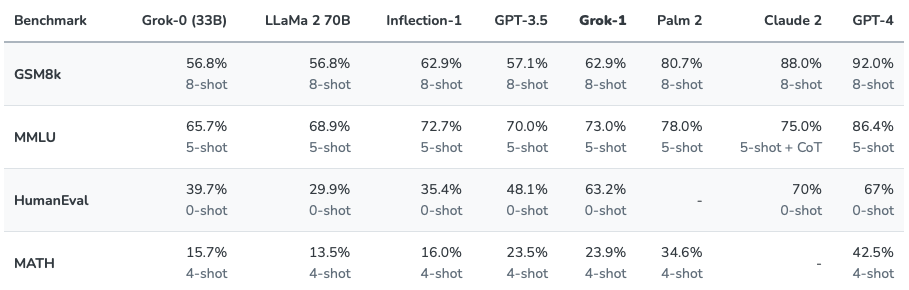
According to xAI, Grok’s prototype LLM (Grok-0) with 33 billion parameters approaches the capabilities of Llama 2 (70B) on standard LM benchmarks, using only half of its training resources. The company claims that the latest beta version, Grok-1, is even more powerful, achieving impressive scores of 63.2% on the HumanEval coding task and 73% on MMLU.
Source:xAI

In mathematical tasks evaluated under the MATH benchmark, Grok scored 23.9%, indicating its ability to handle mathematical queries. However, GPT-4 outperformed Grok in this area with a score of 42.5%.

Lastly, in the GSM8K benchmark, used to evaluate the performance of models on multi-step mathematical reasoning, Grok achieved a score of 62.9. Comparatively, GPT-4 achieved a score of 92%. Analysing the benchmark results, it’s evident that Grok trails behind GPT-4. Nevertheless, it has outperformed Llama 2 and GPT-3.5, showcasing its strengths in certain areas.

Grok Vs ChatGPT vs Bard vs Claude

Internet Access: Musk said that Grok has real time info via the X platform, which is a massive advantage over other models.

This could greatly benefit Grok since the X platform is often the primary source of information about global events. In recent months, Musk has also encouraged journalists to post news directly on the X platform.

Example of Grok vs typical GPT, where Grok has current information, but other doesn’t pic.twitter.com/hBRXmQ8KFi

— Elon Musk (@elonmusk) November 5, 2023

In comparison, ChatGPT last month enabled users to browse the net leveraging the ‘Browse with Bing’ feature in the selector under GPT-4. Bard holds an advantage with its direct internet access. Meanwhile, Claude was trained on data up until December 2022, and although it may be aware of events from early 2023, it does not have internet access.

Image Generation: As compared to ChatGPT, Grok still has a long way to go. OpenAI recently made ChatGPT the first true multimodal model with integration of Dall-E 3. On the other hand, Grok lacks image generation capabilities entirely and does not possess other senses, such as vision and audio. Similarly Bard and Claude also lack image generation capability.

Multiformat Capability: With the latest update, ChatGPT not only reads PDFs but also supports a variety of document types within the same conversation, including PDFs, images, CSVs, and more. Claude similarly enables users to upload PDFs and ask questions about the file’s content. However, as of now, Grok and Bard do not offer this capability.

Pricing: Elon Musk announced that Grok AI assistant will be included in 𝕏 Premium+ for $16/month via web. OpenAI’s ChatGPT is free to use, but ChatGPT Plus requires a subscription at $20 per month. Anthropic’s Claude offers a free version, while Claude Pro is available for $20 (US) or £18 (UK) per month. Google’s Bard is accessible to everyone for free.

X has about 528.3 million monthly active users. Meanwhile, according to the latest available data, ChatGPT currently has around 180.5 million users. With the subscription model, it is very easy for Grok to generate revenue. Additionally, xAI does not lack computational resources. Earlier this year, Musk acquired tens of thousands of GPUs. It’s only a matter of time before Grok also becomes multimodal.

The post Elon Musk’s xAI Took Just Four Months to Build Grok appeared first on Analytics India Magazine.

Back to Basics Week 1: Python Programming & Data Science Foundations

Back to Basics Week 1: Python Programming & Data Science Foundations
Image by Author

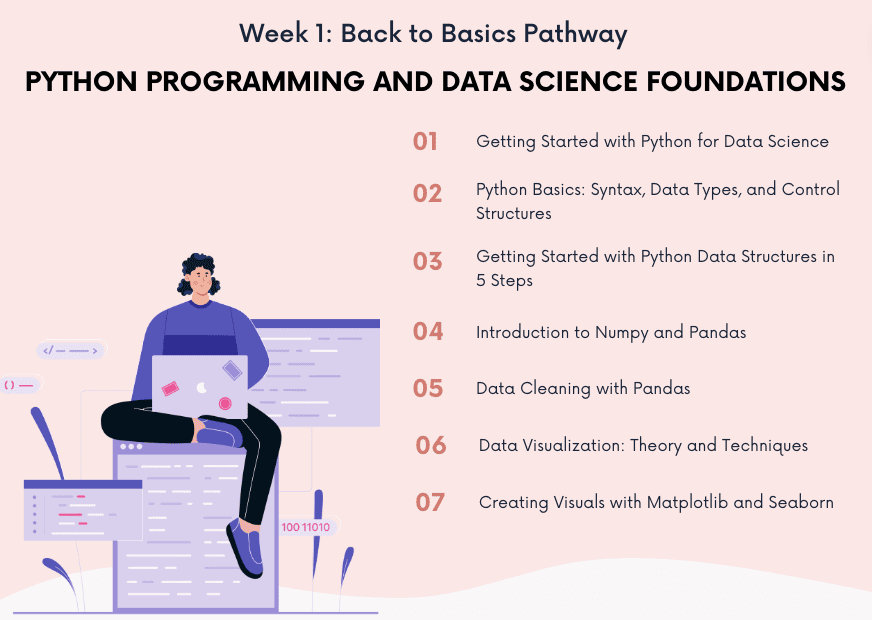
Join KDnuggets with our Back to Basics pathway to get you kickstarted with a new career or a brush up on your data science skills. The Back to Basics pathway is split up into 4 weeks with a bonus week. We hope you can use these blogs as a course guide.

In the first week, we will be learning all about Python, Data Manipulation, and Visualisation.

  • Day 1 to 3: Python Essentials for Aspiring Data Scientists
    • An introduction to Python's role in data science.
    • A beginner-friendly guide to Python's syntax, data types, and control structures.
    • Interactive coding exercises to solidify your understanding.
  • Day 4: Python Data Structures Demystified
    • Learn about Python's core data structures with our step-by-step guide. You'll learn about lists, tuples, dictionaries, and sets—each with practical examples and their significance in data processing.
  • Day 5 to 6: Practical Numerical Computation with NumPy and Pandas
    • Discover the power of NumPy and Pandas for numerical analysis and data manipulation, including real-world applications and hands-on exercises.
  • Day 7: Data Cleaning Techniques with Pandas
    • Equip yourself with essential data-cleaning skills using Pandas.

Let’s get started.

Getting Started with Python for Data Science

Week 1 — Part 1: Getting Started with Python for Data Science

A beginner's guide to setting up Python and understanding its role in data science.

Generative AI, ChatGPT, Google Bard — these are probably a lot of terms you've been hearing over the past few months. With this uproar, a lot of you are thinking about getting into the tech field, such as Data Science.

People from different roles want to keep their jobs, so they will aim to develop their skills to fit the current market. It is a competitive market, and we are seeing more and more people building interest in Data Science, where there are thousands of courses online, bootcamps, and Masters (MSc) available in the sector.

Python Basics: Syntax, Data Types, and Control Structures

Week 1 — Part 2: Python Basics: Syntax, Data Types, and Control Structures

Want to learn Python? Get started today by learning Python's syntax, supported data types, and control structures.

Are you a beginner looking to learn programming with Python? If so, this beginner-friendly tutorial is for you to familiarize yourself with the basics of the language. This tutorial will introduce you to Python’s—rather English-friendly—syntax. You’ll also learn to work with different data types, conditional statements, and loops in Python.

If you already have Python installed in your development and environment, start a Python REPL and code along. Or if you want to skip the installation—and start coding right away—I recommend heading over to Google Colab and coding along.

Getting Started with Python Data Structures in 5 Steps

Week 1 — Part 3: Getting Started with Python Data Structures in 5 Steps

This tutorial covers Python's foundational data structures — lists, tuples, dictionaries, and sets. Learn their characteristics, use cases, and practical examples, all in 5 steps.

If you want to implement the solution to a problem by cobbling together a series of commands into the steps of an algorithm, at some point, data will need to be processed, and data structures will become essential.

Such data structures provide a way to organize and store data efficiently and are critical for creating fast, modular code that can perform useful functions and scale well. Python, a particular programming language, has a series of built-in data structures of its own.

Introduction to Numpy and Pandas

Week 1 — Part 4: Introduction to Numpy and Pandas

A primer on using Numpy and Pandas for numerical computation and data manipulation in Python.

If you are working on a data science project, Python packages will ease your life since you just need a few lines of code to do complicated operations, like manipulating the data and applying a machine learning/deep learning model.

When starting your data science journey, it’s recommended to start by learning two of the most useful Python packages: NumPy and Pandas. In this article, we are introducing these two libraries. Let’s get started!

Data Cleaning with Pandas

Week 1 — Part 5: Data Cleaning with Pandas

This step-by-step tutorial is for beginners to guide them through the process of data cleaning and preprocessing using the powerful Pandas library.

Our data often comes from multiple resources and is not clean. It may contain missing values, duplicates, wrong or undesired formats, etc. Running your experiments on this messy data leads to incorrect results.

Therefore, it is necessary to prepare your data before it is fed to your model. This preparation of the data by identifying and resolving the potential errors, inaccuracies, and inconsistencies is termed as Data Cleaning.

Data Visualization: Theory and Techniques

Week 1 — Part 6: Data Visualization: Theory and Techniques

Unlocking the secrets of how to observe our data-driven world.

In a digital landscape dominated by big data and intricate algorithms, one would think that the average person is lost in an ocean of numbers and data. Isn’t it?

Yet, the bridge between raw data and comprehensible insights lies in the art of Data Visualization. It’s the compass that directs us, the map that guides us, and the interpreter that decodes the mass amount of data that we encounter daily.

But what’s the magic behind a good visualization? Why does one visualization enlighten while another confuses?

Creating Visuals with Matplotlib and Seaborn

Week 1 — Part 7: Creating Visuals with Matplotlib and Seaborn

Learn the basic Python package visualization for your work.

Data visualization is essential in data work as it helps people understand what happens with our data. It’s hard to ingest the data information directly in a raw form, but visualization would spark people's interest and engagement. This is why learning data visualization is important to succeed in the data field.

Matplotlib is one of Python's most popular data visualization libraries because it’s very versatile, and you can visualize virtually everything from scratch. You can control many aspects of your visualization with this package.

On the other hand, Seaborn is a Python data visualization package that is built on top of Matplotlib. It offers much simpler high-level code with various built-in themes inside the package. The package is great if you want a quick data visualization with a nice look.

Wrapping it Up

Congratulations on completing week 1! ??

The team at KDnuggets hope that the Back to Basics pathway has provided readers with a comprehensive and structured approach to mastering the fundamentals of data science.

Week 2 will be posted next week on Monday — stay tuned!

Nisha Arya is a Data Scientist and Freelance Technical Writer. She is particularly interested in providing Data Science career advice or tutorials and theory based knowledge around Data Science. She also wishes to explore the different ways Artificial Intelligence is/can benefit the longevity of human life. A keen learner, seeking to broaden her tech knowledge and writing skills, whilst helping guide others.

More On This Topic

  • Back To Basics, Part Dos: Gradient Descent
  • Free 4 Week Data Science Course on AI Quality Management
  • Geometric foundations of Deep Learning
  • An Excellent Resource To Learn The Foundations Of Everything…
  • 8 Ways to Improve Your Search Application this Week
  • This Week in AI, August 7: Generative AI Comes to Jupyter & Stack…

OpenAI Leaks GPT Builder Ahead of DevDay 2023

OpenAI’s first-ever developer conference DevDay is scheduled for today at 11:30 pm IST. Chief Sam Altman shares the developer community’s enthusiasm as they eagerly await the event.

real christmas eve energy rn

— Sam Altman (@sama) November 6, 2023

However, a recent report unveiled a series of important conference updates that got leaked.

Firstly, Gizmo V8, the latest prototype of ChatGPT, boasts a fresh and upgraded appearance, accompanied by a multitude of novel functionalities. Leaked details reveal a comprehensive feature set, including a Sandbox for importing, testing, and enhancing existing chatbots, custom actions for defining extra chatbot capabilities via OpenAPI specifications, the ability to attach knowledge files for reference, basic tools like web browsing and image creation, an analytics feature to monitor and scrutinise chatbot usage data, the capability to save and share chatbot drafts, the option to publicly distribute completed chatbots, easy setup, and management of chatbot sharing, and access to a marketplace for searching and deploying chatbots developed by other users.

Read more: OpenAI has Just Cracked AGI

In another upcoming update to ChatGPT, a new feature called “Context Connectors” is set to be introduced, which will enable ChatGPT to connect with external apps such as Microsoft 365 and Google Drive.

These custom GPTs will offer unique functionalities and the ability to access specific APIs through a function-calling mechanism. The release of this feature is expected in the coming weeks and will initially be available to ChatGPT Plus users.

Another important update is the GPT Builder or Magic Creator, which has unveiled the ability for users to personalise and distribute their AI assistants or craft entirely new GPTs. The leak revealed that these features can be found within the public client-side source code but are not yet accessible to everyone. With GPT Builder, one can tailor their AI assistants by furnishing them with a name, description, custom directives, conversation prompts, files such as a Code Interpreter, specific functionalities, and actions.

Additionally, GPT Builder harnesses DALL-E 3 to generate profile pictures for these GPTs. Notably, users can incorporate functions directly within the application and also introduce “Custom Actions” with options like none, API Key, or OAuth Authorisation. These custom GPTs will offer unique functionalities and the ability to access specific APIs through a function calling.

Meanwhile, OpenAI recently pulled the plug on a project codenamed Arrakis in its quest for AGI. The intention was to create a smaller, cost-effective model to enhance chatbot efficiency, akin to Meta’s LLaMA and Llama 2, adopted by Microsoft. However, the company may even announce their first fully autonomous agent, named “Jarvis,” at the conference, a big move towards AGI.

Read more: What is Left for OpenAI DevDay?

The post OpenAI Leaks GPT Builder Ahead of DevDay 2023 appeared first on Analytics India Magazine.

8 Most Influential AI Inventions of 2023

AI has been the word of the year. Even the legacy magazine TIME has not been able to overlook the impact of the technology leading it to adding it to its list of best inventions of 2023. The technology has managed to seep into every nook and cranny of our lives, from educational institutions to government departments.

From the 14 inventions TIME enlisted, we’ve picked out the best of the lot. Here’s are 8 best AI inventions that have managed to leave a mark in the constantly evolving industry:

Adobe Photoshop Generative Expand and Generative Fill

In May, amid the fake AI image frenzy, Adobe introduced Generative Fill in Photoshop, a feature which brings generative AI-powered Firefly directly into the hands of designers.

The technology had already wooed the world. And though Adobe was not the first to bring the text-to-image technology, but it managed to take advantage of its existing user base of over 30 million creators.

Since its release, Generative Fill has evolved and integrated in most aspects of Adobe, from Creative Cloud to GenStudio for enterprise customers.

AI Wildfire Detector

AI is trying to be used in every area one can think of today – including putting out a fire before it explodes. The California Department of Forestry and Fire Protection announced the AI-powered Wildfire Detector to upgrade firefighters’ abilities to validate situational awareness and respond quickly.

The department, along with the University of California at San Diego’s Alert California program and its network of more than 1,000 cameras across the state, is using the technology to spot fires early which have been getting worse with each passing year.

Gen-2

Built upon the diffusion architecture by Runway, a well-funded startup, Gen 2 has often been called ‘pivotal’ in terms of AI video generation and editing.

Released in March 2023, Gen-2 improved on its preceding Gen-1 model allowing users to generate new four-second-long videos from scratch through prompting its proprietary AI model. Users also had the option to upload images to which Gen-2 could add motion.

The update in September introduced a ‘Director’s mode’ for users to create visuals by choosing the direction and speed of the movement in their Runway generated clips. More recently, the model has had major improvements to both its fidelity and consistency of results.

City-Wide Drone Detection

Launched in April by Dedrone, the detection system is the largest airspace security infrastructure in the world. The system is available across 40 cities in the West in their Security Operating Center (SOC) or on their phone without any hardware installation.

The network of services is completely cloud based, available on the web as well as the stores on Android and iOS. The system’s database of drone information covers three years and over 240 million drone detections’ worth of drone behaviour, including FAA violations.

GPT-4

The long-awaited GPT-4 is not unknown to anyone on the internet. The AI model powering OpenAI’s paid version of ChatGPT, became the talk of the tech town for all the reasons right and wrong.

While the model surpassed its predecessor and other language models available in the zone, it was highly criticised for the lack of information available about its architecture, dataset, and training process.

As Sam Altman’s brainchild is nearing its first conference, Dev Day, leaks surfacing the internet point towards an incoming advanced GPT-4 for enterprise users.

SeamlessM4T

One major factor lagging in AI research is the diversity and availability of models in several languages. Taking a step forward, tech giant Meta open-sourced SeamlessM4T — Massively Multilingual & Multimodal Machine Translation model.

The translation and transcription all-in-one model facilitates input and output in 100 languages and speech output in 35 languages (including English).

TrailGuard AI

The invention by Resolve, is one of the pieces of technology saving nature one algorithm at a time. The AI-enabled security system is an anti-poaching solution in action to detect poachers and alert park managers in near-real time.

The not-for-profit organisation partnered with Steve Gulick (a conservation technologist) and Intel to develop this cryptic anti-poaching camera-based alert system to prevent animals from being poached.

Project Gutenberg Open Audiobook Collection

The oldest digital library in the world, Project Gutenberg transformed over 5,000 ebooks into audiobooks through synthetic speech technology. The audiobooks, made possible through a collaboration with Microsoft and MIT, are available on Spotify, Apple Podcasts, and Google Podcasts.

The project bypassed the lengthy and expensive process of hiring a human reader to do the job. While the overnight success made it to the top AI innovations list, It’s exactly the kind of AI application that actors were striking against in the US.

The post 8 Most Influential AI Inventions of 2023 appeared first on Analytics India Magazine.

Why Sony Acquired iSIZE

Why Sony Acquired iSIZE

Sony is pretty hell-bent on making its cloud gaming platform work. Most recently it has announced the acquisition of iSIZE, a UK-based company which specialises in deep learning for video delivery. This definitely hints towards the company’s decision of fuelling its cloud gaming ambitions.

iSIZE develops AI-driven solutions aimed at providing bitrate reductions and enhancing quality in the media and entertainment sector. As Sony’s blog reads, “The acquisition provides Sony Interactive Entertainment (SIE) with significant expertise in applying machine learning to video processing, which will benefit a range of our R&D efforts as well as our video and streaming services.”

iSIZE also specialises in making photorealistic neural avatars. The team has been working for almost two years on this for 2D & 3D modelling for gaming and metaverse applications.

The founder of the company, Sergio Grce, has been very interested in AI, along with video imaging, art, and gaming. Thus, along with Yiannis Andreopoulos, he founded iSIZE in 2016, whose expertise was in video streaming services.

This acquisition comes in line with Sony reporting its plan in May to bolster its PlayStation division further and is looking to acquire more studios for the same. Coincidently, it has also been on an acquisition spree since 2021.

The PlayStation team announced that it is planning an “aggressive and interesting” expansion into cloud gaming. Sony CEO Jim Ryan said, “There’s been lots of attention around cloud gaming. We observe mobility in gaming habits to be an increasingly important trend. The cloud will be fundamental to allowing us or anyone else to exploit that trend of mobility.”

Sony is actively looking for opportunities to strengthen its position in the sector, as Microsoft continues to expand its gaming presence with Xbox. The recent completion of Microsoft’s $68.7 billion acquisition of Activision Blizzard has set the stage for intense competition in the gaming industry. Sony’s latest acquisition of iSIZE is seen as a strategic response to this competitive landscape.

Cloud gaming making a comeback?

Apart from the acquisition of Activision Blizzard, Microsoft’s foray into the cloud gaming business reportedly has some serious development routes in India. A recently leaked Xbox internal document revealed that Reliance Jio has been exploring partnerships in the cloud gaming space with Microsoft in 2020.

As per the leaked document, in order to extend Project xCloud, Reliance Jio outlined plans to deploy xCloud servers across 27 Azure regions, encompassing both existing and upcoming locations. This list incorporated Central Indian and South Indian xCloud Servers. Microsoft has been working with Jio to bring Project xCloud into the Indian market since 2020.

Later, the Mukesh Ambani-led firm also tried to partner with NVIDIA for its GeForce Now cloud gaming service in November 2022. But since the partnership did not work out, Jio ended up partnering with other smaller cloud providers such as Ubitus K.K. and announced JioGamesCloud. Possibly, Jio could be able to mark a dent given its large audience in the cloud gaming market.

On the other hand, Microsoft is also planning to launch PC cloud game streaming through Xbox cloud gaming by the end of 2028, along with leveraging its Azure servers.

All of these developments are after Google decided to shut down its Stadia cloud gaming project citing lack of subscribers. Google’s Stadia, which initially aimed to be a first-party consumer service, ultimately pivoted to focus on a white-label cloud gaming service for developers. This shift in strategy emphasises the competitive nature of the cloud gaming market.

Can Sony work it out this time?

Amongst Microsoft, Google, and Sony taking it slow in the cloud gaming industry, NVIDIA hasn’t stopped even a bit. NVIDIA’s GeForce NOW is expanding to accommodate 15 fresh new titles on its platform, including Alan Wake 2.

Sony started its streaming gaming service when it acquired Gaikai in 2012, through which it powered its PlayStation Vita, and now powers PlayStation Now.

Later, Sony acquired OnLive in 2015, but only to shut it down. People on X have been jokingly saying that Sony can only acquire companies that do not have a portfolio, and then shut it down. It would be interesting to see how the acquisition of iSIZE pans out.

On the other hand, Sony has been comparatively quiet when it comes to investing in generative AI. The Sony Venture Fund has been bullish on building robots, but according to Austin Noronha, the managing director at the firm, “For AI, the way we look at the company is around how differentiated will they be compared to legacy systems or large corporations — and whether they are working on their own language models and having their application stack on top of it, versus plugging in to someone else’s.”

The post Why Sony Acquired iSIZE appeared first on Analytics India Magazine.

Trained on Chips, Gen AI is Shaping the Chip Industry

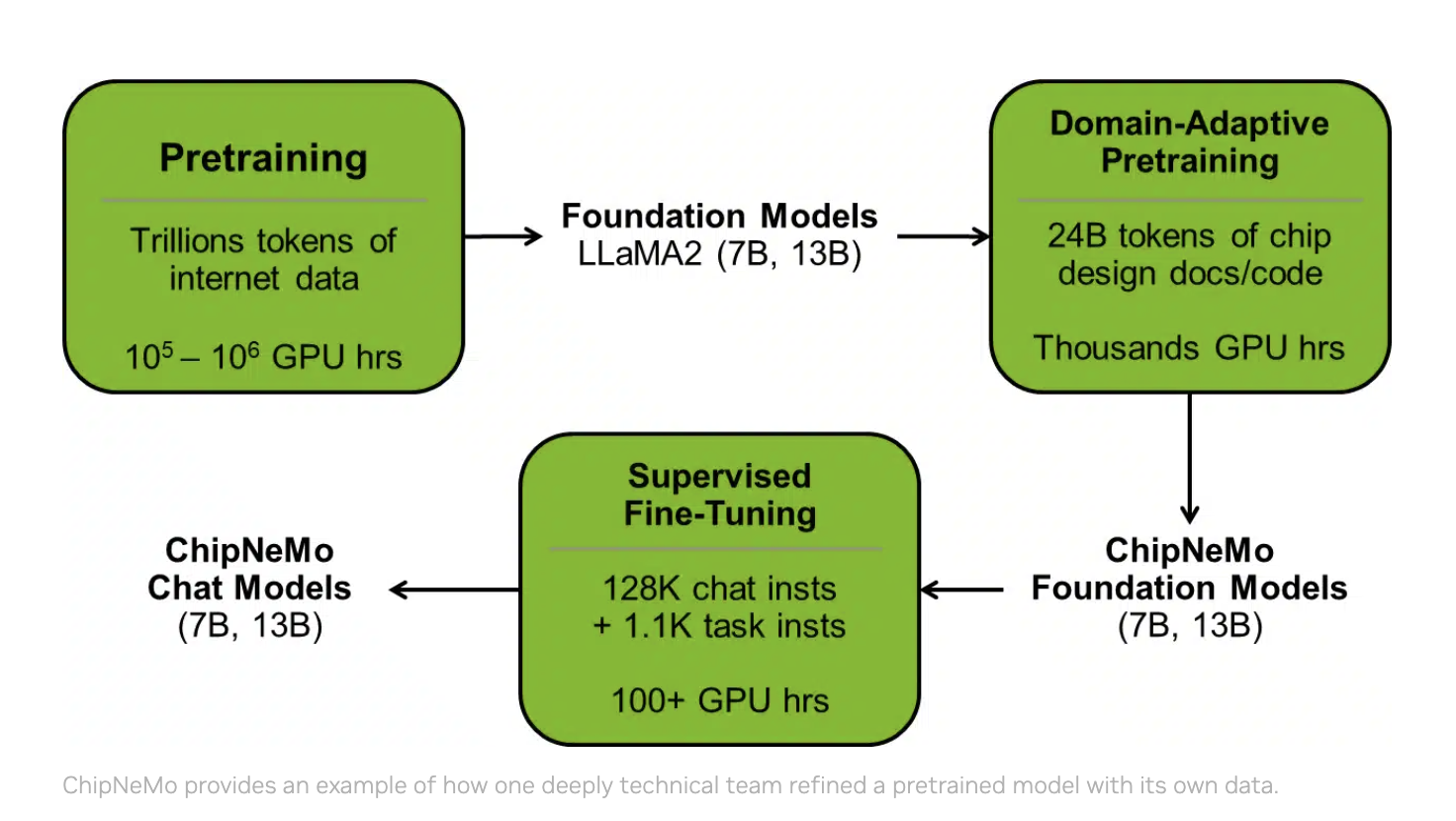
Bill Dally, NVIDIA’s chief scientist, recently introduced “ChipNeMo,” a custom LLM developed by their engineers at the International Conference on Computer-Aided Design, an event for electronic design automation (EDA).

ChipNeMo is trained on the company’s internal data to generate and optimise software in designing semiconductors by customising large language models with the help of NVIDIA NeMo—a cloud-native framework for developers to create and deploy generative AI models with billions of parameters.

“This effort marks an important first step in applying LLMs to the complex work of designing semiconductors,” said Dally. “It shows how even highly specialised fields can use their internal data to train useful generative AI models.”

After evaluating possible use cases of ‘ChipNeMo’, the research team at NVIDIA decided to start with three: a chatbot, a code generator, and an analysis tool. Of these, the analysis tool—automating the time-consuming tasks of maintaining updated bug descriptions has garnered the most positive feedback.

The prototype chatbot responds to questions regarding GPU architecture and design, helping engineers quickly locate technical documents. The code generator, which currently produces snippets of 10-20 lines of software in specialised chip design languages, will be integrated with existing tools, providing a valuable assistant for ongoing designs.

The research paper by NVIDIA explains how the team gathered design data and employed it to craft a specialised generative AI model, a process that can be adapted to any industry.

They started with a foundational model and customised it using NVIDIA NeMo, a framework included in the NVIDIA AI Enterprise software platform for building, customising, and deploying generative AI models. The chosen NeMo model boasts 43 billion parameters and was trained on over a trillion tokens.

The model was refined through two training rounds, with the first using approximately 24 billion tokens of internal design data and the second incorporating about 130,000 conversations and design examples.

This research represents just one of several instances where generative AI is making its mark in the semiconductor industry. Sharing their valuable experience, NVIDIA Research director and the paper’s lead author Mark Ren underscored the importance of customisation in LLMs. Custom ChipNeMo models, with as few as 13 billion parameters, outperformed even much larger general-purpose LLMs in certain chip-design tasks.

However, Ren emphasises the importance of careful data collection and cleaning, as well as staying updated with the latest tools to streamline the work.

The increasing complexity of chip design, driven by the relentless march toward smaller transistors is also straining engineering resources, as the industry faces a daunting 4x increase in workload while grappling with a talent gap of 10%-20%. According to Synopsys, the average number of transistors per chip has increased by a staggering 1000 times since 2000

Optimising Cost

Rising costs have been another prominent issue in semiconductor manufacturing. The industry has witnessed a significant increase in the cost of designing and producing semiconductor chips. Factors such as growing design complexity, shrinking feature sizes, a surging number of masks, higher equipment costs, and stringent quality requirements have collectively contributed to this surge. McKinsey reports that the average cost per transistor has soared by 50% since 2013.

Generative AI can be a game-changer in semiconductor manufacturing by applying its capabilities to every facet such as design, fabrication, testing, and packaging. “I believe over time large language models will help all the processes, across the board,” said Ren.

It can optimise chip design through reinforcement learning, specifically in component placement, known as floorplanning. For instance, Google’s floorplanning algorithm uses deep reinforcement learning to achieve remarkable improvements in power consumption, wire length, and congestion, reducing product development life cycle time significantly.

In the competitive landscape of semiconductor manufacturing, achieving shorter time-to-market cycles is paramount. However, as chip design becomes more intricate, the time available for development and delivery has significantly decreased. McKinsey indicates that the average time to market for chips has shrunk by 25% because of outstanding demand.

Companies like Synopsys—an American EDA company headquartered in California, offer a full-stack AI-driven EDA suite that has made contributions to improving efficiency and reducing development cycles for major semiconductor companies like Samsung Electronics Co Ltd and ST Microelectronics, in turn bringing down costs.

Shankar Krishnamoorthy, GM of Synopsys’ EDA Group illustrated how AI, particularly AI-driven EDA tools, can optimise the design of low-power chips. He cited figures from Synopsys.ai EDA solutions, demonstrating energy and power savings of up to 15%.

Synopsys is in direct competition with Cadence Design Systems, which is making big moves to add AI to chip design software. However, certain experts believe that the former is lapping the latter in competition.

Additional Opportunities in Chip Manufacturing Pipeline

In addition to overcoming these challenges, Generative AI presents a range of opportunities for the semiconductor manufacturing industry.

Generative AI can also play a pivotal role in improving defect detection. The quality of chips depends on a multitude of factors, including material properties, process parameters, environmental conditions, and human errors. However, as feature sizes shrink below 10 nanometers, defect rates increase exponentially due to factors such as quantum effects, variability, and noise. McKinsey highlights that the average defect density has surged by 10 times since 2013.

By utilising unsupervised learning, it can detect defects in semiconductor chips without requiring labelled data or prior knowledge. This technology can enhance defect detection accuracy by up to 30%, surpassing traditional methods.

GenAI can also lead to the discovery of new materials or the optimisation of existing ones for better performance and reduced costs. It can also drive the creation of new products or improvements in existing ones, significantly reducing product development cycles. Moreover, Generative AI can broaden the market potential of semiconductor devices by creating custom ICs for specific tasks, offering superior performance, lower power consumption, and reduced costs compared to general-purpose ICs.

In conclusion, while the semiconductor manufacturing industry faces substantial challenges, the integration of Generative AI promises to be a transformative force. It offers innovative solutions that can optimise chip design, enhance defect detection, and unlock new horizons of efficiency, quality, and innovation.

The post Trained on Chips, Gen AI is Shaping the Chip Industry appeared first on Analytics India Magazine.

Valued at $1B, Kai-Fu Lee’s LLM startup unveils open source model

Valued at $1B, Kai-Fu Lee’s LLM startup unveils open source model Rita Liao 9 hours

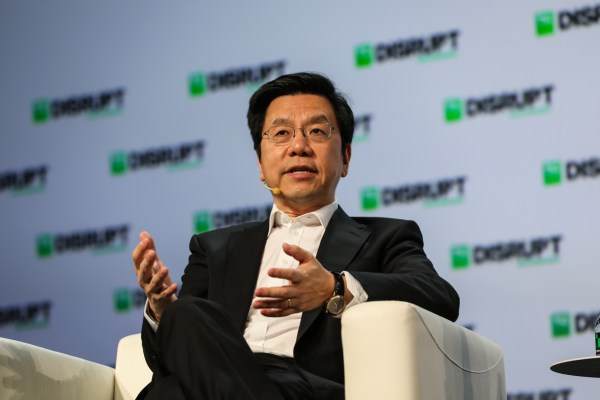
Kai-Fu Lee, the computer scientist known in the West for his bestseller AI Superpowers and in China for his bets on artificial intelligence unicorns, has a new venture — and a great ambition.

In late March, Lee launched a company called 01.AI with the vision to develop a homegrown large language model for the Chinese market. The venture puts him in competition with other prominent Chinese tech leaders, including Sogou’s founder Wang Xiaochuan, who have been swiftly gathering talent and venture capital to establish China’s equivalents of OpenAI.

“I think necessity is the mother of innovation, and there’s clearly a huge necessity in China,” Lee told TechCrunch in an interview, explaining the motive behind starting 01.AI. “Unlike the rest of the world, China doesn’t have access to OpenAI and Google because those two companies did not make their products available in China, so I think many doing LLM are trying to do their part in creating a solution for a market that really needs this.”

01.AI’s growth is a fitting reflection of the rapid development in the generative AI field. Seven months after its founding, the startup has released its first model, the open-source Yi-34B. The decision to introduce an open LLM as its debut product is a way to “give back” to society, said Lee. For people who have felt LLaMA is a “godsend” to them, “we’ve provided a compelling alternative,” he added.

As of writing, Yi-34B, which is a bilingual (English and Chinese) base model trained with 34 billion parameters and significantly smaller than other open models like Falcon-180B and Meta LlaMa2-70B, came in first amongst pre-trained LLM models, according to a ranking by Hugging Face.

“We still believe that larger models, when trained well, on a large amount of high-quality data, will always outperform substantially smaller models of comparable quality and comparable technology, so I think [Yi-34B] outperforming much larger models is something that we don’t usually see,” said Lee. “We feel quite confident as we released models that are 100 billion to 400 billion over the next coming year, year and a half, these models will be dramatically better than today’s model that we announced.”

The startup’s ability to commence model training quickly is no doubt an outcome of its smooth fundraising, which is critical to securing top-tier talent and AI processors. While declining to disclose how much 01.AI has raised, Lee said it’s valued at $1 billion after receiving financing from Sinovation Ventures, Alibaba Cloud and other undisclosed investors.

01.AI has already grown to more than 100 employees, over half of whom are LLM experts from major multinational and Chinese tech firms. Its vice president of technology, for instance, is an early member of Google’s Bard, and its chief architect was a founding member of TensorFlow and worked alongside renowned researchers like Jeff Dean and Samy Bengio at Google Brain. The key figures behind Yi-34B are Wenhao Huang, a Microsoft Research Asia veteran, and Ethan Dai, who held senior AI positions at Huawei and Alibaba.

Having backed over ten unicorns and venture-built seven companies through Sinovation Ventures, Lee is possibly one of the most well-connected investors and entrepreneurs in China.

“It’s been, you know, over 25 years since the founding of Microsoft Research Asia, and everything I’ve done has been about getting super great talent,” said Lee, who launched Microsoft Research Asia, the U.S. giant’s biggest research center abroad, before heading Google China. Over the years, Microsoft Research Asia has earned the reputation as the “West Point” for nurturing China’s AI entrepreneurs.

“Now, of course, you want to pay people fairly, and you need to be competitive in pay, but I really think that it’s also about people believing they can make a difference and believing the company can succeed,” Lee added.

It’s no secret that building LLMs is a costly undertaking. To sustain its cash-intensive operations, 01.AI has plans for monetization right from the start. While the company will continue to open source some of its models, its objective is to build a state-of-the-art proprietary model that serves as a foundation for a diverse range of commercial products.

“We can’t open source everything,” said Lee. “We were quite cognizant of the fact that these large language models require a lot of compute, and therefore, are very expensive. When we raise a lot of money, most of it will be spent on the GPU. Given that, we needed to first acquire as much GPU as we could, which we did.”

Like other LLM players in China, 01.AI has proactively stockpiled GPUs in anticipation of U.S. sanctions; it borrowed money to buy processors even before it landed funding. Over the past year, the Biden administration has heightened restrictions on China’s access to high-end AI chips, prompting Chinese firms to pay inflated prices for chips. The foresight was rewarded — 01.AI now has a supply that will suffice for at least the next 12-18 months.

Aside from causing headaches for Chinese firms, U.S. sanctions have been a catalyst for innovation by encouraging them to optimize the use of computing power. “With a very high-quality infrastructure team, for every 1000 GPUs, we might be able to squeeze 2000 GPUs workload out of them,” said Lee.

01.AI’s path to monetization hinges largely on its ability to find product-market fit for its expensive AI models. While top-notch LLM scientists are scarce, there’s no shortage of product talent in China.

“China’s not ahead of the U.S. in LLM, but there’s no doubt China can build better applications than American developers mostly because of the phenomenal mobile internet ecosystem that was built over the last 12 years or so,” argued Lee.

While the founder gave no details on the services in the pipeline, he hinted that the company is experimenting with concepts in the productivity and social directions, and he’d be “disappointed” if 01.AI didn’t release an app within this calendar year.

The startup’s ultimate goal, according to Lee, is to become an ecosystem where outside developers can build applications easily. “The duty is not just to push out good research models, but even more importantly to make application development easy so that there can be compelling applications,” he said. “At the end of the day. It is an ecosystem play.” Time will tell if Lee’s AI endeavor will pay off.

China’s search engine pioneer unveils open source large language model to rival OpenAI

Meituan buys founder’s months-old ‘OpenAI for China’ for $234M

How ‘Acoustic Touch’ Technology Offers Vision Through Sound

In an era where technological marvels emerge at a breathtaking pace, a remarkable breakthrough has surfaced from the labs of Australian researchers—'acoustic touch.' This pioneering technology promises to redefine the landscape of assistive devices for the visually impaired. Developed by an industrious team from the University of Technology Sydney, the University of Sydney, and the innovative minds at Sydney start-up ARIA Research, acoustic touch stands as a testament to human ingenuity and compassion.

Acoustic touch does not just aim to assist those who navigate the world without sight; it seeks to transform their interaction with their surroundings, turning the ordinary into the extraordinary through auditory signals.

The potential of this technology extends beyond mere convenience—it touches the core of independence and quality of life for approximately 285 million people worldwide who live with visual impairments. As we step into the narrative of acoustic touch, we witness the dawn of a new horizon—one where innovation paves the way for inclusion and empowerment.

A Vision of Sound

The essence of acoustic touch technology lies in its novel approach to sensory augmentation. Traditional assistive devices have relied heavily on tactile feedback or computer-synthesized speech to aid those with visual impairments. However, acoustic touch diverges from this path by creating an auditory landscape.

As objects enter the device's field of view, they are assigned distinct sound icons, or “soundscapes,” that represent their presence. For instance, a user might hear a melody akin to rustling leaves when nearing a plant or a rhythmic tapping that signifies the proximity to a staircase. It's akin to learning a new language—where sound becomes the alphabet for visual information.

Image: Lil Deverell

Global Impact and the Need for Innovation

Visual impairment is not just a personal challenge; it's a global issue. Citing figures from the World Health Organization, we're reminded that 39 million individuals are blind, and an additional 246 million have low vision. These numbers are not mere statistics; they represent people whose participation in everyday activities is hampered by their visual limitations. Assistive technology, therefore, isn't a luxury—it's a necessity that can profoundly impact the daily lives of millions.

In the context of such widespread need, acoustic touch technology emerges as a beacon of progress. It's not just about enhancing the capabilities of those with visual impairments; it's about redefining what it means to live with a disability. By bridging the gap between the physical world and the perception of it, acoustic touch technology can potentially revolutionize how visually impaired individuals engage with their environment, making activities that were once challenging more accessible and autonomous.

This drive for innovation is about enriching the sensory experience and, by extension, the quality of life for a significant portion of the population. It's a poignant reminder of the transformative power of technology when directed towards the betterment of humanity.

A Study of Sound and Sight

The real-world efficacy of acoustic touch technology has been tested in a study led by Dr. Howe Zhu of the University of Technology Sydney. In an experimental setup, the technology was trialed with 14 participants—seven individuals with blindness or low vision and seven sighted individuals blindfolded to serve as controls.

The outcomes were compelling. The participants equipped with acoustic touch-enabled glasses demonstrated a significant enhancement in their ability to recognize and locate objects. Importantly, this improved spatial awareness did not come at the cost of cognitive overload. The study found that users could identify and interact with their environment using sound with “remarkable accuracy,” an encouraging sign for the practical application of this technology.

The implications of acoustic touch technology extend far into the daily lives of those it aims to assist. The ability to locate specific household items, navigate new environments, and interact more confidently with the world offers a new degree of independence for individuals with visual impairments. This independence is vital, not just for the functionality it provides but also for the psychological and social benefits that come with self-reliance.

As we reflect on the transformative potential of this technology, it is essential to recognize that it is not merely an end in itself but a means to a greater goal: enhancing the quality of life and fostering inclusivity. The acoustic touch technology represents a leap forward in assistive devices, a tool that can unlock new opportunities for education, employment, and social interaction for the visually impaired community.

You can read the published study here.

How AI is Navigating SAP’s Intelligent Enterprise

SAP’s Intelligent Enterprise segment has significantly evolved since 2018, with the focus shifting towards seamless integration of various business processes, aiming to create a unified and efficient system.

“The vision was clear: To bring various aspects of business, such as workforce management, supply chain, and financials, under a single technological umbrella,” Michael Ameling, SVP and member of the executive board, head of Intelligent Enterprise & BTP, MD SAP Labs, Dresden, Germany, told AIM at the recently concluded SAP TechEd in Bengaluru last week. Ameling, who is still a “developer at heart”, has been with the company for over seventeen years.

Ameling further elaborated that one of the prime examples is the enhancement of the user experience in SAP systems, where the aim is to enable single sign-on across different systems, thus streamlining user interaction, bolstering security, and ensuring data consistency. This integration serves as the groundwork for continued innovation, like SAP’s digital assistant that leverages natural language processing.

“Such tools aim to simplify user engagement with complex systems through conversational ease, backed by a comprehensive data model that coalesces financial, human resources, and supply chain data, demonstrating the ultimate ambition of the Intelligent Enterprise,” added Ameling.

The team harnesses AI to enhance mainstream business operations, as seen with SAP’s analytics services that use integrated data for deep insights. This integration allows complex queries to be addressed intelligently. Technical progress, such as migrating SAP HANA to the cloud, has furthered this vision, offering quick data access and enabling real-time analytics and AI applications.

The merging of AI and the cloud underlines the Intelligent Enterprise’s transformative impact, creating a unified and forward-thinking business environment. This holistic technological synergy ensures businesses are poised to leverage advanced AI and data analytics, underpinning the excitement for future enterprise technology developments.

Future of Intelligent Enterprise

Emerging technologies set to change businesses include quantum computing and composable enterprise models. However, AI is central to this change, leading to more adaptable, modular systems over traditional, rigid ones, but companies will increasingly use intelligent agents for personalised interactions, automating tasks, and system maintenance, noted Ameling.

Quantum computing, still in its early stages, promises breakthroughs in data processing and complex problem-solving. To capitalise on these technologies, enterprises will need to integrate large datasets and complex processes to gain insights and improve efficiency. Partnerships with major cloud providers will be vital for managing big data. As companies evolve with these technologies, maintaining ethical standards, security, and reliability is essential.

“As we get ready for these new changes, making sure that companies use these advanced technologies safely and fairly will help them be ready for the big changes that are coming,” Ameling commented.

Expansion Strategy

When discussing the strategy for the expansion of SAP’s enterprise solutions, three pillars stand out.

Emerging technologies set to change businesses include quantum computing and composable enterprise models. However, AI is central to this change, leading to more adaptable, modular systems over traditional, rigid ones, but companies will increasingly use intelligent agents for personalised interactions, automating tasks, and system maintenance, noted Ameling.

Quantum computing, still in its early stages, promises breakthroughs in data processing and complex problem-solving. To capitalise on these technologies, enterprises will need to integrate large datasets and complex processes to gain insights and improve efficiency. Partnerships with major cloud providers will be vital for managing big data. As companies evolve with these technologies, maintaining ethical standards, security, and reliability is essential.

“As we get ready for these new changes, making sure that companies use these advanced technologies safely and fairly will help them be ready for the big changes that are coming,” Ameling commented.

Mapping Responsible AI

“We prioritise security and ethical compliance in AI deployment, focusing on issues like identity management and data privacy,” said Ameling. Long before in 2018, it has established an AI ethics handbook, applying to technologies from machine learning to generative AI, with a board dedicated to overseeing ethical adherence.

SAP’s early move in creating these guidelines offers it a competitive advantage, helping customers navigate the complex landscape of international data privacy laws and certifications like ISO. Its platform includes built-in features for data protection and compliance, ensuring customer trust and adherence to varying global regulations. The SAP Business Technology Platform (SAP BTP) ensures service availability and regional compliance, meeting the diverse needs of customers worldwide, and facilitating both innovation and adherence to local regulatory requirements.

“Recognising the intricate challenges posed by AI, SAP has made security a foundational element of its service, important not only for business operations but also for maintaining trust and integrity,” said Ameling.

To cater to the complex regulatory environment, SAP’s platforms integrate default features such as data privacy protection and audit logging to ensure customer compliance. Complementing its security measures, SAP stresses service reliability, with the SAP BTP showcasing a broad reach that satisfies diverse regional and global compliance standards. This is vital for customers in varied locales, who can rely on SAP to address their unique regulatory challenges while leveraging a robust platform for innovation.

Read more: Decoding SAP Labs’ Generative AI Motto

The post How AI is Navigating SAP’s Intelligent Enterprise appeared first on Analytics India Magazine.

Your Data-to-Value Journey Starts with AI and Data Literacy

Slide1

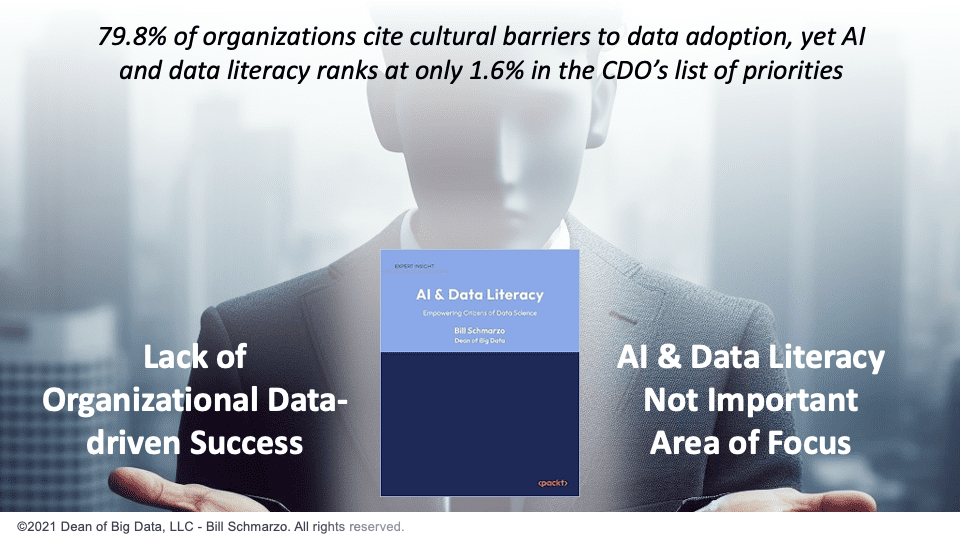
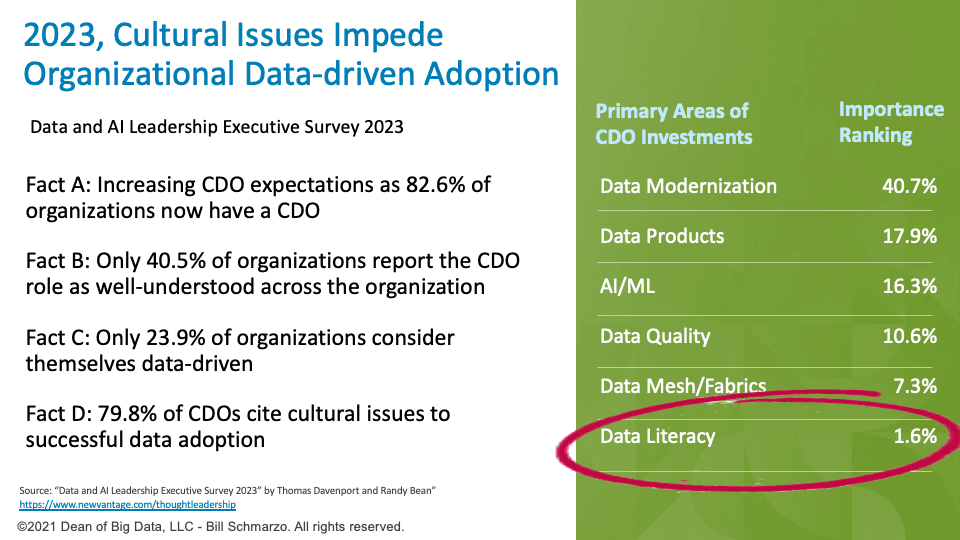
79.8% of organizations cite cultural barriers to data adoption, yet AI and data literacy rank at only 1.6% in the CDO’s list of priorities.

I find the research from New Vantage Partners, headed by industry legends Tom Davenport and Randy Bean, incredibly valuable. Their annual “Data and Analytics Leadership Annual Executive Survey” series delivers invaluable insights into how organizations are trying to get value from their data…and I mean trying.

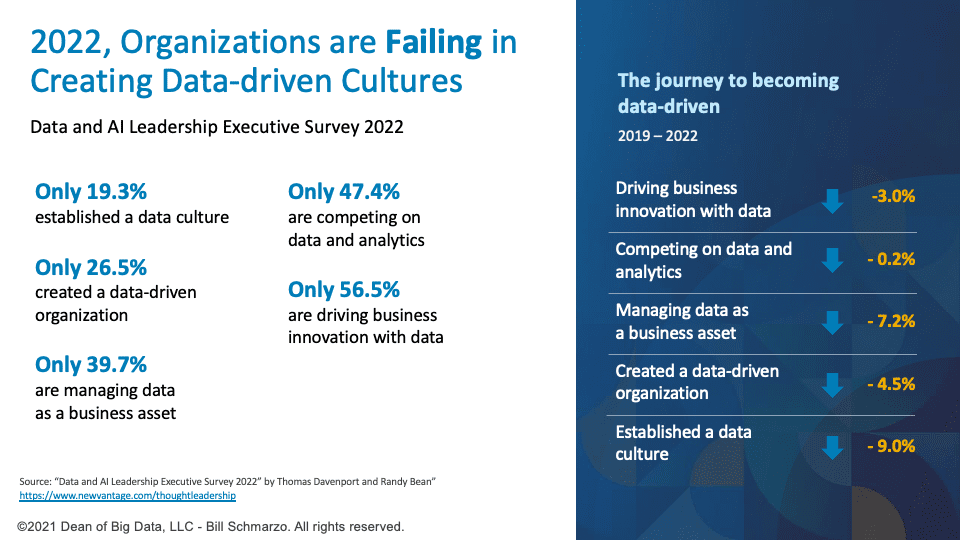
Their 2022 report was stunning in surfacing that organizations were failing in their attempts to become data-driven. The survey highlighted that between 2019 and 2022, nearly 10% of the surveyed organizations had given up on their journeys to become data-driven (Figure 1).

Slide2

Figure 1: “2022 Data and Analytics Leadership Annual Executive Survey” Takeaways

Now, from their 2023 report, we get the following opening statement:

“Yet it would appear that too much of the focus of data executives is on non-human issues — data modernization, data products, AI and ML, data quality, and various data architectures. Less than 2% of respondents ranked “data literacy” as their top investment priority. Could it be that we are leading the horse to water, but it isn’t drinking? Perhaps this accounts for the low level of overall success of the CDO/CDAO function found in the survey.”

The Chief Data Officer (CDO) is focused on keeping up with new technological advancements like Generative AI and Large Language Models, which are in their natural comfort zone. However, they overlook an even more critical factor in achieving data-driven adoption: organizational AI and data literacy. Due to this, they are failing to educate and prepare the organization to participate in and take advantage of the economic potential generated by the AI and data revolution.

And the impact? Well, the facts speak for themselves:

  • Fact A: The importance of the CDO role continues to grow. The role has achieved an industry “critical mass,” with 82.6% of organizations now having a CDO.
  • Fact B: Unfortunately, the CDO’s success is ambiguous. Only 40.5% of companies report that the CDO role is well-understood within their organizations, while only 35.5% of organizations responded that the CDO role is successful and well-established – an 11.6% decline from last year.
  • Fact C: Becoming data-driven and building a data culture is still elusive for most organizations. Only 23.9% of companies characterize themselves as data-driven, and only 20.6% say they have successfully implemented a data culture.
  • Fact D: 79.8% of CDOs cite cultural issues as their biggest challenge to realizing business value, reflecting that change is seldom easy and organizational transformation tends to move slowly.
  • Fact E: Of the CDO’s primary areas of investment, data literacy ranks near the bottom in CDO importance at 1.6%.

Value Creation Success Equation Summary: The importance of the CDO is increasing, but their effectiveness is unimpressive. Their biggest impediment to success is cultural issues, not technology, but they prioritize technology investments over cultural investments.

Sorry, but the facts don’t add up (Figure 2).

Slide3

Figure 2: 2023 Data and Analytics Leadership Annual Executive Survey” Takeaways

As organizations and their CDO leader struggle to get value from their data, the underinvestment in AI and data Literacy dooms these organizations’ data-to-value journey before it has even started. And throwing new technologies at the organization just exacerbates the cultural challenges.

Your data-to-value journey must start with prioritizing organization-wide AI and data literacy. And I know just how to begin that AI and data literacy program.

Addressing the AI and Data Literacy Challenge

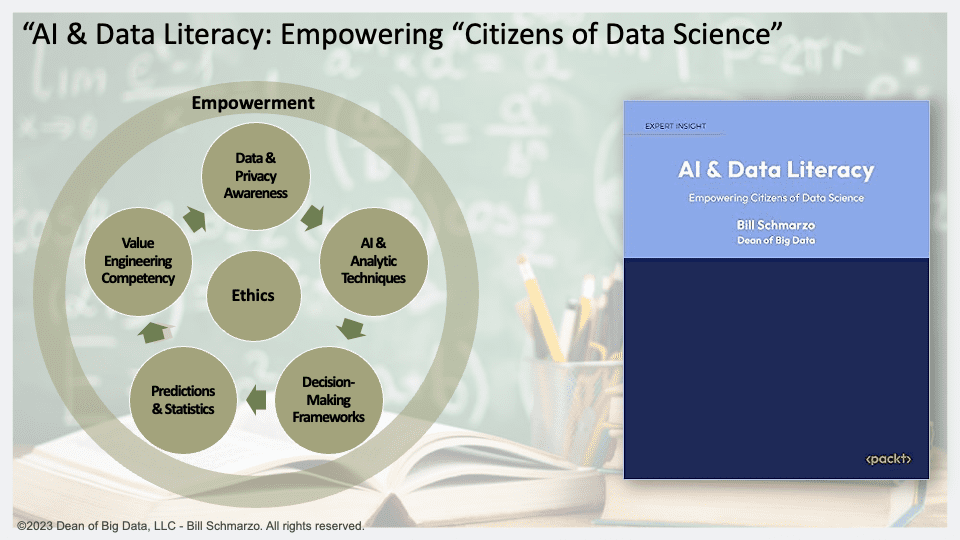
I wrote “AI & Data Literacy: Empowering Citizens of Data Science” because I noticed significant organizational and societal challenges in instilling an AI and data literacy culture. The industry needed some pragmatic, no-hype educational material to ensure everyone understood the roles, responsibilities, and rights in ensuring that AI and data were used to deliver more relevant, meaningful, responsible, and ethical outcomes (Figure 3).

Slide4

Figure 3: AI & Data Literacy: Empowering Citizens of Data Science

This AI and data literacy framework covered in my book is comprised of these components:

  • Data & Privacy Awareness chapter discusses how your data is captured and used to influence and manipulate your thoughts, beliefs, and subsequent decisions. This section also covers personal privacy and what governments and organizations worldwide do to protect your data from misuse and abuse.
  • AI & Analytic Techniques chapters focus on understanding the wide range of analytic algorithms available today and the problems they address. We will dive deep into how AI models work, the importance of determining user intent, and the critical role of the AI Utility Function in enabling the AI model to continuously learn and adapt. This chapter will also explore AI risks and challenges, including confirmation bias, unintended consequences, and AI model false positives and false negatives.
  • Making Informed Decisions chapter explores how humans can leverage basic problem-solving skills to create simple models to avoid ingrained human decision-making traps and biases. We will provide examples of simple but effective decision models and tools to improve the odds of making more informed, less risky decisions in an imperfect world.
  • Predictions & Statistics chapter explains basic statistical concepts (probabilities, averages, variances, confidence levels) that everyone should understand (if you watch sports, you should already be aware of many of these statistical concepts). We’ll then examine how simple stats can create probabilities that lead to more informed, less risky decisions.
  • Value Engineering Competency chapter provides a pragmatic framework for organizations leveraging their data with AI and advanced analytic techniques to create “value.” We will also provide tools to help identify and codify how organizations create value and the measures against which value creation effectiveness will be measured across a diverse group of stakeholders and constituents.
  • AI Ethics chapter explores how we integrate ethics into our AI models to ensure the delivery of unbiased, responsible, and ethical outcomes. We will explore a design template for leveraging economics to codify ethics that can then be integrated into the AI Utility Function that guides the performance of the AI models.
  • Cultural Empowerment chapter focuses on creating a culture of empowered “Citizens of Data Science.” We will focus on empowering individuals and teams to embrace and leverage a wide range of viewpoints, giving them the understanding and comfort level for exploring where and how AI and data can empower their personal and professional lives.

Summary: Data to Value Journey Starts with Data Literacy

The challenge continues: how do we establish a culture of data-driven decision-making and value creation?

Unfortunately, it’s too easy for CDOs and other technology-savvy executives to stay in their comfort zones and focus on the latest technology innovations. It’s fun. It’s cool. It’s safe. Unfortunately, this tendency gets in the way of creating the culture necessary for organizations to take full advantage of the latest technological innovations.

As the New Vantage Partners research highlighted, CDOs must push themselves out of their comfort zones to lead the change necessary to create that data-driven, value-centric culture necessary for leveraging AI and data to deliver more relevant, meaningful, responsible, and ethical outcomes.

To create this culture, it’s necessary that everyone in the organization – and society as a whole – understands their role, responsibilities, and rights in determining where and how they can use AI and data for their personal and professional development. AI and data literacy is the starting point and foundation for creating that culture.