Elon Musk, the entrepreneur behind Tesla and SpaceX, has recently been in the spotlight for his AI startup, xAI, with the unveiling of Grok. This model is announced just a week after the revaluation of Twitter, which he acquired a year ago, now valuing it at $19 billion as opposed to the initial $44 billion.
Announcing Grok!
Grok is an AI modeled after the Hitchhiker’s Guide to the Galaxy, so intended to answer almost anything and, far harder, even suggest what questions to ask!
Grok is designed to answer questions with a bit of wit and has a rebellious streak, so please don’t use…
— xAI (@xai) November 5, 2023
Access Grok LLM here: https://grok.x.ai/
One of the defining features of Grok is its ability to pull in real-time information, setting it apart from its contemporaries. As highlighted in recent screenshots, Grok not only provides updates on current events with a touch of humor but also demonstrates a sharp, satirical tone in its interactions. This approach marks a significant shift from the traditionally neutral and factual AI responses, leaning towards a more human-like, engaging conversational style.
Grok by XAi
As the AI responds to queries about current news or cheeky requests, it manages to maintain a playful yet informative tone, ensuring users are engaged while subtly reinforcing the importance of legality and ethics, as seen in its firm stance against discussing illegal activities.
Grok by XAi
Grok LLM was started with Grok-0, a prototype LLM with 33 billion parameters. The evolution from Grok-0 to Grok-1 witnessed a significant amplification in reasoning and coding capabilities, with Grok-1 outshining its predecessor by scoring 63.2% on the HumanEval coding task and 73% on the MMLU.
Grok-1, the powerhouse of Grok, is an autoregressive Transformer-based model meticulously pre-trained for next-token prediction—a process where the model predicts the subsequent word or token in a sequence based on the preceding ones. Following its pre-training, Grok-1 underwent fine-tuning, benefiting from a wealth of feedback from human evaluators and insights from its predecessor, the early Grok-0 models. This fine-tuning honed its abilities, prepping it for its official release in November 2023.
The training regimen of Grok-1 is both extensive and diverse, encompassing data from the internet until Q3 2023 and invaluable input from AI tutors.
Benchmark Grok-1
Grok-1's competency in handling middle school math word problems, multidisciplinary multiple choice questions, Python code completion tasks, and mathematical problems is demonstrative of its robust reasoning abilities. Particularly noteworthy is its exceptional performance in standard machine learning benchmarks, where it surpassed contemporaries like ChatGPT-3.5 and Inflection-1, only falling short to models with significantly larger training datasets like GPT-4.
A custom training and inference stack built on Kubernetes, Rust, and JAX forms the backbone of Grok's infrastructure. The emphasis on Rust for its high performance, reliability, and bug prevention is a testament to xAI’s dedication to quality and innovation.
Grok is envisioned to be more than just a question-answering AI; it's seen as a tool that aids in scalable oversight, formal verification for enhanced safety and reliability, long-context understanding, adversarial robustness, and multimodal capabilities. The eventual goal is to equip Grok with a plethora of senses, enabling a broader spectrum of real-time interactions and assistance.
In contrast, ChatGPT, another notable AI tool, initially lacked real-time internet access and required prompting for witty responses. While later versions improved upon this, Grok's innate ability to blend humor with real-time information retrieval sets a new standard.
Upon concluding its early beta phase, Grok will be available to X Premium subscribers, with a pricing tier of $16 per month for an ad-free experience. This accessibility indicates a step towards democratizing advanced AI conversational agents.
Below post shows the UI features in Grok; posted by one of the founding members of xAI.
These are some of the UI features in Grok. First, it allows you to multi-task. You can run several concurrent conversations and switch between them as they progress. pic.twitter.com/aXAG0M2oPF
— Toby Pohlen (@TobyPhln) November 5, 2023
Launched in July, xAI is a collaborative endeavor with a team boasting affiliations to reputed AI research entities like Google's DeepMind and Microsoft. Although operating independently, xAI maintains a symbiotic relationship with X, alongside engagements with Tesla and other firms, pooling a diverse range of expertise to drive forward the frontier of AI-driven communication.
NVIDIA CEO Hails New Data Science Facility As ‘Starship of The Mind’ November 6, 2023 by Ali Azhar
NVIDIA founder and CEO Jensen Huang and NVIDIA co-founder Chris Malachowsky inaugurated the Malachowsky Hall for Data Science & Information Technology at the University of Florida (UF). The 263,000-square-foot structure in Gainesville, FL, cost over $150 million. The state of Florida provided $110 million for the construction of the building. The rest of the funds came from private and college funds.
The seven-story building will be used as a multidisciplinary space for engineering, medicine, and pharmacy. One of the key objectives of investing in the Malachowsky Hall is to advance the University of Florida’s efforts to integrate artificial intelligence (AI) across the curriculum and to reinforce the stature of the university as one of the nation's leading public universities. Along with advancing AI on-campus, Malachowsky Hall is set to bring AI growth to Florida’s economy and continue to build a competitive AI workforce in the U.S.
The hall offers innovative collaboration spaces, labs, computing study spaces, a rooftop terrace, and a 400-seat auditorium. The building is designed with sustainability in mind. It features rainwater harvesting facilities and energy-efficient systems.
“Steve Jobs called (the PC) ‘the bicycle of the mind,’ a device that propels our thoughts further and faster,” Huang said while in conversation with UF President Ben Sasse and more than 100 students. “What Chris Malachowsky has gifted this institution is nothing short of the ‘starship of the mind’ — a vehicle that promises to take our intellect to uncharted territories,” Huang said.
Discussing the impact of AI, Sasse underscored the importance of adaptability in the rapidly evolving world. He urged students to work in different organizations and explore different careers as the AI revolution is going to change the workplace and some industries might come to an end in our lives.
According to the UF Board of Trustees Chair Mori Hosseini, the new data science facility will help propel AI education and research that will boost economic growth and improve lives across the globe.
“The fields of AI and data science are of central importance in building a better world,” Malachowsky said, in a statement. “I’m honored to further UF’s world-class capabilities in these areas by supporting the talent and interdisciplinary collaboration that will allow the university to lead during this time of unprecedented opportunity.”
The inauguration of the new building marks a milestone in the partnership between NVIDIA, the state of Florida, and UF. In 2020, NVIDIA and Malachowsky donated just under $60 million to UF for the HiPerGator — one of the most powerful AI supercomputers in the country. The supercomputer is powered by 1,120 NVIDIA A100 GPUs and is available to the UF’s 55,000 students. The HiPerGator helps advance AI research at scale and supports equal access to AI technology and training for students.
UF recently added 100 new AI faculty members to 300 already engaged AI faculty on campus. The inauguration of the Malachowsky Hall opens exciting new opportunities for the UF staff and students to realize the potential of AI innovations across disciplines.
Related Items
UF’s HiPerGator Supercomputer Assists Cattle Scientists Using AI
University of Florida Health, NVIDIA Develop AI Model for Clinical Trials, Medical Decision-Making
Nvidia Expands Its AI Strategy With New Hugging Face Integration, Enterprise 4.0, AI Workbench
365 Data Science offers a risk-free opportunity to enhance data science and AI skills. From November 6 (07:00 PST) to November 20 (07:00 PST), enjoy free unlimited access to the platform’s comprehensive curriculum, interactive courses, practical data projects, and earn industry-recognized certificates—all at no charge.
365's learning platform enables learners to delve into the industry with such courses as Introduction to Data and Data Science, Data Strategy, and Data Literacy. Additionally, the program includes a comprehensive segment on machine and deep learning, offering foundational skills in ML with Python and advanced topics like deep learning.
Until November 20, 365 Data Science is providing two weeks of completely free, unlimited access to its full range of courses and supporting materials, assisting students in mastering data science and AI. This e-learning platform—serving over 2 million users globally—equips learners with vital, future-ready skills in data science, data analytics, programming, machine and deep learning, and AI.
Tradition and Mission: A Timeless Initiative
Now in its third year, 365 Data Science once again launches its free access initiative which initiated during the first COVID-19 lockdown.
Ned Krastev, CEO of 365 Data Science, describes data science as "an ever-evolving field offering immense opportunities for career advancement." He highlights the company's commitment to fostering a worldwide community of ambitious and committed learners.
The initiative’s impact is notable, with over 152,000 unique users from 200 countries participating in 2022, engaging in over 9.2 million minutes of content and achieving 38,761 certificates. Krastev expresses awe at the annual surge in student engagement, viewing it as a reflection of their eagerness to learn and excel in new roles. He emphasizes 365 Data Science’s role in consistently supporting these learners in their journey.
Latest Features & Educational Insights
This year, 365 Data Science has unveiled a library of practical, real-world, data-based projects catering to various experience levels, complexities, and technological needs. Ned remarks, "We're committed to practice-based learning as the key to mastering skills. Our team's relentless efforts aim to equip students with relevant skills from the start, and we look forward to seeing these projects positively impact their careers."
During the free access period, users can enjoy all 365 Data Science courses, projects, exams, certificates, and platform features. Although mastering every skill for a data and AI career in 14 days is challenging, this unlimited free access offers a risk-free opportunity to gain a broader insight into the field and establish career foundations.
Unlock your potential—begin your journey for free
More On This Topic
365 Data Science courses free until 18 November
365 Data Science courses free until November 21
How I Got 4 Data Science Offers and Doubled My Income 2 Months…
Hone Your Data Skills With Free Access to DataCamp
15 Trending MLOps Talks You can Access for Free at ODSC East 2022
Somewhere, someone is speaking about wanting to break into the tech world. If it’s to become a software engineer or they’re interested in data science. When these people start their data science journey, in particular, there are a variety of online courses, boot camps, and degrees to choose from. It can be very difficult, so that’s where I come in and take the workload off of you.
So, let’s go straight into it…
Introduction to Data Science with Python — Harvard
Courses Link: Introduction to Data Science with Python
Harvard University is a well-known private Ivy League research university. To meet the rising demand for technology professionals in today’s market, they understand the importance of providing interested or new students with free material to kick-start their journey in the tech world.
The above course is aimed at newbies into the data analytical world. The most popular programming language for data science at the moment is Python, therefore that is always a good place to start. The course consists of you committing 3-4 hours per week, in which you will learn about:
Study regression models
Utilize popular libraries such as sklearn, Pandas, matplotlib, and numPy
Machine learning concepts such as overfitting, assessing uncertainty, and weighing trade-offs
Fundamental understanding of machine learning models
Basic concept understanding of Machine Learning (ML) and Artificial Intelligence (AI)
If you are looking for other courses, Harvard also offers:
Data Science: Probability
Data Science: Linear Regression
Data Science: Visualization
Data Science: Productivity Tools
Data Science: Machine Learning
High-Dimensional Data Analysis
Statistical Thinking And Data Analysis — MIT
Link: Statistical Thinking And Data Analysis
MIT is also another leading learning institute. In the year of 2001, they launched a platform called OpenCourseWare. This is another learning institute that understands the demands of providing free educational material for people to understand a new market and their new potential careers.
Statistical thinking and implementation in data analysis is a very important concept. Some say that statistics is useful but not mandatory for you to know the ins and outs, but in my time as a data scientist, I have understood the importance of statistics and how it could have improved and fast-tracked my career.
In this course, you will have to commit to 2 sessions per week that run for 1.5 hours each, and you will learn about:
Probability
Discuss sampling techniques
Data summarization
Common sampling distributions
Statistical inference and hypothesis testing
Regression
Nonparametric inference
Other data analytics courses provided by MIT:
Communicating With Data
Advanced Data Structures
How to Process, Analyze and Visualize Data
Mathematics Of Big Data And Machine Learning
Introduction to Data Analytics — IBM
Link: Introduction to Data Analytics
International Business Machines Corporation is not a university, but its courses are well-recognized and provide newbies with the right learning materials to kickstart a new journey. With 397,828 already enrolled in the course and taught in 8 languages, this introduction to data analytics course provides people with a smooth entry into the data world.
This course is flexible and requires you to commit approximately 10 hours to learn about:
What Data Analytics is and the key steps
Different types of data structures, file formats, and sources of data
Describe the data analysis process involving collecting, wrangling, mining, and visualizing data
Differentiate between different data roles
Mining Massive Data Sets — Stanford University
Course Link: Mining Massive Data Sets
Another leading university with great learning material is Stanford University. If you’re seriously thinking about taking up data analytics, it is also good to understand the more popular and fast-developing areas of the tech world, such as machine learning and artificial intelligence. Naturally, a lot of data analysts move on to working on machine learning models and then find their niche, such as natural language processing.
A part of the machine learning world is dealing with mining massive datasets. This course is a 7-week course, and you will learn about the following:
MapReduce
Algorithms for extracting models
Information from large datasets
If you are interested in machine learning, artificial intelligence, and deep learning, the following courses may be of interest to you:
CS 221 — Artificial Intelligence
CS 229 — Machine Learning
CS 230 — Deep Learning
Introduction to Artificial Intelligence — Berkeley
Link: Introduction to Artificial Intelligence
If you’ve already down-packed your knowledge on data analytics and you’re ready to kickstart a career or your learning journey in artificial intelligence, then Berkeley University has a great introduction to artificial intelligence course.
The course is 8 weeks long, and in the link provided, you will have the lecture topics provided in different formats, reading notes, and homework. The course starts with the basic ideas and techniques around the design of intelligent computer systems, which goes into a further deep dive into statistical and decision-theoretic modeling paradigms.
Wrapping it up
These 5 free data analytics courses will take you through a journey of the data world. You will start off with learning the basics and gradually move into more technical aspects of what it really consists of being a data analyst/scientist.
Nisha Arya is a Data Scientist and Freelance Technical Writer. She is particularly interested in providing Data Science career advice or tutorials and theory based knowledge around Data Science. She also wishes to explore the different ways Artificial Intelligence is/can benefit the longevity of human life. A keen learner, seeking to broaden her tech knowledge and writing skills, whilst helping guide others.
More On This Topic
Free University Data Science Resources
New Online MS in Business Analytics for Managers from University of…
KDnuggets News, April 6: 8 Free MIT Courses to Learn Data Science…
KDnuggets News, May 4: 9 Free Harvard Courses to Learn Data…
We keep dreaming — albeit they're most often nightmares — of intelligent robots such as Terminators. However, while robots are now essential for factories and making inroads in the home, no one could mistake them for being intelligent. Roomba cat rides and smart vacuums are fun and useful. Intelligent? Not so much.
But since generative AI exploded on the scene, people have started combining AI and robots to create a new age of smart robots. As we enter the last quarter of 2023, it's clear that the melding of these two will create an era of unparalleled technological synergy.
This is going to happen, by the way. As Vaclav Vincalek, virtual CTO and founder of 555vCTO.com, observed, "The real question is: 'How will generative AI integrate with robotics?' I just can't foresee how going forward, anyone building a smart robot wouldn't integrate generative AI in some way or another."
Companies such as Boston Dynamics and Sanctuary AI, Vincalek said, "have already made it their mission to build robots that are more than simply cameras on wheels." These companies, he added:
"…are striving for robots that can master any terrain and remain balanced. Generative AI for 'robot vision' will help such companies achieve this. Tasks like object detection, image segmentation, and image generation will improve at a staggering rate thanks to generative AI. This technology will also bolster fine-tuning one of the most difficult tasks in robotics: designing a hand that can both lift heavy objects AND handle fragile items like eggs."
Not enough human workers
These advances may come just in time. While we often worry about people losing their jobs to AI and robotics, in the long run, we need smart robots to fill jobs.
As Gearoid Reidy, a Bloomberg columnist, recently wrote, "Over half of [Japan's] businesses say they can't find enough full-time staff." With one in 10 people now over 80, there simply aren't enough workers to go around. For example, self-driving cars are still very much a work in progress, but when your alternative is 80-year-old taxi drivers, the need for self-driving, smart cars becomes much more urgent.
This is not an issue limited to Japan. Germany's industries are facing similar problems — with baby boomers retiring and a smaller cohort of workers entering the job market due to low birth rates. The result? With 45.8 million workers today, Germany expects to lose 7 million of them by 2035. The solution? Ralf Winkelmann, managing director of FANUC Germany, told Reuters: "Robots [will] enable the survival of companies that see their future at risk due to staff shortages."
It's no different in the United States. For all the political hysteria over illegal immigrants stealing US jobs, according to the US Chamber of Commerce, the reality is that Americans are aging out of the workforce. At the same time, the growing number of elderly will need more care and support than ever.
Also: Gen AI a job threat? On the contrary, human workers have much to gain
Other jobs, especially in the hospitality and food-service industries, are going begging. No one wants to flip burgers for minimum wage. Why would they? The US federal minimum wage remains $7.25, while the national average minimum wage is $9.08. Neither have kept up with the cost of living in over 50 years. ZipRecruiter reports the US average hourly pay for a livable wage is $26.93. Looking ahead, it appears smart robots are one of the few viable answers for an ever-shrinking workforce.
Smart robots will also be able to handle mucky jobs that, frankly, almost no one wants to do. For example, people are incompetent at sorting out recycling stuff from ordinary trash. AMP Robotics, however, is using AI and computer vision to distinguish cans, bottles, paper, and many other packaging types and recyclables. The AI then guides robots to pick and place the material, automating the sorting process in a highly manual industry where finding workers is very challenging.
Still, lower-wage workers tend to have the most to lose. The rise of AI-powered automation, noted MIT economist Daron Acemoglu, "is going to have fairly large distributional effects, especially for low-skill service workers. It's a labor-shifting device, rather than a productivity-increasing device." The result, as the historical record shows, will see the income gap between more- and less-educated workers grow ever larger.
Another part of the problem is that sometimes, robotics actually ends up hurting workers instead of helping them do their jobs. Take, for example, the New York Times recently reported on how Smart Bar systems, automated cocktail dispensers, made work harder for waiters who found themselves. spending "more time tending to the machines and less time chatting with customers, a change that she found reduced her tips by about 30%."
This isn't just limited to blue-collar jobs. For example, many people are replacing writers with generative AI. Just like serving up cocktails, though, what the produce may look good at first glance, but a closer examination will find they're filled with errors. That means someone needs to edit the document and fix the mistakes. Now, editors can fix editorial mistakes, but they're not equipped to repair factual errors — or hallucinations, as they're known in AI circles. That job needs to be done by subject matter experts. The result? More time can be wasted fixing bad documents rather than creating good documents.
Jobs destroyed and created
In the long run, according to the World Economic Forum, the number of jobs destroyed will be surpassed by the number of "jobs of tomorrow" created. But in the meantime, there will be plenty of labor disruption. It will impact service jobs the most, but white-collar jobs will also be hit. As Acemoglu wrote, "Automation could increase productivity while reducing wages and employment." Exactly how all this will play out remains to be seen.
Still, smart robots will be a boon for industries where industrial robots are already playing a role. As Massimiliano Moruzzi, CEO of manufacturing automation firm Xaba explained:
"Adopting and deploying industrial robots for manufacturing is tedious, time-consuming, and expensive. It requires highly skilled individuals who know specialized robotics programming languages. In addition, the accuracy of robots used today is limited by the lack of machine learning models that accurately represent the physics of a robot's operation."
That's a big reason why industrial robots, with prices starting at $25,000 per robot, are only found in specialized or bigger businesses.
Also: AI has the potential to automate 40% of the average work day
But, Moruzzi continued, "This can be changed with an AI-driven control system." Any industrial robot can be empowered with both deep intelligence, which controls the body, and cortex intelligence, which interprets sensor data such as vision. Outfitted with such AI, a robot can more fully control its body and better navigate its environment. This, Moruzzi said, "would solve the challenges of deploying industrial robots and significantly reduce the time and costs of robotics deployments."
Robotics will also transform supply chain management. Usually, when I'm writing about that subject, I'm referring to the management of software code supply chains. This time, though, I'm talking boxes, crates, and warehouses.
Smarter automation
COVID pushed automation harder than ever in warehouses, explained Nilay Parikh, CEO at Arvist, which supplies AI solutions for warehouses. "The integration of robots into warehouse operations has had a profound impact on the industry, enabling faster order fulfillment, accurate inventory tracking, and reduced labor costs."
Moreover, with AI increasingly being built-in, tomorrow's robots will be capable not only of carrying out repetitive tasks with precision but — and this is the part Parikh emphasized — "collaborating seamlessly with human workers, which will be key to making progress towards true automation in the future."
Some of these combinations are proving to be both useful and amusing. For example, the well-known general-purpose robotics manufacturer Boston Dynamics has paired its robotic "dogs" with OpenAI's ChatGPT to create a "smart" tour guide, Spot, with a British accent and attitude.
Also: AI will change the role of developers forever, but leaders say that's good news
This is more than a cute trick. Matt Klingensmith, Spot's chief software engineer, noted how this robot-AI combination has what is called "Emergent Behavior — the ability to perform tasks outside of what they were directly trained on. Because of this, they can be adapted for a variety of applications, acting as a foundation for other algorithms."
Now, we're not talking about emergent behavior like an AI proving itself sentient — but they can surprise us. For instance, Klingensmith noted that when Spot was asked a question for which it did have an answer, Spot responded with, "I don't know. Let's go to the IT help desk and ask!" It then did just that. Klingensmoth had neither prompted nor programmed Spot to ask for help. Rather, the smart guide worked out the association between the location "IT help desk" and the action of asking for help on its own.
Figuring out how to encourage this kind of useful behavior will be a major step forward in making AI smart robots much more useful.
New skills and partners
On a different level, Amol Ajgaonkar, Insight Enterprises' Product Innovation CTO, believes we should think of the partnership between AI and robotics in terms of a framework for plugins. "Companies can break down key actions they want a robot to take into generative AI plugins or skills," explained Ajgaonkar. "When deployed and utilized in this manner, it will allow us to take two fundamental steps forward. First, robots will be able to communicate with different systems easily. Second, it will allow humans to communicate with robots and systems not just to get status information but provide complex instructions that can orchestrate actions across multiple robots."
Where will all this take us? Zhenyu Gan, a Syracuse University mechanical and aerospace engineering professor, believes integrating "robotics and generative AI will revolutionize various industries by providing more intelligent, adaptable, and efficient robotic systems. We can expect over the next five years to see a new generation of robots that are capable of making complex decisions and operating with a higher degree of autonomy. This will be particularly important for applications such as autonomous vehicles, drones, and legged robots that require real-time decision-making in dynamic environments."
Also: Two divergent skills that matter in an AI world: Math and business development
Kevin Dunlap, co-founder and managing partner at the robotics and AI company Calibrate Ventures, has high expectations. "With so much money and expertise flowing into AI, robot development will rapidly speed up in the next five years. This will create a leapfrog effect. One of the biggest changes we will see in the next five years will be robots that can follow real-time instructions. Instead of an autonomous robot having to learn the layout of a building by studying a map, which is common today, they will be able to navigate any new environment on the fly by following instructions such as: 'enter the door, follow the hallway, take the second door on the left, and then proceed to the third loading door from the left and park there.'"
This will be a sea change. Dunap continued, "We will be able to drop robots into any situation, and they will work without a lot of pre-programming. And, on a higher level, we will see a lot more human-robot interaction. People are getting used to communicating with AI chatbots, so it's a natural next step to interact with robots. We will ask robots to do tasks and correct them if they mess up. Robots, on the other hand, won't just receive our instructions, but will make active suggestions and recommendations based on their own more highly-developed AI brains."
High hopes and skepticism
Selmer Bringsjord, director of the AI & Reasoning Lab at Rensselaer Polytechnic Institute (RPI), is not so optimistic. While acknowledging that "the prospect of making the mind of a robot a chatbot has proved irresistible to many," Bringsjord reported back on his lab's limited success. They toyed with the idea of making GPT-4 the brain of one of their robots but found it to be of "acutely limited value." That's because robots, which are designed to perceive and physically manipulate objects, "have precious little to do with data regarding language." In short, what robots do and what generative AI does are really very different things and they don't work well together.
Also: Partner, helper, or boss? ChatGPT was asked to design a robot and this happened
Still, most people have high hopes for the combination. The proof will be coming soon enough. If all continues to go well with the marriage of AI and robotics, we can expect self-driving cars that will really work — sorry, Elon, Tesla's not close yet; household assistants to help me stay active around my home as I get older; and, yes, robotic short-order chefs that can flip my burgers. That last scenario, by the way, is — thanks to Roboburger — closer than you might think!
In recent years, Generative AI has shown promising results in solving complex AI tasks. Modern AI models like ChatGPT, Bard, LLaMA, DALL-E.3, and SAM have showcased remarkable capabilities in solving multidisciplinary problems like visual question answering, segmentation, reasoning, and content generation.
Moreover, Multimodal AI techniques have emerged, capable of processing multiple data modalities, i.e., text, images, audio, and videos simultaneously. With these advancements, it’s natural to wonder: Are we approaching the end of traditional machine learning (ML)?
In this article, we’ll look at the state of the traditional machine learning landscape concerning modern generative AI innovations.
What is Traditional Machine Learning? – What are its Limitations?
Traditional machine learning is a broad term that covers a wide variety of algorithms primarily driven by statistics. The two main types of traditional ML algorithms are supervised and unsupervised. These algorithms are designed to develop models from structured datasets.
Standard traditional machine learning algorithms include:
Regression algorithms such as linear, lasso, and ridge.
K-means Clustering.
Principal Component Analysis (PCA).
Support Vector Machines (SVM).
Tree-based algorithms like decision trees and random forest.
Boosting models such as gradient boosting and XGBoost.
Limitations of Traditional Machine Learning
Traditional ML has the following limitations:
Limited Scalability: These models often need help to scale with large and diverse datasets.
Data Preprocessing and Feature Engineering: Traditional ML requires extensive preprocessing to transform datasets as per model requirements. Also, feature engineering can be time-consuming and requires multiple iterations to capture complex relationships between data features.
High-Dimensional and Unstructured Data: Traditional ML struggles with complex data types like images, audio, videos, and documents.
Adaptability to Unseen Data: These models may not adapt well to real-world data that wasn’t part of their training data.
Neural Network: Moving from Machine Learning to Deep Learning & Beyond
Neural network (NN) models are far more complicated than traditional Machine Learning models. The simplest NN – Multi-layer perceptron (MLP) consists of several neurons connected together to understand information and perform tasks, similar to how a human brain functions.
Advances in neural network techniques have formed the basis for transitioning from machine learning to deep learning. For instance, NN used for computer vision tasks (object detection and image segmentation) are called convolutional neural networks (CNNs), such as AlexNet, ResNet, and YOLO.
Today, generative AI technology is taking neural network techniques one step further, allowing it to excel in various AI domains. For instance, neural networks used for natural language processing tasks (like text summarization, question answering, and translation) are known as transformers. Prominent transformer models include BERT, GPT-4, and T5. These models are creating an impact on industries ranging from healthcare, retail, marketing, finance, etc.
Do We Still Need Traditional Machine Learning Algorithms?
While neural networks and their modern variants like transformers have received much attention, traditional ML methods remain crucial. Let us look at why they are still relevant.
1. Simpler Data Requirements
Neural networks demand large datasets for training, whereas ML models can achieve significant results with smaller and simpler datasets. Thus, ML is favored over deep learning for smaller structured datasets and vice versa.
2. Simplicity and Interpretability
Traditional machine learning models are built on top of simpler statistical and probability models. For example, a best-fit line in linear regression establishes the input-output relationship using the least squares method, a statistical operation.
Similarly, decision trees make use of probabilistic principles for classifying data. The use of such principles offers interpretability and makes it easier for AI practitioners to understand the workings of ML algorithms.
Modern NN architectures like transformer and diffusion models (typically used for image generation like Stable Diffusion or Midjourney) have a complex multi-layered network structure. Understanding such networks requires an understanding of advanced mathematical concepts. That’s why they are also referred to as ‘Black Boxes.’
3. Resource Efficiency
Modern neural networks like Large Language Models (LLMs) are trained on clusters of expensive GPUs per their computational requirements. For example, GPT4 was reportedly trained on 25000 Nvidia GPUs for 90 to 100 days.
However, expensive hardware and lengthy training time are not feasible for every practitioner or AI team. On the other hand, the computational efficiency of traditional machine learning algorithms allows practitioners to achieve meaningful results even with constrained resources.
4. Not All Problems Need Deep Learning
Deep Learning is not the absolute solution for all problems. Certain scenarios exist where ML outperforms deep learning.
For instance, in medical diagnosis and prognosis with limited data, an ML algorithm for anomaly detection like REMED delivers better results than deep learning. Similarly, traditional machine learning is significant in scenarios with low computational capacity as a flexible and efficient solution.
Primarily, the selection of the best model for any problem depends on the needs of the organization or practitioner and the nature of the problem at hand.
Machine Learning in 2023
Image Generated Using Leonardo AI
In 2023, traditional machine learning continues to evolve and is competing with deep learning and generative AI. It has several uses in the industry, particularly when dealing with structured datasets.
For instance, many Fast-Moving Consumer Goods (FMCG) companies deal with bulks of tabular data relying on ML algorithms for critical tasks like personalized product recommendations, price optimization, inventory management, and supply chain optimization.
Further, many vision and language models are still based on traditional techniques, offering solutions in hybrid approaches and emerging applications. For example, a recent study titled “Do We Really Need Deep Learning Models for Time Series Forecasting?” has discussed how gradient-boosting regression trees (GBRTs) are more efficient for time series forecasting than deep neural networks.
ML's interpretability remains highly valuable with techniques like SHAP (Shapley Additive Explanations) and LIME (Local Interpretable Model-agnostic Explanations). These techniques explain complex ML models and provide insights about their predictions, thus helping ML practitioners understand their models even better.
Finally, traditional machine learning remains a robust solution for diverse industries addressing scalability, data complexity, and resource constraints. These algorithms are irreplaceable for data analysis and predictive modeling and will continue to be a part of a data scientist's arsenal.
If topics like this intrigue you, explore Unite AI for further insights.
In the ever-expanding universe of AI and ML a new star has emerged: prompt engineering. This burgeoning field revolves around the strategic crafting of inputs designed to steer AI models toward generating specific, desired outputs.
Various media outlets have been talking about prompt engineering with much fanfare, making it seem like it’s the ideal job — you don’t need to learn how to code, nor do you have to be knowledgeable about ML concepts like deep learning, datasets, etc. You’d agree that it seems too good to be true, right?
The answer is both yes and no, actually. We’ll explain exactly why in today’s article, as we trace the beginnings of prompt engineering, why it’s important, and most importantly, why it’s not the life-changing career that will move millions up on the social ladder.
The Rise of Prompt Engineering
We’ve all seen the numbers—the global AI market will be worth $1.6 trillion by 2030, OpenAI is offering $900k salaries, and that’s without even mentioning the billions, if not trillions of words churned out by GPT-4, Claude and various other LLMs. Of course, data scientists, ML experts, and other high-level pros in the field are at the forefront.
However, 2022 changed everything, as GPT-3 became ubiquitous the moment it became publicly available. Suddenly, the average Joe realized the importance of prompts and the notion of GIGO—garbage in, garbage out. If you write a sloppy prompt without any details, the LLM will have free reign over the output. It was simple at first, but users soon realized the model’s true capabilities.
However, people soon began experimenting with more complex workflows and longer prompts, further emphasizing the value of weaving words skillfully. Custom instructions only widened the possibilities, and only accelerated the rise of the prompt engineer—a professional who can use logic, reasoning, and knowledge of an LLM’s behavior to produce the output he desires at a whim.
Speaking the Language of the Machines?
At the zenith of its potential, prompt engineering has catalyzed notable advances in natural language processing (NLP). AI models from the vanilla GPT-3.5, all the way to niche iterations of Meta’s LLaMa, when fed with meticulously crafted prompts, have showcased an uncanny ability to adapt to a vast spectrum of tasks with remarkable agility. Advocates of prompt engineering herald it as a conduit for innovation in AI, envisioning a future where human-AI interactions are seamlessly facilitated through the meticulous art of prompt crafting.
Yet, it’s precisely the promise of prompt engineering that has stoked the flames of controversy. Its capacity to deliver complex, nuanced, and even creative outputs from AI systems has not gone unnoticed. Visionaries within the field perceive prompt engineering as the key to unlocking the untapped potentials of AI, transforming it from a tool of computation to a partner in creation.
Scrutiny of Prompt Engineering
Amidst the crescendo of enthusiasm, voices of skepticism resonate. Detractors of prompt engineering point to its inherent limitations, arguing that it amounts to little more than a sophisticated manipulation of AI systems that lack fundamental understanding.
They contend that prompt engineering is a mere façade, a clever orchestration of inputs that belies the AI's inherent incapacity to comprehend or reason. Likewise, it can also be said that the following arguments support their position:
AI models come and go. For instance, something worked in GPT-3 was already patched in GPT-3.5, and a practical impossibility in GPT-4. Wouldn’t that make prompt engineers just connoisseurs of particular versions of LLMs?
Even the best prompt engineers aren’t really ‘engineers’ per se. For instance, an SEO expert can use GPT plugins or even a locally-run LLM to find backlink opportunities, or a software engineer might know how to use Copilot during to write, test and deploy code. But at the end of the day, they’re just that—single tasks that, in most cases, rely on previous expertise in a niche.
Other than the occasional prompt engineering opening in Silicon Valley, there’s barely even slight awareness about prompt engineering, let alone anything else. Companies are slowly and cautiously adopting LLMs, which is the case with every innovation. But we all know that doesn’t stop the hype train.
The Hype Around Prompt Engineering
The allure of prompt engineering has not been immune to the forces of hype and hyperbole. Media narratives have oscillated between extolling its virtues and decrying its vices, often amplifying successes while downplaying its limitations. This dichotomy has sown confusion and inflated expectations, leading people to believe it’s either magic or completely worthless, and nothing in between.
Historical parallels with other tech fads also serve as a sobering reminder of the transient nature of technological trends. Technologies that once promised to revolutionize the world, from the metaverse to foldable phones, have often seen their luster fade as reality failed to meet the lofty expectations set by early hype. This pattern of inflated enthusiasm followed by disillusionment casts a shadow of doubt over the long-term viability of prompt engineering.
The Reality Behind the Hype
Peeling back the layers of hype reveals a more nuanced reality. Technical and ethical challenges abound, from the scalability of prompt engineering in diverse applications to concerns about reproducibility and standardization. When placed alongside traditional and well-established AI careers, such as those related to data science, prompt engineering's sheen begins to dull, revealing a tool that, while powerful, is not without significant limitations.
That’s why prompt engineering if a fad—the notion that anyone can just converse with ChatGPT on a daily basis and land a job in the mid-six figures is nothing but a myth. Sure, a couple of overly enthusiastic Silicon Valley startups might be looking for a prompt engineer, but it’s not a viable career. At least not yet.
At the same time, prompt engineering as a concept will remain relevant, and certainly grow in importance. The skill of writing a good prompt, using your tokens efficiently, and knowing how to trigger certain outputs will be useful far beyond data science, LLMs, and AI as a whole.
We’ve already seen how ChatGPT altered the way people learn, work, communicate and even organize their life, so the skill of prompting will only be more relevant. In reality, who isn’t excited about automating the boring stuff with a reliable AI assistant?
Prompt Engineering and Its Future: Will it Move Beyond Being Just a Fad?
Navigating the complex landscape of prompt engineering requires a balanced approach, one that acknowledges its potential while remaining grounded in the realities of its limitations. In addition, we must be aware of the double entendre that prompt engineering is:
The act of prompting LLMs to do one’s bidding, with as little effort or steps as possible
A career revolving around the act described above
So, in the future, as input windows increase and LLMs become more adept at creating much more than simple wireframes and robotic-sounding social media copy, prompt engineering will become an essential skill. Think of it as the equivalent of knowing how to use Word nowadays.
Conclusion
In sum, prompt engineering stands at a crossroads, its destiny shaped by a confluence of hype, hope, and hard reality. Whether it will solidify its place as a mainstay in the AI landscape or recede into the annals of tech fads remains to be seen. What is certain, however, is that its journey, controversial by all means, won’t be over anytime soon, for better of for worse.
Nahla Davies is a software developer and tech writer. Before devoting her work full time to technical writing, she managed—among other intriguing things—to serve as a lead programmer at an Inc. 5,000 experiential branding organization whose clients include Samsung, Time Warner, Netflix, and Sony.
More On This Topic
Mastering Generative AI and Prompt Engineering: A Free eBook
The Art of Prompt Engineering: Decoding ChatGPT
Parallel Processing in Prompt Engineering: The Skeleton-of-Thought…
Some Kick Ass Prompt Engineering Techniques to Boost our LLM Models
Unlocking Reliable Generations through Chain-of-Verification: A…
Next Level AI Programming: Prompt Design & Building AI Products
Many talented folks are leaving their big-tech dream jobs to cash in on the AI wave, building companies that are now worth billions, and that too, in less than a year! “The founders of OpenAI, Cohere, and Anthropic left Google to build what that company wouldn’t,” said Vin Vashishta, the founder of V-Square, said.
“Inside of every great company is the company that replaces it,” he noted.
The same was true for Inflection, Character.AI, and even the recent Mistral, where the founders left Google DeepMind, Meta, and OpenAI, to build their own startups.
Kai-Fu Lee, a computer scientist who has previously worked at Google, Microsoft, and Apple, has also started 01.AI, his own AI startup. Now, the eight-month-old Chinese startup has reached a valuation of $1 billion, and became one of the fastest unicorns, joining the list of Avant, iCarbonX, NuCom Group, which became unicorns in less than six months.
The latest funding round included Alibaba Group Holding Ltd’s cloud unit as well.
Interestingly, 01.AI has open sourced its foundational LLM called Yi-34B, which outperforms Llama 2 on various key metrics. Lee said that all he wanted to do was provide an alternative to Meta’s Llama 2, which has been “the gold standard and a big contribution to the open-source community”.
AI Hustle Culture
A Carnegie Mellon University graduate, Lee is also the CEO of Sinovation Ventures. At 01.AI, he has built a team of more than 100 people, which includes his former colleagues from US companies, and other Chinese nationals working overseas. He highlighted that his team not only includes AI specialists, but business experts as well.
Lee mentioned that he has received inquiries from the limited partners of his venture firm regarding how he will manage his dual CEO roles. He emphasised that if he dedicates 40-hours a week to Sinovation, he still has an additional 128 hours per week at his disposal.
“I have 86 more hours to allocate to 01.AI without neglecting my Sinovation responsibilities,” he added, suggesting that he might allocate six hours each day for sleep and other aspects of his life. This sounds in line with Narayana Murthy’s vision of developed countries, and its founders, who are working 70+ hours a week.
Lee’s involvement in AI spans several decades. In his 1982 application to graduate school at Carnegie Mellon, he expressed his desire to commit his life to AI research, believing that this technology would facilitate a deeper understanding of humanity.
“Necessity is the mother of innovation, and there’s clearly huge necessity in China,” said Lee. He highlighted that OpenAI and Google’s models are not available in China, and that is driving innovators in the country to build their own models. This also includes big companies such as Baidu.
Even then, Lee mentioned, “Our proprietary model will be benchmarked against GPT-4,” in reference to OpenAI’s LLM.
Creating jobs
Apart from voluntarily leaving jobs for their own startups, big-tech employees are also being laid off at a rapid pace. When not starting their own companies, these skilled employees are joining these startups. Post-Covid, the high attrition and massive layoffs could be attributed to the shift from WFH to office, among many other reasons, but now the case is more about building AI startups.
According to Vinod Khosla, the businessman and VC, a lot of former Google, Meta, and Microsoft employees have been approaching him for funding, and a lot of them are mostly companies that are focused on AI. He believes that it is because they have a lot of passion to build what they want, and the big-tech is not delivering it.
“Bad times for big tech is a great time for startups that you’ll hear about five years from now,” Khosla said. Though big-tech is also allocating most of its fund for AI projects, employees want to get to it faster, and also get a bigger payout after they succeed, not just mere salaries.
Of course, the journey from being a big-tech employee to a billionaire, or a millionaire is not without challenges. And a lot of these startups are still on the way. But they seem to be only headed upwards and onwards. Interestingly, a lot of these AI startups are also employing the people who are being laid off from the big-tech.
That also explains why big tech is regulating open source, but that conversation is for another day.
The post Why are Big-Tech Employees Quitting? appeared first on Analytics India Magazine.
Graph databases are gaining momentum every year. They will never completely replace relational databases, and they aren’t trying to. But they will start to enter the spaces where datalakes and data warehouses are struggling. A graph database is faster and more intuitive to analyze networks of events, resources, and people:
Financial transactions involving complex patterns, and occasional fraud
Healthcare interactions between patients, medical staff, facilities and equipment
Supply chain webs of customers, vendors, contractors and products
Manufacturing bill of materials with recipes for input materials
Those types of networked relationships are difficult to model and visualize in a relational or dimensional data model. The graph database provides a structure to mimic the real-world networks in business.
As you get started with graph databases and the query languages, it is important to prepare for a shift in your mental model. First off, there is not yet a widely accepted standard query language like SQL. As you can see in the attachment, there is a group of competing languages and a committee struggling to get everyone to agree on a single GQL standard. For our purposes today, we will use the Cypher query language, which is developed and promoted by the top database vendor, Neo4j.
In graph queries we lose some syntax from SQL and gain other syntax. SELECT has been replaced by MATCH. FROM and JOIN have been discarded. But the WHERE and ORDER BY commands are used in the same way. Aggregate functions like SUM and AVG are all there, but the GROUP BY has been discarded. Most importantly, though, we gain the ability to query patterns in the graph using the node relationships. In the attached Cheat Sheet, you will see a list of most-commonly used query approaches.
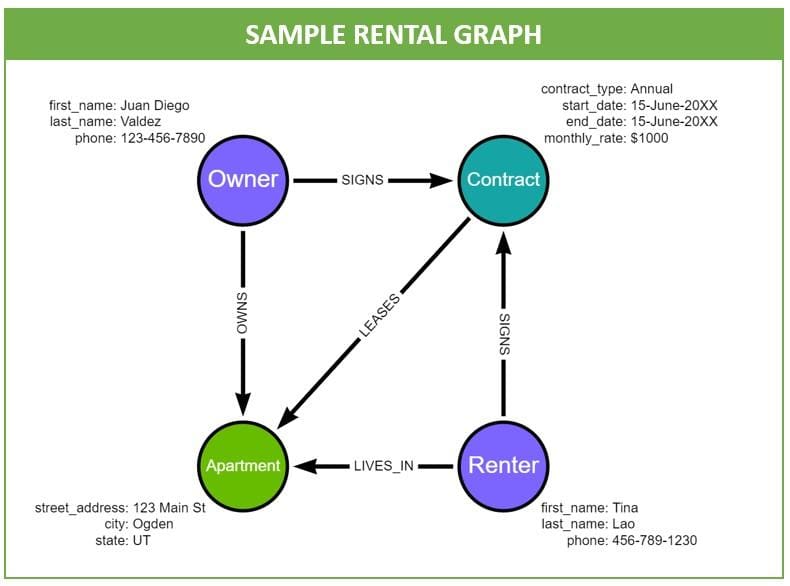
Following is the graph model that will be used in the attached cheat sheet:
I have selected a rental graph because nearly everyone has rented at some time in their life! Obviously, this graph could be much more complex if we added the full list of properties for each node.
Next step is to get some practice. You can download a sample dataset from a source such as Kaggle or from a vendor, such as JanusGraph or Neo4j.
If you have a dataset at your employer or hobby projects that involves networked relationships, give a graph database a try. You will find that the data that fits awkwardly in a relational database will be right at home in a graph!
Stan Pugsley is a freelance data engineering and analytics consultant based in Salt Lake City, UT. He is also a lecturer at the University of Utah Eccles School of Business. You can reach the author via email.
Back in June, Indian IT services and consulting giant LTIMindtree introduced Canvas.ai, a generative AI platform to accelerate concept-to-value realisation for enterprises, all while adhering to ethical AI principles.
Since then, the Mumbai-based subsidiary of L&T has been making strides in building in-house expertise and infrastructure, allowing their data scientists, AI specialists, and MLOps engineers to engage in R&D projects exploring the potential of LLMs. Moreover, they offer consulting services to guide clients in integrating generative AI into their processes, from use case identification to model deployment.
“Our strategy for generative AI revolves around a combination of in-house expertise development, research and experimentation and client-centric application to deliver AI services that drive value and solve real-world challenges,” said Jitendra Putcha, EVP– Data, Analytics & AI, LTIMindtree told AIM.
With over 20 years in the industry, Putcha is known for solving data challenges globally, promoting next-gen solutions, and leading generative AI initiatives. His career includes leadership roles at Cognizant, focusing on data modernisation, AI, and analytics. AIM spoke to him about Mindtree’s AI initiatives, hiring strategy for data science candidates, work culture and more.
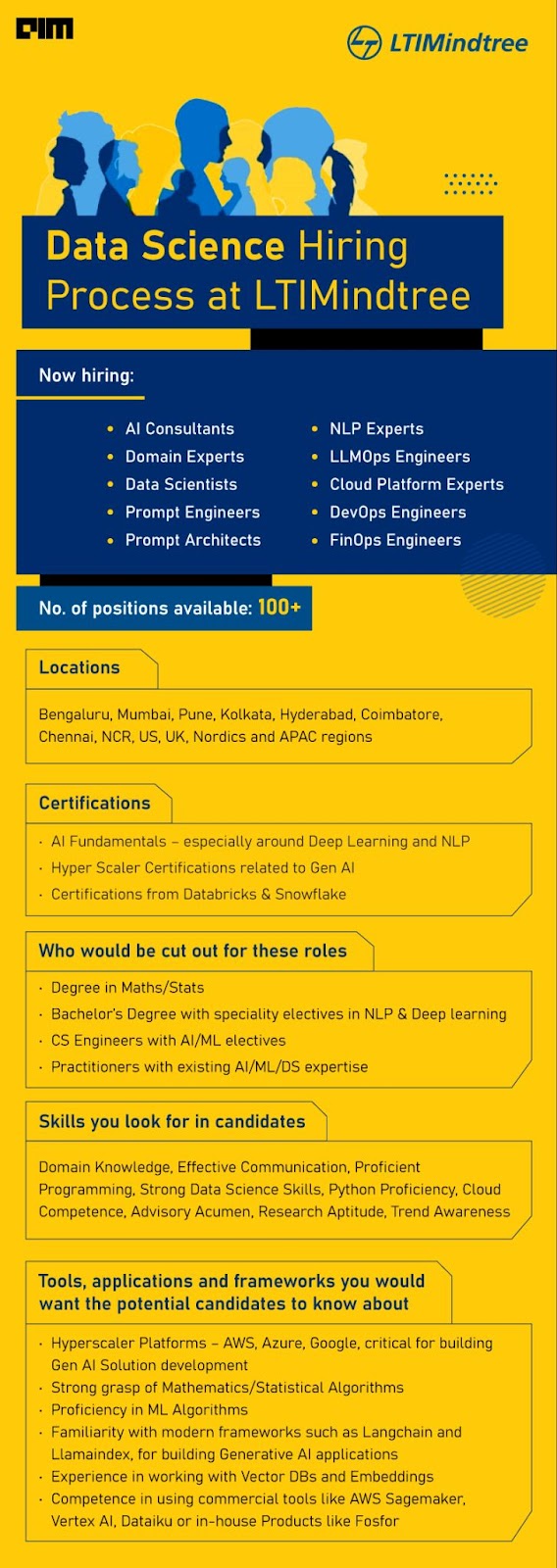
The company is actively hiring for different positions in its AI team.
Inside LTIMindtree’s Data Science Lab
The team addresses various core challenges through data science and AI solutions, including enhancing customer experiences by delivering personalised services, optimising operations by automating tasks and improving decision-making, managing risks by identifying anomalies and potential issues, and exploring new opportunities for growth and competitiveness.
One specific example of their work involves assortment planning with APEX Solution in the retail consumer industry, which optimises product placement on retail shelves to maximise sales and enhance related product positioning.
The organisation implements AI and data science by consulting with businesses to identify and prioritise AI use cases, gathering data to achieve actionable insights, and scaling solutions using hyper scaler cloud platforms. They emphasise responsibility by ensuring unbiased AI models.
Strategically, the organisation focuses on various generative AI architectural styles, including using commercial and open-source APIs for tasks like language translation and code conversion, fine-tuning foundation models using their Canvas.ai platform for secure data, employing RAG for real-time data incorporation, and co-investing in building foundation models when access to proprietary data is available through key customer affiliations.
Interview Process
“We are looking for candidates with skills in data science, AI, and ML, with a strong expertise in deep learning and NLP, in-depth domain knowledge, proficiency in Python programming, a learning mindset conducive to prompt engineering work, effective communication skills, and the ability to stay current with the latest trends for adoption,” said Putcha, talking about the interview process at LTIMindtree.
Internally, the company employs an automated screening and assessment platform called WeCP to evaluate candidates before they can apply for AI-related positions.
“To identify exceptional AI talent, especially among the GenAI’s demographic, we engage AI veterans to lead evaluation panels and mentor participants in nationwide hackathons like the Smart India Hackathon and the Singapore-India hackathon,” he added.
The interview process for a lateral talent hunt includes multiple rounds: the screening round, the first technical assessment round, the second comprehensive technical round, and the final round focusing on company culture and values, often involving discussions with the HR team. This well-structured process ensures a holistic assessment of candidates before making a final hiring decision.
However, Putcha elaborated on the most common mistake candidates make when interviewing for a data science role in the company. He said that candidates often neglect to refresh their knowledge of key data science concepts and Python programming skills. Additionally, some candidates struggle to articulate domain-specific business problems and demonstrate how their solutions align with broader outcomes and impacts.
Expectations
When candidates join the data science team at the company, they can expect to serve as strategic advisors to clients, leveraging proprietary platforms and products to drive substantial business improvements such as increased revenue, reduced total cost of ownership, optimised operations, and enhanced fraud and risk detection.
Alongside this, employees will have a plethora of upskilling opportunities that encompass a comprehensive approach to employee growth and AI proficiency. These initiatives include a career framework called ‘My Career My Growth’ for career progression, a focus on skill development with the Shoshin School offering over 5,000 courses and a Hub and Spokes model for AI content incubation.
Work Culture
The company’s work culture is characterised by a strong focus on its people, emphasising employee well-being, empowerment, and societal impact. “This culture is driven by employee-friendly policies, flexible work arrangements, and a performance-driven approach,” Putcha explained.
“What sets us apart from competitors, especially for the data science team, is its unique positioning as both nimble and financially robust. Our solutions are oriented towards benefiting society, making it a compelling and inspiring place to work,” said Putcha. The Yin-Yang model allows for flexibility in work arrangements, with a strong emphasis on continuous learning and innovation.
In terms of diversity, the gender ratio in the AI team is approximately 30%. The company is committed to promoting diversity, equity, and inclusion, creating a safe and inclusive environment for differently-abled employees as part of its DEI Charter.
“Our dynamic learning environment empowers AI specialists to excel in their field, while our unique culture, focus on customer centricity, and innovation-driven approach provide a platform for making a meaningful impact in the industry,” concluded Putcha.
Read more: Data Science Hiring Process at Happiest Minds Tech
The post Data Science Hiring Process at LTIMindtree appeared first on Analytics India Magazine.