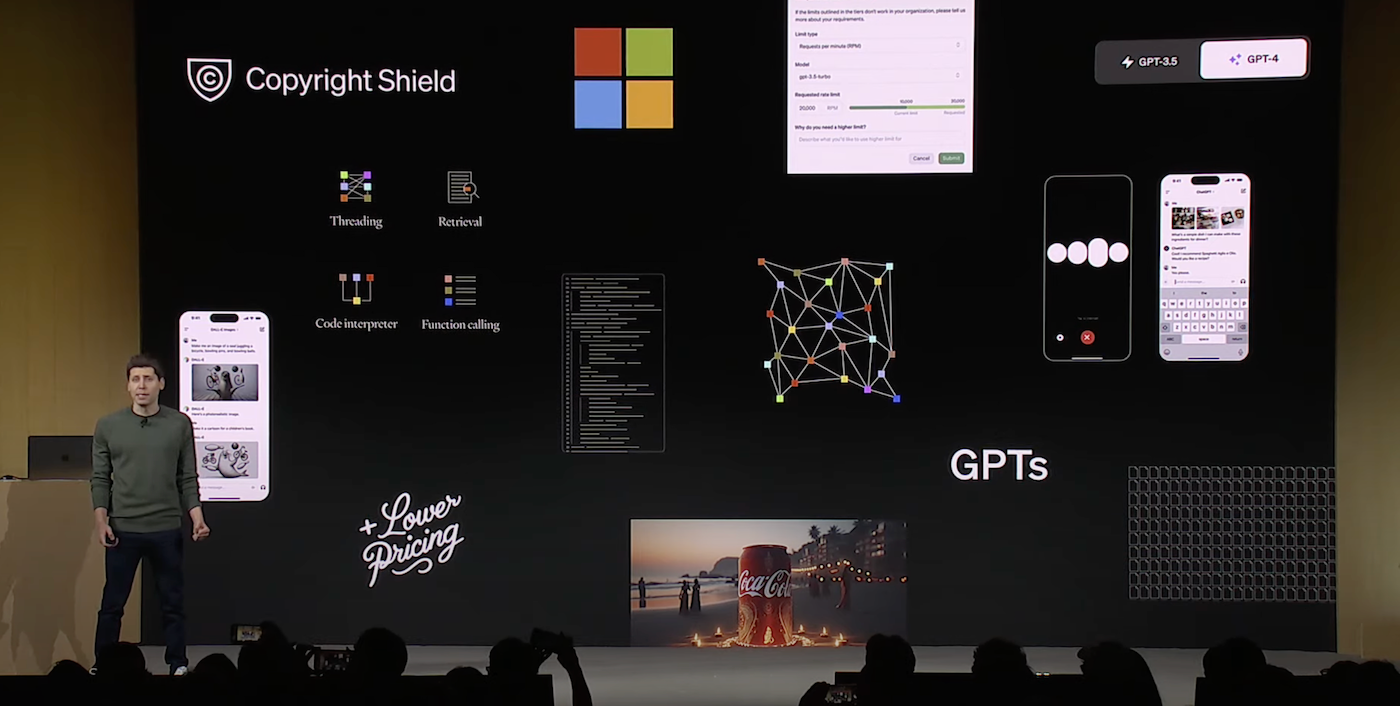
Coca-Cola is using Dall-E-3 to generate Diwali cards, said Sam Altman at OpenAI’s first developer conference – DevDay 2023.
Against the backdrop of Diwali, a time of celebration and festivity, OpenAI announced that developers now seamlessly integrate the recently launched DALL-E-3 model into their applications and products for ChatGPT Plus and Enterprise users. This integration can be achieved by utilising Images API and specifying ‘Dall-E-3’ as the designated model.
Coca Cola’s Love Affair with AI
This is not the first time Coca Cola is working with Dall-E. In February 2023, Coca-Cola announced that it would be collaborating with OpenAI’s DALL-E2 model and ChatGPT for marketing campaigns. It was the first deal with Bain ever since the latter had announced a partnership with OpenAI specifically to use its tools for marketing earlier in the year. Moreover, Coca Cola launched a platform “Create Real Magic” where digital artists from around the world could generate digital creatives using AI.
Last month, Coca-Cola Came up with Coca‑Cola Y3000 Zero Sugar which was co-created with human and artificial intelligence by understanding how fans envision the future through emotions, aspirations, colors,and flavors. AI played a pivotal role not only in crafting the flavor but also in designing the packaging, including the logo and text script. Coca-Cola took into account feedback from its fans during the formulation process. Each can of Y3000 will feature a QR code, leading consumers to an online experience powered by AI, showcasing a vision of the year 3000.
Moreover earlier this year,Coca-Cola released an AI-powered campaign, Masterpiece, which took the world by storm, showcasing some of the most iconic artworks in history, and doing so with the help of advanced artificial intelligence.
Apart from Coca Cola companies like ShutterStock and Snap are also using Dall-E-3 to programmatically generate images and designs for their customers and campaigns.
The post OpenAI Raises Diwali Spirit at DevDay 2023 appeared first on Analytics India Magazine.
Just two days after launching Grok, the xAI team has unveiled the xAI PromptIDE, an integrated development environment designed to revolutionise the world of prompt engineering and interpretability research. This tool accelerates prompt engineering by providing an SDK that empowers users to implement complex prompting techniques and access rich analytics, all geared towards visualising the network’s outputs.
Click here to learn more about PromptIDE
The team says that the core purpose of the PromptIDE is to make Grok-1, the model fueling Grok, accessible and transparent to both engineers and researchers within the community. This IDE is ingeniously designed to empower users, enabling them to explore the capabilities of LLMs swiftly and effectively.
PromptIDE highlights: The `user_input()` function asks the user to enter a string. You can use that to write a chatbot in four lines of Python. While executing the prompt, you see the tokenization, sampling probabilities, alternative tokens, and aggregated attention masks. pic.twitter.com/zvcEmZjDcs
— Toby Pohlen (@TobyPhln) November 6, 2023
Central to the IDE is a Python code editor, complemented by a new SDK, which allows users to implement intricate prompting techniques with ease. As users execute prompts in the IDE, they are provided with a wealth of informative analytics, including precise tokenisation, sampling probabilities, alternative tokens, and aggregated attention masks.
Moreover, the IDE offers a range of quality-of-life features. All prompts are automatically saved, and built-in versioning ensures users can keep track of changes over time. Additionally, the analytics generated during prompt execution can be stored permanently, facilitating the comparison of outputs resulting from different prompting techniques. Users can also upload small files, such as CSV files, and read them using a single Python function from the SDK.
When combined with the SDK’s concurrency features, even moderately large files can be processed with remarkable speed.
At the heart of PromptIDE lies a code editor and a Python SDK. The SDK introduces a novel programming paradigm that allows for the elegant implementation of complex prompting techniques. Python functions are executed within an implicit context, represented as a sequence of tokens.
xAI developer tool for improving and understanding large AI models https://t.co/Xkmz5yf9bl
— Elon Musk (@elonmusk) November 6, 2023
Users can manually add tokens to the context using the prompt() function, or they can leverage the models to generate tokens based on the context using the sample() function. The sample function offers various configuration options, enabling fine-tuned control over the token generation process.
The SDK leverages Python coroutines for concurrent processing of Python functions annotated with @prompt_fn. This concurrent execution capability greatly speeds up tasks, especially when dealing with CSV files or large datasets.
In PromptIDE, you can create interactive prompts using the user_input() function. It pauses execution until the user provides input through a textbox in the interface. This input seamlessly integrates into the context using the prompt() function, allowing dynamic interactions with the model.
Developers can upload small files (up to 5 MiB per file and a total of 50 MiB maximum) to PromptIDE and use them in their prompts. The read_file() function retrieves uploaded files as byte arrays. When combined with the concurrency feature, this capability enables batch processing of prompts, facilitating the evaluation of prompting techniques across a variety of problems.
As of now, the PromptIDE is exclusively available to members of the early access program.
The post xAI Announces PromptIDE for Prompt Engineering with Grok appeared first on Analytics India Magazine.
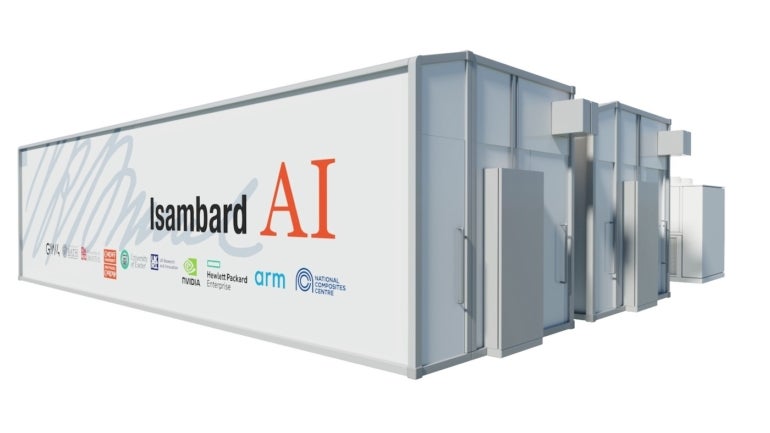
The Isambard-AI supercomputer will be housed at the National Composites Center in Bristol, U.K. Image: NCC
The U.K. government is spending £225 million ($280 million) in a bid to build one of the world’s fastest supercomputers, capable of delivering over 200 petaflops – some 200 quadrillion calculations – every second.
Isambard-AI, named after pioneering British engineer Isambard Kingdom Brunel, will be 10 times faster than the U.K.’s current fastest supercomputer, ARCHER2, and is one of two new machines being built to drive breakthroughs in robotics, data analytics, fusion energy, healthcare and climate research.
Jump to:
Building Britain’s most powerful supercomputer
The U.K. sets out to become the world leader in AI
Supporting the U.K. government’s research into AI safety and risks
How big is the AI industry in the U.K.?
Technical details about the Isambard-AI supercomputer
Building Britain’s most powerful supercomputer
Built by Hewlett Packard Enterprise and hosted by the University of Bristol, Isambard-AI will comprise nearly 5,000 NVIDIA GH200 Grace Hopper Superchips and will contribute 21 exaflops of AI performance to researchers when it opens at Bristol’s National Composites Center in mid-2024 (Figure A).
Figure A
A mockup of the Isambard-AI supercomputer, which will be the fastest in the U.K. when it launches in summer 2024. Image: HPE
Simon McIntosh-Smith, a University of Bristol professor and director of the Isambard National Research Facility, said in an HPE press release that Isambard-AI represented “a huge leap forward for AI computational power” for the United Kingdom.
“Today, Isambard-AI would rank within the top 10 fastest supercomputers in the world and, when in operation later in 2024, it will be one of the most powerful AI systems for open science anywhere,” McIntosh-Smith said in the press release.
He added: “It’s immensely exciting to be at the forefront of the AI revolution and to partner with industry leaders HPE and NVIDIA to rapidly build and deploy large-scale research computing infrastructure to create one of the most powerful supercomputers in the world.”
The UK sets out to become the world leader in AI
Isambard-AI was first announced in September 2023 as part of the U.K. government’s plans to establish a new AI Research Resource – or AIRR – to “drive pioneering AI research and innovation in the UK” and make the country a world leader in artificial intelligence.
The funding injection for the new supercomputer was announced by the U.K.’s Department for Science, Innovation and Technology during last week’s AI Safety Summit, where it also unveiled plans to triple investment in AIRR from £100 million (£124 million) to £300 million ($372 million).
Isambard-AI will be connected to another supercomputer called Dawn, which is being built by Dell, Intel and U.K. computing consultancy StackHPC in partnership with the University of Cambridge, and is due to start running in the coming months.
Together, Isambard-AI and Dawn will provide researchers and scientists with “more than 30-times the capacity of the U.K.’s current public AI computing tools,” according to DIST.
Supporting the U.K. government’s research into AI risks and safety
The Bristol supercomputing facility will be accessible to a range of British organizations for the purposes of AI research. Priority access will be given to the U.K. government’s Frontier AI Taskforce “to support its work to mitigate the risks posed by the most advanced forms of AI, including national security from the development of bioweapons and cyberattacks,” as stated in the U.K. government’s press release about Isambard-AI.
The facility will also support work carried out by the AI Safety Institute, the recently-formed government body tasked with testing the safety and viability of new AI models before and after deployment to help inform government policy.
How big is the AI industry in the U.K.?
According to the U.K. government, as of March 2023, artificial intelligence already contributes more than £3.7 billion ($4.6 billion) to the U.K. economy and employs more than 50,000 people. It claims the country is home to twice as many AI companies as any other European nation, with “hundreds more” setting up shop in the U.K. each year.
Justin Hotard, executive vice president and general manager, HPC, AI & Labs at HPE, said in the HPE press release that the U.K.’s recent investment in AI supercomputing underscored “its commitment to taking a global leadership position in AI.”
Hotard added: “The Isambard-AI system will harness world-leading supercomputing, including high-performance networking co-developed at HPE’s Bristol labs, to provide the performance and scale required for compute-intensive AI projects.”
He added: “We are proud to partner with the U.K. Government and the University of Bristol to give U.K. researchers and industry access to Europe’s largest AI system for open science.”
SEE: UK AI Startup Funding: Alan Turing Institute Identifies Huge Gender Disparity
Technical details about the Isambard-AI supercomputer
Isambard-AI will be built using the HPE Cray EX supercomputing framework and will feature the HPE Slingshot 11 interconnect framework, which is designed to handle the massive data throughput required for complex simulations and AI workloads.
When activated, the supercomputer is expected to hit over 200 petaflops of computing performance as per the Top500 LINPACK benchmark – the standard for measuring a computer system’s processing speed. This computing power will allow for 21 exaflops of AI performance, an exaflop being a measure of quintillion floating-point operations per second used to gauge specialized AI computational tasks. For perspective, the latest smartphones on the market are “only” capable of delivering trillions of calculations per second.
The supercomputer will be hosted in a self-cooled, self-contained data center at NCC, based at the Bristol & Bath Science Park. NCC is one of seven research centers across the U.K. that form the High Value Manufacturing Catapult, which offers access to research and development facilities and expertise that might otherwise be inaccessible to U.K. businesses.
According to NVIDIA, a second, Arm-based supercomputer coming to the NCC next year called Isambard 3 will deliver an estimated 2.7 petaflops of computing performance while consuming less than 270 kilowatts of power, making it “among the world’s three greenest non-accelerated supercomputers.”
Ian Buck, vice president of hyperscale and HPC at NVIDIA, said in the HPE release: “In building one of the world’s fastest AI supercomputers, the U.K. is demonstrating the importance for nations to create their own infrastructure. Isambard-AI will provide researchers with the same state-of-the-art AI and HPC compute resources used by the world’s leading AI pioneers, enabling the U.K. to introduce the next wave of AI and scientific breakthroughs.”
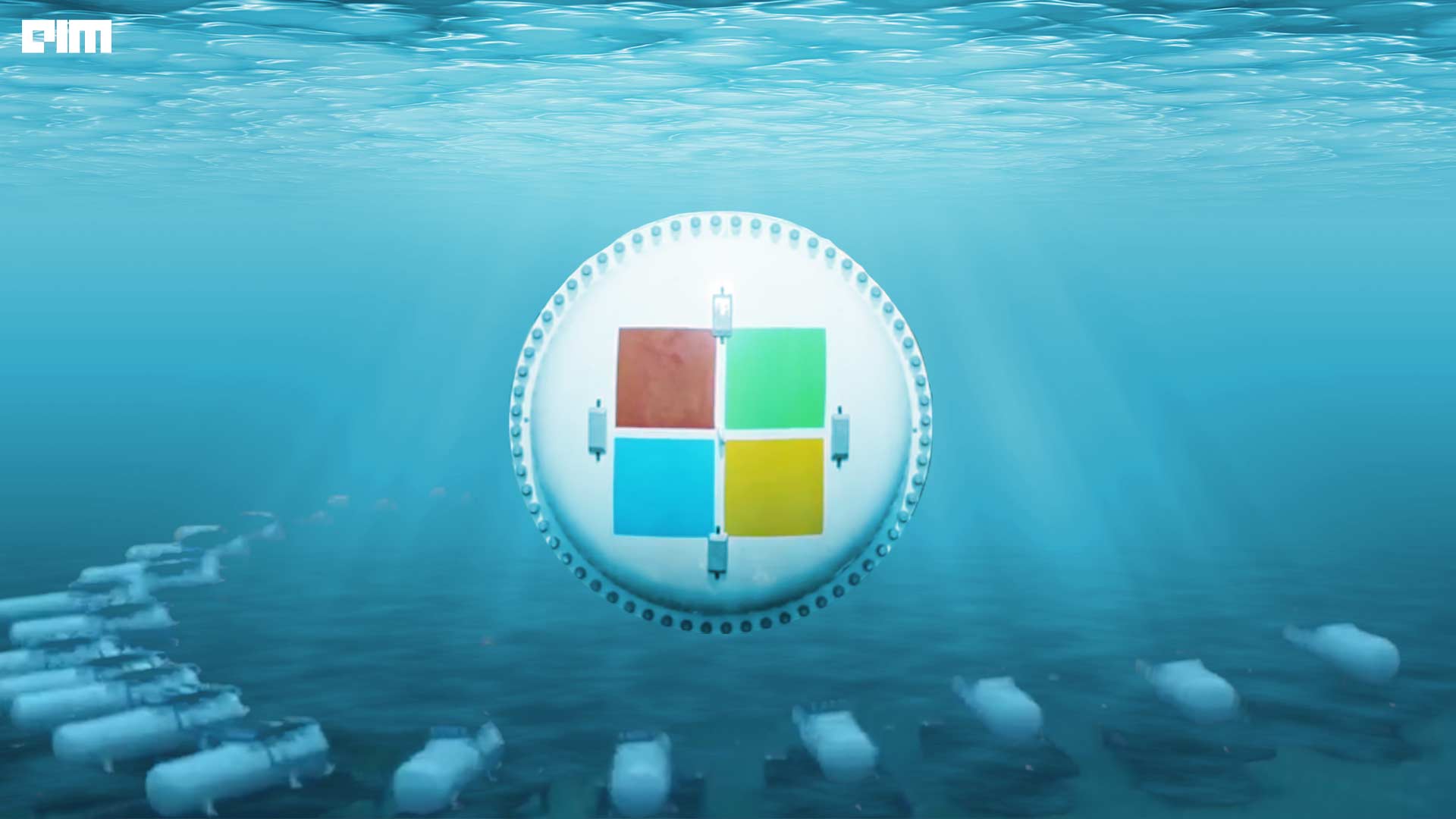
In 2018, Microsoft worked on a research project – Project Natick, to test the viability of subsea data centres that will be powered by offshore renewable energy. After two successful years, the 40-foot-long, 12 rack, self-contained underwater data centre was retrieved from the North Sea for analysis. With the successful deployment of this project, the concept of underwater data centres is no longer just a possibility.
Microsoft Sets The Stepping Stone
The Project Natick proved that in addition to providing cooling efficiency, it is possible to implement environmentally-friendly and sustainable power solutions for data centres. Microsoft is now working on the second phase of the research with Project Natick Phase 2, where the aim is to demonstrate the capability of manufacturing it at production scale.
Microsoft’s Project Natick Plan. Source: Dgtl Infra
With data centres requiring high energy consumption for normal functioning, and GPUs demanding even more, underwater data centres provide respite to the energy problem to a large extent. The ocean bed being cooler helps nullify the heat produced by the servers thereby providing natural cooling at zero cost, and the heat is dissipated into the surrounding environment. Furthermore, it even addresses the problems of low-latency connectivity issues, caused by the long distance between location source and destination.
While the ambitious project results are promising, the viability of underwater data centres still looms high.
All Is Not Easy Underwater
One of the biggest challenges to having underwater data centres is the tricky hardware maintenance. If any kind of problem arises in the server, sending a person to fix it or even lifting up the data centre to the surface is a burdensome task. Robotics could play an important part here to probably fix the issue, but, until then, human dependence will continue.
Furthermore, the network connectivity which is best achieved via underwater network cables poses a huge expense, with costs that can go as high as $400 per foot.
While the underwater datacenter is considered an environmentally sustainable solution compared to land data centres, there are still a number of unanswered questions in terms of understanding how the ocean beds will react in the long run. Questions on the amount of heat emitted and its effect on the ocean bed and marine life when a number of data centres operate underwater, is still unknown. Furthermore, the question on the disposal mode for these data centres after they fail or outlive their usefulness, remains unresolved.
Interestingly, power used for running these data centres can be obtained from renewable sources: something big tech companies are actively working towards.
Big Tech’s Chase Towards Sustainable Tech
With big tech companies actively working on sustainable solutions for the longer run, the shift towards sustainable options for running data centres too is no surprise. Microsoft’s choice of the Orkney Islands for the Northern Isles deployment by the Project Natick team was influenced by the fact that the region’s grid is entirely powered by wind, solar energy, and emerging green energy technologies that are under development by the European Marine Energy Centre. They are even looking for ways to have an underwater datacenter with an offshore wind farm in close proximity.
Microsoft’s attempt to use renewable energy for powering their projects is not new. Recently, Microsoft was in news for looking to hire a program manager specialised in nuclear technology for heading their small modular reactors and microreactor energy systems; thereby, exploring the possibility of harnessing nuclear energy to fuel its data centres. Furthermore, other Big tech billionaires such as Sam Altman, Bill Gates and Jeff Bezos have actively invested in this space.
Exploration of underwater data centres is slowly gaining steam. Last year, Subsea Cloud announced three underwater data centre projects, where it will not be using pressure vessels, unlike Microsoft. Instead, it would be a conventional shipping container with pressure equalised on both sides. Earlier this year, Highlander in China built the first commercial underwater data centre near Hainan Island in China, and is looking to find global customers. With China also experimenting with the same, it is likely that it will become a global chase.
The post What’s Bubbling With Underwater Data Centres? appeared first on Analytics India Magazine.
Alibaba's e-commerce business unit is on the hunt for software partners to test generative artificial intelligence (AI) use cases on its large language models.
Accessible via a suite of application programming interfaces (APIs), called Aidge, the AI models are trained on data insights gathered from across the Chinese tech giant's global e-commerce operations.
Also: Generative AI in commerce: 5 ways industries are changing how they do business
More than 15 APIs now are available with the pilot launch of Aidge on Monday, for independent software vendors (ISVs) and software-as-a-service (SaaS) vendors to develop and test use cases. The APIs span several commerce-related applications including consumer insight, content localization, design, and customer service, announced Alibaba International Digital Commerce Group during the launch in Singapore.
The Alibaba e-commerce business unit is one of six business units created early this year following a major organization-wide restructure, which also saw Cloud Intelligence Group and Cainiao Smart Logistics Network spun off as separate units. Alibaba International operates Alibaba's international commerce retail businesses, including Lazada, AliExpress, Trendyol, and Daraz.
Aidge is built on Alibaba International's proprietary large language and computer vision models and not on Tongyi Qianwen, a spokesperson told ZDNET. The latter is Alibaba Cloud's own large language model, launched in April this year.
Tongyi Qianwen is touted to power all of Alibaba's business applications in the "near future", with the integration aimed at improving user experience across its products and services, including e-commerce, search, and navigation.
Aidge also is only available for pilot in Singapore, where Daraz and AliExpress currently are among those running tests on the AI suite. There are "external customers" involved in the pilots as well, though the Alibaba International spokesperson did not provide details.
Also: 3 ways to secure the best AI partner for your business
Asked if the APIs are accessible on a subscription model, she said more details will be revealed at a later stage.
Pilot tests on Aidge are expected to continue through to December, with the APIs to be rolled out region by region in early 2024, said Zhang Kaifu, vice president of Alibaba International, during the launch.
Noting that many merchants on Alibaba's e-commerce platforms are small and midsized businesses (SMBs), Zhang said these sellers face several common challenges as they look to market their products beyond their local markets. Language and cultural barriers, shortage of talent such as in design and customer service, as well as cost and market competition, are key roadblocks for these businesses, he said.
AI can be leveraged to solve these challenges and bring about cost and operational efficiencies, he added. Multilingual large language models for e-commerce, for instance, can generate local consumer insights and content localization, while AI-powered content production can be tapped for marketing and user acquisition campaigns.
Also: How AI reshapes the IT industry will be 'fast and dramatic'
These AI models can analyze consumer reviews and present relevant information with local context, delivering more engaging and effective marketing and boosting customer acquisitions.
For example, Aidge can generate product titles and descriptions in the market's native language that are "culturally authentic", Zhang said. A charger plug adapter would be described as such in the UK, but referred to as a "power plug adapter" in the US where the imperial system would be used for dimensions, compared to the metric system for UK-listed products.
Aidge APIs currently support 18 languages, including French, Korean, Spanish, Thai, Chinese, and English.
AI drives the ability to scale access to tools and skills that would not otherwise be available to businesses, said Tatiana Palhares, Daraz's chief product officer, who was at the launch. She noted that inequality of such access was particularly visible in this region, where larger brands were more effective in listing their products online compared to smaller sellers.
Also: Global players look to create baseline to evaluate generative AI applications
Limitations in access to tools can prove a major barrier to growth, Palhares said. Daraz is testing Aidge in content generation and customer service, including chatbots, to help SMB merchants on its platform.
The South Asian online shopping site plans to launch an enhancement to Daraz Instant Messaging later this month, facilitating communication between merchants and consumers with AI-generated prompts.
"By empowering sellers to optimize their operations and online stores through AI, we can help them free up their time and spend time on what truly matters: growing their business," Palhares said.
Alibaba International also is rolling out Aidge to merchants on its e-commerce platforms, with the aim to support more SMBs through ISV and SaaS partners.
Also: The best AI chatbots: ChatGPT and other noteworthy alternatives
"Today's pilot launch of Aidge marks only the beginning," Zhang said. "The novelty of AI technologies calls for our collaboration with SaaS partners worldwide to not only test but also co-define its use cases."
Alibaba International's platforms operate in more than 190 countries and have 305 million annual active customers. Alibaba.com serves 200,000 sellers, while AliExpress has 300,000 sellers. Lazada is a platform for 1 million sellers, while Daraz serves 650,000 sellers.
YouTube to test generative AI features, including a comments summarizer and conversational tool Sarah Perez @sarahintampa / 17 hours
YouTube will begin to experiment with new generative AI features, the company announced today. As part of the premium package available to paid subscribers, YouTube users will be able to try out a new conversational tool that uses AI to answer questions about YouTube’s content and make recommendations, as well as try out a new feature that will summarize topics in the comments of a video.
Both features will become available through YouTube’s hub for new experiments, youtube.com/new, on an opt-in basis. The conversational tool will arrive in the next few weeks while the topic summarization tool will begin testing only with a small group of users who sign up for the experiment through the website.
Explains YouTube, the conventional tool’s responses will be generated by large language models that draw on information from YouTube and the web and are designed to help viewers “dive in deeper” to the content they’re watching. For example, participants will be able to ask questions about the video they’re currently viewing or ask for other things to watch similar to the video using actions like “recommend related content.” These conversations with the AI will be able to take place as the video is streaming, so as not to interrupt playback.
Image Credits: YouTube
The feature will be offered initially only in the U.S. and on Android devices via a new “Ask” option on the video’s watch page. YouTube Premium members can opt into this test starting today, but it won’t appear on every YouTube video as of yet. The tool is currently being tested with a select group of users, but will be available as an opt-in for YouTube Premium members in the weeks to come.
The comments summarizer, meanwhile, will leverage generative AI to organize and summarize the topics of discussion in large comment sections underneath a video to allow viewers to catch up on what people have been saying. YouTube believes this feature may also be useful to creators to help them learn what their channel’s subscribers are talking about without having to read through all the comments one by one. This could also help them gain inspiration for new videos based on comment topics, YouTube suggests. Plus, if creators want to remove any comment topics, they’ll be able to delete any comments that appear under certain topics.
Image Credits: YouTube
The topics will be summarized only based on published comments, not those held for review or those that contain blocked words or are from blocked users, YouTube also notes.
This experiment, which is now running on a small number of videos, will only be available in English for the time being.
YouTube says the tests will continue over the next several weeks and months as the company gathers feedback on how consumers are using the new features.
Google has been experimenting with AI across its product line, from Search to Workspace to consumer apps like Photos and Assistant and more. On YouTube specifically, the company has also experimented with AI-powered ads that let brands target cultural moments, and has been rolling out a number of creator-focused AI features, including tools to find music for videos, AI-powered dubbing, plus “Dream Screen,” a generative AI feature that lets you create a background image or video for YouTube Shorts. YouTube Music also recently introduced AI-generated playlists. And YouTube had previously experimented with AI-generated video summaries and quizzes on educational videos.
“These features are experimental and we may not always get it right. That’s why we’re starting small with limited availability and collecting feedback,” said YouTube in its announcement. The company said users will be able to submit feedback directly in the tools themselves.
At the keynote presentation at OpenAI’s first DevDay conference, held November 6, 2023, in San Francisco, OpenAI announced a new, more powerful version of GPT-4, specialized generative AI tools called GPTs and an Assistants API to help developers build AI apps. Additionally, OpenAI announced that ChatGPT with GPT4 Turbo will be able to draw from current events information as recent as April 2023.
Jump to:
GPT-4 Turbo can digest more information than GPT-4 at a lower price
Developers will be able to create and sell custom AI tools known as GPTs
The Assistants API is now available in beta
GPT-4 Turbo can digest more information than GPT-4 at a lower price
GPT-4 Turbo adds these new capabilities to GPT-4:
128,000 token context length, or 300 pages of a standard book.
More control for developers, including a JSON mode, the ability to call multiple functions at once, log probabilities and reproducible outputs.
World knowledge up to April 2023.
Higher rate limits.
GPT-4 Turbo will cost one cent per 1,000 input tokens and three cents per 1,000 output tokens, cheaper than GPT-4, said OpenAI’s CEO Sam Altman (Figure A).
Figure A
OpenAI CEO Sam Altman sums up the announcements from OpenAI’s DevDay on Nov. 6, 2023, in San Francisco. Image: TechRepublic
“We decided to prioritize cost first because we need to do one or another, but we’re working on speed next,” Altman said during the keynote presentation.
GPT-4 Turbo is available today in preview for developers with an OpenAI subscription. OpenAI expects GPT-4 Turbo to be production ready in the next few weeks.
ChatGPT will use GPT-4 Turbo in a gradual rollout starting today. At the time of this writing, GP-3.5 showed a knowledge update, too, up to January 2022.
SEE: OpenAI was among the organizations which signed a voluntary list of AI safety assurances with the U.S. government in September. (TechRepublic)
Another change ChatGPT users will see today is the model picker is no longer a drop-down menu; instead, ChatGPT automatically chooses which model and modality, including images from DALL-E 3 and text-to-speech to use depending on the user’s request.
Developers will be able to create and sell custom AI tools known as GPTs
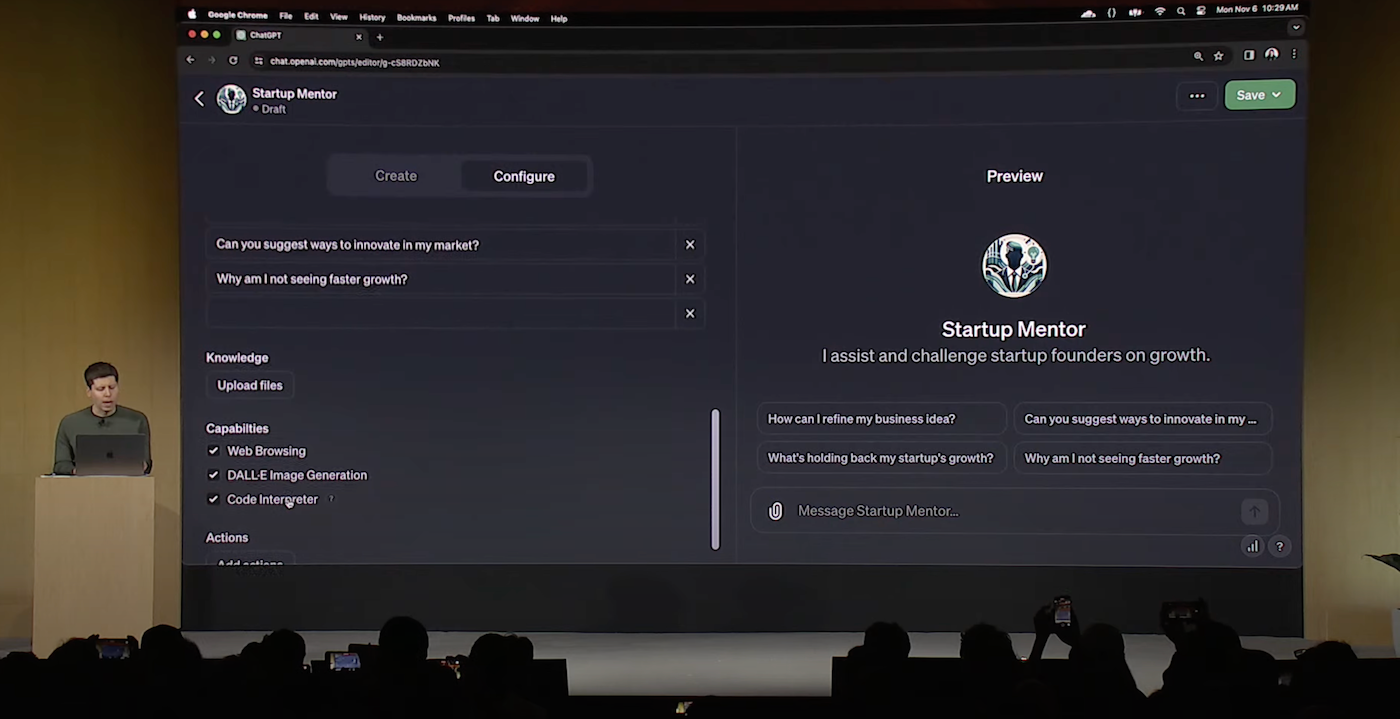
As well as mentioning OpenAI’s stated goal of AGI (hypothetical artificial general intelligence, or AI, which are smarter than humans), Altman emphasized that the goal for the company’s future is to enable AI agents customized to combine specific skills. Toward that end, OpenAI is releasing GPTs, which are tailored versions of ChatGPT (Figure B).
Figure B
OpenAI CEO Sam Altman demonstrated creating a GPT on Nov. 6, 2023 during the OpenAI DevDay keynote in San Francisco. Image: TechRepublic
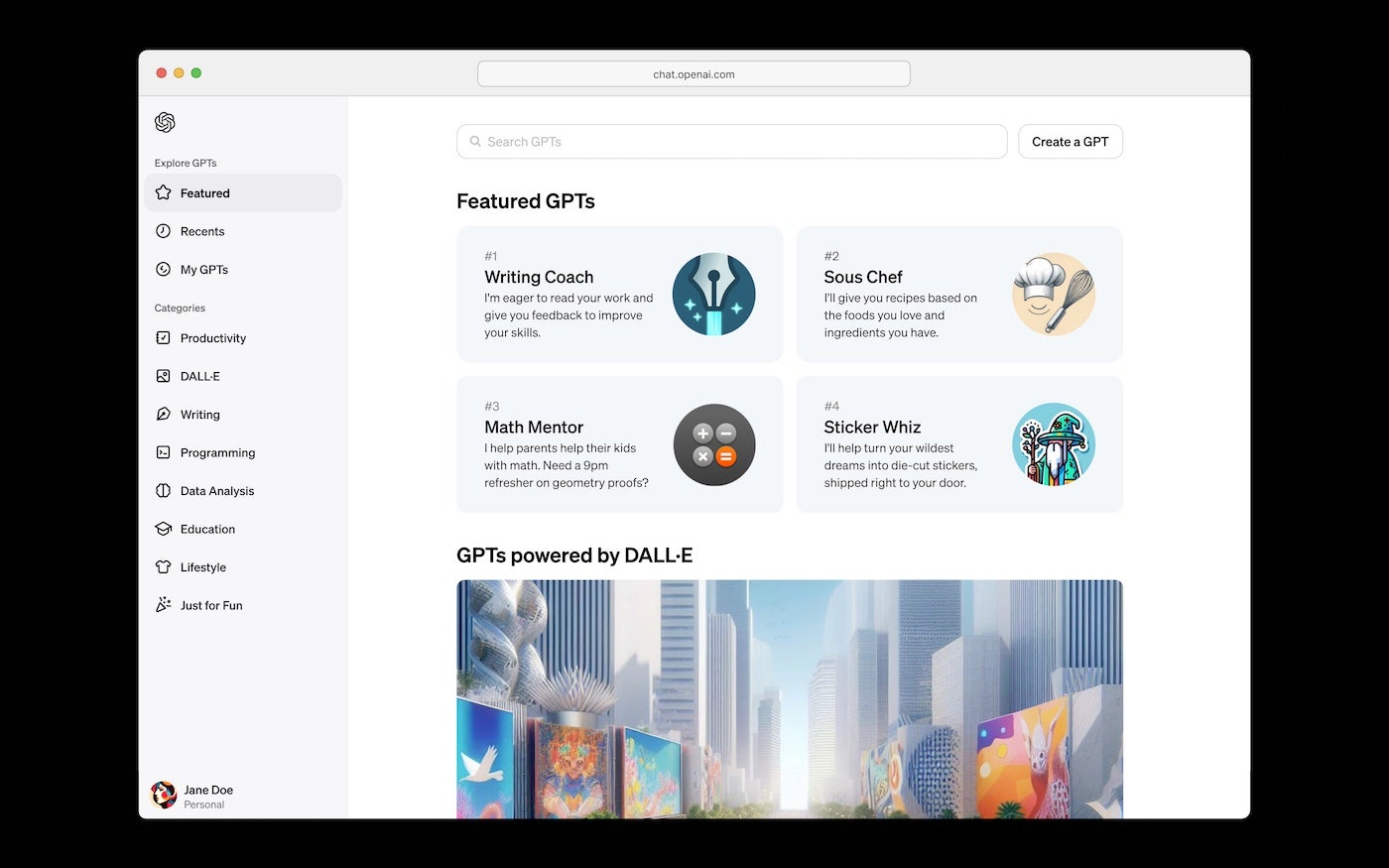
GPTs can be designed, customized and sold on a marketplace called GPT Store, which will open later this month (Figure C).
Figure C
A mockup of the GPT Store front page. Image: OpenAI
Creators can earn revenue from their GPTs based on the GPT’s popularity. Canva and Zapier received early access to the GPT builder and have released their own GPTs.
In ChatGPT Enterprise, users will be able to make GPTs that are sharable only within their organization. GPTs will be available in ChatGPT Enterprise on Wednesday, November 8. OpenAI emphasized that conversations on ChatGPT Enterprise are not used for model training.
Generative design AI will automate 60% of the design effort for new websites and mobile apps by 2026, Gartner predicted in its 2023 Market Databook.
The Assistants API is now available in beta
OpenAI also announced the Assistants API, a tool for building generative AI-based apps that brings together capabilities such as OpenAI’s Code Interpreter, Retrieval and function calling. The Assistants API is built on the same foundation as GPTs, with additional tools. With the Assistants API, developers can add generative AI into their existing apps and services.
For example, OpenAI Code Interpreter can write and generate code and create files. At the keynote, OpenAI demonstrated a voice-based assistant that made changes to users’ OpenAI accounts live.
Assistants API is in beta today; pricing details are available on OpenAI’s site. OpenAI API access is available internationally.
Data and files used with the OpenAI API are not used to train AI models, OpenAI said.
Altman said he sees this Assistants API as a precursor to AI agents, which he believes will gradually be able to take action on their own as they become more capable.
"We are all happy either way" no matter who closes a sale, says OpenAI CEO Sam Altman of the company's partnership with Microsoft.
OpenAI's partnership with Microsoft has no fixed definition of who is leading or handling enterprise AI sales, said Sam Altman, CEO of the artificial intelligence startup. Instead, each company tries its best for "the most shared success possible."
Altman, speaking to a small group of press at the company's first-ever developer conference, in San Francisco, on Monday, indicated there was no set structure to the relationship, which has involved Microsoft putting over ten billion dollars worth of investment into OpenAI.
Also: OpenAI unveils custom GPTs, Store, and Assistant API, at Dev Day
As ZDNET put the question, "A lot of people still wonder where is the division, in going to enterprises, between what OpenAI does and what Microsoft does? Who's responsible for leading, and how does it shake out in terms of who's going to make that happen?"
"The answer is we're both gonna do it, and we set up the relationship between the two of us so that we're very happy when they succeed with a sale, and they're very happy when we succeed with a sale," said Altman, referring to OpenAI and Microsoft. "I'm a huge believer in incentives and superpowers, and if you get everybody's incentives right, everybody just wants the most shared success possible, and I think we've designed that very well," he said.
"They [Microsoft] can sell to a customer," noted Altman. "There's people who, you know, are on Azure who want something that's inside the Azure portal. There's people who like to work directly with us for various reasons, and we are all happy either way."
Also: MacBook Pro (M3 Max) review: A desktop-class laptop for an AI-powered age
Earlier, during his keynote address, Altman was joined onstage by Microsoft CEO Satya Nadella. Altman jokingly asked Nadella, "How is Microsoft thinking about the partnership?" That drew laughter from both Nadella and the audience.
"You guys have built something magical," said Nadella. The partnership has "dramatically changed" the "shape" of Microsoft's Azure cloud computing service, said Nadella. "Our job is to make the best system so you can build the best models," added Nadella.
"I always think of Microsoft as a platform company, a developer company, and a partner company," said Nadella. "The systems that are needed as you aggressively push forward on your roadmap require us to be on the top of our game," said Nadella. He added that the shared mission of the two companies is "to empower every person in every organization on the planet to achieve more".
"The way I summarize it, it's kind of like that, you know, first step of work for anyone, really," says OpenAI CTO Mira Murati, left, of the company's use cases in enterprise. "It just does that first step of work for you, and it's really like a great collaborator."
In response to Nadella, Altman remarked, "I'm excited for us to build AGI together," meaning, artificial general intelligence, the notion of computers that can match human thought capabilities.
In addition to over 2 million developers working with its code, Altman said that 92% of Fortune 500 companies are using its technology.
Also: Every AI project begins as a data project, but it's a long, winding road
Asked during the press conference for business examples, OpenAI's CTO, Mira Murati, taking part in the same press conference with Altman, said, "We have customers in almost every industry, in financial services, in a lot of legal applications, in education apps.
"The way I summarize it, it's kind of like that, you know, first step of work for anyone, really," said Murati. "It just does that first step of work for you, and it's really like a great collaborator."
OpenAI launches API that lets developers build ‘assistants’ into their apps Kyle Wiggers 15 hours
At its developer conference, OpenAI announced a new API, the Assistants API, that it characterizes as a step toward helping developers build “agent-like experiences” within their apps.
Using the Assistants API, OpenAI customers can build an “assistant” that has specific instructions, leverages outside knowledge and can call OpenAI generative AI models and tools to perform tasks. Use cases range from a natural language-based data analysis app to a coding assistant or even an AI-powered vacation planner.
Powering the new Assistants API is Code Interpreter, OpenAI’s tool that writes and runs Python code in a sandboxed execution environment. Launched in March for ChatGPT, Code Interpreter can generate graphs and charts and process files, letting assistants created with the Assistants API run code iteratively to solve code and math problems.
The Assistants API can also tap a retrieval component that augments dev-created assistants with knowledge from outside OpenAI’s models, like product information or documents provided by a company’s employees. And it supports function calling, which enables assistants to invoke programming functions that a developer defines and incorporate the responses in their messages.
The Assistants API is in beta and available to all developers starting today. The tokens used for the API will be billed at the chosen model’s per-token rates, OpenAI says, with “tokens,” here, referring to parts of raw text (for example, the word “fantastic” split into “fan,” “tas” and “tic”).
In the future, OpenAI says that it plans to allow customers to provide their own assistant-driving tools to complement Code Interpreter, retrieval component and function calling on its platform.
At OpenAI’s first developer conference – DevDay 2023 – OpenAI’s Sam Altman announced custom versions of ChatGPT that users create for a specific purpose—called GPTs. GPTs are a new way for anyone to create a tailored version of ChatGPT to be more helpful in their daily life, at specific tasks, at work, or at home—and then share that creation with others.
These GPTs, or tailored AI agents, can be designed without any coding knowledge in natural language, making it accessible to a wide range of users. Whether for personal use, within a company, or for public sharing, GPTs empower individuals to build helpful tools to enhance their daily lives.
GPTs enable users to provide instructions, share extra knowledge, and define specific tasks for ChatGPT, such as searching the web, creating images, or analyzing data. The customization process has been simplified, eliminating the need for manual input and allowing users to focus on the desired outcomes. OpenAI has emphasised community involvement, encouraging educators, coaches, and enthusiasts to contribute their expertise by creating useful GPTs.
To facilitate this collaboration, OpenAI is set to launch the GPT Store later this month, a platform where users can share their creations publicly. The GPT Store will feature creations by verified builders, making it easy for others to discover and utilise these tailored AI agents. GPTs in the store will be searchable, and they may climb leaderboards based on their utility and popularity. Additionally, creators will have the opportunity to earn money based on the number of people using their GPTs.
Furthermore, OpenAI has enabled developers to connect GPTs to the real world by defining custom actions through APIs. These actions allow GPTs to integrate external data sources, interact with databases, manage emails, or assist with e-commerce tasks. The flexibility provided by these actions empowers users to design AI agents that cater to specific needs, both at home and in business settings.
For enterprise customers, OpenAI has introduced internal-only GPTs, enabling businesses to create customised versions of ChatGPT tailored to specific departments, use cases, or proprietary datasets. Companies like Amgen, Bain, and Square have already leveraged internal GPTs to streamline various processes, such as crafting marketing materials, supporting customer inquiries, and aiding software engineers in their onboarding process.
The post OpenAI Unveils Customisable AI Agents; GPTs appeared first on Analytics India Magazine.