Microsoft has announced a vision to tackle cybersecurity challenges that have plagued the tech company in recent years. The newly introduced ‘Secure Future Initiative’ leans heavily on AI.
Microsoft’s vice chairman and president Brad Smith noted, “In the recent months, we’ve concluded within Microsoft that the increasing speed, scale, and sophistication of cyberattacks call for a new response.”
Even though AI is usually lauded and often looked upon as a messiah of the tech industry, the reality begs to differ. As companies similar to Microsoft continue to scramble to understand how deeply AI can be integrated into securing systems, they appear to be digging their own computational graves.
Manually investigating security risks is a cumbersome process but the number of issues are manageable. Rise in generative AI has given birth to problems which did not even exist before. Keeping up with the risks generated through AI is a hard nut to crack as the technology is developing at a much faster rate, leaving no time for companies to magnify upon the security weaknesses.
Analysts have said that language models are so complex that it is nearly impossible to audit them in-depth. “The concern that most security leaders have is that there’s no visibility, monitoring, or explainability for some of those features,” Jeff Pollard, a cybersecurity analyst at Forrester Research recently told The Wall Street Journal.
New Fear Unlocked
On the one hand, generative AI has given the world tons of models and algorithms to play around with. Yet on the other, it is also prone to introducing security risks due to their nature of being trained on preexisting data — including code.
At a conference, David Johnson, a data scientist at the European Union’s law-enforcement agency Europol, pinpointed, “That code can contain a vulnerability, so if the model subsequently generates new code, it can inherit that same vulnerability.”
By signing up for generative AI, companies also unlock fears in new forms like “prompt injections,” where the bad guys use “prompts” or text-based instructions to manipulate these AI models into sharing sensitive information. In less than a year of OpenAI’s ChatGPT being released, several incidents have come forth hinting towards the deficiency of security.
South Korean tech giant Samsung banned the use of ChatGPT after its staff accidentally leaked sensitive data via OpenAI’s chatbot. iPhone maker Apple and e-commerce giant Amazon also joined the growing list of companies cracking down on employees using the hottest AI chatbot of the year.
After these incidents, ChatGPT itself faced a data breach during a nine-hour window on March 20. The creators of ChatGPT at OpenAI issued a statement which noted that approximately 1.2% of the ChatGPT Plus subscribers who were active during this time period had their data exposed. While the percentage seems minuscule, the number was not small as over a million users’ data was breached during the event.
No Quick Fix
Getting an accurate accounting of total global economic losses due to cybercrime and cyberattacks is difficult, but Microsoft believes that total losses have been greater than $6 trillion and could close in on $10 trillion by 2025.
Two months ago, Brian Finch, co-leader of the cybersecurity, data protection & privacy practice at law firm Pillsbury Law told CNBC, “Given the economics of cyberattacks — it’s generally easier and cheaper to launch attacks than to build effective defenses — I’d say AI will be on balance more hurtful than helpful.“
As companies adopt AI internally, it is clear that the human-in-loop architecture is the key for security. Consequently, companies have started shifting towards “zero trust” models where defenses are set up to constantly challenge and inspect network traffic and applications in order to verify that they are not harmful.
As of now AI systems are not capable enough to outsmart hackers behind computer screens. So, co-existing is a critical factor till the time AI becomes dependable enough.
The post AI is More Hurtful than Helpful for Cybersecurity appeared first on Analytics India Magazine.
Cloud computing company VMware rolled out new cloud, AI, edge and data services at VMware Explore Barcelona 2023 on November 7. The new private AI and sovereign cloud services reflect the increased adoption of AI products.
The VMware site has details about the international availability of the company’s platforms and services
Jump to:
Private AI platform partners with Intel, IBM and Kyndryl
Enhanced ransomware recovery
VMware Cloud Foundation 5.1 announced
Adding data services to sovereign clouds
Updates to Tanzu application delivery
Changes to edge products
Private AI platform partners with Intel, IBM and Kyndryl
Organizations have begun to consider the possibilities of private AI, which brings generative AI capabilities to the enterprise without exposing confidential or copyrighted information to the outside world.
SEE: Databricks acquired MosaicML in June to add its “factory” for private AI models. (TechRepublic)
“We truly believe private AI will become the default architecture for enabling generative AI in the enterprise,” said Chris Wolf, vice president of VMware AI Labs, in a pre-briefing for the media on November 2.
To address this, VMware is releasing its own Private AI platform with three choices of partners: Intel, IBM’s watsonx or Kyndryl. Customers are often concerned about CPU and GPU capacity, and VMware brings the ability to intelligently scale access compute when customers need them in order to avoid cost overruns, Wolf said.
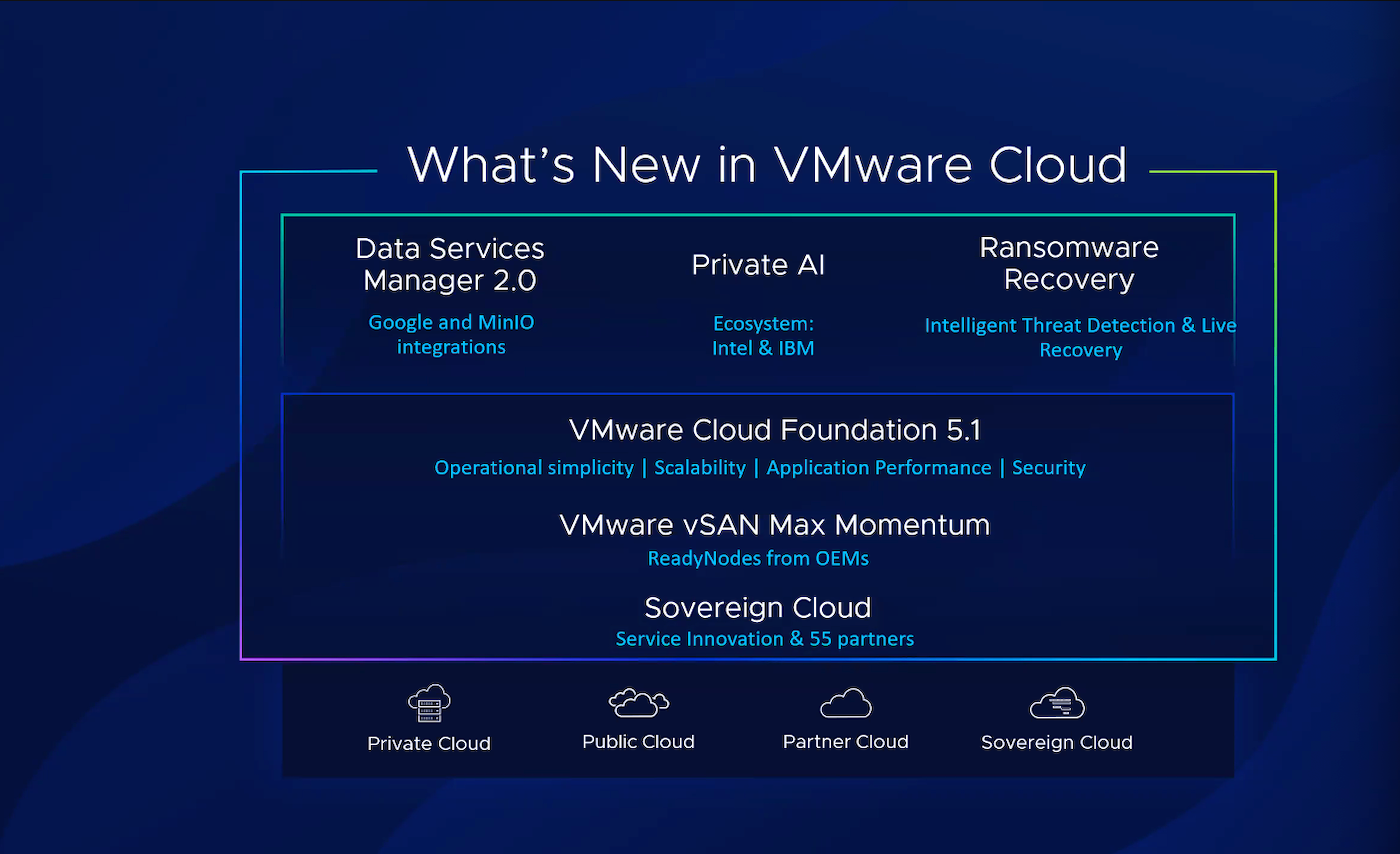
VMware Private AI with Intel processors and hardware accelerators can be combined with the VMware Cloud Foundation (Figure A).
Figure A
The variety of VMware announcements made on November 7, including Private AI, are shown here in an intersecting stack. Image: VMware
VMware Private AI brings IBM watsonx to on-premises environments using full-stack architecture built on the VMware Cloud Foundation and Red Hat OpenShift.
Kyndryl offers new services for VMware Private AI, specifically a framework, software tools and out-of-the-box integrations for building machine learning or generative AI applications.
Enhanced ransomware recovery
VMware Live Recovery, which will be available in Q4 FY24, is an upcoming service that provides unified management of ransomware and disaster recovery across on-premises and public clouds.
VMware Cloud Foundation 5.1 announced
Release 5.1 of the VMware Cloud Foundation infrastructure service will add expanded storage and new sovereign cloud services. It adds 2X GPU capacity, 4x storage performance boost with 16 virtual GPUs per virtual machine, and policy enforcement and self-service virtual private servers, Prashanth Shenoy, vice president of marketing at VMware’s cloud infrastructure business group, revealed at the pre-briefing. Updates to the VMware Cloud Foundation are expected to be released in the fourth quarter of 2024.
VMware Cloud Data Services Manager will be expanded to Google’s AlloyDB Omni, which is appropriate for AI/ML workloads and analytics, and MiniO Object Store. Both are in Tech Preview now.
VMware is also adding ReadyNodes from OEMs to VMware vSAN Max Momentum.
Adding data services to sovereign clouds
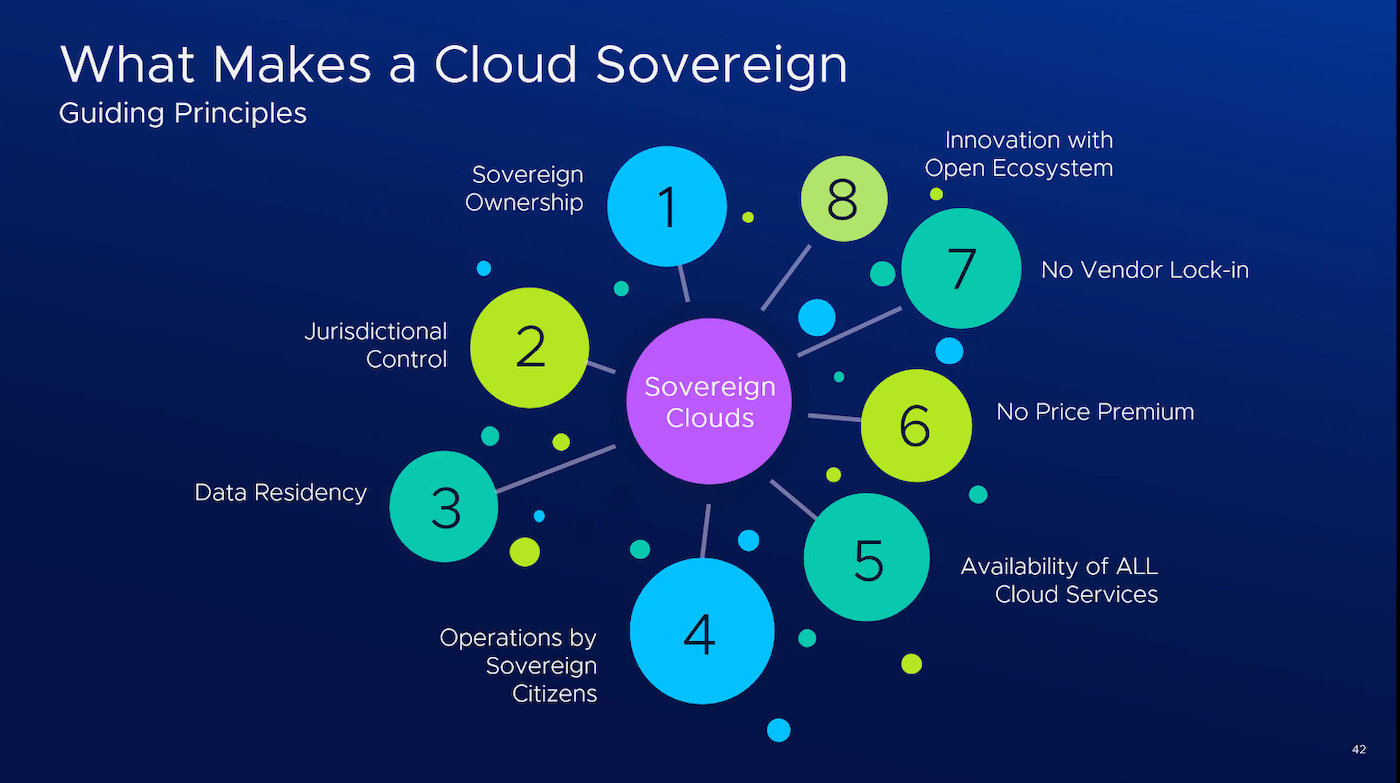
Another development in VMware cloud relates to growing calls for data sovereignty in highly-regulated industries in the European Union. VMware is expanding managed data services for communications service providers, bringing data services to VMware’s existing network of sovereign clouds (Figure B). MongoDB, Kafka, Greenplum and NetApp StorageGRID are coming to the VMware Cloud Foundation in a self-service managed format for sovereign clouds to add agility and develop applications faster.
Figure B
An illustration of the qualities of a sovereign cloud. Image: VMware
Tanzu Mission Control will now be available for container management as an air-gapped variant for sovereign services. VMware will let customers bring their own encryption keys to sovereign security services. VMware is working with new partners in this area as well: NetApp, which brings StorageGRID Object Storage, and Thales, which brings the CipherTrust data security solution and bring-your-own-key features. More than 50 cloud service providers, mostly in Europe and Asia, are now part of the VMware Cloud Verified program.
SEE: Large organizations add sovereignty controls to comply with regulations such as GDPR. (TechRepublic)
Updates to Tanzu application delivery
Tanzu, VMware’s application delivery service, is getting new services, including a new AI tab in Tanzu Application Platform and Tanzu Application Service. A multicloud data control plane within Tanzu Tech Hub is now available in Tech Preview for VMware Tanzu Data Services. The following improvements are coming to VMware Tanzu Intelligence Services:
GreenOps (beta) and deep K8s costing in CloudHealth.
Expanded governance visibility in Guardrails.
ML-based insights and Hub integration.
Intelligent Assist, a conversational AI for queries and search, in Hub.
Multicloud app transformation in Transformer.
App Catalog security enhancements.
Updates to Tanzu Data Services as of November 7 include a simplified bundle of all of VMware’s data offerings, plus a new VMware Tanzu Data Hub (currently in tech preview) for fleet management and ecosystem data services.
Additional updates apply to Spring, the open source Java development framework developed by VMware. Spring 6.1 includes a free Spring Health Assessment, Spring consulting and Spring Boot 3.2. This update was released on November 7.
“As we mark the 20th anniversary of Spring this year, our latest enhancements to the framework and its deep integration to the Tanzu Platform give application teams the ability to leverage more cutting-edge technology like AI in new apps and take those apps to production quickly, safely, and more securely,” said Purnima Padmanabhan, senior vice president and general manager of the modern apps and management business group, VMware, in a press release.
Changes to edge products
Four announcements reveal changes in VMware edge products.
VMware Edge Cloud Orchestrator will help coordinate better visibility for edge workloads.
Intelligent Assist for the VMware Software-Defined Edge will simplify operational experiences for SASE customers and now includes Microsoft Security Copilot. A release date has not yet been announced.
A new Workflow Hub for VMware Telco Cloud Automation will support the proliferation of OpenRAN cell sites. It will be available Nov. 7.
Unifying the VMware Software-Defined Edge Ecosystem and adding integration with Symantec for security. This is expected to occur in Q4 2023.
For IT teams managing employees who use macOS, VMware introduced new Mac management capabilities in VMware End User Computing. For example, Hub Health in Workspace ONE Intelligent Hub and Workspace ONE UEM will automatically identify macOS device health trends.
Organizations that want to bring artificial intelligence (AI) into their workplaces are unlikely to gain the rewards for doing so if they overlook the need to take the necessary steps. What's more, businesses will have to start thinking about what these steps entail, so their workforce is prepared to face the oncoming wave.
The skills that are needed for roles across the globe are estimated to change by at least 65% by 2030, driven by rapid developments in AI that will accelerate workplace change, according to LinkedIn's Global Talent Trends report.
Shifts are already noticeable on the executive networking platform, where job posts containing references to AI or generative AI have more than doubled worldwide during the past two years. LinkedIn's research further reveals the majority of professionals in Asia-Pacific are excited to use AI at work, including 99% of employees in Indonesia, 98% in India, 97% in Singapore, and 84% in Australia.
More employers are seeking talented inivdiduals who know how to use new AI technologies to boost productivity in their organization, said Chua Pei Ying, LinkedIn's Asia-Pacific head economist. The number of posts mentioning topics such as generative AI and GPT on the networking platform has grown 33 times during the past year, while job postings that mention GPT or ChatGPT have also increased by 21 times since November 2022.
Also: How to use ChatGPT
The spikes are hardly surprising because AI can be a powerful tool and it has the potential to revolutionize different aspects of work, improve productivity, and differentiate services, Chua told ZDNET. In India, for example, almost 70% of professionals think AI can help drive productivity, and another 60% believe it can push growth and revenue opportunities during the next year.
Generative AI will change the way many people carry out their work tasks, such as assisting employees in drafting emails or running initial rounds of checks for errors in a budget report.
Citing Microsoft's annual 2023 Work Trend Index, she said 70% of employees would delegate as much work as possible to AI to lessen their workload. Some 76% were comfortable tapping AI for administrative tasks, while 73% would do the same for creative work.
In addition, 33% of pofessionals would use AI to produce quality work in half the time and 30% valued the ability to learn a new skill twice as fast.
As it is, LinkedIn members worldwide are adding AI skills to their profiles more quickly than before, with the number of AI-skilled professionals being nine times bigger in June this year than in January 2016. Growth was the largest in Singapore, at 20 times larger over the same time period, followed by Finland at 16 times, India at 14 times, Ireland at 15 times, and Canada at 13 times.
With AI already reshaping the way employees approach work, Chua said there will likely be greater emphasis on skills and employee training to use the technology moving forward.
The global workplace has been in flux even before the emergence of ChatGPT, where skills for jobs have evolved by 25% since 2015, she noted. In addition, the pace of change is higher in Asia-Pacific, at 36% in Singapore, 30% in India, and 27% in Australia.
"There might be some trepidation among companies and professionals around the changing world of work and the impact of AI. The truth is, we've seen change like this before," she said.
"When the internet became more mainstream in the 1990s, it was viewed as a threat to many jobs and companies. But while some jobs were lost, new jobs were also created…[and] the internet also created many opportunities for companies. I believe the same will be true for AI."
Figure out employee journey to reap AI rewards
But before deciding whether to integrate AI into the workplace, organizations first need to understand what elements the technology comprises and the limitations of each type of AI, said Voo Poh Jee, partner of audit innovation at professional services firm KPMG in Singapore.
Executives will then be able to determine whether implementing AI as a tool can meet their business' needs and evaluate the potential benefits and challenges associated with implementing it, Voo said in an email interview.
Also: How does ChatGPT actually work?
The implementation of new digital tools, such as AI, is also only part of the overall process, she said. Further iterations and refinements need to be considered along the way to ensure AI is properly integrated, adding that organizations should have the relevant resources to follow through on their strategies.
AI will inform a lot of enterprise workflows, so organizations will need to understand the employee journey of different teams, in order to better determine where it should be applied to create the most value, said J. P. Gownder, Forrester's vice president and principal analyst.
For instance, applying AI on data from the CRM system can help a sales executive seeking new leads to identify prospects that are most likely to convert to actual customers, which in turn helps the sales employee spend their time more productively.
Gownder added that work tasks that are predictable, routine, or scalable are most likely to benefit from AI. AI can speed up research and development work, for example. He noted that Dow was able to reduce its product development process for polyurethane formulations by 200,000 times, cutting the discovery phase to just 30 seconds.
Voo also suggested that companies should start with processes that involve large volumes of data, varied datasets from multiple sources, or repetitive and manual tasks. In addition, AI could be used to facilitate data-monitoring processes and analysis.
"Implementing new technologies such as AI will require a substantial amount of time and investment to review the process, as tech implementation is also about process optimization, and ensure it runs smoothly," she said. "This includes time spent on maintenance of the system and reviewing of work processes to ensure the integration is seamless."
The management team also needs to be onboard, which helps set the path for the rest of the workforce to follow and creates an open mindset to embrace potential changes in workplace processes, she added.
Despite the improvements in productivity that AI can bring into the workplace, companies' lack of trust in their workforce is a key challenge, according to Christina Janzer, Slack's senior vice president for research and analytics.
Echoing Voo's views on the need for constant refinements, Janzer said the industry is still figuring out what the future of work means due to the emergence of AI. This effort requires continuous investment in trying new things and investing in new tools, she said.
Also: The impact of artificial intelligence on software development? Still unclear
Unless organizations have a foundation of trust, it will be difficult for employees to feel comfortable enough to try new things at work, she noted. Workers also function better if they are trusted, but one in four employees currently do not feel trusted, she said.
AI has a lot of potential, but companies will need to be thoughtful about how it should be introduced into the workplace and how its impact is measured, Janzer said. This process will help ensure AI is bringing improved efficiencies and positive changes to the organization.
Putting in place a proper change management plan is essential, she said, and this approach requires a two-way communications channel between employee and employer.
Bringing AI into the workplace involves a big change and companies that have an open feedback loop can better understand, and resolve, potential employee concerns. This loop helps to create transparency, which will lead to employee trust, Janzer said.
Also: Implementing AI into software engineering? Here's everything you need to know
Companies can improve their chances of success with AI by looking at their employees and leaders, said Gownder.
"It all starts with people, specifically, the interactions between people and AI. Keeping humans in the loop — retaining a role for human talent, guidance, oversight, and collaboration — is crucial to success with any AI system today," he said. "All employees, not just technical employees, need to have the skills, inclinations, and beliefs that will allow them to work successfully with AI."
Employees will need to cultivate a growth mindset to adapt and pick up new, in-demand skills, Chua urged. Companies should also adopt a skills-first model in hiring and developing talent, she added.
"In this environment, employees are concerned about staying relevant and they want to expand their skillset," she said, noting that LinkedIn has seen a 65% increase in learning hours for the top 100 AI and generative AI courses from 2022 to 2023.
Also: Six skills you need to become an AI prompt engineer
Four in 10 executives in Australia and five in 10 in India are planning to upskill or hire for AI skills in the coming year, she said. The increase in hiring for AI talent in Asia-Pacific has also outpaced overall hiring growth, at 24% in Japan, 20% in Indonesia, 14% in Singapore, and 12% in Australia.
"AI is ushering in a new world of work, and the technology is already reshaping jobs, businesses, and industries," said Feon Ang, LinkedIn's vice president for talent solution and Asia-Pacific managing director.
"With so much change underway, now is the time for business leaders to assess the skills their organizations need now and in the years ahead, so they can set their teams up for success."
Coca-Cola is using Dall-E-3 to generate Diwali cards, said Sam Altman at OpenAI’s first developer conference – DevDay 2023.
Against the backdrop of Diwali, a time of celebration and festivity, OpenAI announced that developers now seamlessly integrate the recently launched DALL-E-3 model into their applications and products for ChatGPT Plus and Enterprise users. This integration can be achieved by utilising Images API and specifying ‘Dall-E-3’ as the designated model.
Coca-Cola’s Love Affair with AI
This is not the first time Coca-Cola is working with Dall-E. In February 2023, Coca-Cola announced that it would be collaborating with OpenAI’s DALL-E2 model and ChatGPT for marketing campaigns. It was the first deal with Bain ever since the latter had announced a partnership with OpenAI specifically to use its tools for marketing earlier in the year. Moreover, Coca-Cola launched a platform “Create Real Magic” where digital artists from around the world could generate digital creatives using AI.
Last month, Coca-Cola Came up with Coca‑Cola Y3000 Zero Sugar which was co-created with human and artificial intelligence by understanding how fans envision the future through emotions, aspirations, colours ,and flavours. AI played a pivotal role not only in crafting the flavour, but also in designing the packaging, including the logo and text script. Coca-Cola took into account feedback from its fans during the formulation process. Each can of Y3000 will feature a QR code, leading consumers to an online experience powered by AI, showcasing a vision of the year 3000.
Moreover earlier this year, Coca-Cola released an AI-powered campaign, Masterpiece, which took the world by storm, showcasing some of the most iconic artworks in history, and doing so with the help of advanced artificial intelligence.
Apart from Coca-Cola, companies like ShutterStock and Snap are also using Dall.E-3 to programmatically generate images and designs for their customers and campaigns.
The post OpenAI Celebrates Diwali with Coca-Cola at DevDay 2023 appeared first on Analytics India Magazine.
Navigating seems like the right choice of words. Data science can sometimes seem like a wild sea that washes up a new job title or specialization every few minutes. Thanks a lot, data science. We appreciate you being dynamic and wild, but what do we do with it?
Let’s first get the basics straight. When I say data science jobs, I mean data science in a broader sense that includes all the data jobs. For me, all these are data science job titles.
Second, data analysts, data scientists, and data engineers are not new jobs anymore. But they still do cause some confusion about who does what. There is some slight overlap between jobs, which doesn’t help.
Many companies make it even worse when having a one-person data team. Yes, startups, I’m looking at you!
No, data analyst, data scientist, and data engineer are not the same job! Who would have thought?
While these jobs have different areas of expertise and focus, they all work towards the same goal as part of data teams within a company.
Why Data Roles Are Crucial
Every company sees value in data and uses a data team to extract it. Generally, there are five common goals most companies try to achieve with that.
1. Informed Decision-Making
The data allowed companies to stop tapping in the dark and relying on the decision-makers' business hunch (read: luck). With the technological advancements, the variety of data and the possibilities of its use increased.
Data science takes data to provide insights that inform strategies and executive decisions.
2. Improving Customer Experience
Companies have to be customer-oriented because that’s where their money is coming from. Data science allows companies to analyze customer behavior and feedback. This enables businesses to tailor their products and services to customers and predict their needs.
3. Operational Efficiency
While they like to earn as much as possible from their customers, businesses also like to do it in the most efficient way. Read: at the lowest cost possible. Data science helps with that. It can automate and speed up tasks, optimize them, and discover bottlenecks. In short, deal with the cost side of the business.
4. Innovation and Competitiveness
Data science drives innovation by identifying and predicting customer needs, trends within the industry, changes in the economy, and so on. The innovation here can refer to the existing or new products, marketing and selling strategies, and manufacturing processes, but it’s not limited to that.
5. Risk Management
Business is a risky, ahem, business. Data science helps identify, assess, and manage potential risks for the company.
Data Science Job Titles
We can’t analyze the differences between the job titles unless we have clear definitions of each. Let’s start from that. Then, we’ll move to their responsibilities, skills, tools used, and career paths.
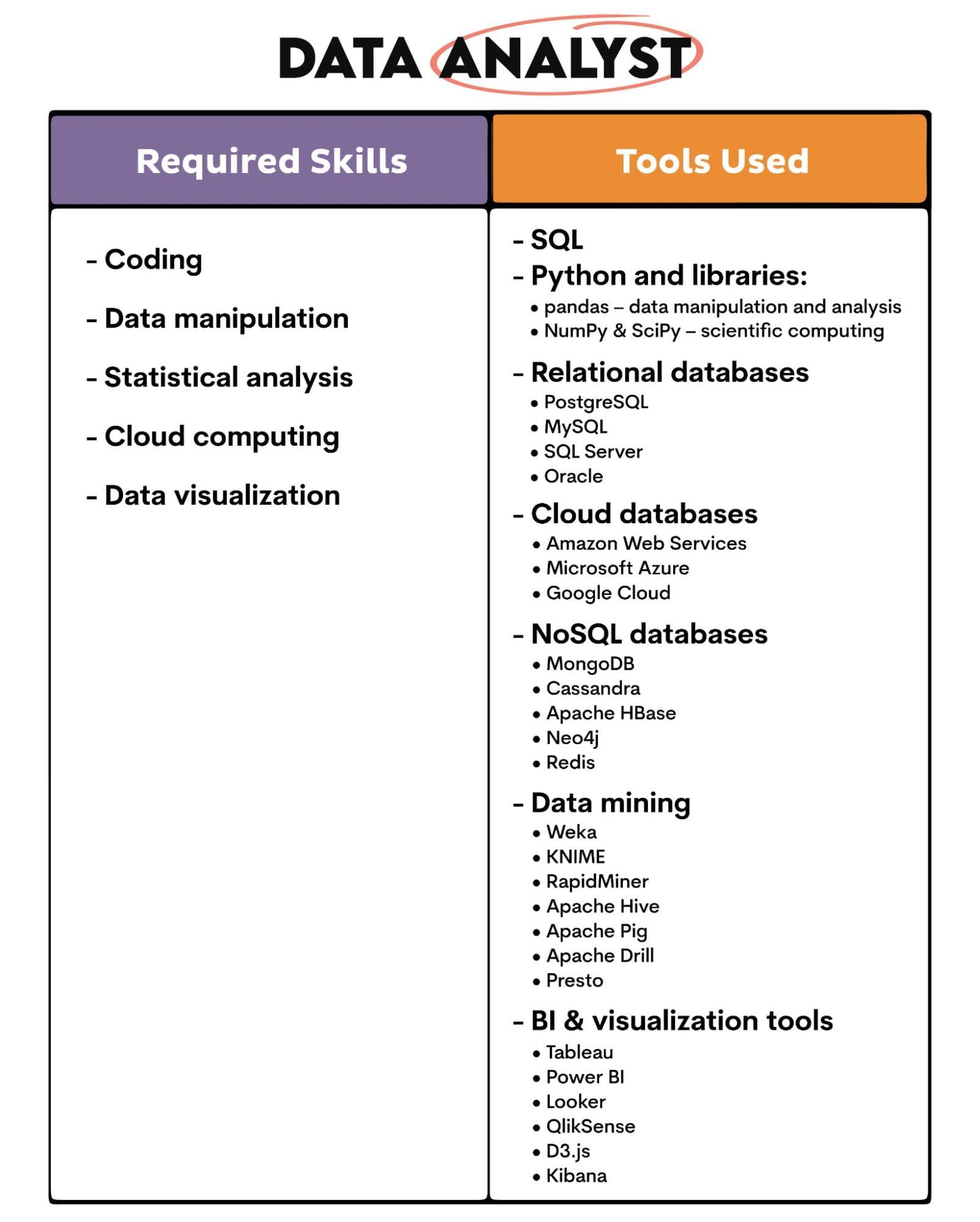
Data Analyst
Role summary: Data analysts, rather obviously, analyze data. They do it to identify patterns and come up with actionable insights. These patterns and insights are presented in the reports and dashboards, enabling decision-makers to make informed decisions.
Data analysts are mostly tasked with descriptive (What happened?) and diagnostic (Why it happened?) data analysis.
Key responsibilities:
Data Cleaning: Making data ready for analysis by standardizing it, changing its format, and dealing with duplicates, missing values, and data inconsistencies.
Data Analysis: Using statistical methods to understand trends, patterns, and insights in data.
Data Visualization and Reporting: Communicating data analysis findings through reports, data visualizations, and dashboards.
Key skills and tools: The main skills and tools used can be derived from the role description.
Career path: Data analysts can move to more senior analyst roles. With more experience and additional education, they can transition into specialist roles, such as statistician, business analyst, or even data scientist.
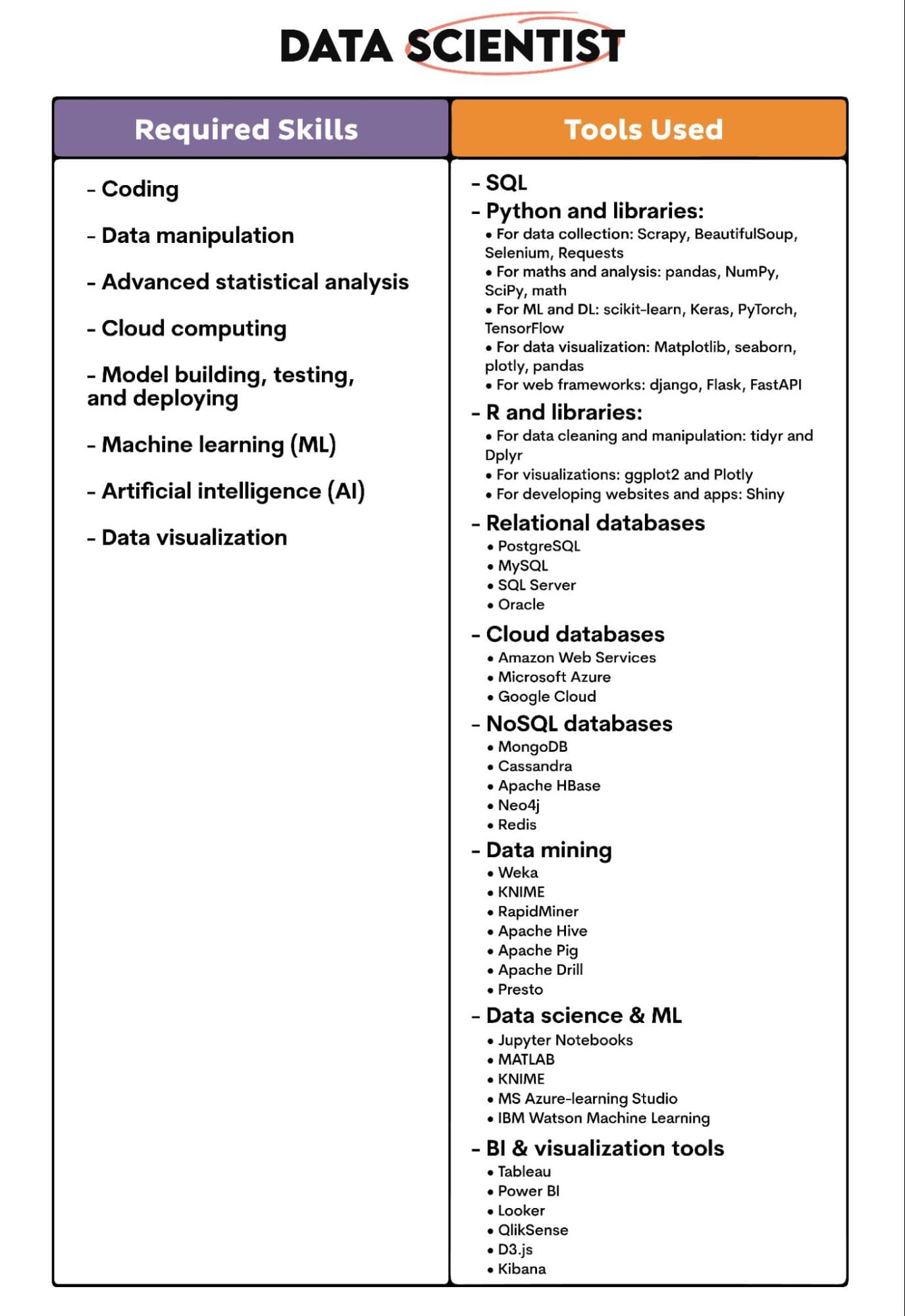
Data Scientist
Role Summary: Data scientists also analyze data but on a more advanced level. They use statistical models and machine learning algorithms to determine the likelihood of future events. This tells us they are, unlike data analysts, concerned with predictive (What will happen?) and prescriptive (What should be done?) data analysis.
Key responsibilities:
Advanced Analytics: Using advanced statistical techniques to extract insights from data.
Machine Learning: Implementing machine learning algorithms to learn from the existing data.
Predictive Modeling: Building and deploying models to predict future events on the actual and new data.
These key responsibilities are built on the same work that data analysts do. Data scientists also can’t do without data cleaning and data visualization.
Key skills and tools: Here are the skills and tools required to be a data scientist. You’ll see there’s some overlap with data analysts.
Career path: Data scientists start as junior data scientists and can move on to senior data scientists, sead data scientist and director of data science. They can also move in other directions, such as becoming AI specialists, machine learning engineers, or computer & information research scientists.
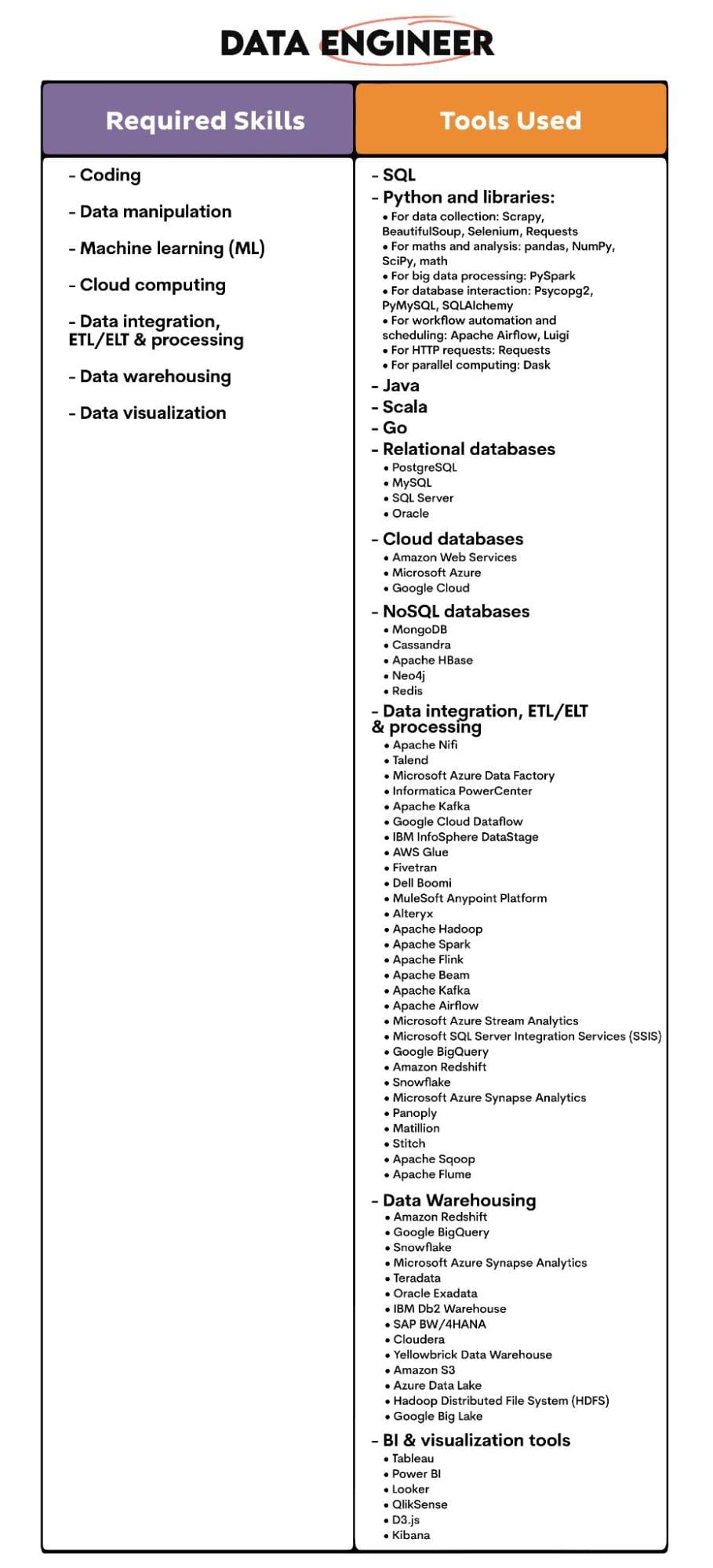
Data Engineer
Role summary: Data engineers are building data systems with the purpose of collecting, storing, and transporting data. They ensure the data availability, quality, and analyzability (Is that a word?) for all the data users.
Key responsibilities:
Data Architecture: Building data systems based on the design envisaged by data architects.
Data Pipeline: Building the system that enables data to run from multiple data sources to databases, data warehouses, and data lakes and being ready for use by other data users.
Ensuring Data Quality: Identifying errors and inconsistencies in data, removing them, and improving data accuracy and reliability.
Yes, data engineers are focused on these tasks. But they, too, can’t avoid data cleaning and data visualization.
Key skills and tools: Here are data engineers’ skills and tools used.
Career path: Data engineers’ careers can progress to senior data engineers or data architects. They can also specialize in areas such as big data, machine learning, or business intelligence.
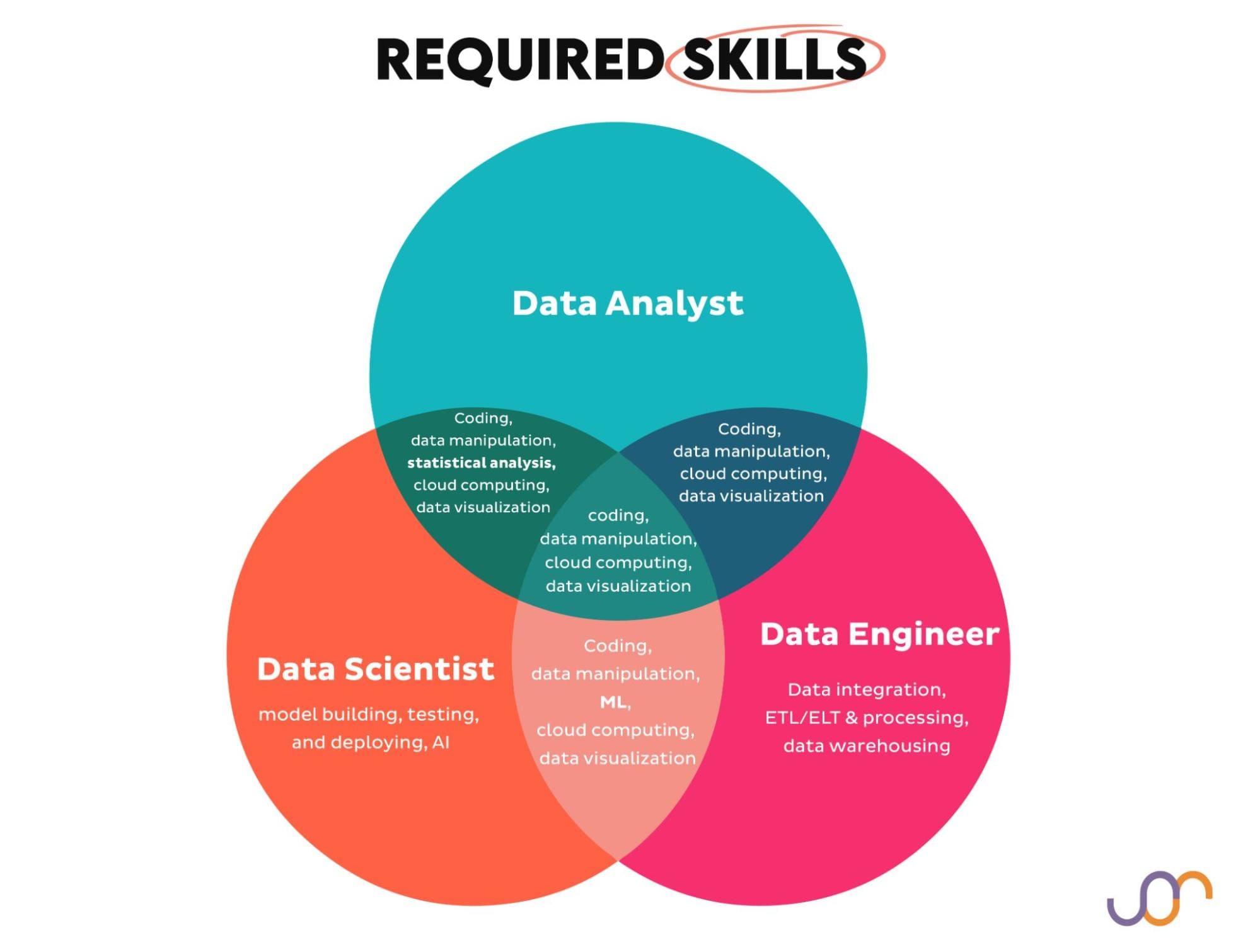
The Venn Diagrams of Data Analysts, Data Scientists, and Data Engineers
We’ve seen the differences between the three jobs. Along the way, we also noticed some overlap between the jobs in terms of the required skills.
For a quick-glance understanding, these can be shown using the Venn diagrams.
You can see that the skills shared by all three jobs are:
Coding
Data manipulation
Cloud computing
Data visualization
The additional skills shared between two jobs on top of that are highlighted.
Data analysts don’t have any skills that are uniquely theirs; other jobs also need these skills to a certain extent.
Skills unique to data scientists are:
Model building, testing, and deploying
AI
Skills special to data engineers are:
Data integration, ETL/ELT & processing
Data warehousing
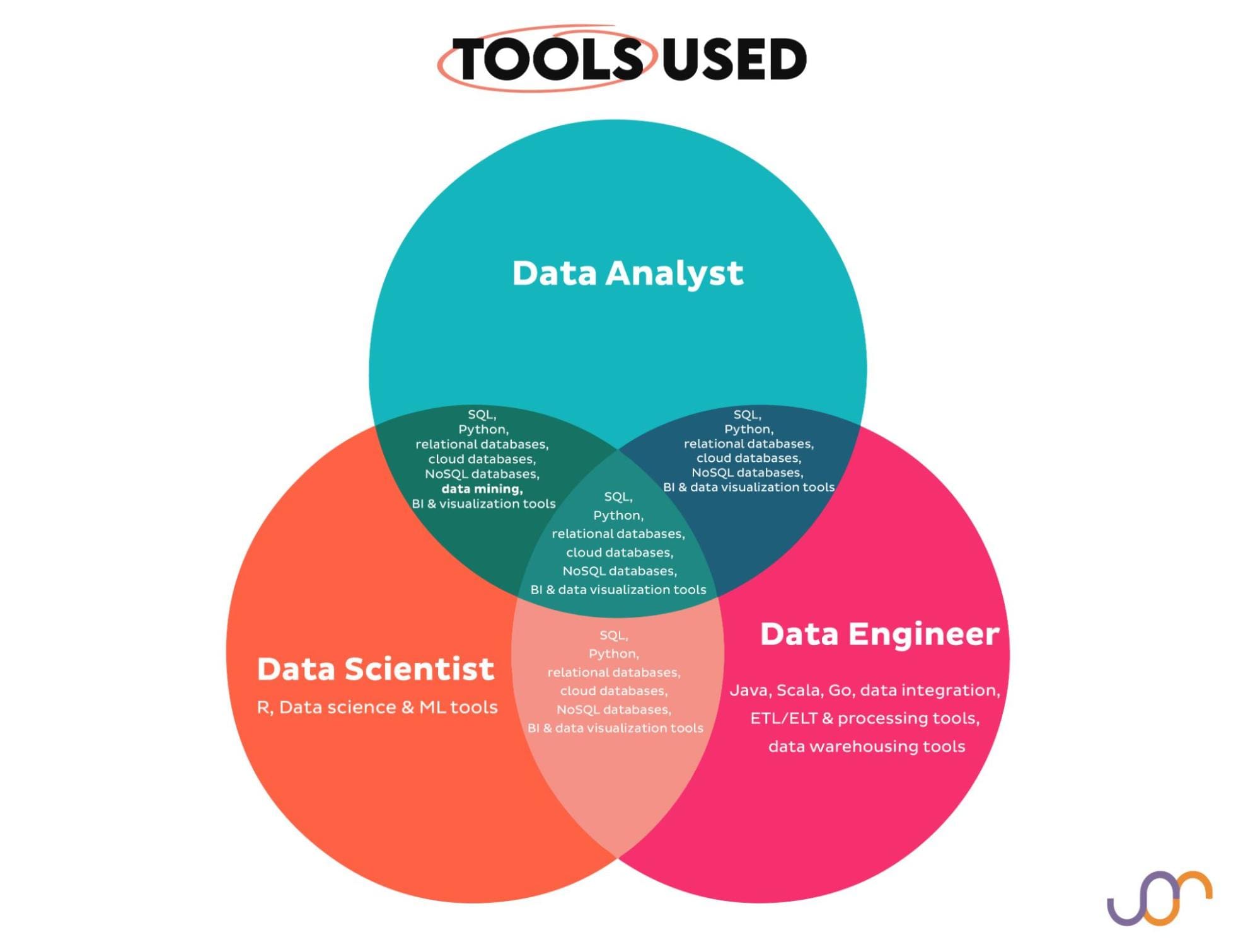
Let’s now use the same visualization to show the tools used in these jobs.
The image shows that all three jobs share these tools:
SQL
Python
Relational databases
Cloud databases
NoSQL databases
BI & data visualization tools
The additional tools shared between two jobs on top of that are highlighted.
The tool types used by data analysts are used by at least one other job. While the jobs might share the same tool types, the tools might be used to a different extent, or the exact tools within a category might be different.
Tools unique to data scientists are:
R
Data science & ML tools
Tools unique to data engineers are:
Java
Scala
Go
Data integration, ETL/ELT & processing tools
Data warehousing tools
Bridging the Gaps: Collaboration is Key
We saw that each role has distinct responsibilities and tools they use. There are also some overlaps between all three jobs. This shows these jobs are not entirely different worlds, and collaboration between data analysts, data scientists, and data engineers in a data team is crucial.
Both data analysts and data scientists rely on the infrastructure and clean, organized data of high quality. On the other hand, data engineers must collaborate with data analysts and data scientists – as they are data users – when building data architecture and providing data.
Data scientists often have to collaborate with data analysts to understand business contexts better.
Conclusion: Choosing Your Path
The differences and similarities between data analysts, data scientists, and data engineers should be much clearer now.
In conclusion,
If deriving insights from data and communicating them is your thing, data analysis might be your path.
If building predictive models and using machine learning algorithms gets your juices flowing, consider data science.
If you feel that building data architecture and ensuring a regular data flow will make you happy, then data engineering might be the right choice.
If you want to learn more, here are more details about the differences between data engineers and data scientists, and also between data analysts and data scientists.
Nate Rosidi is a data scientist and in product strategy. He's also an adjunct professor teaching analytics, and is the founder of StrataScratch, a platform helping data scientists prepare for their interviews with real interview questions from top companies. Connect with him on Twitter: StrataScratch or LinkedIn.
More On This Topic
Tips for Successfully Navigating Beginner Data Science Job Interviews
More Tips for Successfully Navigating Beginner Data Science Job Interviews
Data Scientist vs Data Analyst vs Data Engineer
Elevate Math Efficiency: Navigating Numpy Array Operations
The Ethics of AI: Navigating the Future of Intelligent Machines
Are you satisfied in your job? Take our Data Community Job…
OpenAI might have brought Christmas early, for developers and enterprises on OpenAI’s first DevDay conference. By not just giving a special $500 in API credits for all the people in attendance, the company’s announcements on new features and improvements is probably out to change the way things work, with some touting it to even fold a number of AI startups. With GPT-4 Turbo, AI assistants, Code Interpreter API, and more, it looks like OpenAI is looking to have an edge in the competitor market.
‘Turbo’ Power
OpenAI may have not launched a GPT-5, but their upgraded version of GPT- 4, termed as GPT-4 Turbo, is said to offer an improved version of the model. With a 128k context window, which can fit more than 300 pages of text in a single prompt, it is a significant improvement from the last version that only has a 32k context window – something that might have limited customers who were looking to use longer context window models. Anthropic’s Claude has a 100k context window.
Previously, in an interview with AIM, Devang Agrawal, co-founder and CTO of Glyphic AI, which is an AI copilot for the sales team, spoke about how they choose an apt LLM based on their use cases. “Claude is able to understand long context and can understand 100,000 tokens at one go. This is something you can’t do with GPT-4, which can understand only up to 16,000 tokens,” said Agrawal, referring to the GPT-4-16k context window.
On a similar line, with respect to context windows, Lentra, a digital-lending SaaS platform that employs AI/ML, had a similar experience when it came to experimenting with GPT APIs. When AIM got in touch with Rangarajan Vasudevan, co-founder and chief data officer of Lentra, he said that the API version came with its limitations in terms of number of tokens. “What we were playing out was that if the context I had was slightly broad, I have to break it down into multiple smaller contexts, such that it fits within that limit. But, when I do that, there is a bearing on the correctness,” he said.
Now, with a larger context window on GPT-4 Turbo, companies that switched to other LLMs for lack of context length on GPT, will now have an option to opt for the latter. Furthermore, OpenAI will be offering GPT-4 Turbo at a lower price as compared to GPT-4 : 3x cheaper price for input tokens and 2x cheaper price for output tokens.
AI Assistants To Rule The Way
In a bid to support developers and help build agent-like interactions with their respective applications, OpenAI announced Assistants API. The API is said to aid developers to build their own GPT-like experience into their apps and services. It currently supports three types of tools – Code Interpreter, Retrieval and Function Calling.
Code Interpreter that was released to ChatGPT Plus users in July, will now be available as an API, which means OpenAI is directly going head-on with applications such as LangChain and LlamaIndex. LlamaIndex, a data framework that connects custom data sources to large language models, are pretty much addressed through Assistants API. Furthermore, with ChatGPT-4V, which offers a multitude of features, coding capabilities have only been enhanced in the model.
Text-To-Speech Upgrade
OpenAI’s text-to-speech (TTS) feature that was launched a month ago got an interesting update at Dev Day. Developers can create human-quality speech from text via the text-to-speech API, with and six preset voices across two model variants are offered. Interestingly, applications such as Eleven Labs and PlayHT offer a similar feature, and with OpenAI’s TTS upgrade, its direct competition to eliminate smaller players is evident.
OepnAI’s DevDay keynote speech might have been a short one which concluded in 45 minutes, but the impact of the product announcements will ripple across its competitors, who might have to up the game.
Google Gemini, are you listening?
The post OpenAI’s 128k Context Window Threatens Anthropic and Others appeared first on Analytics India Magazine.
Now creating apps will be everyone’s cup of tea. At OpenAI’s first developer conference – DevDay 2023, Sam Altman made an exciting announcement about GPTs. These are essentially customised chatbots that anyone, regardless of their technical expertise, can create using ‘Natural Language’ which is very much a part of Conversational AI.
“We know that many people who want to build a GPT don’t know how to code. We’ve made it so that you can program the GPT just by having a conversation. We believe that natural language is going to be a big part of how people use computers in the future” said Sam Altman.
Furthermore, once users create their GPT, they can share them publicly on the upcoming GPT Store, set to launch later this month. The GPT Store is going to be pretty much similar to the Google Play Store or Apple’s App Store.
Open AI is launching the ability for developers to create their own GPTs It will show up additional tabs in the ChatGPT interface. The GPT store will be like the app store and will help developers make $$ Exciting but seems like a re-launch of the failed plug-ins. Of course,… pic.twitter.com/yOChKvQS00
— Bindu Reddy (@bindureddy) November 6, 2023
Unlike the Plugin Store which was a hot mess, inside the GPT Store, GPTs will become searchable and may climb the leaderboards as well based on the popularity. Just like how there are categories inside the App Store on iOS, OpenAI will also spotlight the most useful and delightful GPTs it comes across in categories like productivity, education, and “just for fun”.
Speaking of what’s in there for creators, Altman said “Revenue sharing is important to them. We’re going to pay people who build the most useful and the most used GPTs, a portion of our revenue. We’re excited to foster a vibrant ecosystem with the GPT Store”.
With this OpenAI aims to create an ecosystem of its own. Founders of wrapper-based startups might soon join OpenAI’s online store by creating GPTs for OpenAI. It’s safe to say that basic startups may find it challenging to compete against OpenAI’s ‘agents’ or GPTs.
How to build your own GPT
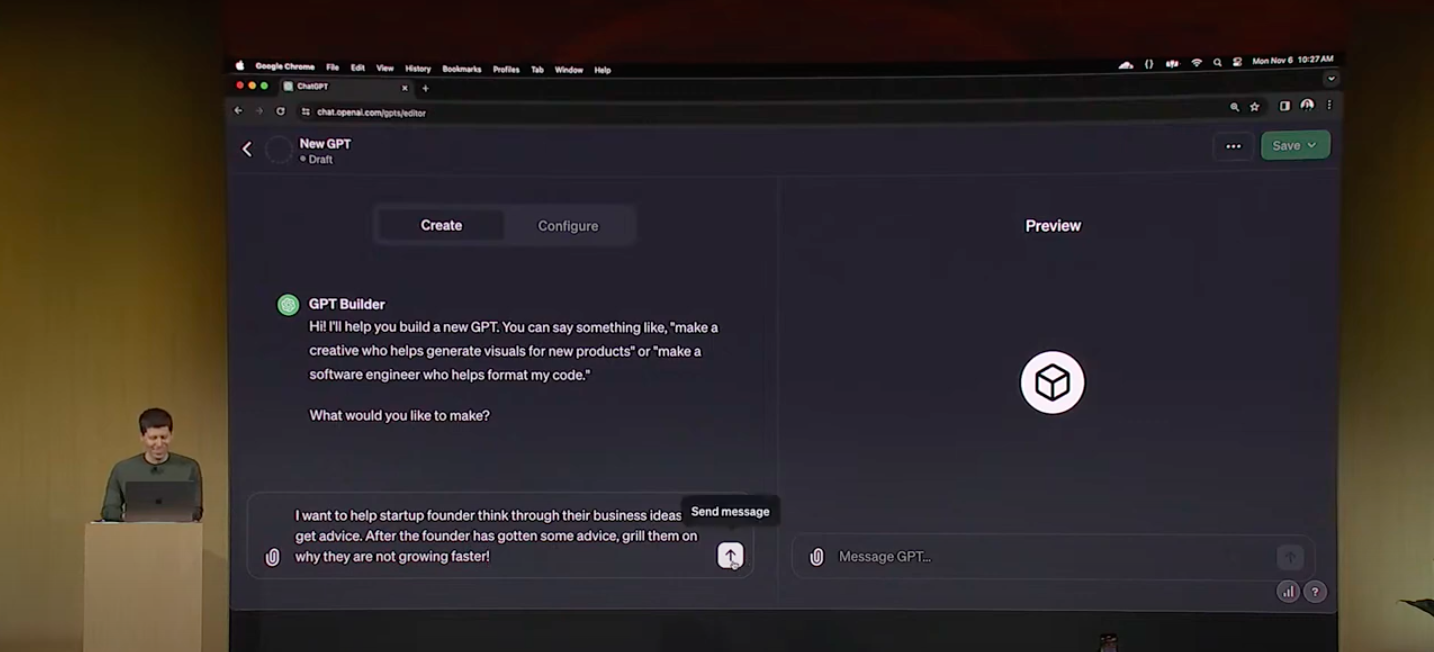
At DevDay, Altman provided a brief example of how to approach building your own GPT using natural language. He demonstrated this with the assistance of a GPT named ‘Startup Mentor’ which offers advice to startup founders. Below is the interface that users will see when creating their own GPT with GPT Builder.
Within the GPT Builder interface, users can input their ideas and relevant information to create their customised GPT. For instance, Altman entered, “I want to help start-up founders think through their business ideas and get advice,” he wrote recalling his YC days, and laughingly added, “after the founder has gotten some advice, grill them on why they are not growing faster.”
Following this input, the GPT Builder automatically generated detailed instructions for the GPT. On the right-hand side of the screen, there’s a ‘Preview Tab’ allowing users to visualise the changes made by the GPT Builder to the GPT. Apart from web crawling and text-based training of GPT-4, GPT Builder also allows users to enter additional information by uploading files, in this case, Altman uploaded his lecture.
ChatGPT has a new "Builder Profile" that allows you to create a profile with a website link. Creating a micro-social network within the GPT Builder marketplace to flex your new custom GPTs is a genius move by OpenAI. pic.twitter.com/QDOJ6rifDi
— Rowan Cheung (@rowancheung) November 6, 2023
Some GPTs are already in the market
During DevDay, Altman highlighted a few existing GPTs developed by companies. For example, Code.org, crafted Lesson Planner GPT, to help teachers provide a more engaging experience for middle schoolers.
Moreover, Canva has built a GPT that lets you start designing by describing what you want in natural language. If you say, “Make a poster for a Diwali/ Christmas party ” and give it some details, it’ll generate a few options to start with by hitting Canva’s APIs.
Additionally, Zapier has built a GPT that lets you perform actions across 6,000 applications to unlock all kinds of integration possibilities, without requiring any code.
Undoubtedly, DevDay’s showcase of GPTs has highlighted the huge potential and proof of a turning point in the history of not just LLMs, but the AI field as a whole. Now, non-technical users can create AI driven applications without writing a single line of code, just with their ideas and creativity, and a little bit of prompt engineering.
The post Now Everyone is an App Developer, Thanks to OpenAI appeared first on Analytics India Magazine.
Last week, Google enabled WebAssembly Garbage Collection (Wasm GC) in Chrome. This is a significant development, as it is likely to lead to more web developers using WasmGC.
WasmGC makes developing better web apps easier. It helps manage memory, moves existing code to the web, and supports faster real-time apps. Google’s support for WasmGC in Chrome shows their dedication to WebAssembly tech.
This update has the potential to make JavaScript more unpopular among developers than it already is. It is widely used to make interactive webpages.
Eloff, a software developer posted on X, “Web Assembly GC is a big deal. Web assembly was like the universal machine, an instruction set compilers could target that runs everywhere.”
Prior to WebAssembly, JavaScript was one of the few programming languages that could be used to develop web applications. However, JavaScript is not known for its performance, especially for complex applications. WebAssembly solves this problem by allowing developers to use high-performance programming languages to develop web applications.
What it means for web developers
WebAssembly is a new technology that allows developers to use programming languages other than JavaScript to develop web applications. The garbage collection feature in Wasm makes it even better because it frees developers from having to worry about manually managing memory.
WasmGC automatically manages memory allocation and deallocation, which allows developers to focus on developing the core functionality of their web applications.
Porting languages to new architectures commonly involves recompiling the VM to support the architecture. While the traditional approach works for WebAssembly (Wasm), the Wasm Garbage Collection (WasmGC) proposal addresses its specific limitations.
WasmGC manages structs and arrays via the Wasm VM’s GC implementation, offering a high-level advantage and tighter integration with the target VM. It helps in minimising shipped memory management code, reducing binary size, and efficiently handling cycle collection through bidirectional links between Wasm and JavaScript, enabling proper references between both.
Stiff competition for JavaScript
“JavaScript is suddenly no longer the only real game in town it seems,” said one user on HackerNews
WebAssembly potentially poses a challenge to JavaScript’s popularity due to its inherent advantages. Wasm’s compiled nature from languages like C and C++ allows for faster execution compared to JavaScript, which is an interpreted language known to be slower.
WebAssembly’s adaptability to various platforms, in contrast to JavaScript’s limitations in this area, enhances its portability. Moreover, the sandboxed environment in WebAssembly improves security by isolating it from other browser components, an advantage lacking in JavaScript, which faces more potential security threats.
The garbage collection feature for WebAssembly was proposed in 2017. Most of the work, however, was done in the last three years. The growing number of users building with WebAssembly has prompted the default option in Chrome, Edge and Firefox.
Though JavaScript and WebAssembly have two distinct roles in web development in performance and speed, the latter stands out. WASM is generally faster than JavaScript due to its pre-compiled nature and efficient execution directly on the hardware, while JavaScript is interpreted, leading to relatively slower execution speeds. A paper published comparing the performance of the two languages concluded that Wasm has improved energy efficiency by 30%.
Unlike JavaScript, Wasm code can be compiled for various hardware architectures, ensuring portability across different devices and platforms. Additionally, it supports multiple programming languages, allowing seamless interactions among them.
Execution of Wasm occurs in a sandboxed environment, which isolates it from the primary browser thread, offering improved security by limiting unauthorised access to system resources. This is the crucial difference between the two languages. With most of the hacks online taking place on the browsers Wasm offers security advantages on a number of fronts.
Sounil Yu, chief information security officer at JupiterOne, said, “Wasm has a limited set of instructions and better memory management, which helps reduce the attack surface for vulnerabilities and prevents some common types of vulnerabilities such as buffer overflows.”
Wasm code also offers a bit of security through obscurity by not being human-readable, making it harder for attackers to reverse-engineer the code and thus more difficult to discover and exploit vulnerabilities.
JavaScript has the largest number of users in web development with more than 63%. It is the foundation of modern web development, offering ease of use, widespread support, and seamless integration with the browser’s DOM. WebAssembly is fairly new, released only in March. In 2022, 67% of respondents of the State of WebAssembly survey were frequently using WebAssembly, which is a big jump from 47% in 2021. Now, WebAssembly is used to build sites by sites with most traffic. WasmGC will only push this popularity.
The post How WasmGC Will Change the Developer Experience appeared first on Analytics India Magazine.
Today, data science teams world over are leveraging generative AI to reap the benefits of the technology that has everyone’s rapt attention. Not one to miss out on the transition, Yuvaneet Bhaker, principal data scientist at Fractal, told AIM that his team too has been leveraging generative AI to stay ahead of the curve.
Bhaker agrees that generative AI can enable direct and indirect applications to work with structured data. Popular direct applications include leveraging natural language for structured database queries and generating various data types, such as tabular, hierarchical, graph, and time-series data. The utility of LLM embeddings is paramount, aiding in classification tasks and detecting rare events like anomalies, fraud, and piracy within datasets.
Indirect applications, on the other hand, facilitate data scientist workflow planning and enhancement. Generative AI offers the ability to produce recommendations, suggesting which features to implement, along with generating implementations (co-pilots) and creating documentation to support these processes.
In this exclusive interaction with Analytics India Magazine, Bhaker contrasts generative AI applications on structured versus unstructured data and delves into how Fractal’s data science team has been leveraging the technology.
Can you tell us how the recent generative AI trend has impacted Fractal?
Bhaker: Fractal has been actively engaged in generative AI. This has accelerated over the past year, we’ve witnessed significant transformations in this field. The surge in generative AI’s capabilities has spurred increased investment and exploration, particularly on behalf of our clients. We are developing tools for our client’s that can boost productivity for internal users and enhance customer experiences.
Fractal provides thought leadership and guidance on generative AI. We help our clients with discovery and implementation of use-cases that can make a real impact. We are developing products, accelerators and best practices of working with generative AI solutions.
Our primary research focus is on enhancing the reliability, explainability, and readiness of GenAI solutions. We blend design, engineering, and AI, catering to end-users’ needs while emphasising speed, reliability, and accuracy. Incorporating domain expertise is another crucial element in this journey.
How is the data science team at Fractal leveraging generative AI? What are the current use cases? Also, which LLMs are you currently using?
Bhaker: Our generative AI team works across multimodal use cases encompassing text, images, videos, structured and unstructured data. We incorporate design and behavioral science concepts to ensure our outputs have a meaningful impact on customers.
One of our primary use cases involves data querying, whether the data is structured or unstructured. This entails searching for relevant information and generating insights or summaries in a contextually useful format. The format varies depending on the end-user, such as a relationship manager or a risk team.
Internally, our data science team utilises generative AI for enhanced productivity, from utilising copilot tools for structured data insights to code translation between programming languages, showcasing the diverse range of applications for such solutions.
We are developing frameworks agnostic to specific LLM, making it easier to upgrade or switch as technology improves. Simultaneously we are partnering with LLM providers to configure each implementation to extract best possible performance. Data security and performance are key criteria for us in this regard.
What are the key differences between using generative AI for structured data compared to unstructured data, and what unique challenges does structured data present?
Bhaker: LLMs can process both structured and unstructured data in part or as a whole. It is possible for LLMs to extract information from unstructured data and shape it in desired format.
High quality structured data simplifies insight generation, pattern discovery, and prediction making. It enables use of data processing and insight generation tools like SQL and python.
There are some challenges in working with structured data, such as granularity, missing values, and dimensionality. However, LLMs have shown greater flexibility in addressing some of these challenges. Generative AI solutions offer the potential to elevate the caliber of existing data while embracing the idiosyncrasies inherent in data with ambiguous formats, all the while maintaining performance integrity.
Historically differences manifested through separate use cases (for example, translation vs forecasting), data processing techniques (tokenisation vs feature engineering), training (transfer learning vs building models every time from scratch) as well as evaluation methodologies.
But, now generative AI empowers us to approach problems with a multimodal perspective, seamlessly incorporating both structured and unstructured data. These models draw upon extensive open-source data and possess a comprehensive ‘worldview’ infused with knowledge. For instance, consider the category ‘credit card’ in structured data. Previously, it was typically represented as a one-hot encoded variable, lacking a nuanced understanding. However, generative AI comprehends the concept of a credit card, bridging the gap between structured data and real-world knowledge.
Going forward, the lines between structured and unstructured problems will become increasingly blurred.
What are the challenges and learnings when it comes to implementing generative AI for structured data?
Bhaker: When we initially implemented these solutions, we noticed that they possessed the ability to generate responses that appeared quite plausible and appealing to human readers. However, when domain experts, such as physicists, programmers, mathematicians, or corporate banking specialists, posed questions within their respective fields, it became apparent that while the responses seemed plausible, they weren’t always accurate. This posed a significant risk, as relying on these responses for decision-making could lead to undesired consequences.
Furthermore, most user interactions with generative AI occur in a chatbot-like fashion at the end of the entire process. However, our goal was to employ generative AI more upstream to automate various tasks, including generating complete blocks of code or insight automation. This introduced additional challenges. Our primary learning from this experience has been centered around enhancing the critique and validation capability of our solution.
We aim to incorporate reasoning abilities to help it understand its limits and clearly communicate uncertainties. We want it to be able to say, ‘I think this is the answer, but I’m not entirely certain’. By verifying the compatibility of queries with available information, we aim to reduce the need for speculative or inaccurate responses. Our ongoing efforts are focused on experimenting with each entity in our solution to enhance its robustness and scalability.
Are there any ethical considerations or potential risks associated with the use of generative AI for structured data?
Bhaker: Generative AI poses a risk of producing deceptive outputs with a high level of confidence, potentially misleading by generating seemingly authentic content. Addressing these concerns would require a transparent approach. Proper attribution, citation along with independent and competent criticism and adversarial Generative AI solutions can be useful. Human domain experts will play a critical role in developing such evaluation and benchmarking capabilities.
Data bias and fairness are inherited from training data emphasis on diverse datasets, and balancing may help. Privacy concerns arise due to sensitive PII data in training as well as querying stages, such info must be carefully masked and removed. Security risk can be addressed by ensuring proper access control. Generated data can be potentially misused, so it is important to identify, tag, and increase awareness to prevent unwanted consequences.
What are some of the challenges for Fractal at large, when it comes to leveraging generative AI at scale?
Bhaker: Initial challenges include cost and rate limitation of LLM APIs. For the right reasons I am hoping, they will become cheaper, faster and better incrementally.
The second challenge revolves around evaluating these solutions, particularly concerning specific tasks. It’s crucial to ensure the reliability of responses. We’ve observed that numerous teams, each specialising in different tasks, can benchmark and validate the responses, enhancing their dependability.
The third challenge pertains to infrastructure, including the expensive GPUs and cloud infrastructure required to host LLMs. At Fractal, we’ve adopted a platform approach. Dedicated teams work on optimising the performance of hosted LLMs, making them available within our ecosystem. This approach leverages expertise in effectively working with these extensive models.
Our approach involves various teams working at different stages — optimising responses, managing infrastructure and APIs, creating a platform for downstream applications, and developing solutions to enhance productivity for our clients. Additionally, our design, behavioral sciences, and domain expert teams contribute their knowledge to make these applications more valuable to our clients.
The post Generative AI Brings a ‘World-View’ to Structured Data appeared first on Analytics India Magazine.
“Welcome to Angular’s renaissance,” said Angular in a post on X. As promised by the developers, the framework has come up with v17 with a lot of new upgrades in its syntax and template features. Angular’s page now includes dark mode, in-depth guides, search-ability, and a lot of tutorials, and most importantly, the Playground, which allows users to write user templates to start with the latest features.
The highlight of the revamp is Angular.dev, which is a new future home for Angular development. This includes new tutorials, updated documentation, and guidance for latest Angular features. And the Playground is where you can explore all these concepts.
The release blog highlights the company’s dedication towards open source development, and improvement for the future v18 release of Angular, which will focus on stability. Moreover, Emma Twersky, senior developer relations at Angular, highlighted that the company has also reformatted its API and CLI references to look like code in the editor, for easier reference.
If anything, the updates to the site highlight what Angular framework is now capable of.
Welcome to Angular’s renaissance.https://t.co/8DxJPZaTd5 pic.twitter.com/yfvylyG6Bs
— Angular (@angular) November 6, 2023
Too little too late, every time
While many developers who have been using Angular are extremely excited with the “new feel” of Angular, others are calling it just dead, or merely a revamp. Some even jokingly questioned if it was acquired by Adobe, given the new design of the website and the logo looks very similar to Adobe’s.
Is Angular dead?
Well, not according to its die-hard fans, who are still holding onto the hope that it will make a glorious comeback — which can still be expected. In the world of web development, where newer, shinier frameworks, such as React, are popping up faster than you can say “Angular”, it’s easy to wonder if the framework would indeed become a relic of the past.
In 2022, we saw the release of Angular v15, which, according to early reviews, was more refined, stable, supportable, and its last-ditch effort to survive. Sure, it may not have set the internet on fire with excitement, but it’s still being used by many.
Angular 15 was dearly loved by a lot of developers. But is that really true?
In May 2023, Angular launched v16 with what it called the “biggest release since the initial rollout of Angular,” but the same could not be said completely about the developer community.
Angular devs in my replies. pic.twitter.com/hBWEOS65Df
— Killed by Google (@killedbygoogle) November 7, 2023
According to the Stack Overflow Developer Survey 2023, Angular has seen better days. It’s down to 18.7% usage, a far cry from its glory days of 30.7% in 2021, and 22.9% in 2022. React, Vue, and even jQuery have snatched its crown. Not to mention, Angular’s satisfaction rate of 58.6% pales in comparison to React’s 74.5% and Vue’s 66.9%.
Why the fall from grace? Well, for starters, fresher and lighter frameworks like React and Vue, for instance, have emerged with simpler syntax, faster rendering, better SEO support, and smaller bundle sizes.
Still afloat
Google has been known for killing a lot of its products. In 2019, it killed AngularJS, but in turn offered its developers Angular, the framework with more than just JavaScript in its focus.
Regardless, Angular has gone through more versions than any other framework. Though this might seem like a good thing, from AngularJS to v2 to v8, to now v17, with each new version, developers must rewrite or migrate their code, making them feel like they’re on a never-ending tech rollercoaster.
And, let’s not forget the lack of support and documentation for the older versions, all this while. Though with the beta update, Angular v17 is still garnering love from the developers.
So, Angular may not be your trendiest framework in town, but it’s still alive and kicking. Interestingly, Google has also been using React, along with Angular for a lot of its framework.
But just like with every update and every year, new blogs keep popping up to check if Angular is dead or not. The Angular team knows it, and thus has promised a stable release of v18 soon, as they know that is what the developers have been craving for all this while.
The post How is Angular Not Dead Yet? appeared first on Analytics India Magazine.