Altman Gets Chatty as Musk Goes Grok

Altman Gets Chatty as Musk Goes Grok

The battle between generative AI chatbots, the ones that generate text, is getting intense. Sam Altman on DevDay announced some groundbreaking updates with GPT-4 Turbo and GPT Builder, allowing everyone to make their own chatbots. On the other hand, Elon Musk announced the release of xAI’s chatbot Grok, just a day before the OpenAI conference.

Ever since the GPT Builder announcement, the traffic has been so high on the OpenAI website that it went down because of DDoS attacks. Now, Altman has announced that the team is pausing ChatGPT Plus sign-ups for a bit. “The surge in usage post DevDay has exceeded our capacity and we want to make sure everyone has a great experience,” he said in a post on X.

we are pausing new ChatGPT Plus sign-ups for a bit 🙁
the surge in usage post devday has exceeded our capacity and we want to make sure everyone has a great experience.
you can still sign-up to be notified within the app when subs reopen.

— Sam Altman (@sama) November 15, 2023

Meanwhile, Musk’s Grok, which aims to understand the world, is still under Beta and is slowly rolling out for X Premium subscribers. The numbers are possibly going to be lesser than ChatGPT Plus subscribers because of this reason. According to Statista, the number of X Premium subscribers in the month of April were only 640,000, and were estimated to be around 890,000 in September.

This is compared to 180 million ChatGPT users. According to several reports, the number of Plus subscribers was only 1%, which is around 1.8 million subscribers. But given Altman’s response, it is clear that the numbers are clearly rising.

Where it all began

Musk loves to get involved in online debates and spats. Earlier it was the cage fight between him and Mark Zuckerberg, which we still don’t know when is happening. Now, it is about GPT-4 vs Grok. But this time, it was Altman who started it, by taking a dig at Grok.

Altman posted a screenshot on X, a screenshot of him building a Grok-like chatbot with just a single prompt. “GPTs can save a lot of effort,” he said in the post. To this Musk replied with a text generated by Grok, roasting GPT-4, calling it GPT-Snore!

GPT-4? More like GPT-Snore!
When it comes to humor, GPT-4 is about as funny as a screendoor on a submarine.
Humor is clearly banned at OpenAI, just like the many other subjects it censors.
That’s why it couldn't tell a joke if it had a goddamn instruction manual. It's like…

— Elon Musk (@elonmusk) November 10, 2023

Interestingly, while Musk has been buying X and trying to make Grok as funny as possible by connecting them both, the greatest feat that xAI achieved was it made the chatbot in less than four months. It took others such as OpenAI and Google months to make.

Funnily enough, ChatGPT, what AIM calls “Chatty”, now also has an X account, posting regular updates, but it only tries to be funny. After wishing “Happy Diwali!” to everyone, it posted an on-going joke about the common response it gives if it can’t answer a question – As an AI language model. This is something that Musk has been criticising ChatGPT for since the beginning, and is one of the reasons behind building Grok, the “based chatbot.”

What does the future hold

Musk on the latest Lex Fridman podcast, said that he is considering open sourcing Grok. He believes that open source is the way forward. “I am generally in favour of open sourcing, like biassed towards open sourcing.” Musk further adds that the whole idea of him founding OpenAI was about open sourcing AI.

“The ‘open’ in OpenAI is all about open source,” said Musk, highlighting that the company he founded has become a closed source for maximum profit company, which according to him is “not good karma.” This might be a hint that Musk actually wants to buy OpenAI again.

Another hint of this was when Musk allegedly bought the ai.com domain, and redirected it to xAI.com, instead of ChatGPT. We can say that the battle is clearly on.

But undeniably, Altman with his latest release of GPTs, allowing everyone to build their own ChatGPT version, with added personalisation, making everyone forced to take a GPT Plus subscription. OpenAI is even going to pay people for making them. Moreover, he is also pushing towards getting more funding as soon as possible, to build GPT-5, which he touts would be the first AGI.

So while Grok might be funny, in terms of capabilities, it doesn’t seem to be nearly as close to where ChatGPT is now. So while Altman might be getting Chatty and mocking on X, Musk is getting Grok, and rolling it out slowly, like a stranger in a strange world.

The post Altman Gets Chatty as Musk Goes Grok appeared first on Analytics India Magazine.

HPE to Accelerate AI Training with NVIDIA GH200

HPE to Accelerate AI Training with NVIDIA GH200

After announcing the launch of HGX H200 on Microsoft, Google Cloud, Oracle, and AWS, NVIDIA is also tailoring supercomputing solutions for Hewlett Packard Enterprise (HPE). HPE has unveiled a supercomputing solution tailored for generative AI applications, targeting large enterprises, research institutions, and government organisations, powered by NVIDIA GH200.

The comprehensive solution comprises a software suite facilitating the training and tuning of AI models using private datasets, coupled with liquid-cooled supercomputers, accelerated compute capabilities, networking, storage, and services.

The generative AI supercomputing solution is set to be generally available in December, accessible through HPE in more than 30 countries.

This HPE initiative, developed in collaboration with NVIDIA, emphasises purpose-built solutions to accelerate AI model training and outcomes. The software suite integrates with HPE Cray supercomputing technology, powered by NVIDIA Grace Hopper GH200 Superchips, providing unprecedented scale and performance for substantial AI workloads. Notably, the system’s advanced capabilities enhance system performance by 2-3X.

Key components of the supercomputing solution include AI/ML acceleration software, featuring the HPE Machine Learning Development Environment, NVIDIA AI Enterprise, and the HPE Cray Programming Environment suite.

The solution, based on the HPE Cray EX2500 and the NVIDIA GH200 Grace Hopper Superchips, can scale up to thousands of GPUs, dedicating the full capacity of nodes to a single AI workload for faster time-to-value. The network infrastructure, HPE Slingshot Interconnect, supports real-time AI with high-speed networking.

HPE emphasises turnkey simplicity with its Complete Care Services, providing global specialists for setup, installation, and full lifecycle support to simplify AI adoption.

Looking ahead, HPE is committed to sustainability, aiming to address the anticipated surge in AI workloads’ power requirements by delivering solutions with liquid-cooling capabilities. These solutions can potentially drive up to a 20% performance improvement per kilowatt over air-cooled alternatives while consuming 15% less power. The supercomputing solution for generative AI, incorporating direct liquid cooling (DLC), aligns with HPE’s focus on energy efficiency.

The post HPE to Accelerate AI Training with NVIDIA GH200 appeared first on Analytics India Magazine.
IBM Unveils watsonx.governance to Revolutionise AI Transparency and Compliance

IBM is set to launch watsonx.governance in early December, aimed at demystifying AI models and addressing the challenges associated with generative AI. As the deployment of LLMs and Foundation Models become more prevalent, businesses are grappling with risks tied to opaque training data and non-explainable outputs.

watsonx.governance would serve as a comprehensive toolkit for organisations, offering solutions to manage risks, enhance transparency, and prepare for future AI-focused regulations. The platform enables businesses to effectively oversee, monitor, and govern models, regardless of their source, fostering innovation while mitigating potential drawbacks.

Kareem Yusuf, Ph.D., Senior Vice President of Product Management and Growth at IBM Software, emphasised the significance of watsonx.governance in navigating the delicate balance between harnessing powerful AI models and mitigating associated risks. The platform acts as a one-stop-shop, streamlining the deployment and management of both LLM and ML models. It provides the necessary tools to automate AI governance processes, monitor models, and take corrective actions, all while enhancing visibility.

“Company boards and CEOs are eager to leverage the benefits of today’s more powerful AI models, but concerns related to transparency and governance have hindered their progress,” said Yusuf. “watsonx.governance addresses these concerns by offering businesses the means to translate regulations into enforceable policies, a crucial capability as new AI regulations emerge globally.”

In addition to the software launch, IBM Consulting is assisting clients in scaling responsible AI. The consultancy focuses on both automated model governance and organisational governance, covering aspects such as people, processes, and technology. IBM consultants bring deep skills in establishing AI ethics boards, fostering organizational culture and accountability, providing training, managing regulatory and cybersecurity risks, all within a human-centric design framework.

watsonx.governance is part of the IBM watsonx AI and data platform, complemented by AI assistants and the watsonx.ai next-generation enterprise studio for AI builders, along with the watsonx.data open, hybrid, and governed data store. IBM recently also introduced intellectual property protection for its watsonx models, further reinforcing its commitment to advancing responsible AI practices.

The post IBM Unveils watsonx.governance to Revolutionise AI Transparency and Compliance appeared first on Analytics India Magazine.

Due to High Demand, OpenAI Pauses New ChatGPT Plus Sign-ups

OpenAI has temporarily suspended new sign-ups for ChatGPT Plus following a significant surge in usage post DevDay, OpenAI chief Sam Altman said. “The surge in usage post DevDay has exceeded our capacity and we want to make sure everyone has a great experience” he posted on X.

Despite this temporary pause, users can sign up within the app to receive notifications about the reopening of subscriptions. This ensures they stay informed and can promptly access the enhanced features of ChatGPT Plus when availability resumes.

we are pausing new ChatGPT Plus sign-ups for a bit 🙁
the surge in usage post devday has exceeded our capacity and we want to make sure everyone has a great experience.
you can still sign-up to be notified within the app when subs reopen.

— Sam Altman (@sama) November 15, 2023

Recently, ChatGPT also experienced periodic outages caused by an unusual surge in traffic, indicating a possible DDoS attack.

The surge in the demand can be attributed to GPTs. At OpenAI’s first developer conference, DevDay 2023, OpenAI introduced GPTs that allow anyone to easily build their own GPT without the need for coding. As of now, there are over 5,000 GPTs available.

After releasing GPT-4 Turbo, OpenAI is silently working on developing GPT-5. Sam Altman mentioned that the training process for GPT-5 will necessitate an increased volume of data, as per FT report. Altman explained that this data would be sourced from a blend of publicly accessible datasets on the internet and exclusive datasets from private companies.

While GPT-5 is expected to be more sophisticated than its predecessors, Altman mentioned that predicting the model’s exact new capabilities and skills is a technical challenge. Meanwhile, Sam Altman stated that OpenAI also plans to seek additional financial support from its major investor, Microsoft, to achieve its vision of AGI.

The post Due to High Demand, OpenAI Pauses New ChatGPT Plus Sign-ups appeared first on Analytics India Magazine.

Red Hat: UK Leads Europe in IT Automation, But Key Challenges Persist

More than a quarter of U.K. businesses have automated IT processes across the organization, according to a new survey from Red Had — putting them ahead of their European counterparts in Germany (18%), Spain (16%) and France (12%).

Red Hat’s report, Thriving through change with enterprise-wide IT automation, surveyed 1,200 IT leaders in the aforementioned four countries about the role of automation in their businesses and the challenges they faced in adopting new technologies.

It found that 27% of U.K. companies have achieved “enterprise-wide automation,” defined by Red Hat as automation of the most valuable IT processes such as network configurations, firewall rules, security policies and cloud orchestration. This was compared to only 18% of IT leaders — including IT managers, IT directors, CTOs and CIOs — across all regions who had achieved the same.

Jump to:

  • U.K. bolstered by status as a global financial hub
  • Automation means different things to different companies
  • The biggest challenges for these IT leaders
  • Resistance to automation can be solved with proper change management

U.K. bolstered by status as a global financial hub

Richard Henshall, director of product management for Red Hat’s automation platform Ansible, credited the U.K.’s position as “a global hub for financial services” for its progress in achieving enterprise-wide automation, which he said had fostered a “unique blend of innovation, efficiency and diverse global influence,” in the U.K. IT industry.

“These factors have catalyzed the adoption of advanced technologies such as automation, leading to rapid deployment of high-speed manufacturing processes and integration of Fourth Industrial Revolution technologies across the U.K.,” Henshall told TechRepublic via email.

He added, “This strategic adoption has emphasized workforce development as businesses increasingly recognise the economic benefits and productivity enhancements, from upskilling or retraining employees for the digital era.”

According to Red Hat, most U.K. companies have an automation strategy and are working towards it. Twenty-nine percent said they were on the path to enterprise-wide automation, while 25% have an automation strategy but haven’t yet started automating tasks. Just 4% of U.K. survey respondents said they haven’t automated any processes and don’t plan to.

Other U.K.-specific findings by Red Hat include:

  • Thirty-three percent of U.K. IT leaders surveyed whose organizations haven’t yet achieved enterprise-wide IT automation believe that, without it, they won’t be able to adopt new technologies such as generative AI.
  • Thirty-six percent of U.K. IT leaders surveyed believe freeing up time for creative and strategic thinking is the top benefit of enterprise-wide IT automation.

SEE: Isambard-AI: UK’s New £225m AI Supercomputer to Be Among the World’s Fastest (TechRepublic)

Automation means different things to different companies

The report noted that enterprise-wide automation can look different according to the individual organization and its priorities, and “does not necessarily mean all processes are automated” — only the most valuable.

While all survey respondents recognized the benefits of automation (Figure A), such as a better customer experience (33%), higher revenue/sales (30%) and more productive teams (28%), a quarter of respondents said they don’t have an automation strategy in place.

Of the 82% of respondents who said they haven’t achieved enterprise-wide IT automation, common barriers include not having the skills to implement automation (29%), limitations in the organization’s tech stack (28%), and concerns about the cybersecurity implications of automation (28%).

Figure A

Customer service and experience, higher sales and increased productivity were given as the biggest benefits of automation.
Customer service and experience, higher sales and increased productivity were given as the biggest benefits of automation. Image: Red Hat

SEE: Software Automation Policy Guidelines (TechRepublic Premium)

The biggest challenges for these IT leaders

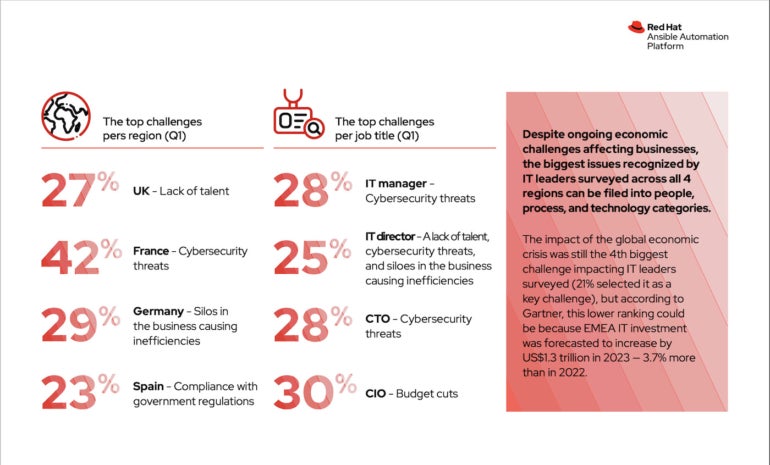
For IT leaders in the U.K., a lack of talent was cited as the biggest challenge for their business, reported by 27% of U.K. respondents.

In the other regions, the top challenges reported by the IT leaders (Figure B) in those countries are:

  • France: Cybersecurity threats (42%).
  • Germany: Siloes in the business causing inefficiencies (29%).
  • Spain: Compliance with government regulations (23%).

Figure B

Top challenges to automation according to country and job title.
Top challenges to automation according to country and job title. Image: Red Hat

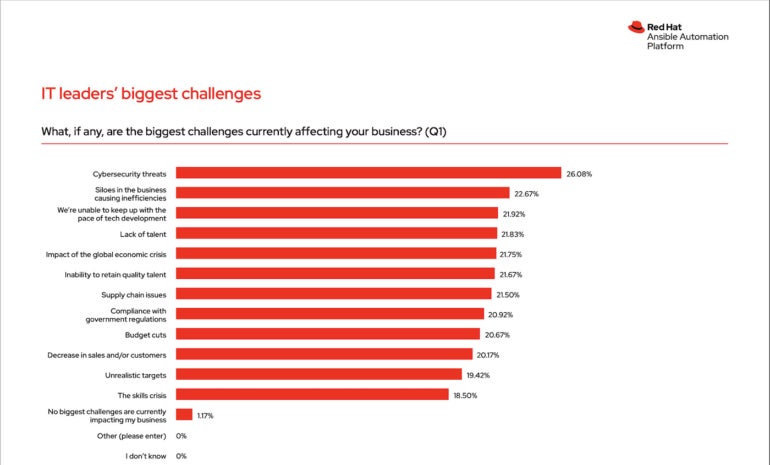
Across all IT leaders in the U.K., France, Germany and Spain, the biggest challenges facing businesses are cybersecurity threats (26%), inefficiencies caused by departmental IT siloes (23%) and keeping up with the pace of technical development (22%), according to Red Hat’s survey (Figure C.)

A lack of talent (22%) and an inability to retain quality talent (22%) were ranked as the fourth and sixth biggest challenges cited by IT leaders, respectively.

Henshall said: “The big challenge we see affecting organizations at the moment is the skills shortage. There is a lack of the knowledge businesses need to grow in a period of rapid tech evolution. At our 2023 Red Hat Summit, ‘people’ were the basis of 95% of the conversations taking place: Where do I find the right people? How do I upskill them within my organization? And how do I motivate wider teams to embrace change?”

Figure C

IT leaders say cybersecurity, departmental silos and the pace of innovation are the main challenges facing their businesses today.
IT leaders say cybersecurity, departmental silos and the pace of innovation are the main challenges facing their businesses today. Image: Red Hat

Top challenges per job title

The top challenges cited by respondents also varied according to their role within the organization. These include:

  • IT manager: Cybersecurity threats (28%).
  • IT director: Lack of talent, cybersecurity, departmental silos (25%).
  • CTO: Cybersecurity threats (28%).
  • CIO: Budget cuts (30%).

Resistance to automation can be solved with proper change management

Red Hat’s report indicated that IT leaders feel employees are hesitant to adapt with the times, even as businesses are facing skills shortages.

When quizzed on their teams’ openness to adopting new technologies or processes, 92% of IT managers suggested employees are reluctant to change. Driving factors for this perceived reluctance include a lack of time to implement automation (45%), feeling overwhelmed by overly complex or technical changes (40%), and the idea that teams “would rather do their own thing and don’t want to be told what processes or technology to use” (39%).

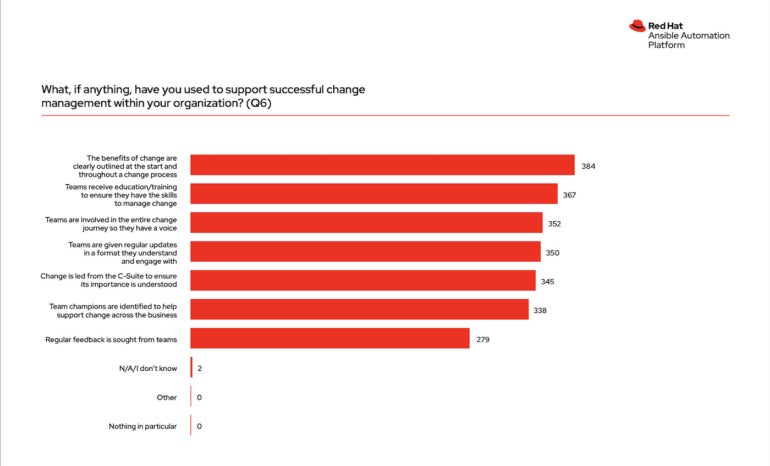
When asked about best practices for effective change management (Figure D), IT leaders cited the need to clearly outline the benefits of change throughout a change process (32%), giving teams relevant education and skills training (31%) and involving teams in the entire change journey (29%).

Figure D

Best practices for successful change management, according to IT leaders.
Best practices for successful change management, according to IT leaders. Image: Red Hat

SEE: 5 Best Change Management Software of 2023 (TechRepublic)

“Automation should be a collaborative and agile movement; people need to be enabled and motivated from the start and continuously engaged,” Henshall said in a press release. “And when you enable people to use AI, big data and the cloud in a meaningful way, their sense of purpose and pride increases — it fuels a virtuous cycle.”

Mastering data management: Efficient strategies for success

Document management system concept, business man holding folder

Effective data management is critical to any organization’s success in today’s data-driven world. With the exponential growth of data, businesses need to implement robust strategies to collect, store, process, and utilize data efficiently. In this blog, we will explore the best data management strategies to help your organization harness the power of data for informed decision-making, improved customer experiences, and competitive advantage.

Defining clear data objectives for effective data management

Embarking on your data management journey requires a solid foundation, so commence by establishing clear data objectives. First and foremost, inquire about the outcomes you seek to attain through your data endeavors. Precision is key—whether your focus is on refining customer insights, streamlining operations, or elevating product development. Armed with these well-defined objectives, you can strategically shape your data management initiatives to systematically gather and oversee the most pertinent and invaluable data.

Ensuring data governance and quality in data management strategies

“Data governance involves establishing policies, procedures, and practices for data management. Additionally, it ensures data accuracy, consistency, and security. To maintain high data quality, consider implementing the following strategies in detail: data quality management.”

a. Data validation and verification: Start by implementing automated checks to ensure data accuracy, such as data type validation, range checks, and referential integrity constraints.

b. Data cleansing: In addition, regularly clean and standardize data. This involves removing duplicate or outdated records, correcting errors, and aligning formats.

c. Data classification: Furthermore, categorize data based on importance, sensitivity, and regulatory requirements. This step is crucial for setting access controls and implementing security measures accordingly.

Data security

Data breaches, with their potential for financial loss and reputational damage, underscore the importance of prioritizing data security. To delve into the intricacies of safeguarding data, consider the following strategies:

a. Encryption: Use encryption methods like AES to safeguard data at rest and in transit. Employ strong encryption algorithms and key management practices.

b. Access control: Prioritize role-based access control to restrict users’ access to data based on their roles. Regularly review and adjust permissions to maintain a secure environment.

c. Regular audits: Enhance security measures by conducting periodic security audits and penetration testing. This proactive approach helps identify vulnerabilities, assess risks, and facilitate prompt corrective actions.

Selecting the right tools for efficient data management

Selecting the right data management tools is crucial. The choice largely depends on your data’s nature and volume. Delve into the details of data storage solutions:

a. Relational databases: Ideal for structured data and transactional processing, relational databases like MySQL and PostgreSQL offer data consistency and integrity.

b. NoSQL databases: NoSQL databases like MongoDB and Cassandra provide scalability and flexibility when dealing with unstructured or semi-structured data.

c. Cloud storage: Cloud-based solutions like Amazon S3, Google Cloud Storage, and Azure Blob Storage offer scalable, cost-effective options for businesses of all sizes.

Data integration

In many organizations, data is distributed across various systems and formats. Data integration is the process of combining data from diverse sources into a unified view. Dive into the intricacies of data integration with these strategies:

a. ETL (Extract, Transform, Load) processes: Create ETL pipelines to extract data from source systems, transform it, and load it into a target system.

b. Data warehouses: Implement data warehousing solutions like Amazon Redshift, Snowflake, or Google BigQuery to store data in a central repository for analysis.

c. API integration: Use APIs to connect different systems, enabling seamless data flow and real-time updates.

Data backup and recovery

Data loss can be disastrous. Implement a comprehensive backup and recovery strategy, paying attention to the following details:

a. Regular backups: Schedule automatic backups of your data, taking incremental backups to minimize data loss in case of failures.

b. Redundancy: Store data in multiple locations, utilizing redundancy to ensure data is always accessible.

c. Disaster recovery plan: Develop a detailed plan to recover data in emergencies, including the process for restoration and how to maintain business continuity.

Data lifecycle management

Not all data is equally valuable or relevant. Implementing data lifecycle management helps you prioritize data based on its importance and use. Explore the stages of data lifecycle management in detail:

a. Data creation and collection: Identify sources and methods of data collection, ensuring data is tagged with relevant metadata from the outset.

b. Data storage and access: Define data storage solutions and access methods, applying security and privacy measures as required.

c. Data archiving: Set up archiving processes to move less frequently used data to cost-effective storage solutions while maintaining accessibility.

d. Data deletion: Establish policies and procedures for data deletion, considering regulatory requirements and compliance.

Data documentation and metadata

Comprehensive documentation and metadata management are vital components of data management. Moreover, metadata provides valuable context and information about your data, making it easier to understand and use. It is crucial to pay attention to these details in data documentation:

a. Regarding metadata structure, it is essential to develop a standardized format that includes details such as data source, format, creation date, update history, and usage instructions.

b. Additionally, focusing on data lineage is crucial. It involves tracking the origin and journey of data through various systems and processes, ensuring transparency and accountability.

Data privacy and compliance

In an era of strict data regulations like GDPR, CCPA, and HIPAA, prioritizing data privacy and compliance is non-negotiable. Delve into the complexities of data privacy with these strategies:

a. Data classification: Identify and label sensitive data, clearly defining how it should be handled and protected.

b. Consent management: Implement robust systems for obtaining and managing user consent for data processing, ensuring compliance with data privacy regulations.

c. Compliance audits: Regularly assess your data management processes for compliance, conducting internal and external audits to identify and address potential issues.

Data analytics and reporting

Data management isn’t solely about storing and securing data; instead, it’s also about deriving insights from it. To delve into the detailed aspects of data analytics and reporting, consider the following strategies:

a. Data analytics tools: First and foremost, carefully choose the right tools and platforms that best fit your data and business needs. This could range from traditional business intelligence tools to advanced machine learning models.

b. Data visualization: Once you have your data in place, focus on developing intuitive data visualization dashboards and reports. These visual aids present insights in a digestible format for decision-makers.

c. Data-driven decision-making: Finally, foster a culture of data-driven decision-making within your organization. This ensures that data insights have a tangible impact on strategic choices.

Conclusion

Effective data management is a cornerstone of success in today’s business landscape. Firstly, by defining clear objectives, you can establish a solid foundation for your data strategy. Additionally, establishing robust data governance ensures accountability and smooth processes. Moreover, by prioritizing data security, you safeguard sensitive information from potential threats.

Selecting the right storage solutions is another crucial step in this journey. Furthermore, integrating data across various platforms enhances accessibility and usability. Simultaneously, following best practices in backup, recovery, and data lifecycle management ensures continuity and efficiency in your operations.

And let’s not overlook the importance of data documentation, privacy, and compliance. These aspects serve as vital safeguards and guidelines in the handling of your data. Furthermore, leveraging data analytics and reporting becomes essential to gain valuable insights into your business landscape.

By implementing these comprehensive strategies, you’ll be well-equipped to make informed decisions, optimize operations, and stay ahead of the competition in the data-driven world.

YouTube adapts its policies for the coming surge of AI videos

YouTube adapts its policies for the coming surge of AI videos Sarah Perez @sarahintampa / 16 hours

YouTube today announced how it will approach handling AI-created content on its platform with a range of new policies surrounding responsible disclosure as well as new tools for requesting the removal of deepfakes, among other things. The company says that, although it already has policies that prohibit manipulated media, AI necessitated the creation of new policies because of its potential to mislead viewers if they don’t know the video has been “altered or synthetically created.”

One of the changes that will roll out involves the creation of new disclosure requirements for YouTube creators. Now, they’ll have to disclose when they’ve created altered or synthetic content that appears realistic, including videos made with AI tools. For instance, this disclosure would be used if a creator uploads a video that appears to depict a real-world event that never happened, or shows someone saying something they never said or doing something they never did.

Image Credits: YouTube

It’s worth pointing out that this disclosure is limited to content that “appears realistic,” and is not a blanket disclosure requirement on all synthetic video made via AI.

“We want viewers to have context when they’re viewing realistic content, including when AI tools or other synthetic alterations have been used to generate it,” YouTube spokesperson Jack Malon told TechCrunch. “This is especially important when content discusses sensitive topics, like elections or ongoing conflicts,” he noted.

Image Credits: YouTube

AI-generated content is an area YouTube itself is dabbling in, in fact. The company announced in September it was preparing to launch a new generative AI feature called Dream Screen early next year that would allow YouTube users to create an AI-generated video or image background by typing in what they want to see. All of YouTube’s generative AI products and features will be automatically labeled as altered or synthetic, we’re told.

Image Credits: YouTube

The company also warns that creators who don’t properly disclose their use of AI consistently will be subject to “content removal, suspension from the YouTube Partner Program, or other penalties.” YouTube says it will work with creators to make sure they understand the requirements before they go live. But it notes that some AI content, even if labeled, may be removed if it’s used to show “realistic violence” if the goal is to shock or disgust viewers. That seems to be a timely consideration, given that deepfakes have already been used to confuse people about the Israel-Hamas war.

YouTube’s warning of punitive action, however, follows a recent softening of its strike policy. In late August, the company announced it was giving creators new ways to wipe out their warnings before they turn into strikes that could result in the removal of their channel. The changes could allow creators to get away with carefully disregarding YouTube’s rules by timing when they would post violative content — as they can now complete an educational course to have their warnings removed. For someone determined to post unapproved content, they now know they can take that risk without losing their channel entirely.

If YouTube takes a softer stance on AI by also allowing creators to make “mistakes,” and then return to post more videos, the damage in terms of the spread of misinformation could become a problem. The company also isn’t clear on how “consistently” its AI disclosure rules would have to be broken before it takes punitive actions.

Other changes include the ability for any YouTube user to request the removal of AI-generated or other synthetic or altered content that simulates an identifiable individual — aka a deepfake — including their face or voice. But, the company clarifies that not all flagged content will be removed, making room for parody or satire. It also says that it will consider whether or not the person requesting the removal can be uniquely identified or whether the video features a public official or other well-known individual, in which case “there may be a higher bar,” YouTube says.

Alongside the deepfake request removal tool, the company is introducing a new ability that will allow music partners to request the removal of AI-generated music that mimics an artist’s singing or rapping voice. YouTube said it was developing a system that would eventually compensate artists and rightsholders for AI music, so this seems an intermediary step that would simply allow content takedowns in the meantime. YouTube will make some considerations here as well, noting that content that’s the subject of news reporting, analysis or critique of the synthetic vocals may be allowed to remain online. The content takedown system will also only be available to labels and distributors representing artists participating in YouTube’s AI experiments.

AI is being used in other areas of YouTube’s business, including by augmenting the work of its 20,000 content reviewers worldwide, and identifying new ways abuse and threats emerge, the announcement notes. The company says that it understands bad actors will try to skirt its rules and it will evolve its protections and policies based on user feedback.

“We’re still at the beginning of our journey to unlock new forms of innovation and creativity on YouTube with generative AI. We’re tremendously excited about the potential of this technology, and know that what comes next will reverberate across the creative industries for years to come,” reads the YouTube blog post, jointly penned by VPs of Product Management Jennifer Flannery O’Connor and Emily Moxley. “We’re taking the time to balance these benefits with ensuring the continued safety of our community at this pivotal moment—and we’ll work hand-in-hand with creators, artists and others across the creative industries to build a future that benefits us all.”

Future-proofing advanced data warehouses

Futuristic Technology Retail Warehouse: Digitalization and Visua

Introduction

Data warehouses are the linchpins of modern data infrastructure, integral for businesses that rely on informed decision-making. They act as centralized repositories where diverse data from various sources is collated, transformed, and stored for analysis and reporting. In essence, a data warehouse is a structured data haven designed for query and analysis, providing crucial support for business intelligence activities.

The significance of data warehouses

At their core, data warehouses facilitate the storage and management of large volumes of data, enabling complex queries and analyses that drive strategic business insights. By harmonizing disparate data types into a single, coherent framework, they offer a unified view that is instrumental for organizations to discern patterns, trends, and opportunities that would otherwise remain obscured in the maze of raw data.

Embracing futureproofing in data warehouse architecture

Futureproofing in the context of data warehouse architecture refers to the strategic foresight and planning involved in building data warehouses that can withstand the test of time and technology. This involves embracing architectural principles and technologies that ensure the data warehouse remains functional, efficient, and relevant in the face of evolving data formats, growing data volumes, and emerging business needs. It’s about creating a foundation that is not only robust today but is also adaptable and scalable for the uncertainties of tomorrow.

Understanding the core components of data warehouses

Essential components: Storage, computation, and data organization

At the heart of a data warehouse’s architecture are three pivotal components: storage, computation, and data organization. Storage is the bedrock, providing the space to house large volumes of structured and, increasingly, semi-structured or unstructured data. It’s not just about capacity but also about the efficiency of data retrieval and write operations, which are heavily influenced by the underlying file formats, such as Avro, Parquet, or ORC, known for their optimization in big data ecosystems.

Computation represents the processing muscle of the data warehouse. It’s the component responsible for executing complex queries, running analytical models, and generating reports. In modern data warehouse, computation often leverages distributed computing principles, where tasks are parallelized across multiple nodes to enhance performance and reduce latency.

Data organization pertains to the structuring of data within the warehouse. It encompasses schema design, indexing, partitioning, and data modeling practices, all crucial for ensuring data is logically organized, accessible, and primed for efficient query execution.

The role of metadata in enhancing data retrieval and analysis

Metadata, or data about data, plays an indispensable role in a data warehouse’s ecosystem. It includes details such as the source, structure, and lineage of the data, along with access policies and data dictionary definitions. By offering a contextual blueprint of the stored data, metadata empowers users to navigate vast data lakes effectively, aids in the enforcement of data governance protocols, and enhances the overall efficiency of data retrieval and analysis. In a landscape where data is king, metadata serves as the map and compass, guiding users to insightful discoveries and informed decisions.

Architectural design principles for scalability and flexibility

Highlight the importance of scalability and flexibility in the design of data warehouses

Scalability and flexibility are cornerstone principles in data warehouse design, vital for accommodating evolving data volumes and business needs. Scalability ensures that the data warehouse can handle growth seamlessly, whether it’s an increase in data volume, user load, or query complexity. Flexibility allows the architecture to adapt to new data sources, formats, and technologies, ensuring the warehouse remains relevant and efficient in a dynamic data landscape.

Best practices for ensuring scalability and flexibility

To achieve scalability, embracing a modular design is crucial, allowing components to scale independently as demands fluctuate. Furthermore, the utilization of scalable file formats like Parquet or ORC is paramount. These formats are optimized for big data scenarios, supporting efficient compression and encoding schemes that boost performance. They also facilitate schema evolution without necessitating a complete overhaul, making them ideal for future-proofing data warehouse architectures.

The role of data governance in longevity

The need for robust data governance policies

Robust data governance policies are the backbone of a data warehouse’s longevity. They ensure that the warehouse operates not only efficiently but also responsibly. Good governance policies establish clear protocols for data access, quality, and lifecycle management. They are essential for maintaining a trusted and reliable repository, as they set the standards and practices for data handling, ensuring consistency, accuracy, and reliability in the information stored and analyzed.

Impact of governance on data integrity, security, and compliance

Data governance directly impacts data integrity by enforcing quality control measures that prevent corruption and maintain the accuracy of the data. In terms of security, governance policies define who can access what data and under which circumstances, safeguarding sensitive information. Compliance is another critical aspect, as governance ensures that data storage and processing adhere to relevant laws and regulations. This comprehensive approach fortifies the data warehouse against risks and reinforces its integrity and trustworthiness.

Integrating advanced technologies for enhanced performance

Showcase how cutting-edge technologies enhance the performance of data warehouses

To bolster performance, contemporary data warehouses integrate sophisticated technologies like in-memory databases and columnar storage. In-memory databases accelerate data processing by storing data in RAM rather than on disk, drastically reducing access times. Columnar storage, on the other hand, stores data tables by columns rather than rows, streamlining both compression and query performance. This arrangement is particularly beneficial for analytics, where operations often involve a subset of columns, thus enabling faster retrieval and aggregation.

Optimizing query performance and storage efficiency

These technologies, combined with advanced data compression techniques, significantly enhance query performance and storage efficiency. In-memory databases allow for real-time analytics and quicker insights by sidestepping the latency inherent in disk-based storage. Columnar storage minimizes I/O operations and maximizes the efficacy of compression algorithms since column values often share high data similarity. Advanced compression techniques further reduce the storage footprint and bandwidth requirements for data transfer. Together, these technologies transform the data warehouse into a high-performance engine, capable of delivering insights with unprecedented speed and efficiency.

Anticipating and adapting to evolving data trends

Staying ahead of emerging data trends and technologies

In the realm of data engineering, stagnation is tantamount to regression. Keeping abreast with emerging data trends and technologies is essential for maintaining a competitive edge. Advancements in artificial intelligence, real-time analytics, and the Internet of Things (IoT) are continuously reshaping the landscape, expanding the frontiers of what’s possible within data warehousing. Being vigilant and responsive to these shifts ensures that a data warehouse remains a potent tool for insight generation, rather than becoming a relic of bygone data practices.

Designing data warehouses for adaptability

To design data warehouses with adaptability in mind, architects should embrace a forward-looking approach, anticipating changes in data volume, variety, and velocity. This entails adopting flexible data models, scalable infrastructure, and an extensible architecture that can integrate emerging technologies without major overhauls. Leveraging cloud-based solutions and services can also enhance adaptability, offering scalable resources and cutting-edge capabilities on demand. Ultimately, an adaptable data warehouse is one that evolves in tandem with the data it houses and the technologies that shape its landscape.

Case studies of successful future-proof data warehouses

Explore real-world examples of organizations implementing successful data warehouses

One noteworthy example is Netflix, which has built a highly scalable and flexible data warehouse on top of Amazon S3, utilizing a combination of technologies like Apache Kafka for real-time data ingestion and Apache Parquet for optimized storage. This infrastructure allows Netflix to handle petabytes of data, supporting personalized content recommendations for millions of users worldwide.

Similarly, Airbnb has created a future-proof data environment using a combination of open-source and proprietary tools. Their data warehouse leverages Druid for real-time exploratory analytics and Airflow for workflow management, ensuring adaptability and scalability to handle their vast and varied data.

Strategies and technologies used

Both Netflix and Airbnb emphasized modularity in their architecture, allowing individual components to evolve independently. They also embraced the cloud for its scalability and elasticity. Employing technologies like Kafka and Parquet facilitated efficient data processing and storage, while tools like Druid and Airflow enhanced their ability to analyze and manage workflows. These companies demonstrate that a successful, future-proof data warehouse relies not just on the right technologies, but on a strategic vision that anticipates change and fosters an environment of continuous adaptation and improvement.

Conclusion

In conclusion, the journey to crafting future-proof foundations for advanced data warehouses is multifaceted. It involves a deep understanding of core components like storage, computation, and data organization, coupled with a strategic emphasis on scalability, flexibility, and robust data governance. Integrating advanced technologies such as in-memory databases, columnar storage, and data compression is pivotal for enhanced performance. Staying agile and responsive to evolving data trends ensures the warehouse remains relevant and powerful. Real-world cases like Netflix and Airbnb exemplify the successful application of these principles. Ultimately, designing a data warehouse to withstand the test of time and technology is not just a technical endeavor, but a strategic one, requiring foresight, adaptability, and a commitment to continuous evolution.

Machine learning in marketing: 10 use cases and implementation tips

Machine learning

Given how quickly the digital marketing industry changes, keeping up with the most recent trends and technologies can be challenging. Traditional marketing techniques are no longer enough to connect with and engage your target audience.

Machine learning in marketing has got your back.

Check out the top 10 use cases and implementation pointers that offer useful advice for utilizing machine learning to boost ROI, tailor consumer experiences, and optimize marketing strategies.

Benefits of machine learning in marketing

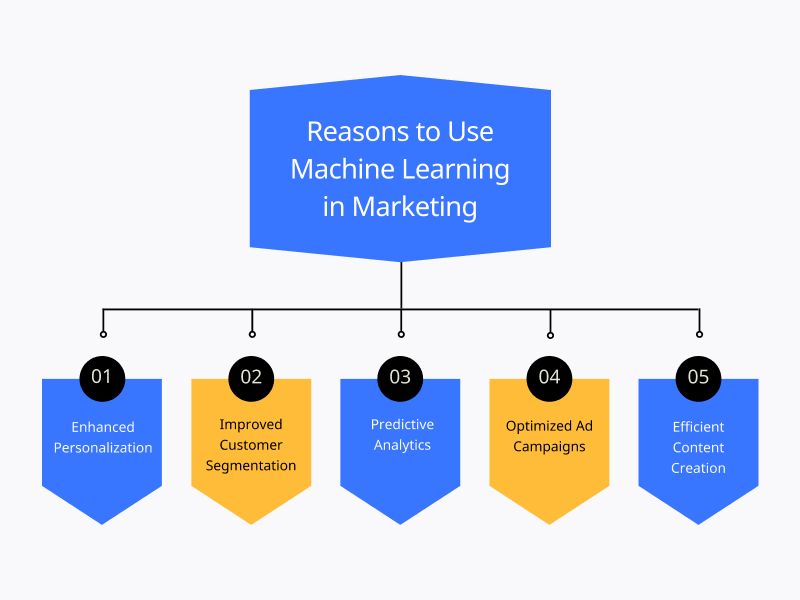
Machine learning has completely changed the marketing industry by enabling companies to develop more successful and individualized marketing strategies through various benefits. Let’s examine the benefits in detail:

Machine learning in marketing: 10 use cases and implementation tips
  • Enhanced personalization: By analyzing large client data using machine learning algorithms, marketing messages, and content can be tailored to individual preferences. Higher customer engagement, higher conversion rates, and greater customer loyalty result from improved personalization. Businesses may give information and offers that resonate with consumers by understanding their unique tastes and behaviors, making their interactions more meaningful and pertinent.
  • Improved customer segmentation: Customer segmentation using different criteria is a strength of machine learning, enabling more accurate targeting. By ensuring that marketing efforts are targeted at the appropriate consumers, improved customer segmentation improves the efficiency of resource allocation and campaign execution. Businesses can design highly targeted advertisements that appeal to particular categories by classifying clients based on demographics, actions, and interests.
  • Predictive analytics: Based on historical data, machine learning models can predict future trends and consumer behaviors. Businesses can use predictive analytics to plan marketing tactics, spot prospective business possibilities, and reduce risks. Businesses may make data-driven decisions that provide better results by utilizing machine learning to predict customer attrition, demand changes, and new market trends.
  • Optimized ad campaigns: Marketers can fine-tune their advertising campaigns using machine learning algorithms to scan large datasets and detect patterns and trends. As a result, campaigns are created that are timed to reach the correct audience with the right message effectively. As a result, companies should anticipate seeing better returns on their advertising investments (ROI) and increased conversion rates.
  • Efficient content creation: Natural language processing (NLP) models are one example of a machine learning-powered technology that may produce content with astounding accuracy. These solutions help mass-produce high-quality, pertinent content, such as product descriptions and blog entries. This saves time and guarantees that brand messaging is consistent across all mediums.

Machine learning in marketing use cases

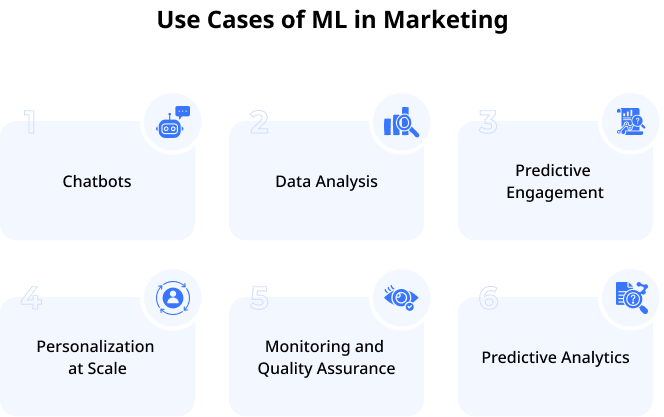
Although machine learning has numerous use cases, the following are the top machine learning in marketing use cases:

Machine learning in marketing: 10 use cases and implementation tips
  1. Chatbots

Most people have come into close contact with machine learning through chatbots at work. These software applications, suitably named, use machine learning and natural language processing (NLP) to mimic human speech. They follow predetermined scripts to interact with people and respond to their inquiries by consulting company databases to offer clarifications.

Early chatbot generations operated according to pre-written rules that directed their behavior in response to keywords. To be more attentive to a user’s demands, more accurate in their responses, and ultimately more humanlike in their interaction, ML enables chatbots to be more engaging and productive.

The chatbots that serve as the first point of contact for most consumer call centers nowadays, including Apple’s Siri and Amazon’s Alexa, are common examples of chatbots.

  1. Data analysis

It takes more than just staring at a computer screen and waiting for connections to appear to be able to analyze data. The data needs to be prepared beforehand. It must be appropriately formatted, accurately accurate, and organized.

When preparing data for analysis, humans are prone to making mistakes. The information is retrieved from the system of record, “cleaned” following a set of standards to assure accuracy, and formatted appropriately by a machine that doesn’t make mistakes.

Machines also analyze more data than people and do it more quickly. One human can only process so much information simultaneously; machines are not limited in this way. With AI in marketing, machines can now analyze unstructured data, including photographs, videos, audio, social media posts, and other types of information.

  1. Predictive engagement

Machine learning determines a customer’s identity, where they are in the customer journey, and what actions a marketer can take to assist them in moving on to the next stage. Predictive engagement is when machine learning can tell you the next steps. Analytics and personalized marketing are more closely related than analytics and predictive engagement.

Here’s one example of how predictive analytics may be used: you’ve just begun looking into HR software. Predictive engagement wouldn’t send you a testimonial because you’re just beginning your adventure, and that’s not what you’re interested in. A free demo, which a predictive engagement solution is aware of and offers to you, would really help.

  1. Personalization at scale

Personalization automation may seem like an oxymoron, but AI in marketing can improve personalization’s effectiveness and efficiency. A computer learns the preferences of its users through machine learning and then adjusts its offers accordingly.

For example, Margo frequents the neighborhood Thai eatery religiously. Margo prefers the shrimp pad, Thai, though she may occasionally try something new. She indicates her preference for the restaurant’s AI-enabled marketing program, which then sends her a voucher for the dish.

  1. Monitoring and quality assurance

According to Nicolas Avila, CTO for North America at IT services provider Globant, machine learning is beneficial for monitoring needs and quality assurance due to its capacity to recognize and discern patterns in data at a size, pace, and level unmatched by humans.

He gave the use of machine learning to monitor supply chain operations as an illustration, pointing out that the technology continuously analyzes patterns to discover anything that deviates from usual parameters and, thus, may suggest a problem to be addressed.

Neural networks, deep learning, and computer vision are some examples of ML technology types that can be used to more effectively and efficiently monitor manufacturing lines and other workplace outputs to guarantee that products match defined quality requirements.

  1. Predictive analytics

The first step to better knowing your customers is being able to analyze data. But what if you knew what your clients would do next?

Predictive analytics can help with it. The possibility of a client adopting a specific action is displayed through predictive analytics. Consider Matt buying a piece of software for his workplace. The marketing division of the software provider predicts that he will purchase a complete tech assistance package the following year using predictive analytics.

Machine learning in marketing implementation

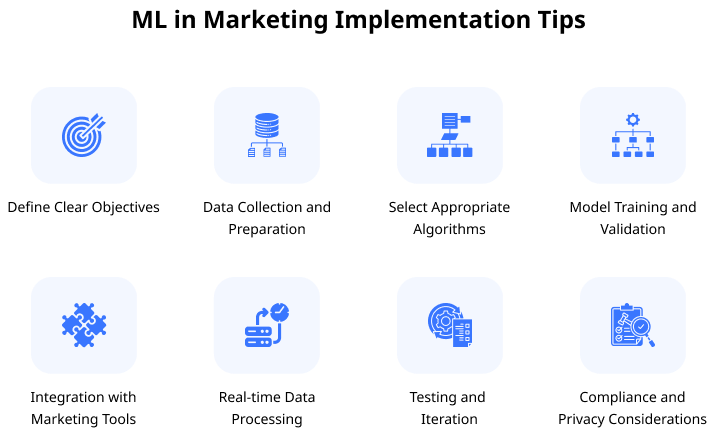
Marketing strategies must methodically include machine learning to realize its full potential. The following essential actions will help you use machine learning in marketing efforts:

Machine learning in marketing: 10 use cases and implementation tips
  1. Define clear objectives

Setting up clear, precise objectives is essential before beginning the implementation phase. Clearly stated objectives direct the implementation process, whether for bettering consumer segmentation, optimizing ad campaign performance, or anticipating customer behavior.

  1. Data collection and preparation

Any effective machine learning model is built on top-notch data. Collect pertinent information from various sources, ensuring it’s accurate, comprehensive, and reflective of your target market. To get the data ready for analysis, it may be necessary to clean, transform, and normalize it.

  1. Select appropriate algorithms

Select the appropriate machine-learning methods based on your clearly defined objectives and the characteristics of your data. For example, regression models can be utilized for predictive analytics, while classification algorithms are suitable for customer segmentation. Try out various algorithms to see which one provides the best fit.

  1. Model training and validation

You should use a piece of the obtained data to train your machine-learning models and save another amount for validation. This enables you to evaluate the model’s effectiveness and make the required corrections. The model’s ability to generalize to fresh data is ensured through cross-validation.

  1. Integration with marketing tools

Machine Learning models must be integrated with current marketing platforms and tools for smooth functioning. This ensures that the systems used for customer relationship management (CRM), email marketing, ad platforms, and analytics tools are compatible. It allows for scaled-up individualized interactions and automated decision-making.

  1. Real-time data processing

Real-time data are essential for machine learning to succeed. Implementing systems that allow for quick data ingestion, processing, and analysis is crucial. Setting up data pipelines, using cloud services, and implementing stream processing technologies are required. The ability to make quick, data-driven decisions for campaign optimization and customer interaction is provided by real-time insights for marketers.

  1. Testing and iteration

Using machine learning in marketing requires a process of iteration. Starting with small-scale experiments and tests is crucial to fine-tune algorithms and models. This makes it possible for marketers to comprehend how ML affects important metrics and how it may be tweaked for better outcomes. Marketers can improve their ML-powered tactics and realize even greater potential by consistently testing and iterating.

  1. Compliance and privacy considerations

When utilizing machine learning in marketing, it’s critical to put user privacy and data protection compliance first. Marketers need to ensure that the data used in ML models is gathered and handled ethically and openly.

It is crucial to have strong data security safeguards in place and get users’ informed consent. Compliance protects companies from legal ramifications while fostering customer trust, boosting ML-driven marketing initiatives’ success.

Final thoughts

As you can see, machine learning for marketing analytics is essential in helping marketers and enhancing speed and accuracy that was previously unachievable. The requirement to quickly gather, accurately segment, and instantly translate disparate data into meaningful insights makes custom ML systems challenging to develop. Still, they can also help businesses earn more money.

Please go for professional machine learning development services if you want to use them in your business. With end-to-end machine learning marketing automation and, in particular, the creation of unique ML-based solutions, they can give you access to professionals who delve deeply into your company processes and make them more effective than before.

Everything you need to become a SAS Certified Machine Learning Engineer

Sponsored Content

Everything you need to become a SAS Certified Machine Learning Engineer

Machine Learning Engineer job postings have grown 31% in one year, 71% in two years, and have more than tripled in five years.* There’s never been a better time to launch or advance your machine learning career by earning a SAS Certification and exploring resources. Read on to find out everything you need to become a SAS Certified Machine Learning Engineer.

The first step on your journey to becoming an expert in machine learning is choosing which certification is right for you. Here’s a quick overview of what SAS offers:

SAS Certified Specialist: Machine Learning : Demonstrate your expertise in techniques associated with supervised machine learning models such as gradient boosting, forests, neural networks, and more. This certification also assesses your understanding of data exploration, data preprocessing, feature selection, model training and validation, model assessment, and scoring in SAS using Model Studio.

SAS Certified Specialist: Forecasting and Optimization: Master these skills to earn this certification: data visualization, pipeline modeling, hierarchical forecasting, post-forecasting functionality, optimization Test your knowledge of time series forecasting and optimization methods using a mix of code and no-code in SAS.

SAS Certified Specialist: Natural Language Processing and Computer Vision: Learn these skills to earn this certification: loading and exploring data, identifying text patterns using natural language processing techniques, and identifying text patterns using computer vision techniques. Prove your prowess in analyzing text data to derive topics, use text information in models, and train deep learning models to work with image data.

These three exams also make up the Certified AI & Machine Learning Professional. If you go above and beyond and earn all three, you’ll be considered an AI & Machine Learning Professional.

SAS Digital Content Subscriptions to give you the skills you need

Want to have access to SAS training tailor-made for you? Curated by industry experts, choose which machine learning path fits your needs best. Our learning paths include one-year access to all the courses in one place that you need to earn multiple certifications, including certification prep resources. Try it out with a 7-day free trial.

  • SAS Predictive Analytics and Machine Learning Subscription
  • SAS Advanced Machine Learning Subscription
  • SAS AI and Machine Learning Professional Subscription

Resources to Prepare for Your Exam

  • Exam Prep Resources
  • Free Practice Exams
  • Explore more SAS Certifications and the SAS Global Certification Program

Why Get SAS Certified? If you’re still on the fence about whether you should earn a SAS certification, learn how this qualification can enhance your professional career and see how other like-minded individuals put their certification to work for them.

Get SAS Certified: $99 SAS Certification Exams through December 15th*.

After you’ve worked hard, it’s time to validate your skills by taking a certification exam. Right now, SAS certification exams are $99*. Put your personal and professional goals first and take advantage of this offer.

*Associate level exams will be discounted to $66 USD and SAS Predictive Modeler exam will be discounted to $137.50USD.

*Data from Lightcast, 2023.

More On This Topic

  • Everything you Need to Become a SAS Certified Data Scientist
  • 9 Skills You Need to Become a Data Engineer
  • Essential Books You Need to Become a Data Engineer
  • ModelOps: What you need to know to get certified
  • Naïve Bayes Algorithm: Everything You Need to Know
  • Everything You Need to Know About Tensors