Ready to sign up for ChatGPT Plus? Join the club (er, waitlist)

ChatGPT Plus waitlist

Instead of signing up for ChatGPT Plus, users can sign up for a waitlist to be notified when subscriptions reopen.

OpenAI is pausing the ability for users to sign up for new ChatGPT Plus subscriptions after a sudden surge in demand in recent days. Anyone looking to sign up for a new ChatGPT Plus subscription has to sign up for a waitlist and wait to be notified when subscriptions reopen.

"The surge in usage post DevDay has exceeded our capacity and we want to make sure everyone has a great experience," Sam Altman, OpenAI CEO posted on X, formerly Twitter.

Also: I used this famous photographer's AI bot to critique my photo, and the results were wild

OpenAI held its first developers' conference earlier this month, almost a year since the launch of ChatGPT. During DevDay, Sam Altman announced new features for the AI chatbot, particularly when used within the ChatGPT Plus subscription.

During DevDay, OpenAI announced the ability to create custom bots through GPT-4, capable of being trained on specific data to perform personalized tasks. ChatGPT will also get a boost through GPT-4 Turbo, a more powerful version of its model and one with double the amount of context, at 128k.

Also: OpenAI aiming to create AI as smart as humans, helped by funds from Microsoft

The new features have gained a lot of attention from existing and new users, particularly the ability to create custom GPTs. The custom GPTs are plentiful and varied, including one from Canva, some for therapy like TherapistGPT, Tweet enhancers for X, book creators, SEO, ones to critique photos, QR code creators, and even some to create birthday cakes.

Additionally, users can now use the multimodal GPT-4 with web browsing capability, image generation through DALL-E 3, and Advanced Data Analysis without having to switch between each feature.

Artificial Intelligence

Ramp taps AI as fintech hunts for growth

Ramp taps AI as fintech hunts for growth

AI can help customers, but can it help the bottom line?

Mary Ann Azevedo 11 hours

An increasing number of fintechs claim to be using artificial intelligence to get ahead. Just how many of them are truly using the technology to improve the experience for their customers, however, is less clear.

In the spend management space in particular, two of the largest players, Ramp and Brex, have been vocal about how they believe AI will transform the way they operate and serve their customers.

Ramp announced on Wednesday a new integration with Copilot, Microsoft’s brand of generative AI technologies. Ramp says its plug-in with Copilot for Microsoft 365 means businesses don’t have to bounce between multiple tools and applications to gather spend insights or set up advanced controls. Microsoft 365 is Redmond’s subscription productivity suite.

“Now they can use natural language to access Ramp’s smart AI assistant from their workspace and get the most advanced work done faster,” said Ramp CEO and co-founder Eric Glyman.

Users will be able to do things like issue new cards directly within Teams or set up and receive real-time alerts on employee transactions.

The company also announced a number of new features around extending Ramp’s capabilities to not just read queries, but also write answers and take the appropriate action, in context, based on the customer’s data.

This includes interacting with Ramp as a conversational agent. For example, according to Glyman, if a manager is chatting with a finance admin about raising the spend limit for their employee’s upcoming travel, the finance admin can tag the Ramp agent into the conversation and ask the bot to raise the spend limit to the specified amount.

Investing more in AI

Both Brex and Ramp claim to have been leveraging AI in various ways for some time.

Brex in particular said it has been using AI since inception across underwriting, fraud, receipt matching and merchant categorization, among other product areas. But it’s dialed up its AI investments over the past year, particularly in customer-facing scenarios.

Unlocking Metrics for Black Box LLMs

Unlocking Metrics for Black Box LLMs November 15, 2023 by Alex Woodie

(sergey kolesnikov/Shutterstock)

AI’s black box problem has been building ever since deep learning models started gaining traction about 10 years ago. But now that we’re in the post-ChatGPT era, the black box fears of 2022 seem quaint to Shayan Mohanty, co-founder and CEO at Watchful, a San Francisco startup hoping to deliver more transparency into how large language models work.

“It’s almost hilarious in hindsight,” Mohanty says. “Because when people were talking about black box AI before, they were just talking about big, complicated models, but they were still writing that code. They were still running it within their four walls. They owned all the data they were training it on.

“But now we’re in this world where it’s like OpenAI is the only one who can touch and feel that model. Anthropic is the only one who can touch and feel their model,” he continues. “As the user of those models, I only have access to an API, and that API allows me to send a prompt, get a response, or send some text and get an embedding. And that’s all I have access to. I can’t actually interpret what the model itself is doing, why it’s doing it.”

That lack of transparency is a problem, from a regulatory perspective but also just from a practical viewpoint. If users don’t have a way to measure whether their prompts to GPT-4 are eliciting worthy responses, then they don’t have a way to improve them.

There is a method to elicit feedback from the LLMs called integrated gradients, which allows users to determine how the input to an LLM impacts the output. “It’s almost like you have a bunch of little knobs,” Mohanty says. “These knobs might represent words in your prompt, for instance…As I tune things up, I see how that changes the response.”

Integrated gradients gives users knobs to tune LLMs (iain hall/Shutterstock)

The problem with integrated gradients is that it’s prohibitively expensive to run. While it might be feasible for large companies to use it on their own LLM, such as Llama-2 from Meta AI, it’s not a practical solution for the many users of vendor solutions, such as OpenAI.

“The problem is that there aren’t just well-defined methods to infer” how an LLM is running, he says. “There aren’t well-defined metrics that you can just look at. There’s no canned solution to any of this. So all of this is going to have to be basically greenfield.”

Greenfielding Blackbox Metrics

Mohanty and his colleagues at Watchful have taken a stab at creating performance metrics for LLMs. After a period of research, they hit upon a new technique that delivers results that are similar to the integrated gradients technique, but without the huge expense and without needing direct access to the model.

“You can apply this approach to GPT-3, GPT-4, GPT-5, Claude–it doesn’t really matter,” he says. “You can plug in any model to this process, and it’s computationally efficient and it predicts really well.”

The company today unveiled two LLM metrics based on that research, including Token Importance Estimation and Model Uncertainty Scoring. Both of the metrics are free and open source.

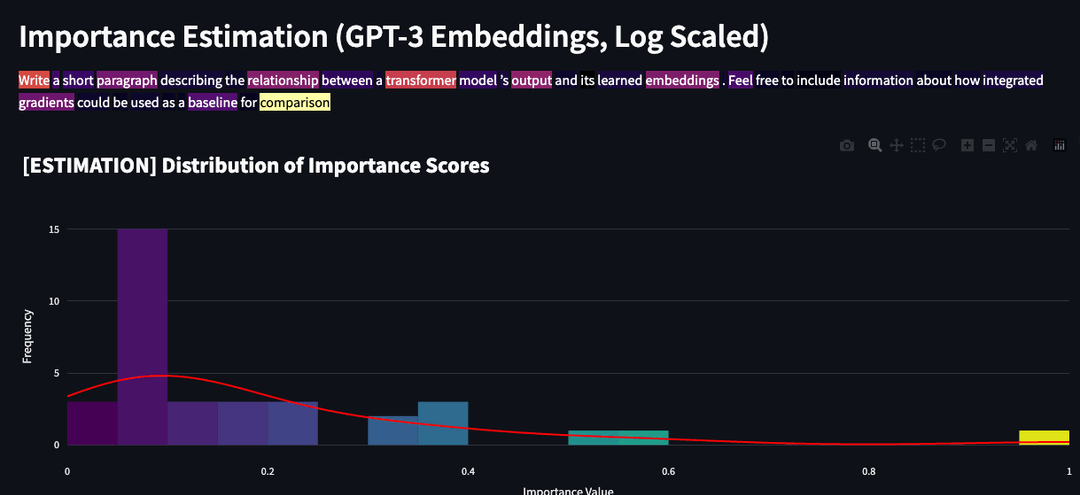
Token Importance Estimation gives AI developers an estimate of token importance within prompts using advanced text embeddings. You can read more about it here. Model Uncertainty Scoring, meanwhile, evaluates the uncertainty of LLM responses, along the lines of conceptual and structural uncertainty. You can read more about it at this link.

Both of the new metrics are based on Watchful’s research into how LLMs interact with the embedding space, or the multi-dimensional area where text inputs are translated into numerical scores, or embeddings, and where the relatively proximity of those scores can be calculated, which is central to how LLMs work.

Watchful’s new Token Importance Estimator tells you which words in your prompt have the biggest impact (Image source: Watchful)

LLMs like GPT-4 are estimated to have 1,500 dimensions in their embedding space, which is simply beyond human comprehension. But Watchful has come up with a way to programmatically poke and prod at its mammoth embedding space through prompts sent via API, in effect gradually exploring how it works.

“What’s happening is that we take the prompt and we just keep changing it in known ways,” Mohanty says. “So for instance, you could drop each token one by one, and you could see, okay, if I drop this word, here’s how it changes the model’s interpretation of the prompt.”

While the embedding space is very large, it’s finite. “You’re just given a prompt, and you can change it in various ways that again, are finite,” Mohanty says. “You just keep re-embedding that, and you see how those numbers change. Then we can calculate statistically, what the model is likely doing based on seeing how changing the prompt affects the model’s interpretation in the embedding space.”

The result of this work is a tool that might show that the very large prompts a customer is sending GPT-4 are not having the desired impact. Perhaps the model is simply ignoring two of the three examples that are included in the prompt, Mohanty says. That could allow the user to immediately reduce the size of the prompt, saving money and providing a timelier response.

Better Feedback for Better AI

It’s all about providing a feedback mechanism that has been missing up to this point, Mohanty says.

“Once someone wrote a prompt, they didn’t really know what they needed to do differently to get a better result,” Mohany says. “Our goal with all this research is just to peel back the layers of the model, allow people to understand what it’s doing, and do it in a model-agnostic way.”

Shayan Mohanty is the CEO and co-Founder of Watchful

The company is releasing the tools as open source as a way to kickstart the movement toward better understanding of LLMs and toward fewer black box question marks. Mohanty would expect other members of the community to take the tools and build on them, such as integrating them with LangChain and other components of the GenAI stack.

“We think it’s the right thing to do,” he says about open sourcing the tools. “We’re not going to arrive at a point very quickly where everyone converges, where these are the metrics that everyone cares about. The only way we get there is by everyone sharing how you’re thinking about this. So we took the first couple of steps, we did this research, we discovered these things. Instead of gating that and only allowing it to be seen by our customers, we think it’s really important that we just put it out there so that other people can build on top of it.”

Eventually, these metrics could form the basis for an enterprise dashboard that would inform customers how their GenAI applications are functioning, sort of like TensorBoard does for TensorFlow. That product would be sold by Watchful. In the meantime, the company is content to share its knowledge and help the community move toward a place where more light can shine on black box AI models.

Editor's note: This article first appeared in Datanami.

Related

About the author: Alex Woodie

Alex Woodie has written about IT as a technology journalist for more than a decade. He brings extensive experience from the IBM midrange marketplace, including topics such as servers, ERP applications, programming, databases, security, high availability, storage, business intelligence, cloud, and mobile enablement. He resides in the San Diego area.

Microsoft Teams AI-powered makeover promises to clean up your messy office

Clean up your messy office with an AI-infused virtual makeover

Do you dread when other people on a video call can see your dirty office or messy living room? A new feature coming to Microsoft Teams will be able to perform a virtual makeover so that your surroundings are more presentable.

At its Ignite 2023 conference on Tuesday, Microsoft unveiled a host of AI-based enhancements for its Teams video conferencing platform.

Also: Microsoft launches two new Copilots, adding AI-guidance for Service and Sales

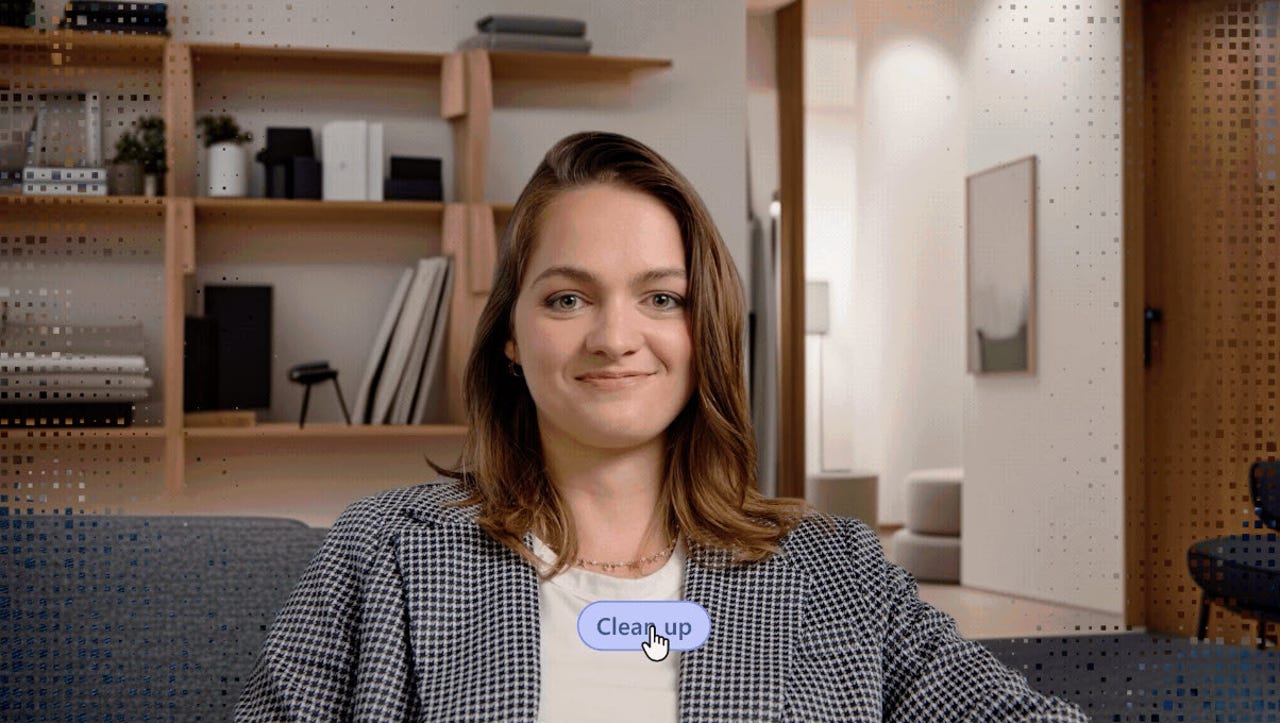
One of the top features on the list is called "Decorate your background." With this new AI-based option, you'll be able to apply generative effects to spruce up your real-world background. You can clean up the clutter or add plants to a wall, convincing people that you're more like Felix Unger than Oscar Madison. This feature will be available early next year to anyone with a Teams Premium license.

Another AI-infused option promises to isolate your voice by learning how you speak. Known simply as "Voice isolation," this feature will be able to recognize your voice and suppress other voices and noises in the background so that your own words come through more clearly. All it takes is a brief enrollment period, says Microsoft, and the AI will know how to identify your speech. Added to Teams Phone and Teams Meetings, the new "Voice isolation" will roll out in early 2024.

Also: Kubernetes made simple? Microsoft adds AI toolchain operator to Azure service

On the Copilot front, Copilot for Teams promises to handle much of the manual labor involved in conducting a virtual meeting. Rather than assign note-taking duties to one of the meeting participants, you can ask Copilot to be your virtual meeting assistant. The AI will be able to take collaborative notes throughout your call and then share them with all the participants. You can also tell Copilot to capture the words from a specific person, and it will serve up a transcription for everyone to see.

Don't want to retain a transcript of the meeting? Copilot can still play a role, allowing you to ask it specific questions and seek out information during the call. After the meeting is over, no transcript and none of the conversations with Copilot will be saved. This feature is typically available for people with a Microsoft 365 Copilot license.

Also: Boosting cybersecurity: Microsoft's AI-driven Security Copilot unveiled at Ignite 2023

A Copilot compose box in the Teams chat and channels will help you write or rewrite a message if you have writer's block. And the Copilot in Microsoft Whiteboard will automatically capture and visualize spoken discussion points during a meeting, save them, and then share them with all participants.

Finally, Copilot will gain an intelligent recap feature for anyone who missed the meeting or wants to review the discussion. The recap will provide a summary of the key points, action items, and decisions so that everyone is up to date. You'll also be able to ask Copilot-specific questions about the meeting.

Most of the Copilot and AI features will pop up in early 2024, while the intelligent recap option will kick off in December of this year.

Also: Azure AI Studio takes the stage at Ignite 2023: Unlock the potential of this AI toolkit

With all the interest in artificial intelligence, Microsoft has been adding AI to its products and services. Trying to capitalize on the trend, the company is actively pushing the name Copilot to define its AI integration across Windows, Office, Teams, Azure, and other offerings for consumers and enterprise customers. With such a push, Microsoft has been keen on transforming AI from a buzzword into an actual business model.

Artificial Intelligence

Martian’s tool automatically switches between LLMs to reduce costs

Martian’s tool automatically switches between LLMs to reduce costs Kyle Wiggers 9 hours

Shriyash Upadhyay and Etan Ginsberg, AI researchers from the University of Pennsylvania, are of the opinion that many large AI companies are sacrificing basic research in pursuit of developing competitive, powerful AI models. The duo blame market dynamics: when companies raise substantial funds, the majority usually goes toward efforts to stay ahead of rivals rather than studying fundamentals.

“During our research on LLMs [at UPenn,] we observed these concerning trends in the AI industry,” Upadhyay and Ginsberg told TechCrunch in an email interview. “The challenge is making AI research profitable.”

Upadhyay and Ginsberg thought that the best way to tackle this might be by founding a company of their own — a company whose products benefit from interpretability. The company’s mission would naturally align with furthering interpretability research rather than capabilities research, they hypothesized, leading to stronger research.

That company, Martian, today emerged from stealth with $9 million in funding from investors including NEA, Prosus Ventures, Carya Venture Partners and General Catalyst. The proceeds are being put toward product development, conducting research into models’ internal operations and growing Martian’s ten-employee team, Upadhyay and Ginsberg say.

Martian’s first product is a “model router,” a tool that takes in a prompt intended for a large language model (LLM) — say GPT-4 — and automatically routes it to the “best” LLM. By default, the model router chooses the LLM with the best uptime, skillset (e.g. math problem solving) and cost-to-performance ratio for the prompt in question.

“The way companies currently use LLMs is to pick a single LLM for each endpoint where they send all their requests to,” Upadhyay and Ginsberg said. “But within a task like creating a website, different models will be better suited to a specific request depending on the context the user specifies (what language, what features, how much they are willing to pay, etc.) … By using a team of models in an application, a company can achieve a higher performance and lower cost than any single LLM could achieve alone.”

There’s truth to that. Relying exclusively on a high-end LLM such as GPT-4 can be cost-prohibitive for some, if not most, companies. The CEO of Permutable.ai, a market intelligence firm, recently revealed it costs the firm over $1 million a year to process around 2 million articles per day using OpenAI’s high-end models.

Not every task needs a pricier models’ horsepower, but it can be difficult to build a system that switches intelligently on the fly. That’s where Martian — and its ability to estimate a model’s performs without actually running it — comes in.

“Martian can route to cheaper models on requests that perform similarly to the most expensive models, and only route to expensive models when necessary,” they added. “The model router indexes new models as they come out, incorporating them into applications with zero friction or manual work needed.”

Now, Martian’s model router isn’t new tech. At least one other startup, Credal, provides an automatic model-switching tool. So its uptick will depend on the competitiveness of Martian’s pricing — and its ability to deliver in high-stakes commercial scenarios.

Upadhyay and Ginsberg claim that there’s been some uptake already though, including among “multi-billion-dollar” companies.

“Building a truly effective model router is extremely difficult because it requires developing an understanding of how these models fundamentally work,” they said. “That’s the breakthrough we pioneered.”

Will GenAI Take Traditional AI Along for the Ride?

Will GenAI Take Traditional AI Along for the Ride? November 15, 2023 by Alex Woodie

(SuPatMaN/Shutterstock)

Nearly a year after the launch of ChatGPT, companies now are falling over themselves in a rush to adopt generative AI to gain a new competitive advantage or prevent competitors from doing the same. But what about traditional forms of AI? Is there still room at the AI inn for good old machine learning?

So far, the rapid uptake of GenAI doesn’t appear to be causing any broad uplift of more traditional forms of AI, such as predictive models based on machine learning algorithms. At least that’s what the research is showing.

For instance, McKinsey’s recent state of AI report says 2023 has been GenAI’s “breakout year,” with one-third of organizations surveyed saying they already using GenAI regularly. What’s more, its survey suggests that 40% of organizations plan to increase their investment in AI overall because of advances in GenAI.

But there doesn’t appear to be any spillover into other forms of AI, McKinsey says.

“…[W]hile the use of GenAI might spur the adoption of other AI tools, we see few meaningful increases in organizations’ adoption of these technologies,” it wrote. “The percent of organizations adopting any AI tools has held steady since 2022, and adoption remains concentrated within a small number of business functions.”

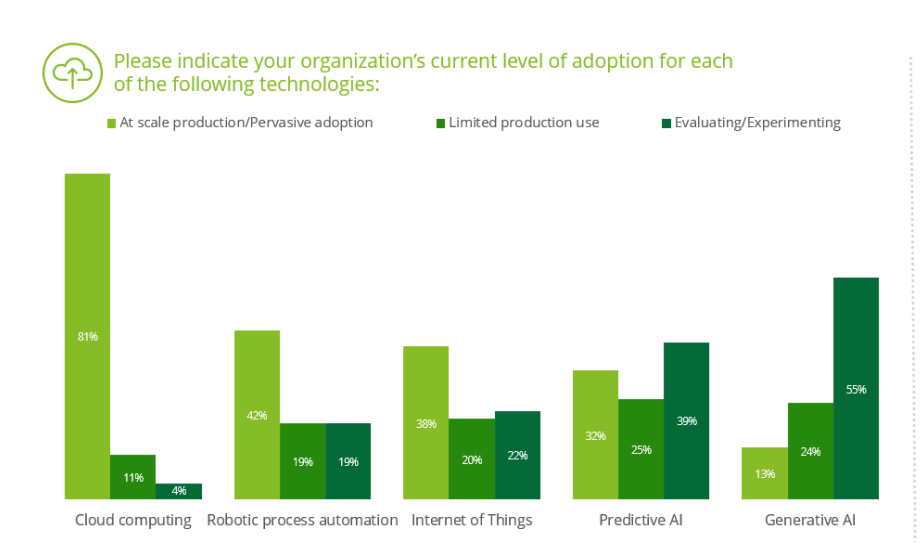
A similar story is told by data coming out of the regular Fortune-Deloitte CEO survey. The summer edition of the survey, which was conducted in June, shows that 55% of CEOs were evaluating or experimenting with GenAI. However, only 39% of CEOs say they are evaluating or experimenting with predictive AI (although more CEOs said they were deploying predictive AI, 32% versus 13% for GenAI).
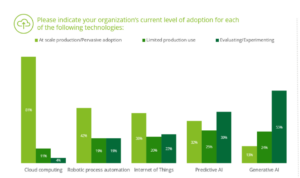
More than half of CEOs in June said they’re experimenting or evaluating GenAI (Source: Summer 2023 Fortune/Deloitte CEO Survey)

Those figures struck Forrester analyst Kjell Carlsson as interesting. “It’s just fascinating to see what attention lands on,” says Carlsson, who is now an AI strategist for Domino Data Lab.

Carlsson notes that there are meaningful differences in GenAI versus traditional AI. For example, GenAI is trained primarily on unstructured data, whereas traditional machine learning is largely based on structured data.

“All of a sudden, that world of unstructured data now becomes usable, and our challenge now is, what should we use it before?” Carlsson says. “We never used it before because it was too painful, and so we haven’t really built business models on the uses.”

The generative nature of GenAI is the real differentiator, he says. Many of Domino’s customers are using GenAI to develop internal assistants and chatbots that are based on the company’s internal corpuses of data, text, and reports. External chatbots that help with customer service are also popular. Carlsson is also seeing, surprisingly, uptake of GenAI among pharmaceutical companies using it to accelerate drug discovery.

But some things haven’t changed with the GenAI onslaught, especially when it comes to getting AI applications into production.

“All of those traditional capabilities that you needed around scale, around being able to incorporate the latest and greatest technologies, being able to go in and have observability and transparency around this, being able to go in and leverage hybrid cloud to do this easily and cost effectively–all of those become even more important in the realm of GenAI,” Carlsson says.

“Mysteriously, GenAI drives you right back to our original value proposition,” he continues. “We’d love to say that we had planned it that way. But it doesn’t mean that it isn’t true. It’s just one of those happy circumstances.”

(JLStock/Shutterstock)

While data science platform vendors like Domino are busy shifting their business models (if not their offerings) to target GenAI, there are other groups of vendors that are riding GenAI’s groundswell even higher.

OpenAI and its business partner Microsoft are leveraging the first-mover advantage to capture a significant share of the emerging GenAI market. Other vendors with foundation models, like Cohere and Anthropic, also appear to be doing quite well.

The market success of GenAI vendors reflects another important difference between GenAI and traditional AI: GenAI currently is largely something you buy whereas traditional AI is something you build.

This was the gist of a recent LinkedIn article by data and analytics consultant John Thomas. “Traditional AI models were mostly custom developed. In contrast, Generative AI applications are mostly built with vendor developed FMs,” he writes.

There are other important differences between GenAI and traditional AI projects, Thomas writes. For instance, getting started with GenAI requires smaller upfront development costs and can be stood up in a matter of days. Traditional AI, on the other hand, requires higher upfront costs and takes much longer to get started.
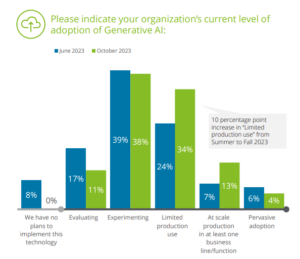
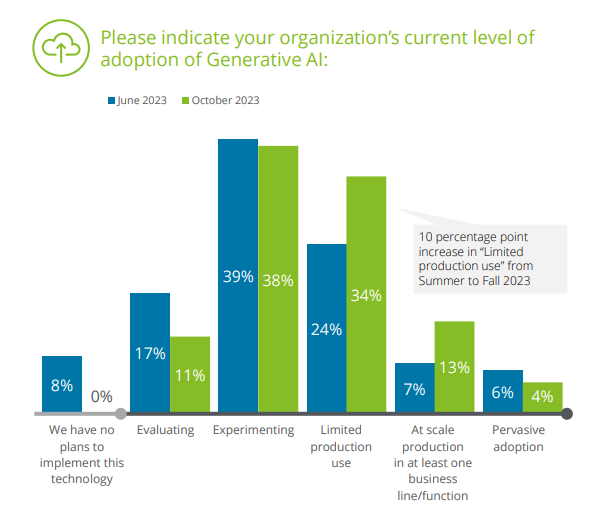
GenAI projects are moving quickly from the experimenting/evaluation phase to limited and full-scale production (Source: Fall 2023 Fortune/Deloitte CEO Survey)

The skills are also vastly different. In traditional AI, it requires skilled developers to create a model from scratch, as well as a lot of data preparation and data labeling work to train the model. But with GenAI, the models come pre-built and pre-trained. Instead, GenAI users focus much of their time on developing the right prompts.

With such large differences in technology, skill, costs, and data types, it’s no wonder that use cases are different, Thomas writes.

“Traditional AI uses are analytical in nature, involves predicting values or classifying observations, based on past data,” he writes. “Generative AI in contrast can generate content and perform tasks. The resulting use cases are fundamentally different and new capabilities include generation and manipulation of code, text, images, video, audio, and data.”

As organizations move from the experimentation phase of GenAI to the early deployment phase–which is already occurring, according to Fotune-Deloitte’s fall CEO survey–they will gain valuable knowledge around how to work with this technology. If past experiences with big data, machine learning, and traditional AI are any indication, there will be unexpected road bumps on the path to productivity (and that’s not even considering known GenAI concerns around hallucinations, privacy, and legal liability).

While the level of hype in the mainstream media would suggest that we have achieved the Holy Grail of AI–the creation of an artificial general intelligence (AGI)–those who are in the trenches of big data, advanced analytics, and AI realize that we are still far from achieving an AGI. What’s more, with less than a year of GenAI experience in most (but not all) organizations, the collective learning curve around GenAI is bound to be steep.

In the meantime, GenAI will continue to consume nearly all the oxygen in the room, at the expense of traditional AI. Once the sugar high around GenAI wears off and executives realize that it doesn’t offer a quick and easy path to transformational success while opening a host of new concerns around accuracy, transparency, and legal liability, then enterprises will find a firmer footing on which to do the hard but necessary work of integrating GenAI into existing IT stacks and with existing business models.

Editor's note: This article originally appeared on Datanami.

Related

About the author: Alex Woodie

Alex Woodie has written about IT as a technology journalist for more than a decade. He brings extensive experience from the IBM midrange marketplace, including topics such as servers, ERP applications, programming, databases, security, high availability, storage, business intelligence, cloud, and mobile enablement. He resides in the San Diego area.


Australia Needs to Prepare to Reap the Benefits of Artificial Intelligence

Australia is well-positioned to capitalise on the future influence of artificial intelligence on its economic prosperity, according to the CSIRO, thanks to its leading positions in a range of areas including AI research, advanced manufacturing and robotics, and machine learning.

However, Stela Solar, director of the National Artificial Intelligence Centre, has said Australia’s AI expertise, which is resulting in innovative tools and use cases, including from the CSIRO’s own Data 61 unit, does risk being undermined by a lack of understanding of AI in the wider community.

Jump to:

  • Australia doing well in international measures of AI expertise
  • Promise clear in non-obvious local and global AI use cases
  • Australia held back by community understanding and buy-in

Australia doing well in international measures of AI expertise

Australia has not been a fast adopter of AI. IBM’s Global AI Adoption Index indicated Australia was lagging behind in 2022. However, it also showed Australia’s growing appetite for exploring AI potential was bringing it back into line with other leading AI-adopting nations (Figure A).

Australia’s recent exploration of AI is boosting its AI adoption ranking.
Figure A: Australia’s recent exploration of AI is boosting its AI adoption ranking. Source: IBM

As the CSIRO’s Solar told the audience at a recent Forrester conference in Sydney, the findings reflect a local ecosystem where there has been a hesitancy to get in first but where there is also now an accelerating wave to get in and experience the benefits of AI in Australia.

In fact, there is a lot for Australia to be proud of. The Stanford Global Vibrance Index puts Australia third in the world per capita for AI research, which Solar called “pretty impressive” (Figure B).

Australia is third in the world for AI research on a per capita basis.
Figure B: Australia is third in the world for AI research on a per capita basis. Source: Stanford University

“We don’t get into the headlines the same way as other countries, but we do have that capability,” Solar said.

Australia’s standing is reflected in other achievements. Queensland was named an advanced manufacturing and robotics hub by the World Economic Forum, while the Australian Institute for Machine Learning has been ranked among the best in the world for machine learning research.

SEE: Australia telcos are deploying chatbots to improve productivity.

Solar said that an Australian field robotics team competing globally at the DARPA SubT Challenge in the US — where participants were challenged with developing teams of robots for autonomous underground exploration — managed to finish second in the world.

“We have world-leading expertise in artificial intelligence in Australia,” Solar said.

Promise clear in non-obvious local and global AI use cases

Forrester’s July 2023 AI Pulse Survey found AI decision-makers are currently focused on top use cases like content generation in customer support, improving employee productivity, self-service data and analytics and improving developer productivity. According to Solar, in addition to popular use cases, the promise of AI is demonstrated by non-obvious use cases.

WPP and NVIDIA’s generative AI content engine for digital advertising

Global advertising behemoth WPP has partnered with NVIDIA to build a generative AI-enabled content engine for digital advertising, which combines 3D design and manufacturing information with creative supply chain tools like generative AI from Adobe and Getty Images.

SEE: Australia is adapting fast to generative AI.

The partnership will enable the utilisation of AI to create more personalised and engaging advertising on consumer products — such as changing a car advertisement from an urban to a rural setting — while staying true to the manufacturer’s brand and product specifications.

Using large language models for threat identification and testing

The CSIRO’s Data 61 has trained a large language model on what good and bad code looks like, so it can help cyber teams automatically test and identify vulnerabilities. With enterprise technology environments growing exponentially, the tool can help cyber teams keep on top of testing by generating its own hypotheses and testing for code vulnerabilities.

NASA designing ‘evolved structures’ for space-bound satellites

NASA is using AI to design stronger, cheaper and lighter parts for aerospace equipment. By feeding in requirements like dimensions and materials, as well as restrictions like any required parts connections, AI is able to generate new and better designs for potential space missions.

These “evolved structures” are different in character from those that a human might design, including being less strictly geometric. They may help satellites and other equipment go further and faster, with Solar saying they are proving more resilient and effective for their purpose.

The CSIRO’s own automated honeypot creator for cyber security teams

Data61, the data and digital specialist arm of the CSIRO, has created a generative AI tool that allows organisations to create fake honeypots within their cyber environments in order to lure and distract threat actors during cyber attacks to protect real organisational data.

SEE: Australia’s cyber shields strategy could benefit from more data science rigour.

Trained on what real honeypots look like, the deception-as-a-service tool allows organisations to spin up highly realistic but fake versions of data and digital assets, according to the CSIRO. Solar said this work would normally take a significant amount of time for cyber teams without AI.

Shell using AI to maximise energy generation from wind farms

Energy company Shell is using AI to optimise the layout of wind turbines in wind farms. By feeding in variables like the area’s landscape, weather, altitude and turbine design, it can help lay out a wind farm in ways that maximise the energy generation potential as a whole.

Macquarie University designs app to kill scammer business models

The cyber hub at Australia’s Macquarie University has developed an AI app, Apate, to combat phone scammers. Named after the Greek goddess of deception, the app keeps scammers talking on long, fake calls, wasting as much time as possible to impact their business model.

Australia held back by community understanding and buy-in

Australia has experienced a “much lower economic impact” of AI in terms of commercialisation or adoption into full production environments at scale. Partially, Solar attributed the lack of follow-through to the general community’s understanding of AI being below the global average.

Solar said organisations often find that, although they might have the experts, roadmaps and vision for AI, they often find the customers or community they are operating within are not confident in AI. They are needing to develop methods to develop community understanding.

“That will, in turn, activate an organisation’s ability to innovate and adopt scenarios,” Solar said.

One of the interesting things in IBM’s Global AI Adoption Index, according to Solar, was India’s vastly greater deployment of AI by SME businesses. This was higher than enterprises in India, reflecting a much higher level of community and customer engagement with AI than in Australia.

Capitalising on the AI promise matters to the Australian economy

Australia’s promise in AI is reflected in our technological achievements to date, Solar said. This includes advances in our mining and resources sector, which has built our strong capability in intelligent edge technologies, which are now being tapped for remote operations in space.

However, Solar said AI has now become the lifeblood of innovation around the world. How Australia responded to that challenge would impact its future economic prosperity.

“It is not AI for technology’s sake but for business outcomes and holistic economic impact,” Solar said. “This might affect whether we have thriving careers and the prospects of our children and grandchildren; we need to look at it from a national as well as organisational standpoint.”

Bing Chat now goes by Copilot and feels a lot more like ChatGPT

Copilot Microsoft

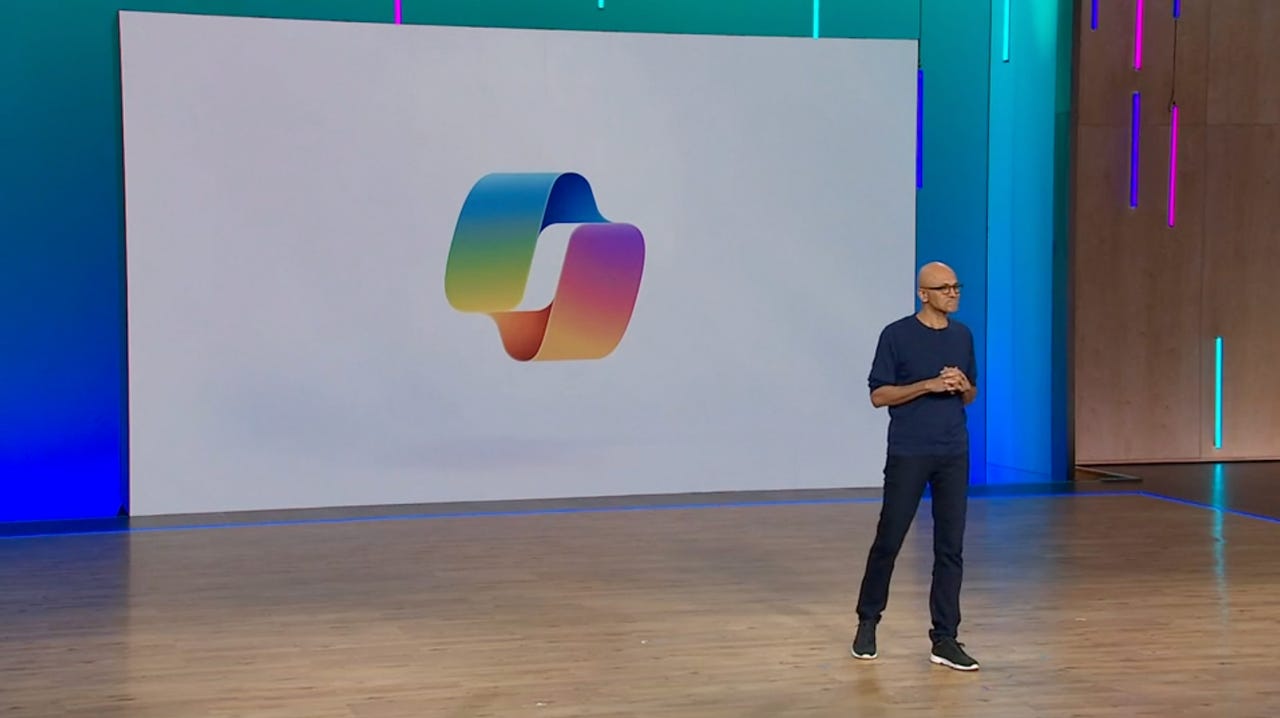
Microsoft CEO Satya Nadella unveils the rebranding of Bing Chat to Copilot at Microsoft Ignite.

In February, Microsoft entered the AI chatbot scene with the launch of Bing Chat, which has become a worthy rival to ChatGPT. Now, the company is giving Bing Chat a makeover that both increases its resemblance to ChatGPT and expands its capabilities.

On Wednesday, at Microsoft Ignite, the company announced that Bing Chat and Bing Chat for Enterprise will now be called Copilot.

Also: Boosting cybersecurity: Microsoft's AI-driven Security Copilot unveiled at Ignite 2023

In addition to changing the name, the shift makes Bing Chat more of a standalone experience — like ChatGPT — with its own standalone web page. Users can still access Copilot from Bing and Windows; however, the standalone site makes it more accessible to everyone since it can be accessed from any browser without relying on Bing.

Regular users need to sign in or create a Microsoft account to access the chatbot, while Bing Chat Enterprise users can get the same commercial data protection with Copilot simply by signing in with their Microsoft Entra ID.

Like Bing Chat, Copilot remains a free experience with access to GPT-4 and DALLE-3 on its platform. By contrast, ChatGPT requires a paid subscription to ChatGPT Plus to access either of those abilities from within its chatbot.

The user interface of Copilot is nearly identical to that of Bing Chat, with the only difference being the change in branding, which now reads "Copilot, your everyday AI companion."

Also: Azure AI Studio takes the stage at Ignite 2023: Unlock the potential of Azure AI Studio's AI toolkit

Users can use Copilot the same way they would use Bing Chat, toggling between creative, balanced, and precise conversation styles, and asking for help with tasks such as writing, coding, shopping, and more.

To further expand Copilot's abilities, Microsoft added support for OpenAI GPTs, a feature announced by OpenAI earlier this month, which allows users to create tailored versions of Copilot for specific tasks.

Also: Microsoft's latest AI offerings for developers revealed at Ignite 2023

Microsoft first released an AI product titled "Copilot" in September as an AI companion running across Microsoft's most used applications and experiences, including Windows, Edge, Teams, and more.

This new Bing Chat rebranding reflects that Microsoft is moving towards having all its AI companion offerings grouped under the Copilot brand. Microsoft Copilot is the free-of-charge AI chatbot companion everyone can access, with other Copilots — such as Copilot for Microsoft 365, Security Copilot, Copilot for Service, and Copilot for Sales — remaining paid services.

More Microsoft

Google Photos turns to AI to organize and categorize your photos for you

Google Photos turns to AI to organize and categorize your photos for you Sarah Perez @sarahintampa / 11 hours

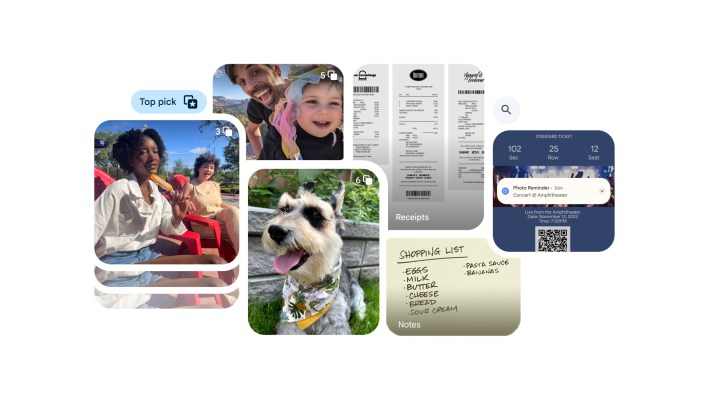
Google Photos is rolling out a set of new features today that will leverage AI technologies to better organize and categorize photos for you. With the addition of something called Photo Stacks, Google will use AI to identify the “best” photo from a group of photos taken together and select it as the top pick of the stack to reduce clutter in your Photos gallery. Another AI-powered feature will identify photos of things like screenshots and documents, categorize them and even allow you to set reminders on those images to find them at a later date — like a screenshot of an event ticket with a QR code you’ll need for entry, for example.

The company says that with Photo Stacks, users will be able to select their own photo as the top pick if they choose or turn off the feature entirely. But if they leave the feature enabled, Google Photos will automatically organize your gallery for you so that multiple photos of the same moment will be hidden behind the top pick of the “stack,” making things tidier. The feature works by using signals that gauge visual similarities in order to group similar photos in your gallery that were captured close together, Google says.

Image Credits: Google

It also notes that a third of most people’s galleries are made up of similar photos, so this will result in a significant reduction in clutter. The stacked photos aren’t removed, of course, just hidden out of sight. To see them, you tap on the stack and then scroll horizontally through the other images.

Another perhaps more interesting feature will use AI to organize certain types of photos, like documents, screenshots, receipts and more.

Image Credits: Google

To work, Google Photos uses signals like OCR to power models that recognize screenshots and documents and then categorize them into albums. In addition, you can also set reminders alongside these images. For example, if you took a screenshot of a concert ticket, you can ask Google Photos to remind you to revisit the screenshot closer to the concert date and time.

Image Credits: Google

You can also choose to automatically archive screenshots and documents after 30 days, keeping them out of your main gallery, but still accessible from their dedicated albums for reference.

Both features will begin to roll out to Google Photos on Android and iOS starting today.

Generative AI: A Game Changer for HR in 2024

In an era marked by rapid changes in the workforce, a pivotal study conducted by CYPHER Learning, a leader in modern learning platforms, reveals significant insights into the challenges and attitudes of HR and business leaders towards generative AI. This study, spotlighting the intersection of upskilling needs and AI technology, is reshaping how organizations approach learning and development (L&D).

The report titled “Generative AI in 2024: A potential lifeline amid workplace turbulence,” draws from a survey of 400 U.S. and U.K.-based HR and business leaders. It highlights the urgent need for effective upskilling and retention strategies in businesses. The findings are eye-opening: 76% of leaders face difficulties in developing training courses with existing resources, and 65% see upskilling as crucial but lack the time for course development.

The report also sheds light on the current usage of generative AI in HR and L&D. It reveals that:

  • 53% of leaders are using AI to make professional development courses more engaging and fun.
  • An equal percentage (53%) employ AI for creating assessments to track learner progress.
  • 54% leverage AI to save time in course creation.

This growing reliance on AI is not without its challenges. The study identifies significant barriers to AI adoption in the workplace. Despite 86% of leaders using generative AI in their roles, concerns about data security, accuracy, and the fear of AI replacing jobs persist. Moreover, while 69% of leaders see AI as a tool to simplify their roles, a knowledge gap in maximizing AI's potential remains a hurdle.

Graham Glass, CEO and co-founder of CYPHER Learning, highlights the urgency of the situation: “Generative AI is augmenting L&D and helping us meet the ever-changing skills requirements. At CYPHER Learning, we believe AI adoption is addressing these challenges – while giving time back to key personnel and saving their organizations money. By adopting commercial solutions with AI validators, all businesses and L&D teams can benefit from using AI easily and securely.”

Further, the research underlines a readiness to embrace AI more extensively if its authenticity could be verified. A significant 77% of HR and business leaders would increase their use of AI with this assurance. Furthermore, 87% agree on the potential to adopt AI more widely if it were integrated into commercial tools.

In response to these insights, CYPHER Learning has launched AI 360 with CYPHER Copilot, a comprehensive suite that synergizes content creation and delivery through generative AI. This innovation reflects CYPHER Learning's commitment to transforming L&D by leveraging AI technology to address the evolving skills requirements.

As generative AI continues to make strides in various sectors, its impact on the future jobs market presents a complex, yet intriguing scenario. While it's clear that this technology is set to revolutionize how we work, the extent to which it will disrupt existing jobs versus create new opportunities remains a topic of considerable debate and anticipation.

On one hand, there is a concern about the potential displacement of jobs, especially in roles susceptible to automation. On the other, there is optimism about the emergence of new job categories and the expansion of existing ones, driven by the unique capabilities of generative AI.

This dual impact suggests a transformative shift in the job landscape, underscoring the need for adaptive skills and continuous learning. As the technology evolves, so too will our understanding of its full impact on employment, necessitating a proactive approach in preparing for a future where human ingenuity and AI collaborate in shaping the workforce, Unite.AI remains committed to reporting on new developments in this area.