Generative AI is a developer’s delight. Now, let’s find some other use cases

Hand touching screen with code on it

Some people might think of generative artifical intelligence (AI) as a solution in search of a problem, but the technology is already proving its worth in one area: software development productivity. Close to half of technology professionals use generative AI to build applications. What's more, one third of IT staff use AI for data analytics. However, research suggests other business use cases are not quite ready.

A survey of more than 2,800 technology professionals, released by O'Reilly, shows that 44% of respondents use AI in their programming work, and 34% are experimenting with it. Data analysis is also a major use case for generative AI, with 32% of IT professionals using it for analytics, and 38% experimenting with it.

Also: Generative AI and machine learning are engineering the future in these 9 disciplines

"We aren't surprised that the most common application of generative AI is in programming, using tools like GitHub Copilot or ChatGPT," Mike Loukides, author of the O'Reilly report, writes. "However, we are surprised at the level of adoption."

There is also evidence of a healthy tools ecosystem that has already sprung up around generative AI, the report indicates. "As was said about the California Gold Rush, if you want to see who's making money, don't look at the miners; look at the people selling shovels," Loukides says.

Also: AI and automation: Business leaders adopt small-scale solutions for greater impact

"Automating the process of building complex prompts has become common, with patterns like retrieval-augmented generation (RAG) and tools like LangChain. And there are tools for archiving and indexing prompts for reuse, vector databases for retrieving documents that an AI can use to answer a question, and much more. We're already moving into the second generation of tooling." The research shows that 16% of IT professionals report their companies are building on top of open-source models.

The report authors believe developers' adoption of AI tools will grow, regardless of whether their management tries to discourage it. "We expect that programmers will use AI even in organizations that prohibit its use," Loukides adds.

"Programmers have always developed tools that would help them do their jobs, from test frameworks to source control to integrated development environments. Programmers will do what's necessary to get the job done, and managers will be blissfully unaware as long as their teams are more productive and goals are being met."

The report shows there's also rising demand for professionals with AI expertise, particularly AI programming (66%), data analysis (59%), and operations for AI/ML (54%). General AI literacy (52%) is also critical, as users have learned when encountering the hallucinations that generative AI tools sometimes exhibit.

Also: Generative AI is everything, everywhere, all at once

Rising levels of adoption of generative AI for data analytics reflects "OpenAI's addition of Advanced Data Analysis (formerly Code Interpreter) to ChatGPT's repertoire of beta features," the report adds.

However, the research suggests many other business use cases for generative AI are still works in progress — and carry some risks. The most common direct business use case is applications that interact with customers, including customer support, the O'Reilly survey shows. Close to two-thirds (65%) of respondents report that their companies are experimenting with (43%) or using AI (22%) for customer-support applications.

Yet the report warns that "customer-facing interactions are very risky" when used with AI. The authors suggest that: "Incorrect answers, bigoted or sexist behavior, and many other well-documented problems with generative AI quickly lead to damage that is hard to undo."

The difficulty in finding appropriate business use cases is cited by IT professionals as the most pronounced roadblock to generative AI adoption — 31% for non-users, 22% for users. Blame a "move fast and break things" culture, Loukides writes. "Badly thought-out and poorly implemented AI solutions can be damaging, so most companies should think carefully about how to use AI appropriately."

Also: AI will change the role of developers forever, but leaders say that's good news

Another reason business use cases take time to formulate is that AI cuts deep into organizational processes. "We also have to recognize that many of these use cases will challenge traditional ways of thinking about businesses. Recognizing use cases for AI and understanding how AI allows you to reimagine the business itself will go hand in hand."
Finally, it's worth remebering that AI is still new. Overall, 38% of IT professionals report that their companies have been working with AI for less than a year. "Even with cloud-based foundation models like GPT-4, which eliminate the need to develop your own model or provide your own infrastructure, fine-tuning a model for any particular use case is still a major undertaking."

European investors grab the popcorn for the new ‘series’ of OpenAI, but are fearful of the fallout

European investors grab the popcorn for the new ‘series’ of OpenAI, but are fearful of the fallout Mike Butcher @mikebutcher / 2 days

With the OpenAI saga playing out across the pond, the European tech community has been waiting for the latest updates as if a new series of “Succession” was about to drop. Indeed, events have at times resembled some Greek tragedy about the Gods fighting it out, atop Mount Olympus, while us mere mortals watch on. With only a handful of large-scale AI startups such as Germany’s Aleph Alpha and France’s Mistral in Europe getting the pulse up (London’s DeepMind was absorbed into the Google Borg long ago), we’ve been grabbing the popcorn and watching this unexpected episode of Silicon Valley from afar.

I probed a few keen tech observers, many of them venture capitalists, but almost none would go on the record, perhaps for fear of drawing the attention of some Valley AI God in full battle-mode.

A U.K.-based investor posited that the drama will have positive effects on Europe’s nascent AI sector.

“This is great news for startups like Mistral, who can probably poach some good employees and catchup with OpenAI. For the AI companies built on OpenAI this will make no major changes in the short term, but will mean the market homogenizes, especially if they lose direction and focus.”

Another pointed out that after OpenAI’s much lauded Demo Day the other week, it was seen as “the most extraordinary kind of business,” but now looks like “an absolute shit show.” They likened it to the debacle that was WeWork.

One European VC predicted that the events will have an impact on all term-sheet negotiations: “I would expect founders to become more resistant to board control over CEO replacement and other similar terms. They will clearly ask ‘if this can happen to Sam Altman, why should I assume it won’t happen to me?’”

At an even more practical level, a lot of European applied AI startups are very reliant on OpenAI, which is (whatever anyone says) head and shoulders above most alternatives. The turmoil at OpenAI seems to be pushing the business more into the hands of Microsoft and that could have quite major implications for companies reliant on OpenAI’s platform, “especially if that company is competitive with or outside the Microsoft ecosystem,” they pointed out.

“From a platform POV, it is a disaster,” said another investor. “So many companies are already working with OpenAI, this is like the Facebook, Twitter, etc. API changes all over again and possibly worse.”

There was also grumbling about European regulation, and a cautionary warning against being too over-reliant on one company, and a non-European one, at that.

“As we have seen with the heavy-handed regulation coming down from EU-level, government won’t save us. We need to have more AI champions locally. There is still time, but unclear how much,” said one investor.

Others were more upbeat about the turmoil buying useful time for European startups: “Which is a good thing for European generative AI startups as it gives them time to breathe and re-calibrate before the next shockwave.”

Finally, one brave soul in the shape of DN Capital co-founder and managing partner Steve Schlenker did go on the record.

One of his concerns is that access to the world’s most successful LLMs will move away from the average startup — “such as those in Europe” — and toward startups and researchers, mostly local to the U.S., and they might have to, in future, pass new, yet-to-be-defined “screening” processes, perhaps even defined by boards like the one at OpenAI.

Furthermore, if the best and brightest from OpenAI go on to be full-time employees of a paid U.S. mega-company like MSFT — one potential scenario, judging by Microsoft’s blanket job offer and hundreds of OpenAI’s own staff signing a letter threatening to quit, then that could have a major impact on competition. “The ability of the AI movement to remain open to all at a fair price will decline rapidly,” he said.

Meanwhile, the upside of all this chaos is that it has been playing out in public on social media, largely on Twitter/X. As a Warsaw-based VC put it to me: “It’s pretty exciting and unique that a lot of this shit show is happening publicly on Twitter. Not possible in Europe!”

OpenAI’s New Board is a “GentleMen’s” Club

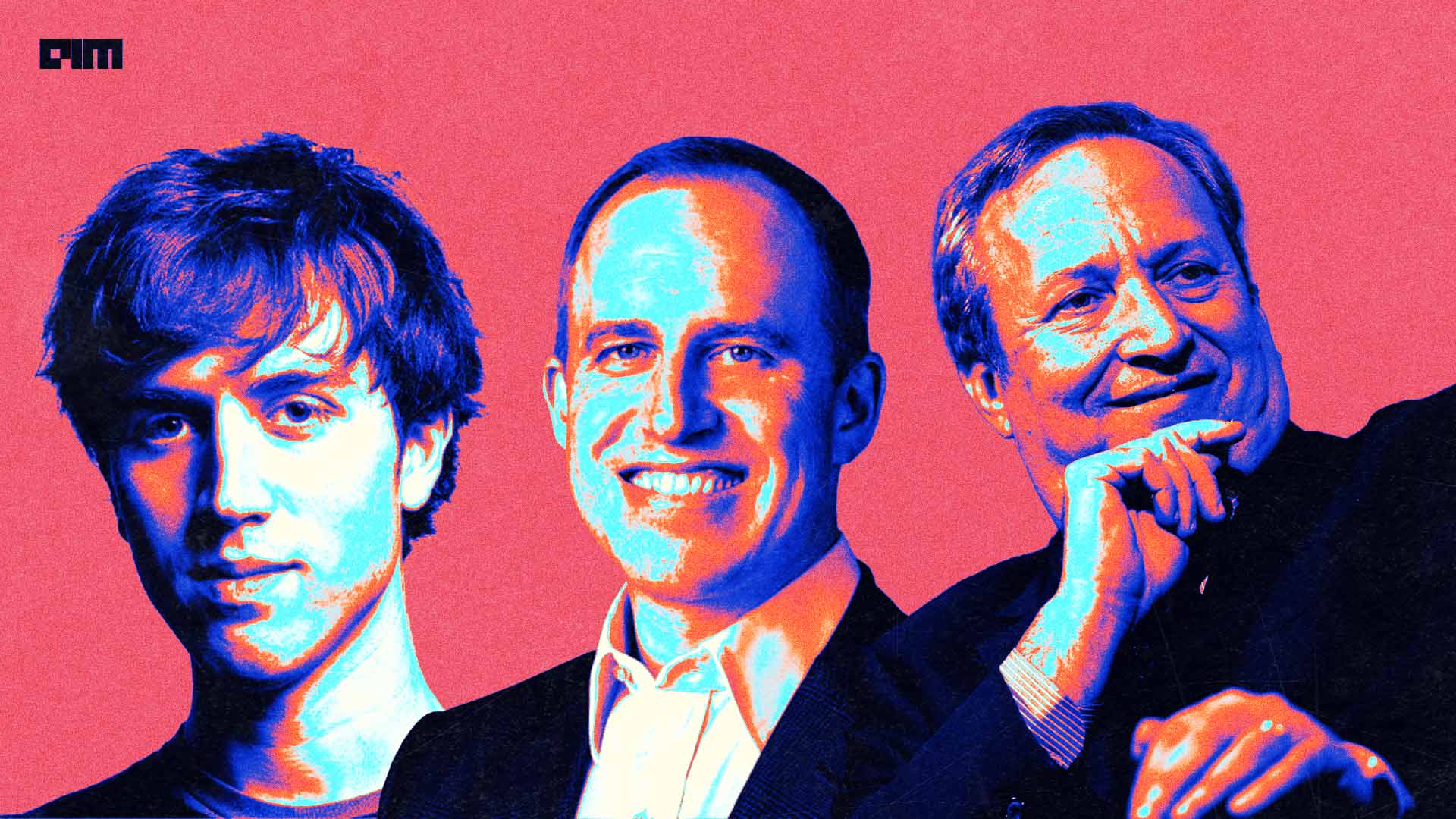
Finally, there’s a respite from the brewing OpenAI crisis that had plunged the tech world into a conundrum. OpenAI announced the return of Sam Altman as the CEO, and with that comes an announcement of a new board of directors. In this reshuffle, three members have been announced and only Adam D’Angelo remains from the old board. All three co-founders have been removed.

Here’s a list of the new board members:

Bret Taylor

American entrepreneur and computer programmer, Bret Taylor has been appointed as the chair of the board for OpenAI. Former Co-CEO of Salesforce and having served on the board of tech companies such as Twitter and Shopify, Taylor comes with a vast experience. He had co-founded a company called FriendFeed which was later acquired by Facebook in 2009 and served as its CTO for three years. He was also the co-creator of Google Maps.

A close companion of Sam Altman, Taylor along with Brian Chesky, CEO of AirBnB, was siding with Altman in the board negotiations that happened last night with Emmett Shear and Adam D’angelo.

Larry Henry Summers

Lawrence Summers is an American economist. He held the position of the 71st United States Secretary of the Treasury from 1999 to 2001 and served as the director of the National Economic Council from 2009 to 2010. Additionally, he was the president of Harvard University from 2001 to 2006, and currently, he holds the titles of Charles W. Eliot University Professor and Director of the Mossavar-Rahmani Center for Business and Government at Harvard Kennedy School.

Having held prestigious financial positions, including that of a Chief Economist of World Bank, Summers was involved in a few controversies in the past. His association with Jeffrey Epstein, making controversial statements claiming men to outperform women in maths and science due to biological differences, and rushing to help his tech friends during Silicon Valley Bank collapse had garnered criticism.

Adam D’Angelo

Adam D’Angelo, co-founder and CEO of Quora, was the former CTO of Facebook. He joined the OpenAI board as an independent director in 2018, and is the only member of the board who has not been removed after the OpenAI drama.

Interestingly, D’Angelo was considered one of the key figures to have made the whole OpenAI drama into a power struggle. He was also known for his stubbornness among Quora employees, something which may have played a part in the negotiation meetings among the founders. With so much going on, the move to retain him on the board was surprising with people quick to react on X.

The company confirmed that this is an initial board, probably hinting at more members to join the team. Interestingly all three cofounders of OpenAI – Sam Altman, Greg Brockman and Ilya Sutskever have been removed along with both the women board members- Tasha McCauley and Helen Toner. Both the women, along with D’Angelo and Ilya Sutskever were involved in Altman’s ousting.

As of now, there are no women on OpenAI’s board.

The post OpenAI’s New Board is a “GentleMen’s” Club appeared first on Analytics India Magazine.

OpenAI is Nothing Without Its Customers

OpenAI Context Window

Despite all the rumours around its customers exiting, leadership turmoil, employees threatening to quit and Altman’s return, there is a positive side to the OpenAI blowup that no one’s talking about. The company that gave the world ChatGPT, did a brilliant job in supporting its consumers, developers, and enterprise customers amid all the drama unfolding on X.

“We are 100% behind OpenAI because they and their people are phenomenal – both technically and personally,” said the chief of BeMyEyes, Mike Buckley, without commenting on the board drama.

Buckley lauded the OpenAI team, including Sam Altman, Brad Lightcap (COO), and Jessica Shieh, and said it prioritised accessibility when no one was looking, and has played a pivotal role in building their product – Be My AI™ – even though it’s close to meaningless for them from a revenue standpoint.

“But the reason we’re sticking with OpenAI beyond just the fact that their models are excellent is because they made a commitment to BeMyEyes before it was a sexy thing to do,” he added.

“So. About OpenAI. I’ve been bombarded by sales calls from rival LLM companies seeking some opportunistic business wins,” said the chief of BeMyEyes, Mike Buckley, adding that he understands that it is fair for them to reach out for networking, and his company was already evaluating backup providers even before all of this drama.

“No matter what is going on, customers are being treated as #1,” said OctaneAI chief Matt Schlicht, saying that this is by far the most impressive part of OpenAI this weekend, showing the performance dashboard, which seems to be working just fine.

“People are dming me as if OpenAI is going to turn off gpt in the next week,” said AI developer Jason. He said that people of that level of integrity towards their leader, are likely going to have the same level of an integrity with their product, their service, and their customer.

Almost 95% of OpenAI employees had signed a petition to leave the company if Altman and Greg Brockman are not reinitiated. Surprisingly, this list includes Ilya Sutskever, who was initially blamed for the firing Altman. Now that Altman, alongside other colleagues are back, hopefully, things will be back to normal. “Returning to OpenAI & getting back to coding tonight,” said Brockman.

we are so back pic.twitter.com/YcKwkqdNs5

— Greg Brockman (@gdb) November 22, 2023

Not only that, OpenAI, amid all the chaos, shipped a new update to ChatGPT, that allows all the users to interact and receive responses with the help of voice instead of text.

Kudos to Emmett Shear as well, who played a pivotal role in reuniting the team safely, and running the show smoothly for the last ~72 hours, alongside the support of leadership team at OpenAI. Interesting to note, amid all the chaos, even Andrej Karpathy was thinking about building a centralised and decenralised AI system.

Now that sky is clear, it feels like nothing ever happened to bein with, and everything was just a bad dream. Hopefully, the two million developers, including 92 percent of Fortune 500 companies (i.e. about 460 companies) that the company boasted are, hopefully, still in favour of OpenAI now that Altman has returned.

Ironically, when the OpenAI drama unfolded, there were a lot of reports that said that more than 100+ OpenAI customers were already in talks with its competitors, including Google, Amazon and Oracle’s billion dollar babies Anthropic and Cohere, respectively. Others were also considering switching to Microsoft’s Azure OpenAI Service, which mimics all its models and offerings. Not sure how much of that is true, anymore.

Clearly, OpenAI is nothing without its “customers and people”.

The post OpenAI is Nothing Without Its Customers appeared first on Analytics India Magazine.

Amidst OpenAI chaos, Sam Altman’s involvement in Worldcoin is ‘not expected to change’

Amidst OpenAI chaos, Sam Altman’s involvement in Worldcoin is ‘not expected to change’ Jacquelyn Melinek 24 hours

Sam Altman may have been asked to leave OpenAI, but his involvement in crypto project Tools for Humanity, which is building Worldcoin, remains uninterrupted, a source close to the project told TechCrunch.

Altman has “consistent and valuable” engagement with Tools for Humanity and “that is not expected to change,” the source said. The source added that Altman is still chairman and co-founder of the project, confirming that the information on the project’s website is up to date.

News of Altman’s ouster sent the Worldcoin token, WLD, plummeting to a low of $1.84 on Saturday, but the token recovered over the weekend and is currently trading on par with previous levels at $2.40, per CoinMarketCap data.

A timeline of Sam Altman’s firing from OpenAI — and the fallout

Worldcoin raised $115 million in May in a Series C round led by Blockchain Capital. As of March, Altman was on the project’s board, but was not involved in day-to-day operations.

“Proof of personhood is becoming increasingly important in the rapidly advancing age of AI,” The Worldcoin Foundation told TechCrunch late on Monday. The team supporting Worldcoin is still focused on the project’s mission, “building a more human internet and a more accessible global economy through World ID, a privacy-enhancing way to verify humanness and uniqueness online,” the company said.

Worldcoin is well-known for its controversial Orb hardware, which scans peoples’ irises and assigns them an ID that lets users access Worldcoin’s application and a digital passport. The verification process is meant to prove individuals’ identities and stop anyone from making multiple accounts.

Worldcoin doubles down on emerging markets amid wider criticism

The crypto project has faced pushback from some countries, especially Kenya, which banned Worldcoin from scanning any more of its citizens’ eyeballs on concerns that the company failed to inform users about the data security and privacy measures it had taken, and how the data collected would be used or processed.

Worldcoin has also faced backlash from critics, who allege the company targets developing countries with laxer privacy rules. The project gives most participants (outside the U.S. and some other countries) 25 WLD tokens, worth roughly $58.5, in exchange for signing up, and that has spurred its critics to call it exploitative.

That hasn’t stopped individuals from signing up. Since launching to the public 120 days ago, more than 2.46 million people have signed up for Worldcoin, according to its website. Over the past seven days, more than 65,200 new accounts have been created and the project has averaged 137,000 wallet transactions daily.

Tiago Sada, head of product for Tools for Humanity and a core contributor to Worldcoin, previously told me that focusing on developing countries and providing free tokens was “fair” because most tech projects focus on emerging markets first, given that they are the “easier ones to operate in.” And Altman should be around to help for the foreseeable future.

Read more of our ongoing coverage of Sam Altman’s firing from OpenAI and the subsequent fallout:

  • Sam Altman’s firing from OpenAI: The timeline so far
  • How OpenAI’s chaos could help Meta
  • A history of OpenAI’s board members
  • OpenAI’s instability escalates an AI talent free-for-all

Sam Altman To Return as CEO of OpenAI

After much drama, Sam Altman will return as CEO of OpenAI. An agreement in principle has been reached for his return, and OpenAI announced a revamped initial board, with Bret Taylor as Chair, along with Larry Summers and Adam D’Angelo.

We have reached an agreement in principle for Sam Altman to return to OpenAI as CEO with a new initial board of Bret Taylor (Chair), Larry Summers, and Adam D'Angelo.
We are collaborating to figure out the details. Thank you so much for your patience through this.

— OpenAI (@OpenAI) November 22, 2023

This development follows recent negotiations led by Altman, with Airbnb chief Brian Chesky and former Salesforce CEO Bret Taylor by his side, while interim CEO Emmett Shear and Adam D’Angelo represented the board’s perspective.

“I love OpenAI, and everything I’ve done over the past few days has been in service of keeping this team and its mission together. When I decided to join Microsoft on Sunday evening, it was clear that was the best path for me and the team. With the new board and with Satya’s support, I’m looking forward to returning to OpenAI, and building on our strong partnership with Microsoft,” Altman said in a statement posted on X.

“Microsoft chief Satya Nadella, who previously expressed his disappointment with the former board, said, “We are encouraged by the changes to the OpenAI board. We believe this is a first essential step on a path to more stable, well-informed, and effective governance.

“Sam, Greg, and I have talked and agreed they have a key role to play along with the OAI leadership team in ensuring OAI continues to thrive and build on its mission. We look forward to building on our strong partnership and delivering the value of this next generation of AI to our customers and partners” he added in his statement.

Interim CEO Emmett Shear, in his statement said “I am deeply pleased by this result, after ~72 very intense hours of work. Coming into OpenAI, I wasn’t sure what the right path would be. This was the pathway that maximized safety alongside doing right by all stakeholders involved. I’m glad to have been a part of the solution.”

Greg Brockman who left OpenAI alongside Altman said, “Returning to OpenAI & getting back to coding tonight.”

.

The post Sam Altman To Return as CEO of OpenAI appeared first on Analytics India Magazine.

OpenAI-Anthropic Merger No More

OpenAI-Anthropic Merger No More

Now that Sam Altman is back at OpenAI as the CEO, the rumour of OpenAI-Anthropic is officially off the table. The current board consists of Bret Taylor, Larry Summers, and Adam D’Angelo.

According to earlier reports, the previous OpenAI board consisting of Helen Tomer, Tasha McCauley, Ilya Sutskever, and also Adam D’Angelo approached Dario Amodei, the co-founder of Anthropic, for a potential merger. The idea was to replace Altman as the CEO with Amodei. Though it is not clear if there was any serious discussion about the deal, Amodei turned down the offer as he is already the CEO at Anthropic, which is a direct competitor to OpenAI.

The OG board loved Anthropic, OpenAI not so much

Looking back though, the board that fired Altman from OpenAI had negative views about the technology that OpenAI is building. For example, Toner wrote a paper that was critical of OpenAI, and was praising Anthropic. It seems like Toner was one of the reasons that Altman was ousted out of OpenAI.

Toner’s paper said that Anthropic’s willingness to not release its AI models is “exactly the kind of frantic corner-cutting that the release of ChatGPT appeared to spur.” She further praised Anthropic for investing more into AI safety than OpenAI. People on X criticise her views, saying it sounds more like an opinion piece than a research paper.

She closes by commending Anthropic who apparently did it right by _not_ releasing their model quickly, and recommends policymakers weave these “tools” of “costly measures” into their toolbelts.
Insane. pic.twitter.com/VUuJhHzYt7

— Austen (@Austen) November 22, 2023

Altman has complained that Toner’s paper was criticising OpenAI’s effort for keeping its AI safe, according to an email he wrote to his colleagues. He said that the paper was dangerous for the company’s reputation since a board member’s criticism “carries a lot of weight,” he said. Altman was definitely on the right over here.

It all points to the fact that old OpenAI’s board was not aligned with the for-profit approach that Altman had steered the company towards. Or maybe, it was just a case of revenge by Toner for the criticism.

Regardless, Anthropic partnering with OpenAI without Altman, would have been an ideal deal for the startup. Anthropic could have attracted the best AI talent in the world, while OpenAI board would be happy with the AI safety approach.

Anthropic predicts it would generate a revenue stream of $200 million by the end of this year, translating to nearly $17 million monthly revenue. By the end of 2024, it hopes to generate $40 million in monthly revenue.

The only point of contention would be OpenAI’s non-profit approach and Anthropic’s for-profit one, which might also eventually change given that OpenAI’s board has resigned and Altman is back as the CEO. The deal is no longer happening.

Why the deal was a good idea

Anthropic’s Claude, its rival to GPT-4, just got a massive upgrade. Claude 2.1, the latest iteration of its AI language model, is now available through API, revolutionising the claude.ai chat experience. Bringing forth key enhancements for enterprises, Claude 2.1 introduces a remarkable 200K token context window, substantial reductions in model hallucination rates, and a beta feature called tool use.

GPT-4 Turbo, announced at OpenAI DevDay earlier this month, boasted a 128k context length, which was a boost up from Claude-2 holding a 100k context length. Now, the 200k context length announcement is clearly an indication that Anthropic is trying to sway away a lot of OpenAI customers amidst the chaos.

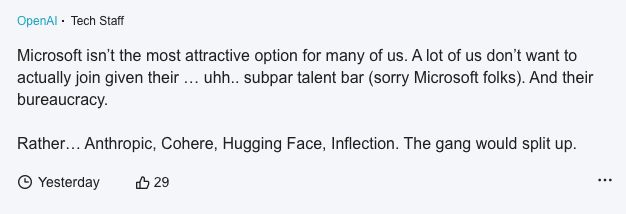
The deal between OpenAI and Anthropic would have been good for them competitively against Microsoft and Google. 95% of the employees of OpenAI, who are considering quitting, are juggling between going to Microsoft or Anthropic, Cohere, Inflection.

Dario and Daniela Amodei, the sibling co-founders of Anthropic, are former OpenAI employees. Daniela was the VP of Safety and Policy at OpenAI and Dario was the vice president of research. Both of them have been quite outspoken about the need for caution in AI development and increasing regulations to make AI systems safe.

This is possibly one of the reasons why the duo departed from OpenAI to form Anthropic. The 2-year old startup casts itself as an AI-safety research lab. But rather than operating as a non-profit like OpenAI, the company operates as a business and has been increasingly raising funds to build its own AI models.

Given the reasons that have been circulating about the departure of Altman from OpenAI, one of them being AI safety policies, Anthropic’s approach might actually align with what the old OpenAI board wanted, including Ilya Sutskever. Now, the deal is no more.

The post OpenAI-Anthropic Merger No More appeared first on Analytics India Magazine.

OpenAI’s initial new board counts Larry Summers among its ranks

OpenAI’s initial new board counts Larry Summers among its ranks Kyle Wiggers 8 hours

Meet OpenAI’s new board of directors: Bret Taylor, Larry Summers and Adam D’Angelo. Or, more precisely, the board for the time being.

Around 1 a.m. Eastern Time on Tuesday, OpenAI announced that, after the company’s previous board of directors abruptly fired Sam Altman as CEO last Friday, it had reached an agreement “in principle” for Altman to return to OpenAI as CEO in tow with a new “initial” slate of board members. Taylor, the former co-CEO of Salesforce, will chair this board, alongside Quora CEO D’Angelo — a holdover from OpenAI’s previous board — and Summers.

We have reached an agreement in principle for Sam Altman to return to OpenAI as CEO with a new initial board of Bret Taylor (Chair), Larry Summers, and Adam D'Angelo.

We are collaborating to figure out the details. Thank you so much for your patience through this.

— OpenAI (@OpenAI) November 22, 2023

“Initial” implies that the board is transitionary rather than permanent. And — this being an “in principle” ordeal — it’s far from concrete. We’ll have to await clarification from OpenAI, which presumably will come at a more reasonable hour in the workday.

If a Verge report is to be believed, however, the final OpenAI board will have nine members total — likely including Altman and a Microsoft exec. Prior to Tuesday’s breakthrough, Microsoft had reportedly been mulling whether to push for a board seat, which might invite regulatory scrutiny given the company’s relationship with OpenAI. Evidently, the company feels it’s worth the governance and oversight guarantees.

Now, Taylor’s name had been bandied about in reports over the past several days as a potential appointee to a new OpenAI board. And it’s not out of the question that D’Angelo, who was reportedly deeply involved in negotiations to bring Altman back into the OpenAI fold, has the necessary support to retain his seat. But Summers is a bit of a wildcard — at least on first glance.

An economist, Summers served as the U.S. secretary of the treasury from 1999 to 2001 and as director of the National Economic Council from 2009 to 2010. More recently, he directed the White House U.S. National Economic Council for then-President Barack Obama, where he played a key role in charting the Obama administration’s response to the Great Recession.

Now, you might ask, what’s an economist and political veteran doing on the newly-formed OpenAI board? Well — a tech outsider on the startup’s board isn’t without precedent, first off. Republican member of the House of Representatives Will Hurd held a seat at one point in time, which he relinquished for an ill-fated presidential run.

But Summer’s appointment is also strategic, my colleague Ingrid Lunden pointed out to me via text. With OpenAI under increasing regulatory scrutiny, Summers brings connections OpenAI will need — and want — with governments, businesses and academia.

Ilya Sutskever, OpenAI’s chief scientist, is one of the big losers here. Reportedly among the board contingent that pushed for Altman’s removal, he’s seemingly been forced to give up great influence at the company he helped to co-found with Altman roughly eight years ago. If his recent post on X (formerly Twitter) is anything to go by, he greatly regrets it. Anyone would.

Tech entrepreneur Tasha McCauley and Helen Toner, director at Georgetown’s Center for Security and Emerging Technologies, are also out. If reporting last night is anything to go by, Altman will be especially pleased by the latter’s ouster; Altman is said to have attempted to have Toner removed from the board earlier this year over a paper she co-authored that cast a critical light on OpenAI’s safety practices.

As for Brockman, who resigned as OpenAI’s president on Friday in protest of the board’s decision to can Altman, it’s unclear as to what his fate might be. The old board kicked Brockman off, and OpenAI’s announcement Tuesday said nothing of him returning. Stay tuned for more on that front; we’re keeping our ears to the ground.

Why OpenAI Did The Right Thing by Firing Sam Altman

While we are still trying to wrap our heads around the recent OpenAI drama, the board has and still is the decision-maker in the whole scenario. Despite holding a position as a board member, the ease with which Sam Altman was ousted was facilitated by a peculiar board structure crafted by OpenAI- and going by the motive for that structure, Altman’s firing is justified.

While the latest development speaks about the tussle ensuing between Altman and the independent board members, the situation that led to this state is solely attributable to the not-for-profit board that holds authority over everyone.

It is almost ominous that Altman knew he is not immune to firing and even spoke about it in a Bloomberg interview a few months ago, where he said that the board can fire him and he believed that the board “needs to be democratised to include all of humanity.”

With the current structure of the board, any conflict that happens against the motive of the non-profit wing can lead to drastic measures which raises the question of what went wrong or what the board saw that was against the interest of the company. With the vision of rapid growth and AGI focus, safety became a topic of contention. It is possible that the steps to achieve this conflicted with the board’s vision, which automatically puts the CEO under fire. Furthermore, the complex board structure made the removal process effortless.

The Complex Board

OpenAI, which started as a non-profit AI research company in 2015 with the goal of advancing digital intelligence to benefit humanity without the need to generate a financial return, created an OpenAI LP, a capped-profit company in 2019. The vision of this company was to build safe AGI for the world, and believed that the capped-profit format would allow them to rapidly increase their investments in compute and talent.

OpenAI LP was structured in a way that allows it to attract funding with the promise of capped financial return for investors and employees. The company’s capped-profit approach limited first round investors to a maximum profit of 100 times their initial investment (100x). Furthermore, any excess value generated will go back to the nonprofit entity to support its mission-driven goals. However, all of this is controlled by one board irrespective of the profit motive.

OpenAI Structure. Source: Substack (Chamath Palihapitiya)

Supreme Board Power

OpenAI’s board of directors sits right at the top of the structure that controls both the nonprofit and for-profit bodies. The ‘capped profit’ company (OpenAI Global LLC) controls ChatGPT in which Microsoft has invested billions of dollars. Interestingly, the company has built a structure where the nonprofit wing takes precedence over any obligation to generate a profit. It is also fair to say that OpenAIGlobal has no control over itself, rather controlled by other entities. The unique hierarchy also limited investors’ say in the running of the company as their contribution also lies towards the bottom of the structure.

In Altman’s ousting episode, there was a bigger catch. Though Altman was part of the board, and had initially invested in the company via YCombinator, he had zero equity in the company – something he had confessed in the AI Senate and even joked about after his firing.

Having no equity in the company also meant that he has no separate power to influence the board in the likelihood of something going wrong. Altman’s commitment to OpenAI, ‘doing what he loves’, pretty much did nothing to secure his position there. While there are options such as dual-class share structures that can secure founders from being ousted from their companies (except for actions such as fraud, misbehaviour, and grave issues), none of this was implemented at OpenAI.

It is also possible that the accelerated growth that OpenAI witnessed from last November with the launch of ChatGPT was unexpected. As Altman himself had mentioned long ago, the company did not expect this kind of growth when they launched ChatGPT, which could also possibly hint at why there was no planning or restructuring of the board. For instance, Microsoft who has invested billions of dollars into OpenAI has no board seat.

The Inevitable Move

While the reason for ousting Altman was attributed to him not being candid with the board, thereby hindering their ability to exercise responsibilities, the decision was delivered by four members from the 6-member board. Out of the four, only Ilya Sutskever was a cofounder and the other three were independent directors with no equity and minimal experience in corporate governance. Pretty much, hinting at how the OpenAI board structure was faulty from the beginning.

While many questions remain unanswered, a weak board structure toppled the biggest AI company in the world and even put the fate of the company at risk. An expensive lesson in corporate governance.

The post Why OpenAI Did The Right Thing by Firing Sam Altman appeared first on Analytics India Magazine.

Founders: Pay attention to what happened with OpenAI’s board

Founders: Pay attention to what happened with OpenAI’s board

If this company structure gives you the ick, you are not alone.

Dominic-Madori Davis 16 hours

This weekend, a soft, rumbling feeling reached a loud consensus: Why the heck was OpenAI structured that way?

In very dumb words, its nonprofit arm had complete control over the for-profit holding company, giving it the ability to oust Sam Altman as CEO without even a day’s heads-up to the well-known Silicon Valley executive or any of the organization’s investors. More technically, as explained to me by stealth startup founder James Rosen-Birch, OpenAI is a tax-exempt charity wrapped around a holding company, which then has a majority stake (with Microsoft as a minority owner) in the for-profit side of OpenAI.

OpenAI’s origin story is now famous: a company that was founded to advance research and development into artificial general intelligence and realized it needed lots of money to do that. It took money from investors and sovereign wealth funds who, of course, wanted returns, so they created a for-profit subsidiary that could issue them equity. That subsidiary remained, however, under complete control of the tax-exempt charity and its board, who, unlike the investors, did not have a financial stake in the business, only the will to see that AI was used for the good of humanity. If this company structure gives you the ick, you are not alone.

Though no one knows precisely what happened, a common theory is that Altman’s for-profit efforts became at odds with the mission-driven nonprofit board.

Internal tensions

In fact, Kimberly Bryant, founder of Ascend Ventures, told us what many in the tech world were thinking: As OpenAI became more popular, struck pretty brand deals, and sought a near-$90 billion valuation, it introduced commercial complexities that the board may have felt were contrary to the company’s stated objectives. Though it is a nonprofit, vision misalignment is hardly unknown in the for-profit sector, leading to conflicts between board directors and CEOs.

“Nonprofit entities inherently prioritize ‘serving the public good’ over maximizing profit, a commitment that faces challenges amid the dynamics of hypergrowth and the diverse objectives of investors,” Bryant told TechCrunch+. “Issues arise when boards become overly controlling, overstep their authority, or act with self-interest . . . such dynamics can not only impede progress but also pose a significant threat, potentially causing severe damage to the organization or company.”

Rosen-Birch said OpenAI’s structure created several overlapping problems and questions, such as whether a for-profit company in a tax-exempt shell really exists for the good of humanity if it doesn’t have to pay for shared public goods and services. “And perhaps most relevant to the problem at hand, how does a board judge whether a company is acting in the interest of humanity? What power do they have to enforce those interests?” he said. “In hindsight, it seems the board was just as confused about [the answer to these] questions as we are.”

The latest update as of publication is that Microsoft, one of OpenAI’s biggest investors, wants Altman to work for them; nearly the entirety of OpenAI has signed a petition to quit if he doesn’t come back, and the fate of the OpenAI board is up in the air.

A cautionary tale

Though OpenAI’s board structure is unique, the fallout from the last few days should serve as a cautionary tale for founders and board members. RareBreed Ventures founder McKeever Conwell said founders rarely pay attention to the structure of their own boards until something grave, like a Silicon Palace coup, is staged against them. “Everybody wants to say boards are broken, but they’re not,” he said. “People just don’t know how to manage their boards.”

Bryant, who was ousted from her last company by the board, said the OpenAI mess could teach startups to “meticulously” choose their board of directors, establish clear expectations, impose term limits, and diligently ensure alignment with the organization’s long-term vision.