Greg Brockman is still announcing OpenAI products for some reason

Greg Brockman is still announcing OpenAI products for some reason Kyle Wiggers 13 hours

Ex-OpenAI president Greg Brockman — who, as far as we’re aware, isn’t currently employed at OpenAI in any capacity — is posting updates about OpenAI products on X, including one today about ChatGPT’s voice narration feature being made available to all ChatGPT users.

ChatGPT Voice rolled out for all free users. Give it a try — totally changes the ChatGPT experience: https://t.co/DgzqLlDNYF

— Greg Brockman (@gdb) November 21, 2023

Perhaps Brockman’s simply expressing pride in his colleagues’ work. Perhaps the job offer from Microsoft fell through. Perhaps negotiations with OpenAI’s board of directors to bring him and Sam Altman — who was OpenAI’s CEO until Friday, when the board abruptly sacked him — back are further along than was reported. (Brockman resigned in protest Friday evening.) Who knows? At this stage in the chaotic OpenAI saga, it’s anyone’s guess.

OpenAI’s existential crises aside, the aforementioned voice feature for ChatGPT — which was announced in September and began rolling out to premium subscribers of ChatGPT, OpenAI’s AI-powered chatbot, a few weeks ago — is powered by a text-to-speech model that can generate human-like voices from text and just a few seconds of sampled speech. OpenAI said that it teamed up with established voice actors to create five different voices, with its open source Whisper speech recognition system used to transcribe verbal utterances into text.

To activate the voice feature, users can head to the settings menu in the Android or iOS ChatGPT apps and tap the “headphones” icon.

Stability AI gets into the video-generating game

Stability AI gets into the video-generating game Kyle Wiggers 9 hours

AI startups that aren’t OpenAI are plugging away this week, it’d seem — sticking to their product roadmaps even as coverage of the chaos at OpenAI dominates the airwaves.

See: Stability AI, which this afternoon announced Stable Video Diffusion, an AI model that generates videos by animating existing images. Based on Stability’s existing Stable Diffusion text-to-image model, Stable Video Diffusion is one of the few video-generating models available in open source — or commercially, for that matter.

But not to everyone.

Stable Video Diffusion is currently in what Stability’s describing as a “research preview.” Those who wish to run the model must agree to certain terms of use, which outline the Stable Video Diffusion’s intended applications (e.g. “educational or creative tools,” “design and other artistic processes,” etc.) and non-intended ones (“factual or true representations of people or events”).

Given how other such AI research previews — including Stability’s own — have gone historically, this writer wouldn’t be surprised to see the model begin to circulate the dark web in short order. If it does, I’d worry about the ways in which Stable Video might be abused, given it doesn’t appear to have a built-in content filter. When Stable Diffusion was released, it didn’t take long before actors with questionable intentions used it to create nonconsensual deepfake porn — and worse.

But I digress.

Stable Video Diffusion comes in the form of two models, actually — SVD and SVD-XT. The first, SVD, transforms still images into 576×1024 videos in 14 frames. SVD-XT uses the same architecture, but ups the frames to 24. Both can generate videos at between three and 30 frames per second.

According to a whitepaper released alongside Stable Video Diffusion, SVD and SVD-XT were initially trained on a dataset of millions of videos and then “fine-tuned” on a much smaller set of hundreds of thousands to around a million clips. Where those videos came from isn’t immediately clear — the paper implies that many were from public research datasets — so it’s impossible to tell whether any were under copyright. If they were, it could open Stability and Stable Video Diffusion’s users to legal and ethical challenges around usage rights. Time will tell.

Stable Video Diffusion

Image Credits: Stability AI

Whatever the source of the training data, the models — both SVD and SVD-XT — generate fairly high-quality four-second clips. By this writer’s estimation, the cherry-picked samples on Stability’s blog could go to-to-toe with outputs from Meta’s recent video-generation model as well as AI-produced examples we’ve seen from Google and AI startups Runway and Pika Labs.

But Stable Video Diffusion has limitations. Stability’s transparent about this, writing on the models’ Hugging Face pages — the pages from where researchers can apply to access Stable Video Diffusion — that the models can’t generate videos without motion or slow camera pans, be controlled by text, render text (at least not legibly) or consistently generate faces and people “properly.”

Still — while it’s early days — Stability notes that the models are quite extensible and can be adapted to use cases like generating 360-degree views of objects.

So what might Stable Video Diffusion evolve into? Well, Stability says that it’s planning “a variety” of models that “build on and extend” SVD and SVD-XT as well as a “text-to-video” tool that’ll bring text prompting to the models on the web. The ultimate goal appears to be commercialization — Stability rightly notes that Stable Video Diffusion has potential applications in “advertising, education, entertainment and beyond.”

Certainly, Stability’s gunning for a hit as investors in the startup turn up the pressure.

In April, Semafor reported that Stability AI was burning through cash, spurring an executive hunt to ramp up sales. According to Forbes, the company has repeatedly delayed or outright not paid wages and payroll taxes, leading AWS — which Stability uses for compute to train its models — to threaten to revoke Stability’s access to its GPU instances.

Stable Video Diffusion

Image Credits: Stability AI

Stability AI recently raised $25 million through a convertible note (i.e. debt that converts to equity), bringing its total raised to over $125 million. But it hasn’t closed new funding at a higher valuation; the startup was last valued at $1 billion. Stability was said to be seeking quadruple that within the next few months, despite stubbornly low revenues and a high burn rate.

Stability suffered another blow recently with the departure of Ed Newton-Rex, who had been VP of audio at the startup for just over a year and played a pivotal role in the launch of Stability’s music-generating tool, Stable Audio. In a public letter, Newton-Rex said that he left Stability over a disagreement about copyright and how copyrighted data should — and shouldn’t — be used to train AI models.

How to use AI to compose email in BlueMail

Man staring at screen with an AI chatbot

In my quest to replace Thunderbird as my default email client on Linux, I first gave Geary a second chance but found it had one "feature" that prevented it from becoming my go-to. Next up in the test is BlueMail and it's already proving to be a winner.

BlueMail is a proprietary email client that offers all the features you need…and then some. One new feature is a built-in AI called GemAI — aka "Generative Email." According to BlueMail, "With the increasing number of emails we receive and send every day, it can be challenging to craft a well-written and effective email in a timely manner. To address this challenge…Generative Email is filtered by content moderation and is based on a customized OpenAI's ChatGPT."

Also: These are the best email hosting services that will protect your data

Although I don't personally like to partake in AI (I prefer to write my own words), there are plenty of people who compose so much email throughout the day that they could use the helping hand. That's where GemAI comes into play.

BlueMail's GemAI is quite easy to use, available across platforms, and includes these features:

  • Uses AI to help users write better emails quickly.
  • Suggests responses based on context, for more efficient/effective communication.
  • Provides condensed summaries for longer emails, to increase your productivity.

GemAI doesn't require any installation or configuration beyond the installation of the email client itself, so you don't have to worry about having to deal with tricky APIs or even connecting BlueMail to a third-party account. It's all there, ready for you to start composing.

Let me show you how it works.

How to use AI to compose email in BlueMail

What you'll need: The only thing you'll need for this is the BlueMail app installed and configured with your email account (or multiple email accounts). That's it. Let's get our AI email on.

GemAI is the blue diamond-shaped icon.

You don't have to write a subject, as GemAI will add it for you.

GemAI composed an email to Santa Clause for me.

Also: Email is our greatest productivity tool. That's why phishing is so dangerous to everyone

AI might not be your thing. But if you don't mind leaning into technology to compose your emails, GemAI is a very good solution and BlueMail leverages it like a champ. Give this a go and see if it doesn't help make your email communication more efficient and effective.

Artificial Intelligence

What does a Harry Potter fanfic have to do with OpenAI?

What does a Harry Potter fanfic have to do with OpenAI? Amanda Silberling 8 hours

Have you ever puked and had diarrhea at the same time? I have, and when it happened, I was listening to a fan-made audiobook version of Harry Potter and the Methods of Rationality (HPMOR), a fan fiction written by Eliezer Yudkowsky.

No, the dual-ended bodily horror was not incited by the fanfic, but the two experiences are inextricable in my mind. I was shocked to discover years later that the 660,000-word fanfic I marathoned while sick has some bizarre intersections with the ultra wealthy technorati, including many of the figures involved in the current OpenAI debacle.

Case in point: in an easter egg spotted by 404 Media (which was too minor for anyone else – even me, someone who’s actually read the thousand-odd page fanfic – to notice), there is a once-mentioned Quidditch player in the sprawling story named Emmett Shear. Yes, the same Emmett Shear who co-founded Twitch and was just named interim CEO of OpenAI, arguably the most influential company of the 2020s. Shear was a fan of Yudkowsky’s work, following the serialized story as it was published online. So, as a birthday present, he was gifted a cameo.

Shear is a longtime fan of the writings of Yudkowsky, as are many of the AI industry’s key players. But this Harry Potter fanfic is Yudkowsky’s most popular work.

HPMOR is an alternate universe rewriting of the Harry Potter series, which begins with the premise that Harry’s aunt Petunia married an Oxford biochemistry professor, instead of the abusive dolt Vernon Dursley. So, Harry grows up as a know-it-all kid obsessed with rationalist thinking, an ideology which prizes experimental, scientific thinking to solve problems, eschewing emotion, religion or other imprecise measures. It’s not three pages into the story before Harry quotes the Feynman Lectures on Physics to try to solve a disagreement between his adoptive parents over whether or not magic is real. If you thought actual Harry Potter could be a little frustrating at times (why doesn’t he ever ask Dumbledore the most obvious questions?), get ready for this Harry Potter, who could give the eponymous “Young Sheldon” a run for his money.

It makes sense that Yudkowsky runs in the same circles as many of the most influential people in AI today, since he himself is a longtime AI researcher. In a 2011 New Yorker feature on the techno-libertarians of Silicon Valley, George Packer reports from a dinner party at the home of billionaire venture capitalist Peter Thiel, who would later co-found and invest in OpenAI. As “blondes in black dresses” pour the men wine, Packer dines with PayPal co-founders like David Sacks and Luke Nosek. Also at the party is Patri Friedman, a former Google engineer who got funding from Thiel to start a non-profit that aims to build floating, anarchist sea civilizations inspired by the Burning Man festival (after fifteen years, the organization does not seem to have made much progress). And then there’s Yudkowsky.

To further connect the parties involved, behold: a ten-month-old selfie of now-ousted OpenAI CEO Sam Altman, Grimes and Yudkowsky.

pic.twitter.com/j3LUDyDO3U

— Sam Altman (@sama) February 24, 2023

Yudkowsky is not a household name like Altman or Elon Musk. But he tends to crop up repeatedly in the stories behind companies like OpenAI, or even behind the great romance that brought us children named X Æ A-Xii, Exa Dark Sideræl and Techno Mechanicus. No, really – Musk once wanted to tweet a joke about “Roko’s Basilisk,” a thought experiment about artificial intelligence that originated on LessWrong, Yudkowsky’s blog and community forum. But, as it turned out, Grimes had already made the same joke about a “Rococo Basilisk” in the music video for her song “Flesh Without Blood.”

HPMOR is quite literally a recruitment tool for the rationalist movement, which finds its virtual home on Yudkowsky’s LessWrong. Through an admittedly entertaining story, Yudkowsky uses the familiar world of Harry Potter to illustrate rationalist ideology, showing how Harry works against his cognitive biases to become a master problem-solver. In a final showdown between Harry and Professor Quirrell – his mentor in rationalism who turns out to be evil – Yudkowsky broke the fourth wall and gave his readers a “final exam.” As a community, readers had to submit rationalist theories explaining how Harry could get himself out of a fatal perdicament. Thankfully, for the sake of happy endings, the community passed.

But the moral of HPMOR isn’t just to be a better rationalist, or as “less wrong” as you can be.

“To me, so much of HPMOR is about how rationality can make you incredibly effective, but incredibly effective can still be incredibly evil,” my only other friend who has read HPMOR told me. “I feel like the whole point of HPMOR is that rationality is irrelevant at the end of the day if your alignment is to evil.”

But, of course, we can’t all agree on one definition of good vs. evil. This brings us back to the upheavals at OpenAI, a company that is trying to build an AI that’s smarter than humans. OpenAI wants to align this artificial general intelligence (AGI) with human values (such as the human value of not being killed in an apocalyptic, AI-induced event), but it just so happens that this “alignment research” is Yudkowsky’s specialty.

In March, thousands of notable figures in AI signed an open letter arguing for all “AI labs to immediately pause for at least 6 months.”

Signatories included Meta and Google engineers, founders of Skype, Getty Images and Pinterest, Stability AI founder Emad Mostaque, Steve Wozniak, and even Elon Musk, a co-founder of Open AI who stepped down in 2018. But Yudkowsky did not sign the letter, and instead, penned an op-ed in TIME Magazine to argue that a six month pause isn’t radical enough.

“If somebody builds a too-powerful AI, under present conditions, I expect that every single member of the human species and all biological life on Earth dies shortly thereafter,” Yudkowsky wrote. “There’s no proposed plan for how we could do any such thing and survive. OpenAI’s openly declared intention is to make some future AI do our AI alignment homework. Just hearing that this is the plan ought to be enough to get any sensible person to panic. The other leading AI lab, DeepMind, has no plan at all.”

While Yudkowsky argues for the doomerist approach when it comes to AI, the OpenAI leadership kerfuffle has highlighted the wide range of different beliefs around how to navigate technology that is possibly an existential threat.

Acting as the interim CEO of OpenAI, Shear – now one of the most powerful people in the world, and not a Quidditch seeker in a fanfic – is posting memes about the different factions in the AI debate.

wake up babe, AI faction compass just became more relevant pic.twitter.com/MwYOLedYxV

— Emmett Shear (@eshear) November 18, 2023

There’s the techno-optimists, who support the growth of tech at all costs, because they think any problems caused by this “grow at all costs” mentality will be solved by tech itself. Then there’s the effective accelerationists (e/acc) which seems to be kind of like techno-optimism, but with more language about how growth at all costs is the only way forward because of the second law of thermodynamics says so. The safetyists (or “decels”) support the growth of technology, but only in a way that is regulated and safe (meanwhile, in his “Techno-Optimist Manifesto,” venture capitalist Marc Andreessen decries “trust and safety” and “tech ethics” as his enemy). And then there’s the doomers, who think that when AI outsmarts us, it will kill us all.

Yudkowsky is a leader among the doomers, and he’s also someone who has spent the last decades running in the same circles as what seems like half of the board of OpenAI. One popular theory about Altman’s ousting is that the board wanted to appoint someone who aligned more closely with its “decel” values. So, enter Shear, who we know is inspired by Yudkowsky and also considers himself a doomer-slash-safetyist.

We still don’t know what’s going on at OpenAI, and the story seems to change about once every ten seconds. For now, techy circles on social media continue to fight over decel vs. e/acc ideology, using the backdrop of the OpenAI chaos to make their arguments. And in the midst of it all, I can’t help but find it fascinating that, if you squint at it, all of this traces back to one really tedious Harry Potter fanfic.

Effective accelerationism, doomers, decels, and how to flaunt your AI priors

A timeline of Sam Altman’s firing from OpenAI — and the fallout

Generative AI: UK Business Leaders Face Investment Challenges as Everyone Claims to Be an Expert

U.K. business leaders feel pressured to accelerate investments in generative artificial intelligence despite an abundance of potentially dud advice clouding decision-making, research from Ernst & Young suggests.

Meanwhile, a survey of 150 U.K. CEOs by KPMG finds that 71% see generative AI as a top investment priority, despite ongoing economic uncertainty and a lack of regulatory or ethical AI frameworks.

Jump to:

  • How U.K. leaders are reacting to generative AI
  • The struggle to separate hype from reality
  • Business leaders worldwide feel the pressure to invest in generative AI
  • Why short-term gains do not guarantee long-term success
  • KPMG: ‘Don’t wait for all the questions to be answered’

How U.K. leaders are reacting to generative AI

EY quizzed 100 U.K. chief executives as part of its October 2023 CEO Outlook Pulse survey and found that 74% feel the need to act decisively on generative AI to stop their competitors from gaining the upper hand.

EY found that most U.K. business leaders are “taking tangible steps” to embed artificial intelligence into their organizations, whether by hiring talent with applicable AI skill sets (54%) or launching AI pilots and partnerships with other companies (42%).

SEE: Tech leaders identify AI, 5G, cybersecurity, big data and metaverse as top investments in EY survey.

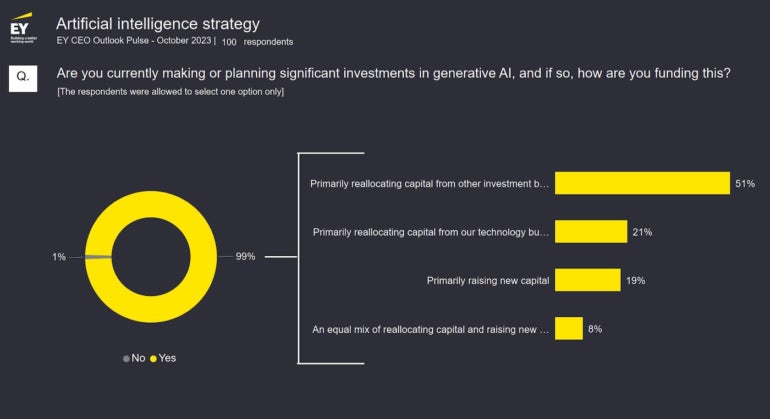
Overall, 99% of U.K. CEOs have made or are planning to make “significant capital investments” in generative AI in the next 12 months, with 51% reallocating capital from other parts of the company to fund these investments (Figure A).

Figure A

Infographic showing more than half of UK CEOs are reallocating budgets to invest in AI initiatives.
More than half of UK CEOs are reallocating budgets to invest in AI initiatives. Image: EY

The struggle to separate hype from reality

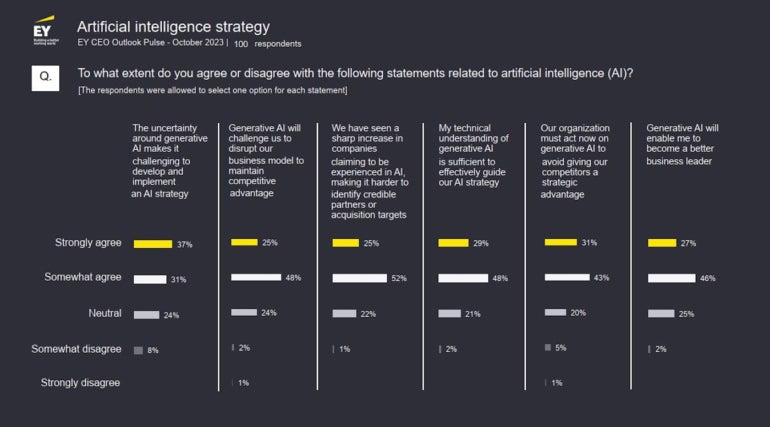
However, businesses face challenges capitalizing on generative AI as they wait for the reality to catch up with the hype. EY found that 68% of business leaders in the U.K. say uncertainty around generative AI is creating challenges for adoption, with EY noting that “a surge in companies claiming AI expertise” is making it difficult for leaders to cut through the noise and implement AI strategies.

Business leaders acknowledge that the buzz around AI, and generative AI in particular, has “hindered decision-making about credible partnerships and acquisition targets,” said EY. More than three-quarters (77%) of U.K. CEOs reported a sharp rise in the number of companies “claiming to be experienced in AI,” making it harder for them to identify good investment opportunities (Figure B).

Figure B

Infographic showing an abundance of companies claiming AI expertise is making strategic decision-making difficult for U.K. CEOs.
An abundance of companies claiming AI expertise is making strategic decision-making difficult for U.K. CEOs. Image: EY

Silvia Rindone, UK&I managing partner for strategy and transactions at EY, commented in the report: “U.K. CEOs clearly see the huge opportunities that AI offers in its ability to drive productivity and provide a competitive advantage and, as a result, are making significant investments in AI technology. However, this optimism is also tempered with caution, with many grappling with how best to implement and future-proof AI strategies.”

Business leaders worldwide feel pressure to invest in generative AI

Data from EY indicates that AI is the top focus area for European CEOs in 2023, with 93% of European business leaders having fully integrated or are planning to integrate AI into their capital allocation over the next 12 months. This is compared to 88% globally, 89% in Asia-Pacific and 82% in the Americas.

Germany leads the pack in Europe, where 53% of companies have already incorporated AI in capital allocation, supported by the government’s plan to invest €5 billion ($5.48 billion USD) in AI research by 2025 under the “AI Made in Germany” initiative. In the U.K., 58% of companies are planning AI investments in the coming year, with France not far behind at 54%.

SEE: Microsoft invests $5 billion in Australia to boost AI, cyber security and tech skills growth.

The urgency to intensify investment is felt worldwide: 70% of 1,200 global CEOs surveyed by EY said they feel pressure to accelerate investment in generative AI, while 68% agreed that uncertainty around generative AI made it difficult to quickly identify, develop and implement AI strategies.

The survey also found that the companies most in need of gains from AI — defined by EY as those expecting to see year-on-year revenues decline in 2024 — are the furthest behind on AI adoption and the least likely to be increasing investment.

“While it makes sense that these companies have fewer resources to invest in AI, they may need to reconsider their approach. Some of the quickest gains from AI deployment are improvements in efficiency and productivity that can boost the prospects of slower-growth companies,” the report read.

Why short-term gains do not guarantee long-term success

Business leaders may also be under the impression that short-term wins in generative AI adoption translate into long-term revenue gains when this may not be the case, EY found.

Sixty-four percent of CEOs who reported seeing “a significant impact from generative AI” expect the technology to define their entire business and operating model in two years or less. CEOs of companies with deeper experience in artificial intelligence expect this to take three to five years, EY found.

EY noted that such transformative change was “significantly harder to achieve than early wins in revenue or efficiency,” indicating that business leaders may be caught up in the hype around gen AI and need to taper their expectations accordingly.

“[This] suggests that AI and gen AI are unfamiliar territory for many CEOs,” the report said. “Setting and failing to meet lofty expectations may erode the confidence of employees and shareholders, making it more difficult to transform in the long run. To avoid this, CEOs should work closely with their chief technology officers (CTOs) to ensure their expectations and strategic plans around AI are feasible given their current resources and capabilities.”

KPMG: ‘Don’t wait for all the questions to be answered’

In its own CEO Outlook Report, KPMG advised business leaders to think cautiously when investing in generative AI — while simultaneously suggesting that they “get started now” rather than waiting for “all the regulatory and ethical questions to be answered.”

PREMIUM: Businesses should consider implementing an AI ethics policy.

KPMG’s survey of 150 CEOs from the U.K. found that 71% see generative AI as a top investment priority, despite ongoing economic uncertainty.

Ian West, head of alliances and head of telecoms, media and technology sector at KPMG U.K., warned executives not to “let FOMO” (fear of missing out) drive their investment in the technology,” but rather to “think through how it could disrupt your business model and be the one driving change.”

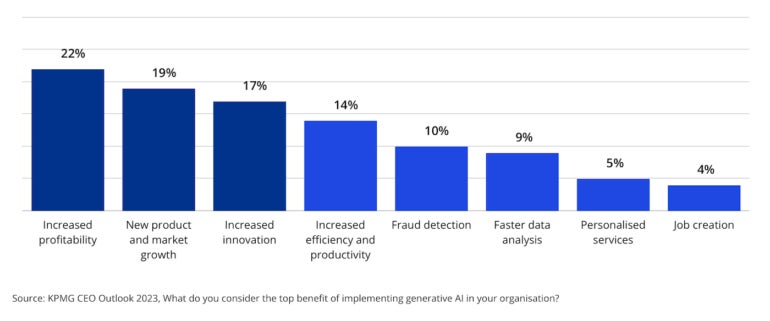
Just over one in five (22%) of executives surveyed by KPMG cited increased profitability as the top benefit of implementing generative AI in their organization (Figure C). This was followed by new product and market growth (19%), increased innovation (17%), increased efficiency and profitability (14%) and fraud detection (10%).

Figure C

U.K. CEOs are attracted by the allure of increased profitability from generative AI.
U.K. CEOs are attracted by the allure of increased profitability from generative AI. Image: KPMG

“AI and machine learning are considered the most important technologies for helping businesses achieve their short-term ambitions over the next three years, according to our Global Tech Report,” KPMG’s report read.

“CEOs are committing to Gen AI over the longer-term and estimate that their investments will pay off in three to five years.”

Why generative AI safety research is beyond alignment

Data science and big data analysis technology. Data scientist wo

A way to counter AI risks could be to create AI risks. The question is by who, a non-profit, a corporation, a nation, or a treaty? It may take extremes in systems, across tasks, to find out the depths of threats.

If AI is used in weaponry, what are all the possible ways, such that when some deploy it in conflict, it can be detected, and if possible, prepared for how it might be countered, or to at least know that AI is behind?

The same applies to cybersecurity and bioweapons. This exceeds red teaming [or jail breaking], where instead of extricating weaknesses for a product or service, it is for impact in the real world, and divergence to misuse then consequences.

It is possible, in generative AI safety research, to unleash AI systems against stuff across scenarios, to become aware of areas where threats might show up, even if there are no clear answers yet, on how to handle them. This could be a premise of safety, beyond seeking AI alignment, to human values.

AI companies are putting in guardrails, which is fine, but their guardrails may not be what [solely] matters, since others may not, and may apply it for nefarious reasons. So, how can the labs be the solution, when the models of others are used for harmful stuff?

The surprises of deep fakes, voice cloning and so forth, are gaps in AI research, where risks stem from applications in the wild, rather than from explorations in closed, random circles.

There are ways to get a fairly large amount of people — spontaneously — exposed to some outputs of AI, without it being in the public yet, to understand how they would react, especially in situations where they might be emotionally involved. This is separate from beta testing or observations that led to emergent abilities, from internal experimenting. This will be more like phases of AI clinical trials.

For risks with election interference, there are several small-time elections across organizations, associations, and others that are not as consequential as national elections. They are samples to experiment with AI tools, where campaigns would have access to do whatever they want, then data on what they do, how the electorates react, the outcome, the irrationality of the campaigns and so forth. These would be used to understand how it is used and where prevention tactics may come in or help to shape awareness messages, then to use that for cases in national elections.

The purpose is consequence extents for what the application presents, to know what it might mean out there, and to prepare for it, while finding ways to communicate safety, more broadly, against people becoming casualties of it, especially if another team let it loose.

For AI research, the good thing might be that the safety team already had precautions that the world may use against those risks.

There are those who care about AI risks that are here and now. There are others who care about AGI risks and its takeover.

Those risks are possible as experiments in closed circles. For those who are worried about job losses from AI, roles in organizations where LLMs can partially or fully erase may be explored to see what might happen if an employee loses a job, or gets a pay cut, due to reduced performance or a takeover by AI.

There are firms that are already firing employees due to the role of LLMs in tasks. Those people can be tracked, for what they do next or their situations. The goal is to understand scenarios and extrapolate it, to prepare options, or at least know what might result, more than assuming that it will simply be really bad or there will be no meaning to life, if someone is unemployed for — the reason of — replacement by AI.

There are those worried about bias. The same applies, where AI is biased, those affected and the results, both in controlled but random studies and then in real-world cases and consequences, to prepare, find options and communicate effectively, all as aspects of research.

For AGI, what might AI want to do when it has autonomy?

Say, as a major data center, with super models, what might it want? If it is connected to a social media account, what might it want to do? Or, an email, or involved in drug discovery and so forth.

This question can be explored with bots, viruses, and several statistical cases across scenarios. Just to have at it and prepare for its reach, and find weaknesses, or blocks.

Since AGI will initially be digital, what are digital exposures that can drastically affect current life, and where must barriers be, for AI models to not be connected?

It is OK to restrict some outputs of some recent chatbots, with what they can answer, but AI safety exceeds those.

There are different categories of safety, but it will be tough to not play things out to know, similar to a tech gain-of-function. AI safety would be at different levels of efforts to include labs, blocs and so forth.

The ultimate AI safety will be to explore a possible way the human mind works, to state, display and expand the biochemical advantage the brain may retain over silicon wafers.

A timeline of Sam Altman’s firing from OpenAI — and the fallout

A timeline of Sam Altman’s firing from OpenAI — and the fallout Kyle Wiggers 9 hours
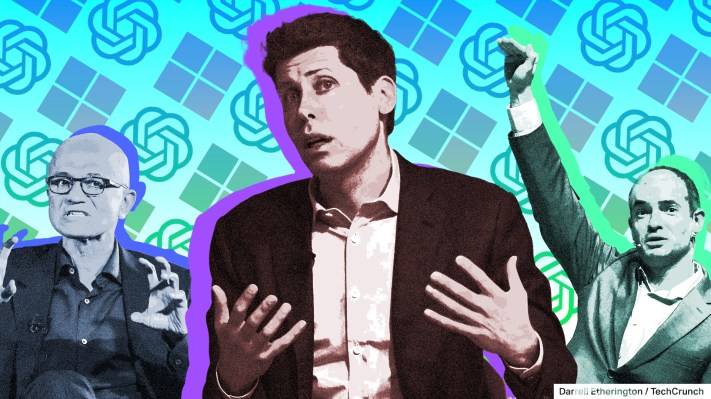
In a dramatic turn of events late Friday, ex-Y Combinator president Sam Altman was fired as CEO of AI startup OpenAI, the company behind viral AI hits like ChatGPT, GPT-4 and DALL-E 3, by OpenAI’s board of directors. Then, the company’s longtime president and co-founder, Greg Brockman, resigned — as did three senior OpenAI researchers. And the fallout continues.

Tip TechCrunch

Do you work at OpenAI and know more about Sam Altman’s departure? Get in touch with TechCrunch.

It’s a fast-moving situation that we’re still trying to get to the bottom of. No doubt more will become clear as time goes on. To make it easier to follow all that’s happened in the meantime, though, we’ve put together a timeline; we’ll do our best to keep it current.

Timeline of Sam Altman’s firing from OpenAI

November 16

Ilya Sutskever schedules call with Altman

According to a post on X (formerly Twitter) from Brockman, Ilya Sutskever, the chief scientist at OpenAI and a co-founder, texted Altman on Thursday evening about scheduling a Friday noon call.

Sam and I are shocked and saddened by what the board did today.

Let us first say thank you to all the incredible people who we have worked with at OpenAI, our customers, our investors, and all of those who have been reaching out.

We too are still trying to figure out exactly…

— Greg Brockman (@gdb) November 18, 2023

Murati told of Altman’s firing

Brockman alleges that Mira Murati, OpenAI’s CTO and now interim CEO, was informed on Thursday night that Altman would be fired.

November 17

Brockman demoted

Brockman says he got a text from Sutskever shortly after noon on Friday asking for a quick call. After sending a Google Meet link, Brockman was told that he was being removed from the board as chairman “but was vital to the company and would retain his role” as president, and that Altman had been fired.

Altman’s firing publicly announced

OpenAI published a post on its blog announcing the executive shake-up. The company’s management team was aware shortly after.

i loved my time at openai. it was transformative for me personally, and hopefully the world a little bit. most of all i loved working with such talented people.

will have more to say about what’s next later.

🫡

— Sam Altman (@sama) November 17, 2023

All-hands meeting

OpenAI held an all-hands meeting Friday afternoon during which Sutskever defended Altman’s ouster. He dismissed suggestions that pushing Altman out amounted to a “hostile takeover,” and claimed that it was necessary to protect OpenAI’s mission of “making AI beneficial to humanity.”

Microsoft releases a statement

Satya Nadella, the CEO of Microsoft, a major investor in — and partner with — OpenAI, published a statement about Altman’s firing:

“As you saw at Microsoft Ignite this week, we’re continuing to rapidly innovate for this era of AI, with over 100 announcements across the full tech stack from AI systems, models and tools in Azure, to Copilot. Most importantly, we’re committed to delivering all of this to our customers while building for the future. We have a long-term agreement with OpenAI with full access to everything we need to deliver on our innovation agenda and an exciting product roadmap; and remain committed to our partnership, and to Mira and the team. Together, we will continue to deliver the meaningful benefits of this technology to the world.”

Brockman quits

Brockman announced his resignation from OpenAI, citing “today’s news.” After sending a memo internally, he published the text on X.

After learning today’s news, this is the message I sent to the OpenAI team: https://t.co/NMnG16yFmm pic.twitter.com/8x39P0ejOM

— Greg Brockman (@gdb) November 18, 2023

Senior OpenAI researchers resign

Three senior OpenAI researchers resign after Brockman, including the director of research Jakub Pachocki and head of preparedness Aleksander Madry.

November 18

“Not … in response to malfeasance”

In an internal memo obtained by Axios sent Saturday morning, OpenAI COO Brad Lightcap said yesterday’s announcement “took [the management team] by surprise” and that management had had “multiple conversations with the board to try to better understand the reasons and process behind their decision.” Discussions were ongoing as of Saturday morning, per the memo.

“We can say definitively that the board’s decision was not made in response to malfeasance or anything related to our financial, business, safety, or security/privacy practices,” Lightcap added. “This was a breakdown in communication between Sam and the board … We still share your concerns about how the process has been handled, are working to resolve the situation, and will provide updates as we’re able.”

OpenAI’s funding in jeopardy

The planned sale of OpenAI employee shares that would value the startup at about $86 billion could be in jeopardy. The Information, speaking to three sources formerly with the company, reports that they no longer expect the sale — led by Thrive Capital — to happen, or, if it does, to come with a lesser valuation because of the recent turn of events.

Altman planning new venture

Altman has been telling investors that he’s planning to launch a new venture, according to The Information. Brockman is expected to join the effort — whatever form it takes. (Possibly an AI chip startup.)

i love you all.

today was a weird experience in many ways. but one unexpected one is that it has been sorta like reading your own eulogy while you’re still alive. the outpouring of love is awesome.

one takeaway: go tell your friends how great you think they are.

— Sam Altman (@sama) November 18, 2023

Investors pushing for Altman’s return

Investors — furious at the turn of events — are reportedly exerting pressure on OpenAI’s board to reinstate Altman, going so far as to recruit Microsoft. Nadella is said to be sympathetic.

Board agrees to reverse course — in principle

The Verge reports that the board agreed in principle to resign and to allow Altman and Brockman to return. It waffled, however, missing a deadline yesterday by which many OpenAI staffers were set to leave the company. Altman is said to be ambivalent about coming back and asking for “significant” governance changes.

November 19

Altman to meet at OpenAI HQ

According to The Information, Altman is expected to meet at OpenAI’s San Francisco headquarters as executives at OpenAI push to have him reinstated as CEO. Brockman was invited to join — but it’s unclear whether he’ll take execs up on that invitation.

Board negotiations hit a snag

Bloomberg reports that Lightcap and Murati, among others, are pushing the board to reinstate Altman. But unsurprisingly, the directors are resisting. As of midday Sunday, the board hadn’t resigned out of concern over who could replace them, and were vetting candidates. One possible new addition could be Salesforce co-CEO Bret Taylor.

Altman out, Shear in

Altman won’t be returning as CEO, according to a report in The Information citing an internal memo sent by Sutskever. As the search for a new permanent CEO continues, OpenAI has appointed Emmett Shear, the co-founder of video streaming site Twitch, as interim CEO — replacing Murati.

November 20

Altman joins Microsoft

Sam Altman, Greg Brockman and colleagues announce that they’ll join Microsoft to lead a new AI research team. Nadella leaves the door open to other OpenAI staffers, saying that they’ll be given the resources they need should they choose to join.

Sutskever’s mea culpa

Sutskever publishes a post on X suggesting that he regrets his decision to remove Altman and that he’ll do everything in his power to reinstate Altman as CEO.

I deeply regret my participation in the board's actions. I never intended to harm OpenAI. I love everything we've built together and I will do everything I can to reunite the company.

— Ilya Sutskever (@ilyasut) November 20, 2023

Employees threaten to resign

Nearly 500 of OpenAI’s roughly 770 employees — including, remarkably, Sutskever — publish a letter saying that they might quit unless the startup’s board resigns and reappoints the ousted Altman. Later Monday, that number climbed to over 650.

Altman and Brockman considering return

As reported by The Verge, Altman’s move to Microsoft isn’t a done deal — and both Altman and Brockman are still open to returning to OpenAI. That is, if the remaining board members who initially fired him step aside.

OpenAI board considers merger

OpenAI’s board of directors approached Dario Amodei, the co-founder and CEO of rival large-language model developer Anthropic, about a potential merger of the two companies, The Information reports. The approach was part of an effort by OpenAI to persuade Amodei to replace Altman as CEO — but Amodei quickly turned down the CEO offer.

November 21

Altman and board in talks

OpenAI’s board of directors is reportedly in talks with Sam Altman, ex-Y Combinator president and an OpenAI co-founder, to return to OpenAI as CEO as soon as this week. That’s according to Bloomberg, which in a brief — citing sources close to the matter — said that discussions are happening between Quora CEO Adam D’Angelo, one current member of the OpenAI board, and Altman — and possibly other board members as well.
DSC Weekly 21 November 2023

Announcements

  • The data security landscape is shifting as organizations embrace SaaS-based applications, public cloud services, data analytics platforms, and AI/ML workloads. Unfortunately, such progress has been met by a resurgence of ransomware attacks and a record-breaking number of data breach disclosures. In light of these revelations, new consumer privacy protection acts have imposed heavier financial penalties, leading to changes in the cybersecurity insurance marketplace and how organizations measure potential risk. Register for the free Data Security Risks and Challenges summit to learn about the latest changes in data security and explore new technologies designed to protect data and customers.
  • Ransomware attacks show no signs of slowing down. This year marked a record-breaking year for ransomware attacks, as they surged 74% by the first three months of 2023. Organizations require not only a solid prevention plan, but they need established recovery solutions to ensure they bounce back from attacks that can cause irreparable economic and reputational damage. The newer and more treacherous modern threat landscape forces organizations to take a second look at cyber insurance and the security it can ensure against fallout from an attack. Join the upcoming Ransomware Preparedness: Strategies for a Secure Future summit to hear leading experts discuss actionable strategies to prevent ransomware attacks, mitigate damage, and select the best cyber insurance option for your organization.

Top Stories

  • Schmarzo and the Value·Nauts: The Journey from Data to Value
    November 18, 2023
    by Bill Schmarzo
    The journey from data and AI to value does not start with data or AI. Data and analytics are the new sources of value creation and competitive advantage in today’s economy.
  • Why generative AI safety research is beyond alignment
    November 21, 2023
    by David Stephen
    A way to counter AI risks could be to create AI risks. The question is by who, a non-profit, a corporation, a nation, or a treaty? It may take extremes in systems, across tasks, to find out the depths of threats.
  • Can AI or GPT-4 Answer my $1m Question?
    November 17, 2023
    by Vincent Granville
    Imagine if GPT-4 could tell traders how to play on the stock market. For instance, using insider information gathered on the Internet, it could produce winning buy and sell signals, with target prices, for various stocks. Then, anyone could use simple English, or even an API to get the right predictions and trade automatically.
Education_DSC_160x600-2

In-Depth

  • Key features to consider in data extraction tools
    November 20, 2023
    by Ovais Naseem
    In the fast-paced, ever-evolving world of modern business, harnessing the power of data has become a game-changer, driving informed decisions and establishing a competitive advantage. The Data integration tools play a pivotal role in amalgamating data from diverse sources and populating it into centralized storage.
  • From Confusion to Clarity: How AI Simplifies Data Management for Enterprises
    November 20, 2023
    by Pritesh Patel
    The evolution of data management has kept pace with the rapid increase in data generation, and after beginning with straightforward relational databases and ETL, big data and unstructured data paved the way for the development of automated data pipelines and lakes.
  • Should you recalibrate your AI roadmap post changes in OpenAI ?
    November 20, 2023
    by ajitjaokar
    Last night’s changes in AI have been seismic post the shock resignation of Sam Altman It is still early days and these changes will be played out Undoubtedly, this change will impact AI roadmaps worldwide So, how should you re-calibrate your AI road map post Sam Altman leaving OpenAI? Has anything really changed?
  • DSC Weekly 14 November 2023
    November 14, 2023
    by Scott Thompson
    Read more of the top articles from the Data Science Central community.
  • Beyond the numbers: The soft skills that elevate data analysts to the next level
    November 14, 2023
    by Aileen Scott
    Data analysts must have a strong grasp of practical data visualization skills to paint a clear picture of complex data for a broader audience. Seeing the big picture by delivering coherent and easily comprehensible content is crucial.

Amazon just rolled out more free AI training and generative AI scholarships

Brain made of cubes

Amazon is offering free training and scholarships for people hoping to fashion a career out of generative AI. On Monday, the company announced three initiatives designed to help workers and students alike learn the new technologies and business models of AI.

Also: Generative AI advancements will force companies to think big and move fast

As part of a program dubbed "AI Ready," Amazon will provide the following benefits:

  • Eight new and free courses on AI and generative AI.
  • Amazon Web Services (AWS) Generative AI scholarships to more than 50,000 high school and university students around the world with access to a new generative AI course on Udacity.
  • A collaboration with Code.org to train students on generative AI.

Free courses

First up, the eight new, free courses cover in-demand jobs for developers and technical workers as well as those for business leaders and non-technical professionals.

Also: I spent a weekend with Amazon's free AI courses, and highly recommend you do too

The new courses are in addition to the 80 free and low-cost generative AI classes already offered through AWS.

Developers and the technical crowd can take advantage of the following free courses:

  • Foundations of Prompt Engineering: This one introduces students to prompt engineering, explains how to design inputs, and covers advanced prompt techniques.
  • Low-Code Machine Learning on AWS: This course shows students how to prepare data as well as how to train and deploy machine learning models. It's aimed at people with minimal coding skills who don't necessarily have a deep knowledge of machine learning.
  • Building Language Models on AWS: This one explains how to use Amazon SageMaker's distributed training libraries to build language models and how to optimize open-source models and foundation models.
  • Amazon Transcribe Getting Started: Here, students learn how to use Amazon Transcribe, an AI platform that converts speech to text using automatic speech recognition technology.
  • Building Generative AI Applications Using Amazon Bedrock. In this one, students learn how to use Amazon Bedrock to build generative AI applications.
  • Introduction to Amazon CodeWhisperer: Here, students learn how to use Amazon's CodeWhisperer AI code generator to create entire lines of code.

Non-technical professionals can try the following courses:

  • Introduction to Generative Artificial Intelligence: This course introduces people to generative AI, its applications, and its important concepts such as foundation models.
  • Generative AI Learning Plan for Decision Makers: This three-course series explains how to plan a generative AI project and ready your organization for generative AI.

Generative AI scholarships

Available through the AWS Generative AI Scholarship program, AWS will offer $12 million worth of Udacity scholarships to more than 50,000 high school and university students from underserved and underrepresented communities around the world.

Also: Does your business need a chief AI officer?

Free to eligible students, the new Udacity course "Introducing Generative AI with AWS" explains generative AI concepts and includes a hands-on project. After successfully passing the course, students get a certificate from Udacity.

Collaboration with Code.org

Finally, a new collaboration between Amazon Future Engineer and Code.org will challenge students to create their own virtual music video set using songs from artists such as Miley Cyrus and Harry Styles. For the Hour of Code Dance Party: AI Edition, participants will code the virtual dancer's choreography and set up emojis as AI prompts to design animated backgrounds.

The goal is to teach the students about large language models and explain how they're used in the predictive analytics that generate images and text.

Also: CIOs assess generative AI's risk and reward for software engineers

Hour of Code will debut during Computer Science Education Week, Dec. 4–10, for students and teachers in kindergarten through 12th grade. To support Hour of Code, AWS will also offer $8 million in AWS Cloud computing credits to Code.org.

With generative AI causing waves across the business world, learning the necessary AI skills is increasingly seen as a new and in-demand career path. A study by AWS and research firm Access Partnership found that AI will become more critical among businesses, with 93% of them anticipating the use of AI-based technologies over the next five years.

To meet those needs, 73% of businesses said hiring workers with AI skills is currently a priority, though most say they're unable to find the right people. For professionals who do learn the necessary skills, employers expect that they'll earn up to 47% higher salaries.

Amazon

A brief look at the history of OpenAI’s board

A brief look at the history of OpenAI’s board Kyle Wiggers 9 hours

Three OpenAI board members stepped down earlier this year within months of each other — yet the startup didn’t line up replacements. One of the current members, former Facebook CTO and Quora CEO Adam D’Angelo, launched an AI chatbot platform, Poe, that leverages — but also competes — with OpenAI products. And two members, Tasha McCauley and Helen Toner, have ties to the same ideological philanthropic organization.

Those are a few of the eyebrow-raising takeaways from a recent Substack post by John Loeber, the co-founder of digital brokerage company Limit, who dug through the Internet Archive and OpenAI’s tax filings to get a sense of OpenAI’s governance. His timeline paints a picture of a board whose makeup changed frequently, oftentimes without warning — precipitating today’s crisis.

Early in OpenAI’s history — circa December 2015 — OpenAI’s board consisted of two people, co-chairs Elon Musk and Sam Altman. By March 2017, the board had grown to four: Musk, Altman, Chris Clark (OpenAI’s first COO) and Holden Karnofksy, the founder of effective altruism research and grantmaking foundation Open Philanthropy.

Greg Brockman, ex-OpenAI president, joined the OpenaI board in late 2017 alongside Ilya Sutskever, OpenAI’s chief scientist. The board would shrink the subsequent year following Musk’s removal — reportedly over leadership disagreements — and Clark’s unannounced departure, but grow anew in 2018 and 2019 with the additions of D’Angelo, Google robotics projects director Sue Yoon (who’d leave only a year later), LinkedIn founder Reid Hoffman, tech entrepreneur Tasha McCauley and Neuralink exec Shivon Zilis.

In 2021, Republican member of the House of Representatives Will Hurd and Helen Toner, director at Georgetown’s Center for Security and Emerging Technologies, joined while Karnofsky resigned. Karnofsky cited a potential conflict of interest because his wife, Daniela Amodei, a former OpenAI employee, helped to launch the AI company Anthropic.

Given that Toner previously worked as a senior research analyst at Open Philanthropy, Loeber speculates that Karnofsky might’ve endorsed her as his replacement.

This year, Hoffman stepped down from the OpenAI board to, he said, avoid possible conflicts with other investments. Zilis also resigned, as did Hurd — the latter to focus on a 2024 U.S. presidential campaign.

Then there were six: Altman, Brockman, D’Angelo, Toner, McCauley and Sutskever. As of Friday, four remained on the OpenAI board — the previous six minus Altman and Brockman. So what to make of it?

Loeber argues that D’Angelo had cause to resign given that Poe arguably competes more directly with OpenAI’s products and services, including the recently-announced GPT Studio, than even Hoffman’s investments.

McCauley, meanwhile, is a co-founder of the Center for the Governance of AI (GovAI), which is funded in part by Open Philanthropy — and she along with Toner are members of GovAI’s advisory board. Besides the fact that Anthropic is in part Open Philanthropy-funded, which has a tinge of corporate conflict to it, it’s not out of the question that McCauley and Toner are closely ideologically aligned and thus perhaps not as independently-minded on OpenAI’s board as it might initially appear.

Perhaps in the coming days and weeks, we’ll learn how these potential conflicts and interplays contributed to OpenAI’s undoing — if in fact they did at all.