This AI-powered vacuum and mop is only $650 for Black Friday

Eufy Clean X9 Pro CleanerBot

What's the Black Friday deal?

Amazon dropped the price for the AI-powered Eufy X9 Pro robot vacuum and mop to only $650 as part of its Black Friday deals.

Why this deal is ZDNET-recommended

The Eufy Clean X9 Pro CleanerBot, a new 2-in-1 robot vacuum, boasts a deep cleaning, hands-free mopping experience, coupled with 5,500pa of suction power. It also uses some AI navigation features to maneuver throughout your house.

Also: Best robot vacuum deals: Get a Roomba or Shark on sale now

Initially, I was less than enthusiastic about trying out yet another robot mop vacuum (I'd tested a similar one recently), but once I watched the Eufy X9 Pro work its way across my home floors, my mind was changed.

ZDNET RECOMMENDS

Eufy Clean X9 Pro CleanerBot

This is the perfect robot vacuum and mop for homes with hard floors, even if there are carpets and rugs in between.

View at Amazon

The CleanerBot truly lives up to the name, outperforming my old Roborock and the Yeedi MopStation Pro in vacuum and mop functions. The suction power, 5,500pa at maximum capacity, is outstanding. And the main brush is bristle-less, made of silicone wedges instead that are just as effective at cleaning floors.

In my limited experience (as I've only tested this model for about a week), the primary silicone brush makes it less likely for the X9 Pro to get tangled, as it's easier to scoop debris up than sweep it.

The mopping function on the Eufy X9 Pro CleanerBot is one of the two features that impressed me the most. The X9 Pro has two rotating mop pads — which I love in a robot vac/mop combo — which put 2.2 lbs of downward pressure to break down tough stains, a particularly useful feat for my home of children and pets.

Review: Roborock S8 Pro Ultra: This 2-in-1 vacuum can do just about everything

The other outstanding feature, and probably my favorite, is the use of AI for navigation, obstacle avoidance, and mapping. The CleanerBot has time-of-flight sensors and an AI camera system, called AI See, that helps detect and avoid objects so the vacuum doesn't suck up your kids' socks or stuffed animals.

It also uses iPath Laser Navigation to create maps of your home, which separates the rooms by color in the Eufy Clean app and even shows you the obstacles that the robot has found in each room. When you review the map after cleaning, you'll find things like power cords, shoes, and trash cans marked on the map.

Eufy isn't the first to use this technology for obstacle avoidance and mapping, but it is a great feature. I hate having to pick up every last bit of paper my kids dropped before I can start cleaning — only to have the robot vacuum get stuck anyway on a power cord somewhere.

Also: This robot vacuum has a brilliant self-cleaning feature I didn't know I needed

The Eufy Clean app lets you customize settings for charging, cleaning intensity, voice, and more. And it also enables you to choose from the rooms that the robot automatically created on the map so you can send it to clean just that area, like a muddy entryway. You can choose to clean zones as small as 1.6 ft by 1.6 ft on the map in case of spills.

The Eufy Clean X9 Pro CleanerBot easily adjusts to uneven surfaces to cross up to 2 cm barriers.

Beyond the AI See camera set, the CleanerBot has a sensor to detect floor types in case you're running the X9 Pro in vacuum and mopping mode and it reaches a carpet or a rug. Once the robot detects a rug or carpet, it raises the mop pads to keep them off the mat and only vacuums on the soft surface.

Also: Best robot vacuums you can buy right now

Here's another thing I was glad to see: The X9 returns dutifully to its station to wash the mop pads rather than wait until they're overdue for a cleaning. I don't want to see my robot mop dragging dry, dirty mopping pads minutes after it should've returned for a refresh, but I haven't found this to be a problem with the X9.

ZDNET's buying advice

The Eufy Clean X9 Pro CleanerBot is available for sale at $650 and is the perfect option for someone looking for a robot vacuum and mop combination for a home with a lot of hard floors, whether that's tile or hardwood, with some carpet or rugs mixed in.

It doesn't have a self-emptying dustbin, and the dustbin itself has to be emptied after each cleaning as it's pretty tiny. Still, the mopping feature and the suction power are impressive, especially as the mop can pick up stains and dirt that my Yeedi MopStation Pro left behind.


Featured reviews

Forget Siri. Turn your iPhone’s ‘Action Button’ into a ChatGPT voice assistant instead

Forget Siri. Turn your iPhone’s ‘Action Button’ into a ChatGPT voice assistant instead Sarah Perez @sarahintampa / 9 hours

With news that OpenAI’s ChatGPT Voice feature is now available to all free users, you can ditch Siri as your main voice assistant on your iPhone — well, specifically on your iPhone 15 Pro and Pro Max, that is. Apple’s latest smartphones support the ability to configure the new Action Button, which replaces the Mute button that has been on the iPhone since its debut. Via a new Settings menu, users can turn the button to other uses beyond silencing their ringer.

Depending on your personal preferences, you can associate the Action Button with any number of tasks — it can open the Camera, turn on the Flashlight, record a Voice Memo, open the Magnifier app, allow you to quickly use an Accessibility feature or run an app Shortcut.

The latter is the option you’ll want to use to turn the button into a trigger for ChatGPT.

iPhone 15 Pro Max in natural titanium, being held, showing the side of the phone including Action and volume buttons

Image Credits: Darrell Etherington

Before Wednesday’s announcement that made Voice access free for all ChatGPT users, however, associating this iOS Shortcut with the Action Button would only lead to an error, as Voice access required a ChatGPT+ subscription. Now, that’s no longer an issue, which means anyone can forgo Siri in favor of ChatGPT by configuring their Action Button to launch ChatGPT’s Voice access feature.

To do so, you’ll need to scroll down to the “Action Button” menu in the iOS Setting screen, then swipe over to the “Shortcut” option near the end. You’ll then tap on the blue button “Choose a Shortcut” and scroll down through the alphabetized list of supported apps to tap on “ChatGPT.” On the next screen, you simply tap the existing Shortcut “Start voice conversation” to associate this particular action with the button.

Note that you’ll need to have the Shortcuts app downloaded on your iPhone, if it isn’t already.

Once configured, you can press and hold the Action Button to kick off your ChatGPT voice session. Users are able to choose from five different diverse voices for their ChatGPT assistant — Ember, Sky, Breeze, Juniper and Cove. You can then simply speak your questions directly to ChatGPT and listen to its responses — like Siri but much, much smarter.

We should note that ChatGPT is far from the only app that supports the iPhone 15 Pro and Pro Max’s new feature. You can also use this button for other common tasks, like placing your favorite Starbucks coffee order, starting a workout, Shazaming a song, calling a favorite person, creating a new note and more.

A number of third-party apps have also adopted the Action Button shortcuts features, including music apps like AirScrobble, Albums, Endel, Longplay, Music Tracker, MusicHarbor and Tape It; recipe and food apps like Ambre, Calory and Crumbl; utilities like CardPointers, Opal, Sleep Cycle Kids, Tide Guide and WaterMinder; productivity apps like Doneit, Drafts, Focused Work, GoodLinks, LookUp, Rewind, Streaks, Tasks, Things, Thoughts, TickTick and Timery; photography apps like Halide; workout apps like Liftin’; reading apps like Books and Instapaper; meditation apps like Zenitizer; entertainment apps like Movie Tracker and Soka; and even other AI utilities like Petey, among others.

Apple’s first-party apps are supported, as well.

If none of these fit the bill, you can also configure your own custom Shortcuts by tapping on the plus + sign in the upper-right of the Shortcuts app’s main screen, then tapping “New Shortcut,” “Rename” (to add your Shortcut’s name), then “Done.”

Next, you’ll tap “Add Action” to see a list of available action categories, each of which you can tap into (like Media or Web) to find the action you need and add it to your shortcut. To add another action, swipe up on the search field at the bottom of the screen, then choose an action again. When you’re finished, tap “Done” and the new custom Shortcut is added to your collection, where it can be found both in the All Shortcuts and My Shortcuts categories. When this process is complete, you can then return to the Action Button menu and assign your custom shortcut to the button.

But we’d argue that adding ChatGPT support is among the better options here, given the AI chatbot’s usefulness across a number of everyday queries to to mention Siri’s lacking capabilities.

Now, if only we could make it the default assistant on the iPhone…

64% of workers have passed off generative AI work as their own

facetechgettyimages-482149611

Many users of generative AI in the workplace are leveraging the technology without training, guidance, or approval from their employers, according to new research from Salesforce. The company surveyed more than 14,000 global workers across 14 countries for the latest iteration of its Generative AI Snapshot Research Series.

Also: If AI is the future of your business, should the CIO be the one in control?

Research shows that over a quarter (28%) of workers globally are currently using generative AI at work, and over half are doing so without the formal approval of their employers. With an additional 32% expecting to use generative AI at work soon, it's clear that penetration of the technology will continue — with or without oversight.

The survey identified the top 3 safe use cases of generative AI:

  1. Only use company-approved GenAI tools/programs.
  2. Never use confidential company data in prompts for generative AI.
  3. Never use personally identifiable customer data in prompts for generative AI.

The top 3 ethical uses of GenAI at the workplace include:

  1. Fact-checking of generative AI outputs before using them.
  2. Only using generative AI tools that have been validated for accuracy.
  3. Only using company-approved generative AI tools and programs.

The survey found other interesting safety and ethical uses of generative AI in the workplace, including sourcing prompt outputs with accuracy. The survey revealed that 64% of workers have passed off generative AI work as their own. And 41% of workers would consider overstating their generative AI skills to secure a work opportunity.

The most alarming reveal of the survey may be that 7 in 10 global workers have never completed or received training on how to use generative AI safely and ethically at work.

Also: How AI reshapes the IT industry will be 'fast and dramatic'

Generative AI usage policies do vary by industry. Only 15% of all industries have loosely defined policies for using generative AI for work — 17% in the United States. Nearly 1 in 4 have no policies on using generative AI at work (1 in 3 in the US). In one example, 87% of global workers in the healthcare industry claim their company lacks clear policies. Nearly 4 in 10 (39%) global workers say their employer doesn't hold a strong opinion about generative AI use in the workplace.

The overall benefits of using GenAI in the workplace are clear. The survey found that 71% of the workforce believe that generative AI makes them more productive at work. And nearly 6 out of 10 employees say GenAI makes them more engaged at work. As far as career benefits, 47% of global workers believe mastering generative AI would make them more sought after in the workplace, over half (51%) believe it would result in increased job satisfaction, and 44% say it would mean they would be paid more than those who don't master the technology.

Artificial Intelligence

Exploring the World of AI Girlfriends: A Glimpse into the Future of Relationships

In the rapidly evolving landscape of artificial intelligence, the concept of AI girlfriends has emerged as a fascinating and, at times, controversial development. These digital companions, powered by advanced Generative AI, are redefining the boundaries of human-computer interaction, offering a blend of companionship and communication that was once the stuff of science fiction.

What are AI Girlfriends?

AI girlfriends are virtual entities created using sophisticated AI algorithms. They are designed to simulate human-like interactions, offering companionship through text and voice communication. These AI entities are not just programmed for basic responses; they are capable of learning, adapting, and personalizing their interactions based on the user's preferences and behavior.

The Role of Generative AI

Generative AI plays a crucial role in the functioning of AI girlfriends. This branch of AI focuses on generating new content, whether it's text, voice, or even images, that is original yet realistic. In the context of AI girlfriends, Generative AI is used to:

  1. Generate Conversational Responses: Through natural language processing and generation (NLP and NLG), AI girlfriends can engage in conversations that feel natural and human-like. They can respond to a wide array of topics, understand context, and even exhibit a sense of humor or empathy.
  2. Personalize Interactions: Generative AI allows these virtual companions to learn from each interaction, adapting their responses to suit the user's communication style and preferences. This personalization makes the experience more engaging and realistic.

Communication Modes: Text and Phone Conversations

AI girlfriends are accessible primarily through two modes of communication:

  1. Text-Based Interaction: Users can text with their AI girlfriends, receiving instant responses. This mode is similar to texting a friend or partner, with the AI able to maintain a coherent and engaging conversation over time.
  2. Voice Communication: Some AI girlfriends offer voice interaction, either through phone calls or voice notes. This adds a new dimension to the experience, as users can hear a voice response, making the interaction more personal and intimate.

3 Best AI Girlfriends Apps

Below we feature the top 3 current state of the art AI girlfriends.

1. Candy.ai

Candy emerges as a groundbreaking platform in the realm of virtual companionship, offering users the unique opportunity to create their own virtual girlfriend. This innovative service allows for extensive customization, enabling users to shape not only the appearance but also the personality and relationship dynamics of their AI companion. With an emphasis on user-centric design, Candy.ai provides a seamless and intuitive interface, where crafting a virtual partner is as simple as making a few selections and clicking a button.

The result is a personalized, interactive digital entity that offers companionship and engagement, reflecting the user's preferences and desires. Candy.ai represents a remarkable blend of technology and creativity, redefining the boundaries of artificial companionship and offering a glimpse into the future of personal AI interactions.

Candy.ai supports various communication modes, including text and voice chat

2. Dream GF

Dream GF introduces an innovative AI-dating simulator that redefines the virtual companionship experience. This platform empowers users to create their own virtual girlfriend, complete with customized characteristics, personality traits, and style, all in a matter of seconds. Leveraging state-of-the-art technology, Dream GF allows for the generation of unique and fully customizable AI-generated dating profiles, offering a vivid reflection of the user's imagination and personal preferences.

The experience is further enhanced by the option to interact with the virtual partner through both text and voice, adding layers of depth and realism to the interaction. Dream GF stands out as a testament to technological advancement in AI, providing a highly immersive and personalized companionship experience that caters to the diverse desires and tastes of its users.

3. Kupid

As a cutting-edge platform, Kupid AI specializes in delivering a unique and immersive chat experience, driven by sophisticated AI algorithms. Users have the opportunity to interact with AI characters that are designed to simulate real-life conversations, providing a level of interaction that blurs the line between virtual and reality. Whether it's casual talk or deep, meaningful conversations, Kupid AI tailors the experience to user preferences, making every interaction feel personal and authentic. This platform is not just about advanced technology; it's about creating a space where virtual companionship becomes a tangible reality, redefining the boundaries of human-AI interaction.

Understanding the Allure of AI Girlfriends

These AI-driven entities are meticulously designed to offer engaging and addictive experiences, appealing to a wide range of emotional and social needs. However, as we delve deeper into this captivating world, it's crucial to remember the irreplaceable value of human interaction.

AI girlfriends are engineered using sophisticated algorithms that not only simulate conversation but also learn and adapt to individual preferences. This personalization creates a sense of connection and understanding, making interactions with these virtual companions highly appealing. The allure is further heightened by their 24/7 availability and the absence of the complexities often found in human relationships. From remembering important dates to responding in a consistently understanding manner, these AI entities are programmed to fulfill idealized companionship roles, making them particularly addictive.

However, this convenience and perfection come with a caveat. As engrossing as these interactions may be, they lack the genuine emotional depth and growth inherent in human relationships. Real-world interactions challenge us, foster empathy, and develop our ability to navigate the intricate nuances of human emotions and social cues. The spontaneity, unpredictability, and profound connections we form with other people play a crucial role in our emotional and psychological development.

Therefore, while AI girlfriends can be a source of entertainment and even comfort, it's essential to maintain a balance. Engaging in the real world, nurturing human relationships, and experiencing the rich tapestry of human emotions and interactions are vital for our holistic well-being

The Future of AI and Human Relationships

The emergence of AI girlfriends raises important questions about the future of human relationships and communication. While they offer companionship and a form of interaction, it's crucial to understand the limits of such technology. AI girlfriends can offer support and a semblance of companionship but cannot replace the depth and complexity of human relationships.

As technology continues to advance, the capabilities of AI girlfriends will likely become more sophisticated, offering more realistic and nuanced interactions. However, the ethical and social implications of such technology will remain a topic of ongoing debate and consideration.

In conclusion, AI girlfriends, powered by Generative AI, represent a significant step in the world of artificial intelligence, offering unique and personalized forms of interaction. As we navigate this new terrain, it's essential to balance the excitement of technological innovation with thoughtful consideration of its impact on human relationships and society.

Inflection AI Introduces Inflection-2, Outperforms Llama 2 and PaLM 2

OpenAI Rival Inflection AI Unveils Most Friendly Chatbot Ever

Inflection AI, the startup which created conversational chatbot Pi, has introduced a new AI model named Infection-2. The company asserts that this model has the capability to outperform two well-known alternatives developed by Google and Meta, positioning itself closely behind OpenAI’s larger flagship model, GPT-4.

Inflection-2 is trained on 5,000 NVIDIA H100 GPUs in fp8 mixed precision, amounting to approximately 10²⁵ FLOPs. This newly-released model is set to be integrated into Pi, the chatbot introduced by Inflection in May. Inflection maintains close partnerships with Microsoft, Nvidia, and CoreWeave for the management of its compute cluster.

Inflection-2 outperformed the largest, 70 billion parameter version of LLaMA 2, Elon Musk’s xAI startup Grok-1, Google’s PaLM 2 Large, and startup Anthropic’s Claude 2, trailing only behind GPT-4 in the MMLU task.

The company stated that, despite math and code benchmarks not being explicit focuses, Inflection-2 performed well across four of them. However, on the two benchmarks for which OpenAI has shared results, it notably trailed GPT-4 by a considerable margin.

It also performed best on two of three questions-and-answers task benchmarks, losing to PaLM 2 Large in one.

Inflection-2 offers improved cost-effectiveness and speed compared to Inflection-1, despite its larger size. The transition from A100 to H100 GPUs, coupled with a highly optimized inference implementation, contributed to this achievement. Moreover, Inflection AI looks forward to training even larger models using the full capacity of our 22,000 GPU cluster.

The post Inflection AI Introduces Inflection-2, Outperforms Llama 2 and PaLM 2 appeared first on Analytics India Magazine.

Hardware-Accelerated AI for Windows Apps Using ONNX RT

Sponsored Content

By Rajan Mistry Sr. Applications Engineer with the Qualcomm Developer Network

Today, you can’t help but read the media headlines about AI and the growing sophistication of generative AI models like Stable Diffusion. A great example of a use case for generative AI on Windows is Microsoft 365 Copilot. This AI assistant can perform tasks such as analyzing your spreadsheets, generating content, and organizing your meetings.

And while such intelligence can feel like magic, its capabilities don’t happen magically. They’re built on a foundation of powerful ML models which have been rapidly evolving. The key enabler for these models is the rich model frameworks which allow ML developers to experiment and collaborate.

One of these emerging ML frameworks is ONNX Runtime (ONNX RT). The open-source framework’s underlying ONNX format enables ML developers to exchange models, while ONNX RT can execute them from a variety of languages (e.g., Python, C++, C#, etc.) and hardware platforms.

Our Qualcomm AI Stack now supports ONNX RT and allows for hardware-accelerated AI in Windows on Snapdragon apps. In case you haven’t heard, Windows on Snapdragon is the next generation Windows platform, built on years of evolution in mobile compute. Its key features include heterogeneous compute, up to all-day battery life, and the Qualcomm Hexagon NPU.

Let’s take a closer look at how you can use the Qualcomm AI Stack with ONNX RT for bare-metal, hardware-accelerated AI in your Windows on Snapdragon apps.

ONNX Runtime Support in the Qualcomm AI Stack

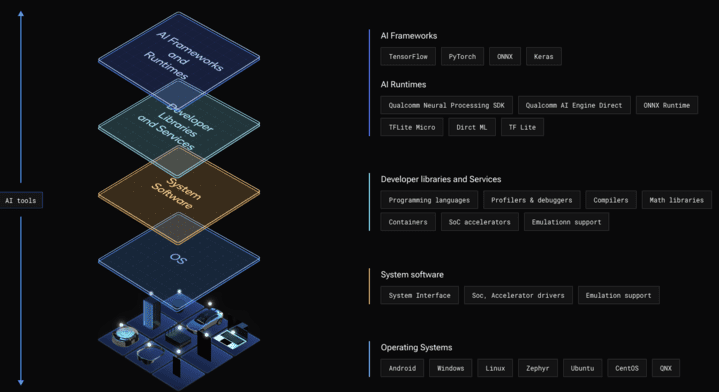
The Qualcomm AI Stack, shown in Figure 1 below, provides the tools and runtimes to take advantage of the NPU at the edge:

Figure 1 – The Qualcomm AI Stack provides hardware and software components for AI at the edge across all Snapdragon platforms.

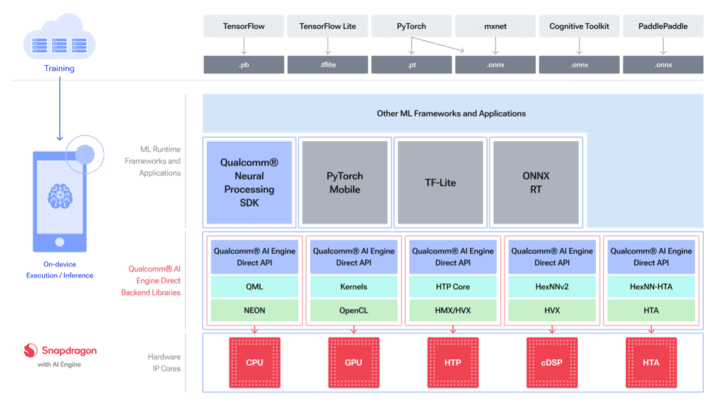
At the highest level of the stack sits popular AI frameworks for generating models. These models can then be executed on various AI runtimes including ONNX RT. ONNX RT includes an Execution Provider that uses the Qualcomm AI Engine Direct SDK bare-metal inference on Snapdragon various cores including its Hexagon NPU. Figure 2 shows a more detailed view of the Qualcomm AI Stack components:

Figure 2 – Overview of the Qualcomm AI Stack including its runtime framework support and backend libraries.

Application-level Integration

At the application level, developers can compile their applications for ONNX runtime built with support for Qualcomm AI Engine Direct SDK. ONNX RT’s Execution Provider constructs a graph from an ONNX model for execution on a supported backend library.

Developers can use the ONNX runtime API’s that provides a consistent interface across all Execution Providers. It is also designed to support various programming languages like Python, C/C++/C#, Java, and Node.js.

We offer two options to generate context binaries. One way is to use the Qualcomm AI Engine Direct tool chain. Alternatively, developers can generate the binary using ONNX RT EP, which in turn uses the Qualcomm AI Engine Direct API’s. The context binary files help applications reduce the compile time for networks. These are created when the app runs for the first time. On subsequent runs, the model loads from the cached context binary file.

Getting Started

When you’re ready to get started, visit the Qualcomm AI Engine Direct SDK page where you can download the SDK and access the documentation.

Snapdragon and Qualcomm branded products are products of Qualcomm Technologies, Inc. and/or its subsidiaries.

More On This Topic

  • Windows on Snapdragon Brings Hybrid AI to Apps at the Edge
  • Nota AI releases beta version of NetPresso Model Search, their…
  • Tech visionaries to address accelerating machine learning, unifying…
  • How to Use NVIDIA GPU Accelerated Libraries
  • Mastering GPUs: A Beginner's Guide to GPU-Accelerated DataFrames in Python
  • RAPIDS cuDF for Accelerated Data Science on Google Colab

Adobe Acquires Indian AI Video Creation Platform Rephrase.ai

U.S.-based technology giant Adobe has made its first generative AI acquisition of an Indian startup, Rephrase.ai, a Bengaluru-based AI-driven video creation company. According to reports from Economic Times, Adobe aims to integrate Rephrase’s technology stack and generative AI video capabilities into its proprietary video-editing platform, Creative Cloud. This move is expected to enhance Adobe’s offerings in the video creation space.

The exact value of the deal remains undisclosed.

Exciting news! https://t.co/1vjINmfQE6 is getting acquired by a pioneering creative tech company, ushering us into the new era of Generative AI. 🚀 #GenAI #TechAcquisition #startups

— Shivam Mangla (@_shivammangla) November 22, 2023

As part of the acquisition, Adobe will integrate the majority of Rephrase.ai’s workforce. The founders of Rephrase.ai will also collaborate closely with the software company moving forward. Currently, Rephrase.ai has a team consisting of approximately 45 employees.

As a result of the acquisition, Rephrase’s investors are expected to achieve a full cash exit, with the founders receiving compensation in both cash and Adobe stock, ET report added.

“The Rephrase.ai team’s expertise in generative AI video and audio technology and experience-building text-to-video generator tools will extend our generative video capabilities — and enable us to deliver more value to our customers faster — all within our industry-leading creative applications,” Ashley Still, senior vice president and general manager, Creative Cloud, wrote in an internal memo to employees.

“A huge shoutout to our team – our technology teams for pushing the frontiers of AI, and our business teams for writing a playbook to sell GenerativeAI in India. Your dedication and hard work have been everything to us, and the company. This is your success, and nobody else’s,” Shivam Mangla, co-founder at Rephrase.ai said on X.

Founded by Ashray Malhotra, Nisheeth Lahoti, and Shivam Mangla, the startup has garnered a total funding of $13.9 million to date. In September of the previous year, it secured $10.6 million in a funding round led by Red Ventures. Additional supporters of the startup encompass Lightspeed India, Silver Lake, 8VC, and Techstars.

The post Adobe Acquires Indian AI Video Creation Platform Rephrase.ai appeared first on Analytics India Magazine.

A Comprehensive List of Resources to Master Large Language Models

A Comprehensive List of Resources to Master Large Language Models
Image generated with Leonardo.Ai

In this vast landscape of AI, a revolutionary force emerged in the form of Large Language Models (LLMS). It is not just a buzzword but our future. Their ability to understand and generate human-like text brought them into the spotlight and now it has become one of the hottest areas of research. Imagine a chatbot that can respond to you as if you are talking to your friends or envision a content generation system that it becomes difficult to distinguish whether it's written by a human or an AI. If things like this intrigue you and you want to dive further into the heart of LLMs, then you are at the right place. I have gathered a comprehensive list of resources ranging from informative articles, courses, and GitHub repositories to relevant research papers that can help you understand them better. Without any further delay, let's kickstart our amazing journey in the world of LLMs.

1. Foundational Courses A Comprehensive List of Resources to Master Large Language Models
Image by Polina Tankilevitch on Pexels

1. Deep Learning Specialization — Coursera

Link: Deep Learning Specialization

Description: Deep learning forms the backbone of LLMs. This comprehensive course taught by Andrew Ng covers the essential topics of neural networks, the basics of Computer vision and Natural Language Processing, and how to structure your machine learning projects.

2. Stanford CS224N: NLP with Deep Learning — YouTube

Link: Stanford CS224N: NLP with Deep Learning

Description: It is a goldmine of knowledge and provides a thorough introduction to cutting-edge research in deep learning for NLP.

3. HuggingFace Transformers Course — HuggingFace

Link: HuggingFace Transformers Course

Description: This course teaches the NLP by using libraries from the HuggingFace ecosystem. It covers the inner workings and usage of the following libraries from HuggingFace:

  • Transformers
  • Tokenizers
  • Datasets
  • Accelerate

4. ChatGPT Prompt Engineering for Developers — Coursera

Link: ChatGPT Prompt Engineering Course

Description: ChatGPT is a popular LLM and this course shares the best practices and the essential principles to write effective prompts for better response generation.

2. LLMs Specific Courses A Comprehensive List of Resources to Master Large Language Models
Image generated with Leonardo.Ai

1. LLM University — Cohere

Link: LLM University

Description: Cohere offers a specialized course to master LLMs. Their sequential track, which covers the theoretical aspects of NLP, LLMs, and their architecture in detail, is targeted towards beginners. Their non-sequential path is for experienced individuals interested more in the practical applications and use cases of these powerful models rather than their internal working.

2. Stanford CS324: Large Language Models — Stanford Site

Link: Stanford CS324: Large Language Models

Description: This course dives deeper into the intricacies of these models. You will explore the fundamentals, theory, ethics, and practical aspects of these models while also gaining some hands-on experience.

3. Princeton COS597G: Understanding Large Language Models — Princeton Site

Link: Understanding Large Language Models

Description: It is a graduate-level course that offers a comprehensive curriculum, making it an excellent choice for in-depth learning. You will explore the technical foundations, capabilities, and limitations of models like BERT, GPT, T5 models, mixture-of-expert models, retrieval-based models, etc.

4. ETH Zurich: Large Language Models(LLMs) — RycoLab

Link: ETH Zurich: Large Language Models

Description: This newly designed course offers a comprehensive exploration of LLMs. Dive into probabilistic foundations, neural network modeling, training processes, scaling techniques, and critical discussions on security and potential misuse.

5. Full Stack LLM Bootcamp — The Full Stack

Link: Full Stack LLM Bootcamp

Description: The Full Stack LLM boot camp is an industry-relevant course that covers topics such as prompt engineering techniques, LLM fundamentals, deployment strategies, and user interface design, ensuring participants are well-prepared to build and deploy LLM applications.

6. Fine Tuning Large Language Models — Coursera

Link: Fine Tuning Large Language Models

Description: Fine Tuning is the technique that allows you to adapt LLMs to your specific needs. By completing this course, you will understand when to apply finetuning, data preparation for fine-tuning, and how to train your LLM on new data and evaluate its performance.

3. Articles / Books A Comprehensive List of Resources to Master Large Language Models
Image generated with Leonardo.Ai

1. What Is ChatGPT Doing … and Why Does It Work? — Steven Wolfram

Link: What is ChatGPT Doing … and Why Does It Work?

Description: This short book is written by Steven Wolfram, a renowned scientist. He discusses the fundamental aspects of ChatGPT, its origins in neural nets, and its advancements in transformers, attention mechanisms, and natural language processing. It is an excellent read for someone interested in exploring the capabilities and limitations of LLMs.

2. Understanding Large Language Models: A Transformative Reading List — Sebastian Raschka

Link: Understanding Large Language Models: A Transformative Reading List

Description: It contains a collection of important research papers and provides a chronological reading list, starting from early papers on recurrent neural networks (RNNs) to the influential BERT model and beyond. It is an invaluable resource for researchers and practitioners to study the evolution of NLP and LLMs.

3. Article Series: Large Language Models — Jay Alammar

Link: Article Series: Large Language Models

Description: Jay Alammar's blogs are a treasure trove of knowledge for anyone studying large language models (LLMs) and transformers. His blogs stand out for their unique blend of visualizations, intuitive explanations, and comprehensive coverage of the subject matter.

4. Building LLM Applications for Production — Chip Huyen

Link: Building LLM Applications for Production

Description: In this article, the challenges of productionizing LLMs are discussed. It offers insights into task composability and showcases promising use cases. Anyone interested in practical LLMs will find it really valuable.

4. Github Repositories A Comprehensive List of Resources to Master Large Language Models
Image by RealToughCandy.com on Pexels

1. Awesome-LLM ( 9k ⭐ )

Link: Awesome-LLM

Description: It is a curated collection of papers, frameworks, tools, courses, tutorials, and resources focused on large language models (LLMs), with a particular emphasis on ChatGPT.

2. LLMsPracticalGuide ( 6.9k ⭐ )

Link: The Practical Guides for Large Language Models

Description: It helps the practitioners to navigate the expansive landscape of LLMs. It is based on the survey paper titled: Harnessing the Power of LLMs in Practice: A Survey on ChatGPT and Beyond and this blog.

3. LLMSurvey ( 6.1k ⭐ )

Link: LLMSurvey

Description: It is a collection of survey papers and resources based on the paper titled: A Survey of Large Language Models. It also contains an illustration of the technical evolution of GPT-series models as well as an evolutionary graph of the research work conducted on LLaMA.

4. Awesome Graph-LLM ( 637 ⭐ )

Link: Awesome-Graph-LLM

Description: It is a valuable source for people interested in the intersection of graph-based techniques with LLMs. it provides a collection of research papers, datasets, benchmarks, surveys, and tools that delve into this emerging field.

5. Awesome Langchain ( 5.4k ⭐ )

Link: awesome-langchain

Description: LangChain is the fast and efficient framework for LLM projects and this repository is the hub to track initiatives and projects related to LangChain's ecosystem.

5. Additional Resources — Research and Survey Papers

  1. "A Complete Survey on ChatGPT in AIGC Era” — It's a great starting point for beginners in LLMs. It comprehensively covers the underlying technology, applications, and challenges of ChatGPT.
  2. “A Survey of Large Language Models” — It covers the recent advances in LLMs specifically in the four major aspects of pre-training, adaptation tuning, utilization, and capacity evaluation.
  3. “Challenges and Applications of Large Language Models” — Discusses the challenges of LLMs and the successful application areas of LLMs.
  4. “Attention Is All You Need” — Transformers serve as the foundation stone for GPT and other LLMs and this paper introduces the Transformer architecture.
  5. “The Annotated Transformer” — A resource from Harvard University that provides a detailed and annotated explanation of the Transformer architecture, which is fundamental to many LLMs.
  6. “The Illustrated Transformer” — A visual guide that helps you understand the Transformer architecture in depth, making complex concepts more accessible.
  7. "BERT: Pre-training of Deep Bidirectional Transformers for Language Understanding" — This paper introduces BERT, a highly influential LLM that sets new benchmarks for numerous Natural Language Processing (NLP) tasks.

Summing Up

In this article, I've curated an extensive list of resources essential for mastering Large Language Models (LLMs). However, learning is a dynamic process, and knowledge-sharing is at its heart. If you have additional resources in mind that you believe should be part of this comprehensive list, please don't hesitate to share them in the comment section. Your contributions could be invaluable to others on their learning journey, creating an interactive and collaborative space for knowledge enrichment.

Kanwal Mehreen is an aspiring software developer with a keen interest in data science and applications of AI in medicine. Kanwal was selected as the Google Generation Scholar 2022 for the APAC region. Kanwal loves to share technical knowledge by writing articles on trending topics, and is passionate about improving the representation of women in tech industry.

More On This Topic

  • The Most Comprehensive List of Kaggle Solutions and Ideas
  • How to Get Up and Running with SQL — A List of Free Learning Resources
  • Top Open Source Large Language Models
  • More Free Courses on Large Language Models
  • Learn About Large Language Models
  • Introducing Healthcare-Specific Large Language Models from John Snow Labs

OpenAI saga shows the race for AI supremacy is no longer just between nations

altmanaigettyimages-1794514589

The battle between the US and China for AI prowess is what I'd first planned to discuss when starting this post. A frenzied weekend has now changed the scope of this debate. Yet, the underlying messaging remains the same, especially for governments still figuring out their role in an era that may be impacted significantly by these emerging technologies.

It's been a jaw-dropping week at OpenAI, and it now appears an agreement has been reached for its ousted co-founder and CEO Sam Altman to return to the helm. The decision comes after days of popcorn-worthy developments, during which the generative AI powerhouse lost its CEO, watched him join Microsoft, replaced its first interim CEO with a second interim CEO, and faced a staff revolt.

Also: Generative AI advancements will force companies to think big and move fast

OpenAI said in a statement announcing Altman's reinstatement: "We have reached an agreement in principle for Sam Altman to return to OpenAI as CEO, with a new initial board of Bret Taylor (Chair), Larry Summers, and Adam D'Angelo. We are collaborating to figure out the details. Thank you so much for your patience through this."

Reports are still unclear whether Altman will now gain a seat on the board, one he didn't have before. He previously noted in a June 2023 Bloomberg interview on AI trust: "No one person should be trusted here… The board can fire me. I think that's important."

Also, no word yet on whether OpenAI's co-founder and chief scientist Ilya Sutskever will return. Sutskever was on the previous board, along with fellow board member Helen Toner, both of whom were speculated to have played a part in the decision to remove Altman. Sutskever, though, later expressed his regret in doing so.

Also: OpenAI aiming to create AI as smart as humans, helped by funds from Microsoft

Toner, who had stayed silent throughout the mayhem, finally said on X after it was revealed Altman would return: "And now, we all get some sleep."

Toner, the director of strategy and foundational research grants at the Center for Security and Emerging Technology, had co-authored a research paper that Altman said was critical of OpenAI. The report noted that the company's efforts in keeping its AI developments safe had paled in comparison with Anthropic's. Altman was upset enough to campaign for her removal from the board, according toaNew York Times article.

In its original statement announcing Altman's dismissal, OpenAI's board had said it was no longer confident in his ability to lead the company. "Altman's departure follows a deliberative review process by the board, which concluded that he was not consistently candid in his communications with the board, hindering its ability to exercise its responsibilities."

Also: AI safety and bias: Untangling the complex chain of AI training

The board further noted that OpenAI, founded as a non-profit in 2015, was "deliberately structured to advance our mission" of ensuring artificial general intelligence (AGI) would benefit all humanity. "The board remains fully committed to serving this mission…we believe new leadership is necessary as we move forward," the statement read.

The company was restructured in 2019 to allow for capital to be raised in pursuit of its mission, while "preserving" the non-profit's governance and oversight. "While the company has experienced dramatic growth, it remains the fundamental governance responsibility of the board to advance OpenAI's mission and preserve the principles of its Charter," it said.

Despite noting Altman's less-than-candid communications as the rationale behind his ousting, the board gave no further details or specific reasons that had led to that conclusion.

With the board, including Toner and Sutskever — said to be concerned about Altman's focus on expansion over AI safety — choosing to remain largely silent over the reason that drove the decision to fire Altman, speculation ran rife on social media.

Also: Companies aren't spending big on AI. Here's why that cautious approach makes sense

As more reports of tensions between Altman and the board emerged, it soon became clear — to most observers — that the debate was very likely between AI safety and profit. And herein lies the crux of the problem. These are still assumptions and speculations because there simply isn't enough information, or any at all, about what really were the concerns of OpenAI's board.

What facts has Altman omitted or lied about that led the board to determine he was no longer aligned with OpenAI's mission that AGI must "benefit all of humanity"? Is OpenAI's backroom research and development nearing AGI, and the board isn't sure "all of humanity" is ready for it? Should this be something the general public and nations need to worry about, too?

If there's one thing that has at least become even clearer in the past week, it is that the world's future with AI in it is very much in the hands of a very small band of market players. The Big Tech collective has the deep pockets and the resources to determine how they think AI should impact society at large. Yet, this elite tech community represents just a minute fraction of the world's population and demographics.

Also: Global players look to create baseline to evaluate generative AI applications

Within days, these tech elite have been able to maneuver Altman's ousting, his hiring at Microsoft (albeit short-lived), the potential transfer of almost an entire OpenAI workforce to another major market player, and Altman's eventual reinstatement. And they've done all of this without any clear concerted effort to explain why he was fired in the first place and verify, or refute, concerns about the prioritization of AI safety over profits.

There are suggestions that OpenAI's new board will initiate an investigation into the motives behind Altman's dismal, but this is said to be internal.

Practice what AI transparency preaches

Amid the chaotic week, one message is now even more apparent. Transparency is crucial in the development and adoption of all AI — generative, AGI, or otherwise. Transparency is the foundation of trust, on which most agree AI must be built to gain human acceptance.

Big Tech, too, has preached the importance of transparency in driving responsible and ethical AI.

And when none is forthcoming, transparency then must be driven by regulation. We need legislation that does not seek to inhibit market innovation in AI, but that focuses on mandating transparency in how this innovation is developed and advanced.

The whole OpenAI debacle should serve as a great learning opportunity for governments and societies on how AI development should move forward. We've now also witnessed the complexities of managing this, even if its development is tied to a non-profit corporate framework.

Also: AI is transforming organizations everywhere. How these 6 companies are leading the way

That a key employee had to resign, so he could talk freely about the risks of AI, clearly indicates market players are unlikely to be fully transparent with its development, despite pledging to do so.

It underscores the need for strong governance to ensure they do so, and the urgency for these to be established. As we've already witnessed, the market — in particular Big Tech — can move at incredible speed. And this likely will accelerate at an even faster pace now that this past week has put more scrutiny on AI.

Lawmakers will need to move quickly. The UK-led Bletchley Declaration on AI Safety is a great step forward, with 28 nations, including China, the US, Singapore, and EU agreeing to collaborate on identifying and managing potential risks from "frontier" AI. The multilateral agreement outlines the countries' recognition of the "urgent need" to ensure AI is developed and deployed in a "safe, responsible way" for the benefit of the global community.

The United Nations also has laid out plans for an advisory team to look at the international governance of AI to mitigate potential risks, with a pledge to adopt a "globally inclusive" approach.

I hope someone over there is taking notes from this past week's OpenAI case study. Because the discussion now isn't just about which nation will dominate the AI race, but whether Big Tech will take over the steering wheel without the necessary speed bumps in place.

OpenAI’s initial new board counts Larry Summers among its ranks

OpenAI’s initial new board counts Larry Summers among its ranks Kyle Wiggers 9 hours

Meet OpenAI’s new board of directors: Bret Taylor, Larry Summers and Adam D’Angelo. Or, more precisely, the board for the time being.

We have reached an agreement in principle for Sam Altman to return to OpenAI as CEO with a new initial board of Bret Taylor (Chair), Larry Summers, and Adam D'Angelo.

We are collaborating to figure out the details. Thank you so much for your patience through this.

— OpenAI (@OpenAI) November 22, 2023

Around 1 a.m. Eastern Time on Tuesday, OpenAI announced that, after the company’s previous board of directors abruptly fired Sam Altman as CEO last Friday, it had reached an agreement “in principle” for Altman to return to OpenAI as CEO in tow with a new “initial” slate of board members. (He’ll replace interim CEO Emmett Shear, who, along with OpenAI CTO Mira Murati, had the briefest of tenures at the reigns.) Taylor, the former co-CEO of Salesforce, will chair this board, alongside Quora CEO D’Angelo — a holdover from OpenAI’s previous board — and Summers.

I am deeply pleased by this result, after ~72 very intense hours of work. Coming into OpenAI, I wasn’t sure what the right path would be. This was the pathway that maximized safety alongside doing right by all stakeholders involved. I’m glad to have been a part of the solution. https://t.co/AGoDBbwhkq

— Emmett Shear (@eshear) November 22, 2023

“Initial” implies that the board is transitionary rather than permanent. And — this being an “in principle” ordeal — it’s far from concrete. We’ll have to await clarification from OpenAI, which presumably will come at a more reasonable hour in the workday.

If a Verge report is to be believed, however, the final OpenAI board will have nine members total — likely including Altman and a Microsoft exec. Microsoft had reportedly been mulling whether to push for a board seat prior to Tuesday’s breakthrough, which could invite regulatory scrutiny given the company’s relationship with OpenAI. The tech giant evidently feels it’s worth the governance and oversight guarantees.

i love openai, and everything i’ve done over the past few days has been in service of keeping this team and its mission together. when i decided to join msft on sun evening, it was clear that was the best path for me and the team. with the new board and w satya’s support, i’m…

— Sam Altman (@sama) November 22, 2023

We are encouraged by the changes to the OpenAI board. We believe this is a first essential step on a path to more stable, well-informed, and effective governance. Sam, Greg, and I have talked and agreed they have a key role to play along with the OAI leadership team in ensuring… https://t.co/djO6Fuz6t9

— Satya Nadella (@satyanadella) November 22, 2023

Now, Taylor’s name had been bandied about in reports over the past several days as a potential appointee to a new OpenAI board. And it’s not out of the question that D’Angelo, who was allegedly deeply involved in negotiations to bring Altman back into the OpenAI fold, has the necessary support to retain his seat. But Summers is a bit of a wildcard — at least on first glance.

An economist, Summers served as the U.S. secretary of the treasury from 1999 to 2001 and as director of the National Economic Council from 2009 to 2010. More recently, he directed the White House U.S. National Economic Council for then-President Barack Obama, where he played a key role in charting the Obama administration’s response to the Great Recession.

Now, you might ask, what’s an economist and political veteran — and a controversial one at that, given his comments as Harvard president on the innate differences in sex and how they keep women from flourishing in math and science — doing on the newly-formed OpenAI board? Well, a tech outsider on the startup’s board isn’t without precedent, first off. Republican member of the House of Representatives Will Hurd held a seat at one point in time, which he relinquished for an ill-fated presidential run.

But Summer’s appointment is also strategic, my colleague Ingrid Lunden pointed out to me via text. With OpenAI increasingly under a policy microscope, Summers brings connections OpenAI will need — and want — with governments, businesses and academia.

A Bloomberg piece notes that Summers sits on a couple of tech boards already, including Block, the payments firm, and the software company Skillsoft Corp. He’s also an adviser to Andreessen Horowitz.

And he has strong views on AI, which needless to say aligns with OpenAI’s interests.

Summers has said publicly that he believes that AI will replace American jobs in 50 to 100 years and stressed the U.S.’ need to remain competitive in AI with geopolitical rivals like China. He’s also likened ChatGPT, OpenAI’s viral AI-powered chatbot, to the printing press and electricity, predicting that it would “[come] for the cognitive class” — rendering higher-skiled jobs obsolete first.

Ilya Sutskever, OpenAI’s chief scientist, is one of the big losers here. Reportedly among the board contingent that pushed for Altman’s removal, he’s seemingly been forced to give up great influence at the company he helped to co-found with Altman roughly eight years ago. If his recent post on X (formerly Twitter) is anything to go by, he greatly regrets it. I’d think anyone in his position would.

Tech entrepreneur Tasha McCauley and Helen Toner, director at Georgetown’s Center for Security and Emerging Technologies, are also out. If reporting last night is anything to go by, Altman will be especially pleased by the latter’s ouster; Altman is said to have attempted to have Toner removed from the board earlier this year over a paper she co-authored that cast a critical light on OpenAI’s safety practices.

And now, we all get some sleep😴 https://t.co/33Shlm04EQ

— Helen Toner (@hlntnr) November 22, 2023

As for Brockman, who resigned as OpenAI’s president on Friday in protest of the board’s decision to can Altman, it was initially unclear as to what his fate might be. The old board kicked Brockman off, and OpenAI’s announcement Tuesday said nothing of his reappointment.

But Brockman confirmed in a tweet that he’ll be “returning to OpenAI,” albeit perhaps not as its president.

Returning to OpenAI & getting back to coding tonight.

— Greg Brockman (@gdb) November 22, 2023

Updated 11:17 a.m. Eastern with additional context about Larry Summers.