How Fractal is Saving Thousands of Litres of Water Using Computer Vision

Sustainability is one of the key issues in the fashion industry. According to the Institute of Water Report, 2,720 litres of water is used to create one cotton shirt. Moreover, fashion companies are also finding ways to reduce the wastage of fabric that is used for designing each piece of clothing. Here is where Fractal Analytics comes into the picture.

“Computer vision aids in optimising production in the fashion industry by helping to minimise fabric wastage. Designers can analyse the dimensions of a given piece of fabric and determine the most efficient cutting patterns,” said Prosenjit Banerjee, Director of Machine Vision Research & Practice, AI@Scale at Fractal, in an exclusive interaction with AIM.

“Though computer vision does not directly reduce the wastage but it is fetching the data that is training the models, which adds to the minimisation that can be done by machine learning models,” said Prosenjit. “A certain size is given, let’s say XL. So given this piece of cloth, how do you cut it so that you know the wastage? Computer vision can actually understand the dimension of the cloth and decide the best possible cutting line so that the cutting process gets automated, and there is less wastage in the end.”

“Computer vision-based algorithms are at the heart of these innovations”

“To understand how computer vision helps in the fashion field, we will have to understand the value chain of the industry,” starts Prosenjit. The fashion value chain begins with sourcing, where raw materials are cultivated and prepared for production. From fibre cultivation to yarn preparation and dyeing, this phase is essential in setting the foundation for quality apparel.

Prosenjit explains that computer vision has a significant impact in quality control. “Textile mills often employ cameras along the production lines to detect defects and blemishes in the fabric. These cameras are equipped with advanced computer vision algorithms that can identify imperfections. In case of continuous defects, the system triggers an alarm, preventing substandard products from reaching the market.”

Due to this, a lot of waste products are stopped before production, resulting in a reduction of wastage.

Then comes the marketing phase, where computer vision has a vital role, majorly in trend analysis and prediction. Social media platforms like Instagram and Facebook provide a rich source of fashion-related images and data. By scraping this data and analysing the text and images, computer vision algorithms can identify emerging fashion trends.

Prosenjit explains that this information is valuable for demand forecasting. For instance, during festivals like Diwali, understanding popular clothing trends can help retailers make informed decisions about what to stock. This data-driven approach enables businesses to align their inventory with consumer preferences and reduce the risk of overstocking or understocking, a crucial consideration given the narrow sales windows in the fashion industry.

Leading the sustainability chain

Fractal, the company that was named the leader in computer vision consulting in 2020, is moving beyond just computer vision. It has its machine vision accelerator called IVA, which stands for Image & Video Analytics. IVA contains different models and various API calls which can be used for different functionalities, and not just fashion, from retail to manufacturing, to satellite imagery.

Fractal aims to build a spin-off called IVA Fashion, which will be especially focusing on the fashion industry. Currently, IVA is working with the Cerebral team on a concept known as Micro Stimuli. The concept is about triggering emotions within customers by targeting specific neurons in the brain, which is still under development.

We have already heard of virtual try-on, where you can leverage AR/VR for testing out clothes. This involves digitising the human body using 3D modelling, creating an exact replica of an individual’s measurements. By inputting clothing dimensions or 3D models from renowned brands, customers can virtually try on clothes, reducing the likelihood of returns due to poor fit. This technology aims to minimise clothing wastage, thus resulting in overall sustainable goals.

The post How Fractal is Saving Thousands of Litres of Water Using Computer Vision appeared first on Analytics India Magazine.

Andrej Karpathy Demystifies LLMs in his New Video

Andrej Karpathy, who specialises in deep learning and computer vision at OpenAI, recently published a new YouTube video ‘Intro to Large Language Models’ based on his recent 30-minute talk on large language models at the AI Security Summit.

Seeing how much interest there is in this critical discussion, Karpathy’s video gives a thorough overview of LLMs and their crucial place in the rapidly developing field of generative AI.

The video focuses on LLM’s journey to a core component behind systems like ChatGPT, Claude, and Bard by drawing parallels with current operating systems and unveiling the connection between everyday technology. Karpathy bridges the gap between standard technology and the recent advancements that characterize the area by simplifying the intricacies of LLMs through analogies with contemporary operating systems.

The talk explores the technical features of huge language models and talks about some of the security-related issues that come with this new paradigm of computing. He also explains how LLM is being trained and how the neural networks are being used after training, along with decoding the integrity of LLM models.

Andrej Karpathy, the former director of AI at Tesla has broken traditional barriers, making it possible for a larger audience to comprehend the intricacies of LLMs. His potential to democratise AI knowledge and promote a more inclusive conversation is demonstrated by his ability to put abstract ideas into understandable language.

Read More: 6 Brilliant Video Resources on Generative AI by Andrej Karpathy

The post Andrej Karpathy Demystifies LLMs in his New Video appeared first on Analytics India Magazine.

OpenAI is Nothing Like Tata Trusts’ Board Structure

With Sam Altman’s recent ousting by OpenAI’s board, the limelight fell on the board structure of the company, which facilitated the move. While the board framework is considered different from the norm, entrepreneur and venture capitalist Vinod Khosla, has called the OpenAI structure to be similar to that of Tata Trusts that are a group of philanthropic organisations in India which was established by the Tata family with close association to Tata Group. However, it is not an apple to apple comparison as both of them operate differently.

Two Independent Bodies

Khosla mentioned in his tweet that the Tata Trusts play a significant role in the governance and ownership of the Tata Group, however, Ratan N Tata, the Chairman Emeritus of Tata Group, is the only common factor to Tata Trust and Group as he is the prominent board member for both; the point being – there are two boards that operates there.

In OpenAI, there is only one board that controls all the functions, including both nonprofit and for-profit. Furthermore, the not-for-profit wing sits at the top of the OpenAI board hierarchy with controlling power over the for-profit wing as well. This is where the stark difference lies.

OpenAI Structure. Source: Substack (Chamath Palihapitiya)

Furthermore, Tata Trusts operate independently with a focused motive of providing for the society. Whereas Tata Group, which has 29 publicly listed enterprises that operate independently, comes under the guidance and supervision of its own board of directors.

Vinod Khosla has been vocal in supporting Sam Altman from the time the ousting crisis began, and is now thrilled with his return. He has also shared other tweets comparing the board to other European conglomerates such as IKEA, Bosch and others, rather rallying a bit too much.

While the new board has only three independent directors as of now, it is possible that the nine-member board that is speculated to be built will have members including VCs and others who can have prominent say in the company’s functioning.

The post OpenAI is Nothing Like Tata Trusts’ Board Structure appeared first on Analytics India Magazine.

OpenAI Secretly Works on Q*, Inches Closer Towards AGI

OpenAI has Just Cracked AGI

OpenAI is reportedly working on a project Q* (pronounced Q-Star), capable of solving unfamiliar math problems.

A few people at OpenAI believe that Q* could be a big step towards achieving artificial general intelligence (AGI). At the same time, this new model is raising concerns among some AI safety researchers due to the accelerated advancements, particularly after watching the demo of the model circulated within OpenAI in recent weeks, as per The Information.

The model is created by OpenAI’s chief scientist Ilya Sutskevar and other top researchers Jakub Pachocki and Szymon Sidor.

Interestingly, this new development comes in the background of Andrej Karpathy – who also happened to be building JARVIS at OpenAI – recently posted on X, saying that he has been thinking of centralisation and decentralisation lately.

Karpathy is mostly talking about building an AI system where it involves a trade-off between centralisation and decentralisation of decision-making and information. In order to achieve optimal results, you have to balance these two aspects, and Q-Learning seems to be fitting perfectly in the equation to enable all of this.

Damn it, why does @karpathy have to blow my mind at 9 pm the night before Thanksgiving pic.twitter.com/D6y6ps5kQA

— Peter Yang (@petergyang) November 23, 2023

What is Q-Learning?

Experts believe that Q* is built on the principles of Q-learning which is a foundational concept in the field of AI, specifically in the area of reinforcement learning. Q-learning’s algorithm is categorised as model-free reinforcement learning, and is designed to understand the value of an action within a specific state.

The ultimate goal of Q-learning is to find an optimal policy that defines the best action to take in each state, maximising the cumulative reward over time.

Q-learning is based on the notion of a Q-function, aka the state-action value function. This function operates with two inputs: a state and an action. It returns an estimate of the total reward expected, starting from that state, alongside taking that action, and thereafter following the optimal policy.

In simple instances, Q-learning maintains a table (known as the Q-table) where each row represents a state and each column represents an action. The entries in this table are the Q-values, which are updated as the agent learns through exploration and exploitation.

This is how it works: A key aspect of Q-learning is balancing exploration (trying new things) and exploitation (using known information). This is often managed by strategies like ε-greedy, where the agent explores randomly with probability ε and exploits the best-known action with probability 1-ε.

The post OpenAI Secretly Works on Q*, Inches Closer Towards AGI appeared first on Analytics India Magazine.

OpenAI Saga Shows Why Open Source is Necessary

The recent turn of events at OpenAI has prompted enterprises to reconsider their dependency on the company, sparking a fervent debate on the need for the imperative role of open-source communities in AI development. Tech experts, CEOs, industry insiders, and open-source proponents like Hugging Face CEO, Clem Delangue, and Stability AI’s Emad Moshtaque amongst others have rallied for a shift toward more decentralised and open-source AI frameworks.

Recently, 70 signatories, including Meta’s chief AI scientist Yann LeCun called for more openness in AI development in a letter published by Mozilla, amid concerns that a few companies could monopolise AI, with some firms lobbying against open AI R&D.

That is precisely what happened, the leadership fiasco at one company threatened service disruption for all the GPT-based businesses—almost 80% of Fortune 500 companies across industries. While support from Microsoft ensured smooth sailing—a mass exodus, as threatened by majority OpenAI employees would’ve been disastrous.

This reiterated the dangers of excessive reliance on a single company’s proprietary models, echoing past concerns seen in the cloud computing industry. Hence, more than 100 startups and growing businesses built around OpenAI’s large language models turned to its competitors like Cohere to safeguard their interests.

The Balance Tips Towards Open Source

Interestingly, amidst OpenAI’s leadership crisis, Andrej Karpathy who has been very quiet tweeted cryptically about contemplating centralisation and decentralisation recently.

“Thinking a lot about centralisation and decentralisation these few days,” Karpathy posted on X. This could also stem from the fact that OpenAI, which was meant to be an open AI research lab turned into a tight-knit closed company with ambitions for profit.

However, it is no surprise because Karpathy is an active contributor to the open-source ecosystem and while holding an important place within OpenIAI had also built a ‘Baby Llama’ model based on Meta’s Llama 2.

The recent shakeup could cause the adoption of this very approach—the balance between closed and open-source models to become more relevant.

Enterprises will need to rethink their strategies and bring in a more multi-approach strategy consisting equally of open-source and closed-source models. Balancing the convenience of proprietary models with the transparency offered by open-source alternatives becomes increasingly integral to shaping the future of AI.

Meta’s collaborations with cloud players like AWS and Microsoft to release its LlaMa 2 open-source model indicate ease of mass adoption because of established and reliable infrastructure from cloud giants. Hence, companies like Meta which released LlaMa and LlaMa 2; Hugging Face which hosts thousands of open-source models; and Cohere with its Sandbox–a library of open-source models; and TII which came up with Falcon, stand to gain from this increasing appeal of Open-source.

Why Open Source is the Best

The cost structures diverge significantly between proprietary and open-source models. Proprietary models often operate on usage-based pricing or subscription tiers, imposing specific costs for tasks or monthly utilisation. In contrast, many open-source models are freely distributed, although fine-tuning or customisation might require additional resources. Understanding these cost dynamics is integral to assessing their impact on profit margins and operational budgets.

Thus, Meta’s LlaMa2 has been wildly successful, topping several charts, competing in capability and being adopted by firms like IBM to build its WatsonX model. This situation would also warrant a lot more fanfare and adoption of Meta’s upcoming Llama 3 which is said to be at par with OpenAI’s GPT-4.

Latency is another critical concern, especially for real-time applications. Larger proprietary models, such as GPT-4, might suffer from longer response times because of API inference with a response time ranging up to 20 seconds, potentially affecting user experiences. In contrast, tailored open-source models designed for specific tasks can offer faster response times, providing a competitive advantage in time-sensitive scenarios.

The aspect of flexibility and transparency underscores a fundamental contrast between proprietary and open-source models. Proprietary models often lack visibility into their underlying code, hindering user understanding and compromising consistency in user experiences. On the contrary, open-source models prioritise transparency and flexibility, empowering users with insights into model behaviours and enabling alignment with specific business objectives.

Security and governance present another dichotomy. Proprietary models often tout enhanced security features and built-in content moderation, reassuring users of data protection and adherence to content policies. However, concerns regarding data compliance and potential leaks often accompany reliance on external proprietary models. Open-source models, lacking out-of-the-box security measures, can be brought within secure business perimeters for local data fine-tuning, mitigating some security risks.

Balanced Board

The situation reiterates the point that such consequential technology should not be controlled by a select few, warranting consideration on the board with a balanced philosophy which mulls the larger good.

A board structured for disagreements and deliberation would prove to be a better fit than one which is lop-sided. Disagreements among open source boards often result in partners leaving or the dissolution of the company. However, this doesn’t necessarily impact the larger ecosystem. The fate of its source code differs, ranging from being sold, or used for a new venture’s ownership, to compensating other equal partners through a fair use agreement.

The post OpenAI Saga Shows Why Open Source is Necessary appeared first on Analytics India Magazine.

Sam Altman returns to OpenAI as CEO amid ouster of board members

Sam Altman

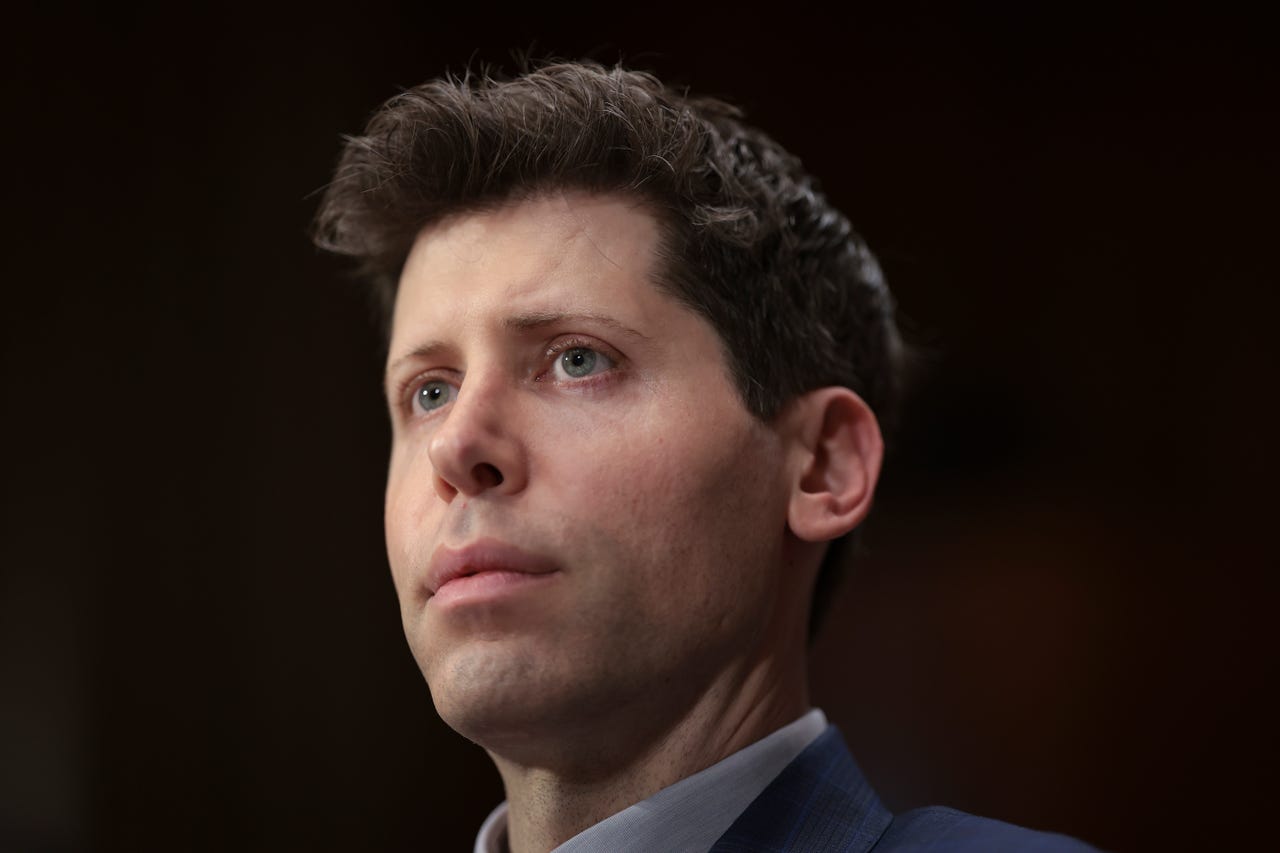
Sam Altman is back as CEO of ChatGPT developer OpenAI, the company he co-founded in 2015. In a post on X, aka Twitter, OpenAI announced that it reached an agreement in principle for Sam Altman to return to OpenAI as CEO following his dismissal last week, and with a new board of directors.

The new board members will be former Salesforce co-CEO Bret Taylor as chair, former U.S. Treasury Secretary Larry Summers, and Quora CEO and existing board member Adam D'Angelo. Gone in the board shakeup are Ilya Sutskever, Helen Toner, and Tasha McCauley. All three had voted to dismiss Altman as CEO, as did D'Angelo.

Also: You can now chat with ChatGPT by voice for free

Altman's reinstatement as CEO comes just five days after OpenAI announced that he had been fired from the top role. To try to explain this sudden and surprising move, the company said only that following a review process it determined that Altman was not consistently candid in his communications with the board. As a result, "the board no longer has confidence in his ability to continue leading OpenAI."

Along with Altman's dismissal last week, fellow co-founder and president of OpenAI Greg Brockman would be exiting as chairman of the board but would remain with the company. (He later quit in protest over Altman's dismissal). Chief Technology Officer Mira Murati would serve as interim CEO as OpenAI would begin a search for a permanent CEO.

However, shortly after all that news hit last Friday, reports starting popping up on Saturday that the board was reconsidering its decision regarding Altman in the wake of pressure from investors and employees. And then Altman's employer quickly changed.

Also: I spent a weekend with Amazon's free AI courses, and highly recommend you do too

By Monday, Altman and Brockman had both been hired (or at least in the process of being hired) by Microsoft to lead a new team working on advanced AI research. The fit seemed natural as Microsoft has been one of the key investors and partners for OpenAI. At the same time, OpenAI tapped Twitch co-founder and former CEO Emmett Shear as interim CEO, replacing Murati.

But wait — all those employees unhappy over Altman's ouster made their voices heard. On Monday, more than 500 of the company's 778 employees released an open letter to OpenAI's board of directors, threatening to resign and join Altman and Brockman at Microsoft if the two co-founders were not brought back. In the letter, the employees insisted that the current board members resign and be replaced by a board "that could lead the company forward in stability."

And now the obvious pressure on the company and the board has led to a reversal of last week's decision, while most of the board members now find themselves on the outs. One member has even expressed regrets over Altman's initial firing.

Also: Generative AI advancements will force companies to think big and move fast

"I deeply regret my participation in the board's actions," Sutskever said in a Monday post on X. "I never intended to harm OpenAI. I love everything we've built together and I will do everything I can to reunite the company."

In his own post, Altman alluded to his brief journey from OpenAI to Microsoft and then back to OpenAI. His decision to join Microsoft on Sunday was clearly the best path for him and his team, Altman said. But with the new board and with the support of Microsoft CEO Satya Nadella, he said that he was looking forward to returning to OpenAI and building on the company's strong partnership with Microsoft.

In its post announcing Altman's reinstatement, OpenAI added: "We are collaborating to figure out the details. Thank you so much for your patience through this."

Also: 7 ways to make sure your data is ready for generative AI

And figuring all this out should be high on the company's priority list. All the back-and-forth firings and misfirings haven't done OpenAI's reputation any good. Beyond upsetting employees, the moves have certainly worried investors, especially Microsoft.

In an interview with Bloomberg TV on Monday, Nadella said that he definitely wants changes at OpenAI in the way the company is governed.

"Surprises are bad and we just want to make sure that things are done in a way that will allow us to continue to partner well," Nadella added. "This idea that somehow suddenly changes happen without being in the loop is not good and we will definitely ensure that some of the changes that are needed happen and we continue to be able to go along with the partnership with OpenAI."

Artificial Intelligence

Breaking Down OpenAI’s New Board

In a striking turn of events that has sent ripples through the AI and technology sectors, OpenAI, a leading entity in the field of artificial intelligence, has recently undergone a significant transformation in its leadership. Marked by the dramatic return of Sam Altman to the CEO position and a consequential reshuffling of its board, these changes represent a pivotal moment for the organization.

OpenAI, known for its groundbreaking work in AI research and development, including the widely recognized ChatGPT and DALL-E models, stands at the forefront of AI advancements. The reshaping of its board, therefore, is not just a shift in personnel but signals a potential change in direction, priorities, and strategies within one of the most influential organizations in the AI arena.

The importance of these changes cannot be understated. As AI continues to evolve and permeate various aspects of our lives, the governance and decision-making processes within key organizations like OpenAI have far-reaching implications. These alterations in leadership and the introduction of new board members with diverse backgrounds in business and technology suggest a potential shift towards a more business-oriented approach, a move that could redefine the trajectory of AI development and its application across industries.

Implications of Altman's Return

The reinstatement of Altman as CEO is likely to have profound implications for OpenAI's strategic direction. Altman's leadership style, known for its emphasis on ambitious research and ethical AI development, could signal a renewed focus on pioneering AI advancements while maintaining a cautious approach to ethical concerns. This could lead to a reinvigoration of OpenAI's commitment to its original mission of ensuring that artificial general intelligence (AGI) benefits all of humanity.

Furthermore, Altman's return could influence OpenAI's collaborative and partnership strategies. Known for fostering strong relationships within the tech community, Altman might steer OpenAI towards more strategic collaborations, potentially broadening the organization's impact and reach. His track record of successful engagements with major tech companies, coupled with his understanding of the business aspects of AI, positions him well to navigate the complex landscape of partnerships and investments in the AI sector.

New Board Members and Their Backgrounds

The reconstitution of OpenAI's board introduces a blend of seasoned professionals from diverse backgrounds, marking a significant shift in the organization's governance structure. These new members bring a wealth of experience from the business and technology sectors, potentially reshaping OpenAI's approach to AI development and application.

Bret Taylor

Bret Taylor, a prominent figure in the tech industry, joins the OpenAI board with an impressive track record. Taylor, known for co-founding the collaborative platform Quip and his tenure as co-CEO of Salesforce, brings a unique blend of entrepreneurial prowess and technical expertise.

His experience in leading major technology companies, coupled with his insights into AI applications in business, positions him as a potentially influential figure in guiding OpenAI's strategic decisions. Taylor's involvement could steer OpenAI towards more application-oriented AI solutions, bridging the gap between cutting-edge research and practical business applications.

Larry Summers

Larry Summers, with his storied background in economics and government, adds a new dimension to the board. As a former Treasury Secretary and president of Harvard University, Summers' expertise in economic policy and regulatory matters could be invaluable for OpenAI.

His insights are particularly crucial as the organization navigates the increasingly complex regulatory landscape surrounding AI. Summers' involvement may signal a more proactive approach in engaging with policy makers and shaping policies that foster ethical AI development while considering economic and societal impacts.

Adam D’Angelo

Adam D’Angelo, the only returning member from the previous board, offers continuity amidst these changes. As the CEO of Quora and a former CTO at Meta, D’Angelo's deep understanding of AI's practical applications and his experience in managing a large-scale AI-driven platform provide a bridge between the old and new visions of OpenAI. His ongoing presence on the board ensures a degree of stability and institutional memory, which is crucial during this transformative phase.

A Shift in OpenAI’s Future

This new composition of the board represents a significant shift from an academic-focused to a more business and technology-oriented expertise. This transition could indicate a strategic pivot for OpenAI, potentially moving towards a model that emphasizes practical AI applications and commercialization, while still maintaining a commitment to ethical standards.

The blend of business acumen and technological insight among the new board members could drive OpenAI towards new frontiers in AI development, possibly influencing how AI technologies are integrated into various sectors and shaping the future landscape of AI-driven solutions.

Anthropic says its updated ChatGPT rival has more skills, tells fewer lies

Anthropic Claude

ChatGPT isn't the only AI game in town. To prove that point, Anthropic has beefed up its Claude AI chatbot with more skills and fewer limitations. In a post published on Tuesday, Anthropic described what's new for Claude in version 2.1, including a decrease in hallucinations, the ability to process 150,000 words in a request, and the use of custom tools for specific tasks.

Hallucinations, or lies, are a common weakness for all generative AI bots, as they tend to serve up misleading or inaccurate information. With Claude 2.1, Anthropic is vowing greater honesty with a 50% decrease in false statements compared with the prior version.

Also: Sam Altman returns to OpenAI as CEO amid ouster of board members

To test Claude 2.1's new level of truthfulness, the development team created a large number of complex but factual questions that often challenge other AI models. Using a guide to distinguish false claims from admissions of uncertainty, the team found that Claude 2.1 was more likely to decline to answer a question than to provide a wrong answer.

The new flavor of Claude has also expanded its comprehension and summarization skills, most notably with long and complex documents that require greater accuracy, such as legal documents, financial reports, and technical specifications. In testing, Claude 2.1 showed a 30% decrease in incorrect responses and a 3x to 4x decline in mistakenly finding that a document supported a specific claim.

Next on the list, the new version of Claude will accept double the amount of information presented to it in a request. The new limit is 200,000 tokens, which translates to around 150,000 words or more than 500 pages.

Also: Generative AI advancements will force companies to think big and move fast

You can now upload large technical documents like codebases, financial statements, and even whole literary works such as The Iliad or The Odyssey. In response, Clause will analyze the uploaded files to summarize their content, generate a Q&A session, and even compare multiple documents.

The use of custom tools is another skill new to Claude. Currently in early development as a beta feature, this new option lets you integrate Claude with external processes, products, and APIs. As such, Claude is now able to search the web, grab information from outside databases, and tap into functions or APIs designed by developers.

With the new integration, Claude can determine which custom tool is needed to achieve a certain task. For example, it could use a calculator to solve complex equations, translate natural language requests into API calls, respond to requests by searching a database or the web, and connect to product databases to help people with recommendations or purchases.

Also: You can now chat with ChatGPT by voice for free

Finally, Claude 2.1 can accept system prompts in which you provide the chatbot with custom instructions to respond to a specific request. The goal of system prompts is to set up a certain context to help Claude deliver more consistent and structured responses.

Claude 2.1 is now available through its API and is running on the Claude.AI website for both free users and Pro subscribers. However, the 200,000 token limit is available only for Claude Pro users.

Artificial Intelligence

OpenAI, emerging from the ashes, has a lot to prove even with Sam Altman’s return

OpenAI, emerging from the ashes, has a lot to prove even with Sam Altman’s return

Altman's back, and OpenAI's board has drastically changed. Now comes the hard part.

Kyle Wiggers 8 hours

The OpenAI power struggle that captivated the tech world after co-founder Sam Altman was fired has finally reached its end — at least for the time being. But what to make of it?

It feels almost as though some eulogizing is called for — like OpenAI died and a new, but not necessarily improved, startup stands in its midst. Ex-Y Combinator president Altman is back at the helm, but is his return justified? OpenAI’s new board of directors is getting off to a less diverse start (i.e. it’s entirely white and male), and the company’s founding philanthropic aims are in jeopardy of being co-opted by more capitalist interests.

That’s not to suggest that the old OpenAI was perfect by any stretch.

As of Friday morning, OpenAI had a six-person board — Altman, OpenAI chief scientist Ilya Sutskever, OpenAI president Greg Brockman, tech entrepreneur Tasha McCauley, Quora CEO Adam D’Angelo and Helen Toner, director at Georgetown’s Center for Security and Emerging Technologies. The board was technically tied to a nonprofit that had a majority stake in OpenAI’s for-profit side, with absolute decision-making power over the for-profit OpenAI’s activities, investments and overall direction.

OpenAI’s unusual structure was established by the company’s co-founders, including Altman, with the best of intentions. The nonprofit’s exceptionally brief (500-word) charter outlines that the board make decisions ensuring “that artificial general intelligence benefits all humanity,” leaving it to the board’s members to decide how best to interpret that. Neither “profit” nor “revenue” get a mention in this North Star document; Toner reportedly once told Altman’s executive team that triggering OpenAI’s collapse “would actually be consistent with the [nonprofit’s] mission.”

Maybe the arrangement would have worked in some parallel universe; for years, it appeared to work well enough at OpenAI. But once investors and powerful partners got involved, things became… trickier.

Altman’s firing unites Microsoft, OpenAI’s employees

After the board abruptly canned Altman on Friday without notifying just about anyone, including the bulk of OpenAI’s 770-person workforce, the startup’s backers began voicing their discontent in both private and public.

Satya Nadella, the CEO of Microsoft, a major OpenAI collaborator, was allegedly “furious” to learn of Altman’s departure. Vinod Khosla, the founder of Khosla Ventures, another OpenAI backer, said on X (formerly Twitter) that the fund wanted Altman back. Meanwhile, Thrive Capital, the aforementioned Khosla Ventures, Tiger Global Management and Sequoia Capital were said to be contemplating legal action against the board if negotiations over the weekend to reinstate Altman didn’t go their way.

Now, OpenAI employees weren’t unaligned with these investors from outside appearances. On the contrary, close to all of them — including Sutskever, in an apparent change of heart — signed a letter threatening the board with mass resignation if they opted not to reverse course. But one must consider that these OpenAI employees had a lot to lose should OpenAI crumble — job offers from Microsoft and Salesforce aside.

OpenAI had been in discussions, led by Thrive, to possibly sell employee shares in a move that would have boosted the company’s valuation from $29 billion to somewhere between $80 billion and $90 billion. Altman’s sudden exit — and OpenAI’s rotating cast of questionable interim CEOs — gave Thrive cold feet, putting the sale in jeopardy.

Altman won the five-day battle, but at what cost?

But now after several breathless, hair-pulling days, some form of resolution’s been reached. Altman — along with Brockman, who resigned on Friday in protest over the board’s decision — is back, albeit subject to a background investigation into the concerns that precipitated his removal. OpenAI has a new transitionary board, satisfying one of Altman’s demands. And OpenAI will reportedly retain its structure, with investors’ profits capped and the board free to make decisions that aren’t revenue-driven.

Salesforce CEO Marc Benioff posted on X that “the good guys” won. But that might be premature to say.

Congrats to @openai! Great to see the good guys win! ❤️ pic.twitter.com/7yitztXwuc

— Marc Benioff (@Benioff) November 22, 2023

Sure, Altman “won,” besting a board that accused him of “not [being] consistently candid” with board members and, according to some reporting, putting growth over mission. In one example of this alleged rogueness, Altman was said to have been critical of Toner over a paper she co-authored that cast OpenAI’s approach to safety in a critical light — to the point where he attempted to push her off the board. In another, Altman “infuriated” Sutskever by rushing the launch of AI-powered features at OpenAI’s first developer conference.

The board didn’t explain themselves even after repeated chances, citing possible legal challenges. And it’s safe to say that they dismissed Altman in an unnecessarily histrionic way. But it can’t be denied that the directors might have had valid reasons for letting Altman go, at least depending on how they interpreted their humanistic directive.

The new board seems likely to interpret that directive differently.

Currently, OpenAI’s board consists of former Salesforce co-CEO Bret Taylor, D’Angelo (the only holdover from the original board) and Larry Summers, the economist and former Harvard president. Taylor is an entrepreneur’s entrepreneur, having co-founded numerous companies, including FriendFeed (acquired by Facebook) and Quip (through whose acquisition he came to Salesforce). Meanwhile, Summers has deep business and government connections — an asset to OpenAI, the thinking around his selection probably went, at a time when regulatory scrutiny of AI is intensifying.

The directors don’t seem like an outright “win” to this reporter, though — not if diverse viewpoints were the intention. While six seats have yet to be filled, the initial four set a rather homogenous tone; such a board would in fact be illegal in Europe, which mandates companies reserve at least 40% of their board seats for women candidates.

Why some AI experts are worried about OpenAI’s new board

I’m not the only one who’s disappointed. A number of AI academics turned to X to air their frustrations earlier today.

Noah Giansiracusa, a math professor at Bentley University and the author of a book on social media recommendation algorithms, takes issue both with the board’s all-male makeup and the nomination of Summers, who he notes has a history of making unflattering remarks about women.

“Whatever one makes of these incidents, the optics are not good, to say the least — particularly for a company that has been leading the way on AI development and reshaping the world we live in,” Giansiracusa said via text. “What I find particularly troubling is that OpenAI’s main aim is developing artificial general intelligence that ‘benefits all of humanity.’ Since half of humanity are women, the recent events don’t give me a ton of confidence about this. Toner most directly representatives the safety side of AI, and this has so often been the position women have been placed in, throughout history but especially in tech: protecting society from great harms while the men get the credit for innovating and ruling the world.”

Christopher Manning, the director of Sanford’s AI Lab, is slightly more charitable than — but in agreement with — Giansiracusa in his assessment:

“The newly formed OpenAI board is presumably still incomplete,” he told TechCrunch. “Nevertheless, the current board membership, lacking anyone with deep knowledge about responsible use of AI in human society and comprising only white males, is not a promising start for such an important and influential AI company.”

I'm thrilled for OpenAI employees that Sam is back, but it feels very 2023 that our happy ending is three white men on a board charged with ensuring AI benefits all of humanity. Hoping there's more to come soon.

— Ashley Mayer (@ashleymayer) November 22, 2023

Inequity plagues the AI industry, from the annotators who label the data used to train generative AI models to the harmful biases that often emerge in those trained models, including OpenAI’s models. Summers, to be fair, has expressed concern over AI’s possibly harmful ramifications — at least as they relate to livelihoods. But the critics I spoke with find it difficult to believe that a board like OpenAI’s present one will consistently prioritize these challenges, at least not in the way that a more diverse board would.

It raises the question: Why didn’t OpenAI attempt to recruit a well-known AI ethicist like Timnit Gebru or Margaret Mitchell for the initial board? Were they “not available”? Did they decline? Or did OpenAI not make an effort in the first place? Perhaps we’ll never know.

OpenAI has a chance to prove itself wiser and worldlier in selecting the five remaining board seats — or three, should Altman and a Microsoft executive take one each (as has been rumored). If they don’t go a more diverse way, what Daniel Colson, the director of the think tank the AI Policy Institute, said on X may well be true: a few people or a single lab can’t be trusted with ensuring AI is developed responsibly.

At $500 off for Black Friday, this robot vacuum and mop is a smart deal

Ecovacs Deebot X2 Omni

What's the Black Friday deal?

Amazon's Black Friday sale is on, and the Ecovacs Deebot X2 Omni is a whopping $501 off for a limited time with an on-page coupon.

Why this deal is ZDNET-recommended

You know that gratifying feeling of coming home to a clean house? With a family of five, that's not a feeling I often get, if at all. Enter the Ecovacs Deebot X2 Omni.

Also: Ecovacs announced a new robot vacuum that squares up to the competition

I've tested a fair share of robot vacuum and mop combinations, so I quite appreciate the experience of having a robot roaming around my home that picks up crumbs, dust, and everything in between. But the Deebot X2 Omni is the best robot vacuum and mop I've tried.

ZDNET RECOMMENDS

Ecovacs Deebot X2 Omni

This high-end robot vacuum and mop has been engineered to give users a hands-free cleaning experience.

View at Amazon

Ecovacs launched the Deebot X2 Omni today, a new flagship robot vacuum and mop combo with a clear edge. After testing it out for a couple of weeks, I've found room for improvement in some tasks — largely outweighed by its long list of strengths.

The X2 Omni checks all the specs boxes for a high-end robot vacuum and mop. It has 8,000Pa of suction power, higher than the 6,000Pa of the current market leader, the Roborock S8 Pro Ultra. Using artificial intelligence (AI), the robot can detect and avoid objects strewn about the floor, such as socks and charging cables, and has a mopping pad that automatically lifts 15mm when carpets or rugs are detected.

Also: The best robot mops you can buy

The Omni station charges the robot vacuum and mop and works as a base where it empties its dustbin and self-washes and dries its mop pads. This feature means you only have to worry about keeping the base station's clean water tank filled and its dirty water tank empty, which you must complete every few cleaning cycles.

Designed to be a hands-free experience, the base station is also self-cleaning. Running the self-cleaning option in the Ecovacs app will clean the base plate in the station — the spot where your mops are cleaned that typically sees water and dirt accumulation. This feature is a level above competitors like Yeedi, which requires users to periodically clean dirty water at the bottom of the docking station.

The dust bag holds everything the Deebot X2 sweeps from your floors and only needs emptying about once a month, although your mileage may vary.

This closure is supposed to hold four liters of clean water when you carry the clean water tank by the handle.

One of my only gripes is that the clean water tank feels awkward to hold when filled — it almost feels like it's not built to last, although I won't know for certain until I've used it for several months. It's a four-liter water tank with a handle to carry it on the lid, held shut by a plastic clip. I hold the tank from the bottom because I feel like using the handle to carry the full tank around will result in the closure failing and four liters of water going everywhere.

About the square shape

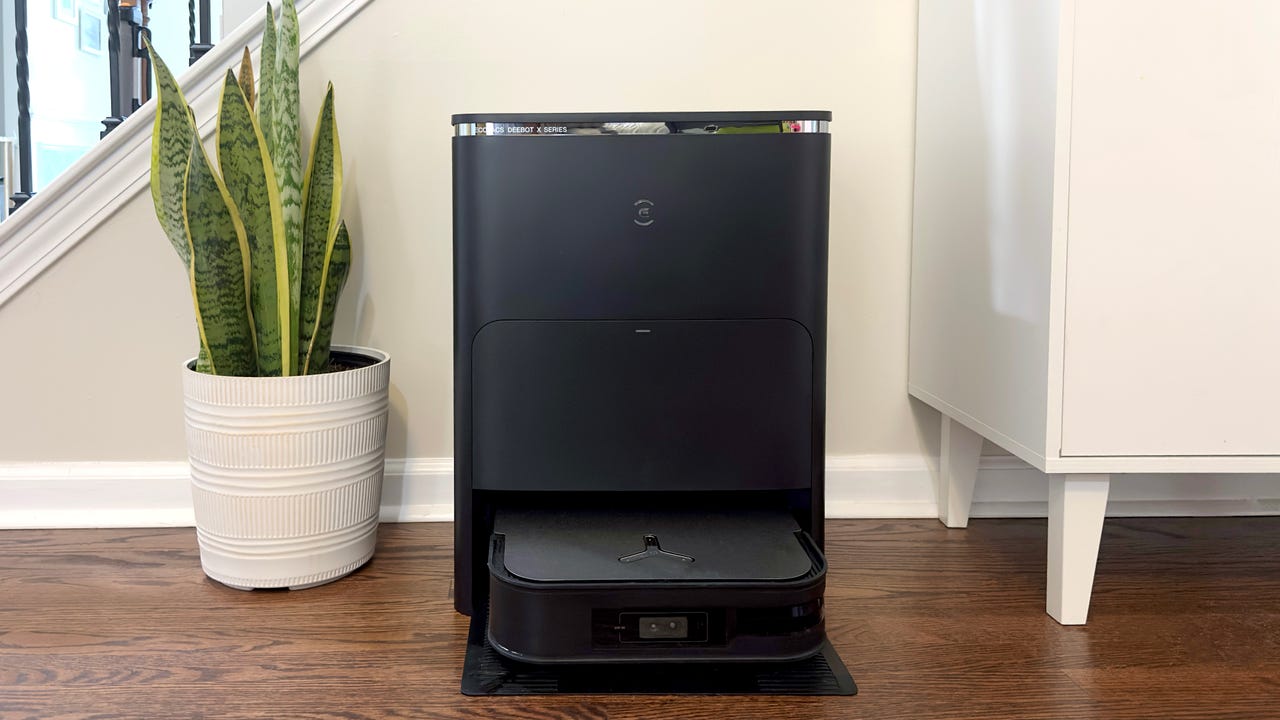
The Deebot X2 Omni has several superpowers, starting with its compact package. The squared edges stood out to me as a feature when I unpacked the device, along with how narrow and short it was. At only 12.6 inches wide, it's about 0.3 inches narrower than the Eufy X9 Pro robot vacuum mop, which had been my super mop until the X2 Omni arrived.

Although 0.3 inches sounds like a small difference in size, it's proven to be considerable when a robot has to navigate through furniture legs. Case in point: the Eufy X9 Pro uses AI to avoid objects, but whenever I sent it to clean the first floor, it'd get stuck between the kitchen barstools legs. The stools are fairly lightweight, so the robot would drag them around instead of signaling it was stuck. I'd see my kitchen barstools gliding around my floor or randomly find one hanging out by the shoe bench.

Also: The best iRobot vacuums

This isn't a big deal and is highly subjective, so it's not something I included in my Eufy review; it's not the robot's fault that it's the exact size as the width of the distance between my barstool's legs. But the narrower Deebot X2 Omni can clean under the barstools and figure its way back out, which means no more 'guess where the barstools are today' games.

The Ecovacs Deebot X2 Omni making its way out of the traveling barstools.

The Deebot X2 is also almost an inch shorter than my Eufy robot vacuum, at 3.7 inches in height. The lower dimensions and narrow build allow the Deebot X2 to clean in places other robots typically can't reach or navigate under.

Some AI-powered features

The Deebot X2 leverages Ecovacs' AIVI 3D 2.0 and combines an AI processor with 3D-structured light sensors with dual-laser LiDAR technology. The result is efficient maps that allow the robot to detect objects during navigation and clean around them intelligently. This feature set means you won't have to ensure your floors are free of charging cables, toys, or shoes before sending out the X2.

The AI-powered navigation and obstacle avoidance, backed by Ecovacs' proprietary AINA Model, uses visual recognition and reinforcement learning based on sensor information.

Also: 6 things to know about robot vacuums before you buy one

The Deebot X2's clever technology also makes for a customized cleaning process if that's your thing. The device's AI-powered visual recognition, ability to detect floor type, and historical cleaning logs let the robot infer which room it's cleaning, such as the kitchen, living room, or bedroom, and adjust its suction power and mopping mode.

A new level of voice control

Voice control makes everything in my home easier. Countless robot vacuums let you use a third-party virtual assistant for voice control, such as Amazon Alexa, Google Assistant, or Siri. Saying, "Alexa, clean the floors" in my house dispatches the Eufy X9 Pro to clean my bedroom and hallway. However, these assistants are limited in the functions they can make the robot perform.

Sure, you can dispatch your robot with Alexa or Google, but have you ever been able to tell it to "turn right, move three meters forward, turn left, and clean there"?

Also: This robot vacuum connects to your home's water supply for full automation

Ecovacs robot vacuums have a built-in voice assistant named YIKO that users can talk with to control the robot directly — and it works swimmingly. Saying "OK, YIKO" wakes up the voice assistant. If your robot is out cleaning, you can ask it to return and clean the dining room again or give it multiple commands in one sentence without pulling up the app.

ZDNET's buying advice

The Ecovacs Deebot X2 Omni is the company's new flagship robot with all the smart features and a price to match, at $1,500, though $407 off right now for Black Friday. Over the past few weeks, it's gained a top-dog position in our home, becoming the main robot to clean the downstairs floor — and that's saying a lot.

The great thing about an all-in-one, self-emptying, and self-cleaning robot vacuum and mop is that it's not best suited for some circumstances — it's suited for all. Some mid-range models might be great at mopping but suffer from not having strong or effective suction, making them best suited for homes with hard floors. Others might boast great suction power, okay mopping, and short battery life, making them best for mostly carpeted apartments or small homes.

The Deebot X2 Omni is great at all of these things. The biggest challenge in our home is downstairs because it's mostly hardwood and tile with some area rugs — it's where the dog comes in and out from the yard, where we cook, and where the toddler drops most of the crumbs.

Also: Skip the Dyson: This $150 stick vacuum is just as powerful (and can mop, too)

The X2 Omni's MSRP of $1,500 compares to $1,600 for the Roborock S8 Pro Ultra (also discounted at $400 off). Suppose I were looking for a hands-free robot vacuum and mop suitable for my home's complex needs. In that case, I'd have to choose the Deebot X2 Omni over the Roborock's flagship because the extra features, like the self-cleaning station and stronger suction, set it apart.