China Open Sources DeepSeek LLM, Outperforms Llama 2 and Claude-2

DeepSeek, a company based in China which aims to “unravel the mystery of AGI with curiosity,” has released DeepSeek LLM, a 67 billion parameter model trained meticulously from scratch on a dataset consisting of 2 trillion tokens.

Available in both English and Chinese languages, the LLM aims to foster research and innovation. The research community is granted access to the open-source versions, DeepSeek LLM 7B/67B Base and DeepSeek LLM 7B/67B Chat.

Check out the GitHub repository here.

The model is available under the MIT licence.

DeepSeek LLM 67B Base has showcased unparalleled capabilities, outperforming the Llama 2 70B Base in key areas such as reasoning, coding, mathematics, and Chinese comprehension. Particularly, its proficiency in coding is highlighted by an outstanding HumanEval Pass@1 score of 73.78, and in mathematics, it achieves remarkable scores, including GSM8K 0-shot: 84.1 and Math 0-shot: 32.6.

The model’s generalisation abilities are underscored by an exceptional score of 65 on the challenging Hungarian National High School Exam.

DeepSeek LLM 7B/67B models, including base and chat versions, are released to the public on GitHub, Hugging Face and also AWS S3. Access to intermediate checkpoints during the base model’s training process is provided, with usage subject to the outlined licence terms.

🌟 Performance Highlights
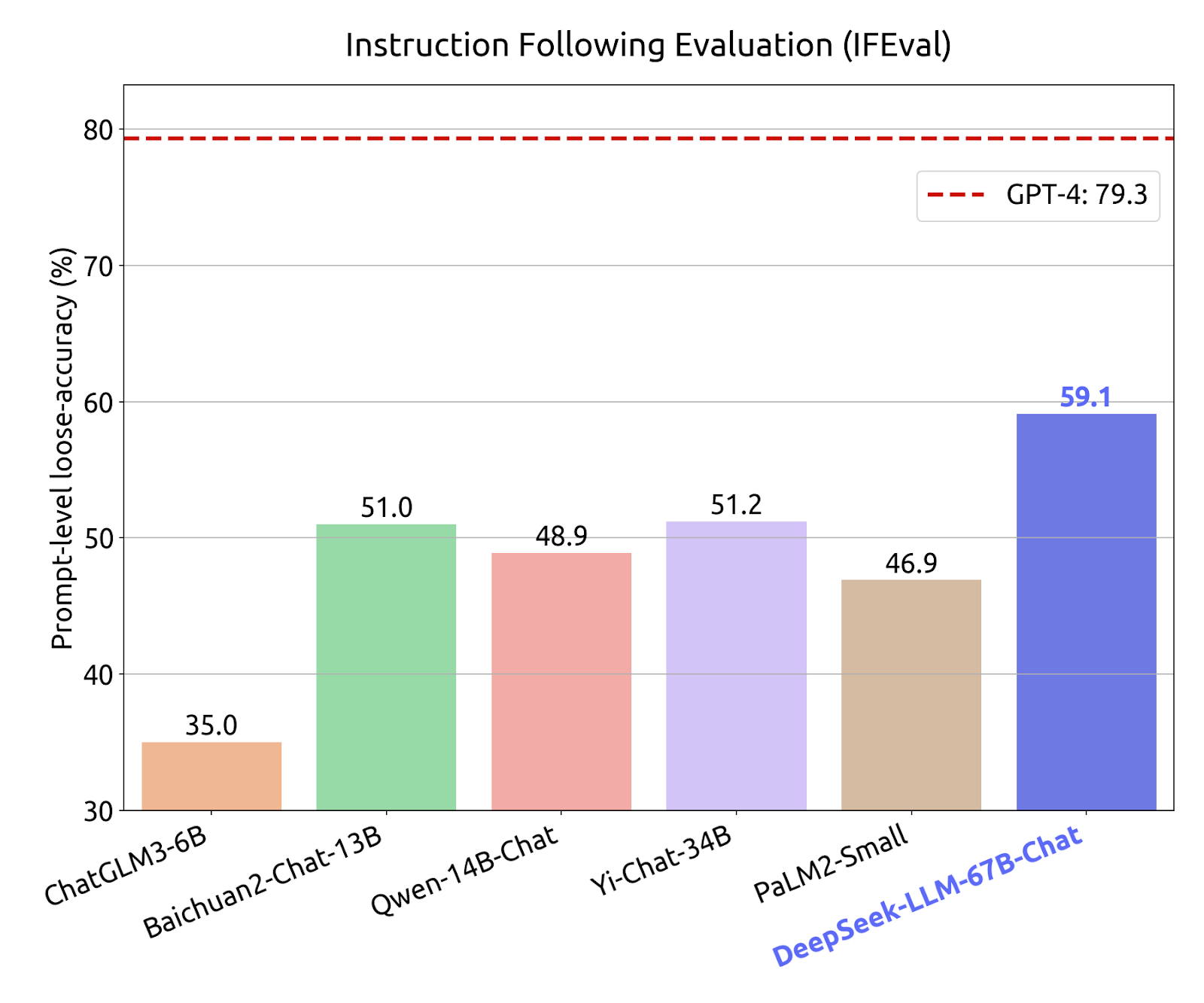
🏆 DeepSeek LLM 67B Base surpasses Llama2 70B Base in general capabilities.
💻 DeepSeek LLM 67B Chat performs exceptionally well in coding, mathematics, and reasoning. pic.twitter.com/Y9uVNYAq2l

— DeepSeek (@deepseek_ai) November 29, 2023

In-depth evaluations have been conducted on the base and chat models, comparing them to existing benchmarks. Results reveal DeepSeek LLM’s supremacy over LLaMA-2, GPT-3.5, and Claude-2 in various metrics, showcasing its prowess in English and Chinese languages.

The evaluation extends to never-before-seen exams, including the Hungarian National High School Exam, where DeepSeek LLM 67B Chat exhibits outstanding performance.

Experimentation with multi-choice questions has proven to enhance benchmark performance, particularly in Chinese multiple-choice benchmarks. By incorporating 20 million Chinese multiple-choice questions, DeepSeek LLM 7B Chat demonstrates improved scores in MMLU, C-Eval, and CMMLU.

DeepSeek LLM’s pre-training involved a vast dataset, meticulously curated to ensure richness and variety. The architecture, akin to LLaMA, employs auto-regressive transformer decoder models with unique attention mechanisms. The pre-training process, with specific details on training loss curves and benchmark metrics, is released to the public, emphasising transparency and accessibility.

Recently, Alibaba, the chinese tech giant also unveiled its own LLM called Qwen-72B, which has been trained on high-quality data consisting of 3T tokens and also an expanded context window length of 32K. Not just that, the company also added a smaller language model, Qwen-1.8B, touting it as a gift to the research community.

Data Science Hiring Process at Pegasystems

Pegasystems, commonly known as Pega, is a global software company founded in 1983, focusing on customer engagement and operational excellence solutions. The Cambridge-based company has become a leader in business process management and customer relationship management.

The primary offering, Pega Infinity, acts as a comprehensive platform for businesses to create, implement, and improve applications, aiming to enhance customer experiences and streamline operational processes.

The company utilises AI and data science throughout its platform to improve decision-making, automate processes, and provide personalised customer interactions. CISCO, HSBC, and Siemens are a few of their primary customers.

In their latest iteration of Pega Infinity 23, the platform introduces over 20 new features, including generative AI-powered boosters to enhance efficiency. The Connect Generative AI feature enables organisations to quickly utilise generative AI with a plug-and-play structure for low-code development.

AIM caught up with Deepak Visweswaraiah, vice president, platform engineering and site managing director, and Smriti Mathur, senior director and head of people, Pegasystems, India, to understand their generative AI play, hiring process and more.

Pega has open positions for solutions engineers and senior software quality test engineers in Hyderabad and Bengaluru.

Decoding Pega’s AI Ventures

In their core platform, Pega Infinity, the organisation relies heavily on data science, which plays a critical role in analytics, insights generation, natural language processing (NLP), generative AI, and various other applications that drive functionalities such as real-time decision-making and personalised customer communications based on attributes.

Data science also contributes significantly to the development of generative AI models, enhancing the overall intelligence of the platform. Its impact extends beyond the core platform to applications like customer service, one-to-one engagement, decision-making, sales automation, and strategic smart apps for diverse industries.

Pega GenAI provides insights into AI decision-making and streamlines processes, such as automating loan processing. “The benefits of generative AI extend to developers and end-users, improving productivity through query-based interactions, automatic summarisation, and streamlined case lifecycle generation,” Visweswaraiah told AIM.

End-users also benefit from realistic training scenarios using simulated customer interactions.

Regarding proprietary foundational models, the organisation’s product architecture prioritises openness and flexibility. They support various language models, including those from OpenAI and Google.

“In upcoming product versions, we are actively working to support and ship local language models to meet specific use case demands, focusing on accuracy, productivity, and performance in response to customer preferences for diverse capabilities,” he added.

Interview Process

The company follows a global hybrid working model, encouraging collaboration in the office while providing flexibility, with about 60% of the workforce attending the office around three days a week. This approach aims to attract talent globally, fostering a vibrant culture and hybrid working environment.

In upskilling employees, technical competencies are crucial, and the company emphasises learning through its Pega Academy, offering online self-study training, live instructor-led courses, and online mentoring. Skill gaps are regularly assessed during performance reviews, providing learning opportunities through gateways and supporting external courses with an educational reimbursement policy.

“For data science roles, we focus on the candidate’s ability to learn rather than specific data science skills,” Mathur told AIM. The company looks for individuals capable of extracting insights from data, making informed decisions, and building models for application in various use cases.

Mathur further shared that the company emphasises the importance of understanding its problem-solving approach and creating deterministic models that consistently provide performant and real-world solutions. It encourages candidates to think from the customer’s perspective and avoid getting lost in vast amounts of data, highlighting the significance of models producing consistent and reliable answers.

Work Culture

The company emphasises diversity and inclusivity, fostering a culture centred on innovation and collaboration. It has been ranked as the best workplace for women by Avatar for five consecutive years. Pega values individuals who think independently, challenge norms and question the status quo to seek better solutions.

The company encourages leadership and curiosity in approaching tasks, promoting an environment where employees are empowered to innovate. Compared to competitors, Pega’s work culture stands out due to the unique problems it addresses and its distinctive approach.

Understanding the product architecture is crucial for employees, given the nature of the challenges they tackle. Pega’s ability to integrate technology into the platform is a significant differentiator, enhancing its capability to address complex issues.

“With a focus on adapting to market changes, our mantra of being “built for change” reflects our commitment to staying dynamic and responsive to evolving needs,” concluded Mathur.

So, if you want to join the dynamic community of Pega, check out the careers page here.

The post Data Science Hiring Process at Pegasystems appeared first on Analytics India Magazine.

Alibaba’s Cloud Business Gets Qwen-ched! 

Alibaba’s Cloud Business Gets Qwen-ched!

Chinese tech-giant Alibaba is desperately trying to save its cloud business with large language models (LLMs). After releasing Qwen-7B in October, Alibaba recently released Qwen-72B, which has been trained on high-quality data consisting of 3T tokens. Compared to the previous versions, this has a larger parameter size and also an expanded context window length of 32K, with more customisation capabilities.

Not just that, the company also added a smaller language model, Qwen-1.8B, touting it as a gift to the research community. It has a 2k context length and requires only 3GB of GPU memory. Both of the models would be available on Alibaba cloud for its customers and also as open source.

Besides Alibaba, its competitors Tencent, Huawei, and Baidu are also building LLMs and are attracting customers and generating revenue rapidly. For example, as reported in July, Baidu’s AI cloud is leading the China market for the fourth year in a row, reporting a 69.7% growth in 2022. The company also released its Ernie Bot, competing with GPT-4.

Same is the case with Tencent and Huawei. On the contrary, Alibaba’s cloud plans are crumbling down.

Qwen-ching GPT-4?

Alibaba’s cloud unit’s growth has also decelerated, experiencing only a 4% annual revenue increase in the last fiscal year, down from 23% growth in previous year, and 50% before that. Despite Alibaba’s emphasis on the potential of AI software in China benefiting the cloud unit, the recent challenges, leadership changes, and US export restrictions on semiconductor chips have posed significant hurdles.

According to reports, the company faces challenges as Chinese businesses, especially in traditional industries, and not the internet driven companies, which show little enthusiasm for paying for public cloud services. Internal conflicts arose between Alibaba Cloud and the e-commerce business over post-spinoff terms, leading to a downfall of customers as well.

Several months ago, Alibaba executives attempted to convince major investors to invest in its cloud unit, planning to spin it off as a separate company, called Cloud Intelligence Group, with a $40 billion valuation. However, the plan failed as investors were hesitant due to the cloud business’s slow growth and financial losses. The attempt highlighted the market’s reluctance towards the spun-off cloud unit, contributing to Alibaba’s recent decision to cancel the move.

This cancellation led to a shed of around $21 billion in its market value, according to several calculations. Alibaba said that these curbs have “created uncertainties for the prospects of Cloud Intelligence Group,” making it difficult to compete with AWS, Microsoft Azure, and Google Cloud, if not just the Chinese counterparts.

“Instead, we will focus on developing a sustainable growth model based on emerging AI-driven demand for networked and highly scaled cloud computing services,” Joe Tsai, CEO of Alibaba, said on the company’s investor call in November.

The drop also highlights how this is an effect of the geopolitical tensions between US and China. Alibaba had to cancel its spin off plans because the US was controlling the chip exports to China, creating uncertainty for the company, but possibly the introduction of LLMs in its cloud might be able to save the company, just like it is doing for Baidu, Huawei, and Tencent.

Emad Mostaque, the founder of Stability AI, recently posted on X, “Chinese open models will overtake GPT-4 shortly zero shot, can already overtake if you chain Qwen & Deepseek appropriately.”

Will test the new Qwen, local open source AI model soon.
“A LLM family built by Alibaba Cloud. In this organization, we continuously release LLMs, large multimodal models, and other AGI-related projects”
China is blasting through US AI regulations.
https://t.co/ue6J7Tyvd6

— Brian Roemmele (@BrianRoemmele) November 30, 2023

Competitions galore

The restrictions on the chip export, especially the ones NVIDIA makes, is creating a lot of challenges for cloud providers in China. But Alibaba appears to be more significantly impacted by it then its counterparts.

Currently, Alibaba still holds a larger market share when compared to its competitors. But the competitors are increasingly rising up, and Alibaba is shaking grounds and is desperately trying to stay afloat by introducing new LLMs for its customers.

For example, Tencent, which stated that its ample chip reserves will sustain its LLM development for several more generations, and Baidu, which mentioned a substantial reserve of AI chips supporting ongoing chatbot enhancements for “at least a couple more generations.” Alibaba did not make a comparable statement.

Tencent also slashed the price of its cloud services by 40% to compete with Alibaba. It also said that the revenue has been growing since the second half of the year. Huawei recorded a 3.1% increase in revenue in the first half of the year compared to previous year. It also reported an increase in overseas exports during the period.

Most recently, at the Huawei Cloud Industry Summit Forum 2023, the company announced the industry’s first large model hybrid cloud, enabling both edge and public cloud, providing customers a suite of tools. This was after the company released Pangu 3.0 to compete with ChatGPT in August.

All competitors are rising up in the cloud business by offering AI services to their customers, but Alibaba is going down. Possibly, the integration of LLM might be able to save the company.

The post Alibaba’s Cloud Business Gets Qwen-ched! appeared first on Analytics India Magazine.

Forrester Report Shows That You Need More Than an LLM to Build a GenAI Application

Forrester Report Shows That You Need More Than an LLM to Build a GenAI Application November 30, 2023 by Ali Azhar

The rapid rise of generative AI (GenAI) has left businesses scrambling to find new and innovative methods to harness the power of this technology for business applications. Many businesses believe that Large Language Models (LLMs) have reinvented how AI-powered business applications get built, and all that is needed is to input data in one of the LLM models from the big players, and it will get the job done. However, things aren’t that easy.

Forrester, a leading research and advisory company, released a new report that highlights that GenAI business applications require more than a general-purpose LLM. Even the most carefully fine-tuned and prompted LLM might not be enough to build and safely operate a GenAI-powered application. The simplistic approach won’t allow organizations to use all their proprietary knowledge to work. It also has several other risks including issues with scaling, security, and cost.

The Forrester report was compiled by surveying the 15 largest service providers on how they are using GenAI and they help over 2000 companies around the globe to build Gen-AI-powered business applications. The findings of the report show that businesses need to assemble a “layers, gates, and pipes” architecture to safely and effectively operate GenAI-powered applications.

The layers, gates, and pipes architecture draws on resources from many layers of intelligence to bring together internal and external capabilities. It also needs Input and output control gates to protect people, the firm, and the models themselves. In addition, it requires application pipes to prompt, embed, and orchestrate layers of intelligence to translate requests into outputs. Finally, testing and learning loops are needed to test and monitor results and make adjustments accordingly.

Digging deeper into the elements of the layers, gates, and pipes architecture, the report states that the layers of intelligence include a wide range of capabilities including general-purpose, embedded, and specialized GenAI models.

Intelligence resources that organizations should create and manage themselves include software applications, AI/ML models, private GenAI models, structured and unstructured data, and people’s prompts and behaviors. The intelligence sources that organizations should source from suppliers should include domain-specific GenAI models, and public GenAI tools, bundled GenAI models, such as SaaS apps.

The use of input gates helps reject bad requests, bogus prompts, and dangerous searches. It can also turn vague requests into answerable prompts. The output gates help validate the outputs for issues according to the compliance requirements, security, and more.

Application pipes are used to tie it all together through an API-first workflow. They help stitch the resources from the layer of intelligence so they can flow smoothly end-to-end. The last element of the architecture is testing through the feedback loops used for testing. They help in establishing trust, confidence, and validity in the application.

The Forrester report also adds that businesses can assemble applications from parts today as they build a full architecture to support GenAI applications over the next few years. GenAI-powered applications are like vibrating organisms that need constant monitoring and optimization. Only through proper care can businesses fully benefit from the power of GenAI business applications.

Related Items

Will GenAI Take Traditional AI Along for the Ride?

New Infosys Report Shows Generative AI Creates Enterprise Agility, Yet Data And Skills Threaten Progress

Survey: Majority of US Workers Are Already Using Generative AI Tools, But Company Policies Trail Behind

Related

ChatGPT 1-Year Anniversary: How Generative AI Has Evolved

Since OpenAI released ChatGPT on Nov. 30, 2022, the generative AI chatbot has helped make artificial intelligence a $207 billion industry. Two months after its launch, ChatGPT was recognized as the fastest-growing consumer application in history.

Due to the quick and massive success of ChatGPT, generative AI has become a mainstream term and changed the way many enterprise decision-makers consider software purchasing decisions. Additionally, generative AI has become an enticing tool for workplace strategy and operations; it’s currently unclear if it will shift how work is done or be a temporary workplace trend.

Since ChatGPT’s launch, enterprise technology companies and governments have discussed the potential safety problems and security risks of generative AI. ChatGPT has been temporarily or permanently banned at some companies for exposing internal data; other organizations have embraced adding ChatGPT-powered applications to their software products. In this article we’ll look back on the last year to explore ChatGPT’s influence on enterprise software.

Jump to:

  • Generative AI became a major player in enterprise software
  • ChatGPT sparked large-scale experimentation with generative AI
  • Generative AI raised ethical, copyright and security questions
  • What’s next for ChatGPT?

Generative AI became a major player in enterprise software

ChatGPT has opened up a massive conversation — and massive spending — in enterprise software, as companies work to implement chatbots and other tools enabled by large language models. Hyperscalers and e-learning platforms have released a wide array of classes and scholarships to support skilled workers in the generative AI space and promote generative AI-driven roles as viable career paths. Companies have also begun creating policies for AI use that are distinct from the rules surrounding other enterprise software utilization.

However, AI adoption has not yet caught on as much across the general population. A Pew Research Study published in August 2023 noted that in a survey of 5,057 Americans, only 24% of people who had heard of ChatGPT had used it. More people who had heard of ChatGPT used the generative AI chatbot for entertainment (20%) than for work (16%).

ChatGPT sparked large-scale experimentation with generative AI

“It won’t be an exaggeration to say ChatGPT has become an unofficial mascot for AI over the past year for millions of consumers and business users,” Arun Chandrasekaran, distinguished vice president and analyst at Gartner, told TechRepublic via email. “It has made it possible for business users to experiment with use cases rapidly with LLMs and move forward with automation across a variety of business functions.”

In the year since ChatGPT was released, OpenAI has leveraged the popularity of its product with monetizable versions such as ChatGPT Plus and ChatGPT Enterprise. These products have made it easy to forget that OpenAI is technically a nonprofit intended to prevent dangerous outcomes from theoretical artificial general intelligence. This may create tension between quick product growth and this ethical mission. In fact, OpenAI’s future was in question shortly before ChatGPT’s one-year anniversary when CEO Sam Altman briefly joined Microsoft (which has committed to providing OpenAI with $10 billion in funding). He returned to OpenAI under “an agreement in principle” with the board on Nov. 22.

Other more commercially-minded companies such as Google, Microsoft and Amazon now have more robust generative AI chatbot products of their own — such as Google Bard, Microsoft’s Copilot and Amazon Q, respectively — than they did before ChatGPT’s release.

“Competition is certainly heating up with conversational chatbots available from others such as Google and Anthropic,” said Chandrasekaran. “In addition, there has been an explosion in both closed-source and open-source LLMs in the past year, many of which were a response to ChatGPT’s viral adoption. While the demand for the consumer version of the model has seen an uneven demand, often varying across months, the demand for LLMs in the enterprise continues to be high.”

Chandrasekaran predicts that the high cost of running inference for LLMs, which is part of a generative AI model’s training, may mean more companies find success with midsize models.

Generative AI solutions like ChatGPT are predicted to add up to $4.4 trillion to the global economy annually, according to a McKinsey research report published in June 2023. Its rapid growth means generative AI is proliferating and specializing for different use cases. McKinsey predicts specialized generative AI applications will create more value than more broad generative AI applications.

Generative AI raised ethical, copyright and security questions

Over the past year, OpenAI’s mission of creating “safe and beneficial” artificial intelligence has sparked a lot of conversation. The technology that OpenAI’s charter talks about — artificial general intelligence that can take on tasks with the flexibility of a human worker — still doesn’t exist. But OpenAI has grappled with how AI perpetuates bias and what can be done to mitigate biased training data and outcomes.

Some U.S. companies have signed a voluntary list of assurances regarding generative AI safety and how they will prevent people from creating misinformation with this technology. The EU is also working on guidelines that will likely influence how generative AI products, including ChatGPT, develop in the next year.

Use of generative AI in cybersecurity

While some generative AI tools have become part of different organizations’ cybersecurity defense mechanisms, the same technology has also been used by cybersecurity threat actors. For example, ChatGPT can be used to write phishing emails more quickly than threat actors might otherwise be able to complete such a task, although AI-generated phishing emails are not necessarily as effective as those written by humans. Overall, generative AI has contributed both positively and negatively to the cybersecurity landscape.

The black box problem

Despite its many advantages, one particular problem users are facing with AIs like ChatGPT is “black boxes.” With this transparency issue, people can’t see how AI-powered chatbots come to their decisions.

“LLMs — large language models like GPT-4, on which ChatGPT is built — make decisions that affect users in a way that is opaque, unreliable and potentially unfair, and the system is found to be, for example, perpetuating harmful biases only after the fact,” Chandrasekaran said.

“Questions around data ownership and how that data should be treated by LLMs is still a very subjective decision, often varying across jurisdictions,” he added.

Copyright and ChatGPT

Some authors have sued OpenAI, claiming that ChatGPT infringes on the copyright of their works because the model was trained on the authors’ works that are available on the internet. In another example, The New York Times considered suing OpenAI in August over a licensing deal; the newspaper tried to negotiate how OpenAI might become a competitor because of ChatGPT’s ability to summarize news articles.

SEE: Why some artists hate AI-generated art (TechRepublic)

What’s next for ChatGPT?

OpenAI has been expanding ChatGPT’s capabilities, including releasing speech functionality in November 2023. Additionally, OpenAI released GPT-4 Turbo, a version of the foundation model with more recent knowledge, greater context and other enhancements, on Nov. 6.

“We should expect ChatGPT to handle more modalities in the future beyond text and code,” explained Chandrasekaran. “Already, image integration has been a huge plus, and we can expect speech and video capabilities in 2024 and beyond. In addition, we should expect more autonomous actions from ChatGPT in the midterm, as OpenAI has signaled its intentions to deliver more autonomous agent features.”

Regulations around generative AI have developed over the last year and can be expected to mature. On Nov. 26, the U.S., U.K. and other countries among the Group of Seven (G7) nations released security-by-design guidelines for AI cybersecurity. These guidelines constitute the first international agreement regarding the security of AI and may shape the development of ChatGPT and other generative AI chatbots in the future.

Note: TechRepublic reached out to OpenAI and Microsoft for commentary.

Deloitte’s Tech Predictions for 2024: Generative AI Will Continue to Shape Chips Market

Deloitte’s 2024 Technology, Media and Telecommunications Predictions report released on Nov. 29 analyzes what the future of tech might look like over the next year. Featured topics include sustainability, artificial intelligence’s prevalence, the impact of cloud sovereignty and changes in the smartphone industry; in particular, the report focuses on how generative AI might change the shape of the semiconductor industry, with specialized generative AI chips potentially making up half of the value of all semiconductors sold by 2027.

“Looking into 2024, we’re seeing a clear trend in practical innovation meeting market demand. Generative AI continues to become a critical tool in our tech arsenal. Meanwhile, sustainability efforts in the telecom and semiconductor spaces are making tangible strides in reducing environmental impacts,” said Kevin Westcott, vice chair, Deloitte LLP, U.S. TMT and global telecommunications, media and entertainment practice leader, in a press release.

Jump to:

  • Enterprise generative AI use expected to skyrocket
  • Semiconductor sales have a generative AI headwind
  • Smartphone 2024 trends are lead by authentication and satellite service
  • Cloud sovereignty changes how cloud operators look at locations

Enterprise generative AI use expected to skyrocket

Deloitte predicted that “almost all enterprise software companies will embed generative AI in at least some of their products” in 2024. Because of this integration, AI chip sales could reach more than $50 billion globally, and software revenue may be at a $10 billion run rate by the end of 2024.

Sales of specialized chips optimized for generative AI have ballooned from nearly nothing to an anticipated two-thirds of all AI chip sales in 2022. Deloitte anticipates that total AI chip sales in 2024 will be 11% of the predicted global chip market of $576 billion. Looking ahead to 2027, the chip market may range from $110 billion (a more conservative and realistic approach, according to Deloitte) to $400 billion (based on more aggressive growth).

SEE: Why business leaders should exercise caution with regards to generative AI (TechRepublic)

Pricing for generative AI for software vendors and IT departments will standardize, Deloitte predicted, with most services ranging from free to $50 per month. Of those services that incur a payment, they will likely use either per seat per month pricing, consumption-based pricing, a hybrid approach or implicit pricing (i.e., charging more in the same format as their existing payment model).

Trends in generative AI spending

More than 70% of companies experiment with generative AI today, but less than 20% are willing to spend more money than they currently are on it, Deloitte found.

Deloitte expected the largest cloud players to spend from 3%–13% of their 2024 capex on generative AI. The operating costs may become troublesome, with each generative AI query costing an estimated $0.01- $0.36. Deloitte found one service that costs $10 per user per month could be losing the provider $20 monthly, with some individual users costing more than $80. Companies will need to prove that generative AI creates a positive ROI.

Software companies will continue to work out how best to monetize generative AI services. Finding a pricing model that “captures its value, covers its costs and is embraced by customers” in 2024 may be a challenge, Deloitte said.

Which generative AI products will be most successful?

Successful generative AI products are likely to fall into the following categories, Deloitte predicted:

  • Enterprise productivity software suites for knowledge workers.
  • Enterprise software solutions such as customer relationship management, database and analysis solutions or enterprise resource planning tools.
  • Engineering, design and software development tools.

Private generative AI, which can be trained on and confined within proprietary and domain-specific data, are emerging as a useful option for enterprises. Publicly trained models may invent incorrect answers or draw data from inappropriate sources. Instead of using publicly trained models, organizations such as Adobe Systems and Getty Images have launched privately trained models; Deloitte expects more companies will do so in the future, either working with hyperscalers to host the models or purchasing hardware.

Semiconductor sales have a generative AI headwind

Advanced chips for running generative AI can be expensive (about $40,000 each) and difficult to acquire. These chips are mostly fabricated in Asia and subject to shifting geopolitical decisions, particularly trade restrictions on China and Russia made by the U.S., Europe and their Asian allies.

Demand for generative AI chips may trickle into the markets for liquid cooling ($2-$3 billion in spending in 2024, according to Deloitte) and high-voltage power supplies.

However, Deloitte pointed out that if enterprise AI use cases don’t materialize, AI chip sales may be in a bubble about to burst. Right now, many companies are ordering from a single designer and a single supplier. Organizations try to buy up supply while the AI market is hot. That means ‘pricing could be roughly as high as it might ever be: as that supplier builds more capacity, or as new competitors enter the market, prices are more likely to decline,” Deloitte predicted.

“2024 is effectively a transition year,” Deloitte wrote in the report. “The various kinds of enterprise software tools that are expected to include gen AI are not launching until late 2023 or early 2024.”

“Will the capabilities of generative AI enable truly differentiated financial performance and competitive advantage?” Deloitte wrote. The answer is yet to be seen.

Sustainability in the semiconductor industry

Sustainability is a hot topic in terms of semiconductors, with companies working on building less resource-intensive products while providing more performance at the same time.

“For semiconductor companies, environmental awareness is its own reward, being more sustainable is good, and is increasingly being required by what is sometimes called the 5Cs framework: capital (investors), compliance (regulators), constituents (such as employees),

communities and creativity (innovation),” Deloitte wrote. “But being more sustainable is often also better for reducing costs, can help in the competition for semiconductor talent and can reduce semi supply chain vulnerabilities.”

Smartphone 2024 trends are lead by authentication and satellite service

A possible shift in smartphone usage in 2024 is the increased use of the phone as an authenticator for “accessing websites, making payments, unlocking cars and controlling entry to physical buildings,” Deloitte said.

Direct-to-device satellite phone connectivity may make waves in terms of cell phone usage next year for limited areas with no established terrestrial phone coverage. Satellite phones exist today but operate separately and differently from personal smartphones. Although satellite service for commercial and government services is part of the equation, the satellite service Deloitte studied would be primarily for the commercial market. Apple is doing so with its collaboration with satellite company Globalstar, while T-Mobile partners with SpaceX.

Cloud sovereignty changes how cloud operators look at locations

Cloud sovereignty is the philosophy of building cloud computing resources that operate within a distinct geopolitical location. The proliferation of data, cybersecurity threats and some recent geopolitical tensions have encouraged technology buyers to position their cloud resources within particular locations; in particular, policymakers have focused more on making sure cloud data resides within the country in which it is being used. Cloud providers may be able to find opportunities for selling sovereignty solutions.

“Being able to quickly adapt to changes in the regulatory framework is crucial, as hundreds of countries develop their regulatory positions, each with their own nuances, some of which might be inconsistent with one another,” Deloitte wrote.

Note: TechRepublic has reached out to Deloitte for more information.

Rising 2024 Announced: AIM’s Flagship Summit on Tech Diversity and Inclusion

The tech world is gearing up for the sixth edition of Rising, a trailblazing conference focused on diversity and inclusion in technology, set to take place on April 4 and 5, 2024, in Bangalore. This year’s conference, themed “Beyond Binary: Redefining Diversity in Tech,” promises to be a groundbreaking event with over 1,000 in-person attendees and more than 50 influential speakers.

A Platform for Inclusive Discussion and Innovation

Rising 2024 will feature a range of discussion topics, challenging traditional notions of diversity by exploring intersections beyond gender and inclusivity across ethnicity, abilities, sexual orientation, and socioeconomic backgrounds. The event also aims to highlight how diverse perspectives drive innovation, offering case studies and best practices. Additionally, the conference will address the evolving skills landscape in tech, emphasizing the need for upskilling and fostering an inclusive learning culture.

Book your passes here.

Tech for Social Good and Mental Health in Focus

A significant highlight of the event is its focus on the role of technology in solving societal challenges and prioritizing mental health in the tech workplace. These sessions aim to explore how technology can be harnessed for social impact and promote a supportive work culture for mental wellness.

Recognizing Excellence

A highlight of Rising 2024 is the recognition of trailblazers and pioneering organizations in the field of tech diversity. The ‘Best Firms for Diversity & Inclusion in Tech Awards‘ acknowledges firms that have excelled in promoting diversity and creating equitable opportunities. Similarly, the ‘DE&I in Tech Leadership Awards‘ honors individual visionaries who have not only driven innovation but also embody the principles of diversity, equity, and inclusion.

Testimonials Highlight Event’s Impact

Attendees from previous editions have lauded Rising for its impactful discussions and networking opportunities. “Rising is not just a conference; it’s an incubator for ideas and strategies that drive real change in the tech industry,” shared a returning participant. Another attendee noted, “The diversity of topics and the quality of speakers make Rising an unmissable event for anyone committed to driving inclusivity in tech.”

A Call to Action for the Tech Community

As Rising 2024 approaches, it stands as a call to action for the tech community to engage, learn, and contribute to a future where diversity and inclusion are not just aspirations but realities. This summit represents a unique opportunity to be at the forefront of shaping a diverse and inclusive tech landscape.

Book your passes here.

The post Rising 2024 Announced: AIM’s Flagship Summit on Tech Diversity and Inclusion appeared first on Analytics India Magazine.

A few large enterprise software provider strategies for the knowledge graph market

A few large enterprise software provider strategies for the knowledge graph market
Image by David Zydd from Pixabay

In November 2023, MarketsandMarkets announced the publication of its Knowledge Graph Market report. In its announcement, M&M estimated the 2023 global knowledge graph market at $0.9 billion, forecasting market growth to $2.4 billion by 2028, a compound annual growth rate of 21.9 percent. M&M also listed these 12 “key players” in its announcement:

  • AWS (US)
  • Franz Inc (US)
  • IBM (US)
  • Microsoft (US)
  • Neo4j (US)
  • TigerGraph (US)
  • Oracle (US)
  • Ontotext (Bulgaria)
  • OpenLink Software (US)
  • SAP (Germany)
  • Semantic Web Company (Austria)
  • Stardog (US)

I haven’t seen M&M’s report, just the press release announcing the report. But it’s interesting anyway to ponder what M&M considers the knowledge graph market to be and where they think the growth prospects are. First some comments about the players I just did a bit of desk research on, to update myself.

SAP’s business process-oriented knowledge graph strategy

All the listed players with the exception of IBM, SAP and Semantic Web Company (provider of PoolParty, a knowledge modeling platform) are prominent graph database providers.

The true outlier on the list is SAP. An application suite provider since its inception, SAP hasn’t offered knowledge modeling products or databases on a standalone basis. All of its efforts are focused on selling and enhancing the utility of its applications, now provided as cloud services.

But even so, SAP does have a novel strategy for positioning itself in this emerging market. Stefanie Glenk’s April 2023 feature on the SAP News Center site “Knowledge Graphs: The Dream of a Knowledge Network” touches on these themes:

  1. Hybrid AI’s potential. SAP underscores that knowledge graphs, unlike current static machine learning techniques, can be updated with new data anytime. Also, that knowledge graphs bring with them precision, explainability and model-driven application power that statistical ML just doesn’t have. Best-in-class approaches blend statistical ML with knowledge graph sources, external as well as internal.
  2. Business scenario automation potential and the Situation Knowledge Graph. SAP has built its own process ontology, distilling 50 years of the company’s process-oriented knowledge, which it now uses to facilitate situation handling. As I understand it, a domain expert working with the process model can place a situation that requires special handling within its context and specify rules to resolve the problem associated with that exception.The intriguing thing about this approach is that the domain experts can do a bit of modeling where they need it to solve an immediate business problem.
  3. Blending the external with the internal with the help of standards. Users of SAP S/4HANA (an in-memory ERP suite) can take advantage of public knowledge graphs such as Wikidata and DBpedia that harness the discoverability and sharing power of semantic standards for a blend of external and internal sources. SAP points to the integration scalability of graphs with this approach and also the ability to start small with subgraphs and iterate and combine to form larger knowledge graphs.

SAP’s approach for these reasons reflects a grasp of the importance of standard, shared semantics and the need to provide business users with a graph-oriented modeling capability where and how they need it. The devil’s in the details, of course. Much depends on how this set of capabilities is implemented.

Oracle’s supply chain-oriented knowledge graph strategy

Judging from what I’ve seen that’s been posted online recently, Oracle’s knowledge graph strategy focuses on desiloing supply chain data. For example, Jason Duncan-Wilson, senior director for Oracle Spatial’s energy & water data exchange, and Kestas Markauskas, senior cloud architect, presented in May 2023 to the Oracle Data & Analytics User Group on the status of the exchange.

Much of this talk targeted an audience who weren’t familiar with knowledge graphs, and it emphasized the power and extensibility of the core industry ontologies Oracle provides that customers can embrace and extend. The messaging was quite consistent with that of the standards-based RDF triple/quad store platform providers on the M&M list.

Microsoft and IBM?

I took a look at the Microsoft and IBM sites as well to see what they offered on the knowledge graph front, because I do track the KG market and hadn’t heard much at all about them in this space, at least not commercial products.

What I found wasn’t strictly related to knowledge graphs, or at least not standards-based knowledge graphs. Microsoft offers the multi-model CosmosDB, which third parties have occasionally used to build narrowly focused, non-standard graphs. IBM of course had the original Watson effort from the 2010s that used knowledge graphs extensively, but the more recent materials I found that mentioned the term “knowledge graph” were tagged as deprecated, no longer current. I came away wondering if I’d missed something.

Final thoughts

As someone who’s followed enterprise semantic graph evolution since 2009, I can safely say the knowledge graph market has always been slow to develop, despite its obvious potential. KGs are essentially middleware, and are hard to sell for that very reason. Which is precisely why SAP’s strategy, which sidesteps the middleware issue, intrigues me.

The Microsofts and IBMs of the world have understandably have had an on again, off again tendency when it comes to commercial KG platform offerings, and the big consultancies who are their major enterprise partners have had that same tendency.

My main takeaways? 1) SAP with its process ontology may be homing in on how to get businesspeople in the knowledge graph loop, but they’re not quite there yet. 2) Oracle with its industry ontologies seems well positioned for supply chain integration, a critical use case. Much depends on finding customers willing to commit to managing meaning at graph scale.

Meta will enforce ban on AI-powered political ads in every nation, no exceptions

global-businessgettyimages-1171503192

Meta says its generative artificial intelligence (AI) advertising tools cannot be used to power political campaigns anywhere globally, with access blocked for ads targeting specific services and issues.

The social media giant said earlier this month that advertisers will be barred from using generative AI tools in its Ads Manager tool to produce ads for politics, elections, housing, employment, credit, or social issues. Ads related to health, pharmaceuticals, and financial services also are not allowed access to the generative AI features.

Also: Meta rolls out new ways for Facebook creators to increase their engagement

This policy will apply globally, as Meta continues to test its generative AI ads creation tools, confirmed Dan Neary, Meta's Asia-Pacific vice president.

"This approach will allow us to better understand potential risks and build the right safeguards for the use of generative AI in ads that relate to potentially sensitive topics in regulated industries," Neary told ZDNET in an email.

Several nations are expected to hold elections next year, including general elections in Indonesia and India, and presidential elections in the US, Finland, Pakistan, and Taiwan.

Meta — whose social media platforms include Facebook, Instagram, WhatsApp, and Threads — has flagged AI as a top priority and plans to add generative AI capabilities across all these platforms.

Its Ads Manager tool is touted as a launchpad for running ads on the platforms, offering an "all-in-one tool" for creating, managing, and tracking ads. A sandbox was introduced in May to provide a testbed for Meta's new generative AI tools for advertisers, including background generation, text variation, and image outcropping. With text variation, for instance, advertisers can generate multiple versions of text to engage with different audiences.

Also: Done with Twitter? Here are the best alternatives

The company also unveiled an AI chatbot, called Meta AI, that includes an AI image generator tool called Emu. These images can be rendered and used across Meta's chat platforms including WhatsApp and Instagram.

Asked about the adoption rate of its AI products, Neary said more than half of advertisers are using the company's Advantage+ tools to optimize images and text in their ad creatives. Its ad tools have helped advertisers clock a $10 billion run rate from Advantage+ shopping campaigns, he added, citing figures shared by Meta's CEO and founder Mark Zuckerberg during the company's recent earnings. There also has been a three-fold increase in advertisers using Advantage+ shopping campaigns weekly, compared to six months ago.

Further emphasizing the role of AI, Neary noted that 20% of content on Facebook and Instagram Feeds now are recommended by AI.

Concerted efforts were made more than a year ago to show more relevant content powered by recommendation engines, rather than content organized around people followed by Meta users. AI also powers better outcomes for marketers, with tools such as Advantage+ suite automating their tasks, Neary said.

Also: AI safety and bias: Untangling the complex chain of AI training

"We believe every connection is an opportunity for business [and] we see this across our platforms," he said. Some 3.96 billion use at least one of Meta's services each month, with 3.14 billion tapping at least one service on a daily basis. About 40% of its users reside in Asia-Pacific, where mobile consumption is high, especially with messaging services, he noted.

Asked how data across its products and services are integrated and used to train its generative AI tools, Neary said a variety of sources are tapped.

"Generative AI models take a large amount of data to effectively train, so a combination of sources are used for training, including information that's publicly available online, licensed data, and information from Meta's products and services," he said.

With publicly available online information, the datasets are filtered to exclude "certain websites that commonly share personal information," he said. Publicly shared posts from Instagram and Facebook, including photos and text, are part of the data used to train the generative AI models that power the features it announced earlier this year.

"We didn't train these models using people's private posts. We also do not use the content of your private messages with friends and family to train our AI [tools]," he said. "We may use the data from your use of AI stickers, such as your searches for a sticker to use in a chat, to improve our AI sticker models."

Also: Watch out: Generative AI will level up cyber attacks

On how Meta is addressing the growing concern about AI safety and personal data use, Neary pointed to a dedicated cross-disciplinary team that is tasked to ensure its technology is designed and used responsibly. The team also gathers feedback from external experts and regulators, he added.

With generative AI still in its early stages of development, he noted that Meta is making efforts now to collaborate with key stakeholders in the industry to "get this right".

Artificial Intelligence

Stability AI Denies Reaching Out to Jasper or Cohere for Acquisition 

Stability AI chief Emad Mostaque has clarified that the company did not approach Jasper or Cohere to sell its business. This clarification follows recent reports suggesting that Stability AI had reached out to the aforementioned companies

Mostaque said, “We have never reached out to anyone to be acquired. Jasper is an awesome partner, and Cohere is doing great work”.

In response to my inbox deluge I’d like to note:
1. We have never reached out to anyone to be acquired
2. Jasper is an awesome partner & Cohere are doing great work
3. We work with many strategics, more announcements to come (!)
4. Stability has simple governance
5. Open rocks

— Emad (@EMostaque) November 30, 2023

Speculation about Stability AI pursuing acquisition has surfaced due to the company’s existing business challenges. According to Mostaque, the company’s current state is described as ‘relatively stable,’ if not ‘unstable’.

To keep Stability AI’s business afloat, Mostaque has recently expressed his intentions to introduce Stability AI Memberships. He believes that in today’s market any AI startup needs to have a business model; otherwise, survival in the market won’t be easy.

“We are doing ok as a business and ramping up nicely” he posted on X.

The company generated $1.2 million in revenue in August and was projected to reach $3 million this month from software and services, according to a post by Mostaque on X on Monday, which he later deleted.

To determine the ideal pricing for his new core Stable models, he ran a poll on X. Ironically, most users voted for $1, indicating that they want the models to be available for free.

What should we price @StabilityAI monthly memberships at allowing commercial use of our new core Stable models (eg SDXL Turbo, Stable Video Diffusion) for those making < $1 million a year in revenue?

— Emad (@EMostaque) November 29, 2023

Mostaque mentioned that there has been tension in the organisation lately regarding what to release versus withhold, how to compete on API and other products, including consumer-focused ones.

“We want to release good models, and the line between open-source and releasing in the open, plus how to build a sustainable business, has been something we have spent a lot of time thinking about,” he added.

Mostaque said that for commercial usage you will compulsorily need to have a Stability AI Membership. “For example, we’re considering, for an indie developer, this fee to be $100 a month, but only if you make above a certain amount of revenue, similar to game engines,” he said.

The post Stability AI Denies Reaching Out to Jasper or Cohere for Acquisition appeared first on Analytics India Magazine.