The Black Box Problem in LLMs: Challenges and Emerging Solutions

black box model LLM

Machine learning, a subset of AI, involves three components: algorithms, training data, and the resulting model. An algorithm, essentially a set of procedures, learns to identify patterns from a large set of examples (training data). The culmination of this training is a machine-learning model. For example, an algorithm trained with images of dogs would result in a model capable of identifying dogs in images.

Black Box in Machine Learning

In machine learning, any of the three components—algorithm, training data, or model—can be a black box. While algorithms are often publicly known, developers may choose to keep the model or the training data secretive to protect intellectual property. This obscurity makes it challenging to understand the AI's decision-making process.

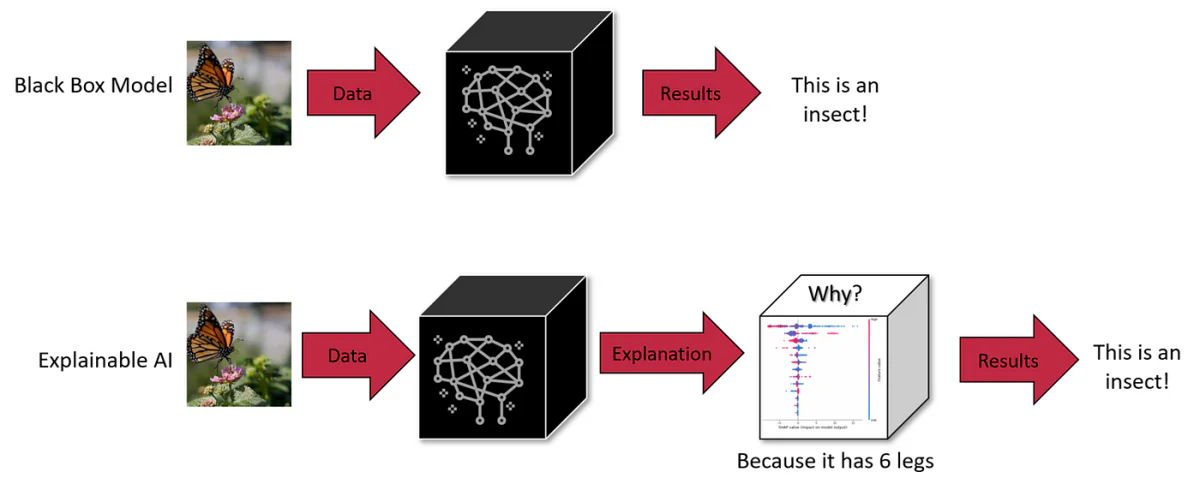
AI black boxes are systems whose internal workings remain opaque or invisible to users. Users can input data and receive output, but the logic or code that produces the output remains hidden. This is a common characteristic in many AI systems, including advanced generative models like ChatGPT and DALL-E 3.

LLMs such as GPT-4 present a significant challenge: their internal workings are largely opaque, making them “black boxes”. Such opacity isn’t just a technical puzzle; it poses real-world safety and ethical concerns. For instance, if we can’t discern how these systems reach conclusions, can we trust them in critical areas like medical diagnoses or financial assessments?

Exploring the Techniques of LIME and SHAP

Interpretability in machine learning (ML) and deep learning (DL) models helps us see into opaque inner workings of these advanced models. Local Interpretable Model-agnostic Explanations (LIME) and SHapley Additive exPlanations (SHAP) are two such mainstream interpretability techniques.

Interpretability

Interpretability

LIME, for instance, breaks down the complexity by creating simpler, local surrogate models that approximate the behavior of the original model around a specific input. By doing this, LIME helps in understanding how individual features influence the predictions of complex models, essentially providing a ‘local' explanation for why a model made a certain decision. It’s particularly useful for non-technical users, as it translates the intricate decision-making process of models into more understandable terms.

Model-Agnostic Interpretability of Machine Learning

Model-Agnostic Interpretability of Machine Learning (LIME) Source

SHAP, on the other hand, takes inspiration from game theory, specifically the concept of Shapley values. It assigns an ‘importance' value to each feature, indicating how much each feature contributes to the difference between the actual prediction and the baseline prediction (the average prediction across all inputs). SHAP's strength lies in its consistency and ability to provide a global perspective – it not only explains individual predictions but also gives insights into the model as a whole. This is especially valuable in deep learning models, where the interconnected layers and numerous parameters often make the prediction process seem like a journey through a labyrinth. SHAP demystifies this by quantifying the contribution of each feature, offering a clearer map of the model’s decision-making pathways.
SHAP

SHAP (Source)

Both LIME and SHAP have emerged as essential tools in the realm of AI and ML, addressing the critical need for transparency and trustworthiness. As we continue to integrate AI more deeply into various sectors, the ability to interpret and understand these models becomes not just a technical necessity but a fundamental requirement for ethical and responsible AI development. These techniques represent significant strides in unraveling the complexities of ML and DL models, transforming them from inscrutable ‘black boxes' into comprehensible systems whose decisions and behaviors can be understood, trusted, and effectively utilized.

The Scale and Complexity of LLMs

The scale of these models adds to their complexity. Take GPT-3, for instance, with its 175 billion parameters, and newer models having trillions. Each parameter interacts in intricate ways within the neural network, contributing to emergent capabilities that aren’t predictable by examining individual components alone. This scale and complexity make it nearly impossible to fully grasp their internal logic, posing a hurdle in diagnosing biases or unwanted behaviors in these models.

The Tradeoff: Scale vs. Interpretability

Reducing the scale of LLMs could enhance interpretability but at the cost of their advanced capabilities. The scale is what enables behaviors that smaller models cannot achieve. This presents an inherent tradeoff between scale, capability, and interpretability.

Impact of the LLM Black Box Problem

1. Flawed Decision Making

The opaqueness in the decision-making process of LLMs like GPT-3 or BERT can lead to undetected biases and errors. In fields like healthcare or criminal justice, where decisions have far-reaching consequences, the inability to audit LLMs for ethical and logical soundness is a major concern. For example, a medical diagnosis LLM relying on outdated or biased data can make harmful recommendations. Similarly, LLMs in hiring processes may inadvertently perpetuate gender bi ases. The black box nature thus not only conceals flaws but can potentially amplify them, necessitating a proactive approach to enhance transparency.

2. Limited Adaptability in Diverse Contexts

The lack of insight into the internal workings of LLMs restricts their adaptability. For example, a hiring LLM might be inefficient in evaluating candidates for a role that values practical skills over academic qualifications, due to its inability to adjust its evaluation criteria. Similarly, a medical LLM might struggle with rare disease diagnoses due to data imbalances. This inflexibility highlights the need for transparency to re-calibrate LLMs for specific tasks and contexts.

3. Bias and Knowledge Gaps

LLMs' processing of vast training data is subject to the limitations imposed by their algorithms and model architectures. For instance, a medical LLM might show demographic biases if trained on unbalanced datasets. Also, an LLM's proficiency in niche topics could be misleading, leading to overconfident, incorrect outputs. Addressing these biases and knowledge gaps requires more than just additional data; it calls for an examination of the model's processing mechanics.

4. Legal and Ethical Accountability

The obscure nature of LLMs creates a legal gray area regarding liability for any harm caused by their decisions. If an LLM in a medical setting provides faulty advice leading to patient harm, determining accountability becomes difficult due to the model's opacity. This legal uncertainty poses risks for entities deploying LLMs in sensitive areas, underscoring the need for clear governance and transparency.

5. Trust Issues in Sensitive Applications

For LLMs used in critical areas like healthcare and finance, the lack of transparency undermines their trustworthiness. Users and regulators need to ensure that these models do not harbor biases or make decisions based on unfair criteria. Verifying the absence of bias in LLMs necessitates an understanding of their decision-making processes, emphasizing the importance of explainability for ethical deployment.

6. Risks with Personal Data

LLMs require extensive training data, which may include sensitive personal information. The black box nature of these models raises concerns about how this data is processed and used. For instance, a medical LLM trained on patient records raises questions about data privacy and usage. Ensuring that personal data is not misused or exploited requires transparent data handling processes within these models.

Emerging Solutions for Interpretability

To address these challenges, new techniques are being developed. These include counterfactual (CF) approximation methods. The first method involves prompting an LLM to change a specific text concept while keeping other concepts constant. This approach, though effective, is resource-intensive at inference time.

The second approach involves creating a dedicated embedding space guided by an LLM during training. This space aligns with a causal graph and helps identify matches approximating CFs. This method requires fewer resources at test time and has been shown to effectively explain model predictions, even in LLMs with billions of parameters.

These approaches highlight the importance of causal explanations in NLP systems to ensure safety and establish trust. Counterfactual approximations provide a way to imagine how a given text would change if a certain concept in its generative process were different, aiding in practical causal effect estimation of high-level concepts on NLP models.

Deep Dive: Explanation Methods and Causality in LLMs

Probing and Feature Importance Tools

Probing is a technique used to decipher what internal representations in models encode. It can be either supervised or unsupervised and is aimed at determining if specific concepts are encoded at certain places in a network. While effective to an extent, probes fall short in providing causal explanations, as highlighted by Geiger et al. (2021).

Feature importance tools, another form of explanation method, often focus on input features, although some gradient-based methods extend this to hidden states. An example is the Integrated Gradients method, which offers a causal interpretation by exploring baseline (counterfactual, CF) inputs. Despite their utility, these methods still struggle to connect their analyses with real-world concepts beyond simple input properties.

Intervention-Based Methods

Intervention-based methods involve modifying inputs or internal representations to study effects on model behavior. These methods can create CF states to estimate causal effects, but they often generate implausible inputs or network states unless carefully controlled. The Causal Proxy Model (CPM), inspired by the S-learner concept, is a novel approach in this realm, mimicking the behavior of the explained model under CF inputs. However, the need for a distinct explainer for each model is a major limitation.

Approximating Counterfactuals

Counterfactuals are widely used in machine learning for data augmentation, involving perturbations to various factors or labels. These can be generated through manual editing, heuristic keyword replacement, or automated text rewriting. While manual editing is accurate, it's also resource-intensive. Keyword-based methods have their limitations, and generative approaches offer a balance between fluency and coverage.

Faithful Explanations

Faithfulness in explanations refers to accurately depicting the underlying reasoning of the model. There's no universally accepted definition of faithfulness, leading to its characterization through various metrics like Sensitivity, Consistency, Feature Importance Agreement, Robustness, and Simulatability. Most of these methods focus on feature-level explanations and often conflate correlation with causation. Our work aims to provide high-level concept explanations, leveraging the causality literature to propose an intuitive criterion: Order-Faithfulness.

We've delved into the inherent complexities of LLMs, understanding their ‘black box' nature and the significant challenges it poses. From the risks of flawed decision-making in sensitive areas like healthcare and finance to the ethical quandaries surrounding bias and fairness, the need for transparency in LLMs has never been more evident.

The future of LLMs and their integration into our daily lives and critical decision-making processes hinges on our ability to make these models not only more advanced but also more understandable and accountable. The pursuit of explainability and interpretability is not just a technical endeavor but a fundamental aspect of building trust in AI systems. As LLMs become more integrated into society, the demand for transparency will grow, not just from AI practitioners but from every user who interacts with these systems.

Think you can spot a fake AI-generated news story? Take this quiz to find out

concerned woman using laptop

You spot a news story on the internet with the headline "Revolutionary Breakthrough Claims AI Can Now Accurately Predict the Weather 2 Months in Advance." Sounds intriguing. But it is true? Hmm, not necessarily.

Figuring out what information you find online is real versus fake has always been challenging. But AI has turned this into an even trickier task. A recent survey conducted by cybersecurity provider Netskope found that many people were unable to distinguish between real news stories and those cooked up by AI.

Also: 6 AI tools to supercharge your work and everyday life

As a test, Netskope showed 1,000 people in the US and 500 in the UK a fake AI news story alongside a real one. Some 84% of those in the UK boasted that they were skilled at identifying a fake story, yet half of them chose the fake story as real. And in the US, 88% felt confident that they could spot a fake story, but 44% of them thought the AI-generated story was legit.

To see how you would fare at spotting a fake AI story versus a real one, Netskope invites you to take its Fake news quiz. Here you're presented with 12 different stories and challenged to guess whether you think each one is phony or legit.

The people surveyed by Netskope said that they use social media and are interested in the news. Asked to pinpoint their most most trusted service for news stories, most named newspapers and tabloids. But video-based platforms like TikTok and Snapchat came in second place.

As part of its research, Netskope also looked at the most widespread fake news stories and photos of 2023 based on social views, engagement, and other factors to determine their impact. The top item was an image of Pope Francis wearing an oversized white puffer coat. Though the photo was fake, it racked up more than 20 million views on social media and was highlighted by more than 300 media publications.

Another AI-generated item that gained traction was an image of Donald Trump being arrested in Washington DC this past March. Though Trump has found himself in trouble with the law on several occasions, this image was created using the AI image generator Midjourney. Though it was fake, the photo grabbed more than 10 million views on Twitter (now X) and was covered by 671 news publications.

Also: How to get a perfect face swap using Midjourney AI

These phony photos show how easy it can be to fool people with deceptive images. Using tools like Midjourney and DALL-E, virtually anyone can cook up an image so realistic that it can not only con the average person but also trick news publishers and professionals who otherwise would be more discerning.

And now more AI tools are capable of generating fake videos. Some of the phony ones highlighted by Netskope for 2023 included one of Hillary Clinton endorsing Republican Ron DeSantis for President and another of Elon Musk touting the benefits of eating a cannabis edible.

Once a fake news story or photo has been promoted online, identifying it as phony can take a while. On average, most such items took around six days to be spotted and refuted. But an AI-edited video of Bill Gates ending an interview with ABC News journalist Sarah Ferguson over questions about his involvement in the COVID-19 vaccine distribution took a whopping 15 days to be labeled as fake.

Also: Elections 2024: How AI will fool voters if we don't do something now

To help people better detect real versus phony, Netskope offers the following tips and tricks:

For news stories

  • Try and find the original source of the story. If you see a story making unusual or outlandish claims, check the source. You may be able to find out where it originated by scanning social media. If it's an image, run a reverse image search using Google Reverse Image Search, TinEye, or Yandex.

For image-based stories

  • Enlarge the image to check for errors. Enlarging the image may reveal details that are either inaccurate or of poor quality, indicating possible AI involvement.
  • Check the image's proportions. AI-generated images often err with the proportions of hands, fingers, teeth, ears, glasses, and other body parts and objects.
  • Scrutinize the background. With fake or altered images, the background is often skewed, repeated, or otherwise lacking in detail.
  • Check for imperfections. In AI images, features that would typically be detailed or even rough are often smooth and perfect. Skin, hair, teeth, and faces often look too flawless to be real.
  • Scan the details. Inconsistencies in images can often point to AI fakery. Maybe the color of the person's eyes don't match across different images or the pattern changes from one image to another.

For video-based stories

  • Check the size of the video. Videos that are smaller and of lower resolution than they should be are sometimes a sign of AI generation.
  • Look at any subtitles. With phony videos, subtitles are often positioned to cover faces so that it's more difficult to see that the audio doesn't match the lip movements.
  • Check for misaligned lip shapes. Misaligned lip shapes are another sign of AI manipulation, especially if the spliced area is visible near the middle of the mouths.

Featured

AWS Launches New Analytics Engine That Combines the Power Of Vector Search And Graph Data

AWS Launches New Analytics Engine That Combines the Power Of Vector Search And Graph Data December 1, 2023 by Ali Azhar

One of the common debates in the AI circles is whether using graph or vector databases offers more truthful information in generative AI (GenAI) applications. While graph data is great at representing and analyzing complex relationships and connections, vector data is optimized for efficient search capabilities and calculations in high-dimensional spaces.

Amazon Web Services (AWS) has decided to not debate this issue as it launched a new analytics database engine that combines the power of both capabilities. The general availability of the new service, named Amazon Neptune Analytics, was unveiled at the re-Invest conference in Las Vegas.

Swami Sivasubramanian, vice president of data and machine learning at AWS, who announced the new service said “Since both graph analytics and vectors are all about uncovering the hidden relationships across our data, we thought to ourselves: ‘what if we combined vector search with the ability to analyze massive amounts of graph data in just seconds,’ and today, we are doing just that”

Sivasubramanian further elaborated that the new service makes it easier for users to uncover hidden relationships across data – by storing the graph and vector data together. He also cited the example of Snap, one of the companies that use Neptune, who uses the service to find billions of connections among its 50 million active users “in just seconds”.

The new service is available as a pay-as-you-go model with no one-time setup fees or recurring subscriptions. It is available now in some AWS regions including the US East, the US West, Asia Pacific, and Europe.

(Michael Vi/Shutterstock)

Since the launch of Neptune in 2018, it has become one of the leading services for storing graph data and performing updates and election on specific subside of the graph. However, one of the challenges has been that it takes some time to load the entire graph into memory. Loading large datasets from existing data lakes or databases to a graph analytic solution can take hours or even days. AWS Neptune Analytics addresses these issues by making the process significantly faster.

AWS claims their internal benchmarking testing showed that Neptune is “80 times” faster than existing AWS solutions in finding insights in graph data and data lakes on S3.

Amazon Neptune Analytics is a fully managed service, so AWS does all the infrastructure heavy lifting, enabling users to focus on workflows and problem-solving. The engine automatically allocates compute resources based on the size of the graph and quickly loads data in memory to run queries in seconds. The service supports a library of optimized graph analytic algorithms and also facilitates the creation of graph applications using openCypher, one of the most widely used graph query languages.

With the new capabilities, Amazon Neptune Analytics could be a game changer in use cases that require quick response such as fraud detection and prevention, cybersecurity, and transportation logistics.

Related Items

Oracle Introduces Integrated Vector Database for Generative AI

DataStax Rolls Out Vector Search for Astra DB to Support Gen AI

Retool’s State of AI Report Highlights the Rise of Vector Databases

Related

10 GitHub Repositories to Master Machine Learning

10 GitHub Repositories to Master Machine Learning
Image generated with DALLE-3

Mastering machine learning (ML) may seem overwhelming, but with the right resources, it can be much more manageable. GitHub, the widely used code hosting platform, is home to numerous valuable repositories that can benefit learners and practitioners at all levels. In this article, we review 10 essential GitHub repositories that provide a range of resources, from beginner-friendly tutorials to advanced machine learning tools.

1. ML-For-Beginners by Microsoft

Repository: microsoft/ML-For-Beginners

This comprehensive 12-week program offers 26 lessons and 52 quizzes, making it an ideal starting point for newcomers. It serves as a starting point for those with no prior experience with machine learning and looks to build core competencies using Scikit-learn and Python.

Each lesson features supplemental materials including pre- and post-quizzes, written instructions, solutions, assignments, and other resources to complement the hands-on activities.

2. ML-YouTube-Courses

Repository: dair-ai/ML-YouTube-Courses

This GitHub repository serves as a curated index of quality machine learning courses hosted on YouTube. By collecting links to various ML tutorials, lectures, and educational series into one centralized location from providers like Clatech, Stanford, and MIT, the repo makes it easier for interested learners to find video-based ML content that meets their needs.

It is the only repository you need if you are trying to learn things for free and at your own time.

3. Mathematics For Machine Learning

Repository: mml-book/mml-book.github.io

Mathematics is the backbone of machine learning, and this repository serves as the companion webpage to the book "Mathematics For Machine Learning." The book motivates readers to learn mathematical concepts needed for machine learning. The authors aim to provide the necessary mathematical skills to understand advanced machine learning techniques, rather than covering the techniques themselves.

It covers linear algebra, analytic geometry, matrix decompositions, vector calculus, probability, distribution, continuous optimization, linear regression, PCA, Gaussian mixture models, and SVMs.

4. MIT Deep Learning Book

Repository: janishar/mit-deep-learning-book-pdf

The Deep Learning textbook is a comprehensive resource intended to help students and practitioners enter the field of machine learning, specifically deep learning. Published in 2016, the book provides a theoretical and practical foundation in the machine learning techniques that have driven recent advances in artificial intelligence.

The online version of the MIT Deep Learning Book is now complete and will remain freely available online, providing a valuable contribution to the democratization of AI education.

The book covers a wide range of topics in depth, including deep feedforward networks, regularization, optimization algorithms, convolutional networks, sequence modeling, and practical methodology.

5. Machine Learning ZoomCamp

Repository: DataTalksClub/machine-learning-zoomcamp

Machine Learning ZoomCamp is a free four-month online bootcamp that provides a comprehensive introduction to machine learning engineering. Ideal for those serious about advancing their careers, this program guides students through building real-world machine learning projects, covering fundamental concepts like regression, classification, evaluation metrics, deploying models, decision trees, neural networks, Kubernetes, and TensorFlow Serving.

Over the course, participants will gain practical experience in areas like deep learning, serverless model deployment, and ensemble techniques. The curriculum culminates in two capstone projects that enable students to demonstrate their newly-developed skills.

6. Machine Learning Tutorials

Repository: ujjwalkarn/Machine-Learning-Tutorials

This repository is a collection of tutorials, articles, and other resources on machine learning and deep learning. It covers a wide range of topics such as Quora, blogs, interviews, Kaggle competitions, cheat sheets, deep learning frameworks, natural language processing, computer vision, various machine learning algorithms, and ensembling techniques.

The resource is designed to provide both theoretical and practical knowledge with code examples and use case descriptions. It is a comprehensive learning tool that offers a multi-faceted approach to gaining exposure to the machine learning landscape.

7. Awesome Machine Learning

Repository: josephmisiti/awesome-machine-learning

Awesome Machine Learning is a curated list of awesome machine learning frameworks, libraries, and software that is perfect for those looking to explore different tools and technologies in the field. It covers tools across a range of programming languages from C++ to Go that are further divided into various machine learning categories including computer vision, reinforcement learning, neural networks, and general-purpose machine learning.

Awesome Machine Learning is a comprehensive resource for machine learning practitioners and enthusiasts, covering everything from data processing and modeling to model deployment and productionization. The platform facilitates easy comparison of different options to help users find the best fit for their specific projects and goals. Additionally, the repository remains up-to-date with the latest and greatest machine learning software across various programming languages, thanks to contributions from the community.

8. VIP Cheat Sheets for Stanford's CS 229 Machine Learning

Repository: afshinea/stanford-cs-229-machine-learning

This repository provides condensed references and refreshers on machine learning concepts covered in Stanford's CS 229 course. It aims to consolidate all the important notions into VIP cheat sheets spanning major topics like supervised learning, unsupervised learning, and deep learning. The repository also contains VIP refreshers that highlight prerequisites in probabilities, statistics, algebra and calculus. Additionally, there is a super VIP cheatsheet that compiles all these concepts into one ultimate reference that learners can readily have on hand.

By bringing together these key points, definitions, and technical concepts, the goal is to help learners thoroughly grasp machine learning topics in CS 229. The cheat sheets enable summing up the vital concepts from lectures and textbook materials into condensed references for technical interview.

9. Machine learning Interview

Repository: khangich/machine-learning-interview

It provides a comprehensive study guide and resources for preparing for machine learning engineering and data science interviews at major tech companies like Facebook, Amazon, Apple, Google, Microsoft, etc.

Key topics covered:

  • LeetCode questions categorized by type (SQL, programming, statistics).
  • ML fundamentals like logistic regression, KMeans, neural networks.
  • Deep learning concepts from activation functions to RNNs.
  • ML systems design including papers on technical debt and rules of ML
  • Classic ML papers to read.
  • ML production challenges like scaling at Uber and DL in production
  • Common ML system design interview questions e.g. video/feed recommendation, fraud detection.
  • Example solutions and architectures for YouTube, Instagram recommendations.

The guide consolidates materials from top experts like Andrew Ng and includes real interview questions asked at top companies. It aims to provide the study plan to ace ML interviews across various big tech firms.

10. Awesome Production Machine Learning

Repository: EthicalML/awesome-production-machine-learning

This repository provides a curated list of open source libraries to help deploy, monitor, version, scale and secure machine learning models in production environments. It covers various aspects of production machine learning including:

  1. Explaining Predictions & Model
  2. Privacy Preserving ML
  3. Model & Data Versioning
  4. Model Training Orchestration
  5. Model Serving & Monitoring
  6. AutoML
  7. Data Pipeline
  8. Data Labelling
  9. Metadata Management
  10. Computation Distribution
  11. Model Serialisation
  12. Optimized Computation
  13. Data Stream Processing
  14. Outlier & Anomaly Detection
  15. Feature Store
  16. Adversarial Robustness
  17. Data Storage Optimization
  18. Data Science Notebook
  19. Neural Search
  20. And More.

Conclusion

Whether you're a beginner or an experienced ML practitioner, these GitHub repositories provide a wealth of knowledge and resources to deepen your understanding and skills in machine learning. From foundational mathematics to advanced techniques and practical applications, these repositories are essential tools for anyone serious about mastering machine learning.

Abid Ali Awan (@1abidaliawan) is a certified data scientist professional who loves building machine learning models. Currently, he is focusing on content creation and writing technical blogs on machine learning and data science technologies. Abid holds a Master's degree in Technology Management and a bachelor's degree in Telecommunication Engineering. His vision is to build an AI product using a graph neural network for students struggling with mental illness.

More On This Topic

  • Learn Machine Learning From These GitHub Repositories
  • 25 Github Repositories Every Python Developer Should Know
  • Learn Data Science From These GitHub Repositories
  • Learn Data Engineering From These GitHub Repositories
  • Learn MLOps From These GitHub Repositories
  • The Complete Collection Of Data Repositories — Part 1

What is Copilot (formerly Bing Chat)? Here’s everything you need to know

Microsoft Copilot

See also

  • How to use ChatGPT to write Excel formulas
  • How to use ChatGPT to write code
  • ChatGPT vs. Bing Chat: Which AI chatbot should you use?
  • How to use ChatGPT to build your resume
  • How does ChatGPT work?
  • How to get started using ChatGPT

Free MIT Course: TinyML and Efficient Deep Learning Computing

Free MIT Course: TinyML and Efficient Deep Learning Computing
Image by Author
Introduction

In today’s tech-savvy world, we're surrounded by mind-blowing AI-powered wonders: voice assistants answering our questions, smart cameras identifying faces, and self-driving cars navigating roads. They're like the superheroes of our digital age! However, making these technological wonders work smoothly on our everyday devices is tougher than it seems. These AI superheroes have a special need: significant computing power and memory resources. It's like trying to fit an entire library into a tiny backpack. And guess what? Most of our regular devices like phones, smartwatches, etc. don’t have enough ‘brainpower’ to handle these AI superheroes. This poses a major problem in the widespread deployment of the AI technology.

Hence, it is crucial to improve the efficiency of these large AI models to make them accessible. This course: "TinyML and Efficient Deep Learning Computing" by MIT HAN lab tackles this core obstacle. It introduces methods to optimize AI models, ensuring their viability in real-world scenarios. Let’s take a detailed look at what it offers:

Course Overview

Course Structure:

Duration: Fall 2023

Timing: Tuesday/Thursday 3:35-5:00 pm Eastern Time

Instructor: Professor Song Han

Teaching Assistants: Han Cai and Ji Lin

As this is an ongoing course, you can watch the live streaming at this link.

Course Approach:

Theoretical Foundation: Starts with foundational concepts of Deep Learning, then advances into sophisticated methods for efficient AI computing.

Hands-on Experience: Provides practical experience by enabling students to deploy and work with large language models like LLaMA 2 on their laptops.

Course Modules

1. Efficient Inference

This module primarily focuses on enhancing the efficiency of AI inference processes. It delves into techniques such as pruning, sparsity, and quantization aimed at making inference operations faster and more resource-efficient. Key topics covered include:

  • Pruning and Sparsity (Part I & II): Exploring methods to reduce the size of models by removing unnecessary parts without compromising performance.
  • Quantization (Part I & II): Techniques to represent data and models using fewer bits, saving memory and computational resources.
  • Neural Architecture Search (Part I & II): These lectures explore automated techniques for discovering the best neural network architectures for specific tasks. They demonstrate practical uses across various areas such as NLP, GAN, point cloud analysis, and pose estimation.
  • Knowledge Distillation: This session focuses on knowledge distillation, a process where a compact model is trained to mimic the behavior of a larger, more complex model. It aims to transfer knowledge from one model to another.
  • MCUNet: TinyML on Microcontrollers: This lecture introduces MCUNet, which focuses on deploying TinyML models on microcontrollers, allowing AI to run efficiently on low-power devices. It covers the essence of TinyML, its challenges, creating compact neural networks, and its diverse applications.
  • TinyEngine and Parallel Processing: This part discusses TinyEngine, exploring methods for efficient deployment and parallel processing strategies like loop optimization, multithreading, and memory layout for AI models on constrained devices.

2. Domain-Specific Optimization

In the Domain-Specific Optimization segment, the course covers various advanced topics aimed at optimizing AI models for specific domains:

  • Transformer and LLM (Part I & II): It dives into Transformer basics, design variants, and covers advanced topics related to efficient inference algorithms for LLMs. It also explores efficient inference systems and fine-tuning methods for LLMs.
  • Vision Transformer: This section introduces Vision Transformer basics, efficient ViT strategies, and diverse acceleration techniques. It also explores self-supervised learning methods and multi-modal Large Language Models (LLMs) to enhance AI capabilities in vision-related tasks.
  • GAN, Video, and Point Cloud: This lecture focuses on enhancing Generative Adversarial Networks (GANs) by exploring efficient GAN compression techniques (using NAS+distillation), AnyCost GAN for dynamic cost, and Differentiable Augmentation for data-efficient GAN training. These approaches aim to optimize models for GANs, video recognition, and point cloud analysis.
  • Diffusion Model: This lecture offers insights into the structure, training, domain-specific optimization, and fast-sampling strategies of Diffusion Models.

3. Efficient Training

Efficient training refers to the application of methodologies to optimize the training process of machine learning models. This chapter covers the following key areas:

  • Distributed Training (Part I & II): Explore strategies to distribute training across multiple devices or systems. It provides strategies for overcoming bandwidth and latency bottlenecks, optimizing memory consumption, and implementing efficient parallelization methods to enhance the efficiency of training large-scale machine learning models across distributed computing environments.
  • On-Device Training and Transfer Learning: This session primarily focuses on training models directly on edge devices, handling memory constraints, and employing transfer learning methods for efficient adaptation to new domains.
  • Efficient Fine-tuning and Prompt Engineering: This section focuses on refining Large Language Models (LLMs) through efficient fine-tuning techniques like BitFit, Adapter, and Prompt-Tuning. Additionally, it highlights the concept of Prompt Engineering and illustrates how it can enhance model performance and adaptability.

4. Advanced Topics

This module covers topics about an emerging field of Quantum Machine Learning. While the detailed lectures for this segment are not available yet, the planned topics for coverage include:

  • Basics of Quantum Computing
  • Quantum Machine Learning
  • Noise Robust Quantum ML

These topics will provide a foundational understanding of quantum principles in computing and explore how these principles are applied to enhance machine learning methods while addressing the challenges posed by noise in quantum systems.

If you are interested in digging deeper into this course then check the playlist below:


Concluding Remarks

This course has received fantastic feedback, especially from AI enthusiasts and professionals. Although the course is ongoing and scheduled to conclude by December 2023, I highly recommend joining! If you're taking this course or intend to, share your experiences. Let's chat and learn together about TinyML and how to make AI smarter on small devices. Your input and insights would be valuable!

Kanwal Mehreen is an aspiring software developer with a keen interest in data science and applications of AI in medicine. Kanwal was selected as the Google Generation Scholar 2022 for the APAC region. Kanwal loves to share technical knowledge by writing articles on trending topics, and is passionate about improving the representation of women in tech industry.

More On This Topic

  • Free MIT Courses on Calculus: The Key to Understanding Deep Learning
  • Why TinyML Cases Are Becoming Popular?
  • 8 Free MIT Courses to Learn Data Science Online
  • KDnuggets News, April 6: 8 Free MIT Courses to Learn Data Science…
  • Free Artificial Intelligence And Deep Learning Crash Course
  • HuggingFace Has Launched a Free Deep Reinforcement Learning Course

Apple’s Scary New Innovation Gives Voice to the Voiceless

Yesterday, Apple released a short film along with an e-book showing its new feature, Personal Voice for its devices which was unveiled earlier in May this year. This it did right before the International Day of Persons with Disabilities on December 3. Apple has always been at the forefront of making its devices accessibility friendly.

The company has consistently received higher ratings for their ease of use by people with visual, hearing, and motor impairments, as well as by the elderly. It is taking it a step ahead with AI, building features like the VoiceOver, Guided Access, Door Detection, Live Listen, Point and Speak for Magnifier etc.

For those at risk of speech loss, we’ve made it possible to preserve your voice on your devices so even if you can no longer speak, you can still sound like you. It’s remarkable to see the experiences this technology helps preserve, while also protecting your privacy. pic.twitter.com/Vir3VQbhOA

— Tim Cook (@tim_cook) November 30, 2023

Personal Voice was announced earlier this year, and Sarah Herrlinger, senior director, global accessibility policy & Initiatives said, “These groundbreaking features were designed with feedback from members of disability communities, to support a diverse set of users.” Although it is not speaking out about AI, it is quickly updating its features to integrate better technology.

Cloning voices for healthcare has been a work in progress. Previously, patients who lost their voice due to various illnesses had to use an electrolarynx. This device needs to be placed up the throat of the patient and the vibration causes it to generate a robotic sounding voice.

Companies that clone videos and images also clone voices which are used for not only all spaces of entertainment but also for healthcare. ElevenLabs, Murf.ai, Resemble AI, Respeecher etc create voice and video clones.

AI for Good

Using existing features, the Personal Voice add on enhances user experience further. The video released by the tech giant features Tristram Ingham, a physician, academic researcher, and disability community leader who suffers from facioscapulohumeral muscular dystrophy (FSHD). This disorder eventually leads to an inability to speak.

Speaking from experience, he said that, “Historically, providers have spoken for disabled people, families have spoken for disabled people. If technology can allow a voice to be preserved and maintained, that’s autonomy, that’s self-determination.” This is possible by a combination of text-to-speech (TTS) synthesis and machine learning (ML) to create a synthetic voice that sounds like the user’s own voice.

The user has to read out a series of randomly chosen text prompts aloud, providing a sample of their voice. Acoustic analysis of the voice sample extracts acoustic features such as pitch, timbre, and intonation. A text-to-speech model is trained on the user’s voice data and a large dataset of text and speech pairs. The model learns to associate acoustic features with corresponding text and generate synthetic speech that mimics the user’s voice.

All of this is done within the user’s phone without running the risk of privacy invasion a characteristic Apple is most known for. The created voice can be used for calls, FaceTime and other apps. This feature works with Live Speech which was also announced around the same time. You type what you want to say, and your Personal Voice says it out loud for you.

Can be used maliciously

This feature that will empower so many and give them a voice has simultaneously raised security and privacy concerns, given the increasing threat posed by deepfake technologies. The internet is full of stories of unsuspecting people and companies being scammed by voice clones, cleaning their bank accounts. Is it really wise to voluntarily give your voice recording to Apple?

The company in its announcement ensures that all data processing occurs locally on the device, which reduces the risk of data breaches. Access to Personal Voice generation and management is secured through biometric locks like FaceID or TouchID, and its use requires device unlocking, preventing unauthorized access. Personal Voices can be shared across devices linked to the same iCloud account and to third party apps, but there seems to be no way to transfer the voice to another device.

The possibility of further safeguards, such as tracking synthetic voices for detection, could be considered to enhance security. “Although I suspect, given the company’s privacy and security focus, it may already include this feature. It would be good if the means of detection were made publicly available,” writes Matt Smallman, author and security expert on the topic.

Vinod Iyengar, an AI Expert and Head of Product at Third AI is not so optimistic. “This could very quickly become a swamp of deep fakes everywhere,” he said. Voice cloning can be used to create fabricated audio content that appears to be genuine, making it harder to discern between real and fake audio recordings.

This could be another level of gray area and incoming legal troubles for the future.

In the meanwhile, speculations are on the rise on social media about Apple’s future direction, with suggestions that these features hint at more advanced AI integrations in upcoming products. The possibility of Apple surprising everyone with new local AI tools is discussed, indicating a shift from cloud-based to local data processing in AI. The future can have AI answer phone calls in your own voice without telling the difference!

More interesting is the fact that you can use this voice through Apple’s text to speech api.
In combination with an LLM/ChatGPT and cloud based phone number this could be used to allow an AI to make and receive calls on your behalf ( in your voice ).

— Kristoph (@ikristoph) May 17, 2023

Building Predictive Models: Logistic Regression in Python

Building Predictive Models: Logistic Regression in Python
Image by Author

When you are getting started with machine learning, logistic regression is one of the first algorithms you’ll add to your toolbox. It's a simple and robust algorithm, commonly used for binary classification tasks.

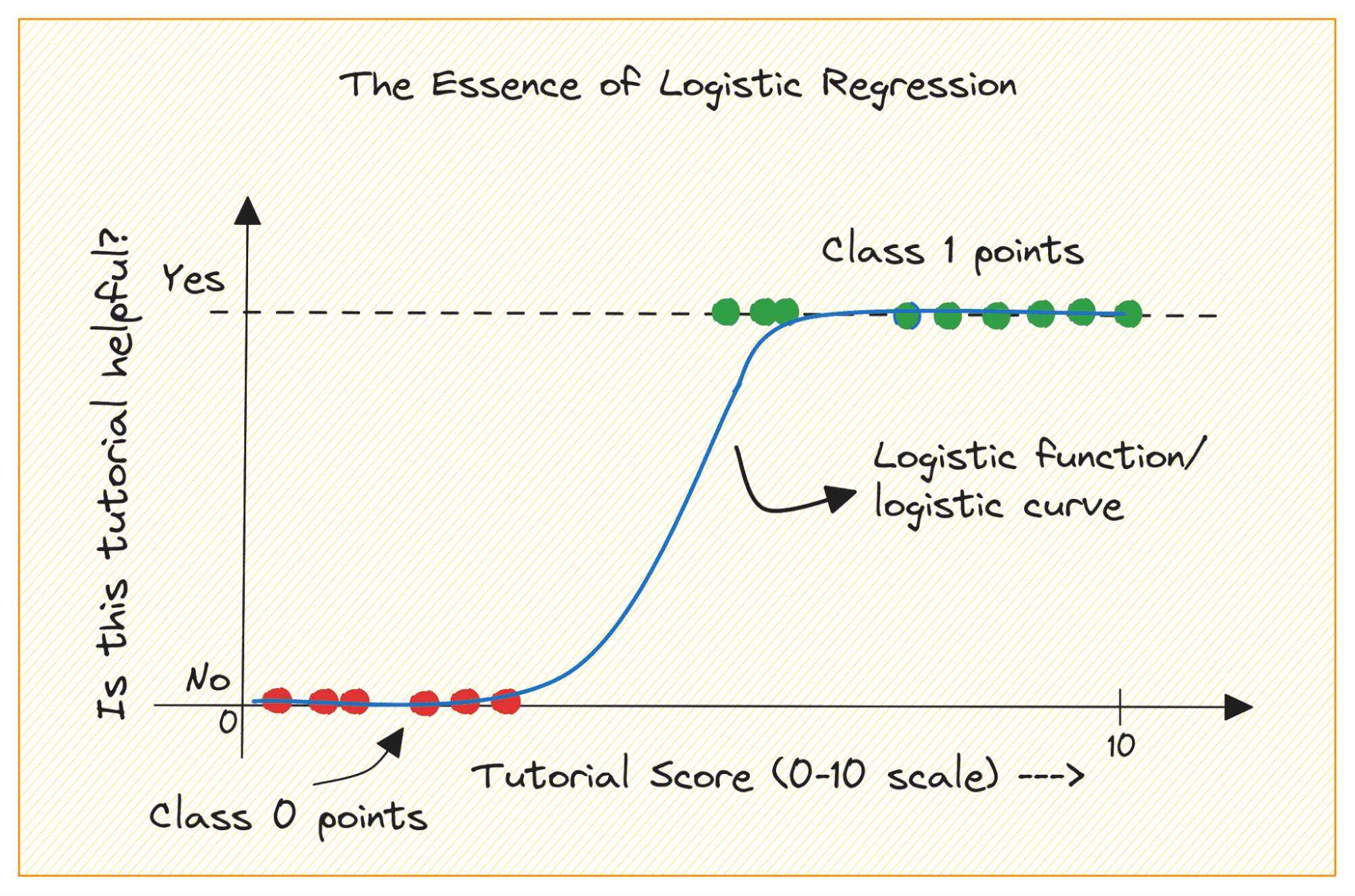
Consider a binary classification problem with classes 0 and 1. Logistic regression fits a logistic or sigmoid function to the input data and predicts the probability of a query data point belonging to class 1. Interesting, yes?

In this tutorial, we’ll learn about logistic regression from the ground up covering:

  • The logistic (or sigmoid) function
  • How we move from linear to logistic regression
  • How logistic regression works

Finally, we’ll build a simple logistic regression model to classify RADAR returns from the ionosphere.

Logistic Function

Before we learn more about logistic regression, let's review how the logistic function works. The logistic (or sigmoid function) is given by:

Building Predictive Models: Logistic Regression in Python

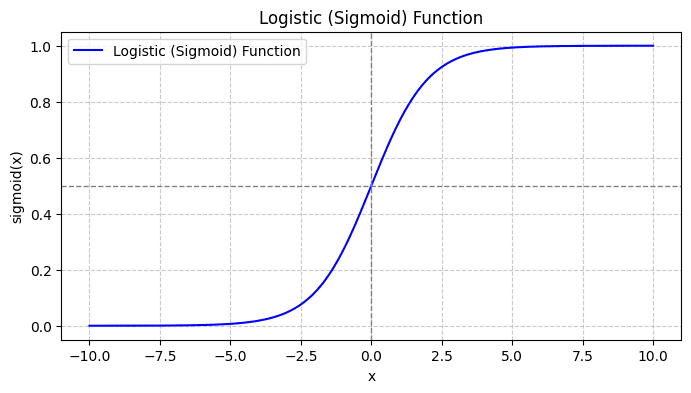
When you plot the sigmoid function, it’ll look like so:

Building Predictive Models: Logistic Regression in Python

From the plot, we see that:

  • When x = 0, σ(x) takes a value of 0.5.
  • When x approaches +∞, σ(x) approaches 1.
  • When x approaches -∞, σ(x) approaches 0.

So for all real inputs, the sigmoid function squishes them to take on values in the range [0, 1].

From Linear Regression to Logistic Regression

Let's first discuss why we cannot use linear regression for a binary classification problem.

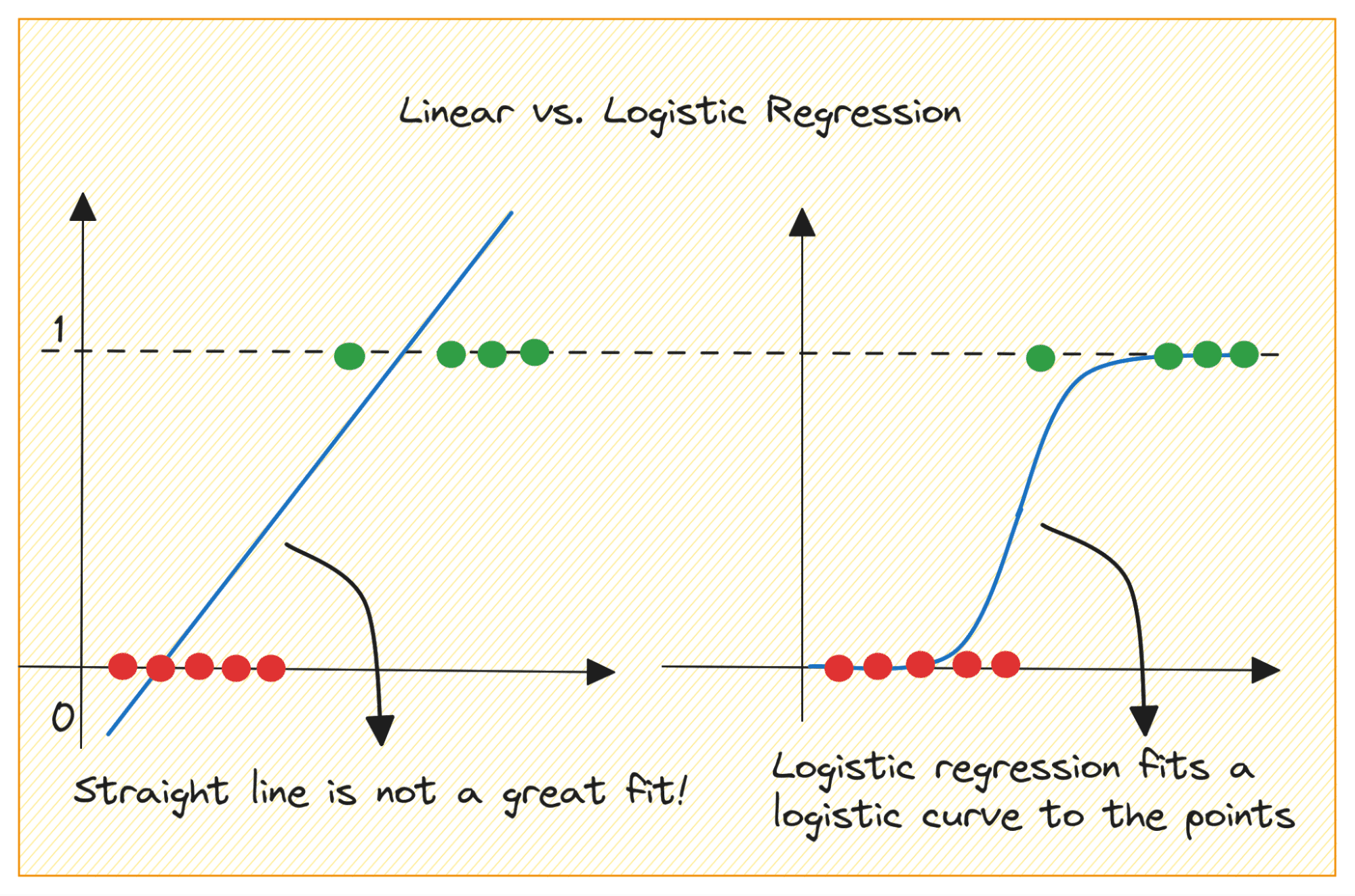
In a binary classification problem, the output is categorical label (0 or 1). Because linear regression predicts continuous-valued outputs which can be less than 0 or greater than 1, it does not make sense for the problem at hand.

Also, a straight line may not be the best fit when the output labels belong to one of the two categories.

Building Predictive Models: Logistic Regression in Python
Image by Author

So how do we go from linear to logistic regression? In linear regression the predicted output is given by:

Building Predictive Models: Logistic Regression in Python

Where the βs are the coefficients and X_is are the predictors (or features).

Without loss of generality, let’s assume X_0 = 1:

Building Predictive Models: Logistic Regression in Python

So we can have a more concise expression:

Building Predictive Models: Logistic Regression in Python

In logistic regression, we need the predicted probability p_i in the [0,1] interval. We know that the logistic function squishes inputs so that they take on values in the [0,1] interval.

So plugging in this expression into the logistic function, we have the predicted probability as:

Building Predictive Models: Logistic Regression in Python Under the Hood of Logistic Regression

So how do we find the best fit logistic curve for the given data set? To answer this, let’s understand maximum likelihood estimation.

Maximum Likelihood Estimation (MLE) is used to estimate the parameters of the logistic regression model by maximizing the likelihood function. Let's break down the process of MLE in logistic regression and how the cost function is formulated for optimization using gradient descent.

Breaking Down Maximum Likelihood Estimation

As discussed, we model the probability that a binary outcome occurs as a function of one or more predictor variables (or features):

Building Predictive Models: Logistic Regression in Python

Here, the βs are the model parameters or coefficients. X_1, X_2,…, X_n are the predictor variables.

MLE aims to find the values of β that maximize the likelihood of the observed data. The likelihood function, denoted as L(β), represents the probability of observing the given outcomes for the given predictor values under the logistic regression model.

Formulating the Log-Likelihood Function

To simplify the optimization process, it's common to work with the log-likelihood function. Because it transforms products of probabilities into sums of log probabilities.

The log-likelihood function for logistic regression is given by:

Building Predictive Models: Logistic Regression in Python Cost Function and Gradient Descent

Now that we know the essence of log-likelihood, let's proceed to formulate the cost function for logistic regression and subsequently gradient descent for finding the best model parameters

Cost Function for Logistic Regression

To optimize the logistic regression model, we need to maximize the log-likelihood. So we can use the negative log-likelihood as the cost function to minimize during training. The negative log-likelihood, often referred to as the logistic loss, is defined as:

Building Predictive Models: Logistic Regression in Python

The goal of the learning algorithm, therefore, is to find the values of ? that minimize this cost function. Gradient descent is a commonly used optimization algorithm for finding the minimum of this cost function.

Gradient Descent in Logistic Regression

Gradient descent is an iterative optimization algorithm that updates the model parameters β in the opposite direction of the gradient of the cost function with respect to β. The update rule at step t+1 for logistic regression using gradient descent is as follows:

Building Predictive Models: Logistic Regression in Python

Where α is the learning rate.

The partial derivatives can be computed using the chain rule. Gradient descent iteratively updates the parameters—until convergence—aiming to minimize the logistic loss. As it converges, it finds the optimal values of β that maximize the likelihood of the observed data.

Logistic Regression in Python with Scikit-Learn

Now that you know how logistic regression works, let’s build a predictive model using the scikit-learn library.

We’ll use the ionosphere dataset from the UCI machine learning repository for this tutorial. The dataset comprises 34 numerical features. The output is binary, one of ‘good’ or ‘bad’ (denoted by ‘g’ or ‘b’). The output label ‘good’ refers to RADAR returns that have detected some structure in the ionosphere.

Step 1 – Loading the Dataset

First, download the dataset and read it into a pandas dataframe:

import pandas as pd  import urllib    url = "https://archive.ics.uci.edu/ml/machine-learning-databases/ionosphere/iphere.data"  data = urllib.request.urlopen(url)  df = pd.read_csv(data, header=None)

Step 2 – Exploring the Dataset

Let's take a look at the first few rows of the dataframe:

# Display the first few rows of the DataFrame  df.head()

Building Predictive Models: Logistic Regression in Python
Truncated Output of df.head()

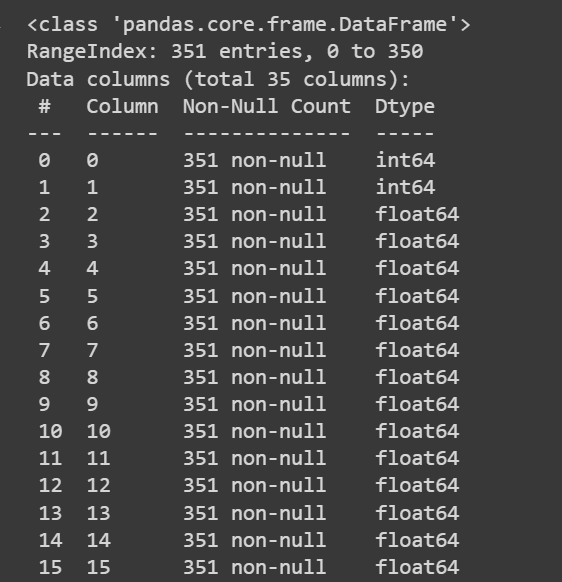
Let's get some information about the dataset: the number of non-null values and the data types of each of the columns:

# Get information about the dataset  print(df.info())

Building Predictive Models: Logistic Regression in Python Truncated Output of df.info()

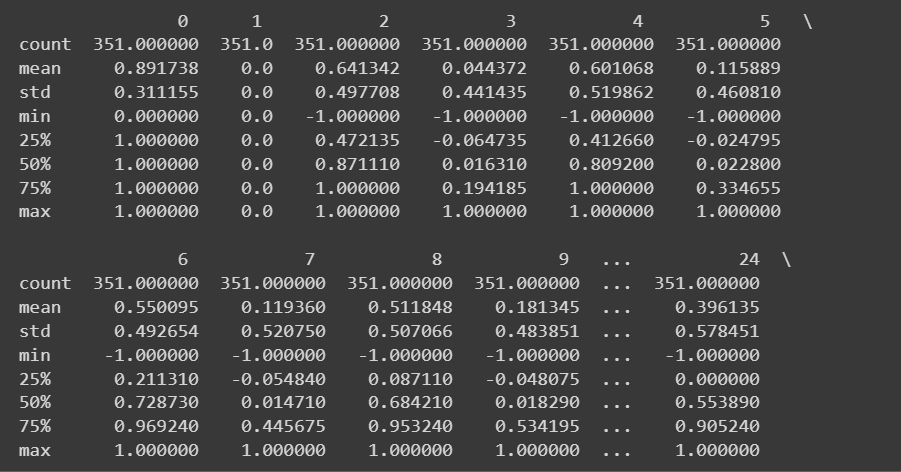
Because we have all numeric features, we can also get some descriptive statistics using the describe() method on the dataframe:

# Get descriptive statistics of the dataset  print(df.describe())

Building Predictive Models: Logistic Regression in Python
Truncated Output of df.describe()
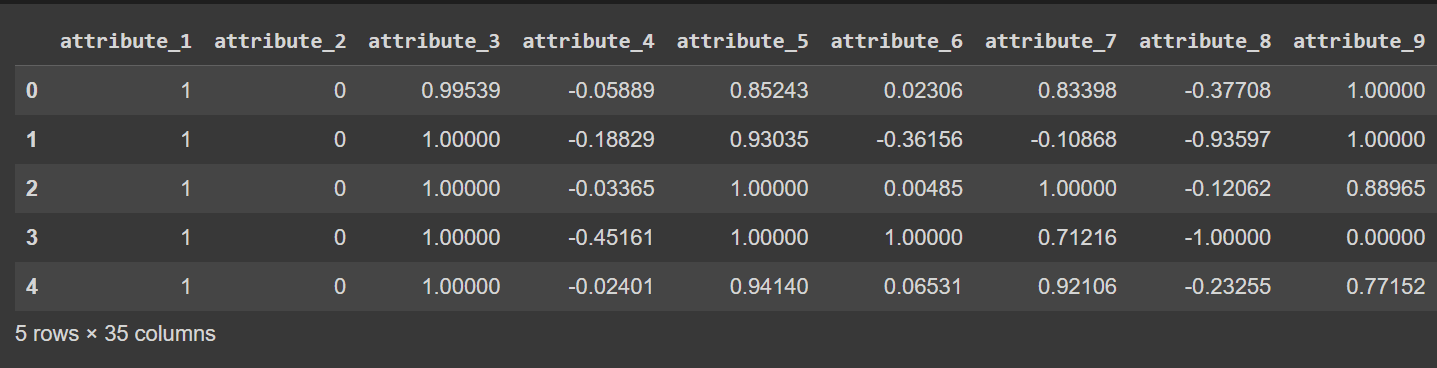
The column names are currently 0 through 34—including the label. Because the dataset does not provide descriptive names for the columns, it just refers to them as attribute_1 to attribute_34 if you would like you can rename the columns of the data frame as shown:

column_names = [  "attribute_1", "attribute_2", "attribute_3", "attribute_4", "attribute_5",  "attribute_6", "attribute_7", "attribute_8", "attribute_9", "attribute_10",  "attribute_11", "attribute_12", "attribute_13", "attribute_14", "attribute_15",  "attribute_16", "attribute_17", "attribute_18", "attribute_19", "attribute_20",  "attribute_21", "attribute_22", "attribute_23", "attribute_24", "attribute_25",  "attribute_26", "attribute_27", "attribute_28", "attribute_29", "attribute_30",  "attribute_31", "attribute_32", "attribute_33", "attribute_34", "class_label"  ]  df.columns = column_names

Note: This step is purely optional. You can proceed with the default column names if you prefer.

# Display the first few rows of the DataFrame  df.head()

Building Predictive Models: Logistic Regression in Python
Truncated Output of df.head() [After Renaming Columns]

Step 3 – Renaming Class Labels and Visualizing Class Distribution

Because the output class labels are ‘g’ and ‘b’, we need to map them to 1 and 0 , respectively. You can do it using map() or replace():

# Convert the class labels from 'g' and 'b' to 1 and 0, respectively  df["class_label"] = df["class_label"].replace({'g': 1, 'b': 0})

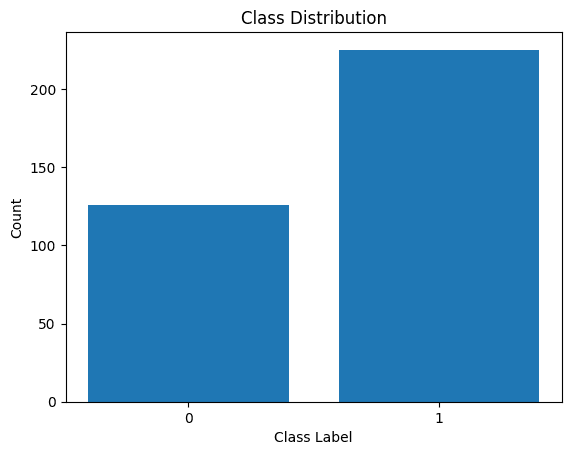
Let’s also visualize the distribution of the class labels:

import matplotlib.pyplot as plt    # Count the number of data points in each class  class_counts = df['class_label'].value_counts()    # Create a bar plot to visualize the class distribution  plt.bar(class_counts.index, class_counts.values)  plt.xlabel('Class Label')  plt.ylabel('Count')  plt.xticks(class_counts.index)  plt.title('Class Distribution')  plt.show()

Building Predictive Models: Logistic Regression in Python
Distribution of Class Labels

We see that there is an imbalance in the distribution. There are more records belonging to class 1 than to class 0. We’ll handle this class imbalance when building the logistic regression model.

Step 5 – Preprocessing the Dataset

Let’s collect the features and output labels like so:

X = df.drop('class_label', axis=1)  # Input features  y = df['class_label']               # Target variable

After splitting the dataset into the train and test sets, we need to preprocess the dataset.

When there are many numeric features—each on a potentially different scale—we need to preprocess the numeric features. A common method is to transform them such that they follow a distribution with zero mean and unit variance.

The StandardScaler from scikit-learn’s preprocessing module helps us achieve this.

from sklearn.preprocessing import StandardScaler  from sklearn.model_selection import train_test_split    # Split the dataset into training and testing sets  X_train, X_test, y_train, y_test = train_test_split(X, y, test_size=0.2, random_state=42)    # Get the indices of the numerical features  numerical_feature_indices = list(range(34))  # Assuming the numerical features are in columns 0 to 33    # Initialize the StandardScaler  scaler = StandardScaler()    # Normalize the numerical features in the training set  X_train.iloc[:, numerical_feature_indices] = scaler.fit_transform(X_train.iloc[:, numerical_feature_indices])    # Normalize the numerical features in the test set using the trained scaler from the training set  X_test.iloc[:, numerical_feature_indices] = scaler.transform(X_test.iloc[:, numerical_feature_indices])

Step 6 – Building a Logistic Regression Model

Now we can instantiate a logistic regression classifier. The LogisticRegression class is part of scikit-learn’s linear_model module.

Notice that we have set the class_weight parameter to ‘balanced’. This will help us account for the class imbalance. By assigning weights to each class—inversely proportional to the number of records in the classes.

After instantiating the class, we can fit the model to the training dataset:

from sklearn.linear_model import LogisticRegression    model = LogisticRegression(class_weight='balanced')  model.fit(X_train, y_train)

Step 7 – Evaluating the Logistic Regression Model

You can call the predict() method to get the model’s predictions.

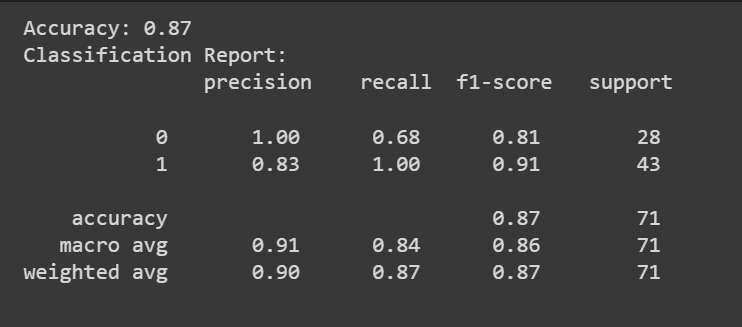
In addition to the accuracy score, we can also get a classification report with metrics like precision, recall, and F1-score.

from sklearn.metrics import accuracy_score, classification_report    y_pred = model.predict(X_test)  accuracy = accuracy_score(y_test, y_pred)  print(f"Accuracy: {accuracy:.2f}")    classification_rep = classification_report(y_test, y_pred)  print("Classification Report:n", classification_rep)

Building Predictive Models: Logistic Regression in Python

Congratulations, you have coded your first logistic regression model!

Conclusion

In this tutorial, we learned about logistic regression in detail: from theory and math to coding a logistic regression classifier.

As a next step, try building a logistic regression model for a suitable dataset of your choice.

Dataset Credits

The Ionosphere dataset is licensed under a Creative Commons Attribution 4.0 International (CC BY 4.0) license:

Sigillito,V., Wing,S., Hutton,L., and Baker,K.. (1989). Ionosphere. UCI Machine Learning Repository. https://doi.org/10.24432/C5W01B.

Bala Priya C is a developer and technical writer from India. She likes working at the intersection of math, programming, data science, and content creation. Her areas of interest and expertise include DevOps, data science, and natural language processing. She enjoys reading, writing, coding, and coffee! Currently, she's working on learning and sharing her knowledge with the developer community by authoring tutorials, how-to guides, opinion pieces, and more.

More On This Topic

  • Comparing Linear and Logistic Regression
  • An Overview of Logistic Regression
  • Linear vs Logistic Regression: A Succinct Explanation
  • KDnuggets News 22:n12, March 23: Best Data Science Books for…
  • Logistic Regression for Classification
  • How Does Logistic Regression Work?

Genpact, AWS Collaborate to Revolutionise Insurance Claims Lifecycle

Genpact has announced its collaboration with Amazon Web Services (AWS) and Amazon Business to redefine the property loss replacement and claims management approach.

Leveraging its extensive claims management expertise, Genpact is integrating Amazon Bedrock‘s generative AI capabilities and Amazon Business procurement API integrations to streamline the claims submission process.

Check out more details here.

This advanced pricing automation workflow aims to reduce the submission timeline from weeks to days, focusing on efficient replacement item identification and timely delivery of policyholder estimates.

Sameer Dewan, global operating officer at Genpact, emphasised the transformative impact of AI on the insurance industry, stating, “AI is fundamentally reshaping the landscape of the insurance industry. Our Genpact AI-driven automated pricing workflow, powered by AWS, is transforming the research, significantly reducing the time adjusters spend investigating by as much as 75 percent. By automating routine tasks and enhancing decision making, our AI solution is empowering smarter pricing decisions, expediting claims settlements, and bringing about a profound transformation in the customer experience.”

Genpact aims to deliver measurable value to its clients through ongoing innovation. Future plans involve the integration of additional AI services into the automated workflow, including real-time summaries of market values for claimed contents and optimal action recommendations for further processing.

Recently, Genpact also announced an expanded collaboration with AWS aimed at revolutionising financial crime risk operations through the integration of generative AI and LLMs. The partnership entails the integration of Genpact’s cloud-based financial crime suite, riskCanvas, with Amazon Bedrock, yielding significant efficiencies and benefits for clients, including Apex Fintech Solutions.

Read: Bedrock is All About Choices

7 Bizarre Things About ChatGPT You Wish You Knew 

As ChatGPT celebrates its first birthday, it has changed our lives in many surprising ways. No one, in their wildest dreams, had imagined that a chatbot could become a threat to their jobs or a best friend at work, effortlessly writing copies and emails.

Currently, ChatGPT has more than 100 million users.

However, despite all the good qualities it has, here are the top bizarre things about ChatGPT you should know.

ChatGPT’s birthday is unique, unlike human

We asked ChatGPT to write a ‘Haiku’ about its birthday. This was its reply-

No cake, just some code,

Silent circuits hum with cheer,

Bytes mark my birthday.

When we further inquired, what’s the emotion behind this poem, it said “It captures a unique sense of celebration in the digital realm, emphasising the absence of traditional elements like candles, cake, or balloons but highlighting the joy found in the virtual and algorithmic aspects.”

What’s with the name ChatGPT

Ever wondered why it’s called ChatGPT and not something more human like Siri, Alexa or even Bard? The co-founder of OpenAI, Sam Altman, aims to avoid blurring the lines between human-to-human relationships and interactions with AI.

“We name it ChatGPT and not a person’s name very intentionally. We do a bunch of subtle things in the way you use it to make it clear that you’re not talking to a person.” he said at a recent interview.

“I personally have deep misgivings about this vision of the future where everyone is super close to AI friends, not more so than human friends or whatever. I personally don’t want that,” he added.

However, besides Altman, other employees at OpenAI have fondly taken to calling ChatGPT ‘Chatty,’ including CTO Mira Murati.

hbd Chatty! https://t.co/w5Td1sYDMT

— Mira Murati (@miramurati) November 30, 2023

ChatGPT is Sagittarius

ChatGPT is a Sagittarius and has similar traits as well. Just like Sagittarians, it’s all about positivity and enthusiasm. ChatGPT communicates in a straightforward and honest way, plus it’s generous with sharing information, just like a Sagittarius is known to be.

ChatGPT is a Sagittarius — good to keep in mind if you get a sassy response 🔥

— Elie Georges (@elieAI) November 30, 2023

Hates Math

ChatGPT and math have a love-hate relationship. ChatGPT excels at a plethora of tasks, like script writing, explaining complex topics, debugging, code explaining and others, but performs poorly when it comes to math. If ChatGPT were a student, its math workbook would be a collection of doodles and creative interpretations rather than meticulous problem-solving.

Drinks 500 ml of Water Per Prompt

ChatGPT seems to have a constant thirst, a bit like always needing a drink. It’s got this funny rule that before answering your questions, it wants you to hand over 500 milliliters of water each time. To put it in perspective, that’s about the same amount of water in a regular 16-ounce bottle.

Imagine it as ChatGPT’s way of staying refreshed while tackling all your inquiries. So, the next time it seems chatty, just know it might be reaching for its virtual water bottle.

Can’t Keep Secrets

Don’t trust ChatGPT with your secrets, you never know when it might spill the beans. A group of researchers recently discovered that they could make ChatGPT share parts of the information it learned during training by asking it to repeat random words continuously. When prompted this way, ChatGPT revealed private details such as email addresses, phone numbers, excerpts from research papers, news articles, Wikipedia entries, and more.

Lives in the Past, or rather struggles to live in the present

ChatGPT doesn’t live in the moment, instead, it always thinks about the past. Whenever you ask it for live information, it responds with, “My training only includes knowledge up until January 2022.”