xAI, an AI startup established by Elon Musk, has submitted documents to the SEC for approval to generate up to $1 billion through an equity offering.
To date, the company has secured approximately $135 million from four investors. The initial transaction took place on November 29, and the filing indicates a “binding and enforceable agreement” for the acquisition of the remaining shares.
Last month marked the launch of xAI’s chatbot, Grok, designed to emulate “The Hitchhiker’s Guide to the Galaxy.” Grok boasts real-time internet knowledge, thanks to two months of intensive training, providing a unique offering to X Premium+ subscribers.
Grok enters a competitive landscape alongside other notable AI entities, such as OpenAI’s ChatGPT, valued at $90 billion, and AnthropicAI’s Claude, valued at $30 billion. Musk recently disclosed that investors from 𝕏 Corp would possess a 25% stake in xAI.
The anticipated value of xAI remains a subject of speculation, prompting industry observers to closely monitor its financial performance. Additionally, there is speculation about a collaboration between Tesla’s real-world AI and xAI’s chatbot.
Fueled by 𝕏’s real-time data, this partnership could pave the way for a future era featuring self-driving cars and humanoid robots, leveraging advanced large language models. The potential implications of such a collaboration raise intriguing possibilities for the intersection of AI and real-world applications.
“We are a separate company from X Corp, but will work closely with X (Twitter), Tesla, and other companies to make progress towards our mission,” X.AI says on its website.
xAI boasts a team comprised of professionals who have previously worked at esteemed institutions such as DeepMind, OpenAI, Google Research, Microsoft Research, Twitter, and Tesla.
The post Elon Musk’s xAI Targets $1 Billion Funding in Equity Offering appeared first on Analytics India Magazine.
‘Mega-deals’ could be inflating overall AI funding figures Kyle Wiggers 10 hours
It’s safe to say that VCs struck while the iron was hot this year where it concerned generative AI.
While venture capital investments overall fell compared to last year thanks to macroeconomic challenges and other related factors, startups in the generative AI space — and AI more broadly — did quite well.
Funding for AI-related startups surpassed $68.7 billion in 2023, according to PitchBook, with generative AI vendors like OpenAI, Stability AI and Anthropic accounting for a substantial portion of that figure. And it appears that the sector will likely close the year with substantially higher investments than the past couple of years.
But could the top-level numbers be misleading?
A report on AI investment in Q3 by PitchBook, released this morning, found that “mega-deals” (i.e., multi-hundred-million-dollar investments from big-name backers) vastly inflated deal totals this year.
For example, just a few months ago, Amazon pledged to invest up to $4 billion in Anthropic, the company developing the AI-powered chatbot Claude. OpenAI secured a $10 billion investment from Microsoft (albeit not all at once and partly in the form of cloud compute credits). Inflection AI, a firm creating what it describes as more “personal” AI assistants, raised $1.3 billion in a funding round led by Microsoft. The list goes on.
In Q3, VC funding inclusive of mega-deals totaled around $22.1 billion. But after subtracting the tech-giant-led tranches secured by generative AI startups, the total is closer to $15.1 billion for the sector.
Microsoft has committed £2.5 billion ($3.2 billion USD) to expanding its artificial intelligence capabilities in the U.K. as part of plans to fuel the country’s AI sector.
The investment, announced by the U.K. government on November 30, will see Microsoft more than double its AI data centre footprint in Britain over the next three years and deliver AI-related training to more than one million people. The company will also supply more than 20,000 graphic processing units for the country’s “next-generation” AI infrastructure and expand its Accelerating Foundation Models Research programme to give the U.K. researchers and scientists priority access to its AI foundation models.
Jump to:
Details about how Microsoft’s UK AI investment will be used
Microsoft’s biggest investment in the U.K. to date
Sunak: A turning point for U.K. AI
Details about how Microsoft’s UK AI investment will be used
Expansion of Microsoft data centre sites
The money will be used to fund the expansion of Microsoft data centre sites in the U.K. capital of London, as well as in the city of Cardiff, Wales, with the possibility that this will be extended into the north of England to help “meet the exploding demand for efficient, scalable and sustainable AI specific compute power,” as stated in the news release.
Azure-based gen AI resources for U.K. university researchers
In addition, researchers from leading U.K. universities, including Cambridge, Oxford, Imperial College, UCL, Bath and Nottingham, will be given prioritized access to Microsoft’s Azure-based generative AI resources for scientific research and discovery. This will be facilitated via Microsoft’s AFMR programme, an initiative launched by the company in October 2023 in partnership with leading universities to accelerate research around foundation AI models.
AI fluency, technical skills and safety training for 1m+ people
To support U.K. workers across the AI economy, Microsoft will make a “multi-million pound investment” to provide AI skills training to more than one million people.
It is hoped that this will boost the U.K.’s AI sector – said to employ some 50,000 people and contribute £3.7 billion ($4.7 billion) to the country’s economy – by helping more people move into AI and data-related career fields.
SEE: Why UK business leaders are struggling to cut through the gen AI hype
The programme will be delivered by Microsoft alongside other “learning and non-profit partners” and will focus on areas such as AI fluency, technical skills, safe and responsible AI development and AI business transformation.
“Microsoft is committed as a company to ensuring that the UK as a country has world-leading AI infrastructure, easy access to the skills people need, and broad protections for safety and security,” said Microsoft vice chair and president Brad Smith in the U.K. government’s post.
SEE: TechRepublic’s AI cheat sheet
In a Microsoft blog post, Smith elaborated that the company would “turn all the lessons it has learned in operationalizing responsible AI principles for its own AI engineers and developers, into learning modules for UK customers and partners.”
This will enable U.K. AI developers to build safer and more secure systems, Smith said – a key theme of the new Guidelines for Secure AI System Development published by the U.K.’s National Cyber Security Centre, the U.S.’s Cybersecurity and Infrastructure Security Agency and other agencies in late November 2023.
Microsoft’s biggest investment in the U.K. to date
Microsoft’s multi-billion-pound investment in British AI represents the biggest investment the Redmond-based company has made in the 40 years it has been operating in the U.K., said Microsoft UK CEO Clare Barclay in the press release about this news.
Michelle Donelan, the U.K. secretary of state for science, innovation and technology, labeled Microsoft’s investment “a huge vote of confidence in the strength of the UK’s technology sector,” which employs more than 1.7 million people and adds £150 billion ($189 billion) to the U.K. economy each year, according to data from techUK.
“This investment not only bolsters critical infrastructure but also ensures that the UK remains at the forefront of driving economic growth and innovation,” Donelan said in the government announcement.
SEE: This new U.K. supercomputer will be among the fastest in the world
A positive shift following recent Microsoft/CMA news
Microsoft’s £2.5 billion down payment on U.K. AI also points to a warming of the relationship between the tech company and the sovereign state after the U.K.’s independent Competition and Markets Authority initially blocked Microsoft’s $69 billion acquisition of Activision Blizzard in April 2023, prompting Smith to hit out against the decision. On Oct. 13, 2023, the acquisition was approved: “The CMA decided to grant consent under paragraph 12 of the Microsoft and Activision Merger Inquiry Order 2023 for Microsoft to acquire Activision, excluding Activision’s non-EEA cloud streaming rights,” the approval document read.
Microsoft was once again referred to the CMA in October this year over concerns about its influence in the U.K. cloud market. A subsequent investigation, which will involve reviewing whether the cost of migrating data out of cloud platforms stifles competition in the sector, is expected to last until April 2025.
Sunak: A turning point for UK AI
Microsoft’s cash injection follows a £500 million ($631 million) investment set aside for AI in the U.K. government’s Autumn Statement, bringing its total planned public investment in advanced computing to more than £1.5 billion ($1.9 billion).
In the government’s announcement, U.K. prime minister Rishi Sunak called the latest investment by Microsoft “a turning point for the future of AI infrastructure and development in the UK,” while chancellor Jeremy Hunt drew comparisons between AI investment in the U.K. and elsewhere in Europe, suggesting that the country was “the tech hub of Europe with an ecosystem worth more than that of Germany and France combined.”
SEE: Why the U.K. leads Europe in enterprise-wide IT automation
The news comes as Sunak’s government makes a concerted effort to draw private investment into the U.K.’s technology industry and cement the country’s reputation as a global leader in artificial intelligence.
In November 2023, the U.K. played host to the first AI Safety Summit, where world leaders pledged to work together to ensure the safety of new and advanced artificial intelligence models. The AI summit was attended by government officials from some 28 countries as well as representatives from leading tech companies, including Elon Musk. A key outcome of the event was the signing of the Bletchley Declaration, and with it came an agreement that tech companies must share the responsibility of testing the safety of AI models with governments.
“The UK started the global conversation on AI earlier this month, and Microsoft’s historic investment is further evidence of the leading role we continue to play in expanding the frontiers of AI to harness its economic and scientific benefits,” said Sunak.
Search queries generally fall under two categories: Those searching for a quick answer and those who want to get a thorough understanding of a topic. Since both of those requests are significantly different in nature, Bing unveiled a new search dedicated to queries that are searching for in-depth responses.
On Tuesday, Bing introduced Deep Search, a new feature on Microsoft Bing that allows users to get more robust and comprehensive answers to their search queries, no matter how complex the topic is.
Also: What is Copilot (formerly Bing Chat)? Here's everything you need to know
Instead of replacing Bing's search engine, it works in tandem with it to give users the opportunity to explore deeper into the web, surfacing results that would typically not show up in typical search results.
The way Deep Search works is that it enhances its web index and ranking system with OpenAI's GPT-4 to better understand the intent of the search query by expanding the query into a more comprehensive description.
For example, a query in Deep Search that simply reads "how do points systems work in Japan?" might be expanded to a more extensive description, as seen below.
Provide an explanation of how various loyalty card programs work in Japan, including the benefits, requirements, and limitations of each. Include examples of popular loyalty cards from different categories, such as convenience stores, supermarkets, and restaurants. Show a comparison of the advantages and disadvantages of using loyalty cards versus other payment methods in Japan, including current rewards and benefits. Highlight the most popular services and participating merchants.
Since the query is ambiguous and could be referring to something else, GPT-4 also helps Deep Search to come up with different possible intents and offers a comprehensive description for each of them. The different intent choices are then presented to the user, who can then select the right one, as seen in the photo below.
Once the intent of the prompt is determined, Deep Search will gather a wide collection of web pages for you to review and rank them according to how well they match the comprehensive description. This guarantees that you see the more tailored results you were looking for.
Also: How to use ChatGPT Plus: From web browsing to plugins
Even though it provides much more comprehensive results, it doesn't take much longer to produce the results. Compared to the one second Bing takes to respond to a regular search query, a Deep Search takes thirty seconds.
Because of the longer wait for search results, as well as the depth of the results, Deep Search isn't meant for every single query. Rather, it's for topics that you want to deep dive into, for example, if you are researching a topic for a paper.
Artificial intelligence is one of the technologies that's seen the most growth this year, but as a certain famous arachnid knows, with great power comes great responsibility. As AI continues to grow, different sectors, organizations, and companies are calling for stronger regulations and transparency regarding the development and use of AI. Meta and IBM are now allied in this cause.
Also: How to use ChatGPT Plus: From web browsing to plugins
The two companies are joining more than 50 other organizations — as part of an international community of technology developers, researchers, and adopters — to push for advancing open and responsible AI.
"We believe it's better when AI is developed openly — more people can access the benefits, build innovative products, and work on safety," said Nick Clegg, Meta's president of global affairs. "The AI Alliance brings together researchers, developers, and companies to share tools and knowledge that can help us all make progress whether models are shared openly or not."
The AI Alliance brands itself as a collaborative platform guided by open innovation, ethical practice, and global inclusivity principles. It aims to create member-driven working groups — comprised of experts from various fields — focused on AI-related topics such as security, social good, governance, and open technology.
Also: Microsoft Seeing AI app lands on Android to help blind and visually impaired users
"The AI Alliance is another milestone in providing openly shareable software, data, and other assets essential to developing transparent, advanced, and trustworthy AI," said Jim Zemlin, executive director at the Linux Foundation.
To foster responsible AI, the AI Alliance plans to create benchmarks, standards, and tools — including a catalog for safety, security, and trust. Its plans include enhancing the AI ecosystem to address global issues like climate change and social issues like education, along with educating the public and policymakers on the risks and benefits of AI.
Also: I asked DALL-E 3 to create a portrait of every US state, and the results were gloriously strange
The partnership seeks to transcend sectors, with participants from the industry, government, research, and academia, signaling a unified approach to the development of safe AI. Participating organizations include AMD, Intel, Red Hat, Hugging Face, Oracle, Dell, NASA, Yale University, Cleveland Clinic, and Harvard University.
Notably missing from the AI Alliance are Google, Microsoft, and OpenAI, arguably the three biggest players in generative AI development worldwide. These companies have already published different goals for the development of responsible AI, along with their own efforts to achieve them, but there's at least one significant difference between these two efforts. The AI Alliance is focused on open-source AI development, while Microsoft, Google, and OpenAI support the use of closed-source AI models.
"Open innovation is all but essential to ensuring equitable access and collaboration around AI and root this technology in principles that adhere to the strongest standards of diversity, trust, and ingenuity," said Kevin Murphy, NASA's chief science data officer. "NASA is excited about efforts like the AI Alliance to continue enabling the global community of scientists, researchers, and practitioners committed to responsible, trustworthy AI technologies."
In a bold move that signals a significant shakeup in the artificial intelligence landscape, Elon Musk's xAI, is on a mission to secure a substantial $1 billion in funding. Already on a promising trajectory, xAI has amassed nearly $135 million, as per a recent filing with the Securities and Exchange Commission.
xAI was unveiled earlier this year with a clear vision: to redefine the boundaries of generative AI. At the heart of xAI's product lineup is Grok, an AI chatbot, distinct in its design and capabilities. Grok, trained on data from Musk's X social network, not only answers queries but does so with a unique blend of wit and a hint of rebellion, as touted by the company. This novel approach to AI interaction is just a glimpse of Musk's broader ambitions in the realm of AI.
The creation of xAI and the introduction of Grok can be seen as an embodiment of Musk’s dualistic approach to AI – embracing its potential while remaining vigilant about its implications. This stance is reflective of a broader debate in the tech community about the balance between innovation and responsibility in the era of rapidly advancing AI.
Funding Strategy and Industry Implications
The pursuit of a staggering $1 billion in funding by xAI is not just a financial milestone; it represents a strategic move in the dynamic landscape of AI. This funding initiative has garnered significant interest from equity investors. The approach is a testament to the confidence in Musk's vision and the potential of xAI in a market dominated by heavyweights like OpenAI and Microsoft.
xAI's strategy extends beyond mere financial acquisition. By offering a 25% equity stake in X (formerly Twitter) to investors in xAI, Musk is weaving an intricate network of technological and financial partnerships. This move could catalyze a new wave of innovation and collaboration in the AI sector. Furthermore, the integration of xAI's AI offerings, like Grok, with the X social network's Premium+ subscription service demonstrates an attempt to blend technology and business, potentially expanding AI’s reach to a wider audience.
This funding endeavor by xAI comes at a critical juncture in the AI industry. As AI technology becomes increasingly advanced and pervasive, the entry of new players like xAI could disrupt existing power dynamics and spur fresh competition. The industry, already witnessing rapid growth and transformation, may find itself at the cusp of further evolution, driven by Musk's vision and xAI’s strategies.
The implications of xAI's successful funding and subsequent innovations could be far-reaching. It could challenge established norms and models within the AI industry, encouraging both established companies and startups to rethink their strategies.
Future Outlook for xAI and AI Development
Looking ahead, xAI stands at a crossroads of technological innovation and ethical responsibility. Musk's call for a pause in the development of powerful AI models, despite his aggressive advancement with xAI, highlights the need for a balanced approach in AI's evolution. This dichotomy reflects the broader tension within the AI community – the race to develop groundbreaking AI capabilities while grappling with the ethical, safety, and societal implications of such advancements.
The future of xAI, amidst Musk's ambitious goals and the evolving AI landscape, is poised to influence not just the technological aspects of AI but also the regulatory and ethical frameworks governing it. Musk's history of disrupting industries suggests that xAI could introduce novel AI applications, potentially transforming sectors beyond technology, such as transportation, communication, and even governance.
Moreover, the success or challenges faced by xAI will offer critical insights into the feasibility of balancing innovative AI development with responsible and ethical considerations. As xAI moves forward, it will undoubtedly contribute to shaping the narrative around AI's role in society, potentially leading to new paradigms in how we interact with, regulate, and integrate AI into our daily lives.
IBM and Meta, along with more than 50 other organizations, have partnered to form the global AI Alliance, which will focus on fostering an open community and enabling developers and researchers to accelerate responsible innovation in AI. This will be done while ensuring scientific rigor, trust, safety, security, diversity and economic competitiveness, according to a blog post about the announcement published today.
“The AI Alliance wants AI technologies to be used responsibly and for good” and in a way that is transparent and broadly accessible, said Anthony Annunziata, director of AI Open Innovation at IBM Research, in an email interview with TechRepublic.
Jump to:
How the AI Alliance will benefit tech leaders and businesses
How the AI Alliance will work
Organizations involved in the AI Alliance
How the AI Alliance will benefit tech leaders and businesses
Annunziata said AI Alliance members plan to start or enhance projects that meet objectives that will benefit businesses and tech leaders in the following ways:
Deploying benchmarks, tools and other resources to enable responsible AI development and use of AI on a global scale.
Fostering a vibrant AI hardware accelerator ecosystem.
Developing benchmarks to evaluate standards for open model releases and model deployment into applications.
Responsibly advancing an open foundation model ecosystem that reflects diverse modalities to address global challenges, such as climate and education.
“With the novelty around AI technology, the AI Alliance also aims to provide educational materials, supporting the academic community and researchers, so future generations can contribute to AI model and tool development projects,” Annunziata said. “Educational content will also contribute to the public discourse through policymakers who must consider benefits, risks, solutions and precision regulation for AI.”
Nick Clegg, president of global affairs at Meta, was quoted in the blog as saying the company believes that, “It’s better when AI is developed openly — more people can access the benefits, build innovative products and work on safety.” The fact that the alliance is bringing together companies, developers and researchers to share tools and knowledge will help everyone make progress and build responsibly — regardless of whether models are shared openly, according to Clegg.
The AI Alliance could benefit open source, collaboration and governance
In an email interview with TechRepublic, Ion Stoica, co-founder, executive chairman, and president of AI application platform Anyscale, said their involvement builds on prior successful collaborations with many of the AI Alliance members, including founders IBM and Meta.
Stoica said they are interested in the impact the alliance could have on open source in AI. “We believe that developing open source models is the best way to accelerate innovation, increase the economic impact, reduce the economic inequality and achieve AI safety,” he said. “Open source will enable us to develop models that can be inspected and certified by public and transparent processes, unlike proprietary models.”
Further, the open source model means anyone can use or modify the source code. This means it will benefit any organization looking to leverage AI, especially smaller businesses with fewer resources than tech giants.
Jim Zemlin, executive director of the Linux Foundation, echoed that, saying the alliance represents another “milestone in the process of providing for openly shareable software, data and other assets essential to the development of transparent, advanced and trustworthy AI,” according to the blog. “Open collaborative processes and open governance are essential to these efforts.”
The foundation will provide “a neutral home for essential elements of the AI ecosystem,” Zemlin added.
Stoica said his experiences have shown him that collaborating across diverse groups is key to advancing new technologies in a fair and equitable way. “The AI Alliance can be a powerful enabler for such collaboration in the AI ecosystem.”
How the AI Alliance will work
In the coming months, the AI Alliance will form member working groups to advance the above project areas, Annunziata said. The members will also create a governing board and technical oversight committee to establish project standards and guidelines.
In addition to bringing together developers, scientists, academics, students and business leaders focused on AI, the AI Alliance plans to participate in existing government, nonprofit and civil society initiatives focused on significant work in the AI space, according to the blog.
Organizations involved in the AI Alliance
Some of the organizations in the AI Alliance include:
AIM has been coming out with academic rankings for graduate courses for the last 8 years. The ranking outcomes will result from a survey, extensive secondary research, and discussions with the participating institutes. This report enlists the top full-time on-campus postgraduate programmes for Data Sciences in India for the year 2023.
This year we are releasing two separate rankings for postgraduate-level Data Science or Analytics programs based on their mode of delivery: on-campus and online/hybrid.
These courses offer value in different ways to students, who can apply to them depending on what they want to learn. A good course has high and well-balanced scores across all the parameters, making it at the top of the ranking. These rankings will help students identify the right course for them.
The report is helpful for institutes offering these programmes to understand where they stand compared to other courses and identify areas of improvement. It can also be used by the policymakers in public and private organizations to get an idea of the progress the Data Science education industry has made and then help bring in changes accordingly.
AIMResearch has conducted this survey to rank various data science and analytics programs based on their performance across five parameters— Certification Value, Return on Investment, Program Success, Teaching & Curriculum, and Student Engagement. An overall index has been calculated based on the average scores of each program across the five subindices (based on the above-mentioned parameters).
The sub-indices themselves were calculated based on the scores given to the answers (of the survey questions) asked by AIM using uniform evaluation criteria. These scores were normalised on a scale from 0 to 1 before the average for the sub-indices was taken. Outliers were capped.
You can see the hierarchy of sub-indices and the final index followed for analysis in the below infographic.
Top PG Data Science/Analytics Courses in India
Post Graduate Program in Data Science with Generative AI & ML, Praxis Tech School
Praxis Tech School’s Postgraduate Program in Data Science stands out due to its remarkable blend of academic rigor and practical industry application. With an impressive ROI, the program promises a 100% return through high placement success rates and salary hikes averaging over 110%. The institute boasts a distinguished faculty, who bring valuable industry experience and academic excellence. The curriculum is a comprehensive mix of theoretical and experiential learning, with a significant focus on real-world application through open-book exams and continuous evaluation.
Group projects and assignments foster collaboration and originality, while rigorous plagiarism checks maintain integrity. The capstone projects, mentored by research-active professors and industry experts, encourage innovative solutions and often lead to noteworthy papers in prestigious international conferences. This robust educational framework, coupled with the strong alumni network, positions Praxis as a leader in data science education.
Learn more about this program here.
M.Sc. in Applied Statistics & Analytics, Nilkamal School of Mathematics, Applied Statistics & Analytics
The Postgraduate Program in Applied Statistics & Analytics is acclaimed for its comprehensive and meticulously crafted curriculum, integrating theory, application, and domain-specific knowledge. The program is bolstered by collaborations with industry giants like SAS India and IDFC First Bank, which provide certifications and scholarships, enhancing the value and reach of the course. The placement cell is proactive, offering extensive training and securing top-tier industry placements, ensuring students are well-equipped for analytics roles.
The curriculum, developed with input from academic and industry experts, includes practical sessions and analytics-oriented projects, fostering practical skills in software like SAS, R, Python, and Tableau. The pedagogy emphasizes applied statistics and domain-specific analytics, preparing students to tackle real-world business challenges. Continuous assessment and personalized feedback from faculty ensure a focused development of competencies. Moreover, a dedicated semester for industry internships underpins the practical learning experience.
Learn more about this program here.
Post Graduate Diploma in Management-Big Data Analytics, Goa Institute of Management
The PGDM-BDA program is built upon a robust Assurance of Learning (AOL) framework ensuring students acquire skills directly applicable to real-life situations. The program’s strong industry connections are evidenced by collaborations with Delhivery and SAS Institute Inc., providing students with practical, hands-on experiences through case studies and real-time projects. The five-month internship, often converted into pre-placement offers, is highly regarded by data science companies, reflecting the program’s relevance and industry alignment.
GIM’s NBA accreditation paves the way for global opportunities, while the alumni base facilitates ongoing career progression. The curriculum is thoughtfully structured, blending technical, managerial, and behavioural skills, with a rich selection of electives allowing personalized career targeting. Rigorous evaluation processes ensure objective assessments and continuous learning, further bolstered by a significant internship component.
Learn more about this program here.
Master of Business Administration in Business Analytics, SVKM’s NMIMS
The MBA-Business Analytics program at SBM, Mumbai, distinguishes itself as a premier offering in 2023 through a unique blend of rigorous academic instruction and real-world industry engagement. A substantial portion of the curriculum is delivered by experienced faculty, with 70% of the syllabus covered by core faculty emphasizing foundational subjects critical for internships and advanced learning. Industry practitioners teach a significant segment of the program, infusing current expertise and perspective into subjects such as NLP and Blockchain.
The program’s structure prioritizes a techno-managerial approach, allocating 40% to analytics and 60% to management, incorporating Harvard Business School case studies and tools pertinent to the industry. With a dual focus on continuous assessment and hands-on project work judged by academic and industry professionals, the program not only fosters practical skills but also enhances employment opportunities, evidenced by a rise in internship stipends and average placement packages. These elements, combined with a robust admissions process that seeks qualified candidates with relevant backgrounds, secure its status as one of the best in 2023.
Learn more about this program here.
M. Tech Data Science (Business Analytics), NMIMS University
The M.Tech Data Science (Business Analytics) program at NMIMS University stands out for its rigorous selection process, strong industry collaborations, and a curriculum that blends practical experience with theoretical depth. Students are selected through a comprehensive entrance test and personal interview to ensure only the top candidates are admitted. The program boasts prestigious partnerships with international and domestic companies offering students live, paid projects that enrich their learning with hands-on application in real-world scenarios.
Esteemed faculty members, including those from Virginia Tech and industry leaders like KPMG, bring a wealth of knowledge and practical insights. The curriculum emphasizes practical learning, with a focus on case studies and a practicum approach that encourages students to apply theory to solve business problems, enhancing retention and understanding. A mandatory six-month paid internship further prepares students for the industry, often covering their tuition fees, while robust evaluations and capstone projects evaluated by industry experts reinforce the program’s applied focus. These features collectively position NMIMS’s program as a leader in data science education.
Learn more about this program here.
Master of Business Administration in Business Analytics, CHRIST University
The MBA program in Business Analytics is acclaimed due to its dynamic curriculum, which is regularly updated by industry experts and international academicians. It ensures that students are proficient in contemporary analytics tools like R, Python, SQL, and visualization software including MS-PowerBI and Tableau, alongside certifications like Bloomberg Terminal. The program is well-supported by industry-academia partnerships for specialized certifications, enhancing practical learning.
Faculty members, ranging from full-time to guest lecturers, bring a wealth of industry experience and academic expertise, fostering an environment rich in mentorship and real-world application. With a strong focus on experiential learning, the program incorporates mini-projects, hackathons, and live projects into its assessment, alongside a structured placement training process. The interdisciplinary approach allows students to take electives across various specializations, providing a holistic understanding of business operations. This comprehensive education, combined with significant industry exposure, positions graduates for success in the competitive field of business analytics.
Learn more about this program here.
M. Tech Artificial Intelligence, NMIMS
NMIMS University’s M.Tech in Artificial Intelligence stands out for AI aspirants. Characterized by its comprehensive selection process that recruits only the most proficient candidates, the program cultivates a community dedicated to academic and professional brilliance. The curriculum, designed around practical application, is taught by esteemed professors, including industry experts from Virginia Tech and corporate leaders from companies like Microsoft, ensuring that students are at the forefront of AI advancements.
The course structure emphasizes hands-on learning through case studies, allowing students to retain theoretical knowledge by applying it to real-world problems. A distinctive feature is the participation in live, paid projects from international firms providing a unique opportunity for students to engage with cutting-edge industry research and applications. With a mandatory six-month paid internship, the program offers substantial professional experience.
Learn more about this program here.
MBA (Business Analytics), Symbiosis Centre For Management and Human Resource Development
The Masters in Business Administration (Business Analytics) at Symbiosis Centre For Management and Human Resource Development stands out due to its industry-oriented curriculum, developed with input from industry professionals, ensuring that students receive an education that is both relevant and current. The program offers practical experience through at least two live projects, which provide invaluable real-world insights. Additionally, the faculty comprises 30 industry professionals and full-time members with PhDs, blending practical and theoretical knowledge.
The program’s structure is balanced, combining theoretical instruction with practical lab work. It focuses on digital transformation and AI strategy, making graduates valuable in the business sector. A case-based approach across all courses aligns teaching with the latest industry trends. The comprehensive evaluation system includes both internal and external assessments, ensuring a deep understanding of the subject matter. Students also complete an internship and a capstone project, further enhancing their practical skills. Graduates of the program demonstrate high employability.
Learn more about this program here.
MSc Economics & Analytics, CHRIST University
The MSc Economics & Analytics program at Christ University stands among the top data science programs in 2023 due to its strong ROI, rigorous curriculum, and practical skill development. It integrates economic theory with proficiency in analytics tools like Python, R, Tableau, PowerBI, and Excel Analytics. The program’s relevance is maintained through partnerships with tech leaders such as Google Cloud and Amazon Web Services, offering students hands-on experience and opportunities for internships with top firms.
Collaborations with international universities and professional organizations broaden learning horizons and industry connections. A dedicated faculty with a blend of industry experience and academic prowess supports innovative learning and professional growth. The Specialization Project and internships provide immersive industry experience, ensuring graduates are equipped for the job market. A thorough admission process selects the most capable candidates, enhancing the program’s reputation and ensuring its graduates are among the best in the field.
Learn more about this program here.
MSc Data Science, CHRIST University
The MSc Data Science program offered at Christ University is a comprehensive two-year journey through the heart of data science, making it an excellent choice for students eager to delve into this field. The curriculum is expertly crafted to balance rigorous academic instruction with practical application, covering advanced subjects like machine learning, big data analytics, deep learning, time series forecasting, and applied statistics. Students gain proficiency in essential tools such as Python, R, SQL, Tableau, and Hadoop, ensuring they are well-equipped to meet industry demands.
The program boasts partnerships with industry leaders like Google Cloud and Amazon Web Services, offers collaborative research projects, and facilitates internships with top companies. The experienced faculty actively contributes to the students’ growth through mentorship and hands-on training. The program offers relevant training to ensure graduates are industry-ready. With an active learning environment that includes industrial visits, expert talks, and industry-linked projects, students not only gain knowledge but also practical experience, making them highly employable in the burgeoning field of data science.
Learn more about this program here.
MBA in Data Science and Data Analytics, Symbiosis Centre for Information Technology
The SCIT MBA in Data Science and Data Analytics is a comprehensive program designed for those aiming to excel in the fast-evolving field of data sciences. This two-year course offers a blend of strategic insights and operational intelligence, crucial for mastering Data Sciences and Analytics. It equips students with analytics competencies and practical experience with data science tools, preparing them for both business and techno-functional roles.
The curriculum covers advanced topics like AI, Data Mining, Cloud Computing, Machine Learning, and Text Analytics, ensuring students are well-versed in current industry practices. Continuous evaluation and a mix of teaching methods, including case studies and practical presentations, ensure a thorough understanding. The partnership with Celonis, Germany, for the Capstone Project further enriches the learning experience, making this program ideal for those seeking a robust education in Data Science and Analytics.
Learn more about this program here.
MBA in Business Analytics, Chitkara Business School
The Chitkara Business School’s Business Analytics program stands out as a comprehensive choice for students with a technical background. Structured into three curriculums – Primary, Parallel, and Personal – it offers a blend of academic knowledge and practical skills. The Primary Curriculum, developed with Ernst & Young, focuses on data-driven insights for business decisions. The Parallel Curriculum includes workshops and conclaves with industry leaders, while the Personal Curriculum emphasizes grooming and community involvement.
Strong partnerships with market leaders ensure relevant, up-to-date learning. Graduates often secure positions in top organizations. The experienced faculty, engaged in research and startups, provide practical insights, enriching the educational experience. The program includes hands-on learning with simulators and real-life cases, global internships, and diverse evaluation methods, including flexible Capstone projects. Tailored for those with backgrounds in B.Tech., MCA, or MSc. (Computer Science), it’s an ideal program for excelling in the ever-evolving field of Business Analytics.
Learn more about this program here.
MSc Data Science & Analytics, NSHM Knowledge Campus
The Data Science & Analytics program at this institution is designed to be comprehensive and interactive, bridging academia and industry needs. It integrates theoretical knowledge with hands-on experience through a curriculum rich in seminars, workshops, and real-world projects. The program partners with various educational bodies like EduSkills and NASSCOM, providing students with seminars, webinars, workshops, and certifications that are critical for industry preparation. Internship opportunities with established companies and start-ups are part of the curriculum, allowing students to engage with real-world projects.
The Analytics Society of India Kolkata Chapter, formed as part of the program, encourages learning beyond the classroom through discussions, hackathons, and competitions. The program’s commitment to practical application is further reinforced by encouraging students to undertake comprehensive data science projects, with outstanding projects receiving recognition and rewards. The faculty’s diverse experience in teaching and industry exposure, along with rich academic achievements, ensures that students are mentored by experts. With a program that balances theory and practice, it is an excellent choice for students aspiring to thrive in the fields of Data Science and Analytics.
Learn more about this program here.
MBA (Business Analytics), School of Management and Entrepreneurship, Shiv Nadar Institution of Eminence
This Business Analytics program offers a comprehensive curriculum that integrates four key elements: business intuition, technology, mathematics, and storytelling. This balanced approach ensures students gain a well-rounded skill set essential for analytics. The program emphasizes experiential learning, enabling students to apply their skills to solve real-world data-driven problems, aligning with industry standards and enhancing career outcomes. Its affordability provides a high return on investment.
The faculty comprises full-time members and industry mentors from leading organizations. These experts, coupled with industry leaders as visiting faculty, ensure high-quality education and effective learning outcomes. The program includes practical components like a semester-long capstone project and a mandatory summer internship, fostering hands-on experience.
Learn more about this program here.
The post AIM Top Ranked PG Data Science Programs (Full Time On-Campus) – 2023 appeared first on Analytics India Magazine.
Technical Advisor and former LinkedIn knowledge graph lead Mike Dillinger recently spoke with Juan Sequeda and Tim Gasper of data.world. During a recent edition of the Catalog & Cocktails podcast, Dillinger stated that most data labels are meaningless text strings. “The vast majority are just junk that we pay for,” he noted.
Dillinger is a proponent of knowledge graphs for good reason: When well designed and implemented, they provide sufficient context essential to AI. Large language models (LLMs) need that explicit, articulated context, which is why a hybrid knowledge graph and statistical machine learning approach will be essential for artificial general intelligence (AGI).
When LLMs are trained on document collections, Dillinger pointed out, that method implies duplication and variation. Which version of a company’s product information is the version the LLM should use? That’s just one open question of many surrounding the inadequate data handling methods of today’s data science practitioners.
The need for relationship specificity
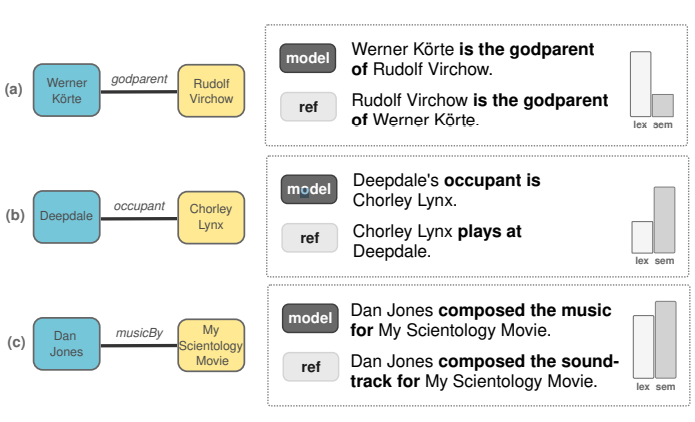
In their October 2023 paper “Mind the Labels: Describing Relations in Knowledge Graphs With Pretrained Models,” Zdenek Kasner, et al. of Charles University in Prague and Heriot-Watt University in Edinburgh observe that “Data-to-text generation models use relation labels (such as godparent, occupant, and musicBy) to describe relations between entities…. Unclear labels can lead to various lexical or semantic incoherencies in the output descriptions, such as swapping the relation direction (a) or using too literal expressions (b).”
(See their Figure 1 below for an example of the model interpretation contrasted with the actual reference meaning. The confusion arises because it’s not clear to the model who the godparent is.)
Zdenek Kasner, Ioannis Konstas and Ondrej Dušek, “Mind the Labels: Describing Relations in Knowledge Graphs With Pretrained Models,” arxiv dot org, October 16, 2023.
The authors of the paper took the time to assemble a dataset with nearly 4,100 triples and over 1,500 unique relationships in order to assess the effectiveness of verbalizing relationships as a starting point for comparing graph-to-text to the far less explicit, relationship impoverished data-to-text data labeling process under scrutiny.
The larger point I’ve tried to make over the years is that half or more of the essential data tends to be missing in most statistical machine learning processes. A best practice that seems entirely absent in today’s approaches would be to develop the quality, relationship-rich, explicitly logical and articulated data up front, rather than using an ad-hoc method downstream to try to correct what’s wrong with the data in that part of the pipeline.
Organic, lasting, growing data
In a June 30, 2023 post for Data Science Central, I described “data” as silica in terms of how most data scientists approach it. That concept of data assumes it can only be inert and inorganic. You have to add metal and heat to make electrically active silicon wafers out of it. Otherwise, it’s just sand, not a renewable resource.
Whereas data can and should be developed as an organic, dynamic, interactive representation of the living world. Any digital twin that’s interactive and reusable should have connected, meaningful data at the heart of it.
Such an organic approach would front load the data quality effort. It would demand more time and effort up front, but the result could be a renewable resource, implying far less effort downstream.
Building up such a renewable resource will require more than data scientists, architects and engineers. It will require others who are responsible for a wealth of domains who can help with accurate representations of the entities within those domains, how they’re interrelated, and how they interact. Representations are models, and modeling should be a team sport.
A risk-aware approach to data quality
Half measures like the underpowered approach to data labeling that’s most common aren’t helping businesses get their arms around AI. One of the initiatives we’re planning at the Dataworthy Collective for 2024 is a data quality framework. That framework will leverage the findings of previous semantic knowledge graph-related efforts that have demonstratively boosted data quality.
Some of the more candid and insightful folks are fed up with AI’s persistent inadequacies and are speaking out. In the process, they’re helping us put all of the major problems with AI out on the table. One of those is Wikipedia founder Jimmy Wales, who articulated one of the main business risks.
“Most businesses, not just charities like us, would say you have to be really, really careful if you’re going to put at the heart of your business a technology that’s controlled by someone else because if they go in a different direction, your whole business may be at risk,’ said Wales, quoted by Pascale Davies in a November 2023 Euronext article.
AI is transforming the way we work, and it's happening faster than you think. Over 100M people already use ChatGPT every week, and more than half of employees say they use AI tools at work.
While there's no question that AI will help certain types of people to do their jobs better, many people are worried that it will actually replace the need for people to do certain jobs at all. This could lead to large categories of jobs being destroyed.
As a result, it's critical that we start thinking about where and how to reskill the workforce for an age of AI-powered software.
The Impact of AI on the workforce
AI is already having a significant impact on the workforce. According to a study by PwC, up to 30% of jobs in the UK could be automated by the early 2030s.
There are several different ways that AI will impact the workforce that researchers have observed in prior technology adoption waves.
Some jobs will be entirely replaced by AI. After the invention of the ATM, people no longer needed to speak with bank tellers for basic transactions, so there was a drastic decline in the number of bank teller roles. We have seen similar declines in the number of call center reps, transcriptionists, and other types of roles that have been replaced with different types of technology.
Some jobs will be augmented by AI. Certain jobs will become more efficient with AI. In the 1800s, 90% of the population were farmers, but as technology became more efficient, fewer farmers were needed to grow the same amount of food. With the current wave of AI adoption, AI will help doctors make better diagnoses and help lawyers review legal documents more efficiently.
Some jobs will be enabled by AI. Before the telephone was invented, there was no such thing as a telephone operator. With this new wave of AI, there is a new category of machine learning engineers who are focused only on “prompt engineering.” This role is different from traditional software development, but it has arisen from the need for new ways to work with AI models.
All of these changes will have a significant impact on the job market, consequences for education and training programs, and implications for government policies and regulations.
The industries impacted most by AI
According to a McKinsey report on AI, three-quarters of executives expect AI to cause significant or disruptive change in their industry's competition within three years. McKinsey's research shows that all industries will see some degree of disruption, but the level of impact will vary.
Interestingly, compared to previous technology waves that have impacted industries like manufacturing, automotive, and aerospace, knowledge-based industries like tech, banking, and pharmaceuticals are expected to be the most impacted by the current wave of AI.
This is because the latest set of AI tools have unique strengths in language- and creative-based activities like creating marketing materials, creating first drafts of presentations using AI, and summarizing text documents.
Reskilling strategies for a world of generative AI
One of the most interesting findings from McKinsey's research on generative AI is that the companies that will be the most impacted by AI are also investing most heavily in adopting AI tools.
While government organizations and policy institutions will invest in this AI shift, employers themselves will likely be some of the biggest drivers of this reskilling.
Here are some of the strategies that companies are using to reskill their workforce for an age of AI:
Encourage employees to be curious and experiment with AI tools and systems. Technology companies like Google have famously asked employees to spend part of their time tinkering with new products. Now that AI has made technology more accessible to more people, companies are asking more employees to try out AI tools that can help grow their businesses.
Provide access to training and development opportunities. Many companies are investing in training programs that teach employees how to work with AI tools and systems. These programs can be delivered through a variety of channels, including free online courses or internal-only training programs.
Invest in AI training for managers and executives. While it's important for all employees to develop AI skills, managers and executives are in a unique position to drive change within their organizations. By investing in their own AI education, they can better understand the potential of AI and how to implement it effectively.
Create a culture of continuous learning and improvement. As the world continues to change, companies are trying to build dynamic cultures to help employees keep up with the latest AI trends and industry developments. Rather than specifying specific tactics, this allows companies to build an evolving culture that can adapt to new situations.
Hire for and develop skills that complement AI, such as creativity, critical thinking, and problem-solving. Rather than hiring for specific rote skills, companies are placing a premium on soft skills like creativity and problem-solving with groups. This takes place in the hiring funnel as well as on the job.
Collaborate with other companies and organizations to share best practices and knowledge. The rise of AI is a global phenomenon, and it's important for companies to work together to share knowledge and best practices. This can take the form of industry associations, conferences, or other types of collaborative events.
Partner with educational institutions to develop AI-focused curricula. As the demand for AI skills grows, educational institutions will need to adapt to meet the needs of students and the workforce. By partnering with these institutions, companies can help shape the future of AI education and ensure that students are learning the skills that will be in demand in the future.
While none of these tactics is a complete solution in itself, it's a toolkit of strategies for companies to begin investing in the future of an AI-powered workforce.
The benefits of investing in reskilling for AI
Investing in reskilling for AI is not only important for individuals, it will also provide significant benefits for the companies who make the investments. Here are some of the potential benefits that companies can reap from investing in reskilling for AI:
Increased productivity and efficiency: As employees learn how to use new AI tools and systems, they can work more efficiently and effectively. This will lead to increased productivity and cost savings for the company.
Improved customer experience: AI tools can help companies provide better service to their customers. For example, chatbots powered by natural language processing technology can answer frequently asked questions quickly and accurately, freeing up human agents to handle more complex issues.
Competitive advantage: Companies that invest in reskilling their workforce for AI will be better positioned to compete with other businesses in their industry. They will have a more skilled workforce that is able to take advantage of new opportunities presented by AI.
Last but not least, investing in teaching employees how to use AI can help companies attract and retain top talent. Employees want to work for companies that are forward-thinking and invest in professional development. By offering training and development programs focused on AI, companies can demonstrate their commitment to employees, which helps them hire and retain the best talent.
The risks of investing in reskilling for AI
While there are many benefits to investing in reskilling for AI, it is important to consider the risks of such a large investment as well.
One of the most significant risks is that despite a large investment in training people on how to use new AI technologies, there is still a major job loss or displacement in certain industries.
As AI technology continues to advance, many jobs may become obsolete or automated if AI can perform better than humans. Rather than preparing workers in these roles to co-exist with AI, it could have been better to prepare them for new opportunities in new roles and new industries.
There is also the possibility of creating a skills gap between workers who have been reskilled and those who have not. There are ethical and equity concerns that people who already have access to the most opportunities are the ones who will have the best opportunities to be upskilled or reskilled as AI tools become more common in the workplace.
Despite these risks, the benefits of investing in reskilling for AI far outweigh the costs. People need to stay up-to-date with new technologies in order for our economy to remain competitive and for individuals and companies to succeed.
Conclusion
AI is transforming the way we work, and it's critical that we start thinking about how to reskill the workforce for an age of AI.
There are many challenges that come with reskilling the workforce for AI, but there are also many opportunities. By investing in training and development programs focused on AI, companies can create a more resilient and competitive workforce. They can attract and retain top talent, improve productivity and efficiency, and provide better service to their customers.
However, it's important to remember that reskilling for AI is not a silver bullet. There are risks associated with such a large investment, including job loss and displacement in certain industries, as well as the potential for creating a skills gap between workers who have been reskilled and those who have not.
Nevertheless, there is a strong set of incentives for individuals, companies, nonprofits, and government entities to invest in learning and leveraging the power of AI. By providing people with the skills they need to succeed in a technology-driven world, companies and countries can ensure their success in the years to come.