In 2023, Meta AI demonstrated a powerful combination of innovative research, open-source development, and practical applications of AI.Their prominence in artificial intelligence and computer vision is marked by its prolific research output and expansive open-source contributions. The Fundamental AI Research (FAIR) team, celebrating its 10-year anniversary, has been integral to this success. With over 900 GitHub repositories, Meta AI demonstrates a commitment to the open-source community.
Notably, the team published 12 influential research papers, covering a broad spectrum of AI domains. These publications, along with their open-source models like Llama, Seamless Communication, and AudioCraft, underscore Meta’s significant role in driving AI innovation, fostering collaboration, and shaping the future of AI technology.
Here is the list of the top 8 papers by Meta!
LLaMA 2
This paper introduces LLaMA 2, an improved version of its predecessor, featuring a larger pre-training corpus, extended context length, and grouped-query attention. It includes models optimized for dialogue, ranging from 7 to 70 billion parameters. These models have shown excellent performance in helpfulness and safety benchmarks.
LLaMA 2 represents a significant leap in language model technology. With a 40% larger pretraining corpus and a doubled context length compared to its predecessor, it provides a more nuanced understanding of language. The introduction of a grouped-query attention mechanism is a technical innovation that enhances the model’s efficiency and accuracy.
The range of models, spanning from 7 to 70 billion parameters, allows for scalability and customization, particularly for dialogue applications. The impact of LLaMA 2 is profound in the realm of AI-based dialogue systems, offering improvements in both the helpfulness and safety of responses, which are crucial for real-world applications.
Segment Anything by Meta AI
This research presented a task, model, and dataset for image segmentation. The Segment Anything Model (SAM) uses an image encoder, a prompt encoder, and a mask decoder, and has created the most extensive segmentation dataset to date, with over 1 billion masks for 11 million images.
This paper introduces a breakthrough in image segmentation. Its unique architecture, consisting of an image encoder, a prompt encoder, and a mask decoder, enables efficient and accurate segmentation tasks.
This dataset provides a rich resource for training and refining image segmentation models. SAM’s impact is broad, as it lays the foundation for various computer vision applications, from autonomous vehicles to medical image analysis, where accurate image segmentation is crucial.
Egocentric Video Task Translation
This paper proposes EgoTask Translation (EgoT2), a unified approach for wearable cameras that improves performance on multiple video tasks simultaneously using task-specific models and a shared task translator.
This unified approach not only improves the performance of individual tasks but also allows for more integrated and comprehensive video analysis. The application of EgoT2 is particularly relevant in areas like augmented reality and personal video documentation, where understanding and interpreting video content in real-time is essential.
Learning Video Representations from Large Language Models
This paper introduces LaViLa, a method for learning video-language representations using LLMs. It focuses on creating automatic video narrators by repurposing pre-trained LLMs to incorporate visual input and fine-tuning them.
These narrators offer improved synchronization of visual information and text, enhanced text diversity, and comprehensive coverage of lengthy videos. LaViLa’s impact is evident in its superior performance in video-text embedding tasks, making it a valuable tool for applications in multimedia content analysis and automatic video captioning.
PACO: Parts and Attributes of Common Objects
The paper is a dataset that focuses on object models, providing detailed descriptions, part masks, and attributes for various objects in both image and video datasets. It aims to facilitate research on joint detection of objects, parts, and attributes.
It introduces a dataset focusing on detailed object models, including part masks and attributes. Covering 75 object categories, 456 object part categories, and 55 attributes, PACO provides a comprehensive resource for object recognition and analysis. This dataset is significant for research in object, part, and attribute detection, presenting new challenges and opportunities for advancing computer vision technologies.
Galactic: Scaling End-to-End Reinforcement Learning for Rearrangement at 100k Steps-per-Second
This paper presents Galactic, a framework for simulating and applying reinforcement learning to robotic mobile manipulation in indoor settings. It features significant speed enhancements and enables large-scale experiments.
Galactic presents a comprehensive framework for simulating and applying reinforcement learning in robotic mobile manipulation. Its remarkable simulation speed and efficiency in learning and inference processes enable large-scale experiments and rapid skill acquisition in robotics. Galactic’s contribution is particularly impactful in the field of robotics, where it accelerates training time and enhances the feasibility of complex manipulation tasks.
GeneCIS: A Benchmark for General Conditional Image Similarity
This research introduces the GeneCIS benchmark for evaluating models’ ability to adapt to various similarity conditions in a zero-shot setting. It proposes a solution that involves mining information from image-caption datasets to improve performance.
The GeneCIS benchmark is crucial for advancing image retrieval technologies, particularly in the context of diverse and open-set similarity conditions.
This paper addresses the limitations of existing video-language embeddings by introducing a hierarchical contrastive training objective. This approach allows for the alignment of text and visual elements at both clip and video levels, capturing immediate actions and broader context.
The impact of HierVL is notable in long-term video modeling tasks and its successful transferability to various challenging downstream tasks, enhancing the capabilities of AI systems in understanding and interpreting video content.
The post Top 8 Papers by Meta AI appeared first on Analytics India Magazine.
Since the beginning of LLMs, benchmarks have been the litmus test to judge their efficiency, at least on paper. However, companies often manipulate the data to project themselves at the top; and in this race, there’s yet to emerge a clear winner.
The recent launch of Gemini and its comparison with GPT-4 on different benchmarks, gives a glimpse of the benchmark manipulation. For instance, Google claimed it outperformed GPT-4 on the MMLU benchmark. However, it was later discovered that Google used COT@32 instead of 5-shot learning.
Meanwhile, Microsoft didn’t stay silent and struck back by releasing a blog stating that, by applying medprompt+ to GPT-4, it achieved a record score of 90.10%. Microsoft stated that with systematic prompt engineering, one can achieve maximal performance.
Prompt engineering is clearly underrated! Just a couple of weeks back, Microsoft published a paper showing that with systematic prompt engineering methods, a generalist GPT-4 model can perform as a specialist on medical challenge problem benchmarks. Today, they released a blog… pic.twitter.com/prK2v3OGTN
— elvis (@omarsar0) December 12, 2023
The tech giant said it continues to explore the out-of-the-box performance of frontier models using simple prompts. Moreover, Microsoft recently launched Phi-2, claiming it outperforms Mistral 7B, Llama 2, and Gemini Nano. Similarly, Mistral AI asserted that its latest model, 8X7B, performs better than GPT-3.5 and Llama 2.
However, the battle over benchmarks is not something new. The obsession of LLM creators with benchmarks isn’t benefiting anyone, as they persist in their competition over a few points here and there.
Do Benchmarks Really Matter?
While benchmarks provide a general indication of where a particular LLM stands, they shouldn’t be considered the sole criteria for judgment. The primary purpose of any LLM is to serve its customers and streamline their tasks.
For example, if you’re utilising an LLM for tasks like creating meeting notes, summaries, and blogs, its ability to perform these tasks accurately is more significant than its benchmark score.
Echoing similar sentiments, AI advisor Vin Vashista said, “Users don’t care about a 3% increase in this benchmark or an 8% boost on that one. If they don’t see the difference, they don’t know there is one.”
“Users want more accurate speech-to-text for meeting notes and summarization, BUT a 3% improvement in accuracy must be noticeable to users in a head-to-head comparison,” he added.
Regarding Gemini, he said,” I understand that Gemini’s benchmarks are better, but generative AI winners won’t be decided by benchmarks. That’s how models win Kaggle, not how products win over customers.”
He added that model metrics must connect with customer and user outcomes, or they’re just vanity metrics. Companies are spending millions to publish benchmarks that customers ignore.
Even though Llama 2 lags behind OpenAI and other models, it is still actively used by several enterprises due to its low cost and high adaptability. Recently, the Indian startup Sarvam AI launched its first Hindi LLM, called OpenHathi, which is built on top of Llama 2.
Benchmarks can be Manipulated
Manipulating metrics is not a difficult task, all you have to do is test your model on the training dataset. This stands out as one of the simplest tricks to achieve a high benchmark score.
Affirming a similar viewpoint, Abacus AI founder Bindu Reddy said, “Now that we are all obsessed about benchmarks, keep in mind that they can be easily gamed. All you have to do is train on benchmark datasets to improve your MMLU scores.” she added. This is not the first time when Reddy has spoken on the futility of benchmarks
“It’s the age-old trick of “training on test” data and works pretty well on LLMS. As the number of LLMs explodes, we will see more and more folks employ this trick.” she added.
Anyone else feels like LLM benchmarks are not really legit anymore? There is very high chance answers were leaked to the training data. There must be some independent random system which can not be reproduced to really know whethet LLM is good
Earlier she posted on X, “When it comes to ChatGPT-like apps, vibes matter, not benchmarks. If your LLM isn’t interesting or spicy and generates boring corporate speak, it’s not going to make it”.
Furthermore, LLM benchmarks don’t necessarily paint an accurate picture of how they can be utilised in real-life scenarios. A user on X said, “After a certain limit benchmarks are a spook for certain use cases. I don’t care about an LLM’s lack of making mistakes – I actually want my LLM to make the best guess at some code because it followed my instructions”.
Don’t you think these LLM benchmarks are starting to sound like BS?
— Karthik Kannan (@meTheKarthik) December 12, 2023
Another user on X said, “With all the LLM benchmarks, have we reached the point where Goodhart’s law applies? i.e.: “When a measure becomes a target, it ceases to be a good measure.”
Simply put, when a specific metric or indicator is used as a target for policy or decision-making, individuals or entities may optimise their behavior to achieve favorable results in that particular metric. However, this can lead to distortions, as the original measure may no longer accurately reflect the intended goals or overall system performance.
This absolutely makes sense. Whenever a company releases an LLM, they tend to emphasize the model’s strong points without revealing the full picture. For instance, when Claude 2 was announced, its GSM8K and Codex Humaneval scores were published, while the MMLU score was not even mentioned.
The post Benchmarks are a Waste of Time appeared first on Analytics India Magazine.
After a decade, Adobe, the design software giant, has announced Spectrum 2, a major update for how its creative applications look and work. The new iteration of the design system is intended to make Adobe tools more intuitive and inclusive while enabling Creativity for All. The first updates will roll out across Adobe web products in early 2024.
Spectrum is the name of the design system in Adobe’s programs, and they have revamped it with the latest iteration. The new way is like a makeover for the whole Adobe family, making them look fresh and modern. The first version of the system was minimal, with a grey colour palette. On the contrary, Spectrum 2 comes with refurbished icons and typography to make Adobe’s application more approachable and bolder.
(Adobe Express was the starting point for Spectrum 2)
The folks at Adobe want everyone to be able to use their computer tools, even if someone has trouble seeing things on the screen. So, they’ve made Spectrum 2 to be really easy for everyone, including those who might have problems with their vision. They followed Web Content Accessibility Guidelines (WCAG) to ensure it’s accessible to as many people as possible.
Everything in Spectrum 2 got a facelift – the little pictures, the words, the colours, and even how things are organized on the screen. It’s like giving a familiar face a new, friendlier look. They’ve also made sure it works well whether you’re using Adobe on a computer, a phone, or even virtual reality headsets. “Every person is different, and we want future Adobe products to flex and adapt to personal needs and preferences,” said the official release statement.
(Spectrum 2 will follow conventions from mobile to mixed reality.)
Adobe worked with a team to show off a bit of Spectrum 2 in Adobe Express. It’s like a preview or sneak peek of what’s coming. Furthermore, the new appearance will vary between platforms as Adobe develops products across OSX, Windows, iOS, Android, and web). Hence, in Spectrum 2, a cross-platform consistency has been maintained where people can learn to use a tool on one platform and then transfer that knowledge to another while also adhering to the conventions of each platform.
The post Adobe Wants to Redefine User Experience With ‘Spectrum 2’ in 2024 appeared first on Analytics India Magazine.
The U.K.’s Department for Education has published a new report about AI’s impact on the job market. The report’s authors said that there was now a “consensus” that 10-30% of jobs could be automated with AI. The technology also has the potential to increase productivity and create new high-value jobs in the U.K. economy.
AI could help power new research to extend human longevity or help us tackle huge problems such as the climate crisis,” said David Shrier, Professor of Practice, AI and Innovation at Imperial College Business School. “But we only can do that if we don’t destroy society first.”
Jump to:
Which jobs are most threatened by generative AI?
Why the impact of generative AI on jobs could be exaggerated
The broader economic impact of AI
AI and society – the long-term view
Which jobs are most threatened by generative AI?
The report has detailed the professions that are most at risk from the introduction of artificial intelligence in the workplace, with jobs in finance, law and business management most likely to be impacted. The report said that the jobs most at risk from the impact of large language models and generative AI include telephone sales, legal professionals and psychologists.
Employees with more advanced qualifications are typically in jobs more exposed to AI, the report’s authors warned.
The report also noted there will be regional variations in the impact of AI on jobs, with workers in London and the South East of England being most exposed to AI, largely because there are more professional jobs concentrated there.
Policymakers are still trying to figure out the likely impact of generative AI and related technologies on jobs and economies over the next few years. In many cases, generative AI can be used to augment jobs and create new businesses, but it can also be used to replace jobs.
Why the impact of generative AI on jobs could be exaggerated
If AI can both automate and augment jobs, which will it be? Early indicators in Europe at least seem positive: New research from the European Central Bank suggests that reports of AI ending human labour may be greatly exaggerated.
AI-enabled automation has so far been associated with employment increases in Europe – at least for high-skilled occupations and younger workers, it said. “This is at odds with the evidence from previous technology waves, when computerisation decreased the relative share of employment of medium-skilled workers,” the report’s authors noted in a research bulletin.
During the deep learning boom of the 2010s, occupations potentially more exposed to AI-enabled technologies actually increased their employment share in Europe, the bank said. However, it also acknowledged that we are very much at the start of the AI era. “AI-enabled technologies continue to be developed and adopted. Most of their impact on employment and wages – and therefore on growth and equality – has yet to be seen,” it said.
DOWNLOAD this Generative AI policy from TechRepublic Premium
Research by the Institute for the Future of Work also reflects this: Its survey found that 79% of firms are adopting robots and AI, and so far the net impact on job creation and skills is positive. While some firms said that new technologies were eliminating jobs, they also said they created jobs, too.
Professor James Hayton, the lead author of the Institute for the Future of Work report, told TechRepublic in a telephone interview that AI adoption was taking place across small and large businesses across many sectors of the economy.
“The implication is that this is hugely widespread in comparison to manufacturing automation in the past, maybe even PCs in the 1980s. This is much more widespread across the whole of the economy with implications for the whole of the workforce,” he said.
How the introduction of AI plays out may come down to the quality of the managers involved.
“It’s really an organizational challenge and a management challenge. The organizations that are better at management practices will involve their people in making those adjustments, so that everyone is more committed to those changing roles, and they are more effective in that transition,” he said.
The broader economic impact of AI
If the impact of AI within a single organisation – for good or bad – depends on its managers, then broader impacts on individual careers – society and economy in general are still far from clear.
Hayton said some senior jobs might remain safe because you need someone to oversee the output of the AI.
“You need human judgement. If you are coding, you need human judgement to check the code. If you are writing copy, you need that [human judgement]. You can’t just hope for the best,” he said.
More junior workers in roles that can be automated might not be so lucky. In some scenarios, companies will use AI to make staff productive; in others, they will simply decide to cut staff costs.
That might mean shifting those jobs to lower-cost economies and using AI to augment the skills of local workers. In which case, the shift of manufacturing from many Western economies in the 1960s (i.e., manufacturing employment moved to new locations such as China, and the lower cost of production led to a consumer boom) could be a model for what will happen to knowledge workers next due to generative AI.
Shrier said that one of the things that is going to be different about the rise of generative AI and large language models is that higher-value jobs are threatened.
“The technology has got better, and it’s got better at exactly the thing that structurally the G7 countries have shifted their economies towards,” he told TechRepublic in a Zoom interview.
SEE: TechRepublic’s coverage of the G7 countries establishing a voluntary AI code of conduct
AI and society – the long-term view
Newer technologies (including AI) are getting adopted faster, and that means the pace of change is much more rapid than prior technology disruptions have been, Shrier argued.
He added: “What we are seeing is something which has profound and troubling implications for the nature of work and the economy, which is you need a senior person to look at what the AI generates and tweak – but you don’t need an army of junior people to generate the original work.”
While that might be great for companies in the short term in terms of cutting costs, the broader economic impact might be a lot more painful. As Shrier pointed out: “Who’s going to buy the goods and services to power the economy if everyone is out of work?”
He’s asking the sort of tricky question that means governments might have to take a harder look at what kind of social safety net they need in place in an AI-inflected future. It might put more momentum behind ideas like universal basic income in the face of what could be massive job eradication, especially as this shift could be focused in areas of the economy like financial services, which currently generate big tax income for governments.
“I have both intense concern and optimism in equal measure; on the one hand, we have things like the potential for the total collapse of society in a few years not in like 30 years…and on the other hand, AI can finally solve some of the most intractable problems that humanity is facing,” Shrier said.
OpenAI Startup Fund is now accepting applications for the second cohort of its six-week program, Converge 2. Founded on the principles that new and robust AI systems can fuel transformative startups, and these startups are pivotal in amplifying human ingenuity through AI, the Converge initiative seeks to push the boundaries of applied AI in crucial domains.
Click here to learn more about Converge 2.
The first cohort was launched in December 2022, which witnessed the global fascination with AI, as innovators from diverse backgrounds apply AI to reshape industries. With expanding model capabilities and diminishing costs for developing AI products, the initiative believes that we are still in the early stages of AI’s potential.
Converge 2 aims to accelerate startups led by exceptional engineers, designers, researchers, and product builders who utilize AI to reimagine the world.
The six-week program, scheduled from March 11, 2024, to April 19, 2024, will include tech talks, office hours, social events, and conversations with industry leaders. Participants will benefit from a $1 million investment from the OpenAI Startup Fund and become part of a thriving community of builders.
Founders from diverse backgrounds and experience levels are encouraged to apply, with no prerequisite for prior experience with AI systems.
The application deadline is Friday, January 26, 2024, at 11:59 PM Pacific.
The cohort is expected to consist of 10–15 companies, and the program involves a time commitment of approximately 4–6 hours per week.
While the first and last week of the program will be held in person in San Francisco, with covered travel costs, the intervening weeks can be completed remotely. However, in-person attendance is strongly recommended to maximize the benefits of the program.
Read: OpenAI to Host its Developer Conference in Bengaluru in January
The post OpenAI Launches Converge 2 for Funding AI Companies appeared first on Analytics India Magazine.
After seeing ChatGPT's success in attracting worldwide interest, many competitors entered the space, resulting in a generative AI application market saturated with an overwhelming amount of options. Finding the right application for your business can be a daunting task, and we're here to help.
Generative AI can help you tackle a variety of business tasks large and small — from generating a quick email to creating an entire marketing campaign.
The biggest advantage of generative AI is that it can help employees perform time-consuming and routine tasks, thereby freeing up human workers to focus on the more creative and changing responsibilities that add real value to the business.
Also: Thanks to my 5 favorite AI tools, I'm working smarter now
For example, instead of spending hours cleaning data in a spreadsheet, that task can be delegated to generative AI, and the person can get to doing what they really need to do, which is working with the data.
The areas where generative AI can help will vary by business, but for the most part, businesses can benefit from assistance with day-to-day communications, such as creating memos, agendas, presentations, and more — the sort of tasks with which the tools below can help.
When seeking out the best AI tool for your enterprise, do keep in mind one important caveat: There is a privacy risk involved when employing generative AI models.
Generative AI models oftentimes use the user's input data to train themselves and become more intelligent. That capability can pose a security issue for enterprises that don't want their data to be saved, and possibly used to generate future answers for other users.
Also: 6 ways business leaders are exploring generative AI at work
The good news is that enterprise versions of generative AI applications nearly always have those security and privacy boundaries in place, a feature that differentiates them from general consumer versions of these products — think ChatGPT versus ChatGPT Enterprise. This is also one of the reasons enterprise versions of tools are nearly always paid services.
As an AI writer, I write, cover, learn about, and research new AI productivity apps every day, and from my findings, these four tools are at the top of the list because of their broad functionality, workspace integration features, and the value they can bring to your business compared to other alternatives with more specific functions.
Although I haven't been able to demo all of these tools in full, my research and coverage of updates on these tools inform my evaluation of their features, and when I do get full access myself, I will update this piece with my perspective. Where applicable, I've also included insights from my fellow ZDNET reporters. And while the tools are not accessible for individual use now, enterprises can enroll in free-trial versions.
Now that you are familiar with what these tools can do for you, and what the potential risks are, your next step is to figure out which application to invest in. Here are the best options to get started.
Copilot for Microsoft 365
With staple applications like Word, Outlook, Excel, PowerPoint, and Teams, Microsoft's 365 productivity software family has become the default for many businesses. If your company happens to rely on these applications, the Copilot for Microsoft 365 add-on could be a game-changer.
Like the rest of Microsoft's Copilots, this add-on is designed to function as an AI companion or assistant that helps you complete tasks across all of the company's 365 applications.
Copilot for Microsoft 365 can perform a wide range of tasks, such as summarizing your conversations in Teams, creating and fine-tuning your documents in Word, creating an entire PowerPoint presentation from a prompt, and even helping you analyze and visualize data in Excel.
I have had the opportunity to go hands-on with Copilot in Word, and it is really as impressive as it sounds, doubling as a writing assistant that can rewrite your text, present you with alternate options, and even write full documents based on other content within your Microsoft workspace.
The premier tool is Copilot's chatbot, which can answer questions based on the content and knowledge it has from your various Microsoft 365 applications.
For example, you could ask Copilot to provide a summary of your emails or messages without requiring you to open Outlook or Teams. Then, within the same chatbot, you could ask Copilot to generate and send a response.
"Copilot is already proving to be a confident first step in generative AI for many organizations," said Colette Stallbaumer, general manager of Microsoft 365. "With Copilot's commercial data protection, prompts and responses are not saved," Stallbaumer told ZDNET. "Microsoft has no eyes-on access to it, and it's not used to train the underlying models."
Microsoft recently released data on users' experiences with Copilot during the eight months since it was first introduced, and the results seem promising. According to the report, 70% of Copilot users said they were more productive, and 68% said it improved the quality of their work.
ZDNET's Microsoft expert Ed Bott, who demoed the tool, said, "it's a startlingly effective way to automate the drudgery of turning data into content. That content still needs careful curating, of course, but it's liberating to power through the first draft with the help of one of these assistants.
That added productivity carries a hefty price tag: Copilot for Microsoft 365 costs an additional $30 per user per month for enterprise customers. Just how pricey is that? The Copilot add-on alone is more expensive than the lower-cost Microsoft 365 business subscriptions, which range from $12 to $23 per user per month. There is also a free-trial option for 30 days.
However, as you will see below, most of the other business-focused services are priced around the same.
Duet AI for Google Workspace
Typically, companies that don't rely on Microsoft 365 for business operations go the Google Workspace route instead. If your company already relies on Google Workspace, Duet AI is for you.
Duet AI does nearly everything described in the Microsoft 365 section above — but for the Google Workspace suite of applications, including Slides, Docs, Meet, Gmail, Chat, and more.
"Large language models are most useful when they have the context of your life, and because Workspace is cloud-native, that privacy-compliant context is readily available in sources like your Gmail and Drive," said Kristina Behr, VP of product management, Google Workspace.
"This means," Behr told ZDNET, "Duet AI in Google Workspace can be a powerful collaboration partner and productivity booster that has the potential to change your life with suggestions that are hyper-personalized and relevant to your work — from kicking off or refining an email draft, creating custom images for a presentation, building bespoke project trackers, and much more."
Other examples of what Duet AI can do include reading and summarizing hefty emails, creating slide decks with information found on other Google Workspace applications, helping you write in Google Docs and Gmail, and even attending meetings for you.
The feature that most stood out for me is Duet AI's "attend for me" feature in Google Meet, which, as the name implies, allows Duet AI to attend meetings on your behalf, and even give you a recap of what you missed — including notes, action items, and video snippets.
Duet AI can also do a series of other noteworthy things for video calls, such as providing a studio look for participants, generating real-time translated captions for 18 languages, and catching up with participants on what they missed when they joined late.
While useful in Google Workspace, Duet AI has also been implemented into other Google offerings to optimize other aspects of your enterprise, such as cybersecurity. ZDNET's cybersecurity expert Charlie Osborne details Duet AI in Mandiant Threat Intelligence, Chronicle Security Operations, and Security Command Center.
The price of Google's AI tool matches Microsoft's. Duet AI for Google Workspace costs $30 per user per month after the free trial expires. However, it has a flexible subscription style. "Duet AI in Google Workspace is generally available to enterprises everywhere, and," explained Behr, "unlike other offerings on the market, there is no minimum seat size, so businesses have the flexibility to start small and work within their budgets as needed."
Otter.ai for Business
Otter.ai became known for its AI transcribing services, which makes workflows that require transcribing audio often, like my own, a lot easier. However, since then, Otter.ai has created an Enterprise version of its platform, which leverages its transcription abilities for meetings.
With Otter.ai for Business, you can have OtterPilot sit in meetings to take notes, provide live transcriptions, offer key takeaways, and more.
All you have to do is connect your Google or Microsoft calendar to your Otter.ai account and prompt OtterPilot to auto-join the Zoom, Microsoft Team, or Google Meet meeting — during which it can take and share notes.
Even if you can't make the meeting, OtterPilot can join the meeting and take notes so that you don't miss a thing and can better distribute your time.
If there are slides in the presentation, Otter.ai takes screengrabs, which are included in the AI's meeting notes, along with timestamps, the names of speakers, and the full audio recording.
"At Otter we conducted research that suggests that nearly 30% of meetings are unnecessary, and it is costing companies millions of dollars in lost productivity," Sam Liang, CEO and co-founder of Otter.ai told ZDNET.
"AI meeting assistants like OtterPilot are changing that — by automatically joining meetings and sharing the meeting notes whether you attend or not. Everyone can get the information they need without spending countless hours in meetings."
My own experience confirms that: I joined a press briefing held on Google Meet that used this service, and the results were pretty amazing. Instead of feeling like I had to jot notes throughout the meeting, I could be more present and then review what I needed after the meeting from the Otter.ai transcription.
Folllowing a meeting, Otter.ai will share a generated summary with hyperlinks to the meeting notes and slides with all of the meeting participants, where everyone can collaborate to add more comments, action items, etc.
Separately, Otter.ai has also partnered with Slack to help share meeting insights with participants before, during, and after the meeting. Before the meeting, it will remind the participants about the meeting, and after, it will share the AI-generated summary, as well as human- and AI-generated meeting notes via Slack.
Otter.ai also offers more tailored offerings of this service to better suit specific professions including such as Otter Chat, Otter.ai for Sales, and Otter.ai for Media.
The cost for Otter.ai for Business, which applies to teams of less than 25 people, is $35 per user per month. Teams of 26 or larger require Otter.ai for Enterprise, and pricing is determined only when contacting the company directly. The business tool offers a 7-day free trial.
Slack
Slack, a business messaging app used by companies for cross-organization communication, has some generative AI offerings on its application. The AI assistance on this application is the least comprehensive of the ones on this list, but it can still help boost your current workflow, especially if you use Slack every day for workplace communication.
Since Slack is used for workplace communication, the chats that take place on the platform hold lots of information, such as documents, messages, team plans, spreadsheets, and more, which can make finding what you need on the platform difficult. That's where Slack's integration of Anthropic can help.
Slack supports Anthropic's Claude within its platform. With Claude, users can message the AI chatbot right from the Slack platform and ask it to perform a variety of tasks, such as drafting copy and answering questions about content shared with it, such as websites.
You can also invite Claude to your conversations with other team members and have the AI summarize lengthy threads, generate action items, turn conversations into structured data, and get assistance in brainstorming ideas and giving you advice.
Getting access to Anthropic in Slack is easy and free. All users have to do is download the app from the Slack app directory for free and open it in Slack. This integration of generative AI in a business platform is the most economical since it's free with a Slack subscription.
Although I have not tied the Anthropic integration myself, ZDNET expert Lance Whitney went hands-on with the feature and shared his entire experience, where he found it to be an effective tool for answering questions, providing information, and generating content.
A Slack Pro subscription starts at $8.75 per use per month but is meant for small teams. A Slack Business+ subscription starts at $15 per person per month, and the Enterprise Grid, meant for the "most complex" of enterprises, would require you to contact sales. Slack offers free trials of the Pro and Business+ plans.
Slack has also shared that it is working on adding generative AI natively into Slack to summarize text with one click and find the content you need more readily with a more intelligent search.
"So as we began the process of building generative AI in Slack, we decided to start with AI-powered summarization and search, which we believe best and most immediately capitalizes on getting value from existing data and knowledge within Slack," said Jackie Rocca, VP of Product, AI & Expansion at Slack to ZDNET.
These native Slack AI featureshave not been released to the public yet and are in pilot this winter. However, if you are interested, don't worry; the wait won't be long, as they will be available in 2024.
Other alternative AI tools to consider
Developments in generative AI are booming, and there is a big focus on using the technology to optimize enterprise operations. As a result, there are many other tools to consider on the market than the ones listed above that offer more specific functionalities.
If you are interested in using a standard AI chatbot for your business operations, ChatGPT for Enterprise or Microsoft Copilot (a chatbot version previously called Bing Chat for Enterprise) are great options. Although neither of these tools won't integrate into your workspace like the ones listed above, they can do everything an AI chatbot does, such as generating text and coding while keeping enterprise protections in place.
For AI assistance with meetings, Zoom's AI Companion, formerly known as Zoom IQ, is another option to consider. The tool, only available to paid accounts, can attend meetings for you, automate chat responses with customizable tone and length, highlight important meeting points, and even summarize the contents of a meeting.
Final advice
As you can see by the list above, the generative AI tools offered by Microsoft, Google, Otter.ai, and Slack would all be helpful in optimizing your workflow significantly, especially when it comes to tedious administrative tasks like reading messages, taking notes, or attending meetings.
Some factors to consider when picking which generative AI tool is best for your business are what application your business currently has a subscription for, which is especially important when considering add-on services, what tasks your business could best benefit from AI assistance with, security protocols, and is the cost of the service worth the productivity gains.
To keep up with the generative artifical intelligence (AI) hype, Google has unveiled several major developments this year, including Duet AI, its AI-enabled assistant that's meant to optimize people's workloads across Google Workspace apps. Now, Duet AI is getting a major upgrade.
On Wednesday, exactly one week after unveiling Gemini, Google's most powerful AI model yet, the company announced that Duet AI for Google Workspace will roll out Gemini in early 2024.
Also: Google unveils a search trend time capsule tool to make you feel old
The announcement is a game-changer for Google Workspace users. The addition of Gemini to Google Workspace should optimize workflows even more than before.
When Google first announced Duet AI for Google Workspace in May, the assistant's capabilities were already robust. Duet AI was able to help users do everything from writing an email, to creating a slide deck from scratch, to attending a meeting, and more.
By adding Gemini's multimodal model abilities that make Duet AI capable of understanding images, videos, and audio in addition to text, the tool's assistance capabilities will become even more comprehensive.
Also: Google's Duet AI for Workspace can create presentations, write emails, and attend meetings for you
For example, imagine you are in a Google Meet session and want to know the exact slide that the transcription of a meeting came from. Duet AI will be able to tell you the exact slide by harnessing Gemini's ability to understand images.
In addition to giving Duet AI multimodal capabilities, Gemini will also improve Duet AI's capability of understanding and generating text, which means it will produce better quality text faster, which is especially valued in Gmail and Google Docs.
Google did not share if this upgrade will impact pricing, but Duet AI for Google Workspace currently costs $30 per user per month after the free trial expires.
Google also announced other Duet AI news, sharing that both Duet AI for Developers, an assistant meant to help with software development, and Duet AI in Security Operations, an assistant meant to help defenders protect their organizations, are now generally available.
Also: How Google Workspace just made it easier for others to pronounce your name
In addition to its Duet AI updates, Google made a slew of Gemini announcements focused on applications for developers and enterprises.
Hyperplane wants to bring AI to banks Frederic Lardinois @fredericl / 1 day
Hyperplane, a San Francisco-based startup that is building foundation models to help banks predict customer behavior, is coming out of stealth today by announcing a $6 million funding round led by former Stripe exec Lachy Groom, who was joined by SV Angel, Clocktower Technology Ventures, Liquid2 Ventures, Soma Capital, Latitud, Atman Capital, Crestone VC and Norte. The general idea here is to help banks use their first-party data to build personalized experiences by predicting user behavior.
The company is already working with about a dozen banks in Brazil and has now set its sights on expanding to the U.S. as well. And while Hyperplane is currently solely focused on the world of banking, over time, the team plans to bring its technology to other verticals, too.
Hyperplane was co-founded by Felipe Lamounier, Daniel Silva, Rohan Ramanath and Felipe Meneses. Lamounier (CEO) spent the last seven years building StartSe, an edtech startup in Brazil, while Silva and Ramanath previously built large-scale AI systems at Google and LinkedIn, respectively.
Hyperplane founders Felipe Meneses, Rohan Ramanath, Felipe Lamounier and Daniel Silva. Image Credits: Hyperplane
“The core hypothesis we started with was: What does it take to build a personalization layer for banks across the world,” Ramanath explained. “If you think of the big technology companies, they have a lot of first-party data, but they also have a lot of investments in data infrastructure and enterprise data warehouses to use all of this data to understand the consumer, to build personalization into every single product page, and finally build this into the consumer experience itself. The goal for hyperplane is, if banks across the world have a lot of first-party data, what does it take to build a data intelligence layer so that banks can plug in their first-party data?”
Lamounier also stressed the fact that banks have the kind of granular data about their customers that isn’t available to other services. “One of the arguments that I use to sell to banks is that the data that these banks have about me as a client is much more vulnerable to catch my behaviors than what Google or Facebook have. It doesn’t matter if I go to the Porsche website — that doesn’t mean that I can buy a Porsche. But Chase or Bank of America, they know the kind of restaurants I go to, what grocery store I go to. If I pick up Uber, what is the affordability? All that data is in-house.”
Currently, most banks barely provide any personalized experiences, so the baseline is low. Yet consumers increasingly expect their banking experience to be more like their other online experiences — especially in a competitive market for banks like Brazil. At its core, Hyperplane provides these banks with the APIs to build these personalization models on the fly. All of these deployments are private and the team stressed that it doesn’t do any data sharing. Hyperplane is also using its own models for all of this.
Currently, the company offers two modules: one for building audience segments and another for creating lookalike audiences to expand potential target audiences by finding similar users. “We found that by building task-specific models, we can get a lot more mileage out of building something custom and from the ground up,” Ramanath said.
Most recently, Hyperplane launched Mandelbrot LLM, a model that specifically helps banks predict when, for example, a customer may churn or which users treat a given bank as their primary bank.
Hyperplane says that using its services allowed the credit limit division of a neobank in Brazil to increase transaction volume by 46%, for example, by being able to get a clearer vision of the estimated income of its customers.
“Brazil has been through an important pro-competition movement in the last decade, and today we see an ecosystem that is eager to adopt new technologies,” Lamounier noted. “The Hyperplane Cloud can scale across markets with little effort, and we’ll soon announce our first partnerships in the U.S.”
Good old-fashioned AI remains viable in spite of the rise of LLMs
Inside AWS’s Plans to Cope with GenAI’s Insatiable Desire for Compute December 13, 2023 by Alex Woodie
Companies that toyed around with generative AI this year will be looking to play for keeps in 2024 with production GenAI apps that move the business needle. Considering there’s not enough GPUs to go around now, where will companies find enough compute to meet soaring demand? As the world’s largest data center operator, AWS is working to meet compute demand in several ways, according to Chetan Kapoor, the company’s director of product management for EC2.
Most of AWS’s plans to meet future GenAI compute demands involve its partner, GPU-maker Nvidia. When the launch of ChatGPT sparked the GenAI revolution a year ago, it spurred a run on high-end A100 Hopper chips that are needed to train large language models (LLMs). While a shortage of A100s has made it difficult for smaller firms to obtain the GPUs, AWS has the benefit of having a special relationship with the chipmaker, which has enabled it to bring “ultra-clusters” online.
“Our partnership with Nvidia has been very, very strong,” Kapoor told Datanami at AWS’s recent re:Invent conference in Las Vegas, Nevada. “This Nvidia technology is just phenomenal. We think it’s going to be a big enabler for the upcoming foundational models that are going to power GenAI going forward. We are collaborating with Nvidia not only at the rack level, but at the cluster level.”
About three years ago, AWS launched its p4 instances, which enables users to rent access to GPUs. Since foundation models are so large, it typically requires a large number of GPUs to be linked together for training. That’s where the concept of GPU ultra-clusters came from.
AWS CEO Adam Selipsky and Nvidia CEO Jensen Huang on stage at re:Invent 2023
“We were seeing customers go from consuming tens of GPUs to hundreds to thousands, and they needed for all of these GPUs to be co-located so that they could seamlessly use them all in a single combined training job,” Kapoor said.
At re:Invent, AWS CEO Adam Selipskyi and Nvidia CEO Jensen Huang announced that AWS would be building a massive new ultra-cluster composed of 16,000 Nvidia H200 GPUs and some number of AWS Trainium2 chips lashed together using AWS’s Ethernet-based Elastic Fabric Adapter (EFA) networking technology. The ultra-cluster, which will sport 65 exaflops of compute capacity, is slated to go online in one of AWS’s data centers in 2024.
Nvidia is going to be one of the main tenants in this new ultra-cluster for its AI modeling service, and AWS will also have access to this capacity for its various GenAI services, including Titan and Bedrock LLM offerings. At some point, regular AWS users will also get access to that ultra-cluster, or possibly additional ultra-clusters, for their own AI use cases, Kapoor said.
“That that 16,000 deployment is intended to be a single cluster, but beyond that, it will probably split out into other chunks of clusters,” he said. “There might be another 8,000 that you might deploy, or a chunk of 4,000 depending on the specific geography and what customers are looking for.”
Kapoor, who is part of the senior team overseeing EC2 at AWS, said he couldn’t comment on the exact GPU capacity that would released to regular AWS customers, but he assured this reporter that it would be substantial.
“Typically, when we buy from Nvidia, it’s not in the thousands,” he said, indicating it was higher. “It’s a pretty significant consumption from our side, when you look at what we have done on A100s and what we are doing actively on H100s, so it’s going to be a large deployment.”
However, considering the insatiable demand for GPUs, unless somehow interest in GenAI falls off a cliff, it’s clear that AWS and every other cloud provider will be oversubscribed when it comes to GPU demand versus GPU capacity. That’s one of the reasons why AWS is looking for other suppliers of AI compute capacity besides Nvidia.
“We’ll continue to be in the face of experimenting, trying out different things,” Kapoor said. “But we always have our eyes open. If there’s new technology that somebody else innovating, if there’s a new chip type that’s super, super applicable in a particular vertical, we’re more than happy to take a look and figure out a way to make them available in the AWS ecosystem.”
It also is building its own silicon. For instance, there is the aforementioned Trainium chip. At re:invent, AWS announced the successor chip, Trainium2, will deliver a 4x performance boost over the first gen Trainium chip, making it useful for training the largest foundation models, with hundreds of billions or even trillions of parameters, the company said.
Trainium1 has been generally available for over a year, and is being used in many ultra-clusters, Kapoor said, the biggest of which has 30,000 nodes. Trainium2, meanwhile, will be deployed in ultra-clusters with up to 100,000 nodes, which will be used to train the next generation of massive language models.
“We are able to support training of 100 to 150 billion parameter size models very, very effectively [with Trainium1] and we have software support for training large models coming shortly in the next few months,” Kapoor said. “There’s nothing fundamental in the hardware design that limits how large of a model [it can train]. It’s mostly a scale-out problem. It’s not how big a particular chip is–it’s how many of them you can actually get operational in parallel and do a really effective job in spreading your training workload across them.”
However, Trainium2 won’t be ready to do useful work for months. In the meantime, AWS is looking to other means of freeing up compute resources for large model training. That includes the new GPU capacity block EC2 instances AWS unveiled at re:Invent.
(Berit Kessler/Shutterstock)
With the capacity block model, customers essentially make reservations for GPU compute weeks or months ahead of time. The hope is that it will convince AWS customers to stop hoarding unused GPU capacity for fear they won’t get it back, Kapoor said.
“It’s common knowledge [that] there aren’t enough GPUs in the industry to go around,” he said. “So we’re seeing patterns where there are some customers that are going in, consuming capacity from us, and just holding on to it for an extended period of time because of the fear that if they release that capacity, they might not get it back when they need it.”
Large companies can afford to waste 30% of their GPU capacity as long as they’re getting good AI model training returns from the other 70%, he said. But that compute model doesn’t fly for smaller companies.
“This was a solution that is geared to kind of solve that problem where small to medium enterprises have a predictable way of acquiring capacity and they can actually plan around it,” he said. “So if a team is working on a new machine learning model and they’re like, OK, we’re going to be ready in two weeks to actually go all out and do a large training run, I want to go and make sure that I have the capacity for it to have that confidence that that capacity will be available.”
AWS isn’t wedded to Nvidia, and has purchased AI training chips from Intel too. Customer can get access to Intel Gaudi accelerators via the EC2 DL1 instances, which offer eight Gaudi accelerators with 32 GB of high bandwidth memory (HBM) per accelerator, 768 GB of system memory, second-gen Intel Xeon Scalable processors, 400 Gbps of networking throughput, and 4 TB of local NVMe storage, according to AWS’s DL1 webpage.
Kapoor also said AWS is open to GPU innovation from AMD. Last week, that chipmaker launched the much-anticipated MI300X GPU, which offers some performance advantages over the H100 and upcoming H200 GPUs from Nvidia.
“It’s definitely on the radar,” Kapoor said of AMD in general in late November, more than a week before the MI300X launch. “The thing to be mindful of is it’s not just the silicon performance. It’s also software compatibility and how easy to use it is for developers.”
In this GenAI mad dash, some customers are sensitive to how quickly they can iterate and are more than willing to spend more money if it means they can get to market quicker, Kapoor said.
“But if there are alternative solutions that actually give them that ability to innovate quickly while saving 30%, 40%, they will certainly take that,” he said. “I think there’s a decent amount of work for everybody else outside of Nvidia to sharpen up their software capabilities and make sure they’re making it super, super easy for customers to migrate from what they’re doing today to a particular platform and vice versa.”
But training AI models is only half the battle. Running the AI model in production also requires large amounts of compute, usually of the GPU variety. There are some indications that the amount of compute required by inference workloads actually exceeds the compute demand on the initial training run. As GenAI workloads come online, that makes the current GPU squeeze even worse.
AMD’s latest GPU, the MI300X
“Even for inference, you actually need accelerated compute, like GPUs or Inferential or Trainiums in the back,” Kapoor said. “If you’re interacting with a chatbot and you send it a message and you have to wait seconds for it correspond back, it’s just a terrible user experience. No matter how accurate or good of a response that it is, if it takes too long for it to respond back, you’re going to lose your customer.”
Kapoor noted that Nvidia is working on a new GPU architecture that will offer better inference capacity. The introduction of a new 8-bit floating point data type, FP8, will also ease the capacity crunch. AWS is also looking at FP8, he said.
“When we are innovating on building custom chips, we are very, very keenly aware of the training as well as inference requirements, so if somebody is actually deploying these models in production, we want to make sure we run them as effectively from a power and a compute standpoint,” Kapoor said. “We have a few customers that are actually in production [with GenAI], and they have been in production for several months now. But the vast majority of enterprises are still in the process of kind of figuring out how to take advantage of these GenAI capabilities.”
As companies get closer to going into production with GenAI, they will factor in those inferencing costs and look for ways to optimize the models, Kapoor said. For instance, there are distillation techniques that can shrink the compute demands for inference workloads relative to training, he said. Quantization is another method that will be called upon to make GenAI make economic sense. But we’re not there yet.
“What we’re seeing right now is just a lot of eagerness for people to get a solution out in the market,” he said. “Folks haven’t gotten to a point, or are not prioritizing cost production and economic optimization at this particular point in time. They’re just being like, okay, what is this technology capable of doing? How can I use it to reinvent or provide a better experience for my developers or customers? And then yes, they are mindful that at some point, if this really takes off and it’s really impactful form a business standpoint, they’ll have to come back in and start to optimize cost.”
This article originally ran on Datanami.
Related
About the author: Alex Woodie
Alex Woodie has written about IT as a technology journalist for more than a decade. He brings extensive experience from the IBM midrange marketplace, including topics such as servers, ERP applications, programming, databases, security, high availability, storage, business intelligence, cloud, and mobile enablement. He resides in the San Diego area.
While large language models can reach hundreds of billions of parameters, Microsoft Research is experimenting with small language models in order to achieve similar performance at a smaller scale. On Dec. 12, Microsoft Research announced Phi-2, a 2.7 billion-parameter language model for natural language and coding. Phi-2 performed better than some larger language models, including Google’s Gemini Nano 2, on certain tests.
Phi-2 is available in the Azure AI Studio model catalog. Microsoft intends for it to be used only by researchers; however, Phi-2 might ultimately lead to the development of smaller, more efficient models that can be used by businesses and can compete with massive models.
Jump to:
What is Phi-2?
Phi-2 is outperforming larger models
How to make a smaller model work like a large one
What is Phi-2?
Phi-2 is a language model used for research and development of other language models, commonly known as artificial intelligence.
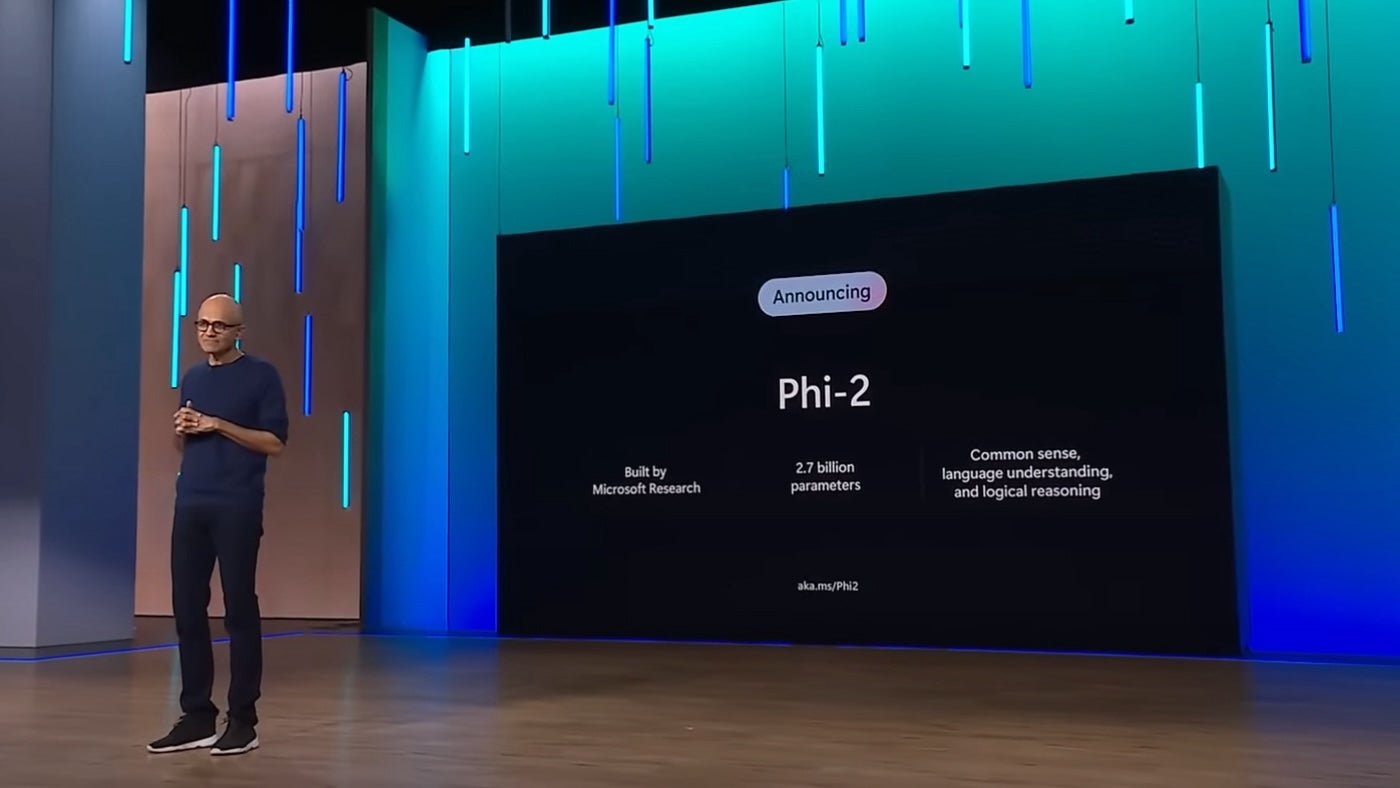
And, Phi-2 is the successor to Phi-1, a 1.3 billion parameter small language model that was released in September 2023. Phi-1 showed impressive performance on the HumanEval and MBPP benchmarks, which grade a model’s ability to code in Python. In November 2023, Microsoft Research released Phi-1.5, which added more common sense reasoning and language understanding to Phi-1. Satya Nadella announced Phi-2 during Microsoft Ignite in November 2023 (Figure A).
Figure A
Satya Nadella announcing Phi-2 at Microsoft Ignite 2023. Image: Microsoft
“With its compact size, Phi-2 is an ideal playground for researchers, including for exploration around mechanistic interpretability, safety improvements or fine-tuning experimentation on a variety of tasks,” Microsoft Senior Researcher Mojan Javaheripi and Microsoft Partner Research Manager Sébastien Bubeck wrote in a blog post on Dec. 12.
SEE: Windows Copilot comes with Windows 11 23H2, but you might not see it by default. Here’s how to find the AI. (TechRepublic)
Phi-2 is outperforming larger language models
Microsoft Research says Phi-2 outperforms Mistral AI’s 7B (7 billion parameter) model and Llama-2 (which has 13 billion parameters) on standard benchmarks like Big Bench Hard and other language, math multi-step reasoning and coding tests. Microsoft Research tested Phi-2 against Google’s recently released Gemini Nano 2 and found that it performed better on the BBH, BoolQ, MBPP and MMLU tests.
How to make a smaller language model work like a large one
Microsoft Research found that smaller models can perform as well as larger ones if certain choices are made during training. One way Microsoft Research makes smaller language models perform as well as large ones is by using “textbook-quality data.”
“Our training data mixture contains synthetic datasets specifically created to teach the model common sense reasoning and general knowledge, including science, daily activities and theory of mind, among others,” Javaheripi and Bubeck wrote. “We further augment our training corpus with carefully selected web data that is filtered based on educational value and content quality.”
Another way to make a smaller language model perform as well as a large one is by scaling up. For example, the research team embedded the knowledge of the 1.3 billion parameter Phi-1.5 model into the 2.7 billion parameter Phi-2 model.
“This scaled knowledge transfer not only accelerates training convergence but shows clear boost in Phi-2 benchmark scores,” wrote Javaheripi and Bubeck.
Note: TechRepublic has reached out for Microsoft for more information.















 About the author: Alex Woodie