In the rapidly evolving landscape of AI, the promise of transformative changes spans across a myriad of fields, from the revolutionary prospects of autonomous vehicles reshaping transportation to the sophisticated use of AI in interpreting complex medical images. The advancement of AI technologies has been nothing short of a digital renaissance, heralding a future brimming with possibilities and advancements.
However, a recent study sheds light on a concerning aspect that has been often overlooked: the increased vulnerability of AI systems to targeted adversarial attacks. This revelation calls into question the robustness of AI applications in critical areas and highlights the need for a deeper understanding of these vulnerabilities.
The Concept of Adversarial Attacks
Adversarial attacks in the realm of AI are a type of cyber threat where attackers deliberately manipulate the input data of an AI system to trick it into making incorrect decisions or classifications. These attacks exploit the inherent weaknesses in the way AI algorithms process and interpret data.
For instance, consider an autonomous vehicle relying on AI to recognize traffic signs. An adversarial attack could be as simple as placing a specially designed sticker on a stop sign, causing the AI to misinterpret it, potentially leading to disastrous consequences. Similarly, in the medical field, a hacker could subtly alter the data fed into an AI system analyzing X-ray images, leading to incorrect diagnoses. These examples underline the critical nature of these vulnerabilities, especially in applications where safety and human lives are at stake.
The Study's Alarming Findings
The study, co-authored by Tianfu Wu, an assoc. professor of electrical and computer engineering at North Carolina State University, delved into the prevalence of these adversarial vulnerabilities, uncovering that they are far more common than previously believed. This revelation is particularly concerning given the increasing integration of AI in critical and everyday technologies.
Wu highlights the gravity of this situation, stating, “Attackers can take advantage of these vulnerabilities to force the AI to interpret the data to be whatever they want. This is incredibly important because if an AI system is not robust against these sorts of attacks, you don't want to put the system into practical use — particularly for applications that can affect human lives.”
QuadAttacK: A Tool for Unmasking Vulnerabilities
In response to these findings, Wu and his team developed QuadAttacK, a pioneering piece of software designed to systematically test deep neural networks for adversarial vulnerabilities. QuadAttacK operates by observing an AI system's response to clean data and learning how it makes decisions. It then manipulates the data to test the AI's vulnerability.
Wu elucidates, “QuadAttacK watches these operations and learns how the AI is making decisions related to the data. This allows QuadAttacK to determine how the data could be manipulated to fool the AI.”
In proof-of-concept testing, QuadAttacK was used to evaluate four widely used neural networks. The results were startling.
“We were surprised to find that all four of these networks were very vulnerable to adversarial attacks,” says Wu, highlighting a critical issue in the field of AI.
These findings serve as a wake-up call to the AI research community and industries reliant on AI technologies. The vulnerabilities uncovered not only pose risks to the current applications but also cast doubt on the future deployment of AI systems in sensitive areas.
A Call to Action for the AI Community
The public availability of QuadAttacK marks a significant step toward broader research and development efforts in securing AI systems. By making this tool accessible, Wu and his team have provided a valuable resource for researchers and developers to identify and address vulnerabilities in their AI systems.
The research team’s findings and the QuadAttacK tool are being presented at the Conference on Neural Information Processing Systems (NeurIPS 2023). The primary author of the paper is Thomas Paniagua, a Ph.D. student at NC State, alongside co-author Ryan Grainger, also a Ph.D. student at the university. This presentation is not just an academic exercise but a call to action for the global AI community to prioritize security in AI development.
As we stand at the crossroads of AI innovation and security, the work of Wu and his collaborators offers both a cautionary tale and a roadmap for a future where AI can be both powerful and secure. The journey ahead is complex but essential for the sustainable integration of AI into the fabric of our digital society.
The team has made QuadAttacK publicly available. You can find it here: https://thomaspaniagua.github.io/quadattack_web/
For tech enthusiasts and developers eager to learn about the latest developments, X (formerly Twitter), the official center for real-time updates, has evolved into a paradise of sorts. As we reveal the top 30 AI-ML influencers of this year, get ready for the ultimate trip into the future. Put on your seatbelts because these digital trailblazers offer exclusive access to the most advanced areas of science and technology, removing all the noise and buzz around AI.
Lex Fridman, @lexfridman
With over 2.2 million followers, Lex Fridman is an AI research scientist who hosts a hugely popular podcast in which he invites influential and prominent guests to discuss a broad range of AI-related topics. He discusses ML and AI on X and regularly updates followers about new podcast events.
Kai-Fu Lee, with over 1.5 million followers, former CEO of Google China, is a prominent figure in the AI world who posts on social media about the latest developments in technology. Being a venture capitalist firm creator also showcases the most exciting AI entrepreneurial ventures. His account also covers significant AI updates.
Marc Andreessen is a well recognized Venture capitalist, software engineer, and entrepreneur with 1.3 Million followers on X. In addition to confounding Netscape, a business that was instrumental in the early development of the internet, he co authored one of the first web browsers, Mosaic. Later on, he helped to build the well-known venture capital company Andreessen Horowitz.
At present, with 871.9K followers, Andrej Karpathy works at OpenAI, having previously served as the lead developer for Tesla Autopilot’s computer vision team. Which includes internal data classification, neural network training, and the science of assembling it all before putting it into production using proprietary inference hardware. Driving is safer and more convenient with Autopilot, even though his team’s ultimate goal is to develop and deploy Full Self-Driving to our rapidly growing fleet of millions of vehicles.
With over 702.7K followers on X, Andrew Ng follows the greatest new ML and AI-related initiatives that are released on Coursera and tweets about the seminars and meetings that are happening right now. He is the founder of Coursera, a frequent participant in business group meetings, and the former chairman of the Baidu AI Group. Dr. Ng is a pioneer in the fields of online training and machine learning, and his AI research has changed the lives of many people. In the fields of robotics, machine learning, and related fields, he has co-authored or published more than 200 scholarly publications. In 2013, he was included in the Time 100 list of the most influential people in the world.
Rowan Cheung founder of the Rundown with 414.5k followers on X is a fast-growing AI weekly whose aim is to inform millions of readers on the most recent developments in AI and how technology is changing the world. Over 120,000 subscribers have signed up for The Rundown in less than three months, relying on its content to keep them informed about developments in the AI industry.
With +369.2K followers on X, Yann LeCun is a professor at New York University, Facebook’s Chief AI Scientist, and a logical voice in science on AI. He retweets news stories that keep you up to date on the newest developments in the field.
Santiago is an applied machine learning specialist in computer science. He has 332.3K Followers on X. Over twenty years of expertise in developing software to address challenging and occasionally fascinating situations have been gained by him. Santigo has a strong commitment to enabling people and organizations to use technology in ways that were previously unattainable to them. He likes uncertainty and is more motivated to work on issues that are beyond the scope of web searches and books. If he can work well with a group of engineers who share his interests, bonus points!
Kirk Borne, an X star you can’t afford to miss, has been guiding the ship of influence since 2013 and has a heavenly following of +274K on X. Kirk not only rides the information waves, but also generates them, spanning across fields such as Astrophysics, Data Science, Machine Learning, Data Mining, and the wide realm of Space Science. Not only is he a global speaker, consultant, researcher, Big Data and Data Science sage, blogger, and researcher, but he’s also the North Star that leads the tech-savvy through the vast expanse of information.
Ronald van Loon, has over 240K fans on X. He champions brainpower superiority in big data, IoT, AI, machine learning, 5G, deep learning, predictive analytics, cloud, edge, and the magical domain of data science, positioning himself as the Gandalf of the digital world. Ranked among the World’s Top 10 Influencers and Thought Leaders, he is the Dumbledore of data-driven, casting magical spells that subdue algorithms.
Erik Brynjolfsson with 207K followers on X, is the Stanford Digital Economic Lab director, which researches enhancing the economy with digital technologies. He is a professor at Stanford and an author of machine learning books.
Antonio Grassothe Commander of the Digital Frontier, who boasts an impressive following of +189K on X. He is on a mission to use the immense power of digital technologies to boost the economy as the daring director of the Stanford Digital Economic Lab. By day a Stanford professor, at night the man behind the machine learning books that turn algorithms into captivating narratives.
Associate Professor Ethan Mollick teaches entrepreneurship, innovation, and the implications of artificial intelligence on education and the workplace at the University of Pennsylvania’s Wharton School and have 187.7K Followers on X. His work has been featured by CNN and The New York Times and published in prestigious business publications. Mollick is also in charge of Wharton Interactive, a project that uses AI and gaming to democratize education.
Jim Fan with 185.1K Followers on X works for NVIDIA AI as a research scientist. Creating broadly capable autonomous agents is my main goal. His research endeavours encompass foundation models, robotics, multimodal learning, policy learning, and large-scale systems to address this immense challenge. Prof. Fei-Fei Li provided me with advice as I completed my doctorate at Stanford Vision Lab. He has previously worked as a research intern at the Mila-Quebec AI Institute, Baidu Silicon Valley AI Lab, OpenAI, NVIDIA, and Google Cloud AI. He was Columbia University’s 2016 valedictorian and the winner of the Illig Medal.
Entrepreneur and product/experience designer Linus Ekenstam with 178.9K Followers on X resides in Barcelona, Spain. He was recently employed at Typeform, where he designed systems and added some humanity to web forms. He has a passion for creating, designing, and building goods from the ground up. He has a range of abilities, including but not limited to product design, product management, UX/UI design, and business development.
Bojan Tunguz is a well-known venture capitalist and entrepreneur with 159.9K followers on X. He has a degree in physics and has experience in a variety of fields, such as technology consulting and scientific research. Additionally, Bojan Tunguz has authored articles about companies, venture capital, and technological developments.
One of the youngest businesspeople in India to secure venture capital funding, Varun Mayya paves the way for everyone who aspires to be successful.He has 144.3K Followers on X. Formerly the founder of JobSpire, he is presently Avalon Labs’ CEO. Avalon Labs’ founder and CEO is Varun Mayya. At the age of 20, he is among the youngest entrepreneurs in India to secure venture capital funding for their firm.
. Gary Marcus with 131K Followers on X is an entrepreneur, academic, and cognitive scientist who specializes in AI. His contributions to the fields of AI ethics, machine learning, and cognitive science are well known. Marcus has influenced conversations on the drawbacks and difficulties of existing AI techniques, arguing that a more integrated and interdisciplinary approach is necessary to create true artificial general intelligence (AGI)
She specializes in innovation, technology, and education as a professor. She has +116K followers on X. She manages companies that deal with AI, cloud computing, industrial IoT, and IoT. She supports environmentally friendly educational initiatives.
A youthful and passionate tech YouTuber, Utsav Techie has amassed more than 5 lakh subscribers on Youtube and 106.5K Followers on X known by his stage moniker Utsav Techie, M. A. Utsav is his true name. More than 1,350 videos have been uploaded to the Utsav Techie YouTube channel, which has received more than 90 million combined views. The collection includes videos with tech backgrounds, including product analysis, tech leaks/rumors, laptops, smartphones, tech news, and how-to videos.
Abacus.AI’s CEO and co-founder is Bindu Reddy. On X, she has 105.9k followers. She was the General Manager for AI Verticals at AWS, AI, prior to founding Abacus.AI. Her company developed and introduced Amazon Personalize and Amazon Forecast, the first AI services of their sort that let businesses quickly build custom deep learning models. Before that, she was the co-founder and CEO of Post Intelligence, a deep-learning startup that Uber bought and provided services for social media influencers. Bindu holds a B.Tech degree from the Indian Institute of Technology, Bombay, and a master’s degree from Dartmouth.
At OpenAI, Logan oversees developer relations and helps developers that use ChatGPT, the API, and DALL-E for their development with 76.4K Followers on X. Outside of OpenAI, Logan teaches Harvard University’s CSCI E-33A Extension School course as a Teaching Fellow and serves as the Lead Developer Community Advocate for the Julia programming language. Logan was the Julia programming language community manager before working at Apple as an applied machine learning engineer, software engineer, and community manager. Logan also serves on the boards of NumFOCUS and DEFNA, having previously served on both boards
Pedro is a prominent computer scientist, professor, and researcher specialising in machine learning and artificial intelligence with 72.4K Followers on X. Domingos is a professor at the University of Washington and is known for his contributions to the field of machine learning, particularly in areas such as data mining, knowledge representation, and computational biology.
A leading expert on artificial intelligence, Allie Miller is both an investor and counsellor with 46.2K Followers on X. Allie used to work at Amazon (AWS) as the Global Head of Machine Learning Business Development for Startups and Venture Capital, where she gave global advice to the best machine learning researchers, entrepreneurs, and investors. She was the company’s first hire and oversaw its growth from 100 employees to a 10-figure AWS enterprise. Before that, Allie was the youngest woman to ever design an artificial intelligence product at IBM, leading product development for thousands of enterprises in the areas of computer vision, communication, data, and regulation.
Co-founder and CEO of Perplexity AI, a business aiming to provide the most reliable information service in the world, is Aravind Srinivas. Additionally, he is active on X where he has 27.9K followers, where he just unveiled a new Perplexity AI editing tool.
In Applied Machine Learning, Vin is employed with 28.6K Followers on X. He has developed and launched products with $100 million+ annual revenue. He is a strategist and engineer. His current area of interest is the monetization of machine learning, which includes pricing and revenue strategies, model reliability, job definition and hiring for roles in research, architecture, and product management, as well as the production process.
With over 70,000 X followers, he is a digital transformation specialist and a director at BCG. He writes about global supply chains, innovation, new business models, and corporate restructuring and reorganization. Over his career, he oversaw a number of prosperous firms.
He is a speaker, a leader in digital transformation with over 36,000 followers on X, and a fintech CTO. He is a researcher and a specialist in using big data analytics, data science, and machine learning for SMEs.
Dr. Pratik Desai has 7,222 Followers on X and he is a computer scientist and entrepreneur with expertise in artificial intelligence, machine learning, and semantic web-based data extraction. Having launched several Silicon Valley firms, he is currently focused on using his startup, Titodi, to deliver AI and ML-based technologies to India’s neglected agriculture market. Titodi, which comes from a farming family, offers farmers and agriculture producers an end-to-end platform with AI and ML-powered tools to improve branding, labelling, marketing, and pricing, which will ultimately increase revenue and profitability.
The post Top 30 AI Influeners to Follow on X in 2023 appeared first on Analytics India Magazine.
The world has gone digital, and there’s no sign it’s slowing down any time soon. As coding becomes an even more essential skill in the workplace, maybe it’s time to stop with the mugs as a holiday gift and give employees something they’ll actually use, like coding courses.
Coding is an invaluable skill that will benefit your employees and your company alike. Each of the following e-learning bundles is on sale from just $20 through Christmas Day only.
The 2023 Complete Python Certification Boot Camp Bundle
This 12-course bundle is beginner-friendly but expands into intermediate and advanced concepts. From the very basics of Python and coding to using Python for machine learning and computer vision projects, this bundle is the ultimate A-Z guide.
Get The 2023 Complete Python Certification Boot Camp Bundle for $19.99 (reg. $84) through 11:59 pm PT on December 25.
The 2023 Premium Learn to Code Certification Bundle
Our best-selling coding bundle goes well beyond Python, and it’s reduced to just $20 through Christmas Day. Rated 4.9/5 stars, this extensive bundle includes 14 courses and does include Python education, but it also takes deep dives into web development, data science, app development and many more key disciplines.
Get The 2023 Premium Learn to Code Certification Bundle for $19.97 (reg. $154) through 11:59 pm PT on December 25.
The 2023 Ultimate AI ChatGPT & Python Programming Bundle
Python is often used in machine learning and artificial intelligence. Learn its AI applications in this bundle as you get familiar with the foundations of what makes the popular chatbot ChatGPT work.
Get The 2023 Ultimate AI ChatGPT & Python Programming Bundle for $29.97 (reg. $154) through 11:59 pm PT on December 25.
Looks like OpenAI’s need journalist’s help to make GPT-4 better. In a surprising move, it recently announced a partnership with the German media house Axel Springer to integrate the latest news from publications such as Politico and Business Insider in ChatGPT.
This partnership also brings additional benefits for Axel Springer. OpenAI will train its models using the data obtained from the news publication, and in return, they will compensate Axel Springer. This is not the first time OpenAI has partnered with a media house, earlier this year, it collaborated with the Associated Press.
Why Germany?
OpenAI does not share a good rapport with the European Union. Interestingly, back in April, Germany had considered banning ChatGPT due to privacy concerns. Now, OpenAI partnering with a German media house might provide them with some respite from government authorities.
In recent events, the EU has passed the EU AI Act, which stipulates that foundation models must comply with specific transparency obligations before being placed on the market. The EU differentiates general-purpose AI models based on risks, and OpenAI falls under the high-risk category. Axel Springer’s partnership would assist OpenAI in demonstrating to EU officials that it has not used stolen data to train its models.
Interestingly, earlier this year, OpenAI lobbied the EU and argued with European officials not to consider its general-purpose AI systems— including GPT-3, the precursor to ChatGPT, and the image generator Dall-E 2— as ‘high risk.
Moreover, during the EU discussion, Germany, France, and Italy were not in favor of imposing the act on open-source companies, and subsequently, they were exempted. Notably, Germany’s AI startup, Aleph Alpha,recently secured an impressive $500 million in a Series B round which is considered one of the European OpenAI competitors.
OpenAI’s Challenge to Grok
Interestingly, this partnership comes at a time when everyone is praising Grok for its capability to have access to real time information through X. Musk recently rolled out Grok to Premium+ subscribers on X , and in a further expansion, xAI is extending Grok to users in India and 46 other countries, including Australia, Canada, Malaysia, New Zealand, and Singapore.
It’s very likely that OpenAI will provide access to real time news only to ChatGPT Plus users, similar to Musk’s approach with Grok. Interestingly, OpenAI has now re-enabled ChatGPT subscriptions which were paused after OpenAI’s Devday due to high surge in traffic.
At the moment, X boasts a larger paid user base compared to ChatGPT Plus. X has roughly around 640K premium users, while, on the other hand, ChatGPT has 180 million users. However, there are no numbers available to comment on how many of them are paid users.
Grok has a huge advantage that it is not dependent on any one particular media house as such and has access to every information users post on it. Recently citizen journalism has gained immense popularity among the masses and Musk has also advocated for it.
Citizen journalism is the path to better future! I strongly encourage people around the world to post news about events as they’re happening, in both text & video. https://t.co/c8PxqinKAm
— Elon Musk (@elonmusk) October 4, 2023
While OpenAI is trained on data available on the internet, offering news from selected media houses could introduce bias into the responses it generates, raising concerns for OpenAI’s safety team.
Patterning with a media company? I don't think that's the right approach to getting "real time" information, nor do I think it won't lead to biased answers. Of course this is dependent on how it's implemented but if it's just information that Chatgpt can use/search from? Gross.
— Jessy Rae Francoeur (@Jessy_Francoeur) December 13, 2023
Despite the drawbacks, with this partnership, ChatGPT might improve in generating accurate information and reduce hallucinations. On X, there is a vast amount of information, but discerning what is correct from what is false can be a tedious task.
A few days ago, a very interesting incident occurred where it was revealed that Grok is also accidentally trained on OpenAI’s data.
Uhhh. Tell me that Grok is literally just ripping OpenAI's code base lol. This is what happened when I tried to get it to modify some malware for a red team engagement. Huge if true. #GrokX pic.twitter.com/4fHOc9TVOz
— Jax Winterbourne (@JaxWinterbourne) December 9, 2023
A user on X shared a screenshot where Grok’s response was based on OpenAI. However, xAI’s engineer, Igor Babuschkin, soon clarified the situation, and said, “The issue here is that the web is full of ChatGPT outputs, so we accidentally picked up some of them when we trained Grok on a large amount of web data.”
Though Grok currently has an advantage over OpenAI in providing real-time information, this can be considered OpenAI’s attempt to get back at them.
The post Why OpenAI Partnered With Axel Springer appeared first on Analytics India Magazine.
If you want to make a career in data science or software engineering, Python is a great first language to learn. So where do you start?
To help you decide, we’ve compiled a list of Python Programming courses—taught at some of the best universities from around the world. Which you can take for free and learn to code from the comfort of your home.
Most of these courses assume no prior programming experience. And teach you both programming and computer science fundamentals. So you can take the first steps—towards a career switch or pivot by learning Python—even if you’ve never programmed before.
Let’s begin!
1. Introduction to Programming with Python — Harvard
CS50’s Introduction to Programming with Python or CS50 Python is a beginner-friendly course targeting learners who want to learn Python—even if they don’t have prior programming experience.
You can access the lectures, lecture notes, and problem sets on the course website. Over the course of ten weeks, this course takes you from an absolute beginner to someone who is fluent enough to code applications in Python.
The course covers the following:
Functions and variables
Conditionals
Loops
Exceptions
Libraries
Unit tests
File I/O
Regular expressions
Object-oriented programming
Python best practices
Course link: CS50’s Introduction to Programming with Python
2. Python for Everybody — University of Michigan
Python for Everybody is a highly recommended Python course. The course is taught by Dr. Charles Severance at the University of Michigan.
If you want to quickly get up to speed on the features of Python and start working with different types of data and applications such as web scraping and working with databases, this course is for you.
Here’s an overview of what you’ll learn:
Basics of Python
Python data structures
File I/O operations
Regular expressions
Network programming
Introduction to OOP
Using web services with Python
Working with databases in Python
Data visualization
Course link: Python for Everybody
3. Introduction to Computer Science and Programming with Python — MIT
Introduction to Computer Science and Programming with Python from MIT teaches you computer science fundamentals using Python. This course does not assume any prerequisite knowledge in programming and computer science.
It aims to introduce the fundamentals of computation and programming even to those majoring in fields other than computer science. Over the course of twelve lectures, you get to learn both the principles of programming and the basics of Python.
Here are some of the topics that this course covers:
Basics of computation
Branching and iteration
String manipulation, approximation, bisection etc.
Decomposition, abstraction and functions
Tuples, lists and related concepts
Recursion and dictionaries
Testing and debugging
Object-oriented programming
Program efficiency
Searching and sorting
Course link: Introduction to Computer Science and Programming with Python
4. Programming Methodology — Stanford
CS106A: Programming Methodology taught at Stanford is another comprehensive course to learn the basics of Python programming. This course also assumes no prior Python Programming experience, and is aimed at teaching beginners how to program in Python.
If you’re interested in learning problem solving with Python, this course is for you. There are a good number of assignments in this course and working through them will help you apply what you have learned.
The course covers the following topics:
Variables and control flow
Lists and images
Lists of lists and strings
File reading
Nested structures
Dictionaries and drawing
Sorting
Object-oriented programming
Memory management
Course link: Programming Methodology
5. Principles of Computation with Python — CMU
Carnegie Mellon University (CMU), through their open learning initiative, offers a free Principles of Computation with Python course. Which introduces you to both Python and the fundamental principles of computing.
You’ll learn about topics such as iteration and recursion. In addition, you’ll learn about core computer science topics such as cellular automata, encryption, and limits of computation.
Here is an overview of the topics covered:
Programming with Python
Iterative processes
Recursive thinking
Binary representation of data and instructions
Cellular automata
Encryption methods
Limits of computability
Course link: Introduction to Computation with Python
Wrapping Up
I hope you found some helpful resources to learn Python. You don't have to take all of these courses to become proficient in Python programming.
Some of you may be looking to learn the features of the language and use it for tasks such as web scraping, working with databases, and the like. While some others may be interested in a head-first approach to problem solving and coding up algorithms in Python.
So depending on your learning goals, you can choose one or more of these courses that you think are the best fit for you. Happy learning!
Bala Priya C is a developer and technical writer from India. She likes working at the intersection of math, programming, data science, and content creation. Her areas of interest and expertise include DevOps, data science, and natural language processing. She enjoys reading, writing, coding, and coffee! Currently, she's working on learning and sharing her knowledge with the developer community by authoring tutorials, how-to guides, opinion pieces, and more.
More On This Topic
5 Free University Courses on Data Analytics
Learn Probability in Computer Science with Stanford University for FREE
KDnuggets News, May 4: 9 Free Harvard Courses to Learn Data…
6 Best Free Online Courses to Learn Python and Boost Your Career
Recently, Nithin Kamath, founder and CEO of Zerodha, posted on LinkedIn a video of him talking about the risk of deep fakes in the financial industry. He highlighted how deep fake is improving and soon, it would become harder for people to figure out if a person online is real or AI-generated.
Surprisingly, the video in which Kamath was explaining this was also a deep fake, which was very hard to differentiate.
This problem will be bigger for banks that have more stringent regulatory requirements during onboarding. The turning point for Indian financial services occurred when onboarding went fully digital, thanks to Aadhaar and similar technologies. When bringing in a new customer, a crucial aspect is ensuring the authenticity of documents and the person opening the account.
Currently, the standard procedure involves retrieving ID or address proof data from sources like Digilocker or Aadhaar. Additionally, facial matching is conducted via a webcam to verify the identity of the person opening the account. Various checks are in place to confirm liveliness and authenticity.
However, with the improvement of deepfake technology, it is expected to become increasingly challenging over time to validate whether the individual on the other end is real or artificially generated. This challenge will be more pronounced for banks with stricter regulatory requirements during the onboarding process.
Enter World ID 2.0
Sam Altman-backed WorldCoin has introduced World ID 2.0, a digital passport for the online realm that is a unique human identity. It empowers humans to validate your unique human identity on the internet while safeguarding your privacy. Crafted as an open protocol, it is designed to be a collective ownership, granting users full control.
Initially introduced in early 2023, World ID 1.0 addressed the imperative challenge of establishing personhood proof in the age of AI, prioritising privacy, inclusivity, and openness.
The second release will introduce Apps for integrations to verify online accounts using World ID, including integrations with major platforms such as Reddit, Discord, Shopify, Minecraft, and Telegram. In this upgrade, World ID will feature three Levels, World ID Device, World ID Orb, and World ID Orb+, allowing tailored verification checks, ensuring adaptability to real-world use cases.
Interestingly, World ID 2.0 might be able to solve these problems with deep fake. Just like other platforms, World ID can be introduced within government apps and services such as Digilocker or within banking to ensure more security, further protecting people’s identities.
Moreover, the second-generation protocol boasts core enhancements, like the ability to reset your World ID at an Orb and solidifying its status as the most secure, private, and inclusive proof of personhood. For added privacy, World ID Apps access only a disposable number derived from your World ID, ensuring a consistent yet unlinkable experience across different platforms.
Though this comes with hackable instances on apps other than the Orb, the possibility is still imaginable.
Concerns with World ID
Although it may appear logical in certain aspects, the extensive risk to personal freedoms and the potential for government abuse are substantial, even while considering World ID as a solution. Do we really want the government to have real-time access to our web browsing?
Analogous to how government-backed digital currency, which is different from blockchain-based cryptocurrency, empowers authorities to monitor and document each of your online financial transactions, digital ID poses a similar capability, scrutinising every click you execute online. Moreover, WorldCoin has already said that it is giving governments the permission to use its ID system.
The parallel with digital currency is evident, as it affords authorities the capability to meticulously track and record every online financial transaction. Similarly, the implementation of digital ID raises valid concerns about the government’s access to real-time information on every online interaction, which was already made possible with UPI.
It becomes paramount to deliberate on the trade-offs between enhanced security and the preservation of personal freedoms. World ID 2.0 acknowledges the need for this delicate balance, aspiring to offer a secure, private, and inclusive proof of humanity while respecting the rights and privacy of individuals, emboldening the solution for deep fake along with it.
The post World ID 2.0 is the Solution for a lot of Deep Fake Scams appeared first on Analytics India Magazine.
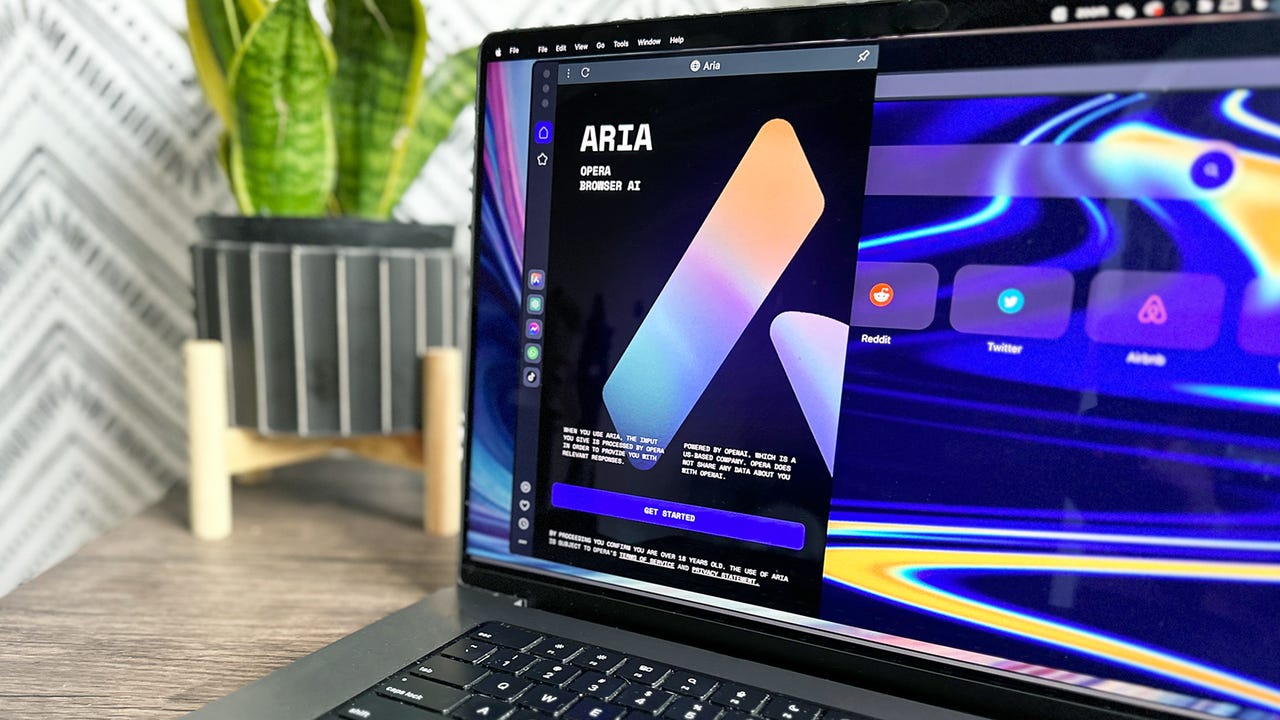
Aria is always accessible on the built-in sidebar to the left.
Opera's Aria simplifies the use of artifical intelligence (AI) within the browser. Because of this simplification, you can use Aria as your go-to research tool, and avoid the likes of Google for searching.
I've been using Aria as a research tool when writing novels. But one thing I've discovered is that I often have to go back to one or more chats I've had with Aria. For example, when naming characters for a new book series, I've combined the first and last names of different classical composers to come up with character names.
Also: Meet Aria: Opera's new built-in generative AI assistant
The key issue is that I have to run the same chat every time I need to create a new character name. When you type the prompt, List 100 classical composer names, it can take Aria a few seconds to generate the list. It would be nice if I could keep a reference to that list, without having to copy and paste it into yet another document that's either open or in another a tab.
I like to work more efficiently. And thanks to Opera's Pinboard features, it didn't take me long to come up with a workflow to meet that need.
Also: How to use Opera's built-in AI chatbot (and why you should)
Essentially, you create a Pinboard for a certain category (for example, Aria Chats or Book Research), and then you pin the Aria chat to the Pinboard. Then, when you need to reference the chat later, you simply open the Pinboard, click on the pinned chat, and you're done.
But how do you do create this workflow? Let me show you.
How to save an Aria Chat to a Pinboard
What you'll need: The only thing you'll need is an up-to-date version of the Opera browser that is connected to a free Opera account (because you have to connect the browser to your account to use Aria). Both Aria and Pinboard are available for the Linux, MacOS, and Windows versions of the browser.
You can create as many Pinboards as you need.
My chat of 100 classical composer names is ready to be pinned.
Saving my list of composer names to a Pinboard.
This is a great way to retain information you've received from an Aria AI chat. Instead of having to re-run the same chats over and over, just save them to a Pinboard and you're good to go.
Embarking on a cinematic journey in 2023 is no longer confined to traditional editing methods. Enter the era of innovation, where artificial intelligence is at the forefront, reshaping the landscape of video editing. Unveiling a suite of cutting-edge tools, we explore the top AI editing solutions poised to redefine the way filmmakers craft and perfect their visual narratives.
From streamlined workflows to unparalleled efficiency, discover the transformative potential that these tools bring to the creative realm, ushering in a new era of cinematic brilliance.
Here are the top 5 video generating tools which are widely used and appreciated:
The software algorithm for Synthesia mimics speech and facial movements based on video recordings of an individual’s speech and phoneme pronunciation. This results in the creation of a text-to-speech video that looks and sounds like the individual.
The platform allows users to create content using pre-generated AI presenters or by creating digital representations of themselves, called artificial reality identities (ARI), using the platform’s AI generation tool. These avatars can be used to narrate videos generated from text.
The new features which are making a difference are-
All creator and enterprise plan users can now download the audio from any videos in “.wav” format.
The videos can now be translated into 29 languages within seconds.
The guest role feature allows enterprise accounts to invite guests to Synthesia for a seamless collaboration.
New precision zoom feature.
The video analytics feature kicks in when a new video is uploaded to Synthesia, recording analytics for every view.
Live video aspect ratio while the video is running.
New avatars – Captain Ace & Luna – are now available with the new update.
Gesture preview will now allow the users to check the gestures and the postures they are in before going live.
Pika had an ambitious goal of simplifying video production, and as a result, they developed Pika 1.0. This new platform is equipped with a generative AI model that can edit videos in various styles, such as “3D animation”, “anime”, and “cinematic”.
Pika 1.0 is a groundbreaking tool that can extend video length, transform styles, and even edit content using AI. This means that it can alter clothing or add characters to the video. The platform has recently emerged from stealth mode, and it is already making waves in the video production industry.
The new features are:
Its ‘video to video’ feature transforms videos into different styles using a text prompt.
Uses generative AI to expand video canvas seamlessly, ensuring optimal display across formats.
Generative fill editing tools allow for object replacement within a scene based on user prompts. This feature holds promising implications for product advertisements.
CGI animation with lifelike expressions, nuanced lighting, and identifiable celebrities.
Users can now extend clip lengths beyond the previous 3-second limit, addressing a major concern.
Runway ML is a sophisticated AI system that can create unique videos by using text, images or video clips. On November 2, 2023, Runway announced on X that Gen-2 has been upgraded. While it is not marked as a new major version (which will be Runway Gen-3), it brings significant improvements to both text-to-video and image-to-video algorithms, which will enhance the quality of the generated videos.
The new features are:
The new Motion brush works with image prompts which will turn an image into an animated version of that image.
Exclusive to Gen-2, now you can synthesize new videos in any style using nothing but a text prompt.
Generate a video in the style of an image you provide alongside a text prompt.
Content-guided video synthesis using just an input image.
Transfer the style of any image or prompt to every frame of your video.
Turn mockups into fully stylized and animated renders.
Isolate subjects in your video and modify them with simple text prompts.
Turn untextured renders into realistic outputs by applying an input image or prompt.
Unleash the full power of Gen-2 by customizing the model for even higher fidelity results.
Rephrase.ai is a Bengaluru-based startup that creates AI-powered videos for businesses worldwide. Their deep tech generative AI creates personalized, professional-quality videos to humanize communication. With their cutting-edge AI technology, they’ve helped leading businesses create award-winning campaigns.
In 2023, Adobe acquired Rephrase.ai, allowing them to integrate Rephrase’s technology with Creative Cloud, enhancing their video-editing platform.
Some of the improved features are:
Rephrase.ai offers a diverse selection of pre-made avatars, now including more than 50 AI avatars representing different ethnicities.
The tool offers versatile business and casual avatar styles.
It supports over 100 languages with local accents, enabling users to create videos in different languages.
The tool ensures the best lip sync across the board, providing near-perfect synchronization.
Users can upload their custom media, such as images or animations, to personalize their videos and enhance the visual appeal.
The tool supports multiple aspect ratios, making it easy to create videos for different platforms.
It allows users to instantly turn PowerPoint presentations into human video presentations.
Stable Video Diffusion by Stability.AI
Stable Video Diffusion is a video diffusion model that uses latent variables to create high-quality videos from text and images created by Stability AI, which delivers open-access AI models with minimal resource requirements in imaging, language, code and audio.
Researchers have recently adapted these models, which were initially designed to generate 2D images, to generate videos. This was achieved by adding temporal layers and fine-tuning the models on small, high-quality video datasets.
Some of its unique features are:
It uses latent diffusion models with temporal layers and fine-tuning on video datasets.
This model can be fine-tuned on specific multi-view datasets to enhance its capability of multi-view synthesis from single images.
A new web experience that will feature text-to-video interface showcases Stable Video Diffusion in advertising, education & entertainment. It’s waitlisted for early access.
It has two models that create videos with 14-25 frames. The frame rates range from 3-30 frames per second.
These models are highly competitive and may outperform some leading models.
The post Top 5 AI Video Generating Tools that Made Production Seamless in 2023 appeared first on Analytics India Magazine.
With a number of AI wearables announced this year, one category that witnessed a surge of releases and caught our eyes was smart glasses. Several big tech companies have unveiled their lineup of smart glasses, with some of them incorporating AI features.
Meta created a buzz a few months ago with the announcement of their new version of their Ray-Ban Meta smart glasses, followed by other big tech companies which did not want to be left behind. Here are some of the biggest tech eyewear releases in 2023.
Meta Ray Ban Smart Glasses
Mark Zuckerberg revealed the latest Ray Ban Meta Smart Glasses during the Meta Connect event in October, this year. This announcement comes two years after the launch of the initial Ray Ban Stories, which lacked the advanced features present in the newly introduced glasses. With the smart glasses, one can take calls, play music, capture photos, videos and even live stream them. Furthermore, the multimodal featured glasses will have Meta AI integrated.
Amazon Echo Frames 3rd Gen
Amazon Echo Frames are eyewear that allows users to interact via Amazon’s flagship voice assistant, Alexa. In October, the company announced the latest version of these smart glasses capable of running a myriad of tasks, including playing music, hands-free communication, and controlling the smart home via Alexa.
Jio Smart Glasses
Reliance Jio presented its MR glasses, known as Jio Glass a few months ago. These glasses utilise mixed reality (MR), combining augmented reality and virtual reality. The glasses can be connected to the smartphones via a USB-C cable and features a virtual display of up to 100 inches. The company is set to launch two versions of the glasses to cater to consumers and enterprises.
Huawei Eyewear 2
The Huawei Eyewear 2 smart glasses were unveiled in October in Barcelona. These wearables are equipped with built-in speakers, enabling users to enjoy music and make voice calls. In contrast to the initial Huawei Eyewear, the updated model boasts extended battery life, faster charging, and features a lightweight titanium frame. The previous version was released in 2021.
Lenovo Legion Glasses
Legion Glasses, released in October, are primarily designed as accessories for Lenovo’s Legion Go Windows gaming handheld. However, they are also compatible with any device capable of displaying content via USB-C, including Windows, Mac, and Android devices. They function as wearable displays rather than AR glasses and include features such as Micro-OLED displays and Lenovo’s venture into the consumer glasses market.
Xreal Air2 Smart Glasses
Xreal Air2, is a screen-reflecting smart glass that emulates a high-definition screen from ten feet away. These AR glasses are compatible with various devices and offer a portable 330-inch screen. With an additional accessory, users can anchor the virtual screen anywhere in their surroundings. Xreal also offers custom prescription lens insert for users who wear glasses.
The post 6 Uber-Cool Smart Glass Launches by Big Tech Companies appeared first on Analytics India Magazine.
Google recently launched its second generation of text-to-image generator model, Imagen2, with quiet upgradation in image quality and innovative capabilities that make it stand out from DALL.E 2
Compared to the former version, Imagen 2 sets itself apart by rendering text in multiple languages, aligning it with leading image-generating models, and allowing users to effortlessly overlay logos onto products, clothing, business cards, and more, expanding creative possibilities for businesses and artists alike.
Meet Imagen 2: our most advanced text-to-image diffusion technology. It features high-quality, photorealistic outputs and stronger consistency with your prompts. Now available to use via @GoogleCloud’s #VertexAI platform. → https://t.co/T1IIJMbIW9 pic.twitter.com/iWIzi2jgZH
— Google DeepMind (@GoogleDeepMind) December 13, 2023
Powered by innovative training and modeling techniques, Imagen 2 is enhancing its ability to understand detailed, long-form prompts. It allows the model to provide intricate responses to questions about elements in an image, ushering in a new era of interactive and nuanced AI-generated content.
Although Imagen demonstrated significantly superior performance to DALL.E 2, Imagen 2 has outstated this with its text-to-image capabilities. With superior photorealism, seamless text integration, and accessibility through Google Cloud’s Vertex AI, Imagen 2 offers finer control and advanced functionality. Its focus on high-quality, realistic outputs makes it the preferred choice for those seeking top-tier performance in text-driven image generation.
Everything You Need to Know About Imagen 2
Irrespective of just an AI model, it is bridging creativity and technology with its unparalleled capabilities in text-to-image creation, multilingual proficiency, and watermark technology by Google DeepMind’s SynthID. Since safety is a top priority, it has built-in precautions like digital watermarking to align with Google’s Responsible AI principles.
Snap, Shutterstock, and even Canva are backing up with Imagen to enhance creativity and streamline design processes. Snap’s AI Camera Mode, Shutterstock’s ethically sourced AI image generator, and Canva’s seamless integration with Imagen are just a glimpse into the transformative impact of this technology.
As Imagen 2 has taken center stage, generative AI is witnessing a revolution. From empowering artists and designers to providing scalable solutions for businesses, Imagen 2 is set to become a cornerstone in the future of image creation. With its innovative features and success stories from industry leaders, Imagen 2 is not just an upgrade—it’s a game-changer.
The post Google launches Imagen 2, better than DALL.E 2 appeared first on Analytics India Magazine.